
The Establishment of Shi‘i Courts in Awadh
The Usuli ulama, for all their privileged position and new wealth, lacked official control over Awadh law. To move into such judicial posts required a degree of integration into the institutions of the secular government which the Indian Usulis had thus far avoided. It would also give the mujtahids a much more powerful tool for shaping Awadh society in accordance with their interpretations of Islamic law in its Imami form. The coincidence of ambitious Usuli ulama at the head of the religious establishment and cooperative Awadh monarchs guaranteed both the willingness of the government to appoint Shi‘i judges and the willingness of the jurisprudents to plunge into the mire of positive law.
Mughal traditions proved tenacious in Awadh, partially because the Nawabs, for all their Iranian and Safavid symbols, had themselves been integrated into the Mughal heritage. Even when the Nishapuri rulers declared themselves kings, Awadh administration proceeded along Mughal lines. Many Mughal land and service grants continued in force, and what was most remarkable, the judicial system remained in the hands of Hanafi Sunnis. As was shown above, even in the first decade of the nineteenth century Sacadat ‘Ali Khan proposed that a Shi‘i judiciary be established. The Usuli ulama, who did not trust him and did not wish to compromise their integrity any further, rebuffed him.
The Farangi-Mahall family filled most judicial posts. Lucknow and Faizabad had urban criminal and civil courts (divani ‘adalat ), and major govern-
ment offices employed jurisconsults. Hereditary village qazis had jurisdiction over their parganah. Large landholders and government-appointed revenue collectors and governors (fawjdars ) also dispensed justice according to customary law; In Faizabad Hafizu'llah Farangi-Mahalli headed the civil and criminal courts, with his relative Nicmatu'llah serving as a mufti. In Lucknow Muhammad Yusuf Farangi-Mahalli (d. 1870) succeeded his father as mufti on the civil and criminal court at Rs. 200 per month, holding the post until Vajid ‘Ali Shah's deposition. Sunnis from outside Lucknow filled some judicial posts. Mufti Sacdu'llah Moradabadi (1804-77) studied in Rampur and Delhi, arriving in Lucknow in 1827 for further schooling at Farangi Mahall. He taught at the royal seminary, then became mufti for the office of the chief municipal authority (kotwal ) in Lucknow.[38]
With the accession of wealth, power, and prestige to the Shi‘i high ulama in the 1840s, they now made a bid to control the Islamic-law judicial system, a traditional outlet for the talents of Muslim learned men. Mufti Sayyid Muhammad Quli Kinturi, who retired to Lucknow from a post in the British court at Meerut in 1841, strongly advocated this step. While in Meerut he wrote a work urging the king to institute a Shi‘i legal system. He published it in 1843, dedicating it to Amjad ‘Ali Shah, to whom he referred as "the exemplar of [the phrase] 'the just king'" (misdaq as-sultanal-‘adil ). He said he wrote the work to refute Sunni taunts that Shi'is were incapable of being qazis and muftis, and to encourage the Awadh government to take up the torch of the Buyid, Safavid, and Qutb-Shahi states in promoting Shi‘ism and honoring the Shi‘i ulama. He insisted that it was forbidden for non-Shi‘is to be court judges, admonishing the king to appoint only Imami jurisprudents to such posts. He explained tile difference between a qazi (who makes specific judgments in disputes between parties) and a mufti (who gives general pronouncements in elucidation of the law), arguing that only qualified mujtahids should be appointed to either post.[39]
Kinturi therefore endeavored to exclude laymen and Akhbaris from judicial posts, as well as Sunnis. He had, however, to answer the charges of those Indian Shi‘is who insisted that only the ulama in Iran and the Arab lands held the status of mujtahid, there being no mujtahids in India. On the
[38] For Hafizu'llah, see Rahman ‘Ali, Tazkirah-'i‘ulama-yiHind (Lucknow: Naval Kishor, 1914), pp. 51, 243; ‘Abdu'l-Bari Farangi-Mahalli, Atharal-awwal min ‘ulama ' FaranjiMahall (Lucknow, 1321/1903), pp. 13, 31; for Muhammad Yusuf, see R. ‘Ali, Tazkirah-'i , ‘ulama , pp. 220-21; ‘Abdul-Bari Farangih Mahalli, Atharal-awwal , p. 34; Mawlavi Muhammad Yusuf to Chief Comm., Oudh, 7 May 1860, Board of Revenue, Lucknow File 357; for Sacdu'llah, see R. ‘Ali, Tazkirah-'i‘ulama , pp. 74-75. The judicial posts held by the Farangi-Mahallis under the Nishapuris of Awadh suggest that they had rather closer ties to the government than they later admitted; see Francis C. R. Robinson, "The cUlama ' of Farangi Mahall and their Adab ," in Moral Conduct and Authority , ed. Barbara Daly Metcalf (Berkeley and Los Angeles, Univ. of California Press, 1984), pp 172-76
[39] S. Muhammad Quli Kinturi, Ahkam-i‘adalat-i ‘alaviyyah (Lucknow: Matbac-i Sultani, 1259/1843), pp. 3, 34, 58-59.
contrary, he asserted, rulings in accordance with Imami Shi‘ism could be implemented in Awadh insofar as the ulama there had met all the classical requirements of independent judicial reasoning (ijtihad ).[40]
Lay Shi‘is had for long made the leading mujtahids arbitrators in their disputes.[41] In establishing a Shi‘i court system Amjad ‘Ali Shah formalized, again, an informal arrangement. He appointed Sayyids Muhammad and Husayn Nasirabadi jointly to head a supreme appeals court that would oversee all Islamic-law courts. Sayyid Muhammad made his eldest surviving son, Sayyid Muhammad Baqir Munsifu'd-Dawlah (d. 1859), chief justice (daroghah ) of the Lucknow civil and criminal court (divani‘adalat ), retaining the Farangi-Mahall jurisconsults in a subordinate position (a compromise falling short of Kinturi's all-Shi‘i ideal). Sayyid Muhammad Baqir received Rs 500 per month in formal salary, but a British investigation concluded that "the incumbent receives much more than 500 from many sources."[42]
The government created an entirely new system of Islamic-law courts in the provinces, called the fawjdari‘adalat . It appointed Twelver Shi‘i jurisconsults, one for each district in Awadh, to be attached to the office of the district's governor and revenue collector. Sayyid Muhammad Baqir likewise headed up this new branch of the judiciary. His younger brother Sayyid Murtaza (d. 1859) presided over a subordinate Sadr as-sudur court that handled cases at the local level. The chief mufti, or jurisconsult (sadrifla '), over all the provincial courts was Sayyid Hadi Nasirabadi (1813-58), a nephew of Sayyid Muhammad, the chief mujtahid.[43] As might be expected, Sayyid Muhammad bestowed the less desirable but still powerful jurisconsular posts in the provinces, not on members of the Nasirabadi family, but on their younger disciples, often themselves from outside Lucknow. They included two clerics from a British-ruled province just north of Awadh, as well as muftis from small towns in Awadh proper.[44] A member of the Nasirabadi clan still based in that village became jurisconsult for his area.
The creation of the Shi‘i judicial system, like the seminary, provided employment for the emerging third generation of Usuli ulama, who found job opportunities in traditional fields like prayer leading to be limited. The king considered Sayyid Muhammad ‘Abbas Shushtari for a post as the prayer
[40] Ibid, pp 59-60
[41] Kashmiri, NujumT 1 252
[42] Enclosure 67A, no. 3, with See Chief Comm, Oudh, to See Govt. India, 5 Jan 1857 For S. Muhammad Baqir, see Kashmiri, NujumT 179-80 For the new judicial system, see ibid., 1 254-55, 269; Lalji, "Sultan al-hikayat," foil 82a, 104b; Wajid ‘Ali Shah, Reply to the Charges against the King of Oude (Calcutta Enghshman Press [1856]), pp 39-42.
[43] For S. Muitaza Nasirabadi, see Kashmiri, NujumT 1·180-86, for S Hadi, see ibid., 1:175-79, S Hadi dedicated his scholarlv career to polemics with Christianity, of which he wrote a number, and a defense of Usuli scholasticism against Protestant pietism.
[44] E g., Zamin ‘Ali Badoli and Hafiz Anwar ‘Ali Thanabauni, both fiom Muzaffarnagar to the north of Awadh, Javad ‘Ali Bhihravi from just south of Rai Bareli, and S. Muhammad Zaydpuri. See Nauganavi, Tazkirah , pp. 15-16, 110-11, 196, and Kashmiri, NujumT . 1:469.
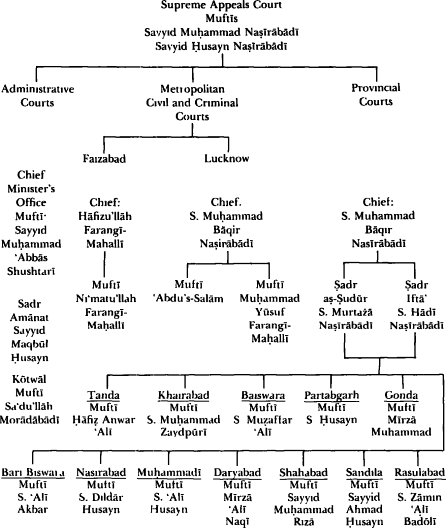
Diagram 4
The Awadh Judiciary (circa 1855)
leader at the new cathedral mosque built in the 1840s, but protocol required him to retain Sayyid Muhammad Nasirabadi. As compensation, he made Shushtari, then teaching at the seminary, jurisconsult of the chief minister's office. He received a substantial increase in income, but said he was reluctant to accept the post because of the interference of government officials, the enmity of those he ruled against, the dishonesty of the attorneys, and the greed of court officials. Once when a plaintiff offered him a bribe, Shushtari re-
portedly broke into tears at this affront to the holy Law.[45] Those tears expressed the contradiction between the original sectarian ideology of Imami Shi‘ism on the one hand, hostile to the secular world in the absence of the divinely-guided Imam, and on the other the Usuli ideology of collaboration with any state that was willing, and involvement in positive law and practical administration.
The Usuli clerics advanced in the 1840s on the last major front in their battle for monopoly over important religious posts, that of the Islamic-law judiciary. They vigorously practiced exclusionary closure, hoping to displace the Sunni magistrates completely by arguing that only an Usuli mujtahid could legitimately give legal rulings as magistrate or jurisconsult. They also argued against Iranian competitors that Indian Usulis were perfectly competent to derive legal rulings. A Shi‘i judicial system also allowed the Usuli ulama to impose many of their conceptions of proper behavior, property, and family relations, and relative rights of various social groups and religious communities on sections of Awadh society. The appointment of the provincial jurisconsults even tenuously extended the writ of Usuli law into the interior of Awadh, a new and significant development. Of course, the Shi‘i judges had relatively little influence on Awadh society as a whole, since most persons handled their legal matters informally or, in the countryside, went before tacalluqdar landholders. Still, sometimes Shi‘i judges could play pivotal roles, as will be shown in chapter 10.