
Alliances and the Firm's Institutional Environment
From the Japanese firm's point of view, trade takes place within a set of ordered environments that can be dimensionalized along a continuum from "relational" to "transactional" exchange, as seen in Figure 3.2. Legal theorist Ian Macneil (1978) has characterized transactional exchange as the sine qua non of impersonal market exchange: "A transaction is an event sensibly viewable separately from events preceding and following it, indeed from other events accompanying it temporally- one engaging only small segments of the total personal beings of the participants " (p. 893). It is a one-time, arm's-length exchange among anonymous or otherwise unrelated traders, requiring neither structural nor symbolic connection between the parties. In relational exchange, in contrast, actors rely on various forms of implicit assumptions and agreements to organize their relationships: "The fiction of discreteness is fully displaced as the relation takes on the properties of 'a minisociety' with a vast array of norms beyond those centered on the exchange and its immediate processes" (p. 901).
Trade within the firm, at the center of Figure 3.2, is marked by a high degree of relational exchange: actors are embedded in a common arena governed by structurally interlinked resource flows and by a common set of rules and rituals that constitute the firm as a social system. The relationship among organizational members as a whole takes precedence over that of any single transaction. The first ring demarcates the firm's boundaries, and immediately outside of it lies the firm's first-order environment. At the interfirm level, probably the most critical relationship is that between the company and its suppliers. The dose ties that exist among Japanese firms and the subcontractors in their vertical keiretsu are an often-noted feature of the organization of industry in Japan (e.g., Clark, 1979). As suggested earlier, these subcontractors perform many of the functions typically carried out in-house by U.S. firms through their own divisions. Within the vertical keiretsu, exchange between the parent and satellite firms is embedded in a dense network of ongoing relationships, as various forms of information, technical and financial assistance, and managerial expertise are provided on a reciprocity basis.
The parent firm, and by extension its satellites, are in turn embedded in a broader set of relationships defined by the intermarket keiretsu. This second-order environment comprises more loosely coupled relationships among dozens of firms in diverse industries. Internal exchange is gener-
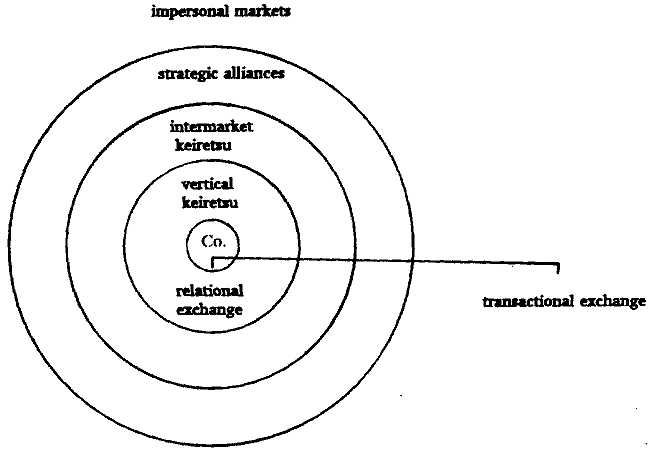
Fig. 3.2. Alliance Form and the Japanese Firm's Institutional Environment.
ally less pervasive than at the firm or vertical keiretsu level, but the identity of the group nevertheless imparts structural and symbolic significance to these exchanges. Strategic groupings represent a third-order environment. These involve exchanges more intimate and durable than those in impersonal markets, but generally without the history, symbolic coherence, or density of exchange networks found in the vertical or intermarket keiretsu. Finally, at the outer level one finds impersonal exchanges among actors that are relatively unconnected structurally or symbolically-for example, a firm's occasional purchases of office supplies from a large number of different retailers. These are "true" market transactions, without intensive ties or enduring obligations.