
Middle-Altitude Mountain Agropastoralism
The middle-altitude agropastoral strategy combines transhumant tending of cattle, water buffalo, sheep and goats with permanent agriculture that is often carried out at multialtitudinal sites. The main focus of crop production is found in the main villages that tend to be located between 1,000 and 2,500 meters. Here terraces are carefully maintained for the cultivation of rice, maize, millet, buckwheat, mustard, vegetables, and winter wheat. Much effort is put into irrigating fields for rice production, and farmers are familiar with techniques of manuring, intercropping, double and relay cropping, and crop rotation. Surrounding forest and woodland areas supply grazing, fodder, and forest-floor litter for fertilizer as well as furnishing fuel wood and lumber. In summer those households that own substantial numbers of cattle and water buffalo often take them up to the rich pastures between 2,500 and 3,000 meters (this is sometimes handled by a single household member or hired herder rather than by the entire family) and sheep and goats may be taken as high as 5,000 meters (again often by specialists). During these weeks herders may live in simple, movable, bamboo shelters, as is common in Nepal, or more substantial herding huts such as are common in the Indian Himalaya west of Nepal (Pant 1935; Berreman 1963a ). Summer herding bases sometimes provide a secondary crop-production site for the cultivation of potatoes and hardy grains such as buckwheat, wheat, and barley. In autumn livestock are led down to the main villages where they graze on field stubble and leave behind manure for the next round of field preparation. In winter the herds may be taken still farther down the valley, where herders again base in temporary shelters or herding huts.[15]
Middle-altitude agropastoral peoples often also participate in complex regional interaltitudinal and trans-Himalayan trade networks. This trade brings the people of the lower-altitude regions salt, wool, seed potatoes, and other valued products from the high valleys and Tibet in exchange for agricultural surpluses grown in the midlands. Mid-altitude-grown grains, especially rice, maize, wheat, and millet, are traded to higher-altitude regions along with some meat, dairy products, and fruits and vegetables. Much of this trade is carried out by high-altitude people who journey down valley in winter and who may make trans-Himalayan spring and autumn trade trips to Tibet. Some middle-altitude groups, however, transport their own agricultural surpluses into higher regions during the late autumn and winter and some middle-altitude farmers also trade agricultural products they have obtained from other middle-and low-altitude areas.
Figures 2 and 3 illustrate the geographic and altitudinal seasonal land-
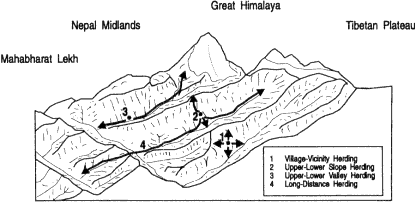
Figure 2.
Middle-Altitude Agropastoralism, Geographic Patterns (Base drawing
adapted from Metz 1989)
use patterns associated with the middle-altitude mountain agropastoral strategy. In them I distinguish four different patterns of seasonal altitudinal and geographical land-use patterns. Two are relatively compressed in both altitudinal and geographical land use, making use of the resources of a single slope. Two are extended in altitudinal and geographical land use, making fuller use of the resources not only of variations in slope but also of longer-distance up and down valley movements. The first of the slope-based patterns is a village-based, relatively settled way of life such as is practiced particularly by groups living in the lower-altitude regions of the Nepal midlands. Here the entire focus is on crop production in the main village with herding and fodder collection from slope areas within easy reach of the settlement. All the other subsistence patterns require seasonal shifts of residence by at least some family members. The second pattern makes use of microenvironmental variation on a single slope, but the distances and relief involved make it necessary for herders to base seasonally in herding huts (goths ) a day or two away from the main village. Cattle, water buffalo, sheep and goats may thus be taken on a limited-distance transhumant migration that may nonetheless cover several thousand meters of altitudinal variation. This movement of only a few kilometers takes them to summer pasture high on the ridge in the temperate forest or even subalpine zone and may also take them to winter pastures below the village in subtropical reaches of the gorge. The third pattern is a longer-distance transhumance in which flocks of sheep and goats and possibly also herds of cattle, crossbreeds, and even water buffalo are taken up valley to summer pastures in the Great Himalaya above 3000 meters. The fourth pattern that traverses
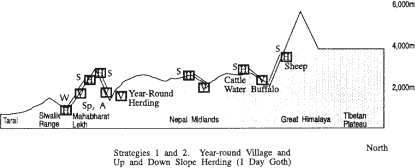
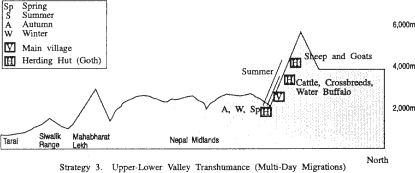
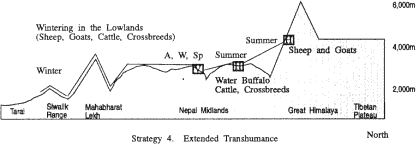
Figure 3
Middle-Altitude Agropastoralism, Altitudinal Patterns
the ranges adds to the third pattern a longer-distance winter move as well, one which takes herders and their sheep, goat, and cattle across the Mahabharat Lekh and out of the midlands into the valleys north of the Siwalik range or even beyond the Siwalik range to its southern alluvial slopes and the Tarai.
In the Dudh Kosi valley and adjacent areas variations of middle-altitude agropastoralism are practiced by Rais, Gurungs, Magars, and several Sherpa groups including the Pharak and Shorung Sherpas. Some of these Sherpa groups have adopted land-use practices that they may have adapted from those of their non-Sherpa neighbors and which from the standpoint of Khumbu Sherpas are quite "un-Sherpa." Some Sherpa families in the Dudh Kosi region, as in the Arun watershed, for example, raise water buffalo and practice swidden cultivation. And in the Arun region some Sherpas even raise pigs and cultivate irrigated rice.
Within the range of microenvironments found in the Nepal midlands and the Great Himalaya between 1,000 and 3,000 meters a great diversity of production systems could be described through which middle-altitude agropastoralists use the resources of particular sites. In the 1,500-2,500-meter altitudinal range in which most of the main villages are located these systems include several different types of production based on rain-fed permanent crops with and without small-scale keeping of cattle, water buffalo, sheep and goats such as year-round cultivation, summer-only cultivation, different types of annual and multiyear crop rotations and fallowing practices, different types of intercropping and relay cropping, food and fodder crops, subsistence and commercial crops. There are also systems based on irrigated agriculture (including rice only and rice followed by winter-irrigated or nonirrigated crops), again with and without associated livestock raising, as well as a number of different types of woodland, forest, grassland use and management. These could be further differentiated on the basis of variations in the use of agricultural inputs (seed, fertilizer, and labor especially), by the social and cultural arrangements influencing crop production, and orientation towards subsistence or commercial production. While this approach would offer valuable insights into land-use techniques and institutions, a fuller understanding of local land use would require both attention to differentiation in wealth, power and other factors that influence household and community resource-use options and decisions and the investigation of the strategies by which particular families, economic classes, communities, and ethnic groups combine sets of these microenvironmentally based production systems into household and regional economies.
Different peoples within the middle-altitude region employ slightly different production systems in very similar microenvironmental sites, and individual ethnic groups make use of more than one system even in similar sites. Crop decisions and rotations, field-fertilization practices, grazing patterns, and other aspects of production systems may vary. Such differences may reflect cultural perceptions (including crop and livestock preferences and religious prohibitions), social arrangements (especially land tenure and communal resource-management institu-
tions), economic differentiation, and political power. There is accordingly no simple equation between given microenvironments and the production systems used in them, although environmental conditions (including altitude, slope, aspect, and the amount, type, timing, and intensity of precipitation) may broadly influence the range of what is and is not rewarding in terms of high yield and low risk.