
Serenade for Small Orchestra (1896)
In 1895 Schoenberg joined the small amateur orchestra Polyhymnia as cellist. It may well have been for this group that he began to compose what appears to be his first large-scale instrumental work, the Serenade in D Major. Schoenberg completed only the first movement; a scherzo, slow movement, and finale survive as fragments. The first movement is dated 1 September 1896 on the first page and 3 September on the last. The scherzo was begun on 30 November. The slow movement and finale bear no date.[11]
[10] By repetition Schoenberg extends the cadence past m. 32; the first theme reappears in m. 38.
[11] The slow movement fragment (microfilm no. U265–67 at the Schoenberg Institute), which bears no date, has not previously been identified as belonging to the Serenade. Maegaard 1972, 1: 26, includes only the other three movements in his entry for the Serenade; the slow movement is described on p. 152 as a separate work. Thieme 1979, 94, also identifies only three movements. Although it is not dated, the Andante clearly belongs to the Serenade. It has the same instrumentation as the other movements. It also has similar handwriting and is copied on the same kind of 28-stave paper as the scherzo movement (the other two movements are on 24-stave paper).
The orchestral serenade was a popular medium within the Austro-German-Bohemian sphere in the last decades of the nineteenth century. Schoenberg would surely have been acquainted not only with the two early serenades of Brahms (opp. 11 and 16), but also with more recent ones by Robert Volkmann, Antonin Dvorak[*] , Josef Suk, and Robert Fuchs. A well-worn score of Fuchs's Serenade for Strings in D Major, op. 9 (published 1874), filled with performance indications in an unidentified hand, survives in the archives of the Schoenberg Institute. This may well have been a score used by Polyhymnia and may also have provided inspiration for Schoenberg's own work in the same key. For his first movement, however, he found a more compelling structural-technical model in Brahms, and in particular in the first movement of Brahms's Second Symphony, also in the key of D major.
The overall design of Schoenberg's movement owes little directly to Brahms; it takes the form of a small-scale and somewhat oddly proportioned sonata, with a very brief exposition (mm. 1–12), consisting of a single long phrase moving from tonic to dominant; a substantial modulatory development (13–44); a conventional recapitulation (45–58); and a lengthy coda (58–77).[12] But the actual thematic ideas and their treatment are strikingly close to Brahms's first movement. Both movements begin with a theme (marked a in ex. 2.3a) in the low strings (violas in Schoenberg, cellos in Brahms) consisting of a neighbor-note figure that surrounds the tonic; the theme falls to the dominant note A. Unlike Brahms, however, Schoenberg accompanies this theme from the outset with a repeated rhythmic figure in the woodwinds (marked b). After two bars (one in Brahms), a new triadic idea (c) enters above motives a and b. This theme is treated imitatively by the violins while being accompanied continuously by the other two ideas. At the climax of the short exposition, the violin theme takes on the rhythm of motive b.
What is especially distinctive here is Schoenberg's creation of a texture in which—as in Brahms—each part is given a motivic or thematic function. The effort is more successful than in the A-minor Presto for piano. Also impressive is Schoenberg's handling of the retransition and arrival of the recapitulation. This is always a crucial moment in Brahms's sonata forms, one for which he developed many elegant and ingenious procedures that Schoenberg must have studied carefully. By m. 33, in the development section, Schoenberg has modulated to


[12] See Thieme 1979, 97, for a formal diagram of the movement, as well as an analysis.
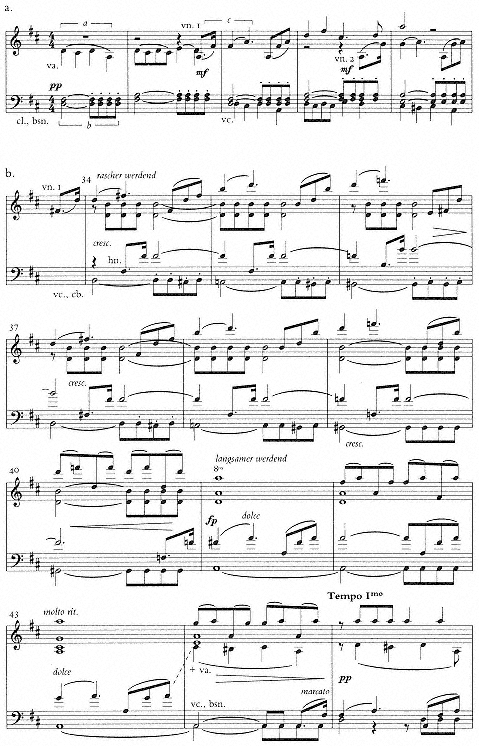
Example 2.3
Schoenberg, Serenade for Small Orchestra (1896), I.
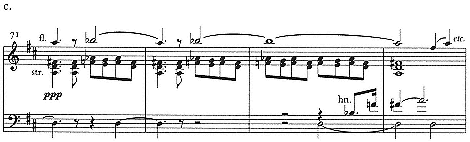
Example 2.3
continued
B, and its chromatic lower neighbor,


The motivic-thematic process complements this harmonic one. For the ten measures preceding the retransition, Schoenberg has avoided developing motive c, which now reemerges at the arrival on B minor, accompanied by motive b in the cellos and basses. At the climax of the crescendo, in m. 40, the theme is dissolved or "liquidated" in diminution—much as Brahms treats his own analogous triadic theme at various points in the first movement of his Second Symphony (cf. mm. 59ff.). Throughout this passage, c has been presented by the strings (first violins and violas), while the horns reiterate only the dotted upbeat figure as a kind of ostinato on octave


The other portion of this movement that deserves commentary is the conclu-
[13] See, for example, the retransition and entrance of the recapitulation in the Andante of Brahms's Third Symphony, discussed in Frisch 1984, 137–40.
sion of the coda, where the tonic is reached not via the dominant, but directly from an augmented sixth chord (a German sixth, spelled


Although the harmonic vocabulary is relatively simple, the association between the two passages, retransition and coda, shows Schoenberg already thinking of harmonic function in terms of large-scale structure. The retransition and coda occupy analogous, or perhaps complementary, places within the sonata form: the retransition represents the moment of greatest harmonic tension, the coda the moment of least tension. To point up the relationship, Schoenberg employs dissonant harmonies that resolve by means of neighbor motion.
In the ways just analyzed, the first movement of the Serenade in D Major is a great step forward from the piano works of 1894. The work is a more effective, persuasive composition largely because Schoenberg has begun to internalize, to make his own, some of Brahms's more important techniques. In terms of the spectrum proposed in chapter 1, we might say that Schoenberg's emulation and allusion are now giving way to absorption. As we listen to the first movement of the serenade, we are less aware of the model than of the skill and naturalness with which Schoenberg manipulates the principles taken over from it.