
Part Two—
Healing Global Wounds
Yet, over the last decade, Native Americans, ranchers, peace activists, Downwinders, and even members of the normally conservative Mormon establishment have attempted to draw a firm line against further weapons' testing, radiation poisoning, and ecocide in the deserts of Nevada and Utah. The three short field reports that follow (written in 1992, 1993, and 1996–97) are snapshots of the most extraordinary social movement to emerge in the postwar West.
Humbling "Mighty Uncle"
Flash back to fall 1992. The (private) Wackenhut guards at the main gate of the Nevada Nuclear Test Site (NTS) nervously adjust the visors on their riot helmets and fidget with their batons. One block away, just beyond the permanent traffic sign that warns "Watch for Demonstrators!" a thousand anti-nuclear protestors, tie-dyed banners unfurled, are approaching at a funeral pace to the sombre beat of a drum.
The unlikely leader of this youthful army is a rugged-looking rancher from the Ruby Mountains named Raymond Yowell. With a barrel chest that strains against his pearl-button shirt, and calloused hands that have roped a thousand mustangs, he makes the Marlboro Man seem wimpy. But if you look closely, you will notice a sacred eagle feather in his Stetson. Mr. Yowell is chief of the Western Shoshone National Council.
When an official warns protestors that they will be arrested if they cross the cattleguard that demarcates the boundary of the Test Site, Chief Yowell scowls that it is the Department of Energy who is trespassing on sacred Shoshone land. "We would be obliged," he says firmly, "if you would leave. And please take your damn nuclear waste and rent-a-cops with you."
While Chief Yowell is being handcuffed at the main gate, scores of protestors are breaking through the perimeter fence and fanning out across the desert. They are chased like rabbits by armed Wackenhuts in fast, low-slung dune-buggies. Some try to hide behind Joshua trees, but all will be eventually caught and returned to the concrete-and-razor-wire compound that serves as the Test Site's hoosegow. It is October 11, the day before the quincentenary of Columbus's crash landing in the New World.
The U.S. nuclear test program has been under almost constant siege since the Las Vegas—based American Peace Test (a direct-action offshoot of the old Moratorium) first encamped outside the NTS's Mercury gate in
1987. Since then more than ten thousand people have been arrested at APT mass demonstrations or in smaller actions ranging from Quaker prayer vigils to Greenpeace commando raids on ground zero itself. (In Violent Legacies Misrach includes a wonderful photograph of the "Princesses Against Plutonium," attired in radiation suits and death masks, illegally camped inside the NTS perimeter.) Dodging the Wackenhuts in the Nevada desert has become the rite of passage for a new generation of peace activists.
The fall 1992 Test Site mobilization—"Healing Global Wounds"—was a watershed in the history of anti-nuclear protest. In the first place, the action coincided with Congress's nine-month moratorium on nuclear testing (postponing until this September a test blast codenamed "Mighty Uncle"). At long last, the movement's strategic goal, a comprehensive test ban treaty, seemed tantalizingly within grasp. Secondly, the leadership within the movement has begun to be assumed by the indigenous peoples whose lands have been poisoned by nearly a half century of nuclear testing.
These two developments have a fascinating international connection. Washington's moratorium was a grudging response to Moscow's earlier, unilateral cessation of testing, while the Russian initiative was coerced from Yeltsin by unprecedented popular pressure. The revelation of a major nuclear accident at the Polygon in February 1989 provoked a non-violent uprising in Kazakhstan. The famed writer Olzhas Suleimenov used a televised poetry reading to urge Kazakhs to emulate the example of the Nevada demonstrations. Tens of thousands of protestors, some brandishing photographs of family members killed by cancer, flooded the streets of Semipalatinsk and Alma-Ata, and within a year the "Nevada-Semipalatinsk Movement" had become "the largest and most influential public organization in Kazakhstan, drawing its support from a broad range of people—from the intelligentsia to the working class."[49] Two years later, the Kazakh Supreme Soviet, as part of its declaration of independence, banned nuclear testing forever.
It was the world's first successful anti-nuclear revolution, and its organizers tried to spread its spirit with the formation of the Global Anti-Nuclear Alliance (GANA). They specifically hoped to reach out to other indigenous nations and communities victimized by nuclear colonialism. The Western Shoshones were amongst the first to respond. Unlike many other western tribes, Chief Yowell's people have never conceded U.S. sovereignty in the Great Basin of Nevada and Utah, and even insist on carrying their own national passport when travelling abroad. In conversations with the Kazakhs and activists from the Pacific test sites, they discovered a poignant kinship that eventually led to the joint GANA-Shoshone sponsorship of "Healing Global Wounds" with its twin demands to end nuclear testing and restore native land rights.
In the past some participants had criticized the American Peace Test encampments for their overwhelmingly countercultural character. Indeed, last
October as usual, the bulletin board at the camp's entrance gave directions to affinity groups, massage tables, brown rice, and karmic enhancements. But the Grateful Dead ambience was leavened by the presence of an authentic Great Basin united front that included Mormon and Paiute Indian Downwinders from the St. George area, former GIs exposed to the 1950s atmospheric tests, Nevada ranchers struggling to demilitarize public land (Citizen Alert), a representative of workers poisoned by plutonium at the giant Hanford nuclear plant, and the Reese River Valley Rosses, a Shoshone country-western band. In addition there were friends from Kazakhstan and Mururoa, as well as a footsore regiment of European cross-continent peace marchers.
The defeat of George Bush a month after "Healing Global Wounds" solidified optimism in the peace movement that the congressional moratorium would become a permanent test ban. The days of the Nevada Test Site seemed numbered. Yet to the dismay of the Western Shoshones, the Downwinders and the rest of the peace community, the new Democratic administration evinced immodest enthusiasm for the ardent wooing of the powerful nuclear-industrial complex. Cheered on by the Tory regime in London, which was eager to test the nuclear warhead for the RAF's new "TASM" missile in the Nevada desert, the Pentagon and the three giant atomic labs (Livermore, Los Alamos, and Sandia) came within a hairsbreadth of convincing Clinton to resume "Mighty Uncle." Only a last-minute revolt by twenty-three senators—alarmed that further testing might undermine the U.S.-led crusade against incipient nuclear powers like Iraq and North Korea—forced the White House to extend the moratorium.
Although the ban has remained in force, there is some evidence that the Pentagon has participated in tests by proxy in French Polynesia. In 1995 the White House, breaking with the policy of the Bush years, allowed the French military to airlift H-bomb components to Mururoa through U.S. airspace, using LAX as a stop-over point. The British Labor Party, echoing accounts in the French press, charged that Washington and London were silent partners in the internationally denounced Mururoa test series, sharing French data while providing Paris with logistical and diplomatic support.[50]
More recently, the spotlight has shifted back to Nevada where peace activists in spring 1997 were preparing for protests against NTS's new program of "zero yield" tests. The Department of Energy is planning to use high explosives to compress "old" plutonium to the brink of chain reaction, an open violation of the Comprehensive Test Ban agreement, in order to generate data for a computer study of "the effects of age on nuclear weapons." This is part of the Clinton administration's science-based Stockpile Stewardship program, which, critics allege, has merely shifted the nuclear armsrace into high-tech labs like Livermore's $1 billion National Ignition Facility where super-lasers will produce miniature nuclear explosions that will in
turn be studied by the next generation of "teraflop" (1 trillion calculations per second) supercomputers. Great Basin peace activists, like their Global Healing counterparts fear that such "virtual atomic tests," combined with data from "zero yield" blasts in Nevada, will encourage not only the maintenance, but the further development of strategic nuclear weapons. In the meantime, motorists will still have to "Stop for Demonstrators" at the Mercury exit.[51]
The Death Lab
January 1993. It has been one of the coldest winters in memory in the Great Basin. Truckers freeze in their stalled rigs on ice-bound Interstate 80 while flocks of sheep are swallowed whole by huge snow drifts. It is easy to miss the exit to Skull Valley.
An hour's drive west of Salt Lake City, Skull Valley is typical of the basin and range landscape that characterizes so much of the intermontane West. Ten thousand years ago it was an azure-blue fjord-arm of prehistoric Lake Bonneville (mother of the present Great Salt Lake), whose ancient shorelines are still etched across the face of the snow-capped Stansbury Mountains. Today the valley floor (when not snowed-in) is mostly given over to sagebrush, alkali dust, and the relics of the area's incomparably strange history.
A half-dozen abandoned ranch houses, now choked with tumbleweed, are all that remain of the immigrant British cottonmill workers—Engels's classic Lancashire proletariat—who were the Valley's first Mormon settlers in the late 1850s. The nearby ghost town of Iosepa testifies to the ordeal of several hundred native Hawaiian converts, arriving a generation later, who fought drought, homesickness, and leprosy. Their cemetery, with beautiful Polynesian names etched in Stansbury quartzite, is one of the most unexpected and poignant sites in the American West.[52]
Further south, a few surviving families of the Gosiute tribe—people of Utah's Dreamtime and first cousins to the Western Shoshone—operate the "Last Pony Express Station" (actually a convenience store) and lease the rest of their reservation to the Hercules Corporation for testing rockets and explosives. In 1918, after refusing to register for the draft, the Skull Valley and Deep Creek bands of the Gosiutes were rounded up by the Army in what Salt Lake City papers termed "the last Indian uprising."[53]
Finally, at the Valley's southern end, across from an incongruously large and solitary Mormon temple, a sign warns spies away from Dugway Proving Ground: since 1942, the primary test-site for U.S. chemical, biological, and incendiary weapons. Napalm was invented here and tried out on block-long replicas of German andJapanese workers' housing (parts of this eerie "doom city" still stand). Also tested here was the supersecret Anglo-American anthrax bomb (Project N) that Churchill, exasperated by the 1945 V-2 attacks
on London, wanted to use to kill twelve million Germans. Project W-47—which did incinerate Hiroshima and Nagasaki—was based nearby, just on the other side of Granite Mountain.[54]
In the postwar years, the Pentagon carried out a nightmarish sequence of live-subject experiments at Dugway. In 1955, for example, a cloud generator was used to saturate thirty volunteers—all Seventh-Day Adventist conscientious objectors—with potentially deadly Q Fever. Then, between August and October 1959, the Air Force deliberately let nuclear reactors melt down on eight occasions and "used forced air to ensure that the resulting radiation would spread to the wind. Sensors were set up over a 210-mile area to track the radiation clouds. When last detected they were headed toward the old U.S. 40 (now Interstate 80)."[55]
Most notoriously, the Army conducted 1,635 field trials of nerve gas, involving at least 500,000 pounds of the deadly agent, over Dugway between 1951 and 1969. Open-air nerve-gas releases were finally halted after a haywire 1968 experiment asphyxiated six thousand sheep on the neighboring Gosiute Reservation. Although the Army paid $1 million in damages, it refused to acknowledge any responsibility. Shrouded in secrecy and financed by a huge black budget, Dugway continued to operate without public scrutiny.[56]
Then in 1985 Senator Jeremy Stasser and writer Jeremy Rifkin teamed up to expose Pentagon plans to use recombinant genetic engineering to create "Andromeda strains" of killer microorganisms. Despite the American signature on the 1972 Biological Weapons Convention that banned their development, the Army proposed to build a high-containment laboratory at Dugway to "defensively" test its new designer bugs.[57]
Opposition to the Death Lab was led by Downwinders, Inc., a Salt Lake City–based group that grew out of solidarity with the radiation victims in the St. George area. In addition to local ranchers and college students, the Downwinders were able to rally support from doctors at the Latter Day Saints (Mormon) Hospital and, eventually, from the entire Utah Medical Association. Local unease with Dugway was further aggravated by the Army's admission that ultra-toxic organisms were regularly shipped through the U.S. mail.
The Pentagon, accustomed to red-carpet treatment in super-patriotic Utah, was stunned by the ensuing storm of public hearings and protests, as well as the breadth of the opposition. In September 1988 the Army reluctantly cancelled plans for its new "BL-4" lab. In a recent interview, Downwinders organizer Steve Erickson pointed out that "this was the first grassroots victory anywhere, ever, over germ or chemical warfare testing." In 1990, however, the Dugway authorities unexpectedly resurrected their biowar lab scheme, although now restricting the range of proposed tests to "natural" lethal organisms rather than biotech mutants.[58]
A year later, while Downwinders and their allies were still skirmishing with the Army over the possible environmental impact of the new lab, Desert Shield suddenly turned into Desert Storm. Washington worried openly about Iraq's terrifying arsenal of biological and chemical agents, and Dugway launched a crash program of experiments with anthrax, botulism, bubonic plague, and other micro-toxins in a renovated 1950s facility called Baker Lab. Simulations of these organisms were also tested in the atmosphere.
The Downwinders, together with the Utah Medical Association (dominated by Mormon doctors), went to the U.S. District Court to challenge the resumption of tests at the veteran Baker Lab as well as the plan for a new "life sciences test facility." Their case was built around the Army's noncompliance with federal environmental regulations as well as its scandalous failure to provide local hospitals with the training and serums to cope with a major biowar accident at Dugway. The fantastically toxic botulism virus, for example, has been tested at Dugway for decades, but not a single dose of the anti-toxin was available in Utah (indeed in 1993, there were only twelve doses on the entire West Coast).[59]
In filing suit, the Downwinders also wanted to clarify the role of chemical and biological weapons in the Gulf War. In the first place, they hoped to force the Army to reveal why it vaccinated tens of thousands of its troops with an experimental, and possibly dangerous, anti-botulism serum. Were GIs once again being used as Pentagon guinea pigs? Was there any connection between the vaccinations and the strange sickness—the so-called "Gulf War Syndrome"—brought home by so many veterans?
Secondly, the Downwinders hoped to shed more light on why the Bush administration allowed the sales of potential biological agents in the months before the invasion of Kuwait. "If the Army's justification for resuming tests at Dugway was the imminent Iraqi biowar threat," said Erickson, "then why did the Commerce Department previously allow $20 million of dangerous 'dual-use' biological materials to be sold to Iraq's Atomic Energy Commission? Were we trying to defend our troops against our own renegade bugs?"[60]
In the event, the Pentagon refused to answer these questions and the Downwinders lost their lawsuit, although they remain convinced that bioagents are prime suspects in the Gulf War Syndrome. Meanwhile, the Army completed the controversial Life Sciences Test Facility, and rumors began to fly of research on super-lethal fibroviruses like Ebola Fever. Then, in 1994, Lee Davidson, a reporter for the Mormon Deseret News, used the Freedom of Information Act to excavate the details of human-subject experiments in Dugway during the 1950s and 1960s. Two years later, former Dugway employees complained publicly for the first time about cancers and other disabilities that they believe were caused by chemical and biological testing. The
Department of Defense, finally, admitted that clean-up of Dugway's 143 major toxic sites may cost billions and take generations, if ever, to complete.[61]
The Great "Waste" Basin?
Grassroots protest in the intermontane states has repeatedly upset the Pentagon's best-made plans. Echoing sentiments frequently expressed at "Healing Global Wounds," Steve Erickson of the Downwinders boasts of the peace movement's dramatic breakthrough in the West over the past decade. "We have managed to defeat the MX and Midgetman missile systems, scuttle the proposed Canyonlands Nuclear Waste Facility, stop construction of Dugway's BL-4, and impose a temporary nuclear test ban. That's not a bad record for a bunch of cowboys and Indians in Nevada and Utah: two supposedly bedrock pro-military states!"[62]
Yet the struggle continues. The Downwinders and other groups, including the Western Shoshones and Citizen Alert, see an ominous new environmental and public-health menace under the apparently benign slogan of "demilitarization." With the abrupt ending of the Cold War, millions of aging strategic and tactical weapons, as well as six tons of military plutonium (the most poisonous substance that has ever existed in the geological history of the earth), must somehow be disposed of. As Seth Schulman warns, "the nationwide military toxic waste problem is monumental—a nightmare of almost overwhelming proportion."[63]
The Department of Defense's reaction, not surprisingly, has been to dump most of its obsolete missiles, chemical weaponry, and nuclear waste into the thinly populated triangle between Reno, Salt Lake City, and Las Vegas: an area that already contains perhaps one thousand "highly contaminated" sites (the exact number is a secret) on sixteen military bases and Department of Energy facilities.[64] The Great Basin, as in 1942 and 1950, has again been nominated for sacrifice.
The Pentagon's apocalyptic detritus, however, is a new regional cornucopia—the equivalent of postmodern Comstock—for a handful of powerful defense contractors and waste-treatment firms. As environmental journalist Triana Silton warned a few years ago, "a full-fledged corporate war is shaping up as part of the old military-industrial complex transforms itself into a new toxic waste-disposal complex."[65]
There are huge profits to be made disposing of old ordnance, rocket engines, chemical weapons, uranium trailings, radioactive soil, and the like. And company bottom-lines look even better when military recycling is combined with the processing of imported urban solid waste, medical debris, industrial toxics, and non-military radioactive waste. The big problem has
been to find compliant local governments willing to accept the poisoning of their natural and human landscapes.
No locality has been more eager to embrace the new political economy of toxic waste than Tooele County, just west of Salt Lake City. As one prominent activist complained to me, "the county commissioners have turned Tooele into the West's biggest economic red light district."[66] In addition to Dugway Proving Ground and the old Wendover and Deseret bombing ranges, the county is also home to the sprawling Tooele Army Depot, where nearly half of the Pentagon's chemical-weapons stockpile is awaiting incineration. Its non-military toxic assets include Magnesium Corporation of America's local smelter (the nation's leading producer of chlorine gas pollution) and the West Desert Hazardous Industry Area (WDHIA) (see map 19.3), which imports hazardous and radioactive waste from all over the country for burning in its two towering incinerators or burial in its three huge landfills.[67]
Most of these facilities have been embroiled in recent corruption or health-and-safety scandals. Utah's former state radiation-control director, for example, was accused in late December 1996 of extorting $600,000 ("in everything from cash to coins to condominiums") from Khosrow Semnani, the owner of Environcare, the low-level radioactive waste dump in the WDHIA. Semnani has contributed heavily to local legislators in a successful attempt to keep state taxes and fees on Environcare as low as possible. Whereas the two other states that license commercial sites for low-level waste, South Carolina and Washington, receive $235.00 and $13.75 per cubic foot respectively, Utah charges a negligible $.10 per cubic foot. As a result, radioactive waste has poured into the WDHIA from all over the country.[68]
Meanwhile, anxiety has soared over safety conditions at the half-billion-dollar chemical-weapons incinerator managed by EG&G Corporation at Tooele Army Depot. As the only operational incinerator in the continental United States (another, accident-ridden incinerator is located on isolated Johnson Atoll in the Pacific), the Depot is the key to the Pentagon's $31 billion chemical demilitarization program. Vehement public opposition has blocked incinerators originally planned for sites in seven other states. Only in job- and tax-hungry Tooele County, which has been promised $13 million "combat pay" over seven years, did the Army find a welcome mat.[69]
Yet as far back as 1989, reporters had obtained an internal report indicating that in a "worst case scenario" an accident at the plant could kill more than two thousand Tooele residents and spread nerve gas over the entire urbanized Wasatch Front. (The National Gulf War Resource Center in Washington, D.C. would later warn that "if there is a leak of sarin from the Tooele incinerator or one of the chemical warfare agent bunkers, residents of Salt Lake City may end up with Gulf War illness coming to a neighborhood near you.") Federal courts nonetheless rejected a last-minute suit by
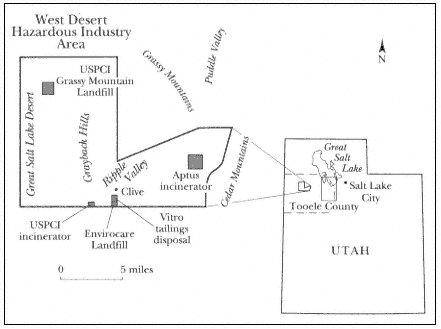
Map 19.3
Location map of Tooele Valley and the West Desert
Hazardous Industry Area, Tooele County, Utah.
the Sierra Club and the Vietnam Veterans of America Foundation to prevent the opening of the incinerator in August 1996.[70]
Within seventy-two hours of ignition, however, a nerve gas leak forced operators to shut down the facility. Another serious leak occurred a few months later. Then, in November 1996, the plant's former director corroborated the testimony of earlier whistleblowers when he publicly warned EG&G officials that "300 safety, quality and operational deficiencies" still plagued the operation. He also complained that the "plan is run by former Army officers who disregard safety risks and are too focused on ambitious incineration schedules." Environmental groups, meanwhile, have raised fears that even "successful" operation of the incinerator might release dangerous quantities of carcinogenic dioxins into the local ecosystem.[71]
Indeed, there is disturbing evidence that a sinister synergy of toxic environments may already be creating a slow holocaust comparable to the ordeal of the fallout-poisoned communities chronicled by Carole Gallagher. At the northeastern end of Tooele Valley, for example, Grantsville (pop. 5,000)
is currently under the shadow of the chlorine plume from Magnesium Corporation, the emissions from the hazmat incinerators in the WDHIA, and whatever is escaping from the Chemical Demilitarization Facility. In the past it has also been downwind of nuclear tests in Nevada and nerve-gas releases from Dugway, as well as clearly from the open detonation of old ordnance at the nearby but now closed North Area of the Army Depot.
For years Grantsville had lived under a growing sense of dread as cancer cases multiplied and the cemetery filled up with premature deaths, especially women in their thirties. As in a Stephen King novel, there was heavy gossip that something was radically wrong. Finally in January 1996, a group of residents, organized into the West Desert Healthy Environment Coalition (HEAL) by county librarian Chip Ward and councilwoman Janet Cook, conducted a survey of 650 local households, containing more than half of Grantsville's population.
To their horror, they discovered 201 cancer cases, 181 serious respiratory cases (not including bronchitis, allergies, or pneumonia), and 12 cases of multiple sclerosis. Although HEAL volunteers believe that majority Mormon residents reported only a fraction of their actual reproductive problems, they recorded 29 serious birth defects and 38 instances of major reproductive impairment. Two-thirds of the surveyed households, in other words, had cancer or a major disability in the family: many times the state and national averages. As Janet Cook told one journalist, "Southern Utah's got nothing on Grantsville."[72]
"Most remarkable," Ward observed, "was the way that cancer seemed to be concentrated among longtime residents." One source of historical exposure that Ward and others now think has been underestimated were the Dugway tests. "One respondent, for example, reported that she gave birth to seriously deformed twins several months after the infamous sheep kill in Skull Valley in 1968. Her doctor told her that he'd never seen so many birth defects as he did that year."[73]
But more than one incident is undoubtedly indicted in Grantsville's terrifying morbidity cluster. Environmental health experts have told HEAL that "cumulative, multiple exposures, with 'synergistic virulence' [the whole is greater than the sum of the parts] " best explain the local prevalence of cancers and lung diseases. In a downwind town where a majority of people work in hazardous occupations, including the Army Depot, Dugway, WDHIA, and the Magnesium Corporation, environmental exposure has been redoubled by occupational exposure, and vice versa.[74]
Consequently, West Desert HEAL, supported by Utah's Progressive Alliance of labor, environmental, and women's groups, has been demanding increased environmental monitoring, a moratorium on emissions and open detonation, complete documentation of past military testing, and a baseline regional health study with meaningful citizen participation. By early 1997
it had won legislative approval for the health survey and a radical reduction in Army detonations. The Magnesium Corporation, however, was still spewing chlorine and the Pentagon was still playing chicken with 13,616 tons of nerve gas.[75]
From a bar stool in the Dead Dog Saloon, Grantsville still seems like a living relic of that Old West of disenfranchised miners, cowboys, and Indians. Yet just a few miles down the road is the advance guard of approaching suburbia. Since 1995 metropolitan Salt Lake City has expanded, or, rather, exploded into northern Tooele Valley. The county seat, Tooele, has been featured in the New York Times as "one of the fastest-growing cities in the West," and a vast, billion-dollar planned suburb, Overlake, has been platted on its fringe.[76]
Although local developers deride the popular appeal of "tree-huggers" and anti-pollution groups, significant segments of the urban population will soon be in the toxic shadow of Tooele's nightmare industries. "When the new suburbanites wake up one morning and realize that they too are downwinders," Chip Ward predicts, "then environmental politics in Utah will really get interesting."[77]