
Eighteen—
Seismic Energy, Spectrum, and the Savage and Wood Inequality for Complex Earthquakes
Kenneth D. Smith, James N. Brune, and Keith F. Priestley
Introduction
As a result of calculations of energy radiation from a deterministic fault model, Haskell (1966), introduced a statistical model of fault rupture to better represent the irregular motions observed on strong-motion records (Housner, 1947, 1955; Thompson, 1959) and the observed generation of high-frequency energy from earthquakes with large source dimensions. An extension of this model was introduced by Aki (1967). In his model, Haskell (1966) visualized the actual faulting process as a swarm of acceleration and deceleration pulses arising from the variations in the elastic properties along the fault. These pulses propagate along the fault with some mean velocity but are highly chaotic in detail. Depending on the spatial and temporal correlation length of these pulses, this model can have a far-field displacement amplitude spectral falloff, beyond the corner frequency, proportional to w –1 (spatial correlation length much larger than time correlation wavelength) or to w–3 (spatial correlation length comparable to time correlation wavelength).
Approaching the problem from a different point of view, Brune (1970) introduced a fractional-stress-drop model to represent abrupt fault locking or healing, or nonuniform stress drop like a series of multiple events with parts of the fault remaining locked, in either case causing the fault to have less slip than if a uniform static stress drop over the whole fault equaled the dynamic stress drop. Aki (1972) characterized this process as a series of "rapid slips and sudden stops." In the Brune model the fractional stress drop introduces an w–1 slope in the displacement amplitude spectrum beyond the corner frequency, and thus leads to considerably more high-frequency energy than for an w–2 falloff model with the same seismic moment and source dimension. This effect is of great importance in determining the level of strong
ground motion during large earthquakes. Some more recent models of earthquakes have incorporated similar features, for example, the asperity models of Hartzell and Brune (1977) and McGarr (1981), the barrier model of Papageorgiou and Aki (1983), and the complex multiple-event models of Joyner and Boore (1986) and Boatwright (1988).
The shape of the spectrum beyond the corner frequency is obviously important to calculations of the total radiated energy. The total radiated energy is given by an integral of the square of the far-field velocity spectrum over frequency. On the one hand, if the displacement amplitude spectrum falls off as w –2 , the velocity spectrum falls off as w –1 , and the velocity-squared spectrum (proportional to energy) falls off as w–2 , so that there is relatively little contribution to the total energy beyond the corner frequency. On the other hand, if the displacement amplitude spectrum falls off as w–1 , the velocity spectrum (and velocity-squared spectrum) is constant, and the contribution to the total radiated energy is proportional to the bandwidth of that portion of the spectrum.
The shape of the spectrum beyond the corner frequency is of crucial importance to the Savage and Wood (1971) hypothesis, or inequality, in which the apparent stress is always less than half the stress drop. Since the apparent stress is proportional to the total radiated energy, it is obviously directly related to the existence of an w–1 band in the displacement amplitude spectrum. In fact, we show in the next section that the Savage and Wood (1971) hypothesis is violated directly in proportion to the width of the w–1 section of the amplitude spectrum for equidimensional faults.
The empirical evidence for an w–1 band in far-field earthquake displacement spectra remains subjective, but more data from high dynamic range, broadband digital seismographs may soon provide more objective evidence. In a recent article, Brune et al. (1986) gave some preliminary evidence from the Anza, California, seismic array (Berger et al., 1984) that displacement spectra from small, low-stress-drop earthquakes behave in this way, thus offering some support for the partial-stress-drop model for small-stress-drop events. However, the critical frequencies involved were so high that uncertainties in attenuation leave the results in question (Anderson, 1986). Similar weak support for an w –1 band is reported by Anderson and Reichle (1987) in a study of small aftershocks of the Coalinga earthquake recorded on the Parkfield strong-motion array. One study (Tucker and Brune, 1974) of the displacement of larger earthquakes (ML equal 4 to 5) provides evidence for a band of w–1 spectral falloff that does not suffer from the uncertainties that affect studies of smaller earthquakes. Unfortunately Tucker and Brune had only two observing stations so that their results are not as reliable as, for example, would be the case for similar larger events recorded on the Anza array, with ten high-quality digital stations.
Vassiliou and Kanamori (1982) have published results from a study of
energy estimates based primarily on teleseismic body-wave pulse shapes recorded on long-period WWSSN instruments, which could not give reliable estimates of high-frequency radiated energy. However, on the basis of strongmotion records from four earthquakes they argued that most of the radiated energy in the near field was adequately represented in the far-field longperiod pulse shapes. In this paper we reconsider two of these earthquakes from a different point of view and conclude that significant energy is radiated at frequencies higher than the Haskell corner frequency for the overall dimensions.
In a recent study of the 1978 Tabas, Iran, earthquake, Shoja-Taheri and Anderson (1988) estimated the radiated energy on the basis of near-field strong-motion records. They obtained results one to two orders of magnitude higher than corresponding teleseismic energy estimates based on a procedure developed by Boatwright and Choy (1986). This dramatically illustrates the importance of reconciling near-field and far-field energy estimates. Boatwright (personal communication) has questioned the Shoja-Taheri and Anderson results, in part because of this large discrepancy.
Most recently Priestley and Brune (1987) and Priestley et al. (1988) found strong evidence for the existence of w–1 spectral falloffs for the Mammoth Lakes and Round Valley, California, earthquakes. It was this new evidence from the Mammoth Lakes earthquakes, and the results of a class exercise in estimating the radiated energy for various spectral shapes, that stimulated the present study.
Seismic Energy
Gutenberg and Richter (1942, 1956) proposed the first dynamic measure of the energy radiated by fault rupture. They related the radiated energy to the earthquake magnitude. Magnitude measures are usually based on information from a limited frequency band and do not adequately represent the contributions of all frequencies to the radiated energy. However, integration of the velocity-squared seismogram, in the determination of the radiated seismic energy, does incorporate the entire frequency band.
Wu (1966) derived a simple expression for determining the radiated S-wave energy, which incorporated the S-wave radiation pattern

where r is density, ß is the shear wave velocity, R is the hypocentral distance, and W ( f ) is the spectral displacement amplitude according to Brune (1970). Hanks and Thatcher (1972) obtained an analytic solution to the integration of the velocity-squared spectrum in equation (1) for a simple displacement spectrum in which the asymptotes of the constant-amplitude, long-period
level and an w–2 (or f–2 ) high-frequency falloff meet at some (sharp) corner frequency, f0 . The analytic solution of equation (1) for this approximate model is

where W 0 is the zero frequency displacement spectral amplitude. Hanks and Thatcher decreased E s by a factor of two in order to be consistent with the energy of the Brune (1970) model. The actual difference is a factor of 1.67, resulting from the fact that the Brune displacement spectrum is rounded at the corner frequency. This illustrates the dependence of the calculation of the seismic energy on the shape of the spectrum near the corner frequency.
Using the following definition of seismic moment M0 (Keilis-Borok, 1957)

and an apparent stress (Wyss, 1970) equal to µEs/M 0 , where µ is the rigidity of the faulted crust, an expression for apparent stress for the Hanks and Thatcher (1972) asymptotic approximation to the Brune (1970) model displacement amplitude spectrum can be developed from equation (2). This expression is

Similarly, the Hanks and Thatcher energy approximation can be recast in terms of seismic moment as

These expressions are of interest because there is some evidence that actual earthquake spectra have a sharper corner than for the Brune (1970) model (Brune et al., 1979). We will discuss the relationship between spectral shape and radiated energy and the reason for selecting a sharp corner model in a later section.
Note that equation (4) was arrived at making no assumptions concerning the relationship of the corner frequency to the source geometry, and the R dependence is now only in the definition of the seismic moment. Equation (4) is similar in form to derivations of Randall (1973) and Vassiliou and Kanamori (1982).
Energy Results for the Savage and Wood, Orowan, and Brune Models
Savage and Wood (1971) propose a faulting model in which the final stress level (S0 in their terminology) is lower than the dynamic frictional stress,
Sf . This results in a static stress drop, S – S0 (where S is the initial stress), greater than the dynamic stress drop, S – Sf . They suggest this "overshoot" results from the momentum of the moving fault block. Savage and Wood (1971) express their model in terms of energy and stress drop, specifically in the ratio of twice the apparent stress to the stress drop. In other words, if

holds, then the final stress, S 0 , is less than the frictional stress, and there is, through their argument, "overshoot" (Savage and Wood, 1971 provide a complete derivation). The apparent stress and the static stress drop are measured quantities. Evaluation of (5) depends on reliable measures of stress drop and radiated energy.
Relationship (5) is the Savage and Wood inequality. Savage and Wood determined ES primarily using the Gutenberg-Richter magnitude-energy (ML – ES ) relationship (with few exceptions) and static stress drops reported in the literature. They concluded that in most cases the apparent stress was significantly less than half the stress drop, in support of an "overshoot" model. We believe that recent, more accurate measures of energy and stress drop, as described later, do not support this conclusion.
Orowan (1960) proposed a faulting model in which the final stress, S0 , is equal to the frictional stress, Sf . In this case, the effective stress is equal to the stress drop, and the radiated seismic energy reduces to

where

In the Brune (1970) model the far-field shear-wave pulse shape is determined by the effective stress, but the spectrum for the far-field pulse accounts for only forty-four percent of the Orowan energy. Most of this difference can be accounted for by the shape of the Brune spectra at the corner frequency, and this leads to a discussion of energy as a function of spectral shapes.
Energy and Spectral Shape
The radiated energy is a function of spectral shape. In particular, the shape of the spectra near the corner frequency and the high frequency spectral falloff control the measure of the radiated energy, since the displacement amplitude spectrum is multiplied by w and then squared. As discussed earlier, Hanks and Thatcher (1972) integrated the w–2 spectral shape, with a sharp corner frequency, to calculate the radiated energy. If we assume a Brune (1970, 1971) relationship between corner frequency and source dimension, do not decrease the integral by a factor of two (that is, depart
from Hanks and Thatcher, 1972, in this respect), and include P-wave energy (one-eighteenth that in the S-wave; Wu, 1966), then eighty-three percent of the Orowan dislocation energy of equation (6) is accounted for. Thus, the w–2 spectral shape, with a sharp corner and a Brune (1970, 1971) relationship between the corner frequency and the source dimension, accounts for nearly all of the dislocation energy.
It is clear that if the spectral falloff at high frequency is steeper than w–2 there will be less radiated energy. For example, average high-frequency spectral falloffs of w –3 account for only forty-eight percent of the Orowan energy, if the corner frequency and source dimension are given by the Brune (1970, 1971) model.
For circular fault rupture and a Brune (1970, 1971) relationship between corner frequency and source dimension, intermediate spectral slopes, w–1 (or w–1.5 ), beyond the inital corner frequency result in higher radiated energies than would be the case for the Orowan model, the amount depending on the bandwidth of this portion of the spectrum. Of course, high-frequency spectral falloffs of w–1 cannot extend to infinite frequencies, since this would imply infinite energies.
In the Brune (1970) model, the bandwidth of the w –1 portion of the spectrum is proportional to the fractional-stress-drop parameter Î, and thus for Î = 0.1 the total radiated energy is about ten times as great as for Î = 1. Similarly, if the parameter

For large strike-slip earthquakes, a rectangular source model is usually more appropriate, since rupture is constrained at depth and extends only in length. The spectrum for a Haskell-type rectangular rupture theoretically results in two corner frequencies (Haskell, 1966; Savage and Wood, 1971), one associated with the length and another with the width of the rupture surface, with the spectrum falling off as w–1 in between. For a constant-stress-drop model, the width controls the amount of slip for a given stress drop. Energies determined by integrating the spectral shape resulting from the rectangular source geometry of the Haskell model are consistent with radiated energies that would result from the Orowan assumption. Thus, if the second (higher) corner frequency is higher than expected for the width of the fault in the Haskell (1966) spectrum, that is, the intermediate slope is longer, then the radiated energy is clearly higher than for the Orowan case, and again the Savage and Wood inequality is violated. Thus, for rectangular sources we will test whether the second corner frequency is higher than predicted for the Haskell model, and for equidimensional sources we will test whether there is any w –1 section in the spectrum.
Data
We have attempted to construct the attenuation-corrected far-field radiated energy spectrum for a number of moderate to large earthquakes. At high frequencies, we have used near-source recordings to minimize the effects of uncertainty in attenuation. At low frequencies, we have used moment constraints based on long-period seismic waves.
Although there have been great improvements in understanding the various factors that affect high-frequency near-source recordings, large uncertainties remain. Recent advances in observing high-frequency weak and strong motions, including down-hole recordings, have opened the possibility of resolving many of these questions. Although vigorous debate continues about the effects of, for example, near-site attenuation and surface-layer amplification, we attempt in this study to present preliminary evidence relating to the question of total radiated energy.
Composite acceleration spectra have been constructed for the following earthquakes: 1940 Imperial Valley (fig. 1a), 1971 San Fernando, California (fig. 1b), 1978 Tabas, Iran (fig. 2a), 1979 Coyote Lake(fig. 2b), 1979 Imperial Valley, California (fig. 3a), 1980 Mexicali Valley (fig. 3b), 1984 Morgan Hill, California (fig. 4a), 1984 Round Valley, California (fig. 4b), and 1985 Michoacan, Mexico (fig. 5). The figure captions include references to the specific acceleration records used in constructing the spectra. Although the discussion of the calculation of radiated energy has been in terms of velocity spectra, acceleration spectra are plotted in figures 1–5. This helps to emphasize the high-frequency component.
These acceleration spectra have been corrected for free-surface effects (a factor of 2), and, for the Imperial Valley events, an additional correction factor of 3.4 has been applied to account for amplification within the thick sedimentary layer (Mungia and Brune, 1984a ). For the acceleration records from other sedimentary sites, a correction factor of 2 has been applied along with the free-surface correction.
For recordings very near to the source, the scaling of the energy with distance, equation (1), has to be modified. The nearest part of the ruptured area may be only several kilometers from the recording site, and the station can be considered to be in the near field. For the Michoacan event we are faced with such a source-receiver geometry and have attempted to account for it by scaling the high-frequency energy contribution appropriately. We have multiplied the integration of the velocity-squared spectrum of the near-field acceleration record by the ratio of twice the rupture area (to account for both sides of the fault) to that of a sphere of radius 10 km, and then assumed that this was the true amount of energy radiated from a point source. We then applied the R2 distance scaling in equation (1) with respect to the distance between the recording site and the fault. The long-period level is not
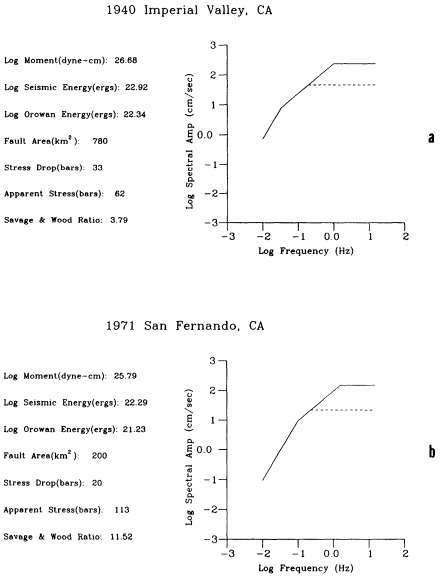
Figure 1
(a) 1940 Imperial Valley, California. High-frequency level is determined from
the corrected El Centro acceleration spectra; N-S component (Mungia
and Brune, 1984b ). (b) 1971 San Fernando, California. High-frequency level is
determined by the corrected spectra of the transverse component of the Pacoima
Dam accelerogram (Trifunac, 1972). The dashed line represents the high-frequency
level that would result from a corner frequency determined from the fault width
(table 1) for a Haskell (1966) model (Savage and Wood, 1971).
| ||||||||||||||||||||||||||||||||||||||||||||||||||||||||||||||||||||||||||||||||||||||||||||||||||||
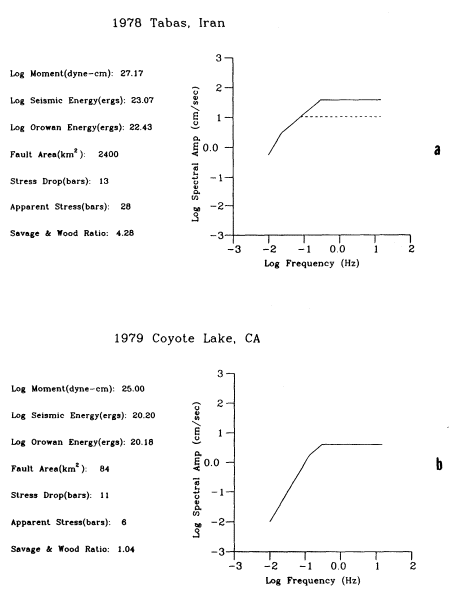
Figure 2
(a) 1978 Tabas, Iran. High-frequency level is determined from the corrected
Tabas acceleration spectra; transverse component (Shoja-Taheri and Anderson,
1987). (b) 1979 Coyote Lake, California. High-frequency level is determined from
the corrected spectra of the Gilroy Array No. 1 accelerogram; N40°W horizontal
component (Brady et al., 1980a ). The dashed line represents the high-frequency
level that would result from a corner frequency determined from the fault width
(table 2) for a Haskell (1966) model (Savage and Wood, 1971).
| ||||||||||||||||||||||||||||||||||||||||||||||||||||||||||||||||||||||||||||||||||||||||||||||||||||
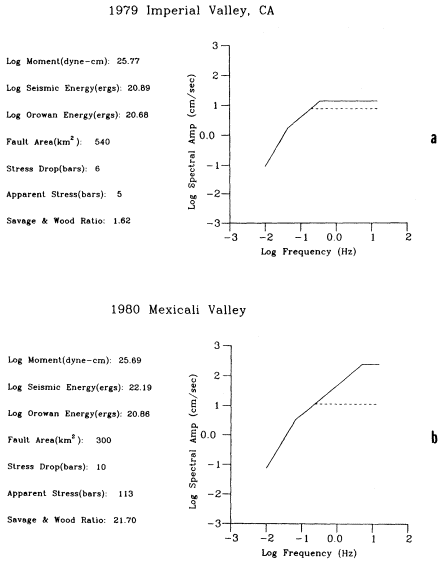
Figure 3
(a) 1979 Imperial Valley, California. The high-frequency level is determined
from the corrected spectra of the Keystone Road El Centro Array accelerogram;
N140°E horizontal component (Brady et al., 1980 b ). (b) 1980 Mexicali Valley,
Mexico. The high-frequency level is determined from the corrected spectra
of the Victoria, Mexico accelerogram; N40°W horizontal component (Mungia
and Brune, 1984a ). The dashed line represents the high-frequency level that
would result from a corner frequency determined from the fault width
(table 3) for a Haskell (1966) model (Savage and Wood, 1971).
| ||||||||||||||||||||||||||||||||||||||||||||||||||||||||||||||||||||||||||||||||||||||||||||||||||||
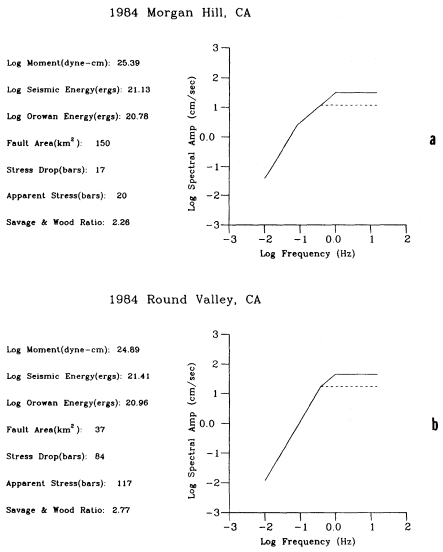
Figure 4
(a) 1984 Morgan Hill, California. The high-frequency level is determined from the
corrected spectra of the Anderson Dam–Downstream accelerogram; N40°W
component (Brady et al., 1984). (b) 1984 Round Valley, California. The high-frequency
level is controlled by the corrected spectra of the Paradise Lodge acceleration record,
and the intermediate slope is determined from long-period body waves; transverse
component of the acceleration record (Priestley et al., 1988). The dashed line represents
the high-frequency level that would result from a corner frequency determined
from the fault width (table 4) for a Haskell (1966) model (Savage and Wood, 1971).
| ||||||||||||||||||||||||||||||||||||||||||||||||||||||||||||||||||||||||||||||||||||||||||||||||||||
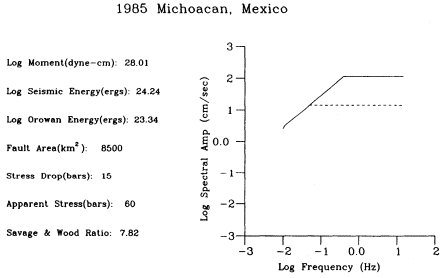
Figure 5
1985 Michoacan, Mexico. High-frequency level controlled by the average
spectra (corrected for surface amplification) of the Michoacan acceleration
array; transverse components (Anderson et al., 1986). The dashed line
represents the high-frequency level that would result from a corner
frequency determined from the fault width (table 5) for a Haskell (1966)
model (Savage and Wood, 1971).
affected, since it is determined from the seismic moment, but the high-frequency level is increased.
For all but the 1984 Round Valley, California, earthquake, a rectangular source geometry is a good approximation to the fault geometry suggested by aftershock patterns. The Coyote Lake and Morgan Hill, California, earthquakes have particularly well-recorded aftershock sequences, which allow a good constraint on the rupture extent. Tables 1–5 include references for source dimensions for all events. Note that table numbers correspond to figure numbers. In constructing the spectra, the intersection of the long-period level as determined from the seismic moment and the trend of the acceleration spectra was in all cases approximately equal to or consistent with the lowest corner frequency (representing fault length) expected for a Haskell rectangular model (Savage 1974a). Plotted in figures 1–5 is the second (higher) corner frequency for the theoretical Haskell model, which is fixed by the depth extent (width) of rupture (dashed line). This corner is fixed by the depth of fault rupture for each event as referenced in corresponding tables 1–5. The composite spectrum of the Coyote Lake earthquake indicates a second corner frequency very nearly equal to that expected for a Haskell-type rupture and is the only event in our study where this is true.
| ||||||||||||||||||||||||||||||||||||||||||||||||||||
The 1984 ML = 5.8 Round Valley, California, earthquake is the only event for which we have created a composite spectrum that shows a circular or equidimensional rupture area. The Round Valley spectrum also has the additional constraint, at intermediate frequencies, of teleseismic body-wave amplitudes recorded at GDSN (Global Digital Seismic Network) stations, as well as long-period surface-wave information (20 s) and a near-source (<5 km epicentral distance) acceleration recording (Priestley et. al., 1988).
Also provided in figures 1-5 are the calculations of the radiated energy from equation (1), the energy from equation (6) that would result for an Orowan-type event, the stress drop as determined from the spectra, seismic moment, apparent stress, and fault area. The "Savage and Wood ratio" (that is, the ratio of twice the apparent stress to the stress drop, as shown below) is also included:

If this number is less than 1, then by the Savage and Wood argument there would be "overshoot," the final stress level being less than the frictional stress. This number is greater than or equal to 1 for all events studied.
Large Earthquakes as Composites of Smaller Events and Energy Implications
A Savage and Wood ratio greater than 1 (violating the Savage and Wood inequality) implies that the static stress drop, S – S0 , is relatively low, or that a significant amount of extra energy is being radiated at intermediate and high frequencies. Individual subevents, small with respect to the total fault dimensions but with high dynamic stress drops, would contribute more to the high-frequency energy (Boatwright, 1982). For the acceleration spectra of the Michoacan earthquake, Anderson et al. (1986) termed this the "roughness" portion of the spectra, after Gusev (1983), and clearly this "roughness," or high-frequency detail, can be seen on their near-field displacement pulses (figure 6 of Anderson et al., 1986). The high velocity pulse observed on the Pacoima Dam record for the 1971 San Fernando, California, earthqauke was interpreted by Hanks (1974) as being due to an initial high-stress-drop subevent with a much higher stress drop than determined for the entire faulting event. This in part contributed to the extended intermediate slope in the spectrum of the Pacoima Dam accelerogram, but most of the energy in this range comes from later high-frequency complexities in the record.
Hartzell (1982), Papageorgiou and Aki (1983), Mungia and Brune (1984b ), Joyner and Boore (1986), and Boatwright (1988), among others, have simulated the ground motion of large earthquakes using a summation of small events. Spectral shapes generated by these models relate directly to the calculation of radiated energy and apparent stress, and therefore evaluation of the Savage and Wood inequality (5). For instance, the asperity model of Boatwright (1988) incorporates an intermediate slope of w–1 to w–1.5 and is similar in principle, as stated by Boatwright, to the "partial stress drop model" of Brune (1970). In this model a high-stress-drop event occurs within a larger source area of lower stress drop and gives rise to a relative increase in high-frequency energy. For this case the Savage and Wood inequality is violated.
Frequency-Band Limitations and the Calculation of Radiated Energy
Vassiliou and Kanamori (1982) calculated the seismic energy radiated by large earthquakes using teleseismic body waves. They determined that most of the energy radiated by large earthquakes is below 1 to 2 Hz, therefore within the bandwidth of GDSN stations, and that this frequency band was sufficent for energy calculations. This method can be applied if the displacement spectrum falls off as w –2 at frequencies higher than 1 to 2 Hz. However, for several of the events we have studied there are important energy contributions at frequencies greater than 1 Hz (spectra with extended intermediate
slopes). This can be seen especially in the spectra of the 1971 San Fernando (fig. 1) and 1980 Mexicali Valley (fig. 3) earthquakes where the second (higher) corner frequencies are greater than 1 Hz.
Band limitations can also be a problem at long periods. The integration of velocity-squared time series from the acceleration record would return less reliable estimates of radiated energy if the bandwidth of the instrument is at a higher frequency than the lowest corner frequency of the far-field spectra. Therefore, composite spectra or wideband instrumentation would be required to incorporate all the details of the spectral shape, particularly for larger events with significant intermediate slopes.
Discussion
We have constructed estimates of the spectra of several large to moderate size earthquakes and integrated the velocity-squared spectra to determine the radiated seismic energy. Seismic moments have been used to constrain the long-period level (flat portion of the far-field displacement spectrum), and near-source acceleration spectra have been used to constrain the high-frequency amplitudes. Approximate corrections for free-surface and sediment amplification have been made. Significant intermediate slopes of w –1 apparently exist in the spectra, with consequent increases in the calculated radiated energy. These intermediate slopes extend to higher frequencies than those predicted for the Haskell (1966) model (Savage, 1974a , b ). Interpreted in terms of apparent stress and static stress drop, these earthquakes violate the Savage and Wood inequality (5) and provide evidence against "overshoot" as a source model in these cases. The ML = 5.8 1984 Round Valley, California, earthquake, the only event considered here that has a more or less equidimensional rupture surface (Priestley et al., 1988), has a composite spectrum with an intermediate slope of w–1 The initial corner frequency in the Round Valley spectrum is a good approximation to the source dimension, as determined from the aftershock pattern, for a Brune (1970) type source model. This event is a good example of the calculated energy being greater than that predicted for an Orowan rupture in equation (6).
On the basis of their data, Savage and Wood (1971) suggested a ratio of twice the apparent stress to static stress drop of 0.3 as a typical value (that is, accounting for only thirty percent of the Orowan energy), and they used this result as evidence for the "overshoot" model of equation (7). Assuming a Brune (1970, 1971) model and a sharp corner frequency, we have shown that such a ratio would require steeper (»w –2 ) high-frequency spectral falloffs, beginning at the corner frequency, than are generally accepted. Hanks (1979) argued against w–3 high-frequency spectral falloffs. In terms of rupture models, focusing due to rupture velocity and the angle with respect to the fault normal affect the shape of the spectra over the focal sphere. However, aver-
age high-frequency spectral falloffs of w–3 do not exist in the spectra of far-field S-waves for these models (Joyner and Boore, 1986; Joyner, 1984; Boatwright, 1980; Madariaga, 1973; Sato and Hirasawa, 1973).
Our spectra have typically been constructed from one acceleration record, and we have necessarily made some assumptions about the location of the station with respect to the fault, radiation pattern effects, average spectral shape, and site effects; thus, there remains considerable uncertainty in our results. The ideal situation would be to have many stations surrounding the source and be able to account for focusing, site effects, and radiation pattern to a much greater degrees.
Our purpose in this study has been to show how spectral shape relates to estimates of apparent stress, to further pursue the idea of integration of the entire spectral shape as a method of determining radiated energy, to document cases of intermediate slopes in the spectra of moderate to large earthquakes, and to use energy considerations to show that for many earthquakes the Savage and Wood (1971) inequality is violated. There is no strong evidence that the overshoot mechanism is ever operative.
Acknowledgments
This research was partially funded by U.S. Geological Survey research grant 14–0007–G1326.
References
Aki, K. (1967). Scaling law of seismic spectrums. J . Geophys. Res., 72: 1217–1231.
——— (1972). Scaling law of earthquake source time function. Geophys. J. R. Astr. Soc., 31: 3–25.
Allen, C. R., G. R. Engen, T. C. Hanks, J. M. Nordquist, and W. R. Thatcher (1971). Main shock and larger aftershocks of the San Fernando earthquake, February 9, through March 1971. U.S. Geol. Surv. Professional Paper 733, 17–20.
Anderson, J. G. (1986). Implication of attenuation for studies of the earthquake source. In Earthquake Source Mechanics, Geophysics Monograph 37, Maurice Ewing vol. 6. American Geophysical Union, 311–318.
Anderson, J. G., P. Bodin, J. N. Brune, J. Prince, S. K. Singh, R. Quaas, and M. Onate (1986). Strong ground motion from the Michoacan, Mexico, earthquake. Science, 233: 1043–1049.
Anderson, J. G., J . N. Brune, and R. S. Simons (1987). The Victoria accelerogram from the June 9, 1980 Mexicali Valley, Mexico earthquake (Submitted to Bull. Seism. Soc. Am. ).
Anderson, J. G., and M. S. Reichle (1987). Study of spectra and site effects from Coalinga aftershocks recorded near Parkfield, California (Submitted to Bull. Seism. Soc. Am. ).
Berberian, M. (1982). Aftershock tectonics of the 1978 Tabas-e-Golshan (Iran) earth-
quake sequence: A documented active thin and thick skinned tectonic case. Geophys. J. R. Astr. Soc., 68: 499–530.
Berberian, M., I. Asudeh, R. G. Bilham, C. H. Scholz, and C. Soufleris (1979). Mechanism of the main shock and the aftershock study of the Tabas-e-Golsham (Iran) earthquake of September 16, 1978: A preliminary report. Bull. Seism. Soc. Am., 69: 1851–1859.
Berger, J., L. M. Baker, J. N. Brune, J. B. Fletcher, T. C. Hanks, and F. L. Vernon (1984). The Anza array: A high dynamic-range, broadband, digitally radiotelemetered seismic array. Bull. Seism. Soc. Am., 74: 1469–1481.
Boatwright, J. (1980). A spectral theory for circular seismic sources: Simple estimates of source dimension, dynamic stress drop, and radiated energy. Bull. Seism. Soc. Am., 70: 1–26.
——— (1982). A dynamic model for far field acceleration. Bull. Seism. Soc. Am., 72: 1049–1068.
——— (1988). The seismic radiation from composite models of faulting. Bull. Seism. Soc. Am., 78: 489–508.
Boatwright, J., and B. Choy (1986). The acceleration spectra of subduction zone earthquakes. EOS, 76: 310.
Brady, A. G., P. N. Mork, V. Perez, and L. D. Porter (1980a). Processed data from the Gilroy array and Coyote Creek records, Coyote Lake, California earthquake 6 August 1979. U.S. Geol. Survey Open-file Report 81–42.
Brady, A. G., V. Perez, and P. N. Mork (1980b ). The Imperial Valley earthquake, October 15, 1979. Digitization and processing of accelerograph records. U.S. Geol. Surv. Open-file Report 80–703, 197–209.
Brady, A. G., R. L. Porcella, G. N. Bycroft, E. C. Etheredge, P. N. Mork, B. Silverstein, and A. F. Shakal (1984). Strong-motion results from the main shock (Morgan Hill, California) of April 24, 1984. U.S. Geol. Surv. Open-file Report 84–498, 18–26.
Brune, J. N. (1970). Tectonic stress and spectra of seismic shear waves from earthquakes. J . Geophys. Res., 75: 4997–5009.
——— (1971). Correction. J . Geophy. Res.,76: 5002.
——— (1976). The physics of strong ground motion. In C. Lomnitz and E. Rosenblueth, eds., Seismic Risk and Engineering Decisions. 141–177, Elsevier Sci. Publ. Co., New York.
Bruen, J. N., R. J. Archuleta, and S. Hartzell (1979). Far-field S-wave spectra, corner frequencies, and pulse shapes. J . Geophys. Res. 84: 2262–2272.
Bruen, J. N., J. Fletcher, F. L. Vernon, L. Harr, T. Hanks, and J. Berger (1986). Low stress-drop earthquakes in light of new data from the Anza, California telemetered digital array. In Earthquake Source Mechanics, Geophysics Monograph 37, Maurice Ewing vol. 6. American Geophysical Union, 269–274.
Cockerham, R. S. and J. P. Eaton (1984). The April 24, 1984 Morgan Hill earthquake and its aftershocks, California Division of Mines and Geology Special Publication 68, 215–236.
Doser, D. I., and H. Kanamori (1987). Long-period surface waves of four western United States earthquakes recorded by the Pasadena strain meter. Bull. Seism. Soc. Am., 77: 236–244.
Ekstrom, G. (1985). Centroid-moment tensor solution for the April 24, 1984, Morgan Hill, California, earthquake. California Division of Mines and Geology Special Publication 68, 209–214.
Gross, W. K., and J. C. Savage (1985). Deformation near the vicinity of the 1984 Round Valley, California, earthquake. Bull. Seism. Soc. Am., 75: 1339–1347.
Gusev, A. A. (1983). Descriptive statistical model of earthquake source radiation and its application to an estimation of short-period strong ground motion. Geophys. J. R. Astr. Soc. 74: 787–808.
Gutenberg, B., and C. F. Richter (1942). Earthquake magnitude, intensity, energy, and acceleration. Bull. Seism. Soc. Am., 32: 163–191.
——— (1956). Earthquake magnitude, intensity, energy, and acceleration (second paper). Bull. Seism. Soc. Am., 46: 105–145.
Hanks, T. (1974). The faulting mechanism of the San Fernando earthquake. J. Geophys. Res. 79: 1215–1229.
——— (1979). b values and w –g seismic source models: Implications for tectonic stress variations along active crustal fault zones and the estimation of high-frequency ground motion. J . Geophs. Res., 84: 2235–2242.
Hanks, T., and W. Thatcher (1972). A graphical representation of seismic source parameters. J . Geophys. Res., 77: 4393–4405.
Hartzell, S. H. (1982). Simulation of ground accelerations for the May 1980 Mammoth Lakes, California, earthquakes. Bull. Seism. Soc. Am., 72: 2381–2387.
Hartzell, S. H., and J. N. Brune (1977). The Horse Canyon earthquake of August 2, 1975: Two-stage stress-release process in a strike-slip earthquake. Bull. Seism. Soc. Am., 69: 1161–1173.
Haskell, N. A. (1966). Total energy spectral density of elastic wave radiation from propagating faults: Part II. A statistical source model. Bull. Seism. Soc. Am., 56: 125–140.
Housner, G. W. (1947). Ground displacement computed from strong-motion accelerograms. Bull. Seism. Soc. Am., 37: 299–305.
——— (1955). Properties of strong ground motion earthquakes. Bull. Seism. Soc. Am., 45: 197–218.
Johnson, C. E., and L. K. Hutton (1982). Aftershocks and preearthquake seismicity: In The Imperial Valley California, earthquake of October 15, 1979. U.S. Geol. Survey Professional Paper 1254, 51–54.
Joyner, W. B. (1984). A scaling law for the spectra of large earthquakes. Bull. Seism. Soc. Am., 74: 1167–1188.
Joyner, W., and D. M. Boore (1986). On simulating large earthquakes by Green's function addition of smaller earthquakes. In Earthquake Source Mechanics, Geophysics Monograph 37, Maurice Ewing vol. 6. American Geophysical Union, 269–274.
Kanamori, H., and J. Regan (1982). Long-period surface waves: In The Imperial Valley California, earthquake of October 15, 1979. U.S. Geol. Surv. Professional Paper 1254, 55–58.
King, N. E., J. C. Savage, M. Lisowski, and W. H. Prescott (1981). Preseismic and coseismic deformation associated with the Coyote Lake, California, earthquake. J . Geophys. Res., 86: 892–898.
Keilis-Borok, V. I. (1957). Investigation of the mechanism of earthquakes. Tr. Inst.
Geofis. Akad. Nauk, SSSR, 40 (in Russian). (Engl. transl., Sov. Res. Geophys. Ser., 4, 1960).
Madariaga, R. (1976). Dynamics of an expanding circular fault. Bull. Seism. Soc. Am., 66: 639–666.
McGarr, A. (1981). Analysis of peak ground motion in terms of a model of inhomogeneous faulting. J . Geophys. Res., 86: 3901–3912.
Mungia, L., and J. N. Brune (1984a ). High stress drop events in the Victoria, Baja California, earthquake swarm of March 1978. Geophys. J. R. Astr. Soc. 79: 725–752. 752.
———. (1984b ). Simulations of strong ground motion for earthquakes in the Mexicali-Imperial Valley region. Geophys. J. R. Astr. Soc., 79: 747–771.
Niazi, M., and H. Kanamori (1981). Source parameters of the 1978 Tabas and 1979 Qainat, Iran, earthquakes from long-period surface waves. Bull. Seism. Soc. Am., 71: 1201–1213.
Orowan, E. (1960). Mechanism of seismic faulting. Geol. Soc. Am. Memoir, 79: 323–345.
Papageorgiou, A. S., and Aki (1983). A specific barrier model for the quantitative description of inhomogeneous faulting and the prediction of strong ground motion. Part. I. Description of the model. Part II. Applications of the model. Bull. Seism. Soc. Am., 73: 693– 722, 953–978.
Priestley, K. F., and J. N. Brune (1987). Spectral scaling for the Mammoth Lakes, California, earthquakes (submitted to Bull. Seism. Soc. Am. ).
Priestley, K. F., and T. G. Masters (1986). Source mechanism of the September 19, 1985, Michoacan earthquake and its implications. Geophysical Research Letters, 13: 601–604.
Priestley, K. F., K. D. Smith, and R. S. Cockerham (1988). The 1984 Round Valley, California earthquake sequence (accepted by Geophys. J. R. Astro. Soc.).
Randall, M. J. (1973). The spectral theory of seismic sources. Bull. Seism. Soc. Am., 63: 1133–1144.
Reasenberg, P., and W. L. Ellsworth (1982). Aftershocks of the Coyote Lake, California, earthquake of August 6, 1979: A detailed study. J . Geophys. Res., 87: 10, 637–10, 655·
Reilinger, R. (1984). Coseismic and post seismic vertical movements associated with the 1940 M 7.1 Imperial Valley, California, earthquake. J . Geophys. Res., 89: 4531–4538.
Richter, C. H. (1958). Elementary Seismology. W. H. Freeman, San Francisco, California.
Sato, T., and T. Hirasawa (1973). Body wave spectra from propagating shear cracks. J. Physics Earth, 21: 415–431.
Savage, J. C. (1974a ). Relation of corner frequency to fault dimensions. J.Geophys. Res. 77: 3788–3795.
———. (1974b). Relation between P- and S-wave corner frequencies in the seismic spectrum. Bull. Seism. Soc. Am., 64: 1621–1627.
Savage, J. C., and M. D. Wood (1971). The relation between apparent stress and stress drop. Bull. Seism. Soc. Am., 6 : 1381–1386.
Shoja-Taheri, J., and J. G. Anderson (1988). The 1978 Tabas, Iran, earthquake: An interpretation of strong motion records. Bull. Seism. Soc. Am., 78: 142–171.
Thompson, W. T. (1959). Spectral aspects of earthquakes. Bull. Seism. Soc. Am., 49: 91–98.
Trifunac, M. D. (1972). Stress estimates for the San Fernando, California, earthquake of February 9, 1971: Main event and thirteen aftershocks. Bull. Seism. Soc. Am., 62: 721–749.
Trifunac, M. D., and J. N. Brune (1970). Complexity of energy release during the Imperial Valley, California earthquake of 1940. Bull. Seism. Soc. Am., 60: 137–160.
Tucker, B. E., and J. N. Brune (1974). Source mechanisms and mb –MS of aftershocks of the San Fernando earthquake. Geophys. J. R. Astro. Soc., 49: 371–426.
Vassiliou, M. S., and H. Kanamori (1982). The energy released in earthquakes. Bull. Seism. Soc. Am., 72: 371–387.
Wu, F. T. (1966). Lower limit of the total energy of earthquakes and partitioning of energy among seismic waves. Ph.D. Diss., California Institute of Technology.
Wyss, M. (1970). Stress estimates of South American shallow and deep earthquakes. J. Geophys. Res., 75: 1529–1544.