
PREFACE
Venice is a maze. It insists on its own complexity and defies its viewer to resolve the seemingly irresoluble. When I first encountered it I was working on my dissertation, which evolved, at first almost unwittingly, into a study of midcentury Venetian madrigals engaged equally in the play of literary texts and musical ones. Since then I have increasingly tried to understand what singing poetry meant in midcentury Venice by widening my gaze across the city's cultural life. I hope this broadening of perspective is at once a deepening as well, a means to swell the space in which composers' settings of verse are seen to coexist with an array not just of literary texts but of other artworks, forms, events, habits, and personalities.
This book, then, seeks to view madrigals in Venice as specific cultural practices, entangled inextricably with a great variety of other practices. Yet there is a more particular story about it and them, book and madrigals, which emerged from problems that arose along the way. One central, and generative, problem had to do with how to situate madrigals in a city that lacked systematic accounts for their main habitat, the private salon. For unlike many courtly and provincial counterparts, Venetian salons that accommodated madrigals resisted the schemata of chronicles and registers, rules and logs. Refusing to straiten their activities into schedules and preserve them in records, they thwarted the facile discernments of others, the capacity to be known and defined.
I came to these places as removed and inquisitive as the contemporaries they excluded — more so, perhaps. For even as I saw how the city's memory had dispersed and obscured the practices I aimed to grasp, I continued to hone the scholarly tools of documentary discovery and control. Ultimately these tools both failed and enabled my ends: failed in that I quickly had to abandon hopes of recovering
the city's memory in a missing document or buried archive; enabled in that the patient, manifold accumulation of data (for which my training had prepared me) was to form the heuristic foundation of a new approach in its several senses of solicitation, access, and direction. In time I came to regard Venice as my ethnographic field and the subject of my study not as Venetian madrigals but madrigals in Venice.
Further, the material amassed on my several "field trips" seemed to carry an irrepressible charge to admit the cacophonous and often contradictory subjectivities and mechanisms that defined madrigals in Venice, even while the city claimed to position sovereign authors in figures like Adrian Willaert, Cipriano de Rore, and Gioseffo Zarlino. (One of my cases in point is a book entitled Di Cipriano il secondo libro de madregali a cinque voci insieme alcuni di M. Adriano et altri autori a misura comune novamente posti in luce — a book dedicating less than a third of its space to Rore, the rest to eight named authors and three anonimi. ) The inalterable necessity to seek out madrigalian practices in fragmentary testaments — scattered dedications, prefaces, dialogues, tracts, letters, occasional and dedicatory poems, handbooks, genealogies, wills, contracts, and more — was thus in the end a liberating constraint. Moreover, as the contexts of Venetian musical life failed to reveal themselves on the cognitive ground on which I was largely trained, they helped remake my ways of knowing according to their own modes and sympathies. The more reflexive spirit of inquiry that has entered musicology had a hand in this in later stages of the book, of course. But that was not all. The image of a unitary musical Venice at midcentury continually broke down on close encounter to divulge not a single fixed reality but particular modes of display that existed in competition with many other ones.
Mine is not primarily a study, then, of musical forms or their numerous manifestations. In developing my thoughts on the subject, moreover, I have not tried to provide anything like an encyclopedic extension of Alfred Einstein's treatment of Venetian madrigals in The Italian Madrigal — that is, to account comprehensively for the whole range of composers and madrigal prints that might reasonably be called "Venetian." Readers may find my treatment "selective" but will, I hope, find my selectivity guided by an attempt to construct some compelling, at times provocative, interpretations. By mediating between this complex of relations I hope to make intelligible the place of Venetian madrigals within the particular urban context that engendered them.[1]
We may begin to unravel the skein of questions gathered in this study by starting with a strand from social history. In the year 1550 Bernardino Tomitano, a Paduan teacher of logic, wrote a long, fictitious letter to Francesco Longo enumerating the
[1] I appeal here to the kind of history recently described by Edward Muir and Ronald F. E. Weissman, "Social and Symbolic Places in Renaissance Venice and Florence," in The Power of Place: Bringing Together Geographical and Sociological Imaginations, ed. John A. Agnew and James S. Duncan (Boston, 1989), pp. 81-103.
attributes necessary to a Venetian nobleman.[2] Despite the casual epistolary pose it struck, his letter masked a dense manifesto of the conduct appropriate to high-placed Venetians. It offered, in effect, a partial Venetian miniature of Baldassare Castiglione's famous Cortegiano, defining the boundaries of a Venetian aristocracy with its own special formulas for courtliness. Describing the manners of the patrician politician, for instance, Tomitano exhorted Longo to habits that had long served to clothe Venetians in the public eye: modesty, benevolence, purity and naturalness of speech, sententiousness, gravity, measured orderliness, dignity, and practicality.
Cede audacity to modesty. Incline toward esteeming yourself less, not more, than your rank. Don't rely on your might. Pay no heed to flatterers. Think in the evening of how benevolent your actions were in the day, how worthy of you, how useful to the common good, especially in managing public concerns. . . . When you come to speak in the [Major] Council, make your speech conform to your age and profession — not rough, for this would not be what is expected of you; nor overtly artful, for this would bring you little praise. Let it then be made up of natural artfulness, pure words, and full of examples and thoughts of your homeland, not sung out but espoused with gravity; not convoluted but disposed with order. Be rich with reason rather than commonplaces. Magnify your case with all diligence and insist on its necessary aspects.[3]
I start with this now obscure text for two reasons. The first is to invoke it as an epigraph for my study, since the ideals it distills might be taken as a standard to which Venetians by turns conformed or resisted. The second is to point up the profoundly Venetian transformations that brought it to print. Tomitano's exhortations found no place in the heavy traffic of Venetian printed words until they were recast
[2] Signed "di Padova a xxx d'Agosto M.D.L.," the letter survives in manuscript copies in I-Vnm, MSS Ital. cl. VII, no. 227 (7609), and I-Vmc, Cod. Cic. 770, fols. 90-123. A published edition is extant at I-Vnm entitled Lettera di M. Bernardino Tomitano al Magnifico M. Francesco Longo del Clarissimo M. Antonio [n.p., n.d.] (shelf no. Misc. 2765); the Marciana's catalogue gives publication data for this print as "[Venezia: Giov. Antonio Coleti, 17..?]," thus attributing its publication to the author of the preface. Coleti's preface states that the letter was discovered by "Sig. Ab. Jacopo Morelli Custode di questa pubblica Libreria di S. Marco." In addition to the Dialogo cited below (see n. 4), at least two other rare editions of the letter exist: Jacopo Morelli, ed., Operette, vol. 3 (Venice, 1820), pp. 321-407 (hereafter Operette ); and Raccolta ferrarese di opuscoli, vol. 17 (Venice, 1785), according to the information in the Inventari dei manoscritti italiani (I have not seen the latter). I quote here and elsewhere from Morelli's edition, which corresponds in all but modernized orthography to the Marciana manuscript.
Tomitano was born in Padua in 1517 and died there in 1574; for a brief biography see the Dizionario enciclopedico della letteratura italiana 5:293 and Chap. 5 n. 17 and passim below. (Note numbers as cross-references direct the reader to the main text in the vicinity of the cited number.)
[3] "Ceda l'audacia alla modestia. Pendete nel stimarvi meno, che più del vostro grado. Non vi fidate delle vostre forze. Non ascoltate adulatori. Pensate la sera le operazioni fatte il giorno quanto siano state buone, quanto degne di voi, quanto utili al comune benefizio, spezialmente maneggiando le pubbliche cure. . . . Occorrendovi parlare in [il Maggior] Consiglio, sia la vostra orazione all'età conforme, ed alla professione vostra. Non rozza, chè questo sarebbe fuor d'aspettazione; nè meno d'arte apparente, chè questo vi apporterebbe poca laude. Sia dunque fatta con arte naturale, con parole schiette, e della patria vostra, piena di esempi, e colma di sentenzie; non cantata, ma gravamente esposta; non inviluppata, ma con ordine disposta; sia piuttosto ricca di ragioni, che di luoghi comuni; esagerate con ogni diligenza il caso, ed insistete sopra le parti necessarie" (Tomitano, in Operette, p. 366).
in the livelier antiphony of a dialogue between the deceased scholar Triphon Gabriele and an eager youth and published anonymously in 1566. Now part of the vernacular mainstream, they bore the title Dialogo del gentilhuomo veneziano cioè institutione nella quale si discorre quali hanno a essere i costumi del nobile di questa città, per acquistare gloria & honore (Dialogue of a Venetian gentleman, that is, treatise in which are discussed the necessary habits of a nobleman of this city in order to attain glory and honor).[4] This made Tomitano's words more palatable to a wide readership than the original would have been, freeing his treatiselike letter from some of its lumbering didacticism. But as a dialogue, the text promoted all the more powerfully his idealized model of Venetian character. In such a form it took as its main target the growing numbers of nonpatrician readers, curious to learn how they might borrow some measure of this "glory and honor" and increasingly able to do so.
The Dialogo was adapted by the printer, popular historian, and frequent ghost-writer Francesco Sansovino, son of the famous sculptor.[5] Ironically, but typically, both Tomitano and Sansovino were foreign observers of the Venetian patriciate who assumed the task of codifying already heavily symbolized mores that they themselves could know only as outsiders to the republic and to its highest-ranking classes. For them, as for much of Italy and Europe, Venice functioned as an exemplum among modern states. It represented unmatched constitutional stability, political wisdom, good judgment, and liberty. These virtues were intoned in innumerable public speeches. In his oration for the election of Francesco Donà (or Donato) in 1545, the official state orator Cornelio Frangipane praised the new doge for serenity, gravity, high-mindedness, innocence, justness, prudence, integrity, eloquence, and charity. In the same oration he exalted the city of Venice for its balanced form of government, its rule by many, its liberty, tranquillity, and sagacity, and especially its prudence.[6] Nobleman and city coexisted in a happy synecdoche, both in his own eyes and the eyes of others. The qualities they exemplified had only magnified in the foreign gaze with the repeated invasions of Italy after 1494, culmi-
[4] The relationship of the Dialogo to Tomitano's letter and identification of the author was first made by Morelli, as recounted in Coleti's preface (see n. 2 above). The Dialogo was printed in Venice by Francesco Rampazetto and bears the shelf no. 142.D.197.2 at I-Vnm. As Emmanuele A. Cicogna points out, Triphon Gabriele, who communicated with friends but wrote little, may have been the one who gave Tomitano the ideas included in the letter to Longo. A Venetian patrician resident in Padua, Gabriele's thoughts on the Venetian republic were recorded by the Florentine Donato Giannotti in his Repubblica de' vinitiani of 1540. See Cicogna, Delle inscrizioni veneziane, 6 vols. (Venice, 1834), 4:82. Cicogna also notes yet another work that appropriated Tomitano's letter "con ben maggiore impudenza," namely Aldo Manuzio il giovane's Il perfetto gentiluomo (Venice, 1584), which took not just "i sentimenti, ma quasi anche tutte le parole della detta lettera, e solennemente spacciò l'opera per sua nella dedicazione che ne fa al Principe e alla Repubblica di Venezia."
[5] Not a clue was given as to its original author, and its new form carried a dedicatory preface misleadingly signed simply "F. S." Cicogna's account of the work (see n. 4 above) is given under no. 84 of his catalogue of Sansovino's works (Delle inscrizioni veneziane 4:81-82). For a biography of Sansovino see Paul F. Grendler, "Francesco Sansovino and Italian Popular History, 1560-1600," Studies in the Renaissance 16 (1969): 141-42, and for further bibliography, p. 142 n. 2. See also Chap. 5 n. 23 and passim below.
[6] Saggio di rime e prose di Cornelio Frangipane, ed. Lorenzo Cosatti (Milan, 1812), pp. 110, 115, and 94-101.
nating in the successive collapses of Florentine republicanism that attended the Medici restorations of 1512 and 1530 and, in 1527, the Sack of Rome. Faced with such perils and failures, both Italy and Europe at large fell increasingly prey to Venetians' myths about themselves.[7]
This too was something of an irony. While Venice's self-image was crystallizing into a doctrine of virtues, its own fortunes had suffered a decline. In 1509 the imperialist republic had been jolted from its confident penetrations of the mainland by the League of Cambrai, which ranged against it all the major forces of Europe. The league's formation represented the shattering moment when Venice's political star began to dim. The city never recovered the full political strength it had exercised at the turn of the century, nor did it regain all of its dominions on the terraferma.[8] Venice remained wealthy, but some of the entrepreneurialism that had characterized the older patriciate was gradually becoming the province of citizen merchants, foreign businessmen, and a number of young upstart nobles.[9]
In such a time Venetians might have looked on the imaginative realms of arts and letters with some indifference. But from all that can be deduced, this was generally not so. If the city failed to recoup certain of its land claims, it fortified its assertions of glory after only a brief period of restraint by compensating with redoubled artistic investments. By the mid-sixteenth century the doge's processions, state political iconography, and performances of civic liturgy — all highly visible forms — had assumed unprecedented levels of vigor.[10] They served directly the cause of bolstering civic pride by promoting the city's image and its myths of foundation. They remind us, in turn, that while many of the most famous reinscriptions of Venetian myths came from travelers and onlookers from abroad, these myths started with Venetians themselves. It was partly by these means that Venice continued to maintain its status as the ne plus ultra of republicanism among the Italian city-states.
The mythologizing that marks internal explanations of Venetian history and character, both implicit and explicit, did not just ornament the city's infrastructure, then, but carefully constructed its identity, fostering images of Venetian equilibrium at home while spreading them abroad. Any attempt to reconcile the Venice
[7] William J. Bouwsma elaborated such a claim in Venice and the Defense of Republican Liberty: Renaissance Values in the Age of the Counter Reformation (Berkeley and Los Angeles, 1968), esp. Chaps. 2-4, and others have expounded the idea since. See, for example, James S. Grubb, "When Myths Lose Power: Four Decades of Venetian Historiography," Journal of Modern History 58 (1986): 43-94, and the extensive bibliography cited there.
[8] On this see Libby J. Lester, "Venetian History and Political Thought after 1509," Studies in the Renaissance 20 (1973): 7-45. See also Bouwsma, Venice and the Defense of Republican Liberty; Felix Gilbert, "Venice in the Crisis of the League of Cambrai," in Renaissance Venice, ed. John R. Hale (London, 1973), pp. 274-92; and for a summary of relevant literature, Margaret L. King, Venetian Humanism in an Age of Patrician Dominance (Princeton, 1986), p. 237 n. 91.
[9] See James Cushman Davis, The Decline of the Venetian Nobility as a Ruling Class (Baltimore, 1962); Ugo Tucci, "The Psychology of the Venetian Merchant in the Sixteenth Century," in Renaissance Venice, ed. Hale, pp. 346-78; and Brian Pullan, "The Occupations and Investments of the Venetian Nobility in the Middle and Late Sixteenth Century," in ibid., pp. 379-408.
[10] See Edward Muir, Civic Ritual in Renaissance Venice (Princeton, 1981); and Ellen Rosand, "Music in the Myth of Venice," RQ 30 (1977): 511-37.
that appears as lived experience with its myths about itself must therefore confront the many paradoxes it engendered. Venice was a town that absorbed and balanced a huge range of divergent views, activities, personalities, social and professional types. It was a necessary part of such an urban fabric that myth should collide with material realities.
Among many spheres in which Venice mediated such contradictions, one that gained new vitality in the sixteenth century was the private drawing room. There, Venetians played out their civic ideals in less systematized and obvious forms than the ritualized ones orchestrated for public ceremonies, but in ways no less implicated in the newly heightened consciousness of civic identity. Private salons could reiterate values of the old order yet still embrace a new diversity of social classes and professional affiliations and a new casualness in intellectual expression. The multi-form bands of poets, collectors, polygraphs, singers, and instrumentalists who attended salons probably seemed to descendants of quattrocento Latin humanists too eclectic and dilettantish to be taken seriously. But theirs was a resourceful accommodation of old values to new circumstances — to the intellectual and social mobility promoted by a younger culture and epitomized by its energetic relationship to the press. Ultimately, by accommodating foundational beliefs to a wider, more variable commerce in ideas, Venice's new generations reshaped the ideas of old. Thus, whatever strains of unreality marred the layered myths that compounded the Venetian image, their sum total made for a powerful frame of reference: no one who sought success in Venice, native or foreign, could remain isolated from the insistent demands of the city's mythologies.
Such demands weighed heavily on artists and literati. In many domains — political iconography, music for state occasions, encomiastic verse, and the like — artistic production explicitly articulated the city's self-images, trumpeting its claims to republican success and longevity.[11] Jacopo Sansovino's giganti, huge statues of Mercury and Neptune sculpted for the ceremonial threshold of the doge's palace, personified in their powerful bones and muscle the spirit of Venetian civic might (Plate 1).[12] Similarly, the wealth of verse written and set to music in honor of the visit to Venice of Henry III during the summer of 1574 affirmed the city's power, even as it claimed principally to praise the French king.[13] These examples leave little doubt about their impetus and central message. But how are we to understand the interplay of artistic forces and local imaginings in realms less directly allied to state
[11] A fundamental article on the topic is David Rosand, "Venetia figurata: The Iconography of a Myth," in Interpretazioni veneziane: studi di storia dell'arte in onore di Michelangelo Muraro, ed. David Rosand (Venice, 1984), pp. 177-96.
[12] See Douglas Lewis, "Jacopo Sansovino, Sculptor of Venice," in Titian: His World and His Legacy, ed. David Rosand (New York, 1982), pp. 133-90, esp. pp. 133-36. (Much of the work, it should be noted, was actually done by assistants in Sansovino's workshop, as was the norm in sculpture at the time.)
[13] Among the famous settings are those of Andrea Gabrieli, Hor che suo bel seno and Ecco Vinegia bella, published two years after Andrea's death in the Concerti di Andrea e di Gio: Gabrieli . . . primo libro e secondo (Venice, 1587).
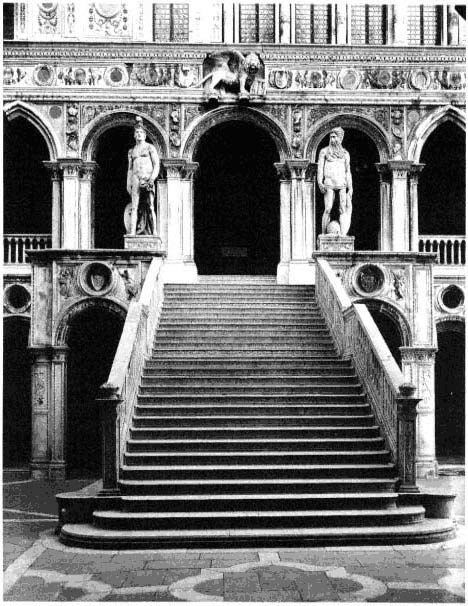
1.
Jacopo Sansovino, Mercury and Neptune, 1554, for the Giants' Staircase by Antonio
Rizzo (1484-1501), Palazzo Ducale, Venice.
Photo courtesy of Osvaldo Böhm.
machinery — in lyric poetry, pastoral canvases, domestic architecture, or the abstractions of musical style?[14] Still more, how can we hope to comprehend the curious intermixing of foreign habits with local tastes to which a city flooded with stranieri in various stages of assimilation was so habituated — and most especially in confronting works with no unilateral relationship to the state?
These are the central questions in my consideration of the city's relationship to one musical genre, the madrigal. Its two most famous exponents from mid-century, Adrian Willaert and Cipriano de Rore, both linked with Venice, were Netherlanders. Even though the repertory of madrigals they developed around 1540 must be understood within the play of things Venetian, much about it that changed the shape of secular music in Italy was decidedly the product of northern music — a network of separate parts woven into a pensive and intricate polyphony. What is more, the most ample and significant contributions to the Venetian repertory were settings of lyrics by a Tuscan poet, Petrarch.
Willaert's one monument of madrigalistic composition was located in his four-, five-, six-, and seven-voice corpus of motets and madrigals called Musica nova, published in 1559 but probably written for the most part between the late 1530s and mid-1540s. This collection preserved Willaert's weightiest undertakings in both genres, twenty-seven motets and twenty-five madrigals. It was published in a spectacular format, with its title enclosed in a fantastical illustration representing a storm-swept Venetian sea bordered by mermaids and cupids (Plate 2). A woodcut of the aged Willaert, emanating gerontocratic excellence, appeared on its verso (Plate 3).
The madrigals of the Musica nova departed from all previous ones by consistently setting complete sonnets — all but one of them Petrarch's — in the bipartite form of the motet and by adapting a dense counterpoint formerly reserved for sacred music. Like the speech of Tomitano's ideal patrician, these madrigals aspired to a declamation less "sung" than set forth with recitational "gravity." The compositional principle that guided them was above all commitment to an exemplary presentation of Petrarch's words, a principle pursued with all the deliberation, learnedness, and restraint insisted on by guardians of official Venetian character. None of the madrigals Willaert published between 1534 until his death in 1562 in anthologies or other mixed collections echoed the spirit of patrician Venice with the same precision or weight as the Musica nova; if anything, they diffused and softened its aims.
Long before the Musica nova left its private shelter, Rore made a stunning debut as an apparent unknown with his Madrigali a cinque voci of 1542 (later known as the Libro primo ). Like Willaert's madrigals, many of Rore's set full sonnets by Petrarch,
[14] Indeed, David Rosand has argued that Venice essayed a unique sort of iconography designed to thwart single, unambiguous readings, seeking instead multivalent ones. He presented the idea in "Painting in Venice: The Question of Meaning" (paper delivered at the Renaissance Society of America, Annual Conference, New York City, April 1, 1988), and in other forms in "Venereal Hermeneutics: Reading Titian's Venus of Urbino," in Renaissance Society and Culture: Essays in Honor of Eugene F. Rice, Jr., ed. John Monfasani and Ronald G. Musto (New York, 1991), pp. 263-80, and "So-and-So Reclining on Her Couch," in Titian: 500, ed. Joseph Manca, Studies in the History of Art (Washington, D.C., 1994).
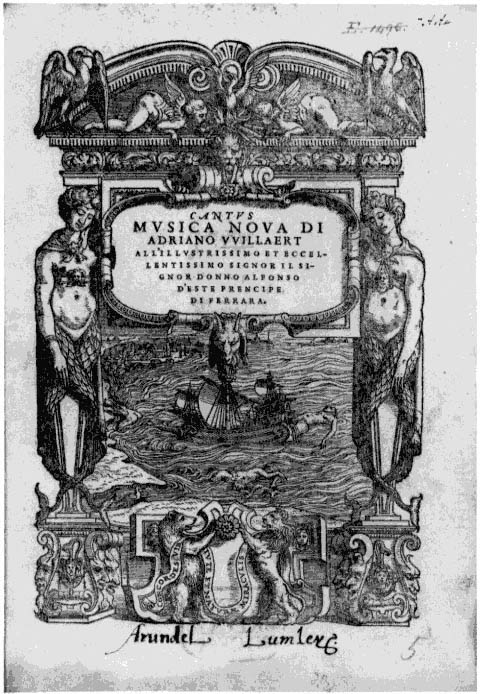
2.
Musica nova (Venice, 1559), title page.
Photo courtesy of the British Library.
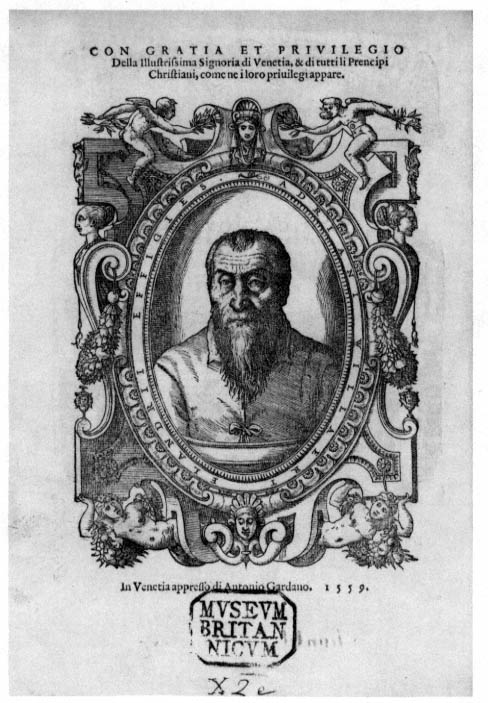
3.
Musica nova (Venice, 1559), portrait of Adrian Willaert.
Photo courtesy of the British Library.
as well as the verse of "high" literary moderns like Luigi Tansillo, Antonio Tebaldeo, and Francesco Maria Molza, and drew the verses along in an opaque polyphony. Yet his madrigals ventured more dramatic and expressive gestures than Willaert's. They contrasted melodies that were sometimes more cantabile than Willaert would invent, at other times rougher and more irregular.
Such biographical fragments as survive about Willaert and Rore might tentatively be related to differences in their music. As a servant to Italian patrons from 1515 or 1516 and chapelmaster of San Marco from 1527, Willaert's connection with the Venetian establishment seems relatively straightforward. Contemporary accounts saw in him the mythological personification of Venice, an embodiment of the modest reserve demanded of its nobles and figured in its stately images. In 1546 his pupil Girolamo Parabosco's comedy La notte called him "so kind, gentle, and modest that one could set him as an example of all manner of other virtues."[15] Willaert was hired, in accordance with governmental regulations, by the Procuratori de Supra, but at the express personal initiative of doge Andrea Gritti.[16] Nominally, at least, the cappella he administered was the private one of the doge. Willaert was thus an arm of the state whose position demanded unfaltering loyalty to the republic's self-image and its long-standing ideals. The Procuratori approved Willaert's suitability in the record of his appointment with the epithet "circumspectus vir" (a deliberate or cautious man),[17] a characterization on which numerous variations were rung in popular literature during his subsequent tenure. Thus, despite his northern origins — and, as we will see, despite the fact that he enjoyed the private patronage of the elite Florentine nobleman Neri Capponi — Willaert was wholly assimilated to a Venetian image and made instrumental in its representation.
Rore's orientation to Venetian cultural and musical habits is far more ambiguous. His biography remains cratered despite information that he probably resided in Brescia from at least 1542 until possibly 1545 or 1546.[18] From Brescia he seems to have produced freelance compositions for at least two Florentine exiles, Neri Capponi and Capponi's comrade Ruberto Strozzi. It seems doubtful that he ever lived in Venice, except perhaps briefly early in his career and then without a regular appointment.[19] More than this, it is unclear whether Rore was ever really Willaert's student. Only two documents allude to such a relationship between them: one, an
[15] "Tanto gentile, & cosi piacevole, & modesto, che si puo porre per uno essempio di tutti queste altre virtute" (as spoken by the character Gerardo, act 3, fol. 32').
[16] On Gritti's dogeship, his military success, his cosmopolitanism, and especially his affinity for the French, see Andrea da Mosto, I dogi di Venezia nella vita pubblica e privata (repr.; Florence, 1977), pp. 235-46. For a clarification of Gritti's involvement in Willaert's hiring see Giulio Maria Ongaro, "The Chapel of St. Mark's at the Time of Adrian Willaert (1527-1562): A Documentary Study" (Ph.D. diss., University of North Carolina at Chapel Hill, 1986), pp. 70-81.
[17] See Vander Straeten, La musique aux Pays-Bas 6:191, and Ongaro, "The Chapel of St. Mark's," p. 75 and Appendix, Document 44.
[18] I refer to Richard Agee's discoveries; see Chap. 2 n. 3.
[19] It used to be thought, owing to Francesco Caffi's unsupported claim, that Rore had been a member of the chapel under Willaert before transferring to Ferrara; see Chap. 8 below, n. 55. On Rore's trip(s) to Venice, where he delivered compositions to Capponi, see Chap. 2 nn. 35 and 36.
oblique remark in a dedication to Scotto's edition of Rore's Terzo libro a 5 of 1548 (RISM 15489 ), referring to Rore, Willaert, and "other disciples of his"; the other, a description of Rore as Willaert's discepolo on a title page printed in the following year. But these tell us only in fact that in the late forties some people in Venice had begun to describe Rore as a follower of Willaert's practice.[20] Altogether this is surprisingly scant evidence of a direct Venetian connection for Rore and of a circumstance that would place him in the city for an extended time. It is rather more pointed testimony to an association with Florentine exiles. Yet in their broad contours, if not their idiomatic details, Rore's madrigals of the 1540s embrace a style whose identity is otherwise exclusively the province of composers resident in Venice and the Veneto: Willaert, his students at San Marco — principally Parabosco, Perissone Cambio, and Baldassare Donato — and, beginning in the later 1540s, composers in the Veneto like Giovanni Nasco, Francesco Portinaro, and Vincenzo Ruffo.
Any attempt to explain Venice's effect on the course of secular music through its larger cultural themes, then, will be complicated both by the elusive genealogy of Venetian madrigal writing and by the complex and tacit place its various incarnations occupied in the city's larger cultural patterns.
Among Willaert's protégés even the Italians brought their own training and habits from cities scattered throughout the peninsula. It may be all the more significant, therefore, that one of the few from a Venetian dominion, a native of nearby Chioggia, became the foremost explicator and apologist for the Venetian idiom. Gioseffo Zarlino, theorist, teacher, and later chapelmaster, played a crucial role in clarifying for later generations the aesthetic impulses and compositional habits of contemporaneous Venetian musicians. His first publication, the imposing Istitutioni harmoniche of 1558, assumed the daunting task of codifying a style whose constant shifts and irregularities made it all but impossible to systematize. In this his role was unique, for his exegeses of Venetian counterpoint, modes, and text setting were only faintly anticipated by his predecessors and abandoned by his successors. Chief among the former is the Venetian Giovanni del Lago, whose sketchy, derivative writings from around 1538-41 only hint at the new horizons.
Without this written witness we would have virtually nothing from the mouths of musicians themselves. More plentiful explanations of Venetian thinking come from literati, whose accounts complement those of del Lago and Zarlino. Literary figures wrote abundantly on poetics, vernacular style, grammar, imitation, the questione della lingua, and genre, and in a wide range of forms: rhetorical handbooks, letters, commentaries, dialogues, and treatises. The large, rapid production of these
[20] The dedication in RISM 15489, written by the flutist Paolo Vergelli to Gottardo Occagna, was taken by Edward E. Lowinsky as evidence that everyone in Venice knew Rore to have been Willaert's pupil; see his "Calami sonum ferentes: A New Interpretation," in Music in the Culture of the Renaissance and Other Essays, ed. Bonnie J. Blackburn, 2 vols. (Chicago, 1989), 2:602-3. Yet the term used there is discepolo, like that in the title page of the 1549 print, Fantasie, et ricerchari a tre voci (RISM 154934) (also printed by Girolamo Scotto), a term that often meant "follower" (i.e., of someone's practice) rather than "student." For further discussion of this see below, Chap. 8 n. 56.
texts animated the dynamics of circulation and the creative processes of rejection, reinvention, and revision that were played out in reception. Ultimately, musical and literary writings of mid-cinquecento Venice illuminate one another, both of them translating Ciceronian precepts of style while imposing on them their own idiosyncrasies and formal demands.
In some way, virtually all these theoretical writings were dominated by the Venetian Pietro Bembo's dialogue on the questione della lingua, Prose della volgar lingua of 1525, a work whose relevance to secular music has been recognized for some time. Bembo's Prose recast Ciceronian rhetorical precepts in the terms of trecento Tuscan literary style. In this study I take Bembo's transformations of Ciceronian canons as central to a tropology of Venice that interconnects civic identity, rhetorical principles, and expressive idioms. Three of these canons were most crucial to Bembo's scheme: first, the separation of styles into three distinct levels: high, middle, and low; second, variazione, the varying of each style with a balance of opposed qualities broadly subsumed within the categories of gravità and piacevolezza (gravity and pleasingness); and third, decoro (propriety), the appropriate matching of styles to subjects. I argue that Bembo merged Venetian mythology with ancient rhetoric in a way that made one particular meaning of decorum — that of moderation — the all-embracing, universal principle of his stylistics; and further, that this principle functioned as an inseparable corollary of variazione, calling the latter into service as a means of tempering extremes in order to avoid too intense an emphasis on any one style or affect.
In proposing this scheme Bembo claimed Petrarch as his model for the vernacular lyric. Bembo's Prose tried to codify and make imitable Petrarch's rime for readers whose linguistic style he hoped to shape. Yet Petrarch's lyrics had already come to hold an unequalled appeal for the indigenous society that formed Bembo's most eager audience. Among the aspects of Petrarchan verse that appealed to Bembo and to the rhetorical culture for which he wrote was its delicate interplay of verbal sounds (as Dean Mace has pointed up).[21] In expounding the workings of these sounds according to his principle of variation, Bembo assigned a new importance to sound as an agent of linguistic meaning. This is the facet of his poetics that has commanded the greatest attention of music historians, interested in its effect on contemporaneous madrigalists. Nonetheless, I argue that Petrarch's continual undercutting of verbal utterance through oxymoron and paradox symbolized even more importantly the reserve on which Venetians claimed to insist in other domains. Coupled with its intricate plays of verbal-psychic wit, this poetics, not surprisingly, entranced a society bound by civic habit to discreet emotional display and simultaneously absorbed in a stylized self-presentation. By explicating Petrarch in Ciceronian terms, Bembo implicitly located his lyrics in the performative domain
[21] Dean T. Mace, "Pietro Bembo and the Literary Origins of the Italian Madrigal," The Musical Quarterly 55 (1969): 65-86.
of the orator. So doing he underscored the concerns and biases of his Venetian readers and granted them what must have seemed a deeply satisfying endorsement and an irrefutable authority.
In the succeeding pages I try to enlarge these themes to consider Venice's signal role in steering Italian secular music on a new course. Enlargement in this sense means something like the magnification one gets when peering through a lens. For in drawing repeatedly on sources like Tomitano's letter that stand outside the immediate business of making madrigals, I try to picture close up the intricate cultural weave of which madrigals were a part and to reconstruct aspects of its palpable form. My aim is not to find in these far-flung sources exact mirrors of the madrigalists' ideals or the aesthetic structures they built. Rather, it is to develop, figuratively speaking, a colloquy between various players in Venice and to discover in the city's multiple texts a way to contemplate the diverse meanings and eclectic processes that involved madrigals in larger cultural patterns.
On the path to finishing this book I received invaluable help from many institutions and countless friends and colleagues. The groundwork was done with the aid of the Gladys Krieble Delmas Foundation for Research in Venice, the Penfield Scholarship fund of the University of Pennsylvania, and the American Association of University Women. I expanded research in Venice and Florence with help from a Grant-in-Aid from the American Council of Learned Societies and awards from the University of Southern California Faculty Research and Innovative Fund and the American Philosophical Society. A Fellowship for University Teachers from the National Endowment for the Humanities provided me with an indispensable year's leave from teaching, during which most of the writing was done. To all of these I am deeply appreciative. I also wish to thank the American Musicological Society, the Chicago Humanities Institute, the Gladys Krieble Delmas Foundation, the National Endowment for the Humanities, and the Associates of the University of California Press for generous subventions toward publication of this volume.
The Renaissance Quarterly kindly granted permission to reprint substantial portions of Chapter 4, which appeared in volume 42 (1991) as "The Academy of Domenico Venier, Music's Literary Muse in Mid-Cinquecento Venice."
My work was helped by the staffs of many libraries and archives, of which I would like to acknowledge especially: Sandra Sambo, Michela dal Borgo, and Alessandra Schiavon of the Archivio di Stato di Venezia; Orsola Gori of the Archivio di Stato di Firenze; Paul Gehl and Robert Karrow of the Newberry Library, Chicago; Alice Schreyer of Special Collections at the University of Chicago; and the staffs of the British Library, the Biblioteca Nazionale Marciana, the Museo Civico Correr, the Fondazione Cini, the Folger Shakespeare Library, the Bancroft Library at the University of California at Berkeley, and the University of Pennsylvania Rare Book Room.
At the University of California Press I benefited from the expert skills of my acquisitions editor Doris Kretschmer and project editor Rose Vekony and from astute copyediting by Fronia W. Simpson. I am grateful for helpful comments I received from two readers solicited by the press, James Haar, a longtime source of stimulating dialogue on Italian madrigals, and Dean Mace. I hope I can be forgiven for mentioning just a fraction of the many other people who have helped me along the way: Richard Agee, Tiziana Agostini Nordio, Linda Armao, Jane Bernstein, Lawrence Bernstein, Lorenzo Bianconi, Bonnie Blackburn, David Bryant, David Butchart, Donna Cardamone Jackson, Stefano Castelvecchi, Julie Cumming, Robert Durling, John Freccero, Jonathan Glixon, John Walter Hill, Lynn Hooker, Alvin Johnson, Michael Keller, Victoria Kirkham, Julius Kirshner, Mary Lewis, Anne MacNeil, Paul Martell, Stefano Mengozzi, Robert Morgan, Anthony Newcomb, Giulio Ongaro, Jessie Ann Owens, Claude Palisca, Nino Pirrotta, Harold Powers, Francesco Rizzoli, John Roberts, David Rosand, Ellen Rosand, Shuli Roth, Ingrid Rowland, Marta Tonegutti, Antonio Vassalli, Nancy Vickers, and Elissa Weaver, and all the members of the Petrarchism seminar at the University of Chicago. Many of them are thanked in footnotes where it has been possible to point to a particular debt.
There are several others whose roles I must acknowledge more specially. Tita Rosenthal offered probing comments and copious bibliographical advice on Chapters 1 through 6 and made Venice an altogether richer place for me. Gary Tomlinson, at first the advisor on my dissertation, has since been a continual interlocutor on madrigals and histories. He knows how important our conversations have been to me over many years, for which I could not begin to thank him here. My friend and colleague Howard Mayer Brown gave me many lively conversations and insights on cinquecento music and countless other topics, scholarly and otherwise. Before his sudden death in Venice on 20 February 1993, every page of this book was intended to elicit his sharp reading. At every turn my husband, Thomas Bauman, has contributed his critical acuity as well as his remarkable skills as a writer, linguist, musician, editor, and computer whiz. I have been abashed and touched by his colossal support over all this time. And I have been blessed by the good humor, affection, and patience of Emily and Rebecca Bauman.
Finally a few words about the dedication. I take leave of this project deeply aware that what I have tried to envision in the nexus of people's language, their pictures, their music, and their city had its origins in my parents' house. The example they gave me to imagine worlds beyond our own cannot be measured in words. I dedicate this book to them with the sort of tender appreciation that the frailty of life makes only sweeter.
CHICAGO, SPRING 1993