
Tz'u, Tz'u Writers Singing Girls
Surely the close association between tz'u and professional female entertainers must bear on any answer to the question. To remind the reader of how extensive that association was, I shall begin here by reviewing and discussing some representative passages in anecdotal writings that depict it. I will concentrate on sources that concern two men of letters, Ch'in Kuan and Huang T'ing-chien. Both men were prolific tz'u writers, but unlike, say, a man such as Liu Yung, who was known for little else than his dissipations in the pleasure quarters, Ch'in Kuan and Huang T'ing-chien were also serious shih poets and, more importantly, holders of prestigious literary posts in the capital (e.g., court historian, drafter of decrees, erudite at the imperial academy). We would be wrong to think that it was only men of low or little stature, like Liu Yung, who were depicted in contemporary sources as being in close and intimate contact with professional entertainers.
An early twelfth-century collection of anecdotes about tz'u , Yang T'i's Ku-chin tz'u-hua , contains the following story about one of Ch'in Kuan's compositions:
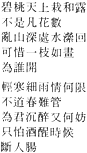
When Ch'in Shao-yu was staying in the capital, a high official once invited him to a feast, during which he brought out Emerald Peach, one of his favorite concubines, to encourage the guests to drink. She did it, however, listlessly. Shao-yu understood what was on her mind, and he, in turn, raised a cup and urged Emerald Peach to drink. The high official said, "Emerald Peach has never been much of a drinker," not wanting Shao-yu to impose on her. But she said, "Today, on this academician's behalf, I'll get dead drunk!" She grabbed a large winecup and took a long drink. On the spot, Shao-yu then composed this song to the tune "Lady Yü":
An emerald peach in heaven grows amid sweet dew,
not an ordinary flower.
Deep in jumbled hills, where the river winds,
how touching! A single branch like a painting,
for whom does it blossom?
Light chill and fine rain—boundless feelings!
No one knew spring would be so hard to control.
Why shouldn't I get drunk for you?
My only worry is that once I'm sober,
a heart will break.
Everyone regretted what had happened. The high official said, "Don't ever let this concubine appear at one of our feasts again!" With that, the guests all laughed.[4]
There are many such anecdotes that purport to describe the circumstances under which a tz'u was written. A substantial proportion of them are quite unconvincing. Often the connection between the song and the story is tenuous, or the particulars may even be contradictory.[5] This story, however, actually helps to make sense out of the song, which is indeed found in Ch'in Kuan's collection of tz'u .[6] Of course, even without the story we would realize that "Emerald Peach" (Pi-t'ao) must be the name of a girl. But the second stanza, whose language is more vague than the translation suggests, would otherwise be rather unclear, especially the third line, where it would be uncertain who was getting drunk for whom. The story clarifies these lines by giving a sensible account of the dynamics between three persons: the bored singing girl, the attractive Ch'in Kuan, and the jealous and protective host. Ch'in's song, with its frank and aloof depiction of the girl's unenviable situation, has the effect of deflating the spirits of the revelers. The host then pretends to be
[4] Yang T'i (early 12th cent.), Ku-chin tz'u-hua (in Chiao-chi Sung Chin Yüan jen tz'u , ed. Chao Wan-li (Taipei: Chung-yang yen-chiu-yüan, li-shih yü-yen yen-chiu-so, 1972), p. 10b. For the text of the tz'u I have adopted the textual variants in the Ch'üan Sung tz'u version of the piece (see n. 6 below).
[5] See, for example, the anecdote about one of Chou Pang-yen's tz'u discussed by James R. Hightower, "The Songs of Chou Pang-yen," Harvard Journal of Asiatic Studies 37 (1977): 237–38, as well as that referred to in my study, The Literary Works of Ou-yang Hsiu (1007–72) (Cambridge: Cambridge University Press, 1984), pp. 136–37.
[6] The piece is "Yü mei-jen," no. 2. See T'ang Kuei-chang, ed., Ch'üan Sung tz'u (Hong Kong: Chung-hua shu-chü, 1977), 1:467; hereafter abbreviated CST .
outraged, trying to relax the tension and put everyone back at ease. The story is a plausible account of how the song might have been written, whether or not it is historically accurate.
Ch'in Kuan evidently had a reputation as something of a gallant, an image that must have been founded largely on the widespread popularity of the romantic songs he wrote. Several anecdotes tell of singing girls or courtesans who fell in love with him. The most elaborate story (whose reliability certainly is open to question) has him traveling through the undistinguished city of Ch'ang-sha, on his way into exile, when he meets a singing girl who possesses, to Ch'in's amazement, a manuscript copy of his tz'u . Without revealing his identity, Ch'in speaks with the girl and learns that she could sing all of his songs but had no interest in those by other writers. "Have you ever met this Academician Ch'in?" he asks her. "I live here in a remote and uncultured area. He is a high-placed gentleman of the capital. Why would he ever come here? And even if he did, why would he look at me?" Ch'in persists: "You say you are in love with Academician Ch'in, but it's just his songs you like. If you saw his face, you might feel differently." "No," she replies, "If I could ever meet him and somehow become his slave, I would die with no regrets." Ch'in finally reveals his identity, and the girl withdraws respectfully from the room. Shortly she reappears, dressed in formal attire, and bows to Ch'in from the doorway. A feast is prepared by the girl's mother, and when Ch'in is seated the place beside him is left vacant in deference to him. The girl performs her entire repertoire of his songs. At the end of the evening, the girl welcomes Ch'in to her bed. Ch'in stays on a few days with her, and when he finally resumes his journey, the girl vows to wait for him until he is pardoned. Ch'in goes off to exile, where he eventually dies. The girl receives news of his death in a dream, whereupon she sets out to mourn him. When she arrives beside his coffin, she walks around it, cries out, and expires.[7]
In its present form this story is surely romanticized fiction, but the bulk of it, without the ending, may well have its roots in a popular image of Ch'in as a man whose songs could win for him the hearts of singing girls. Unfortunately, the girl in this story is unnamed. Other of the girls Ch'in is said to have favored are supposed to have their names coded into songs he wrote for them. More than one source reports that when Ch'in Kuan was serving in Ts'ai-chou he had an affair with a singing girl named Lou Wan, whose polite name was Tung-yü. He is
[7] Hung Mai (1123–1202), I-chien chih (Peking: Chung-hua shu-chü, 1981), "pu" section 2.1559–61.
said to have written a tz'u for her, one that is likewise found in his collection,[8] whose opening line reads: hsiao-lou lien-yüan heng-k'ung , "The small storied house with a garden blocks the sky." The opening line of the second stanza is: yü-p'ei ting-tung pieh-hou , "His jade pendant chimes after he departs." The first line encodes the girl's formal name (hsiao-lou for Lou, and yüan is a pun on Wan), and the second her polite name.[9] Ch'in is supposed to have gone a step further in a song he wrote for another girl, T'ao Hsin-erh. The closing line reads: t'ien-wai i-kou ts'an-yüeh tai san-hsing , "Beyond the sky, a hook of a moon with three stars attached"—a clever way of describing the written character hsin (heart), the girl's name.[10] Both of these songs are quite conventional portraits of longing and separation, and neither of them has a preface or any other indication that they were written for a particular woman. But the assertions that they were deserve to be taken seriously because they help to explain what otherwise strike the reader as oddities in these two songs: the phrase lien-yüan (literally, "with a garden") seems slightly odd in its line (thus, some texts have lien-yüan , "stretching afar," instead),[11] and the detail about the moon and three stars seems gratuitous without some reason for its presence.
If Ch'in Kuan was the romantic poet whom the singing girls were apt to fall for, a rather different image of Huang T'ing-chien emerges from his tz'u and the anecdotes surrounding them. Huang T'ing-chien is primarily known, of course, as a shih poet, and one whose highly allusive and bookish style seems at first sight quite unpromising for any involvement with tz'u . It is interesting, then, to learn that not only was Huang also a prolific tz'u writer, he was one who used extremely colloquial language in his tz'u —so colloquial that the meaning of some of his songs now escapes us. But it is not only the diction of Huang's tz'u that makes them singular: a sizable portion of them present a particular voice that is not often encountered in other tz'u of the time. It is the voice of an aging official who is infatuated with one or another singing girl but gener-
[8] "Shui lung yin," CST , 1:455.
[9] The sources are Tseng Tsao's (d. ca. 1155) Kao-chai shih-hua (Hu Tzu [1082–1143], T'iao-hsi yü-yin ts'ung-hua—ch'ien-chi [Peking: Jen-min wen-hsüeh ch'u-pan-she, 1981], 50.338), and Tseng Chi-li's (late 12th cent.) T'ing-chai shih-hua , in Li-tai shih-hua hsü-pien , ed. Ting Fu-pao (Peking: Chung-hua shu-chü, 1983), 1:309 (Lung Mu-hsün, ed., Su-men ssu-hsüeh-shih tz'u [Peking: Chung-hua shu-chü, 1957], vol. 1, Huai-hai chü-shih ch'ang-tuan chü , p. 81).
[10] The tz'u is "Nan ko-tzu," no. 1, CST , 1:468. The source for this reading of the tz'u is Tseng Tsao, Kao-chai shih-hua (Hu Tzu, T'iao-hsi—ch'ien-chi , 50.338).
[11] This is what is found in CST , 1:455, but the shih-hua texts cited above have yüan , "garden," instead.
ally cannot attain the object of his desires. Huang apparently wrote tz'u that cultivate this voice all through his life. Several of them, in which the speaker identifies himself as an old man, were written in the last years of Huang's life, during his southwestern exiles to Ch'ien-chou, Jung-chou, and I-chou.
What is really striking about these tz'u of Huang's is how many specifics they contain that encourage us to read them autobiographically. These are not vague expressions of male love and longing. Thanks to details found both in the songs themselves and in their subtitles or prefaces, these compositions appear firmly rooted in Huang's life. We know, for example, that as an old man Huang wrote three songs for a very young singing girl named Ch'en Hsiang ("just over thirteen, spring not yet complete"), whom he met in Heng-yang while on his way into exile in 1104. The songs allude to a brief romance followed by the songwriter's forced departure, and dwell on the speaker's worry that by the time he is able to return the girl will have chosen another man. Huang continued to write for Ch'en Hsiang after his departure. It seems that she took up calligraphy and wrote to Huang (the master calligrapher!) asking for a sample of his characters in small regular style. The sample he sent back to her was yet another tz'u , which describes her and refers to her progress at her new avocation.[12]
One relies heavily upon the subtitles to Huang's songs for such information, and it should be acknowledged here that those subtitles might conceivably have been added by some later editor who, working on the presumption that the songs were autobiographical, did his best to identify their original settings. On balance, however, the chance of this is slight. Several of the subtitles are indisputably written in the first person. As for those subtitles whose point of view is ambiguous and might either be read as first-person or third-person statements (a problem commonly encountered in literary Chinese), the very specificity of their information argues against the possibility that they are from an editor's hand. Su Shih had, of course, established a convention of writing such identifying tags to one's own tz'u , and it is preferable to think that Huang simply followed his example.
The song translated below is less explicit than some, but the information it does contain makes it easy to reconstruct a setting grounded in Huang's biography:
[12] This information is gleaned from three of Huang's songs and their subtitles: "Mo-shan hsi," CST , 1:388; "Mo-shan hsi," no. 2, CST , 1:402; and "Juan lang kuei," no. 1, CST , 1:402.
To the tune "Swaying Courtyard Bamboo"[13
] Written outside the Chi-chou city wall ,
while serving as magistrate of T'ai-ho
Soughing winds at the south hall blow plum blossoms,
ravens cry, startled in treetop nests.
Our meeting in a dream did not last long,
across the city wall tonight you understand.
I sit up late, the water turns emerald pointlessly.
The glow of the mountain moon sinks in the west.
I bought a place to lodge you in,
but stubbornly you wouldn't come.
Today Heaven glares at you,[14
] you'll go among fowl forever, abused by them.
Useless now is my pity for you![15
] Wind and sun will injure the branch of blossoms.
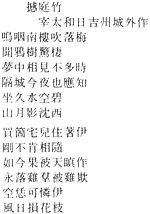
Huang served as magistrate of T'ai-ho hsien from 1081 to 1083. T'ai-ho was part of Chi-chou prefecture (modern Chi-an, Kiangsi), and Huang must have made periodic visits to the prefectural seat. This song was evidently written as Huang was leaving Chi-chou to return to his post in T'ai-ho. The song, together with its subtitle, suggests that Huang had met a singing girl during his stay in the city and tried to convince her to go back to the outlying T'ai-ho with him, assuring her that he would set her up in her own house. She refused, and Huang, frustrated
[13] "Han t'ing chu," CST , 1:390.
[14] Adopting the variant ni for tso (Lung Mu-hsün, Su-men , vol. 2, Yü-chang Huang hsien-sheng tz'u , p. 22) since the word must rhyme.
[15] Adopting the variant o-lien "intense love" for k'o-lien (Lung Mu-hsün, Su-men , vol. 2, Yü-chang Huang hsien-sheng tz'u , p. 22).
and bitter, wrote this song (and possibly even sent it to her) on the first night of his journey home. To "go among fowl" must mean to stay with the other girls Huang had found her among. Another of Huang's tz'u singles out a girl as a "kingfisher among the fowl."[16]
In his later years, it was more common for Huang to represent the girl as willing but his own circumstances as unfavorable. An anecdote in Wu Tseng's Neng-kai chai man-lu (1157) confirms the information given in the song's subtitle, which dates it to Huang's fifty-eighth year:[17]
To the tune "A Happy Event Draws Near"[18
] In T'ai-p'ing prefecture a little singing girl, Yang Chu, played the zither and
presented wine
Once she touches those heart-awakening strings,
her feelings show on two slanted hills.
When she plays the part where men of old sorrowed,
pearls hang on her eyelashes.
This governor does not choose to come or go,
don't let tears mark your red cheeks.
What a pity that in old age I dislike wine
and disappoint the brimming plantain leaf.[19]
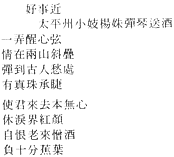
The reader of Huang's songs soon becomes accustomed to taking the term shih-chün , "governor," as a reference to Huang himself, especially in the context of forced travel. (In fact, nine days after arriving at his post as governor of T'ai-p'ing, Huang was demoted and ordered to leave.) The situation implied here is that the girl loves the songwriter deeply and is brokenhearted over his imminent departure. As soon as she begins to play, her sorrow is evident in the music and on her face
[16] "Mu-lan hua ling," no. 46, CST , 1:393.
[17] Wu Tseng (late 12th cent.), Neng-kai chai man-lu (TSCC ed.), 17.487.
[18] "Hao-shih chin," no. 2, CST , 1:411.
[19] Adopting the textual variant chiao , "plantain," for chin ; see Lung Mu-hsün, Sumen , vol. 2, Yü-chang Huang hsien-sheng tz'u , p. 66.
(the "slanting hills" are her eyebrows). The governor, meanwhile, is so old and infirm that he cannot even find solace in wine.
It turns out that Huang wrote a shih poem about the same singing girl, as Wu Tseng points out. The contrast between the two pieces is revealing:
Written in T'ai-p'ing Prefecture (no. 2)[20]
Timeless emotions are conveyed by her fingertips,
Yang Chu in misty moonlight, year after year.
To whom does her own heart fly?
She plays "Pine Wind" so fervently, she nearly
breaks a string.

It is precisely the personal involvement of the author with the girl that is absent from the shih poem.