
Richard Matheson: Storyteller
Interview by Pat McGilligan
Richard Matheson's fan club is a big one, and his name is familiar to horror, science fiction, and fantasy fans around the world.
In Hollywood permanently since the late 1950s, Matheson is responsible for classic science fantasy films (The Incredible Shrinking Man, based on his own first novel), vintage television episodes (fourteen of the best, early Twilight Zone segments; plus noteworthy contributions to Alfred Hitchcock Presents, Star Trek, and Night Gallery ); a slew of stylish Edgar Allan Poe adaptations for the producer-director Roger Corman in the 1960s (including House of Usher, The Pit and the Pendulum, Tales of Terror, and The Raven ); and landmark telefilms (Steven Spielberg's breakthrough made-for-TV feature Duel; The Night Stalker about a vampire in Las Vegas, which won the Writers Guild Award for Best Television Script; and The Morning After with Dick Van Dyke as an alcoholic corporate executive).
Scriptwriting has fueled and financed his fiction writing and vice versa. While maintaining his Hollywood footing, Matheson has continued to write an impressive number of short stories and novels. Many have been adapted for the big or the small screen, sometimes by Matheson himself, sometimes not. Horror was a longtime specialty, and two of Matheson's scariest books have had a long life in print. I Am Legend (New York: Walker, 1970), about the sole survivor of a global plague, has been filmed twice, as The Last Man on Earth and The Omega Man. His haunted-house novel, Hell House (New York: Viking, 1971), is one of the all-time spookiest. Somewhat watered-down but still terrifying, it became the 1973 film The Legend of Hell House.
Since the early 1970s, Matheson has eschewed sheer horror and ranged far and wide. He has adapted one of his own novels, the time-travel romance Bid Time Return (New York: Viking, 1975), into the film Somewhere in Time. He developed Ray Bradbury's Martian Chronicles into a television miniseries. He
and Steven Spielberg have maintained a long-standing association, which began by chance and has continued out of mutual admiration. In 1983, they worked together again on Twilight Zone—The Movie. Matheson was involved in three of the four segments of the anthology film, including one that recycled his own original episode from the 1960s, "Nightmare at 20,000 Feet"; later, Matheson consulted and wrote for Amazing Stories, also for the 1985–87 revival of the Twilight Zone series on television. In addition, Matheson contributed the script for Jaws 3-D, the third in the Spielberg-originated sharkamok film series.
Matheson has made a career sidelight out of mining the material of other fantasists, and has faithfully, if sometimes loosely, scripted not only literary works by Edgar Allan Poe and Ray Bradbury but also the speculative fiction of Fritz Lieber, Jack Finney, and August Derleth. A 1990 Matheson-scripted telefilm, The Dreamer of Oz, offered the writer's sincere, warm-hearted paean to the famous author of children's books, L. Frank Baum (portrayed by John Ritter). The New York Times television critic John J. O'Connor declared the telefilm "shamelessly on target."
Recently, Matheson has returned to his boyhood enthusiasm for westerns. His 1991 novel Journal of the Gun Years (New York: Berkley, 1991), about a legendary marshal who reveals the harsh truth about himself in his journal, was hailed by Stephen King, one of Matheson's many admirers, as the best book he had read that year. It won the coveted Golden Spur Award for western writers, and was followed by The Gunfight (New York: Berkley, 1993).
Matheson is a tall man with a trimmed beard and thinning blond hair. He is soft spoken, mild mannered, equable. An interview with him quickly turns searching and philosophical. Raised as a Christian Scientist, nowadays the writer remains preoccupied by metaphysical questions. Indeed, in 1993, Matheson published his first nonfiction book, an exploration of the writings of Harold W. Percival, about the quest for spiritual enlightenment, called The Path (Santa Barbara: Capra Press).
Paying the bills has always been an important motivation for a productive career. The struggle to eke out one's existence, the terror of the mundane, the ordinary man caught up in macabre circumstances—to some extent, these recurrent Matheson motifs, imagined into unforgettable extremes, have found their inspiration in his own life of hard work and the uphill climb that he discusses in this interview.
A lover of classical music, Matheson finds time to compose music and, with his wife, helped found a small theater organization in the community where he lives. For many years, he acted regularly in local stage productions. Community and family remain important to him. His elder son, Richard Christian Matheson, already has a solid reputation as a motion picture, television, and fiction writer, and was his father's cowriter on the 1990 screen comedy Loose Cannons. His younger son, Chris, cowrote the two highly success-
ful films Bill and Ted's Excellent Adventure (1989) and Bill and Ted's Bogus Journey (1991), as well as Mom and Dad Save the World (1992). Daughter Ali is also a writer, story editor, and producer. His older daughter, Tina, somehow managed to escape writing; she is a social worker.
We had a good chuckle on the day I arrived to interview Matheson at his home in Hidden Hills, California, a planned community an hour's drive north of Los Angeles. I happened to be wearing a jumpsuit, and had just come from spending time with the director Martin Ritt, who was notorious for always wearing jumpsuits. Matheson confessed that he too was invariablely a jumpsuit man, although he wasn't wearing one that day.
After the interview, Matheson took me outside and rummaged around in his garage, generously proffering copies of several of his books that I hadn't
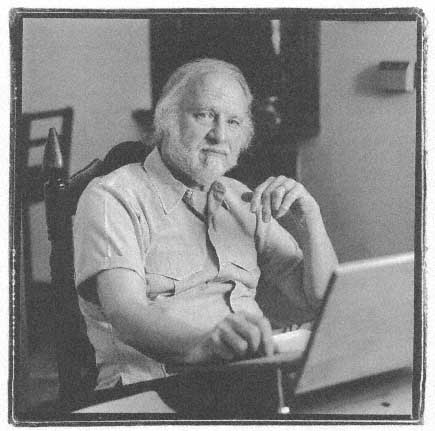
Richard Matheson in Calabasas, California, 1993.
(Photo by William B. Winburn.)
caught up with. When I went away, my arms were full, and I was shivering with the anticipation of pleasure.
| ||||||||||||||||||||||||||||||||||||
|
Selected television credits include the following episodes for The Twilight Zone series: "And When the Sky Was Opened" (1959, based on his short story "Disappearing Act"; "Third from the Sun" (1960, based on his short story); "The Last Flight" (1960, script); "A World of Difference" (1960, script); "A World of His Own" (1960, script); "Nick of Time" (1960, script); "The Invaders" (1961, script); "Once upon a Time" (1961, script); "Little Girl Lost" (1962, script based on his short story); "Young Man's Fancy" (1962, script); "Mute" (1962, script based on his short story); "Death Ship" (1962, script based on his short story); "Steel" (1962, script based on his short story); "Nightmare at 20,000 Feet" (1963, script based on his short story); "Night Call" (1963, script based on his story "Long Distance Call"); and "Spur of the Moment" (1964, script).
Other television episode credits include "The Return of Andrew Bentley," Thriller (1962); "Time Flight," Bob Hope's Chrysler Theater (1966); "The Enemy Within," Star Trek (1966); "The Big Surprise," Night Gallery (1970); "The Funeral," Night Gallery (1972), based on his short story; "The New House," Ghost Story (1972) and Amazing Stories (creative consultant, 1985–1987).
Telefilms include Duel, ABC Movie of the Week (1971); The Night Stalker, ABC Movie of the Week (1972); The Night Strangler, ABC Movie of the Week (1973); The Morning After (1973); Dying Room Only, ABC Movie of the Week (1974), based on his novelette of the same title; Scream of the Wolf. ABC Movie of the Week (1974); Dracula (1974); The Stranger Within (1974, based on his short story "Mother by Protest"); "Amelia," part of the Trilogy of Terror (1975, based on his short story "Prey"; the other two parts were based on his short stories "The Likeness of Julia" and "Millicent and Therese"); Dead of Night (1977, three segments, including one based on his short story "No Such Thing as a Vampire"); The Strange Possession of Mrs. Oliver (1977, story, script); The Martian Chronicles (1980, script); and The Dreamer of Oz: The L. Frank Baum Story (1990, co-story, script).
Published novels and short story collections include Fury on Sunday, Someone is Bleeding, I Am Legend, Born of Man and Woman, The Shrinking Man, The Shores of Space, A Stir of Echoes, Ride the Nightmare, The Beardless Warriors, Shock!, Shock II, Shock III, Shock Waves, Hell House, Bid Time Return, What Dreams May Come, Journal of the Gun Years, The Gunfight, By the Gun, Shadow on the Sun, Earthbound, 7 Steps to Midnight, Now You See It, and The Memoirs of Wild Bill Hickock.
Nonfiction works include The Path.
You started out in journalism, right?
Sort of. I had always wanted to be a writer, but I was very good in mathematics—I would say "unfortunately" now. A group of students from the grade school I was going to, about twenty-one of us, took a mathematics test, and five of us got into Brooklyn Technical High School. By an error in judgment, I went there for four years and majored in structural engineering, taking all of those incredibly arcane, technical courses.
When I got out of the Army, I went to a vocational advisory service. I could have gotten into any technical college, because I had so many credits—and this Brooklyn technical school, at the time, was very highly regarded. When the vocational adviser, bless his heart, realized what I really wanted to do—when he found out I wanted to be a writer—he combined my engineering background with journalism, and wrote to colleges saying I wanted to be a technical writer. He got me into the University of Missouri journalism school on the GI Bill—only it was a better deal, Public Law 16, because I had had frostbitten feet.
How did you make the leap from technical journalism into writing fiction and fantasy?
I never was in technical journalism. That was just a ruse to get me into that school. But I was in journalism, and as soon as I could, I became the music reviewer [of the college paper]. I used to review all the concerts and stuff. I wrote little plays there. A friend of mine and I wrote a musical they performed for the J show back in '47, or something like that. One of their early shows had Jane Froman in it.[*]
I always knew I was going to be a writer. But I came from a background where you didn't consider being a creative writer as a logical means of making a living.
What was your background?
An immigrant family. The idea of writing for a living was not really a feasible one to them, I think. The other people I knew during that time didn't think it feasible either. After I got out of college and was trying to write for a living, they'd say, "How long are you going to give it? When are you going to get a job?" A friend's mother, who was Irish, would ask me, "When are going to go to woik?"
At first I tried to get a job in magazines or newspapers when I got out of J school. I went back to New York, still trying to play the role of earning a living like a sensible human being. There was an editor of Esquire magazine whose name was Donald Berwick. He said to me, "Why don't you get a night job doing anything, and write in the daytime?" So that's what I did.
* The singer Jane Froman survived an airplane crash and became a popular figure during World War II. The story of her life was turned into the 1948 movie With a Song in My Heart. She briefly attended the University of Missouri School of Journalism.
Was there any kind of cultural background or impetus from your family?
I learned classical music from my family, from my sister and my mother. I read a lot; my sister read a lot. I was taken to the library when I was very young, and I became an omnivorous reader. My sister, again, was a great moviegoer who took us to the movies a lot, living in Flatbush, where there were, like, ten theaters within walking distance. I went to the movies constantly. I always went to the Saturday matinees, and you'd go whenever else you could. If you were staying home, sick from school, and you could get away with it, you'd sneak over to the movies.
What were you reading when you were growing up—science fiction and fantasy?
I read a lot of fantasy when I was a kid. Science fiction, I never read until I sold a story which they told me was science fiction.
Fantasy, like H. P. Lovecraft?
No. I never read H. P. Lovecraft. Actually, my reading was very unguided. When I was a real young kid, I read these huge volumes of fairy tales—The Red Fairy Book, The Green Fairy Book, The Orange Fairy Book. I read all of them. It's a joke by now, but I keep telling people I read a book called Pinocchio in Africa. That was one of the first books I took out of the library. People swear it doesn't exist. I don't know if Collodi—the guy who wrote the original—wrote it, but I swear I read it.[*] I read all of Kenneth Roberts's historical novels. Arthur Machen's The Great God Pan. Anything I could get my hands on.
Did you dream of writing movies?
Well, I always liked movies. Whether, in my teen years, I ever gave credence to the idea that I could actually write them, I don't know. But I corresponded with people like [the producer] Val Lewton when I was a teenager.[**] I remember writing to him and telling him that I had figured out two of his secrets for scaring people: one was that you lead the viewer's eye to one side of the screen and then have something jump out from the other side; the other was an extended period of silence, suddenly broken by anything—like a horse nickering in the stable—that would make you jump out of your skin. He wrote back to me that he and his editors, Robert Wise and Mark Robson, were delighted I had been able to figure this out. (Laughs. )
When you were watching movies, growing up, were you particularly affected by the movies that were fantasies?
Oh, sure. Nothing horrific, because my mother wouldn't let me listen to [the radio program] Witch's Tales and things like that. She wanted to protect
* Eugenio Cherubini, Pinocchio in Africa (Boston and New York: Ginni and Co., 1911).
** The producer Val Lewton was in charge of a special production unit at RKO in the 1940s, noted for turning out atmospheric, low-budget horror films, some of which—including Cat People, The Leopard Man, The Seventh Victim, The Ghost Ship, Curse of the Cat People, The Body Snatcher, and Isle of the Dead —have come to be regarded as minor classics.
me. She used to let me listen to Let's Pretend, which was on the radio, and which, in the early days, was almost as horrific as Witch's Tales. But she wouldn't let me go to the movies to see anything like that. I remember once she took me—I must have talked her into it—to The Werewolf of London [1935], with Henry Hull. When he started changing into a werewolf, I fell down and crawled up the aisle and stayed in the lobby. I couldn't handle it.
I liked fantasies—but they were the ones about benevolent ghosts. Topper [1937], Heaven Can Wait [1943], Here Comes Mr. Jordan [1941].
Did you have gods or paragons among the fantasy authors you were reading?
Not when I was young. Later on, William Golding, who's sort of a fantasy writer, stood out for me.[*] Oddly enough, years later, I was going to a gym in Reseda, swimming in the pool there, and a guy said to me, "I see you made the cover of Saturday Review. " I said, "I did?" He showed me the magazine. I swear to God, it was me, but it was William Golding! We were like twins. Amazing. It was like a doppelgänger effect.
Gods among directors? Obviously, Lewton.
You mean [the director Jacques] Tourneur[**]—but I don't think I was that aware of directors; I was just aware of movies in their entirety. The overall effect. If I had an idol when I was thirteen, it was Errol Flynn because I loved swashbucklers. I've always wanted to write one. I still haven't had a chance—to this day. Maybe I'll write one on my own.
I'm drawn toward fantasy—I always have been. But I love westerns, detective stories, mystery, suspense, swashbucklers, love stories, anything.
What was the night job you got?
My brother managed a place in New York where you typed up these metal address plates for magazines—I'd get a penny, penny and a half a plate. My mother and I would go together; we both did it. Then I'd write during the day.
What prompted you to move to California?
I really was drawn toward films. After I got out of college, even more so. I told you I had had frostbitten feet—a romanticized description of what they call trench foot, where your feet get wet and cold—that's how I got discharged from the Army. And my feet got very cold in Brooklyn, where I lived, especially during the winter when it was extremely cold.
Partly it was the attraction of the climate?
I probably used the climate as an excuse to myself. I lived on East Seventh Street in Brooklyn with my mother and I remember walking down the street one day and the wind was so cold and so loud I was screaming into it and I
* William Golding's first published novel is also his best-known, Lord of the Flies. He was awarded the Nobel Prize in literature in 1983.
** Jacques Tourneur was the director of many of the producer Val Lewton's best-known horror and suspense films.
couldn't hear my own voice. That was the day I decided I was going to go to California. It seems remarkable to me now, that I would have the chutzpah just to leave.
My agent had a writer out here, William Campbell Gault, who met me at the bus station and let me stay at his house for a few days. And he introduced me to other writers, including a group called the Fictioneers.
Who were the Fictioneers?
Mostly western, detective, and pulp writers. There was William R. Cox, Les Savage, Bill Gault—a whole pile of them. Hank Kuttner was the only one in the group writing science fiction and fantasy.[*] I don't think [Ray] Bradbury ever went to that particular group. It was a social club. We would meet for dinner and talk.
Was it an exchange of ideas?
I don't think so. They were hardboiled old pros. I don't think they sat around talking about creativity. They were more likely to talk about the prizefight the night before or the ballgame.
Were you the junior echelon?
I was the kid of the group. They were all in their late thirties or early forties.
When you say a lot of the Fictioneers were pulp people, do you mean "pulp" affectionately?
Sure. When I went to college and took writing courses, they would always talk about the distinctions between the pulp writer and the slick writer and the art writer. I came to realize that was ridiculous. There are only interesting stories and dull stories, no matter where they're printed.
The author Donald Westlake, speaking appropos of Jim Thompson, told me that what happens when you're writing pulp is: You're writing fast for the money, so you write along and get halfway through the story and suddenly realize you're in a knot. What you really should do is go back and untangle it properly, so that the story is clear from beginning to end. But because you're writing fast, you don't—you keep the knot and throw in a line, "Oh, yes, and he had divorced her three months before she was killed," to keep the story going. So that pulp has all the energy and style and the lure of literature, but frequently it's all knotted up illogically.
By that token [Robert] Ludlum would be a pulp writer still, because that's how he does it. Apparently, he doesn't really plot; he just starts out his stories
* William Campbell Gault is the author of many hardboiled and mystery novels including Blood on the Boards; The Bloody Bokhara; Dead Hero; Death out of Focus; Don't Cry for Me; The Hundred-Dollar Girl; Run, Killer, Run; and Vein of Violence. William R. Cox's many mysteries and westerns include Bigger Than Texas, Death on Location, The Duke, Firecreek, and Hot Times. Les Savage's novels include Hangtown, The Hide Rustlers, Last of the Breed, The Royal City, The Silver Street, and Teresa. Henry Kuttner's science fiction is anthologized as The Best of Henry Kuttner, with an introduction by Ray Bradbury. His novels include Beyond Earth's Gates, Big Planet, Return to Otherness, The Time Axis, and The Well of the Worlds.
and lets them roll all over the place. Somebody told me—and this person swore it was true—that Ludlum wrote one book and got to the middle of the story, killed off the main character, and then thought, "Oh, my God, what do I do now? I still have half a book to write . . . " So he had the guy's twin come back to finish the story. He had been out driving around, trying to figure out what to do when he saw a Gemini laundry truck. So the book became The Gemini Factor. That must be why they almost never make films out of his books, because you cannot make head nor tails of his stories. They sent me The Osterman Weekend before they made it [into a film], but I turned it down because I couldn't figure it out. They finally made a picture out of it, and I didn't know what the hell was going on. It was incomprehensible.
And the director [Sam Peckinpah] was going downhill, which didn't help matters. Under the condition of writing for the least amount of money per word imaginable, can a pulp writer maintain a high standard?
Of course it's better to be a little more careful. I never wrote like a pulp writer. Once in a while, you get inspired, like I did when I wrote a story called "Madhouse"—ten thousand words—and I rattled it all off in one sitting. But that's a rarity. It's much better to be a professional and a craftsman, and to rework things.
To this day, I've never written to the market. I've always written just what interested me and pleased me. As the perfect proof of that, just at the time when the horror novel was really starting to go crazy, I gave it up after I wrote Hell House. I had lost interest in it. I still have no interest in it. Now, it's like an industry, for Chrisakes.
When you were out here in the early fifties, was there much interaction with the film industry? Did you go to parties with Hollywood people?
No, no. I had nothing to do with Hollywood at all. Our hero was William R. Cox, who worked for Universal as a contract writer making $350 a week, which at that time was just a staggering amount of money to us. He was writing what he referred to as "tits-and-sand movies" for people like Yvonne DeCarlo and Jeff Chandler. We were in awe that he was making that much money.
You published your first short story in 1950?
Right.
And came out here in 1951?
Right.
Was it hard to make a living at first?
Oh, sure. I remember there was a point—'53, I think—when we had only $300 left; then I sold I Am Legend, and they paid $3,000 down. [It was published by Fawcett in 1956.] That saved my life. I think I borrowed that $300 from Bill Gault, too.
Why did six or seven years go by before you started writing movies? Was it that hard to break in?
Actually, I never even tried. Every once in a while, my agent would get interest, a call from The Dick Powell Theater once, but nothing ever came of it. I never in my heart of hearts thought anything would. Then, in 1954, we went back east because we were running out of money—my wife and I and our daughter and son—and I went to work for my brother again. He had his own business by then.
That was when I wrote The Shrinking Man. My agent, Al Manuel, sold it to Universal. They just wanted to buy the book. I recognized that this was my chance—now or never—to write the screenplay. They probably figured, "Let him have his ten weeks; then, we'll have it rewritten . . . " At the time, I was still living on Long Island.
That motivated your return to the West Coast?
Right.
When you adapted your novel into a screenplay, what kind of accommodations did you have to make in your thinking?
I took to it like a duck to water. I've always written visually when I write novels or short stories. I can see it as I write it; therefore, the reader can see it, and therefore, my prose transposes pretty easily to films. If you write that way,
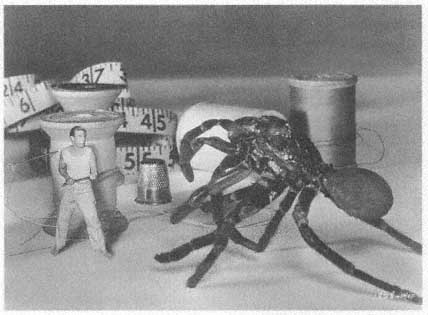
Grant Williams under attack from a spider in The Incredible Shrinking Man.
to me, it's just a question of learning the technique of film writing, which isn't that complicated. It will take you about maybe a week to learn it. I over-learned it. I wrote intricate camera descriptions, which was perhaps ridiculous. But I've always written detailed shooting scripts. To a lot of writers, it's a mistake. They always say, "Why bother? The director will change it." I do it anyway. It works out—sometimes.
In Duel, Spielberg shot my script. He embellished it, obviously, and made it marvelously interesting, but it was my script, my through-line, and many of my shots.
What was the reaction of Universal to your Shrinking Man script?
They had it rewritten. Richard Alan Simmons, who became one of the producers of Star Trek, rewrote it. I sent in a long rebuttal of why I should have solo credit. At the time, I thought I had coped with the whole thing masterfully, but I think he just backed off and let me have the credit because it was my first picture.
He was nice about it.
I think so.
But parts of the script are still his.
Sequences. It was still fundamentally my story, of course, but there were things . . . the paint-can sequence, for example.
There is really not another movie like The Incredible Shrinking Man—the story is so philosophical about life.
I know. I didn't really appreciate it for a long time. Actually, it wasn't until my son Richard became a professional writer that he pointed out how unusual it was for its time. The ending alone was unusual for its time.
In writing the script, I wanted to follow the structure of the book—which was sort of like Last Year at Marienbad [1962]—where you plunge right into the story and then have flashbacks. I had actually written the book manuscript the other way around, starting from when the main character was big. But by the time he got to be small, maybe one hundred pages had gone by, and I thought, "Geez, this is real boring." So I restructured it. I did the same thing with I Am Legend. I restructured that book too, so that you were just plunged into the story, and the flashbacks brought you up to date.
In The Shrinking Man, the first moment is the spider chasing him through the cellar, instead of telling the whole continuity of how it happened; then, I could pick specific points along the way to fill in the story.
Universal wouldn't go along with your structure.
No, they didn't do it that way. It's a straight continuity, as you know.
How about the unusual ending? They kept that.
[Albert] Zugsmith, the producer, kind of liked it.
You wrote more than one script for Zugsmith.
Quite a few, but none [of the others] ever got made.
What kind of a person was he?
The prototypical big-cigar, flushed, heavyset producer. Every time I saw him, he would say, "I'm going to give you a writing lesson, kiddie . . . " But he was nice to me.
Did the jobs come in rapidly after the film of Shrinking Man?
No. Not at all.
Television?
No. I came out here again in '55. I didn't start working in television until four years later.
You went through another dry period?
Very dry. I wrote a sequel to Shrinking Man for Zugsmith: "The Fantastic Little Girl," about his wife shrinking. Not made. I wrote two entire versions of Gulliver's Travels —one in which he's a boy. Then, at that time, Around the World in 80 Days [1956] was coming out, so Zugsmith had me write another version. He visualized David Niven as Gulliver, a sort of English wastrel, drunk, falling off a boat. And Cantinflas as a Lilliputian soldier.
Wasn't The Beat Generation a Zugsmith project too?
Yeah, that was after he left Universal and went over to Metro. Actually, that film was based on a true case history which he had all this material on—about a guy who would meet salesmen and talk to them on the road, learn all about their houses, where they were during the day, what they did; then he would go and attack the wives while the salesmen were still on the road. I wrote it as a police procedure film. It ended up . . . well, you know how. I remember a copy of the script, many drafts in, where Zugsmith had meticulously crossed off police everywhere and had written in fuzz. It turned into absolute nonsense. Lewis Meltzer also worked on the script . . .
You started writing for television in? . . .
Nineteen fifty-nine—when Chuck Beaumont and I went in to see The Twilight Zone people.[*] I had an agent for years and years who didn't do anything for me, and then I switched to Preminger/Stuart, so did Chuck, and suddenly we got phone calls for appointments. We both started working on The Twilight Zone. I started working on Lawman. He and I wrote a bunch of stuff for different shows.
What kind of hands-on involvement did Rod Serling have on The Twilight Zone?
Whenever I see one of my scripts for that show, it's always my dialogue—word for word. Respecting writers as he did, Rod let you do your own thing. It was really a nice experience. That was the first time I worked in television. I
* The television and motion picture writer Charles Beaumont, who died at the age of thirty-eight, has become a cult figure among science fiction and fantasy fans. His screen credits include Wonderful World of Brothers Grimm, Seven Faces of Dr. Lao, and The Intruder (from his novel). But the bulk of his work was in television, where he wrote a number of memorable originals for The Twilight Zone, Alfred Hitchcock Presents, and Thriller series.
didn't know how nice it was. We would have three-day rehearsals, for God's sake, where we sat around tables with actors and directors, and discussed the show. That's still pretty unheard of in television.
Yet, I have to say, I have really gotten more satisfaction out of other things on television. I've had more things on television that I felt good about than I ever had with films.
Would you have story conferences with Serling?
Yes, of course. You wouldn't just write a script that they thought was perfect. You'd go in to see him and [the producer] Buck Houghton, and sit and discuss changes.
Serling was always pushing the show in cerebral directions, with scripts that were thoughtful or thought provoking or somehow meaningful. Was that explicit in story conferences?
People always ask me why The Twilight Zone is still alive, and I always say, "Because the stories are so interesting." That's what I do. I tell an interesting story. I think that's why I'm still around.
I had never done a television script. Ordinarily, they would ask for an outline, or so I was told. But the first show I did, the idea I presented to them was so vivid that they just said, "Yes, do it."
You presented it orally?
Yes, to Rod Serling and Buck Houghton. I just said, "A World War I airplane pilot goes through a fog, lands, and he's in a modern SAC base." They said, "Yeah, do it," because the image was so vivid. Then I had to figure out the story.
Did you do the same sort of oral pitch with other people—with, say, Alfred Hitchcock?
No. I met Alfred Hitchcock once when there was a chance I was going to write The Birds. I never saw him otherwise. I guess I would meet with Joan Harrison and Norman Lloyd, the producers of the show. I only did one onehour show anyway—based on a novel of mine—Ride the Nightmare. I never worked on the half-hour show.
Was any other TV experience as good as The Twilight Zone?
Oh, Lawman was just as good—it was wonderful because of the producer Jules Schermer. If the scripts were the way he liked them, he never let anybody change a word. The lead, John Russell, was not the greatest actor in the world, but there was this director who used to work with John Ford who directed a few of them. I wrote a couple of outlines, and Jules said yes. He had total control. The scripts and the shows turned out very nicely. I got a Writers Guild Award for one of them.[*]
* Matheson earned a Writers Guild Award for Best One-Half Hour Episodic Drama for his "Yawkey" segment of Lawman in 1959. He also collected a Writers Guild Award for Best Adaptation from Material Not Originally Written for Television for The Night Stalker in 1972.
At the same time you were still writing short stories—which many writers consider the perfect, elegant form. Did you at all consider TV to be lesser work or job work?
No. I never considered that about anything. I just tried to do what interested me the most. That's why I've suffered such terrible disappointment when things turn out badly, because I put myself into everything—to this day. I just finished a script for Universal based on Conan Doyle's The Lost World, and it turned out great. Everybody was delighted with it. Then, what happens? Universal bought [the novel] Jurassic Park. That's going to be their dinosaur picture, so mine is out the window. That's crushing to me.
You mentioned that Joan Harrison bought a novel of yours and turned it into a television episode. Was that happening a lot with you—that people were buying your short stories and novels, as well as original stuff?
Yes. But mostly original stuff. I did one Combat. I remember Bob Blees, the producer, introducing me around, "Here is the very talented Mr.Matheson . . . " I wrote the script. When I got the script [back] in the mail, I thought they had sent me the wrong script. At that time, I was not as aware of multicolored pages as I am now. Somebody had rewritten it totally. That was the birth of Logan Swanson, my pen name, which has appeared on some pretty punk stuff.
Mostly TV stuff?
No. Even fiction. On one occasion, it was because I had two short stories in the same anthology, and the editor didn't want to use my name twice; so he used Logan Swanson. I also had Logan on a novel called Earthbound. For the first time in my career, these women editors were fiddling around with my style. I got so ticked off that I was going to cancel the whole book. But they were already setting it into type, so I said, "All right, put Logan to work again."
Does his name appear on some motion pictures?
Oh yeah—The Last Man on Earth, the first [film] version of I Am Legend.
Where did the name come from?
My wife's mother's maiden name is Logan, and my mother's maiden name was Swanson, actually, in Norwegian, Svenningsen. But in this country it was changed to Swanson.
How did you get involved with American International, Roger Corman, and the low-budget horror cycle of films?
I guess my agent was approached, and I went in to talk to them. They were going to do "Fall of the House of Usher." I met with Roger—he was the first one I met with. It took a while before I met [the American International executives] Jim Nicholson and Sam Arkoff. I was under the impression, at first, that I was working strictly for Roger. I guess he got a producer's credit on all those pictures, but I don't know how much producing he actually did.
He gets a director's credit . . .
Oh, well, he always directed.
How did Corman strike you?
You can't dislike Roger. You like him from the moment you meet him. I like him to this day. (Laughs. ) He's just an extraordinarily decent, pleasant guy.
You say that as a kind of backhanded compliment. As if he didn't give you much else in the way of input.
One thing that sticks in my mind is that I always was cutting the script. Roger was always telling me that it was too long. Then, when I would cut it, it always turned out to be too short. I would have to come in at the last minute and add something.
Were you on the set doing much work?
I don't think I ever actually worked on a set. After I wrote these scripts, there was very little further writing. Sometimes I would do no rewriting at all. I was on the set quite often but just as a spectator.
What did you think of Roger's directing?
Oh, he's very, very concise. Very rapid. He's a camera director, not an actor's director. I don't think he would ever say he was an actor's director. He just gets the people and assumes they are going to know their job. The one thing I heard him say the most, as I've said before, is "We're on the wrong set . . . " He'd finish a shot and say, "We're on the wrong set," and walk very rapidly to the next setup. They shot those pictures in, like, two weeks.
The thing with Corman is, he couldn 't slow down. He really stopped working or directing prolifically after his success, when he could afford to slow down. He was like a pulp writer who couldn't make the transition to success.
Exactly.
Did you have much of a feeling for Poe 's work?
Not much. I read some Poe when I was in college and when I was younger. It's just that I poured myself into "Fall of the House of Usher," the first one. I read the story. I really tried to get the whole essence of it. The outline I wrote was like a work of art. I took it really seriously.
I'm sure they only wanted to do one picture, and that was it. They had no idea it was going to turn out so well. Not only the script but [also] Roger's direction, and [the actor Vincent] Price did a nice job. It just kept running and running and running all summer. They were running it on double bills with Psycho [1960].
How do you rate those Poe pictures? Which turned out the best?
Of the ones I wrote, the first one. Although the later ones—Masque of the Red Death, Tomb of Ligea —may have gotten closer to Poe. All of them, I think, were more like Lovecraft stories presented as Poe pictures.
Probably the best of mine was the House of Usher. Pure Poe-try, should I say? The second one, Pit and the Pendulum, that's just a little short story which I had to make a whole picture out of. I had this idea for a mystery-suspense film, something I had never used before, and I just thrust it into that mold.
The Comedy of Terrors, which isn't Poe, [Jacques] Touneur directed, and I think it's very funny. I am proud of that picture and of the fact that I got AIP [American International Pictures] to hire Tourner.
Earlier on, I had asked for Tourner on one of my Twilight Zones. I think I've told this story before. They said, "Well, he's a movie director. I don't think he can handle this time schedule . . . " As I recall, he did the shortest shooting schedule of anyone—twenty-eight hours. He had this book with every shot in it and detailed notes. He knew exactly what he was doing every inch of the way. He was so organized.
After a while, I couldn't take the AIP things seriously anymore. That oh-my-God-she-isn't-dead-she's-been-buried-alive sort of thing. How long can you be serious about that? The Raven was just an out-and-out comedy.
Your bent is more realistic. Just a touch of the supernatural.
That's my idea of the best fantasy and/or scary stories. Everything totally realistic, except for one little element that you just drop in. Like Rosemary's Baby [1968].
By this time, the mid-1960s, with all these wonderful credits, you must have been besieged by work.
I don't think I was ever besieged by work because I don't have a specific image. Usually, they want you to do the same thing [over and over]. Because I always wanted to do something different, I never really got into any kind of roll in any one direction. But I couldn't have done the same thing over and over again, anyway. If I had tried, the scripts would have gotten worse and worse as I got less and less interested.
Apart from AIP, you have always done a lot of work at Universal . . .
It seems I can't get away from Universal. I started with The Shrinking Man. Duel and Somewhere in Time were at Universal. And I worked on Amazing Stories as a creative consultant, at Universal, for a year.
Let's talk about Duel and Steven Spielberg. When you first met him, did you have any idea that this was going to be a great figure in the history of movies?
Nope. Duel was his first film. I remember the producer, George Eckstein, saying, "Well, they stuck me with some hotshot director . . . " I was told that when they saw what he had been filming out in the desert, they wanted to cancel the film, but he was too far into it.
You wrote it for Universal. They assigned it to Spielberg?
Yeah. George Eckstein was the one who approached me. He became the producer, and I worked on the script for him. He had a terrible time getting it made. Apparently, at one point, they were going to try to make a movie out of it with Gregory Peck. Only they couldn't get Gregory Peck. They tried for other directors, and they couldn't get one. They tried for other actors. Finally, they had to shut down McCloud, so they could use Dennis Weaver. I remember him, Eckstein, one day on the phone saying, "Well, I got a truck . . . " That's all he had at that point—a truck. (Laughs. )
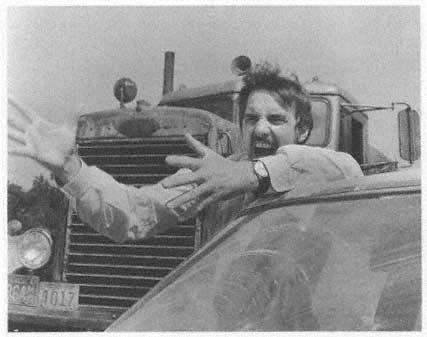
"Like a kid with a toy": Dennis Weaver in Duel , directed by Steven Spielberg.
There was never much dialogue, per se?
No. Although I had more voice-overs, which were taken out. I had more of the character talking to himself. I'm glad it was taken out.
Did you have meetings with Spielberg?
No. I met him when they were shooting. I went out to that cafe where they were shooting a scene—after the main character is run off the road, he goes into this cafe and orders a cheese sandwich. I thought at the time that the cafe was open for business, and they were just letting Spielberg shoot there. Those people looked so real to me. It never crossed my mind that these were actors and actresses playing parts. I saw Spielberg setting up a shot—he was like a kid with a toy. But we didn't see that much of each other.
He's the type of person who might have read your stories or novels.
The only thing of mine I know he read is What Dreams May Come. My recollection is he called me one Christmas day—he and Amy Irving—after he had finished reading it. He thought it was wonderful. I asked, "Do you want to make a movie out of it?" We played around with the idea through the years. But he's always so busy.
He came back to you for help on Amazing Stories.
Yeah. That was after the Twilight Zone movie and "the gig of the season," as my agent called it. It was a lot of fun. In the beginning, a bunch of us met in a huge conference room at [Spielberg's production company] Amblin. There was food on the bar counter, and after working about three hours, we had a delicious meal on the patio. And the meetings themselves were a ball. Steven was usually there; [the Amblin executives] Frank Marshall, Kathleen Kennedy; [the supervising producers, Joshua] Brand and [John] Falsey; David Vogel, the producer; [the consulting writers] Bob Zemeckis and Bob Gale; [the story editor] Mick Garris. We'd sit and discuss ideas. I guess I did well, because I became the creative consultant for the show's second season.
I remember an idea I came up with in one meeting. The premise was that, in the future, a spacecraft would come down and the aliens would examine this strange environment. Then, when they took off, the down angle would reveal gradually that it had been Disneyland. I came up with the notion that in the space craft, the aliens would remove their helmets and big ears would pop up, and we'd see that they were giant mice; they were turned on because they had found the source of their god. I remember Steven slowly laying his face down on the table—he was so amused by the notion. Unfortunately, it was never made.
There was a period of time in the seventies when you went back to writing fiction. I read somewhere that in the long run, you feel television and movies detracted from your more serious writing.
Well, I have always put out probably the same amount of work. But a lot of it I didn't get paid for. I was doing some on speculation, which didn't sell. Or I was writing a script for somebody and getting paid, but it was never made. I've got so many scripts that were never made—which I thought were good. If I had written them as novels, they probably would have sold. I would have done better to write a novel.
But as my wife always points out, we had four children to raise. It takes a lot to raise a family of four, and we needed it. I don't regret it. I don't recall ever taking a job out here that I literally felt that I had to hold my nose to do. That's probably one reason why I haven't been flooded with work. I've turned down more than I've done, because I have to be fired up.
I didn't always have the choice. And they weren't paying big money for my kind of book back then. As I said, I got $3,000 for I Am Legend. If I wrote I Am Legend today, I'd probably get quite a bit of money.
You probably got more money for the Twilight Zone movie than for all of your Twilight Zone episodes collected together.
Oh, absolutely. When I started out in television, I remember, I had to hold out and play tough in order to get $1,500 for a half-hour script at that time. Now, what do they pay? Twelve thousand dollars is the minimum, I think, for a half-hour script . . . or more.
Do you feel some of your television and film writing is as good as your best novels? Or do you make any distinctions in your mind?
No, not if it's well done. The only difference is, if it's brilliant and well done, like Duel, you can't take all the credit for it. A novel and a short story—you might have had a helpful editor, but it's all you. If a movie that you wrote is brilliant, you have to credit the director, the cameraman, the composer, the actors . . . it's different. Novels are more personally satisfying.
Yet, when it's your own source material . . . I don't think anyone in the world would have written Duel except for you. Whereas Star Wars seems to me to be more generic—in the best sense of the word perhaps—although that may be a little too easy to say now, with hindsight, than before it was made.
I guess.
Whereas Duel is highly original and has a personality that is distinctly Matheson.
I don't know. I spent years writing a book that was going to be two thousand pages long, about a spiritualist family. I wrote about two hundred pages, and my editor read it and said, "Only Matheson could—or would —write such a book." (Laughs. ) That was true.
But I had the story for Duel for a long time. I tried to peddle it. I distinctly remember trying to sell it to the series with Ben Gazzara about the guy who was dying, called Run for Your Life. Nobody wanted it. People always said, "It's too thin." I never would have sold it to TV or movies. I had to write it first as an novelette for Playboy. After it was published, then suddenly people thought it was wonderful.
Because they could see it—
In black and white, word for word, all the description. Otherwise, they didn't have the imagination to envision it.
I'm surprised you did leave horror novels behind. You have written a couple of cult classics. And there have been some pretty good horror movies based on some of your books—like Legend of Hell House.
That could have been more frightening, actually. Actually, they were very discreet about it. My book is much more terrifying. I wrote the script, but there were certain parts of it—anything that was actually visual—which they took out. Like the scene where Pamela Franklin is raped by the ghost—in the book, and probably in my original script, I described what it looked like as the ghost was lowering itself down on her. It was ghastly. Perhaps wisely, they decided not to show anything. You never really saw anything in that picture. It was all suggestion.
Your inclination would be to show the terror?
Well, I did in the book. The book was just totally overt, not subtle at all. A very overt horror story—graphic and blatant in every way. I got it all out of my system.
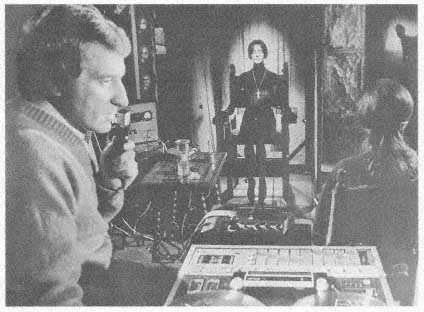
"My book is much more terrifying": Pamela Franklin and Clive Revill in the film version
of Legend of Hell House , directed by John Hough.
Bid Time Return was certainly a change-of-pace novel, a sweetly romantic love story that was also a suspenseful mystery. Was the film version faithful to your script? I know that the film [Somewhere in Time] has a huge cult following.
Yes, it followed my script, and I'm delighted with the way it turned out. The filming of it was such a lovely experience for everyone. I remember attending the first meeting of all the crew members, and they actually applauded me when [the producer] Steve Deutsch [now Steve Simon] introduced me. And people kept coming up to me during the filming on Mackinac Island to tell me how much the story meant to them.
When the film did badly at the box office, it was a great disappointment to everyone. Though I think it made a profit eventually. The videocassettes have rented and sold well, and there have been many showings on cable; so the film lives on. It's amazing how many people I meet who say they love that film. There is something in it that struck a romantic nerve.
I know that you have continued to work in television as often as films. How did you feel about the way The Martian Chronicles turned out?
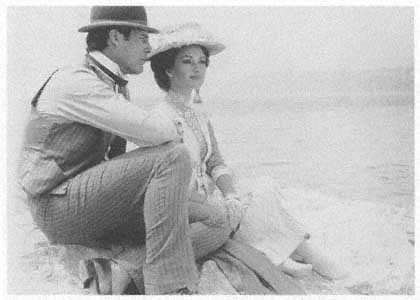
"A film that struck a romantic nerve": Christopher Reeve and Jane Seymour in
Somewhere in Time , directed by Jeannot Szwarc.
I tried to be as faithful to the book as I possibly could. I think they did an inferior job. In Part 2, there were some good moments. There was one particular scene with Fritz Weaver in a church, where he thought he was experiencing the coming of Christ. It was a marvelous scene. It had the feeling the whole thing should have had.
What about this thing you just finished, about L. Frank Baum?
It's called The Dreamer of Oz, and I've just seen it. It's a wonderful piece of work, a biography of Baum and the story of how he came to write The Wizard of Oz. John Ritter plays Baum. David Kirschner, who produced Child's Play, is the producer.
I was at Kirschner's house, and he was talking to me about making a film out of a play I have written—a suspense horror play—when I saw all this stuff lying around, all these drawings and plans for the Oz film. I said, "Why didn't you ask me to do this?" He always thought of me as a horror writer. That's the way they categorize out here. But once I mentioned it, he thought it was a good idea. It was a labor of love for all of us.
Is it fair to say that your work in the eighties has become more soft edged—still fantasy or cerebral, but going away from things like The Shrinking Man, the horror films, and Duel—towards more romantic or comic sto-
ries like Somewhere in Time and Loose Cannons the script you wrote with your son?
Actually, we wrote two. Oh, they were not soft edged. One, which was called "Face Off," was totally rewritten by the director Bob Clark. He rewrote almost every word.
Why?
Because they let him. They bought this picture for a lot of money, everybody was wildly enthusiastic about it, and then they got a director who they let rewrite the whole thing! It would have made a wonderful picture the way we wrote it. They made a horrible, horrible picture.
What was the original concept?
It was a police-action picture but a comedy. About this older detective who has been on this serial killer case and is partnered with a guy who's had a breakdown in the past, but he's a wonderful criminologist. The criminologist has a multiple-personality disorder. So throughout, at any key moment, the criminologist splits off and becomes someone entirely different, much to the confusion and anger of his partner. It turns out the murderer is a Wayne Gretzky type—that's why we called it "Face Off" —who uses an antique ice skate that he has had sharpened for killing.
The film [of "Face Off"], Loose Cannons, is about a porno group vying with some neo-Nazi group to get a porno film of Adolf Hitler . . . it was so ludicrous. It dropped like a stone in the market and deservedly so. It was pitiful.
You said there were two that you wrote together . . .
We sold another picture that Richard Donner was going to direct. We met with him and his wife for some time. We revised it. Everybody loved our script, except of course the producer. Now it's being rewritten by someone else. Who knows if we'll recognize it when we see it.
What's it called?
"Shifter" was our title—about a shape shifter.
In general, do you find it harder to get stories all the way through to filming? Is the Hollywood of today that much different from the Hollywood you first got to know in the late 1950s?
My recollection is that the people I met back then were all older than me. They had been in the business for quite a while. They had experience. They had credentials. Nowadays, you meet the young executives, young producers, young agents, and their credential is that they went to Yale Law School. I don't know how good they are, or how much they really care.
Actually, I don't feel the same way about films that I used to. No, I don't mean films; I mean the film business. I still love films. It's a wonderful medium of expression; nothing like it. But the business . . . I just haven't been able to beat it. I should have gone into production, directing, some inside job. I had an agent once who said that if I went into film production only to protect
my scripts, I'd be making a bad mistake. I can't think of any other reason to go into film production, at least for me.
But I didn't do that—my own failing—I'm a loner who likes to sit in a quiet, isolated room and write. The hurly-burly of the business would have been too much for me. When I first started in it, I was only twenty-nine years old, and I was popping Valiums like candy then. Now . . .
Anyway, it was my own fault. I can't blame the business for being what it is. And there's always something new and hopeful that you're working on. Even as I say this, a script I just finished—on Nikola Tesla—shows great promise of turning out well because of the director, Walter Murch, and the people involved in the production.
A lot of your signature film ideas lend themselves very well to a "wienie" synopsis.
They always say you should be able to tell any good story in two or three lines—or even one sentence. You couldn't categorize my work that way completely. And you can't say, "This is a story about Lawrence of Arabia . . . ";
that's such an expansive character. But give me virtually any film or story, and I can probably reduce it to two or three lines. And I hope my films fit into that category.
Does the inspiration for you usually begin with the story idea?
Yeah. Through the years, I have been able to get more and more into character, but I never went into stories based on characters. I went into stories based on a story idea. Then I put characters in the story that I hoped would be believable and realistic in real life and maybe move you. But I'm a storyteller. The story is the thing. They can put that on my tombstone: Storyteller.
Where do your ideas for stories come from?
When I was writing short stories, some of my ideas would come from other books because I read omnivorously. Someone would mention something in a short story, totally overlooking what they had said, and I would pounce on it like a tiger. For example, there's a section in Wild Talents, one of Charles Fort's books, [New York: Garland, 1975], where, in several paragraphs, he describes, literally, a sequence that I made a whole short story out of. I couldn't believe when I wrote it that nobody ever latched on to the connection. He said in future times, psychic girls would fight wars; they will visualize terrible things happening to soldiers. And I got a great story out of that.
Most of my ideas have come from films. When I lived in Brooklyn, I went to see a Dracula film and the idea came to me: If one vampire was scary, what if the whole world was full of vampires? That became I Am Legend.
Another time, I went to see a comedy with Ray Milland and Aldo Ray [Let's Do It Again, 1953]; and Ray Milland was leaving an apartment and he put on Aldo Ray's hat and it came down way over his ears. At that second, I
thought, "What if a guy put his own hat on and that happened?" That's where I got the idea for Shrinking Man.
It's not an exaggeration to say most of your ideas come from other movies—
And most of the ideas come from bad movies. Because if they're good movies, you're absorbed and not distracted. If it's a bad movie, if you're a movie buff, you stay and watch anyway. But as you're sitting there, you drift off. Something will happen [on the screen] . . . and it will spin off [in your mind] into something else.
When you're reading a story, I think, if the story is really boring you, you will stop reading it. You have to concentrate or stop. In a movie, you don't have to concentrate. You can just sit there. Things will come into your eyes but not really into your brain. And you drift off in a different direction . . .
Do you have any idea what it is about yourself that draws you to fantasy or speculative scenarios?
It's just what I am. It's what I was born as. It's what I'm composed of. I'm pretty much a believer in astrology, and I think what I am inclines me in that direction.
I don't think it comes down to genes necessarily, but it was there when I was born. Because when I started to read, I was drawn to that immediately. I wasn't drawn to anything else. I didn't want to be a fireman, I didn't want to be a policeman. And when I was seven, eight years old, I was writing little poems and stories and giving them to the Brooklyn Eagle. They published my poem about Columbus and a short story about an eagle who saved a little boy.
I wrote little fantasy stories throughout high school and college. And when I got out of college, science fiction was in its ascendancy. So I started writing science fiction, although I had never read it and didn't know anything about it. All my life, I've read fantasy, and I like fantasy. I don't mind being categorized as either a fantasy writer or an offbeat writer. I am that. But it's just that I am interested in doing other stuff too.
You don't feel that being inclined towards fantasy had anything to do with your environment.
No. My environment had nothing to do with it. We were from an immigrant family—
There was no grim reality you had to escape from into your imagination?
Just the horrible reality of the Depression and wondering—not where the next meal was coming from, I never felt endangered in that sense—but I was always aware that things were difficult. As a result of which, that insecurity is part of my nature too. Whether it's built in or whether that came from my environment, I don't know, but I have this dread of financial insecurity.
It sounds like you have good reason—there have been ups and downs.
Oh yeah. When we bought this house, for more money than we'd dreamed of spending for a house, that year I earned almost nothing. It was staggering to me. Terrifying.
Did you have a particularly religious upbringing?
I was raised as a Christian Scientist. When I was in the Army, I utilized my religious beliefs in order to feel safe in combat, protected, which was a little ironic because my blood pressure went up to about 170. What your conscious mind feels and what's really going on inside of you are two very different things, of course.
In college I started going to all the different churches. I kept a diary of my reactions to each of the churches and my "superior" observations of each religion. (Laughs. )
I left the church. We never took our kids to church. Yet I regard myself as being very religious and as having very extreme and specific metaphysical beliefs. I find them very valuable and comforting. But I don't go to a church. I don't subscribe to any one religion.
The metaphysical beliefs are reflected in your work to some extent.
Actually, Christian Science wasn't that bad of a religion to be raised in, because there's no sense of fear involved in it. Over the pulpit in the church, it says: God Is Love. They raise you with that idea. You can walk away from that because it doesn't frighten you.
Yet in your work you're fascinated by fear.
Yeah. What is Duel but the ultimate paranoiac's nightmare? I have an introduction that I wrote for my collected short stories that deals with the whole idea, which I maintain is true, that you can discern the mental state of the writer in his stories. I ran through my stories chronologically over a twentyyear period to show what my state of mind was—towards parenthood, marriage, and other things. The underlying theme of almost all my stories then was paranoia. Something out there is trying to get you.
During the [Writers Guild] strike recently, I sold a couple of short stories—the first time I had written any short stories in a decade. It was interesting for me to note that in both of them the premise was, not that there's something out there that's trying to get you, but that there's something inside your head that's trying to get you. (Laughs. ) Which is much more to the point.
Did you at any point study or read philosophy?
Oh, sure. I read a lot of philosophy books.
Were you affected by any one book or philosopher in particular?
The one book that has affected me the most, which I subscribe to totally, is called Thinking and Destiny, by Harold Percival. I've read hundreds and hundreds of books on metaphysics; I have my own modest library. I used maybe eighty books to research What Dreams May Come, my novel about afterlife. But this one book [Thinking and Destiny ] incorporates everything that I believe. You can buy it through The Word Foundation in Dallas.
Would it be fair to describe your work as existentialist?
I think the theme of almost all my work has been one man up against some terrible situation and trying to survive it, from The Shrinking Man to I Am Leg-
end, even to my war novel, The Beardless Warriors [Boston: Little, Brown, 1960]. It's a positive premise ultimately—the protagonist comes to some kind of understanding or triumphs at the end. The Shrinking Man— he still exists in another dimension. I Am Legend— the character comes to realize that he has to die because he has become the terror in the world, instead of all these vampires that were terrorizing him before. The Beardless Warriors— the main character matures by the end of the story.
You come from a fairly complacent upbringing . . .
My mother came over to this country from Norway at a very early age, and immigrants clustered together for safety. They were fearful about this whole new environment. They chose to come, but they were surrounded by strangeness, and it frightened them. My mother was thirteen when she came, and she was always fearful of what was out there. Be careful. Don't misbehave. Oh, you mustn't do that or say that. You mustn't think that.
To an extent, then, that psychology of paranoia was inherited.
I was certainly exposed to it. My mother had this immigrant psychology—which generated fear of the unknown—and she turned to religion, which is a protection.
One of the things that distinguishes Shrinking Man and Duel is that the protagonists are utterly ordinary. They're not supermen or Victor Mature.
Well, I grew up in that kind of background, and I always chose to apply the horrors, the terrors, or the mystical elements in a very banal neighborhood environment.
On the other hand, two later novels I wrote were very different, Bid Time Return— which they made into [the film] Somewhere in Time— a time-travel love story, and What Dreams May Come, [New York: Berkley, 1978] a love story about life after death.
I wrote a screenplay based on What Dreams May Come, that at one time was going to be directed by Wolfgang Peterson, who did Das Boot [1981], but nothing came of it.[*] It's clear to me that Hollywood does not want to make a serious picture about afterlife. Pictures like Ghost [1990] make a brief, momentary excursion into the afterlife—just a couple of feet beyond this earth—and then they immediately pop back and tell the story. My story goes entirely there and stays there. I don't think they'll do that. Pictures like Ghost are popular. And they squeeze a few metaphysical values out of the yocks and mysteries. But how much can you play for yocks if you're actually going into afterlife—I don't know.
Anyway, I don't do the old-fashioned sort of horror story anymore. I don't want to do that anymore. I have probably lost readers because of that. They
* At this writing, What Dreams May Come has been revived as a project and is scheduled to go before the cameras with Robin Williams as its star and New Zealander Vincent Ward as director. Matheson did not write the script.
liked my hard-edged, scary stuff from the early days. They probably think my brain has turned to Jell-O.
Could the idea that you were influenced by this paranoia in your youth be connected to the fact that you're just now beginning to experience more range and variety in your work?
That's an interesting idea. You mean, I've finally broken loose and am trying new things? But I've always tried . . . I have written all kinds of stuff that nobody was interested in. So many times people have said to me, "You're ahead of your time." I got so fed up with that line that I didn't want to hear it anymore. To me, that meant only that I wasn't making any money. That I was out of step. Maybe I was ahead, but what's the difference? I might as well be behind.
In a sense you feel overly categorized.
I think I'm getting out of it. It took a hell of a long time. They are not comfortable with you unless you are categorized. It's so much easier to say, "Oh yeah, Matheson. There he is on the horror shelf. Hire him to do this."
Right now, I'm adapting what is considered to be a horror novel. I'm also doing a live-action musical for TV. I may be doing a film eventually, about the Mafia. And there's an old western novel of mine, which Mark Harmon is interested in doing. Originally, it was an outline for a film that I wanted to sell—I must have written it twenty years ago—and it's only now that someone is interested.[*] And it is only now that it is going to be published.
Sounds like you're peaking now.
If you hang around long enough and don't die off, they figure you're here to stay. (Laughs. )
Which of your own pictures are you most satisfied with?
Duel. The Morning After, which I think is a wonderful piece of work. Both The Night Stalker and The Night Strangler. Somewhere in Time. The Dreamer of Oz. Of the ones I did for AIP, probably I liked The Comedy of Terrors the best, and it wasn't even Poe. A handful of TV half-hours, mostly Twilight Zone and Lawman. And maybe next year I'll have something else to add to the list . . . who knows?
* Matheson reports that as of this writing nothing has come of the Nikola Tesla script, the horror novel adaptation, the live-action musical, the Mafia film, or the Mark Harmon western. "As is Hollywood's wont," Matheson explained.