
The Histrionic Code
Film scholars may increasingly supplement textual analysis with knowledge of how a particular text both relates to other texts and functions in the larger culture, but close formalist analysis still remains an important methodology in cinema studies and other disciplines. Even Tony Bennett and Janet Woollacott, who believe that the text is "an inconceivable object," nonetheless do not suggest that "texts have no determinate properties—such as a definite order of narrative progression—which may be analyzed objectively."[1] In this chapter and the next, I shall focus on these "determinate properties"; in chapter 3, looking at the ways the Biograph actors employed the histrionic and verisimilar codes in the construction of their characters, and in chapter 4, theorizing a model of the interaction among the signifying practice of performance and other textual signifying practices and showing the workings of this interaction in the films themselves.
It may help to begin by formulating some general principles about the actors' use of the histrionic code at various points in the early Biographs. Most shots in these films fall into one of five categories: (1) the tableau; (2) everyday activity; (3) conversations; (4) heightened emotions and action scenes with more than one performer; and (5) gestural soliloquies in which an actor emotes while alone in the frame.[2] As a rule, the performances in these categories tend to range from the checked to the unchecked histrionic code.
1—
Modified Tableau
Although the Biographs borrowed the tableau from the stage melodrama, they somewhat modified its usage. In the theatre, per-
formers used the tableau to convey intense emotions in nonverbal form, freezing in place with arms fully extended outward, downward, or upward at an act's climax. A contemporary print depicting the second act of East Lynne shows the actors in the act-ending tableau: In the center a man sits in a chair, hands clasping head in an agony of despair. A young girl kneels at his feet, her right hand reaching up in supplication. To the left, an elderly gentleman has both hands raised high above his head in an appeal-to-heaven posture. To the right, a stern woman points at the girl with her left hand, while her right hand is held perpendicular to her body, the finger pointing to the door in one of the most parodied of all histrionic gestures.[3]
Obviously, the Biographs retained the goal of expressing strong emotion in nonverbal fashion but somewhat modified the technique. The actors eschewed fully extended gestures and kept their arms close to their bodies, expressing emotional intensity through a comparative lack of movement rather than absolute stillness. The only motionless tableau in the Biographs occurs in A Corner in Wheat (1909) at the moment when the poor line up to buy the overpriced bread and become perfectly motionless, contrasting with the frenzied activity of the Wheat King's party.
Usually, the actors make small gestures that contrast markedly with the more common broad gestures of the histrionic code and thus convey the impression of relative motionlessness. In the last shot of A Drunkard's Reformation , Arthur Johnson and Linda Arvidson sit in front of the fire with their little girl. The child sits on the floor before her father's chair, the mother sits on the arm of the chair. Arvidson has her arm around Johnson, and they hold hands. With his free hand, Johnson gestures to the girl, as if to credit her with his reformation.
2—
Everyday Activity
In scenes of everyday activity characters are shown going about their normal routine prior to the introduction of narrative disequilibrium. They might be shown at work, like the farmers plowing their fields in the opening shot of A Corner in Wheat , or at home, like the happy family at the beginning of The Lonely Villa (1909). In these shots, gesture helps to establish a character and that character's relation to other characters. The characters often handle props, such as books, or the tools of their trade, that prevent fully extended outward movements.[4] Gestures tend to be close to the body, fairly slow, unstressed, and not held for any significant time.
In the first shot of Lady Helen's Escapade (1909), Florence Lawrence portrays a bored, wealthy woman. She sits in a chair beside a table on which her arm rests, her hand dangling loosely over the front. When a maid offers food, she rejects it with a languid wave of the hand. Then she heaves a sigh, shoulders visibly moving, and yawns. All her gestures are slow, and with the exception of the wave, her arms and hands stay close to her body.
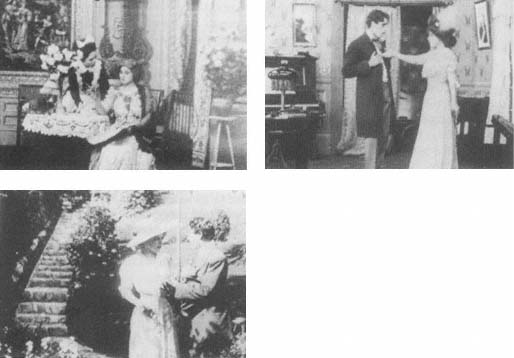
Above left: Lady Helen's Escapade: A languid wave of the hand.
Above right: The Voice of the Violin: The conversational gesture.
Lower eft: A Summer Idyl: The conversational gesture.
3—
Conversation
In the Biographs, conversations among characters involve a great many gestures of a type we might call, to use a semantic term, "diectic" or "anaphoric"—the gestural equivalent of verbal "shifters," personal pronouns and words indicating place, such as here and there .[5] In the films, these meanings are expressed by inward movements, indicating I or here , and outward movements, indicating you, there , or similar ideas. In A Convict's Sacrifice (1909), the released convict, James Kirkwood, talks to a laborer, Henry Walthall, who is eating his lunch. Kirkwood points to the food and to himself and Walthall hands him the dinner pail. Then Walthall asks his boss to hire Kirkwood, pointing at himself and then the convict, as if to vouch for his behavior.
Conversational gestures usually fall somewhere between the contained stillness of the tableau and the frantic extended movement of the gestural soliloquy. In The Voice of the Violin (1909), Arthur Johnson proposes to Marion Leonard. He declares himself with both hands on his chest, then extends his arms one on either side of the woman. No, she says, with her hand on her chest, then points to him, then puts her hand back on her chest. We can see the gradual modifications in the histrionic code by looking at another marriage proposal, from a film released the following year: In A Summer Idyl (1910), Walthall proposes to a society woman (Stephanie Longfellow), who rejects
him. He leans closer to her, his hand on his chest, then extends his other hand to her palm up. Then he takes her hand in both of his. She says no, and he pleads with right hand extended to her, left hand on his chest, the fingers relaxed. All his motions are slow and graceful, and his arms are never fully extended outward like Johnson's.
Because Walthall stresses his gestures less than Johnson, the performance does not connote the same degree of theatricality. This becomes clear in comparing the way each actor places his hands on his chest. Johnson uses both hands with the palms flattened, to modern eyes parodying a lover declaring himself, as the pose absolutely reeks of theatricality. Walthall places one hand lightly on his chest, the palm slightly raised and fingers slightly cupped. Though Walthall employs a conventional gesture, the lack of emphasis reduces the deliberate self-consciousness of the histrionic code.
4—
Heightened Emotions and Action Scenes
Categories 4 and 5 most closely resemble the stereotyped ideas of "melodramatic" acting, as performers tend to resort more to the unchecked histrionic code. The arms are fully extended upward, outward, or downward, the gestures are often more heavily stressed and quickly performed than in everyday activities or conversation, and poses are held longer. In A Test of Friendship (1909), Arthur Johnson receives the news that he has been ruined (financially, not morally, this latter being a woman's prerogative). His hands clutch his head and then come down, fingers spread, as his arms are held straight out to his sides. He bows his head, and his hands drop to his sides. He then looks up and clenches his fists.
In The Call of the Wild (1908), we see two performers enacting heightened emotions. A woman (Florence Lawrence) rejects the proposal of a "civilized Indian" (he wears a suit and attends parties). The veneer of civilization immediately vanishing, the rejected suitor (Charles Inslee) leads an Indian band on the warpath, captures his beloved, and proceeds to work his will upon her. He kisses her, and she falls to her knees, arms outstretched. Her left hand points to her chest and then to heaven, while her right hand points to him. He points to his Indian followers, as if to say, "I am one of them." She points to heaven again, her arm straight up and fully extended. Finally seeing the light, he raises both arms, sinks to his knees, lowers his head on his arms. She then points off screen right, as if to say, "Come back with me." Here we see a mixture of the diectic gesture and the unchecked histrionic code.
5—
Gestural Soliloquies
In the gestural soliloquy, the quality of the gesture remains the same as with heightened emotions, but the quantity increases. In the previous category, no single performer enacts an elaborate series of gestures because the other actors collaborate in creating an emotional effect or in telling the story. Gestural soliloquies often occur at emotional high points
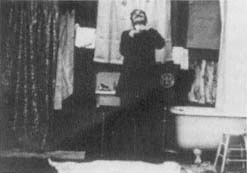
The Hindoo Dagger: The gestural soliloquy.
in which the characters undergo emotional catharsis. The characters in this situation often have only one point to make: "I am angry," "I am grief-stricken," or "I am desperate," and employ a series of gestures (sometimes repeating the same gesture), all of which express the same state of mind. While narratively redundant, the cumulative effect of the gestures is to increase the emotional impact, in keeping with the heightened emotional states characteristic of the melodramatic form. Though this repetition runs counter to injunctions against "the useless multiplication of gesture," each gesture remains distinctly separate, preserving the digital nature of the histrionic code.
In The Hindoo Dagger (1909), a woman's lover (Harry Solter) discovers her body and, thinking he will be accused of murder, enacts his distress. Kneeling at her side, he puts both hands on top of his head, then holds the backs of his clenched fists to his forehead, then puts his hands to his throat. He raises his arms in appeal to heaven, then waves clenched fists in the air, and finishes by crossing his arms over his chest. The Tavern Keeper's Daughter (1908), like The Call of the Wild , relates a tale of lust, villainy, and redemption. This time the pursued virgin takes refuge in a cabin occupied only by a crib and a baby. The villain (George Gebhardt) charges in, overlooks the woman, but spies the baby. In best melodramatic tradition, the child precipitates a reformation, and the villain enacts a gestural soliloquy. He sinks to his knees by the crib, beats his breast, raises clenched fists in the air, puts bowed head in hands, spreads arms wide, looks up to heaven, crosses himself, and slumps forward, head in hands. Then he rises, puts one forearm to his eyes and his other hand to his chest. All these gestures could be translated into one or two verbal phrases: "I am sorry," or "Forgive me."
The gestural soliloquy was also used to trace a character's thought processes, though the verisimilar code would better suit this function. In this case, rather than simply heightening emotional effect, the soliloquies serve to ad-
vance the narrative. In A Burglar's Mistake (1909), a husband (Harry Solter) contemplates suicide. As he holds the gun, he sees a toy that his young child has left in his office. He gestures to the door with his free hand, his arm extended behind him. Then he makes a fist in the air and brings his arm sharply down and up in a semi-circle as he decides on a course of action. Note, however, that the performer's gestures might be incomprehensible without the presence of the toy, showing precisely how difficult it is to discuss performance in isolation from other signifying practices.