
III
Avec ce titre magique de Paris, un drame, une revue, un livre est toujours sûr du succès.
Théophile Gautier, Paris et les Parisiens au XIXe siècle
With this magic title of Paris, a play, a journal, a book is always sure of success.
The Revolution generated an immense amount of writing about France, and the production about Paris increased astronomically. Many contemporaries must have agreed with J. B. Pujoulx, who noted in the first chapter of Paris à la fin du XVIII siècle that no period favored the observer more than the present: "Everything is new." Paris became the indisputable center of French political, economic, and intellectual life. Its population augmented at a faster pace than ever before, doubling between 1801, when the first official census was taken, and 1850 (and this despite a serious cholera epidemic). Political volatility exacerbated the sense of urban instability. In a space of less than seventy years, France moved through an impressive number of political regimes. Two monarchies, two empires, and three republics were ushered in variously by two revolutions (1830 and 1848), two military defeats (1815 and 1870-1), one coup d'état (1851), and one civil war (1871). But, as for the Revolution of 1789, the city of Paris was the theater of all but one of these events (the Prussian army laid siege to but did not actually occupy the city in 1870-1).
The great number of guidebooks to Paris that appeared in the new century testifies to the need for guidance, not simply because of the altered topography but also, and more urgently, because of the radically altered character or, to use the term favored by contemporaries, the "physiognomy" of a city that had been shaken to its foundations by revolution. The extraordinary popularity of the Hermit series inaugurated by Étienne de Jouy, beginning in 1811, reveals a dramatic combination of anxiety and curiosity about the city that was changing before the very eyes of the writer and the reader.[9] Jouy's hermits gave the guidebook, or what I shall call the "literary guidebook," a formula that seems to bring Mercier up to date (the later Hermite de la Guiane acknowledges his connection to Mercier). But the filiation is trickier than this explicit reference allows. The Tableau de Paris remains unique because Mercier's city has a decided and marked unity, a coherent physiognomy.
Such cohesion is exactly what the quarter century between Mercier and Jouy has shattered. The volatility of politics has rendered the task of the would-be observer of customs uncommonly difficult. "The French nation no longer has a physiognomy," complains another one of Jouy's personages, Guillaume le Franc-Parleur (William the Frank Speaker), writing a month after the final defeat of Napoléon at Waterloo and the reestablishment of the Bourbon monarchy. "The convulsions of suffering have altered its traits so profoundly and so completely denatured its character, that it has become entirely unrecognizable." Returning to Paris after an absence of twenty-five years and despite having lived in the city for thirty years before that, a friend reports to Guillaume with considerable distress that "Men and things, everything is changed, displaced, confused: I look and recognize nothing; I speak, and people barely hear me."
The chronicler-protagonists of the Hermit series exhibit none of Mercier's enthusiasms, few of his quirks, and little of his ambition. The politically circumspect Jouy moves with the times and the regimes. Royalist fervor wins out when "the august family of the Bourbons is given back to us." Jouy kills off his Bonapartist original Hermit de la Chaussée d'Antin just as Louis XVIII enters Paris as king. Guillaume le Franc-Parleur, the new Hermit, is younger, a politically correct monarchist who, "like all France," had been the "dupe" of Bonaparte's promises. The trenchant criticism and the overreaching ambition to comprehend the course of the city in history had to wait for the great novelists of the July Monarchy, for Balzac and Stendhal and Hugo. Jouy's Hermits have a far less intense relationship to the city than either Mercier before him or Balzac and Hugo after. Like Mercier, the Hermit "paints" customs. But he seeks to depict society as such and not a given society, and his concern is with "classes, species and never individuals."
In all his various incarnations, the Hermit is a genial character whose regular sorties into the city take him into unaccustomed places and bring him into contact with a broad range of people but, as the name implies, without ever involving him deeply. The affable tone of the essays and the title warn the reader that this observer sets himself apart from the city. Very much unlike Mercier, who is passionately involved in every event, every individual, every city space, the Hermit remains aloof from the scenes that he himself observes. It is this distance from his material that enables the Hermit to travel through the
provinces as easily as Paris. For, whether at home or abroad, the Hermit is essentially a traveler (he proudly tells of his trip around the world with Bougainville). He most definitely is not, as Mercier so proudly is, a man of letters. And he is certainly not, again as Mercier so assertively is, much interested in reform.
Jouy's extraordinary success pointed to a pervasive bewilderment over the state of urban society, a state of affairs that other writers by the score also sought to address. If, as Victor Hugo insisted in the 1820s, a postrevolutionary society compelled a postrevolutionary aesthetic, a postrevolutionary urbanizing Paris dictated an urban aesthetic. Just how that aesthetic might be revolutionary was a subject of great debate as writers sorted out genres and styles, publics, publishers, and politics. But that it must be revolutionary in some fashion admitted of no doubt. Histories, guidebooks, essays, novels, and poetry about Paris glutted the market, which then asked for more. Every person able to pick up a pen seemed to rush to take up Pujoulx's implicit invitation when he declared at the beginning of the century that however much had been written about Paris, no time was as interesting as the present. The result, predictable enough, was a surfeit of publications on and about Paris. In 1856, by way of justifying yet another anthology of Paris explorations, Théophile Gautier took stock of a situation that was surely not new: "With the magic title of Paris, a play, a journal, a book is always sure of success. Paris has an inexhaustible curiosity about itself that nothing has been able to satisfy, not the fat serious books, nor the thin publications, not history,. . . not memoirs, not the novel."[10]
Guidebooks proper, with maps and details on the location of streets and sights, generally confined themselves to tracking topography and institutions. As Paris expanded and built (Napoléon I started significant building projects virtually as the century began), guidebooks proliferated. Typical of what we now immediately recognize as an example of this most conventional of genres was Le Nouveau Conducteur parisien ou plan de Paris (1817) with maps, listings of hotels, means of transportation, sometimes statistics of one kind or another, and useful information ranging from hours and locations of restaurants, museums, and libraries; numbers of houses, streets, and inhabitants; locations of translators; the street numbering system; and so on. Le Nouveau Conducteur, like most of its predecessors in the ancien régime and indeed most of its successors, addressed largely foreign-
ers, referring those in need of more information to the sixth edition of Le Conducteur de l'étranger à Paris.
Little cultural information is included beyond reassurances to the apprehensive visitor that drinking the water from the Seine "does not indispose Parisians with its slight laxative quality" and, moreover, has no ill effects on foreigners so long as they drink it mixed with wine or a drop of vinegar. (Mercier had already pointed to the "purgative" powers of the Seine [1, 4].) The title points to the difference. For this guidebook is, as announced, a conductor, not a guide. A conductor gives precise directions to a specific, known, charted terrain (note that the subtitle of Le Nouveau Conducteur can be translated "map" or "outline"). A guide imparts as well a larger sense of direction. The conductor may be far in the lead; the guide, closer by, imparts wisdom as well as direction through unknown and uncharted terrain. The archetypical image is, of course, Virgil's guidance of Dante through the Inferno (Dante addresses Virgil in canto 2, line 10, "Poeta che mi guidi . . ."). Le Nouveau Conducteur has no author. There is no guide. The modern guidebook makes no moral claims, confines the advice it offers to practical, readily verifiable information, and assumes no responsibility for conduct beyond its confines. We are at the antipode of Mercier's idiosyncratic, opinionated reports about the city and equally as far from his ambition to render the "physiognomy of [his] century." Perhaps these new writers of guidebooks agreed with Jouy that France in the early nineteenth century no longer had a physiognomy.
Without an author, these guidebooks essentially renounce any claim truly to guide the individual in Paris. Modern equivalents of Jèze's tableaux, these works content themselves with the obvious, with surface detail, which, although abundant, says nothing about the nature of the urban experience and nothing about revolutionary Paris. We are miles from the excitement and the wonder that pervade Mercier's Tableau, and still further from the intense explorations of the city by Balzac and Hugo. All of these authors, in however different a mode, stamped the city with their strong personalities.
The link between Mercier and Balzac or Hugo, then, comes not through conventional guidebooks, but by way of what are more aptly called "literary guidebooks." These works are not really guidebooks, since, unlike either Le Nouveau Conducteur or Jouy's Hermit series, they offer significant directions to the new society emerging in Paris
after the Revolution, and especially after the July Revolution of 1830. Topography is the least of the matters taken up in these works, from the fifteen-volume Paris, ou le livre des cent-et-un (1831-34) to the work that caps and exhausts the genre, Paris-Guide, published for the World's Fair of 1867. For Parisians as interested as they were anxious about the world changing before their very eyes, these works offered both information and assurance. Where Mercier gave an état présent, nineteenth-century commentators reveled in change, in the new characters, personalities, customs, and behavior that characterized contemporary urban life.
At the same time, no single authorial voice grounds the interpretation of the city text. These were aggressively collective endeavors, multivolume collections of vignettes on people, places, events, and institutions. The anthologies capitalized on the expansion of the reading public, which also made the serial novel so successful a formula at about the same time, beginning in the 1830s. Publishers raced to get out the next compilation, and writers from all corners of the literary world joined in, from Chateaubriand and Charles Nodier among the older generation to Lamartine, Balzac, Gérard de Nerval, Alexandre Dumas, Victor Hugo, and a host of others. Foreigners too, Goethe and Fenimore Cooper most prominent among them, were pressed into service. Paris, ou le livre des cent-et-un saved the publisher from bankruptcy, and each volume of Les Francais peints par eux-mêmes carried a front page to all the contributors from the "Grateful Publisher." By the 1840s these literary guidebooks carried lavish illustrations by Gavarni, Henry Monnier, and Daumier, to mention only the best known.
The pieces themselves run the gamut from the sketches of urban character types known as physiologies (Balzac's "Histoire et physiologie des boulevards de Paris" in Le Diable à Paris or the "Physiologie du flâneur," to which I return in chapter 3), to serious, and generally unimaginative, delineations of sometimes picturesque institutions (the morgue, the insane asylum at Charenton, public libraries) to incidents (the cholera epidemic, the funeral of the scientist Cuvier).[11] Like the city that they strove to represent, these collections offer something from and for almost everyone.
The nominal model of the new urban journalism is Lesage's satirical novel, Le Diable boiteux (1707 and 1726), which recounts the adventures of Asmodée, a minor devil of lust and lechery, as he removes
the rooftops of houses in Madrid (read Paris) to flaunt his control over human lives. Immensely popular from its publication, Le Diable boiteux offered a convenient tag for the literary guidebooks and, perhaps, in the figure of the devil, an emblem of authorial perspective. Asmodée is uninvolved; he comes from another world. When Jules Janin signs "Asmodée" to his introductory article to Paris, ou le livre des cent-et-un (1831), he signals his connection to a genre that looks at the city from afar, and when Gavarni places a devil standing over the map of Paris on the title page of Le Diable à Paris, he too suggests distance as the operative mode of urban interpretation in the texts that follow (though it must be admitted that the devil in question bears no resemblance to the description that Lesage gives of his Asmodée)
Yet, if Lesage supplied the emblematic figure for these collections, it was Mercier who furnished the literary model. Fifty years after the publication of the Tableau de Paris, the publisher, Ladvocat, placed Paris, ou le livre des cent-et-un under Mercier's aegis: "We must do for the Paris of today what Mercier did for the Paris of his time." But politics has intervened in that half century, and Mercier's brush will no longer do. "Another pen besides Mercier's is needed." It is not simply a question of finding a contemporary Mercier. No single pen can comprehend the postrevolutionary city. Indeed, how could any individual render the multiplicity of "tricolor Paris?" Is not this urban multiplicity inscribed on the flag itself? Does not the very flag of France join the white of the monarchy to the red and the blue of the city of Paris? Who can possibly render the "drama of a hundred different acts" of this revolutionized city? What guide could possibly lead us through the "long gallery of modern customs, brought into being by two revolutions?" The publisher's solution—the solution of this particular genre on the edge of literary respectability—counters diversity of subject with diversity of execution, which is why the literary guidebook stands as the paradigmatic genre of urban exploration.[12]
Jules Janin begins his introductory article, "Asmodée," by insisting on the association between new times and new modes of presenting them. Since everyone has taken to observing contemporary society, nineteenth-century Paris wants not one but many observers to reveal it all: "It is through this revolution in the study of customs that the new lame Devil will get something out of us. . . . It is through the
collaboration of everyone that he will write once again the story of our failings."[13]
Yet collaboration placed definite limits on urban discourse. Although Mercier clearly gloried in the exuberant diversity he found on all sides, he remained confident of his ability to contain the proliferation of the city. His nineteenth-century epigones—overwhelmed by diversity, by sheer numbers, by strange sectors of society and their stranger inhabitants—could not sustain his sense of certainty. Insofar as the fragmentation of the city precludes encompassing the whole, these works could only enumerate their findings. No single point of view prevails. The classical unities, and the more modern ones as well, no longer obtain. The social and political revolution calls for the collaborative interpretation: "Unable to get a comedy out of one man, we have set out more than a hundred strong to make a single comedy; a hundred of us or two: what's the difference? As far as unity is concerned, it comes down to the same thing." Less unified perhaps, the resulting production is more interesting.
To judge by the number of works that appeared in this format, including reprints of previously published articles, multiple authorship made good commercial sense, and it made good sociological and aesthetic sense. Jules Janin obviously thought so, for ten years after Paris, ou le livre des cent-et-un, he undertook the introduction to undoubtedly the most ambitious of these works, Les Francais peints par eux-mêmes (five of the nine volumes concern Paris), which appeared between 1840 and 1842 and was billed as an encyclopédie morale du dixneuvième siècle. Not only the rapidity of change but also and especially the fragmentation of Parisian society, Janin asserted, force a new approach to the city. In one hundred years (the same period Mercier allotted for his own work), "people will recount that this city, so proud of its unity, was divided into five or six sections ('faubourgs'), which were like so many separate universes, separated from one another far more effectively than if each were surrounded by the Great Wall of China."[14] Things do not seem to have changed much on this score since Jouy affirmed that in no city except Peking and Lahore do the classes and neighborhoods live so separately (L'Hermite de la Chaussée d'Antin, 12 June 1813).
Janin also echoes Jouy (and other conservative writers, such as Balzac) in pointing to contemporary politics, and specifically the Revolution, as the source of division. "This great kingdom has been cut
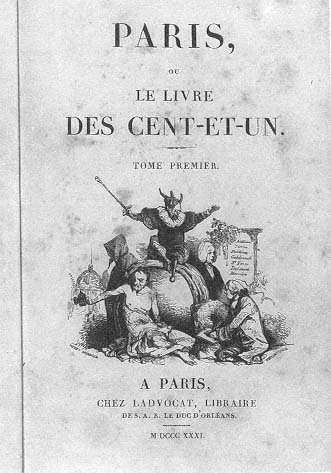
Plate 5.
Title page by Henry Monnier, Paris, ou le livre des
cent-et-un (1831). Among the ancestors invoked for this
miscellany of sketches on the city that opened with
the July Monarchy, English writers predominate on the
tablet in the background (Addison, Sterne, Fielding,
Goldsmith); St Foix and Dulaure are historians of Paris;
and the incomparable Mercier is the author of the Tableau
de Paris. The peg-leg devil, who overlooks the scene in the
foreground, is taken from Lesage's novel of 1709,
Le Diable boiteux. He will acquire more contemporary
demeanor and dress in later collections. (Photograph by the
University of Chicago Medical Center, A.V. Department.)
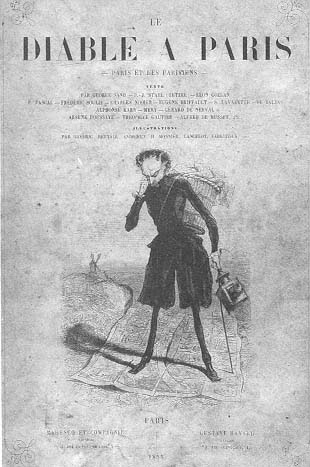
Plate 6.
Title page, Le Diable à Paris (1855). The devil, in
somewhat more modern dress and no longer lame,
straddles a map of Paris, lamp in hand to light his
way. His basket literally overflows with the articles
of the writers contributing to the collection listed
under the title. (Photograph by University of
Chicago Medical Center, A.V. Department.)
into as many little republics." A single writer could grasp the unitary nature of the king's domain; many chroniclers are needed to comprehend the warring, squabbling republics of a postrevolutionary age. Just open any chapter of Les Caractères, Janin urges, and you will be convinced that representation of France in the July Monarchy must be divided among many authors. Contemporary society boasts, or despairs, of innumerable phenomena that La Bruyère never imagined. Today, in postrevolutionary society, there are multiple cities within the city, and they are all changing all the time. A portrait has to be drawn every hour because yesterday's is already out of date.
Yet the most fundamental questions remain. What and where is Paris? How is the city to be imagined, defined? How in fact are we to read these texts, and the city beyond? I would suggest that tables of contents (tables des matières ) provide just the unity that the city text requires, a unity that encounters diversity in much the same way that a map imposes an artificial, constructed unitary view on three-dimensional space. The order of the text is logical in the primary, etymological senses of theory (logia ) and discourse (logos ) More accurately, this order is physiological because each table of contents is itself taken as an overgrown physiologie. That is, each table of contents offers a particular entry into urban life, a singular, necessarily reductive angle of vision on the vast complex of the city. Like the physiologies that reduced individuals to types, these multiauthored collections reduced urban society to a string of character types.
The very vogue of these works testifies to the failure of the definitions they propose, the failure, in sum, of what may be termed an "aesthetic of iteration." In these texts the divers parts of the city fail to cohere.[15] Jouy made this aesthetic his guide: "The best, or rather the only means of knowing [Paris] well is to examine each part in isolation" (L 'Hermite de la Chaussée d'Antin, 12 June 1813). But at least Jouy could claim that his pages would make the connections. The chorus of voices of multiple authors fails to provide that minimal focus. The aesthetic of iteration founders on the descriptive because there is no authority to turn the list of description into the order of narrative. There is no guide, no authority, to interpret the city.
Absent that guiding authority, the order of these works becomes sociological, the order / disorder of society complacently, uncritically duplicated in an urban text designed to reassure. The multiple authorship vaunted by Janin and so strongly supported by publishers
and readers alike reproduces, as indeed it is meant to, the diversity and the disorientation of urban life. The city is laid out before the reader like the merchandise displayed in the arcades that Walter Benjamin takes as another emblem of modernity and of Paris. By design the display of the guidebook diffuses attention onto as many points as possible, to entice the potential consumer or spectator to sample at random and at will. The power is in the hands of the consumer, not the author.
I suggest that synecdoche is the basic trope of these jumbled urban texts. The table of contents, with the chapter titles listed one after another, is to these works as the view from Notre-Dame is to the city itself, a simplification, perhaps a distortion, but one that is necessary in order to conceive the city as a whole. The table contains the entire book and itself offers an interpretation of that book, and of the city. (This interpretation may be confirmed by the actual articles or modified or, for that matter, contradicted altogether.) The table of contents constitutes an urban planning of a sort, a utopia, though of real enough places and institutions, in any case a fiction. The table of contents negotiates the text and, by extension, the city. The strange becomes familiar, the familiar becomes amusing. These texts depend upon one reading of the city—that contained in the table of contents—and produce another as the individual devises an interpretation within textual constraints.