
The Problem of the Repute of Tz'u during the Northern Sung
Ronald C. Egan
Despite the increased attention that has been given in recent years to Sung dynasty shih poetry, the impression persists in many quarters that tz'u was the real focus of poetic interest and excitement during the dynasty. This is an impression that owes as much to the many valuable studies of tz'u that have appeared in the past decade, which have elucidated the achievements of the Sung tz'u writers, as it does to the old formulation about the genres (T'ang shih Sung tz'u ), which has had remarkable staying power. We are apt, therefore, to think of tz'u as the form that was fresh, vital, and unexplored upon the establishment of the Sung. Once we accept this image of tz'u , which certainly has some validity, it is natural then to want to delve more deeply still into the accomplishments of particular writers, to study both their individual traits and the dynamics of the development of the genre through the dynasty. No doubt the linguistic difficulties tz'u presents, because of its colloquial and specialized diction, have contributed to the aura that surrounds it as a challenging object for scholarly study. However, as the subject becomes ever more firmly established as a field of inquiry, and as our attention is focused ever more intently upon the distinctive, if subtle, marks of each writer's corpus, we are apt to overlook certain aspects of early appraisals or criticism of the genre, especially anything that runs counter to our perception of tz'u as a pillar of Sung literature. This paper concerns one such issue in the history of Sung tz'u : its disrepute among large numbers of the lettered elite and its struggle for acceptance, especially during the Northern Sung. This, then, is primarily a study of early perceptions and criticism of tz'u , rather than of tz'u stylistics. But I shall also argue that tz'u 's struggle to gain acceptance sometimes significantly affected the way it was written.
So long as we confine our attention to collections of tz'u , it is easy to work under the assumption, whether we are conscious of it or not, that this was a universally accepted poetic form during the Sung. After all, a great amount of it was produced, and many of the writers were eminent figures in Sung letters and public life. But as soon as we look outside of the tz'u collections for confirmation of our assumption, we are apt to be dismayed. The first and lasting impression given by Northern Sung sources is one of silence. It is almost as if tz'u never existed, for it goes unmentioned in the channels normally used to confer and sustain literary prestige. Two areas of silence or absence are particularly significant: literary collections (wen-chi ) and prefaces. It was the rule throughout the Northern Sung to exclude tz'u from literary collections. In none of the earliest recensions of the literary collections of the major writers (Yen Shu, Fan Chung-yen, Ou-yang Hsiu, Chang Hsien, Su Shih, Huang T'ing-chien, Ch'in Kuan, Ch'ao Pu-chih, Ho Chu, and Ch'en Shih-tao) were tz'u included alongside the prose and shih poetry. We know that in many if not all cases the writers themselves edited their literary collections, so that the exclusion of tz'u was their own decision. Simply put, what that decision shows is that tz'u were not considered to be sufficiently wen , "literary," for inclusion in a wen-chi . These same men regularly excluded other of their more unpolished writings (for example, shu-chien or ch'ih-tu , notes or informal letters, as opposed to the more literary letter, shu ) for apparently the same reason. It was only in later centuries, when a writer's "complete works" were compiled, that tz'u began to make their appearance together with other forms. Before that time, and in many cases after it as well, a writer's tz'u circulated independently, in what must have been small and, to judge from the record of lost works, ephemeral editions. From the mid–Southern Sung on, of course, there were tz'u anthologies as well.
The lack of prefaces for tz'u collections is equally striking. In Sung literati culture, prefaces were a major vehicle through which writings were legitimated and standards of taste proclaimed. The leading writers wrote dozens of prefaces for the poetry and prose collections of their acquaintances. But among the surviving works only two tz'u prefaces can be found.[1] This nearly complete lack of introductory state-
[1] See the prefaces by Chang Lei (1054–1104) and Huang T'ing-chien (1045–1105), discussed at the end of this paper. In addition, the somewhat earlier Northern Sung writer Chang Hsien is said to have written a preface for Yen Shu's collection of tz'u , but this piece does not survive. See Jao Tsung-i, Tz'u-chi k'ao (Hong Kong: Hsiang-kang tahsüeh ch'u-pan-she, 1963), p. 36.
ments suggests that tz'u were generally not even considered worthy of a defense.
As we would expect, tz'u are hardly ever mentioned in another sort of document, the colophon (t'i-pa ). The important colophon writers of the Northern Sung left hundreds of notices on all sorts of literary texts, calligraphy, paintings, and scholarly paraphernalia (inkstones, musical instruments, etc.). But they refrained almost entirely from making reference to tz'u .[2] It is only in the anecdotal record that one finds substantial mention of tz'u . There are plenty of stories that somehow involve a contemporary tz'u . It is significant, though, that these stories were transmitted by lesser figures—men who are remembered primarily as compilers of anecdotes. They and their compilations are located a rung or two down from the highest levels of literati culture. Their writings amount at times to little more than gossip about the really prestigious persons of their age. The other qualification that should be stated is that the Sung anecdotal record is so rich that our ability to find mention of tz'u in it is hardly surprising. For every reference to tz'u , there must be ten to shih poetry.
The situation is an odd one: to judge from the songs themselves, the eleventh century was a heyday of tz'u writing, a lively and creative period that saw the development of an impressive range of unprecedented individual styles. Obviously, the authors relished their tz'u writing, but they also avoided calling attention to their activity. The Southern Sung critic Hu Yin observed that nearly all the scholars of the day expressed themselves in tz'u , but then they "immediately covered their tracks" and explained, if noticed, that they were just playing around.[3] Why was there this ambivalence, which is certainly much more pronounced with tz'u than with shih poetry? It is unlikely that the relative newness of tz'u accounts for these scholars' reticence to adver-
[2] Huang T'ing-chien, who left several hundred colophons, has but a single notice on tz'u —it is on one of Su Shih's compositions; see Yü-chang Huang hsien-sheng wen-chi (SPTK ed.), 26.7a. For Su Shih's lone colophon on earlier tz'u , see below. See also his single colophons on the tz'u of Huang and Ch'in Hsuan, Su Shih wen-chi , ed. K'ung Fan-li (Peking: Chung-hua shu-chü, 1986), 68.2157 and 68.2161.
Although it consists mostly of post–Northern Sung materials, a recent compilation of prefaces and colophons on T'ang and Sung tz'u conveniently gathers together most of the Northern Sung writings on tz'u that survive (except for passing references to tz'u in letters, etc.). See Chin Ch'i-hua et al., T'ang Sung tz'u-chi hsü-pa hui-pien (Kiangsu: Chiang-su chiao-yü ch'u-pan-she, 1990). The compilation happens also to illustrate the point made here about the scarcity of such materials from the Northern Sung period.
[3] Hu Yin (1098–1156), preface to Chiu-pien tz'u , by Hsiang Tzu-yin, in Sung liu-shih ming-chia tz'u , ed. Mao Chin (Kuo-hsüeh chi-pen ts'ung-shu ed.), p. i.
tise their involvement with it. After all, there were ample instances of tz'u writing from well over a hundred years earlier that could have been adduced. Moreover, in other areas of cultural endeavor (e.g., in painting) the leading Sung scholars were hardly reluctant to discuss their unprecedented involvement.
Tz'u, Tz'u Writers Singing Girls
Surely the close association between tz'u and professional female entertainers must bear on any answer to the question. To remind the reader of how extensive that association was, I shall begin here by reviewing and discussing some representative passages in anecdotal writings that depict it. I will concentrate on sources that concern two men of letters, Ch'in Kuan and Huang T'ing-chien. Both men were prolific tz'u writers, but unlike, say, a man such as Liu Yung, who was known for little else than his dissipations in the pleasure quarters, Ch'in Kuan and Huang T'ing-chien were also serious shih poets and, more importantly, holders of prestigious literary posts in the capital (e.g., court historian, drafter of decrees, erudite at the imperial academy). We would be wrong to think that it was only men of low or little stature, like Liu Yung, who were depicted in contemporary sources as being in close and intimate contact with professional entertainers.
An early twelfth-century collection of anecdotes about tz'u , Yang T'i's Ku-chin tz'u-hua , contains the following story about one of Ch'in Kuan's compositions:
When Ch'in Shao-yu was staying in the capital, a high official once invited him to a feast, during which he brought out Emerald Peach, one of his favorite concubines, to encourage the guests to drink. She did it, however, listlessly. Shao-yu understood what was on her mind, and he, in turn, raised a cup and urged Emerald Peach to drink. The high official said, "Emerald Peach has never been much of a drinker," not wanting Shao-yu to impose on her. But she said, "Today, on this academician's behalf, I'll get dead drunk!" She grabbed a large winecup and took a long drink. On the spot, Shao-yu then composed this song to the tune "Lady Yü":
An emerald peach in heaven grows amid sweet dew,
not an ordinary flower.
Deep in jumbled hills, where the river winds,
how touching! A single branch like a painting,
for whom does it blossom?
Light chill and fine rain—boundless feelings!
No one knew spring would be so hard to control.
Why shouldn't I get drunk for you?
My only worry is that once I'm sober,
a heart will break.
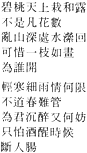
Everyone regretted what had happened. The high official said, "Don't ever let this concubine appear at one of our feasts again!" With that, the guests all laughed.[4]
There are many such anecdotes that purport to describe the circumstances under which a tz'u was written. A substantial proportion of them are quite unconvincing. Often the connection between the song and the story is tenuous, or the particulars may even be contradictory.[5] This story, however, actually helps to make sense out of the song, which is indeed found in Ch'in Kuan's collection of tz'u .[6] Of course, even without the story we would realize that "Emerald Peach" (Pi-t'ao) must be the name of a girl. But the second stanza, whose language is more vague than the translation suggests, would otherwise be rather unclear, especially the third line, where it would be uncertain who was getting drunk for whom. The story clarifies these lines by giving a sensible account of the dynamics between three persons: the bored singing girl, the attractive Ch'in Kuan, and the jealous and protective host. Ch'in's song, with its frank and aloof depiction of the girl's unenviable situation, has the effect of deflating the spirits of the revelers. The host then pretends to be
[4] Yang T'i (early 12th cent.), Ku-chin tz'u-hua (in Chiao-chi Sung Chin Yüan jen tz'u , ed. Chao Wan-li (Taipei: Chung-yang yen-chiu-yüan, li-shih yü-yen yen-chiu-so, 1972), p. 10b. For the text of the tz'u I have adopted the textual variants in the Ch'üan Sung tz'u version of the piece (see n. 6 below).
[5] See, for example, the anecdote about one of Chou Pang-yen's tz'u discussed by James R. Hightower, "The Songs of Chou Pang-yen," Harvard Journal of Asiatic Studies 37 (1977): 237–38, as well as that referred to in my study, The Literary Works of Ou-yang Hsiu (1007–72) (Cambridge: Cambridge University Press, 1984), pp. 136–37.
[6] The piece is "Yü mei-jen," no. 2. See T'ang Kuei-chang, ed., Ch'üan Sung tz'u (Hong Kong: Chung-hua shu-chü, 1977), 1:467; hereafter abbreviated CST .
outraged, trying to relax the tension and put everyone back at ease. The story is a plausible account of how the song might have been written, whether or not it is historically accurate.
Ch'in Kuan evidently had a reputation as something of a gallant, an image that must have been founded largely on the widespread popularity of the romantic songs he wrote. Several anecdotes tell of singing girls or courtesans who fell in love with him. The most elaborate story (whose reliability certainly is open to question) has him traveling through the undistinguished city of Ch'ang-sha, on his way into exile, when he meets a singing girl who possesses, to Ch'in's amazement, a manuscript copy of his tz'u . Without revealing his identity, Ch'in speaks with the girl and learns that she could sing all of his songs but had no interest in those by other writers. "Have you ever met this Academician Ch'in?" he asks her. "I live here in a remote and uncultured area. He is a high-placed gentleman of the capital. Why would he ever come here? And even if he did, why would he look at me?" Ch'in persists: "You say you are in love with Academician Ch'in, but it's just his songs you like. If you saw his face, you might feel differently." "No," she replies, "If I could ever meet him and somehow become his slave, I would die with no regrets." Ch'in finally reveals his identity, and the girl withdraws respectfully from the room. Shortly she reappears, dressed in formal attire, and bows to Ch'in from the doorway. A feast is prepared by the girl's mother, and when Ch'in is seated the place beside him is left vacant in deference to him. The girl performs her entire repertoire of his songs. At the end of the evening, the girl welcomes Ch'in to her bed. Ch'in stays on a few days with her, and when he finally resumes his journey, the girl vows to wait for him until he is pardoned. Ch'in goes off to exile, where he eventually dies. The girl receives news of his death in a dream, whereupon she sets out to mourn him. When she arrives beside his coffin, she walks around it, cries out, and expires.[7]
In its present form this story is surely romanticized fiction, but the bulk of it, without the ending, may well have its roots in a popular image of Ch'in as a man whose songs could win for him the hearts of singing girls. Unfortunately, the girl in this story is unnamed. Other of the girls Ch'in is said to have favored are supposed to have their names coded into songs he wrote for them. More than one source reports that when Ch'in Kuan was serving in Ts'ai-chou he had an affair with a singing girl named Lou Wan, whose polite name was Tung-yü. He is
[7] Hung Mai (1123–1202), I-chien chih (Peking: Chung-hua shu-chü, 1981), "pu" section 2.1559–61.
said to have written a tz'u for her, one that is likewise found in his collection,[8] whose opening line reads: hsiao-lou lien-yüan heng-k'ung , "The small storied house with a garden blocks the sky." The opening line of the second stanza is: yü-p'ei ting-tung pieh-hou , "His jade pendant chimes after he departs." The first line encodes the girl's formal name (hsiao-lou for Lou, and yüan is a pun on Wan), and the second her polite name.[9] Ch'in is supposed to have gone a step further in a song he wrote for another girl, T'ao Hsin-erh. The closing line reads: t'ien-wai i-kou ts'an-yüeh tai san-hsing , "Beyond the sky, a hook of a moon with three stars attached"—a clever way of describing the written character hsin (heart), the girl's name.[10] Both of these songs are quite conventional portraits of longing and separation, and neither of them has a preface or any other indication that they were written for a particular woman. But the assertions that they were deserve to be taken seriously because they help to explain what otherwise strike the reader as oddities in these two songs: the phrase lien-yüan (literally, "with a garden") seems slightly odd in its line (thus, some texts have lien-yüan , "stretching afar," instead),[11] and the detail about the moon and three stars seems gratuitous without some reason for its presence.
If Ch'in Kuan was the romantic poet whom the singing girls were apt to fall for, a rather different image of Huang T'ing-chien emerges from his tz'u and the anecdotes surrounding them. Huang T'ing-chien is primarily known, of course, as a shih poet, and one whose highly allusive and bookish style seems at first sight quite unpromising for any involvement with tz'u . It is interesting, then, to learn that not only was Huang also a prolific tz'u writer, he was one who used extremely colloquial language in his tz'u —so colloquial that the meaning of some of his songs now escapes us. But it is not only the diction of Huang's tz'u that makes them singular: a sizable portion of them present a particular voice that is not often encountered in other tz'u of the time. It is the voice of an aging official who is infatuated with one or another singing girl but gener-
[8] "Shui lung yin," CST , 1:455.
[9] The sources are Tseng Tsao's (d. ca. 1155) Kao-chai shih-hua (Hu Tzu [1082–1143], T'iao-hsi yü-yin ts'ung-hua—ch'ien-chi [Peking: Jen-min wen-hsüeh ch'u-pan-she, 1981], 50.338), and Tseng Chi-li's (late 12th cent.) T'ing-chai shih-hua , in Li-tai shih-hua hsü-pien , ed. Ting Fu-pao (Peking: Chung-hua shu-chü, 1983), 1:309 (Lung Mu-hsün, ed., Su-men ssu-hsüeh-shih tz'u [Peking: Chung-hua shu-chü, 1957], vol. 1, Huai-hai chü-shih ch'ang-tuan chü , p. 81).
[10] The tz'u is "Nan ko-tzu," no. 1, CST , 1:468. The source for this reading of the tz'u is Tseng Tsao, Kao-chai shih-hua (Hu Tzu, T'iao-hsi—ch'ien-chi , 50.338).
[11] This is what is found in CST , 1:455, but the shih-hua texts cited above have yüan , "garden," instead.
ally cannot attain the object of his desires. Huang apparently wrote tz'u that cultivate this voice all through his life. Several of them, in which the speaker identifies himself as an old man, were written in the last years of Huang's life, during his southwestern exiles to Ch'ien-chou, Jung-chou, and I-chou.
What is really striking about these tz'u of Huang's is how many specifics they contain that encourage us to read them autobiographically. These are not vague expressions of male love and longing. Thanks to details found both in the songs themselves and in their subtitles or prefaces, these compositions appear firmly rooted in Huang's life. We know, for example, that as an old man Huang wrote three songs for a very young singing girl named Ch'en Hsiang ("just over thirteen, spring not yet complete"), whom he met in Heng-yang while on his way into exile in 1104. The songs allude to a brief romance followed by the songwriter's forced departure, and dwell on the speaker's worry that by the time he is able to return the girl will have chosen another man. Huang continued to write for Ch'en Hsiang after his departure. It seems that she took up calligraphy and wrote to Huang (the master calligrapher!) asking for a sample of his characters in small regular style. The sample he sent back to her was yet another tz'u , which describes her and refers to her progress at her new avocation.[12]
One relies heavily upon the subtitles to Huang's songs for such information, and it should be acknowledged here that those subtitles might conceivably have been added by some later editor who, working on the presumption that the songs were autobiographical, did his best to identify their original settings. On balance, however, the chance of this is slight. Several of the subtitles are indisputably written in the first person. As for those subtitles whose point of view is ambiguous and might either be read as first-person or third-person statements (a problem commonly encountered in literary Chinese), the very specificity of their information argues against the possibility that they are from an editor's hand. Su Shih had, of course, established a convention of writing such identifying tags to one's own tz'u , and it is preferable to think that Huang simply followed his example.
The song translated below is less explicit than some, but the information it does contain makes it easy to reconstruct a setting grounded in Huang's biography:
[12] This information is gleaned from three of Huang's songs and their subtitles: "Mo-shan hsi," CST , 1:388; "Mo-shan hsi," no. 2, CST , 1:402; and "Juan lang kuei," no. 1, CST , 1:402.
To the tune "Swaying Courtyard Bamboo"[13
] Written outside the Chi-chou city wall ,
while serving as magistrate of T'ai-ho
Soughing winds at the south hall blow plum blossoms,
ravens cry, startled in treetop nests.
Our meeting in a dream did not last long,
across the city wall tonight you understand.
I sit up late, the water turns emerald pointlessly.
The glow of the mountain moon sinks in the west.
I bought a place to lodge you in,
but stubbornly you wouldn't come.
Today Heaven glares at you,[14
] you'll go among fowl forever, abused by them.
Useless now is my pity for you![15
] Wind and sun will injure the branch of blossoms.
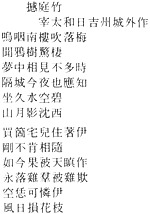
Huang served as magistrate of T'ai-ho hsien from 1081 to 1083. T'ai-ho was part of Chi-chou prefecture (modern Chi-an, Kiangsi), and Huang must have made periodic visits to the prefectural seat. This song was evidently written as Huang was leaving Chi-chou to return to his post in T'ai-ho. The song, together with its subtitle, suggests that Huang had met a singing girl during his stay in the city and tried to convince her to go back to the outlying T'ai-ho with him, assuring her that he would set her up in her own house. She refused, and Huang, frustrated
[13] "Han t'ing chu," CST , 1:390.
[14] Adopting the variant ni for tso (Lung Mu-hsün, Su-men , vol. 2, Yü-chang Huang hsien-sheng tz'u , p. 22) since the word must rhyme.
[15] Adopting the variant o-lien "intense love" for k'o-lien (Lung Mu-hsün, Su-men , vol. 2, Yü-chang Huang hsien-sheng tz'u , p. 22).
and bitter, wrote this song (and possibly even sent it to her) on the first night of his journey home. To "go among fowl" must mean to stay with the other girls Huang had found her among. Another of Huang's tz'u singles out a girl as a "kingfisher among the fowl."[16]
In his later years, it was more common for Huang to represent the girl as willing but his own circumstances as unfavorable. An anecdote in Wu Tseng's Neng-kai chai man-lu (1157) confirms the information given in the song's subtitle, which dates it to Huang's fifty-eighth year:[17]
To the tune "A Happy Event Draws Near"[18
] In T'ai-p'ing prefecture a little singing girl, Yang Chu, played the zither and
presented wine
Once she touches those heart-awakening strings,
her feelings show on two slanted hills.
When she plays the part where men of old sorrowed,
pearls hang on her eyelashes.
This governor does not choose to come or go,
don't let tears mark your red cheeks.
What a pity that in old age I dislike wine
and disappoint the brimming plantain leaf.[19]
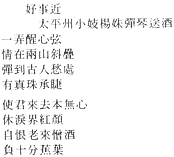
The reader of Huang's songs soon becomes accustomed to taking the term shih-chün , "governor," as a reference to Huang himself, especially in the context of forced travel. (In fact, nine days after arriving at his post as governor of T'ai-p'ing, Huang was demoted and ordered to leave.) The situation implied here is that the girl loves the songwriter deeply and is brokenhearted over his imminent departure. As soon as she begins to play, her sorrow is evident in the music and on her face
[16] "Mu-lan hua ling," no. 46, CST , 1:393.
[17] Wu Tseng (late 12th cent.), Neng-kai chai man-lu (TSCC ed.), 17.487.
[18] "Hao-shih chin," no. 2, CST , 1:411.
[19] Adopting the textual variant chiao , "plantain," for chin ; see Lung Mu-hsün, Sumen , vol. 2, Yü-chang Huang hsien-sheng tz'u , p. 66.
(the "slanting hills" are her eyebrows). The governor, meanwhile, is so old and infirm that he cannot even find solace in wine.
It turns out that Huang wrote a shih poem about the same singing girl, as Wu Tseng points out. The contrast between the two pieces is revealing:
Written in T'ai-p'ing Prefecture (no. 2)[20]
Timeless emotions are conveyed by her fingertips,
Yang Chu in misty moonlight, year after year.
To whom does her own heart fly?
She plays "Pine Wind" so fervently, she nearly
breaks a string.

It is precisely the personal involvement of the author with the girl that is absent from the shih poem.
The Disrepute of Tz'u
My purpose in reviewing these particular tz'u and anecdotes here is to describe the nexus of associations that prevailed between the literati, the tz'u they composed, and the female singers who performed them. In the Northern Sung, there was not yet such a phenomenon as the literary tz'u , divorced from music and the female entertainer. On the contrary, tz'u then could almost be viewed as a kind of dialogue between literatus and singing girl (there are, in fact, records of lively exchanges between male poets and female singers, each extemporizing new songs' lyrics).[21] But while the contact between tz'u writers and singing girls was extensive and featured the appearance, at the very least, of romantic liaisons, it was not approved of in all quarters. The silence, noted earlier, maintained by the tz'u writers concerning their compositions must be due in large part to an awareness that their works were looked on unfavorably
[20] Huang T'ing-chien, "T'ai-p'ing chou tso," no. 2, Shan-ku shih chi (Kuo-hsüeh chi-pen ts'ung-shu ed.), "wai-chi" 17.400.
[21] For a protracted exchange of songs between Huang T'ing-chien and the singer Hsi-hsi, see Yang T'i, Ku-chin tz'u-hua , 10a–b. On this sort of contact and exchange in the earlier history of the genre, see Marsha L. Wagner, The Lotus Boat: The Origins of Chinese Tz'u Poetry in T'ang Popular Culture (New York: Columbia University Press, 1984), pp. 81–91 and 101–2.
by many members of the educated elite. The literati continued to set words to song anyway—it was far too pleasurable to stop—but they kept quiet in the more acceptable forms of written expression about what they were doing.
What is the evidence of the disrepute of tz'u , aside from the authors' own silence? It survives in various forms, ranging from outright denunciations and scandal to covert attempts to de-emphasize the social setting of the songs, thus making them more acceptable. To begin with the denunciations, one that is recorded in several sources is that addressed by the monk Fa-hsiu to his friend, Huang T'ing-chien:
Fa-yün-hsiu, a native of Kuan-hsi, had a face of iron and was stern and cold. He was good at using reason to best other men in argument. After Lu-chih [Huang T'ing-chien] had become famous throughout the empire, whenever he wrote a new shih or tz'u people would rush to circulate it. One day the dharma master [Fa-hsiu] said to Lu-chih, "There's no harm in writing as many shih as you like, but you should stop composing erotic songs and little tz'u ." Lu-chih laughed, "They are just words in the air. I'm not killing anyone, and I'm not stealing. Surely I won't be sentenced to one of the evil destinies for writing these songs." The dharma master replied, "If you use wicked words to arouse lust in men's hearts, causing them to ignore propriety and violate the law, then your words will be a source of crime and wrong, and I'm afraid you will not merely be punished with evil destinies." Lu-Chih nodded and subsequently stopped writing songs.[22]
In Huang's own version of this exchange Fa-hsiu is more forthcoming about the punishment that awaits him if he does not desist: he will be reborn in the Hell of Slit Tongues, a place reserved for those who used offensive words in life.[23]
These stories emphasize Fa-hsiu's skill in argument, so naturally they conclude with Huang heeding Fa-hsiu's advice. In fact, all the evidence suggests that Huang's tz'u writing was not the least affected by Fa-hsiu's reproof and, if anything, seems to have become more abundant in his later years. The Southern Sung scholar Hu Tzu noted, with marked disappointment, this discrepancy between the conclusion of the anecdote and Huang's later record.[24]
Hu Tzu's attitude indicates that we should not dismiss Fa-hsiu's criticism out-of-hand as a kind of puritanism found only among Buddhist monks. Disapproval of tz'u was not limited to any single group in Sung society. When reference was made once, in the presence of Lü Hui-
[22] Hui-hung (1071–1128), Leng-chai yeh-hua (Yin-li tsai ssu t'ang ts'ung-shu ed.), 10.3a.
[23] See p. 222 below, and cf. Hu Tzu, T'iao-hsi—ch'ien-chi , 57.390.
[24] Hu Tzu, T'iao-hsi—ch'ien-chi , 57.390.
ch'ing (Wang An-shih's assistant grand councilor), to the fact that Yen Shu, an earlier grand councilor, had been fond of composing tz'u , Lü Hui-ch'ing remarked impatiently, "Anyone who governs the realm is supposed to start by 'banishing the tunes of Cheng.' How could he himself compose more of them!"[25] Lü's outburst equates tz'u with the "licentious" songs of the ancient states of Cheng (and Wei), which Confucius, whom Lü quotes, had condemned.[26] Yen Shu's son, Yen Chitao, once found himself the object of a similar sort of moral indignation. In the 1080s, while he was serving as a lowly garrison supervisor, Yen sent copies of his writings to the governor of his prefecture, Han Wei, in an apparent attempt to impress the superior official. This was a common enough practice, but in this case Yen Chi-tao had misjudged his recipient badly. Yen had sent copies of his tz'u , and Han Wei, who was a distinguished scholar but not a literary man (and would later be appointed tutor to the heir apparent), was neither impressed nor amused. Han Wei sent an admonishing letter in reply, observing that Yen had "more than enough" talent, but that his moral cultivation was inadequate. He urged Yen to look to this deficiency.[27]
With such denunciations in mind, it will surprise no one to learn that Ch'eng I, the Northern Sung Confucian philosopher whose low opinion of belles lettres is well known, also registered his disapproval of certain lines found in well-known tz'u . What is particularly interesting about the following passage is the way Ch'eng I's criticism is taken up and elaborated upon by the Southern Sung scholar Ch'en Ku, who recorded it:
I-ch'uan [Ch'eng I] once read Ch'in Shao-yu's tz'u with the lines, "If Heaven only knew, / Heaven too would grow thin!"[28] and remarked, "The Lord of Heaven lives in exaltation high above us. How can this man be so disrespectful toward him?" I-ch'uan also saw Yen Chi-tao's tz'u , which reads, "My dreaming soul is unaccustomed to any constraints. / It treads on willow catkins, crossing Hsieh Bridge,"[29] and said, "These are the words of a ghost!" Actually, Shao-yu's lines are derived from Li
[25] Wei T'ai (d. 1110), Tung-hsüan pi-lu (Peking: Chung-hua shu-chü, 1983), 5.52 (Hsia Ch'eng-t'ao, T'ang Sung tz'u jen nien-p'u [Shanghai: Shang-hai ku-chi ch'u-pan-she, 1979], p. 240).
[26] Lun-yü 15/11.
[27] Shao Po (d. 1158), Shao-shih wen-chien hou-lu (Hsüeh-chin t'ao-yüan ed.), 19.151–52 (Hsia Ch'eng-t'ao, T'ang Sung tz'u-jen nien-p'u , pp. 258–59).
[28] From Ch'in's "Shui lung yin," no. 6,CST , 1:455–56.
[29] From Yen's "Che-ku t'ien," no. 33, CST , 1:226–27. Hsieh Bridge must be a place where the speaker, a male, used to meet his lover. Cf. the meaning of "Miss Hsieh" (Hsieh-niang or Hsieh-nü ) in other tz'u , as explained by Wen Kuang-i, T'ang Sung tz'u ch'ang-yung yü shih li (Huhehot: Nei-Meng-ku ch'u-pan-she, 1978), pp. 167–68.
Ch'ang-chi's [Li Ho's], "If Heaven had feelings, / Heaven too would grow old,"[30] which are similarly disrespectful. Shao-yu eventually died in exile and Shu-yuan [Yen Chi-tao] likewise did not live to an old age. Although it is said that there is such a thing as fate, their deaths were caused as well by their error of using words to encourage promiscuity.[31]
Ch'en Ku's attitude, clearly, is a reformulation of Fa-hsiu's opinion that tz'u are so immoral and harmful to society that the writers are apt to be punished for the misdeed of "encouraging promiscuity" (ch'üan yin ). But whereas Fa-hsiu referred to unfavorable rebirth, Ch'en Ku alludes to the Confucian notion of early death. Without Ch'en Ku's remarks, it would be easy to interpret Ch'eng I's criticisms as nothing more than the sort of fussy intolerance that literal-minded scholars often show for poetic language. But a case can be made for finding more in Ch'eng I's comments than just this, and the case is supported by Ch'en Ku's expansion of the criticism. What precisely, we might ask, is so objectionable to Ch'eng I about the reference to Heaven in Ch'in Kuan's tz'u ? Those lines are, of course, part of a description of a lonely woman who is pining away for her lover who has deserted her. The tz'u is a portrait of lovesickness, and the lines in question assert that the illness is so powerful that it could overcome even Heaven (if Heaven only understood what was happening). There is, after all, a sense in which one of the functions of Sung tz'u was to document and legitimate emotions that contemporary society barely gave notice to, much less sanctioned. Love and its associated longings may be so strong, Ch'in Kuan implies, that they become the central fact about a life. They take control of the person and of her health, and they would do the same for Heaven if Heaven could experience them. These are assertions, even if not explicitly made, that seemed preposterous, or even worse, to men of other persuasions like Ch'eng I. One could trace a similar objection to Yen Chi-tao's lines about the dreamer: it may have been a common-place in love songs to speak of a soul emerging from the body during sleep and visiting a distant lover, but unromantic minds, once again, were unwilling to attribute such powers to love. They knew that the hun soul could only leave the body at death, which is why Ch'eng I says what he does.
The fate of Ou-yang Hsiu and his tz'u provides evidence of another kind of the uncertain status of this genre during the Sung. As famous as
[30] Li Ho, "Chin-t'ung hsien-jen tz'u Han ko," Ch'üan T'ang shih (Peking: Chung-hua shu-chü, 1960), 391.4403.
[31] Ch'en Ku (early 13th cent.), Hsi t'ang chi ch'i-chiu hsü-wen (Chih-pu-tsu chai ts'ung-shu ed.), 8.6a.
he was during his lifetime as a statesman, scholar, and poet, Ou-yang also lived through more than the usual share of controversy. Unlike many other prominent Sung officials who were charged from time to time with abuses of power or disloyalty to the throne, Ou-yang Hsiu was charged with immoral conduct in his personal life. In his middle age Ou-yang was accused of having had an illicit affair with a niece (the girl herself brought the charge), and years later he was denounced for having committed incest with a daughter-in-law. Both times a formal investigation was held, Ou-yang adamantly maintaining his innocence, and both times the charges were eventually dropped (though damage was done in each case to Ou-yang's reputation and career).[32]
We certainly do not have enough information to pass judgment on Ou-yang's culpability in these cases. It is clear that the charges against Ou-yang were seized upon by his political enemies, if they did not plant them in the first place, and used in an attempt to topple him from power. Of course, there might have been some combination of wrong-doing on Ou-yang's part and opportunism on the part of his rivals. We do not know. It is likely that Ou-yang's reputation as a man who "enjoyed life" and had a weakness for young girls made him seem particularly vulnerable, in the eyes of his enemies, to this sort of scandal. If so, we can say that Ou-yang's fame as a tz'u writer, which was considerable, helped to make him vulnerable, for his tz'u projected that image of him. At the least, we can say that Ou-yang's activities as a tz'u writer figured in these scandals. It is virtually certain that during the first case, and perhaps the second as well, tz'u that dwelled on infatuation with a young girl were composed by Ou-yang's accusers and falsely circulated under Ou-yang's name. Thus did his enemies seek to defame and incriminate him.
This sheds new light on the reasons Northern Sung scholars had for keeping tz'u out of their literary collections. But if tz'u could be this damaging, why weren't other tz'u writers similarly implicated in scandal? Why were Ou-yang's problems unique? The answer, I believe, is that Ou-yang's circumstances lent themselves uniquely to his trouble. Prominence was, of course, one of the necessary conditions. Through the entire Northern Sung, aside from Ou-yang there were really only two other prolific tz'u writers who were politically powerful: Yen Shu, just older than Ou-yang, and Su Shih, a generation younger. Yen Shu held the highest offices in the empire and although, as mentioned above,
[32] For a fuller discussion of the issues raised in this and the following paragraphs, see my Ou-yang Hsiu , pp. 5–11 and 133–95.
he was eventually subjected to some criticism for combining this eminence with tz'u writing,[33] his career as such seems to have been remarkably free of controversy. He was not the leader of a major movement or faction, and no one was determined to topple him. Ou-yang, by contrast, was repeatedly at the center of factional strife. He was a major spokesman for the reform movement led by Fan Chung-yen in the 1040s, whose defeat coincided with Ou-yang's Niece Chang case, and he was also embroiled in the bitter rituals controversy of the late 1060s, when the second charge of sexual offense against him surfaced. Su Shih was even more regularly involved in political struggle than Ou-yang, his mentor, had been. But Su Shih's enemies did not need to resort to innuendo about incontinence. Incautious remonstrator that he was, Su's criticisms of court policy gave his adversaries plenty of material to use against him. It was, after all, more efficient to question a man's loyalty to the emperor than his sexual conduct. Another consideration is that neither Yen Shu nor Su Shih wrote such racy tz'u —colloquial in their diction and relatively explicit in their references to lovemaking—as Ou-yang did. Yen Shu was known for his elegantly restrained and "aristocratic" tz'u style. Su Shih of course pioneered a new approach to tz'u , avoiding the old preoccupation with romance and adopting instead the broad range of subjects of the shih poet. (Here was a man who wrote a famous tz'u on his deceased wife—hardly the stuff of scandal.) There may be one other factor: Ou-yang Hsiu had something of the stuffy moralist in him. He is one who set himself up as a champion of neglected Confucian virtues and encouraged a comparison between himself and the great Han Yü. For the enemies of such a man there is, naturally, nothing so satisfying as seeing him dogged by questions about moral probity in his personal life.
The later textual history of Ou-yang Hsiu's tz'u reveals, in its own way, the stigma attached to some songs. By the time that literary critics and anthologists addressed themselves to Ou-yang's tz'u in the Southern Sung, so august was Ou-yang's reputation as a statesman and writer that it had simply become, for several of the critics, incompatible with the more colloquial and explicit of his tz'u . Tseng Tsao, the compiler of the anthology Yüeh-fu ya-tz'u , wrote in his preface: "Mr. Ou-yang was the most venerable Confucian of his day. He also prided himself on his ability to enjoy life. He wrote songs that are graceful and charming, a
[33] Wang An-shih himself, in addition to Lü Hui-ch'ing, expressed misgivings over Yen Shu's being both grand councilor and tz'u writer; see Wei T'ai, Tung-hsüan pi-lu , 5.52.
style that all the world came to emulate. However, during his lifetime certain scoundrels composed erotic songs and falsely attributed them to him. I have excluded all such songs from my anthology."[34] These Southern Sung scholars took advantage of the stories of forged, slanderous tz'u to disassociate a substantial proportion of Ou-yang's pieces from his name, retaining only the most ya , "elegant," of his compositions. In the late twelfth century, Lo Mi edited a new "complete" collection of Ou-yang's tz'u . Working, so far as I can tell, with nothing more authoritative than his own notions about the limits of Ou-yang's good taste, he went through an earlier collection of Ou-yang's tz'u and excised dozens of pieces that struck him as improbably vulgar. His "editing" caused the confusion over Ou-yang's corpus and identity as a tz'u writer that has lasted down to this day.
Su Shih
The attitudes we have been examining acquire additional interest when it is understood that not only did they affect the ways tz'u were talked about and transmitted, they could influence as well the way tz'u were written. It was not just that certain moralists looked down upon tz'u as improper, while tz'u writers, gaily oblivious of this disapproval, went on producing new compositions. Literati themselves were apt to be ambivalent about tz'u , and this ambivalence spurred some of them on to explore new ways of writing. The argument can be made, at the least, that what everyone recognizes as a major eleventh-century innovation in tz'u writing—that undertaken by Su Shih—was directly linked to the shadow of disrepute the genre lived under. Su Shih's development of the new "bold and unrestrained" tz'u style, or his novel decision to "use the methods of shih to compose tz'u ," is partly explained, according to this view, as an effort to rid the genre of its disreputable elements and to make it more acceptable. No doubt Su had other motives as well. I will present the argument for this one in the following pages, citing the more important supporting sources, since if it is valid it is one of the more significant ramifications of the points discussed above.
We are accustomed to thinking of Su Shih as one of the major tz'u writers not only of the Sung but of all of Chinese history. Several of the songs he wrote are among the most famous of all tz'u . These individual successes are complemented by his prodigious output: with over three hundred pieces to his credit, Su Shih is the most prolific of all Northern
[34] Tseng Tsao, Yüeh-fu ya-tz'u (TSCC ed.), p. i.
Sung tz'u writers. Despite his credentials in the tz'u field, however, it is evident that Su Shih too partook on occasion of the biases we have been examining. Below is a colophon Su Shih wrote on the shih collection of Chang Hsien:
Chang Tzu-yeh's shih poetry and prose are mature and masterful. His tz'u are nothing more than an ancillary skill. For example, his [shih poem] "West Creek at Hu-chou" contains the lines "At breaks in the floating duckweed you see the mountain's reflection, / as the light skiff starts home you hear the river grasses," and his poem written to rhyme with mine has the couplet "As sad as the kuan fish that knows the night is long, / as tired as the butterfly during busy spring." These and other of his lines are every bit the equal of those written by ancient poets. However, the world only knows to praise his tz'u . Formerly, the portraits painted by Chou Fang were all in the "inspired" rank [shen p'in ], but the world paid attention only to his portraits of aristocratic ladies. Is this not a case of "never having seen a man who loved morality as much as he loves feminine beauty"?[35]
To the extent that Su Shih is here attempting to enhance the stature of Chang Hsien's shih , we may say that he fails completely. By the end of the Sung, Chang Hsien's shih collection had been lost. Chang has been remembered subsequently, as he was evidently known in his day, solely for his tz'u .
Knowing that Chang's fame is based on his tz'u , Su Shih begins with an attempt to rectify the world's understanding: Chang's gift for tz'u is merely an ancillary skill. His real talent is in the more profound forms, prose and shih poetry. Subsequently, Su reveals the reason for the low evaluation he presents here of Chang's tz'u . Su likens them to the T'ang painter Chou Fang's famous portraits of high-placed women. Both describe feminine beauty. Both promote sensuousness and appeal to the base instincts and appetites of men. Su concludes by quoting Confucius on the lamentable popularity of such appeal.[36] Surprisingly, here we find Su Shih, the great tz'u writer, delivering an opinion on the genre that is not far removed from the condemnation expressed by contemporary Buddhist and Confucian moralists. This does not mean, of course, that Su Shih had no appreciation of Chang Hsien's tz'u . Actually, Su Shih seems to have begun writing tz'u largely under Chang Hsien's tutelage in Hang-chou in the early 1070s.[37] When the occasion was a
[35] Su Shih, "T'i Chang Tzu-yeh shih-chi hou," Su Shih wen-chi , 68.2146.
[36] Lun-yü 9/18.
[37] Nishi Noriaki, "Toba[*] no shoki no sobetsu-shi[*] ," Chugoku[*] chusei[*] bungaku kenkyu[*] 7 (1968): 67–71.
formal one, however, Su Shih would reiterate the hierarchy of literary genres that was conventional.[38]
In Su Shih's day, and well on into the Southern Sung, one of the methods used by those who wrote and appreciated tz'u to enhance their stature was to draw a distinction between two types or schools of tz'u , the "elegant" and the "vulgar" (ya and su ), and then to heap scorn upon the latter. Once the "vulgar" tz'u were separated out and identified as a distinct (and degenerate) subgenre, it was easier to accept what remained as a legitimate part of the high poetic tradition. We have seen one manifestation of this process in the textual history of Ou-yang Hsiu's tz'u . But the premier example of this prejudice is the Sung treatment of Liu Yung and his tz'u . No Sung tz'u writer comes in for so much abuse as Liu Yung. His character and morals are regularly impugned, and his compositions dismissed. (Li Ch'ing-chao, for example, calls his language "low as dirt.")[39] Liu Yung's uniqueness in the historical and critical record must stem from the fact that no other writer produced a corpus of tz'u that is so consistently colloquial in its diction or so convincing in its descriptions of love—and its frustrations—between literati and singing girls. (There is good reason to think, moreover, that no other writer's compositions were as popular with the singers and their audiences as Liu Yung's, which may help to account for the virulence of his detractors.) There are stories about the emperor intervening to fail Liu Yung on the civil service examinations because of his reputation as a dissolute songwriter, and stories about him having to change his name to escape his disrepute.[40] The story that best represents the attempt to distinguish his style of tz'u from the more respectable kind is the well-known anecdote that describes a meeting of Liu and Yen Shu, who was then grand councilor:
After Liu San-pien [Yung] had offended Jen-tsung with a song, the Board of Personnel would not give him a new appointment, and San-pien could
[38] Wu Hsiung-ho suggests a different interpretation of Su Shih's colophon, linking Su's opening comment about Chang's tz'u with the term widely used to designate tz'u in the Southern Sung: shih-yü (Su wrote that Chang's tz'u was his yü-chih ). Wu attempts to establish that the phrase shih-yü was not pejorative. That is really a separate issue, and a complex one. In any case, Su Shih did not use the term shih-yü to designate tz'u . Moreover, Wu quotes Su's colophon out of context and distorts the gist of his remark. See Wu's T'ang Sung tz'u t'ung-lun (Hangchow: Che-chiang ku-chi ch'u-pan-she, 1985), pp. 289–90.
[39] Hu Tzu, T'iao-hsi—hou-chi , 33.254.
[40] See James R. Hightower, "The Songwriter Liu Yung," pt. 1, Harvard Journal of Asiatic Studies 41 (1981): 325–29.
not stand it. He went to the government office, where His Excellency Yen [Shu] said, "Do you, sir, write songs?"
"Even as Your Excellency, I too write songs."
"I may write songs, but I never wrote anything like 'Tired of her needle work, she nestles close to him.'" Whereupon Liu withdrew.[41]
In this anecdote, as in literary history, Yen Shu epitomizes the "elegant" tz'u tradition. That is why Liu Yung's attempt to defuse the censure implicit in Yen's opening question backfires. It is true that I write tz'u , Yen Shu replies, but I do not write your sort of tz'u , which treat so openly of flirtation and love. In his tz'u , as this anecdote suggests, Yen Shu did indeed remain true to the Hua-chien chi tradition of more restrained and evocative treatments of love, in which the poignant loneliness of separated lovers is more prominent than scenes of trysting.
Su Shih's views on Liu Yung are, predictably enough, mixed. Su is on record as having expressed admiration for certain of Liu Yung's lines.[42] There is little doubt, however, that Su's appraisal of the bold depiction of love found in Liu Yung's works was unfavorable.[43] Nevertheless, the really interesting aspect of Su's remarks about Liu Yung is that they are not in neat agreement with the ya /su dichotomy as normally conceived. Su's comments reveal, first, an awareness that there is no absolute division between the two, which is certainly true, and, second, that he is not entirely satisfied or comfortable even with the ya or "elegant" tradition because of its preoccupation with love, however evocatively described.
More than once Su Shih teased his protégé Ch'in Kuan about the affinities Ch'in's songs had with Liu Yung's. These are gentle reproofs, to be sure, and uttered partly in jest. But there is a serious point behind the humor: it is not right for a man of Ch'in's education and stature to imitate the man who was the darling of the singing girls. That Su would even recognize and acknowledge this similarity between Ch'in's and Liu's songs is unexpected. In fact, Ch'in Kuan's songs generally con-
[41] Chang Shun-min (d. ca. 1110), Hua-man lu (Pai-hai ed.), 1.30b; trans. Hightower, "Liu Yung," pt. 1, p. 332.
[42] Chao Ling-chih (1061–1134), Hou cheng lu (Chih-pu-tsu chai ts'ung-shu ed.), 7.11a, quoted by Chu Ching-hua, "Su Shih 'i shih wei tz'u' ts'u-ch'eng tz'u-t'i ko-ming," in Tung-p'o tz'u lun-ts'ung , ed. Su Shih yen-chiu hsüeh-hui (Ch'eng-tu: Ssu-ch'uan jen-min wen-hsüeh ch'u-pan-she, 1982), p. 9. Chu argues that Su Shih's opinion of Liu Yung's tz'u was not as negative as usually thought.
[43] This point is made by Yeh Chia-ying, "Lun Su Shih tz'u," in Yeh Chia-ying and Miao Yüeh, Ling-hsi tz'u-shuo (Shanghai: Shang-hai ku-chi ch'u-pan-she, 1987), pp. 201–2.
tinue the Hua-chien tradition and would have been termed "elegant" by most critics. Although Su disapproves of the "vulgar" style, his remarks betray an awareness of how easily elements of it could find their way into the songs of literati poets—in other words, of how murky the distinction between the two "styles" was:
When Shao-yu [Ch'in Kuan] returned to the capital from K'uai-chi and saw Tung-p'o, Tung-p'o said to him, "I never thought that after we parted you would write tz'u in the manner of Liu Ch'i [Yung]."
"Although I have no learning," Shao-yu replied, "I would not stoop to that."
"'My soul wastes away, facing this scene': are these not lines like Liu Ch'i's?"[44]
The lines Su Shih quotes here are from one of Ch'in Kuan's best-known tz'u , one that is written in a male voice and describes the man's sorrow as he parts from his lover, a professional entertainer.[45] A contemporary source asserts that Ch'in Kuan wrote the song for a singing girl he was in love with and had to leave.[46]
Su Shih's uneasiness over Ch'in Kuan's tz'u surfaces again in the following passage, found in Yeh Meng-te's Pi-shu lu-hua . Su Shih refers once again to the same Ch'in Kuan song, this time by its opening lines: "Mountains brush wisps of clouds, / the sky sticks against withering grasses":
Among the four scholars who were his followers, Su Tzu-chan had the highest regard for Shao-yu. Tzu-chan always had words of praise for all of Shao-yu's writings, not just his tz'u . However, Su felt that the style [of Shao-yu's tz'u ] was flawed. He used to tease Shao-yu, saying, "Academician Ch'in, whose 'mountains brush wisps of clouds,' / State Farms Administrator Liu, whose 'dewy blossoms cast shadows.'"[47]
It cannot be Ch'in's line about mountains and clouds that Su Shih objects to. Su uses the line as a tag to call to mind Ch'in's song, and Su is surely thinking as well of the many other songs like it that Ch'in wrote. Ch'in Kuan's status as an academician and erudite at the imperial academy is implicitly at odds with such songs, and Su Shih juxtaposes his official title here with the song words to emphasize the incongruity. The criticism is developed further by the matching line about Liu Yung,
[44] Tseng Tsao, Kao-chai shih-hua (Lung Mu-hsün, Su-men , vol. 1, Huai-hai chü-shih , p. 82, quoting Yü-hsüan li-tai shih-yü ).
[45] "Man t'ing fang," no. 1, CST , 1:458.
[46] Yen Yu-i (mid-12th cent.), I-yüan tz'u-huang (Hu Tzu, T'iao-hsi—hou-chi , 33.248).
[47] Yeh Meng-te (1077–1148), Pi-shu lu-hua (Hsüeh-chin t'ao-yüan ed.), B.2b.
whose disrepute was well established and whose highest office, assistant administrator of state farms, was a far cry from the prestige of academician.
Su Shih does not cling to the ya/su distinction as his contemporaries did, using it to claim respectability for a certain style of tz'u . Instead of disassociating the more literary from the more colloquial tradition, Su's comments have the effect of drawing the two together, even if only so that he can express disapproval of both. Another remark Su makes about Liu Yung shows that Su was eager to develop an entirely new sort of alternative to Liu's type of songs and, indeed, that Su thought of Liu's compositions as typical of tz'u generally. The remark is made in a personal letter to a friend in which Su talks about his own tz'u :
Recently I have written several little tz'u . They may not have the flavor of Mr. Liu Ch'i's [Yung's] compositions, but they too represent a style of their own. Ha-ha! A few days ago I went hunting in the countryside and caught quite a few animals. I wrote this song about it. If you have a brawny northeasterner sing it, clapping his hands and stamping his feet, and have pipes and drums play along in accompaniment, it makes for quite a manly sight! I have copied it out to amuse you.[48]
The song this letter accompanies is a tz'u describing a hunt and thus departs, both in its diction and tone, from virtually everything that readers normally associated with tz'u .[49] It marks, in other words, as much of a break with the Hua-chien tradition as it does with that exemplified by Liu Yung. This piece constitutes an early and radical attempt by Su Shih to put tz'u to a new use, having it sung by brawny northeasterners rather than female entertainers. Su Shih did not continue in this particular vein, which we might term "martial tz'u ," and was soon to find another way to produce tz'u that might be called "manly" (chuang ). Nevertheless, I take Su's reference to Liu Yung here, followed by his guffaw, as a disparagement of tz'u generally, and a sign of his discomfort with its unmanliness.
Among earlier tz'u writers literary history reserves a special place for Li Yü, the last ruler of the Southern T'ang, who saw his kingdom destroyed and lived his final years as a captive in the Sung capital. Li Yü had already produced a corpus of tz'u that sounded intensely personal and departed from the preoccupation with beautiful ladies and the
[48] Su Shih wen-chi , 53.1560. Kang-i Sun Chang also quotes form this letter in her discussion of Su Shih's innovations; see The Evolution of Tz'u Poetry from Late T'ang to Northern Sung (Princeton: Princeton University Press, 1980), p. 160.
[49] "Chiang shen-tzu," no. 4, CST , 1:299.
adoption of feminine personas of the Hua-chien chi anthology. However, in his only comment on this leading Five Dynasties tz'u writer, Su Shih seizes upon the feminine element in one of Li Yü's songs and rails against it. The tz'u in question, one of many in which Li Yü laments the loss of his realm, ends with the lines, "Worst of all was the day I bid a hurried farewell to my court: / the royal musicians played parting songs, / I wept before my palace women." The man had brought his state to ruin, Su Shih observes impatiently, "He should have wailed aloud at the ancestral shrine of the royal clan and admitted his guilt publicly to his people before leaving. What was he doing shedding tears in front of his palace women and listening to musicians play parting songs?"[50] Su Shih finds Li Yü's lines offensive rather than poignant. Standing as Su's sole remark on Li Yü, the comment suggests that Su Shih was as dissatisfied with the deposed king's tz'u as he was with Liu Yung's, and for much the same reason, as dissimilar as the two men and their songs might seem to us.
Here again, as with Chang Hsien above, we encounter the issue of multiple modes of response to an earlier writer's compositions. As a reader and listener, Su Shih may have been fond of Li Yü's tz'u . As a tz'u writer, Su Shih may have been influenced by Li Yü's compositions. But in the more formal role of written commentator (i.e., in a colophon), Su Shih's aversion to the unmanliness of tz'u eclipses whatever literary appreciation he may have had for Li Yü's works.
Su Shih may not have always been so disapproving of tz'u , but once one takes note of remarks such as those above, one begins to hear echoes elsewhere in Su Shih, even where they are muted, of this same uneasiness with the feminine and romantic elements traditionally found in tz'u . Huang T'ing-chien had written the following tz'u about a fisherman:
To the tune "Sands of the Washing Stream"[51]
Over Bride Jetty painted eyebrows are sad,
by Maiden Pool watery eyes have the look of autumn.
A startled fish mistakes the hook of the sinking moon.
A cap of green leaves, and countless cares
beneath a verdant reed jacket are forgotten.
Slanting winds blow the drizzle, turning the bow of the boat.
[50] . "Shu Li chu tz'u," Su Shih wen-chi , 68.2151–52. Li Yü's tz'u is "P'o chen-tzu," Ch'üan T'ang Wu-tai tz'u , ed. Chang Chang and Huang Yü (Taipei: Wen-shih-che, 1980), 1:231–32; translated and discussed by Chang, Evolution of Tz'u, pp. 85–86.
[51] "Huan hsi sha," CST , 1:398–99.
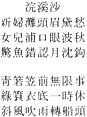
Su Shih wrote a colophon on this tz'u , in which he reports that when Huang himself was asked what he liked best about his composition he referred to the opening two lines, which use images of a woman's face metaphorically to describe the dark hills and autumnal river. Su Shih appends this comment: "However, as soon as he leaves 'Bride Jetty,' he enters 'Maiden Pool.' Isn't this fisherman too much of a philanderer [t'ai lan-lang ]?"[52] It must be Su Shih's lingering dissatisfaction with the romantic sentimentality so typical of tz'u that makes him unable to resist making such comments, even when they are uttered, as here, in jest.
Su Shih also figures in one of the stories that survive about a Hang-chou singing girl named Ch'in-ts'ao, "Zither Melody." Ch'in was known for her quick wit, and especially her ability to extemporize tz'u or change the rhyme of an extant composition. This particular story, however, highlights Su Shih's wit as she addresses questions to him (aping the manner of a Buddhist novice toward his spiritual teacher). Su's answers are all couplets quoted from earlier poetic works:
Once when Tung-p'o was at West Lake, he said playfully to Ch'in, "Come, I'll be your master. You ask me questions."
Ch'in asked him, "What is a lake scene?"
Su replied, "'Autumn waters and distant skies are one color, / sunset clouds and a lone duck fly off together.'"[53]
"What is the person like in the scene?"
"'Her skirt displays six panels of Hsiao-hsiang River, / her hairdo suspends a patch of Wu Mountain clouds.'"[54]
"What is on her mind?"
"'She loves that Scholar Yang / and nearly kills Adjutant Pao with jealousy.'"
"How did it all end?"
[52] "Pa Ch'ien-an chü-shih 'Yü fu tz'u,'" Su Shih wen-chi , 68.2157. Also recorded in Wu Tseng, Neng-kai chai man-lu , 16.473; and Hu Tzu, T'iao-hsi—ch'ien-chi , 48.330.
[53] Wang Po (648–75), "T'eng-wang-ko hsü," Ch'üan T'ang wen (1814 ed.), 181.19a.
[54] Li Ch'ün-yü (mid-9th cent.), "T'ung Cheng Hsiang ping ko-chi hsiao-yin hsi tseng," Ch'üan T'ang shih , 569.6602.
"'Her gateway is deserted, horse and carriage rarely pass. / In old age she becomes a traveling merchant's wife.'"[55]
Hearing this, Ch'in suddenly became enlightened. She shaved her head and became a nun.[56]
Su Shih's final couplet is taken from the description in Po Chü-i's "Lute Song" of the sad later years of a former entertainer. Although we might first suppose that there is nothing special about Su Shih's appearance in this story, and that almost any literatus might equally well have been Ch'in's questioner, my argument is that Su Shih does have some degree of special appropriateness in such an anecdote. Whether or not the anecdote has any basis in historical fact, Su Shih's role here befits his habit of questioning the fascination shown conventionally in tz'u with the courtesan and her romantic liaisons.
There is an obvious objection to the argument presented here, which is that Su Shih's own corpus of tz'u is filled with songs that are addressed to or describe singing girls.[57] It is certainly not true, despite how often it is claimed or implied, that Su Shih rejected the conventional methods of tz'u writing outright and poured all his energies into developing his famed "heroic and unrestrained" alternative. But if Su produced numerous tz'u that are faithful to the Hua-chien tradition and its alluring portraits of female entertainers, what are we to make of his remarks discussed above?
My answer is that if we read Su Shih's tz'u chronologically, the apparent contradiction loses much of its urgency.[58] It is well known that Su Shih did not begin to produce tz'u in any quantity until surprisingly late, during his first assignment to Hang-chou (when he was already in his late thirties). It is likely that this late start itself reflects some early ambivalence he felt toward the genre. When he did begin he stayed, naturally enough, within boundaries that were well established. Some scholars, it is true, have detected even in Su Shih's early tz'u , especially those written as farewells to friends, signs of the breakthrough that was later to come.[59] But it is questionable whether those signs are really sig-
[55] Po Chü-i (772–846), "P'i-p'a hsing," Ch'üan T'ang shih , 435.4822.
[56] Wu Tseng, Neng-kai chai man-lu , 16.483.
[57] Support for this point can be found in the recent article by Ch'eng Shan-k'ai on images of singing girls in Su Shih's tz'u , "Tung-p'o yüeh-fu chung ko-chi ti mei-hsüeh i-i," in T'ung-p'o tz'u lun-ts'ung , pp. 90–106.
[58] The most complete chronological arrangement of Su Shih's tz'u is Ts'ao Shuming's Tung-p'o tz'u (Hong Kong: Hsiang-kang Shang-hai yin-shu-kuan, 1968), which supersedes in its dating of the pieces, though not in its annotations, Lung Mu-hsün's Tung-p'o yüeh-fu chien (Shanghai: Shang-wu yin-shu-kuan, 1936).
[59] See Nishi Noriaki, Toba[*] no shoki no sobetsu-shi[*] ," pp. 64–73.
nificant except in retrospect. It must be said that during his first decade as a tz'u writer, the 1070s, while he served in Hang-chou, Mi-chou, and Hsü-chou, Su Shih produced a large number of quite conventional compositions. However, what the reader of his corpus for these years finds is that every now and then, on rare occasions, Su Shih departed from conventional methods. He undertook then to write intensely autobiographical tz'u , and it is precisely these that became famous (e.g., his hunting piece, his dream of his late wife, his autumn moon-festival song for Tzu-yu, his historical reflections at Yen-tzu-lou, and his P'ing-shan Hall lament for Ou-yang Hsiu).[60] These pieces are linked by their common repudiation, for that is what it amounts to, of the world of romanticized courtesans, and their adoption instead of many of the conventions of occasional shih poetry. This, I would suggest, is a more useful way of describing Su's innovation than vaguely to characterize it as "heroic and unrestrained." Read against the other tz'u Su Shih wrote during these years, these pieces fairly jump off the page, so distinctive are they in subject and tone. In these few pieces Su Shih had already found an approach to tz'u that flourished during his subsequent Huang-chou exile (when the political trouble his shih writing had brought him encouraged him to experiment with "little tz'u " instead).[61] Huang-chou and the years after comprise the period of Su's greatness as a tz'u writer, when he demonstrated how powerful was this new coupling of shih poetry conventions with the lyricism, informality, and spontaneity of tz'u . Su himself wrote in Huang-chou to a friend, "Recently I have composed many new musical verses, and each one is extraordinary."[62]
The Southern Sung scholar Hu Yin said of Su Shih's tz'u that they "washed away in one stroke all the colored silks and perfumed oils" of earlier compositions.[63] Hu Yin was thinking, of course, of Su Shih's innovative tz'u when he wrote this. As a characterization of those tz'u Hu Yin's statement is accurate enough, but it is problematic if applied to
[60] "Chiang shen-tzu," no. 9, CST , 1:300 (no. 54); "Chiang shen-tzu," no. 4, CST , 1:299 (no. 56); "Shui-tiao ko t'ou," no. 3, CST , 1:280 (no. 65); "Yung yü lo," no. 2, CST , 1:302 (no. 86); and "Hsi chiang yüeh," no. 12, CST , 1:285 (no. 93). (The numbers in parentheses are those assigned in Ts'ao Shu-ming's edition.)
[61] See Su's remarks to this effect in his letter "Yü Ch'en Ta-fu," no. 3, Su Shih wenchi , 56.1698.
[62] "Yü Ch'en Chi-ch'ang," no. 9, Su Shih wen-chi , 53.1567. It is evident that Wang Shui-chao also takes this comment (and the crucial term ch'üeh ) to refer to Su's tz'u ; see his "Lun Su Shih ch'uang-tso ti fa-chan chieh-tuan," She-hui k'o-hsüeh chan-hsien 1984, no. 1:264.
[63] Hu Yin (1098–1156), preface to Chiu-pien tz'u , p. i.
Su Shih's corpus as a whole, simply because it took Su some years to effect his break with the tz'u tradition, and occasionally he even lapsed back into that tradition—which should hardly surprise us—after his new style was established.
Other Defenses
Su Shih's innovation, as important as it was, did not transform everyone's idea of how tz'u should be written. There were scholars, even within Su's own "circle," who continued to compose tz'u that stayed well within the Hua-chien style. To conclude this discussion, I would like to return to this more traditional style of tz'u and to consider some of the statements that were made in defense of it. Topics already discussed above, including the recourse taken to distinguishing "elegant" from "vulgar" tz'u and Su Shih's new approach, constitute what were probably the most significant and well-known reactions to the problem of tz'u 's low stature. But other solutions or defenses were raised as well, even if they were offered more tentatively and did not gain any great prominence.
We might begin with an amusing if not serious defense, one that shows, through its contorted argument, how great the pressure could be to find legitimation for tz'u . In a conversation with a P'u Ch'uan-cheng, Yen Chi-tao once broached the subject of his father's (Yen Shu's) tz'u writing. Chi-tao begins:
"My father may have written a great many little tz'u , but he never wrote women's words."
Ch'uan-cheng said, "'Green willows, fragrant grasses by the poststation road, / the young man [nien-shao ] abandons me, leaving carelessly.'[64] What are these if not women's words?"
Yen asked, "What do you think nien-shao means?"
Ch'uan-cheng replied, "It refers to her lover, doesn't it?"
Yen said, "If we use your interpretation, then how are we to understand Lo-t'ien's [Po Chü-i's] lines, 'I wanted to detain my youth [nien-shao ] to await wealth and honor, / but wealth and honor did not come and youth left me'?"[65]
Ch'uan-cheng laughed and saw the point.[66]
[64] The quotation is from Yen Shu's "Yü-lou ch'un," CST , 1:108–9.
[65] From Po's poem "Hao-ko hsing," Ch'üan T'ang shih , 435.4810–11.
[66] Hu Tzu, T'iao-hsi—ch'ien-chi , 26.178.
Yen Chi-tao is trying to exonerate his father, admitting that he wrote tz'u but claiming that he did not go so far as to write in the persona of a woman, especially a lovesick woman. Yen sounds eager here to promote an image of his father as a philosophical or autobiographical tz'u poet. Ch'uan-cheng immediately challenges Yen's claim with a quote from one of Yen Shu's better-known compositions.
The song in question is filled with topoi that are commonly found in tz'u on parting, loneliness, and separation. In addition to the willow and the post-station of the opening line, there is reference to an interrupted dream, parting sorrow (li-ch'ing ), a tangled heart, and endless romantic longing (hsiang-ssu ). Given the conventional associations of such language, the most natural reading of the tz'u is that Ch'uan-cheng first adopts (reflected also in several modern commentaries on the piece):[67] the song is written in the persona of a woman whose young lover (nien-shao , interchangeable in this sense with shao-nien ) has lightly abandoned her. The verb used in line two (p'ao ) normally refers to just such abandonment or rejection in love (especially a man's rejecting a woman). But this tz'u , like many whose theme is loneliness, need not be read exclusively as a jilted woman's complaint. The language is vague enough to permit interpreting the piece as a nonspecific expression of grief over partings. We need not even identify the speaking voice with either sex. The second line might refer to a parted friend (or friends) rather than a particular lover, or it might even be read as a generalized statement: "In youth we abandon others (i.e., friends, lovers) too lightly."[68]
However, that is not what Yen Chi-tao is saying. He is insisting that the phrase nien-shao be taken as "my youthful years" (rather than "the young man") and that it is here personified, so that the speaker talks of its going off and deserting him. This is indeed the way the phrase nien-shao is used in the Po Chü-i poem Yen cites, a poem about aging. This is, however, a most unlikely meaning for nien-shao in this particular tz'u , with all of its subsequent language that must refer to real, not metaphorical, parting. Yen Chi-tao is forcing a very peculiar reading on his father's tz'u , and he is doing so to try to make it more respectable. Ch'uan-cheng is said to be persuaded, but we need not be so gullible. Yen Chi-tao began with a claim that was specious (as the Ssu-k'u ch'üan
[67] See Ch'en Yung-cheng, Yen Shu Yen Chi-tao tz'u hsüan (Hong Kong: San-lien shutien, 1984), p. 73, Ch'en Hung-chih, T'ang Sung tz'u ming-tso hsi-p'ing (Taipei: Wen-chin ch'u-pan-she, 1976), pp. 102–3, and Chiang Shang-hsien, T'ang Sung ming-chia tz'u hsinhsüan (Taipei: Published by the author, 1963), pp. 103–5.
[68] This is the reading suggested by Han Ch'iu-pai in Ho Hsin-hui, Sung tz'u chien-shang tz'u-tien (Peking: Yen-shan ch'u-pan-she, 1987), pp. 112–13.
shu editors have pointed out) and was forced into a further distortion to back it up.[69]
Earlier we passed over a remark that deserves to be closely examined, for it brings up a potentially more serious defense. When Fa-hsiu first criticized Huang T'ing-chien for writing "erotic songs and little tz'u ," Huang tried to deny any wrongdoing, saying, "They are just words in the air [k'ung-chung yü erh ]. I'm not killing anyone, and I'm not stealing. Surely I won't be sentenced to one of the evil destinies for writing these songs." This response brings up a number of issues. It is not immediately clear what Huang means by "words in the air." The phrase might conceivably refer to the fictionality of these literary works, or even to the distinction between the "voice" or persona of the songs and the author. In either case, Huang would be saying, in effect, that it is unfair for any listener to connect Huang personally with the emotions or liaisons described in his songs. (Thus, the voice of an older man infatuated with young girls, so common in Huang's songs, is not to be identified with Huang himself.) Huang would be shielding himself from criticism by appealing to the fictional world of the songs and the right a writer has to create such a world without being personally implicated in it.
Such distinctions are, of course, familiar to us and are regularly employed in our own reading of tz'u . In light of the rest of Huang's comment, however, it seems that the distinction he has in mind might more accurately be described as one of words versus deeds rather than that of persona versus author (if he is not simply thinking of the orality of the words "in the air" as they are sung for the listeners' enjoyment). These two vary in their focus: the former focuses on the author and the difference between what he says and what he does, while the latter focuses on the literary work and the question of whose voice it presents. There is, at the same time, another point or argument implicit in Huang's remarks: whatever culpability may be assigned to him, it is certainly of a minor sort and far less serious than that which results in murder or theft. Neither argument carries any weight with the Buddhist Fa-hsiu, who counters that insofar as Huang's erotic songs incite other men to immoral behavior, Huang's culpability is heavy indeed. Huang seems to have no response to this charge about the effects his songs may have upon male listeners.
Chang Lei wrote one of the two surviving Northern Sung prefaces for tz'u , one for the works of Ho Chu.[70] The preface is a concise apology for
[69] See Ho-yin Ssu-k'u ch'üan-shu tsung-mu t'i-yao chi Ssu-k'u wei-shou shu-mu chin-hui shumu (Taipei: Shang-wu yin-shu-kuan, 1978), 5:4419.
[70] Chang Yu-shih wen-chi (SPTK ed.), 51.15b–16a.
Ho's compositions and is fraught with the sense that some sort of defense is necessary. Essentially, Chang seeks to exonerate Ho by arguing, first, that he could not help himself and, second, that he certainly did not put any effort or thought into his compositions. Chang's statement is particularly noteworthy for its squeamishness over the sentiment in Ho Chu's tz'u . Chang points out that even Liu Pang and Hsiang Yü, rival claimants to the throne after the fall of the Ch'in dynasty, had their sentimental moments. And yet how could they, of all men, be considered "girlish"? Chang even attempts to separate the author somewhat from the emotion found in the lines he wrote: the author merely uses the songs to "lodge his intent" (not "his emotion").
The last defense of tz'u that will be considered here may be the best-known one from the Northern Sung. It is the preface Huang T'ing-chien wrote for Yen Chi-tao's tz'u . The piece is not dated, but it must have been written toward the end of the eleventh century.[71] Huang T'ing-chien died in 1105, and Yen Chi-tao died at roughly the same time. The preface reads as if it is intended to console Yen Chi-tao in his final years.
As the seventh and last son of Grand Councilor Yen Shu, Yen Chi-tao had a remarkably undistinguished career. We know that he sometimes held the assignment of vice prefect and that he once served as supervisor of Hsü-t'ien Garrison.[72] These were hardly eminent positions for a man who had spent his boyhood in the environs of the imperial palace (and is reported to have once impressed Jen-tsung at a banquet with his poetic ability).[73] It is also recorded that Yen Chi-tao was once imprisoned for his connections with Cheng Hsia, a man who protested Wang An-shih's reforms too vigorously in the 1070s, and that Yen removed himself from government service well before the normal retirement age, after which he went on living privately in the capital.[74] All in all, Yen Chi-tao can hardly be said to have lived up to what might fairly have been expected of him, given his advantages.
For his literary friends and would-be eulogizers, Yen Chi-tao's life presented yet another problem. He seems to have written tz'u almost ex-
[71] Hsia Ch'eng-t'ao (T'ang Sung tz'u-jen nien-p'u , p. 261) estimates that Yen Chi-tao compiled his collection of tz'u in approximately 1101. This matches my speculation about the date of the collection's preface.
[72] My source for Yen Chi-tao's biography is Hsia Ch'eng-t'ao's nien-p'u in his T'ang Sung tz'u-jen nien-p'u . See also Yang Chi-hsiu, Hsiao-shan tz'u yen-chiu (Taipei: Li-ming wen-hua shu-chü, 1985), pp. 5–10.
[73] Huang Sheng (mid-13th cent.), T'ang Sung chu-hsien chüeh-miao tz'u-hsüan (SPTK ed.), 3.12a–b.
[74] Wang Cho (early 12th cent.), Pi-chi man-chih (THTP ed.), 2.6a.
clusively. He did not leave a collection of shih poetry or other writings (the first important Northern Sung tz'u writer to fail to do so). Thus, compensation for his lackluster official career could not be found in his literary work, or at least it could not be found in the conventional ways. We do not know whether Yen Chi-tao asked Huang T'ing-chien to write this preface or if Huang volunteered to do so out of fondness for Yen. Although Yen was not one of Huang's close friends, Huang was kindly disposed toward him (as shown by his attempt to introduce Yen to Su Shih). In any case, the task Huang undertook was not an easy one. He responded by pursuing various lines of defense and justification:
Yen Shu-yüan is the youngest son of the lord of Lin-tzu [Yen Shu]. He is a large man with an imposing manner and is a stranger to inhibition. In writing and calligraphy he makes his own rules. He is fond of evaluating other men but has no use for the world's judgment of him. Although the gentlemen of the age praise and love him, they consider him lacking in self-restraint. So it is that he has always been confined to low positions. All his life he hid his mind in the six arts and delighted in the philosophers. The opinions he held were lofty, but he never sought to peddle them in the world. Puzzled over this, once I asked him about it. "Even as I crawl meekly along," he answered, "I am the object of other men's ill will. Were I to get angry and express my feelings, I would be spitting in people's faces." Therefore, he simply amused himself with the vestiges of yüeh-fu [i.e., tz'u ], using the techniques of shih poets to write them. His compositions are fresh, vigorous, and forceful, so that they move any listener's heart. Gentlemen and officials circulate them, saying only that they capture the style of Lin-tzu's compositions. Few men are really able to appreciate their flavor.
I have said this of Shu-yüan: he is definitely an outstanding man, but his foolishness is also exceptional. Those who love Shu-yüan were annoyed and asked me for the particulars. I said, "He has always been hobbled in his career and yet has never once stood outside the gate of powerful officials—this is one foolishness. He writes prose essays in his own style and refuses ever to adopt the language of recent chin-shih recipients—this is another foolishness. He spends cash by the million until his family members go cold and hungry, and yet his face maintains the expression of a little child—this is another foolishness. People are untrue to him but he bears no grudge, and once he trusts someone he cannot dream that the man will ever deceive him—this is another foolishness." My listeners allowed that it was all true.
Despite everything, his yüeh-fu could be called the "Greater Odes" of the entertainment quarters, the ceremonial music of men of high standing. The best of them are in the tradition of the "Kao-t'ang" and "Lo Goddess" rhapsodies, and even the lesser ones are not inferior to the
"Peach Leaf" and "Round Fan" songs.[75] As a young man I myself used to write yüeh-fu occasionally, to accompany drinking and other amusements. The monk Fa-hsiu alone found fault with me, accusing me of using brush and ink to encourage promiscuity, and saying that according to the dharma I should be imprisoned in the Hell of Slit Tongues. But had he never seen Shu-yüan's songs? Regardless, in all comfortable households of the wealthy and powerful, where there are clever girls with pretty faces, if the master appreciates good writing, he will spend a thousand cash in the market to get a fine copy of Shu-yüan's lyrics, saying to anyone who criticizes him, "Aren't you also a man of Shu-yüan's era?" Handsome gentlemen in their prime who have recently come to know the enjoyments of women and wine, as well as undernourished scholars who have suffered for their principles and discover only late in life the attractions of flowing skirts—to cause both sorts of men to have these songs played and danced to while they poison themselves with feasting and pleasure and have no regret, this is the extent of Shu-yüan's crime![76]
There are three main points or arguments in this preface. Huang devotes the bulk of his preface to his theme of Yen Chi-tao as an eccentric and "foolish" man. From the very opening, with its reference to Yen as a "stranger to inhibition," on through the second paragraph, we are told to think of Yen as a maverick who has no thought for the world's opinion of him. The foolishnesses that are enumerated in the second paragraph are, of course, intended to sound endearing and even to be seen as marks of Yen's high moral standards. The implication is that Yen's tz'u themselves are another of these foolishnesses and that, as such, we are wrong to dismiss them as frivolous.
Huang is anxious to establish the point that the true intent or meaning of Yen Chi-tao's works is of a quite different and more profound order than their subject matter—women and wine. But why did Yen choose those subjects? His decision, Huang would have us believe, was rooted in his peculiar personality. The world failed to appreciate Yen, and Yen, of course, refused to alter his ways to win the world's esteem. Yen even refused to explain himself or vent his frustrations in the sort of literature (shih poetry) normally used for such purposes. (This would be "spitting in people's faces.") And so he turned instead to tz'u . Yen writes tz'u effectively, and those who hear them cannot but be moved by his words. But Huang, we gather, is moved by something else: when-
[75] For these Chin dynasty love songs, see Kuo Mao-ch'ien (late 11th cent.), ed., Yüeh-fu shih-chi (Peking: Chung-hua shu-chü, 1979), 45.660 and 45.664–65.
[76] Huang T'ing-chien, Yü-chang Huang hsien-sheng wen-chi (SPTK ed.), 16.24a–25a.
ever he hears Yen's tz'u he thinks of how misunderstood the author is and how he refuses to write seriously about being misunderstood. That is the true "flavor" of Yen's tz'u as they reverberate in Huang's ears. This is a twist upon the tactic, common in prefaces to shih collections, of pointing to a man's literary works as evidence of his ts'ai , "ability," that went unused by the world. Huang appreciates Yen's tz'u for what they do not say. This too is a recourse to a moralistic reading or defense of literature. In this case, the peculiarity of the reasoning has its roots in Yen's odd habit of writing nothing but tz'u .
Huang's second argument, broached just briefly at the start of his concluding paragraph, is that tz'u are, after all, just one more genre in a long and respectable line of song forms. He refers first to the ancient court and ceremonial music, and later to well-known early rhapsodies on goddesses and to pre-T'ang love songs. This defense was to become commonplace in the Southern Sung and can be found in the writings of many tz'u anthologists and critics, where it becomes a virtually obligatory opening statement. It is really quite unpersuasive, because it ignores the considerable differences in subject, tone, social role, and quantity between tz'u and earlier song forms. There was nothing in earlier literary history that very much resembled tz'u —certainly not the ceremonial odes in the Book of Songs or the goddess rhapsodies, whose origins must be in shamanistic incantations—and assertions to the contrary are transparent attempts to lay claim to a lineage that does not exist.
The third point Huang makes is more interesting. He confronts head-on the real problem with tz'u : the pervasive links that were perceived between these songs, female entertainers, and men of letters (who were interested in both). Huang gets around to his point by recalling, first, Fa-hsiu's criticism of Huang's own tz'u . It is almost as if Huang wants another chance, years later, to respond to the monk. Huang implies that Yen Chi-tao's songs are in even "worse taste" than his own and have greater potential for encouraging immoral conduct. Immediately, however, Huang falls back upon the songs' popularity: how, Huang wonders, can anything so widely accepted really be that bad? In his closing lines Huang's tone becomes ironic as he describes Yen's "crime" in terms calculated to make it sound utterly innocuous. This is a bold stroke: to face the charge of wrongdoing, admit guilt, and then laugh off the incrimination. No other Northern Sung defender of tz'u so openly confronts and brazenly dismisses, even if he does not really refute, the views of tz'u 's detractors.
Huang T'ing-chien's preface, coming as it does near the end of the Northern Sung, makes an apt terminus of this survey of attitudes toward tz'u in that period. The era came to a close before the "problem" of tz'u was really resolved. But partial justifications were being formulated, and some authors (e.g., Su Shih) even altered the way they wrote tz'u by way of response. Strictly speaking, it is illogical to suggest that the advances evident in Huang T'ing-chien's thinking about tz'u may have been connected or indebted to the innovations Su Shih made in practice. Huang T'ing-chien should have been thinking about the traditional subjects and tone of tz'u , not Su Shih's new style, when he wrote his preface for Yen Chi-tao. As is often pointed out, Huang and other of Su Shih's "followers" did not follow their mentor's lead in their own writing of tz'u .
Illogical as it may be, I suspect that there is some connection between Su Shih's new approach to tz'u writing and the new boldness his colleague shows in defending the genre. The effort Su Shih put into writing sober and highly personal tz'u from the mid-1070s onward cannot have gone unnoticed by his literary friends and must have had an impact on how the genre was perceived. There is something very public about Su Shih's involvement with tz'u . We know that many of his pieces were composed at parties amid gatherings of friends. As for the writers of the preceding generation (Yen Shu, Ou-yang Hsiu), we may speculate that their tz'u often had similar origins. But Su Shih tells us explicitly in prefaces and other notes when and why he wrote his songs. He calls attention to his engagement with the genre in a way that no writer had previously done. It is difficult to imagine Huang T'ing-chien broaching, in his preface to Yen Chi-tao's tz'u , such subjects as a seriousness underlying apparently frivolous pieces or the harmlessness of listening to songs if the prestigious Su Shih had not, through the openness of his involvement with songs, lent to the form a new respectability. Huang even appropriates the phrase that was commonly used to characterize Su Shih's innovation: writing tz'u using the techniques of shih poetry.
The stature of tz'u seems to have been enhanced somewhat by the end of the eleventh century. When Liu Yung died decades before, leaving nothing but an enormously popular collection of songs, no literatus saw fit to legitimate it with a preface. Likewise, Yen Shu and Ou-yang Hsiu remained remarkably silent about their own tz'u and kept them out of their literary collections. When these men died, no one mentioned tz'u in the various funerary and eulogistic pieces that commemorated their lives. But with Chang Hsien, who died in 1078, we begin to detect
a change. In his preface to Chang's shih collection, Su Shih could still complain that the world appreciated Chang's tz'u but neglected his important literary work, his shih . This is a vestige of the old attitudes. But in another place, a formal panegyric for Chang Hsien, Su Shih actually mentions Chang's tz'u and suggests that they developed out of his shih .[77] Then, by the end of the century, we meet the novel case of Yen Chi-tao, the son of a grand councilor who was content to write nothing but tz'u , and we also encounter Huang T'ing-chien, who tried valiantly to defend him. At just about the same time Chang Lei took it upon himself to defend Ho Chu's tz'u writing.
If this change is accepted, it is tempting to go a step further and link it to a growing acceptance of various sorts of aesthetic endeavors, a proliferation of artistic legitimacies, that is evident in the exact same period. The causes of these changes outside the field of tz'u are too complex to explore here. But it can be said that in the last two decades of the century new claims are made for the seriousness of shih poetry, for calligraphy, and for scholarly painting. Su Shih and his friends had evidently become intrigued by the idea that a person must throw his energies into some activity to attain insight into the underlying principles of the world.[78] Virtually any activity would do (even tea connoisseurship),[79] anything that brought the person out of vacuous introspection and put him in intimate contact with some aspect of "the world" (wu ). Tz'u is not specifically cited as one of the acceptable pursuits, and so any link between the small but discernible rise in its stature and this current of thought will have to remain speculative. The whole thrust of this new idea, however, is to lend legitimacy to activities formerly looked upon by many as less than profound. It is likely that the increasing acceptance of tz'u was peripherally connected with this idea and that in some complex way men like Yen Chi-tao are related, perhaps both as cause and consequence, to the new seriousness accorded to a broad array of cultural pursuits.
[77] "Chi Chang Tzu-yeh wen," Su Shih wen-chi , 63.1943.
[78] The clearest statement of this notion is contained in Su Shih's farewell to the monk Ssu-ts'ung, "Sung Ch'ien-t'ang seng Ssu-ts'ung kuei Ku-shan hsü," Su Shih wen-chi , 10.325–26.
[79] See Su's "Shu Huang Tao-fu P'in ch'a yao-lu hou," Su Shih wen-chi , 66.2067.