
The Model
Sewell's thinking about the Wisconsin model took off from the fact, by then well-documented, that educational aspirations among young people are positively related to socioeconomic background (Sewell and Shah 1968b ). The researchers wished to understand the mechanisms by which differential family background is translated into differential educational goals. A major hypothesis was that high socioeconomic status (SES) results not only in more intellectual ability and better performance in school, but that high status parents provide more encouragement of, and psychological support for, postsecondary education than do low status parents. In the words of Sewell and Hauser (1980):
We then extended our analysis using a path model to determine and compare the direct and indirect effects of socioeconomic status, measured intelligence, and parental encouragement on college plans. We assumed that parental encouragement would be influenced by the socioeconomic status and measured ability of the child, and that all three variables would have direct effects on college plans. This analysis revealed that for both sexes, the effect of socioeconomic status on parental encouragement is greater than that of ability. . . . The direct effect of parental encouragement on the college plans of both sexes is greater than the direct effect of socioeconomic status or of ability.
Since, as we shall see, sibsize is also related to young people's educational goals or expectations, our interest in this chapter focuses on the mechanisms by which variability in sibsize affects these goals. Are most of its effects indirect, operating through ability, grades, and differential parental expectations and encouragement? Or, does it have fairly substantial direct effects even after taking these intervening variables into account? Insofar as sibsize
has indirect effects, what intervening variables does it impinge on the most? These questions were not raised by the Wisconsin researchers in their work on high school seniors, since sibsize was not part of the original model. Only recently, at a much later stage of the longitudinal analysis, has this variable been added and, by this time, the interest of Sewell and his colleagues had shifted somewhat from a concentration on goals to a concentration on outcomes.
In employing the Wisconsin approach to educational goals, we are using the most updated specification of the model, a specification that differs from the early work of Sewell and his colleagues (see, Sewell and Shah 1968a and b ; Sewell, Haller, and Portes 1969; Sewell, Haller, and Ohlendorf 1970). The changes made by Sewell and colleagues (see, Sewell and Hauser 1980, for a summary of the changes) in this recent version relate principally to a disaggregation of the parental SES index in order to consider separately mother's and father's education, father's occupation, and father's income. Additionally, the updated version of the model views the young person's intellectual ability as an intervening rather than a predetermined variable. This change was in response to a recognition of the influence of parental characteristics on the young person's abilities.
We have also made some changes of our own in the model. An important change concerns the measurement level of the dependent variable—educational goals. The Wisconsin model used a dichotomous dependent variable—whether or not the youngster expected to go to college. All of our data (as will be discussed in more detail shortly) relate to years of expected postsecondary education. As for the remainder of the model, the Wisconsin approach did not include sibsize (although the followup analysis of actual educational attainment did add this variable). The Wisconsin model of educational goals included a measure of ability, grades in school, and an index of parental, peer, and teacher expectations of the student as perceived by the youngster. In the Wisconsin formulation, parental goals or expectations are regarded as indicative of parental support (or lack of it) for postsecondary schooling. Our model deletes peer expectations, because recent research has suggested that once one takes account of the selectivity of peers for one another, the effect on students' educational aspirations is small (for a review of this literature, see Cohen 1983). As for teacher effects, it is unfortunate that
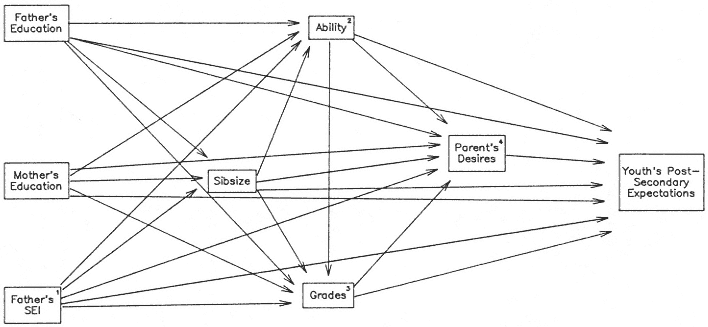
Figure 6.1.
Diagram of the Basic Path Model of Youth's Postsecondary Expectations. (1) In Cycle III, family income. (2) In Cycle III, WISC; in HSB,
Vocabulary. (3) In Cycle III, WRAT. (4) In Cycle III, data are from parent; in HSB, they are from the student concerning the parent.
the data sets analyzed here have high proportions of missing data on this issue and, hence, this variable has been excluded. Our model retains parental desires or goals for the student, and this variable, like the student's expectations, is coded in terms of years of postsecondary schooling desired. Moreover, as will be discussed, in the High School and Beyond study (HSB), the data on the parents are from the student (as in the Wisconsin model) reflecting the student's perception of parent's goals. In Cycle III of the Health Examination Survey, the data on parent's desires are from the parent directly, providing some check on the criticism (of the Wisconsin research) that to obtain parents' views from students, and then regress these views on students' expectations, involves a degree of circularity that may guarantee a high level of explained variance (R2 ). The diagram for the basic model is shown in figure 6.1.
What expectations have we concerning the nature of the relationships, the placement of the variables, and their relative importance in the model? For reasons that by now do not require explanation, the model assumes some inverse relation of fertility by the parent's socioeconomic background. We also expect a positive effect of background on ability and a negative effect of sibsize. Holding ability constant, the model assumes that parents' background will affect grades positively because higher-educated parents will place more emphasis on academic achievement and create home situations that are conducive to study and concentration. Children of higher-SEI fathers may need to work less at odd jobs as well. We expect large sibsize to be negatively related to grades because of distraction and crowding at home, and to more emphasis on community and family activities than upon academic achievement. Based on past research, we expect ability to be the major influence on school performance for both sexes and for all classes in school. Although we believe that parental desires for children probably influence ability and grades, we have adhered to the placement of both prior to parental desires in this model. Our reasoning is twofold. First, we are dealing with high school students and the postsecondary goals of the parents. At this relatively late stage in the young person's education, it seems reasonable to think of the parents' postsecondary desires as responsive to ability and grades. Second, there is an advantage to having continuity with the Wisconsin model. For a study that treats parental encouragement and grades in a nonrecursive model, see, Hout and Morgan (1975).
We expect that parents' characteristics will have significant direct effects on their educational desires for both sexes, but that the mother's education will be more important than the father's education for girls, and that the reverse will be true for boys (Sewell, Hauser, and Wolf 1980). We also expect, as already discussed, that grades and ability will be important for parents' desires, but that the relative importance of grades will be greater for boys than for girls congruent with research by Sewell and others (ibid.). We expect the relative negative importance of sibsize for the parents' desires to approximate the positive importance of the father's SEI, primarily because sibsize seems rather consistently to have a negative effect on educational variables that approximates the positive effect of the father's SEI. Moreover, we expect that parental background and sibsize influences on the parents' desires will be mediated primarily through ability (rather than school performance), because parents will be more strongly influenced by a life-long experience with a child than by his or her grades in school.
Regarding the student's own expectations, we expect family background effects to be more heavily mediated than is the case for the parents' desires, because students' expectations are conditional on parental support and encouragement. We also see no reason to doubt that sibsize will continue to be a negative offset to the father's SEI. We believe that for the students' goals, grades will be more important than ability, in contrast to the parents, because grades are so strongly supported normatively among students as indicating how they "stack up" against peers. Since a major finding of the Wisconsin analysis is that parents' desires have the most important effect of all the variables in the model, we expect to find this relationship as well.
It is worth noting that, in addition to our focus on sibsize, the analysis in this chapter represents a detailed consideration of the revised Wisconsin model using educational goals as the principal focus of interest. As we have mentioned, by the time that Sewell and colleagues finally revised the overall model, their major concern had shifted from educational goals to a concentration on educational and occupational attainment and income.
Since the principal function of path models is to make explicit theoretical assumptions and interconnections, this is an appropriate place to discuss the causal status of family size and parents' educa-
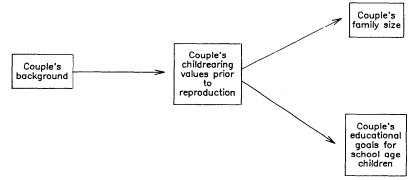
Figure 6.2.
Hypothetical Model of Parent's Childrearing Values as Antecedent to Both the
Number of Children They Have and Their Educational Goals for Their Children.
tional goals for children. It can be argued, of course, that insofar as parents of different numbers of children have different educational goals, the association is not a consequence of family size but a cause of it. According to this argument, sibsize per se does not give rise to differential parental educational goals for children, but rather sibsize is a consequence of the couple's goals prior to reproduction which continue after the children are actually present. Holding constant marital intactness and control over fertility (both fecundity and control over unwanted births), this reasoning is diagrammed in figure 6.2.
Is this possible confounding theoretically so compelling as to rule out the relevance of the basic model we have suggested? There are a number of reasons for believing that the answer is negative. First, parental concern about the educational quality of children (or lack of such concern) is not the only determinant of family size. Leaving aside marital disruption, couples may have different family-size goals for reasons quite other than a concern about child quality—reasons relating to the couples' interest in children as social investments, as economic investments, as political power investments, and so on (Blake 1979; Blake and Del Pinal 1982).
In addition, family-size goals are also related to other consumer goals of parents—the parents' quality of life rather than the quality of the child. Further, not all fertility is explicable by reference to couple's family-size goals. A share is due to differential fecundity
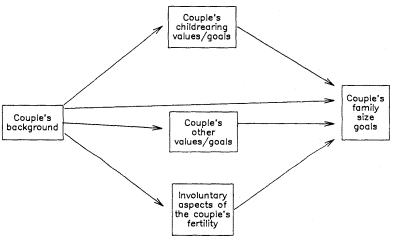
Figure 6.3.
Hypothetical Model of the Determinants of Family-Size Goals.
and differential efficiency and effectiveness of birth control practice. However, insofar as concern about the educational quality of children affects family size, our controls for parents' background characteristics take this fact into account—at least partially. This is especially true since we have no evidence that, after controlling for major background factors, couples have different child-quality goals. In sum, the determinants of family-size goals can be modeled as shown in figure 6.3.
Finally, the analysis to be presented in this chapter will show that parents' schooling desires for children are influenced more by the child's ability and performance than by either parental background or sibsize, and we have seen in a prior chapter (using younger children) that sibsize is an important influence on IQ. In sum, we have reason to believe that, through a variety of channels, both indirect and direct, sibsize genuinely influences parents' educational goals.
Consequently, although a share of parents' educational expectations for school-age children may be a result of couples' prereproductive educational goals for prospective children (even after controls for parental background have been introduced), we shall proceed in this chapter as if this possibly confounding effect did not
exist. We believe that if the presumed confounding could be measured, it would not change the basic argument of our model, although it would certainly add a dimension to our understanding.
Although we know that even prior to high school a number of students from large sibsizes and low socioeconomic status drop out of school, the analysis of our basic model allows us to view the educational selection process in high school populations, as well as among a sample of somewhat younger children from Cycle III of the Health Examination Survey. These samples can help us to understand how parental background and sibsize get translated into more proximate influences on young people's expectations of postsecondary educational attainment—influences such as intellectual ability, grades, and parental desires.