
6—
Family Background, Sibsize, and Educational Expectations
In this chapter, we continue our effort to understand how family background and sibsize operate to affect educational attainment. Here our object will be to learn how these aspects of the family get translated into differential postsecondary educational goals among young people.
Although the sibsize effects on educational expectations in the pages that follow are modest, we have included this analysis for a number of reasons. First, the effects are consistent in direction, generally significant, and typically as important (or almost as important) as the father's SEI or family income. Additionally, the analysis, following in the theoretical tradition of the Wisconsin data, suggests ways in which the effects of sibsize on educational goals could be studied among young people at a considerably earlier age. Obviously, such research would require the employment of a more realistic set of dependent variables than college expectations, the relevance and validity of which doubtless decline rather rapidly as one moves down the age range. Nonetheless, our analysis here, like similar analyses in the past, suggests the importance of focusing research regarding the determinants of educational objectives on much younger groups of students than appear in this chapter.
Why analyze factors affecting youngsters' educational goals? The answer, in brief, is that the postsecondary goals of high school students have been found to be a major predictor of years of schooling completed (Alexander and Eckland 1975; Sewell and Hauser 1980). In fact, Sewell and Hauser believe that if you can explain educational aspirations you are well on your way to explaining
attainment (Sewell and Hauser 1980, 64). In this chapter, we will use (with some changes to be discussed) that part of the Wisconsin model of status attainment that focuses on educational aspirations as its principal dependent variable. The full model (see, Sewell and Hauser, ibid.) considers the determinants of occupational aspirations, educational and occupational attainment, and income as well.
The Model
Sewell's thinking about the Wisconsin model took off from the fact, by then well-documented, that educational aspirations among young people are positively related to socioeconomic background (Sewell and Shah 1968b ). The researchers wished to understand the mechanisms by which differential family background is translated into differential educational goals. A major hypothesis was that high socioeconomic status (SES) results not only in more intellectual ability and better performance in school, but that high status parents provide more encouragement of, and psychological support for, postsecondary education than do low status parents. In the words of Sewell and Hauser (1980):
We then extended our analysis using a path model to determine and compare the direct and indirect effects of socioeconomic status, measured intelligence, and parental encouragement on college plans. We assumed that parental encouragement would be influenced by the socioeconomic status and measured ability of the child, and that all three variables would have direct effects on college plans. This analysis revealed that for both sexes, the effect of socioeconomic status on parental encouragement is greater than that of ability. . . . The direct effect of parental encouragement on the college plans of both sexes is greater than the direct effect of socioeconomic status or of ability.
Since, as we shall see, sibsize is also related to young people's educational goals or expectations, our interest in this chapter focuses on the mechanisms by which variability in sibsize affects these goals. Are most of its effects indirect, operating through ability, grades, and differential parental expectations and encouragement? Or, does it have fairly substantial direct effects even after taking these intervening variables into account? Insofar as sibsize
has indirect effects, what intervening variables does it impinge on the most? These questions were not raised by the Wisconsin researchers in their work on high school seniors, since sibsize was not part of the original model. Only recently, at a much later stage of the longitudinal analysis, has this variable been added and, by this time, the interest of Sewell and his colleagues had shifted somewhat from a concentration on goals to a concentration on outcomes.
In employing the Wisconsin approach to educational goals, we are using the most updated specification of the model, a specification that differs from the early work of Sewell and his colleagues (see, Sewell and Shah 1968a and b ; Sewell, Haller, and Portes 1969; Sewell, Haller, and Ohlendorf 1970). The changes made by Sewell and colleagues (see, Sewell and Hauser 1980, for a summary of the changes) in this recent version relate principally to a disaggregation of the parental SES index in order to consider separately mother's and father's education, father's occupation, and father's income. Additionally, the updated version of the model views the young person's intellectual ability as an intervening rather than a predetermined variable. This change was in response to a recognition of the influence of parental characteristics on the young person's abilities.
We have also made some changes of our own in the model. An important change concerns the measurement level of the dependent variable—educational goals. The Wisconsin model used a dichotomous dependent variable—whether or not the youngster expected to go to college. All of our data (as will be discussed in more detail shortly) relate to years of expected postsecondary education. As for the remainder of the model, the Wisconsin approach did not include sibsize (although the followup analysis of actual educational attainment did add this variable). The Wisconsin model of educational goals included a measure of ability, grades in school, and an index of parental, peer, and teacher expectations of the student as perceived by the youngster. In the Wisconsin formulation, parental goals or expectations are regarded as indicative of parental support (or lack of it) for postsecondary schooling. Our model deletes peer expectations, because recent research has suggested that once one takes account of the selectivity of peers for one another, the effect on students' educational aspirations is small (for a review of this literature, see Cohen 1983). As for teacher effects, it is unfortunate that
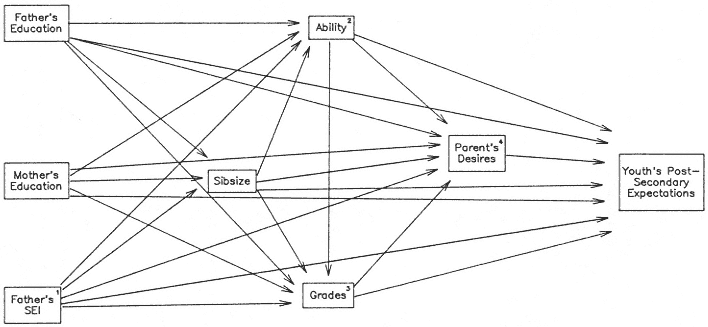
Figure 6.1.
Diagram of the Basic Path Model of Youth's Postsecondary Expectations. (1) In Cycle III, family income. (2) In Cycle III, WISC; in HSB,
Vocabulary. (3) In Cycle III, WRAT. (4) In Cycle III, data are from parent; in HSB, they are from the student concerning the parent.
the data sets analyzed here have high proportions of missing data on this issue and, hence, this variable has been excluded. Our model retains parental desires or goals for the student, and this variable, like the student's expectations, is coded in terms of years of postsecondary schooling desired. Moreover, as will be discussed, in the High School and Beyond study (HSB), the data on the parents are from the student (as in the Wisconsin model) reflecting the student's perception of parent's goals. In Cycle III of the Health Examination Survey, the data on parent's desires are from the parent directly, providing some check on the criticism (of the Wisconsin research) that to obtain parents' views from students, and then regress these views on students' expectations, involves a degree of circularity that may guarantee a high level of explained variance (R2 ). The diagram for the basic model is shown in figure 6.1.
What expectations have we concerning the nature of the relationships, the placement of the variables, and their relative importance in the model? For reasons that by now do not require explanation, the model assumes some inverse relation of fertility by the parent's socioeconomic background. We also expect a positive effect of background on ability and a negative effect of sibsize. Holding ability constant, the model assumes that parents' background will affect grades positively because higher-educated parents will place more emphasis on academic achievement and create home situations that are conducive to study and concentration. Children of higher-SEI fathers may need to work less at odd jobs as well. We expect large sibsize to be negatively related to grades because of distraction and crowding at home, and to more emphasis on community and family activities than upon academic achievement. Based on past research, we expect ability to be the major influence on school performance for both sexes and for all classes in school. Although we believe that parental desires for children probably influence ability and grades, we have adhered to the placement of both prior to parental desires in this model. Our reasoning is twofold. First, we are dealing with high school students and the postsecondary goals of the parents. At this relatively late stage in the young person's education, it seems reasonable to think of the parents' postsecondary desires as responsive to ability and grades. Second, there is an advantage to having continuity with the Wisconsin model. For a study that treats parental encouragement and grades in a nonrecursive model, see, Hout and Morgan (1975).
We expect that parents' characteristics will have significant direct effects on their educational desires for both sexes, but that the mother's education will be more important than the father's education for girls, and that the reverse will be true for boys (Sewell, Hauser, and Wolf 1980). We also expect, as already discussed, that grades and ability will be important for parents' desires, but that the relative importance of grades will be greater for boys than for girls congruent with research by Sewell and others (ibid.). We expect the relative negative importance of sibsize for the parents' desires to approximate the positive importance of the father's SEI, primarily because sibsize seems rather consistently to have a negative effect on educational variables that approximates the positive effect of the father's SEI. Moreover, we expect that parental background and sibsize influences on the parents' desires will be mediated primarily through ability (rather than school performance), because parents will be more strongly influenced by a life-long experience with a child than by his or her grades in school.
Regarding the student's own expectations, we expect family background effects to be more heavily mediated than is the case for the parents' desires, because students' expectations are conditional on parental support and encouragement. We also see no reason to doubt that sibsize will continue to be a negative offset to the father's SEI. We believe that for the students' goals, grades will be more important than ability, in contrast to the parents, because grades are so strongly supported normatively among students as indicating how they "stack up" against peers. Since a major finding of the Wisconsin analysis is that parents' desires have the most important effect of all the variables in the model, we expect to find this relationship as well.
It is worth noting that, in addition to our focus on sibsize, the analysis in this chapter represents a detailed consideration of the revised Wisconsin model using educational goals as the principal focus of interest. As we have mentioned, by the time that Sewell and colleagues finally revised the overall model, their major concern had shifted from educational goals to a concentration on educational and occupational attainment and income.
Since the principal function of path models is to make explicit theoretical assumptions and interconnections, this is an appropriate place to discuss the causal status of family size and parents' educa-
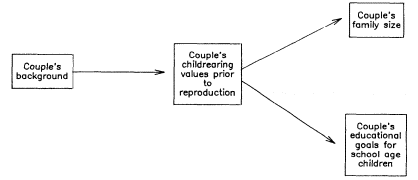
Figure 6.2.
Hypothetical Model of Parent's Childrearing Values as Antecedent to Both the
Number of Children They Have and Their Educational Goals for Their Children.
tional goals for children. It can be argued, of course, that insofar as parents of different numbers of children have different educational goals, the association is not a consequence of family size but a cause of it. According to this argument, sibsize per se does not give rise to differential parental educational goals for children, but rather sibsize is a consequence of the couple's goals prior to reproduction which continue after the children are actually present. Holding constant marital intactness and control over fertility (both fecundity and control over unwanted births), this reasoning is diagrammed in figure 6.2.
Is this possible confounding theoretically so compelling as to rule out the relevance of the basic model we have suggested? There are a number of reasons for believing that the answer is negative. First, parental concern about the educational quality of children (or lack of such concern) is not the only determinant of family size. Leaving aside marital disruption, couples may have different family-size goals for reasons quite other than a concern about child quality—reasons relating to the couples' interest in children as social investments, as economic investments, as political power investments, and so on (Blake 1979; Blake and Del Pinal 1982).
In addition, family-size goals are also related to other consumer goals of parents—the parents' quality of life rather than the quality of the child. Further, not all fertility is explicable by reference to couple's family-size goals. A share is due to differential fecundity
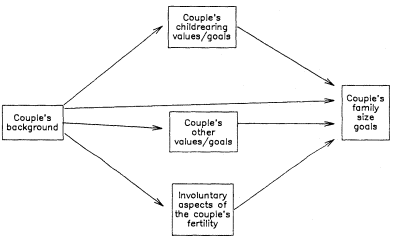
Figure 6.3.
Hypothetical Model of the Determinants of Family-Size Goals.
and differential efficiency and effectiveness of birth control practice. However, insofar as concern about the educational quality of children affects family size, our controls for parents' background characteristics take this fact into account—at least partially. This is especially true since we have no evidence that, after controlling for major background factors, couples have different child-quality goals. In sum, the determinants of family-size goals can be modeled as shown in figure 6.3.
Finally, the analysis to be presented in this chapter will show that parents' schooling desires for children are influenced more by the child's ability and performance than by either parental background or sibsize, and we have seen in a prior chapter (using younger children) that sibsize is an important influence on IQ. In sum, we have reason to believe that, through a variety of channels, both indirect and direct, sibsize genuinely influences parents' educational goals.
Consequently, although a share of parents' educational expectations for school-age children may be a result of couples' prereproductive educational goals for prospective children (even after controls for parental background have been introduced), we shall proceed in this chapter as if this possibly confounding effect did not
exist. We believe that if the presumed confounding could be measured, it would not change the basic argument of our model, although it would certainly add a dimension to our understanding.
Although we know that even prior to high school a number of students from large sibsizes and low socioeconomic status drop out of school, the analysis of our basic model allows us to view the educational selection process in high school populations, as well as among a sample of somewhat younger children from Cycle III of the Health Examination Survey. These samples can help us to understand how parental background and sibsize get translated into more proximate influences on young people's expectations of postsecondary educational attainment—influences such as intellectual ability, grades, and parental desires.
The Data
The data for the analysis in this chapter concern high school sophomores and seniors studied in the survey High School and Beyond (HSB), and youngsters age 12 to 17 in Cycle III of the Health Examination Survey. From HSB, we have used as predictors the mother's and father's education in years, the father's occupation coded according to the Duncan SEI, sibsize, the age standardized vocabulary test as an indicator of ability, the students' average grades during the past year, and the responses from students to a question about the post–high school education desired by the mother. The dependent variable is the student's estimate of the years of schooling he or she expects to achieve. The codes for mother's desires and student's expectations were as follows:
11 Less than H.S. graduation (sophomores only)
12 H.S. graduation only; vocational-trade
13 College, less than two years
15 College, two years or more
16 Finish college
18 Master's degree
22 Ph.D., M.D., etc.
Mother's desires for youngster's postsecondary education were favored over father's because the latter could not be scaled in years
and would have resulted in a dichotomous dependent variable.
The Cycle III predictors were father's and mother's education coded in years, family income (no data were available on the father's occupation), sibsize, the age-standardized WISC as a measure of ability, the age-standardized WRAT (see appendix A for a detailed discussion of the WRAT) as a measure of school-related performance, and data derived from the parent (primarily the mother) concerning years of schooling desired for the child. The dependent variable was the youth's expectations about the years of schooling he or she would achieve. The codes for parent's desires and youth's expectations were as follows:
11 Quit school as soon as possible
12 Finish high school
14 Get some college
16 Finish college
18 Finish college and take further training
It will be remembered that a major difference between the HSB and the Cycle III data is that the HSB refers to the student's estimate of the mother's desires. The Cycle III data are based on information from the parent directly. Also, Cycle III contains a wider age range than does HSB. Whereas HSB relates to sophomores and seniors, Cycle III (including as it does youngsters who were age 12 to 17) involves those who are in grades 6 through 9 as well as those who are in grades 10 through 12.
It is worth emphasizing here that the principal data on educational expectations analyzed in this chapter are from young people who have already "survived" critical states in the schooling process. As we know from adult experiences, youngsters who are high school students, and especially those who are seniors, are a selected group of survivors (that is, their characteristics differ from the drop-outs). This process of selective school leaving occurs during grade school, between grade school and high school, and during the first shock of the transition into high school. Furthermore, as may be seen from table 6.1, the selection is specific for sibsize. Average school performance is higher at the higher grades than at the lower ones, and this is particularly true for those from large families. For example, among youngsters from sibsizes five-plus in Cycle III, the
age-standardized WRAT scores for tenth- to twelfth-graders are approximately one-half a standard deviation higher than the scores for sixth- to ninth-graders, whereas the differences in WRAT scores by grade is relatively small for those from small families. Moreover, the increase in scores at the higher grades is accompanied by a decrease in variance as can be seen from a comparison of the standard deviations. The same increase in school performance and homogeneity of school performance is evident in the HSB data as well. As a consequence of this selection by sibsize, the sibsize effects on educational expectations to be discussed in this chapter are not large. It may also be true that among those students who suffer family background disadvantages (such as coming from a large family), schooling has a marginally greater effect on school performance than among more advantaged students—if the student can manage to remain in school and at grade level. Hence, both selection and the differential value that is added by schooling may contribute to greater homogeneity at the higher class levels. Documentation of this process may be found in Alexander and others (1985).
Students' Educational Expectations
We begin with the sophomores and seniors in the High School and Beyond study. Table 6.2 shows the decomposition of our basic model of student's educational expectations into total effects, indirect effects, and direct effects. For readers who are not familiar with the jargon of path analysis it is worthwhile for us to go over the logic briefly. Initially, it should be noted that since path analysis compares effects of variables in a model, standardized regression coefficients are used throughout. The parents' SES variables are predetermined—that is, they are given in the model and are assumed to appear without further explanation. Hence, the total effects of parental SES are the standardized regression coefficients for SES variables taking account only of their intercorrelations. The direct effects of each of the parent's background variables are the standardized coefficients taking into account, in addition, the effects of the subsequent variables in the model—sibsize, vocabulary, grades, and mother's desires. Consequently, the indirect -effects coefficients for the mother's education, for example, indicate how
| ||||||||||||||||||||||||||||||||||||||||||||||||||||||||||||||||||||||||||||||||||||||||||||||||||||||||||||||||||||||||||||||||||||||||||||||||

| ||||||||||||||||||||||||||||||||||||||||||||||||
| |||||||||||||||||||||||||||||||||||||||||||||||||||||||||||||||||||||||||||||||||||||||||||||||||||||||||||||||||||||||||||||||||||||||||||||||||||||||||||||||||||||||||||||||||||||||||||||||||||||
| ||||||||||||||||||||||||||||||||||||||||||||||||||||||||||||||||||||||||||||||||||||||||||||||||||||||||||||||||||||||||||||||||||||||||||||||||||||||||||||||||||||||||||||||||||||||||||||||||||||||
much of the total effect of mother's education operates through sibsize, vocabulary, grades, and mother's desires respectively. Readers should satisfy themselves that the coefficients for indirect and direct effects for each variable sum to the coefficient for total effects (except for small differences due to rounding). Turning to sibsize, the total effect is, again, the standardized coefficient taking account of the effect of prior variables in the model (the parents' background); whereas the direct effect of sibsize is the coefficient taking account, in addition, of the effects of vocabulary, grades, and mother's desires; with the indirect effects of sibsize operating through these variables shown in-between. The reasoning is the same for the remainder of the variables: Total effect is the standardized coefficient taking account of prior variables in the model (or concurrent variables as with parents' background), direct effect takes account of the influence of prior and subsequent variables, and indirect effect shows how, beginning with predetermined variables, subsequent variables absorb some of the total effects.
We may note first of all (table 6.2) that, for both high school classes, the model explains a high proportion of the variance in student's postsecondary expectations—between 58 and 64 percent. This fit compares most favorably with the Sewell and Shah analysis (1968b ), which had an R2 (variance explained) for Wisconsin senior boys of 37 percent and for girls of 41 percent. The improved fit is probably because our analysis is based on years of schooling (for both the mother's desires and the youngster's expectations) rather than an ordinal variable, and includes sibsize and school performance, which the Sewell and Shah (1968b ) analysis did not. Second, it is clear that a major increment to explanation rests with the variable "student's perception of mother's schooling desires." This finding accords with the analyses by Sewell and Shah (1968b ).
As for direct effects, most of the total effects of parental background and sibsize are mediated—primarily through ability and the mother's desires. Thus, most of the influence of parental background and sibsize has been translated into differential ability and the youngster's perception of parental wishes. Consequently, since the direct effects of background and sibsize have been diminished,
and ability operates through grades, grades remain unchallenged as the only major direct effect after the mother's expectations (which are far and away the most important variable). However, as between boys and girls, the relative importance of grades compared to the mother's desires is consistently greater for boys. For example, among senior boys, the effect of grades is 41 percent of mother's desires, but for girls, only 24 percent. In addition, comparing the relative effects of ability versus grades by sex, it is evident that the relative importance of grades compared to ability is greater by far for boys than for girls. So, boys are more influenced by grades compared either to ability or the mother's desires than are girls. Since the relative importance of ability compared to the mother's desires is less for girls than for boys (in addition to the relative importance of grades being less), it turns out that girls are relatively more dependent on their mother's educational hopes and wishes than are boys, and less stimulated by their own performance (or their own ability operating through their performance). This finding corresponds with the recent analysis of Wisconsin data by Sewell and his colleagues (Sewell, Hauser, and Wolf 1980).
Although the results for seniors and sophomores are very similar, it should be noted that the direct effects of both ability and grades (compared to the mother's desires) are relatively more important for sophomores. We would argue that this quite probably reflects the differential selection that occurs between the tenth and twelfth grades. In particular, by the senior year, students have higher and more homogeneous school performance.
Turning to indirect effects of family background and sibsize, we have seen that the principal mediating channel is the mother's desires and that next comes ability. Relating to the selection noted above, it is worth mentioning that although the mother's desires are the most important mediating channel for both sophomores and seniors, ability and grades have relatively more importance in mediating parental SES and sibsize among sophomores than among seniors. This further documents the mechanism of selection at younger ages in high school. Moreover, when (as in table 6.3) the effects of parental SES and sibsize through ability are decomposed (see, Alwin and Hauser 1975), we see that, for both younger and
| ||||||||||||||||||||||||||||||||||||||||||||||||||||||||||||||||||||||||||||||||||||||||||||||||||||
| |||||||||||||||||||||||||||||||||||
older students, the indirect effects through ability directly and, by that route, through grades are greater than the effects through mother's desires. For example, for sophomore boys, 42 percent of the effect of background and sibsize through ability is then through grades, but only 26 percent is through the mother's desires. Among senior boys, the differential between indirect-ability effects through grades and through mother's desires is less (38 percent for grades and 31 percent for mother's desires). We have, of course, already seen that when it comes to direct effects, sophomores are relatively more sensitive to ability and grades in their educational expectations (compared to the mother's desires) than are seniors. The overall analysis thus points to some of the mechanisms whereby students select themselves out of school over time, or decide to truncate their educations at critical stopping points like high school graduation.
This analysis of HSB thus seems to justify some straightforward conclusions. By the time youngsters are this far along in school, family background, sibsize, and ability operate primarily to create two major stimuli for boys' postsecondary expectations—performance in school and the perception of parental support for more (or less) postsecondary education. Moreover, differential performance provides a stimulus to differential parental support. By and large, boys from socially disadvantaged and large families have absorbed the impact of these influences into personal characteristics—less ability, lower grades, and lower educational expectations, and these boys perceive a home environment that reinforces their own views. With regard to girls (tables 6.2 and 6.3), the results are similar to those for boys, but with some important exceptions. The relative effect of the mother's education is greater than for boys, the relative effect of grades compared to the mother's desires is much less than for boys, and the relative effect of the mother's desires is generally markedly greater for girls than for boys. In sum, girls appear to be more dependent on their mother's education and their perceptions of parental hopes for them, and less influenced by their own performance, than are boys (see Sewell and Hauser 1980; Sewell, Hauser, and Wolf 1980).
Turning to Cycle III of the Health Examination Survey (table 6.4), it is clear that whether the parents' views are recounted by the student (as in HSB), or stated by the parent herself or himself
(in Cycle III), parental expectations and desires are singularly important in explaining young people's educational expectations. However, as might be expected, increments to R2 from adding the parents' views are generally larger when these views are given by the student than by the parent independently. It is nonetheless true that this increment ranges between 27 and 65 percent of R2 (without the parent's views) in Cycle III, and that the coefficient for the parent's expectations is far and away the most important for this data set, as is the case for HSB.
Rather than embark upon a discussion of the entire path analysis for Cycle III, we shall concentrate here upon those features of it that are similar and dissimilar to the HSB findings. Looking first at direct effects on students' expectations, we see that, among boys, the mother's education is not significant either for younger or older children, but for older girls mother's education does have a significant influence, whereas father's education is unimportant for girls in general. These results are broadly similar to those for HSB. Equally, the relative effects of the school performance measure, WRAT, versus the importance of the parents' desires is somewhat greater for boys than for girls. As with HSB, for both boys and girls, the parents' desires are clearly the most important among the predictors. Turning to indirect effects, the most important mediating influence for background variables and sibsize is the parents' schooling desires, except for the mother's education, which is most frequently mediated through the WISC. As between the WISC and the WRAT, background effects and sibsize are more frequently mediated through the WISC. However, much of the effect of background and sibsize on expectations through the WISC actually goes through performance (WRAT) as in HSB, and not through the mother's desires (table 6.5).
Parents' Educational Expectations for Children
The importance of the parents' educational goals for students' own postsecondary ambitions leads us to ask how sibsize affects parental goals. The model, figure 6.1, states that sibsize has an effect on parents' educational desires (or the student's perception of these desires) even after taking account of the effect of the parents' SES
| |||||||||||||||||||||||||||||||||||||||||||||||||||||||||||||||||||||||||||||||||||||||||||||||||||||||||||||||||||||||||||||||||||||||||||||||||||||||||||||||||
| |||||||||||||||||||||||||||||||||||||||||||||||||||||||||||||||||||||||||||||||||||||||||||||||||||||||||||||||||||||||||||||||||||||||||||||||||||||||||||||||||||||||||||||||||||||||||||||||||||||||||||||||||||||||||||||||||||||||||
| ||||||||||||||||||||||||||||||||||||||||||||||||||||||||||||||||||||||||||||||||||||||||||||||||||||
| |||||||||||||||||||||||||||||||||||
(education and the father's SEI). The model says that this total effect of sibsize may be reduced, however, if we recognize that sibsize influences ability and grades and that some of its total effect on the parents' desires may operate indirectly through these channels. That is, parents of small families have smarter and higher-performing children, and it is these factors that lead to higher parental goals. The same type of reasoning operates for the family background variables of mother's and father's education and father's SEI. Do these variables have direct influences on the mother's expectations, or are their effects mediated through sibsize, ability, and grades? What do the data show? We shall begin with the HSB.
Table 6.6 presents the total effect, the indirect effects, and the direct effects of the variables in the model on the mother's educational desires (as perceived by the student) for sophomore boys and girls in HSB. First we may note that this model leaves a lot of variance unexplained, and this is particularly true for girls. At best the model explains 25 percent of the variance (senior boys), and at worst 17 percent (sophomore girls). So, there are other influences beside the variables in the model (including poor measurement) that affect the schooling the mother desires, and perhaps particularly the student's perception of these desires. We may remind the reader, however, that the model performs as well as the one used in the Sewell and Shah analysis of the Wisconsin data (Sewell and Shah 1968b ).
Considering direct effects first, we see that high percentages of total effect remain for both family background and sibsize even after considering ability and grades. By and large, the remaining direct effects run between 70 and 80 percent of the total effects for these variables and all are significantly different from zero at the .01 level. This finding means, therefore, that insofar as high status and small family size influence the mother's educational goals, this influence is affected relatively little by the child's ability or school performance. Among family background variables and sibsize, we see in addition that sibsize consistently ranks fourth, but close to the father's SEI. Another point of interest is that, among boys, the father's education is equal to or greater than the mother's education in its effect but, among girls, the mother's education predominates over the father's as an influence. In sum, girls are more dependent on having educated mothers than are boys when it comes to maternal support for higher education.
The fact that family background and sibsize affect the mother's schooling desires without a great deal of mediation by ability and grades does not, of course, mean that ability and grades are not important in the mother's calculations. As can be seen from the column on direct effects, the importance of ability and grades generally outweighs that of family background or sibsize on the mother's desires, although the mother's or father's education sometimes competes for a dominant place. It is interesting as well that, among boys, the direct effect of grades on the mother's desires exceeds the effect of ability but, among girls, ability either ranks above grades or is equal to them in importance.
We may now turn from direct effects to indirect ones. Although the effects of family background and sibsize are not mediated a great deal by ability and grades, there is some mediation. That is, some of the total effect of family background and sibsize is indirect. So we may ask, to the extent that this mediation takes place, which variable is more important as a mediator—ability or grades? The answer seems clear from table 6.6—ability. That is, insofar as status and sibsize influence mothers in their educational desires, and insofar as this influence depends on ability and/or grades, it appears that ability predominates as an influence.
Although this answer seems straightforward, it is not as ironclad as it could be because we have not explored the possibility that the indirect effect of parents' SES and sibsize on ability may actually be operating primarily through grades. For example, it may be that high parental status and small families lead to higher ability, and higher ability gets translated into higher grades, which are what really influence the mother's desires. From table 6.7 we can see that most of the effect of parental SES and sibsize through ability remains, it is not lost to grades, although some of course is lost. Hence, the original message of table 6.6 holds. Inasmuch as parental background and sibsize have effects on the mother's desires, and inasmuch as these effects are mediated by ability and grades, ability is the predominant mediating path.
Finally, we may note that the mediation through sibsize of parental background variables is very small and not statistically significant (table 6.6). This means, of course, that if high or low status parents have differential educational desires, these differences are not due to the influence of status on sibsize and, by that path, on parents' goals. We shall return to this point in a moment.
| |||||||||||||||||||||||||||||||||||||||||||||||||||||||||||||||||||||||||||||||||||||||||||||||||||||||||||||||||||||||||||||||||||||||||||
| ||||||||||||||||||||||||||||||||||||||||||||||||||||||||||||||||||||||||||||||||||||||||||||||||||||||||||||||||||||||||||||||||||||
| |||||||||||||||||||||||||||||||||||||||||||||||||||||||||||||||||||||||||||||||||||||||||||||||||||
We will now consider the results for Cycle III (table 6.8). It is convenient to begin by concentrating on those students who are in grades 10 through 12, and looking at the similarities with and differences from the HSB results.
Regarding similarities, among boys the direct effects of the mother's education are not only relatively less important than the father's, they are not even statistically significant. Very little of
family income or sibsize effects are mediated, and father's education retains approximately two-thirds of its total effect. Insofar as the father's education is mediated, the path through the WRAT (our indicator of school performance) is somewhat higher than the WISC. Considering the direct effects of the WISC and the WRAT, not only is the WRAT the most important variable explaining the mother's desires, but most of the effect of ability (the WISC) is mediated through the WRAT. Hence, consistent with HSB for boys are the greater relative importance of the father's education (compared to the mother's), the modest amount of mediation affecting family background variables and sibsize, and the overriding importance of school performance as an effect on the mother's desires.
For tenth- through twelfth-grade girls, we find that little of family income and sibsize are mediated and that 60 percent of the total effect of the father's education remains direct. The main mediating path for father's education is through the WISC. Further emphasizing the importance of the WISC for girls, we see that the direct effect of the WISC is close to the direct effect of the WRAT (although the WRAT is higher) whereas for boys the effect of the WISC was entirely mediated through the WRAT. Thus, as with HSB for girls in Cycle III, family background and sibsize are relatively unmediated, and the relative importance of ability versus school performance for the mother's desires is repeated.
Let us now turn to some differences from HSB. One major difference is that for both boys and girls the model fits better—the amount of variance explained is considerably higher than it was for HSB. We can only surmise why this should be true, but we believe that a major reason is that the family background data were derived from the parent in Cycle III, whereas they came from the student in HSB. We have already discussed the data problems with HSB and so there is no further need to elaborate on this point. The data on the parent's desires also come from the parent in Cycle III, so there is less slippage all the way around.
An interesting methodological point is that although Cycle III explains the parent's schooling desires better than HSB, the HSB explains the student's schooling goals better than Cycle III. Given the substantive difference between the two data sets (Cycle III obtains the parent's views from the parent, and HSB obtains them
| |||||||||||||||||||||||||||||||||||||||||||||||||||||||||||||||||||||||||||||||||||||||||||||||||||||||||||||||||||||||||||||||||||||||||||
| |||||||||||||||||||||||||||||||||||||||||||||||||||||||||||||||||||||||||||||||||||||||||||||||||||||||||||||||||||||||||||||||||||||||||||
from the student), this result should not be too surprising. When the parent's wishes are the primary dependent variable, the data are more accurate if they come from the parent. When the student's schooling goals are the primary dependent variable, and the parent's views are regarded theoretically as "support and encouragement" provided to the student, then there is less inaccuracy if the student's perception of the parent's wishes is used, as in HSB. Clearly, however, as noted already, even when the parent's desires are obtained from the parent (as in Cycle III), these desires are perceived with some accuracy by the student, as is indicated by the large increment to explained variance (R2 ) when the parent's perceived desires are included.
Another difference between Cycle III and HSB is that for girls in Cycle III, even the total effect of the father's education is twice that of the mother's education, and the influence of the mother's education is almost entirely mediated—primarily through the WISC. Hence, unlike HSB, the mother's education is not relatively more important than the father's education as an influence on the parent's schooling desires for Cycle III high school girls. One speculation concerning this difference is that the Cycle III data were gathered at a time when wives' characteristics were more likely to be submerged into husband's and, hence, independent effects on many women's views about girl's education might be obscured in the earlier data set.
When we focus on the younger boys and girls in Cycle III, our interest centers on how the results are similar to or different from the Cycle III high school students. As for similarities, and considering boys first, we see that (except for the mother's education) very little of the total effect of family background and sibsize are mediated. The direct effect of the mother's education, however, becomes insignificant. The relative direct effect of the WRAT is still the most important of all effects in the model, and most of the WISC is mediated through it. It is also true that the direct effect of sibsize offsets the effect of family income. As for differences from older students, among younger boys the WISC is relatively more important than among older students in explaining parents' postsecondary desires, in addition to being important as a mediator for the mother's education.
Among younger girls, as among older ones, we see the direct
relative importance of the WISC, family income and sibsize are essentially exact tradeoffs and, insofar as background and sibsize are mediated, this occurs through the WISC. Different from older girls is the fact that the direct effect of the mother's education is relatively more important than the father's (the father's becoming statistically insignificant), and the fact that the direct effect of the WISC is actually greater than the effect of the WRAT.
In sum, although there are a number of important similarities between how the model of parents' schooling desires works for younger and older students, an interesting difference is that for both younger boys and girls ability enters in more forcefully (relative to indicators of school performance) in the parents' calculations. It may be that the parents of younger students put more weight on their own sense of the child's ability (high or low) than on school performance measures. For example a child who is experienced as very bright but at present not a high performer, may nonetheless be thought of as having high educational potential, whereas a child who is experienced as fairly dull but who "tries hard," may not be singled out by the parent for college.
We may ask why the model is less predictive among younger than among older students. We believe that the reason is fairly straightforward. A question on parents' postsecondary desires for offspring is less relevant to parents of younger students than older ones. While it is a question that probably can be answered readily by parents of very young students at the extremes of ability and performance, for many other parents the question, as stated, may be premature.
As between boys and girls, the mother's education seems to be clearly more important an influence on parental desires for girls than it is for boys. In addition, there is a fairly consistent tendency for grades to be relatively more influential when it comes to desires for boys, whereas ability is more so when it comes to girls. The greater dependence of educational aspirations for girls versus boys on the mother's education is hardly surprising in view of past research (Sewell, Hauser, and Wolf 1980), but the greater emphasis on grades and school performance for boys as influences on parents educational desires requires some explanation. It may be that competitive school performance is part of parents' role definition of successful male behavior and future success in life generally. It is
probably more rare for parents to emphasize competition for grades when they think of educating their daughters. In fact, being intensely competitive with boys for grades in school is often regarded by parents as a negative for girls. Hence, parents of girls may be more likely to think of postsecondary education for daughters if the latter are bright enough to be able to go to college, but not necessarily because of the daughter's competitive grade-point average.
Summary and Conclusion
This chapter has asked how aspects of family background, including sibsize, get translated into differential postsecondary goals among young people. Our concentration on this dependent variable is justified on the basis of past research by others showing that postsecondary goals of high school students are a major predictor of years of schooling completed. This chapter uses (with some changes) that part of the Wisconsin model of status attainment that focuses on educational aspirations as its dependent variable. Important novel components of our analysis are that we repeat the analysis on three national data sets of boys and girls, two of which concentrate on young people prior to their senior year. Moreover, one of the data sets contains information on parents from parents, whereas the other two derive information on parents from youngsters (like the Wisconsin data). We are thus able to see whether the high degree of importance attached to parental influence on youngsters in past research is primarily a function of circularity in the data-gathering procedure. Finally, we have done a detailed analysis including sibsize, not included as a variable at the time that the Wisconsin analysts were focusing on youngsters' educational goals.
A major emphasis in the chapter concerns the mechanisms by which differential sibsize affects educational goals. Are most of its effects indirect, operating through ability, grades, and differential support and encouragement? Or, does it have substantial direct effects even after taking these intervening variables into account? Insofar as it has indirect effects, what intervening variables does it impinge on the most?
With regard to student's expectations in the HSB data, we find that most of the total effects of parental background and sibsize are
indirect—mediated through ability and the mother's schooling desires. Differential ability influences grades, so that the net of this analysis is that mother's desires and grades become the most important direct influence on the students' expectations. As between grades and the mother's desires, younger students (sophomores) are more sensitive to grades relative to the mother's desires than are seniors. Our analysis thus suggests a mechanism by which younger students begin to select themselves out of school on the basis of externally validated performance.
The students' expectations in Cycle III of the Health Examination Survey are exceptionally valuable in showing that even when the parents' desires have been stated by the parent, parental desires are still the most important influence on students' expectations. The Cycle III results are otherwise broadly similar to the HSB results.
Because of the demonstrated importance of the parents' expectations to the students' expectations, we analyzed how sibsize affects parents' expectations specifically. Our main question was whether sibsize operates through ability and grades to influence parents' expectations, or whether it has an effect over and above the fact that youngsters from smaller families are smarter and do better in school. We found that insofar as parental status and sibsize influence parents' educational goals, this influence is primarily direct—that is, it is independent of the child's grades or ability. However, although background and sibsize are not mediated very much, it is nonetheless true that the most important direct influence on parental expectations is ability and grades, not parental background and sibsize. These findings were essentially replicated for Cycle III. However, a major difference from HSB is that the model fits better, presumably because the data on parents are from the parent directly and not from the youngster. There are also noteworthy differences between how the model works on younger and older students. Among younger students, ability is more important to parental expectations than it is among older students where grades weigh more heavily. We interpreted this to mean that among younger children, parents put more weight on their own observations of the child's talents but, as the youngster moves along in school, external validation must be recognized. It is also true that the model is less predictive among younger students. We believe
this may be due to the fact that postsecondary expectations may be less salient and realistic for parents of younger than older students, especially the large body of such students who are neither very bright nor very dull.
In sum, young people from higher-status families and small sibsizes appear to have higher educational goals primarily because these influences operate on ability and grades and thence through parental expectations. Regardless of how the data on parents' expectations are obtained, or whether these data pertain to seniors or younger children, parents' expectations are the most important influence on youngsters' expectations. These results tend to confirm past research using the Wisconsin model, except that they add considerable detail concerning the relative importance of sibsize compared with other family background variables. And we have been able to show that the importance of parental expectations is not simply a methodological artifact of questioning students about their views of their parents' views.