
Tombs of the Northeast
The sporadic control exercised by the Chinese over its commanderies in third-century Korea ceased, presumably, with the conquest of
north China by various tribal groups in 313. In 1949, however, archaeologists unearthed a stone tomb at Anak (the former Han commandery of Lelang) that bore an inscription in Chinese referring to one Dong Shou.[5] The inscription states that Dong Shou died in A.D. 357 and that he was governor of Lelang. It adds several other official titles, all of which are purely Chinese.
Many architectural elements of the Yinan tomb, such as the octagonal pillars, corbeled ceilings, and Laternendecke, are found in the Dong Shou tomb. Its plan, moreover, is similar to Yinan's, with a front and a back room lying on an axis and asymmetrically arranged rooms, one on either side of the main chamber.[6] Still other architectural elements of Yinan, which need not concern us here, are found in northern tomb constructions of the early Six Dynasties period.[7]
Like the Yinan tomb, the stone walls of the Lelang tomb are covered with pictures, as are the ceilings. Here, however, the pictures are painted rather than carved. Su Bai links both the method and the style of the paintings to third-century tomb paintings at Liaoyang.[8] Except for the motifs painted on the ceilings, the subjects of the paintings—domestic scenes, attendants, mounted processions, the tomb occupant and his wife—are, as Su Bai remarks, the stone images of Han.[9] These subjects are also found in the Liaoyang tombs.[10] The scenes of history and legend, however, do not appear in these later tombs of the northeast.
I shall discuss the portrait of Dong Shou (fig. 13) in conjunction with another, recently excavated, portrait from a tomb at Chaoyang in present-day Liaoning (fig. 14).[11] Although both tombs are of stone, they differ architecturally. The newly unearthed tomb has only one main chamber and one side room and is considerably smaller than the Dong Shou tomb. Construction is simple, with none of the architectural refinements of the Yinan and Lelang tombs.[12] Portrayed on its plaster-coated walls, however, are numerous scenes, many of whose themes—such as food preparation, processions, officials, attendants—are similar to those of the Lelang tomb. The authors of the report conclude, because of similarities of construction, relics, and style of the paintings to other tombs both in the same region and elsewhere, that the tomb was constructed in the first half of the fourth century.[13]
A portrait of the deceased appears on a wall in a niche of the main chamber of the Chaoyang tomb. It is virtually identical with the portrait of the Lelang tomb. Although the portrait is badly damaged and difficult to see in reproduction, the report confirms this. Both men are frontally seated, cross-legged, on a platform surmounted by a canopy
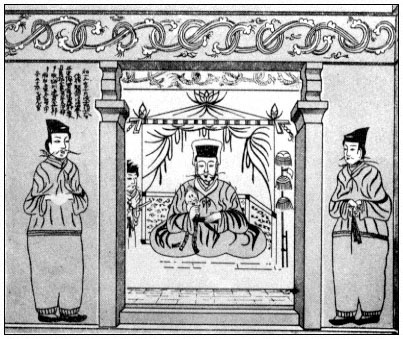
13.
Portrait of Dong Shou.
Drawing of a wall painting from a stone tomb at Lelang
(Anak, Korea). Ca. A.D. 357. (From K. H. J. Gardiner, Early History of Korea. )
and backed by a screen. The faces of both are long ovals that show thick dark eyebrows, almond-shaped eyes, a long nose, and so forth. The Chaoyang report confirms that there are traces of a beard, as in the Dong Shou portrait, although one is not visible in the reproduction. Robe lapels are wide, sleeves are broad. Each man grasps in his right hand an object identified in the reports as a fly whisk, held upright in front of the right shoulder. According to the Chaoyang report, the fingertips of the left hand touch a cup held in front of his waist. The published illustration, however, shows the left hand in the same gesture as Dong Shou's, but touching the wearer's belt, to which is attached the shou, his sign of rank. The men wear identical hats. The broadly painted interior strokes of their upper robes and the lack of any definition of bodies underneath clearly suggest the heavy cloth that, visible on the Dong Shou drawing, fully covers and hides the
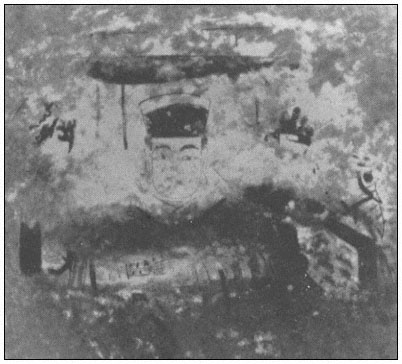
14.
Detail of a wall painting from a stone tomb at Yuantaizi, Chaoyang county,
Liaoning province. Fourth century A.D. (From Wenwu 1984.6.)
lower torso and legs. Its wide, scalloped contours are the only evidence of the subject's seated, cross-legged posture.
Virtually identical, wholly interchangeable, these are official portraits. The frontal, static posture, the accoutrements of office (hats, fly whisk, the heavy robes with wide lapels, canopy, screen, flanking attendants) tell us no more than that they are officials. It is their status that counts, their membership in an elite group. All else is irrelevant. That they served well is confirmed by the accompanying scenes that attest to the abundance and prosperity of a well-ordered domain.
No inscription remains in the Chaoyang tomb to identify the incumbent. Nor is it clear, despite the inscription, that the Lelang tomb was built for the governor of Lelang.[14] If it is his tomb, who appointed him, under whom did he serve?
We read of Dong Shou only once in the Jin shu, in connection with
the Murong Xianbei chieftain Huang, in whose domain Dong apparently resided.[15] Embroiled in the civil wars that engulfed the domain after the death in 333 of Huang's father, Hui, the faction to which Marshal Dong Shou belonged was defeated by Huang. Offered sanctuary by the king of Koguryo, many of the defeated, including Dong Shou, fled east and south.
We can thus account for the presence of Dong Shou in Lelang. But it is not clear who actually controlled the territory. It is unlikely, as K. H. J. Gardiner points out, that it was still a Chinese commandery, in terms of any actual administrative control. Evidence in the form of inscribed bricks, however, suggests that as late as 404, Chinese were settled there.[16] Dong Shou therefore governed Lelang either as the appointed official of the king of Koguryo or as an independent warlord.
Arguing for the latter, Gardiner notes that the string of titles on the tomb inscription are official Chinese titles, although without foundation in fact. "By these titles," he notes, "Tung Shou [Dong Shou] signalized his independence of Koguryo and gave himself the appearance of a loyal officer of the Chin [Jin] dynasty in China."[17] Moreover, they served to increase his prestige by linking him to earlier, legitimate governors of Lelang. Assessing the arguments, Gardiner concludes that the tomb was built for Dong Shou and that the portrait is intended to be like him.[18]
In fact, however, we do not know who the incumbents of the Lelang and Chaoyang tombs were or whom they served. Chinese architecture, Chinese pictorial subjects, and Chinese titles are not in themselves clear evidence that the patrons were Chinese: they merely tell us that the patrons wished to be seen as Chinese. The grandiose titles of the Dong Shou inscription, such as "General Pacifying the East," "Commander-Protector of the Barbarians," are Dong Shou's wish, his soi-disant rank. So also may have been the characteristics of the portrait.
For the purpose of this argument, therefore, neither the origins (ethnic, social, etc.) of the subjects of the two portraits nor the actual masters they served matters; what matters is that they wished to be portrayed as Chinese. The specific Chinese pictorial traditions they chose reveal much about what they valued, about their soi-disant character, as it were.
It is therefore of considerable interest that these two tombs of the fourth century perpetuate architectural (in the case of the Lelang tomb) and pictorial traditions of a much earlier period, the late Han
dynasty. The many paintings that adorn the stone walls depict some of the same scenes found in the Han tombs at Yinan, Helingeer, and so forth, such as a kitchen scene, stables, officials, processions. However, there are no depictions of historical or legendary figures exemplifying filial piety, uprightness, incorruptibility. Status and wealth are depicted for us; Confucian virtue is not, or, at least, not in the same way, for, as I have noted in the previous chapter, status and wealth are themselves evidence of virtue.
The incumbents of the Chaoyang and Lelang tombs wished to be portrayed as ones who administered a state and served an empire—and with the same conduct and values publicly espoused by those who had, in reality, served the Han empire. It is therefore not surprising that artisans utilized Han pictorial traditions to convey these specific values. The two portraits differ little from the many Eastern Han finds of depictions of officials. Whether it be the Master of Records portrait painted on the brick tomb at Wangdu in Hebei, the homage scene of the brick tomb at Helingeer, or the homage scene in relief in the stone tomb at Zhucheng in Shandong, the chief subjects of these paintings are depicted as serving (or as having served) the state.[19] Large figures, seated frontally, cross-legged and motionless on a platform, formally robed and capped, their attendants at the ready—these are portraits that denote rank.
They are the pictorial counterparts of the various inscriptions that appear in these tombs. The Master of Records at Wangdu is named by the office held, not by personal name; the incumbent of the tomb at Helingeer is referred to by offices held, not by personal name; the inscription at Lelang names Dong Shou and follows with a long list of putative offices held. In the broadest sense of the definition, the pictorial depictions, albeit stock images, are portraits because they were intended to be like specific individuals. Conventions that had not yet lost their significance told all that counted, a man's rank or status in life. As I have remarked of earlier images, if the subjects of the Chaoyang and Lelang portraits look exactly alike, it is because they were alike, in the only way that mattered. Chinese artisans residing in the Han dynasty settlements throughout the northeast transmitted these traditions, which were refreshed by the influx of Chinese fleeing the turmoil of the early third century.Their continuance is seen in the tomb paintings, datable to the Three Kingdoms–Western Jin period (A.D. 220–316), at Liaoyang, in Liaoning province.[20] The tradition of the Han "official" portrait, however, did not survive merely as a result of later artisans' pictorial bankruptcy. Other paintings in the
Chaoyang and Lelang tombs, for example, are clear evidence of the emergence of new themes and of a large stockpile of images and scenes for funerary art. The portrait of rank persisted because it was wanted. It continued to have meaning for patrons and viewers.