
The Cosmos
We have seen that the text of Parsvanath's five-kalyanakpuja places great emphasis on the wider transmigratory context of Parsvanath's Tirthankarhood—his journey through different states of existence in different regions of the universe. This is one of the most obvious facts about the rite: that it situates itself in relation to a cosmos far wider than the place and time of Parsvanath's last birth. Within the framework of the rite, it is his cosmic situation that renders his final lifetime intelligible. A certain vision of the cosmos is therefore an element in the ritual culture within which the rite occurs. This is a vision in which the radical asceticism represented by the Tirthankar—asceticism that culminates in his complete disappearance from the world of acts and consequences—is a reasonable response to existence.
The key to this vision is magnitude. If we supplement the rite's text with other sources, as I now propose to do, we discover that the Jain cosmos is a place of very large numbers. It is a stupendous vision in which, some would say, we see the numerical and metrical imagination run riot. The point of the vision, however, is not simply metrical; rather, its purpose is to illustrate the difficulty of attaining liberation. The cosmos, enormous in extent, swarms with forms of life, most of which are highly vulnerable to inadvertant or deliberate violence. Within this vast system, the opportunity to acquire a human body, which is the only body in which liberation is possible, is vanishingly small. The numbers in question are deployed in three domains: space, time, and biology.[21]
Space
The Jain cosmos is a multi-tiered structure divided into three "worlds" (loks ): a world of the gods above, a hell below, and between them a thin terrestrial world where (among others) human beings dwell (Figure 3). At the very top is a small fourth region, resembling a shallow depression, which is the abode of liberated souls (siddh sila ). Running like a shaft from top to bottom is a zone called the tras nadi , so named because multisensed beings (tras ) cannot exist outside it. The entire structure is fourteen rajjus high. The standard unit of distance in Jain cosmography is the yojan , which equals about eight miles. A rajju (rope) is equal to "uncountable" yojans .[22] Mt. Meru, which is 100,000 yojans (800,000 miles) high, is depicted on Jain maps as the merest bump in comparison with the whole structure. This vast cosmos, with its multiple layers and enormous internal volume, is the venue of the
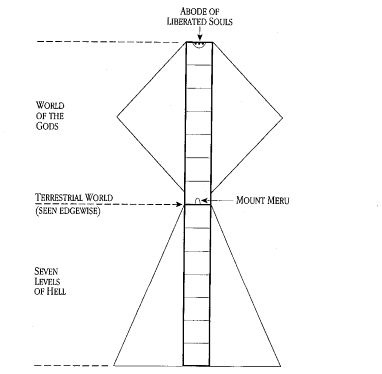
Figure 3.
The Jain cosmos. A simplified version of a
book illustration (Santisuri 1949: unnumbered page)
Note the shaft-like tras nadi extending from top to
bottom. The horizontal lines mark the fourteen rajjus
of the structure's height. The levels of hell correspond
to the rajju lines below the terrestrial world; the vari-
ous heavens are distributed within the upper half of
the tras nadi.
drama of the soul's bondage and liberation. Like a gigantic sealed aquarium, it is completely self-contained: Nothing enters, nothing leaves. Within it is an infinite (anant ) number of beings (jivs ) who cycle and recycle from death to birth to death again. Except for the liberated, this wandering from existence to existence is eternal, for the cosmos was never created nor will it ever cease to be.
Humanity's physical surround is the terrestrial world, which is a flat disc with Mount Meru at its center[23] Here, and only here, are to be found human beings and animals. At the middle of this disc, and serving as Mount Meru's base, is a circular continent called Jambudvip, which is subdivided into seven regions separated by impassable mountains. The most important of these regions are Mahavideh, Bharat, and
Airavat. Mahavideh is a broad belt running east and west across the continent and is divided into thirty-two rectangular subdivisions. At the extreme south and north of the continent are, respectively, the much smaller regions of Bharat and Airavat. Bharat is the South Asian world, and the sole region physically accessible to us.
Surrounding Jambudvip is a series of concentric oceans and atoll-like circular islands continuing outward to the edge of the disc. These are said to be "innumerable" (asankhyat ), which means that although there is an actual limit beyond which there is simply empty space, the number of islands and oceans cannot be counted. The first two islands are divided into regions representing radial extensions of the seven regions of Jambudvip: Here, too, we find Mahavidehs, Airavats, Bharats, and so forth. Humans dwell in all of the regions of the first island, but it is possible for humans to live only in the inward-facing zone of the second island, which is separated from the outward-facing zone by a range of mountains.[24]
The most important feature of the terrestrial world is not its rather complicated physical geography (of which my brief account gives little true idea) but its moral geography. A portion of the habitable lands of Jambudvip and of the first two concentric islands is known as bhogbhumi , "the land of enjoyment." Humans living in these regions exist in a state of continuous enjoyment without effort or struggle; subsistence is provided by trees that magically fulfill wishes, and premature death is unknown. Because asceticism cannot flourish in such an environment, Tirthankars do not appear in these regions and liberation is not possible. Contrasting with bhogbhumi are the areas known collectively as karmbhumi , "the land of endeavor," in which our region is included. In these regions it is necessary for humans to earn their livelihoods through work, and premature death is possible. Because such an environment is conducive to reflection and asceticism, liberation is possible in this zone, and Tirthankars are born here.
The terrestrial world is dwarfed by the regions above and below. Towering above is the "world of gods" (devlok ), which is the destination of those who have lived virtuous lives.[25] The areas actually inhabited by deities are contained within the shaft-like tras nadi . There are twenty-six separate paradises in all, organized in a series of levels extending up to the top of the cosmos just below the abode of the liberated. Between the lowest heaven and the terrestrial world is a gap; here planetary and stellar bodies (the abodes of the jyotisk deities) move in stately circles around the summit of Mt. Meru. Below the terrestrial
world, and extending downward as far as the heavens rise above, is the region known as hell (narak ).[26] This is where those who have committed sins must suffer the consequences. There are seven levels of hell, and the lower the hell the more severe the punishment.
Among the more striking features of this cosmos is its sheer size. By comparison with the upper and lower worlds, the terrestrial world is tiny. The entire cosmos is often represented as a standing human figure with the terrestrial world as its pinched waist. And yet even if the terrestrial disc is viewed within a reduced frame of reference, it too turns out to be vast. The diameter of the central area of the terrestrial world—that is, the world within the circle of mountains dividing the second circular island into habitable and nonhabitable zones—is 4,500,000 yojans , which (if the precise calculation is relevant) is roughly 36 million miles. The diameter of Jambudvip is 1000,000 yojans (800,000 miles) and the north-south dimension of Bharat is roughly 525 yojans (about 4,200 miles).
Taken together, these figures and calculations provide a basis for a certain conception of one's situation in the world. By comparison with one's immediate surroundings, Bharat is vast. But Bharat is but a tiny bite off the edge of the world-island to which it belongs. Inconceivably vaster than this world-island is the world-disc. But the world-disc itself is but a thin wafer in a cosmos that is a towering hierarchy of unimaginable dimensions. And everywhere (as we shall see) this cosmos teems with beings. Very small then—inconceivably small by comparison—is an individual's own niche in the cosmos.
Time
According to the Jain vision of things, in the karmbhumi regions of Bharat (our region) and Airavat, time moves through repetitive and very gradual cycles of moral and physical rise and decline. During the ascending half-cycle the human life span lengthens, body size increases, and the general level of happiness increases; these trends are reversed in the half-cycle of decline. The cycles are immensely long. According to one version,[27] a complete cycle lasts for a period of time equal to twenty korakorisagars . Korakori is a numerical expression equaling ten million multiplied by ten million, so by this reckoning an entire cycle takes 2 × 10¹⁵ sagars . A sagar (or sagaropam ) is a unit of time measurement. The same source (see also J. L. Jaini 1918: 90) asserts that one sagar equals one korakori , multiplied by ten, of units
called addhapalyas , and an addhapalya equals "innumerable" uddharapalyas , each of which in turn contains "innumerable" vyavaharapalyas . A vyavaharapalya equals the time it would take to empty a circular pit with a diameter and depth of one yojan (8 miles) of fine lamb's hairs if one hair were removed every 100 years.[28] The point of these abstruse and fantastic calculations is, of course, to emphasize the nearly inconceivable vastness of the periods of time portrayed.
Each half-cycle is subdivided into six eras and each era is named according to how "happy" (sukhama ) or "unhappy" (dukhama ) it is (ibid.: 89). An ascending half-cycle thus evolves from dukhama-dukhama (severely unhappy) through dukhama (unhappy), dukhama-sukhama (more unhappy than happy), sukhama-dukhama (more happy than unhappy), sukhama (happy), to sukhama-sukhama (extremely happy) (renderings partly from P.S. Jaini 1979:31). The declining cycle is the reverse of this. We (in Bharat) are currently in the fifth age (often called the pañcam kal ) of a declining half-cycle. When a descending half-cycle begins, all human wants are effortlessly satisfied by wish-fulfilling trees, and human beings attain an age of three palyas (presumably addhapalyas ) and a height of 6 miles. By contrast, the last age is a time of extreme discomforts and lawlessness; miserable, dwarfish, with a height of one and one-half feet, humans live a mere twenty years. In a declining cycle such as ours, Tirthankars exist only during the fourth age (the first Tirthankar appearing at the very end of the third), and it is only during this period that liberation is possible. During the first three ages the general happiness discourages ascetic exertion, and during the last two ages the misery is too great. Our current fifth age began just after Lord Mahavir (the last Tirthankar of our half-cycle) left the world; it will last only 21,000 years.
These cycles, however, do not occur in all regions of the terrestrial world. The most significant exception is Mahavideh, half of which is karmbhumi . This means that there are Tirthankars active at the present time in that region.
The social and cultural world we know was the creation of Rsabh, the first of the twenty-four Tirthankars of our declining half-cycle.[29] As P.S. Jaini (1979: 288) points out, Rsabh occupies the functional niche of a creator deity in a tradition that denies creation. Prior to his advent, the world was a precultural paradise.[30] Because of the magical wish-fulfilling trees, toil was nonexistent. Old age and disease were unknown. Religious creeds did not exist. There was no family, no king or subjects, no social organization. As just noted, humans were 6 miles tall
and their lives were eons long. Born six months before their parents' death, these extraordinary beings (called yugliyas ) came into the world as mated sibling pairs. Each pair lived as a couple after puberty, and in time produced two similar offspring. In uncanny parallel with the theories of Lévi-Strauss and other anthropologists, the Jains see presocial humanity as humanity without the incest taboo.
With the passage of the first three eras conditions deteriorated. The magical trees began to disappear and this resulted in shortages of food and other necessities. This led to the development of anger, greed, and conflict. Because of the crime and disorder, the frightened people met together and formed small family groups (kuls ), and set persons of special ability in positions of authority. Here is Hobbes in a Jain guise. These individuals were called kulkars , and by establishing property rights and a system of punishments, they were able to maintain order as paradise dwindled away. The last of the kulkars was named Nabhi,[31] and he was the father of Rsabh.
Rsabh was the inventor of society, polity, and culture in our half-cycle of cosmic time. He was the first king, made so by the twins because of the troubles then occurring. He introduced the state (rastra ), the enforcement of justice by punishment (dandniti ), and society (samaj ) itself (these terms are from Lalvani 1985:31)[32] He established the system of varnas , the ancient division of Indian society into functional classes.[33] He also taught such necessary arts as farming, fire-making, the fashioning of utensils, the cooking of food, and so on. His was also the first nonincestuous marriage, which established the current system of marriage. In the end he abandoned the world and became the first Tirthankar of our half-cycle of cosmic history. He was also the first to receive the dan (merit-generating gift) of food from a layperson, which in this case was sugar cane juice. So important was this event that Jains commemorate it in a calendrical festival (aksaytrtiya ).
With Rsabh's advent, our corner of the world became redemptively active. He was the only Tirthankar of the third age; after him, in the fourth age, came the remaining twenty-three Tirthankars Of our current declining half-cycle. Each promulgated the same teachings and left behind the same fourfold social order of monks and nuns, laymen and laywomen. The penultimate was Parsvanath, with whose rite of worship this chapter began, and the last was Lord Mahavir. Soon after Mahavir's departure the window of opportunity for liberation closed.
The history of the twenty-four Tirthankars invests what would otherwise be a featureless timescape with moral and soteriological
meaning. There is no beginning or end to the cosmic pulsations of the Jain universe, and in this perspective the face of time is blank. But within the cycles the passage of time can be converted into a significant narrative, one that has a direct bearing on the nature of the world experienced by men and women at the present time. The era of the Tirthankars thus seems to mediate between timeless eternity and the world that men and women know: The totally repetitive periodicity of the five kalyanaks belongs to eternity; the individuation of the specific careers of the twenty-four Tirthankars belongs to the particular history of our world and era.
Mahavir's departure inaugurated the history of the Jain tradition itself, established by Mahavir's followers. The ultimate locus of the sacred for the Jains, the Tirthankar as a generic figure, is no longer present in the world.[34] In the aftermath of their era, therefore, the task is to maintain some kind of contact with their presence as it once was. They are gone—as we have seen—utterly. But although the beneficence (kalyan ) intrinsic to their nature exists no longer in embodied form, it can be transmitted from generation to generation by means of the lines of disciplic succession that link lineages of living ascetics with Lord Mahavir. Their teachings also remain, although we possess only an incomplete version. Although their kalyanaks no longer occur in our world, these events can be (as we have seen) evoked through ritual. And of course the social order they established—the fourfold order of Jain society—endures still.
Biology
The Jains have created a complex system of biological knowledge. It is a system that includes concepts of physiology, morphology, and modes of reproduction, but its main focus is taxonomy. It should not be thought of as a system of scientific analysis. Its basic motivation is soteriological, and the system may be seen as a conceptual scaffolding for the Jain vision of creaturely bondage and the path to liberation.
The beings of the world (jivs ) are divided into two great classes, liberated (mukt ) and unliberated (samsari ). Liberated beings are those who have shed all forms of karmic matter, and unliberated beings are those who are in the bondage of karma .[35] In turn, unliberated beings are divided into two great classes: beings that cannot move at their own volition (sthavar ) and beings that, in order to avoid discomfort, can move about (tras ).[36] The beings of the sthavar class possess only one
sense, the sense of touch, and are of five types: 1) "earth bodies" (prithvikay ) that inhabit the earth, stones, and so on; 2) "water bodies" (apk ay ) that inhabit water; 3) "fire bodies" (teukay or tejkay ) that live in fire (and electricity); 4) "air bodies" (vayukay ) that inhabit the air; and 5) plants (vanaspatikay ).
Plants come in two general types: pratyek , in which there is one soul per body, and sadharan , in which there are infinite (anant ) souls in a given material body. The sadharan or multiple-souled forms of plant life are, in turn, of two types: "gross" (badar ) and "subtle" (suksam ). The gross varieties include such common root vegetables as potatoes, carrots, onions, garlic, and yams, and this taxon, therefore, is extremely important from the standpoint of dietary rules. Because potatoes and similar vegetables harbor tiny forms of life in infinite numbers, they are—in theory—forbidden to Jains.[37] The ban on the eating of root vegetables is one of the principal markers distinguishing Jain vegetarianism from that of other vegetarian groups in India. The plant category also includes tiny beings, infinite in number, called nigods .[38] They are the lowest form of life and exist in little bubble-like clusters that fill the entirety of the space of the cosmos. They live a short time, perish, and then take rebirth as nigods again (with some exceptions, as we shall see). They are a teeming sea of invisible life everywhere around us, even within our bodies.
Tras beings are classified on the basis of the number of sense organs they have. The viklendriy class, consisting of beings of two to four senses, opposes the pañcendriy class, consisting of beings with five senses. Two-sensed animals have taste and touch; three-sensed animals add smell; four-sensed animals add vision; and five-sensed animals add hearing. A somewhat different principle of animal classification is based on the manner of giving birth. Those born from the womb (and this includes eggs) are called garbhaj . Beings called sammurchim are born by means of the spontaneous accretion of matter into a body. All beings of fewer than five senses are born this way, as are some five-sensed animals and human beings.
Coexisting with (and consistent with) the above scheme is yet another system of classification, and in many ways this is the most important of all. This is the system of the four gatis , the four "conditions of existence." These four categories are: hell-dwellers (naraki ), animals and plants (tiryañc ),[39] humans (manusya ), and deities (dev ). They are ranked on the basis of the relative happiness (sukh ) or sorrow (dukb ) experienced by the beings within them.
The most miserable of all beings are the hell-dwellers. They exist in perpetual darkness and suffer from unrelenting hunger, thirst, and extremes of heat and cold. They are tortured in various ingenious ways by demon-like beings who perform this function. The punishment is often of the punishment-fits-the-crime variety. Picture books exist in which the punishments for various sins are depicted in vivid and rather disgusting detail, a sort of pornography of punition.[40] Hell-dwellers take birth (as do the gods) by means of instantaneous creation, and their terms of punishment are eons long. An Ahmedabad informant once told me that hell-beings remember their torments after they are reborn as humans, which—he said—is why babies cry. He then went on to say that the parents give the child a doll to stop the crying, and the child clings to it and says, "mine! mine! mine!" Then, he continued, at the age of twenty-one or so "they give you a bigger doll, and the same thing happens." The result is attachment to family and other worldly things, and so the cycle goes on.
The animals and plants (tiryañc ) experience somewhat less misery than hell beings do, or at least this seems to be true of five-sensed animals. However, birth anywhere in the tiryañc category is extremely undesirable. Their natural place of habitation is the world-disc, but they can live in many areas barred to human beings.
Human beings experience more happiness and less sorrow than those in the tiryañc category. As noted already, humans occupy only the restricted central area of the world-disc; they are distributed, of course, between the two moral zones of karmbhumi and bhogbhumi . The humans in bhogbhumi are born as twins of the same sort that exist in our world during the paradisaical age; their lives are spent in sensuous enjoyment, and liberation is impossible for them. Humans can be either womb-born (garbhaj ) or born by spontaneous generation (sammurchim ). The latter are generated from various impurities (such as excrement, urine, phlegm, or semen) produced by the bodies of womb-born humans. They are without intelligence and cannot be detected with the senses; their bodies measure an "uncountably" small part of a finger's breadth. They die within one antarmuhurt (forty-eight minutes) without being able to develop the full characteristics of a human body.[41] Certain rules of ascetic discipline are based on the injunction to avoid harming these beings. For example, after eating, some ascetics and extraorthoprax laymen drink the liquid residue from washing their hands and plates or bowls. This is to prevent the spontaneous generation of millions of little replicas of themselves, for whose deaths they would
then be responsible, in the meal's remains. Just as the category of multiple-souled plants invests Jain vegetarianism with a distinctive character, this category provides the basis for certain distinctive features of Jain asceticism.
The truly crucial fact about human existence, however, is that liberation is possible only in a human body. As we know, liberation is not possible for all humans, but it is possible only for humans. This is a fact with momentous consequences, as we shall see in the next chapter.
The gods and goddesses are, in some ways, mirror images of the hell-beings. Hell-beings are being punished for their sins; the gods and goddesses are being rewarded for their virtuous acts in previous existences. The question of the cosmic functional niche of the gods and goddesses will be addressed in the next chapter. For now it is sufficient to note that, as are the hell-dwellers, the gods and goddesses are stratified. The lowest are the bhavanvasi s, "those who dwell in buildings," who live in the uppermost of the seven hells but are not subjected to hellish torments. Residing in an intermediate level between the uppermost level of hell and the earth are deities known as vyantar s who inhabit jungles and caves. They can help human beings, but can be malicious, too. The jyotisk deities (planetary deities) dwell in the region between the earth and the heavens above. They belong to two basic categories, moving and stationary.
The most important deities are the vaimanik s, so named because they inhabit heavenly palaces (viman s) of various kinds. They are divided into two basic types. Lowest are the kalpopapan s, those who are born in paradises (kalpa s). Residing in palaces above the kalpopapan deities are the kalpatit deities (without kalpa s), who are of two kinds: the graiveyak s, who dwell in nine palaces above the topmost of the heavens of the kalpopapan deities, and the anuttar s, who live in five palaces higher still. The kalpopapan deities perform the celebrations of the Tirthankars' kalyanak s. They also live in organized societies in which there are kings, ministers, bodyguards, villagers, townsmen, servants, and so on. The kalpatit deities do not participate in rituals and are not socially organized. Goddesses are found dwelling only in the first and second heavens of the kalpopapan deities and below, although they may visit higher heavens. In these lower regions the gods have sexual relations; at higher levels, sexual relations become progressively etherealized: from mere touch, to sight, to hearing, to thought, and finally to no sexual activity at all.[42]
The Indras are the kings of the gods. There are sixty-four of them in
total: twenty who rule the bhavanvasi s, thirty-two for the vyantar s (and a subcategory known as van vyantar s), two for the jyotisk s, and ten for the twelve paradisaical regions. As we shall see in the next chapter, the Indras (and Indranis, their consorts) are symbolically central to ritual action among Jains.
Rules
The Jain universe might be likened to a three-dimensional board game. The board is samsar , the world of endless passage from existence to existence.[43] The playing pieces are infinite in number and are, subject to the rules of the game, free to move anywhere on the board. The object of the game is to leave the board. The game has no beginning or end; it has been going on from beginningless time (anadi kal se , as Jains always say) and will continue for an infinite time to come (anant kal tak ). Nor does it reflect the purposes of some divine creator; there is no rhyme or reason to it—the game simply is. Most player/pieces are not even aware of the game, to say nothing of the possibility of winning; they merely wander "without a goal" (laksyahin ) from existence to existence, leaving pain and havoc in their wake.
The various taxa of living things are the stopping places of player/ pieces between moves; moves occur at the moment of death. There are rules of play (often called sasvat niyam , "eternal rules," in the materials I have seen) determining which moves are possible and which are not. The human and tiryañc classes share one critical feature: After death, humans and subhumans can be reborn in any class at all. They can return to their previous classes, or they can switch from tiryañc to human, or vice-versa. Or, on the basis of sin or merit, they can ascend to heaven or descend to hell, and it should be noted that this is true of animals as well as of humans.[44] By contrast, the divine and hellish classes are one-stop existences. Gods and hell-beings must be reborn either in the human or tiryañc class.
These various rules of play result in a game with certain general features. Victory, which is moving off the board of play, is extremely difficult to achieve. Even to have a chance at winning, one must first take birth in the human class, and this in itself is hard to do. Forward and upward progress is hard; falling backwards from the goal is easy. There is no opting out of the game. The game goes on eternally, and, short of victory, there is no way at all to discontinue play.
Cosmos as Pilgrimage
The soul's career in the cosmos is sometimes likened to a pilgrimage. A good example of the use of this metaphor is to be found in a book (Arunvijay, n.d.), put into my hands by a Jaipur friend, consisting of a collection of rainy season discourses given by a Tapa Gacch monk named Arunvijay.[45]
The soul, he says, is on a pilgrimage through the cosmos (a samsar yatra ) ,with the final destination being liberation. His account begins with the nigod , beings who have not yet begun the pilgrimage. Infinite in number and packed into every cranny of the cosmos, these tiny beings mostly just wink from one identical existence to the next. The nigod s, he says, are a kind of "mine" (khan ) or reservoir of souls, infinite in extent and inexhaustible. To begin the pilgrimage, a soul must leave this condition; only then does a soul enter the "dealings" (vyavahar ) of samsar . Can a nigod leave this condition by means of its own effort? No, says Arunvijay. It is a law of the cosmos that in order for one nigod to leave that condition, one soul in the universe must attain liberation. Given the vast number of nigod s and the relative infrequency of liberations, it follows that this is an extremely rare event, and that we—those of us now in a higher condition—are fantastically fortunate even to have left the condition of nigod .
Having left the status of nigod , he says, the soul enters various existences as badar sadharan vanaspati (coarse vegetable bodies that live together in infinite numbers in a single plant or portion thereof) and finds itself packed within masses of similar souls in the form of moss on a wall, a potato, or the like. It then takes birth as various kinds of earth and water bodies before graduating upward to the status of pratyek vanaspati (that is, the vegetable bodies that live one to a plant or portion thereof). It then goes on to inhabit air bodies and fire bodies. In this way the soul takes "uncountable" (asankhya ) births among the one-sensed beings.
Arunvijay says that the soul progresses because of the accumulated effect of merit resulting from virtuous actions performed in various births. Exactly how merit is generated by the activities of such humble beings he does not explain, and his overall characterization of the soul's destiny does not emphasize ethical retribution. Rather, the image he stresses repeatedly is the "wandering" (paribhraman ) of the soul. His favorite metaphor is that of the ox tied to an oil press. The wretched beast goes round and round in a circle (the four gati s); he is blindfolded,
and has not the faintest idea of where he has been or what his destination will be.
The pilgrimage continues. The soul takes "uncountable" births as it advances from two to four-sensed bodies. But it can also regress and even fall back into the one-sensed category again. In the end the soul may at last enter the category of five-sensed beings. It now spends countless years in this class. It must take birth as every form of water beast, then every kind of land animal, then all the varieties of birds. It takes "violent births" (himsak janam s) in the form of such animals as lions or tigers. As a carnivore it commits the sin of killing five-sensed creatures, and now it descends into hell.[46] The soul spends eons (sagaropanm s of years) in hell, and moves back and forth between hell and the tiryañc class many times. It even falls back into the four-, three-, two-, and one-sensed classes yet again. Eons more pass. And then progress resumes.
At long last, after infinite existences from beginningless time, the soul/pilgrim enters a human body. Alas, it sins and falls into hell, and from there takes birth all over again in the sub-five-sensed classes. As a result of truly fearsome (bhayankar ) sins commited as a human, the soul can even fall back into the condition of nigod . How often, our author exclaims, has the soul gone downward and how far it has fallen! Our soul/pilgrim may also become a deity on the basis of merit earned by deeds. From this condition, however, it must return, and Arunvijay says that it may well fall all the way down to the lowest classes of life again. These transformations will occur again and again. The soul/pilgrim goes through the four gati s, the five jati s (classes of beings with from one to five senses), and the entire 8,400,00 kinds of births that exist. This is the nature of the cycle (cakra ) of the soul's great pilgrimage through the cosmos. And there is more. Arunvijay reminds us that not only have we all been through this cycle, but we have been through it an infinite number of times.
What is Arunvijay's main point?[47] Almost everything he says converges on one fundamental assertion, namely that one's birth in a human body should not be wasted.[48] This reflects the ascetics' view of things, a view that exists as a perpetual rebuke to the more comfortable lay view that routine piety is enough. It is possible, he says, for human births to be repeated; in theory it is possible to have seven or eight in a row. But this is very difficult and requires an immense amount of merit. Human birth is "rare" (durlabh ) and in this vast cosmos very difficult to obtain. Sin is so easy, and the sins of one life can pursue you through
many births. Not only will sins send you to hell, but they will result in many births in the classes of two- to four-sensed creatures after you have emerged from below. Arunvijay reflects at length on the sin of abortion, and it is significant that, in his eyes, part of the horror of abortion is that it cuts the newly incarnated soul off from the possibility of a human existence.
His conclusion is that one must set a "goal" (laksya ) of release from the cycle of rebirth in the classes of living things. The contrast is between one who has such a goal and those who are "without a goal" (laksyahin ) .Those who are without a goal wander blindly and aimlessly. You have sinned an infinity of times, but now you have gotten the Jain dharm (Jainism). If you set the goal of release, he says, then it is easy to get rid of sins. What is needed is a full effort in spiritual endeavor. This is the real point of everything he has said. He is not much interested in the whys and wherefores of the wandering soul's entry into one kind of body or another. More important is the sheer scale of things. The soul takes many, many births—infinite births—in its endless wanderings through this vast cosmos. At long last has come the opportunity for deliverance, and this opportunity must not be allowed to slip away.
Arunvijay uses this vision of the soul's pilgrimage to reinforce the plausibility of central Jain values. Large numbers abound: uncountablities and infinities. The universe is inconceivably vast in size. The times-cape is infinite in extent. The taxonomic system is enormous and labyrinthine. The potential for doing harm to other beings is boundless. Liberation is possible only in a human body, and human bodies are hard to get. The zone of human habitation is tiny by comparison with the cosmos as a whole, as is the human taxon by comparison with the teeming multitudes of other forms of life with which the cosmos is filled. Indeed, even a human body is not in itself enough, because liberation is actually available during the merest sliver of time in comparison with all of time. And even in eras and places where Jain doctrine can be heard, not everyone hears it. Here, then, is the pilgrim at last in human form and in contact with Jain teachings. Lucky is such a pilgrim, and so valuable an opportunity must not be wasted.
Arunvijay's main concern is not with proselytizing asceticism. His primary goal is to raise the general level of piety of his lay audience. But the vision he projects is one that places a context around the core values that inform the text of Parsvanath's five-kalyanak puja . Ascetic withdrawal is the central meaning of Parsvanath's last life. The only truly
rational and morally defensible response to this cosmos is the most radical withdrawal from it. This is not the way most Jains live, but it is a constant undertow in Jain religious life, and one that creates strains and ambivalences. It cannot be ignored. How could it be, when it is dramatized on a daily basis by living ascetics?