
Four
The Art of Manas-Katha
The scriptures are the ocean, wisdom is Mount Mandar,
and saintly people are the gods.
Katha is the nectar distilled from their churning,
and devotion is its sweetness.
7.120a

The Economics of Katha
It is not uncommon these days to hear the complaint that Katha has become a business, that performers "sell" their exposition, and that the high fees they command reduce the art to just another commodity to be traded in the marketplace. A recent article in a popular Hindi magazine cynically observed that "no intelligent person will deny that now the whole affair is carried on solely as a livelihood." The prospect of financial gain is seen as a powerful lure and as itself explaining the great proliferation of performers in recent years. Again, to quote the same article: "How many expounders are there in Kashi nowadays? Even if one were to have a census taken by Hanuman, that energetic seeker who found the herb of immortality, perhaps for once even he would fail in his efforts! In every lane there is some establishment for Katha and in every neighborhood, a vyas ."[1]
If contemporary expounders are faulted for their greed, their precursors are often idealized for their simplicity and disinterest in material gain. In the old days, one hears, the donation (daksina[*] ) might have been big or small, but it was always given , never demanded or bargained for. The list of early expounders in Lakshmandas and Chakrapani's book concludes by observing that "all these kathavacaks were noncovetous;
[1] Jhingaran, "Ham sevak," 20-21.
whatever was offered at puja time, they would always supplement with something of their own and then immediately spend on a feast for sadhus and devotees."[2] Anjaninandan Sharan's account of early expounders mentions instances in which an especially brilliant Katha was lavishly rewarded by an appreciative patron, but the author is careful to note that the great Ramayanis were similarly disinterested in these gifts. Thus, the two thousand rupees that Ramkumar Mishra is said to have received for his month-long program at Kanak Bhavan—which would translate into a small fortune by the standards of today's devalued currency—were said to have been donated for a sadhus' feast.
Sharan himself was a sadhu and had definite ideas about the corrupting aspects of material gain. But this view of wealth is only one of several to be found in Hindu society, and expounders who are householders have been, at least in recent times, inclined to take a different view. For these people, unless they are fortunate enough to be independently wealthy, Katha is indeed a livelihood, a profession by means of which they maintain themselves and their families. In my conversations with expounders concerning the economic aspects of their art, I encountered little reticence about discussing earnings; most performers spoke willingly and even proudly of the fees they were able to command. The ability to earn an income from Katha seemed to be interpreted by them as a mark of professionalism, a sign of public recognition of their knowledge and profound study of the Manas . Moreover, I found general agreement among performers and patrons as to the fees normally commanded by what may be termed ordinary, middle-level, and top-ranking (or "All-India") expounders.[3]
An ordinary vyas —that is to say, a local expounder who does not receive outside invitations or a young performer with limited experience—will generally receive less than Rs 100 for a one-hour performance. He may receive considerably less: as little as Rs 11 or Rs 21,[4] and a small packet of sweets. Some daily kathavacaks perform on a monthly stipend of Rs 100 or Rs 200, supplemented by the (usually modest) offerings that their listeners place on the arti tray at the end of the performance. The middle range of performers consists of those who receive Rs 100 to Rs 300 for a performance. A considerable number of fairly well known expounders fall into this category; if they perform
[2] Quoted by Sharan, "Manas ke pracin tikakar[*] ," 909.
[3] The fees detailed here are all as reported during the research period (1982-84); subsequent inflation has undoubtedly upped the ante in the world of Katha .
[4] Multiples of ten are considered unlucky, so an extra rupee is usually added to make the figure auspicious.
regularly—as many of them do—their incomes may be substantial. Most of the major festivals held in Banaras, such as that of Gyan Vapi, pay their featured out-of-town performers at the rate of about Rs 200 per day plus travel and accommodation expenses. As already noted, this sum may be less than the performer would normally command, but the prestige and exposure provided by the festival compensates for the loss of money. The hourly fees of the highest-ranking speakers are on the order of Rs 500 to Rs 1,000 and up; these are the "All-India" expounders, so called because they are much in demand in major urban areas distant from the Hindi-speaking heartland—for example, in Bombay and Calcutta, where the most lavish patronage is now to be found. Money is no object to the wealthy industrialists of these cities, but prestige is important, so they patronize only the most famed expounders and reward them lavishly for their skills. Moreover, in private performances, the host's wealthy guests may, as a gesture of homage, offer their own gifts at the speaker's feet at the end of the performance, and it is not uncommon for a small pile of hundred-rupee notes to accumulate in this fashion.
A sense of how a moderately successful vyas rates his own and others' earnings may be derived from this excerpt from an interview with Ramnarayan Shukla, the resident expounder of the Sankat Mochan Temple.
PL : | You earn money in order to support your family, right? By doing pravacan . . . . |
RS : | Whenever I go anywhere outside. In the beginning, I used to get a little bit. I started getting fifty rupees a day, then a hundred, then a hundred and fifty, and now it's become two hundred. But then there are certain devotees, for example, some sant or mahatma may be holding a sacrifice and he may give a little or a lot, whatever. So often I take only that much, whatever is given. It may be that later on I will get still more, maybe two hundred and fifty or three hundred. Shrinath-ji is getting five hundred per day. Ramkinkar-ji gets a thousand. Everybody's different. . . . |
PL : | But it seems to me that there is no jealousy among you Ramayanis. |
RS : | (chuckles) Oh, it's there, it's there. There's a lot of it. Well, we are like relatives, so we talk about each other. . . .[5] |
It was the nearly unanimous opinion of my informants that the most successful contemporary vyas is Pandit Ramkinkar Upadhyay, whose name is a household word among Manas enthusiasts and whose clients include some of the wealthiest industrialists in India. Ramkinkar and I
[5] Ramnarayan Shukla, interview, December 1982. In this context, "sacrifice" (yajña ) refers to public recitation and exposition of the Manas , as described in Chapter 2.
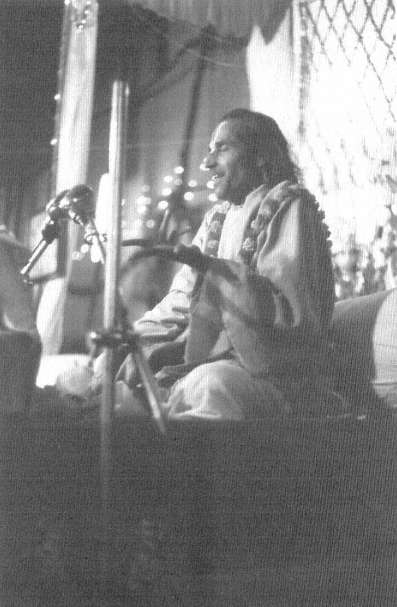
Figure 17.
Ramnarayan Shukla of the Sankat Mochan Temple, performing at
Gyan Vapi in 1982
did not discuss his fees, but one of his students told me that Rs 1,000 was his minimum fee for a single discourse and that more commonly a patron would arrange a seven-to-fifteen-day program and offer Rs 20,000 or more. Shrinath Mishra, another "All-India" vyas , told me that while his own minimum fee was normally Rs 500, he had once received a daksina[*] of Rs 20,000, and on another occasion one of Rs 25,000 for nine-day programs in the homes of wealthy patrons.[6] Ramkinkar's income is also supplemented by earnings from published collections of his talks, which sell briskly at his major programs.
Do performers grow rich expounding the Manas ? By the standards of ritual specialists and traditional scholars and performers, the incomes of the highest-ranking Ramayanis are lavish indeed. Even the most successful classical musician does not have major engagements every night, whereas a revered vyas like Ramkinkar travels from one nine- or fifteen-day program to another and can be busy for as much of the year as he chooses. But even though audiences derive pleasure from hearing Katha , they regard its performers primarily as religious teachers rather than as entertainers, and some of the popular resentment of their earnings stems from the fact that high fees are considered inconsistent with the sacred status of the vyas . As highly visible religious spokespersons, expounders are expected to behave in an exemplary fashion: to wear traditional (desi , or "national" as opposed to "foreign") dress, to be strict vegetarians, and to avoid polluting activities such as eating in restaurants or attending cinema shows.
Even the highest-paid expounders, however, will on occasion accept a minimal fee or perform "for love" for a charitable organization or other sponsor with whom they feel a special connection. Thus, when Shrinath Mishra gave seven evenings of pravacan at Banaras Hindu University in 1983 under the auspices of the university's Tulsi Research Society (Tulsi sodhsansthan ), he accepted a token "honorarium" of Rs 700, far less than his normal fee, because he was an alumnus of the university and was invited by some of his former professors. Ramnarayan Shukla, who commands Rs 200 per diem when he performs outside Banaras, gives Katha twice and sometimes thrice daily when he is in the city as part of his duties as resident vyas at Sankat Mochan, for which he receives only a modest monthly stipend. One of the least commercially ambitious of contemporary expounders, Ramnarayan indeed prefers not to accept outside engagements, because of his personal devotion to Sankat Mochan Hanuman, the presiding deity of the temple.
[6] Shrinath Mishra, interview, October 1983.
Qualifications of a Performer
Brahmans and Others
The majority of contemporary Ramayanis are Brahman males, a fact that reflects the priestly caste's traditional role in mediating and authoritatively interpreting sacred text. Whereas the suta , or epic bard, was explicitly identified as a non-Brahman, the expounder of the Puranic tradition—the pauranika[*] or vyakhyatr[*] —was normally a religious specialist by birth, and the special pith[*] from which he held forth was a sacred seat that non-Brahmans could not occupy. Although it is certain that many great Ramayanis of the past were non-Brahmans, in recent years the question has again been raised as to whether such expounders are qualified to occupy the vyas seat. A Banaras informant recalled a controversy several decades ago over whether a certain Khatri (Kshatriya) who taught the boy actors in the Ramnagar Ramlila and also expounded the Manas should be allowed to occupy the vyaspith[*] at the Sankat Mochan festival.
My interviewees were of two minds on this question. Shrinath Mishra and other Brahman performers advanced the position that, properly speaking, only Brahmans should be allowed to expound from the pith[*] because the Manas itself, in their view, upholds the tradition of varna[*] (social divisions based on birth) and the religious authority of Brahmans, and one who is expounding the text should do so in a manner consonant with its teachings. According to Shrinath, even Chakkanlal, the great Kayasth expounder of the late nineteenth century, did not presume to occupy the dais but discoursed informally, sitting on the ground in the midst of the "devotional assembly" (gosthi[*] ).
One of the most venerable Ramayanis of Ayodhya, Pandit Ramkumar Das of Mani Parvat, expressed a different opinion. In his view, the right to sit on the vyas seat and narrate Katha depends not on varna[*] status but only on capacity or ability (ksamta ). In support of his argument, he cited the case of Kak Bhushundi, the crow who narrates the Manas-katha to Garuda. A crow is regarded as untouchable—as the "Chandal among birds"[7] —yet if Bhushundi can sit on one of the ghats of the Manas Lake (surely the most exalted of vyas seats) and narrate Ram's acts, then clearly any human being may be permitted to do so.[8] A
[7] A Chandal is an untouchable who performs such tasks as the removal of animal carcasses and tanning of hides.
[8] Ramkumar Das, interview, April 1984.
similar opinion was expressed by Sacchidanand Das, another Ayodhya Ramayani, who cited a mythological incident in support of his view.
Once a suta was expounding Katha from the vyas seat in the midst of an assembly of forest sages, when suddenly Balaram entered the group. Everyone rose out of respect for Lord Krishna's brother, but the suta remained seated and went on with the Katha . Balaram was seized with anger and beheaded the storyteller. The sages were horrified and told him that he had incurred the sin of Brahman killing, because even a suta becomes equivalent to a Brahman when seated on the vyaspith[*] narrating Katha .[9]
It is noteworthy that both Ramkumar Das and Sacchidanand Das are Ramanandi sadhus, and such men often express relative indifference to caste distinctions.[10] It is also significant that they represent the Ayodhya Katha tradition and that Ram's city is today the principal base of the older style of exposition typified by daily afternoon performances in which the entire Manas is expounded sequentially, for which, as I have noted, the financial rewards to the performer are relatively meager. This practice stands in contrast to the lucrative pravacan style of the festivals and private performances patronized by status-conscious mercantile groups, for whom the presence of Brahman teachers—conferring ritual status in return for financial support—is highly desirable. Thus, the patrons of the newer style of Katha , by their "Sanskritizing" attitudes no less than by their lavish patronage, may be encouraging the predominance of Brahmans in the field of Manas exposition.
One controversial development of recent years has been the entry of women into the field, a number of whom have gained considerable renown. Shrimati Krishna Shastri, for example, who belongs to a family of kathavacaks , now performs widely at festivals and in private engagements.[11] Another kathavacika (female kathavacak ) is Sunita Shastri, a student of Sitaram Sharan of the Lakshman Kila Temple in Ayodhya, who frequently performs during such festivals as Ram Navami. I have heard it said by Katha goers that women possess "the sakti [power] of Sarasvati," the goddess of speech, and hence make particularly good
[9] Sacchidanand Das, interview, April 1984. This story occurs in several Puranic sources, including Bhagavatapurana[*] 10.78-79; see Rocher, The Puranas[*] , 55-56. On the inviolability of a vyas in performance, see below, p. 183.
[10] In fact the Ramanandi attitude toward caste status is complex and variable and, despite a general attitude of "liberalism," is sometimes influenced by the more conservative attitudes of householder patrons; see van der Veer, Gods on Earth , 172-82.
[11] In 1982 she gave a fifteen-day program under the auspices of a Hindu organization in Amritsar, Punjab; the performance was documented by Kali C. Bahl, to whom I am grateful for this information. For a popular treatment of the subject of women's Katha , see Upadhyay, "Surile svar mem[*] tairti Ram-katha ka guñj."
orators. There also remains an element of novelty in hearing Katha given by a woman; hence, the sponsors of a festival are often eager to include at least one kathavacika on the performance roster. Only ever-conservative Banaras seems to lag behind in this regard. There the question of whether women possess the "authority" (adhikar ) to expound the epic remains a subject of debate, with most of the "learned men" of the city still arguing that they do not, according to a popular magazine article, which adds: "The ironic thing is this, that whether the Katha is on the Bhagavata , the Mahabharata , or on Ram, there will often be a preponderance of women among the listeners. So those who are opposed to women's Katha are clearly saying, 'Yes, of course you can listen to Katha , you can recite the Manas too; but you can never sit on the dais and give Katha !'"[12]
The same article mentions a number of Banarsi women who were trained in Katha by Sant Choteji, a Ramayani known for his liberal views, who have begun to make careers for themselves despite the continuing opposition of conservative males. One of these women, Vijayalakshmi, described her choice of profession as the result of a childhood environment that was "Manas -permeated"; her parents' encouragement led her to commit the whole epic to memory by age fourteen. She had begun giving Katha even earlier, however, at age eleven.[13]
An even more radical departure from orthodoxy is the "Muslim" vyas , Rajesh Muhammad—actually a Muslim convert to Vaishnavism, although he has provocatively retained a half-Islamicized name that clearly adds to his commercial appeal. I did not have an opportunity to hear him perform, but he is popular on the festival circuit and his name frequently came up when informants were asked to list leading contemporary expounders. In February 1984 he was the principal speaker at the prestigious eleventh annual Ramayan Mela in the pilgrimage town of Chitrakut, where he discoursed on Bharat-carit .[14] According to Shrinath Mishra, he is permitted to sit on the vyas seat in many places. His flaunting of his background obviously poses something of a dilemma to the orthodox: on the one hand, he bears the indelible stigma of his Muslim birth; on the other, his conversion and the dedication of his life to the propagation of the Manas is viewed as an affirmation of the greatness of Hindu dharma.
[12] Jhingaran, "Ham sevak," 23.
[13] Performances by children have a strong appeal for Hindu audiences, as they combine charming innocence with a prodigious knowledge of scripture that seems to confirm listeners' belief in the potency of samskars[*] , or "impressions" from previous lives. For a popular treatment of the subject, see Upadhyay, "Sri Ram Katha ke ye ba1 kathavacak."
[14] For an account of this festival, see Richariya, "Ramayan[*] mela."
Becoming a Vyas
Although the decision to pursue a career as a vyas may be prompted by a range of motives, including financial ones, most performers I interviewed described their choice of vocation as the result of spiritual experiences or as a response to an inner summons to dedicate their lives to the "propagation and promotion" (pracar-prasar ) of the Manas . The venerable Banarsi expounder Narayankant Tripathi recalled being chosen to play the role of Ram in the Khojwan bazaar Ramlila when he was about fourteen. His excitement over the role gradually awakened his interest in studying the Manas . One day as he was being made up for his part, some elderly sadhus began asking him philosophical questions, and he found himself answering them authoritatively, speaking from his heart. The listeners were astounded at his wisdom and eloquence, for his formal education had been meager. This display of verbal ability was the first indication that he should become a vyas .[15]
A similar story was told by Rameshvar Prasad Tripathi of Allahabad, who had played the role of Ram in a thirty-night lila cycle patterned after that of Ramnagar. Because of his nightly participation in the drama, he began to fall behind in his regular studies; moreover, the world of the lila powerfully affected him and he felt drawn to recite the Manas and discourse informally about it to his friends. In his town there lived a wealthy merchant who was fond of Katha and sponsored an annual competition among Ramayanis; the winner would be engaged to expound the epic for a month. Rameshvar went to hear the competitors' discourses, but after they had all spoken, one of his friends told the patron, "Sir, this boy can do better," and pushed him forward. He spoke in his usual fashion and so impressed the merchant that he pronounced him the winner of the coveted engagement, the first of Rameshvar's career.[16]
Ramnarayan Shukla attributed his decision to become a vyas to the influence of Vijayanand Tripathi, whose daily Katha he used to attend, and also to a near-fatal accident that occurred when he was about twenty-eight years old and left him with the conviction that the Manas had saved his life.[17] But even though Ramnarayan had heard Vijaya-
[15] Narayankant Tripathi, interview, August 1983.
[16] Rameshvar Prasad Tripathi, interview, November 1982.
[17] He had just returned from a Katha at Vijayanand's house, the theme of which had been "fate versus endeavor"; as he reached to switch on the electric light in his room, a loose wire dealt him a tremendous shock, which hurled him to the floor. When he came to his senses he found that he still had the Manas clutched tightly in one hand and felt that its power had saved him "from the mouth of death." Since the book had altered his "fate," his "endeavor" now became to serve it (interview, December 1982).
nand's Katha and later studied the notes of Shrinath Mishra, he attributed all his knowledge of the epic to having "read" it silently and repeatedly in front of Sankat Mochan Hanuman while simultaneously uttering the mantra "Sita-Ram" with his lips. This practice was undertaken on the advice of an aged sadhu, who said it would invite Hanuman's grace. "I read with the eyes only, I paid no attention, yet very quickly, the whole Ramayan came to me; I didn't have to recite it or memorize it."[18]
Shrinath Mishra earned a medical degree at Banaras Hindu University while attending the daily Katha of Vijayanand Tripathi, in the course of which he heard two complete expositions of the Manas . As the eldest son in a middle-class Brahman family, he faced the difficult decision of whether to give up a promising medical career in order to take up a more uncertain one as a vyas . Ultimately unable to decide, he chose a course well known in Banaras: taking two slips of paper, he wrote "practice medicine" on one and "give Katha " on the other and placed them before Sankat Mochan Hanuman. After praying for guidance, he sent a small child into the sanctuary with orders to pick up one of the slips of paper; since the child was too small to understand the situation, Hanuman himself would "choose." In Shrinath's case he chose Katha .[19]
Whereas the above examples all emphasize experiences of vocation, it should be noted that in the Katha field, as in other traditional professions, family background may also be a factor in the decision to take up a performance career. Many prominent expounders come from families that have pursued this line of work for several generations. Ramkinkar Upadhyay, for example, is the son of Pandit Shivnayak Upadhyay, who was likewise a popular vyas . Ramkinkar feels that his father's influence on him was slight, for he recalls having been a shy child who always fell asleep when listening to pravacan and was considered to have little promise as a speaker; yet the fact that his father was a successful performer was obviously no hindrance when he later did choose this career. The great vyas of Vrindavan, Binduji, had an adopted daughter whom he married to a younger vyas , Manas Shastri; the son born of this marriage, known as Piyush Goswami, is now one of the most successful of the younger generation of performers. Sometimes a generation is skipped, as in the case of the family of Narayankant Tripathi, whose son-in-law is a priest who performs life-cycle rituals for a hereditary clientele; he has trained both his grandsons as kathavacaks . Such stu-
[18] Ramnarayan Shukla, Katha , Sankat Mochan Temple, August 1983.
[19] Shrinath Mishra, interview, October 1983.
dents not only have the advantage of constant training from a close family member but also receive special opportunities to gain practice and exposure. Narayankant's elder grandson, Vidyabhaskar, began performing at the age of eight in the company of his grandfather; and during my stay in Banaras Narayankant began permitting his younger grandson, then about sixteen, to sit on the pith[*] at Sankat Mochan and discourse for half an hour each afternoon. Some family dynasties are even more impressive, especially where royal patronage is involved: Ramji Pandey of Ramnagar claims that seven generations of his family have served the maharajas of Banaras as Ramayanis.
Studentship and the Tradition
It has become commonplace among Katha aficionados to speak of one or another "style" (saili ) or "school" (parampara ) of Katha , but these terms must be understood in an informal sense, as applying to what has always been essentially an individual art for which there exists no prescribed curriculum or institutionalized training. Rather, as in other Indian performance traditions, the aspiring vyas normally attaches himself to some successful exponent of the art as a disciple or student (cela or sisya[*] ), an arrangement that may be more or less formalized. Such a period of study should be viewed less as the completion of a prescribed curriculum than as the adherence to a particular way of life, combining personal religious discipline and study of the Manas with service to the teacher and the daily hearing of his and others' discourses on the epic. In time the practice of this way of life may lead the student—if he possesses the necessary talent and dedication—to a performance career.
As I have already noted, the term parampara refers primarily to a spiritual lineage, which transmits authority rather than information. This is underscored by the repeated observations of that great connoisseur of Katha , Anjaninandan Sharan, on the originality of interpretation of the greatest expounders.[20] His comments suggest that although aspiring performers may study with teachers, the eventual aim of their training is to enable them to develop new and original insights into Tulsi's verses.
[20] Note such comments as "Kashthajihva Swami's points are uniquely his own; these interpretations cannot be found in any other books" and "Baba Haridas's extraordinary bhavs came entirely from his own heart; they are never seen in any other commentary"; "Manas ke pracin tikakar[*] ," 918, 919.
Internalizing the Text
The first requirement of the professional expounder is an intimate familiarity with the text, not simply "knowledge of" or "knowledge about" the text in the modern sense, such as might be gleaned from two or three "close readings," but rather "knowledge through" the text—a process no longer advocated by modern secular education but still pursued by some Western religious communities and certainly akin to the kind of involvement with scripture cultivated in the lectio divina of medieval Christian monasteries.[21] In the initial phase of this kind of "knowing" the text is internalized—often through apparently mindless repetition—to such an extent that it is not only memorized but its language, structures, and images come to permeate the mental processes so that there is no occurrence, word, or image encountered in life that does not immediately evoke in the devotee some parallel word, phrase, or situation from the text. Indeed, what some expounders do in performance might best be described as thinking through or by means of the words of the Manas . It is this kind of knowledge that makes possible the prodigious mental feats of certain expounders—their ability, for example, to function as living concordances of the epic, capable, given a single word from the text, of citing virtually every line in which it appears.
Thus, an important part of the training of all Ramayanis is the constant recitation of the Manas , a habit that many of them cultivate from childhood. Hari Narayan, an aspiring vyas whom I met at Sankat Mochan, where he had come to take notes on the Katha , told me that his daily practice was to read two masparayan[*] installments and thus to finish a complete reading every fortnight. Even Shrinath Mishra, a fully accomplished performer, said that he continued to recite the epic daily, completing one reading every month. But the training phase for many expounders involves even more frequent and intensive repetition, especially utilizing nine-day and unbroken recitations. The preceding chapter gave examples of legendary performers who achieved a mastery of the epic by an auspicious 108 recitations; this procedure is well known and is thought to invite the grace of Hanuman, who can bestow both knowledge and eloquence on the teller of Ram-katha .
Written Sources
Apart from recitation and its goal—the internalization of the text—the training of a vyas may involve the study of other written materials,
[21] On the importance of lectio divina , see Graham, Beyond the Written Word , 128-40; and Leclercq, The Love of Learning and the Desire for God , esp. 15-17, 71-74.
including such well-known commentaries as the Manas piyus[*] and the Vijaya tika[*] . These days younger performers particularly value the published works of Ramkinkar Upadhyay, such as the four volumes of his Manas muktavali (Necklace of Manas pearls), which contain edited transcriptions of his performances.[22] The ready availability of these written kathas (the Muktavali series alone contains 213 discourses, and there are more than half a dozen other volumes of Ramkinkar's talks on the market) coupled with the impressive commercial success of this vyas make it likely that Ramkinkar's style and ideas will exert an influence on the next generation of Ramayanis.
From at least the middle of the nineteenth century, expounders have also made use of anthologies of problems (sankavali[*] ) concerning Manas verses, together with their resolutions (samadhan ). An early manuscript example is Vandan Pathak's Manassankavali[*] (c. 1840), which was published in Banaras in 1875. Modern examples include the popular Manassanka[*]samadhan of Jayramdas Din, published by Gita Press in 1942 and repeatedly reissued (a twenty-ninth printing was released in 1981), and the four-volume Manassanka[*]samadhanratnavali of Pandit Ramkumar Das.
Another facet of the training of many contemporary expounders is education in a Sanskrit university, often to the level of sastri ("expert in the sastras ," an advanced degree). Such training acquaints students with a range of sacred texts from which they may quote in future discourses and is especially valued by expounders who want to emphasize Tulsi's fidelity to Sanatan Dharm "orthodoxy" as they perceive it. Among the Sanskrit texts most frequently cited in Katha are the Valmiki Ramayana[*] and the Bhagavata purana[*] . However, an erudite vyas need not confine himself to Ramayan-related or even bhakti -inspired works, or to Sanskrit-language texts, and some performers draw on whole libraries preserved in their memories. For example, in a single program I attended, Shrinath Mishra quoted repeatedly and often at length from more than two dozen sources. These included (in addition to the Manas ) Tulsi's Vinay patrika , Kavitavali , Gitavali , and Dohavali ; the Bhaktamal of Nabhadas; the Bhagavatapurana[*] , Mahabharata, and Valmiki Ramayana[*] ; compositions attributed to Kalidasa, Bhavabhuti, and Shankaracharya; the works of the Hindi poets Kabir, Surdas, Mirabai, Bihari, Keshav, Chandravali, Rahim, Raskhan, Ghananand, Raghuraj Kavi, Padmakar, Kashthajihva Swami, and Bharatendu Harishchandra;
[22] Upadhyay, Manasmuktavali ; the title of this work, like those of many Manas -related texts, alludes to Tulsi's lake allegory; here the individual verses on which Ramkinkar expounds are likened to the pearls which grow in the Manas Lake.
as well as numerous folksongs, proverbs, and quotations that Shrinath identifies only as "miscellany" or "oral tradition" (sphut[*] ).
For students fortunate enough to have access to them, the performance notes of a revered expounder are another potential source, especially if the expounder is the student's own teacher and is available to clarify and expand on the often-obscure notes. Whereas earlier performers wrote in the margins of the epic manuscripts they carried with them into performance, the current style is of extemporaneous pravacan , delivered without the aid of either text or notes. The Manas is still present on an ornate stand, but it is wrapped in silk and garlanded with flowers—an object of worship rather than a text to be read. Reading is unnecessary in this context, because a good vyas is expected to have completely internalized the text—to have become the Manas personified, the human voice of the Ramayan tradition.
Preparing for Performance
In view of the sacred status of the vyas and the emphasis on extemporaneous delivery, I was not surprised to find performers reluctant to divulge details about their choice and development of a topic for exposition.[23] In interviews, many expounders stressed the importance of spontaneity and of ideas that came to them only when they were actually before an audience. Some stated that they never prepared at all beforehand and that it was only by the grace of Ram or Hanuman that they were able to manifest eloquence when seated on the vyas seat. No doubt, as any lecturer knows, the inspiration of the moment does play its part in successful Katha ; yet when I had heard a good many performances, I found myself convinced that, as the old adage goes, perspiration must play at least as great a part as inspiration. This was confirmed in later interviews with expounders who were more candid regarding the practical techniques of their trade. Ramji Vyas, a pandit employed by the Kashiraj Trust in Ramnagar and a successful vyas until his retirement from performance due to ill health in about 1980, spoke frankly of his debt to the Manaspiyus[*] and also of his habit of keeping notes on his own ideas and others' performances. At the conclusion of a festival
[23] Sharan has remarked on the secrecy with which some nineteenth century performers guarded their notes, especially if (as was often the case) some of their best ideas were borrowed from other expounders; "Manas ke pracin tikakar[*] ," 926.
program, he would hurry home to record any striking bhav that he might want to use in the future. His forty-year career was represented, he said, by a pile of notebooks "several feet high."[24]
Shrinath Mishra showed me stacks of notebooks wrapped in cloth and carefully numbered, some of which date back to the days when he sat at Vijayanand Tripathi's feet, taking notes on his daily Katha . Most of the notes consist of "settings" (i.e., treatments; Shrinath used the English term) of verses and episodes from the epic, written "in my own fashion"—that is, with abbreviations and reminders to himself. He compared their condensed style to that of sutras and said they would be meaningless to most readers, but his longtime students were permitted to study them. On one occasion when I came to Shrinath's establishment, Ramnarayan Shukla was seated on the floor, poring over one of the notebooks and making his own notes from it. When I asked Shrinath to identify the many sources from which he had quoted in a certain performance, he several times wished to check something in his notes. Each time, a student was dispatched into the next room to bring forth a particular notebook; Shrinath would then identify the section of the notebook in which the particular quotation was to be found, and the student would look it up and read the relevant notes to him. The "catalog" to this impressive library of notebooks is, of course, entirely in Shrinath's head—another indication of this fine expounder's prodigious memory—as the "settings" are entered in the order in which they were developed, which bears no relation to their order in the epic. Thus, despite the existence of the voluminous notes, the living presence and guidance of the teacher remains an essential ingredient in Shrinath's pedagogy.
The process of drawing up "settings" for performances is never-ending, according to Shrinath, and he continues to fill notebooks with ideas. Moreover, if a bhav of another expounder pleases him, he will write it down and consider using it himself. When I asked if he thought other performers would resent such "borrowing," he replied,
No, the good ones will never be jealous. The petty ones, those who have few ideas, they will be jealous and will want to prevent another from using their material. But those who possess a vast treasure, who have studied much, they will feel no regret. For "what one hears, one may say." Goswami-ji says,
Sants are like bees, who collect virtuous qualities.
1.10.6
[24] Ramji Vyas, interview, August 1983.
Thus a wise man should be like a bee: a bee lands on many flowers, he sips their nectar, in this manner he collects it; just so, wise men, when they hear good things, should collect and savor them.[25]
Other expounders expressed similar views on the subject of borrowing; indeed, even in my limited exposure to Katha performances I sometimes heard the same illustration or parable told by several different performers. Of course, it is also acceptable to cite another vyas by name, crediting him with the bhav ; this is sometimes done when citing legendary performers of the past, like Kashthajihva Swami or Ramkumar Mishra, whose names are themselves evocative for the audience of the depth and continuity of the tradition.
In another section of our interview, Shrinath described the process by which he "sets" or prepares a new topic for performance (he used the English word "set" throughout—by which he seemed to mean both "select" and "plan"—and turned it into a Hindi verb: set[*]karna ); his remarks suggest the balance between preparatory work and inspiration.
SM : | Well, those who say "It's all God's grace," they're not telling the truth. Before giving Katha , it's essential to "set" the subject, to decide on which topic, and how and in what fashion you're going to speak, so that it will be effective. And you only have an hour, so you have to know how much you can say. A speaker who prepares in advance is going to speak well. |
PL : | Such as when you spoke at Banaras Hindu University on that verse, "Sivaaja pujya . . . ." |
SM : | I "set" it first, yes. We Ramayanis, at any time—whether we're out somewhere walking, or sitting someplace—we map out the subject at least once, plan the sequence; and then, when we're actually speaking, if some other good idea comes, or in the opening meditation, if some new insight comes to mind, then that's another matter. But a "setting" is essential, for absolutely every good speaker.[26] |
In certain situations, however, particularly in small-scale and private Katha , a patron may at the last minute request the exposition of a particular line or raise a problem for the vyas to resolve. The prevalence of the topical style of exposition has given rise to the suspicion among audiences that many expounders, especially on the festival circuit, have only a limited number of preplanned and virtually memorized "lectures" that they are prepared to deliver and are unable to discourse, as the great Ramayanis of old were reputedly able to do, on every line and episode of the epic. I heard this complaint frequently both from audience members and expounders themselves—although, when voiced by the latter,
[25] Shrinath Mishra, interview, October 1983.
[26] Ibid.
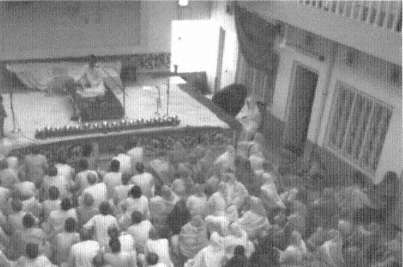
Figure 18.
Shrinath Mishra giving Katha at Janaki Mahal, Ayodhya, during
Ram Navami festivities, 1984
it was always in reference to other performers; every vyas claimed to be able to discourse on the complete Manas . Shrinath Mishra likewise agreed that many expounders today have a limited repertoire but added that, even in his own case, given a new topic at the last minute, some quick thinking would be necessary to "set" the approach he would take.
In contrast to Shrinath, Ramkinkar Upadhyay stated that he never prepared in advance for a performance. His method, he said, was to "enter into that inner state in which Hanuman-ji, by means of my voice, may express what he wants to express. And the greater my absorption in that state, the greater the flavor [ras ] in the Katha ." He downplayed the notion that his rhetorical gifts were the result of study or training and, when discussing his development as a performer, used the analogy of a lottery. "Now suppose there is a lottery, and someone wins it; and then someone else asks him, 'Tell me, what's the technique of winning a lottery?' Well, what technique will he describe?"[27] Ramkinkar's annual pravacan series at Lakshmi-Narayan Temple in New Delhi is one of the most spectacular public Katha programs, attended by thousands of Delhi residents; moreover, the daily talks are recorded for later publication. Yet Ramkinkar told me that his 1983 topic, Kevat[*]prasang[*] (the episode of the boatman, Kevat—2.100.3-2.100) was chosen only about
[27] Ramkinkar Upadhyay, interview, April 1983.
an hour before he was to mount the podium on the first evening, in the course of an informal discussion with his patroness, Sarla Birla, and other admirers. This insistence on spontaneity is part of Ramkinkar's public image as a consummate vyas , who is capable, without any special preparation, of discoursing for hours on any line from the Manas . Such self-assurance, indicative of a complete internalization of the text, is held in high regard in Katha circles.
Performance Structure and Techniques
Even though the performance styles of individual expounders vary considerably (examples of their diverse approaches are given later in this chapter), their performances follow a conventional pattern and share certain symbolic and ritual elements, which this section describes.
The Vyas Seat
A vyas preparing to perform first worships the pith[*] on which he is to sit and on which the Manas is installed, bowing to it with joined palms and taking its "dust" on his forehead. The symbolism of the pith[*] is subject to diverse interpretations; I was variously told that it represents Tulsidas and the Ramayani tradition, Veda Vyasa, and the Lord Himself. The word is used in popular Hinduism to refer to the abode of a deity; thus, 108 Devi piths[*] are believed to mark the sites at which fragments of the goddess Sati's body fell to earth when it was cut to pieces by Vishnu's discus. Among Ram devotees, the Manas itself is revered as a divinity—as a "form" or "embodiment" (vigrah ) of the Lord. In Ramnarayan Shukla's words: "Sants and mahatmas even today revere the Ramcaritmanas as a deity. One must offer flower garlands to it, place food offerings before it, perform its arti . . . . Just as the Lord takes physical incarnation, just so this is his body in the form of speech [vanmaysarir ], that is, composed of language. So understanding it to be the Lord, we worship it."[28]
But if a "seat" becomes a center of power because of the divine presence that it hosts, it also confers authority and divinity on a human "sitter," enabling him to put aside his mundane identity and assume a new persona. The monarch's throne and judge's bench are piths[*] that, even in secular contexts, confer special dignity and authority. When a
[28] Ramnarayan Shukla, interview, December 1982.
vyas , having worshiped the pith[*] , takes his seat upon it, he himself becomes a suitable object for worship and is garlanded with flowers by the sponsoring patron. Similarly, it is understood that once an expounder is seated on the pith[*] he should never be disturbed or interrupted, and he is excused from normal social obligations, such as rising out of respect for a more senior vyas or other dignitary who may arrive during his performance. I was told that, since the Manas is present on the pith[*] and since Veda Vyasa was an incarnation of Vishnu, an expounder in performance is considered to be saksat[*]bhagvan (the Lord made manifest).[29]
The Mangalacaran[*] and the Kirtan
Once seated, a vyas closes his eyes and composes himself in a brief meditation. Then, with eyes still closed, he begins uttering his mangalacaran[*] : a benediction usually consisting of Sanskrit slokas interwoven with verses from the Manas . The mangalacaran[*] . (literally, auspicious undertaking), also referred to as an "obeisance" or "salutation" (vandana ), is so common a feature of South Asian Hindu performance, both religious and "secular," that we may identify it as a characteristic "performance marker" for this culture—a sign to the audience of the moment of transition into the performance frame.[30] A mangalacaran[*] is both a benediction and an invocation. Deities are praised and, by being praised, are invited to be present, to assist in—or in some cases, to take
[29] Strict adherence to this practice can result in embarrassing situations, as was demonstrated one evening at the Gyan Vapi festival in 1982. Lakshman Chaitanya, an influential disciple of the late Swami Karpatri, had been invited to speak at 9:00 P.M. ; when he failed to arrive, the next scheduled vyas , Shitalprasad of Ayodhya, was asked to begin. But about twenty minutes later, the ascetic leader swept into the enclosure in a bevy of ocher-robed disciples, who urged the crowd to its feet to salute him with a rousing cry of "Har Har Mahadev!"—the invocation of Shiva always used to greet Karpatri. Shitalprasad appeared to take no notice and continued his discourse. Chaitanya seated himself on a tiger skin at the other end of the dais and appeared to go into meditation; when, after ten minutes or so, it became clear that the vyas had no intention of surrendering the microphone, the sannyasi could not conceal his annoyance and stalked out of the mandap[*] , trailed by apologetic members of the organizing committee. Shitalprasad was unrepentant and later repeated the view that a vyas discoursing from the pith[*] should never be interrupted. The incident was much discussed by audience members, particularly as it echoed a similar one some years earlier when Ramkinkar Upadhyay had offended Swami Karpatri himself by refusing to interrupt a Katha and rise for the obligatory "Har Hat Mahadev!" on the latter's arrival.
[30] Thus, bharat natyam[*] and other classical dance performances begin with a mangalacaran[*] praising Shiva as Lord of the Dance and invoking the earth's blessing. Sanskrit dramas likewise open with a prayer, and even martial and "secular" bardic recitations (such as those of the Alha cycle) begin with a vandana invoking Ganesh, Sarasvati, and other deities. On performance "keys" or markers, see Bauman, Verbal Art as Performance , 16-24.
over—the performance. I have already noted Ramkinkar's conviction that while delivering Katha he becomes merely an "instrument" for Hanuman; thus, he rates the success of his performances by the degree to which "he" is not responsible for them. A similar view is expressed by Ramnarayan Shukla, another vyas whose performances are sometimes marked by the overshadowing presence of Hanuman: "You go and sit on that seat and you worship the deity. From that you form a link, you establish a connection. You meditate, utter a vandana , and then that deity will come. You make the connection, and he gives you facility [in Katha ], makes it happen. That's why we do it."[31] It is clear that most expounders do not enter into a state of actual "possession"—indeed, their performances are characterized by a high degree of lucidity and control—yet we must note that the relationship between possession and folk performance is a complex one and even in Katha , as we shall see, the line demarcating the two is not always clear.[32]
Each expounder has his own mangalacaran[*] , with which he begins every performance. Part of it will have been given by his guru and part chosen by the performer himself early in his career; once selected, it never changes. The formulaic nature of this benediction—which may last five minutes or more—can of course be useful to the performer. It allows him additional time to review the sequence of themes he has previously chosen or even to redesign his talk to suit an audience member's last-minute request. The invocations of many expounders, especially those who are sadhus, include a formula identifying the performer's sampraday , or spiritual lineage. In Ayodhya, for example, the two principal Vaishnava sects are the dominant Ramanandi sampraday and its spiritual ancestor, the Ramanuja sampraday .[33] A vyas of the Ramanandi sect usually includes in his invocation the following sloka :
Originating in Sita's Lord,
transmitted through the noble Ramanand,
and encompassing all our teachers—
that guru lineage I venerate.
[31] Ramnarayan Shukla, interview, December 1982.
[32] On the relationship between possession and performance, see Ramanujan, "Two Realms of Kannada Folklore," 68-73; for an example of possessionlike phenomena in Katha , see below, p. 199.
[33] According to Ramkumar Das (interview, April 1984), the term Srisampraday , often applied to the Ramanuja tradition, is used in Ayodhya only in reference to the Ramanandis. Note, however, Richard Burghardt's speculation that the Ramanandi sect was originally an independent development, which later sought legitimacy through association with the older and more orthodox Ramanuja tradition; "The Founding of the Ramanandi Sect."
Initiation in the Ramanuja tradition, however, will be indicated by the substitution of "Lakshmi" for "Sita" in the opening line and of "Ramanuja" for "Ramanand" in the second. The distinction is not minor from the sadhus' point of view, for while the Ramanuja tradition worships Vishnu (Narayan) and Lakshmi as the primordial cause of creation, the Ramanandis adore Ram and Sita, of whom, in their view, Lakshmi-Narayan and all other gods are mere manifestations. Thus, the invocation establishes the doctrinal credentials of the expounder; at the same time, it facilitates the assumption of an impersonal identity as speaker for an ancient and atemporal tradition.
Apart from such doctrinal formulas, a mangalacaran[*] may contain an invocation of the performer's own teacher and also of his patron deity (istadev[*] )—most commonly Hanuman. The slokas recited are often taken from the mangalacarans[*] with which Tulsidas begins each book of the epic; in this respect too, the text's structure mirrors and is mirrored by the structure of a Katha performance. When such familiar verses are used, audience members sometimes chant softly along with the vyas , but the performer appears to take no notice of their participation. His eyes remain closed and he seems to be engaged in an act of private dedication. Often, indeed, the mangalacaran[*] is delivered so softly as to be barely audible to the audience. This may reflect a deliberate strategy, for by forcing his listeners to strain to hear him, the speaker captures their attention and creates a hushed and expectant atmosphere for his opening remarks.
Completing the invocation, the vyas opens his eyes and leads the crowd in a brief kirtan , or melodious chant of the name of Ram. This is performed antiphonally: the vyas sings a line and the audience responds by repeating it. A single simple paean of praise may be repeated several times, such as "Jay Sita-Ram, jay jay Sita-Ram," or the leader may introduce rhyming variations such as "sankat[*] mocan krpa[*] nidhan" (liberator from distress, treasury of grace—the former title is an epithet of Hanuman).
The mangalacaran[*] and participatory kirtan give the speaker a measure of the audience's mood, which will be crucial to the success of his performance. If he senses that the crowd is bored or restless, the congregational singing offers him an opportunity to intervene and try to establish a more alert, responsive atmosphere for his talk.[34] Occasionally, an
[34] Cf. Bruce Rosenberg's observation on American folk sermons, "When an audience is responsive the preacher catches its enthusiasm. The singing before the sermon begins is a sure indication of the congregation's emotional level"; The Art of the American Folk Preacher , 43.
expounder will even interrupt the kirtan to chide a particularly listless audience, perhaps using a humorous approach in an effort to establish rapport with the crowd: "I hear nothing; are you all asleep? Remember, this is the Lord's name! You must sing it so that they hear you even on the other side of the Ganga! Come on, once more. . . ."
The Performance Cycle
There is a pattern typical of all Katha performance: a gradual progression from slowly paced delivery, through a growing involvement by the speaker in his topic reflected in louder and more rapid speech, to an emotional climax. Performers typically begin softly and slowly, seemingly in the meditative state that is the fruit of their preliminary devotions. Opening remarks at festivals often include a formal greeting of dignitaries and sponsors and then of the assembly as a whole. They may also include remarks on the sacral significance of the occasion, a deferential bow to preceding speakers, and a protestation of the performer's inadequacy (although as everyone knows, expounders are scheduled according to their rank, with the lesser invariably performing first). Such dignified and often formulaic openings provide time for the crowd to settle down. Thus, Swami Sitaram Sharan, addressing a huge crowd gathered on the eve of Ram's birthday in Ayodhya's Lakshman Kila Temple, commenced his Katha with a long paean to his audience and a citation of the auspicious place and time of the assembly.
O most worthy of reverence, fervently adored assembly of saints, high-minded ones intent on tasting the nectar of the Lord's lotus feet, and goddesses![35] By the grace of Shri Sita-Ram, on the bank of the teardrop-born Saraju, seated in the proximity of beloved Shri Lakshman-ji, having obtained the companionship of Ayodhya-dwelling saints and devotees, we have all been, for many days, savoring the Lord's auspicious, sweet, emotion-filled katha -nectar. And now the moment that has been awaited for a year, that moment—tomorrow, 12:00 noon—is approaching; that supremely holy instant in which will occur the celebration of the Lord's manifestation. This is the grace of the holy realm of Ayodhya![36] Just now you have heard from Sunita-ji and from Shriman Narayan-ji, on the subject of the Lord's incarnation, very sweet Katha .[37]
[35] Deviyom[*] —a polite reference to the women in the crowd.
[36] Avadh-dham : dham (dwelling or home) in Vaishnava tradition signifies a holy place so intimately associated with the Lord that it partakes of his being. Thus a dham like Ayodhya, Chitrakut, or Vrindavan is considered to be another divine "embodiment" (vigrah ).
[37] Sitaram Sharan, Katha , Lakshman Kila, Ayodhya, April 4, 1984.
Noteworthy here is the speaker's parallelistic, additive style, which is characteristic of Katha and reflects both the exigencies of extemporaneous delivery and the performer's associative and expansive approach to his material. For what most expounders actually do within their hour-long performances—and what their patrons value highly enough to reward with the sometimes-lavish remunerations noted earlier—might best be described as a sort of free-form verbal meditation on a chosen word, line, or theme from the Manas . This excerpt becomes the warp for a rich tapestry of images, associations, quotations, and anecdotes, presented not as a systematic analysis of a literary work but as a celebration of the inexhaustible meaning of a sacred story. The associations made by the performer may seem brilliantly incisive; they may also seem farfetched and contrived—-although even these, if they can be buttressed by an appropriate citation (praman[*] ) from the epic or some other revered text, can evoke exclamations of delight[*] from connoisseurs. The aim of the performer is less the construction of logical argument than the evocation of bhav , or "mood" (as we have seen, his interpretations themselves are so labeled) from which listeners may derive ras —"juice" or emotional "flavor."
In listening to Katha performances I was reminded of the sequence of events in an Indian classical music recital: the progression from meditative alap to rhythmic tal , which gradually increases in intensity and rises to a series of crescendos. Within this structure the musician executes a set of improvisations on a melodic line, or raga. In Katha , an excerpt from the Manas becomes the raga on which the performer elaborates. The field over which the vyas -improviser ranges—his "scale," or the totality of musical tones at his disposal—is, first of all, the Manas itself. Some expounders pride themselves on drawing their citations exclusively from the epic, and there are stories that celebrate the facility with which legendary performers could defend any point with a quotation from the text.[38] Additionally, a learned performer in search of pramans[*] may range over the vast scriptural and poetic literatures of Sanskrit and Hindi.
[38] Vandan Pathak is said to have boasted that he did not concern himself with anything that was not mentioned in the Manas . Once while he was giving Katha an old woman presented him with a savory she had prepared. As Pathak eagerly pocketed this offering, someone in the crowd jokingly called out, "Maharaj, what does this have to do with the Manas ?" Pathak, who was renowned for his great presence of mind when seated on the vyaspith[*] , instantly quoted a half-line from Book One—"He will become happy if he plunges into this lake" (1.35.8)—the last word of which, though a verb (parai , "plunges"), made a pun on the colloquial name for the clay bowl in which the woman had presented her gift, thus "proving" to delighted listeners that it was indeed mentioned in the Manas (recounted by C. N. Singh, interview, February 1984).
Time is an important element in contemporary Katha ; the custom of limiting one's discourse to an hour has become virtually a rule, and rarely does a vyas exceed this limit. At the Gyan Vapi festival, two oversize electric clocks bracket the dais like huge, unblinking eyes, one of them situated directly behind the expounder's seat. An experienced performer, of course, is adept at tailoring his delivery to the prescribed period, even without such external reminders. As he nears the end of his allotted hour, he will raise the emotional pitch of his discourse and attempt a satisfying summation that may include a return to his opening theme. If he is going to be speaking for several days, he may offer a hint of the following day's topic to spark listeners' curiosity. When he finally concludes, it is with a sudden lapse into the slow, quiescent tone of his opening mangalacaran[*] , for a last auspicious utterance that fades into inaudibility: "Siyavar Ramcandra-ji ki jay" (Hail Sita's bridegroom, Ramchandra). This may be followed by more rounds of kirtan in which, if the performance has been well received, audience members respond with particular fervor. As a revered vyas rises to leave, admirers rush forward to touch his feet or garland him.
The conclusion of a Katha may also be signaled by the appearance of a priest with an arti tray and lamp; this is especially the custom in daily programs in which a single performer is featured. The expounder remains seated while the assembly rises to sing the usual hymn to the Ramayan and the priest waves an oil lamp before the vyas and the book. Afterward, worshipers crowd forward to take blessings of the flame, sweeping their hands over it and then touching their foreheads, and place cash offerings on the tray. Many then come forward for the darsan of the expounder and to receive prasad in the form of tulsi leaves (sacred to Vishnu), which have been resting on the Manas during the talk.
Performer-Audience Interaction
Hindi discourse is highly interactive, with the speaker frequently soliciting expressions of comprehension and affirmation from his listener, often by means of the negative question particle na ? (Isn't it so?). Ramayan expounders, too, frequently pause to solicit affirmation and approbation, and they may seek listeners' responses by other means as well—for example, by posing rhetorical questions that someone in the crowd may answer or, when quoting from the epic, by reciting all but the last word or phrase of a line and then gesturing to invite listeners to complete it. Those who can (and the end rhyme helps) gain an opportunity
to display their own knowledge of the text while deriving a satisfying sense of participation in the performance.
Almost invariably a vyas , again like an Indian musician, cultivates a special rapport with an appreciative and responsive individual in the audience. At large festivals, a special seating area is sometimes reserved for members of the organizing committee and their guests. These prominent listeners can usually be counted on to display their connoisseurship by frequent and fervent responses. An expounder will often single out such listeners for special attention, developing a dialogue with them by glances and gestures and making them surrogates for the wider audience. This kind of behavior need not be viewed as manipulation on the performer's part; rather, it reflects the interactive milieu essential to good performance in the Indian context and is also a reminder of the archaic sense of Katha as "conversation."[39] When an elderly and respected connoisseur of Katha arrived late to one of Shrinath Misra's performances, the vyas interrupted the discourse to call him to the front of the hall, remarking tellingly,
Oh, Thakur Sahab! Please come forward! If a superior listener sits right in front, the pleasure will increase, won't it? My guru always used to say, when someone's going to give Katha , if you want to hear really good Katha , then carefully pick ten or twenty good men and seat them in the front. And if you want to wreck somebody's Katha , just get a few men of the sort who, as soon as the talk begins, will straightaway start to slouch and stare off into space. . .. (laughter)
If, as often happens, the expounder is personally acquainted with one of the listeners, he may even make personal asides to him and develop moments of actual dialogue that, if the respondent is clever and well chosen, may themselves become a source of pleasure to other listeners. Such sustained interaction, however, is more typical of the intimate atmosphere of daily, ongoing Katha , in which a core group of listeners may remain the same for literally years on end. This is the case, for example, in Ramnarayan Shukla's daily performances at Sankat Mochan Temple, at which one regular is a retired Sanskrit professor whom Ramnarayan treats with great respect and affection, calling him Kaka-ji (Uncle—although they are not related). Whenever the vyas quotes Sanskrit verses, he turns to the old professor with a deferential gesture,
[39] The sitar virtuoso Ravi Shankar once remarked to an American concert organizer that if she wanted his performance to be excellent, she should fill the front row with connoisseurs of Indian music with whom he could develop an interaction (Joan Erdman, personal communication, November 1984).
sometimes verbally soliciting his approval—"Isn't that correct, Kaka-ji?"—and the old man will smilingly nod, "Yes, quite so." At times, "Kaka-ji" even speaks up in the midst of the Katha , responding to a quoted sloka with one that it has brought to his mind. Such an interruption would be out of place in a large sammelan , but it is appropriate in the intimate milieu of daily satsang[*] .
An audience's response is not always favorable, although Katha goers—mindful of being in a religious assembly—are usually polite and refrain from the musa'ira audience's practice of booing unpopular speakers off the stage.[40] Restlessness and unresponsiveness are the usual methods of demonstrating disfavor; real disapproval will be reserved for postperformance discussion, but any criticism can influence a performer's standing and the likelihood of his receiving invitations to perform in the future. Real connoisseurs are not impressed by mere facile delivery; in the performances of the most successful expounders, rhetorical and interactive skills blend harmoniously with insight and creativity of interpretation to produce bhavs that are truly worth relishing.
The Language of Katha
The North Indian verbal artist can enrich his performance by drawing on a wide range of spoken and literary dialects. The parallel vocabularies of Sanskrit, Perso-Arabic, and regional dialects such as Bhojpuri, Avadhi, and Braj Bhasha offer the gifted performer terms and idioms appropriate to various rhetorical strategies. Since Sanskrit remains for pious Hindus the language of religious authority and prestige, the use of a heavily Sanskritized diction serves to underscore a performer's appeal to authoritative tradition. Similarly, the use of certain terms rarely encountered in ordinary speech (such as atah[*] , "ergo"; and yatha , "that is to say") recall their use in the Sanskrit commentarial tradition and formal logic and thus lend extra weight and dignity to the orator's argument. However, should a vyas choose to recount an anecdote concerning the Mughal emperor Akbar or some other figure from the period of Muslim rule, he may adopt a more Urduized vocabulary, substituting Perso-Arabic for Sanskrit terms. And the same performer, retelling an episode from the Ramayan, may vividly evoke its humor or pathos by recasting it as a dialogue that he acts out, shifting into a regional dialect to make use of intimate forms of address and folk idioms.
[40] Cf. Naim, "The Poet-Audience Interaction in Mushairas."
Decisions on appropriate vocabulary depend on the place and occasion of the Katha . When Ramnarayan Shukla speaks to his daily faithful at Sankat Mochan, for example, he delights them not only with his erudite quotations from Sanskrit texts but also with his use of slang expressions and Banarsi idioms, especially kinship terms and local names of foods and sweetmeats. The renowned "All-India" vyas Ramkinkar Upadhyay, however, most often performs in large urban areas before audiences that include people from many geographical regions; he eschews localisms and prefers instead a more Sanskritized diction, which carries a special appeal for his largely college-educated audiences.
Another way in which language may be "Sanskritized" is by the deliberate pronunciation of the normally deleted short vowel a . This suggests not only Sanskrit pronunciation but also traditional Hindi prosody, the meters of which require that all vowels be pronounced. The addition of the extra vowel seems to impart a "metrified" effect to spoken prose, calling special attention to it and enhancing, so to speak, its "performance density." Changes in rhythm and voice pitch can also metrify prose in performance; a common technique is to shift into what might be termed "liturgical chant"—the near-monotone style used by priests in the recitation of Vedic mantras. The effect is not unlike that of an English speaker suddenly delivering sentences in an imitation of a Gregorian chant; his intention would probably be to parody, and the vyas too sometimes uses the chant to comic effect. But more often the use of chanting is associated with the performer's assuming, however fleetingly, a different persona, especially that of a revered religious teacher. At such moments, the vyas uses short, parallel sentences to suggest a pattern typical of religious verse and a near-monotone chant evocative of mantras, which lends a special weight and dignity to the pronouncement.
Formulaic Epithets
Like many other oral performers, Ramayanis make use of epithets and stock phrases that they have memorized or create spontaneously by analogy to similar memorized phrases. Such formulaic phrases appear to be useful to the extemporaneous orator, since they allow him time to think ahead and develop his next sequence of ideas; for this reason, they are sometimes characterized as "stall formulas."[41] In understanding
[41] Rosenberg, The Art of the American Folk Preacher , 53-54.
their value to the traditional performer, however, we should not overlook the appeal that such phrases hold for his listeners. The katha -goer derives an evident satisfaction from the baroque accumulation of grandiose titles and the ease with which they are reeled off by the performer. The fixity of such expressions and the fact that they may have been heard hundreds of times before do not detract from their appeal. The use of stock epithets is a feature that the Katha tradition shares with the epic tradition on which it is grounded (which the epics, in turn, presumably borrowed from an earlier bardic performance tradition).[42] The formal expectations of Katha audiences and their deep sensitivity to the epic tradition allow them to savor the appropriateness of formulaic epithets rather than to view them as tired clichés.
When Ramnarayan Shukla quotes from his teacher, Vijayanand Tripathi, he does not simply identify him by name but uses an elaborate formula including the guru's title (padvi ) and several other honorific terms: "Revered divine teacher, 'royal swan of the Manas Lake,' his eminence Pandit Vijayanand-ji Tripathi-ji always used to say. . . ." The same performer's frequent epithet for the author of the Manas is similarly elaborate: "Crown jewel of devotees, ornament of the lineage of poets, his eminence Goswami Tulsidas-ji." Equally glorious titles can be generated for all the major characters in the epic; even though the most elaborate ones may not be used constantly, they are always available to the performer to embellish his discourse while providing him with a few seconds in which to frame his next thought.
Katha in Context: The Contemporary Performance Milieu
Because audience and setting are crucial ingredients in the art of Katha , I would like to offer, as an introduction to the discussion of performance styles that follows, a brief description of some of the settings within which contemporary performances unfold. This section also supplements and updates the legendary and historical material presented in the preceding chapter.
[42] Cf. Goldman's observation on the Valmiki text: "A character in the Ramayana[*] may be burdened with three or more epithets or patronymics in a single verse. In many cases, a single such term, such as kausalyananda-vardbana , or a term paired with a proper noun, such as laksmano[*]laksmi-vardhana[*] . . . will occupy a full quarter of a verse"; The Ramayana[*]of Valmiki : Balakanda[*] , 99.
Daily Katha an Afiternoon at Sankat Mochan
Despite the growing importance of festivals and private performances, nitya (continuous or daily) Katha remains an important oratorical tradition in North India. It is encountered especially in religious centers and ashrams, where there is a steady audience of sadhus and pilgrims intent on experiencing satsang[*] and gaining insight into the sacred story. In Ayodhya, for example, most of the larger temples and monasteries have resident kathavacaks who perform daily in late afternoon. The audience of ashram residents may be supplemented by neighborhood people with a fondness for a particular speaker's exposition and by sadhus who are temporarily lodged in the establishment, for the daily Katha constitutes one of the important religious activities of the day.
The timing of daily Katha is obviously not based on the modern commercial day, but on an older pattern. Agricultural work as well as religious activity begins before dawn, and a midafternoon meal often marks the end of the workday. In the late afternoon, when the sun's heat is less intense, people gather in the shade of a tree or under a temple portico to pass an hour or two enjoying Katha . This pattern has been only partially replaced by the modern workday of factories and offices, and it continues to coexist with it in cities, especially the smaller ones, which retain a strong sense of traditional culture. Fashionable shops in New Delhi may open and close (more or less) by the clock, but the tiny establishments that line the lanes of Banaras adhere to a more erratic and individualized pattern, which is considered a part of the special ethos of the city, the sense of "Banarsiness" (Banarsipan ) of which residents speak with pride. One man, reflecting on the increasing pace of life in the city, compared the modern commercial atmosphere with what he recalled from his childhood: "In those days, brother, if a shopkeeper didn't feel like working in the afternoon, he'd just hang up some straw mats in front—not these steel shutters with locks like they have now, just mats (can you imagine, people were so honest!)—and then he'd go off and have a swim, or listen to some music, or attend a Katha , whatever was his pleasure. Nowadays the city is full of outsiders who don't understand the Banarsi way of life, and so it's just rush, rush, all the time."[43] Despite the nostalgic tone of these comments, the life-style they describe is not altogether a thing of the past. The same person reported that he himself left work at the Banaras railway yard daily by 2:00 or 3:00 P.M. in order to join a group of friends for boating and swimming excursions
[43] P. L. Yadav, interview, October 1982.
to the other side of the Ganga; during the month of Ramlila , he left work even earlier in order to carry out his practice of daily attendance at the Ramnagar production. Similarly, although it is said that daily Katha is not as widespread or as well patronized as in the past, such programs are still relatively common.[44]
In some cases patronage is provided by a charitable endowment that pays a monthly stipend to the performer; this is supplemented by daily offerings. Such an arrangement is in effect at Chini Kshetra, a religious trust housed in an old-fashioned townhouse (haveli ) in a small lane close to Dashashvamedh Ghat, the main bathing place in the congested central city. The trust was endowed in 1874 by a prosperous merchant whose family later shifted to Calcutta, whence his descendants still administer it. The endowment provides for the upkeep of the building, the salary of a manager, daily meals for some thirty Brahman boys pursuing religious studies in the neighborhood, and a daily Katha program from 7:00 to 8:00 P.M. In 1983 the kathavacak was Vidyabhaskar Tripathi, a twenty-four-year-old law student at B.H.U. and grandson of Nara-yankant Tripathi of the Sankat Mochan Temple. Vidyabhaskar had been in the employ of the trust for six years, receiving, in addition to the daily offering, a stipend of Rs 150 per month, and was nearing the end of his second complete exposition of the Manas . The program attracted a steady audience of forty to sixty people, mostly older residents of the Dashashvamedh area.
Probably the best-known daily Katha program in the southern part of the city is the one at Sankat Mochan Temple. Here the program in the early 1980s featured two performers—Narayankant Tripathi and Ramnarayan Shukla—and the small audience of regulars was periodically expanded by crowds of darsan seekers who visited the temple, especially on Tuesdays and Saturdays. Narayankant, affectionately known as Baba-ji, was said to be the oldest expounder in Banaras and had long served as the temple's resident vyas ; he had now become, so to speak, its emeritus vyas , the official position having been passed on, about a dozen years earlier, to Ramnarayan.[45]
One approaches Sankat Mochan through a lofty sandstone gateway, conveniently fronted by a parking area for bicycles, rickshas, and motor vehicles; the parking lot is a reflection of the growing fame of this temple and its astute promotion by a succession of influential mabants for,
[44] Jhingaran observes, "Thirty or forty years ago, Ram-katha and Ramlila were an essential part of the daily activities of nearly every Banarsi"; "Ham sevak," 21.
[45] Baba Narayankant Tripathi passed away in 1985.
as Narayankant recalled to me, fifty years ago Sankat Mochan was no more than a tiny shrine in the forest, flanked by a few dilapidated mud-brick structures. Today a brick-paved path lined with trees leads the worshiper from the gateway through a shady park filled with chattering monkeys to the shrine itself, where two lofty temples lie within a complex of columned courtyards and whitewashed outbuildings.
Like all Hindu temples, Sankat Mochan has its busy and its quiet times, a reflection of the daily puja schedule, which in turn reflects the "day" of its patron deity. Hanuman, like most gods, rises early and has a busy morning. At 6:00 A.M. , for example, having already been bathed, dressed, and refreshed with an early breakfast, he is ready to enjoy an hour's recitation of the Valmiki Ramayana[*] , presented to him by Ramnarayan Shukla as part of his own daily duties at the temple. Then from 8:00 to 11:00 A.M. he is entertained with kirtan of the name of Ram, sung by five Brahmans in the employ of the temple. In the meantime, as background to this official litany, numerous supplicants seated on the marble well platform that fronts his shrine or walking the circumambu-latory colonnade that surrounds it, are filling his ears with their own renditions of the Hanumancalisa and the Manas . At midday Hanuman enjoys another meal and retires to rest behind a red silken curtain embroidered in silver spangles with the message "Jay Sita-Ram." During the midafternoon when Hanuman is unavailable, the public side of temple life comes to a halt; vendors of sweets doze behind their leaf-covered wares and a loincloth-clad priest draws a bucket of water from the well and takes a leisurely bath in a corner of the courtyard. By 3:00 P.M. , however, things begin to pick up. The curtain will be reopened soon, and worshipers will again begin to arrive, first in a trickle but turning into crowds by evening.
It is at this juncture that Katha occurs, during the transition from drowsy afternoon to bustling evening when (especially on Tuesday and Saturday) people will wait in jostling queues for Hanuman's darsan and ringing bells and fervent cries of "Bajrangbali ki jay!" will echo through the complex.[46] The expounders perform, as usual, in order of precedence, beginning with a "warm-up" pandit who performs occasionally at about 2:30, when there is practically no one in the compound, and discourses on the Bhagavatapurana[*] . Katha on this text is still held in high regard in Vaishnava circles, although in practice it is comparatively rarely heard; in any case, this man is an uninspired performer. I remem-
[46] Bajrangbali ("the mighty one"—possibly derived from a Sanskrit compound meaning "one possessing adamantine limbs") is a popular epithet of Hanuman.
ber him droning on in a soft monotone from an early section of the text, presenting, with almost no exposition, a catalog of names of sacred cities and rivers to an audience of two or three elderly men, one of whom appeared to be asleep. This too is Katha of a sort: textual exposition as spiritual Muzak—an auspicious background noise to which one may not give much attention but from which one absorbs merit (punya[*] ) all the same.
The vyas seat at Sankat Mochan is a gaddi , or "couch," made of worn planks set on creaky, lathe-turned wooden legs—an object displaying no particular artistry and cracked and faded with age. Yet this seat is an object of veneration, for legend associates it with the time of Tulsidas. By the time Baba Narayankant approaches the gaddi at 3:30, the temple compound has begun to stir. An attendant appears with an ocher cloth to drape over the gaddi and a wooden bookstand to set at one end of it, and then carefully unwraps a large, ancient-looking copy of the Manas , its cover and pages stained from years of flower offerings. Baba Narayankant is an aged but wiry man in a stained caubandi (a tunic tied in four places and traditionally associated with Brahman teachers) who walks with a bamboo staff and gives his age as ninety-six. He has been giving Katha at Sankat Mochan, he says, for fifty years and has trained dozens of expounders. He needs help in climbing onto the high seat, and his voice is no longer as strong as it once was; moreover, he is quite toothless and his speech is sometimes difficult to understand. Yet despite these handicaps of old age, he has a warm presence and draws a small but devoted group of listeners.
Most of them are regulars and know one another; there are smiles and gestures of greeting as each arrives and much urging of the newcomer to sit near the front. Although this is apt to be a daily ritual, it never palls. The little gestures of modesty and civility are part of the charmed circle of satsang[*] , an affirmation of both social decorum and devotional fellowship: "No, no, Maharaj, kindly deign to come forward, you must sit here, near Baba-ji." One old man always sits at Baba-ji's feet and listens intently, his face radiant with delight. The vyas turns to him after each well-made point, and the old man nods delightedly, as if to say, "Quite right, just what I feel myself! But how well you've put it!" This favorite listener hails from Bihar but now lives close to Sankat Mochan because, as he tells me one day, "What else is there to do but listen to the Lord's story?" Another, younger devotee is a technician in charge of the electron microscope in the physics department at the university. He praises Baba-ji's style as "the old style, using the Manas only."
Baba Narayankant's Katha is straightforward and charming. He proceeds line by line through the text, sometimes paraphrasing rather than reciting a verse and drawing most of his citations from the Manas itself. If his speech is sometimes slurred, his expressive face helps to make up for this: alternately tender, compassionate, firm, it eloquently conveys the emotion of each line. Rendering poignant passages such as Laksh-man's petition to his mother for permission to accompany Ram to the forest, his voice breaks with emotion, and the elderly Bihari at his feet, ever in tune with the expounder's mood, fishes for a handkerchief to wipe away a tear.
Narayankant says that he will expound Ayodhyakand[*] for at least one year and the complete epic in not less than three. Then he will start over again, as he has numerous times during the past half-century. His Katha is seamless, woven through the years. He begins each session where he left off the day before and ends abruptly at 4:25, sometimes breaking off in midsentence when a priest appears with arti tray and the small congregation rises to sing the praises of the story. Behind the priest is Ramnarayan Shukla, freshly bathed and dressed in an immaculate shirt and dhoti; people in the crowd greet him reverently, but he himself comes forward to touch his aged predecessor's feet and receive a tulsi leaf from him. Then, as Narayankant hobbles away on his staff, Ramnarayan bows to the gaddi and takes his place.
Narayankant's little group of regulars grows rapidly when the younger vyas takes over. The old man can no longer project his voice effectively, and the temple is not a quiet place; only those who sit directly in front of him can pick up what he says. Ramnarayan on the other hand has a strong, clear voice—the kind of voice that, in North India, attracts listeners like a magnet. People making the darsan round in the temple pass the little portico, just opposite the main shrine, where the Katha is being given and are drawn irresistibly to the periphery of the group. Some listen only briefly, just to see what the excitement is about, but many others, after listening for a moment, sit down and join the satsang[*] . Village pilgrims from the Banaras hinterland come to Sankat Mochan in great numbers; they are readily identifiable, the men in their rough homespun tunics and mud-covered plastic shoes and the women in garishly patterned saris. Such rustic visitors often linger on the fringes of the group, listening intently with rapt expressions, their minds torn between fretting children clamoring for city treats and the magical web of the story into which they feel themselves drawn.
Such is the power of Katha , Vaishnavas believe, that even a chance hearing may transform one's life. Among the regular listeners at Ram-
narayan's feet is a well-dressed young householder from the Bhadaini neighborhood who has taken initiation from the vyas and, like him, wears a double strand of tulsi beads around his throat. He is often seen around the expounder's quarters at the temple, assisting him in various ways, and from this I assume that he may himself be an aspiring vyas . When I question him one day, he laughs: "No, 1 am not like that! I serve him out of love and to gain devotion for the Lord. What's the good of rendering service if your motive is, 'Oh, I'll become a vyas and earn a hundred rupees an hour!'?" Then he tells me the story of his "conversion," itself a Katha about Katha . He first came to Sankat Mochan on the suggestion of a friend, just for darsan , but a Katha was going on, so he listened to it. Ramnarayan was telling a story:
A certain Marwari merchant and his wife, on a pilgrimage to Chitrakut, were en route to Atri's ashram when they lost their way.[47] There were dacoits in the area, and as the couple had money and gold jewelry, they were terrified. Suddenly a dark-skinned tribal appeared, carrying a load of firewood on his head. Seeing their plight, he offered to guide them safely back to their lodgings. The Marwari gratefully promised him a reward of five hundred rupees. On arrival, the merchant went upstairs to get the money, but when he came down after a moment the tribal was nowhere to be seen. It seemed impossible that he could have walked away so quickly, and in fact, the road was quite deserted. The Marwari questioned the shopkeepers sitting nearby, but no one had even seen such a person.
Here my teller pauses to look at me probingly, "You understand, don't you, who it was?" Hearing this story, he continues, he was struck "right here" (pointing to his heart), and he has been coming to the daily Katha ever since.[48]
Although Ramnarayan occasionally accepts invitations to perform outside Banaras, he does not like to be away from Sankat Mochan for long. He has a house in the Nagwa neighborhood and a son, Prahlad Narayan, who is an aspiring vyas , but for many years he has virtually lived in a small room in the temple compound and his devotion to its resident deity is an all-consuming passion. His health is poor and his discipline arduous; it is said that he is under treatment for bone tuberculosis and is in much pain. When he fell critically ill in the early 1980s, the doctors gave him up for lost; many of his listeners today vouch for that and for the miraculous nature of his recovery. Ramnarayan says simply,
[47] The site at which the sage Atri and his wife, Anasuya, entertained the brothers and Sita is located in a wooded valley about fifteen kilometers from Chitrakut, in an area said to be infested with robbers.
[48] M. Upadhyay, interview, July 1983.
"My life was finished, but Sankat Mochan kept me in this body for the sake of all of you who come to hear the Katha ." Ramnarayan is unsparing of himself as a performer, and in addition to his daily afternoon program and his morning recital of the Valmiki text to Hanuman, he gives Katha each evening at 8:00 P.M. on Tulsi Ghat, about a kilometer away, and also a late-night program on Thursdays at the temple; moreover, he frequently performs at other functions in the city. Beyond this, he devotes several hours each afternoon to reciting Ram's name in front of Hanuman; indeed, it is to this practice that he attributes all his knowledge.
Ramnarayan's performances are intense and physically taxing. He is best known, understandably, for Hanuman Katha and for a certain extraordinary phenomenon that occurs sometimes in the course of it. Even though many expounders suggest that in performance they become "mouthpieces" for the Lord, Ramnarayan is the only performer I have observed to display physical signs suggestive of actual possession. On occasion—usually a Tuesday or Saturday—while he is discoursing on the wonderful carit of Hanuman, he enters a state of intense excitement and begins twisting his head from side to side with a whiplash motion, his long hair flying about him. His face turns bright red and the veins and tendons in his neck bulge from the strain. The blurred image of his oscillating features suggests a religious calendar vision of a multiheaded deity, and like the deity, he seems to be speaking out of many mouths at once: a fountain of sound pours from his lips, flashing with strings of couplets and highly alliterative verses abounding in staccato retroflex sounds, describing the monkey's exploits in battle. The atmosphere becomes electric and listeners gaze openmouthed with wonder. Then suddenly it is over; the motion of the head stops, and Ramnarayan, looking flushed but exhilarated, resumes his normal pace as if nothing had happened.
Although Ramnarayan's performances are always animated and intense, occurrences such as I have just described are rare and are not touted as special attractions of his Katha . His regular listeners simply know that this happens to him sometimes and understand it in their own fashion. "He has seen Hanuman; that's why it happens," one man told me and added, quite correctly, "You and I wouldn't even be able to speak if we were turning our heads like that!" Ramnarayan would say only that he does not consciously induce these phenomena and has, in fact, "no idea" what happens to him at such times.
While Ramnarayan discourses, the evening crowds pour into the tem-
ple and his congregation grows, often numbering one hundred or more by arti time. The noise level also rises, and although the vyas has a powerful voice, sometimes the din in the temple becomes too much even for him and he must momentarily close his eyes and compose himself, muttering "Shri Ram!" Like Narayankant he does systematic exposition; this is part of his vow to Sankat Mochan, "to remain here and expound the whole Ramayan as long as he keeps me in this body." But he ranges further from the story than the older vyas does, quotes from an impressive corpus of texts, and introduces thematic topics appropriate to special occasions in the ritual calendar; thus, on Vasant Panchami, a day sacred to the goddess Sarasvati, he discourses on the power of speech, of which she is patroness. He frequently expounds lines word by word, and a single pregnant term, such as the name Kashi (in 1.6.8; "Kashi and Magadh, the river of the gods and the river of ruin"—part of a series of opposites listed by the poet in his opening invocation), may send him off on a thirty-minute paean to the glories of Shiva's city and its lord.
The end of Ramnarayan's daily Katha is signaled by a formulaic closing that incorporates one of his favorite couplets from the Manas :
The essential object of all Katha , all discourse, is this: to develop love for the Lord's feet and, adhering to one's own proper dharma, to constantly repeat the Lord's name.
Whose name is the antidote to illusion,
remover of the three kinds of anguish—
may that Merciful One, to me and to you
ever be well disposed!
7.124a
The Sammelan: an Evening at Gyan Vapi
When the Manas recitation at Gyan Vapi ends each day at about 1:00 P.M. , workmen clear away the platforms used by the reciters and spread cotton carpets over the floor to create a huge seating area. The crowd begins to collect at about 6:00 P.M. , although the program does not formally begin till 7:00. Early arrivals are entertained by a local devotional singing party (bhajan mandali[*] ). What follows is a brief account of the sequence of performers at Gyan Vapi on a typical evening during the 1982 festival.
The first speaker, introduced shortly after 7:00 P.M. , is a young Banarsi expounder whose name does not appear on the posted schedule
but is being given an opportunity to display his skills as a "warm-up" to the featured speakers. Naturally, he is given the least desirable time slot, for at this early hour the rug-strewn enclosure is only about a third full and the crowd is restless and inattentive. Nevertheless, this is Gyan Vapi—the Carnegie Hall of Banaras Katha —and no doubt the young vyas considers himself lucky simply to be here. He speaks for only half an hour and is followed by the first invited speaker, also a young and relatively unknown performer, Hari Mishraji of Barhaj, who likewise performs for only half the usual time. The strategy of the organizers appears to be sound, however, for although Hari Mishraji's Katha is unsophisticated—it consists almost entirely of a string of quotations from the Manas , each followed by a brief prose translation delivered in a strident, haranguing style—he has a fine voice and sings all the verses to an appealing melody of his own, vigorously snapping his fingers in time with the rhythm. This kind of Katha is not highly regarded by connoisseurs (one listener remarks pointedly to me about "those who merely shout and wave their arms"), but it is melodious and easy to follow and so seems a good choice for this part of the evening, when the mandap[*] is slowly filling with a more serious crowd. Moreover, Hari Mishraji's clear, ringing tones and innumerable quotations sound especially good over the loudspeaker network and carry the unmistakable message of Manas-katha to anyone within its far-flung range.
A more senior expounder, Gokarna Nath of Mirzapur, ascends the dais at 8:00 P.M. and performs for an hour. His exposition is straightforward and narrative-based, and on each of the three nights that he performs he chooses an episode from that morning's recitation and works his way slowly through it, one line at a time.[49] In addition to having a melodious voice, he is an expressive actor, and his performance has more subtlety than that of his predecessor. On the first evening of the festival, he expounds the episode of Sati's delusion (Satimoh ): the failure of even Lord Shiva's wife, in her incarnation as Sati, to understand how the unmanifest, eternal Lord could become incarnate as Ram, prince of Ayodhya, and her disastrous effort—against Shiva's warnings—to test Ram's divinity. The verses describing this episode are interspersed with Gokarna's translations and explanations. He is especially good at enacting dialogue, rendering it in colloquial household dialect while expressively miming Sati's willfulness and later embar-
[49] This is a common practice at programs organized around nine-day recitations. The speaker begins by reminding the audience of which day of the path[*] it is and then bases his exposition on one of the episodes chanted that morning.
rassed regret, Shiva's dismayed resignation, Ram's polite irony, and so forth. His Shiva and Sati sound (as they often do in folk performances) like a middle-aged village couple, and the humor of his retelling provokes laughter from listeners. His underlying theme, like that of the text episode itself, is the unfathomable nature of Ram's incarnate divinity, which confuses even gods.
The next speaker is Piyush Goswami of Vrindavan, grandson of the famous vyas Binduji Maharaj, whose name was particularly associated with the development of large-scale festivals. Piyush-ji begins by asking the audience's indulgence for his youth (he looks to be in his late twenties), calling himself a "mere child"; in fact, he is a polished performer with a melodious voice and an emotional style' of presentation that evokes a warm response from the crowd. His presentation is less narrative-oriented than that of Gokarna; he prefers to examine a small section of text from a variety of angles, quoting it repeatedly and holding it up for scrutiny, though always with the eye of faith. The mandap[*] is full when he comes on, and several prominent members of the organizing committee arrive just before he begins and seat themselves directly in front of the dais, pushing back those of less prominence who arrived earlier but seem to accept this treatment without complaint.[50] Piyush Goswami is clearly a respected performer, and his pauses are usually punctuated with a flurry of appreciative exclamations. His subject is the Book Two passage in which Lakshman responds to the forest-dweller Guha's grief at seeing Ram and Sita reduced to sleeping on the bare earth. This is a favorite passage with commentators, both because of the poignancy of the situation (and Piyush-ji's emotional comparison of the splendor of the divine couple's life in Ayodhya with their circumstances in exile evokes tears from some listeners) and because of the philosophical content of Lakshman's reply, which readily lends itself to interpretation from a variety of perspectives. Piyush-ji's approach (which is hardly original) is to hail it as the "Gita of the Treta Age," comparing the eighteen lines of Lakshman's discourse to the eighteen chapters of the Bhagavadgita .
The last featured speaker of the evening, who takes his seat on the dais about 10:00 P.M. , is Shrinivas Pathak of Mathura, a middle-aged
[50] I was sometimes surprised by the treatment meted out to Katha audiences by wealthy devotees and religious leaders. At Lakshman Kila in Ayodhya, Ram Navami pilgrims waited for hours to secure good positions to hear Swami Sitaram Sharan, only to be thrust out of the way at the last moment when the swami arrived with a coterie of wealthy admirers including the chief justice of Bihar, who pushed their way to the front of the packed crowd.
vyas with a solemn demeanor and a cool, detached style, in marked contrast to Gokarna Nath's histrionics and Piyush Goswami's emotional interpretations. His pravacan has an unusually admonitory flavor, and he reminds listeners several times that it is not enough merely to recite or listen to the Manas but they must try to apply its teachings to their lives. At the close of his talk he leads the crowd in an extended kirtan , explaining, "Whether or not they liked the Katha , if you talk to most people a day or two later you will find that they remember, at best, maybe two percent of what the vyas said. But if one forms the habit of remembering God's Name, it will remain with one all one's life and give liberation at the moment of death."
The festival program concludes each night with a brief sermon by Shiva Narayan, the elderly local vyas who has been associated with this festival since its beginnings and leads the morning recitation. Citing the lateness of the hour and his own poor health, he discourses only briefly and then leads the audience in the usual Ramayan[*] arti , at the end of which there is a great rush to take the blessings of the arti lamp and touch Shiva Narayan's feet. Then the crowd disperses rapidly, passing the booth of a lone tea seller who offers fortitude to face the chilly and deserted streets.
One-man Show: Ramkinkar at Birla Temple
Given the choice, any vyas would probably prefer a private engagement to an appearance as one of many performers in a sammelan . To be invited to speak alone is more prestigious and usually more lucrative, and it frees the expounder from the anxiety and sense of competition that is common in a festival situation. Individual engagements are usually sponsored by private patrons and may be presented in the patron's home to an invited audience; however, they may also be opened to the public as a form of religious philanthropy, which is obviously intended to reflect favorably on the sponsor.
There is virtual unanimity among my interviewees that the most renowned contemporary vyas is Pandit Ramkinkar Upadhyay, and his fame surely owes much to his longstanding relationship with the Birlas, a family of industrialists that controls one of the largest conglomerates in the private sector of the Indian economy. "Birla" is a household word in India, for the family has placed its imprint on everything from fabrics to heavy machinery. It has also been anxious to place its name on reli-
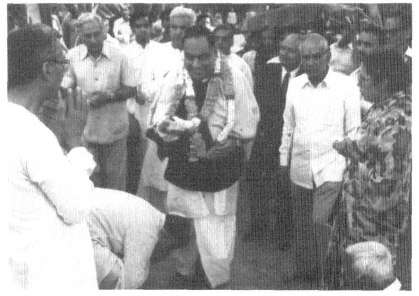
Figure 19.
Ramkinkar Upadhyay being greeted on his arrival at New Delhi's
Lakshmi-Narayan Temple by Basant Kumar Birla and his wife, Sarla
gious institutions and has constructed and endowed imposing temples, dharmashalas, and ghats in major pilgrimage places. The family sponsors cultural institutions as well, and these too have a strongly religious character; for example, it is the Calcutta-based Birla Academy of Art and Culture that publishes the many volumes of Ramkinkar's pravacan and sponsors the public programs, held annually in Delhi and Calcutta, that generate these collections.
Ramkinkar hails from a village near Banaras and maintains a residence in the city, but he seldom performs there nowadays. Although one sometimes hears, in explanation, that the unorthodox nature of his interpretations earned him the ire of the late Swami Karpatri and other Sanatani leaders, an equally valid reason would appear to be economic. The springs of courtly and aristocratic patronage that nurtured the Katha tradition in nineteenth- and early twentieth-century Banaras have dried up, and the most successful expounders have carried their art to the greener pastures of Calcutta, Kanpur, and Bombay, which are home to a new class of "princes."[51] Such is Ramkinkar's popularity that, ac-
[51] Shrinath Mishra, whose textual interpretations I never heard criticized, likewise says that he spends "eleven out of twelve months" outside Banaras, catering to a wealthy clientele that also includes branches of the Birla clan.
cording to an aide, his busy performance schedule—restricted somewhat by health considerations (he was roughly sixty years old in 1983)—is fixed three years in advance and includes a number of annual engagements that have remained constant for two decades or more.
One such stint is his appearance for nine evenings at the time of Ram Navami at New Delhi's Birla Temple, a masonry and marble colossus whose principal shrine honors Vishnu and his spouse (Lakshmi-Narayan) and is located about a kilometer west of Connaught Place, the commercial heart of New Delhi. The program is held in the garden behind the temple, where an open-air proscenium stage of red sandstone faces a vast lawn set among gardens, fountains, and religiohistorical monuments. On this stage, the sponsors erect an elaborate white podium with a velvet-fringed canopy, resembling one of the aerial chariots seen in religious calendar art. Other arrangements include metal balustrades demarcating men's and women's seating areas on the lawn, festive entrance gateways decorated with flowers, and a bookstall that does a brisk business selling Ramkinkar's many publications. Outside on the main street there are electrified signs announcing Manaspravacan . The crowd, which numbers in the thousands, is prosperous-looking and its male contingent seems dominated by white-collar workers, many with attaché cases, who have come from jobs in nearby high-rises and government offices. Quite a few carry "two-in-ones"—the ubiquitous cassette recorders-cum-radios—which they use to record the discourse. Such devices are an increasingly common sight at pravacan programs, and many expounders, no doubt flattered by their presence, allow them to be placed directly in front of them. It is said, however, that Ramkinkar's concentration is disturbed by these machines, and so the organizers have arranged a special area off to one side, complete with electrical outlets, where the owners of tapedecks may record from a nearby loudspeaker.
The daily pravacan is from 6:00 to 7:00 P.M. , the right time in downtown New Delhi to catch office workers on their way home. It is preceded by a professional bhajan singer who entertains the gathering crowd and leads it in Ram-namkirtan as the moment of Ramkinkar's arrival approaches. The atmosphere is electric with excitement as the small, rotund vyas steps through the ornamental gateway at the edge of the lawn and gravely makes his way down the central aisle, moving at a snail's pace to avoid treading on the innumerable heads and arms that poke through the side railings to touch his feet. At the end of the aisle, garland in hand, wait the principal listeners of this Katha , Basant Kumar Birla, chief executive of the Birla corporate empire, and his wife, Sarla.
Mr. Birla, an international figure who spends most of his time in the world of corporate boardrooms and private executive jets, appears here in dhoti and kurta , looking very much the pious householder; he and his wife sit attentively on the lawn directly in front of the dais throughout each program.
While Ramkinkar is being greeted by the Birlas and other dignitaries, two of his students, part of the considerable entourage that accompanies him to Delhi, ready the dais for him, fluffing up pillows and unpacking a large tote-bag of personal items, including a richly robed statue of Hanuman and a small copy of the Manas , wrapped in red silk. There is also a silver tumbler, kept in readiness should the master's throat become dry. While Ramkinkar performs, a student remains crouched behind the vyas seat, ever ready to offer assistance.
From his high perch on the canopied dais, Ramkinkar surveys an audience of some five thousand persons spreading across the great lawn and beyond into the hilly rear of the temple garden. Even though this throng lacks the intimacy of the small group of listeners who gather around Baba Narayankant each afternoon at Sankat Mochan, it is no less devoted to its vyas , and there are many in the crowd who have been coming to these talks for years. Indeed, when Ramkinkar begins to utter his mangalacaran[*] , there are some who murmur the slokas along with him, and when he concludes his invocation with the opening couplet of Ayodhyakand[*] , the entire assembly joins in with one voice.
Ramkinkar's admirers are fond of pointing out that he possesses no "voice"; whereas expounders like Binduji were famous for their vocal ability, Ramkinkar is famous despite his lack of it. "His voice lacks every good quality," one man observed to me, "yet thousands of people sit spellbound. How else can one explain it except by grace?" In truth, Ramkinkar's delivery is flat almost to the point of being monotone, his pace and rhythm show little change over the course of an hour, and apart from a few restrained hand gestures—hardly visible to the better part of his huge audiences—he makes no effort to enliven his presentation. He is also unusual in that he makes only minimal use of quotations; sometimes he merely reminds listeners of Manas passages without actually reciting them. What he does quote is delivered in the same flat tone in which he speaks.[52] Ramkinkar's dry, untheatrical delivery seems
[52] This type of delivery is common to some other Banaras expounders, however, and represents, according to Shrinath Mishra, a convict, on that the Manas should be presented without undue theatrics or embellishment. In this respect, the orators of Shiva's city strike a puritanical contrast to their more colorful counterparts from the Braj region.
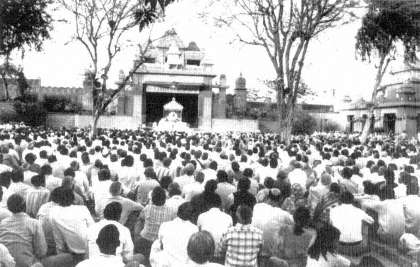
Figure 20.
The crowd at one of Ramkinkar's annual pravacan programs at
Lakshmi-Narayan Temple, New Delhi
to contribute to his image as the "thinking person's vyas ," whose discourse appeals particularly to the university-educated intelligentsia. Such people, perhaps because they themselves have been led to discover or rediscover the Manas by hearing it explained by this vyas (whose specific approach to the text is considered in the next section) often seem to regard him as without precedent in the oral-scholarly tradition. A Calcutta businessman attending the Delhi program told me emphatically that Ramkinkar had no precursors: "Earlier expounders like Binduji just sang the Manas , but they couldn't explain it. Now, thanks to Pandit-ji, people are finally beginning to understand its meaning." Needless to say, this view is hardly defensible; it is likely, however, that some of Ramkinkar's enthusiastic devotees have been exposed to relatively little Katha and may be unaware of their expounder's traditional antecedents.
Not everyone is spellbound, of course. At the festival in Ayodhya at which I first heard Ramkinkar perform, he had some difficulty in quieting the huge crowd, which included many country pilgrims perhaps accustomed to a livelier style of Katha . And since Ramkinkar is the most famous and, by all accounts, most commercially successful vyas , it is inevitable that he should have his detractors, especially among fellow
performers. The most common complaints heard against him are that he has "turned Katha into a business" and that his interpretations of the Manas are "imaginary" (kalpanik ), doctrinally unsound, and contrary to the intention of Tulsidas. Although it is not my concern to enter into this controversy, it may in fairness be pointed out that the first complaint is often heard from other professional (and no less commercial) performers whose earnings happen to be far less than Ramkinkar's, while the second seems to reflect a particularly narrow, "fundamentalist" understanding of the Manas , not necessarily characteristic of the broadest tradition of the epic's interpretation.
It is worth mentioning in this connection that Ramkinkar's allegorical and bhakti -centered interpretations of the text rarely stress the ideal of varnasram[*]dharm —a term used euphemistically nowadays to refer to caste-based social inequality—which some conservative expounders emphasize as one of the epic's primary themes. At Birla Temple, Ramkinkar devoted his 1983 pravacan series to Kevat-prasang[*] , a thirteen-line excerpt from Ayodhyakand[*] that highlights the exemplary devotion of Kevat, an untouchable who ferries Ram's party across the Ganga. Even though the drama of the passage depends to some extent on the audience's awareness of Kevat's base status, Ramkinkar's interpretation exalts Kevat to an unusual degree, emphasizing the timing of his encounter with Ram (just after the prince has left Ayodhya on his journey into exile) to suggest that Tulsidas has made Kevat not merely an exemplary outcaste devotee but in fact "the first citizen of Ramraj ." In subsequent discourses, he suggests that Kevat's love for Ram is beyond the understanding of the gods and even surpasses that of Dashrath for his son. Although none of this amounts to a radical political message—and Ramkinkar's audience, perhaps more than most Katha audiences, is squarely upper-middle class—it has a liberal, democratic tinge that may help to explain this speaker's popularity with the Birlas, who have sought to promote the glories of Hinduism while opposing, in principle at least, "backward" practices such as untouchability.[53]
As Ramkinkar concludes his remarks, the evening arti ceremony begins in the adjacent temple; broadast by loudspeaker, it features a recording of the popular film hymn "Jay jagdis hare." Hundreds of devotees linger in the garden in the gathering dusk, forming a long queue for
[53] It is a matter of policy that Birla-built temples be open to all regardless of caste, and their walls are inscribed with Vedic and Puranic verses followed by Hindi translations in order to make the scriptures accessible to all literate people.
the usual prasad of tulsi leaves; a few place cash gifts at Ramkinkar's feet. Then they too join the dispersing throng of Delhiites, many of them facing long commutes to distant suburbs by scooter or bus.
The Performer and the Text
The transcription of Katha performances produces, to my mind, disappointing results. Performances that I experienced and described immediately afterward in my notes as brilliant and exciting appeared flat and dull when "reduced to writing." Talks that had seemed highly cohesive, in which ingenious interpretations emerged one after another in a sparkling strand, seemed rambling and untidy in written form, lacking any principle of organization and filled with incomplete sentences and gratuitous digressions. All oral art, of course, has an inherently "emergent" quality, which results from its being the product of a unique context.[54] Although specific aspects of a performance can be documented through various media (and film or videotape obviously provide a more complete record of a Katha performance than an audio recording and its poorer relative, a written transcription), the total atmosphere of the performance is a fleeting experience that can only be approximated by documentation. Transcriptions of one-hour Katha performances typically take up fifty to seventy pages and appear to contain much redundant and fragmentary material. Rather than offer a translation of an entire such discourse, I prefer to discuss a number of the characteristic approaches to the Manas used by oral expounders, illustrating each with excerpts from performance transcriptions.[55] These are presented in a manner that adheres as faithfully as possible to the original performance (for example, the occurrence of ellipsis in an excerpt indicates that the performer broke off in midsentence, not that anything has been deleted from his remarks), with parenthetical notes on nonverbal aspects of the performance. Thus I hope to convey to readers something of the flavor of individual performances while focusing on the theme of greatest relevance to my study: the relationship of oral exposition to text.
[54] The term "emergent" is used by Bauman and other folklorists to highlight the qualities in a performance text that develop out of the specific circumstances of the performance itself; see Verbal Art as Performance , 37-45.
[55] Initial transcriptions were made by Chitranjan Dart of the Landour Language School, Mussoorie, U.P.; translations are mine.
Vyakhya And Vyakaran[*]
The term vyakhya , "full explanation or exposition," is used by many performers to refer to their handling of the text, but it can cover a range of approaches. As used in the Sanskrit commentarial tradition, the term often refers to a word-by-word gloss on a text, involving first the division of words joined by sandhi and then the substitution of synonyms for each. Vyakhya on the Manas , whether oral or written, is rarely this systematic. One reason, of course, is that the language of the epic is a form of the vernacular, and even though difficult passages exist, much of the text is straightforward narrative that can be understood by most Hindi speakers. The kind of tortuous constructions that abound in Sanskrit kavya , which require elaborate decoding, are not characteristic of Tulsi's epic. There is rarely a need for a commentator to analyze every word of a line, although certain key words may engage his attention and become the basis for extended exposition. As an extemporaneous art form, Katha is inherently digressive; one word under discussion will suggest another, and this may in turn suggest an anecdote that carries the vyas far from his original train of thought—although he will eventually return to it, usually by once more quoting the verse under discussion. In such vyakhya , the epic verse is used as a thematic anchor or frame for the speaker's verbal improvisation.
In the nineteenth century, some of the best vyakhya utilized the disciplines of grammar (vyakaran[*] ) and poetics (alankar[*] ) in analyzing the Manas . These approaches are rarely encountered in present-day Katha , probably because audiences lack the background to appreciate such analysis. Some connoisseurs mourn the decline of the older approaches. C. N. Singh told me, for example, that he is "still haunted" by a Katha he heard while visiting Ayodhya in his youth, in which the vyas began with the assertion of a "doubt" (sanka[*] ) concerning whether the opening line of Sundar kand[*] contains a grammatical error.[56] The speaker offered extensive arguments both pro and con, involving erudite excursions into Sanskrit and Prakrit grammatical theory, all buttressed by appropriate citations. The question was not a small one, Singh pointed out, since it involved the imputation of error to a divinely inspired poet; moreover, certain rationalizations of the questionable construction might necessitate the reinterpretation of other verses. He concluded, "The question
[56] The line reads, "Jamavanta ke vacana suhaye, suni Hanumanta hrdaya[*] ati bhaye"; literally: "Jambavan's pleasing speech, Hanuman hearing it, [his] heart was utterly delighted." The line appears to make incorrect use of the conjunctive participle (purvakalikakriya ; here, suni —"hearing" or "having heard") by making it refer to a different subject (Hanuman) than that of the main clause (Hanuman's heart).
was never resolved and I have never since been able to settle it. But that was not really the point. These kinds of arguments were only devices used to create interest, to get you involved in the Manas ."[57]
One style of vyakhya is still commonly used in Manas exposition. This is the practice, already mentioned, of defining each key word in a line in terms of its use in other epic passages. An example of this—as well as a theoretical statement on the practice—may be seen in the following excerpt from one of Ramnarayan Shukla's discourses at Sankat Mochan. The expounder begins by reciting a verse in praise of Ram, which contains the word jan —devotees, subjects, dependents:
Supremely merciful and adoring of the meek,
who has great love and compassion for his devotees. . . .
1.13.6
The Lord loves his devotees, is compassionate toward them [repeats second line above]. "Devotees' you see, means . . . dependent ones. Because, you know, in the Ramcaritmanas , in Tulsidas's books, the definition of any word has, somewhere or other, been given by Goswami-ji himself. He's explained it himself . . . somewhere. You have to search! So, who are called "devotees"? Look in Aranya[*]kand[*] , when the Lord says to Narad,
Listen, Sage, I tell you emphatically,
those who adore me, relying on nothing else,
these I ever protect
as a mother guards a child.
3.43.4,5
In this connection, the Lord says, "I have two kinds of children: one is big and one is little—just as a mother has a big child, and that big child does everything by himself, he relies on himself, but the small child relies on the mother."
The sage is like my elder son,
the humble man like my little one.
The devotee relies on my strength, the other on his own,
when both are assailed by the enemies lust and anger.
3.43.8,9
"The devotee relies on my strength"—here's the definition of devotee !: one who relies on the Lord's strength, is dependent on the Lord, supported by him, entirely surrendered to him.[58]
In the context of Ramnarayan's ongoing daily exposition in which the entire epic is presented sequentially, such analysis establishes a funda-
[57] C. N. Singh, interview, August 1983.
[58] Ramnarayan Shukla, Katha , Sankat Mochan Temple, August 3, 1983.
mental vocabulary for the discourse and invites listeners to experience the epic as a seamless and cohesive world of meaning.
Shrinath Mishra also uses the term vyakhya to describe his approach to the text; as he is normally engaged only for brief performance-series, however, he does not attempt a systematic exposition of the complete text but chooses brief passages or themes to explore. In February 1983, when he gave seven evenings of pravacan at Banaras Hindu University, Shrinath chose as his theme a single verse from Book Seven:
Ram, whose feet are worshiped by Shiva and Brahma,
is gracious to me—such is his supreme tenderness.
7.124.3
In Shrinath's analysis, this half-caupai concisely reveals the two fundamental aspects of the Lord's character: his "power" or "majesty" (prabhav ) and his "inherent nature" (svabhav , i.e., his characteristic love and compassion).[59] This insight became the basis for a long chain of vignettes that extended over the seven evenings (and Shrinath probably could have continued almost indefinitely, so central is the theme to Vaishnava doctrine) and provided examples of these two aspects of the divine character.[60] Each evening's pravacan began and ended—was anchored, so to speak—in the theme-line but otherwise consisted of free improvisation, dense with quotations from literary works and oral tradition, comprising stories from the Manas , the Bhagavatapurana[*] , and the lives of famous poets and devotees, each of which expanded on the notion of either prabhav or svabhav .
Creative Retelling: Dialogue and "Domestication"
In an essay on Kannada folklore, A. K. Ramanujan points to the "domestication" of Sanskritic gods and heroes that is characteristic of folk retellings of epic and Puranic stories: "In Sanskritic mythology, the gods do not even blink or sweat, let alone weep tears, sneeze, or menstruate. Their feet do not touch the earth."[61] In folktales, however, gods and
[59] This Vaishnava interpretation of the Lord's dual nature resembles Otto's well-known characterization of the two aspects of the sacred: mysterium tremendum and mysterium fascinans , the first eliciting a response of awe or even terror, the second producing an irresistible attraction; The Idea of the Holy , 12-40.
[60] The approach was not original, however. C. N. Singh recalled that the sadhu Snehlata of Ayodhya used to offer a similar vyakhya of this line, offering thirty-two examples each of Ram's prabhav and svabhav ; interview, August 1983.
[61] Ramanujan, "Two Realms of Kannada Folklore," 64-68.
heroes are liable not only to weep but also to blow their noses and argue with their wives in earthy village dialect. Although the Manas might be termed a "folk-influenced" retelling of the Ramayan story, and although it contains many touches of the humor, local color, and proverbial wisdom characteristic of regional folktales, it is a work that strongly asserts both its own religious authority and its fidelity to a perceived "great tradition," and its author generally maintains an august and dignified tone. His principal characters may not be quite as unearthly as the gods referred to in the above quotation, but they are still exalted and noble, and his hero and heroine have sometimes been faulted by Western readers as paragons of an unrelieved and almost inhuman virtue. Devotees, however, do not share this negative assessment. Even though Ram is perceived as less playful than Krishna, indeed as profound or serious (gambhir ) by nature, he is nonetheless, to his worshipers, entirely real, familiar, and human.
One reason that the epic characters remain vivid and alive to their audience is their domestication in the endless retellings of the Manas in Katha performances. For these are indeed folk recastings of the Ramayan, utilizing the text as a framework to be fleshed out with imaginary and highly colloquial dialogues containing touches of humor and pathos often missing from the original. For example, when Tulsi tells the story of Ram's anger at the monkey king Sugriv, he has his hero speak some harsh words and Lakshman display his usual hot temper; but he does not have Lakshman say (as Shrinath Mishra does when he retells the story), "Lord, for the first time in your life you're speaking my language! I'm going to go kill him right now. You got the big brother, now I'll take care of the little one!"—the last sentence a crudely comic reference to Ram's earlier slaying of Sugriv's brother Bali. Nor does he have Ram nervously tell himself, "Oh no, this fellow is really going to murder him!"[62] Many of the expounders' domestications prove to be "readings between the lines" of the epic—never accepting the text at face value but always probing the motives, mental processes, and emotions of characters, imagining their facial expressions and gestures, and bringing them all to life for listeners.
To demonstrate this approach, I offer a brief passage from Sundar kand[*] followed by a transcription of its retelling by Shrinath Mishra. In this episode, Ravan's brother Vibhishan, having just fled Lanka, is coming to surrender to Ram. The monkeys, led by Sugriv, fear that he comes
[62] Shrinath Mishra, Katha , Banaras Hindu University (hereafter, B.H.U.), February 14, 1983.
with an evil purpose and attempt to warn Ram against him. Ram counters that he must be true to his vow to welcome all who come to him seeking shelter. The Manas passage reads:
Sugriv said, "Listen, Lord of the Raghus,
Ten-head's brother is coming to meet you."
The Lord said, "Friend, what do you think?"
The monkey king answered, "Listen, Lord of men,
the illusory power of the demons can't be fathomed.
A form-changer—who knows why he comes?
This scoundrel comes to learn our secrets!
Bind and hold him—that seems best to me."
[Ram replied] "Friend, you've analyzed the strategy rightly,
but I've vowed to protect those who seek shelter."
5.43.4-8
In Shrinath's interpretation, this passage draws special poignancy from the fact that both Sugriv and Vibhishan have quarreled with and ultimately betrayed their elder brothers. Sugriv has already come under the Lord's protection, but now Vibhishan's fate seems to hang in the balance and, ironically, Ram allows Sugriv to present the case against him. This becomes the means for Ram to teach the proud and somewhat narrow-minded monkey king a lesson on the value of compassion. It also allows for a humorous digression in which Ram compares himself to the demon and finds that every evil quality that Sugriv has attributed to Vibhishan has a parallel in his own divine attributes. The discussion of evil qualities or "defects" (dos[*] ) reminds the vyas of a passage in Book One in which nine defects are attributed to Shiva. After this digression, he returns to the subject of Ram's reception of Vibhishan and completes the story:
You know the time when Vibhishan-ji came seeking shelter and Sugriv-ji stopped him? Sugriv-ji said,
Sugriv said, "Listen, Lord of the Raghus,
Ten-head's brother is coming to meet you."
5.43.4
"Ten-head's brother"—that's the point—Ravan's brother is coming! The Lord said,
The Lord said, "Friend, what do you think?"
5.43.5
[off-handedly, speaking as Ram] "What's the need to consult me? If he's coming, well, let him come." Sugriv-ji said, "You don't understand. I'm telling you it's Ten-head's brother. . . . So the Lord said [sighs, then slowly
and deliberately] "Well, if Bali's brother[63] can come, why can't Ravan's brother?" [loud approval from listeners: "Vah!"] "If Bali's brother can come take refuge in me, then why shouldn't Ten-head's brother come?"
Sugriv said, "Come on, Maharaj! I mean something else, you're not getting it." The Lord said, "What's your point? Speak up, explain!"
"Look here," Sugriv said [excitedly], "Ten-head's sister came, and what a big calamity that was!"
Shurpanakha, the sister of Ravan. . . .
3.17.3
"Janaki-ji was carried off, it was a great calamity! And now Ten-head's brother is coming. . . ."
[slowly] Then the Lord said to Sugriv-ji, "Friend, I've left Ayodhya and come all this way. I go to all the ashrams of the sages and ascetics, to all the devotees' places; I go all over. If even a single devotee wants to meet me, I go to him and then travel on. I go there and then travel on! [fervently] Now a devotee is coming to meet me, and you are holding him back, Sugriv! What is this you're doing? Let him come!"
The enemy's younger brother, Vibhishan the demon. . . .
Vinay patrika. . . . Goswami-ji has eleven other books, you know, and if one studies them, the intoxication is all the greater. My revered teacher was a great scholar of all twelve books. That's why I quote a lot from the other books in my Katha .
The enemy's younger brother, Vibhishan the demon—
what devotion was he fit to practice?
But when he sought refuge, you brought him before you
and met him with open arms.
Vinay patrika , 166.8
[tenderly] The Lord, you know. . . . [returning to the story] Then Sugriv-ji said, "Maharaj, you are a king, therefore you should think like a king. Right now, consider, as a king, whether Vibhishan should be given refuge or not."
The illusory power of the demons can't be fathomed.
A form-changer—who knows why he comes?
This scoundrel comes to learn our secrets!
Bind and hold him—that seems best to me.
5.43.6,7
Four defects! Four defects were pointed out by Sugriv at that time: "illusory power of the demons"—that's one; "form-changer"—two; "who knows why he comes?"—three; "to learn our secrets"—four.
[63] I.e., Sugriv himself.
The Lord said, "Sugriv, these four faults which you have pointed out in Vibhishan, it seems that they are in me as well. It seems they belong to me also." Sugriv-ji was stunned, "Lord, what are you saying?" The Lord said, "You said that 'the illusory power of the demons can't be fathomed.' Well., if the illusory power of the demons can't be fathomed, my illusory power also can't be fathomed:
Hari's illusory power is inscrutable,
not to be fathomed, King of Birds!
7.118a
My illusory power is also incomprehensible." And "form-changer": whenever the demons wish, they can take on a form. So the Lord said, "This defect also is found in me:
Of the fish, the turtle, the boar, the man-lion,
the dwarf, and of Parashuram . . .
[he pauses, smiling; audience completes line]
. . . you took the form!
6.110.7
[outburst of applause, exclamations of "Vah!"] When I desire it, then I too can take on a form. So this defect also is in me.
The illusory power of the demons can't be fathomed.
A form-changer—who knows why he comes?
5.43.6
Well, this 'who-knows-why-he-comes' defect is in me too:
The reason that Hari becomes incarnate,
one cannot say it's this or it's that.
1.121.2
The reason that God comes, this no one can explain with certainty. So,
A form-changer—who knows why he comes?
The scoundrel comes to learn our secrets!
5.43.6,7
He comes to learn our secrets. And I, I too . . .
Ram sits at the palace window
receiving everyone's homage.
He divines each one's desire
and gives accordingly to each.[64]
I too, day and night, find out, you see, everyone's secrets. So it appears that all four defects are in me. Therefore, if there are four defects in Vibhishan and there are four defects in me, well then, if one defective person makes friends with another defective person, well, you know, perhaps it may turn out for
[64] A folk saying expressed as a doha .
the best! [laughter] But if a defective person should make friends with a meritorious person, well, that could be very difficult." Like the time when nine defects were pointed out in Lord Shiva—you know, by the seven sages.[65] Parvati-ji was delighted. She said, "Sages, I have heard it said:
Eight defects are ever in woman's heart.[66] 6.16.2
There are eight defects in women, so I have heard. So if an eightfold-defective woman should be wed to a ninefold-defective husband, well, they'll hit it off quite well![67] [laughter] But if by chance an eightfold-defective woman should get a ninefold-auspicious husband. . . ." They had pointed out nine auspicious qualities in Lord Vishnu, you know. But I'm not going to tell that story now; my subject is different. I'll just tell you the gist: that they described nine good qualities in Lord Vishnu, nine defects in Lord Shankar. Then Parvati-ji said, "If a ninefold-auspicious man is wed to an eightfold-defective woman, it will be a mismatch. But if she should marry a ninefold-defective man, then, you know, it just might work out!"
Mahadev may be full of defects,
Vishnu, the abode of all good qualities . . .
But get the point, it comes at the end:
Mahadev may be full of defects,
Vishnu, the abode of all good qualities,
but whatever pleases one's heart,
that alone one desires.
1.80
"Hey, Seven Sages, what are you saying? Don't you know who my guru is? My guru is Shri Narad-ji."
My obstinacy will persist through millions of births:
I'll wed Shambhu or remain a virgin!
1.81.5
I won't abandon Narad's advice,
whether my home prospers or perishes, I won't fear.
One who lacks faith in his guru's words
finds no happiness or profit even in dreams!
1.80.7,8
[65] In Tulsi's retelling of the courtship of Shiva and Parvati, Shiva sends the seven sages to test Parvati, who is performing austerities to win him as her husband. The sages try to sway her from her purpose by pointing out a catalog of defects in her prospective spouse: he is naked, has no home or family, carries a skull, etc. (1.79.5,6).
[66] A rebuke uttered by Rayan after his wife Mandodari urges him to return Sita to Ram. In the intertextual world of Katha , even the unwed Parvati quotes the Manas , although its story has yet to be narrated m her!
[67] I.e., since by conventional wisdom a husband should always surpass his wife.
At that moment the seven sages . . . ah, they fell at Mother Parvati's feet! [returning to original story] So, when the Lord said these things about Vi-bhishan-ji, and when he lifted Vibhishan up and clasped him to his heart, at that moment the Lord looked at Sugriv-ji. The Lord said to Sugriv-ji, "Sugriv, you told me,
Bind and hold him—that seems best to me.
5.43.7
Bind him and hold him prisoner. Well, Sugriv, I am following your advice—I am binding him. But not with rope; I'm binding him in my arms." Right? [audience: applause and "Vah!"]
Having spoken, Vibhishan fell prostrate. Seeing this,
at once the Lord lifted him up with delight.
That humble speech pleased the Lord's heart
and his great arms clasped Vibhishan to his breast.
5.46.1,2
Marvelous is the Lord's nature, marvelous! The more you dwell on it, the more delight you'll experience. . . .[68]
The penultimate sentence above is almost a refrain, repeated at the end of each anecdote or episode in the seven-day Katha . Sometimes (as here) it is the Lord's svabhav , or "nature," that is praised, and sometimes his prabhav , or "majesty." In this way, Shrinath ties his many anecdotes and explanations into his overall treatment of the theme verse. But, as must be clear, his exposition is more an evocation and celebration of the Lord's being than a theological analysis of it, just as his vyakhya of the verse is more an improvisation on its mood and implications than a systematic analysis of its language or content.
The excerpt shows how much of a performer's exposition may consist of quotations—roughly half of Shrinath's Katha comprises aptly chosen verses from the Manas . It also offers an example of how a vyas , in presenting the text in his own fashion, necessarily interprets and comments on it. In the passage under consideration, the first line spoken by Ram himself ("kaha prabhu sakha bujhie kaha"; 5.43.5) is susceptible to at least two readings, because the verb bujhna can mean either "to think, to understand" or "to ask, to consult." The translation I have offered ("The Lord said, 'Friend, what do you think?'") is based on the first sense of the verb and is the interpretation preferred, for example, by the Gita Press tika[*] and the Manaspiyus[*] . Shrinath, however, wishes to stress the disparity between Ram's and Sugriv's understanding of the
[68] Shrinath Mishra, Katha , B.H.U., February 14, 1983.
situation and so takes the verb in its other sense and glosses the line, "What's the need to consult me?" having Ram add (with a hint of irritation in his voice), "If he's coming, then let him come."[69] This contributes to a heightening of tension in the retelling, as Sugriv supposes that Ram did not understand him correctly and hastens to explain, with a certain impatient urgency, why a demon like Vibhishan is not to be trusted. Thus the vyas gradually "sets up" Sugriv for the denouement: Ram lovingly embraces Vibhishan and shoots a glance in Sugriv's direction, accompanied by an ironic comment on the monkey's advice to "bind" the new arrival. Neither the glance nor the comment, of course, is mentioned in Tulsi's text.
Just as the text may be expanded through dialogues and incidents based on distinctive interpretations of its lines, it may also be supplemented by stories or motifs taken from other works of Tulsidas. Thus, while discoursing on the supreme good fortune of Kaushalya, Ram's mother, Shrinath Mishra cites a couplet from Balkand[*] , which in turn reminds him of a Kavitavali verse that mentions the infant Ram demanding that his mother give him the moon to play with—a theme Tulsi probably borrowed from the poetry of Surdas.[70] The expounder turns this brief reference into a charming dialogue between Ram and his mother, culminating in a humorous and ironic "punchline" that reflects, as Shrinath intends, on the Lord's "majesty" (prabhav ):
The all-pervading Brahman, stainless,
qualityless, and dispassionate—
that very unborn one, mastered by love and devotion,
lies in Kaushalya's lap.
1.198
Goswami-ji says that the all-pervading Brahman, stainless, qualityless, and dispassionate. . . . One time Bhagvan was playing, you know? And,
Sometimes he stubbornly demands the moon,
or seeing his reflection, is frightened.
Sometimes he claps his hands and dances,
filling the womens' hearts with delight.
Kavitavali , 1:4
[69] Shrinath is following the interpretation of his guru, Vijayanand Tripathi, whose own Vijayatika[*] glosses the line "The Lord said, 'O Friend, what is there to question in this?'" The commentary adds, "The Lord said, 'You are my friend. You have the authority to allow people to meet me, and my door is always open. No one is denied a meeting. What need is there to deliberate about this? If he wants to come, then let him come!'"; Vijayatika[*] 3:235.
[70] See, for example, poem 5, p. 170, in Bryant's Poems to the Child-God ; note also poem 16, p. 159, which describes Krishna playing with his reflection, a motif also alluded to in Kavitavali .
Bhagvan said, "Mommy, give me the moon. I will play with the moon." When God plays, you know, will he play with any ordinary toy? [obstinately] "Give me the moon!"
Kaushalya said [sighs patiently], "The moon, you know, cannot come down to earth." Bhagvan laughed and said, "You mean, God can come down to earth, but the moon cannot come?" [audience: "Vah!"] "You are able to bring down the Absolute, and yet you cannot bring the moon? "[71]
Sometimes the Ramayan story is enhanced in Katha by the introduction of material that has no basis in any of Tulsi's writings, or perhaps in any literature. Such anecdotes drawn from the oral tradition contribute significantly to domesticating the august epic characters and offer another kind of commentary on the story. The following example, again taken from Shrinath Mishra's performances, was woven into a retelling of the episode in which King Janak's messengers come to Ayodhya to announce Ram's impending marriage, and King Dashrath eagerly solicits news of his sons. The messengers remark on the personalities of the two princes, and this reminds the vyas of a story told by "a sant of Ayodhya." The story, which features an object (a jhar-phanus[*] , or "chandelier," presumably of glass or crystal) more suggestive of a nineteenth-century princely setting than of the ancient world of the Ramayan, allows the expounder to make a good-natured joke over the fact that Lord Ram, even as a child, was inclined to be reserved.
O King, even as Ram possesses incomparable strength,
so Lakshman is a storehouse of fiery energy.
1.293.3
The messengers, here, are making a distinction. "Your elder son, Your Majesty? Well, the fact is, he's very solemn; very dignified, your elder son. . . ." You know, a certain sant of Ayodhya used to tell a wonderful story: Little Lord Ramchandra was twirling a stick. The stick flew from the Lord's hand and struck Ayodhya's most precious chandelier—you know, a hanging lamp—Ayodhya's most valuable one. The chandelier broke; it was shattered! The servants came and told Maharaja Dashrath, "Your Majesty, Ayodhya's most valuable chandelier got broken today!" Then Kaushalya-ji came. Kaushalya-ji was very frightened and said to Maharaja Dashrath, "A chandelier, the costliest in all of Ayodhya, got broken." So then Maharaja Dashrath asked sternly, "Who broke it? Who did it?!"
"Uh . . . Shri Ram. [pleadingly] Your Majesty, it was a mistake, please forgive him! Ram made a mistake. . . ."
[pause] Then Maharaja Dashrath said [gaily] "Sound the trumpets! Call a
[71] Shrinath Mishra, Katha , B.H.U., February 13, 1983.
holiday! Go all out! At least my little Ramchandra should be naughty enough to break one chandelier!" [laughter and applause][72]
Similarly, the informal and open-ended structure of Katha allows the performer to "contemporize" his discourse (to borrow another term from Ramanujan) by including personal anecdotes and contemporary stories. These may be as inspiring as Ramnarayan Shukla's account of the austerities of Jugalanand Sharan, a saintly sadhu whom he knew in his youth; or as satirical as Shrinath's tale of a Calcutta businessman of his acquaintance, who aspired to earn "twenty-five lakh rupees" (Rs 2,500,000) and then retire to Vrindavan but later found—after he had earned several times the desired amount—that he was too firmly enmeshed in worldly cares to set out for Krishna's holy city. And when Shrinath has the hot-tempered Lakshman note with disappointment Ram's use of the word "tomorrow" in his threat to slay Sugriv—fearing that Ram has, as usual, left a compassionate loophole in his anger—the vyas offers a homely digression on the habits of contemporary merchants:
Our U.P. shopkeepers, you know, the clever ones, they post signs in their shops: "Cash today, credit tomorrow!" Well, whenever you go there, it's always "today," right? When is it ever "tomorrow"? [laughter][73]
Esoteric Interpretations
A common honorific appended to the names of famous expounders is Manasmarmajña —"knower of the secrets of the Manas "; for the vast reservoir of the epic is thought to conceal mysteries in its depths that only its most profound students can discern. One reason devotees flock to hear Katha is to learn some of these secrets and so gain insight into difficult or obscure passages. One such passage occurs in the dialogue with Parashuram (Parasuramsamvad ) in Book One. After Ram breaks Shiva's bow to win Sita's hand, he is confronted by the militant Brahman ascetic Parashuram, who challenges and insults him; their conversation is joined by Lakshman, whose hot temper matches Parashuram's own. The passage abounds in amusing insults and plays brilliantly on the tension inherent in the Brahman-Kshatriya relationship. The denouement of this long and heated exchange, however, is swift to the point of obscurity: after finally silencing his younger brother with a stern glance, Ram addresses the offended Brahman:
"Truly I speak, and not to flatter my family—
a son of Raghu in battle does not fear even Death.
[72] Shrinath Mishra, Katha , B.H.U., February 15, 1983.
[73] Ibid.
Yet such is the greatness of the Brahman race
that even a fearless one stands in awe of you."[74] Hearing Raghupati's sweet and mysterious words,
the curtain of Parashuram's understanding was lifted.
1.284.4-6
Ram's speech, though essentially a reiteration of what he has said earlier in the dialogue, produces a dramatic effect on the Brahman, who only a moment before was heaping abuse on Ram and threatening to kill him but now breaks into a long paean of praise to him as God incarnate. The obvious query—just what precipitates this sudden change of heart?—has been sharpened by Tulsi's use of the word gurh[*] (mysterious, allusive) in the next to last line above to describe Ram's words; clearly the poet intends them to convey more than their surface meaning, although he provides no further explanation. The commentarial tradition has offered many interpretations for this puzzling passage, which seems significant in that it concerns a moment of recognition of the hero's incarnate divinity. For Shrinath Mishra, this is one of those passages in which Ram's awesome majesty (prabhav ) is triumphantly manifested:
"Such is the greatness of the Brahman race
that even a fearless one stands in awe of you."
1.284.5
The Lord is wearing his yellow robe [acting it out with gestures]. He pushes aside his robe and then he gives a sign to Parashuram, pointing here [gesturing to his chest]:
"Such is the greatness of the Brahman race . . . "
He says [with great emotion], "Your grandfather Bhrigu once kicked me, and I still wear that mark like an ornament! [audience: "Vah!"] Yet you address me as a 'foe of Brahmans'!"
"Such is the greatness of the Brahman race
that even a fearless one stands in awe of you."
Hearing Raghupati's sweet and mysterious words,
the curtain of Parashuram's understanding was lifted.
1.284.5,6
At that moment, Parashuram-ji . . . Look here—it's that very word. Listen carefully; you people are all learned. It's that very word! [recites slowly]
Then Parashuram knew Ram's majesty [prabhav ]
and his body trembled . . . .[75] 1.284
[74] This half-line may alternatively be read, "that he who fears you becomes fearless"—most commentators offer both interpretations.
[75] Shrinath Mishra, Katha , B.H.U., February 14, 1983.
In Shrinath's analysis of the pivotal verse, the word "such" (asi ) is the clue to a physical gesture by means of which Parashuram's ignorance is finally removed. For according to Vaishnava doctrine, Vishnu, the Supreme Lord, bears certain physical marks, one of which is a footprint-shaped scar on his chest, a legacy of the kick of the temperamental sage Bhrigu, who once sought to test the Lord's humility.[76] Thus, by baring his chest Ram reveals to Parashuram that he is more than just "a son of Raghu"—he asserts his atemporal, divine identity.
Tulsi's account of Ram and Sita's marriage contains another enigmatic verse that has received attention from commentators. The poet notes that "all the gods" came to witness the festivities, and he describes their astonishment at the splendor of King Janak's capital and the magnificence of the arrangements. But the reaction of Brahma, the world-creator, is singled out for special comment.
But the Ordainer was particularly surprised,
for nowhere did he see his own handiwork.
1.314.8
This verse appears to present a problem, for although Vaishnavas believe that it is merely at the instigation of his overlord, Vishnu, that Brahma executes his periodic task of cosmic creation, they nevertheless regard him as creator of the world, and Janakpur is part of the world. Yet the poet has asserted that, at the time of the wedding, the creator could detect no trace of his own labors there. When Ramkinkar Upadhyay gave Katha in Ayodhya on the anniversary of the marriage festivities, he asked his listeners to consider whether Ram's marriage had been an ordinary temporal event. If it had been, he went on, then what would they all participate in later that evening, when wedding processions mounted by various temples would circulate through the city amid great rejoicing? Would these merely be "commemorations" of an event in the remote past? To counter this view, Ramkinkar introduced the episode containing the above verse, which he expounded as follows:
There was pride in Brahma's heart: "I have fabricated all this creation! And within this creation made by me, in this city of Janakpur, such a grand celebration is taking place. People are sure to think of me; they'll think, 'How great is Brahma's creation!'" But when Brahma entered Janakpur and looked around, then what happened? It says,
[76] See Padma purana[*] 6.282.8-93; translated in O'Flaherty, Hindu Myths , 149-54. This interpretation is not original to Shrinath; it is mentioned in the Manaspiyus[*] (5:691) as "the bhav of certain profound men."
But the Ordainer was particularly surprised,
for nowhere did he see his own handiwork.
1.314.8
Brahma looked around. He was stunned. He said, "But there seems to be nothing at all here made by me!" Well, the god of faith, Lord Shiva, understood: "Intelligence operates according to reason, and so the god of intelligence is confused." Immediately, he came and stood before Brahma, but he didn't address him directly. Smiling, he asked all the gods, "What have you all come here to see?" They said, "Shri Ram's wedding." So Lord Shankar said, "Shri Ram's wedding is not to be seen with the eyes only. If one were to see it only with the eyes, then one would experience merely the delight of appearance." They asked, "How then are we to experience its delight?" Look here, you must have read the verse:
Shiva admonished all the gods,
"Don't become dumfounded with surprise . . . .
1.314
Why not? He said,
"Ponder in your hearts . . . .
It's not enough just to see , you must ponder in your heart!
"Ponder in your hearts—
for this is the marriage of Sita and Raghubir!"
1.314
To explain Brahma's state, I'll give you an example. How was Brahma's condition at that time? There was a little boy who was very beloved of his morn and dad. His morn and dad were always taking him on their laps, always caressing him. One day by chance that little boy happened upon the photo of his more and dad's wedding. When he examined it he saw his morn and he felt very happy; then he saw his dad and again he felt happy. He looked happily at everyone in the photo, but then he became sad. Some perceptive person asked, "First when you were looking at the photo you were happy. Why have you now become sad?" So the little boy said, "what can I say? It seems that everybody's picture is in here but mine, therefore I feel sad." [laughter] And then that wise person said, "Well then, understand from this photo that you did not always exist. It was only after this wedding that you came to be."
And so Lord Shiva said to Brahma, he said, "Brahma, don't look around here thinking 'what have I made?' Look here to find out "Who has made me'!" [laughter and applause][77]
Here a homely anecdote of a small boy's naiveté is used to present the Ramaite doctrinal view of Sita-Ram as the primordial ground of being
[77] Ramkinkar Upadhyay, Katha , Ayodhya, December 20, 1982.
and to emphasize that their apparently narrative-bound "marriage" is actually an event that stands outside cosmic time. Not only in the above excerpt but throughout this Katha Ramkinkar's emphasis is on the immediacy of the events in the Manas and the importance of the devotee's direct participation in them. Describing the placement of the various guests in the marriage pavilion, he suddenly challenges his listeners, "But where, in the pavilion, are you seated? Do you see yourself there or not?" If they are not present in the pavilion, he chides them, they are denying the Vaishnava doctrine of the eternality (sasvatatva ) of the Lord's lila . They are viewing the Manas as a mere "picture" (citra ) of the past, however lovely and idealized, rather than as the "mirror" (darpan[*] ) that Tulsidas intended it to be—a mirror in which they must see their own reflections.
Indeed, it is by "pondering in their hearts" or even by quite literally "placing themselves in the picture" through visualization techniques—concerning which I have more to say in the next chapter—that traditional expounders arrive at some of their unusual interpretations of the text. For although Ramayanis might be unwilling to attribute absolute theological weight to their interpretations—they are primarily storytellers, not theologians—at the same time, they would not like their views to be dismissed as "mere imagination" (an accusation sometimes leveled against Ramkinkar). The term they prefer is bhav , which in this context might best be translated "insight" in the literal sense. It is Very much within the realm of devotional possibility to regard a brilliant vyas as one who has actually been witness to what he describes. How else could he "see" Ram's meaningful glance in Sugriv's direction at the moment of embracing Vibhishan ? How else could he "see" Ram push aside his robe to show the Brahman's foot-mark to Parashuram? How else could he repeat conversations and reveal gestures and facial expressions that the text does not record? We might say that he sees all this "in his mind's eye" and regard it as mere imaginative license; the bhakti tradition is more inclined to place the locus of these events in the heart and to consider them insights into a higher reality.
Numerology and "Structural" Analysis
A notable characteristic of traditional Indian scholarship is its penchant—some might say mania—for systematic classification and hierarchy. From the three "strands," or gunas[*] , constituting material existence, the four aims of life, five elements, six flavors, eight (or nine) aesthetic
emotions, ten states of separation, to the twenty-four avatars of the Lord, the thirty-two basic postures of hatha[*]yoga , and even the sixty-four different positions in which it is possible (in theory at least) for male and female to unite—there is hardly an aspect of life that Brahmanical thinking has not subjected to detailed, if at times rather gratuitous, classification into orderly systems, usually according to auspicious numerical values. Such systematizing reveals more, however, than a compulsive need to organize; it reflects a cultural conviction of meaningful structure underlying the apparently untidy diversity of the world of forms.
The devotee accepts the Manas as a work of the highest inspiration—Lord Shiva's own retelling of the eternal Katha of Ram—and therefore he expects its grand design to be filled with hidden meanings and relationships. One of the aims—indeed, one of the special delights—of Katha is to call listeners' attention to meaningful structures and correspondences underlying the surface narrative. The kind of intense but loving scrutiny to which traditional scholars subject the text is very successful in revealing such structures and thus serves to enhance the audience's appreciation of the epic as an inexhaustible store of meanings relevant to every aspect of life.
Whenever a Manas verse contains a series of adjectives or nouns, traditional scholarship is almost certain to remark on their number, and certain lines indeed lend themselves particularly well to sustained analysis in numerological and symbolic terms. One such verse is the couplet that describes Ram's beauty when he appears to King Manu and Queen Shatrupa as a reward for their long and arduous penance.
Blue as a blue lotus, blue as an amethyst,
blue as a rain-bearing cloud—
the sight of his beauty put to shame
millions upon millions of Love gods.
1.146
Although the casual reader might see only a cluster of conventional metaphors in the first two lines, the commentarial tradition discerns a triad immediately suggestive of the tripartite structure of the cosmos: the netherworld (conceived as a watery abyss and symbolized by the water-born lotus), earth (with its mines of precious stones), and heaven (realm of clouds and rain). Certain Ramayanis have also sought to relate these metaphors to other triadic clusters in philosophy and mythology:
for example, to the divine trinity of Brahma, Vishnu, and Shiva, and to the three divine attributes of existence, sentience, and bliss (sat, cit, and anand ).[78]
Pointing out the recurrence of numerical values in the text also confirms the audience's belief that there is a deeper structure to the epic than meets the eye. In his account of the reception of the newly married Ram and Sita in Ayodhya, Shrinath Mishra notes that Tulsidas used six metaphors to describe the happiness of Queen Kaushalya on beholding her son and his wife for the first time.
Like a yogi who attains supreme insight,
an invalid given rejuvenating nectar,
a pauper who finds the philosopher's stone,
or a blind man who gains beautiful eyes,
like one dumb from whose lips Sarasvati shines forth,
or a warrior victorious on the battlefield.
1.350.6-8
The expounder invites his listeners to consider why the poet has used six metaphors—their number is not arbitrary, he insists. He reminds them that Kaushalya, in a previous incarnation, was Shatrupa, wife of the primordial lawgiver Manu, who performed austerity together with her husband and was rewarded with the promise that she would one day give birth to the Lord in human form. Shrinath then cites the verse in which Shatrupa framed her boon, pointing out that it consists of six separate requests:
That very joy, that beatitude, that devotion,
that love for your feet,
that discrimination and that way of life,
O Lord, by your grace, grant me.
1.150
"These six," he concludes solemnly, "are fulfilled today for Kaushalya-ji."[79] Of course, the more hard-nosed reader may object that the two passages, in fact, resemble each other solely in the numerical total of their components and that even a vyas would be hard put to demonstrate more specific parallels between the boons requested by Shatrupa and the metaphorical descriptions of Kaushalya's happiness. But to undertake such belabored argument is not the expounder's intent; he merely hints at a structural parallel in passing, as an aside in the course
[78] Mishra, Tulsidarsan , 328-29.
[79] Shrinath Mishra, Katha , B.H.U., February 15, 1983.
of a longer story. In the performance context, such an insight, suggesting a unity of design linking two widely separated episodes in the text, is highly effective and earns a warm response from the devout audience.
An even more audacious example of an expounder's "structural" analysis may be drawn from one of Ramnarayan Shukla's daily talks at Sankat Mochan Temple. One day, while discoursing on the power of "speech" (vac ), he announced with great fervor that "Hanuman never utters any speech that does not contain the four holy syllables Si-taRa-ma ." This idea immediately intrigued the temple audience, but curiosity turned to astonished delight as the vyas began reeling off at great speed each of the lines spoken by Hanuman, right from his first appearance in Book Four, holding each one up in the air for a split second, as it were, and then with dazzling speed dissecting it almost visibly, syllable by syllable, like a sort of human word processor, discarding some syllables and retaining others to show that each line does indeed contain Si-taRa-ma .[80] Inherent in the spectators' warm response to this verbal tour de force, of course, is their own faith in Hanuman and their admiration for Ramnarayan's deep devotion to him, as well as their recognition that, consciously or not, the author of the Manas really did seem to have structured each of Hanuman's speeches to contain the letters of his adored master's and mistress's names.
Allegorical Interpretation
The technique of treating the Manas as an allegory and viewing' each of its characters as symbolic of an emotional or spiritual state is not new;[81] it is best exemplified at present by the work of the renowned but controversial Ramkinkar Upadhyay, whose interpretation of the epic—his characteristic bhav —is frequently termed "metaphysical" or "mystical" (adhyatmik ) by his admirers.[82] Whereas many contemporary expounders favor what might be called a "fundamentalist" approach to the
[80] Ramnarayan Shukla, Katha , Sankat Mochan Temple, February 7, 1984.
[81] C. N. Singh has pointed out that the famous nineteenth-century Ramayani, Kashthajihva Swami, gave allegorical interpretations to many passages (interview, August 1983).
[82] Ramkinkar himself does not endorse this designation. Like many expounders, he conceptualizes Manas interpretation through the traditional scheme of the four ghats, each of which represents a "point of view" from which the text may be examined. He associates the adhyatma perspective with the "Ghat of Wisdom" (jnan ), on which Shiva and Parvati are seated, but he emphasizes that there are also the ghats of "Adoration," "Duty," and "Humility" (upasna , karma , and dainya ) and that he makes use of all four in his exposition (interview, April 1983). On the traditional interpretive scheme of four ghats, see my essay "The View From the Ghats."
text—viewing its events and characters in an extremely literal fashion and constantly emphasizing the supposed historicity of the story—Ramkinkar, though not denying that the events of the epic happened as described, reinterprets them in order to emphasize their relevance to archetypal and hence contemporary human situations. It appears to be particularly this feature of his pravacan that has won the admiration of the urban, college-educated people who make up a large part of his audience.
At their best, Ramkinkar's discourses are so cohesive and seamlessly woven around a central theme or image that it is difficult to single out brief passages to convey their flavor effectively. In the Ayodhya performance mentioned earlier, for example, the vyas developed his remarks around the metaphorical image of a mirror, symbolic of the Manas itself, and its comparison with a picture or painting.
If, when reading the Ramcaritmanas you feel that it describes something that happened in the Treta Age, then you are looking at a picture. But if, when reading the ancient story, you feel that it is also the truth of the present age, the truth of our own lives, the truth of our difficulties, then it means that you are using it as a mirror.[83]
Rhetorical questions concerning the underlying meaning (abhipray , tatparya ) of characters and events form a recurring leitmotif in Ramkinkar's performances, and the answers he provides to these questions nearly always involve symbolic interpretations. Thus, the fact that King Dashrath, in Ayodhyakand[*] , gazes into a mirror while seated on his throne surrounded by courtiers singing his praise is interpreted by Ramkinkar as a demonstration of the need for those in authority to turn their attention from flattering voices (both internal and external) and to engage in intense self-examination. The fact that the king's crown has slipped to one side is likewise given a symbolic interpretation by the vyas :
And when he looked in the mirror, his gaze went in the direction of a defect: he saw that his crown had become crooked and he straightened it. And what is the significance of that? The crown, you know, is the symbol of authority. And, brother, it is in the nature of authority to constantly slip away. This crown of authority never resides on anyone's head for all time; in some way or other it invariably slips away.[84]
The just king, he continues, is not afraid to consult the mirror of truth,
[83] Ramkinkar Upadhyay, Katha , Ayodhya, December 20, 1982.
[84] Ibid.
even in public view; but, he adds, Tulsidas has deliberately refrained from mentioning even a single mirror in Lanka, Ravan's golden city of self-deception.
At times, Ramkinkar supports his allegorical designations by citing the epic. Thus, in discussing Ram's slaying of Taraka (1.209.5,6) he "proves" his interpretation of the female demon as a symbol of despair by the clever use of a line from an earlier passage in which Tulsi compares the deeds of Ram in human form with the wonders wrought by the Lord's name. Again using the image of the mirror, the expounder asks his listeners to look beneath the surface of the story to see its relevance to their own lives:
The story goes that this Taraka, you know, was a woman of the Treta Age who became a demon. But really, this Taraka is present in our own lives. Look in the mirror, and she is there. And who is Taraka?
For the sake of the sage, Ram annihilated
the daughter of Suketu, with her army and her son.[85] Together with weakness and sorrow, the devotee's despair
is voided by the name, as night by the sun.
1.24.4,5
So Goswami-ji says, Taraka is the despair in life.[86]
By a similar symbolic substitution, Shiva's bow, which Ram breaks to win Sita's hand, is interpreted as "egotism" (ahamkar[*] ), over which Shiva is said to be the presiding deity. This association, like that of "intellect" with the god Brahma, is supported by Ramkinkar's reading of a line from Lanka[*]kand[*] in which Ravan's wife Mandodari, urging her husband not to fight Ram, describes the Lord's "universal body" (visvarup ).
Shiva is his ego, Brahma his intelligence,
the Moon his mind, and Vishnu his consciousness.
7.15a
It is in part for such "strained" interpretations that Ramkinkar is criticized by some religious leaders as well as by other expounders. "He is leading people astray," one elderly vyas told me, "because he does not interpret the Manas in accordance with the Veda, which is what Tulsidas intended." A prominent mahant of Banaras concurred, "His interpretations are fabricated out of his own mind; Goswami-ji never even
[85] I.e., Taraka, daughter of the yaksa[*] Suketu.
[86] Ramkinkar Upadhyay, Katha , Ayodhya, December 20, 1982.
imagined such things!" In an interview, Ramkinkar countered such criticism by observing wryly that anyone who said anything new could expect to be similarly reviled. Hadn't the Brahmans of Banaras assailed Tulsidas himself for his supposed "innovations"?
And others will come after me, and they too will ponder in their hearts, they too will develop their ideas from the perspective of a welling up of feeling; and those same dogmatic people will oppose them too. Only then they will use my ideas in their arguments, saying "What he said, that is ancient and traditional."[87]
Certainly, it appears to an outsider that Ramkinkar is guilty of no more strained interpretation of the text than many another expounder. That he gives novel twists to certain verses in order to advance his arguments can hardly be called an innovation; by all accounts, the popular nineteenth-century Ramayani Vandan Pathak was guilty of a far more tortuous manipulation of Tulsi's words. What sets Ramkinkar apart, aside from his singular commercial success, is his tendency to move away from a literal interpretation of the story in order to make it more relevant to the concerns of his audience. The tremendous response that his effort has elicited—reflected in the designation "emperor of Katha " (Kathasamrat[*] ) popularly accorded him and in the frank admiration for him expressed by many younger performers—suggests that Ramkinkar's allegorical style of interpretation will exert a major influence over the shape of Manas-katha to come.
The Nature of Katha: A Cross-Cultural Perspective
An American scholar of India can hardly escape being a translator—not merely of words, but of the outlooks and ideas that shape all the manifestations of the culture, including its language. In attempting to describe my fieldwork to interested Western friends, I have found it easy enough to situate Katha within certain categories that my listeners understand or think they understand—such as "public oratory" or "religious rhetoric"—yet I suspect that the associations these terms evoke for modern Westerners may not illuminate the real nature and appeal of Katha .
To risk a broad generalization, I would venture that contemporary Western culture has become desensitized to artful speech. Near-univer-
[87] Ramkinkar Upadhyay, interview, April 1983.
sal literacy and the mass production of printed texts, combined with the dominant practice of silent reading, has given rise to a style of appreciation of the word that is increasingly divorced from the hearing of it. At the same time, the influential media of film and television have encouraged an attitude of passive consumerism toward entertainment, eliminating the possibility of real interaction between performer and audience and helping to create an audience of what Susan Sontag has boldly termed "image junkies"—an audience hooked on (and in consequence, deadened to) the proliferating flood of images.[88] The spoken word endures in modern mass media, but it is increasingly unable to stand on its own and command attention without the support of powerful illustrative images. Television is aimed first of all at "the viewer," who is only secondarily a listener, and there is a pervasive notion that the image—especially the photographic image—is somehow "true"; that is to say, accurate, scientific, impartial—certainly truer than the word.[89] Jean Leclercq has observed that even the term "rhetoric" has come to be viewed with suspicion; the effective and artful use of language, once considered, along with grammar, a cornerstone of education and culture, is now apt to be dismissed as "mere eloquence" or even seen as a suspicious manipulation of words.[90] Yet the manipulation, by unknown others, of persuasive images possessing great power to penetrate into the inner life of the individual is treated with little suspicion or is even applauded as the welcome dissemination of "information"—a term increasingly confused with "knowledge" or even with "truth." In my opening chapter I spoke of the decline in the appreciation of poetry in the West and its major survival in the form of popular music; here I would add that, even in the successful genre of Rock, music alone is now often insufficient to engage the audience's attention. Concerts become visual extravaganzas and records are replaced with "video discs" that allow the song to be "seen" as well as heard; in both cases—and this is sadly characteristic of modern mass entertainment—the marketplace clamors for ever-new and more sensational, even shocking, images, in order to tempt jaded visual appetites.
Even in realms where rhetoric seems to remain important—for example, in political speech making—the role of language is downplayed. Presidential press conferences are "media events," and almost as much
[88] Sontag, On Photography , 24.
[89] In her opening essay, "In Plato's Cave," Sontag discusses this unquestioned belief in the "reality" and "impartiality" of the photographic image, which she regards as a dangerous illusion; ibid., see esp. 22-24.
[90] Leclercq, The Love of Learning and the Desire for God , 266.
attention is given to the dress, makeup, and deportment of the speaker as to the words he utters. These are understood to have been composed by others, carefully rehearsed, and then read out from an artfully concealed monitor to give the illusion of naturalness. Of course, it may be objected that such artificial events are hardly representative of the art of public speaking in the present-day West; effective and even extemporaneous orators, be they politicians, clerics, or academics, are still to be found, and they are not without their admirers. But my point is that the average person today is less likely to have regular exposure to artful speaking than was the case before the rise of the electronic mass media;[91] indeed, today's "viewer" would be unlikely to seek such entertainment even if it were available, for words alone, unenhanced by images, would offer insufficient stimulation.
In modern India, despite the growing popularity of the cinema, radio, and television, there remains a strong and pervasive appreciation for verbal art. Among the poor, certainly, conversation remains a major form of entertainment. Talk, as we like to say, is "cheap"; it is also, to a certain extent, sustaining. It gives human contact, relief, and recreation—the temporary forgetting of one's troubles or their loud advertisement to sympathetic ears. And very often in the midst of conversation storytelling arises, which is even more diverting. I have discussed Katha as a genre of formalized performance that occurs in certain contexts, but storytelling itself pervades the entire spectrum of Indian verbal communication. Many times I have seen a conversation turn into a kind of Katha , as one speaker is drawn to illustrate a point by means of a story; if he is an expressive speaker or, better yet, something of an actor and if the conversation is occurring in a public place, a crowd will almost immediately begin to gather, to listen intently to the speaker's words and of course to spur him on to even more brilliant expression.
During the month of Ramnagar Ramlila performances, there is an hour's break each evening while the maharaja performs his twilight devotions; I always passed the time with the Ramayanis whose job it was, at other times, to chant the epic. They were men of modest means, and their refreshment consisted of tea and pan , the common currencies of male civility, which even the poor can afford to exchange. But their recreation consisted of very rich displays of verbal art: stories, jokes,
[91] Note the popular "Lyceum System" of the late nineteenth century, which brought gifted orators to audiences throughout the northern United States and Canada. Each lecturer typically gave about 110 performances in the course of a "season" on the circuit; Neider, The Autobiography of Mark Twain , 161-69.
riddles, aphorisms, puns, anagrams, all interspersed with copious quotations from the poets: Tulsidas, Sur, Keshavdas, Bihari, and many others. I was amazed at the verbal resourcefulness of these men. And when, as happened every so often, someone would pose a serious Ramayan-related question, the joking would cease: all eyes would turn toward Ramji Pandey, the chief Ramayani, who would launch into an impromptu katha —he was, after all, at other times of the year, a professional expounder.
But even if one may generalize that modern India's culture remains unusually appreciative of verbal art, one must certainly add that the oral exposition of sacred text is unique neither to South Asia nor to Hindu-ism; rather it is common, in some form, to most of the world's religious traditions. For comparative purposes, I would like to introduce briefly two examples of such oral exegesis within the Western Christian tradition—one from the contemporary United States and one from medieval Europe. Unlike Katha , neither can be said to be widely practiced or appreciated at present, but each suggests an attitude toward scripture and its exegesis that has striking parallels in the Katha tradition and helps, I believe, to shed light on the nature of that tradition's enduring appeal.
The sermons of American folk or "spiritual" preachers have been the subject of a major study by Bruce A. Rosenberg. Although Rosenberg was interested primarily in metrical chanted sermons, which he studied in the light of the Parry-Lord theory of "oral composition," he found common features in both chanted and nonchanted styles. Both are extemporaneous, use an abundance of scriptural quotations and images, and are patronized by congregations consisting largely of low-income, poorly educated people, particularly American blacks (although some white Southern congregations also favor this type of sermon). The basic structure of such a sermon, according to Rosenberg, is what many ministers term the "text and context" form: "The preacher begins with a quotation from Scripture (the 'text'), proceeds to explain it ('context'), raises a doctrine from the passage and then, in the section that most interests the preacher, applies that doctrine to everyday. affairs."[92] Rosenberg notes that this type of exegesis has deep roots in the Christian tradition—he observes that it was characteristic of Puritan churches and, by the evidence of surviving texts of Middle English sermons, appears to have been "the basic pattern for the later Middle Ages."[93] He
[92] Rosenberg, The Art Of the American Folk Preacher , 14.
[93] Ibid., 32. On the style of late-medieval sermons (which likewise bore a close resemblance to Katha ), see Wenzel, Preachers, Poets, and the Early English Lyric.
contrasts it to the "topical sermons" preferred by the pastors of some contemporary churches, "dealing with more secular matters such as civil rights, our Asian wars, [and] the 'New Morality,'" which are characteristically written in advance and read out from a manuscript.[94]
The critical period for the development of the chanted style of preaching studied by Rosenberg was the late eighteenth and early nineteenth centuries, when the religious fervor of the "Second Great Awakening" swept through the country, expressing itself in outdoor camp meetings that featured itinerant ministers known for their oratorical skills and encouraging, as a sign of salvation, passionate and ecstatic expression—singing, dancing, clapping. The "New Lights" style of preaching associated with this revival reached great numbers of plantation slaves in the early nineteenth century and was eventually adopted by black preachers, who developed it (influenced, in part, by the antiphonal "spirituals" popular among the slaves) into a chanted form "which embodies the emotional power of music and the ostensibly rational power of the spoken word."[95]
The many striking similarities between Vaishnava Katha and "spiritual" preaching go beyond the text-context exegetical structure basic to both,[96] and anyone acquainted with Katha who reads Rosenberg's study will recognize many familiar patterns: the intimacy and immediacy with which Biblical stories are retold and their personages referred to ("Jesus said to me last night . . . ."; "I heard John say the other morning . . . ."); the use of formulaic "stall lines" and rhetorical questions ("God from Zion!"; "Am I right this evenin'?") to give the speaker time to compose his next line; the preachers' reluctance to speak about their preparation and the ways that they "work up" a sermon and organize its points in their minds beforehand (sometimes with the assistance of books of "sermon outlines" that correspond to the Hindu expounder's tikas[*] and sankavalis[*] ); the speakers' insistence that they only serve, when preaching, as mouthpieces for the Holy Spirit; and the congregation's active participation in the sermon and tendency to anticipate the next phrase that the preacher is going to speak.[97] Rosenberg even compares the sermon to a jazz improvisation, developed from the "basic score" of scripture, which the preacher has mastered;[98] jazz, of course,
[94] Ibid., 32.
[95] Ibid., 17.
[96] Cf. Rosenberg's observation, "The sermon itself is usually based on a single line of Scripture, and not on an elaborate narrative. That single line may be expanded in many ways"; ibid., 34.
[97] Ibid., 17-56.
[98] Ibid., 25-26.
is the Western musical style most often compared to classical Indian music, to whose structure I have similarly likened Katha . He also notes the additive, digressive style of the sermons and the fact that they come across badly in written form, appearing to lack "coherence" or any "principle of organization." However, he seems to feel that there is an ideal of organization and unity that many preachers are simply too "untidy" to meet; hence he criticizes their tendency to introduce "irrelevant" and "amorphous" material into their talks.[99]
As we have seen, a rambling, digressive style is so characteristic of Katha performances that it seems unfair to fault them for it; it stems not only from the extemporaneous nature of the performance but also from the nature of the performer's training and religio-aesthetic goals. Tidy organization is more characteristic of what Rosenberg's informants call (with a certain disdain) "manuscript preachers"—those who read from a prepared text rather than relying on the inspiration of the Spirit.
Despite these parallels between "spiritual preaching" and Katha , there are significant differences. One concerns the level of the congregation's response, which in the case of American folk preaching sometimes reaches the point of rendering the preacher's words unintelligible, so that Rosenberg can argue convincingly that the rhythm of the chant, more than its content, conveys the "message."[100] A typical Katha audience interacts with the expounder in various ways, but by comparison it is relatively restrained, although we may note that other devotional activities, often occurring as adjuncts to Katha (such as kirtan singing) provide a channel for emotional and ecstatic release. Another, related difference lies in what I cautiously call the level of "sophistication" of the performance, although in using this term I wish to avoid any derogation of the American preachers. The language of the latter is deeply influenced by the imagery and metaphors of the Bible and peppered with direct quotations from it, as the language of Ramayanis is similarly shaped by the Manas . Yet many of the spiritual preachers are men of limited formal education, whose exposure to literature apart from the Bible is meager and whose audience is drawn largely from socially underprivileged classes. Katha , in contrast, is rooted in an ancient tradition of oral scholarship, which presumes the study and memorization of an often-immense body of literature, and the appeal of its performances appears always to have cut across economic and educational lines.
[99] Ibid., 33, 91.
[100] Ibid., 40-47.
Today's urban Katha audience may include university professors and pandits as well as shopkeepers and illiterate laborers.
The structure of prescholastic scriptural exegesis suggests that a closer parallel to Katha may have existed much earlier in Christian tradition, especially in the written sermons of the monks of the eighth to twelfth centuries, so eloquently described by Jean Leclercq in The Love of Learning and the Desire for God. The educational background and training of the monastic authors was more akin to that of the Vaishnava expounders, for it was founded on a knowledge of a voluminous tripartite literature consisting of the Bible, the patristic writings, and the classics of ancient Rome (which the monastic authors admired for their stylistic excellence). As in the Manas tradition, the study of scripture was less a curriculum than a way of life; in the monasteries, the daily practice of the lectio divina produced a kind of textual involvement that Leclercq, searching (like me) for a more apt term than "memorization," describes as "impregnation" with scripture—a process that "inscribes, so to speak, the sacred text in the body and in the soul."[101]
Monastic writings such as St. Bernard's "Sermons on the Canticle of Canticles" may be assumed to bear a close relationship to the oral exposition of scripture by venerable monks and abbots (verba seniorum) that occurred daily in monasteries of the period. The typical stylistic features of these writings are worth noting; they are, first of all, personal in tone; "instead of being a teacher's instruction for a universal and anonymous public, [the monks' sermons] are addressed to a specific audience, to a public chosen by and known to the author." Consequently there is a strong sense of milieu in the writings, and an oral tone. Leclercq observes of St. Bernard, "When he writes . . . he always writes for someone, he is always addressing someone, and it is just as if he were speaking."[102] Whereas the content of the sermons may be broadly characterized as "scriptural exegesis" (and the routine of the verba seniorum was to have a child or novice recite two or three lines of scripture, on which a more senior monk would then expound), the style is typically so rambling and digressive as to hold little appeal for modern readers. The writings of Gregory the Great, for example, "give the impression of being unorganized and overly diffuse" and indeed "unsystematic," and St. Bernard, in expounding the second verse of the Canticle of Canticles, launches on a series of apparent "digressions" that occupy him for fully six sermons before he finally returns to his original subject.[103]
[101] Leclercq, The Love of Learning and the Desire for God , 73.
[102] Ibid., 174.
[103] Ibid., 27, 75.
Were the monastic writers simply "untidy" and "disorganized," as Rosenberg supposes his gospel preachers to be? According to Leclercq, their manner of expounding scripture was a natural outgrowth of their internalization of it by lectio divina , which gave rise to the phenomenon he calls "reminiscence"—whereby the words in a scriptural passage served as "verbal echoes" to arouse memories of other passages.
The mere fact of hearing certain words, which happen to be similar in sound to certain other words, sets up a kind of chain reaction of associations which will bring together words that have no more than a chance connection, purely external, with one another. But since the verse or passage which contains this word comes to mind, why not comment upon it here? In such a case an author may turn away from his original subject which he had started to treat, and apparently lose the thread of his discourse.[104]
Such digression, being text-inspired, was acceptable to monastic expounders and their audiences because of their belief that every line of scripture was equally inspired by God; thus, in a sense, no digression could be "meaningless" so long as it concerned scripture. Moreover, exegesis itself was understood, as it often is in the Manas tradition, as a process of explaining the meaning of words by examining their use in other passages—what Leclercq calls "exegesis by concordance"—so that it can truly be said that, for the monastics, "the Bible itself is the commentary on the Bible."[105] Even when the "concordance" approach is not followed, the language of a monastic author like John of Fecamp is so dense with quotations, images, and metaphors derived from scripture and from the patristic writings that it is often difficult to tell when he is being "original" and when he is simply paraphrasing or quoting a traditional source.[106]
Another aspect of monastic discourse with obvious parallels in Ramayan exposition is the monks' great fondness for numerical symbolism: "There are thus two Advents, two loves, two spurs, two feet of God, three degrees of obedience, three kinds of chalices, horses, and lights, four animals, four loaves, four impediments to confession, and so on." As I have already pointed out, such classification codifies traditional notions of cosmic order and affirms the mystical unity of scripture; Leclercq offers the insight that the approach may also reflect the
[104] Ibid., 74.
[105] Ibid., 83.
[106] Ibid., 184.
contingencies of oral delivery: "This way of numbering the different 'points' of the sermon makes its memorization easier for the author who is going to speak."[107]
Throughout Leclercq's study, the exegesis of the monasteries is contrasted with the scholastic style that became popular from the thirteenth century onward and flourished primarily in urban schools. The latter style was impersonal, addressed to a universal audience, and more systematic and logically structured; it subjected the scriptures "to the same type of investigation as might be applied to any other historical document. Problems of authenticity, of dating, of situation and form were examined in succession."[108] Although the two traditions differed in their methods of analysis, they differed even more in their aims, and this distinction is relevant not only to the tradition of the monastic exegetes but also to that of the gospel preachers and Ramayanis, for it relates to the religio-aesthetic aims of traditional religious oratory. Monastic commentaries, according to Leclercq, "are more like exhortations than explanations," and the theology they put forth is one of "admiration" rather than of "speculation."[109] "Monastic commentary is addressed to the whole being; its aim is to touch the heart rather than to instruct the mind. It is often written in a fervent style which expresses an inner rhythm which the author wants to communicate to his readers."[110]
The favorite texts of the monastic commentators were the Psalms, with their tone of praise and personal communion, and above all the Canticle of Canticles, which the monks understood as an allegory of the contemplative life.[111] By contrast, later scholastic commentators preferred the Sapiential Books of the Old Testament, such as Proverbs and Ecclesiastes, to which they could apply the intellectual quaestiones central to their method of analysis, which had as its aim the acquisition of knowledge. But the aim of monastic exegesis was different; it implied a milieu and a discipline—what the Vaishnavas call a sadhana . "This theology assumes on the part of the teacher, and on the part of his audience, a special way of life, a rigorous asceticism, or as they say today a 'commitment.' Rather than speculative insights, it gives them a certain appreciation, of savoring and clinging to the truth and, what is
[107] Ibid., 169.
[108] Ibid., 3.
[109] Ibid., 154, 226.
[110] Ibid., 84-85.
[111] That cloistered renunciants chose to base their meditations on the most "erotic" book of the Old Testament has an interesting Vaishnava parallel in the rasik sampraday ; see Chapter 5, Ramlila and Devotional Practice.
everything, to the love of God."[112] Here it is necessary to emphasize again that the sadhana —the meditatio —of medieval Christian monastics consisted largely of the verbal repetition of scripture, its "learning by mouth," to which the appropriately oral term ruminatio was commonly applied. Such "mastication" of the sacred word released its flavor, which could then be "savored" by a metaphorical internal organ, the palatum cordis . Such terms, as Leclercq notes, are difficult to translate for the modern Western audience, whose reading is typically of quite a different nature; but they would make perfect sense to connoisseurs of Katha , who often describe the act of listening as rasasvadan —"savoring the juice" of the performance. And Manas enthusiasts would understand the advice of the Cistercian monk Arnoul of Boheriss, who wrote, "When he reads, let him seek for savor, not science. The Holy Scripture is the well of Jacob from which the waters are drawn which will be poured out later in prayer."[113] This author's chosen metaphor for scripture accords well with Tulsi's own allegory of his Manas as a reservoir of the glory of Ram, from which arises the river of inspired utterance, which nourishes the hearts of the faithful.
When a traditional expounder draws "water" from Jacob's well or Shiva's lake and offers it to his listeners to savor, his activity implies a community of interpretation, which shares an understanding of the water's value and the pleasure to be derived from savoring it. This pleasure, according to the tradition, does not lessen the more the water is tasted; on the contrary, it increases. But to understand the aesthetic and spiritual aim of traditional exegesis as the savoring of the text brings up the question of the role and value of originality. In comparing the chanted sermons of folk ministers with those of "manuscript preachers," Rosenberg notes that originality of material is of primary concern only to the latter: "Since informational content is seldom interesting when repeated, the manuscript preacher must search weekly for new sermon topics or at least novel ways of presenting familiar ones. The preacher who chants is much less concerned with new data: his message is ever on the gospel."[114] Rosenberg then extends this observation into a more general statement on aesthetics: "In traditional art there is no suspense and no surprise; one is satisfied aesthetically because of a sense of the logic and justness of procedure, the inherent dignity of it, and because of the fulfillment of traditional expectations."[115] Whatever its
[112] Leclercq, The Love of Learning and the Desire for God, 4.
[113] Ibid., 73.
[114] Rosenberg, "Oral Sermons and Oral Narrative," 91.
[115] Ibid., 93.
relevance to spiritual preaching, this generalization suggests a rather mechanical view of the nature of traditional verbal art and seems inadequate to explain the appeal of either the monastic exegete or the modern vyas ; in the latter case, we have already noted that one of the "traditional expectations" (at least of a connoisseur like Anjaninandan Sharan) is that a fine expounder working within a tradition that emphasizes the eternality of handed-down truth will nevertheless display a kind of originality—or perhaps we might better say, a freshness of expressive interpretation. Moreover, if an audience were satisfied aesthetically merely because of "the logic and justness of procedure," then it would be unable to distinguish between a good performance and a bad one—and yet such judgments are constantly made by "traditional" audiences, including the congregations of Rosenberg's study, which respond with restless boredom to some sermons yet sing and clap with joy for others.
Leclercq offers, in my view, a more balanced perspective on the relationship of "originality" to "tradition." He notes that although the monastics focused for centuries on the same body of texts and shunned innovation—which for them was virtually synonymous with heresy—they felt free to adapt the stories and metaphors of scripture to changing circumstances: "Unanimity amongst authors comes from the fact that all depend on the Bible, and their originality results from the fact that the basic analogy can have various applications."[116] In discussing the writings of Rupert of Deutz, one of the greatest monastic theologians, Leclercq points both to his absence of innovation and to the nature of his originality:
No doubt, if Rupert's teaching is reduced to its main points, the conclusion might be drawn that he is advancing only commonplaces. As a matter of fact, he is simply handing on the traditional teaching, the classical Christianity. But he does so with such a deeply religious feeling and such a rich poetic orchestration that he awakens in his reader new conceptions of mysteries which are not familiar to him; he never ceases wondering over them.[117]
Just as the essential ingredient in monastic exegesis is the commentator's "feeling," which brings the mysteries of scripture to life for the community of listeners, so it is by means of "feeling" (bhav ) that the vyas revivifies the Ramayan and awakens in his listener new insights into its unchanging story.
[116] Leclercq, The Love of Learning and the Desire for God , 105.
[117] Ibid., 218.
The traditional audience's expectation of a certain constancy of subject matter does not rule out the possiblity of artistry on the part of the performer. Western painting and sculpture for more than a millennium were preoccupied with a limited repertoire of subjects, yet the manner of depiction of, say, the Madonna and Child, changed greatly from region to region and from century to century, and works of genius stand out despite the constancy of theme. We who live with a constant deluge of "new" images and a continuous babel of "original" stories may be inclined to forget the expressive power that can be evoked by a restricted vocabulary of narrative and image, understood deeply and re-presented well. Artists themselves, however, often understand the freedom of expression that such restriction can paradoxically offer. Viewing a twelfth-century carving of the virgin and child, the painter Renoir is said to have exclaimed,
They were lucky: I mean those stonecutters who carved the old cathedrals. To think of doing the same subjects all one's life: Virgin and Christ-child, the Apostles, the four Evangelists. I shouldn't be surprised if some of them did the same subject over and over again. What freedom! Not to have to be preoccupied with a story, since it has been told hundreds of times.[118]
Certainly we can generalize that for the Katha tradition originality and artistry lie not in the story but in the manner of its telling; not in the ideas presented but in the feelings they convey, from the heart of the speaker to that of the listener, within the community of satsang[*] .
The medium of Katha is artful language, but its essence is emotional communication—which Vaishnavas believe can touch inner depths or even effect a radical change of heart. I have already recounted how Ramnarayan Shukla's young admirer found himself "struck" by a Katha ; Shrinath Mishra took up the same theme one day, illustrating it with a story from Sundar kand[*] . As Hanuman is about to enter Lanka, he confronts a female demon (Lankini), who bars his way. He knocks her unconscious and bloodies her face, but strangely enough, when she recovers her wits, she praises the effect of his "fellowship" (satsang[*] ).
Hanuman-ji struck a blow, you know? He struck Lankini, and she called it satsang[*] .
My son, if heaven's bliss and final deliverance
are placed in one pan of a balance,
together they won't equal the weight
of one moment of satsang[*] !
5.4
[118] Renoir, Renoir, My Father, 66.
[speaking as Hanuman] "She's punched out, and now she's talking about 'satsang[*] '! Is that any satsang[*] , to endure a blow? Can suffering a blow be satsang[*] ?"
"Ah," she said, "but it is. That's just what satsang[*] is!" If in Katha , in satsang[*] , you don't get "hit," then you haven't really experienced it. It should always deliver a blow. And just as Lankini's blood poured forth, just so—around here we say, you know, that in poetry blood represents passionate love[119] — well, you go for satsang[*] , and if no love pours out of you, if no "blood" flows, then you haven't really experienced it.[120]
The Palace of Mirrors
In his pioneering study of Vaishnava performance traditions, The Miracle Plays of Mathura , Norvin Hein observed of the genres he studied that "all of the dramas are interpretations of scripture, directly or remotely . . . and reflect even in their external forms the structure of a traditional Indian commentary with its text."[121] As we have seen, the rhetorical art of Katha is likewise rooted in the Vaishnava performance tradition and, moreover, might at first appear to be precisely a form of oral commentary on a written text. My observations of Katha performances, however, lead me to propose that our understanding of their underlying structure would be furthered by a careful qualification of the terms "text" and "commentary," when used in reference to this tradition.
As the preceding section suggested, the meaning of "commentary" has not remained constant even within the Christian tradition. The exegetical writings of pre-thirteenth-century monastics differed not only in style but also in intent from those of later scholastic writers; the former are little read today, whereas the latter may properly be considered the forerunners of modern analytical writing, and it is their notion of "commentary" as a rational sequence of intellectual questions and answers designed to stimulate knowledge, impersonally presented through the medium of writing and addressed to a nonspecific audience, that has had the most influence in shaping our sense of the term. For the monastic tradition, however, no less than for that of the vyas , there was no need of such "commentary"; for scripture itself contains its own commentary—its own "explanation" and justification. What learned and inspired people do with scripture—that is to say, "commentary" in the
[119] Shrinath points out that the word Tulsi uses for "blood" in this passage (rakt ) can also mean "love" or "attachment."
[120] Shrinath Mishra, Katha , B.H.U., February 16, 1983.
[121] Hein, The Miracle Plays of Mathura , 274.
monastic sense and the Vaishnava sense—is evoke and celebrate, realize , the text.
But it is necessary to repeat with reference to both traditions that even though the text being commented on may be symbolically represented as a book, it is not a book in the modern sense; rather, it is sound, the word, the word of God—a collection of inspired utterances to be sung and heard and repeated until they become completely internalized. A successful commentator is a model of such internalization and hence a model of religious achievement for the community of believers in a given text. Part of the pleasure that his listeners derive from his discourse comes simply from witnessing the ease with which he moves in the realm of the word, the readiness with which its verses and phrases come to his lips, the fact that he has it "in the throat" or "learned by mouth." The commentator is thus an exemplar, and his commentary an exemplary act, whose merit belongs not to him alone but to the community of good people who form the milieu in which he performs.
Like monastic exegesis or folk gospel preaching, Katha is a milieu-oriented art form, arising in and inseparable from the spiritual outlook and practice of a particular community. For this reason, it does not translate well to another medium or milieu. The images and emotions awakened by such performances have as their prerequisite the audience's intimate knowledge of sacred text; indeed, for one lacking such knowledge even the informational content of the sermon may sometimes be unintelligible. In the midst of a sermon on the Twenty-third Psalm, the Reverend Rubin Lacy (who figures prominently in Rosenberg's study of American folk preaching) suddenly begins a "digression" with the following words:
They tell me
In the mornin'
When the horses
Begin to come out
And the riders on the horses
Want 'em to come out
God from Zion![122]
At this point, a listener not well versed in the New Testament and the language of scripture-derived images favored by Lacy might easily lose the train of the discourse. The members of Lacy's congregation, however, hearing the words "mornin'" and then "horses" know at once that the reference is to the final days of this world and to the eschatological
[122] Rosenberg, The Art of the American Folk Preacher , 64.
scenario of the Book of Revelation, and with this understanding awakened by the preacher's words, they anticipate the associated feelings of expectancy, holy awe, and triumphant justification. Similarly, when Shrinath Mishra begins a story with, "You know, the time when Vibhishan came for refuge . . . ," he can be certain that he has not only situated his intended remarks within a narrative framework but has also aroused in listeners a whole chain of associated feelings on which he can build.
If we bear in mind that sacred text itself, though fixed and bounded in structure, is essentially an oral/aural experience for the Manas tradition, then it becomes possible to understand the intimate and seamless interplay of text and oral commentary—a relationship that we might profitably suggest by such paired terms as "seed" and "manifestation," "theme" and "improvisation," or even "blueprint" and "realization." For a Katha , like a banyan tree, is a manifestation that grows from a seed. In the case of the Manas —itself an exemplary Katha —that seed is explicitly identified as the name Ram, which the poet reveres as the "seed utterance" (bij mantra ) underlying all creation.[123] For latter-day expounders, the words of the Manas , charged with the power of that name and widely believed to be themselves highly efficacious mantras, become seeds for further expansion and elaboration. But to call one "text" and the other "commentary" is to risk missing the point that, for their audience, the two possess the same nature and manifest a single process. For this tradition, what we call "texts" are in a very real sense written-down performances—not in the sense of transcriptions such as modern researchers make from their tape recordings but rather in the sense of sharing the same motives, processes, and ultimate aims. The rambling, episodic structure of the Manas , with its many repetitions and digressions—so often criticized even by its Western admirers as potentially pleasing only "from the oriental point of view"[124] —corresponds closely to the kind of sequential illumination of ideas and endless variations on a theme that occur in vyas performances; in both cases, the structure mirrors not a process of analytical reasoning or even of straightforward narration, but a meditative dwelling on emotionally perceived truth.
Thus, I would repeat that the Manas has for its audience an emergent
[123] See, for example, 1.19.1-2, in which Tulsi worships the divine name as "the cause of fire, sun, and moon," and as "the life-breath of the Veda." Later he refers to the legend of Shiva's having chosen the two syllabic characters of Ram's name from among the "thousand-million verses" of the archetypal Ramayan, because these were its essence (1.25).
[124] Hill, The Holy Lake of the Acts of Rama , xx.
quality. It is a means rather than an end, a living seed rather than a finished artifact. Similarly, its contemporary realization in Katha is more than just the verbalization of written commentary. As I have noted, written Manastikas[*] appear to have been largely by-products of the oral performance tradition—although some of the most renowned performers never acquiesced to this particular form of reification—and have been used primarily as training aids for other expounders (i.e., as records of past performances and sources of potential embellishment for future ones). If the broad genre label Katha does not distinguish between, on the one hand, the simple retelling of the Manas text, and on the other, its elaboration into such complex forms as described here, I would assert that this is not mere carelessness of terminology but an indigenous recognition of an identity of process. And it is process, not product, that is of the essence.
In describing the Manas as a "mirror" for the world, Ramkinkar Upadhyay utilizes a metaphor with a long history in Western thought; it was much favored by medieval Christian monks, who borrowed it from the writings of St. Augustine, who had himself adapted it from Plato: "Holy Scripture is a mirror. In it one sees the picture one should reproduce. As one reads, one can compare oneself with what one ought to be, and try to acquire what the picture needs so that it can resemble the model."[125] This view of the "reflexivity" of scripture suggests a kind of identity or continuity between the mirror and the object it reflects. For Christians, the Word of God precedes creation and is the source from which the universe springs; the words of the Word, the holy scriptures, are deposited in the world to guide souls back toward that Word. For Hindus too, the Word is preexistent; as mantra it is understood as both the source of the universe and its continuing, reverberating ground. Creation, indeed, is a "commentary" on the Word.
To reflect is to reproduce and, in so doing, to "reflect on"—to "comment" or elaborate on. There is a small temple in Ayodhya, a great favorite with pilgrims, called the Shish Mahal, or "Palace of Mirrors." Here the enshrined images of Ram, Sita, and Lakshman are placed in a recessed alcove lined with mirrors—the whole arrangement resembling a fitting room in a department store. As one bows for darsan , one beholds not a single divine triad but myriad, extending in all directions into hazy infinity: thus, the cosmic Lord "comments" on his temporal, narrative-bound identity.
The Manas too, in its narrative structure, resembles a house of mir-
[125] Leclercq, The Love of Learning and the Desire for God , 80.
rors, as the story is reflected back and forth between four sets of tellers and listeners. And as it is reflected, it grows, expands, and gets reinterpreted. The reflexivity of scripture is a clue to its dynamic and living nature, its existence as a process; as Ramkinkar correctly perceived, a text that is merely a "picture" is a static, fossilized thing, but one that is a "mirror" will present a different picture to each eye, to each interpreter, and to each age that gazes into it. The text training of the vyas , his inscribing of the text in his being, is only a specially intense variation of his society's use and veneration of the text; this practice gives him the ability and authority to look into the mirror and tell us what he sees. The Manas thus becomes a point of view, a way of looking at life and the world, a darsan —the Sanskrit term we commonly render as "philosophy" (for it is that too); through its lens, the world is recreated. But the text itself is recreated and revivified through the lens of the vyas , the expounder who—by his magical ability to "divide" and so creatively elaborate—partakes in the nature of divinity itself. It is the art and discipline of the expounder that has kept the Ramayan story from becoming merely a picture of an archaic ideal and has maintained it as a living mirror of social ideals and soteriological aspirations.
The metaphor of the mirror reminds us of the importance of seeing as well as hearing. The Veda, the eternal truth, is "heard" (sruti ), but its first narrators are described as "seers" (rsi[*] ), and the tradition holds that to narrate correctly one must be witness to what one describes. Valmiki is a "seer," and by the grace of Brahma, the events of Ram's life are revealed to him so that he can compose his great poem.[126] In the Indian epic tradition, every great narrator is also a participant in his narrative: Vyasa not only composes the Mahabharata but also figures decisively in its story; Valmiki meets his hero in the forest and later shelters the abandoned Sita and her sons. Tulsidas too is thought to have had the darsan of Ram and Lakshman at Chitrakut and to have seen their story in his "heart's mirror"; the three exemplary narrators through whom the story has been transmitted to him—Shiva, Yajnavalkya, and Bhushundi—are all introduced into the narrative at one point or another and made witnesses to what they describe. For devotees, the desire to recite and to hear the Lord's story is strong indeed, but stronger still is the desire to see it or, even better, to actually participate in and become part of it. And so, having considered something of the recitation and oral exegesis of the Manas , we must now turn to the genre of performance in which its story is most concretely lived.
[126] Ramayana[*] 1:2:30-33; Goldman, The Ramayana[*]of Valmiki: Balakanda[*] , 129.