
A—
The Active Heroism of Heracles in Perspective (1153–1272)
a—
The Loss of Hylas (1153–1239)
Unable to use their sail because of the absence of wind as they leave Cyzicus, the Argonauts decide to have a rowing contest in which the winner will be the last crewman to give up. In the midst of the contest, the men succeed in driving the ship at such a speed that, in the words of the narrator, not even the horses of Poseidon would have overcome it (1157–58). Then, toward late afternoon, one by one they give up until Heracles rows alone and
drives the Argo forward by himself, even causing the timbers of the ship to shake because of his massive strength. Thus Heracles can claim victory in the contest. But just as they are passing the Rhyndacus River and the tomb of Ægæon, the victor's oar breaks in two. With his oar now broken, the hero is reduced to a state of shock because, as the narrator tells us, his hands were unused to inactivity (1170–71).
Apollonius calls attention to the tomb of Ægæon not merely to parade his knowledge of local landmarks but because the tomb bears a thematic relevance to the loss of Heracles' oar and its consequences. The mythic figure Ægæon is not the Hesiodic Uranid here (cf. Th. 147–53, 617–20). According to Lucillus Tarrhæus (apudSad 1.1165c, d [= fr. 11a Linnenkugel]), a first-century-A.D. commentator, Apollonius's Ægæon was the giant who fled from Euboea[*] and died near Phrygia. Tarrhæus draws his information from the Heracleia of Cinæthon (Davies p. 142 a),[7] who tells how Poseidon drowned Ægæon for competing against him.[8] Recognition that this is the Ægæon whose tomb the Argonauts pass is important for the understanding of events in this episode; for Ægæon and Heracles have something in common. Although it may not be immediately apparent, the contest that leads to Heracles' abandonment indirectly involves Poseidon. When the Argonauts get their vessel up to full speed, as mentioned just above, Apollonius states that not even the horses of Poseidon could have caught up with it (1157–58). Even after the rest of the men give up from exhaustion, Heracles continues to row the ship by himself. The authorial comment, in conjunction with the reference to Ægæon's tomb, suggests that the contest has gone too far: the Argonauts—and Heracles in particular—appear to be competing with Poseidon, a very risky challenge. The reader can find confirmation of the fact that the rowing contest has involved the god of the sea in that the Argonauts recognize the absence of Heracles just after they pass the Cape of Poseidon (cf. 1279), a notice that the poet has set at the center of the episode.
[7] Cf. Vian 105 n. 2.
[8] F. Vian, "Les G HG ENEIS de Cyzicus et la Grande Mère des Dieux," RA 72 (1970) 80–96, has discussed the importance of Poseidon and earthborn giants in this area.
There are other indications in the text that Heracles' behavior courts divine disfavor. In his amusing depiction of Heracles after he broke his oar, Apollonius alludes to an Odyssean episode in which Poseidon plays a central role. When Heracles holds on to one half of his oar as the other slips into the sea, he sits and stares in silent disbelief at what has happened to him:
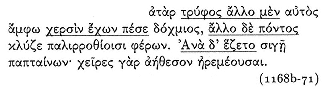
One piece he held
in both his hands as he fell sideways; the sea, carrying away
the other piece , swallowed it in its surf. He sat up , silently
looking around; for his hands were unused to inaction.
The wording recalls the demise of the lesser Ajax in Book 4 of the Odyssey . After Poseidon had saved Ajax from the storm that wrecked so many ships of the Greek fleet, the arrogant boaster insisted that he had saved himself. The enraged god then split the rock on which he sat in two, one piece remaining fixed and the other falling into the sea:[9]
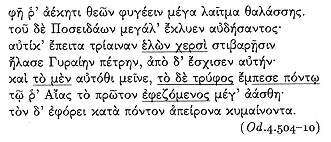
He [sc. Ajax] said that he had escaped the great depth of the sea
in spite of the gods.
Poseidon heard him utter this hybristic boast
and immediately upon taking his trident in his massive hands ,
he struck the Gyræan rock, splitting it in half.
One part remained there, but the other slipped into the sea ,
[9] The parallel was noted by Mooney and Ardizzoni ad 1.1168 and Campbell ad 1.1168–69.
the part on which Ajax was seated when he made his deluded
comment;
this carried him down within the swollen, boundless sea.
By inviting us to think of Ajax's hybristic defiance in Heracles' rowing of the Argo and in the breaking of his oar, Apollonius calls this remarkable feat into question. Comparison with the demise of Oilean Ajax encourages us to view Heracles' rowing as arrogant competition with the god of the sea.
Heracles broke his oar in the early evening (

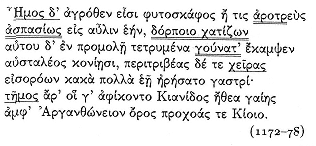
At the time when a gardener or

field toward his hut,

and there at the entrance bends his worn

caked with dust, and looking at his gnarled hands
utters many a curse against his stomach,
at that time the heroes reached the towns of the Cianian land
around Mount Arganthoneion and the mouth of the Cius River.
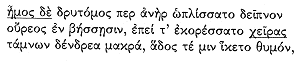
The simile is a contaminatio of two Homeric similes: Il. 11.86–89 and Od. 13.31–35.[10] In the Iliadic simile, the Greek army breaks through the Trojan line at the time when a weary lumberjack has his lunch:
[10] Cf. Mooney ad 1.1172–77, Vian 105 n. 4, and especially Campbell ad 1.1172ff.
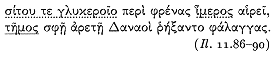
At the time when a lumberjack prepared his dinner
in the mountain glens, after wearing out his hands
cutting tall trees and feeling within that he had had enough,
and

at this time the Danaans courageously broke through the enemy
lines.
In the Odyssean simile, the poet likens Odysseus, who longed for his last day on Phæacia to end, to a tired plowman who desires to go home for dinner:
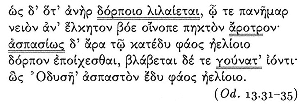
As when a man

a pair of dusky steers pulled his sturdy

land,
and the light of the sun set

so that he can go to prepare his dinner, his

walked,
just so welcome was sunset for Odysseus.
In both Homeric similes, the occupation of the laborer and his sense of hunger, although poignant details, are of secondary importance to the issue of time. Apollonius, however, has heightened the importance of these details by making them equally relevant to the narrative, as will be seen below.[11]
Some have seen the gardener and plowman of the Apollonian simile as representing all the Argonauts, who likewise are weary and hungry from their rowing.[12] On the contrary, the one
[11] Cf. A. W. James, "Some Examples of Imitation in the Similes of Later Greek Epic," Antichthon 3 (1969) 77–90, who argues that in general Apollonius improves on Homer's similes by producing more precise parallels between simile and narrative.
[12] E.g., Blumberg 27 n. 31, Fränkel ad 1.1172–76b.
Argonaut whom the poet highlights in the contest is also the main focus of the simile. In his description of Heracles' rowing, Apollonius says that the hero creates furrows in the water (


While the Argonauts prepare to eat their dinner, Heracles orders them to begin while he goes off to secure another oar. Fränkel has seen in his willingness to put off eating an indication of Heracles' Stoic commitment to duty.[15] Yet Heracles' frenzied response to the loss of Hylas belies such a philosophical stance. Although Apollonius does not make Heracles' feelings about his dinner explicit, the previous simile suggests that Heracles, like the agricultural laborers with whom he is compared, is not altogether pleased with having to work before his meal. In this case, the work will consist of finding and uprooting a small tree out of which to fashion his new oar. One can now better appreciate how thoroughly and successfully Apollonius "contaminated" the two Homeric similes. In the Iliad the hungry worker was a
[13] Pace Collins 88–89, who believes that Heracles was staring at the other Argonauts to prevent their laughing at him.
[15] H. Fränkel, "Das Argonautenepos des Apollonios," MH 14 (1957) 6–7 n. 5; cf. his suggestion in his commentary ad 1.1207–10 that Heracles was a water, as opposed to a wine, drinker because of his Stoic temperance.
lumberjack,[16] and in the Odyssey he was a plowman; in the Argonautica , Heracles digs furrows in the sea and then afterwards uproots a tree on land.
In describing the tree that Heracles plans to use for his oar, Apollonius imitates a line from an episode of the Odyssey in which another club-wielding figure of legend played a central role, the Cyclops Polyphemus. The Argonautic description runs as follows:
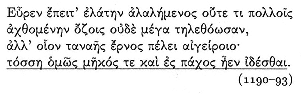
Then in his wanderings he [sc. Heracles] found a pine tree, neither
laden
with too many branches nor excessively leafy,
but that was like the stock of a slender poplar;
it appeared equal in length and thickness to the eye .
When Odysseus and his men were inside Polyphemus's cave, they discovered his club, which Odysseus describes to his Phæacian audience in these words:[17]
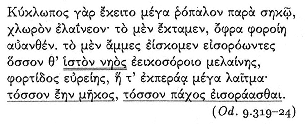
For along the pen lay the Cyclops's great club,
made from the green branch of an olive tree that he had cut to
carry
after it dried out. Upon seeing it we said it looked like
[16] One might recall that in their battle with the Gegeneis, which featured Heracles and his style of heroics, Apollonius compared the felling of the giants to the work of lumberjacks.
[17] Mooney, Ardizzoni, and Campbell ad loc. all note the imitation.
the


a wide freighter, which sails the deep sea;
it was equal in length and thickness to look at .
In addition to imitating Od. 9.324, a few lines later Apollonius also borrows the Odyssean ship simile; but instead of having it qualify the size of the tree (Homer has his simile qualify the size of Polyphemus's club). he applies it to Heracles' uprooting of the tree (



Reference to the Polyphemus episode continues in the third section of this first ring (a ). When we first meet Hylas, he, like Heracles, also goes off to fetch something, in his case water for his master's dinner:
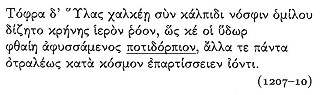
In the meantime Hylas, taking a pitcher of bronze, set off apart
from
the group in search of the holy stream of a fountain, so that he
might
draw water for dinner and have all the other things
ready and in order before Heracles returned.
Before Apollonius, there are only three extant occurrences of the word

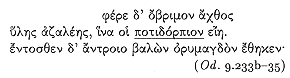
He [ sc. Polyphemus] carried a huge bundle
of dried wood so that it might be available to him for his dinner .
He brought it within his cave and threw it down with a crash.
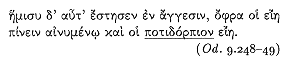
And [the other] half he poured into vessels, so that it might be
at hand
to drink when he wanted and be available to him for his dinner .

He was as hungry as a lion and took in his hand the leg of a lamb,
so that it might be available to him for his dinner when he returned
home.
Imitation of the Homeric

[18] Again, Mooney, Ardizzoni, and Campbell ad loc. cite the Homeric parallels; I found the reference to Matron in TLG .
To sum up what we have seen thus far: in the rowing contest Apollonius implicitly compared Heracles to Ægæon and Ajax, both of whom dared to rival Poseidon, and explicitly to a hungry farmer. In the securing of a new oar and in the preparation for Heracles' dinner, allusion to the cannibalistic Polyphemus, whose cave is filled with all sorts of foods, brings to mind a well-known Homeric figure who is characterized by his excessive hunger and irreverence toward the gods (cf. Od. 9.273–78). All three suffered as a result of their folly: both Ægæon and Ajax were killed at sea for daring to rival Poseidon, and Polyphemus, the son of Poseidon, was blinded by his own club because of his cruelty and appetite. These three figures provide the backdrop against which the story of how Heracles acquired Hylas should be read. They offer eloquent comment on why Heracles loses him.
Apollonius explains the speed and care of Hylas's preparations for Heracles' dinner in a brief digression. Heracles had trained the youth well in his duties ever since the time he had taken him from his father, Theiodamas, whom the hero killed over a draft ox.[19] The narrator informs us, however, that this was merely a pretext for initiating a war against the unjust Dryopians (1207–20). Apollonius's sketchy telling of the tale conflicts in several points with that of Callimachus, who many agree was Apollonius's model.[20] In the Ætia fr. (fr. 22–25 Pf.), Callimachus combined two stories involving Heracles

[19] J. Cowell, "Hylas and Heracles," Pegasus 12 (1969) 44–48, argues that elements of Hylas's experience associate him with the ephebeia. Hunter (2) 448–52 makes a similar argument regarding Jason.
[20] E.g., A. Ardizzoni, "Eracle e Teodamante in Callimaco e in Apollonio Rodio," RFIC 13 (1935) 452–67; C. Corbato, Riprese callimachee in Apollonio Rodio (Trieste 1955) 7–12; and more recently, A. Barigazzi, "Eracle e Tiodamante [sic ] in Callimaco e Apollonio Rodio," Prometheus 2 (1976) 227–38.
[21] This is also the version of Conon Dieg. 11 (FGrHist 26 F 1.11), Philostratus Im. 2.24, Lactantius Div. Inst. 1.21, among others; in Apollodorus 2.5.11, the ox pulls a cart, not a plow.
stories, the victim of Heracles'





[22] Vian 46–48; in particular, Vian compares Ætia fr. 22 Pf. with Argo. 1214; cf. Feeney (supra n. 2) 56.
[24] A comparable identification of victor and vanquished was observed in the previous chapter; cf. Chapter 7, pp. 173–74.
Heracles, this will be the painful loss of the son of the man he piteously killed.
In describing the rape of Heracles' young page, Apollonius focuses on the numinous setting and, within it, the reaction of the water nymph to Hylas's beauty. In doing so, he imitates certain features of the episode in the Odyssey in which Nausicaa fell in love with Odysseus.
When Hylas approaches the fountain into which he will eventually be drawn, the nymphs of the area are dancing in honor of Artemis:
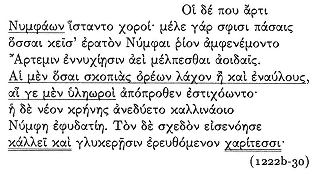
Just then choruses
of nymphs were beginning to form; for it was the duty of all
the nymphs who lived thereabout on the lovely mountain
to celebrate Artemis forever with nightly songs.
Those whose allotted homes were the peaks of mountains or
the streams
and those living in the forest were arranging themselves in lines
far away.
But the nymph of the fair-flowing fountain just then rose up
to the surface of the water and saw Hylas nearby,
a flush of

Apollonius has in mind the moment when Odysseus, after his exhausting swim to Phæacia, is roused from sleep by the voices of Nausicaa, who has just been compared to Artemis (Od. 6.102–9; cf. 149–52), and her servants:[25]
[25] Mooney ad 1.1226 and Vian 108 n. 3 observed the imitation.
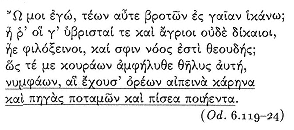
Alas! Who are the people to whose land I have come?
Are they arrogant, savage, unjust?
Or do they welcome strangers and fear the gods?
The sound of girl's voices has reached me,
like those of nymphs who inhabit the lofty peaks of mountains,
and the river springs , and the grassy dells .
Apollonius has adapted the Odyssean division of nymphs into groups of three. He then describes the effect that Hylas has on the nymph in a way that recalls the effect that Odysseus had on Nausicaa after his bath:[26]
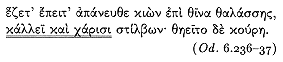
Then, going apart, he sat down upon the seashore
glistening with

in amazement.
In his reference to this famous episode, the poet would seem to urge the reader to compare Hylas and the nymph to Odysseus and Nausicaa, and upon comparison we observe a significant inversion of the Homeric model: the young and effeminate[27] Hylas is cast in
Odysseus's role, and the aggressive nymph is placed in that of the demure Nausicaa.
Hylas is a passive young man who, when fetching water, causes a young nymph to fall desperately in love with him; he is also the antithesis both of the Homeric hero, with whom he is subtly compared, and his master, who has just rowed the Argo by himself and uprooted a tall tree. In the second half of this episode (A ), Apollonius will turn his attention to Jason, another young man who, like Hylas, causes young women to fall desperately in love with him as he searches for the golden fleece. Like Hylas, Jason too stands in strong contrast with Heracles by virtue of his passive mode of action. But as will be seen in the second half of the episode, Jason's passivity and skills of leadership prove effective and, what is more, essential for an expedition without Heracles. One other point of comparison between Jason and Hylas emerges: like Hylas, the passive Jason will have a captivating effect on Medea, the key to the success of the expedition;[28] and like the nymph, Medea will not let go.
b—
Reaction to the Loss of Hylas (1240–72)
As I pointed out in the previous chapter, Apollonius has a remarkable talent for forging elements from diverse and even contradictory traditions into a unified and convincing story line. Here too in his account of the loss of Hylas, the poet has successfully blended several divergent accounts,[29] aided, perhaps even influenced, by his predilection for the ring format. According to Autocharis (FGrHist 249 F 1), who provides us with the earliest extant tradition of the events in Mysia, Polyphemus the Argonaut founded the city of Cius,[30] and Hylas was a local divinity. Later
[28] Apollonius will refer to the Odyssean episode just alluded to in the third book when Medea goes to meet Jason for the first time, imitating both the tripartite division of nymphs and the simile comparing Nausicaa to Artemis (Argo. 3.876–84). Before leaving this section of the episode, I would also add that just as Heracles reveals the enormous capacity of his physical strength by single-handedly plowing the sea (i.e., rowing the Argo by himself), Jason's great heroic feat in the poem similarly entails the single-handed plowing of the field of Ares with brazen, fire-breathing bulls (3.1326ff.); the ability to succeed in the latter task, however, comes not from Jason's own physical power, but from the drugs given him by the young woman whom he seduced.
[29] For more details, see Delage 115, Händel 27–33, Vian 43–48.
[30] A fact that Apollonius will mention; cf. 1321–33, 1345–47.
versions (e.g., Euphorion fr. 76 Powell, Socrates
In addition to incorporating a reference to the tradition in which Polyphemus was Hylas's lover, the ring format also invites a comparison between the reactions of the two heroes to the loss of Hylas; and just as he contrasted the different roles that Heracles and Jason played in the battles on Oros Arkton, here too Apollonius highlights the different reactions to Hylas's disappearance through animal similes. In this way, the poet uses Hylas's other lover as a foil for Heracles, who is clearly the main focal point of the first half of the episode.[32] While Polyphemus awaits Heracles' return,[33] he hears Hylas's shout and runs to the fountain like a wild and hungry animal (

[31] Cf. The Oxyrhynchus Papyri 54 (1987) no. 3727 for the fragment of a second-century-B.C. poem that also makes Heracles the lover of Hylas; and G. L. Huxley, "Thracian Hylas," JHS 109 (1989) 185–86, for a brief discussion of this fragment. The relationship between Heracles and Hylas is not the equivalent of a father–son relationship (as D. N. Levin, "Apollonius' Heracles," CJ 67 [1971] 24–25, and M. Pulbrook, "The Hylas Myth in Apollonius of Rhodes and Theocritus," Maynooth Review 8 [1983] 25–31, cited by F. McGready, "Heracles' Love for Hylas," CL 3 [1983] 79–80). Heracles' reaction to Hylas's loss betrays clear signs that the hero was in love with the boy; see H. White, Studies in Theocritus and Other Hellenistic Poets (Amsterdam 1979) 63–73.
[32] Cf. Levin (supra n. 31) 25, Palombi (supra n. 3) 84.
[33] This is an especially nice touch; Polyphemus, as Blumberg 25 reminds us, is Heracles' brother-in-law, and so his concern is dramatically plausible.
hunger motif seen above; because of his "hunger" to find Hylas he, like Heracles, will be left behind.[34] The manner in which he responds to the emergency, however, differs significantly from Heracles'. In his frantic search for the boy, Polyphemus at least has a plan of action and gives some thought to what might have happened to Hylas. His constant shouts are meant to get a response from the boy; he believes that Hylas may be the prey of an animal or of some pirates, and for this reason draws his sword (ba , 1240–52). He is not, then, completely undone by the situation.
Heracles' response to the news is quite different. At the center of this ring, Polyphemus meets Heracles, informs him about Hylas, and offers his erroneous opinion about what has happened. In the following section, which corresponds to that giving the reaction of Polyphemus (ba , 1261–72),[35] Heracles does not act so logically. He begins to sweat and experience nausea, and then bolts off with no particular place in mind. Apollonius compares him to a bull stung by a gadfly who now runs and now stops to howl out of pain.[36] Like the bull, Heracles runs helter-skelter and every now and then stops to shout—not because he is calling out to locate Hylas, but because of the pain that the boy's loss has caused. Moreover, he describes the bull as



[34] Cf. Fränkel ad 1.1245. The association of Polyphemus with Heracles' fate calls to mind the other Polyphemus, the Cyclops, whose hunger prompted his suffering, to which Odyssean episode Apollonius alluded in this section of the episode.
[35] N.B. there is also a close numerical corresponsion between the parts of this subsection: 13 lines–8 lines–12 lines.
[36] James (supra n. 11) 84 discusses the relationship of this simile to its Homeric model, Od. 22.299ff.
two and points to the ironic justice of Heracles' predicament. In short, Apollonius has Heracles reenact the occupation and suffering of the man he victimized. Comparison with Polyphemus the Argonaut underscores Heracles' complete inability to deal with the situation. Like Jason in the ensuing conflict arising over his abandonment, Heracles can well be described as
