
Kepler's Law of Equal Areas and the Polygonal Approximation
Kepler published his equal area law in 1609, but as a student in the 1660s Newton appears not to have had direct contact with Kepler's works or with other primary astronomical sources, such as those of Ptolemy or Copernicus. Newton derived his early knowledge of astronomical theory from secondary sources in the form of textbooks, many of them inferior works. He employed a variety of equant mechanisms in his early work to predict the speed of the planets in their elliptical paths. It is not clear when Newton first became aware of Kepler's law of equal areas, even as an approximation. One scholar argues that it is possible but unlikely that he knew of the area law as a student.[33] Another, however, argues that there are reasonable grounds for believing that the area law was both known and appreci-
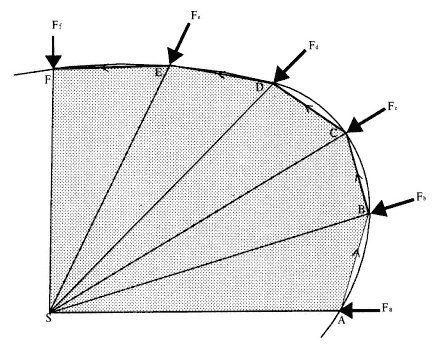
Figure 2.2
If a body moves under the action of a series of impulsive centripetal forces, then it
sweeps out equal areas in equal times. The area under the shaded polygon will reduce to
the area under the continuous curve as the time between impulsive forces is diminished.
ated by most of the serious astronomers of the period (1650 to 1670).[34] In any event, Newton did not establish the area law as an exact mathematical theorem for a central solar/planetary force until after 1679.
Figure 2.2 is based upon the drawing that appears in the 1684 treatise On Motion . Newton used the polygon ABCDEFS to approximate the continuous motion of the planet in its path. In this polygonal approximation, the disjointed polygonal path "collides" with the smooth planetary path at a discrete number of points. The motion between any two points on the path, such as A to B , proceeds in the absence of any force function. A series of impulsive forces F b , Fc , Fd , . . . , act on the planet only at the discrete points A, B, C, D , . . . , where the two paths collide. In general, the forces differ in magnitude, but they are always directed toward the same fixed point S . Newton demonstrated that, for a given time between collisions, all the triangular areas SAB, SBC, SCD , . . . , are equal. Thus, equal areas are described in equal times. The law can be demonstrated to be independent of the functional dependence of the impulsive force on distance. The only restriction is that the force always be directed toward the fixed center of
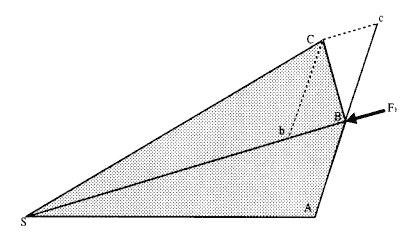
Figure 2.3
The resultant displacement BC is the diagonal of the parallelogram BcCb formed
by the virtual displacement Bc and the deviation cC .
force S . The discontinuous motion along the sides of the polygon was ultimately reduced to the continuous motion along the smooth orbital path by letting the size of the triangles, such as SAB , become infinitely small. This limiting process constitutes a hallmark of Newton's dynamics.
As a preliminary review of the tract On Motion —which Newton sent to Halley in 1684—consider the following excerpt in which Newton describes the law of equal areas. The details of the proof have been omitted (they are given in chapter 4); for the moment simply follow the flow of the argument.
All orbiting bodies describe, by radii having been constructed to their center, areas proportional to the times.
Let the time be divided into equal parts, and in the first part of the time let a body by its innate force describe the straight line AB. The same body would then, if nothing impeded it, proceed directly to c in the second part of the time . . .
See figure 2.3 where Bc is the displacement that would have taken place in the given time if the impulsive force F had not acted on the body at point B .
Now when the body comes to B, let the centripetal force act with one great impulse, and let it make the body deflect from straight line Bc and proceed along straight line BC.
Again, see figure 2.3 where BC is the displacement that did take place in the given time when the impulsive force F did act on the body at point B . The displacement cC is the deviation produced by the change in motion of the body generated by the impulsive force acting at point B . The resulting displacement BC can be seen as the diagonal of the parallelogram
formed, with sides given by the virtual displacement Bc and the impulsive displacement cC .
Join S and C and because of . . . the triangle SCB will be equal to . . . the triangle SAB.
By a similar argument, if the centripetal force acts successively at C, D, E, etc., making the body in separate moments of time describe the separate straight lines CD, DE, EF, etc., the triangle SCD will be equal to the triangle SCB . . .
Thus, given the demonstration, all the triangular areas in figure 2.2 above are equal (i.e., area SAB = SBC = SCD = SDE = SEF , etc.).
In equal times, therefore, equal areas are described. Now let these triangles be infinite in number and infinitely small, so that each individual triangle corresponds to the individual moments of time, the centripetal force acting without diminishing, and the proposition will be established.
This result, with the full supporting demonstrations, appears as Theorem 1 in the tract On Motion and as Proposition 1 in the Principia . Note that Newton did not use the polygonal approximation to obtain the specific dependence of the force upon distance, such as the inverse square law of gravitation. As will be demonstrated in the discussion of impulsive collisions in chapter 3, the specific form of the force is intertwined with both the time during collisions and the time between collisions. Given that the force acts always toward a fixed point, however, it is possible to use the polygonal approximation to predict interesting properties of the force, such as the law that equal areas are swept out in equal times. In his early analysis of uniform circular motion, Newton used the polygonal approximation and the central nature of the force to demonstrate other properties of such motion. Yet, when Newton attempted to find the specific nature of the force (i.e., to solve direct problems) he did not begin with a discrete polygonal path, but rather he developed another approach, one that began with a smooth continuous path. Just as the polygonal approximation is based upon Descartes's dynamics of collisions, so this alternate parabolic approximation is based upon Galileo's linear dynamics.