
THE WEB OF BUSINESS AFFILIATIONS
The term "network" has taken on dual meaning in the area of organizational theory. On the one hand, it refers to a rigorous, formalized methodology, as reflected in journals like Social Networks and sophisticated techniques of structural analysis (e.g., White et al., 1976; Burt, 1983). On the other hand, it has been used to refer to informal social systems which are not easily captured by formal theories of bureaucracy or markets (e.g., Eccles and Crane, 1988; Lincoln, 1989; Powell, 1990). Both the more formal and the metaphorical usages of the network perspective have received increasing attention in the analysis of the industrial organization of East Asian economies. Comparative approaches
have looked at how network structures differ across countries and have combined elements of rigorous network data collection with informal theories of "network organization" (Hamilton and Biggart, 1988). Normative approaches (Imai, forthcoming) have provided economic rationales for particular arrangements and have relied primarily on an informal approach to network analysis. The approach taken here combines elements of both the formal and the informal meaning of network.
In the network approach, emphasis is placed on the direct study of how economic and other transactions allocate resources in a social system (Wellman and Berkowitz, 1987). The particular composition of ties among financial, commercial, and industrial firms is seen as determining significant features of an economy's overall organization and its resulting performance. Institutions such as markets, industries, and business groups become defined as characteristic patterns of concrete exchanges among diverse actors within a broader matrix of intercorporate relationships in which they are embedded. Among various archetypal patterns, we consider the following three: industry, the business community, and the intercorporate alliance. Each represents a distinctive social focus (Feld, 1981), with industry set in the context of relationships based in competition within similar market niches, the business community in the loosely coupled structure of interpersonal networks; and alliances in historical ties of obligation among companies.
The importance of industry has been a primary focus of economists and is of increasing interest to sociologists and organizational theorists as well. In network theory terms, industry represents a nexus of critical resource dependencies among an identifiable set of "structurally equivalent" firms-companies that share common patterns of exchange in economic markets (Burt and Carlson, 1989). Pursuit of competitive advantage is an important driving rationale. Corporate ownership, for example, becomes a means of gaining control over critical uncertainties in organizational environments-a tool by which organizations seek to "restructure their environmental interdependence in order to stabilize critical exchanges" (Pfeffer and Salancik, 1978, p. 115). Similarly, mergers and joint ventures arise in order to manage concrete but problematic relationships with other firms (Williamson, 1985). Empirically, the structure of industries has been correlated with various features of firm conduct and performance in the industrial organization literature, including advertising and R & D expenditures, and profits, growth, and diversification rates (e.g., Scherer, 1980).
The business community as an organizing framework can be viewed
in several ways. In a social-hierarchy formulation, economies are seen to stratify around firms' statuses. Averitt (1968) argues that this results in a "dual economy" made up of large, technologically sophisticated, multimarket, elite firms at the center and small, less-developed firms at the periphery-a formulation that has long been popular for explaining Japanese industrial organization. Whether developed economies, including that of Japan, can in fact be divided this neatly has been increasingly questioned.[3] Nevertheless, it is clear that the markets for capital and labor, at the least, are affected by a firm's position in a larger social structure. The work on diffuse networks of intercorporate relationships suggests ways in which relationships among firms may be organized to serve interests at the level of a broader business class (Palmer, 1983; Ornstein, 1984). Useem (1984), for example, argues that directorships shared across firms serve not so much the immediate interests of each organization-to monitor and mobilize bilateral pairs of firms-as a resource dependency position would indicate, but rather the interests of an inner circle of business elites.[4]
These archetypes suggest two different, though not incompatible, sets of business relationships. The industry framework focuses primarily on firms' immediate task environments and the ways in which critical resource- and technology-driven dependencies have led to adaptations at the interfirm level to manage them. The business community framework, in contrast, is concerned with the position of corporations in an extended social structure, its stratification, and the ways in which this affects interfirm activity.
A third organizing framework is what I have termed the "intercorporate alliance": relationships based on localized networks of long-term, mutual obligation.[5] In contrast to the broader class-wide interests of an extended business community, alliances are defined by interests among specific subsets of closely connected firms. The most powerful "inner circle" for each firm is made up of the other group companies with which it is affiliated. At the same time, alliances differ from organization by industry in that historical association is as important as immediate task requirements in determining the particular patterns they take. Firms in Japan are linked together over time in relationships that, as we see in the following chapter, involve strong patterns of preferential trading among firms in the same group. These patterns, moreover, occur even where functional transactions (e.g., bank loans or steel trade) could easily take place across groupings.
Industries, Status Hierarchies, and Alliances: Cross-Cutting Spheres of Japanese Business
The names of Mitsubishi, Mitsui, and Sumitomo are well known as the remnants of the prewar zaibatsu groupings operating under family-controlled holding companies. But these represent only a fraction of the vast complex of elaborate alliances that make up the Japanese economy and bring firms into complex and often overlapping networks of vertical, horizontal, and diversified relationships. There exists in Japan no single, universally accepted system for classifying these relationships. Nevertheless, we can differentiate four broad categories of alliance that are typical in Japan, which are referred to here as (1) the intermarket keiretsu, (2) the vertical keiretsu, (3) small-business groups, and (4) strategic alliances, including joint ventures and project consortia.
Figure 3.1 depicts these relationships schematically, showing their representation in different market sectors and their location in the business community. The horizontal axis reflects the diversity of market sectors in which the group is involved, with a wide span indicating broad industrial representation. The vertical axis indicates firms' positions within the structure of firm stratification. The "traditional" sector at the bottom reflects the central role of local social networks of family, friendship, and community ties, while the "modern" sector at the top reflects embeddedness in a national network of business elites (the zaikai )-the Japanese social economy is acutely sensitive to company size, and security, status, wealth, and power accrue to the largest.
The Intermarket Keiretsu Groupings of large firms based around a major commercial ("city") bank are referred to variously as keiretsu, kigyo shudan or kigyo gurupu (enterprise group). As noted earlier, I have adopted the keiretsu terminology and have added the qualifiers "intermarket" and "vertical" to characterize two quite different forms of group structure. This form of alliance, discussed in considerably greater detail below, represents loosely structured associations of large relatively equally sized firms in diverse industries, including banking, commerce, and manufacturing. The social communities of business that they represent are the elite in Japan-economically, politically, and socially.
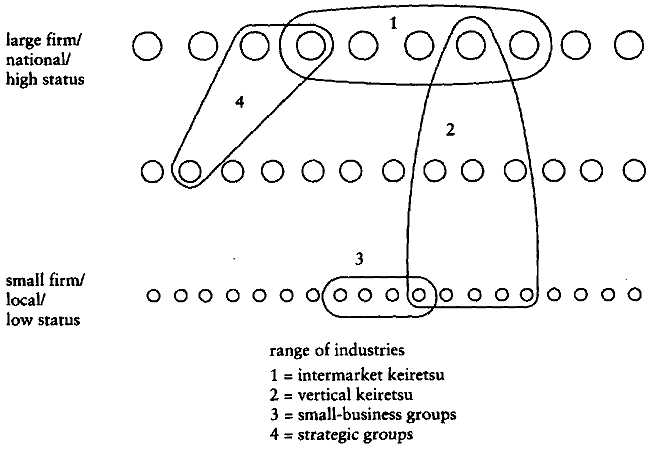
Fig. 3.1. Cross-Cutting Social Spheres: Industrial Diversity, Status Position, and Alliance Form.
The Vertical Keiretsu In contrast to the highly diversified character of the intermarket keiretsu, the vertical keiretsu are tight, hierarchical associations centered on a single, large parent firm and containing multiple smaller satellite companies within related industries. While focused in their business activities, they span the status breadth of the business community, with the parent firm part of Japan's large-firm economic core and its satellites, particularly at lower levels, small operations that are often family-run. Most firms in intermarket keiretsu maintain their own vertical keiretsu, leading to an intersection of these two forms, as seen here.
The vertical keiretsu can be divided into three main categories. The first are the sangyo keiretsu, or production keiretsu, which are elaborate hierarchies of primary, secondary, and tertiary-level subcontractors that supply, through a series of stages, parent firms. The second are the ryutsu keiretsu, or distribution keiretsu. These are linear systems of distributors that operate under the name of a large-scale manufacturer, or sometimes a wholesaler. They have much in common with the vertical marketing systems that some large U.S. manufacturers have introduced to orga-
nize their interfirm distribution channels (Stem and El-Ansary, 1977). A third-the shihon keiretsu, or capital keiretsu-are groupings based not on the flow of product materials and goods but on the flow of capital from a parent firm, and are sometimes referred to in Japanese academic writings by the German term Konzern. The leading contemporary examples are the railroad groups of Tokyu and Seibu, which have diversified from train lines into real estate, hotels, department stores and distribution, and travel and recreation businesses.
Small-Business Groups Firms of fewer than a thousand employees account for over half of all sales and assets in the Japanese economy but are often overlooked in favor of the more conspicuous large firms. One of the ways that small firms have tried competing with the more efficient large-firm sector is through collaboration. The result is a rich panoply of producers and purchaser cooperatives, traditional and high-technology industrial estates (the last are sometimes known as "technopolises"), and neighborhood associations. I have labeled these collectively as "small-business groups."
Small-business groups involve a considerably greater diversity in 'the type of interfirm organization represented than do the intermarket or vertical keiretsu. They are sometimes focused on a single industry but also frequently bring together firms across multiple industries, positioned horizontally and organized within a common geographical nexus. Small-business groups trade largely in social currency and are closely tied to the local communities of which they are a part.
Strategic Alliances Strategic alliances include a wide range of inter-firm organizations based on relatively focused instrumental needs. They are sometimes called "functional" groups (kino-teki shudan ) though "ad hoc" is probably closer; they include joint ventures, project consortia, and various other forms of cooperation (in Japanese, the popular word teikei ) that move firms outside their traditional keiretsu groupings into new alliances that bridge industries and utilize new technologies. Strategic groupings cut across all sectors of industry and society, often in diagonal relationships that span diverse market sectors and social positions. Strategic alliances have increased dramatically in frequency in Japan in the 1980s, as they have in the United States. Large firms in Japan, for example, are now establishing relationships with small, high technology firms in an attempt to expand beyond their traditional industries (see, for example, Imai, 1984).
Alliances and the Firm's Institutional Environment
From the Japanese firm's point of view, trade takes place within a set of ordered environments that can be dimensionalized along a continuum from "relational" to "transactional" exchange, as seen in Figure 3.2. Legal theorist Ian Macneil (1978) has characterized transactional exchange as the sine qua non of impersonal market exchange: "A transaction is an event sensibly viewable separately from events preceding and following it, indeed from other events accompanying it temporally- one engaging only small segments of the total personal beings of the participants " (p. 893). It is a one-time, arm's-length exchange among anonymous or otherwise unrelated traders, requiring neither structural nor symbolic connection between the parties. In relational exchange, in contrast, actors rely on various forms of implicit assumptions and agreements to organize their relationships: "The fiction of discreteness is fully displaced as the relation takes on the properties of 'a minisociety' with a vast array of norms beyond those centered on the exchange and its immediate processes" (p. 901).
Trade within the firm, at the center of Figure 3.2, is marked by a high degree of relational exchange: actors are embedded in a common arena governed by structurally interlinked resource flows and by a common set of rules and rituals that constitute the firm as a social system. The relationship among organizational members as a whole takes precedence over that of any single transaction. The first ring demarcates the firm's boundaries, and immediately outside of it lies the firm's first-order environment. At the interfirm level, probably the most critical relationship is that between the company and its suppliers. The dose ties that exist among Japanese firms and the subcontractors in their vertical keiretsu are an often-noted feature of the organization of industry in Japan (e.g., Clark, 1979). As suggested earlier, these subcontractors perform many of the functions typically carried out in-house by U.S. firms through their own divisions. Within the vertical keiretsu, exchange between the parent and satellite firms is embedded in a dense network of ongoing relationships, as various forms of information, technical and financial assistance, and managerial expertise are provided on a reciprocity basis.
The parent firm, and by extension its satellites, are in turn embedded in a broader set of relationships defined by the intermarket keiretsu. This second-order environment comprises more loosely coupled relationships among dozens of firms in diverse industries. Internal exchange is gener-
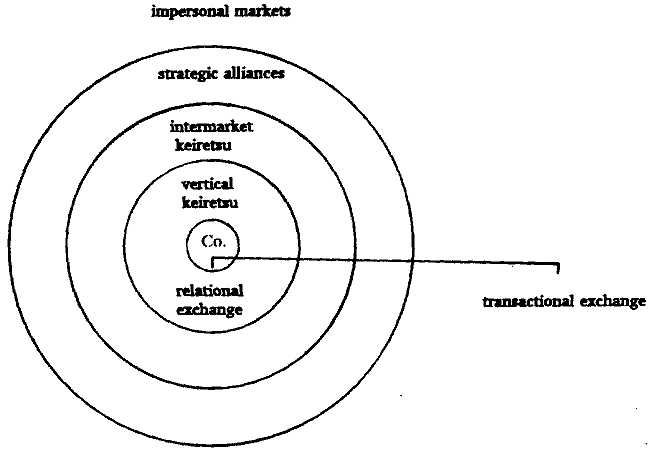
Fig. 3.2. Alliance Form and the Japanese Firm's Institutional Environment.
ally less pervasive than at the firm or vertical keiretsu level, but the identity of the group nevertheless imparts structural and symbolic significance to these exchanges. Strategic groupings represent a third-order environment. These involve exchanges more intimate and durable than those in impersonal markets, but generally without the history, symbolic coherence, or density of exchange networks found in the vertical or intermarket keiretsu. Finally, at the outer level one finds impersonal exchanges among actors that are relatively unconnected structurally or symbolically-for example, a firm's occasional purchases of office supplies from a large number of different retailers. These are "true" market transactions, without intensive ties or enduring obligations.