
Vasilii Nikitich Makarov
Born August 5 (New Style), 1887, in Lunëvo, a village not far from the provincial town of Vladimir, northeast of Moscow, Vasilii Nikitich Makarov came from peasant stock, although both his father and paternal grandfather were workers (see figure 1). After excelling in his rural school, he was recommended by his teacher for a zemstvo scholarship to complete his higher grades in town.[11] For two years after graduating, Makarov worked in agriculture, entering the Moscow Teachers' Institute in the fall of 1905. Soon he
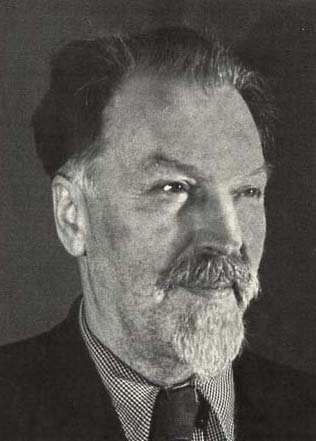
Figure 1.
Vasilii Nikitich Makarov (1887–1953) at age sixty.
was drawn into the vortex of protest during that revolutionary year. A member of revolutionary student circles (kruzhki ), Makarov joined a strike committee and distributed illegal literature among workers. With the restoration of order the following year, Makarov was arrested, but he was released after three months for lack of conclusive evidence and was allowed to resume his studies, graduating in 1908.[12]
Trained as a science teacher, Makarov was posted to a school in the Volga town of Kostroma, north of Moscow, but returned to Moscow in 1911 to attend night school at the Moscow Commercial Institute to upgrade his qualifications, teaching fourth grade during the day at a school attached to the Moscow Teachers' Institute. Apparently, the punishing schedule did not
diminish his effectiveness as a teacher; indeed, he seems to have had a talent for teaching In bidding him farewell, his students in both Kostroma and Moscow emphasized not only his kindness and empathy, but also his ability to inspire them to strive for a life "in science."[13]
In 1916, after meeting a physician who was a member of the Socialist Revolutionary Party, Makarov joined the SRs as well. With the overthrow of the tsar, Makarov was elected the uezd (county) commissar of Makar'ev uezd and chair of the democratic rural assembly. But his growing misgivings about the irresolute policies of the SR party led him to decline the nomination by the local Provincial Peasant Congress to stand as a deputy for the Constituent Assembly in the fall of 1917. He officially resigned from the party on January 1 1918.
In September 1918 he was tapped to serve as the principal for a middle-grade school for workers in Moscow province and later for a number of schools in the capital itself. Rising through the educational bureaucracy, Makarov was named head of the Moscow's Bauman School District but apparently continued to teach science. This relatively placid existence ended in June 1930, when he was appointed academic specialist in the Science Sector of the RSFSR People's Commissariat of Education, almost immediately thereafter rising to deputy head and then head of the sector (which he remained until February 16, 1937). Simultaneously, he was appointed the director of the Zoological Museum of Moscow State University, to replace Grigorii Aleksandrovich Kozhevnikov, who had been forced to resign as a "bourgeois" professor. By the beginning of 1931 Makarov was also president of the All-Russian Society for the Protection of Nature, and with the reorganization of the zapovedniki in September 1933 became the deputy director of the Main Administration. Makarov could have achieved none of this had he not been accepted into the Communist Party in April 1928.[14]
When Makarov assumed leadership of the nature protection movement, hostile critics were already identifying the "counterrevolutionary" implications of the movement's ecologically based objections to elements of the First Five-Year Plan. To deflect these accusations, Makarov instituted a policy of "protective coloration," muting criticism of regime resource policies, pledging verbal loyalty to "socialist construction," and renouncing a commitment to the absolute inviolability of the zapovedniki . At the same time, however, the strategy sought to preserve the All-Russian Society for the Protection of Nature as a place where alternative visions of development could be freely discussed and to preserve the zapovedniki as factually inviolable, although no longer officially so.[15]
Both the movement and the regime at times revealed an awareness of discord between Soviet environmentalism and Stalinist policies and values. Recent finds in Russian archives throw dramatic new light on just how courageously "out of step" leading conservationists were with the Five-Year Plan
for "socialist construction." Of course, not every ecologist always evinced courageous behavior, nor did every occasion elicit it. With the exception of ichthyologist Mikhail Nikolaevich Knipovich, the nerve of almost all prominent ecologists and zoologists withered under the ferocious attacks of Isaak Izrailovich Prezent at the All-Union Faunistics Conference in February 1932.[16] Yet, surprisingly frequently ecologists sketched out an alternative vision of land use, the use of scientists, and even civic speech. Perhaps unmatched in its time as a call for norms of decency in political discussions was a letter sent in 1931 by Makarov, now the de facto leader of the Russian conservation movement, to the Scientific Sector of People's Commissariat of Education (where he was deputy head) and to its Communist Party cell.
Only recently having become president of VOOP, Makarov in early 1931 inherited a precarious situation. VOOP had undergone a high-level audit the previous year that revealed numerous deficiencies in the work of the Society from the perspective of the regime, including "undisguised apoliticism" and ecological "alarmism."[17] Press articles ridiculed scientific societies, including VOOP, as an "All-Union zapovednik for the endangered species of bourgeois scientists," coming dangerously close to the truth.[18] Makarov's letter combined a surprisingly forthright objection to an excessively rough, denunciatory style of polemics with protestations of loyalty to the regime's strategies of development, "socialist construction." Because the nature protectionists' visions of development clashed with those of the regime, their averring loyalty was either conscious dissembling or self-delusion in pursuit of "protective coloration."
Makarov's letter was one of his first serious attempts to counter the ominous assaults directed at the movement he now headed. While he conceded that "Marxist-Leninist criticism" prodded "many stagnant areas of science to come alive" and succeeded in getting academics to descend from their ivory towers and to begin to meet society's "legitimate expectations" of them (sotsial'nyi zakaz ), Makarov observed that "that was not so in all cases." Sometimes, he contended, "comrades offering critical comments have acted too hastily and made superficial judgments, not possessing the requisite erudition for a proper consideration of the problems addressed." At times, "Bolshevik" critics behaved even more irresponsibly, driven by "the preconceived aim—whatever it takes —to identify an enemy, reveal a [political] deviation, and to unmask sabotage and counterrevolution in science; they have 'twisted and distorted' critical material, turning healthy Bolshevik criticism into the dubious weapon of polemics and even denunciation. This unfortunate criticism, purveyed in the mass media and distracting the masses from the substance of the issue, has been harmful."[19]
Amazingly, the concrete example Makarov chose to exemplify, his charges was the recent article "Sabotage in Science" published by Arnosht Kol'man
in the Party's theoretical journal Bolshevik . Kol'man was one of the Party's key curators of science, even serving as watchdog over such illustrious figures as Nikolai Ivanovich Vavilov and Nikolai Ivanovich Bukharin during their 1931 visit to Great Britain. In strong language Makarov contested what he argued were Kol'man's false claims—that the conservation movement sought to "undermine our socialist construction and engineer a restoration of capitalism."[20] "Pointing out to Comrade Kol'man the error of his views in the given case elicited no effect." He evidently continued to remain convinced that the protection of woodlands in "sparsely wooded areas and on nonarable lands is a land mine under socialist agriculture." Similarly, Makarov accused Kol'man of failing to understand the value of the protection of unplowed steppe as a reservoir for genetic material, especially in developing drought-resistant varieties of agricultural plants, as demonstrated by Vavilov.
Additionally, the conservation leader cited an equally vicious article by two other authors also directed against his movement, and concluded:
These [articles] also force us to consider the following questions: Is THIS KIND OF defense of the great cause of socialist construction of the Five-Year Plan from putative sabotage useful? Is it permissible to purvey gross distortions, as Comrade Kol'man and others have done, in full public voice? Doesn't this gladden the genuine enemies of socialist construction both here and abroad, enemies who will snatch at any opportunity to demonstrate, on the basis of isolated examples, how science is profaned in the USSR and how thoughtlessly and wantonly scientific ideas and the people selflessly serving science are trashed? . . . The Council of the [All-Russian] Society [for the Protection of Nature] insists that the Scientific Sector and the Party cell . . . rap the knuckles and head of those adepts of "leftist" witchhunting and "distortion" of the authentic character of the activity of our Society and the content of its journal. Criticism, merciless Bolshevik criticism of the entire press is an essential fact of life, but, in the opinion of the Council of the Society, the "obfuscating" tactics of [our] critics has nothing in common with that.[21]
The conservation movement's defense not only of "free" nature but of "free" science and, to an extent, of prerevolutionary norms of public communication, was fraught with risk.[22] As mentioned in my previous work and now confirmed by a host of newly available archival documents, repression did indeed strike Russian environmentalists hard during the early to mid-1930s.[23] Some few lucky ones like movement founder Grigorii Aleksandrovich Kozhevnikov were merely fired from their positions or, like A. V. Fediushin, were able to flee to distant regions. Others, like geographer V P. Semënov-tian-shanskii, were placed on blacklists but somehow were never picked up. Many others, though, were less fortunate, and the roster of those arrested during that period abounds with important names.[24] Although not all environmentalist victims of Stalinist repression suffered because they were
environmentalists, and a majority of committed activists emerged relatively unscathed from the terror, a climate of intimidation enveloped the conservation cause during the dark decades of the 1930s and 1940s.