
The Mask As Metaphor
Cocijo
Though the particular mask that the Olmecs used to designate that point of contact with the world of the spirit disappeared with the death of Olmec culture, it lived on in altered form within the religious art of each of the major cultures of the Classic period as an integral part of a system delineated through a variety of similarly constructed masks through which each of those cultures mediated between the worlds of nature and the spirit. As Covarrubias's chart (pl. 2) demonstrates, those cultures used the features of the Olmec mask, modified in their own ways, to symbolize the provision of the life-sustaining rain and divinely ordained rulership from the world of the spirit. Those modifications that distinguish each of the major Classic period rain gods—Cocijo, Tlaloc, and Chac—resulted from the particular means by which the Olmec culture was transmitted to its Classic period heirs.
That this transmission did, in fact, take place is now generally accepted by Mesoamerican scholars; as Covarrubias suggested in 1957, the Olmec was the "mother culture" that gave birth to the great Classic period cultures of Mesoamerica.[89] Or to put it more precisely, Olmec influence operating on the village cultures of various areas of Mesoamerica "played the role of a catalyst. It led to decisive steps forward, or quickened the pace of progress ... [by implanting] religious ideas and rough ideas of social structures that germinated, flowered, and bore fruit in the classic era."[90] But this general agreement among scholars does not extend to a unanimity of opinion as to the means of cultural transmission. Covarrubias seems to have imagined an Olmec empire, "a form of incipient theocracy by which they dominated a large population of peasant serfs, the peoples of the Preclassic cultures, a system that later prevailed all over Middle America and replaced the simple communalistic system of small autonomous peasant villages."[91] Others, no doubt thinking of the clearly religious art that betrays the Olmec presence, believed that Olmec warriors "paved the way for missionaries who spread the cult of the Olmec jaguar god."[92]
But the intensive research effort in the last twenty years directed toward understanding the development of the Preclassic cultures of the highlands of Mexico suggests that trade rather than
colonizing or proselytizing was the primary motivating force,[93] especially that trade through which the Olmecs acquired the goods necessary for religious art and ritual—such things as "obsidian, jade, turquoise, iron pigments, iron ores, mica, mollusk shell, turtle shell, fish and stingray spines, and shark teeth."[94] At site after site outside the Olmec heartland on the Gulf coast, there seems to have been a relatively small number of Olmecs living with a large group of local people, presumably to direct the acquisition of the needed goods. Grove concludes that even Chalcatzingo, the highlands site with the most extensive evidence of an Olmec presence, was not an Olmec city but merely served as a "gateway city" through which the Olmec funneled "the supply of status goods" acquired from the village cultures.[95] Archaeological data regarding numerous other Preclassic sites also suggests either an Olmec presence or significant Olmec contact related to precisely this sort of trade.[96]
The archaeological evidence also suggests that the extensive contact with or even the permanent presence in these early villages of representatives of a significantly more sophisticated culture had a predictable effect. Symbolic forms in art and ritual, the maintenance of which were the fundamental reason for the Olmec presence, flowed from the more sophisticated group to the less sophisticated one, a movement encouraged by the fact that both cultures were rooted in and grew from the same shamanic base whose fundamental assumptions we will describe at length below. Thus, the Olmec culture in the heartland became the model to be emulated by the village cultures. There is evidence of this sort of relationship on both sides. Philip Drucker argues convincingly that a number of Gulf coast monuments depict contact with outsiders, presumably leaders from one or another of these villages. "These foreign visitors," he goes on to say,
may well have been honored by being shown the splendors of La Venta—the ceremonials and the monuments—[and] . . . may have been impressed enough to want to emulate their hosts, and were lent (or given?) Olmec sculptors to do some carving for them; or they arranged for some of their personnel to be trained by Olmec sculptors.[97]
As for the other side of the relationship, Robert Drennan concludes that in the Valley of Oaxaca from 1150-850 B.C., Olmec symbolism was intimately involved with "ritual activity accompanying the emergence of larger-scale, ranked society." These Olmec symbols were derived from "a network of interregional contacts through which were transmitted several kinds of ritual objects and materials together with symbols of probable religious meaning."[98] Thus, Drennan would seem to be describing the effect on the receiving group of precisely the contact described by Drucker. Although Drennan's dates would make this particular example of that connection impossible since the scenes Drucker describes are to be found on monuments carved several hundred years later, the general principle nevertheless seems valid: Olmec symbolism derived from Olmec contact was used pervasively, not only in Oaxaca but in village cultures in a number of Mesoamerican areas, both to make clear and to support the status of rulers and religious functionaries in those village cultures. The masks of the gods of the village cultures came to have Olmec features.
But it is equally clear that this influence operated during a limited period and that it did not change completely the art style or belief structure of the local group. Thus, Olmec symbolism was superimposed on preexisting local cultures with indigenous beliefs, ritual, and artistic style. Concerning the central Mexican highlands, for example, Grove notes that Chalcatzingo "was not an Olmec colony. The vast majority of the site's artifacts show that in basic cultural details it was central Mexican and non-Olmec."[99] Similarly, according to Louise Paradis, "Olmec-related artifacts have now been found in an archaeological context in Guerrero . . .imbedded in a local cultural tradition that has nothing to do with the one commonly labeled Olmec."[100] And according to Coe in his study of the material from such sites as Tlatilco, Las Bocas, and Tlapacoya, "there are manifestly two distinct artistic traditions during the Middle Preclassic in the highlands—one Olmec and the other indigenous."[101] These Olmec artifacts constitute the evidence that remains of the use by the leaders of these cultures of Olmec symbols, beliefs, and, probably, connections to consolidate their status, and this was also true in the Valley of Oaxaca. Most objects carrying Olmec symbols discovered in Oaxaca were for ritual use and "functioned to connect those who were entitled to use them to the ultimate sacred propositions of Olmec religion"; in other words, these individuals were marked as the descendants of the gods, indicating that "a major reason for the diffusion of the Olmec art style throughout Mesoamerica was the increased need for mechanisms of sanctification in various regions owing to internal social evolution."'[102] The "mechanisms" used were Olmec because the Olmecs had developed them for precisely the same purpose from precisely the same set of underlying assumptions about man, the gods, and the relationship between them.
As the Olmec art style and the underlying belief system it expressed diffused throughout Mesoamerica in this way, a similar phenomenon occurred in each of the areas to which it spread. Rather than supplanting the indigenous style and belief system, the Olmec system first coexisted but ultimately fused with the local system. This fusion of religious ideas and symbols can be seen generally in the development of mask symbolism and
specifically in the evolution of the mask of the rain god which we can trace from the Olmecs, through the village cultures, and into the Classic cultures that grew from those village cultures as a result of the Olmec "catalyst." Of the three clear-cut routes of this complex development, we will consider first the Valley of Oaxaca and its development in the Classic period of the great civilization centered on Monte Albán, for which its version of the were-jaguar mask continued to symbolize both rain and rulership as it had for the Olmecs. Next we will explore the central Mexican highlands and the development of that mask, primarily as a symbol of rain, in the Classic period culture of Teotihuacán and in the Postclassic Toltec, Aztec, and Mixtec cultures. Finally, we will trace the development of the rain god by the Maya, primarily as a symbol of rulership, first at Izapa and Kaminaljuyú, then in the lowland culture of the Classic period, and finally in the Yucatán.
We have chosen to look at Oaxaca first both because its rain god, Cocijo, was the first post-Olmec rain god to appear and because the rain god of no culture shows clearer evidence of its Olmec heritage than that Cocijo of the Zapotec culture of the Valley of Oaxaca, which constructed the mountaintop urban center of Monte Albán at about 550 B.C. and from that remarkable site "dominated the Valley of Oaxaca for more than 1000 years."[103] The similarities between Cocijo and his Olmec ancestor are both visual and conceptual. The visual similarities can be seen at a glance: both have symbolic headdresses, exaggerated eyebrows, distinctive ear ornamentation, and, most important, a were-jaguar mouth. The conceptual similarities are equally clear though they cannot be seen. Both Cocijo and the Olmec rain god are actually a range of symbolic variations of a basic mask with each of the variant forms being a particular combination of symbolic features designed to convey a particular aspect of the supernatural force, in this case, rain and rulership, that we are calling a god. In addition, in both cases, the rain god exists as an integral part of a system of such gods, each a similarly constructed but differently detailed mask, by which their creators symbolized the systematic totality of the world of the spirit. Thus, the Zapotec system in general and the features of Cocijo in particular were rooted firmly in the Olmec past.
As Covarrubias's chart (pl. 2) makes clear, however, the most immediately apparent similarity of the mask of Cocijo to its Olmec ancestors is the were-jaguar mouth. This mouth is commonly depicted in Zapotec art, often but not always in the Cocijo mask, but nowhere can it be seen more clearly and its development traced more easily than on the so-called funerary urns characteristic of the culture of Monte Albán. Present in all the phases of development of that culture, these ceramic urns are generally found in tombs, but they "occur as offerings in temples and caches as well."[104] What, if anything, the urns originally held is unknown, but that is perhaps unimportant since their primary function seems to have been to support a representation of the face or entire body of a human being or a god with either the person or the god wearing a variety of clearly symbolic items such as masks, headdresses, pectorals, ear flares, and clothing.
As is the case with much symbolic Mesoamerican art, the identity of these figures and the meaning of their symbolic regalia have proven very difficult for scholars to interpret. One of the problems of interpretation is general: those who have viewed Mesoamerican art from a European perspective—from the Spaniards of the sixteenth century to the scholars of the present—have had great difficulty distinguishing between gods and human beings, and the tendency from the beginning has been to see almost all figures as gods even though the art makes clear distinctions between creatures of myth and those of the natural world, distinctions that we have seen in Olmec art and that we will discuss at length in our discussion of the mask in ritual. In the case of Oaxaca, this difficulty is compounded by the fact that little is known about Zapotec religion before the Conquest. No codices survive, and the basic sources of the little information we have are the reports of the Spanish friars of the sixteenth and seventeenth centuries, among which are to be found lists of what the friars took to be gods. Unfortunately, it now appears that the friars confused two very different spiritual categories. On the one hand, there were the composite beings, such as the rain god, symbolizing forces originating in the world of the spirit. These composite beings were involved in myth and ritual throughout the area, as the widespread representations of Cocijo, for example, suggest. On the other hand, each local area had deified the ancestors of local leaders, and there were, of course, a multiplicity of such "deities" in the valley at any given time.
Using one of the lists of the friars as a guide and creating new categories, that is, new "gods," when they needed them, Caso and Bernal in their monumental 1952 classification of the urns, Urnas de Oaxaca, attempted to identify the figures on the urns, figures they assumed were gods. The result was a large number of so-called gods, many of them no doubt actually deified ancestors, a number that has grown larger as more urns are studied. In his 1966 study that categorizes urns not recorded by Caso and Bernal, Frank Boos says that by that time "the figures . . . appear to fall into 44 primary categories [most of them gods], which at once subdivide into 138 subcategories."[105] Truly a bewildering variety of gods. But taking into account the results of recent scholarship makes it clear that we must distinguish, as we did with Olmec sculpture,
between those urns that depict composite masks made up of features taken from a variety of natural creatures, that is, masks representing creatures of myth, and the urns that depict human beings either unadorned or wearing elaborate symbolic regalia.[106] In our discussion of the symbolic masks that are the gods of Monte Albán, we will concentrate on the urns, and related art, that depict the composite masks—the fantastic creatures of Mesoamerican myth.
And on such urns no god was depicted more often than Cocijo. The earliest depictions of his characteristic mask, in the period from 500 to 200 B.C., designated Monte Albán I, establish the basic characteristics that remain constant to his representations in the last phase of Zapotec development before the Conquest. The urns of Monte Albán I indicate clearly the Olmec influence, but research has shown that this influence was the result of a conscious revival of a style adopted by the earlier village cultures rather than the result of a continuing tradition. The period of Olmec contact was roughly from 1150 to 850 B.C., and after that time, the use of Olmec symbolism in the art and ritual of the Valley of Oaxaca waned for several hundred years[107] until, by the beginning of Monte Albán I in 500 B.C., Olmec symbols are no longer found. However, such symbolic Olmec forms as were—jaguar mouths and flame eyebrows reappear late in that period at about 300 B.C. "in what must have been a conscious revival" that interpreted these symbols in ways indigenous to the Valley of Oaxaca on ceramic objects completely uncharacteristic of Olmec forms. As John Paddock puts it in discussing three such pieces, "somebody in the Valley of Oaxaca had a total understanding of O1mec style in a cultural setting that was no longer Olmec."[108] The transition from the Olmec were-jaguar rain god to Cocijo had been made. And this transition marks an important point in any study of the development of the rain god in Mesoamerica; we now have, for the first time, a name for that supernatural concept.
An examination of one of the earliest Cocijo urns (pl. 14), a marvelously simple, beautiful realization of the essential form, shows clearly the Oaxacan reinterpretation of the Olmec heritage.[109] The general appearance of these early Cocijo is very similar, for example, to San Lorenzo Monument 52 (pl. 4), our Rain God CJ. Both are easily distinguished from representations of human beings by their pudgy, relatively rectangular, and frontally flat faces surmounted by similarly shaped headdresses with incised symbolic markings. In both, the ears, eyes, and mouth are emphasized by their symbolic treatment, but the most immediately apparent similarity is the mouth; Cocijo's protruding upper lip surmounted by a pug nose graphically indicates his were—jaguar origins. But this feline mouth is different in two respects. First, it has teeth, but not the fangs often seen in Olmec representations. These protrude, in the manner of human buckteeth, directly under the extended lip. A far more striking difference, however, is the exaggerated bifid tongue that emerges from just under those teeth. This is the tongue of a serpent and marks the beginning of the association of the serpent with the jaguar in a mask symbolizing rain.[110]
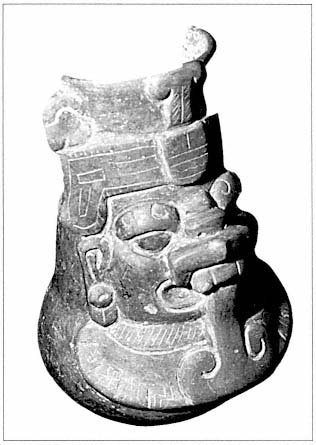
Pl. 14.
Cocijo, funerary urn, Monte Albán I
(Museo Nacional de Antropologia, México).
And there are other differences as well. Even this early Cocijo has notably non-Olmec eyebrows, which in the course of the development of Cocijo's mask through the centuries, evolve into a Tlaloc-like "goggle" form, perhaps due to the influence of Teotihuacán. These early eyebrows are rather crescent shaped and puffy and carry an incised design suggesting the bifurcation of the tongue. The headdress, too, is distinctly non-Olmec in shape and in the designs incised on it. The central design is a rudimentary glyph C, a common feature of Cocijo headdresses and a widely used symbol in Zapotec art. Although neither the meaning nor the referent of the glyph to the Zapotecs is at all clear, in its earliest form, the form suggested here, it seems to depict a vase "seen in cross section and having a
horizontal band . . . often decorated with undulations that represent water"[111] and suggest the serpent. This would seem a fitting design for a rain god, and the fact that Caso and Bernal, at least, see that design as evolving into a stylized jaguar mouth[112] makes it all the more fitting. Seemingly rising from the glyph is another repetition of the bifurcated tongue element, this time with the implied cleft in the tongue at the same spot as the cleft in the headdress of the Olmec Monument 52 and all the other cleft-headed were-jaguars. While the facial configuration and the mouth of the O1mec were-jaguar remain, the tongue of the serpent has now appeared on the mask of the rain god, creating a link between the jaguar and the serpent which was to endure.
But why connect the serpent to rain? Some of the reasons are obvious. As Seler points out, the serpent's "peculiar form and mode of locomotion" suggest water and lightning,[113] as is made clear by the use of an undulating line to represent both water and the serpent in Mesoamerica generally and in the Valley of Oaxaca specifically and by such concepts as the fire serpent carried by the Tlaloc of the highland Mexican cultures which represents lightning.[114] Lightning is no doubt suggested by the way the serpent strikes its prey, but it is also traditionally connected with the flickering tongue of the serpent, and it is, of course, precisely that tongue that is the symbolic detail used in the mask of Cocijo. Beyond these fairly obvious connections, however, another stands out clearly. As we will demonstrate in Part II, the logic underlying blood sacrifice involves reciprocation, in this case the provision of mankind's most precious fluid, blood, to the gods in ritual reciprocation for the provision of their most precious fluid, water, to humanity. Just as water sustains life, blood symbolizes life. And as the blood in the form of snakes rising from the necks of both the massive decapitated Aztec Coatlicue (pl. 9) and the decapitated ball players depicted on the Lapida de Aparicio and on the reliefs of the ball court at Chichén Itzá, for example, reveal, the snake symbolized the blood of life to the Mesoamerican mind. Thus, the serpent represents sacrificial blood, the mythic equivalent of the rains.
But there is still another, quite different, way in which the serpent's shape contributed to its symbolic connection with rain. In Mesoamerica, as elsewhere in the world, the serpent is vitally linked to the earth's fertility, and that fertility, of course, depends upon rain. The serpent's phallic shape and its entrance into the female earth both suggest the human sexual metaphor through which agricultural fertility was symbolically rendered, and that phallic suggestion is made even stronger by the use of the tongue, another common symbol for the phallus, as the symbolic reference to the snake on the Cocijo mask. And more fascinating is the fact that this is a bifid, or cleft, tongue, a detail commonly exaggerated on the Cocijo masks which coincides nicely with the female sexual connotations of the cleft in earlier Olmec art. Thus, the cleft tongue in itself brings together fundamentally male and female sexual symbols in a mask symbolically related to fertility, and that tongue reinforces, then, the symbolic connection of the serpent to sexual, and thus agricultural, fertility. Just as the "opposed" male and female principles are united on the symbolic tongue, a union that in nature creates new life, so the Cocijo mask unites the "opposed" worlds of spirit and matter to provide the sustenance for that life.
Very closely related to the sexual metaphor with its emphasis on the creation of life is the serpent's shedding its skin to be "born anew," a rebirth mythically analogous to the seed's sprouting to renew the earth's vegetation with the coming of the rains. In the serpent, Mesoamerican man could see the endless cycle of existence: first death, but then rebirth as the orderly cosmic processes sustained his individual life through the annual renewal of his sustenance, the corn, which was symbolically man's flesh, the mythic equivalent of life itself. What Heinrich Zimmer says of Indian spiritual thought is equally true of Mesoamerica: "the serpent is life-force in the sphere of life-matter. The snake is supposed to be of tenacious vitality; it rejuvenates itself by sloughing off its skin.[115] That Mesoamerican mythic thought was aware of this symbolic dimension of the serpent is apparent in the Aztec hymn to Xipe Tótec which uses the snake metaphor in exactly this way. The hymn says that "the fire serpent hath been made a quetzal serpent.[116] As Pasztory points out,
the fire serpent, Xiuhcóatl, signified the dry season, and this mythical beast was believed to carry the hot, daytime sun across the sky; the quetzal serpent, Quetzalcóatl, is a metaphoric reference to the earth covered by a green mantle of vegetation in the rainy season. Xiuhcóatl and Quetzalcóatl were gods rather than mythical creatures, two visual metaphors that illustrated the alternating seasons in time and the transformations of the earth's surface.[117]
And both, of course, were linked to the snake, cóatl, and to the ultimately spiritual process that guaranteed fertility. It is no doubt also significant that this line occurs in the hymn to Xipe Tótec, Our Lord the Flayed One, in whose ritual priests donned the flayed skins of sacrificial victims to become the metaphorical equivalent, as is the snake, of the dead seed that carries new life within it (see below).
The metaphorical use of the snake to suggest rebirth was not limited to the Valley of Mex-
ico. Merle Robertson's study of the Maya art of Palenque reveals a similar metaphor at work. At Palenque,
red seems to have represented the living world, the world of humans and the environment in which they lived. Certain parts of serpents were assigned the color red—scales, teeth, tongue and sometimes beards. This may have been because these were considered the "humanlike" living parts of serpents that die or are shed, and then are renewed (reborn) by the growing of new parts.[118]
Perhaps not coincidentally, red is fundamentally related both to Xipe who was for the Aztecs the red aspect of the quadripartite Tezcatlipoca and to death, as the red pigment, often cinnabar, lavishly spread over burials throughout Mesoamerican history attests. And as if to underscore the connection between the serpent and the rebirth that follows death in the endless cycle of life, the ceramic tube connecting the womb-shaped tomb of Pacal in the Temple of Inscriptions at Palenque to the temple above is "both an umbilical cord proclaiming the lineage rites and a serpent.[119]
It is important to remember that all of these symbolic uses of the serpent to suggest renewal through a series of metaphors related to the emergence of life from within the womb, the seed, or the dead skin exist within a mythological tradition that uses the mask as a metaphorical means of emphasizing inner/outer, spirit/matter oppositions at every turn. Within such a tradition, it is no surprise to find the snake playing a vital symbolic role. Turner speaks of snake symbolism elsewhere in the world as one means of representing "logically antithetical processes of death and growth" which he characterizes as "liminal: that which is neither this nor that, and yet is both."[120] And a fascinating hint that Mesoamerican snake symbolism relates precisely to the liminal point at which life and death, inner and outer, spirit and matter come together is the fact that the part of the snake chosen to represent the creature as a whole is the tongue, exactly the part that emerges from within the body and the part that functions, in human terms, most significantly in the speech that allows the communication of inner realities to the external world. In Mesoamerican art, tongues and speech scrolls frequently emerge from mouths; they are the inner made outer in the same symbolic way that the mask makes inner reality visible by placing the inner, true face over the outer, physical face.
The liminal role of the snake in Mesoamerican symbolism is no doubt partially the result of its being an anomalous creature, one that is difficult to fit into the categories into which human beings divide the living creatures of the world. For this reason, among others, it has universally provoked the awe that allows it to function as a sacred symbol.[121] For Christians, of course, it is the epitome of evil, and in its ability to penetrate into the earth, it suggests Satan and the nether regions. In pre-Columbian Mesoamerica, however, its anomalous character suggested the whole of the spiritual realm, both the netherworld and its complementary opposite, the heavens, as Quetzalcóatl, for example, indicates. Nowhere is the snake's symbolic role in linking the earth's surface to the enveloping spiritual realm made clearer than in the great serpents that flank the stairways of pyramids at Teotihuacán's Ciudadela and Tenochtitlán's Templo Mayor and in those serpents that flank the doorways of temples at Chichén Itzá and presumably did so at Tula. Just as the pyramid stairway joins earth to heaven and the temple doorway links the surface to the heart of the earth, so the serpent symbolizes man's ability, through mythic art and ritual, to move from the surface of the earth to these spiritual realms, the ultimate source of his life on earth.
For all these reasons, the snake is the fitting companion to the jaguar in the mask of the rain god. For the peoples of the highlands, the rattlesnake, in particular, can be seen as the equivalent of the jaguar in the lowlands. Each represented in its environment that aspect of nature beyond man's power to control by normal means, the reason, no doubt, for the Zapotec's seeing the snake as a particularly disastrous omen.[122] As Ruz points out, "the deification of the serpent is easy to understand in regions where this animal abounds; the fear inspired by the deadliness of its poison, and in spite of its fragile aspect, the silence and quickness of its movements, all suggest a supernatural power.[123] Thus, the snake, like the jaguar and ultimately the rains, represents a disruptive force that man cannot control through normal means, a force that can only be brought into harmony with man's life in culture through myth and ritual. That fusion, as we have shown above in the case of the jaguar, is accomplished symbolically by constructing a mask made up of the features of man and serpent which unites those opposed forces in a representation of the harmony ultimately found only in the world of the spirit. Through the mask man can transcend nature and participate in the force that alone can control snake, jaguar, and rain.
We can now return to our consideration of the urns representing Cocijo with an understanding of the significance of the serpent's tongue emerging from the mouth of the mask, but while that symbolic tongue remains a constant part of Cocijo's features, other symbolic details are transformed to create a number of variations on the basic theme enunciated by the mouth. The headdress, for example, exists in a number of forms, the most common of which displays the glyph C. At times, the glyph has what might be interpreted as two streams of water flowing from the top of the vaselike form in what is probably a visual reference to the pan-
Mesoamerican notion that the rain is stored in great urns from which it is spilled onto the earth, a reference repeated in varying forms in connection with the rain gods of all the Classic period cultures. These streams are often superimposed on a background of plumes (pl. 15) that, especially in the light of a similar use of plumes in connection with a serpent face during the same period of time at Teotihuacán, are a tantalizing suggestion of the plumed serpent that is directly related in the Valley of Mexico to the storm's winds that sweep the roads clear for the coming of the rains and thus to fertility. Other Cocijos wear a simple, hatlike headdress also found on many other figures represented on the urns. It is often incised with striations and sometimes bears a glyph. Still others have headdresses bearing corncobs and, perhaps, stylized representations of parts of the corn plant which rather obviously refer to a particular aspect of Cocijo's function.
The treatment of the eyes also varies somewhat but not as significantly as the headdress. Most Cocijo masks have eyes bracketed by U-shaped elements underneath and similar elements, raised in the center to form a stepped fret, as eyebrows. The eyebrows may well be a stylization of the bifurcated tongue design on the puffy eyebrows of the early urn we examined above and thus a continuing reference to the serpent qualities of Cocijo. It is also quite possible that the bracketing of the eyes on the Cocijo mask is related to the so-called goggle eyes of Tlaloc, a motif also related to the serpent. But a similar treatment of the eyes of relatively realistic jaguars from the Valley of Oaxaca suggests the alternative possibility of were-jaguar symbolism in this element. There are slight variations of the basic theme: occasionally, the outer edges of the lower brackets are hook-shaped, a motif found on other urn figures as well. In fact, virtually all the masks of the figures representing the gods on the urns of the Valley of Oaxaca have one variation or another of the basic bracket pattern, and the symbolic significance of this is made clear by the consistent occurrence of a particular variation with a particular type of mask. In this case, the stepped fret of the top element occurs generally on Cocijo masks and not on others.
Thus, the existence of the basic mouth in connection with a limited number of variations in eyes and headdress, as well as in pectorals and costume, reveals the fundamental debt of the peoples of the Valley of Oaxaca to their spiritual ancestors on the Gulf Coast. Following the Olmec lead, they developed a system for symbolizing their gods, that is, the forces emanating from the world of the spirit, by combining a relatively small number of symbolic traits as facial features in a mask that delineates the spiritual forces underlying and sustaining the natural world. Varying those features through the range of their possible combinations made it possible to specify the particular aspect of the spiritual force in question—in this case, the provision of water to sustain man's crops and his life—and thus to communicate with a great deal of precision information about man's relationship to the gods. The Cocijo urns thus comprise a system with "a set of attributes (e.g., water, corn, lightning) that define the supernatural force or set of forces depicted."[124]
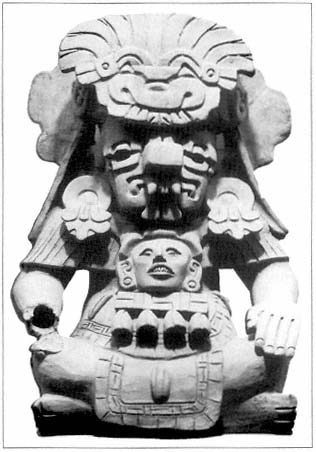
Pl. 15.
Cocijo wearing a Glyph C headdress, funerary urn,
Monte Albán III (American Museum of Natural History, New York).
It is clear that this system was fully developed quite early in the history of the Zapotec culture of Monte Albán since its basic symbolic features changed very little over the thousand-year development of that culture despite the fact that the style of the urns changed dramatically, reflecting the changing society; as the society became larger and more stratified, religious symbolism became more conventional and more ornate.[125] As Covarrubias puts it, the simple vases of Monte Albán I (pl. 14) became "increasingly more elaborate in period II, majestic and imposing in size and design; becoming more and more ornate and formalized in period III; reaching a frankly baroque flamboyancy that sinks suddenly into complete decadence in period IV."[126] It is no doubt more than coincidental that the point of most abrupt change which occurred
between periods II and III was also the time of Monte Albán's most significant contact with Teotihuacán.[127] But even though that influence may well have affected the style of the urns, the fundamentally Zapotec symbolism embodied in the mask of Cocijo changed very little.
Although there is no question that that symbolism was fundamentally related to rain, it is evidently true that Cocijo was a god of the lightning that the Zapotecs saw as the operative force in splitting the clouds to release the needed rain.[128] That concept of an operative force, with its clear implications of creative power, may explain the close relationship between Cocijo and the earthly rulers of the Zapotec people. The power these rulers wielded was derived from the gods, and upon their death, they "became gods" through whose mediation mortal men could approach the essence of divinity.[129] Such a conception of rulership no doubt accounts for the great number of urns depicting human beings wearing headdresses displaying the mask of Cocijo, a way of displaying a mask in ritual regalia which we saw earlier with the O1mecs and one which we will explore at length in our consideration of ritual mask use, and for the incorporation of the name of the rain and lightning god in the names of some of the rulers.
Cocijo's power and significance is also demonstrated in his close relationship to the calendar that charted the motion of time, a motion directly revelatory of the essence of divinity to the Mesoamerican mind. In the Valley of Oaxaca, both the 365-day solar calendar and the 260-day sacred calendar were divided into units designated with Cocijo's name. The solar "year could be divided several ways, the most common being a contrast between a dry season, cocijobáa , and a rainy season, cocijoquije ." In this case, the reason for the designation cocijo seems clear since the distinction between the seasons relates to rain, but "the term cocijo was also used for units of the pije [the 260-day calendar], but in this case the division was into 4 cocijo of 65 days each."[130] This division seems to have no obvious basis in Cocijo's function as a rain god, and for that very reason it reveals clearly the power attributed to him: just as he was the operative force in providing the rain, he was also the force that moved the calendar, that is, time, through its endless cycles, a fundamental relationship to time shared, as we shall see, by Tlaloc. And Cocijo, like all of the rain gods of the Classic and Postclassic cultures of Mesoamerica, was quadripartite—mysteriously one and four simultaneously. Interestingly, this concept is given symbolic form in ceramic pieces with Cocijo attached to four or five linked vessels that suggest visually his quadriplicity with the fifth vessel, when present, marking the center position of the quincunx.[131] As the calendar divisions suggest, he was the force of time and its periods as well; he was the essence of life and its existence in time and space; he was the one and the many. A number of qualities of the Olmec rain god suggested precisely this quadriplicity, and it is significant that the first descendant of that Olmec ancestor manifests it so fully and strongly.
Thus, the mask of Cocijo symbolically unites diverse elements from the world of nature to suggest the attributes of one of the fundamental supernatural powers through which that natural world exists. The significance of that supernatural force to the Zapotecs is clearly indicated both by the tremendous number of Cocijo representations created by them in their long history and by the fact that the basic symbolic form stayed virtually the same over that time span while both the form of the society and the style of its religious art changed tremendously.