
The New Regime
Mount Lebanon still needed a government, however—a government that all its people could identify with and respect. That was the next item on Fuad's agenda, but one he had to resolve with the representatives of other powers, by force of circumstances. Events in the region had created an uproar in Europe, particularly in France. Although Fuad's swift action calmed this reaction, it did not prevent the landing of a large French force in Beirut for the purpose of protecting the Maronites and other Christians. The French military presence complicated the search for a new governmental structure for Mount Lebanon because it aroused the suspicions of other powers and compromised Ottoman sovereignty.
When, in October 1860, the representatives of Great Britain, France, Russia, Austria, and Prussia sat down under Fuad's presidency in Beirut to discuss the situation, they were still more concerned about their own interests than with those of the Lebanese. As the negotiations dragged on for months, however, the participants acquired greater familiarity with the area and with the concerns and wishes of its various groups and communities. Finally, it was agreed as a matter of principle that Mount Lebanon had to be recognized as a unit and its problems dealt with in a way that would enhance this unity rather than undermine it. It was also agreed, however, not to include Beirut in Mount Lebanon. (Until 1864, Beirut remained the seat of the Province of Saida, which included Latakia, Tripoli, Nablus, and Jerusalem, in addition to Beirut and Saida. In 1864 this area was incorporated into the Province of Damascus. In 1887 the same area, except Jerusalem, once again became a province in its own right, called the Province of Beirut.)
By May 1861 the committee finally produced a draft statute that was then taken up for final revision in a meeting between the ambassadors and the Ottoman grand vizier, Âli Pasha, in Istanbul. The outcome was an organic statute called the "Règlement for the reorganization of Mount Lebanon." An international protocol signed on June 9, 1861, ratified the Règlement and also set out certain guidelines concerning its implementation.[61]
Mount Lebanon would be organized into a special Ottoman governorate, or mutasarrifiyya (see Map 2 for its boundaries.) A Christian governor was to head the mutasarrifiyya . He would be appointed by and directly responsible to the Sublime Porte (Bâb-i 'Âli , the executive headquarters of the Ottoman central government, named after the high gate
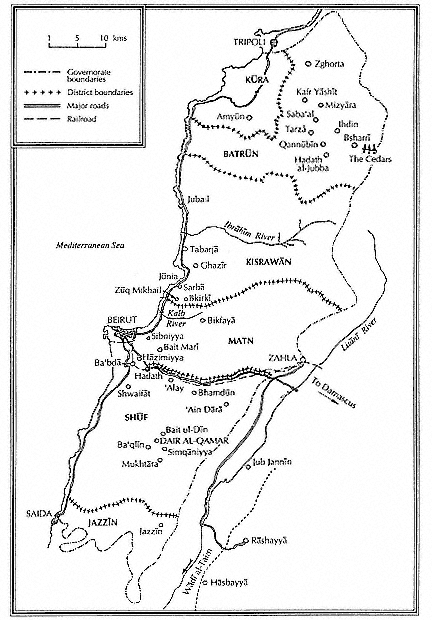
Map 2.
The Governorate of Mount Lebanon, 1861–1920 (based on Isma 'il Haqqi, ed.,
Lubnân, mabâhith 'ilmiyya wa ijtimâ'iyya , 2nd ed., Beirut, 1969–70).
used to enter the complex that housed the offices of the grand vizier).[62] A three-year term was fixed for the first governor, Davud Pasha. At the end of this term, the ambassadors would reconvene with the Ottoman foreign minister to review matters. At this meeting, held in 1864, lengthy negotiations over the proposals by Davud Pasha and others to revise the Règlement , in light of the past three years' experience, culminated in a series of important amendments. An international protocol was signed to this effect on September 6, 1864. This revised 1864 version of the Règlement remained the basic document according to which Mount Lebanon's autonomous government was constructed and run during the mutasarrifiyya period.
Although both versions of the Règlement were based on international agreements, they were promulgated in the form of an imperial decree, with the understanding that it was the responsibility of the Ottoman government to make the new order work.[63] Would the Ottomans sincerely shoulder this responsibility, which involved building a governmental framework within which the people of Mount Lebanon could reconcile their differences and heal their wounds? To that question we now turn.