
Clan Temples and Temple-Clans
Nakarattars referred both to their clan temples and to the clans themselves as "nakarakkovils ." For the sake of clarity, I shall diverge slightly from this usage and distinguish between temple-clans and clan temples. During the colonial period, the temple-clan was a set of otherwise unrelated lineage segments (kuttikkira pankali , see below) who shared hereditary cult membership in a common clan temple. Membership of individual Nakarattars in a temple-clan was determined agnatically but indirectly by membership in a lineage segment that belonged to the clan. Although every lineage segment of a Nakarattar temple-clan claimed descent from the founders of the clan's temple, and although consanguinity was presumed and intermarriage prohibited, different lineage segments from the same temple-clan did not, in general, exhibit demonstrable consanguineal ties. In other words, colonial Nakarattar clans were quite similar to the better-known clan groups represented by Brahmanic gotras (Khare 1970; Madan 1962). The substantive difference is that, whereas Nakarattar temple-clans trace their descent from ancestral members of specific temple cults, Brahman gotras trace their membership from ancestral disciples of mythical gurus called rishis .
The temple-clans varied in size (see Figure 16 for 1930 estimates), and some were divided into subclans (see Table 14). These two traits—their uneven population distribution and their differential segmentation—suggest a long-term historical process of sequential fission and migration, thereby lending support to the sequence described in their caste history (if not its telescoped time frame, cf. Rudner 1985). But this is a topic that requires further investigation.
Nakarattar clan temples were owned jointly by their clan members,
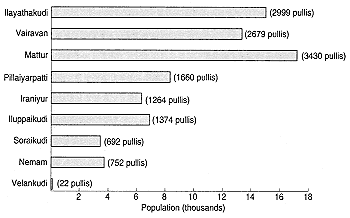
Figure 16.
Nakarattar temple clans by population, ca. 1930.
Source: Temple census in Ramanathan Chettiar (1953). Population
figures were calculated as five times the number of pullis in a clan.
who were called kovil pankalis "temple shareholders". Representatives from each clan made up the executive officers and boards of trustees (karyakkarars ) for their respective clan temple. They directed the construction and operation of the temple. They also allocated expenditures and investment of considerable sums of money. In the colonial period, the businesses of kovil pankalis were the primary beneficiaries of temple investments. For example, kovil panam deposits from a clan temple made up almost half the liabilities of a major banking agency in Burma during the colonial period from 1912 to 1915 (see Chapter 5). In addition, as illustrated earlier in this chapter by the case of Ilayathakudi Temple, temple funds were frequently spent on devastanam properties or on local civic improvements, such as roads or tanks for the villages of Chettinad.
Nakarattar clans supported their temples by a variety of means. Every Nakarattar household or pulli was tithed a nominal amount each year in a tax called a pulli vari . In addition, a wealth tax or asti vari was charged on exceptional occasions, as temple needs demanded. These contributions were taken seriously (though less so today), and individuals and their kin could be excommunicated from the community for failing to meet their contributions. This was an important sanction, for clan temples legitimized Nakarattar marriages, and without clan temple sanction no marriage could occur. Finally, clan temples received a major portion of their funding through endowments of land or money or both. Only Nakarattars belonging to the temple clan were permitted to endow the clan temple.[17]
| ||||||||||||||||||||||||
(table continued on next page)
(table continued from previous page)
| ||||||||||||||||||||||||||||||||
Clan temples served local political functions by integrating the Nakarattar community with other individuals and groups who participated in temple rites of worship, including members from non-Nakarattar jatis residing in Chettinad. Like any village temple, inhabitants from the surrounding villages might worship there as part of the regular round of daily worship (naivettiyam ) maintained at any Siva temple; they might worship on an occasional basis (arccanai ) to satisfy a vow (nerttikkatan ) or to ask a boon and make a promise in return (ventutal ), or they might take part in one of the few yearly rituals (utsavam ) staged by a Nakarattar clan temple. In the last case, Nakarattars received first honors before any other caste, even Brahmans.
Members from non-Nakarattar castes also served special roles in temple rituals, including rituals peculiar to Nakarattar clan temples. In particular, clan temple vairavis , or "temple messengers," were traditionally drawn from the Pandaram caste. Their special role concerned rites of Nakarattar marriages and funerals pertaining to the clan temple. At marriages, vairavis brought a garland to the bride's house, signifying her official transfer to her husband's clan. At funerals they brought a large torch to the top of the temple tower (kopuram ) to guide the dead person's spirit (avi ). Vairavis also invited Nakarattar and non-Nakarattar notables to important temple functions. Besides these official duties, however, vairavis also acted in an unofficial capacity as a kind of middleman employment service between Nakarattars and non-Nakarattar employees. If labor (skilled or unskilled) was needed for constructing a house, if cooks or gardeners were required, if a new maidservant had to be found, very often it was the temple vairavi who learned of the need while carrying out his official duties and who brought together the potential employees and employers. In this way, activities oriented around the rituals of Nakarattar clan temples extended to and tied together people from all over Chettinad, not just those who dwelled in the immediate temple neighborhood.
For all of these reasons, Nakarattar clan temples were—with village temples—one of the primary instruments of political integration for the people of Chettinad generally, and for the Nakarattar caste in particular. This is less true today than it was before the colonial creation of novel institutions of government following the Morley-Minto and Chelmsford reforms of 1909 and 1919 and the District Board elections of 1937. During the colonial and precolonial periods, the Nakarattar village and clan temples must have played a very important role, indeed, and the Nakarattar system of decision making within clan temples tells us a good deal about their political organization.
As already noted, trustees were recruited on a hereditary basis. But, over the course of time, many Nakarattar families made substantial endowments to their clan temples, and the descendants of these families all had claims to the honors and obligations of trusteeship. In principle, Nakarattars dealt with the plethora of candidates having claims to trusteeship by rotating the office in a regular fashion between selected small groups of prominent families from throughout Chettinad (Periakarrapan 1976).