
PART TWO
THE POLITICAL AND IDEOLOGICAL AMBIGUITIES OF ROLLANDISM IN THE 1920S
4
The Intellectual's International
We are in one word—and let this be our word of honor—good Europeans, the heirs of Europe, the rich, oversupplied, but also overly obligated heirs of thousands of years of European spirit.
Nietzsche, The Gay Science
Romain Rolland's immediate postwar dilemma was to discover a means of struggle against future war that would preserve intact his nineteenth-century conception of the responsibility of the intellectual. His engagement during the Great War did not permit him to be swallowed by postwar ideologies or mass movements. Beginning in 1919 and continuing throughout the 1920s, he tried to salvage a purposeful role for the committed European writer.
Like Freud, Romain Rolland emerged from World War I with an altered and more tragic sense of death.[1] His experience as an antiwar writer reinforced his refusal to support postwar cynicism, violence, or realpolitik. To prevent further war, he urged Europeans to work actively for peace. He cited Spinoza to underscore his point: "For Peace is not mere absence of war, but it is a virtue that springs from force of character."[2] He tried to restore a sense of fellowship, mutual comprehension, tolerance, and authenticity to the intellectual elite of Europe and the world. He aimed his efforts at the literati and the young members of the cultural sector.
The notion of an international of the mind was originally an antidote to all that was retrograde about the war: nationalism, militarism, the uncritical consensus mentality, the mass delirium and destructive frenzy.[3] With the prolongation of the hostilities, Romain Rolland feared that the fundamental fabric and existence of European culture were in jeopardy. In early 1919, he began to mobilize for his dream of an intellectual's international. He did so without having a practical or administrative sense and without the
secretarial or economic resources of existing institutions. It was a one-man venture, expensive in terms of time, money, and energy.
The intellectual's international was to be a voluntary association of artists, scientists, and thinkers organized around universalist, supranational, progressive, and humanistic principles. Romain Rolland's vision presupposed an intelligentsia independent of national institutions or academies, the League of Nations, the Socialist International, or the Communist International inaugurated in March 1919. In crisis situations these free thinkers might retain a dissenting and nonconforming view.
He proposed that the intellectual's international hold regular congresses and conferences to provide stimulating scholarly dialogue. If it were established in conjunction with an international university, the international would create networks of student and educational organizations. He hoped also to link it to a publishing house and to issue a newspaper, a bulletin, and a multilingual journal mixing literature, biography, science, and scholarship. Europeans would extend their knowledge of other cultures through reading excellent translations of non-European classics and through the proliferation of popular biographies of seminal cultural figures.[4] Romain Rolland's proposal took direct aim at cultural nationalism and ethnocentrism, both of which were fostered by ignorance, the stereotyping of national characters, and xenophobia. The war had exacerbated such primitive forms of thought. Both the international publishing house and university, he argued, might better pursue their goals in Russia, Asia, or America—anywhere but Paris.[5] The French writer linked the intellectual's international to the dissemination of Esperanto, the international language for which he propagandized.[6] Moreover, he anticipated monumental collective enterprises, such as an Encyclopedia of the Twentieth Century.[7]
If Romain Rolland's idea of preserving and reinventing high culture was elitist, the elitism was muted by the proposal that writers should mediate between high and popular cultures. Cultural endeavors should be immediately accessible to the masses and not restricted to privileged groups. This international was apolitical in its organization and ideology. It could neither be tied to existing political parties, groups, programs, and electoral strategies nor to mass movements or politicized world views. He insisted that
it be genuinely eclectic in the search for a new politics of truth, world peace, and cross-cultural dialogue. Internationalism was consistent with an intransigent individualism and a sentimental form of socialism. He saw himself as the prototype of the pacifist internationalist intellectual. He proclaimed that the valid role of the intellectual was to synthesize and unify, to set up bridges between peoples.[8]
Romain Rolland reacted ambivalently to the Russian Revolution. It caused him to reflect on modern social revolution and to reappraise his deepest cultural priorities. He was one of the first Western writers to be receptive to developments in the Soviet Union, but his career as a fellow-traveling intellectual remained uneasy. Over the interwar years, he agonized over and reevaluated his pro-Soviet stance.
Romain Rolland's enigmatic position on the Bolshevik Revolution was built on fragmentary and at times contradictory evidence. News was always filtered through the presuppositions of the reporter. Much of his information came from written accounts and from discussion with Russian intellectuals who spent the war in Switzerland. The most important of these were Anatole Lunacharsky, destined to become Soviet minister for enlightenment; Nicholas Rubakin, an encyclopedic scholar and philologist with pro-Kerensky tendencies; and Paul Birukof, a Tolstoyan.[9] Some of his confusions about the Russian Revolution reflect discrepancies in their accounts. He remained in close contact with the French militant trade unionist and radical journalist Henri Guilbeaux, editor of Demain and intermediary between the European Zimmerwaldian left, which was mounting an opposition to the war, and the Bolsheviks.[10] Many first visitors to the USSR (Alfred Rosmer, Jacques Mesnil, Victor Henry) visited Romain Rolland in Switzerland and shared their impressions of the early days of the revolution.[11]
Neither a zealous advocate nor an unyielding opponent of the Russian Revolution, he took the role of a friendly but critical sympathizer. Without enrolling in the Communist Party or its international organizations, he proclaimed an international solidarity with the events in Russia and welcomed some of its goals. One could
offer an empathic understanding of the Russian Revolution without being a Bolshevik, without abandoning one's critical perspective. Throughout his career as an engaged writer, his writings on the Soviet Union remained personal and impressionistic.
Romain Rolland stressed what was universal and liberating about this world-historical development. Writing optimistic accounts primarily to a French and European audience, he quickly anticipated that the Russian Revolution might counter Western political stalemate and obsolete social structures. Revolution could become a viable alternative to decadence. The Russian Revolution could free human beings from the futile sense that history could not be made or understood. On the pessimistic side, he warned the Bolsheviks to avoid the distortions, isolation, and arrogance of their eighteenth-century French predecessors. He specifically counseled the Russian Communists and their European followers against gratuitous violence and internal factionalism. The Soviet mission transcended Russian borders: it was to bring the world peace, liberty, fraternity, and a heightened awareness of the historical possibilities for freedom. "Let your Revolution be that of a great, healthy, fraternal, human people, avoiding the excesses into which we fell!"[12]
Writing contemporary history was a risky undertaking; advising revolutionaries about revolution was no less so. His critical support for the revolution left him vulnerable to attacks from the communists, the center, and the right. Romain Rolland's writings stressed the process of perception, the proper spirit in which to receive information about the Soviet Revolution. He urged his audience to confront the social upheaval in Russia with an open and nonpartisan attitude, to put aside their received and pejorative notions about communist insurrectionaries. He distrusted interpretations of Russian events that were emotional, demagogic, and uninformed and that fueled the anticommunist hysteria from European right-wing and middle-class circles, including the press. He insisted on making distinctions among the various groupings and parties on the left.[13] Throughout the interwar years, he never embraced a one-dimensional anti-Soviet standpoint, but carefully differentiated himself from those unnuanced vilifiers of the Soviet Union who, he believed, always served reactionary interests.
He realized that the Soviet Union was surrounded by hostile enemies and needed distinguished defenders, individuals of con-
science, who were clearly non-Bolshevik. In October 1919, Romain Rolland penned a dramatic piece of humanitarian propaganda, entitled "For Our Russian Brothers: Against the Starvation Blockade." He linked the war mentality to counterrevolutionary politics. He bitterly denounced the Allied invasion of Russian territory. The crusade by the bourgeois democracies of America and Europe against the Soviets was a "hideous crime." Above all, this invasion revealed the class interests of the revolution's opponents.[14] The Russian Revolution belonged to those "chaotic and grandiose ventures of renewing the old and corrupted order." He portrayed it as a symbol of human potentiality, representing the unextinguishable possibilities of liberation.
To posturing critics who equated the Soviet Union with bloody anarchism, Romain Rolland replied that it was premature to discuss the results of the recently initiated social experiment. No European could dismiss the Russian Revolution as destructive given Europe's dismal record in four and a half years of total war: twenty to thirty million people killed or maimed, economies wrecked, land and industry devastated. In contrast, the Soviet Revolution arose from the debacle of the war, posed itself as a corrective to empire and to militarism, and promised an era of vast industrial and agricultural planning. "Bolshevism is not disorganized; it has attempted to organize chaotic disorder; it has attempted to provide new social formulas in the midst of the moral and material ruin of Europe."[15]
However much he praised the Russian Revolution, he refused to accept the mechanical exportation of Bolshevik leadership, party discipline, political agitation, or social analysis to the West. Toward the Bolshevik leaders and the Marxist-Leninist ideology, he adopted a mixed but on balance negative attitude. Russian revolutionaries were different from the democratic socialists or socialist humanists he admired. He viewed Lenin and Trotsky as honest, driven, faithful, and energetic leaders and never doubted that they were high-minded and self-effacing. Both were motivated by an ideal of a just social order. Both had well-articulated ideas about internationalism and had lived abroad. Yet he felt that Lenin and Trotsky had an unusual capacity for violent discourse and actions. Their tempers were fanatical and despotic; they acted out of political expediency; they repeatedly displayed doctrinal intransigence and personal authoritarianism. Class consciousness and class struggle, he pre-
dicted, would not inaugurate a peaceful world. He was alarmed that the Bolsheviks wanted to "revolutionize the world" and resorted to force to accomplish their goals. His initial impressions of Marxism-Leninism were equally negative. He saw Leninism as a vulgarization of socialism, an amoral ideology that systematically eliminated a spiritual or psychological component of human endeavor. Its iron law of economic development stemmed from a narrow view of productive relations and political economy. It cynically justified a provisional class dictatorship to legitimize new forms of tyranny. Its view of historical process appeared deterministic and reductionistic.[16]
Romain Rolland fundamentally disagreed with the Bolshevik ideas of a minority dictatorship, centralization, secrecy, and regimentation of intellectual and artistic life. He found Leninism too politicized, dogmatic, intolerant of opposing political views, and blind to alternative methods of critical analysis and intuition. Leninists, he learned from his friendship with Gorky, were suspicious of intellectuals, if not anti-intellectual. The vanguard party had no tolerance for other avant-gardes. Lenin, in wanting to transform world war into revolutionary class warfare, dismissed all antiwar positions during the war as simpleminded, dangerous, petit-bourgeois "bacilli."[17] Despite the revolution's successes, Romain Rolland would never condone the Bolsheviks' centralizing opinion and curtailing individual or democratic freedoms. He refused to sanction any limits imposed from above on political opposition from workers' unions, artists, or thinkers. These groups had to conduct their affairs without harassment or party discipline.[18]
Romain Rolland's idea of an intellectual's international in 1919 was diametrically opposed to Lenin's view of the Communist International. Yet he appreciated the grandeur of the Soviet experiment from its beginning. The Bolsheviks had organizational power and were initiating worthwhile economic, scientific, educational, and cultural endeavors. They faced considerable internal and external obstacles in the gigantic project of social reconstruction, including the hostility to their successes by the bourgeois countries of the world.[19]
The end of the First World War and the successful Russian Revolution sparked revolutionary activity in central European countries. The repression of the European revolutions left a profound impact on him.[20] Romain Rolland summarized his attitudes toward these
abortive revolutions in a piece documenting the crushing of the Spartacist revolt. "Bloody January in Berlin" narrated and interpreted the events of the Spartacist uprising from 5 January to 11 January 1919, which culminated in the double assassinations of Karl Liebknecht and Rosa Luxemburg on 15 January. Once again contemporary Germany demonstrated its worship of naked force, the drunkenness of its ruling-class establishment, and the obsequious mentality of its people.[21]
Romain Rolland defended the revolutionary socialists against the savage repression. He wrote as an independent intellectual concerned with historical accuracy and disgusted by the monstrousness of the murders. He sensed that the suppression of this uprising would have calamitous consequences for both the German revolution and the cause of world peace. He dramatized these issues to alert progressive French opinion in general, French socialists in particular, to the moral and political danger of the situation.[22]
Romain Rolland viewed Liebknecht and Luxemburg as attractive, impeccably sincere champions of revolutionary and Marxist democratic socialism. They were thinkers of stature and activists who had condemned the Great War and worked for Franco-German reconciliation, beginning with the fraternal contacts between the working classes of both countries. He contrasted the kind, disinterested quality of their commitment to working people with the ruthless smashing of their movement.[23]
This bloody repression clarified the depth of the militaristic and conservative reaction in Germany, characterized by its nationalistic rage, visions of revenge against France, and the fiction of the stab in the back. The establishment of the Weimar Republic had not substantially changed the German people. German capitalists, with the bourgeois press, seized on such emergencies as the Spartacist uprising to defend their class interests and material possessions. The Spartacist revolt became an opportunity to eliminate revolutionary Socialists, while retarding "the progress of the Socialist idea."[24]
Right-wing Social Democrats thus established a dreadful historical precedent, which they legitimized in the name of democracy. A majority of German socialists had supported the German Sacred Union and allowed the war to domesticate and bureaucratize the structure of the Social Democratic Party (SPD). In 1919 socialist heads of government behaved no differently in crises from liberals
or reactionaries. German socialists had no scruples against calling in the imperial army and the Freikorps to crush the revolution with force. Nor did the Socialists Scheidermann or Ebert show remorse for their murderous deeds: "The fratricidal victors rejoiced without shame."[25]
The organized working class, Romain Rolland concluded, would have to be educated by this catastrophic turn of events to unite around its own interests. Spontaneous revolution was a dead end that only facilitated political repression. More significant, worker movements had to be on guard against the divisive, treacherous, and opportunistic actions of their former leaders. Socialists in power would use the instruments of state violence against the organized working class. "But it was the first time that Socialism found itself on the side of power and against the proletariat."[26] He predicted that it would not be the last such incident.
Reacting to the betrayal and deception by socialists of socialists, Romain Rolland distanced his intellectual's international from the Socialist International. Throughout the interwar years, he maintained a skeptical, even distrustful, posture toward European socialist parties and politics. He supported neither the extreme left wing of socialism, which believed revolution was imminent, nor the right wing and center, which were reformist, legalistic, and double-dealing. Postwar socialism, including French socialism, lacked leadership, ideological direction, faith, and the ability to distinguish itself from the establishment.[27]
Romain Rolland's attitudes toward Woodrow Wilson shifted during the period from October 1914 to the spring of 1919. He first imagined Wilson to be a moderate and disinterested man of good will. He was captivated by the American president's language, which appeared generous and enlightened while it camouflaged his class interests. But Romain Rolland's hopes were dashed by Wilson's refusal to intervene to end the hostilities during the war and his inability to assert himself as an arbiter for a just peace. After the Armistice, Wilson did not curb the appetites of the Allies for revenge.[28] By the opening of the Peace Conference on 18 January 1919, Romain Rolland saw that Wilson was a fraud and that the treaty being negotiated would lay the foundation for a future world war.[29]
Romain Rolland never accepted the credibility of Wilsonian democratic ideologists. The Treaty of Versailles and the League of Na-
tions represented the final apotheosis of liberal idealism, the collapse of the expectations raised by the Enlightenment and the French Revolution. Wilson's betrayal was unusually harsh because it trampled so many of Romain Rolland's immense hopes. He remained critical of such false prophets, distrusting parliamentary politicians, including the French Radicals, who preached Wilson's brand of legalistic internationalism and democratic humanitarianism. Just as the intellectual's international stood in neither the Bolshevik nor the socialist camp, so too it rejected any official allegiance with postwar liberalism:
The moral abdication of President Wilson, abandoning his own principles without having the frankness to admit it, signals the ruin of that great bourgeois idealism that for a century and a half insured the ruling class of its prestige and its strength, in spite of its many errors. The consequences of such an act are incalculable.[30]
Clarté was initiated in 1916–1917 by four young French writers and journalists: Henri Barbusse, Victor Cyril, Raymond Lefebvre, and Paul Vaillant-Couturier. Barbusse and Lefebvre were inspired by Romain Rolland's antiwar position and were sympathetic to his form of pacifistic left-wing intellectualism. Their original conception of Clarté coincided with Romain Rolland's principles of intellectual independence and the regeneration of cultural life. Under its umbrella, Clarté attempted to assemble war veterans, antimilitarists, republicans, Radicals, protocommunists, socialists, pacifists, academics, and even nationalistic intellectuals.[31]
In 1919, Romain Rolland expressed deep misgivings about the recruits to the Clarté movement. Its members lacked literary and intellectual authority, were arrivists, and resembled "the fashionable world of Paris at a dress rehearsal."[32] A collection of journalists and theatrical celebrities, such as Colette and Edmond Rostand, might produce some glitter and some "facile camaraderie" in times of relative calm, but in a crisis they would prove unreliable. The Parisian tone of the Clarté movement disturbed him. Its parochialism suggested an evanescent commitment to peace and internationalism. Many of Clarté 's members (J. H. Rosyn, Paul Fort, Anatole France) had taken self-serving and plainly chauvinistic positions.
Many adherents were virulently anti-Soviet. Rather than turn the intellectual's international into a meaningless gathering of French literati, he suggested a more democratic, more international organization. Such associations were better located outside Paris, where "foreign thought and action" were received more openly.[33]
Romain Rolland found the organizational structure of Clarté to be misconceived, overly eclectic, and diffuse. "Above all, the present situation demands the constitution of a closed, solid, resistant nucleus of intransigent souls who carry the new faith."[34] He advocated a smaller, more carefully selected group of thinkers, earnestly prepared for permanent opposition to war. As apostles of peace and internationalism, they would be inflexible on key issues, personally honorable, and undeflected by practical considerations of career, reputation, or political affiliation. The experience of the Great War would have taught the value of refusal. The postwar context would confront intellectuals with sharp choices: "Prudent silence, the amiable neither yes nor no, must be interpreted 'No.'"[35]
He objected to Clarté 's equivocation on contemporary events in 1919. Not speaking out suggested either ideological confusion at Clarté or, worse still, a desire not to offend centrist or nationalistic members of the advisory board. This implied that Clarté lacked the resolve to emerge as an oppositional voice.[36] Privately, Romain Rolland feared that Clarté was too much under the moral patronage of Anatole France. He had condemned the French Voltairean for his xenophobic outbursts during the war and for his calculated silence about the unjust peace treaty.[37]
Before he resigned from the Clarté committee on 23 June 1919, Romain Rolland took sharp issue with its deceptive editorial structure, consisting of two parallel committees: an ornamental but impotent committee composed of recognizable international names (Anatole France, Thomas Hardy, Upton Sinclair, Stefan Zweig) and an invisible but powerful central committee dominated by the Parisian inner circle of Clarté . He felt it was antidemocratic and irresponsible to make decisions without consultation.[38] He was further alienated by the bungling bureaucratic mediocrity of Victor Cyril, the least talented of Clarté 's founders.[39]
Romain Rolland's refusal to stay with the Clarté group demonstrated the heretical and puristic nature of his ideals. His pursuit of the intellectual's international was without tactical finesse, flexibil-
ity, or the spirit of compromise. He was stubbornly prepared to risk becoming the "one against all." Clarté would not accept Romain Rolland's assumptions or his need for absolute moral decency.
Romain Rolland's intransigent individualism, his desire to complete ongoing cultural projects (novels, plays, biographies), and his efforts to reorient European cultural life to the sacred, all made his rupture with Clarté inevitable. Yet he could not tolerate total breaks. He remained friendly with Barbusse, Lefebvre, and Vaillant-Couturier, hoping still to collaborate with them on joint endeavors. In late 1919 and early 1920, such an opportunity presented itself. Along with Barbusse and the French writer Georges Duhamel, Romain Rolland attempted to prepare for the first in a series of International Congresses of Intellectuals. This congress was never held.[40]
About the same time, he wrote to E. D. Morel, secretary of the Union of Democratic Control, an English-based pacifist and internationalist organization, that he was unwilling to become an active member of that organization.[41] He could be at once committed and nonaligned; joining an association might be a full-time affair, distracting him from his art and his reflective solitude. His work for an intellectual's international went forward without the aid of political and ideological associations such as the Union of Democratic Control, even when he agreed with their goals and esteemed their leaders:
I, too, have arrived at the stage of integral internationalism, and I believe in the necessity for human evolution of a radical transformation for the benefit of the world of Labor. But essentially I limit myself to my own task as "worker of the mind." That is considerable enough to demand all of my energies. I would like to introduce the great intellectuals of diverse nations who have conserved the independence of their thought, posing to them principles of an International of the Mind, which struggles against the disastrous work of intellectuals formed into regiments serving the enemy nationalisms.[42]
Romain Rolland opened his postwar career with a forceful, highly visible proclamation of intellectual autonomy and liberty, "The Declaration of Independence of the Mind." He unequivocally asserted the dignity of the intellectual's vocation. First published in Paris in the French Socialist newspaper L'Humanité on 26 June 1919, two days before the signing of the Treaty of Versailles; translated into the major languages of the day; read in the newspapers and
journals of France, Switzerland, England, Italy, Germany, Austria, and America; cosigned by a select circle of the world's intellectual personalities, his manifesto received both attention and some measure of legitimacy.[43] The controversy triggered by the Declaration illustrated that he had touched a sensitive nerve in Europe.
The discourse affirmed his sense of the intellectual's "Rights of Man." Romain Rolland emphasized the intellectual's right and obligation to think, research, write, publish, and communicate honestly, without the shackles of censorship, nationalism, or political allegiances. After five years of conflict, he called for intellectuals to stand up against destitute moral relations and the silence, acquiescence, and embitterment among themselves. He asked them to clean up their own affairs, then make fraternal alliances with the democratic masses.
The final draft of the Declaration read:
Declaration of Independence of the Mind
Workers of the Mind, comrades scattered throughout the world, separated for five years by armies, censorship, and the hatred of nations at war, we address an Appeal to you at this hour when barriers are falling and frontiers are reopening, to revive our fraternal union, but as a new, more secure and reliable union than that which previously existed.
The War threw our ranks into confusion. The majority of intellectuals put their science, their art, their reason at the service of governments. We wish to accuse no one, to direct no reproach. We know the weakness of individual souls and the elemental force of great collective currents: the latter has swept aside the former in an instant, for nothing had been prepared to help in the work of resistance. Let this experience at least help us for the future!
And let us first of all acknowledge the disasters that have been brought about by the almost total abdication of the intelligence of the world and its voluntary enslavement to unchained forces. Thinkers and artists have added an incalculable sum of poisonous hatred to the plague that devours Europe's flesh and spirit; they sought in the arsenal of their knowledge, their memory, their imagination, old and new reasons, historical reasons, scientific, logical, and poetic reasons to hate; they worked to destroy comprehension and love between men. And thus they have disfigured, debased, lowered, degraded Thought, of which they were the representatives. They made Thought the instrument of passions and (without knowing it, perhaps) of the selfish interests of a political or social clan, a state, a country, or a class. At present, out of this savage battle from which all the involved countries, victorious or vanquished, emerge battered, ruined, and in the bottom of their heart (though they do not admit it)
ashamed and humiliated by their excess of madness, Thought, compromised with them in their struggle, emerges with them, fallen.
Stand up! Let us disentangle the Mind from its compromises, its humiliating alliances, its hidden bondage. The Mind is the slave of no one. It is we who are the servants of the Mind. We have no other master. We exist to uphold, to defend its light, to rally around it all misguided men. Our duty is to maintain a fixed point, to point to the polar star, in the midst of the swirling passions in the night. Among these passions of pride and mutual destruction, we make no choice. We reject them all. We honor Truth alone, free, frontierless, limitless, without prejudices of nations or castes. Assuredly, we are not uninterested in Humanity. It is for Humanity that we work, but for it as a whole . We do not know peoples. We know the People—unique, universal—the People that suffers, that struggles, that fails, and that constantly rises to its feet again, and that always marches along a rough road drenched in its blood—the People of all men, all equally our brothers. And it is in order that they may, like us, become conscious of this fraternity, that we raise above their blind conflicts, the Arch of Alliance—the free Mind, one and manifold, eternal.[44]
The first paragraph emphasized fraternal unity between intellectuals and a reopening of the frontiers of the mind coinciding with the reopening of national borders. By referring to the intellectual as a "comrade" and a "worker of the Mind," he affirmed the principle of labor's fundamental significance, while raising the elusive issue of the link between workers and intellectuals. Intellectual solidarity might stem from negatives: opposition to the forces of militarism, nationalism, censorship, and hatred that had divided them during the Great War. Prewar cultural and scientific associations were anachronistic and insufficient; he pressed for a new model of intellectual dialogue.
In paragraph 2, he criticized Europe's intellectuals for allowing their intelligence and imagination to be manipulated by warring governments. He muted his censorious thrust, however, by a vague proposal for planned resistance to war in the future. To prevent a repetition of the catastrophe, he exhorted intellectuals to remember how subjective principles and expectations had been betrayed. Conscience was as crucial as consciousness and memory.
Romain Rolland's third paragraph indiscriminately attacked European intellectuals for contributing to the atmosphere of universal hatred during the war. Knowledge had been mobilized and twisted into an instrument of war. Thinkers had lost their perspective on events and on their own proper responsibilities in an emergency.
Intellectuals had shamelessly produced war propaganda and disseminated racist and chauvinistic slander. They colluded with the lies of ruling governments, Allied as much as Central Powers.
"Abdication of intelligence" meant the surrender of rational and ethical bearing in a moment of frenzy. European intellectuals had violated their authority. They had renounced their prerogative to defend culture, reason, and human values. The war had repeatedly negated the true foundations of creativity and critical inquiry; these freedoms extended to the right to resist warfare, oppression, and one-dimensional opinion. The mind, Romain Rolland insisted, had no master, no privileged hierarchy, no set of standards to which it must submit. The mind and the spirit were ends in themselves: pure, sacred, indivisible, inalienable.
If European intellectuals had degraded thought, they had degraded their own characters in the process. His repetition of scathing adjectives ("disfigured, debased, lowered, degraded") revealed the depth of his fury at the betrayal. Intellectual life would remain unhealthy unless intellectuals demonstrated their capacity for selfcriticism and discovered effective, conscious ways to combat passion by reason and to struggle against murderous collective currents.
In the final paragraph, Romain Rolland triumphantly called for intellectuals to rise from the debris of a war in which there was no winner. To redeem their own bad faith and to revitalize cultural production, thinkers should refrain from any contributions to death and destruction. They should avoid all entangling alliances, including those of nation, state, party, group, or class.
Romain Rolland connected his totalizing notion of humanity to his oceanic conception both of the people and of the intellectual's mission to embrace the universe. This mystical idea worked against the nationalist, liberal democratic, socialist, and Bolshevik notions of popular and concrete historical struggle. The ideal intellectual worked fraternally for the miserable or exploited. Romain Rolland's idea of freedom was highly abstract, but it permitted him to link mental and manual labor. To reemphasize the necessity for intellectual autonomy, to overcome the taint of intellectual submission, his manifesto closed on a note of transcendence. Freedom, truth, and fraternity could only be attained if the thinker rose above the petty, blinding conflicts of everyday life. Still echoing the
slogan "Above the Battle," he urged the writer to act as a detached, universalist, humanistic, morally uncorrupted individual.
The published manifesto was virtually identical to the first draft Romain Rolland penned on 16 March 1919.[45] Only one sentence, strategically located in the final paragraph, which affirmed the intellectual's mission, was changed. The original read: "We are engaged to serve only free Truth." (Nous prenons l'engagement de ne servir jamais que la Vérité libre .) The published version deleted the word "engagement ": "We honor Truth alone."[46] Romain Rolland implied that moralists could be engagés , but their overriding concerns, obligations, promises, pledges (all synonymous with the French term engagement ) must be to discover deeper layers of meaning in human life and its relationship to the world.
Romain Rolland elaborated on the Declaration in August 1919 in E. D. Morel's English pacifist journal, Foreign Affairs .[47] To justify his initiating the dialogue between workers and intellectuals, he reminded his audience of his minority stance during the war. To advocate universal brotherhood, social justice, and mutual comprehension among the warring nations was necessary, but not sufficient. In addition, intellectuals must coordinate their efforts against conservative ideas and political forces, to struggle against the reassembled forces of tyranny. Romain Rolland hoped to use his prestige to mediate between the cultural sector and the working classes, or at least to prevent an increase in existing misunderstandings.
He urged the organized working class not to dismiss the intelligentsia out of hand. Just as he could not sanction intellectual contempt for the people, so Romain Rolland refused to countenance worker anti-intellectualism. He was particularly upset about developments in the Soviet Union, where intellectuals were distrusted and actively harassed, where latent Bolshevik paranoia about artists was coming into the open.[48]
Although he opposed intellectual censorship by the Soviets, Romain Rolland praised the Russian experiment in social reconstruction and the effort to eliminate material scarcity. The Bolshevik Revolution was a model of participatory social and economic development with enormous global significance.[49] To separate intellectuals from the working class at this juncture was to cut labor off from the natural creativity and critical perspective crucial to the construction of a durable society. Workers needed intellectual ex-
pertise and vision; intellectuals would grow enervated and antiquated without meaningful contact with workers. Even more dangerous was the precedent of intellectuals' turning against socially conscious workers to become an ideological "tool of oppression in the hands of the exploiters."[50]
Romain Rolland predicated the proposed dialogue on two notions: first, that the goals of manual and mental workers were equally dignified, despite the division of labor; and second, that fraternity was best implemented outside of political parties or mass movements. For the moment, Romain Rolland worked to lay bare unexamined biases, including those stereotypes accepted by the working class and its representatives.[51]
For Romain Rolland the very future of the world depended on collaboration between workers and intellectuals. He concluded his commentary on the Declaration by echoing Marx's rousing Communist Manifesto of 1848:
Manual and intellectual workers, let us unite. Let us unite all who believe in the possibility of a freer, dignified, and happier world, in which the forces of production and of creation would be harmoniously associated rather than working toward their mutual destruction, as they are doing now, in part through our mutual opposition, which is absurd and criminal. Let us not weary of hope and of action: let the intellectuals illuminate the road that the workers have to construct. There are different labor gangs. But the object of labor is the same.[52]
In an appendix to the Declaration published in L'Humanité in August 1919, Romain Rolland reiterated his critical support for the Soviet Union. He regretted that "our Russian friends" were prevented from signing his manifesto, condemned the Allied military intervention and the blockade of the Soviet Union, and proclaimed that "Russian thought is the avant-garde of the world's thought."[53] "Russian thought," in Romain Rolland's context, meant not Leninism but rather the Russian literary heritage or Soviet artistic developments.[54]
Romain Rolland composed an impassioned revolutionary dedication to a second volume of his antiwar essays, Les Précurseurs . He dated the dedication August 1919:
In Memory
of the Martyrs of the new Faith:
the human International.
To Jean Jaurès, Karl Liebknecht, Rosa Luxemburg,
Kurt Eisner, Gustav Laundauer,
victims of ferocious stupidity
and of the murderous lie,
liberators of the men who killed them.[55]
In this dedication, Romain Rolland voiced his solidarity with the assassinated martyrs of European socialism, communism, and anarchism—particularly with revolutionary militants. The five celebrated persons he hailed in the dedication were devoted to revolution, internationalism, and socialist humanism. They were at once revolutionaries and intellectuals of high caliber. In moving closer to the proletariat, Romain Rolland seemed to imply that he saw socialism as the only method of eradicating the material roots of world war and social repression and establishing internationalism. Romain Rolland connected violence to ignorance, insincerity, and class mystification. Socialism, on the contrary, appeared to be the all-embracing ideology of "the human International"—and thus the universal road to peace and to both collective and individual freedom.
This emotional identification with socialist revolutionaries was incompatible with Romain Rolland's more moderate and apolitical commitment to freedom of thought. Significantly, he opened Les Précurseurs with this engaged dedication but closed with the idealist Declaration. In between were articles published between 1916 and 1919 that supported the ideals of an intellectual's international. But the tension between the dedication and the Declaration remained unresolved. Whether the real forerunners of the future were embattled working-class leaders or pacifist intellectuals was undecided. The contradiction between outright allegiance to socialist revolution and the duty to exercise one's free spirit colored all of Romain Rolland's committed writings in the 1920s. In offering unsolicited advice to workers while not being a worker, in praising martyrs of the European socialist movement while remaining outside socialist organizations or revolutionary discipline, in urging an end to the antagonisms between workers and intellectuals while rejecting political struggle, he found himself entangled in a maze of contradictions. To soften the paternalistic ring of his writings, he formulated an image of the future harmonious mingling of all
forms of productive labor. He opted again for an ideal of totality and transcendence.
On 25 April 1919, Romain Rolland sent George Bernard Shaw a copy of the Declaration, requesting his signature.[56] This move was consistent with his original plan of securing signatures from a distinguished independent writer, artist, and scientist from every major country in the world.[57] The invitation triggered a private controversy that recapitulated his stormy relations with Shaw during the war.[58]
Romain Rolland told Shaw that the manifesto would not only help restore intellectual autonomy interrupted by the war, but also reverse the disillusionment of the young and silent members of the cultural sector. In an attempt to disarm Shaw's caustic wit, he confessed that such appeals were romantic attempts to take a stand against an apparent evil; their authors were Don Quixotes, attacking windmills. Instead of swords, idealist intellectuals employed their pens. Yet he wanted Shaw's support to reinforce the shaken confidence of an "intellectual youth which waits, disoriented, anguished, for its elders to rally it and render it confident in the power of the liberating Mind. . . . I have taken account of the Quixotism of this appeal. But once in his life Don Quixote did unhorse his adversary."[59]
Shaw replied in French on 7 May 1919, adamantly refusing to sign and returning paragraphs of the Declaration with unsolicited editorial corrections. He deflated Romain Rolland's unsubstantiated claims of virtue for the thinker while poking fun at his own linguistic deficiencies:
We must have a confession rather than a reproach: without that we will have the air of being Pharisees, even snobs. To avoid this I have dared to correct your draft a little. What do you think of it? Naturally you will know how to edit my gibberish: I am a vile linguist.[60]
Shaw's revision stressed the necessity of national defense and the impossibility of detached neutrality in times of war. Survival took precedence over intellectual opposition or detachment: "Search as we might to soar above the battle. Useless: in war the first duty is to
the home, to the neighbor, the supreme task is to divert death from them."[61]
Romain Rolland found that Shaw's changes distorted the spirit of the discourse. Shaw the entertainer, playing semantic games, simply caricatured his stance "above the battle." He, in turn, accused Shaw of offering an apology for the patriotic excesses of intellectuals during the war. Through his irascible sarcasm, Shaw justified the sacrifice of all forms of resistance to national defense and brute survival. Romain Rolland retorted: "I do not put the nation, the country, the home, before everything. Above all, I put the free conscience." Shaw guaranteed the future warmongers a "blank check." Romain Rolland's vigilance, however, would not politicize intellectual commitment: "I see no future in the efforts of free thought adapting itself to political necessities. . . . If it [thought] wants to save others, let it begin by saving itself. Let it make it its business to constitute, over and above nations, an International of thought, a world conscience."[62]
Shaw's reply ridiculed Romain Rolland's seriousness as an idealistic mystification of free thinking. Shaw bluntly reminded him of the material and biological needs of the ordinary man and soldier, as well as the imperative to "muddle through," especially in times of military emergency. He considered the advocacy of an intellectual's international excessively pompous and self-righteous, even hypocritical. With humorous self-deprecation, Shaw mocked Romain Rolland's ideas about the omnipotence of Thought. The man of thought was a linguistic construct, not a historical reality:
You flatter war and man. "The man of thought" does not exist. I am not thought. I am Bernard Shaw. You are Romain Rolland. We eat, and eight hours after, we forget our philosophy, and only feel hungry. . . . All that you say of Thought is true. Therefore, let Thought sign your manifesto. But John Smith and Pierre Duval cannot sign. They have fought for us; and we at least paid the taxes. No man has been above the battle. Such a pretension would be repugnant to the world and would break our influence. Excuse my bluntness: in writing English I have enough tact; but in a foreign language one writes as one can.[63]
Romain Rolland rejected Shaw's dichotomies as false and cynical. Material necessity required neither the abandonment of vision nor the renunciation of rational conduct. He defended his antiwar
position and affirmed charitable principles. Intellectuals ought to use their ideas and their ethical sensitivity to emphasize communion, not distinctions, between people and nations:
It is not strictly necessary to forget ideas when one feels hunger. In all times there are men who die for their ideas. There are some who have died for them in this war. There will be some in this peace. . . . I am not above the battles—all battles. I have been, I am, I will always be "above the battle" of nations and countries. I am struggling against nations, countries, castes, against all barriers that separate men.[64]
Romain Rolland's next letter, in which he included a copy of his acerbic antiwar play Liluli (1919), was the turning point of this exchange. Shaw immediately appreciated the caustic irony of Liluli , lavishing praise on it with German adjectives: "Liluli is kolossal, grossartig, wunderschön , magnificent. I have tasted it enormously, boundlessly, with ecstasy."[65] Under Shaw's aegis, it was performed before the British public. Romain Rolland finally decided that Shaw's jabs were aimed at form, not content. Shaw's satire also worked to "brand the servile aberration of unregimented thought during the war."[66] But Shaw did not sign the manifesto; the debate ended as it began, deadlocked.
Romain Rolland's Declaration offended many postwar Marxist intellectuals, most of whom looked instead to the Communist International. He sent Max Eastman, the American bohemian and antiwar writer, a copy of the Declaration, extending the amicable exchange he had enjoyed with young American left-wing writers during the war. Eastman published the manifesto in the New York City periodical The Liberator , but he offered a Marxist critique in the very same number.[67]
Eastman considered Romain Rolland's view of intellectuals a grandiose self-deception, shrouded in Platonic rhetoric that blurred the real choice for intellectuals: to opt for or against the proletariat. "We must place ourselves and all our powers unreservedly upon the side of the working class in its conflict with the owners of capital. We must adapt—at least so far as we are engaged upon this social quest—a fighting mentality and we must engage in a conscious class struggle." Romain Rolland's notions were effusive and sentimental. Eastman doubted the real possibility of individual autonomy in a class society. The French writer overestimated intellectual activity,
thereby giving his manifesto "the flavor of self-conscious superiority or importance." He lacked any sense of how to apply ideas in practical circumstances and failed to devise an instrumental view of human knowledge.[68]
Eastman argued that the current struggle for liberty and democracy was synonymous with the global mission of communism. Just as Marxism was the best scientific method for unraveling the complicated economic roots of social relations, so the international communist movement had become the key agency of social change. The truly committed intellectual joined with the proletariat to wage total class struggle against the bourgeoisie. Most intellectuals could not be counted on to participate in these revolutionary struggles. Eastman praised Romain Rolland's moral courage during the war, but he expected little from writers who proudly held themselves apart from the revolutionary venture. Eastman reaffirmed his general suspicion of intellectuals while repudiating the metaphor "Above the Battle" as a pretense of Olympian detachment and cosmic independence.[69]
Romain Rolland answered Eastman's public denunciation privately: "The disagreement between us is, in effect, complete. So complete that I will not try to discuss it here. I prefer to expose these two theses in a more objective fashion in a work that I am now writing." He denied that his idealism was a religion, insisting that it was an experimental, open-ended strategy of discovery, which stemmed from radical doubt: "I am not a believer in a faith, religious or Marxist. I am from Montaigne's country that doubts eternally but that searches eternally. I search for the truth. I will never reach it."[70] Against the injunction to intellectuals to work actively in proletarian social struggles or join communist organizations, he argued that happiness, social justice, and the general will of the people had never been served by minority dictatorships or dogmatic theories. "A social community that could only be saved by a renunciation of the free intelligence will not be saved in reality, but lost. For it would rest on corrupted bases." He ironically noted that Eastman wanted to subordinate free intellectual inquiry and individual conscience to the service of the "new science," Marxism. This was a naive form of intellectual arrogance.[71]
Eastman's attack was the first in a series of confrontations with Marxist intellectuals that would punctuate Romain Rolland's career
as an engaged intellectual. It anticipated his celebrated debate with Henri Barbusse in 1921–1922. Romain Rolland welcomed dialogue with twentieth-century Marxist intellectuals. In the framework of these controversies, he always distinguished personalities from issues. He retained personal esteem for Eastman and respected his review despite their irreconcilable dispute.[72]
During the war, Romain Rolland's relations with Albert Einstein had been cordial.[73] In 1919, he fully expected Einstein to join his campaign for intellectual freedom and to help secure followers for his Declaration in Germany. On the fifth of June 1919, he recorded Einstein's "consent."[74]
Einstein's motives for supporting the Declaration were mixed. He viewed signing as the lesser of two evils, although collective appeals were risky at that moment. They might simply provoke counterappeals, or they might confuse the basic issues. Einstein suggested that quiet diplomacy through one's private connections might be more efficacious than open protests against the international climate of distrust and revenge. He urged the exploration of German war guilt:
I was not among the authors who drafted the appeal [the Declaration]. Being only too well aware of the bitterness prevalent in the various countries, I do not believe that such efforts toward international reconciliation hold out much promise of success at present. I gave my signature because it would have been worse to withhold it; but I was convinced that the appeal would not produce much of a response.[75]
Romain Rolland had been generally sympathetic to Heinrich Mann's efforts during the war to promote Franco-German reconciliation, and to his controversy with his brother, Thomas Mann. In 1919, Heinrich Mann was one of Germany's most celebrated men of letters. Although he signed the Declaration, he carped at the phrase "We know nothing of peoples. We know the People." Romain Rolland regarded Mann's suggested revision as too great a concession to nationalism.[76]
Georg Frederick Nicolai, professor of biology at the University of Berlin and pacifist author of The Biology of War (1917), emerged as the earliest and most energetic supporter of the Declaration. Romain Rolland had praised Nicolai's "great Europeanism" during the war, and in 1919 Nicolai catalyzed the French writer's idea of
composing his manifesto.[77] Nicolai circulated the appeal all over central Europe in 1919, partly to popularize Romain Rolland's point of view and partly to document the "German answer" to it. He published both the former and the latter in his brochure Romain Rolland's Manifest und die deutschen Antworten (1919). Nicolai lobbied to have the Declaration appear in several German newspapers, reviews, and even in theater programs in 1919, including Demokratie, Forum, Freiheit, Berliner Tageblatt, Deutsche allgemeine Zeitung, Vorwarts , and Germania .[78]
Karl Kraus, the eminent Viennese satirist, social critic, and poet, refused to sign Romain Rolland's Declaration and gave his reasons. Kraus was unprepared to forgive German intellectuals for their sordid behavior during the war. Nor could he express solidarity with other names already on the list. Kraus's opposition to the war was based on a conservative desire to preserve culture and traditions. He neither shared the assumptions of European pacifists or left-wing intellectuals about the war nor agreed with their methods for posing complicated moral questions.[79]
Romain Rolland and the Italian idealist philosopher Benedetto Croce had not corresponded during the war but knew of each other's activities through intermediaries. Croce signed the appeal in terms that underscored his ambiguous relationship to Romain Rolland's antiwar thought.[80] Croce pedantically referred the French writer to a text that summarized his own writings on the Great War:
It is very willingly that I fix my signature under your noble appeal. But I wish, so that you may understand the sense and the limit of my approval, that you read the book [L'Italia dal 1914 al 1918 ] I am sending you, which is the record of all that I have written during the War. You will find your name sometimes, and thus the reason for our divergences. I believe that war is sacred , but that truth is equally sacred, and that it must not be employed as an instrument of war. The instruments of war are made of other materials.[81]
Romain Rolland admitted to Croce that the two had distinct social and ideological preferences. In exchange for the book he had sent, Croce should consult Romain Rolland's anthology of antinationalist and anti-imperialist writings, Les Précurseurs . Despite their differences, as idealists they could concur on intellectual liberty, which was implicit in their sacralization of the mind.[82]
Romain Rolland encountered unexpected refusals from four dis-
tinguished members of the French intellectual and scientific community. The French economist and pacifist Charles Gide objected to the Declaration on the grounds that it "neglected the nation's right of existence in order to recognize only the unity of the universal proletariat, which will become the doctrine of the International."[83] Likewise, Charles Richet, a Nobelist in physiology and member of the French Academy of Sciences, refused to endorse the text.[84] Marie Curie, Nobelist in physics and in chemistry, declined to sign, perhaps out of "timidity or nationalist obstinacy," wrote a disappointed Romain Rolland. He had reluctantly solicited Anatole France's signature, even after expressing his reservations about including France on Clarté 's board. He angrily remarked that the elderly skeptic had "shut himself up smugly in a discreet and padded silence."[85]
There were many favorable reactions to his appeal, several of which opened new intellectual relationships in his life. The cordiality and emotional intensity of these letters reassured the French writer.[86]
Romain Rolland was both delighted and irked at the response of the British philosopher Bertrand Russell. Russell wrote warmly: "I do not know how to express to you how I rejoiced at receiving your letter and the Declaration which accompanied it. It marks the end of the isolation of war time."[87] Russell sympathized with Romain Rolland's efforts to reconcile intellectuals in all countries. Nevertheless, he had reservations about the third paragraph of the text, which he found too accusatorial and self-righteous, and which contradicted the manifesto's claim of fellowship:
I do not desire to impose on them the task of saying publicly: Peccavi [I have sinned]. I would prefer to make the reconciliation as easy as possible. I would not want to proclaim that we are their total superiors from a moral point of view. I would like to do everything that is possible to diminish rancors within nations, as well as international rancors. For my part, I would prefer a constructive paragraph rather than a criticism, a paragraph attending to the future and the great tasks which now remain for intellectuals.[88]
Romain Rolland interpreted Russell's answer as encouraging and generally approving. Though disinclined to embrace those thinkers "who betrayed once and who will betray a second time,"[89]
he urged Russell to petition for English signatories to the Declaration.
In England, Bertrand Russell, who signs with enthusiasm, asks that one cut out of the Declaration all disavowals of past misdeeds. And certainly the sentiment which inspires this demand is noble and pure: it is fine to be modest; but we must know how to guard a just pride, in the interests of a great cause, and not rush to wipe away the treasons of yesterday, for they will give way to the treasons of tomorrow.[90]
Toward the end of the campaign to circulate the Declaration, Romain Rolland was disillusioned by its immediate reception:
It is not even possible to unite the small handful of free intellectuals of Europe around a text, however mild and attenuated. One could say that certain of those who struggled most energetically during the five years of war are at present exhausted and doubt themselves. . . . My Declaration has received so many demands for modifications or attenuations from different sides, that in realizing them, nothing would remain other than the title.[91]
The principal objections concerned the Declaration's explicitly internationalist outlook and its demand that intellectuals criticize misbehavior and recant beliefs held during the war. Moreover, in an open appeal, it was considered inappropriate to treat nationalists and consensus intellectuals impartially. Compassion, it seemed, could be expressed in a moral history or in a psychological novel, "but not in a Declaration, which is an action, a rallying cry, an appeal to indecisive and disheartened youth who wait for a direction, a guide, in the disarray of souls."[92]
Intellectuals must be held accountable for their actions, inaction, bad judgment, and lack of moral fiber. Thinkers had served death and confusion by promoting a hatred that, Romain Rolland charged, "devastated, devastates, and will devastate Europe for a long time to come."[93] The same unrepentant men would prepare Europe for its next war, which seemed increasingly inevitable. He nearly abandoned the project of collecting signatures for the appeal. As a last resort, he might turn to younger intellectuals or enlightened war veterans. If they failed him, he would launch the Declaration under his own name, despite the personal risk, "because one must never stifle the cry of conscience, whether one is or is not understood."[94]
Romain Rolland explained his intransigence toward European pacifists in a letter to Russell. Many prewar pacifists—liberal internationalists, Christians, and antimilitaristic socialists—had become chauvinistic and warmongering during the hostilities. Their antiwar rhetoric had evaporated when the Sacred Union commenced. Their peacetime pacifism had to be regarded cautiously unless they could candidly confront their opportunistic reversal during the war. He would doubt their good faith until they proved their commitments to peace with action. He predicted that these "elements of moral compromise" would manifest themselves again as soon as a national emergency occurred.[95]
Romain Rolland lamented his failure to establish a center for intellectual internationalism in a neutral country. The free minds of Europe remained isolated in their own countries, "hermetically closed off" from one another. Common struggle was more efficacious than individual combat. While speaking out against "the corrupting lie . . . which infected all of European thought," he articulated his private conflicts about being engaged and disengaged at the same time:
I speak in any case against my own inclinations. For I am from taste a solitary person who loves nothing more than living far from cities and from action, in art and in nature. Circumstances have constrained me, and I am not grateful to them for that. But I would at least like to be engaged to aid the young "workers of the mind" of Europe and of America (indeed of some other countries) to multiply the occasions to assemble, to discuss together, to cooperate if possible on common works and projects, so that they can prepare for or cope with the new hurricanes, which we see amassing on the horizon.[96]
In 1919 Romain Rolland's engagement was clearly more cultural than political. He began his postwar career with a notion that action and spirit, politics and morality, collective and individual struggle, could be fused. His writings glorified human fraternity, panhumanistic ideals, and the moral tenacity of those historical actors and witnesses with an identifiable ethical consciousness. He wrote to inspire his readers with the goals he deemed transcendent and eternal. In this he adhered to an older tradition of the French moralist. Despite disclaimers, Romain Rolland tended to attribute to the intellectual priestly qualities and divine functions.
Romain Rolland's writings in 1919 were oppositional. He urged
intellectuals to protest the ill-conceived and vengeful Versailles Peace Treaty, to repudiate all forms of imperialism and latent and manifest forms of nationalism, to insist on his version of unofficial, nonlegalistic internationalism, and especially to reopen dialogue with one another, taking the first steps toward an international of the mind. Last, he linked a rudimentary pacifist outlook with a Western, secular, idealist and individualist position. Above all else, he wanted to demonstrate that the antiwar vision could not be domesticated by the Allied victory and that it could be differentiated from a Bolshevik, socialist, or liberal position.
Thus, many aspects of Romain Rolland's engagement with his contemporary sociopolitical reality veered toward the concrete, whereas much of the idiom remained abstract and aloof. To his poetic wartime confidant and subsequent biographer, Pierre-Jean Jouve, he wrote: "The only fecund action that we can take at this moment must be slow, tenacious, deliberate."[97] Creative action and quiet meditation presupposed mental readiness and understanding of process to yield lasting cultural results. Political intercession was evanescent and of doubtful efficacy.
Romain Rolland recognized that there were urgent, immediate abuses that required the committed intellectual's concern, if not active intervention. The end of the war did not erase glaring instances of social injustice, political oppression, economic exploitation, and cultural exclusion. Battles remained to be fought.
In 1919 Romain Rolland was engaged and disengaged at the same time. If he continued to address present-centered causes, it was always in the name of higher humanistic values. He was moving from the position of "Good European" toward a planetary vision. Romain Rolland's oceanic feeling enabled him to take public positions, often radical and militant ones, frequently uncompromising and impractical ones, while transcending time, space, causality, and particularity. His oceanic mysticism showed him how the part merged with the whole and prevented him from giving way to a persistent sense of futility. He continued to struggle without expecting a favorable outcome, always keeping humanity itself at the center of his engaged outlook:
What preserves me from lasting despair is that I can always escape the present; whether by habit, or by nature, my mind embraces great
spaces—centuries and the entire earth. Inspiration requires a calm, large, equal rhythm—a suitable rhythm—which overcomes fevers. I believe that we must accustom ourselves to this great breadth; the enormous world crisis, in which we are now engaged, does not admit of speed; there is a century, perhaps more, for addressing it; we will not see the end of it; but let us mark it with the rhythm of our pulses; let our secular thoughts make something of it. . . . Let each of us be the whole Man.[98]
5
The Rolland-Barbusse Debate
When one has no character one has to apply a method.
Albert Camus, The Fall
Inasmuch as the unsurpassable framework of Knowledge is Marxism; and inasmuch as this Marxism clarifies our individual and collective praxis, it therefore determines us in our existence.
Jean-Paul Sartre, Search for a Method
Every decade or so the French intelligentsia produces a public quarrel dramatizing an internal conflict of major importance. The Romain Rolland-Henri Barbusse debate was one of these "great" controversies.[1]
After the failure of European revolutions from 1918 to 1920, Europe entered a period of political, economic, and social stabilization, marked by attempts to exclude socialists and communists from any decisive influence on the state. The modernization of the European economy along corporatist lines coincided with a reassertion of the forces of consensus. Raymond Poincaré dominated French politics for the period 1920–1924. He was harsh toward Germany and pushed for full reparations. Domestically, Poincaré was conservative, socially repressive, and nationalistic. France, preoccupied with its security, tried to keep Germany in an inferior military and diplomatic position and hoped to achieve its own economic recovery from the First World War without exacerbating class struggle.[2]
Historians have conventionally dated the Bolshevization of the French Communist Party (PCF) from 1923 to 1925.[3] If we examine the PCF's perception of intellectuals, we can see that this hardening of line occurred earlier. Except for the brief interlude of the French Popular Front, the PCF's approach to intellectuals in the early 1920s foreshadowed the main features of its policy through-
out the interwar period, specifically, its intolerance of democracy within Communist organizations and its avoidance of critical dialogue with workers, trade unions, leftist organizations, and anarchist militants.
The PCF was formed after the acrimonious Congress of Tours in December 1920. Having split from the SFIO (Section Française de l'Internationale ouvrière), the French Communists accepted Lenin's twenty-one conditions for joining the Third International and adopted an antagonistic policy toward Socialist and Social Democratic parties.[4]
The situation of the PCF in early 1922 was precarious. The prospects for postwar revolution in the industrial West fizzled out by 1920, and with the absence of dynamic, competent leadership, the PCF found its membership and influence declining. The one successful upheaval, the Soviet Revolution, left a profound imprint on the French Communists, who accepted Bolshevik tactics and the Leninist emphasis on organization, discipline, and centralization. A simpleminded form of Leninist theory also prevailed.
After 1920 the Communist Party's press became more centralized. Organs such as L'Humanité evolved from the spirit and content of Jaurèsian socialism. As Marxist dogma triumphed, the French communists out-Bolshevized the Bolsheviks and adopted a position of loyalty to the official line of the Communist International. The party offered its followers a fundamental choice: expulsion or capitulation to Moscow. No independent path was acceptable. By 1924 the left workers' opposition had been expelled; dissidents had been condemned and eliminated. Following these purges, the PCF developed a bureaucratic leadership on the model of the Russian Central Committee. With Trotsky the leading Soviet architect of Comintern policy toward France, heterodox fellow travelers and heretics were exposed and discredited to the masses and party militants.[5]
French communism was action oriented, antiparliamentary, antimilitaristic and nontheoretical. It built itself into a coherent, strategically flexible, and tightly disciplined political movement, whose membership accepted the necessity of a monolithic, hierarchical organization. To tighten its links with the industrial workers of France, the party embraced both legal and illegal tactics, such as elections and subversion of the army. The tacit, unconditional loyalty of its leadership to the Soviet Union often led to tragic policies
in France. By the end of Bolshevization in 1926–1927, the PCF had become an identifiable mass movement whose goals were subordinated to the priorities of Soviet foreign policy.
French communism developed a paradoxical relationship to French society and politics, which led to the ghettoization of the PCF. It remained ideologically primed for a revolution that never materialized. Party representatives had a puerile and vulgarized grasp of Marxist theory. The PCF, proclaiming its intolerance of democracy, disassociated itself from the French socialist traditions of free discussion and participation by the membership in decision making.[6]
Romain Rolland had a lifelong commitment to harmony and reconciliation. He considered the split in 1920 between the French communists and the socialists disastrous. This schism made it easier for the right to maintain its economic, cultural, and political hegemony by weakening the proletarian movement, confusing the working class, and deflecting it from its own interests. When he contributed to the French left-wing press, he adamantly refused to lend his name to one party as an instrument of authority against the rival. Thus he wrote: "I will not mingle in the unholy struggles that have divided and weakened the two halves of Socialism."[7] For him there were no enemies on the left. The real opponents were those who inhibited progressive sociopolitical and cultural change. He resisted fratricidal warfare, trying instead "to promote inside France the confederation of all forces of the revolutionary Left against reaction."[8]
Whereas activists had to limit their aims and narrow their focus to be effective, intellectual and creative activity had an absolute and timeless character. As his orientation shifted, Romain Rolland abandoned a short political biography of Karl Liebknecht. He exhorted younger writers to emulate him and concentrate on projects that would restore confidence in individualism and prevent them from "getting involved in social and political activity." He never underestimated revolutionary action or the educational possibilities in propaganda, but he considered such projects unsuitable for intellectuals. Intellectuals had to be disposed to "stronger, more vast and profound action."[9]
Coinciding with the signing of the peace treaties, Romain Rolland published three experimental works, a play, a novella, and a novel, that integrated a coherent antiwar stance and an aesthetic vision.
The play Liluli (1919) was Romain Rolland's fiercest critique of the wishful fantasies and conformist thinking of the war years.[10] He paraded an entire society before his audience, a civilization marching frenetically to war. The farcical technique unveiled the ways in which war twisted people, institutions, and ideas into onedimensional forms. In the end, no individual or collectivity could oppose the pilgrimage to annihilation. "Liluli is the revolt of a French Jean-Christophe against the French lie."[11] The "lie" was the capitulation to a hypocritical idealism, specifically nationalism.
Liluli depicted how technology and propaganda intensified the momentum of mass aggression. Violence reproduced itself, as the intellectuals of Europe indulged an uncanny taste for death, glory, and nostalgia for their lost youth. Ideologues of the slaughter, they sang a monotonous hymn to war. Romain Rolland made them the chorus of the play, portraying them collectively as silly geese—solemn, stupid, self-satisfied, conformist, and manipulated.[12]
Liluli, the enchantress of illusion, cared for nothing and belonged to everyone and no one in turn. Her elusive amorality turned men's brains inside out, preparing them to kill or to be killed. Romain Rolland showed no way out of collective murder. The play was written to "shake the stupid assurance of the reader."[13] Its last laugh was a lethal one.
In the novella Pierre and Luce (1920), Romain Rolland revealed the universality of war through the experiences of innocent, amorous adolescents at home. Set in 1918, and climaxing with the bombing of the church of Saint Gervais in Paris on Good Friday, Pierre and Luce showed that no one was spared in total war. The author characterized the Great War as an immense, meaningless massacre that trivialized death and made people insensitive to loss. The war eroded such secure prewar institutions as religion, country, and family. When certainty, calm, and memory were eradicated, there was no escape from the present, even in romantic love.[14] The deaths of the attractive but doomed adolescents made a single point about the war: namely, that they died for nothing.[15]
Romain Rolland wrote the meditative novel Clérambault (1920) between 1916 and 1920. It summed up his philosophical position
during this period. The novel is flawed by didactic passages and by the hero's virtual canonization. In experimenting with the genre of antiwar literature, Romain Rolland articulated metaphors that were to pervade pacifist discourse in the 1920s and 1930s. He offered two theses: that the Great War was criminal and that the idea of country was a fetish.[16]
The novel offered more than an indictment of chauvinism, pride, human cruelty, and militarism. In Clérambault , Romain Rolland a dvanced the integral or absolute pacifist position, which condemned all forms of violence, including the use of force by revolutionaries. Subtitled "The History of a Free Conscience During the War," the book addressed the postwar dilemma of pacifist intellectuals. "Free conscience" was independence of the mind, the intellectual's inherent capacity to be autonomous, to "stand alone and to think alone for all."[17] The free thinker thinks with his heart, understands all sides, and defends "eternal values," even if he is perceived by contemporaries as a public enemy. Thus the hero, Clérambault, could address his readers in a manner "inoffensive, fraternal to all, comprehending to all sides."[18]
Yet Clérambault's unlearned, spontaneous intelligence of the heart was not devoid of contradictions and self-doubts. It included feelings of deep loneliness and personal inadequacy. Conscience was freed through guilt and penance. As he evolved from a man captured by patriotic enthusiasm to one guided by compassion, Clérambault experienced the alienation of the unpopular dissenter from wife, family, friends, colleagues, and country. The war provoked a crisis of conscience in Clérambault, calling into question many of his nineteenth-century values. The key to his transformation was the death of his son, Maxime, in the trenches. Grief destroyed his uncritical idealism and made him confront his own responsibility for his son's death. He universalized the responsibility of parents for the deaths of European youth.
Clérambault discovered that ideas were as murderous as cannon. The war had domesticated European men of letters, robbed their independence and critical intelligence. The Great War revised the view of history as continuous progress toward harmony. Total war underscored the role of treachery and force in history. Clérambault indicted intellectuals for their collective bad faith, their collusion with murder: "The death of European youth, in all countries,
lies at the door of European thought. It has been everywhere a servant to the hangman."[19]
Clérambault's pacifist stand during the war stirred up social tensions and political animosities: "For all true pacifism . . . is a condemnation of the present."[20] He soon ran into the realities of censorship and the confusions generated by partial information, misinformation, and rumor. Because there were few outlets for dissenting views in wartime, he published in journals of the extreme left. Thus he came into contact with worker militants and socialist revolutionaries. Clérambault accepted neither their analysis of the war nor their solutions. His own writings explicitly condemned capitalism and imperialism, but always in the context of a critique of the state, of nationalism, and of Western civilization. Clérambault spoke a class vocabulary, but it was neo-Jacobin and populist, not marked by a Marxist conception of history or class struggle.[21]
While admitting he was a prisoner of his own individualism, Clérambault remained outside the revolutionary social movement and refused to subordinate his free spirit to the directives of the proletarian leaders. Action for the sake of action was mindless, self-destructive, and contrary to the work of building a new society. Faith in direct action actually disguised a profound worker anti-intellectualism. He contested all political philosophies that rested on the premise that the end justifies the means. Clérambault defended sacred values and saw the revolutionaries as young Saint-Justs—hot-headed, dictatorial, simplistic, and scornful of the opposition. In political practice as well as in theory, means were far more significant than ends.[22]
Clérambault remained a solitary war resister, alone with his free conscience and internationalism. He was called a traitor for his pacifist writings: death threats multiplied, and he was tried for circulating pacifist propaganda among the working class. The nationalist press encouraged violent attacks on Clérambault, fearing that his seditious ideas might weaken morale. Finally, Clérambault was murdered by a nationalist in much the same manner as the French socialist Jean Jaurès.[23]
The pacifism outlined in Clérambault was idealistic, psychological, and decidedly tragic. Individuals must prepare to resist, be persecuted, and die to oppose social brutality and the menace of world
war. Postwar pacifists must be moral without being sanctimonious, religious without being intolerant. A noncoercive, harmonious world did not require the pacifist intellectual to adopt short-term, practical solutions. The major struggle would be against personal impatience and weakness and the conflicts of a divided self.
Clérambault furnished Romain Rolland with a temporary ideological justification for the individual autonomy he craved. It articulated his personal sense of mission, illustrating his receptivity to nonviolent political strategies. Clérambault's absolute pacifism, internationalism, individualism, and defense of moral freedoms remained above direct political involvements, which were polluting by definition. He made no effort to link his pacifism to existing organizations, to propose principles of leadership or a national or international program of organization or action. Romain Rolland's pacifism did not draw on the pre-1914 French peasant tradition of antimilitarism and resistance to conscription.[24] It lacked a systematic social and economic analysis of the roots of war or of the historical origins and political limitations of pacifism. It did not appeal to the longing for revolt that communists and fascists alike were able to tap after World War I. Most important, his pacifism did not seem destined to grip a larger secular public.[25]
"Integral pacifism" was merged with non-Eurocentrism and antinationalism. Romain Rolland's opposition to imperialism stressed the cultural implications rather than the economic and strategic dimensions of the Leninist view. It was difficult to distinguish integral pacifism from contemporary European liberalism or legalistic internationalism, as embodied by supporters of Wilson and the League of Nations. He did not adequately address crisis situations. What would pacifists do in case of foreign invasion, a new world war, or the fascist threats that by 1922 became increasingly real?
Romain Rolland, at fifty-seven, found his intellectual situation in France unique. He no longer had reliable allies in the French university system, an old center of intellectual influence. He was not associated with a Paris review, nor had he established a school of thought. He wrote episodically for the left-wing daily press. He was stigmatized as "anti-French" by right-wing and liberal opinion, which blurred distinctions between pacifist internationalism and communism.[26] Yet his writings were popular throughout France and his books sold extremely well at home and
abroad. The novel Colas Breugnon, bonhomme vit encore , published in the spring of 1919, ran through fifty-two printings in that year. By 1920, several volumes of Jean-Christophe had been republished in 125 French printings. He earned a comfortable living as a freelance writer. His works were almost immediately translated into the major European languages.
At the same time, the prize-winning novelist discovered that his name had almost disappeared from the French literary press and newspapers. He believed there was an intentional boycott of his works, motivated by political resentments or the vindictiveness of official intellectual circles in Paris.[27] He did not take into consideration developments in aesthetic or literary taste after the war.
Romain Rolland's literary reputation was damaged by the fact that André Gide and important editors of the Nouvelle Revue française (NRF ) disliked him, his style, and his views on art. Gide once remarked nastily that Jean-Christophe was the only French novel that read better in German translation.[28] The NRF exercised a decisive influence on cultural attitudes in Paris. Romain Rolland never wrote for the NRF and the NRF seldom reviewed his works. Reviews that appeared were overwhelmingly negative.[29]
Romain Rolland, for his part, had enormous contempt for the NRF . He considered its stable of writers to have been excessively nationalistic during the war and their aestheticism to be morally bankrupt, narrow-minded, and impotent. They might have taste and talent:
But what great antipathy I have for this N. Revue f. [NRF ]. They are people for whom theory is the whole of life! Since they can create nothing (or so little) by themselves, they manufacture boxes, boxes with the manic determination of confused wasps who build cells without ever putting anything into them. And how proud they are of their boxes! . . . They are very distinguished minds. France is well guarded. Oh! How glad I am to be outside it all![30]
Nevertheless, Romain Rolland was not completely isolated. In the immediate postwar context he had influence and articulate disciples. Although his engagement was too diffuse to be a coherent doctrine, Rollandists existed who were prepared to popularize the message. His activity during the First World War inspired a series of critical studies and biographies published between 1919 and 1921 by close friends and associates: Paul Colin, the editor of the
Brussels review, L'Art libre ; Stefan Zweig, the popular Austrian writer, translator, and biographer; Pierre-Jean Jouve, the French poet and novelist; Jean Bonnerot, French literary critic; and Marcel Martinet, communist poet, playwright, and theoretician of proletarian culture.[31] Jouve's biography, introduced "as a poem and an act of faith," exemplified the reverential nature of these studies. They were labors of love, written to repay a personal debt to Romain Rolland, viewing his life as a work of art and a model of heroism, good Europeanism, and moral wisdom. Zweig's dedication to his intellectual portrait verged on hagiography.[32]
In the early 1920s, Romain Rolland's relation with intellectuals sympathetic to communism was rich but exceedingly contradictory. His exchanges with these writers revealed their differences, reenacted the dilemmas sketched in the novel Clérambault , and set the stage for his major collision with Henri Barbusse.
The novelist and essayist Jean-Richard Bloch opted for Bolshevism in December 1920 at the Congress of Tours. He was deeply disillusioned by nationalism and by the behavior of the socialist majority during the Great War.[33] Yet Bloch had signed Romain Rolland's Declaration and he remained receptive to particular features of Romain Rolland's populist, anti-imperialist, and humanistic vision. Internationalism could be sharpened, Bloch insisted, if it were linked to an unequivocal protest against capitalism.[34]
Romain Rolland reiterated that the authentic intellectual opposed any political, religious, or class dictatorship and resisted all forms of intellectual repression. The International of the Mind remained uncontaminated by Leninist and other politicized views of an international association.
I will always maintain the International of the Mind outside of the 2nd, 3rd, or the 4th International of Action. These worlds are not juxtaposable. An International of Action is always relative: it aims exclusively, narrowly, toward a goal that will be and must always be surpassed; and it aims with one eye in closing the other. The International of the Mind has an absolute and eternal character: not to lie, either in word, or in thought; never to tolerate a shackling of the free search for and public verification of the truth. And consequently, it admits free groupings, but it refuses all official unitarianism, commanded by State, by Church, or by Party.[35]
In a review of Raymond Lefebvre's novel Le Sacrifice d'Abraham (1920), Romain Rolland penned one of his most memorable phrases,
exemplifying the task of the committed intellectual: "Pessimism of the intelligence, optimism of the will." Lefebvre was one of French communism's most talented writers. He preserved what was valid in the past without diminishing his inventiveness; his intellect, probity, skepticism, and faith were combined with the determination to act, to dream, and to take audacious risks. His trials became the source of his resilient strength.
But what I especially love in Raymond Lefebvre is this intimate alliance—which for me makes the true man—of pessimism of the intelligence, which penetrates every illusion, and optimism of the will. It is this natural bravery that is the flower of a good people, which "does not need to hope to undertake and to succeed to persevere," but which lives in struggle over and above suffering, doubt, the blasts of nothingness because his fiery life is the negation of death. And because his doubt itself, the French "What do I know?" becomes the weapon of hope, barring the road to discouragement and saying to his dreams of action and revolution: "Why not?"[36]
Lefebvre's review of Les Précurseurs typified the organized French left's perception of Romain Rolland in this period. Socialists and communists esteemed him for his impeccable internationalism and courage during the war. Sketching his transition from prewar writer of genius into one who "sounded the rally of the International," Lefebvre found Romain Rolland's judgments consistently generous: "He who never had a red card in his portfolio became the leader of an International of which he was not a member."[37]
Henri Barbusse had also been inspired by Romain Rolland's antiwar stance, regarding him as someone who had preserved the honor of the intelligentsia.[38] Romain Rolland had applauded Barbusse's impressionistic antiwar masterpiece, Le Feu (1916), as one of the most powerful works of literature generated by the war.[39]
Romain Rolland resigned definitively from the Clarté committee on 23 June 1919. The subsequent evolution of Clarté confirmed his initial fears. From pacifist internationalism in 1919 to Third International communism in 1920, Clarté resolved its ideological ambiguities by hardening its line. Excessive eclecticism had given way to dogma. Barbusse's denunciation of prewar pacifism, accompanied by an increasing number of unbalanced articles on the Soviet revolution, vindicated Romain Rolland's decision to stand apart from the review. He found the tone of Clarté increasingly strident: the
review did not transform the consciousness of its readers but addressed only the convinced. Clarté 's sectarianism would alienate French and German intellectuals and prevent communism from being properly studied and from taking root in the cultural sector. Independent figures such as Einstein would recoil from "the extremism of opinions, tone, and followers of the group."[40]
Romain Rolland's initial impressions of Barbusse were mixed: "Very nice, amiable, but a bit too flattering."[41] Barbusse ingratiated himself; he yearned for public acclaim. In their social goals and orientation they shared "the same tireless constancy and wholehearted devotion," but Romain Rolland envisaged alternative means to achieve those goals. Barbusse seemed more oriented to journalism and mass manipulation.[42]
Romain Rolland resented Barbusse's desire for "ready-made success." He invidiously compared his own years of solitude and work discipline while writing Jean-Christophe to Barbusse's instantaneous fame with Le Feu , which failed to prepare him for the crucial work of the present. By April 1920, Romain Rolland considered Barbusse a failure who had squandered his moral authority by preferring the "role of orator at literary meetings."[43] Barbusse was just another French celebrity, a man of letters momentarily in fashion. He would not have a lasting imprint on his public. Barbusse had a "weakness of character": he was slighty, not well grounded in basic values, easily seduced by fame and by circumstances.[44]
From 1919 to 1922, Henri Barbusse tried to win leftist war veterans (the Association Républicaine des Anciens Combattants) and intellectuals (the Clarté group) to the cause of the Third International, while taking pains to publicize his political independence. He did not join the French Communist Party until 1923. In the short tract The Knife Between the Teeth: To the Intellectuals (1921), Barbusse equated communism with reason and the eternal truths of conscience.[45] Communist doctrine was "at the summit of the history of ideas." Workers of the mind not in solidarity with this movement were judged incapable of assuming their social responsibilities. Barbusse addressed the French intellectuals' lack of realism and congenital distrust of politics, by which they upheld the status quo. Intellectuals failed to see the necessary relationship between political action and social thought, to see that "politics is life."
Barbusse discounted the difference between political inactivity and conservatism: "Those who are not with us are against us."[46]
Barbusse's brochure bore out its title by aggressively attacking such competing ideological stands as liberalism, pacifism, humanitarianism, anarchism, and moralism as outmoded and socioeconomically ungrounded. Intellectuals had to accept the doctrine of the Communist International as well as indicate their fraternal sympathy for the Soviet Revolution, "the beginning of the second phase of humanity." Barbusse's advocacy of violence to achieve social progress ("Today violence is the reality of justice") was consistent with his support for a Leninist dictatorship of the proletariat. Violence and class dictatorship were temporary, justifiable means to the end of socialism.
Barbusse blunted the edge of his knife by making two concessions. The first reassured writers that an alliance with the Communist Party phalanx would not mean the total subordination of their work to politics or sociology. Nor would they be required to join communist organizations or obey party discipline strictly. The second was a gesture of conciliation toward Romain Rolland, "splendid incarnation of conscience and incensed perspicacity."[47] Such praise was curious after Barbusse had defamed pacifists for confusing the fantasy of peace with the reality. It underlined his reluctance to excommunicate Romain Rolland and his prestige from communist front organizations.
From December 1921 to the spring of 1922, Henri Barbusse and Romain Rolland carried on a heated exchange of open letters over the political and social responsibilities of the intellectual. The debate was triggered by Barbusse's polemical Clarté article "The Other Half of Duty: Concerning Rollandism."[48] Romain Rolland replied in the Brussels journal L'Art libre , and his rejoinders were reprinted in the Italian Rassegna internazionale and the Parisian dissident Communist newspaper, Journal du peuple .
Ostensibly, Barbusse aimed his attack at the "numerous and vague disciples" of Romain Rolland, who remained unaware of the impotence, social hazards, and "intellectual error" of Rollandism. The only "Rollandists" actually named by Barbusse were the Ger-
man pacifist intellectual Georg Nicolai and the English pacifist E. D. Morel. Barbusse leveled three serious charges against this nonreactionary "intellectual left": that they demonstrated an infantile antipathy to politics; that they had an ahistorical phobia about violence; and that they trafficked in moralistic and nonapplicable ideas. Barbusse condemned the Rollandists for their self-imposed distance from events and their faulty analysis of the social causes of war and misery.[49]
Intransigence on the issue of intellectual autonomy clouded the actual commitments of the Rollandists. Although they posed as representatives of advanced thought, their critiques of the existing social order were always partial, insufficient, and after the fact. "The role of the pure moralists is negative." Barbusse insisted that protest and refutation were only half the intellectual's responsibility. Barbusse discovered the detachment and sentimental ivory-tower humanitarianism of the Rollandists beneath the trappings of modernism or libertarianism. Their domain was that of pure ideas. Without organization, collective regulation, and scientific analysis of social problems, they were unable to react effectively to the present. Barbusse argued that their pacifist and liberal ideologies were dated and irrelevant.[50]
In an elliptical reference to the novel Clérambault , Barbusse condemned the attitude of the "alone against all" as inadequate in the struggle against a powerful enemy. Rollandist posturing was merely "moral ceremony." Because the Rollandists' critique of society was fragmentary, it could easily be turned in a reformist direction. Gradual changes and ineffective protests obstructed the total revolutionary emancipation of the workers by enticing them with temporary rewards and false promises. The Rollandists remained pessimistic because they were unable to enlist completely in the social revolution: they lacked a unified doctrine, a coherent method of inquiry, and a viable program to replace what they condemned. "The revolutionary mind is the complement of the spirit of revolt."[51]
Barbusse advanced the model of Clarté , an implicit revolutionary commitment to the Third International and to Leninist socialism. Socialism was synonymous with scientific infallibility, realism, reason, advanced republicanism, and true internationalism. The strength of Clarté 's commitment to socialism derived from its capacity to unite philosophy and action, "idea and will." No other
stance could mediate between the oppressive present and the liberating future. Barbusse's socialist science operated by applicable laws, whereas the Rollandist view was imprecise, ornamental, and impressionistic. Independence for the sake of independence was circular and historically antiquated. Intellectuals needed communism to actualize their dreams.[52]
Barbusse's agency of social change was the popular multitudes, mobilized by their collective awareness of the inequities of the capitalist system. The producers (workers) implemented a "revolutionary social geometry" through violence and constraint. Violence remained a provisional, but neutral instrument in the work of socialist reconstruction. Rollandists exaggerated the role of force in class struggles, forgetting that "the imperialist, militarist regime" rested on social crimes. Barbusse urged his audience, presumably younger French intellectuals and students, to judge violence situationally, according to its historical utility. Violence was necessary to disarm the capitalist profiteers and parliamentarians and to begin the process of erecting a more rational and just order. "Violence is in the totality of the revolutionary social conception only a detail and only a provisional detail."[53]
Romain Rolland entered the controversy by attacking Barbusse's "neo-Marxist Communist" theory for claiming "the infallibility of its fundamental laws."[54] Such absolute certainty was unwarranted by the evidence: it reflected communism's arrogance and its intention to universalize the Soviet model to include non-Russian societies. He found the postulation of a "revolutionary social geometry" to be both absurdly rationalistic and reductive.[55]
Romain Rolland refused to justify Soviet errors by pointing to the historical context. Certainly, the period of the civil war and of war communism, including the villainous intervention by the governments of Europe and America, had contributed to internal Soviet difficulties. But Bolsheviks—and their Western supporters—must bear responsibility for the current repression and the rigidification of the political line. He had observed their secrecy, intolerance of any organized opposition, and tendency toward centralization. They had made the noble aspirations of the Russian people into vehicles of political expediency: "I do not struggle against one reason of State in favor of another. And militarism, police terror, or brutal force are not in my eyes sanctified because they are the
instrument of a Communist dictatorship instead of being an instrument of a plutocracy." He found Soviet communist practice too pragmatic, too responsive to lies, and too political to suit his vision of what the Revolution could be. He refused the Manichean choice posed by Barbusse as intellectual blackmail. He simultaneously opposed Western democratic and Soviet forms of oppression.[56]
Romain Rolland particularly disliked the party spirit among the Bolsheviks. He distrusted the automatic attribution of truth, justice, and progress to the Soviet Communist Party. The claims of absolute correctness and scientific validity for Marxism remained unproved and unprovable. Lenin remained the only free communist, because he was permitted to criticize and exercise his capacity for judgment. All other Bolsheviks were epigones mouthing a political hymn. Even Lenin's freedom was limited by the doctrinaire parameters of his ideology and by his isolation in the Kremlin.[57]
On the issue of the communist justification of violence, Romain Rolland extended the argument first expressed in Clérambault . The communist legitimization of violence upset him more than the cruelty of the past. He was unable to differentiate the communist mentality from the labels and collective psychology of right-wing and nationalist groups after the Great War. The ideologies of both left and right only intensified aggression and bloodshed. His refusal to sanction violence even as a temporary expedient stemmed partly from his divergence from Bolsheviks about the possibility of revolution in Western Europe. His reading was that the era of revolution had passed. Europe was on the verge of "a long crisis . . . of an era of upheavals, during which the nations will have to suffer a great many more attacks than those they have just experienced. We are arming ourselves for this age of iron."[58]
He completely rejected Barbusse's proposition that violence was a "provisional detail." He advanced a theory of the self-perpetuating nature of human aggression. The experience of violence was traumatic; it left "indelible traces" in the human mind and memory, scars that endured for a lifetime. Thus the experience of violence—as victim or victimizer—was never temporary or trivial. Repeated acts of aggression predisposed individuals to act violently to protect themselves and their territory if threatened by an assault. Contemporary communists did not seem interested in ending human aggression but promised to escalate class warfare. No
matter how rationalized the use of violence, past experience determined that the human psyche would answer coercion with further forms of coercion.[59]
Romain Rolland reasserted the integral pacifist position of Clérambault . The question of means was more crucial in revolutionary than in "normal" times. Although he accepted the necessity for radical social change, he hoped to minimize the disparity between brutal techniques and the society that was the goal. Because people were molded by participation in daily struggles and because the final goal was rarely reached, the emphasis was on the free, voluntary, and moral nature of conflict. Distorted by the excessiveness and arbitrariness of violence, the means might overwhelm the goal. "The means, however, shape the minds of men according to the rhythms of justice or to the rhythms of violence. And if it is according to the latter, no form of government will ever prevent the oppression of the weak by the strong."[60]
Communist intellectuals made a fetish of ends and overvalued direct action. Thus they were unwilling to promote debates within their ranks or exchange ideas with the progressive members of the European intelligentsia. Their propagandists belittled opponents with mindless name-calling and abuse. Rather than lift the discussion to the level of ideas or strategies, they dismissed the defenders of conscience and love as "anarchistic" or "sentimental." Romain Rolland predicted that communist intolerance would separate the intellectual left from the revolution; more important, it would polarize political lines.[61]
Romain Rolland knew that earlier revolutions had grown authoritarian, if not despotic, once in power. The victorious Bolshevik Revolution might also deteriorate into a new form of domination and injustice. He retained his independence and a firm resolve to oppose all despotic forms of government:
With you and the Revolutionaries against the tyrannies of the past! With the oppressed of tomorrow against the tyrannies of tomorrow! Schiller's phrase: (it has always been my motto) In tyrannos! (Against all tyrants)[62]
Barbusse's second open letter alleged that Romain Rolland himself lacked generosity for revolutionary activists. Concepts like
"harmony" and "wisdom," derivatives of metaphysical wordplay, postponed active participation in struggle. Barbusse criticized his world vision for the "absence of a viable, practical real solution, which it brings to human unhappiness." Romain Rolland's critique of communism, with its obsessive fixation on "violence," paralleled those "of the anarchists and the bourgeois." Those profoundly troubled by violence should denounce the policies of Western imperialist countries who were plundering the entire globe and holding the Soviet experiment in check. The disenchantment of men such as Romain Rolland hindered the revolution, retarding the communist efforts in social reconstruction.[63]
Romain Rolland's second letter to Barbusse spoke directly to the latter's "convenient and oratorical" placement of Rollandists in the ranks of the bourgeoisie.[64] He ironically noted that communists mouthed their class-conscious rhetoric to the detriment of their opponents, forgetting that members of the bourgeoisie were also to be found in the Communist Party—an oblique reference to Barbusse's own middle-class social origins. He offered an expansive view of the Russian Revolution as an alternative to the Communist Party view. He universalized the revolution's creative possibilities and hope for a "better and happier humanity," while Barbusse narrowed it to the exclusive property of a professional vanguard: "The Revolution is not the property of a party." Rolland stressed the coexistence of the revolution with liberty; Barbusse fused the revolution with equality.[65]
Total freedom of thought ought to complement revolutionary activism. Intellectuals were obliged to protest against all sloganizing, whether of a party, church, or caste. Flag-waving of any sort was anathema, no matter what color the flag or how attractive its symbols. Intellectuals must be unceasingly vigilant against all authority. Romain Rolland called for protest to be practiced during and after the making of a revolution, to question power permanently, and to take public stands against injustice and the usurpation of rights. He asserted that philosophically inclined writers not only prepared the revolution but also were crucial in constructing the just society after the upheaval. Against the Bolshevik denigration of the intelligentsia, he evoked the tradition of the eighteenth-century philosophe to buttress his idea of the intellectual's responsibility:
[the responsibility] to ridicule, to castigate, to fling stones at abuses, in emulation of the mordant criticism, the embittered irony of Voltaire and the Encyclopedists who did more for the downfall of the monarchy than the handful of rash men who took the Bastille.[66]
Romain Rolland's assessment of the potential for radical change in Western Europe clashed with Barbusse's. The war had left the working class apathetic and exhausted. The communist analysis lacked psychological realism if it felt that these "profound masses" could implement a program of massive social change. He was not reassured by the caliber of existing French Communist Party leadership. Time was needed to heal the injuries of the First World War and to accomplish the immense job of social reconstruction. Such a task required generations. Barbusse's remedy was precipitate and destructive. The unleashing of revolutionary forces in Europe in 1922 would be disastrous, triggering a painful repression, reopening the wounds of the war, and sapping the last resources of the progressive forces.[67] In relegating socialist victory to the distant future, Rolland suggested that his perspective was actually an evolutionary one.
Switching from rejoinder to affirmation, Romain Rolland introduced a novel element into the controversy—Gandhian nonacceptance of the state. He sketched Gandhi's contribution as a spiritual quest, a political philosophy, and a powerful tactic. Gandhi's life and work were little known in continental Europe, but the viability and adaptability of the doctrine had been proved by the work of "thousands of Anglo-Saxon Conscientious Objectors" and by Gandhi's efforts to undermine English colonial domination of India. Romain Rolland presented Gandhism as a strategic and ethical alternative to Bolshevism. It contradicted the Bolshevik overvaluation of collective forces by demonstrating the efficacy of individual resistance to the state. It refuted the communist insistence on the necessity of violence by revealing the practical option of nonviolence in struggles of national liberation, struggles against conscription, and labor battles.[68]
He introduced Gandhi's theory and practice to disprove the accusation that his vision was partial and disconnected from political practice. Gandhism promised to break the cycle of violence begetting violence. Neither passive nor negative, it required enormous willpower and self-discipline of the individual resisters, heroic
moral refusal to collaborate with the "criminal State." The political and religious aspects of Romain Rolland's Gandhism intermingled. Implacable rejection of the state threatened existing power relations, while the individual's willingness to make sacrifices represented a return to the sacred, a release of moral forces, "the fire of conscience, the quasi-mystical sense of the divine that is in every being."[69]
Gandhism creatively extricated Romain Rolland from his political impasse and enabled him to integrate the processes of individual and collective emancipation. The work of constructing a revitalized and just society would tap the moral resources of the individuals but allow resisters relative autonomy. Individuals would be accountable to themselves, not to a party or a coterie.[70]
In a postscript Romain Rolland offered Barbusse an object lesson in modern science. He dissected the epistemology of Barbusse's "social geometry" to show that it was simply another form of faith. Barbusse confused scientific facts with irrefutable laws. A law required an abstract conception expressing relations between facts. Laws did not exist in nature, but in people's minds. There were no laws that did not eliminate certain facts, that did not take into account the mind of the scientist. Science, like all other human disciplines, had a self-reflexive component, was relative, as Einstein had established, and only approximated an exact view of nature. To think that one could arrive at precise laws was to indulge in metaphysics.[71]
Barbusse's communist methodology shifted abruptly from the pure to the applied sciences. An unmediated leap from mathematics to sociology stemmed from abstract reasoning, which failed to consider the living complexity of the human organism as well as the role of psychology in all social interactions. At its best modern sociology offered a "calculus of probabilities," "rough approximations" of existing reality, hardly Barbusse's geometric clarity and rigor.[72]
In his third and final letter, Barbusse again insisted that Rollandism was utopian.[73] Good will, faith, and honesty were excellent virtues, but insufficient to restructure society. Intellectual protest, too, was admirable but limited. Rollandists lent prestige to the forces of reformism, diffusing the militancy of competing groups who called for radical change. Steeped in self-contradiction, these
"half-liberals" and "half-pacifists" took refuge in the poetic exaltation of individual freedom and conscience while omitting all reference to the privileged nature of that liberty.[74]
Barbusse revived Romain Rolland's distinction between liberty and equality, but turned it against his opponent. That Romain Rolland chose liberty was perfectly consistent with his position: liberty was a vague notion readily modifiable by external circumstances. Equality, in contrast, was scientifically exact and attainable. Nor would Barbusse retract the pejorative epithets "bourgeois" and "anarchist" to describe Romain Rolland's thought: they were justified by the fragmentary and inapplicable nature of his theory and his deductive approach to social problems. To glorify individualist solutions and to characterize all collective behavior as masking hidden forms of tyranny was to indulge an infantile antiauthoritarianism. Romain Rolland's arguments could be lifted by the Western ruling class to "discredit the Russian revolutionary experiment." Rollandists refused to take risks. Rather than accept revolutionary practice, they would choose noninvolvement in the daily political tasks required to implement their humanitarian dreams.[75]
As for Romain Rolland's reflections on violence, Barbusse found them "confused, arbitrary, lost in verbalism." He conceded that the word "constraint" was preferable, being less emotionally charged. Constraint was an essential element not only of social struggle but also of the cohesion and discipline of a functioning collective movement. Romain Rolland misinterpreted communist realism as blood-thirstiness or a desire for reprisals.[76]
Barbusse's reaction to Gandhi's political philosophy and methods was contradictory. He granted the efficacy of nonacceptance in specific circumstances, seeing "this heroic passivity" as closely related to the weapon of the political strike. A "peaceful revolution" might also be possible in certain historical frameworks. The success of the nonviolent tactic depended on the nearly unanimous consent of its participants. Unless the vast majority resisted, violence would be multiplied. If only a few conscientious objectors refused to mobilize for war in France, their actions would backfire; they would be jailed and summarily executed. Individualism in the absence of a collective and international organization could not stand against the deadly force of repressive agencies. Consequently, Gandhian resistance was beside the point in France.[77]
Notwithstanding the Soviet Union's "faults" and its waverings of doctrine, Barbusse compared contemporary socialist reality favorably to modern capitalist society, dominated by "imperialism, the rapacity of the metallurgical and military oligarchy, the oppression of the rich with all the pretexts of nationalism." Barbusse preferred communism, with its scientific predictability and practical attempts to build a better, more egalitarian, future. He regretted that Romain Rolland did not choose the same path; the former master must be surpassed to meet the pressing demands of the times: "What you have said—what you have done—will always remain sacred and precious to us, and in spite of you, we will use them to go further than you."[78]
The immediate backdrop for Romain Rolland's last letter was a polemical article by Amédée Dunois and several ill-tempered journalistic pieces by Marcel Martinet, literary editor of L'Humanité and a close associate of his. The rhetorical violence of these pieces coincided with the announcement of an open trial in Russia of the Social Revolutionaries, a party in opposition to the Bolsheviks. The trial was scheduled to begin in March 1922, at the same time as the Genoa Conference. This news suggested further ideological intolerance and a general tightening of the political dictatorship in Russia. Most Western observers were unaware that the trial was orchestrated by general secretary Stalin while Lenin was ill. Afterward, the Social Revolutionaries and all other organized political opposition in the Soviet Union were banned.[79]
Romain Rolland's last open letter focused on the distortions in Leninist theory and practice, rather than "prolonging to eternity" the Barbusse debate.[80] His letter was pervaded by "anxiety" and "doubt" about the open trial of the Social Revolutionaries.[81] Such events were easily exploited by the anti-Bolshevik forces of Western Europe. A progressive Western intellectual, he insisted, could criticize both the credo and the policies of the USSR without being denigrated as a bourgeois or a reactionary.[82]
He linked communist materialism to recent developments in capitalist industrial technology. Communists accepted most of the political and economic assumptions of modern industrialism but were ignorant of the advances in philosophy and psychology. They debunked and persecuted people of faith and spirit. Drawn from a "single book" (presumably Capital ), Marxism was ill-equipped to
explain the diversity of human nature. Nor were the legalistic and mechanistic formulas of Soviet Marxism supple enough to grasp the complexity of lived experience. Marxist rationalism tried to encompass all of human behavior under a "unitarian" political and economic system, forgetting those aspects of motivation that sprang from culture, education, or the psyche.[83]
He advised his "Communist friends" to be more humble, self-critical, and above all willing to make alliances with potential supporters. The Bolshevik "brutalization of European liberal opinion" was both unrealistic and self-defeating. Alienating such writers as Bertrand Russell, Georg Brandes, and Anatole France might sever the social revolution from "moral forces" who influenced public opinion. Anatole France, despite his allegiance to Clarté and self-proclaimed advocacy of communism, had publicly protested the trial of the Social Revolutionaries. Bolshevik denunciations of the intelligentsia for "petit-bourgeois sentimentality" ruptured a link with those attempting to reconcile the "exigencies of the socioeconomic Revolution and the no less legitimate demands of spiritual liberty." The intellectuals vilified by the communist press were in closer touch with the emotional pulse of Western society than were the sectarian communists.[84]
The communists were ignorant of the history of revolutions. Duplicating the fatal mistakes of the French Revolution, they lauded organized coercion, rationalized their conspicuous errors, deliberately rebuffed distinguished foreign partisans, and negated the humanistic principles that had originally motivated the social upheaval. Above all, they were unable to forestall an authoritarian dictatorship. In Russia and in France, communism was blind to the power of emotion and imagination:
The politics of violence and above all the clumsy efforts to extol that policy have had the inevitable consequences of estranging from the Russian Revolution the elite liberal thinkers of Europe . . .; just as the massacres of the French Revolution definitely alienated it from the Wordsworths, the Coleridges, and the Schillers. . . . In my opinion that was one of the causes of the ruin of the French Revolution. Let the Russian Revolutionaries be advised. Woe to those who scorn the forces of the heart![85]
Romain Rolland pitted his concept of the complexity of the human organism and of society against the Marxist materialism that
reduced this multidimensionality to a dogma. Marxist horizons were "far too narrowly circumscribed by economic materialism." Implicitly retreating from Gandhism, he was now unable to conceive an alternative route to communism. Nevertheless, he would patiently wait for a strategy to extricate him from his dilemma. The article ended with an idealist glorification of "Mind" as an autonomous universe, a force of nature. He remained apart from all mass movements, attempting to harmonize insurrectionary forces with those of the heart in his effort to find the "revolutionary formula of the future."[86]
Romain Rolland was concerned that Barbusse, by initiating this quarrel, not only placed Rollandists on the defensive but also divided the left and weakened the forces for internationalism. The only beneficiary was political and intellectual reaction.[87] More seriously, he was appalled by Clarté 's refusal to publish the entire debate in its pages as the affair unfolded. This intolerant attitude mirrored communist views on intellectual liberty and freedom of the press, anticipating the kind of repressive society that communists might construct. His replies were published in the Brussels periodical, L'Art libre , directed by Paul Colin.[88]
The French Communists jumped into the midst of the polemic by publishing an article by Amédée Dunois in L'Humanité called "Concerning the Communist Manifesto ." Dunois offered some rudimentary class analysis, relying on the Marxist distinction between infrastructure and superstructure. Marx had resolved this debate by pointing toward practical solidarity with the modern proletariat. Identifying capitalist society with decadence, war, and legalized exploitation, Dunois held that class reconciliation was impossible between the proletariat and the bourgeoisie. Bourgeois ideology and sentimentality were parasitical; intellectuals should side with the workers, whose historical mission it was to make the revolution and achieve socialism, despite "the convulsion of dictatorship and terror."[89]
Romain Rolland stated his position unequivocally in a letter dated 10 March 1922: "I am with the proletariat when they respect truth and humanity. I am against the proletariat every time they violate truth and humanity. There are no class privileges, neither high nor low, in the face of supreme human values."[90]
Dunois replied vigorously in the same issue of L'Humanité , in an
article entitled "Neutrality Is Impossible." Communist intellectuals alone were committed in a realistic way; Romain Rolland had regressed back to his idealistic 1914 stance "above the battle." Circumstances forced one to decide between the organized working class and the middle class. Against the abstract devotion to freedom and justice, he posed the "pitiless realism" of Machiavelli and Marx to attain these sublime goals. Class struggle, not individual greatness, lay at the base of historical progress. Because an exploited class had to seize situations as they developed, it could not always exercise complete control over its actions or its means.[91]
Marcel Martinet climaxed his role in the polemic in an angry piece entitled "The Intellectuals and the Revolution." He announced his final break with his former mentor, whose disillusion with the reality of the Russian Revolution proved that he had not changed since the war. Defenders of "Independence of the Mind" had been repetitious and far too generous toward "imbecilic and cruel social regimes" in the West, while brimming over with complaints about proletarian demagoguery. During the war, Romain Rolland had raised global issues on which revolutionaries had meditated, despite their disagreements with him on methods and solutions. But that time had long since passed, and his views had to be superseded. The "vain retreat" of the intelligentsia from the workers' struggle showed their lack of vision and reluctance to dirty their hands in a bloody revolution.[92]
A by-product of this debate was a fervent exchange between Romain Rolland and the celebrated Marxist historian of the French Revolution, Albert Mathiez, author of Robespierre terroriste (1921). Mathiez questioned the nature of intellectual disengagement from the great Revolution of 1789. Apparently written to correct Romain Rolland's Dantonist misinterpretation, the book's hidden purpose was to establish precedents for intellectual allegiance to revolutionary upheavals. Contemporary intellectuals could logically and in good faith rally to the Soviet Revolution. He referred to the "fact" that most European writers had continued to sympathize with the French Revolution despite the Terror.
There were without doubt then, as today, some Romain Rollands to take refuge above the social battle in a superior puritanism, but there were also the Henri Barbusses to understand the profound reasons for an unprecedented crisis and to maintain their sympathies and
their cooperation with the men of action who led the struggle with intrepid hearts.[93]
Romain Rolland contested Mathiez's evidence for Wordsworth's allegiance to the French Revolution. A three-line passage from The Prelude was hardly sufficient. Mathiez glossed over Wordsworth's horror of the revolutionary Terror, self-servingly misrepresenting the poet's historical disillusionment with these excesses. The distortions of the Terror pushed Wordsworth forever away from political commitments, toward an exclusive absorption in poetry and the imaginary process. Thereafter the revolution became a symbol of youthful illusions and self-deceptions. Romain Rolland, in fact, linked his own critical view on Bolshevik violence with the philosophy of Wordsworth. "He finally discovered that true freedom is inner freedom, that of the creative mind." Yet Romain Rolland also admired Robespierre as a historical personality and a leader with vision and political acumen. Mathiez's fine scholarship merely disguised his apology for the "dictatorship of violence at the time of the Convention." Romain Rolland's appreciation of the "incorruptible" changed neither his identification with the martyred poets of the Terror nor his opposition to any justification for dictatorships: "If tomorrow Robespierre became master in France again, I would go to die with [André] Chénier and not with Robespierre."[94]
Convinced that the substantive issue of the Barbusse debate was "a great subject," Romain Rolland encouraged L'Art libre to solicit responses from intellectuals all over Europe. Widening the forum, however, did not mean trivializing the ideas or dealing in personalities: no injurious remarks about Barbusse or Clarté were to be included. The debate must maintain a serious level of discourse and address divergent ideas to resonate with writers.[95] He appended a provocative appeal to intellectuals:
Do you think that it is the present duty of the artist, the scholar, the man of thought to be engaged in 1922 in the army of the Revolution, as they were engaged in 1914 in the Army of Right? Or rather does it seem to you that the best way of serving the cause of humanity and even the Revolution is to protect the integrity of your free thought—even if against the Revolution, if the latter does not understand the vital need for liberty? For not understanding this need, the Revolution would no longer be a source of renewal, but would become a new form of monster with a hundred faces: Reaction.[96]
The Romain Rolland-Henri Barbusse debate expanded in March 1922, when an entire number of L'Art libre was devoted to the discussion of "Independence of the Mind: Responses to Romain Rolland's Appeal." Twenty-seven intellectuals replied; the debate spilled over to the April issue.[97] Only three of the twenty-seven participants supported Barbusse.[98] Two intellectuals took middle positions between Romain Rolland and Barbusse.[99] The remaining articles were all strong statements on behalf of Romain Rolland's point of view, reflecting consensus on the importance of the World War I experience, an almost unanimous opposition to violence, and impatience with attempts to legitimize coercive methods and temporary dictatorships. The Rollandists appeared vehemently committed to a pluralistic society. Believing in personal transformations and a shared concept of internationalism that transcended class and party, they stressed the right of individual privacy and autonomy. Many invoked the idea of cultural revolution in contrast to the communist view of social and political upheaval.[100] There were significant omissions: only one reference was made to Marx's writings, which suggests the ancillary role of Marxist theory in the controversy. Gandhian theory and practice did not fare much better.
Edouard Dujardin's Paris journal Cahiers idéalistes provided an additional forum for the Rolland-Barbusse debate by publishing thirteen reactions from French, Swiss, and Italian intellectuals. Two of the thirteen sided with Barbusse.[101]
French anarchists and libertarian communists took a lively interest in the debate, partly because of the inherent magnitude of the issues and partly in response to Barbusse's defamation of anarchism. Articles appeared in Le Libertaire, Revue anarchiste , and Journal du peuple in the spring and summer of 1922. The French extreme left was alarmed by the persecutions of Russian anarchists and Social Revolutionaries. They protested repressive Soviet policies and criticized the Bolshevik worldview from a libertarian perspective.[102]
Romain Rolland especially admired the responses of Duhamel, Durtain, Vildrac, van de Velde, and Zweig. Writers on both sides of the issue were not always tactful or germane. He was satisfied with the private expressions of solidarity he had received from Albert Einstein and Maxim Gorky. The pacifist intellectuals Norman Angell, Frederick van Eeden, E. D. Morel, and Bertrand Russell agreed
with Rolland's principles of intellectual independence but did not intercede because they were traveling or in ill health.[103]
Feeling that it was necessary to establish a forum for advanced thought free from partisan politics, Romain Rolland urged his colleagues to inaugurate a new Paris-based international review. It should contain "no politics" and should be "as individualist as possible." Besides ending the cultural isolation of intellectuals in Western Europe and the Soviet Union, he wanted it to offer an alternative to Clarté 's Marxist parochialism and to the NRF 's aestheticism and formalism. The review should promote a cultural taste for the foreign, a task best accomplished by translating non-French classics and by actively seeking the collaboration of Asian intellectuals.[104] The first number of the journal Europe appeared on 15 January 1923.
Romain Rolland deeply distrusted the prevailing politics on both the left and the right. He departed for Switzerland on 30 April 1922, never again to live permanently in the French capital. He explained his self-imposed exile in these words:
I am leaving Paris, definitively this time, morally more isolated than I have ever been. . . . Political and intellectual reaction is ruling in France. I am leaving Paris at the time of the Conference of Genoa, at which the French delegation is the only one to obstruct the pacification of Europe. The people are indifferent. The nation is ready for another war, whenever it should please Poincaré. I foresee a second Waterloo, sooner or later. And it is sad to say that when it comes it will be but just.[105]
Once installed in Villeneuve, Switzerland, a town exquisitely perched in the mountains overlooking Lake Leman, Romain Rolland returned to creative activities. The first volume of his novelistic cycle L'Ame enchantée, Annette et Sylvie , appeared in August 1922.[106] Believing that the Barbusse debate was over, he expressed his feelings of respect for Barbusse "in spite of the errors of his thoughts." The public controversy had reinforced Romain Rolland's esteem for the younger French writer. Privately faulting his self-deceptions and unnuanced thinking, Romain Rolland praised Barbusse's sincerity, noble character, courteousness, faith in humanity, and "chivalric generosity."[107] He left open the possibility of fraternal collaboration.
During the summer of 1922 the pages of L'Humanité were open to Romain Rolland's attack on American capitalism for its "execrable persecutions" of radical labor groups such as the Industrial Workers of the World.[108] But they were swiftly shut when he interceded on behalf of Henri Fabre, director of Journal du peuple , who had been purged from the PCF, and protested the current trials of the Social Revolutionaries in the Soviet Union. Trials should not be coverups, he wrote in his journal; progressives in the West had to be kept informed in order to assess such confusing and disturbing events.[109]
Romain Rolland was enraged by L'Humanité 's refusal to publish his articles.
There is no longer justice or truth in the French Communist press, only Communist justice and truth. This will lead to shipwreck, not for freedom, which does not concern the Communists, but for the Revolution. If the Revolution does not retain religious respect for truth and moral values, it will fatally break up into combinazioni —or otherwise become cunning and violent like Fouché or Bonaparte.[110]
He tried to restore mutual tolerance among the people and movements on the left. Communist intellectuals misconstrued his stance as "anti-Bolshevik," but the "anti-Bolshevism of the left" was actually a communist construction, revealing communist fanaticism and ignorance of the cultural sphere. "As I have said earlier: not 'anti-Bolshevik'—but 'aBolshevik.' For in the depths of my soul, none of this interests me."[111]
Leon Trotsky contributed a fitting epilogue to the Romain Rolland-Henri Barbusse debate in October 1922. Combining irreproachable revolutionary credentials and penetrating literary insights, Trotsky articulated the official Soviet view and relegated Rollandist humanism to the dustheap of history. In a review of Martinet's drama La Nuit , Trotsky unleashed an attack on Romain Rolland's philosophy: his narrow humanitarian egoism pertained only to artists; he lacked a program of mass action for the people. When the issues of war and peace and intellectual collaboration shifted to social revolution, Romain Rolland faltered and remained stationed "above the battle." The French moralist's blanket condemnation of violence and dictatorship stemmed from individualist moral and aesthetic notions—not from an understanding of history. Revolu-
tionary violence was the sole means by which workers could reverse the exploitative regimes of their oppressors.
As long as the people suffer the dictatorship of capital, Romain Rolland poetically and aesthetically condemns the bourgeoisie; but should the working class endeavor to burst the yoke of their exploiters by the only means in their power, by the force of revolution, they in turn encounter the ethical and aesthetic condemnation of Romain Rolland. And thus human history is in sum only material for artistic interpretation or for moral judgment. Romain Rolland, the pretentious individualist, belongs to the past.
Obliquely referring to Gandhian ideas, Trotsky argued that pacifism was not a revolutionary strategy. It raised expectations while fulfilling them with passivity and halfway measures. "Poisoned by skepticism, he soared high in contemplation, but in his decisive moments was always hostile to the insurgent proletariat."[112]
Romain Rolland recorded this going-over at the hands of the "Czar of all Russians, more powerful than Napoleon."[113] The comments of "Generalissimo" Trotsky were "not without justice" from the perspective of a Marxist revolutionary activist. Though Trotsky failed to understand his character or his faith, he was a far more interesting opponent than the bourgeois literary critics: "Trotsky's sabre dipped in red ink is better than the razor of Souday or Thibaudet." It was futile to reply to Trotsky's scathing remarks. He was convinced that the Bolsheviks had arrived at a conspicuous "point of aberration,"[114] namely, concentrating their energies on pockets of left-wing intellectuals, pacifists, anarchists, socialists, and antimilitarists rather than on the entrenched adversary—finance capitalism and the upper bourgeoisie.
The Rolland-Barbusse confrontation raised rather than resolved complicated questions. Its relatively wide-scale reverberation in intellectual and political circles testified to the relevance of the issues under discussion and to the tragic seriousness of the intellectual's search for a meaningful path after World War I. For a brief moment, European and French men of letters were asked to formulate their views publicly about their role in society. Posing such a question was itself a political act, and it raised the enigmatic question of the intellectual's political affiliation. The expansion of the debate into a public investigation, featured in special numbers of L'Art libre and Cahiers idéalistes and spilling over into the communist and
anarchist press, testified to its resonance throughout the cultural sector. It documented how intellectuals saw themselves in 1922 and how they contested issues at the intersection of politics and culture.
As Romain Rolland aptly observed, the antimonies of the quarrel opposed liberty to authority, freedom to equality, but also the ideology of integral pacifism—Clérambault 's "one against all"—to the Marxist ideology of historically determined collective forces. The relationship of means to ends was posed, and the proposition that Gandhian noncooperation might be an alternative to revolutionary violence. Romain Rolland's stress on the intellectual's continuous search for truth collided head-on with Barbusse's communist view of class consciousness, itself a derivative of class conflict.[115]
The confrontation climaxed Barbusse's break with Romain Rolland's internationalism, pacifism, and intellectual independence. Barbusse was now aligned with Third International communism, and he held that all intellectuals with faith in the future would affiliate with such movements. Postwar Europe was almost completely politicized, and intellectuals could no longer deceive themselves that their relationship to exploitative society was apolitical. Partial politicization and aloofness were unacceptable; the only option was total commitment to both Marxist ideology and communist organizational structures. Following this debate, Barbusse marked out a successful career as orator, journalist, organizer, and spokesman for communist front operations. He never again wrote a great literary work. Until his death in 1935 he was a tireless servant of the Communist International.
Barbusse called for the fusing of class struggle and political struggle. His perception of the methodological value of Marxism as an instrument of social analysis was rudimentary. If anything, Barbusse's Marxism lived up to the title of his journal, Clarté: it was dedicated to enlightening its readers. Many of his key points were crude extrapolations of Lenin's writings. Barbusse bridged the gap between criticism and action by joining a mass communist party at least rhetorically devoted to proletarian emancipation and to the realization of socialism. The contours of Barbusse's later uncritical attachment to Stalinism are foreshadowed here. Romain Rolland would never reach some of his opponent's conclusions or embrace
communist organizational structures. His journey as a fellow traveler was far more agonizing.
Barbusse's doctrine of the intellectual's responsibility was mechanistic and undialectical. Its primitiveness reflected the slow and fragmentary penetration of Marxism into France, an almost caricaturish grafting of the Bolshevik ideology onto Jacobinism and post-Enlightenment thinking. Barbusse's Marxism was the vulgar Marxism of the untutored worker and party militant of the period. His thought precluded even a preliminary sketch of socioeconomic or sociocultural analysis. Barbusse had assimilated an overlay of Leninist propaganda before the conceptual apparatus of Marx. His sectarian presentation of the communist case clearly represented the world vision of the PCF at this moment.
Barbusse dedicated himself to politicizing both the masses and the intellectuals and to wresting political control away from the dominant classes in French society. Romain Rolland backed off from overt power considerations, worked to depoliticize at least the intellectual sector of society, and refused to polarize the class struggle.
In Romain Rolland's outlook, intellectuals defended the cultural legacy of the past, worked to reinvent culture in the present, and helped to expand the consciousness of their public. Yet he had a healthy skepticism about the precise goal or meaning of intellectual labor. Intellectuals could not change the world but could only interpret it, perhaps contribute an element of transcendence and consolation. He took refuge in nineteenth-century idealist abstractions: thinkers should aim for truth, justice, humanity, the elucidation of ethical concerns. They should be heretics, reject all false dichotomies, and strive toward returning modern humanity to the sacred. Since Barbusse believed in the historic mission of the European proletariat, he viewed Romain Rolland's notion of the intellectual to be another elitist obfuscation, covering over old forms of class privilege, maintaining the separation of mental workers from manual workers.
Romain Rolland stumbled in explaining how his noncommunist intellectual politics could involve daily struggle, vigilance, exemplary activity, and significant social change rather than the token espousal of unrealizable positions. The reality of the Russian Revo-
lution exacerbated his difficulties. It made him seem utopian and romantic and Barbusse realistic and scientific.
Romain Rolland tried to close the chasm between engagement and allegiance to critical inquiry and imaginative endeavors. To bridge the gap between freedom and social revolution, he defended traditional civil liberties. He stressed pluralism, unity on the left, and libertarian values as necessary antidotes to Bolshevik political expediency, centralization, purity of doctrine, and divisiveness. His plea for open criticism between communists and noncommunists, and for self-criticism within communist circles, had a prophetic ring. Anticipating the distortions if research conformed to ideological boundaries, or access to information were prohibited, he accepted no rationalization for policies that suppressed elementary human rights. He opposed all policies that circumscribed cultural freedom.
What ultimately separated him from his communist opponents was his view of the Soviet Revolution. Barbusse and his allies perceived Marxism and the Russian Revolution on a political level. For Romain Rolland, the revolution posed a moral problem. He accented potentials unachieved, ideals debased, power internally abused, and ideology hardened into formula. Part of his disappointment with the Soviet Revolution derived from his grandiose expectations of this world-historic event. He was convinced that revolutionary spokesmen dismissed the psychological and spiritual features of human existence. In offering critical support of the Russian Revolution, he tried to determine both its faults and its merits.
Despite his firm decision not to join the PCF, it would be a mistake to see his divergences with communist intellectuals as an indication of anticommunism. He remained a noncommunist intellectual who believed that dialogue among sincere and well-informed members of the left would be enlightening to all sides. The persistent adversary was the political, institutional and cultural hegemony of the reaction. The debate with Barbusse did not terminate in total rupture of relations or in long-term acrimony. If they differed on liberty and equality, they could still remain fraternal. Romain Rolland left the door open for their subsequent antifascist efforts in 1927–1928 and for their initiation of the Amsterdam-Pleyel movement ten years after their controversy.
Barbusse's attack on the political implications of Rollandism
forced him to crystallize his critique of the Russian Revolution, to restate his philosophical orientation, and to advance a strategy that extricated him from his ambiguous position between revolutionary Leninism and the progressive and pacifist bourgeoisie. At this juncture, he ingeniously introduced Gandhi's political philosophy and tactics, foreshadowing the major line of his political evolution throughout the remainder of the 1920s. In 1922, Romain Rolland's knowledge of Gandhi's life and writings was fragmentary. Opening the issue in a debate with a communist intellectual set a precedent for future discussions of nonviolent resistance. Gradually, he elaborated the parameters of Gandhian noncooperation for Europe. Having passed through the stages of antiwar dissent, integral pacifism, and propaganda for an intellectual's international, Romain Rolland was now ready to study the Mahatma's writings and the history of his movements in South Africa and India. By 1923 he emerged as the European popularizer of Gandhi.
6
Gandhian
Gandhi was still present throughout India, in his achievements, his example, his image. For Europe, he was simply a liberator with clean hands; a symbol of saintliness, with the quaintness that goes with many saints: an obstinate nun with a big toothless smile, dressed in a humble plebian garment worn like the uniform of freedom.
André Malraux, Anti-Memoirs
To comprehend Romain Rolland's intellectual politics in the period 1923–1932, we must treat the ambiguities of his engagement as a Gandhian. Since the publication of his biography of Gandhi in 1924, over four hundred books about Gandhi have been released. Today, Gandhi's name and face are so familiar that it is hard to envision a time when he was not part of our consciousness. But before the French writer popularized his image—fusing anti-imperialism, the nonviolent political philosophy, and the holiness of his life—Gandhi was an obscure Indian lawyer, unknown in continental Europe or America.
Romain Rolland's critique of imperialism emphasized that Europe's destructive tendencies, so visible during the Great War, were active in the colonized regions of Asia and Africa.[1] The civilizing rhetoric of imperialism veiled nationalistic and expansionistic aims, the will to amass wealth and to subjugate weaker societies. "Under the mask of civilization, or of a brutal national idealism, the politics of the great States methodically practice fraud and violence, theft and degradation (rather, extermination) of the so-called inferior peoples."[2] Throughout the interwar period, he protested European imperialism and predicted that the awakening nations would turn this violence against the Europeans themselves. Imperialistic aggressors would inevitably be confronted with anti-imperialistic aggression, which might finally engulf Europe. If this happened, Europeans were ultimately responsible.[3] Romain Rolland sought
some intermediary between the imperialistic and anti-imperialistic forces, between East and West. Progressive intellectuals of Europe and developing countries might be able to "use their hearts and geniuses" to work toward nonviolent solutions to imperialistic injustices. Because struggles for national liberation might unchain cataclysmic forces, he urged intellectuals to preserve an "Island of Calm," to not be swept away by the destructive passions.[4]
Opposition to war was meaningless unless buttressed by opposition to imperialism. The Great War and the Treaty of Versailles convinced Romain Rolland that imperialist rivalries were creating the conditions for another world war. In one issue of Clarté he signed a public indictment of the French suppression of the Riff rebellion in Morocco and condemned all wars unequivocally.[5] The oppressive reality of "brutal and greedy imperialism" would provoke a counterattack, unleashing insurrectionary movements in Asia and Africa. The revolutionary dynamic of decolonization would not necessarily follow a Bolshevik model. Anti-imperialist movements might turn against the Soviet communists, perhaps to follow another path of historical development.[6]
All critical inquiry into imperialism should rely on accurate, firsthand information. Most crucial, it should grasp the totality of the situation by considering the perspectives of "both the conquerors and the conquered." The historical destinies of colonizer and colonized played decisive roles in struggles for self-determination and in the construction of independent societies. For Romain Rolland, imperialism derived from the expansionistic policies of military elites and venal capitalists: the "imperialism of armies and of money."[7] He understood that French involvement in Morocco and Syria was strategically designed to protect French interests in Algeria. That was no longer a legitimate aim:
[Algeria's] conquest was the fruit of an extortion, and to defend that conquest, it is necessary to commit in turn other extortions, other crimes against the independence of native peoples. If the conqueror stops on the road and wavers, all his conquests totter; all Islam rises in insurrection. And who can calculate the ensuing ruins, not only for France but for Europe?[8]
Gandhi's political philosophy offered one humane solution to the multiplication of imperialist and anti-imperialist aggression.
Gandhi's democratic and conciliatory methods were preferable to the Soviet model as a way out of the "iron net" of imperialist domination and privilege: "It would be necessary as certain great-hearted men have discussed—such as Gandhi and some magnanimous Englishmen—that both antagonists should consent to make mutual sacrifices and to treat together in a spirit of kindness and abnegation this terrible question on which depend the life and death of both." The Gandhian path moved toward international cooperation, redress of the grievances of colonized nations, and a negotiating mechanism to satisfy the mutual needs of the imperialist powers and the countries seeking independence. Romain Rolland advocated the Gandhian route but had few illusions about the reception of these nations by Western governing elites. He knew "the blindness and obstinate pride of the great States."[9]
Anti-imperialism included a defense of civil liberties. His 1926 appeal in favor of a jailed Vietnamese writer supported the absolute right of the colonized to freedom of speech. He also denounced the French presence in Indochina, and he advocated national independence. If "loyal collaboration" between the French and the indochinese occurred, intelligence and mutual resources might be shared. Independence should not mean a total rift. Vietnamese students and workers in Paris ought not to imitate Western violence and insensitivity. Movements of national liberation should repudiate all forms of racial pride and nationalistic prejudice. Europeans could struggle with the Indochinese in their fight for self-determination, if both sides accepted an "equality of rights and duties."[10]
Romain Rolland's anti-imperialism was fundamentally Gandhian. His denunciation of imperialism was often harsh and violent, but his remedies left the door open for dialogue between East and West. His intention was to circumvent the massive dislocations and random violence of struggles of national liberation and the efforts to repress them. The real work of creating a durable society could begin only after the struggles ended. Romain Rolland's anti-imperialism was also accompanied by an uncompromising opposition to pan-European ideas, such as a United States of Europe,[11] and by recurring pressure for revision of the Treaty of Versailles.[12]
In the interwar period, the isolated pockets of French and European pacifists bestowed enormous prestige on Romain Rolland, calling him "the conscience of Europe" because of his antiwar
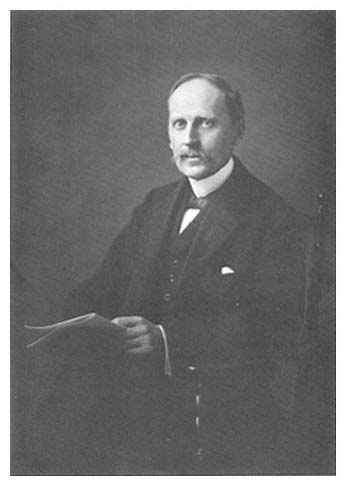
Portrait of Romain Rolland at about the age of forty.
Romain Rolland on the balcony of his Left Bank apartment
in Paris during the time he was writing Jean-Christophe .
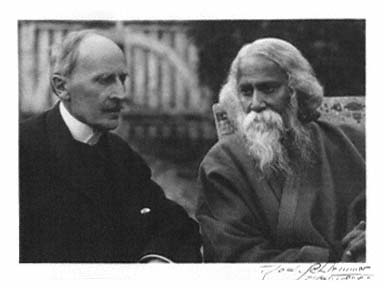
Romain Rolland with Rabindranath Tagore
in Villeneuve, Switzerland, 1926.
Romain Rolland with Stefan Zweig, his Viennese
biographer and friend, Villeneuve, Switzerland, 1933.
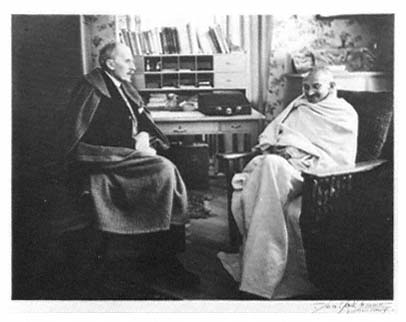
Photograph of Romain Rolland with Mohandas
Gandhi, Villeneuve, Switzerland, December 1931.
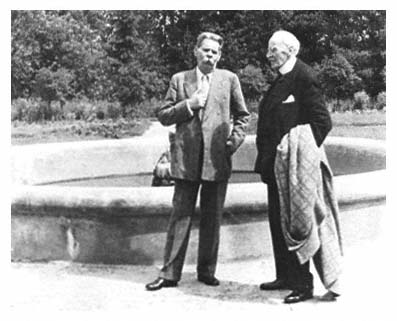
Romain Rolland with Maxim Gorky, in the vicinity of Moscow, July 1935.
Romain Rolland with Nikolai Bukharin and Otto Schmidt
during his visit to the Soviet Union, summer 1935.
Romain Rolland and Madame Marie Romain Rolland with
Maxim Gorky at the Moscow railroad station, July 1935.
stance during the First World War.[13] His introduction of Gandhi and his dissemination of the nonviolent political philosophy further reinforced his stature. He was a paternal figure and pioneer with unassailable pacifist credentials, an authority within the anti-war movement. Pacifists regarded him with affection, even if they were unaware of his latest position. They repeatedly asked him to clarify internal disputes and external dilemmas; to write interventions, petitions, declarations, manifestos, prefaces; and now and then to contribute money to rescue a failing antiwar periodical.[14] Romain Rolland debated continuously in the interwar era with pacifist intellectuals along the entire spectrum of pacifist sentiment and ideology—educators, mothers, scholars, Tolstoyans, anarchists, Christians, and advocates of disarmament and conscientious objection.[15]
Romain Rolland seldom missed an opportunity for a symbolic gesture to oppose war or to deflate the arrogance of the militarists. When the Chamber of Deputies passed a conscription law in the spring of 1927, and French right-wing Socialists such as Joseph Paul-Boncour collaborated in supporting the bill, he published a blunt oath of conscientious objection. The worst oppression of all was the militarization of intelligence by the state:
The monstrous project of military law, audaciously camouflaged by the warmongering pacifist verbiage of several Socialists, and voted by sleight of hand at the French Chamber, last March 7 [1927], claims to realize what no imperial or Fascist dictatorship has yet dared to accomplish in Europe: the entire slavery of a people from the cradle to the tomb.
I swear in advance never to obey this tyrannical law.[16]
In "The Duty of Intellectuals Against War," he again advocated intellectual independence from institutions and parties. Intellectuals were exhorted to be "look-out men" for the eventuality of war. Thinkers were enjoined to go beyond impartiality, beyond the "laborious and scrupulous exercise of intelligence." Protest was linked to action.[17]
Romain Rolland was not the first French writer to look to the East for inspiration or consolation or the first to compare the Orient
with a materialistic, declining Occident.[18] He was, however, one of the first French intellectuals to conceive of modern India as a challenge to European political reality and global hegemony. He was drawn to the East because it differed from the violence and cultural stalemate of the postwar West. His meditation on India renewed the spiritual inquiry that had been interrupted by the world war and immediate postwar issues. Romain Rolland's Gandhian phase was, in part, a flight from sociopolitical preoccupations into oceanic metaphysics.
The Orient offered attractive regenerative possibilities for Europe; Indian thought might give receptive Europeans ontological as well as political options, introduce them to an alternative ethical system, encourage them to rethink their discredited values. The otherness of India could assist demoralized Europeans in rediscovering and tolerating their own otherness, thus initiating inner growth without precipitating anxiety or the need to dominate on the part of the Westerner. Romain Rolland's discourse on India emphasized similarities between East and West as well as the traditional contrasts. He discovered an exemplary personality to represent the East: a man of purity and self-sacrifice, a "great-souled" individual who was himself engaged in an epic political experiment. Romain Rolland mythologized Mohandas Gandhi into "the Mahatma."[19]
Unlike earlier Orientalists, Romain Rolland was convinced that European imperialistic domination of India must end. Empire building led to expansionism, imperialist rivalries, bloody suppression of native populations, and ultimately to war. The colonizers imposed their language, educational system, and cultural values on other civilizations. It is difficult to disentangle Romain Rolland's moral and political critiques of imperialism.[20] He recognized that European empires were crumbling and that movements of national liberation would eventually triumph. He hoped that decolonization would not reenact the violence of the colonizing impulse but would contain an explicitly internationalist dimension, rejecting the ethnocentrism of imperialist domination.
Gandhi provided Romain Rolland with a tentative solution to his dilemma as a committed intellectual in the 1920s, an ideological alternative to Bolshevism, and a corrective to postwar European pacifism. No matter that his political orientation was not
pragmatic, or that his cultural writings crossed the boundaries of fiction. Romain Rolland became a self-appointed citizen of the world, mediating between East and West from his exile in neutral Switzerland. In the process he contributed the first documented study of Gandhi and modern India, using largely Indian and British sources.[21]
Romain Rolland's writings on India in the 1920s were not received in a total vacuum. A spate of books by Orientalists had appeared in France.[22] Between February and March 1925 the Parisian periodical Cahiers du mois sponsored an exchange entitled "The Appeals of the East." Twenty-two celebrated writers commented on the interpenetrability of Eastern and Western ideas, taking a position on the "grave peril" or value of Eastern influences on the West.[23]
Although writers such as Henri Barbusse and André Breton argued that interpenetration would be beneficial,[24] most participants adopted the stance of Paul Valéry, a lucid spokesman for the French conservative intellectual establishment:
From the cultural point of view, I do not think that we have much to fear now from the Oriental influence. It is not unknown to us. We owe to the Orient all the beginnings of our arts and of a great deal of our knowledge. We can very well welcome what now comes out of the Orient, if something new is coming out of there—which I very much doubt. This doubt is precisely our guarantee and our European weapon.
Besides, the real question in such matters is to digest . . . . The Mediterranean basin seems to me to be like a closed vessel where the essences of the vast Orient have always come in order to be condensed.[25]
Action Française writer Henri Massis remained hostile to Eastern influences and preoccupied with defending the West against foreign contaminants. His integral nationalistic stand favored the restoration of French will and grandeur, the preservation of its mental, religious, and geographical purity. He alleged that Romain Rolland's interest in Gandhi and Indian culture was politically motivated. Asian idealogues only weakened France, created disorder, and consequently played into the hands of hostile political forces such as Japan, Germany, and the Soviet Union. Receptivity to Eastern culture was nothing less than intellectual treason.[26] In a transparent display of cultural nationalism and contempt for the for-
eign, most of the writers argued that the East had far more to gain from exposure to the West, that East-West barriers were unmodifiable, and that limited exchanges ought to be guided by academics or Oriental specialists, not amateurs or propagandists.[27]
Romain Rolland replied, limpidly, "Where Henri Massis is, Romain Rolland cannot be."[28]
To Romain Rolland, the assertions of most participants in the debate were tinged with superiority and Eurocentrism, proving that French thinkers were rigidly closed to dialogue. They desperately needed an infusion of Eastern sources, and he was prepared to stand alone to promote substantive East-West exchange.[29] He used his connections to publish works by Tagore and to keep abreast of Indian affairs; he opened his home to prominent Indian visitors. He welcomed the works of Hermann Hesse, whose novels (particularly Siddhartha , the first part of which was dedicated to Rolland) irrefutably proved that Europeans could fathom Hindu thought.[30]
In humanitarian appeals during the same period, Romain Rolland attacked French nationalism and promoted Franco-German reconciliation. He responded to developments in Weimar Germany by writing from the perspectives of those suffering, the victims of runaway inflation, hunger, the military occupation of the Ruhr, political arrest, and indiscriminate hatred of Germans. If the French, from their postwar position of strength, failed to redress German grievances resulting from the unjust peace treaty and other punitive policies—failed to be sensitive to the desperate plight of the Germans—they would sow the seeds of German revenge, preparing to reap the next war.[31]
Romain Rolland was introduced to Indian thought in February 1915 in a series of letters from the Hindu writer Ananda K. Coomaraswamy. In becoming the European spokesman for Indian culture, he hoped both to regenerate postwar Europe and to avoid a fatal East-West clash resulting from mutual ignorance and stereotypes.[32]
As early as October 1916, he supported the work of the Nobel Prize—winning poet Rabindranath Tagore, whose 1916 "Message from India to Japan," a denunciation of European imperialism and
the exclusively political and material foundations of European civilization, Romain Rolland addressed hyperbolically as a turning point in world history.[33]
The theme of Asian-European cross-fertilization permeated his thinking on India. In correspondence and discussions with Tagore, Romain Rolland stressed cultural exchange and advised against the imposition of either civilization on the other.[34] He was more concerned with cultural revitalization than with concrete problems of power relations.[35]
Gandhi's heroism contrasted with the absence of visionary leaders in Europe:
That Gandhi's action of twenty years in South Africa has not had more reverberation in Europe is a proof of the incredible narrowness of view of our political men, historians, and men of faith: for his efforts constitute a soul's epic unequaled in our times, not only by the power and constancy of sacrifice, but by the final victory.[36]
An infusion of Eastern ideas might rekindle the old humanist torch. Romain Rolland did not propose to adopt Oriental forms of thought indiscriminately, however; they should be assessed impartially. He entertained high hopes that Europe , the review ostensibly founded under his patronage, would publish such assessments and propagate the ideas, but his hopes were dashed by the editors' refusal to publish Tagore's novel A Quatre Voix . This incident led to a temporary falling-out with Europe , though the "charming novel" was subsequently published by the Revue européenne in 1925.[37]
Romain Rolland first learned of Gandhi through conversations with Dilip Kumar Roy in August 1920.[38] The tentative nature of his defense of nonviolent noncooperation in the second open letter of the Rolland—Barbusse debate, in February 1922, mirrored his tentative knowledge of Gandhi and the Indian struggle for liberation. When asked in August 1922 to write an introduction to the French edition of Gandhi's Young India , he wanted initially to decline. Gandhi's spiritualized nationalism lacked the breadth of his own internationalism. Such important subject matter required more than a superficial treatment. He therefore postponed any writings on Gandhi in order to read about and reflect on Gandhi's mode of thought and action.[39]
With the assistance of his sister, Madeleine Rolland, Romain
Rolland (who neither spoke nor read English) spent the latter half of December and all of January 1923 reading Gandhi's texts. These included Indian Home Rule , articles in Young India , and writings from Gandhi's South African struggles. He was aided by the Indian academic Kalidas Nag, an intimate of both Gandhi and Tagore. Nag, Tagore, and others encouraged him to visit India.[40]
Gandhi and his French biographer had significant affinities. They were of the same generation—Gandhi was born in 1869; Romain Rolland in 1866. Both were influenced by and had corresponded with Tolstoy. Both emerged from their experiences in the Great War with an aversion to violence and warfare.[41]
If Romain Rolland was enchanted with Gandhi's blend of individualism, activism, and morality, he was equally troubled by Gandhi's distrust of science, his nationalism, and his nostalgia for preindustrial times.[42] Fascination far outweighed hesitation, however, and Romain Rolland planned a biographical portrait of the Indian leader modeled on his immensely successful Beethoven (1903). He wrote a short, easily digestible narrative essay centering on Gandhi's life and message, designed to acquaint as many readers as possible with the Gandhian movement. It was first published in three installments in the new Parisian monthly Europe , from March to May 1923, before it was released in book form in 1924.[43]
Gandhi's staunch opposition to oppression, particularly the British colonial variety that Gandhi had encountered both in South Africa and in India, became the connecting thread in the essay. His often indiscriminate attack on Western civilization derived from the brutality of British colonial rule, "written in the blood of the oppressed races, robbed and stained in the name of lying principles." Gandhi associated modernity and progress with domination and simplistically pitted the spiritual East against the acquisitive, technological West.[44]
Romain Rolland found the religious foundations of Gandhism reassuring. He drew on traditional Christian vocabulary to describe Gandhi and his movement, pointing to the similarities between Gandhi and Christ, St. Francis, and St. Paul to reinforce any religious associations the European reader might make. Since the nonmolestation of all forms of life had the standing of a categorical imperative, those who engaged in Gandhian resistance were acting spiritually. "Real noncooperation is a religious act of purification."[45]
Gandhi's methods demonstrated a capacity for tactical flexibility. His political philosophy contained a gradual theory of stages. In his campaigns there was first a concerted effort to work through legal means, employing negotiation and compromise to redress grievances. Only after exhausting legal resources, petitions, newspaper propaganda, and agitation by students, farmers, and the working class did Gandhi permit more disruptive, illegal tactics. Noncooperation moved from one level of resistance to another, increasing the degree of militancy at each level. Its campaigns were highly selective and cautious. Gandhi considered civil disobedience a legitimate but extreme form of noncooperation that should be focused on specific laws. Because personal risk was great and self-control was required of the resister, civil disobedience was applicable only when all other alternatives had been explored and was feasible only for the reliable elite.[46]
The concept of noncooperation was powerful and timely: Gandhi understood that "noncooperation can and must be a mass movement." His refusal to yield to the forces of the criminal state was not an infantile negation but an assertion of India's pride in herself. As Romain Rolland observed: "India had too much lost the faculty of saying 'No.' Gandhi returned it to her."[47] Gandhi appreciated the necessity for political organization and leadership; his strategy was a sophisticated staged program of cultural action employing meetings, demonstrations, fasts, and prayers, as well as music, national symbolism, and traditional Hindu imagery to guarantee maximum political efficacy.[48] Moreover, Gandhi demonstrated a shrewd sense of timing and propaganda and was adept in winning sympathy for his movement, both in India and among progressives in England.
Absolute sincerity of commitment was proved by the persecutions Gandhians suffered in all their campaigns. Gandhi himself had been imprisoned three times by 1923. Gandhism could be distinguished from other political ideologies by the moral restraint built into its doctrine, by the tendency of Gandhian resisters to circumvent power clashes whenever possible. Gandhians viewed their opponents as potential converts, if not allies, and tried to persuade the enemy by demonstrating the "irresistible" moral rightness of their positions.[49]
The most striking example of Gandhi's rejection of political expe-
diency came in February 1922, after the riots at Chauri Chaura. In this small village eight hundred miles from Bardoli province, where Gandhi prepared to launch his mass civil disobedience campaign, a violent confrontation took place on 5 February between his followers and the local police. After provocation by the constables, the crowd retaliated by burning the police headquarters and murdering twenty-two policemen. Learning of the episode on 8 February, Gandhi immediately suspended the Bardoli campaign of civil disobedience. He made this choice against the advice of other Indian political leaders and despite the willingness of the rank and file to carry on with its more assertive action. The English government initially considered Gandhi's judgment an act of folly. It arrested him on 10 March 1922.
Romain Rolland contrasted Gandhi's tactical choice with repressive policies in Europe, including current Bolshevik practices. He stressed the purity, self-mastery, and silent suffering required of the Gandhian resister:
To create the new India, it is necessary to create new souls, souls strong and pure, which are truly Indian and wrought out of Indian elements. And in order to create them it is necessary to form a sacred legion of apostles who like those of Christ are the salt of the earth. Gandhi is not, like our European revolutionaries, a maker of laws and decrees. He is the molder of a new humanity.[50]
Gandhi had generated a powerful momentum within the ranks of his movement. It is unclear how far this movement could have gone in 1922. As a contemporary commentator, Romain Rolland understood that the initiation and abrupt halt of the Bardoli campaign crystallized the ambiguities at the core of the Gandhian movement.[51] Nevertheless, he congratulated the Mahatma on his choice, thereby underlining the precedence of the spiritual over the political in his mission: "The history of the human conscience can point to few pages as noble as these. The moral value of such an act is exceptional. But as a political move it was disconcerting."[52] If Gandhi's acceptance of personal responsibility for the Chauri Chaura episode was naive, his penitential fast was a magnanimous gesture of legendary proportions.
The balance sheet of the biography was mixed. Though conceived in the genre of haute vulgarisation , it was not simply hagiography or
propaganda. Gandhi's opposition to science and technology and his exaggerated hope in cottage industries were historically regressive, a feature of Gandhi's messianic approach to immediate conflicts. Other policies recalled the cloister of medieval monks, most particularly his xenophobic attitude toward other cultures. Romain Rolland had not visited India or learned its languages. But his writing on Gandhi proved that civilizations could interpenetrate.[53]
He also disapproved of Gandhi's puritanical outlook. The severe restrictions on sensual gratification and abstention from sexual intercourse were reminiscent of St. Paul's hostility toward the body.[54] Gandhi's personal saintliness did not obliterate the erotic and aggressive urges of less disciplined men and women. Because of his own freedom from "the animal passions that lie dormant in man," or perhaps because of his overcompensation for them, Gandhi denied the human potential for violence, including violence to self.[55] His answer to perennial reliance on cruelty was an exceptionally high standard of behavior. Conspicuously lacking the redeeming features of their master, many of Gandhi's disciples had vulgarized the doctrine, substituting discipline for idealism, dogma for principles, and above all narrowness for Gandhi's emphasis on the attainment of truth through experimentation.[56] Romain Rolland noted the aggression in much of the discourse of nonviolence: "Tagore is alarmed and not without reason at the violence of the apostles of nonviolence (and Gandhi himself is not exempt from it)."[57]
Not without disclaimers, his portrait underscored that Gandhi's message to the world was as urgent as it was great. Whether that message was peace, noncooperation, nonviolence, or voluntary self-sacrifice, Gandhi recaptured the full potential of Indian liberation. If his successes were studied and his techniques emulated in other battles against oppression, India's special message might be extended to the peoples of the world. His political instrument was equally the most humane technique known to history: nonviolence. For the biographer, Gandhism symbolized a universal hope and a political alternative to the pervasiveness of force in the West. It could give to the demoralized pacifists a vigorous faith and an experimental tactic for change. Taken by the immense power of the doctrine, Romain Rolland announced his own conversion to the principles of Gandhian nonacceptance. Anticipating scorn from the left and right, he asserted that Gandhi's methods had proved their value for
the social battles to come. The real enemy in the nonviolent struggle was the resister's personal weakness and lack of conviction:
The Realpolitikers of violence (whether revolutionary or reactionary) ridicule this faith; and they thereby reveal their ignorance of deep realities. Let them jeer! I have this faith. I see it flouted and persecuted in Europe; and, in my own country, are we a handful? . . . (Are we even a handful? . . . ) But if I alone were to believe, what difference would it make for me? The true characteristic of faith is—far from denying the hostility of the world—to see and believe in spite of it! For faith is a battle. And our nonviolence is the toughest struggle. The way to peace is not through weakness. We are less enemies of violence than of weakness. . . . Nothing is worthwhile without strength: neither evil nor good. Absolute evil is better than emasculated goodness. Whining pacifism is fatal for peace: it is cowardly and a lack of faith. Let those who do not believe, or who fear, withdraw! The road to peace is self-sacrifice.[58]
In "Gandhi Since His liberation," Romain Rolland stressed the strengths of Gandhi as an adversary of British imperialism and of nonviolence as a political weapon. This piece informed European readers of Gandhi's two-year imprisonment, the rupture of his direct influence on Indian politics, and his subsequent release on 2 February 1924. Gandhi had elaborated a four-part program for national independence and social reform, the objectives of which were (1) work toward Indian home rule through the unity of Hindu and Moslem factions; (2) spinning as a remedy to Indian pauperism and as a pragmatic way to extricate India from economic dependence on Britain; (3) the disappearance of Untouchability; and (4) the methodical application of nonviolence in both propaganda and deed, including civil disobedience as a last resort. Gandhi opposed the British government and struggled against imperialism, while distinguishing between the English people and their administrators. He also realized that while colonization had ruined India's economy, decolonization would cause hardships on British industrial workers in Manchester: "A Gandhi is one of the very rare men capable of rising above the interests of individual parties in struggle and of wanting to seek the welfare of both."[59]
Romain Rolland's "Introduction to Young India " revised the point of view of the biography. The Gandhi presented here is decidedly more Mazzinian, complex, tragic, and ultimately more revolutionary than in the earlier portrait. "Nonviolence . . . in other words the
political nonviolence of the Non-cooperator [is] a reasoned method of peaceful and progressive revolution, leading to Swaraj , Indian Home Rule." He underlined the interlocking role of experimentation and direct action in Gandhi's politics. However, those who opted for class struggle and violence were also engaged in an experiment. Without judging which experiment was more viable for India or applicable to Europe, the French writer urged the partisans of violence to be "honorable" and "unhypocritical" in elaborating their strategy and tactics. Feeling an affinity between communists and Gandhians, he refused to dismiss the courage and idealism of violent revolutionaries: "Between the Mahatma's nonviolence and the weapons of revolutionary violence there was less separation than between heroic noncooperation and the sterile ataraxia of the eternal acceptors."[60] Satyagraha, insistence on truth, was based on the laws of active love and voluntary renunciation. Gandhi was different from passive, sentimental, "nerveless" European pacifists. Romain Rolland now emphasized the rational and accessible nature of the Mahatma's message, as well as the mystical side. The doctrine was also experimental: "But we must dare. Gandhi dares. His audacity goes very far."[61] Gandhism was characterized as an open-ended struggle, full of dangers for the half-believer, unsuitable for the individual who could not endure extended periods of self-discipline. "Nonviolence, then, is a battle, and as in all battles—however great the general—the issue remains in doubt. The experiment which Gandhi is attempting is terrible, terrifyingly dangerous, and he knows it."[62]
Romain Rolland's essays on Gandhi illustrated the positive attributes of the Mahatma's character and the wide possibilities of organized nonviolence. The point of view is best understood as noncommunist; Bolshevik and Gandhian methods were compared in just three brief allusions in the biography.[63]
As with his other biographies, he spent approximately six to eight months researching Gandhi's life and only three weeks composing the text. His small volume on Mahatma Gandhi sold extremely well in France (thirty-one printings in three months, at least 100,000 copies in the first year) and was translated into Russian, German, English, Spanish, and three Indian dialects by 1924 and into Portuguese, Polish, and Japanese by 1925. The critical
reception in Paris was apathetic.[64] By 1926, nevertheless, a fiftieth printing was published. The biography was clearly a best-seller.
The French communist reaction to his introduction of Gandhi was politically inconsistent. In the midst of the Romain Rolland-Barbusse debate, the communist author Ram-Prasad Dube focused on the social aspects of Gandhi's movement in India, drawing a parallel between Gandhism and the European anarchosyndicalist movements. He praised Gandhi's expertise in propaganda and agitation and his willingness to engage the mass movement in illegal tactics but predicted that Gandhi's politics of concession to authority and the perfection of the individual would ultimately fail. Gandhi would be remembered chiefly as the initiator of the first stage in India's social revolution.[65] One year later, L'Humanité published a far more critical article by the Indian Marxist revolutionary and representative to the Comintern, M. N. Roy. Roy held that the Gandhian movement was socially suspect, composed of members of the "reactionary petite bourgeoisie." It was neither anti-imperialist nor committed to complete Indian independence. To harness the energy of the "revolutionary spontaneity of the masses," an indigenous Communist Party was necessary. Roy looked to the Indian leader C. R. Das to provide the Indian left with leadership and a radical direction. The country simply could not afford to become captive to Gandhi's moralism and theology.[66] Later, in March 1923, L'Humanité published an editorial signed by the executive committee of the Communist International. While condemning British imperialism and their fierce reprisals against the Indians for the Chauri Chaura incident, the statement carefully excluded criticism of Gandhi or his movement.[67]
Romain Rolland's portrait of Gandhi triggered a clever, if inaccurate, rejoinder by Henri Barbusse that blurred the political and ideological antagonism between Gandhism and Bolshevism. Following the pattern of the earlier polemic, Barbusse's article "Eastern and Western Revolutionaries: Concerning Gandhi" praised the spirit in which Romain Rolland wrote his essay. Although it opened communications between Europe and Asia, his "magisterial and lyrical study" of Gandhi nevertheless misrepresented the formal opposition between Gandhi's doctrine and that of Western revolutionaries. Barbusse asserted that Gandhi belonged on the side of the Third International. His intransigence, utilitarianism, and practicality indi-
cated that "Gandhi [was] a true revolutionary."[68] As a pragmatic idealist with a realistic understanding of Indian political constellations, Gandhi, without being aware of it, was "very close to the Bolsheviks."[69] His verbal vilification of communism resulted from his unfamiliarity with Marxist doctrine and misinformation about communism in the Soviet Union.
In Gandhi's activities as a popular leader and his defense of the working and agricultural masses of India, Barbusse found a form of class struggle.[70] Noncooperation was irrefutable revolutionary activism, not passivity. Gandhi's ability to suspend his movement at a crucial moment after the violence of Chauri Chaura only dramatized the immense authority of the Mahatma over 300 million Indians.[71]
Barbusse emphasized that nonviolence was merely a provisional tactic.[72] If Lenin had been in India, he too would have spoken and acted as Gandhi did: the two "are men of the same species, prodigious characters, who know how to measure for and against."[73] The spectacle of the Indian masses agitating for their sovereignty shared many similarities with the Russian experience. Gandhi's goals were identical to those of Lenin's, namely, a society in which privileges would be eliminated, where people could live a peaceful, egalitarian life. Their methods were alike: "Lenin is for constraint—and Gandhi also."[74]
Gandhi would evolve closer to the Communist International's concept of a professional, socialist revolutionary. His grasp of the value of organization, leadership, and discipline added to his intimacy with the Indian popular multitudes did not contradict contemporary communist teachings. The only significant contrast between communism and Gandhism was Gandhi's patriarchal attitude towards labor, a residue of his repudiation of industrialization.[75]
Barbusse's article ended with a critique of Romain Rolland and Tagore. These "marvelous and admirable artists" telescoped social issues into individual categories. They overemphasized "moral values." The idealist hand Romain Rolland had extended to the East had to be politicized, by bringing the Eastern and Western revolutionary movements into closer contact. Gandhi himself was invited to participate in the "Left International" to guarantee the proliferation of his thought.[76]
On reading the first communist articles on Gandhi, Romain Rolland was moved to laughter. The slogan "petit bourgeois" was
abusive enough with reference to the Gandhian movement, but this "tarte à la crème of Communist language" took on a thoroughly ridiculous savor when applied to India. Because India's social structure was fundamentally agricultural, Marxist phraseology obscured more than it explained. There could be no "possible analogy" between the politics and class structures of Europe and Asia. Communist polemicists used "sleight of hand" to debunk Gandhi while overestimating the significance of the Indian communist movement.[77]
The second series of communist articles by Barbusse and the Indian Bolsheviks devalued the "true and holy grandeur of Gandhi." Unable to arrive at a consistent line on Gandhi, the communists presented contradictory theses that would only confuse the European audience. On the one hand, the communists characterized Gandhi as a religious utopian, a "chimerical being without practical intelligence." On the other hand, they portrayed him as "a prudent Bolshevik who use[d] nonviolence as a provisional expediency."[78]
Romain Rolland was equally disturbed by information he received from Russian friends about Soviet overtures to Gandhi, directed by M. N. Roy and other Indians of Bolshevik persuasion. If Gandhi were sufficiently informed, he would perceive the underlying opportunism that motivated these gestures. Under no circumstances should Gandhi be deceived and manipulated by the Bolsheviks. There was a fundamental antagonism between nonviolent and communist tactics as well as between the basic philosophies of the two doctrines. He alleged that the Bolsheviks desired a political alliance with the Gandhians to prop up their own power base in India. In the end, the communists had contempt for nonviolence and would either attempt to subvert it or crush it entirely.
Romain Rolland's intention was to introduce and transmit Gandhi as an independent thinker, without linking him to an existing social movement or political party.
I admire the intelligence and energy of the Bolshevik government; but I feel a profound antipathy for its means of action; they totally lack frankness. Its politics is to utilize, in its struggle to destroy the present European system, all the great forces opposed to European imperialism, even if these forces are also opposed to the system of Bolshevik oppression and violence. . . . Certainly I prefer Moscow
to Washington, and Russian Marxism to American-European imperialism. But I claim to remain independent of one as of the other. "Above the Battle!" The Civitas Dei, the city of nonviolence and of human Fraternity, must refuse every alliance, every compromise with the violent partisans of all classes and all parties.[79]
Romain Rolland was alarmed by the deliberate communist distortions of the spirit, internal dynamics, and goals of the Gandhian movement. They interfered with his own efforts to disseminate the Mahatma's message from a spiritual perspective consistent with the central foundations of the nonviolent movement. He urged C. F. Andrews, a British missionary and friend of Gandhi, to warn Gandhi about self-serving communist efforts to make procommunist propaganda within the Gandhian movement. Indian communists would infiltrate the nonviolent rank and file. Gandhi might also be invited to visit the Soviet Union and Germany. Above all else, he urged Gandhi to distinguish clearly his movement's motivations and aims from those of the Communist International.[80]
Gandhi acted directly on Romain Rolland's warning, delivered through Andrews. In his article entitled "My Path," published in Young India on 11 December 1924, he implicitly endorsed Romain Rolland's "Western" assessment of his doctrine and dissociated himself from communist interpretations. "It is my good fortune and misfortune to receive attention in Europe and America at the present moment." The good fortune was that his doctrine was made more accessible. But "a kind European friend has sent me a warning . . . that I am being willfully or accidentally misunderstood in Russia." The friend discreetly left unnamed was Romain Rolland. The biographer was now playing advisor, urging the subject of his biography not to be duped by the communist Machiavellians. Gandhi denied that he planned to visit the "great countries" of Germany or Russia. India was the main stage of his social experiment and "any foreign adventure" would be premature until his movement had succeeded in his native country. The Mahatma added that he was unsure of the precise nature of Bolshevism. "But I do know that insofar as it is based on violence and denial of God, it repels me. . . . There is, therefore, really no meeting ground between the school of violence and myself."[81]
Romain Rolland breathed a sigh of relief when he learned of Gandhi's categorical repudiation of Bolshevism in Young India .
That article ended the equivocation about the real nature of the nonviolent movement and terminated the hypocritical game of the pro-Soviet communists. Yet Romain Rolland regretted one aftereffect of Gandhi's statement—its manipulative use by the reactionary European press. The Parisian daily Le Matin exploited Gandhi's article as yet another weapon in their anticommunist crusade.[82]
Gandhi had made a powerful impact on Romain Rolland by the summer of 1924. Still strongly attached to his intellectual independence, the French writer felt obliged to make public statements not only to "relieve his conscience" but also to defend noncooperation, which he identified with a politics transcending party, class, nation, and force. He wrote: "It is clear that Gandhian noncooperation as an example will lead its apostles in Europe to sacrifice without any practical result—and perhaps for a rather long time. It is not less true and good in an absolute fashion; and it is the sole means of salvation for human civilization."[83]
During the period from February 1924 to September 1925, two significant events considerably affected Romain Rolland's relationship to Gandhi. The first was a postcard he sent to Gandhi excusing himself for inadvertent errors in his short biography.[84] This gesture initiated a unique epistolary friendship between the two that lasted until 30 December 1937. Second, he wrote a letter of introduction for a young Englishwoman, Madeleine Slade, asking Gandhi to accept her into his ashram. After reading his biography of Gandhi, she was converted to the Mahatma's philosophy, thereby discovering her life's mission. Slade not only became Gandhi's close disciple, but also remained the intermediary between Romain Rolland and Gandhi throughout the entire interwar period.[85]
Gandhi praised Romain Rolland's essay both for containing so few factual errors and for having "truthfully interpret[ed] my message."[86] Gandhi again expressed his satisfaction with the biography: "Tell M. Romain Rolland that I will try to live up to the high interpretation that he has given my humble life."[87]
Romain Rolland's idealization of Gandhi was bound to lead to disillusion. For ten years the personal contacts between Gandhi and his French biographer were marked by geographical distance, cordiality, and mutual respect, but also by consistently different conceptions of the world and their historic missions. Gandhi and Romain Rolland met only once. In truth, they had little in common.
Madeleine Slade mediated between Romain Rolland and Gandhi (the Mahatma neither read nor spoke French). Gandhi wrote letters of introduction to Romain Rolland for many of his colleagues and disciples traveling in Europe. They exchanged letters on birthdays. Romain Rolland often wrote before and after Gandhi participated in fasts, prayers, and marches or entered life-threatening periods of imprisonment.
Throughout this time, there were serious tensions between the two. Romain Rolland vehemently clung to his vocation of free-spirited intellectual. Gandhi did not see himself as a theoretician but rather as a popular Indian guru, devoted to his own brand of political and religious action. Gandhi's contribution to a festschrift for Romain Rolland's sixtieth birthday in 1926 stressed his own difference from his biographer. He wrote that he was not a man of letters and did not know a great deal about the French Nobel laureate. He also referred to Romain Rolland as "my self-chosen advertiser"—a distancing and slightly denigrating term.[88]
Romain Rolland emphasized his separation from the Mahatma's movement. He refused to become an official spokesman for Gandhi in Europe: "I am not a Christian, I am not a Gandhian, I am not a believer in a revealed religion. I am a man of the West who, in all love and in all sincerity, searches for the truth."[89] His motives in writing about Gandhi were personal; he felt called on to "relieve his heart." He wrote out of love, to present the Gandhian message to Europeans, alerting them to the possibility of a free and joyous choice. Wounded by the offhand remark Gandhi made about his biography (he supposedly said that it was "literature"), Romain Rolland countered that it was "not written for 'literature' (The littérateurs scarcely consider me as one of them)."[90]
In his private diary, the converted Romain Rolland entertained doubts about the realistic possibility for Gandhian nonacceptance being applied in Europe as early as November 1926. Nonacceptance could only be practiced by an elite corps of "apostles and martyrs." The faith required a well-trained, tightly disciplined band of self-abnegators. Nonacceptance might subvert the modern state if practiced over a long period of time, but in Europe only a minority of conscientious objectors possessed this faith, with the courage to sacrifice their lives, families, professions, and personal welfare for principles. To practice war resistance in an era of fascism and rearma-
ment was to risk persecution. Conscientious objectors would be harassed and punished. He observed that even Gandhi practiced his doctrine inconsistently, lacking the spiritual hardiness attributed to the early Christians.[91]
Europe could not survive without peace. But European pacifists were obliged to connect their antiwar activity to a larger effort to "revise the values of life." Gandhism represented a cultural revolution that might assist them to reevaluate politics, morality, and social attitudes by beginning with the self. Romain Rolland's pacifism, although it contained critical components, was essentially positive and character building. That is why he so deeply appreciated the sentiments of Spinoza's Political Treatise .[92] By the middle and late 1920s he recognized that the religious and political climate of Europe was "unsuited" for Gandhi's heroic experiment.[93] Non-violence promised salvation, but it had no roots in the industrial, secular, materialist West—especially in Latin Europe.
Their correspondence often debated Gandhi's views on war resistance. They had a brief controversy about two French peasants who resisted World War I and retreated into the mountains for thirteen years. The Mahatma refused to discuss the case in Young India . Romain Rolland, for his part, judged Gandhi's response to their action harsh and puristic.[94] This, in turn, gave rise to a more acrimonious exchange about Gandhi's role during the Great War, both his support of the British Empire and his active participation in the war. The French writer was dissatisfied with Gandhi's rejoinder in his Autobiography .[95] There were instances of "doctrinal narrowness" in Gandhi's message and a growing number of personal inconsistencies. Gandhi's justification of his activities during the Great War was not convincing; the Mahatma should have adhered to the strategy of individual civil disobedience.[96]
Romain Rolland urged Gandhi to visit Europe in the late 1920s to tell the anti-imperialist version of the struggle (Europeans usually heard only the viewpoint of the British Empire) and to enter into direct contact with other oppressed peoples.[97] On Gandhi's sixty-first birthday in 1930, he referred to Gandhism as a unifying "revolution of the spirit, . . . the refusal hurled by the proud soul against injustice and violence. . . . This revolution does not breed opposition between races, classes, nations, and religions; it brings them together."[98]
By 1931, Romain Rolland was writing more stinging indictments of European imperialism, largely in response to the social crisis engendered by the world depression. The language of pacifist engagement in the 1920s gave way to the revolutionary language of the 1930s. Europe's only hope, he exclaimed, was for a "complete reversal of the social order." Capitalist imperialism had to be toppled and replaced. Since Gandhism contained a revolutionary potential, he issued calls for a nonviolent revolution with Gandhi as leader.[99]
The warmth of their relationship peaked during Gandhi's five-day visit to the French writer's villa in Villeneuve from 6 December to 11 December 1931.
Historians have trivialized their conversations at this time by dwelling on the circus atmosphere that followed Gandhi's entourage (even Romain Rolland viewed ironically the incongruous assortment of nudists, vegetarians, crazies, lottery-card holders, and peasants bringing milk to the "King of India," who converged on his villa).[100] Most accounts mention the music and the metaphysics.[101] In fact, they discussed the political and economic crisis of Europe and the urgent necessity for Gandhi to clarify his views on social questions. Romain Rolland viewed Europe's malaise as deriving historically from the rivalries and expansionism of international capitalism. He asked Gandhi what options nonviolence posed for Europeans in the face of this crisis.[102] Rolland observed that nonviolence could work only if the resisters shared a common religious belief system. Nonviolence also required visionary leadership and a broad base of followers. For nonviolence to succeed in Europe, the organized workers in factories and arsenals would have to be mobilized. Workers, he alerted Gandhi, were already politicized, and many were inspired by events and the example of the Soviet Union. Most organized French workers were class conscious and prepared for class struggle, which might include violent confrontations. He pressed Gandhi for clarification of his perspectives on Italian fascism (Gandhi had chosen to visit Italy after leaving Switzerland), but above all on the clash between capitalism and the labor movement.[103]
Gandhi did not consider the antagonisms of labor and capital essential. If a collision occurred, he favored organized labor. The methods of satyagraha could be employed against capitalists, as he
had demonstrated in India. Gandhi appeared insensitive to the plight of unemployed workers in England and in industrialized countries: "In England's case the unemployed have not many reasons to complain of the capitalist." He seemed ignorant about developments in Russia. Without having studied the facts, he stated that he was distrustful of the USSR; that he associated communism with violence, arbitrariness, intolerance, and terrorism; and that he was unequivocally opposed to the dictatorship of the proletariat.[104]
In summary, Gandhi's visit had a mixed impact on Romain Rolland. He still revered Gandhi as a man, admired his sense of humor, stamina, leadership qualities, and self-control, but he felt removed from him. At times it seemed that they had nothing to discuss, that the formidable differences in their sensibilities, lifestyles, and cultural politics were unbridgeable. He was dissatisfied with Gandhi's faulty knowledge of pacifist and left-wing politics in Europe and deeply disturbed by the Mahatma's planned trip to fascist Italy. Most significant, he reluctantly endorsed Gandhi's positions on labor and class struggle.[105]
Italian fascism was a controversy, an embarrassment, and finally an impasse in Romain Rolland's relations with Gandhi. After being Romain Rolland's guest in Switzerland, Gandhi visited Italy for four days from 11 December to 15 December 1931. Gandhi's trip to fascist Italy repeated Tagore's Italian fiasco of 1926, with its elements of farce and tragedy. The French writer tried to persuade the Mahatma not to risk traveling in Italy. If he were foolish enough to go, he should take precautions against being "swindled" by the unscrupulous regime. He was entirely unsuccessful in explaining to Gandhi the symbolic dangers of visiting a fascist dictatorship in Europe, but it was contrary to his style to veto Gandhi's trip. Gandhi made only one concession to Romain Rolland: he resided with the independent General Moris, declining shelter from the official fascist establishment.[106]
Gandhi had been invited to Italy by the Italian consul to India. The Indian leader delivered a short address at the Institute of Culture in Rome. Ostensibly, Gandhi was motivated to visit Italy by his unabashed curiosity, his empirical desire to test out and observe Italy's political and social context for himself. Gandhi also asserted, somewhat self-righteously, that as a messenger of peace his presence in Italy would ultimately have a constructive effect on
the Italians. In Gandhi's words: "The distant effect of a good thing must be good." Before entering Italian territory, he requested that no secret meetings be held and that he be permitted to speak his mind freely in public. Gandhi's contact with Mussolini's Italy may have signaled to the British his bitterness after the collapse of the Round Table Conference designed to discuss Indian independence and the safeguarding of minorities in India. The prospect of India establishing friendly relations with Italy may have given pause to the ruling echelons in England. In reality, Gandhi's four-day trip to Italy involved a number of incongruous activities. He toured the Vatican museums but was denied an audience with the Pope. He met with Maria Montessori and visited two of her experimental schools. He had an appointment with Tolstoy's granddaughter. He also had an interview with the new secretary of the Fascist Party of Italy, Achille Starace. And last, he was received by Mussolini for twenty minutes in the duce's office.[107]
Although Gandhi's historical reputation was not irreparably damaged by the visit to Italy, it had immediately disastrous repercussions for the triple causes of world peace, anti-imperialism, and resistance to social injustice. Romain Rolland accurately predicted that the fascist press would misrepresent or suppress the content of Gandhi's public statements. The newspaper Giornale d'Italia quoted Gandhi as sympathetic to fascist opinions, alleging that he sanctioned the use of violence. Fascist press reports of his speeches simply deleted the "non" from the word "nonviolence." With the peaceful and loving components of his statements removed, Gandhi's critique of the British Empire seemed more menacing than he intended. The trip to fascist Italy tarnished his prestige among pacifists and leftists in France and Great Britain. Far more insidious was the effect of Gandhi's presence on thousands of oppressed antifascist Italians, both in and out of Italy: "Anything of this nature in Italy would be harmful to the Italians. People would say: 'The great saint is with the oppressors against the oppressed.' "The antifascist emigrés clustered around La Libertà in Paris reported that Gandhi's trip to Italy was marked by "ingenuousness."[108] Gandhi's misinformation about the degrading policies of the Italian government angered his French biographer. He began to reappraise the incisiveness and efficacy of Gandhism in the face of international fascism.
Unable to convince Gandhi that the "true face of Fascism" was
murder and repression, Romain Rolland predicted that nothing worthwhile would result from Gandhi's trip. "I should have said to him: Well, then, you will not go. At no price ought you to shake hands with the assassin of Matteotti and Amendola."[109]
Gandhi, in fact, had been favorably if somewhat ambivalently impressed by Mussolini. Europeans should suspend judgment on Mussolini's "reforms," he thought, until an "impartial study" could be carried out. Although Italy was repressive, its coerciveness paralleled other European societies that were also "based on violence." There was merit, Gandhi held, in Mussolini's programs against poverty, his opposition to "superurbanization," and his corporate efforts to harmonize the interests of capital and labor. Moreover, behind Mussolini's implacable facade and his oratorical flourishes, Gandhi detected an "inflamed sincerity and love for his people," as well as a disinterested desire to serve his country. The Italian people were inspired by the duce—this accounted for Mussolini's vast popularity.[110] Gandhi subsequently told several Indians leaving for a European trip that there were two Europeans worth knowing: Mussolini and Romain Rolland—a distinction his antifascist French biographer ironically recorded but hardly appreciated.[111]
Romain Rolland was incensed by Gandhi's impressions of fascist Italy; they were "hasty," "erroneous," and "careless." He challenged Gandhi's capacity to assess the popularity of the fascist regime, given his short stay; his ignorance of the Italian language, history, and culture; and his failure to meet opponents of the government. Gandhi was astute at reading progressive British opinion and politics, but he seemed oblivious to the dynamics of fascism and to the abuses of organized state violence. The hidden Italy was a wounded country, best represented by the enemies and victims of fascism, that is, by those men and women silenced by lies, mystified by "bread and circuses," and brutalized by police terror. Gandhi knew nothing of deported Italians doing forced labor on volcanic islands off the coast of southern Italy. He had no idea of Matteotti's widow, hounded by the fascist secret police. Gandhi's insensitivity to the "moral sufferings" of the majority of the Italian people was shocking. Romain Rolland refuted Gandhi's rationalizations for Mussolini's policies by differentiating between Western countries. To say that all Western democracies were coercive was sophistic and ahistorical.[112]
Gandhi misunderstood that fascist violence had a bureaucratic apparatus and ideological legitimacy not to be found in the Western democracies. The various "crimes" of the duce's regime included state-ordered executions. Mussolini suppressed civil liberties. He systematically destroyed the Italian Labor Confederation, popular libraries, and the socialist municipal councils. He decimated the Italian Socialist Party, an act of vindictive revenge, for Mussolini had served as the second-ranking official of that party. He brutalized the Italian peasantry, exacerbating the divisions between north and south. Gandhi was mistaken to see Mussolini as a protector of the Italian people; he should not have swallowed the duce's self-aggrandizing rhetoric at face value. There was no self-abnegation, no ascetic ideal, among the Italian Fascist Party leadership. Rather, they were arrivistes committed to amassing personal wealth, imposters who craved domination. Mussolini's regime consisted of a "band" that "pillaged the State treasury and gorged [themselves] with millions." Romain Rolland pointed out that the symbiotic connection between fascist leadership and big business was explicitly expansionist and imperialistic. It would eventually push Italy into wars and into efforts to suppress underdeveloped countries.[113] A responsible political personality was obliged to support the antifascist cause.
Romain Rolland's preoccupation with Gandhi became the point of departure for another line of inquiry—Hindu mysticism. His biography of Gandhi was subtitled "The Man Who Became One with the Being of the Universe." By the late 1920s, he entered a period of scholarly researches on intuition, musical genius, and the nature of oceanic religiosity. The products of Romain Rolland's "journey within" were his autobiographical Le Voyage intérieur: Le Périple (1946); his multivolume biography of Beethoven, Beethoven: Les Grandes Epoques créatrices de l'Héroïque à l'Appassionata (1928) and Goethe et Beethoven (1930); and his three-volume study of Indian spirituality, Essay on Mysticism and Action in Living India: The Life of Ramakrishna (1929) and The Life of Vivekananda and the Universal Gospel (two volumes, 1930).[114]
Romain Rolland's immersion in mysticism plunged him once more into the oceanic current underlying his artistic sensibility. His period of intellectual disengagement culminated with the biographies of Ramakrishna and Vivekananda. There could be no greater
flight from social and political reality than these introspective autobiographical works, nothing more meditative than these volumes on Hindu mysticism. But even these works were designed to overcome the contemporary European ignorance of Eastern religious thought by paralleling common experiences of the divine. He combated the unbridled rationalism and scientism to which the twentieth-century mind was heir, claiming "the sovereign right of the religious spirit—in the true sense—even and especially outside of religious institutions, in every profound and impassioned movement of the mind."[115] While working on Hindu mysticism, Romain Rolland engaged Sigmund Freud in a controversy over the origins and meaning of the oceanic sensation.[116]
For Romain Rolland, the connections between Indian mysticism and the music of Bach and Beethoven, German idealism, the principles of the French Revolution, and the metaphysics of Spinoza irrefutably demonstrated the unity of human nature. The oceanic sensation allowed him to think himself into the minds of people and cultures different from his own. The oceanic feeling was the imaginative source and the deep structure of access to others and the world. It allowed him to grasp intuitively the larger connections the individual experienced in relationship to culture.[117]
After returning to India, Gandhi was arrested, led an unsuccessful campaign against Untouchability, and conducted fasts and marches. Romain Rolland kept the French reading public informed of these events by writing a total of nine reports, a serialized "Letter from India," published in Europe .[118] The British repression of the noncooperation movement made Gandhi seem to him a revolutionary martyr, a partisan of labor against capital.[119] He argued that a social revolution was imperative in Europe, and he predicted that such a revolution would follow either the Leninist or the Gandhian model. He held that violence and nonviolence, communism and Gandhism, were not necessarily incompatible—at least among sincere practitioners and in terms of the desired goal. He saw himself as the mediator between the pro-Soviet and pro-Indian camps in the period 1931 to 1934:
In the eyes of thousands of men who at the present moment consider it intolerable to maintain the present capitalist and imperialist society and who have resolved to change it, the great and ambitious Indian experiment with Satyagraha is the only chance open to the
world of achieving this transformation of humanity without having recourse to violence. If it fails, there will be no other outlet for human history than violence. It's either Gandhi or Lenin! In any case, social justice must be achieved .[120]
In April 1934, Romain Rolland definitively broke with nonviolent noncooperation as a tactic for revolution or resistance in contemporary Europe. The reason for the change was the historical ascendancy of fascism. Satyagraha having no realistic chance for victory in a Europe saturated by fascist movements, he switched his loyalties to the struggles of organized labor. Workers, at least, would actively resist fascism and right-wing extremism.[121]
By 1935, Romain Rolland revised his views on Gandhi's leadership of the Indian movement. For social reconstruction in India, the French writer preferred the younger leaders Nehru and Subhas Chandra Bose, who were more coherently socialist and who belonged to the left wing of the Indian Congress Party. Gandhi's sentimental and religious approach to politics no longer corresponded to realities in his own country. Nonviolence was not the "central pivot of all social action." He was particularly upset by the Mahatma's refusal to adapt the principles of socialism for his country. Gandhi's prejudices, his obstinate clinging to received ideas, meant that he was ill equipped to lead India, once it gained its independence, into the modern world.[122] Although he no longer advocated Gandhi's political philosophy and tactics, Romain Rolland always retained enormous respect for Gandhi the man; there was no personal rupture in relations, just distance. Nor did he waver in his judgment of Gandhi's prominence in modern Indian history. His last public statement on Gandhi condensed the ambivalence of his admiration for the man and his refusal to cling to nonviolence "in the face of the growing ferocity of the new regimes of totalitarian dictatorships. . . . We cannot, in this circumstance, advocate and practice Gandhi's doctrine, however much we respect it."[123]
To assess Romain Rolland's engagement as a Gandhian, we should note that his essays accomplished their immediate goals: they disseminated information about Gandhi's struggle in India and they familiarized the European public with the concepts of nonviolence and noncooperation.
From 1923 to 1932, he had harnessed his international prestige
and his gifts as a writer to serve as the European popularizer of Gandhi. His articles, introductions, anthology of Gandhi's thought, and above all his biography transmitted the Mahatma's message in Europe. Romain Rolland presented nonviolent resistance as a concrete third way between Leninism and Wilsonism. By 1923, he was convinced that the revolutionary conjunctures of postwar Europe had passed, that the European reaction had consolidated its gains. He presented Gandhism as a potentially powerful political philosophy, a vision of politics and morality, that allowed both for individual refusal and for collective disobedience. In the European setting, it might provide postwar pacifists a viable model for the organization and structure of a movement, a paradigm for leadership and action. By the late 1920s he considered Gandhism a revolutionary movement of the spirit or soul. By the early 1930s he linked it to the revolutionary strategy and tactics of syndicalism. Civil disobedience and radical trade unionism could work together.
His World War I experience, coupled with his reaction to events in the immediate postwar period, made Romain Rolland psychologically and ideologically receptive to Gandhi's ideas. Motivated by his intellectual curiosity about India, he seized on Gandhism in part to extricate himself from his political bind: isolation, a posture of criticism without the proposal of a constructive program, and, above all, reliance on vague, metaphysical formulas in place of concrete notions of strategy and tactics. He assumed the task of expanding the consciousness of the European intellectual community by introducing Gandhism as a new area of study, a collateral branch of Indian spiritual thought, without compromising his intellectual integrity, and without having to join an established political party. Accepting the precept that no form of knowledge was foreign to the mind, he initiated a process of European acquaintance with Indian culture, personalities, and political conflicts and strategies. His campaign confronted European and particularly French xenophobia. Romain Rolland must be seen as a great challenger of French ethnocentrism.
If Romain Rolland's essays prepared the European public for Gandhi's message and methods, they failed to ask how Gandhism would ground itself in the materialist West. In his enthusiastic effort to demythologize standard East-West stereotypes and to stress unity, he blurred distinctions. He made a leap of faith to
Gandhism, but he did not consider the sources of Gandhian resistance in Europe or the training ground for its leadership.
Gandhi's methods might indicate to European pacifist intellectuals a way out of their impasse. He was painfully aware that members of the French and European peace movements had capitulated to the war in 1914 and after. Pacifists had been weak, contradictory, and unable to transform their theories into antiwar practice in the face of the grave crisis of World War I. Gandhism might provide European pacifists, especially religious ones, with principles requiring self-sacrifice, imprisonment, and even death. Nonacceptance of the state might allow European war resisters to move from isolated acts of conscientious objection to a massive civil disobedience that might ultimately subvert the state. With the Indian model in mind, one could not separate issues of social injustice from the foreign policies of major European powers.
Despite the genuine affection between Romain Rolland and Gandhi, the two were working at cross-purposes, even at the most cordial stages of their relationship. Gandhi's main platform was India: his movement would prove its viability there within the context of the independence struggle. The propagandistic edge of Romain Rolland's essays undoubtedly supplied the Gandhian struggle with an additional lever of prestige and authority. For his part, Romain Rolland seized on the universal aspects of the Mahatma's theory and practice. Though he sympathized with the Indian national liberation movement, he was committed to generating a French and European Gandhian movement—he wanted to internationalize the nonviolent cause. If Europeans did not accept Gandhi as a new spiritual and political guide, his ideas would at least stimulate dialogue among partisans of progressive social change.
Because he never considered systematic thinking a virtue, Romain Rolland was not perplexed by the internal contradictions within Gandhism itself. There was no critique, for instance, of Gandhi's policies when they were patently unreasonable, puristic, or even inconsistent with the dictates of conscience. Romain Rolland subsequently called into question Gandhi's support of the British Empire, as he did his voluntary participation in the Boer War and especially World War I. That the Mahatma had accepted—but transformed for his own purposes—the elementary Hindu allegiance to caste (with the exception of the barbaric tradition of Untouchability),
cow protection, idol worship, and other aspects of traditional Hindu doctrine demonstrated that his political philosophy was inextricably tied to ancient Indian customs. Romain Rolland did not realize that Gandhi's failure to reconsider his attachment to Hinduism would leave India hopelessly backward looking or that Indian religiosity would obstruct the movement's acceptance by Westerners. Moreover, Gandhi's capacity to tap India's spiritual heritage illustrated a tighter grasp of political expediency in India than the idealistic biographer wanted to grant.
Romain Rolland pursued his flight from time by meditating on eternity. Gandhism pushed him toward depoliticization: his trilogy on Indian mystics represented his most disengaged stance in the interwar period. He tended to overlook the limitations of the satyagraha doctrine, which was anti-industrial, nationalistic, and entangled in a mystifying metaphysical web. His failure to visit India prevented him from seeing the stark and overwhelming reality of India's poverty and the ignorance of its populace. Only in the mid-1930s did he sense that Gandhism would never provide India with a complete tool by which to liberate itself from this misery. He never saw noncooperation in practice, hence he never ascertained its finite limits. In his mind it remained a beautiful ideal, something to be striven for and perfected in the future.
Like so many students and advocates of Gandhi after him, Romain Rolland saw in Gandhism what he wanted to see.[124]
He made broad, unsubstantiated claims about nonviolence, especially given the very limited nature of its victory in South Africa and its precarious state in India from 1923 to 1932. By refusing to extract the secular content and political appeal of the nonviolent message, his writings might have unwittingly retarded a mass European acceptance of Gandhi's novel political weapon. He did not initially try to politicize either the doctrine or the audience. At first he had not carefully examined whether the movement was inherently reformist or revolutionary, whether it could be stretched to encompass socialist goals. More important, he blunted the differences between national independence struggles and those involving war resistance and class conflicts in more advanced societies. Although some of the propaganda for nonviolence contained unwarranted rhetorical violence, he never developed a psychological critique of absolute nonviolence that questioned whether nonvio-
lent resisters did emotional violence to themselves through their radical prohibition of the expression of anger.
In Romain Rolland's biography, the Mahatma is deified as a messiah for India and for the world. Gandhian noncooperation with the state became the gospel updated, alternatively described as a new Christianity and a religion of humanity. Gandhi answered his need not only for a splendid spiritual leader but also for a martyr. The British persecution of Gandhi and the violent repression of his movement suggested that he might die violently and soon. History bore out that dreadful premonition. Gandhi was assassinated in 1948, four years after Romain Rolland's death.
The Gandhian stage culminated Romain Rolland's evolution from antiwar dissenter to popularizer of nonviolent resistance. Gandhism was compatible with Romain Rolland's dialectical formula for intellectual commitment: "Pessimism of the intelligence, optimism of the will." Nonviolent resistance fused audacious action with critical analysis. There was no great gap between Gandhian nonviolent resisters and the violent social revolutionaries. He was most pro-Gandhi while disenchanted with the Russian Revolution, and he became most critical of Gandhi when he moved closer to the fellow-traveler position. For several years, he tried to be an international intermediary between the two camps.
If his introduction of Gandhism resolved a personal and spiritual problem for him, it simultaneously created major problems for pacifists throughout the twenties and thirties. Romain Rolland's Gandhism stressed character building, virtue, and integrity; it was oriented toward fortifying the individual's autonomy, healing inner existential splits. He wanted pacifists to be incorruptible and visionary, to stand above parties, classes, and coteries. They were not to dirty their hands. Rollandist pacifism was ambivalent toward the Communist International and toward the issue of social revolution. That ambivalence would plague pacifists during the period between the wars.
Gandhism did not provide a social, economic, or cultural analysis of the roots of war or a persuasive ideology for the masses. It was not readily absorbed in the postwar European atmosphere of speed, machines, automobiles, airplanes, jazz, and adventure. It did not appeal to the longing of youth for revolt or the yearnings of war veterans for camaraderie. Gandhism in Europe did not give
rise to a surrogate Gandhi. Romain Rolland was not enough of an activist or professional politician to step into that role.
Gandhism served as a key transition in the history of commitment of French intellectuals between pre-World War I liberal humanitarianism and the socialist humanism of the 1930s fellowtraveling position. Gandhism allowed Romain Rolland to pass from the nineteenth century to the twentieth. It represented a noble wager to find a pragmatic political stance that elevated individualism and ethical concerns, rather than the primacy of force or the historical destiny of the collective. Romain Rolland's Gandhism permitted him to absorb the immediate postwar trauma without despair, cynicism, crackpot realism, or irony and to search for a nonviolent alternative. This quest and the discourse that established the myth of the great-souled Gandhi and disseminated the nonviolent political philosophy remain creative contributions. Romain Rolland's creativity was that of the mediator. Gandhian engagement symbolized the intellectual's refusal to sanction violent solutions to political problems. It epitomized a moral vision that insisted on struggle for progressive, even revolutionary, sociopolitical change through peaceful means.