
Hydrogeochemistry
Most present-day surface thermal activity is concentrated within and immediately east of the Pleistocene rhyolite field, apparently along an east-northeast-trending zone between Sugarloaf Mountain and Coso Hot Springs—a zone mapped as a fault by Hulen (1978). Coso Hot Springs consists of fumaroles and intermittently active, acid-sulfate springs and mud lakes that emanate from a north-northeast-trending fault along the east side of the main horst block. Surface flow is related to local precipitation, but water samples from a 125-m-deep well are alkaline and chloride rich (~3,000 ppm of chloride); the bottomhole temperature was 142°C (Austin and Pringle, 1970). South of this area are laminated siliceous sinter and travertine exposures that are evidence of older, widespread thermal springs. Fumaroles of Devil's Kitchen, occurring in the tuff ring of dome 53, are noted for their present-day deposition of sulfates, sulfur, and cinnabar. Although these surface expressions are not chloriderich and are typical of a high-level, vapordominated system, the chloride-rich waters from wells in this immediate vicinity indicate that at depth there is a hot-water-dominated hydrothermal reservoir (White et al ., 1971).
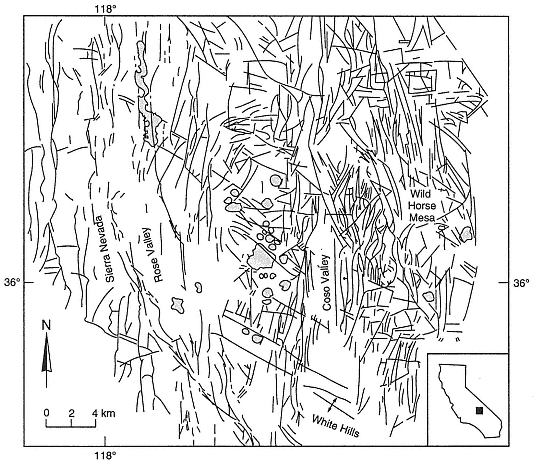
Fig. 5.24
Detailed structural map of the Coso Range and adjacent area, showing distribution of faults.
Location abbreviations are those used in Fig. 5.20; shaded patterns denote rhyolite domes.
(Adapted from Roquemore, 1980.)
The hydrothermal system at Coso is apparently controlled by fractures in the Mesozoic granitic and older metamorphic basement rocks. Water samples from two wells of this system were analyzed by Fournier et al . (1980), and their chemistry is summarized in Table 5.4. Although the chemical analyses show variability that can be attributed to evaporative concentration, water/rock reactions at different temperatures, and different sample preservation and laboratory procedures, the samples exhibit essentially the same chloride content, and water of relatively uniform composition is found throughout the permeable rock underlying the Coso area sampled. The chloride content also indicates a hot-water-dominated rather than a vapor-dominated system.