
Shared Culture of Public Arenas
Early-nineteenth-century sources refer, albeit briefly, to an array of collectively observed ceremonial activities, most of which were identified by the administration as "religious." Certainly their subject matter was religious, as the observances frequently reenacted stories from sacred texts. Particularly at this time, however, such ceremonials constituted statements of shared civic identity, of "Banarsipan," as much as they did a specific religious identity. The Muslim petition submitted in 1809, for instance, referring to a disputed site, said that "for some years, the lower classes of Hindus and Muhammedans have annually celebrated the marriage of the Laut and have divided the offerings between them" (Board no. 9093:168).[5] Similarly, in referring to a site shared by a temple and a mosque, the Acting Magistrate noted that "the Muslims have frequently participated with the Hindus in the offerings presented to the idols" (Board no. 9093:262A). Even thirty years later, a British observer resident in the city commented that "on most occasions of festive and multitudinous assemblage, the distinctions of religion give way, and the scene bears more the character of a fair than of a religious meeting" (Prinsep 1831, quoted in Eck 1982:254). Indeed, the shared civic sense fostered by such public ceremonials is suggested by Acting Magistrate Bird when he noted in 1809 that "the religious ceremonies of the Muhammedans and Hindus are so inseparably blended" that any attempt to "disunite them" would constitute a "new arrangement" (see fig. 15).[6]
This same source provided a brief description of an observance of Bharat Milap[*] in 1809, which sketches the nature of these shared cultural activities. The story for the occasion is staged each year on a small field permanently set aside for the purpose in muhalla[*] Nati Imli. After reenacting the reunion of Rama[*] with his brother Bharat, the observance opens out to become a general celebration shared by thousands of people (see N. Kumar 1984:263). In 1809, although the seeds of conflict had been sown which would soon erupt in a virtually unprecedented riot between groups of Hindus and Muslims, the citywide ceremony was deemed sufficiently important that "it was amicably agreed upon to suppress and conceal their mutual differences during the cele-
[5] I have not been able to find a description of this "marriage" ceremony.
[6] IOL & R. Board's collections. F/4/365, no. 9093 for 1812-13:269A.
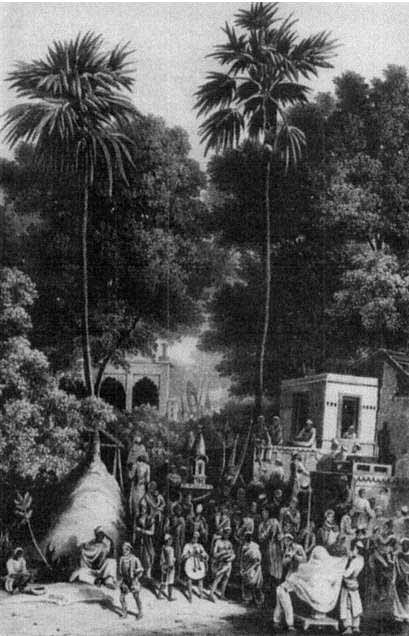
Fig. 15
Drawing of a tazia procession during the Muharram observance, 1831. James
Prinsep, Benares Illustrated (Calcutta, 1833).
Courtesy of Ames Library, University of Minnesota. (Compare with figure 13.)
bration . . . and refer them after the expiration of the holiday to the decision of the Court" (Board no. 9093:44).
Part of a preeminent occasion for collective play,[7] this festival occupied an important place in the inventory of Banaras's public-arena activities. Perhaps the most appropriate documentation of this is found in a vernacular newspaper almost a century later, when the Bharat Jiwan commented on "the Bharat Milap of Nati Imli which is famous in this and all nations. . . . None would object perhaps to calling it the foremost of Kashi's melas and festivals, because on that day all Kashivasis—women, aged, children, Hindus, Muslims and the English—feel a rush of Rambhakti [devotion to Ram[*] ] in their hearts . . . it would have to be an invalid or disabled person who does not go to see it" (Bharat Jiwan , 30 Oct. 1893, 8, quoted in N. Kumar 1984:264). Its eminence can be further attested to by the growth around it of a number of legends (see N. Kumar 1984).
While the occasion was doubtless particularly important to the artisans and other lower-class groups of the city (e.g., Ahirs carried in the swarup s, or actors, playing Ram, Laxman, and Sita[*] ), the newspaper went on to note by name the important local leaders who participated by observing the event.[8] Even today, one of the measures signifying the importance of the Bharat Milap[*] observance is participation by the Maharaja of Banaras, who enters first as "the king" who then "becomes front rank of the audience, completing the sense of the event as that of a total people, led by their king, witnessing and worshipping the momentary arrival of their God in their midst. . . . The Maharaja, in the words of informants, is the people and the kingdom, and his exchange with Rama is symbolic of that of the necessarily anonymous masses [who] throng to the spot" (N. Kumar 1984:266).
By the middle of the nineteenth century this functional role of the Maharaja as symbol of "the people and the kingdom" had become virtually unique in U.P. As the Rohillas, the Nawabi of Awadh, and other successor states gave way to the British Empire, those who performed the integrative function described here were either dispossessed or had their status reduced and trivialized to that of mere large landlords.[9] Nowhere else in U.P. did such a coalition (of merchants, Maharaja, and Gosains) succeed in protecting and extending the shared local culture. How did this unique situation evolve in Banaras? In the remainder of
[7] Bharat Milap provides a pivotal scene in the longer enactment of the Ramlila[*] .
[8] Kumar also refers to newspaper advertisements in the 1930s selling tickets for wealthier observers to secure places in nearby gardens and rooftops from which to view the field.
[9] Given the right circumstances, some of the taluqdars of Awadh doubtless possessed the potential to expand their control (as the Bhumihar family had) until they possessed kingly attributes (T. Metcalf 1979).
this chapter I will argue that the answer to that question can be found by focusing on public arena activity; this focus points up a series of renegotiations of the relationship between state and community which helped preserve a particular form of local culture even while it accommodated changes in the roles and connections between leaders and followers in Banaras.
The Maharaja's own public ceremonial, as it was elaborated over two centuries, typifies the processual elements of collective observance. As was noted in the Introduction, the Hindu merchant corporation of the city, and the Bhumihar dynasty based in Ramnagar, cosponsored this unique version of Ramlila[*] .[10] By virtue of its thirty-one-day length and its patronage by the dynasty, this Ramlila remains, to the present, "the most extensive, best performed, and draws the largest audience of any" Ramlila in the subcontinent (Schechner and Hess 1977). Its key attributes emphasize expression of the "relationship between government, Maharaja, and ordinary people." Schechner and Hess note that the day-to-day events of the performance follow the outlines of Tulsidas's epic poem, the Ramcharitmanas[*] , "but some events—notably those of great iconographic effect, the processions—are given higher focus: they are good theatre, and especially display the Ramlila's two leading performers, Rama and the Maharaja." This provides the widest possible appeal, incorporating all Banarsis even as it emphasizes the integrative role of the ruler.
Although the Maharaja does not figure in Tulsidas's narrative, or in the other, ubiquitous enactments of it staged throughout north India,[11] "each day's [Ramnagar-sponsored] performance begins only after the Maharaja arrives, either on elephant or horse-drawn carriage or in his 1927 Cadillac limousine." Since the performance ceases and resumes again around the Maharaja's daily sandhya puja , it is the Maharaja who imposes, twice a day, a "processional rhythm" on the performance. Indeed, the authors note that "The Maharaja and Rama are mirror images of each other, the twin heroes of the Ramnagar Ramlila. The Maharaja is as much a mythic figure as Rama." Throughout the Ramlila, his actions and attire reflect his mythic kingly role as "upholder of reli-
[10] While merchant roles have undoubtedly expanded in the twentieth century, Hess's recent description is worth noting: "Most spectators cross the river [from Banaras to Ramnagar] each day to attend the Lila; a fair number come from the Ramnagar side as well. . . . Though no survey was taken of audience members' caste, occupation, or education, we noticed that small-scale merchants were heavily represented. Almost no one we met in the crowd spoke English. People of different castes and classes appeared to mingle quite freely, though there may have been ways of maintaining separations of which we were unaware" (Hess 1987:3).
[11] For a discussion of the political implications of Ramlila performances throughout U.P., see Freitag 1989, chap. 7.
gion, repository of tradition and authority," patron of the arts and learning. At the same time, he has a second mythic role, that of representative of Shiva, the lord of ancient Kashi.
The Ramnagar dynasty quite deliberately pursued certain political ends (see chapter 1) through Ramlila[*] patronage. Important gains were made for Hindu culture in the process—especially noteworthy in the face of the political power of the (Muslim) Nawab of Awadh. But other, internally significant political ends were served as well by this elaboration of a popular observance—ends that reinforced the relations with the lower classes of Banaras, frequently Muslim, through the emphasis on the Maharaja as ruler of all. While Rama[*] "fulfills his destiny . . . as the bearer of Hindu culture" (Schechner and Hess 1977:54), Tulsidas's equal emphasis on devotion over orthodoxy, of shared brotherhood over community and caste divisions, enabled the dynasty to use this event for integrative purposes, even with Muslim weavers. Thus the observance documents the uniquely Banarsi emphasis on the role of local ruler, with whom all Banarsis could identify. We may speculate, too, that the physical locale of the Ramnagar observance—with its permanent constructions representing various places in the subcontinent located in a space at some remove from the neighborhoods where popular forms of competition were focussed—could function in integrative ways not available to other observances of Ramlila.