Spread
A gauge of the rate of penetration of the new units is the pattern of their use in books requiring specification of units, like atlases, compendia of architectural drawings, and manuals of surveying, building, and engineering. Although such works employing old units exclusively were published into the 19th century,[88] the common pattern up to around 1815 was to present measurements and calculations in both meters and toises and their multiples. A good indication for the early years is the collection of architectural designs awarded prizes by the Institut de France and other government bodies between 1795 and 1803. Forty of these designs have units: three use toises only, two use meters only, and the balance uses both. Before 1800 toises have priority when both scales are present; after
[86] Kelly, Metrology , xiii; ibid., 27–30, for text of the laws of 1812.
[87] Respectively, Kelly, Metrology , xvi, and Louis Puissant, Traité de topographie, d'arpentage et de nivellement , 2nd edn. (Paris: Courcier, 1820), 245 (1820).
[88] See, for example, Charles-François Viel, De la construction des édifices publics sans l'emploi du fer (Paris: Perronneau, 1803); L. Ducrest, Vues nouvelles sur les courans d'eau, la navigation intérieure et la marine (Paris: Perronneau, 1803); Molard, Description , 1; J.Ch. Krafft, Recueil d'architecture civile (Paris: Bance ainé et al., 1812); Bernard Forest de Belidor, La science des ingénieurs, dans la conduite des travaux de fortification et d'architecture civile , ed. C.L.M.H. Navier (Paris: Firmin Didot, 1813).
1800, meters.[89] A collection of plans for large structures published in 1823 shows a very considerable change: of seventy-six plates with scales, two have toises only, eleven have both, and sixty-three meters only; and the old measures occur exclusively in one section of the collection, on stone bridges.[90] The obvious extrapolation does not hold, however; a set of 105 house plans published in 1843 under the promising title Paris moderne suggests that builders of private dwellings then still preferred to express themselves in the measures of the old regime. About 30 percent of the plans use toises only; another 30 percent, meters only; and 40 percent, both. All the plans are dated, the earliest to 1815; the strongest showing of the toise against the meter occurs not at the beginning, but in the period 1835–9. The meter takes over after 1840, the year in which the metric system at last became obligatory in France.[91]
Up-to-date technical manuals show the same equivocation as architectural drawings. An authoritative indicator is the huge treatise on the building arts (four volumes in five of text, three of plates) published between 1805 and 1816 by Jean-Baptiste Rondelet, chief architect of the church of Sainte-Geneviève and architectural consultant to the government. Rodelet's plates strongly favor the old measures; his text appears to be the work of a schizophrenic. The earliest volume (1805) uses pieds, pouces, and lignes and also metric units, sometimes converted but often not, in tables and in calculations; at one point it gives dimensions in meters and computes in toises.[92] In the volumes published in 1812, Rondelet usually proffers all dimensions in both the old and new style, but without the advantage of decimal notation: for example, "31 pieds 3/7 (10 mètres 209 millimètres)."
[89] Projets d'architecture et autres productions de cet art qui ont merité les grands prix accordés par l'Académie, par l'Institut national de France, et par des Jury du choix des artistes ou de gouvernment (Paris: Detourelle, 1806).
[90] Louis Bruyère, Etudes relatives à l'art des constructions (Paris: Bance ainé et al., 1823).
[91] Louis Marie Normand and G.E. Lemmonier and Paris moderne, ou choix de maisons de campagne et constructions rurales des environs de Paris , 3 vols. (Liège: d'Avanzo, 1843), and several other editions; Bouchard, Prieur , 313. The obligation was laid down in a law of 4 July 1837; it took effect on 1 January 1840.
[92] Jean Baptiste Rondelet, Traité théorique et pratique de l'art de bâtir (Paris: chez l'auteur, 1805–16), 3, 57, 66–7, 83 ff., 102, 164, 179–83, 269 ff., 388–96.
His preference for the old appears from his way of obtaining specific gravity, which he understands as the weight in grams of a cubic centimeter of a substance. He measures the weight of a sample, in air and in water, in onces and gros, deduces the weight of a cubic pied, and converts to the metric system. The preference for the old units persists into the last volumes, published in 1816. Then—after 1,839 pages of schizophrenic computations, the last of which provides the cost of old bricks in old money—Rondelet introduces some "notions about metric measures."[93] It is instructive that this instruction precedes a recomputation of costs in metric measures and decimalized currency. The relative ease of such computations was the great benefit that the reformers had advertised.
From about 1810 many technical manuals by professors and government officials used metric measures exclusively. For example, the professor of mathematics at the Ecole impériale militaire, Louis Puissant, and Pierre Pommiés, professor at the Lycée Napoléon, both influential teachers of surveying and geodesy, used meters exclusively and without explanation in many textbooks beginning in 1807.[94] Jean-Nicholas Hachette, professor at the Ecole polytechnique, brought the metric system into the preface of his textbook on machines, without comment, as the only satisfactory way "to express their effect in numbers." The chemist Jean-Antoine Chaptal, one-time minister of the interior and long-time educational reformer, naturally used nothing but modern measures in his survey of the state of French industry after the fall of Napoleon. Still there are hints of backsliding where least expected. The official surveyors of France might have worked exclusively in meters and understood the higher geodesy; but the local land measurer often enough made do with old units and little geometry into the reign of Louis Philippe. A manual for such measurers, "especially people who have not studied geometry," was published in 1833 by an inspector of the cadastral survey. It contains an explanation of the metric system, an injunction
[93] Ibid., 1 , 99, 101–2, 158–60; 4 , 583–604, 609–44.
[94] Puissant, Traité de topographie , 139, 154, and Michel Pommiés, Manuel de l'ingénieur du cadastre (Paris: Impr. impériale, 1808), 166–9, illustrate the type.
to use it, and tables for the easy conversion of old local measures into meters, "and vice versa."[95]
As it spread, the metric system did help to realize the reformers' ambition to improve the numeracy of Europeans. In the Ancien Régime, despite its baroque abundance of metrological units, most people had need only for a single system; during the Empire, because of the government's policy of driving the meter home, more and more citizens had to learn how to convert one set of measures into another. If the first advance of European "Rechenhaftigkeit"—"the inclination, habit, and ability to resolve the world into numbers and to bring these numbers together into an artificial system of income and outgo"—may be likened to literacy in one language, the domestication of the metric system made reckoners bilingual.[96]
The early treatises on metric calculations propagated not only decimal arithmetic, including the concept of place, but also the idea of significant figures and the operation of rounding off. An Exposition abrégée du nouveau système , published in the provinces in 1802 or 1803, may stand for the genre. It explains that the many decimals generated during conversion are artifacts of multiplication and division, and demands that they be dropped from the final answer.[97] Rounding off, says Rondelet, in his belated account of metric computations, is essential to the new system. Rounding off might in practice mean only rounding up, as readers of an Arithmétique pratique of 1800, which recommends changing 0.7411440 to 0.75, learned to do; a practice that would favor shopkeepers, who could round up each of their many small transactions.[98] Even arithmetic may have its social bias. The utility of metric conversions in teaching numeracy
[95] J.A. Chaptal, De l'industrie Françoise , 2 vols. (Paris: Renouard, 1819); A. Lefevre, Guide practique et mémoratif de l'arpenteur, particulièrement destiné aux personnes qui n'ont point étudié la géométrie (Paris: Bachelier, 1833), i-vi, 15–21.
[96] Quote from Werner Sombart, Der Bourgeois. Zur Geistesgeschichte des modernen Wirtschaftsmenschen (Munich: Duncker and Humblot, 1913), 164.
[97] Exposition abrégée , 23–4, 29–30. See also the contemporary Tables de comparaison , xiv–xxix; Capelli, Rapports , 49–57.
[98] Rondelet, Traité, 4:2 (1816), 610–3; Adrien Poittier, Arithmétique pratique et démontrée, pour réduire les anciennes mesures en nouvelles (Paris: Bernard and Moutardier, nivôse an VIII), 146–52. Gattey, Eléments , 32–3, rounds up only if the part dropped is >> 0.5 of the last figure kept.
appears further from popular textbooks of arithmetic that use such computations as exercises. This practice persisted long after the universal adoption of the metric system in France.[99]
According to the president of the Paris Agricultural Society, the great majority of people who could read and write in 1810 knew nothing more of arithmetic than addition and subtraction. He had a prescription for correcting this innumeracy and a vision of the happy consequences. "If decimal calculations could be introduced into primary schools along with the use of the new measures, not only would the housewife be able to make all the computations she requires, but also the worker could measure without difficulty and, by adding the use of the rule and compass for tracing geometrical figures,he would be able to draw all his plans himself, and the farmer would have no problem with surveying."[100] This grand project has been realized in large measure. The male academic and quantitative spirit of the late Enlightenment found a fertile if capricious partner in La belle Marianne , the spirit of revolutionary France.
[99] See, for example S.F. Lacroix, Traité élémentaire d'arithmétique, à l'usage de l'Ecole centrale des quatres nations , 2d edn. (Paris: Courcier, 1805), 115–46; Garnier, Traité, 1 , 263–75, 281–93; and, for the later period, A. Thinon, Leçons sur le système métrique et sur les applications usuelles de l'arithmétique (Paris: Dezobry and Magdelleine, 1860), 131.
[100] Chessiron, "Mesures," 8 , 293.
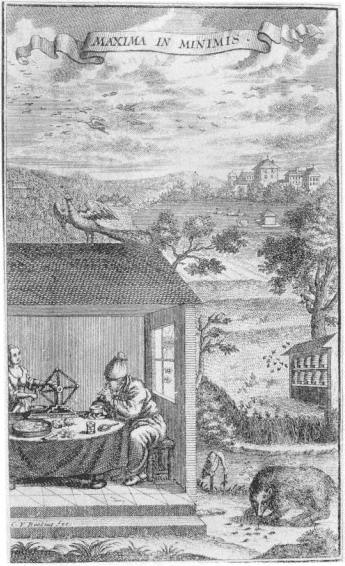
Fig. 1.1
Besides the strict mathematical method, which was intended only
for the learned reader, Wolff also used the physicotheological method
for a popular audience. According to the latter method, everything in
nature must be both perfect and useful. Demonstrating or proving
this thesis became a rationale for 18th-century natural history. The
scientist should look for "greatness in small things" (maxima in minimis),
which phrase served as the motto for Friedrich Christian Lesser's
Insectotheology (Frankfurt, 1740). The study of nature reveals the
infinite diligence of the wasps and the ants, the beauty and strange
development of the butterfly, the artfulness of the spider, the utility of the
silkworm—these and other features of nature provided inspiration
for 18th-century research and speculation.
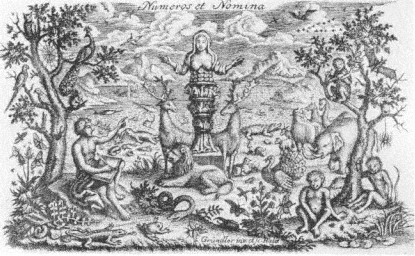
Fig. 1
Albrecht von Haller called Linnæus "the second Adam." He appears in this role
in a vignette for the eleventh edition of Systema naturae (ed. Lange, Haller, 1760). As
Adam, Linnæus is sitting naked, naming all the animals (cf. Genesis 2:19). Paradise is
crowded with animals and plants, monkeys climbing the trees, whales swimming in
the sea; everything is at peace. The fall is yet to come. The figure in the middle is Diana
polymammae, symbol of Nature and its generative force. Linnæus—with "his" flower
Linnea borealis at his feet—is urging numbers and names, Numeros et nomina,
from Diana. He is Nature's bookkeeper.
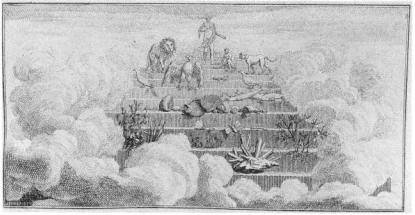
Fig. 2
This instructive vignette, from Charles Bonnet, Oeuvres d'histoire naturelle, 4
(Neufchâtel, 1781), depicts man at the top of the scale of nature. As man belongs
to both the material and the spiritual world, he keeps hishead in the clouds. On
lower steps of the scale follow the monkey, the lion and the dog, the eagle, fish,
lizards, corals, and so on. Everything in nature is thus to be understood
both in hierarchy and in continuity.
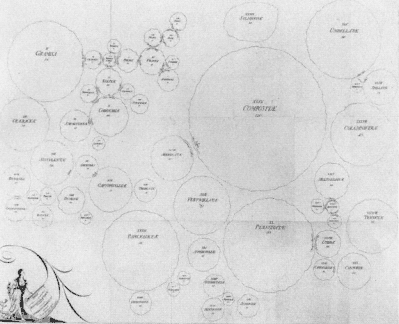
Fig. 3
In private lectures Linnæus discussed the possibility of arranging
natural orders linearly. With so many uncertainties in establishing these
orders and with so many more plants still to discover, however, such an
arrangement must wait. This map, believed to be based on a drawing by
Linnæus, shows continuity between some groups, as well as gaps requiring
more knowledge: Linnæus, Praelectiones in ordines naturales plantarum,
ed. P.D. Gieseke (Hamburg, 1792), facing p. 623.
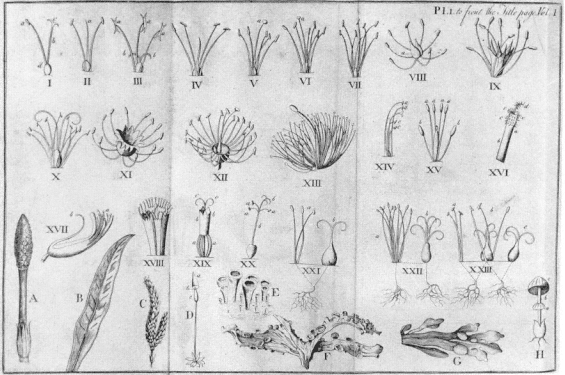
Fig. 3.1
Illustration of the Linnæan sexual system, from William Withering, A botanical arrangement
of all the vegetables growing in Great Britain (1776). See chapter 3, page 77.
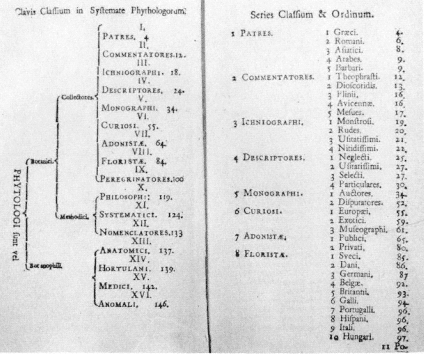
Fig. 3.2
Linnæus' classification of botanists, from his Bibliotheca
botanica (1736). See chapter 3, page 79.
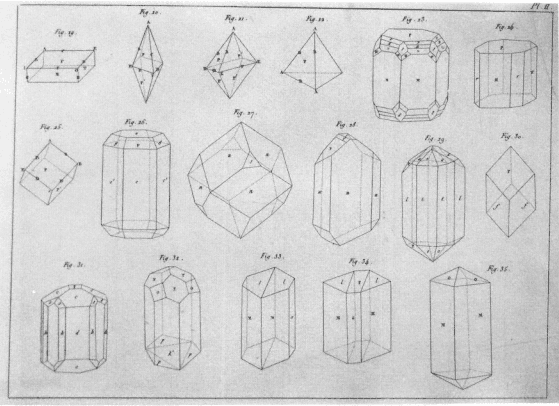
Fig. 3.3
René Just Haüy's geometrical forms of crystals, from his Tableau comparatif des résultats
de la cristallographie et de l'analyse chimique relativement à la classification des
minéraux (1809). See chapter 3, page 92.
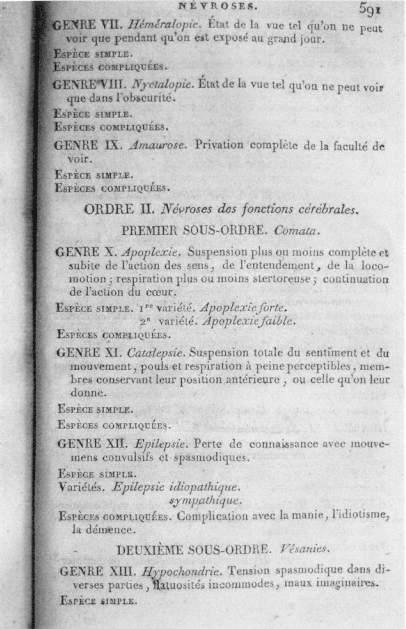
Fig. 3.4
Classification of nervous disorders showing orders, genera, species, and
varieties, from Philippe Pinel, Nosographie philosohique, 6th ed. (1818).
See chapter 3, page 99.
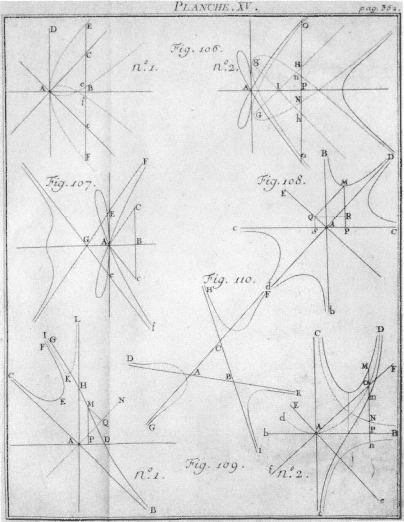
Fig. 3.5
Illustration of curves classified by Gabriel Cramer in his Introduction
à l'analyse des lignes courbes algébriques (1750). See chapter 3, page 102.
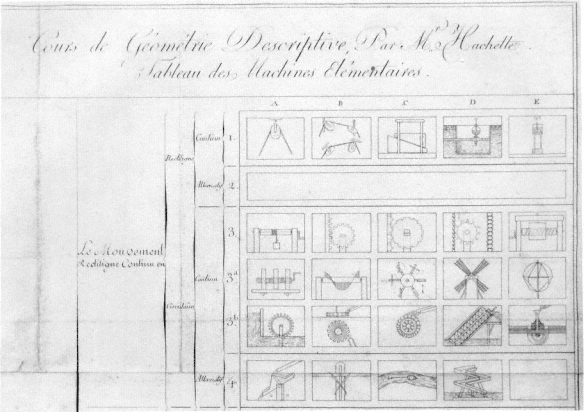
Fig. 3.6
Portion of Jean Nicolas Pierre Hachette's classification of simple machines, from
his Traité élémentaire des machines (1811). See chapter 3, page 106.
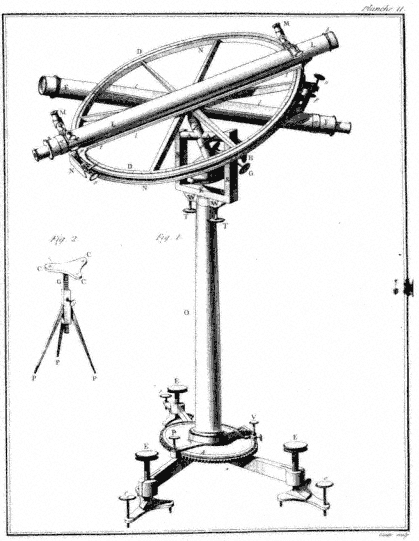
Fig. 6.1
The repeating circle, from Jacques Cassini, Pierre François Méchain, and
Adrien-Marie Legendre, Exposé des opérations faites en France [1791]. By
courtesy, National Land Survey (Lantmäteriverket), Gävle.
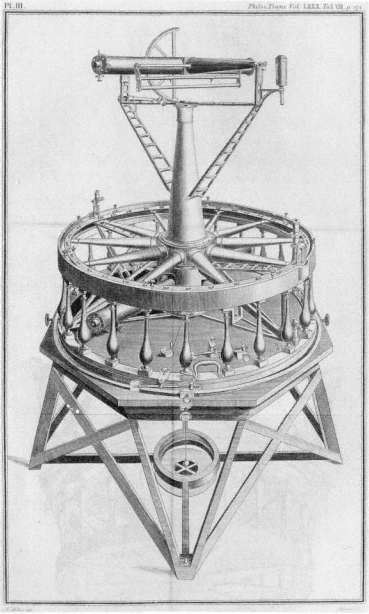
Fig. 6.2
According to William Roy, "It is a brass circle, three feet in diameter,
and may be called a theodolet [theodolite], rendered exremely perfect."
From Roy's "Account of the trigonometrical operation" in the
Philosophical transactions for 1790.
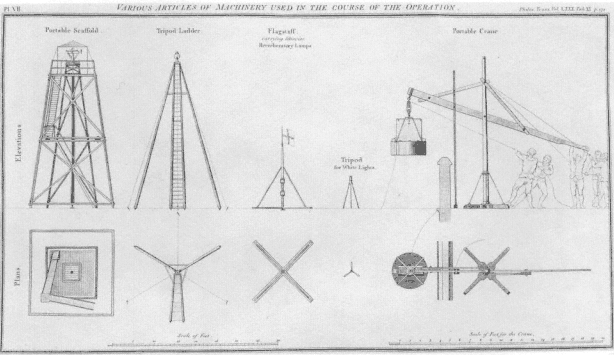
Fig. 6.3
The theodolite was used with a portable scaffold and crane in the high-tech military surveying
operations of the late 18th century. From Roy's "Account of the trigonometrical operation" (1790).
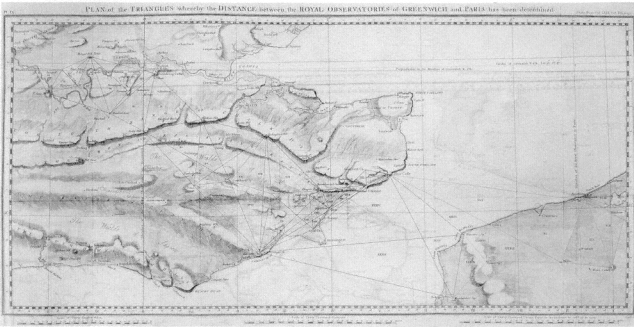
Fig. 6.4
The cross-channel connection, from Roy's "Account of the trigonometrical operation" (1790).
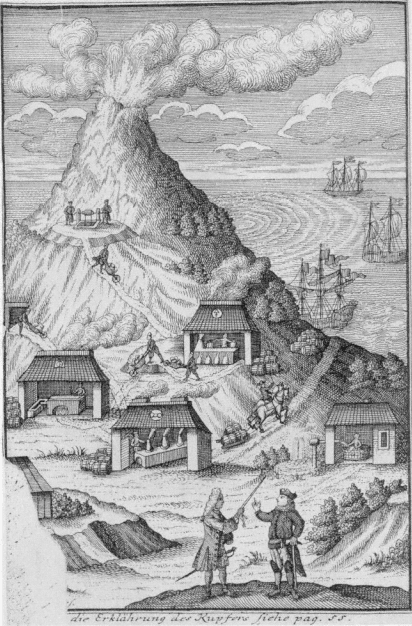
Fig. 8.1
The close connection between economics, technology, and chemistry in
"die ganze Historie vom Kiess," from F.J. Henckel, Pyrotologia (1725). Instruments
in the small buildings illustrate the role of chemistry in the production
of sulfur, vitriol, and arsenic from pyrites.
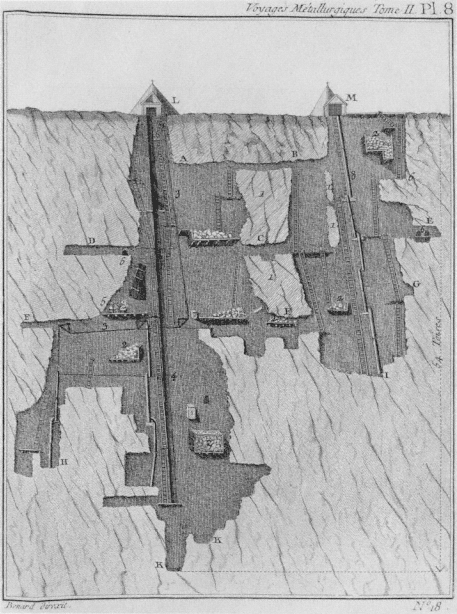
Fig. 8.2
Ädelfors mine in Sweden as seen in 1767 by G. Jars. From his Voyages métallurgiques, 2 (1780).
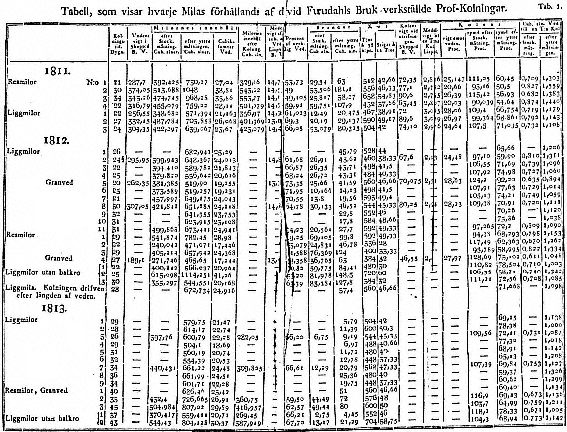
Fig. 10.1
Tabular display of experiments in charcoal-burning in Dalecarlia, from
Carl David af Uhr, Berättelse om kolnings-försök åren 1811, 1812 och 1813.
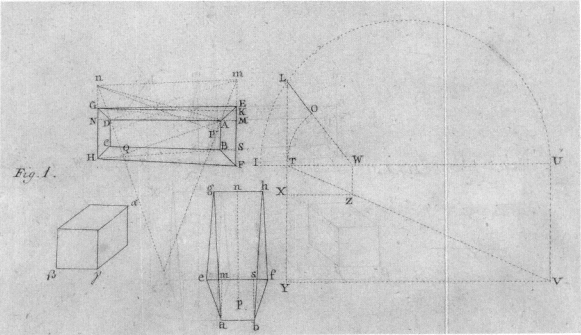
Fig. 10.2
Illustrations for Zacharias Plantin's studies of the volume of rhombic sledges of charcoal,
from the Kungl. Vetenskapsakademiens Handlingar for 1778 and 1784.
| ||||||||||||||||||||||||||||||||||||||||||||||||||||||||||||||||||||||||||||||||||||||||||||||||||||||||||||||||||||||||||||||||||||||||||||||||||||||||||||||||||||||||||||||||||||||||||||||||||||||||||||||||||||||||||||||||||||||||||||||||||||||||||||||||||||||||||||||||||||||||||||||||||||||||||||||||||||||||||||||||||||||||||||||||||||||||||||||||||||||||||||||||||||||||||||||||||||||||||||||||||||||||||||||||||||||||||||||||||||||||||||||||||||||||||||||||||||||||||||||||||||||||||||||||||||||||||||||||||||||
Fig. 10.3
Systematic display of data from Johann Eric Norberg's study (1772–3) of human muscle power,
from the Kungl. Vetenskapsakademiens Handlingar for 1799.
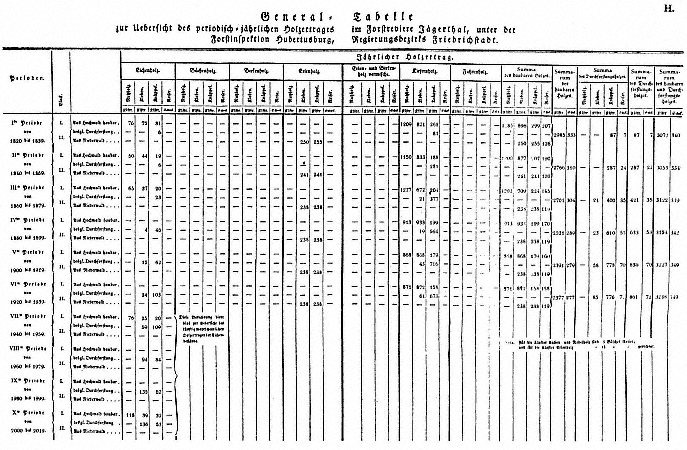
Fig. 11.1
Georg Hartig's 200-year plan for the Jägerthal forest district, from his Neue Instructionen (1819).
By courtesy, Department of Special Collections, Yale University.
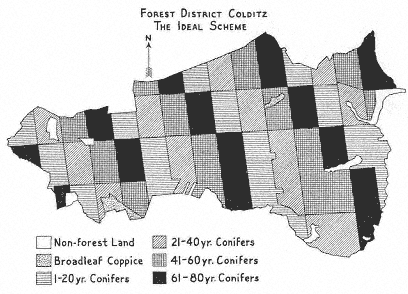
Fig. 11.2
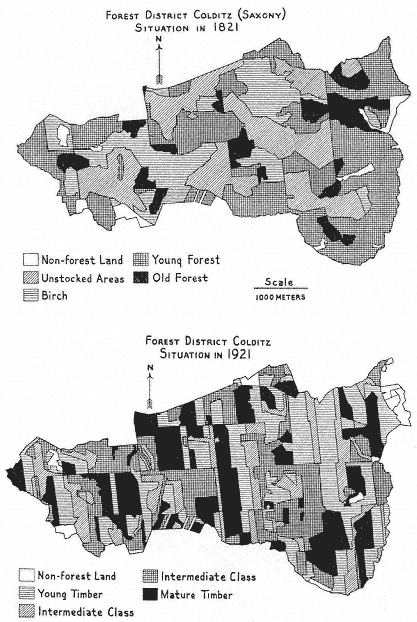
Transformation of the Colditz forest district after 100 years of managements
according to Cotta's ideal scheme. From Heske, German forestry.
By courtesy, Stanford University Libraries.