
25—
The Marriage Ceremony (Book II, Yconomique )
Formal and Decorative Relationships
The illustrations for Book II of the Yconomique (Figs. 83 and 84) conclude the cycles of B and D . Compared to the miniatures of Book I of this text (Figs. 80 and 81), the program appears quite summary and routine. Even though the modern reader may find that the text of the Yconomique offers fascinating insights into both Aristotle's and Oresme's views on the institution of marriage, Oresme himself may have thought that the contents of Book II did not address the vital political interests of his primary readers. If Oresme felt this way, it could explain why the depiction of a wedding ceremony in Figures 83 and 84 provides such an extremely reductive version of the ideas expressed in the text. Indeed, the paradigmatic mode is that of neither a general model nor an example but that of a symbolic abbreviation. In this respect, the illustrations of Book II of the Yconomique recall those of Books II and, to a lesser extent, those of Book VIII of the Politiques (Figs. 55–57, 77, and 78). The common feature is a disjunction between complex textual development and radically simplified visual translations.
Figures 83 and 84 were again executed by the workshop of the Master of the Coronation Book of Charles V. Unlike Figure 80 in Book I, however, the hand of the master is not visible in these illustrations. Their composition depends on the scene of Charles V entering Reims cathedral from his Coronation Book (Fig. 85).[1] The most striking similarity is the representation of the church. Although far more simplified in Figure 83, the depiction in Figure 84 of the three bays and flying buttresses is quite close to those in the model. The motif of the priest standing at the main portal of the church derives from the reception of the king by the archbishop of Reims. It appears that a drawing in a model book was available for the use of members of the atelier, as is true of the miniatures of Book I.[2] It is obvious that Figure 83 is far smaller than Figure 84. This miniature is restricted to the width of the second column of the text, at the top of which it stands. Figure 83 is the first illustration in the Politiques and Yconomique program of B to share the column format and small dimensions after the prefatory miniatures of Oresme writing his translation (Fig. 44) and the dedication portrait (Fig. 45). These latter two examples precede the text proper of the Politiques . It is, therefore, correct to assume that Figure 83 occupies the lowest place in the hierarchy of importance among the text illustrations of this manuscript.
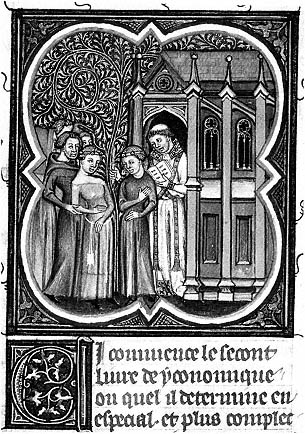
Figure 83
A Marriage Ceremony. Le yconomique d'Aristote, MS B.
The decorative structure of the folio of which Figure 83 is a part also reflects the lesser importance of the illustration. The ivy-leaf motif is confined to the miniature: the foliate borders in the margins of other illustrations from this manuscript are lacking. Also missing are rubrics to announce the introductory paragraph above which Figure 83 stands. The four-line foliate initial C of the opening word of this paragraph is also smaller than usual.
Figure 84, however, achieves greater prominence. As previous analysis has shown, the reformatting of D called for a regularity in the shapes of the illustrations. Thus, Figure 84 is a rectangle that occupies the width of the entire text block and achieves frontispiece status. This image—like the preceding illustration for Book I of the Yconomique —is somewhat smaller than the miniatures of the Politiques in the same manuscript. The decorative character of folio 375, where Figure 84 stands, is far more elaborate than that of Figure 83. Furthermore, the painted frame of Figure 84 establishes the miniature as a separate design element. In short, the revised format of D cedes to Figure 84 an importance that was lacking in Figure 83.
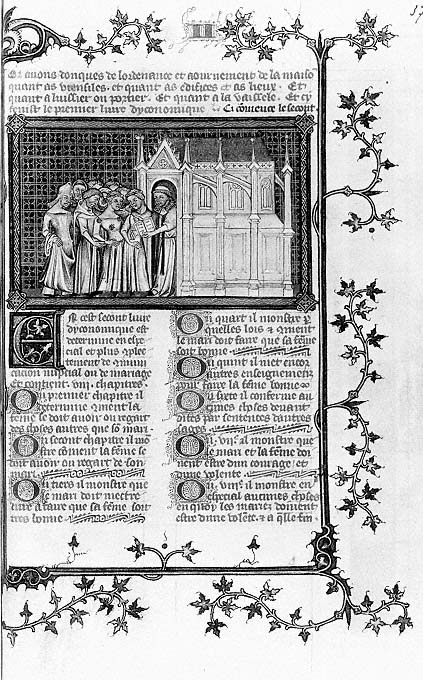
Figure 84
A Marriage Ceremony. Le yconomique d'Aristote, MS D.
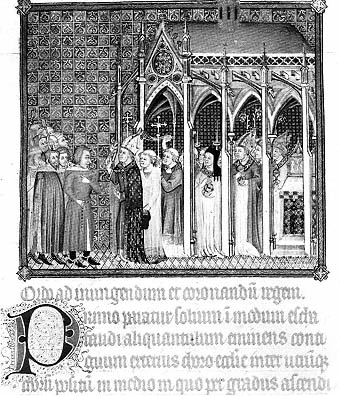
Figure 85
The Reception of Charles V at the West Portal of Reims Cathedral.
Coronation Book of Charles V.
Figures 83 and 84 retain the distinctive uses of color noted in the previous miniatures of the two manuscripts. The bride in the center, who wears a rose robe, is flanked by a male figure (possibly her father) and the groom, both of whom wear light blue mantles. A partially seen figure on the left repeats the rose of the bride's dress, which contrasts with a red hood. The priest in the center stands out in his white robes and gold stole from these brightly colored figures on the left and the monochrome gray tones of the church on the right. In Figure 84, the color of the roof and body of the church echo those of Figure 83. A larger company than the five people in Figure 83, the group in Figure 84 is delineated in grisaille with rose washes. In both cases the application of gold picks out the decorations of the bride's dress and the jeweled circlets in the couples' hair. The spiraling foliate motif of the blue-and-gold background of Figure 83 presents a more active, if more limited, contrast to the figures than the more extensive rust-and-gold geometric background of Figure 84.
Text-image Relationships
The lack of inscriptions in Figures 83 and 84 repeats the example set by the illustrations of Book I of the Yconomique . The consequent abandonment of the miniature's lexical function probably reflects Oresme's assumption of the readers' familiarity with the subject of marriage. The indexical, summary character of the illustration supports this suggestion. On another level, the choice of a wedding ceremony as standing for the whole of the marriage relationship may also reflect the common rhetorical figure of synecdoche. The summary paragraph below the illustration echoes the cursory nature of the miniature: "Cy commence le secunt livre de Yconomique , ouquel il determine en especial et plus complectement de communication nuptial ou de mariage. Et contient .viii. chapitles" (Here begins the second book of Economics , in which he considers particularly and more fully married life or marriage. And it contains eight chapters).[3]
One reason that Oresme may have chosen the wedding ceremony to introduce the subject of marriage is that Aristotle discussed it in both the Ethics and the Politics , as well as in the previous book of the Economics . Thus, there is a preexistent textual link that might bring the reader to associate previous knowledge of the subject in these works with the forthcoming expansion of the theme in Book II of the Yconomique . In his commentaries on Book I of this text, Oresme refers to relevant passages in Books I and VII of the Politiques and Book VIII of the Ethiques .[4] Indeed, marriage as one of Aristotle's three types of relationships among people of unequal rank is depicted by the bride and groom in Figure 38, the illustration of Book VIII in C .[5] Oresme may have intended or hoped that the repetition of the motif of the bride and groom would constitute a visual and textual association with Aristotle's previous discussion of marriage in the Ethics .
By choosing a wedding ceremony Oresme may also have wanted to signal an aspect of the institution of marriage apart from its ethical, political, and economic implications. As a means of updating Aristotle's exploration of the theme, Oresme introduces the Christian view of marriage as an institution ordained by God. In the context of how the wife should conduct herself (Book II, Chapter 2), the text speaks of the procreative function of marriage as something that could not "be greater or more holy."[6] Oresme's gloss on the passage elaborates this point: "car societé de mariage, qui est pour procreation d'enfans et pour mutuel aide, est chose saincte et divine" (For the marriage relationship, which is for the procreation of children and for mutual help, is a holy and divine thing).[7]
Even more clearly than in Book I of the Yconomique Oresme glosses the idea of marriage as a "divine partnership."[8] The translator's assimilation of Aristotelian and Christian notions of marriage is quite clear:
Et meismement en nature humaine, de laquelle Dieu a especial solicitude et cure. Et donques selon le Philosophe, mariage est de divine ordenance et se acorde a ce que dit Nostre Salveur, que Dieu fist ceste conjunction: Quod ergo Deus conjunxit, etc. Et aussi il fu né en mariage et fu present as noces la ou il fist le commence-
ment de ses signes par un gracieus et joyeus miracle en muant l'eaue en bon vin. Et par ce il approva mariage comme chose saincte, laquele Dieu beneÿ des la premiere creation: Masculum et feminam creavit eos et benedixit illis. Et est mariage un sacrement et donques est ce chose divine. Apres il met comment ce est convenable chose.
(And this accords with human nature, for which God has a special solicitude and attention. Thus according to Aristotle, marriage is divinely ordained and he agrees with the statement of our Saviour that God made this union: 'What therefore God hath joined together, etc.' [Matt. 19:6]. And our Saviour also was born from wedlock, and He was present at the wedding ceremony where He first demonstrated his powers by a gracious and joyous miracle, changing water into wine. In this manner He gave approval to marriage as a holy thing, which God blessed from the beginning of creation: 'Male and female created He them and He blessed them' [Gen. 1:27]. And marriage is a sacrament and is therefore a divine rite. He next indicates how this is a felicitous thing.)[9]
Oresme may have chosen the scene of the wedding in front of the church to emphasize marriage as a sacrament. He may have done this not so much from theological conviction but as a means of updating and concretizing the wedding ceremony as an intelligible shorthand or synecdoche for marriage.
Visual Structures
Although both miniatures belong to the single register type, the visual structures of Figures 83 and 84 are related to two distinct types of illustrations in the cycles. As was noted above, Figure 83 belongs to the single-column quadrilobe type represented by the portrait of Oresme writing (Fig. 44) and the dedication portrait of Oresme presenting the book to Charles V (Fig. 45). This is not to say that the use of quadrilobes was limited in the programs of both B and D to text-column illustrations. The quadrilobes were favored by the Master of the Coronation of Charles VI for the programs of Books II, III, and VIII of the Politiques (Figs. 55–56, 60, and 77). For this text, the workshop of the Master of the Coronation Book of Charles V repeated the same type of enframement as was used for the miniatures of Books II and III (Figs. 57 and 61). In all these illustrations, however, the quadrilobes are divorced from the column as individual units of an ensemble. Despite variations among them, the design of the quadrilobe units seems to focus on a single event or person in a series related to sequence in the text. As an index of its lesser textual value, Figure 83 stands apart from this practice and instead belongs to the prefatory quadrilobes devoted to portraits of the translator and patron.
By contrast, the visual structure of Figure 84 relates more clearly to the illustrations of Book VI of the Politiques (Figs. 70 and 71) and of Book I of the Yconomique
(Figs. 80 and 81). Although the rectangular shape and larger size of the former distinguish it from the Yconomique miniatures, both types share the representation of agricultural work carried out by farmers and peasants in an exterior landscape setting. Furthermore, the other two scenes also share another characteristic: several activities take place at the same time. Thus, Figure 84 is anomalous in respect to the social class represented, the type of setting, and the focus on a single event. These changes probably occurred because of the reformatting of the manuscript. Yet it is also significant that as a result of these physical revisions, the ritualistic character of the scene achieves greater prominence.
The Representation of the Wedding Ceremony
The ceremony in front of a church marked the second step in the medieval marriage ceremony. The first was "a betrothal in which one made a marriage promise for the future (sponsalia de futuro ) and the actual wedding itself (sponsalia de praesenti )."[10] The betrothal, which guaranteed arrangements for the transfer of property, was legally binding, as it was based on the mutual consent of the couple. At the church door, the bride and groom expressed their desire to wed and administered the sacrament to one another. The priest's role was that of a witness. Following the ceremony at the church door, the couple entered the building to participate in a nuptial mass.[11]
The ceremony depicted in Figures 83 and 84 obviously corresponds to the second step, the marriage ceremony in facie ecclesiae . In both scenes the groom stands next to the priest and closer to the church door; the leafy spiral of the background in Figure 83 makes clear the separation of bride and groom. The groom places his right hand on his heart in a gesture that may signify a pledge of devotion to the bride, who is not so independent as her intended mate. In both scenes the figure at her left, probably her father, places his hand on her arm, perhaps an allusion to the fact that she leaves the paternal house and protection for that of her husband. The bride in Figure 83 seems to shrink backward in a modest way, as though she is somewhat fearful of the fateful step she undertakes. Her counterpart in Figure 84 appears, however, more forthcoming and removed from her father's protection. This bride is accompanied by a more numerous retinue than that attending her counterpart in Figure 83. Clad in white in both miniatures, the priest holds in his left hand an open book. The book may refer to the appropriate blessings contained in a pontifical or missal or to pledges made by the couple.[12] The lighted taper that the priest holds in his right hand in Figure 83 gives way in Figure 84 to the instrument for asperging the couple with holy water.
Several details of the costume of the bridal couple are worth noting. Following the fashion of the period, the bride wears a low-cut dress decorated with three jewels.[13] In Figure 83 she wears the aumonière , a purse suspended from a belt. This accessory may allude to the marriage custom of offering arrhes , a symbolic gift of coins or jewels relating to the bride's dowry.[14] Both bride and groom wear gold circlets on their heads, possibly suggesting wedding crowns.[15] Several fourteenth-
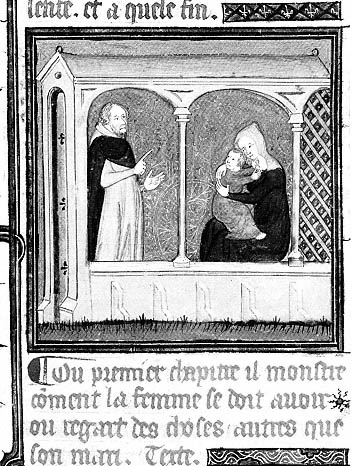
Figure 86
A Husband Instructs His Wife. Le yconomique d'Aristote, Paris,
Bibl. Nat .
century illustrated manuscripts of Gratian's Decretals depict the bride and groom wearing either crowns or circlets in scenes of the wedding banquet following the nuptial mass.[16] Although such circlets were associated with grand attire worn by the aristocracy, such items may have been worn by other classes and were customary for such a festive occasion.[17] In short, the design and details of Figures 83 and 84 may accord with Oresme's intention of encouraging his readers' association of a contemporary wedding ceremony with the discussion of the social and religious institution of marriage in the Yconomique .
Although the text of Book II of the Yconomique continues the patriarchal attitude of Book I, Figures 83 and 84 do not reveal this perspective. As in the illustration of Book VIII of the Ethiques (Fig. 38), the bride and groom are represented
as equals. It is significant that a different passage from Book II was chosen as the subject of the illustration for a slightly later illustrated manuscript of the Yconomique (Fig. 86). Chapter 1 lists six rules by which the wife runs the household under her husband's guidance, while later chapters lay out her obligations to behave properly.[18] Figure 86 represents a husband instructing the wife with a commanding gesture of his right hand. The scene takes place in an arcaded porch or interior of a house. His standing figure occupies one bay; those of his wife and child, the second. She is seated grasping a chubby child, whose expression and clinging gesture indicate alarm about paternal admonitions. The husband's domination is clear from his commanding gesture and standing posture. The wife's submission is equally evident from her seated position and the inclination of her head. Her modest dress also accords with the desired deportment of the chaste and virtuous wife set forth in the text. Also significant is that, as in the illustration of Book I of the Yconomique from this manuscript discussed above (Fig. 82), the husband's costume and the domestic setting indicate the depiction of a middle- or upper-class household. Thus Figures 82 and 86 prefigure the future popularity of the Economics in both vernacular and Latin forms as an authoritative conduct book for regulating family life.[19]
While Oresme's text maintains the patriarchal point of view of the Latin medieval translations, certain of his glosses, such as those in Chapters 4 and 5 of Book II, emphasize the humane character of the husband's treatment of his wife.[20] Although Figures 83 and 84 do not refer to such text passages, they represent a moment of equality in the relationship symbolized by the wedding ceremony. In this way Oresme may have chosen to insert unobtrusively his own progressive views on the companionate nature of marriage. As noted in the previous chapter, in any oral explication of the text by Oresme such ideas could have appealed to and alluded to Charles V and Jeanne de Bourbon as exemplars of the partners in a harmonious marital relationship.