
Maurice Roche

Maurice Roche was born in Clermont-Ferrand in 1925. Among his numerous publications are Compact (Paris: Seuil, 1966), Circus (Seuil, 1972), CodeX (Seuil, 1974), Opéra bouffe (Seuil, 1975), Mémoire (Paris: Belfond, 1976), Macabré , poème (Seuil, 1979), Testament: poème , livre/cassette (Paris: SonTexte, 1979), Maladie mélodie (Seuil, 1980), Camar(a)de , fiction/essai (Paris: Arthaud, 1981), Je ne vais pas bien, mais il faut que j'y aille (Seuil, 1987; awarded the Grand Prix de l'Humour noir and the Prix Paul-Vaillant-Couturier), Qui n'a pas vu Dieu n'a rien vu (Seuil, 1990), and Sous la chair des mots (Montpellier: Editions CMS, 1993).
Selected Publications in English:
CodeX . Extracts translated by Mark Polizzotti. In The AvantGarde Today: An International Anthology , edited by Charles Russell. Urbana: University of Illinois Press, 1981.
CodeX . Extracts translated by Carl Lovitt. In In the Wake of the Wake , edited by David Hayman and Elliott Anderson. Madison: University of Wisconsin Press, 1982.
CodeX and Circus . Extracts translated by Inez Hedges. In Inez Hedges, Languages of Revolt: Dada and Surrealist Literature and Film . Durham, N.C.: Duke University Press, 1983.
Compact . Translated by Mark Polizzotti. Elmwood Park, Ill.: Dalkey Archive Press, 1988.
Macabré . Extracts translated by Claudia Reeder. Brooklyn, N.Y.: Assembling Press, 1979.
Maladie mélodie . Extracts translated by David Hayman. In Re-forming the Narrative: Toward a Mechanics of Modernist Fiction . Ithaca, N.Y.: Cornell University Press, 1987.
Mem. Mori . Extracts from Compact . Translated by Mark Polizzotti. Toronto: Rampike, 1986.
Serge Gavronsky: When I read a traditional American novel, I'm struck by its insistence on plot and, as a result, by the critic's periphrastic strategies. A review thus becomes a second-rate effort at doubling the nature of the characters and the story line, rather than being attentive to the writing itself.
Maurice Roche: Not always. Take Burroughs, for example . . .
SG: That's true, but he's not quite the traditional novelist! I'm thinking of the insistence on narrative in the U.S., on the telling of the tale—that seems to me far removed from your CodeX, Circus , and Compact , novels in which, however much one might hope to capture them in a verbal translation, in the final analysis, as Derrida said of Joyce's Finnegans Wake , the eye has to play its part. Your texts pun, and that punning can only be appreciated when the reader doubles as a viewer. If you read Roche out loud, something gets lost in the translation!
MR: True. In my work the stories do not exist as stories alone. They are composed as a musical score. They insist on typography, drawings, sketches, notes.
SG: The "what's it about" aspect is negligible. Don't you think that the American bias in favor of transposing the spoken into the written, encoding everyday experiences into the text, really doesn't correspond to your own ambitions?
MR: It's not only a question of using language but of tasting it in one's mouth—Ie goût de la langue —the way Rabelais did, or Céline.
SG: When I look at one of your pages, I see a flurry of words, enabling the reader to read what he or she wishes or to be carried by the text along its own currents.
MR: The problem with literature is perhaps its untranslatability. By that I mean that I cannot read a German text as I would a French one; a translation will never be exactly what the original text was. I'm fascinated by that—well, perhaps not by the question of untranslatability, but by something that provokes a certain anxiety. Even though I learned to speak English as a bartender—and I too can function within the realm of national clichés, saying "yes," "no," and "thank you," in a number of languages!—still, it may be that were I to come
across a chauffeur, my bartender's English would no longer suffice. That was the idea in Compact when I introduced a page of braille. It was to show the reader that he was blind, that he couldn't understand a thing, that he couldn't read a single word. That's what fascinates me in this sort of literary work—the incommunicability of it all, and not its profound nature, either; something quite superficial. It comes about when you sculpt a text, when you call into question all its tricks, certain anomalies of language, when you put on paper all the incongruencies contained in language, all its paradoxes. If I write in French, "Il arrive qu'il parte," try to translate that!
SG: How about a fast try, let's say, "When he's coming he's going," though I'm aware that what it really says is, "It so happens he's leaving."
MR: I'm sure that in German someone would find an equivalence for this apparently strange and, on the face of it, contradictory statement. That's what interests me in literature, whether French or German: when the writer focuses on things in his own language that constitute a barrier to communicability. Television, radio, the media—all accentuate the breach between this type of endeavor and the mask that conceals it. Talk for the sake of talking, in order to make sounds, against background noise . . .
SG: As if the background noise were made up of words . . .
MR: A background noise that really keeps you from listening in, the way a TV screen acts as a screening device for the material shown. You see an image on the screen, but the screen also blocks it. My problem is not to change the world. It's changing anyway, but obviously not through literature and not because we begin to question all sorts of things. I make a book the way Calder makes a mobile. That's about it for me. I might have done the same with music, but you see I like to tell stories! You were talking a while back about narration and description—well, yes! There's got to be a story in a book. It's indispensable. That's what I miss in music, especially since I'm neither a romantic nor Berlioz. I couldn't tell my story in music. Maybe I'm wrong. Perhaps in contemporary music you can tell a story. I'm sure we're getting there, but I was much more at ease with
literature, since it was through literature that I was able to tell a story.
I build my church . . . and description plays an important part. There's a whole literary school that defined itself around description! And because of it, all of a sudden, all those pages we used to skip over in a Balzac novel are now read in a different manner. When I tell a story, I'm not involved in what has been called a literature of commitment or something like a roman à thèse . That's not my thing. I'm not interested in that. I seek out difficulty. One day, as I was writing Compact , I said to myself, "That's untranslatable," and yet there were certain things I had written in French that I found, curiously enough, better in another language. So this barrier exists only in a certain idea that we have of it.
SG: You talk about the French language, but in fact there are numerous French languages in your texts.
MR: Some friends of mine had translated one of my texts into Russian, and I saw there was a pun in that language that I hadn't intended in the French. I told them that was not by chance; it wasn't a gratuitous or arbitrary thing. And I worked it over with a friend of mine who knows Russian.
SG: This curious mixture that appears to cross linguistic lines and at the same time doesn't, isn't it the same with music? Don't we have a tendency to speak about French music, or German or English music?
MR: Up to now that has been the case, but in contemporary music . . . Yet even without knowing the name of the composer, I can tell if he's French or not. Serial music doesn't interfere with the identity of the composer, either. In language and structures, one proceeds with subtlety and modesty. And when I use a passage in English in one of my texts, it's not for the sake of elegance but to make a point, to render a color of the mind. It's not just language but a way of articulating thought. When I wrote Circus , for instance, I wasn't thinking of the fact that the Japanese write from top to bottom, but I was taken by the idea of producing a textual experience that hadn't yet been tried.
And yes, my training as a musician may have come in handy in this sort of practice.
SG: Isn't the conceptualization of the page in that work of a graphic nature, too?
MR: Yes, but not in the unfolding of thought; not in the act of writing, either, since I do know what it is to write music, and I know that the two are not at all similar. Music poses the problem of note values, rhythm, etc., which is absolutely particular to it, whereas in prose it's a matter of narration. Someone once said that when he wanted to express a thought he would write a novel and when he had nothing to say he would compose a musical score. That's idiotic! I'm persuaded that in writing music you are also telling something, but it's something rather fluid. There are no characters, or if there are, one is the reader and the other is the composer.
SG: Doesn't that go back to the vocalization of the Homeric text?
MR: Listen, even when you sing you're telling a story!
SG: What about your own story?
MR: I've always been fascinated by language. When I was six years old, for example, my father, who unfortunately died early, used to read me works by Alfred Jarry and Victor Hugo's Fin de Satan . He was a very good reader. He loved literature, and every time he found me with nothing to do, he would either read to me or ask me to read out loud. And music, too. Don't forget that he and Roger Desmorière, an orchestra conductor who is now dead, had been childhood friends. I began to study music later on, but I must admit that literature fascinated me from the start. As you know, my parents weren't upper-class people by any means. My father worked for Michelin, and my mother was a social worker at one time.
SG: Were you always interested in prose?
MR: Not just prose! Poetry always fascinated me. I read more poetry than anything else, and as a child I even wrote poetry, but I also liked to tell stories. I read lots of novels, too. Balzac, Jules Romains. My father brought books home all the time. I have a great admiration
for Jules Romains. Sartre, who wrote such garbage, was influenced by American literature, but when he began his Chemins de la liberté , wasn't he in fact technically continuing Jules Romains's Hommes de bonne volonté ? But Sartre is more of a pain in the ass. Even if his Chemins de la liberté may be the worst stuff, it's still the best thing he ever wrote.
Now I remember what my father said to me when I was thirteen or fourteen years old, "I don't get why you're so set on becoming a musician when it's perfectly clear that one day you'll be inside the skin of a writer." When he said that I thought it was perfectly ridiculous. I liked to read novels, I had learned about them in school, of course, but don't you see, between Mozart and Proust, I would always chose Mozart. Someone once said that a successful writer is a failed musician!
SG: Did you ever notice that the first three books you wrote all began with the letter C ? And that after Opéra bouffe , the next three begin with the letter M ?
MR: That was unavoidable. I didn't intend it that way, but the titles correspond to the content. Did you know that when Compact came out, over twenty years ago, my editors at Seuil asked me to change the title? If it had a meaning in English, it certainly didn't in French.
SG: What do you think about the Oulipo school?
MR: It's very different I was great friends with Georges Perec; he was the most involved in playing games, and yet that didn't stop him from being an extraordinary person. But what really, really interested him were language games, crossword puzzles and the like. In my case, these were only a means to an end, and if I no longer needed them, then . . . But there is one thing I hold dear despite everything, maybe because I'm a romantic after all, and that's feeling the whoosh of the wind after the bullet's passed by.
Appendix on the Works of Maurice Roche
by Maurice Roche, translated by Serge Gavronsky[*]
A Little Memento
Compact (or, The Seeing Blind) is a novel about blindness, mercantilism, impossible love (symbolized by a striptease scene in front of a blind man). Numerous narratives—brought together into a single one—crisscross each other; there's at once a single possibility for the narration and numerous narrative practices.
Circus (or, The Alienated Annexed): hologram of our daily life—its massacres, its genocides, its death camps, hunger . . . The text is pulverized, multiplied, but the elements in place are condensed into a single unitary discourse.
CodeX (or, The Amnesiac Memorialist) appears as an archaeology of fiction, the book of illness, of the pains of the body, the sum of therapeutics: medica-lying [médicamenteuses ] recipes, advice on how to die "cured" of life—and rest in peace; knowledge summarized in an appeal for peace in the shape of an atom bomb.
Opera buffa (or, My Toys Had Been Given Away, I Had So Few) belongs to the comedic and satiric genre, that is, it's aggressive. It appears as an intermezzo (composed of intermezzi), a hyphen that links all my preceding works to the following ones.
Memento Mori (Life Is Here Only to Be Remembered): native city, childhood, the father's death, work—which is neither joy nor health—un-
[*] Maurice Roche was kind enough to give me this unpublished text as an addition to the interview.
employment, experiencing a hospital, futile projects for an autobiography.
Mem. Mori , besides using techniques borrowed from the epistolary novel, dispersed in time, also uses montage in its filmic sense (this has nothing to do with collage—as some have wrongfully assumed).
This return to memory, before losing it forever, is interspersed with events occurring during the composition of the novel.
Macabré (Danse Macabre; or, The Precarious Scythe), a biped's choice of inventions, tasks, and obsessions: torments, tortures, loves, famines, illnesses, murders of all sorts. A sequence of illustrations in the tradition of the dance of death of the Middle Ages. Fusion of text and drawings.
Testament (Sound/Text): A work in the renewed tradition of a literary genre in vogue in the Middle Ages: the author's voice from beyond the tomb—accompanied by a tape.
Malady Melody (Pain is connected to music; one cannot conceive of the former without the presence of the latter; love and death find their way in both.) A story of a short life and a long agony. These are the elements that constitute the games and pleasures that help humans to disbelieve that they're already on their way to dying. It's an internal opera with its recitatives, its arias, its "numbers."
Camar(a)de[*] (Pain Painting) is about rediscovering the origin of the major themes that constitute the thread of life and of a given work. This doesn't come to pass without hesitation, without difficulty; the itinerary resembles a labyrinth—a "way whose paths bifurcate." As if the narrator wanted to put off the ineluctable encounter, all the while seeking it out desperately, when in fact it's by his side, that old, faithful camar(a)de
[*] If the parenthetical a is removed, camarade (comrade or crony) becomes the figure of Death (la camarde ).
that accompanies us, an invisible shadow with its grave and laughing mask, the one we try to conceal even as we represent it as a ritual, magical conjuration, sometimes as a trompe l'oeil.
This fiction forms a sort of diptych with the preceding novel. In Malady Melody , music underlies the narrative; in Camar(a)de , painting plays with writing not in order to illustrate it, as is customary, but to cast light on it. A confrontation of the image and the word. Doubling of the image and the word. Not a book of the dead but a book of blithe desire.
I'm a Near Goner but I've Got to Go . This "novel of novellas" is composed of a succession of narratives extending one into the other, like a rhizome, in which one finds sketches written down for stories, fables, fragments, tatters of souvenirs, and more or less truncated parables, not to mention those endless stories whose beginnings are all absent. All that unified by a few underlying leitmotifs and by a subliminal image whose presence one unknowingly acknowledges in the course of reading and which should, in the end, reveal itself in the form of a mental hologram.
On Compact
After Compact appeared, they said one had to have a pair of scissors to be Maurice Roche. I'm not a pair of scissors . . . Scissors are our way of life. Contrary to what readers of "romanticized biographies" may think, life is not a straight line. As for Compact , not only did I not work with scissors, but I composed the work line by line in exactly the way it's presented to the reader, from beginning to end. For example, I didn't work on page eleven before completing page ten. That said, a book is a composition , whether one wants it to be or not. Despite all previous plans or grids—however necessary, even indispensable—the initial project is dismembered. This holds true for Compact as much as for Circus and CodeX , though these three books—which for me constitute a whole—
appear very different in their aspects, each having its autonomy, its global project. As a consequence, it cannot be said that separate pages were written in and of themselves and then redistributed.
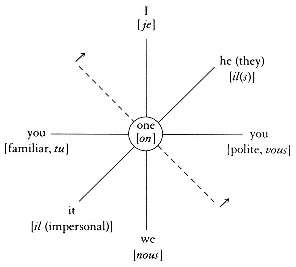
If one really reads Compact , one can see that it's indeed prose in the etymological sense of the word, even if the book appears as a diachronic/synchronic reading, and thus as writing that had to be controlled in light of the evolving text. In this manner linearity is constantly called into question by various events that have come to disturb the book itself during its composition. This is precisely the opposite of what happens in a collage. From the start, there's Compact : a book deduced from itself as the reading proceeds. Yes, it's formal—to the extent that this text, which sees itself as polysemic, suggests, through the use of a series of personal pronouns, numerous narratives that crisscross among themselves gathered into a single one, and various narrative practices. In fact the movement of Compact can be represented as a lottery of personal pronouns which, turning around the central neutrality of the impersonal pronoun, "one" [on ], tend toward anonymity, that is, toward the
unanimity of an absence, at the same time refusing neutrality, because they deploy themselves around it (see figure).
Each pronoun indicates a narrative, a narrative mode, and each narrative has its own typeface, its temporal mode, its syntax. Typography furthermore may be considered in a wider sense as punctuation, as the coloration of the timbre of the reading as well as an indication, a provocation leading to different temporal modes of reading. There can be within the same sentence numerous fragments of each one of these narratives, which can appear either as an emendation or as a contradiction—in any case, as a counterpoint: this gives rise to a type of movement between the narrative that seeks its completion, the one that's in the process of being composed, the one that one doesn't want to complete but nevertheless does complete, etc.
Notes
&&&
The Body's Design
Every writer, whatever his writing, would like to know the proper way of inhabiting his own body, his own problems—health, love, lost love. All are part of an absolutely scandalous life that is imposed on us. The fact that I have pain in my hands and cannot hold a pencil—that too is part of culture. All forms of writing belong to the body. They are the body's design. We write with our bodies, be it literature, music, painting; I would even say film and, of course, song. Vocal cords are part of the body. Can one really imagine Kathleen Ferrier without her body? She died of cancer of the vocal cords. Her last recital was recorded. I heard it. She was sublime. She fainted at the end of it and died a few days later. We write our bodies and those of others. We participate in the bodies of others. We participate in the lives of others—their pain, their thinking, their writing, their singing, and everything that can be heard and seen. That's obvious. What surprises me is that most people don't see it that way.
Onomatopoeia in Comic Strips
Language, it has been said, began with a cry and an onomatopoeia; writing, through drawing. All that must have accompanied religious rites. Protection and subsistence. Anything to feed one's face in the hunt's trajectory. They could as well have imitated the cries of animals as engrave them on the walls of caves: the hunter's Michelin Guide. In the beginning people drew visible objects and subjects in the same way that they named, or rather imitated, various noises and sounds of nature. The evolution of writing (from the tip of the flint to the pen!) occurred at the same time as that of language (from a cry to a speech!). Hadn't the time come to represent, to identify ideas without contours? This explains why, after hieroglyphics, ideograms developed, rebuses, etc., and finally the alphabet. I'm schematizing.
It is interesting to observe that onomatopoeia has come back full force, especially in comic strips . . . and specifically using the alphabet! See, for example, those assemblages of letters (on the page) with appropriate graphic renditions, which, via the reader's eyes, address themselves to his ear.
The Sound Thickness of the Text
Cratylus said, "It is in Nature that names are affixed to things." If the sonorities of language enveloped the reality of things named, one might perhaps rediscover a hidden truth. There's a fabulous truth in onomatopoeia. "Honk! Honk! Honk!" is more evocative that "warning" or "horn." Isn't it pretty when Ponge says that all the vowels in the French language are to be found in the word oiseau ?
One must also look at a word. Claudel wrote a marvelous piece in which he explained how words resemble what they designate. Locomotive , for example. The L represents the smokestack, the o the wheels, the m the body of the machine, the t the platform with its roof, the i the
railway worker, etc.[1] I too like to wander through language in this fashion. It brings us to a truth, a child's truth.
We are destined to die and thence condemned to render to the real its lively character. One must reunite the world in a single body, that of the text. Everything must join in that: the letter, the word, the sentence, discourse, the graphic procedure that may be an integral component of the work's structure; there must be a phonic and phonetic architecture to the text. Besides the "subtext" (anagrams, logogriphs, etc.), the "exegetical text" (hieroglyphic citations), there exists a text outside the page, above the page, if I may say that—a discourse in relief in the sound thickness of writing, which obviously calls to a certain inner ear as the reading proceeds. "To make the double breath visible: writing and breathing." As Claudel said (once more!):
The ductus traced by the quill follows that of the voice.
When asked why I make use of different typographic options and consider the space on the page, I like to underscore that it's a question of an expanded punctuation, and also an intonational punctuation. You don't read an italicized text in the same way as you do one in capitals. That's an indication of the sound of color.
The thickness of the text is not only in the ear or the eye. The blind read with their hands! In Compact I quoted a text in braille (though I didn't use raised dots), simply to show that those who can see are blind. If you were to read a text in braille, you wouldn't understand a thing. Therefore you too are blind. For the blind, the sound thickness of the text rests on raised dots; they have it at their fingertips. And you who think you can see—you see nothing. You're blind. You're the blind man's blind man.
[1] That's my interpretation. Here's Claudel's: "A drawing for children: First of all, the length of the word is made in an animal's image. L is the smoke; o , the wheels and the boiler; m the pistons; t indicates speed, as in auto , like a telegraph pole or perhaps a crankpin; v is the lever; i , the whistle; e , the connecting buckle." I prefer my interpretation!
Musician or Writer?
Ever since the beginning, most writers have been fascinated by music: Shakespeare ("The man that hath no music in himself . . . is fit for treasons"); Rabelais, whose famous "frozen words" (=onomatopoeia) are taken from Clément Janequin's polyphonic song "La Guerre"; later on, Diderot . . . but I'll not mention them all. In the nineteenth century Stendhal, Balzac (see his Gambara , whose protagonist invents the panharmonicon, ancestor of our synthesizer). Closer to our own time, Proust and Thomas Mann, etc., to say nothing of our own contemporaries. Apart from Mallarmé, James Joyce is the one who dealt most extensively with music. It has been observed, in particular by André Hodier, that if others wrote about music, and often in a superb manner, Joyce wrote music itself. It's obvious that the eighteen styles of Ulysses originate in musical models of the past. In Finnegans Wake , where Joyce no longer seems to depend on music, a few nevertheless see the precursor of contemporary musical forms, themselves generating new works of fiction. As for myself, if I find this idea seductive, and if some may have been happily inspired by it, I am not, for all that, convinced. (Can't help thinking of Pierre Dac's comment, "Beethoven was so profoundly deaf that throughout his entire life he thought he was painting!")
In music there's an inexpressible factor that is rarely found in literature. Moreover, this factor transcends language barriers—even and especially and paradoxically—when it is a question of a work as unique, as maximal as Finnegans Wake . Music doesn't need translation, even if it carries more precise resonances within the culture that created it. But today all types of music are fused into one. Olivier Messiaen and all of Western music have been touched by musical compositions coming from the Far East. Obviously it's more difficult for a literary text to achieve universal recognition than it is for a musical one. It does happen, thank God, but infrequently.
It's clear that a successful writer is no more than a failed musician.
We Exist for the New
But then I sometimes ask myself who nowadays can actually be interested in literature? There's no doubt that here in France there's a pronounced hostility toward anything that disturbs daily routines. I've just found a text I read on the TV show "Apostrophes." (I once was gently reprimanded for having declared in a newspaper interview, "I'd like to know why, in a world of supersonic planes and atomic submarines, we should still be satisfied with a horse-and-buggy literature, a sedan borne by moth-eaten servants?") Here's the text:
Are there rules that allow us to write a novel, so that a written story that falls outside them should be considered otherwise? If Don Quixote is a novel, does The Red and the Black represent another? If Monte Cristo is a novel, is The Dram Shop another? Is there a comparison to be drawn between Goethe's Elective Affinities , Dumas's Three Musketeers , Flaubert's Madame Bovary , Mr. Zola's Germinal ? Which of the above is a novel? And where are those so-called rules? Where do they come from? Who defined them? By virtue of what principles, what authority, and what logic? An intelligent critic should discover everything that least resembles the novel already written and encourage aspiring writers as much as possible to follow new paths.
I'm not responsible for the above; Guy de Maupassant wrote it. Well, that ought to keep you from asking me if my books are novels! Don't ever bug me about this business again!
Stockhausen reminds us that an objection currently leveled at certain artists is that they're nothing but innovators, that they're only interested in seeking out the new because it's new. If we look closely, the opposite seems to be the case, to wit: innovation remains on the outside, it isn't sufficiently universal, and the new is pursued for its effects and not because it is new. Apart from these misunderstandings, it's precisely in the name of the new that artists invent (discover) the new . Perception of the new produces knowledge, and it would be trifling for an artist to ask why men and women do not constantly aspire to knowledge.
Me
An atavistic rotten piece of luck was responsible for my coming into the
world. I wasn't made for living. Well, then, for what ?
On the one hand, I felt I couldn't have cared less for her ( . . . !); on the other hand, I had to suffer her sickening affection.
On the model of Joubert, who tore out from books those pages he didn't like, he on the other hand had deleted from his own work all that he considered superfluous, that is, practically everything. What remained were aphorisms, reflections, portraits, "cameo novels," selections . . .
I'll be dead as long as anybody else, and yet at this hour I'm alive. I prayed
until midnight and now I'm dead tired. I'm hungry .
Who said, "One of the charms of style is in the precision of equivocation?"
If I spit in my soup it's to give it flavor.
I'm a sick man, my father knows it .
Up to the age of eight, I neither laughed nor smiled—since then, I've adopted
a sort of rictus .
As a child, my mother would scold me because I didn't eat; thereafter, I
was so hungry that I lost my appetite forever .
How to translate the effort that goes into translating, from one language
into another, an untranslatable expression—and in such a way as not to betray
the effort ?
I try to follow a line of thought which goes all alone into the night and I
remain with a memory of this little adventure. It's as if one had lost something
of oneself and were chagrined by that .
You've only got what you invent .
Headaches are very close to the skull .
One feels more and more hemmed in as the world gets larger and larger .
When you get a rise out of the boss's confidence, there's no more need for
women .
Would she my faillus cuntinue to succor . . .
I'll be dead as long as anybody else, and yet at this hour I'm alive .
. . . if that were to happen while reading it? Obviously, since it isn't the
truth !
I observe, I who have succeeded by my own means in reaching my sixtieth,
that we belong to a fragile generation . . . Up to now, not one of us has reached
his eightieth !
There are more and more fewer and fewer friends .
Without memory, all's new .
My love, I always wrote the same thing. When will you notice that ?
Your reason's my folly.
On the day of one's death, one should change names. However . . .
. . . I walked into a bar
A blonde belle . . .
We never said a word !
And if I only had a few more minutes to live, I'd make the best of it and
sleep .
In order to offset that famous "prophetic gift of oneself" that all of us have, so they say, more or less without our knowing it, he had modified a number of comments.
I'm a near goner but I've got to go
had
become:
I'm not feeling so bad, but I'll stay .
Until the end, I'll hesitate between these two epitaphs:
Died for having closed his eyes upon a dream
Died for having looked life in the face .
Moi
Une scoumoune atavique m'a valu de venir au monde. Je n'étais pas fait
pour vivre. Mais alors, pour quoi ?
D'une part, j'avais le sentiment de n'éprouver plus rien à son endroit ( . . . !); d'un autre côté je devais souffrir son affection maladive.
A l'instar de Joubert arrachant des livres les pages qui lui déplaisaient, il avait, lui, supprimé de ses propres ouvrages ce qui lui semblait superflu, c'est-à-dire presque tout. Subsistaient aphorismes, réflexions, portraits, «romans éclairs», échantillons . . .
Je serai mort aussi longtemps que n'importe qui, et cependant à l'heure
présente je suis vivant. J'ai prié jusqu'à minuit et je suis crevé. J'ai faim .
Qui a dit: L'un des charmes du style est dans la précision des équivoques ?
Si je crache dans la soupe c'est pour lui donner du goût.
Je suis un malade, mon père le sait .
Jusqu'à l'âge de huit ans je n'ai ri ni souri—depuis, j'ai adopté un certain
rictus .
Enfant, ma mère me gourmandait parce que je ne mangeais pas; par la
suite, j'ai eu tellement faim que ça m'a à jamais coupé l'appétit .
Comment traduire l'effort qui consiste à essayer de traduire, d'une langue
en une autre, une expression intraduisible—et de telle sorte que cela ne trahisse
pas l'effort ?
Je tente de suivre un discours qui part seul dans la nuit et je reste avec le
souvenir de cette petite aventure. C'est comme si l'on perdait quelque chose de
soi et qu'on en éprouve du chagrin .
On n'a que ce que l'on invente .
Les maux de tête sont très prés du crâne .
On se sent de plus en plus étriqué à mesure que le monde s'élargit .
Jouir de la confiance de son patron et ainsi ne plus avoir besoin de femme .
Encore eut-il phallus que je la connasse pour que je le susse
Je serai mort aussi longtemps que n'importe qui et cependant, à l'heure
présente, je suis vivant .
. . . si cela se passe quand on le lit? Evidemment, puisque ça n'est pas vrai !
Je constate, moi qui suis parvenu par mes propres moyens à la soixantaine,
que nous sommes d'une génération fragile . . . Jusqu'ici, aucun d'entre nous
n'a atteint quatre-vingts ans !
Les amis nombreux de moins en moins ne sont plus de plus en plus .
Sans mémoire tout est nouveau .
Mon amour, j'écrivais toujours la même chose. T'en rendras-tu compte ?
Tu es la raison de ma folie.
Du jour que l'on meurt on devrait changer de nom. Mais voilà . . .
. . . dans le bar où j'entrai
une blonde si belle . . .
Nous ne nous sommes rien dit !
Et s'il ne me restait plus que quelques instants à vivre, alors j'en profiterais
pour dormir .
Pour dévier l'effet de ce fameux «don prophétique de soi» que chaque individu possède, paraît-il, plus ou moins à son insu, il avait modifié certaines remarques.
Je ne vais pas bien, mais il faut que j'y aille
cétait
devenu:
Je ne vais pas mal—partant, je reste .
Jusqu'à la fin, j'hésiterai entre ces deux épitaphes:
Mort pour avoir fermé les yeux sur un rêve
Mort pour avoir regardé la vie en face .