
PART TWO—
THEORY
The five articles in this section are theoretical in different senses, which is congruent with the changed nature of theory in the eighties, the decade in which they all appeared. Each essay must pose the question of theory anew; no method or context can guarantee its occurrence. On the other hand, there is virtually no occasion or writing mode in which theory might not occur. In the eighties, and so far in the nineties as well, there is still theory, or anti-theory, that proceeds from a prior, fixed position and therefore issues mechanically. But theory that emerges in a context that does not determine it or on an occasion that has not been called to summon it for some end, may still surprise writer and reader alike.
As its title indicates, Virginia Wright Wexman's article is concerned with the practices of film analysts and text interpreters, whose work she posits as shaped by "concrete historical processes." She classifies them according to Antonio Gramsci's distinction between (1) traditional intellectuals who serve the dominant group by rationalizing its social hegemony and (2) a more "organic" function "by which a rising group theorizes its own entrance into the upper reaches of the social power structure." Those who argue Vertigo 's status as pure cinema serve the power structure by "rationalizing particular cinematic institutions at work in the film." Vertigo 's feminist critics belong to a larger group of women intellectuals "who have elaborated a discourse on women at a moment when women have been entering high-level positions both within and outside of the academy."
Wexman cites Donald Spoto's Hitchcock biography to establish that in making Vertigo , the director was concerned primarily with the stars and the locations. (She observes astutely that Hitchcock's obsession with his actresses enabled him to function more effectively in "the environment of commercialized eroticism that defined the Hollywood style.") Wexman superbly elucidates the social implications of the Madeleine-Judy contrast and of the role of tourism
and travelogue in fiction film, and in Vertigo in particular. She also notes that critics have failed to grasp the "displacement of racial and class issues into the sphere of sexuality" in Vertigo and other films. She cites an essay by Michael Rogin that uses psychoanalysis with analysis of fifties cold-war America to trace a polarized conception of "otherness." In the popular imagination, Wexman argues, such conceptions were often focused on women. "Images of women were often deployed to displace and domesticate fears of a more un-governable xenophobic cast, fears of the Russians and of 'subversives.' . . . Hitchcock has masked the ideological workings of racism and xenophobia beneath a discourse of sexuality that is itself idealized as romantic love."
The title of Esther C.M. Yau's article on Yellow Earth is precise: "Western Analysis and a Non-Western Text," not of. Of presumes a through reading that reveals the main significations of a text. What this article provides instead is a many-stranded exploration on both its "analysis" and "text" sides. That Yau is highly adept at Western-style analysis and knowledgeable of Chinese history and culture makes this double exploration possible.
The article is dialectical in more ways than one can enumerate without writing a text as long as hers. This dialectic, the back-and-forth between expertises, provides continual illumination and increased admiration for the film, but nothing like resolution. Yau observes that the Chinese audience is used to "tear-jerking" melodramas but that Yellow Earth
has missed most of the opportune moments for dialogue and tension, and is thus unnecessarily opaque and flat. . . . The scenes where Cuiqiao is forced to marry an older stranger, and the one where her tiny boat disappears from the turbulent Yellow River, would both be exploited as moments for pathos. But here they are treated metonymically: . . . the rough dark hand extending from off-screen to unveil the red headcloth of the bride is all one sees of her feudalist "victimizer" [and] the empty shots of the river simply obscure the question of her death. In both situations, some emotional impact is conveyed. . . . But the cinematic construction is incomplete, creating an uncertainty in meaning and a distancing effect in [the] audience.
These are some of the reasons that this apparently simple, visually stunning film is so elusive of interpretation. Thus, the text that Yau begins to explore on the first page of her article, she is still exploring on its last page. Even the Chinese censors were puzzled; they frowned but did not ban.
Yau also seeks to make the text responsive to its historical and political contexts, asking in what way the text is different from and incommensurable with master narratives (socialist dogma, mainstream filmmaking, classical editing,
etc.). The main part of Yau's article pursues these and other questions regarding "the interweaving and work of four structurally balanced strands . . . on three levels: a diegetic level, . . . a critical level, . . . and a discursive level." The strands are narrative, but are also "semic" ones, that is, sites of meaning. Yau's analysis illuminates the film, but her question remains: "How does this non-Western text elude the logocentric character of Western textual analysis as well as the sweeping historicism of cultural criticism?"
The point of departure of Manthia Diawara's 1988 article is twenty-five years of African cinema, beginning with Borom Sarret (1963), Ousmane Sembene's first film, and proceeding to Cheick Oumar Sissoko's Nyamanton (The Garbage Boys , 1986) and other films. This work has "necessarily created an aesthetic tradition which African filmmakers use as a point of reference which they either follow or contest." Why has this tradition largely escaped serious attention?
The lack of African critics who know African traditions is at fault, as well as . . . the ethnocentrism of European and American film critics. . . . They think that [African] cinema is in the process of finding its individuality, that the film-makers have not mastered yet the film medium, that the camera style is still primitive in African films.
Diawara's goal is "to make possible the definition of a dynamic aesthetic proper to Africa." He will do this by developing the relations between African oral tradition and African cinema. An essential part of these relations has to do with the figure of the griot (the bard), who is both a storyteller and the custodian of traditional values. Fundamental for the griot is skill in narration, including detailed, nuanced realization of the story itself. Not only is the film-maker a kind of griot, but many African films also specifically refer to the griot tradition itself. "When African films are examined," Diawara notes, "one sees that all the directors resort in different ways to oral story-telling forms."
What follows is an illuminating discussion of different manifestations of the griot in a number of important films. Indeed, in the most brilliant turn of this influential article, Diawara demonstrates how each film's realization of the griot positions it socially and ideologically. For instance, Borom Sarret shows a fat griot with a gold tooth taking a cart driver's morning wages to tell him a story. The griot's narrative, authoritative in oral tradition, here exploits his listener and omits contemporary realities that oppress him. But Ababakar Samb's Jom (1981) surrenders its narrative authority to the griot and thus positions the spectator to identify uncritically with tradition, with which everything positive is associated, just as everything negative is placed on the side of modernism.
The articles by Marsha Kinder and Brian Henderson concern the applicability of Gérard Genette's categories of narrative analysis (as set out in "Discours du récit" [1972]) to film—a realm of inquiry about which Genette himself says nothing. Henderson considers Genette's five main topics—order, duration, frequency, mood, and voice—in relation to film. Narrative order chiefly involves what Genette calls analepses, which go backward in time, and prolepses, far less frequent, which go forward in time. If a work has no temporal variations, its order is called straight chronology. It seems that the majority of films of every era are told in straight chronology, whereas, according to Genette, such order is the exception in novels. The article discusses many examples of analepsis in classical cinema, American and European, and in the avant-garde. Because there is no "normal" reading speed, duration in literature has to do with the relative speeds of different passages, determined by comparing the number of pages devoted to different time periods, and dates these sections by the story time they cover. Films, on the contrary, have fixed viewing times; one may compare a length of film measured in minutes and seconds or in feet, to a portion of story, or vice versa, and one may assemble these findings in an exact table.
Narrative frequency—what Genette calls the iterative—has to do with relations of repetition between a narrative and a story. The most common of these—to narrate once what happened many times—is the iterative, strictly speaking, in which a single utterance takes upon itself several occurrences of the same event. Henderson discusses several instances of iteration in classical cinema before launching into an extended analysis of the Huw-narrated opening passage of How Green Was My Valley , which makes repeated use of the word "would," the principal verb form for the iterative in English. The almost imperceptible shift from the iterative to the singulative mode in Huw's narration raises the question of how such a slippage is possible in cinema. Are the images neutrally either iterative or singulative, depending upon a voice-over to define their temporal status? Another issue concerns what Genette calls the pseudo-iterative: scenes presented, particularly by their wording in the imperfect, as iterative, whereas their richness and precision of detail ensure that no reader can seriously believe they occur and reoccur in that manner, several times, without variation. This happens occasionally in Proust; in cinema it is pervasive because "richness and precision of detail" seem to be inherent in cinematography and sound recording. Genette's chapters on mood and voice painstakingly distinguish them. His shorthand for the difference is that mood has to do with who sees and voice has to do with who speaks. Voice in literature can be complex indeed, but someone—a major or minor character or an identified narrator (or a succession of these)—is understood to be speaking the words of the novel or poem. In cinema, it is unclear who "speaks" the images, music, sound effects, dialogue, and graphic material that comprise a film.
Marsha Kinder begins with a discussion of Genette on the literary and Henderson on the filmic iterative. Genette speaks of Proust's "intoxication with the iterative" and Henderson of an ultra-literal position according to which cinema, because of its precision and detail, is inherently singulative. Kinder then says:
I am arguing precisely the opposite position: namely, that the iterative is inherent in cinema, either through the pseudo-iterative . . . or through the iterative implication (where the acknowledgement of the iterative repetition is only implicit and positioned within a scene presented as singulative). . . . Genette confines the iterative to temporal relations and to utterances about past events. Yet by acknowledging that iterative repetition depends on the mental construction of a class . . . of similar instances, he opens a space within the iterative for the issue of typicality. Since temporality . . . is not foregrounded in film the way it is in literature, I am arguing that it is this issue of typicality that is usually foregrounded by the iterative in cinema.
Kinder analyzes the opening of Duel in the Sun as an instance of Hollywood's intoxication with the singulative, where the iterative implications of scenes are used to naturalize the singulative and render the slippage between the two invisible. In neorealism, by contrast, the iterative background is not subordinate, "but at least coequal, normative, and determinant in ideological terms. . . . Individuals and their actions are chosen precisely because they are representative and typical in an iterative sense." In Umberto D , the maid's ordinary morning routine foregrounds the iterative. What Kinder calls "the spectatorial retraining function of the neorealist pseudo-iterative" is "perhaps most notable" in Il Posto (The Job ). The film concerns the entry of a young man from Lombardy into the dehumanizing world of the Milanese bureaucracy. The character's typicality is underlined by the scores of other young people who are seen at his workplace, on the streets of Milan, in his suburban tenement, etc. Indeed, at a certain point, there is a sudden slippage into the iterative, as we see a series of brief scenes showing how each of five clerks from the office typically spends his evenings. In these sequences from both films, "the neorealist intoxication with the iterative immerses the spectator, not in the emotional intensity of personal memory as in Proust, but in the ideological relations between individual and collective experience." Chantal Akerman's Toute une nuit (The Whole Night ) "goes much further in deconstructing traditional narrative." We see the beginnings of a series of meetings between various actual or potential lovers, but none is continued to produce anything like narrative development, let alone closure. Kinder argues that there is an important iterative aspect to this film also: "the brief scenes are presented in such a way as to suggest that these or similar events occur every night—an aspect that was already implicit in the title Toute une nuit ."
Tense, Mood, and Voice in Film:
(Notes after Genette)
Brian Henderson
Vol. 36, no. 4 (Summer 1983): 4–17.
Narrative Discourse[*] is a translation of "Discours du récit," which is the major part of Figure III (1972) by Gérard Genette. Genette's topics are traditional ones of literary theory and criticism: order, duration, frequency, mood, and voice in classical fiction and the subversion of these in modern texts. Genette offers no new method of literary analysis but a clarification, systematization, and extension of older ones, amounting to a transformation of them. The book is immensely stimulating and has already been quite influential.
Aside from a reference or two, Genette does not treat film, and his work cannot be directly applied to film. Each of his categories must be rethought on the ground of film analysis, a project whose value is argued below.
What does Narrative Discourse do? It studies Proust's A la recherche du temps perdu and it studies narrative discourse; it is at once the criticism of one text and a theory of narrative. To do both without subordinating one to the other is a paradox; but it permits "a refreshing rotation and mutual entertainment between theoretical dryness and critical meticulousness." Genette compares the project to an insomniac turning over and over in search of a better position.
His study of narrative discourse is limited to the narrative text itself. He does not compare the Recherche to actual events, as one might a history, nor to the circumstances of its production, as might a biography of Proust. Rather he addresses the relationship between a narrative discourse and the events that it recounts and the relationship between the discourse and the act that produces it. But it is the narrative discourse alone that informs us both of the events that it recounts and of the activity that supposedly gave birth to it.
Narrative Discourse, An Essay in Method , translated by Jane E. Lewin (Ithaca: Cornell, 1980). Figures of Literary Discourse , translated by Alan Sheridan (New York: Columbia University Press, 1982) comprises translations of Genette essays from Figure I (1966), Figure II (1969), and an additional essay from Figure III . See also Seymour Chatman, Story and Discourse: Narrative Structure in Fiction and Film (Ithaca: Cornell, 1978), especially pp. 63-79.
Genette distinguishes three aspects of narrative reality within the narrative text: story refers to the narrative content, that is, to the chronological order of events implied by the narrative; narrative refers to the narrative discourse or text; narrating refers to the producing narrative action.
Having made these distinctions, Genette turns to method. Since any narrative is a linguistic production, telling of one or several events, he argues that it is legitimate to treat it as the development given to a verbal form, in the grammatical sense of the term: the expansion of a verb. "I walk, Pierre has come are for me the minimal forms of narrative, and inversely the Odyssey or the Recherche is only, in a certain way, the amplification (in the rhetorical sense) of statements such as Ulysses comes home to Ithaca or Marcel becomes a writer ." This perhaps authorizes us to formulate the problems of analyzing narrative discourse according to categories borrowed from the grammar of verbs. Genette reduces these to three basic classes of determination: tense, mood, and voice. Tense, which includes order, duration, and frequency, has to do with temporal relations between narrative and story. Mood has to do with the modalities, i.e., the forms and degrees of narrative representation. Voice has to do with the mode of action of the verb in its relations with the subject of the statement, not an actual writer or speaker, but the subject of the enunciating itself; more broadly, it has to do with what Genette calls the narrative situation and its two protagonists: the narrator and his audience, real or implied. These terms are borrowed from the grammar of verbs for narrative analysis; Genette claims no rigorous homology between the two instances.
To study the tense of a narrative is first of all to compare the order in which events are arranged in the narrative discourse with the order of succession these events have in the story. Types of order include straight chronology and anachronies, a general name for deviations from straight chronological order. Anachronous narratives begin, in one way or another, in medias res then go backwards (analepses) or, much less frequently, forwards (prolepses). Analepses are external when their entire extent happens before the beginning of the first narrative, commonly used to give background to the present action. They are internal when they fill in gaps occurring later than the start of the novel. There are also lateral ellipses, in which the narrative sidesteps an element within a chronological passage. Genette calls this paralipsis, ellipsis to the side; like a temporal ellipsis it may be filled in later.
It is not difficult to apply Genette's basic concepts of order to cinema. It seems that the majority of films of every era have been told in straight chronological order whereas, according to Genette, such order is the exception among novels. Prolepses are relatively rare in the novel but they are even rarer in cinema. Flashforwards are sometimes used by Resnais and Roeg, on the whole integrally to their projects; in some sixties and early seventies films they were used
rather unsystematically as instances of "mind" or "cinema" or both, e.g., Easy Rider .
Anachronies in cinema come down mainly to analepses. Such figures are extremely rare in the first twenty years of film history, although one does find there dreams, visions, and even "reviews" of material shown earlier in some sequels, episodes of serials, etc. In Broken Blossoms (1919), Griffith introduces Battling Burrows then flashes back to his recent victory in the ring to explain his bad temper at having to keep in training; he introduces Lucy then flashes back to her encounters with a weary wife and with some prostitutes to show the options that hem her in. In the manner of classical fiction, The Cabinet of Dr. Caligari (1919) casts its main story as a long analepsis inside a framing story set in the present; but like Last Year at Marienbad (1961), this "past" may be delusional and therefore the "remembering" itself a strictly present action. Victor Sjöstrom's The Phantom Chariot (1920) exhibits a remarkable mastery of cinematic tenses, at one point presenting a flashback within a flashback.
The greatest period for analepsis in classical cinema was undoubtedly 1941–1957, that maturity of the sound film marked by Citizen Kane (1941) and How Green Was My Valley (1941). The latter begins with an older Huw leaving the valley and remembering it as it was; the rest of the film presents that remembering and never returns to the framing story, recurring at the end to memory images from the early part of the analepsis iteself, in a kind of looping of the past. More usual is the analeptic structure of All About Eve (1950), which returns to the framing story at the end and carries it forward for an additional scene or two. Citizen Kane, Double Indemnity (1944), and Sunset Boulevard (1950) follow this pattern, as indeed do most analeptic films of the classical period.
Analepses in the cinema have nearly always involved the use of language, sometimes explicit dialogue setting up a return to the past, more often the direct intervention of language in the form of titles or voice-over. Without such linguistic cues, and quite often with them, analepses in classical cinema are usually marked redundantly by plot, indirect dialogue, music (dreamlike or "mental"), and optical devices such as blurs, rippling, fades, or dissolves. Classical cinema reacts to a tense shift as though to a cataclysm; the viewer must be warned at every level of cinematic expression, in sounds, in images, and in written language, lest he/she be disoriented.
Why is this? Cinema has no built-in tense system as language does. One cannot write a sentence without indicating tense but one can apparently make a shot, and therefore perhaps a film, without indicating tense. In written discourse the tense structure must be renewed with every sentence and, concomitantly, a single sentence may subvert that structure; Genette pauses over the tense structure of several individual sentences by Proust and their implications
for the narrative as a whole. In the cinema, one is tempted to say, if the camera keeps running or if there is a cut to another angle within the scene, continuous temporality is the result; the cut to another sequence is read as straight chronological order, unless otherwise marked. One must do something, indeed a great deal, if a comprehensible shift of tenses is to be achieved in cinema. So, at any rate, classical cinema has persuaded us by making straight chronological order seem natural and inevitable. Cinema, unlike language, is, in Barthes's terms, a "complex system in which different substances are engaged," in which "the senses are subjected to the concerted action of a collection of images, sounds, and written words." Language need only change a word-ending to indicate tense shifts; cinema must pass from one complex conjunction of communication channels to another and provide a plausible transition between them, all without an explicit tense system.
This is one reason why films like Wild Strawberries (1957) and 8 1/2 (1963) made such an impact when they appeared and have had such influence. They went back and forth between past and present without explicit linguistic cuing and with a subtlety as to other signals that made the old ways seem heavy-handed. These films seemed to abolish the rhetoric of tense shifts in cinema; in fact they substituted new rhetorics for old. 8 1/2 in particular convinced viewers that it had achieved the seamless interaction between past and present that it had aimed for. Any spoken version of "I remember" would have defeated the film's psychological subtlety and cinematic fluidity. But other, well-hidden signals prepare the audience for tense shifts and guide it back smoothly. These include the context of setting and plot and Fellini's isolation of Guido by reframing or character movement just before a return to the past. There are also at times different optical treatment of past and present, wind sounds, fading of present voices, etc. Rota's music is used to bridge time shifts expertly as is Mastroianni's detachment and bemusement, his inwardness amidst public scenes, slight modulations of which carry him (and us) from something in the present to something in the past. He is passive yet alert to his own visions, as though receiving them from outside and shaping them at the same time. Indeed Fellini brings in a pair of mind-readers to keep his hero from introducing the past on his own ("Asa Nisi Masa").
Certain films undermine our ability to distinguish analepses from straight chronological order and thereby subvert narrative order itself. These include works by Buñuel, Duras, and Rainer, not to mention the semi-narrative films of the avant-garde. Made well before Marienbad —and more lucidly—Maya Deren's Meshes of the Afternoon (1943) tempts us to discover a single narrative order; our effort is necessary to the film's operation but is of course doomed to fail.
Perhaps the most formidable subversion of order specifically, of order as order, is Not Reconciled (1965) by Jean-Marie Straub, an adaptation of
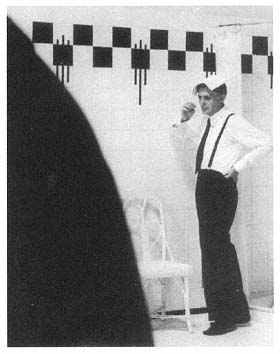
Mastroianni as Guido in 8 1/2
Heinrich Böll's long Billiards at Half-Past Nine (1962) into a 53-minute film. The story deals with three generations of a Cologne family and the resistance of some of its members to militarism in World War I, in the thirties, and in the postwar period in which it is set; it all takes place on Heinrich Fähmel's eightieth birthday, a Ulysses -like day on which various characters remember the past. Straub actually straightens out the novel's jumbling of the events of the day and eliminates most of its flashbacks. Nevertheless the film is vastly harder to follow than the novel because Straub has omitted most of the signals that cue viewers as to time shifts.[*] He uses straight cuts to go to the past and to return; there are no optical devices and no music cues. Voice-over is used for the past
The film begins with a three-second shot of a man playing billiards, saying to a bellboy, "Tell me what, boy?", which is followed by eight shots with voice-over concerning boys involved in political conflicts at a high school. Then there is a shot of the billiard player ordering a cognac and five shots of the bellboy going to get it, including two flashbacks concerning his life at the hotel. A shot back in the billiard room, in which the bellboy asks if there is more to the story, is followed by twelve more shots, with voice-over, of one of the schoolboys being beaten, being smuggled out of the country, etc. At this point, less than seven minutes into the film, first- and even second-time viewers have no idea where they are and have no way to regain their footing for the rest of the film. For a fuller treatment, see Richard Roud, Jean-Marie Straub (New York: Viking, 1972), which remains the best introduction to its subject.
material itself, but not to bridge present-past shifts. Plot context and period detail are probably what viewers most rely upon to construct the narrative order of a work. Here too Straub withholds orientation: he makes his thirties shots and his fifties shots virtually indistinguishable in dress, environment, gestures, mode of speech, etc., which is also a thematic statement. (Some of the World War I–era shots have period flavor.) Also, there is never enough context provided to know with certainty which shots belong to which period, let alone how the various events depicted relate to one another. It is only upon multiple screenings or upon reading about the film, or both, that we realize that some of the characters are the same characters at different ages; there are two Roberts, two Schrellas, two Johannas, and two Heinrichs. Most remarkable of all is the temporal coherence of Not Reconciled when one has studied it carefully. Its order is straight chronology with three major analepses (Robert's two-part story of the thirties and Heinrich's story of 1910–1918) and two minor ones (Hugo the bellboy's life at the hotel). Straub is right in calling it a simple film but it takes a great deal of work to understand that.
All of our examples, from Griffith to Straub, have stayed within Genette's basic categories of straight chronology and analepsis. It is notable that he himself does not stay within these simple concepts. Thus he finds in Proust "repeating prolepses" (playing a role of advance notice), "prolepsis on analepsis," "analepsis on prolepsis," "analepsis on paralipsis," etc. Our discussions indicate that cinema has not (yet) developed the complexity of tense structures found in literary works. They also indicate that in cinema analysis the interesting questions have to do not with narrative order itself, but with how films indicate this order, both straight chronology and deviations from it.
For Genette, duration is a more difficult question than that of order or frequency because the time needed to read a text depends upon factors external to it. There is no "normal" reading speed so one cannot pose a hypothetical equality between narrative time and story time, against which to measure variations. One can, however, compare parts of the narrative discourse to each other to determine their relative speeds. This method applies only to the large narrative articulations of a work and not to detailed studies of rhythm, which, Genette notes, would lack rigor. Thus he divides Proust's text according to its principal temporal and spatial breaks, determines the number of pages devoted to each, and dates these sections by the story time they cover. He then expresses these findings in an overall ratio: the Combray episode devotes 140 pages to ten years, the Gilberte episode devotes 200 pages to two years, etc. On the basis of this table Genette assigns a range of variations to the Proustian text: from 150 pages for three hours to three lines for twelve years. He also notes a durational evolution in the overall text: a gradual slowing of the nar-
rative through longer and longer scenes and a corresponding increase in the number and length of ellipses between such scenes. Genette calls such variations of speed, which all narratives have, anisochronies or effects of rhythm.
Films, of course, have fixed viewing times. One may compare a length of film, measured in minutes and seconds or in feet, to a portion of story, or vice versa, and one may assemble these findings in an exact table. One may examine the large narrative articulations of a whole film or the microrhythms of very short passages. Genette's account of duration does not enlarge these methodological options; he is dealing with a less exact case. But by making the question of duration newly interesting, he provides new motivation to make such analyses.
Duration in cinema is a very delicate matter, as anyone knows who has shown Straub or Michael Snow to an unreceptive audience. Even viewers sophisticated in other respects become angry if their sense of proper filmic duration is challenged.
If Straub's transgressions in Not Reconciled have to do with order, those of his Chronicle of Anna Magdalena Bach (1968) have to do with duration. The 93-minute film consists almost entirely of images and sounds of musicians in period costume playing Bach's works. An account of the circumstances of the composing and playing of these works, of Bach's financial difficulties, of the births and deaths of their children—and of little else—is spoken over the images and music by Anna Magdalena. She usually speaks over the ending of one work and the beginning of another or in very brief intervals between them. She also speaks very rapidly, as though speaking of family matters and external circumstances hurriedly between musical performances. Straub calls it a Marxist film because it presents the actual production of music (directly recorded), to which Bach's waking hours were massively devoted, as well as his marginal economic status and his struggle for the right to select his musicians. Despite superb performances of well-chosen Bach works, Chronicle still has the power to empty theaters and classrooms.
In the commercial realm, Frank Capra reports in his autobiography that the first version of Lost Horizon (1937) was too long and had too much background to the main story. As a result, the preview audience was restless throughout the screening. A durational miscalculation at the beginning threw off the reception of the entire film. Capra's response was to "Burn the first two reels," his chapter title for the incident, an indication of how strongly the durational code is enforced.
Film's multi-channelled textuality raises durational problems, and opportunities, not found in literature. Image, dialogue, voice-over, music, sound effects, and written materials may contribute, complementarily or redundantly, to a single duration; or they may create multiple, simultaneous, or contradic-
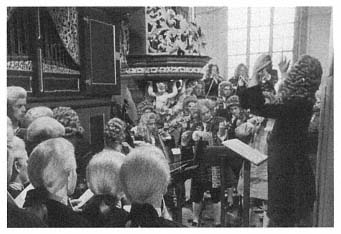
The Chronicle of Anna Magdalena Bach
tory temporalities. Modern films have exploited such possibilities in a variety of ways. In Le Petit Soldat (1960), like The Lady from Shanghai (1948) before it, a final shot of the hero is held while the voice-over summarizes a much larger time period:
It was after killing Palivoda that I learned of Veronica's death. Only one thing was left to me: learn not to be bitter. But I was happy, because I had a lot of time in front of me.
Similarly, Badlands (1973) opens with a long take of Holly in bed playing with her dog, over which we hear her voice-over:
My mother died of pneumonia when I was just a kid. My father had kept their wedding cake in the freezer for ten whole years. After the funeral he gave it to the yard man. He tried to act cheerful but he could never be consoled by the little stranger he found in his house. Then one day, hoping to begin a new life away from the scene of all his memories, he moved us from Texas to Fort Dupree, South Dakota.
The classical cinema is not without its durational contradictions either, although one must look more carefully to find them. How Green Was My Valley (1941) covers many years of its novel source in less than one year, including births, deaths, two sets of emigrations, the transformation of the valley from garden to slagheap, etc. In the same year Huw begins school, graduates, and goes to work in the mines. The decision to use Roddy McDowall as Huw
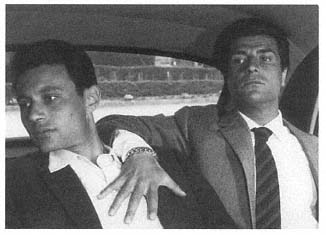
Le Petit Soldat
throughout the film imposes this durational contradiction: Huw does not age while events around him suggest years going by. The other players do seem to get older—there is even an excuse for his mother's hair turning white suddenly. The duration of the plot and that implied by the performance level are contradictory, something that could not happen in literature.
Genette continues his discussion of duration and prepares for his discussion of frequency by proposing a general system of narrative speeds. In theory there is a continuous gradation from the infinite speed of ellipsis, defined as story time without discourse time, to the absolute slowness of descriptive pause, defined as discourse time without story time. In fact the narrative tradition has reduced that liberty to four basic relationships that Genette calls the canonical forms of novelistic tempo. Besides ellipsis and descriptive pause, there are the scene, most often in dialogue, realizing an equality of time between narrative and story, and the summary, a form with variable tempo—that of the other three is fixed—that covers the entire range between scene and ellipsis. Summary remained, to the end of the nineteenth century, the most usual transition between scenes, the background against which scenes stood out, and thus the connective tissue par excellence of novelistic narrative, whose fundamental rhythm was defined by the alternation of summary and scene. Genette ingeniously shows that, despite appearances, there are almost no summaries in Proust and no descriptive pauses. Proustian descriptions are always grounded in a character's perception and therefore are parts of scenes. Moreover, narrative cutting in Proust is never accomplished by Balzacian summaries but by a quite different kind of synthesis, that of the frequentive or iterative, which is used in conjunction with ellipses.
The cinematic equivalent of Genette's scene is clear enough; indeed the notion and the prestige of the dramatically present moment were borrowed by the novel from theater. Summary we will consider in relation to the iterative, below. Ellipsis in cinema is a vast topic; aside from single-take films on the Lumière model or virtual long takes like Hitchcock's Rope (1948), there can be no cinema without ellipsis. In Rossellini, Godard, and other figures of modern cinema, as in the later Recherche , ellipses tend to become longer and more abrupt. The scenes between gaps are not necessarily longer, as in Proust, but may be denser in synthesized content (Rossellini) or in cinéma-vérité detail (Godard). Rossellini's ellipses trace the movements of an argument unconcerned with conventional diegesis, though what he does show is usually "neorealist" in its detail and objectivity. Similarly, but differently, Godard likes to balance the ethnographic detail of actual locations, direct sound, and observed gestures with the arbitrary jumps and dénouements of fiction, often expressed through ellipses. (In Masculin-féminin [1966], Paul's death occurs between the next-to-last and the last sequences.) Generalizing is hazardous, but both Rossellini and Godard tend to use long takes around their ellipses, as though their abruptness and force would be lost amidst montages.
Description poses special problems for film analysis because every shot serves a descriptive function, whatever else it may do. At the same time no shot is entirely descriptive, therefore cannot be a true descriptive pause, because the fixed time of film viewing makes it dramatic also. Even if no action occurs in this shot or in this setting, the time devoted to them builds expectations for action to come; they too are ticks on the dramatic clock. Indeed few things build more expectancy than silent shots of objects in a narrative film.
Speaking very broadly, some films seem to invent actions to fill out projects descriptive of a time or place (Ford's Judge Priest ); others describe an environment so that we will understand the action to follow (every heist film). The opening scenes of classical narrative films generally describe a setting while introducing us to the protagonists of the action. The trick in classical script construction, as in the theater before it, was to accomplish this while already advancing the action. The opening sequence of How Green Was My Valley , told in the frequentive tense, describes a complex setting in detail, introduces us by name and personality to eight or nine characters, indeed to an entire village, and immerses us in a nostalgic vision of a way of life that will begin to deteriorate in the next sequence.
Description provides a bridge to frequentive or iterative narrative, for as Genette says, "The classic function of iterative narrative is thus fairly close to that of description, with which, moreover, it maintains very close relations." Narrative frequency has to do with the relations of repetition between the narrative and the story. Genette proposes a system of relationships between the
capacities for repetition on the part of both the narrated events of the story and the narrative statements of the text. This system is reducible to four virtual types. One may narrate once what happened once; one may narrate n times what happened n times; one may narrate n times what happened once; one may narrate one time what happened n times. The last is the frequentive or, as Genette prefers to call it, iterative narrative, in which a single utterance takes upon itself several occurrences of the same event: "For a long time I used to go to bed early."
In classical narrative, iterative sections are almost always functionally subordinate to singulative scenes, for which they provide a sort of informative frame or background. In this the classical function of iterative narrative is fairly close to that of description: both are at the service of the narrative as such, which is the singulative narrative. The first novelist to liberate the iterative from its functional dependence was Flaubert, who constructed entire passages in its mode. But no novel has given the iterative a scope, importance, or technical elaboration comparable to Proust's. Genette develops these points in a series of fine analyses, including a classification of kinds of iteration that need not concern us here. Suffice it to say that his elaboration of the iterative is one of the most original things in Narrative Discourse .
In classical cinema, as in the classical novel, the iterative nearly always has an information or background function subordinate to singulative scenes. The exterior shots of trains or buses in backstage musicals signify numberless such journeys. If the words "Baltimore," "Philadelphia," "New Haven" appear under a series of train shots, as in The Bandwagon , then there is a narrative summary as well as iterative narrative; a specific itinerary is signified as well as numerous rides on trains. The montages of nightclub signs and clinking champagne glasses in romantic comedies are iterative in function. If they stand for a series of such evenings, they are what Genette calls generalizing or external iteration; if for one of them, what he calls synthesizing or internal iteration.
In Trouble in Paradise (1932), Lubitsch shows Mme. Colet's typical activities as head of a company by cutting from her on a stairway to four shots of servants and assistants down below, who say, respectively: "Yes, Mme. Colet," "No, Mme. Colet," "No, Mme. Colet," "Yes, Mme. Colet." This rhyme is itself rhymed later when Gaston has taken over direction of the company. Lubitsch shows this change (summary) and the typical obedience that Gaston now receives (iteration) by cutting from him to another series of servants and subordinates: "Yes, M. LaValle," "No, M. LaValle," "No, M. LaValle," "Yes, M. LaValle." Needless to say, the repeated yesses and nos also echo and mock the sexual oscillation that is going on in the plot.
The opening sequence of How Green Was My Valley presents a large and sustained figure of iteration; it takes up over half of the film's entire spoken
narration by the older Huw, whose face we never see. As he is leaving it for the last time, Huw remembers his valley as it was when he was a boy, describing a typical day through a repeated use of the word "would," the principal verb form for the frequentive in English.
Someone would strike up a song and the valley would ring with the sound of many voices . . . Then came the scrubbing . . . Most [of the coal] would come off but some would stay for life . . . There was always a baron of beef or a shoulder or leg of lamb before my father. There was never any talk while we were eating . . . My mother was always on the run . . . After dinner, when dishes had been washed, the box was brought to the table, for the spending money to be handed out. No one in our valley had ever seen a bank. We kept our savings on the mantlepiece.
At this point, when Huw gets his penny, hurries to the candy shop, and meets Bron, his future sister-in-law, the voice-over narration suffers an odd sea-change, dropping almost imperceptibly from the iterative to the singulative mode.
It was on this afternoon that I first met Bron—Bronwen. She had come over from the next valley for her first call on my father and mother.
I think I fell in love with Bronwen then.
Which afternoon is "this," since the voice-over has been describing the typical activities of many days but of no particular day? Thematically one might call this a fall into time: out of the frequentive mode, which is preserved, as in Proust, from the ravages of time, into the singulative mode, the order of irreversible time and change, in which the family will be dispersed and the valley destroyed. The fall into time is also a fall from grace, corresponding to Huw's first love attachment outside of the family as well as to his brother's marriage, the first actual division of the family.
Most interesting, theoretically, is how and why such a slippage is possible in cinematic iterative; it would not be in literary narrative. Are the images neutrally either iterative or singulative, depending upon a voice-over to define their temporal status? If so, then the continuity of the images may sustain us through a shift in tense, while the changed verbal tense tells us how to read the images. Or is there a shift of reference here? The images have seemed to follow the voice-over narration, as though illustrating it; perhaps, its introductory function accomplished, the voice-over now refers to the images. "This afternoon" seems to refer to the images we see before us. This shift may prepare us for the
withdrawal of the voice-over in favor of the images, which will now be furnished with synchronized dialogue; this is what happens in How Green Was My Valley . After Huw describes his love for Bronwen and the scene shifts to her introduction to the family, from which young Huw is pointedly excluded, his voice-over ceases—except for seven or eight more interjections of a clearly summarizing sort throughout the rest of the film.
Our discussion of How Green Was My Valley raises the problem of what Genette calls the pseudo-iterative:
scenes presented, particularly by their wording in the imperfect, as iterative, whereas their richness and precision of detail ensure that no reader can seriously believe they occur and reoccur in that manner, several times, without any variation.
This happens occasionally in Proust; in cinema it is pervasive because "richness and precision of detail" seem to be inherent in photography and sound recording, at least in those practices of them engaged in by most films. Thus Donald Crisp and company walk to the pay window in precisely this way only once, as recorded in the take included in the release print of the film. Some might take an ultra-literal position and say that this makes the iterative impossible in cinema; its images and sounds are always singulative. But, as noted, cinema is a "complex system"; it is the "concerted action" of images, sounds, including voice-overs, and written words that create meaning in cinema, including iterative constructions. And, as Metz once argued, the fact to be understood is that films are understood, including the cinematic iterative.
Nevertheless, the singulative tendency of recorded sounds and images can have a backlash effect on iterative constructions. How Green Was My Valley goes from the iterative to the singulative by virtue of a tense change in the voice-over. A much more frequent figure is a scene that begins in the iterative, by virtue of a title or a voice-over, then becomes singulative, as though reverting to the singulative in the absence of continued linguistic definition to the contrary. A title in Lady Windermere's Fan (1925) tells us that the way a gentleman rings a lady's doorbell reflects the state of their relationship and we see a tentative finger finally engage the button. "But when he knows her well . . ." says a later title, and we see an impatient finger ringing and ringing. Under the pressure of the title, these images are iterative: they narrate once what happened many times; but in the scenes that follow each image, singulative events occur. One might say that the doorbell images are iterative and the rest of each scene singulative; or better, that the doorbell images have a dual status, belonging both to an iterative construction and to a singulative one.
There is also the opposite problem, what Genette calls "a sort of contamination by the iterative" of a singulative scene. In Proust this is produced by a few iterative sentences within a singulative passage. In cinema, as in the other performing arts, there are many ways to suggest habit, frequency of occurrence, and typicality within a singulative context. Indeed, how many plays and films, from King Lear to On the Waterfront , open on a scene of habitual order just as it is about to be changed irrevocably.
Genette's chapters on mood and voice painstakingly and brilliantly distinguish them. Perhaps for that reason, his treatment of the two topics is very much intertwined. Strictly speaking, the mood of narrative statements can only be the indicative since the function of a narrative is to report facts, real or fictive, not to give an order (the imperative), to express a wish or state a condition (the subjunctive), etc. Admitting that he is extending the linguistic metaphor, Genette argues that within the indicative there are differences between degrees of affirmation as well as different points of view from which an action may be looked at. One can tell more or less what one tells and one can tell it according to one point of view or another; this capacity and the modalities of its use are what Genette's category of narrative mood concerns. Thus the chief sub-categories of mood are distance and perspective. The narrative can furnish more or fewer details, rendered in a more or less direct way, and can thus seem to keep at a greater or lesser distance from what it tells. That distance need not be fixed throughout a narrative but may vary according to the knowledge of one or more participants in the story, adopting what is usually called their point of view. Thus the narrative seems to take on, with regard to the story, one or another perspective.
Genette's discussion of distance entails an extended contrast between mimesis and diegesis. Mimesis is direct imitation, as are words and actions on a stage. Written narration cannot be mimetic since it presents words and actions described by an intermediary—the author or, more correctly, the narrative discourse itself. An exception is direct speech, presented in the manner of drama, in which the mediation of the narrator seems to disappear. Genette cleverly shows that the interior monologue, which he prefers to call immediate speech, pushes mimesis to its limit by "obliterating the last traces of the narrating instance and giving the floor to the character right away." Some analysts have called cinema or particular films or passages mimetic, others have called them diegetic; sometimes the terms are used more or less interchangeably. Genette's definitions might make possible a new clarity regarding cinematic instances, although, again, cinema is a more difficult case because it is a "complex system." Films usually present the direct imitation of speech and action but do so in a mediated, or diegetic way. Films may combine mimetic and diegetic ele-
ments in a large variety of ways and may also oppose them through slight discrepancies or gaps, as in Bresson's Diary of a Country Priest (1951).
Narrative perspective is a second mode of regulating information, turning on the use or absence of a restrictive point of view. Genette confronts at the outset a widespread confusion between mood and voice, between the question: Whose point of view orients the narrative perspective? and the question: Who is the narrator? Or, more simply, between "Who sees?" and "Who speaks?" Genette's clarification of this large, muddied realm is, with his original discussion of frequency, his most conspicuous achievement.
Genette prefers the term "focus of narration" or "focalization" to "point of view." Ishmael and Strether occupy the same focal positions in Moby-Dick and The Ambassadors , respectively. That Ishmael also narrates while an author absent from the story narrates The Ambassadors is a question of voice, not of mood. Wayne Booth's implied author and narrator, the narrator who is dramatized or undramatized, reliable or unreliable, are all categories of voice.
Genette distinguishes nonfocalized narratives, generally the classical narrative, from internally and externally focalized narratives. Internal focalizations are fixed if we rarely leave the point of view of one character; variable if we go back and forth between more than one character; or multiple if the same event is evoked several times according to the point of view of different characters, e.g., The Sound and the Fury , certain epistolary novels, or Rashomon . In external focalization (some of Hammett and Hemingway), the hero performs in front of us without our knowing his thoughts or feelings. A focalization is not necessarily steady; a work may combine many types of focalization, even all of them, although particular passages are usually focalized in one way rather than another. The division between variable focalization and nonfocalization is sometimes difficult to establish, since the nonfocalized narrative can most often be analyzed as a narrative that is multifocalized ad libitum .
Older Huw is the narrator of How Green Was My Valley —it is literally his voice that we hear; but this does not control the question of mood. We almost never see things from young Huw's visual perspective. How Green is nonfocalized in that no sequence, let alone the whole film, is shot from any one character's perspective. It is variably focalized in that it frequently borrows a character's perspective for one or more shots—sometimes for dramatic reasons, sometimes opportunistically because it yields a stunning image or an efficient view of the action. Huw's arrival at school is shot in a non-focalized way; he is small and timid in the hallway but no character is looking at him in this way. When Huw opens the door, Ford cuts to his point of view of the girls in the class looking hostile, then to the boys in the class, farther away, looking even more hostile. (Both shots cannot be from Huw's perspective, strictly speaking.) Ford then cuts to a shot of the teacher from Huw's point of view
but when he is summoned to the front of the room, his point of view is dropped in favor of, more or less, the point of view of the class. Later on, a few shots of Huw's fight in the school yard are taken from the perspective of a girl who is sympathetic to Huw but not otherwise an important character. Ford gives us a few shots from Huw's perspective to register the first impact of school, then proceeds in a nonfocalized or variably focalized way to present the events that happen there.
Several of the film's shots are classical Griffith-Ford iconic images, for some of which, anyway, there can be no character perspective, unless it be that of God or America. Such shots include those of the entire family assembled, for which there can be no character perspective because there is none who is not part of the scene. Many of the final memory images in How Green , though not of the entire family, are also of this kind.
Genette's account of voice is particularly long and complex; our remarks will be partial and abbreviated. Genette equates voice with "the narrating instance," that is, with the presence of the narrator in the story he tells. The narrator is not the author and not a character. Even where the narrating is identified with a character, the instances are distinct. The elements of the narrating situation include "time of the narrating," "narrative level," and "person."
The tense structure of language requires a narrator to situate himself temporally in relation to the story he tells—but not spatially. Narrators almost never describe the place where they are narrating; moreover, the narration itself, as opposed to the story, has no apparent duration. In the classical novel, in Proust, "narrating involves an instantaneous action."
Voice-over narrators in cinema are generally shown: Joe Gillis floating dead in a pool in Sunset Boulevard; Walter Neff addressing the dictaphone in Double Indemnity; Addison DeWitt and Karen Richards sitting at the banquet table in All About Eve . In How Green we see the older Huw pack his things in order to leave the valley but his face is hidden, as though sharing the shame of the besmirched valley and the degraded present. We do not see the writer of A Letter to Three Wives (1949), who narrates the film; a more remarkable transgression of this sort is Le Plaisir (1951) by Max Ophuls. Over a blank screen, the author, presumably Maupassant (voice of Peter Ustinov), speaks to us:
I have always loved the night, the hours of darkness. That's why I am so grateful to be able to speak to you in the dark. They wanted to photograph me; after all, this is a photographic medium, can one say that? But that I didn't allow. An author's pleasure is to be heard, not seen. I thought the best thing might be if I just told you these stories myself, as if I were sitting beside you and, well, who knows, maybe I am. I will try to speak English, but I have not had as much practice as I would like.
Perhaps you can guess my anxiety. These tales are rather old and you are so very modern, as we all call ourselves while we are still alive. Anyway, be patient with me. Here's the first story.
The instances mentioned all realize that instantaneity of narration of which Genette speaks: Huw packing his things, DeWitt and Richards at the banquet table, and Joe in the pool remember it all and speak it all in a flash. Not Reconciled does something different in this respect also. Robert Fähmel, the narrator of the two-part analepsis about the thirties, pauses in the middle of his story for a cognac and the film devotes five shots to the fetching of the cognac. This includes two brief flashbacks concerning the duties of Hugo, Robert's listener, in the hotel. In Straub, even the listener has his own material situation and even listening must be produced; narrating and listening usually take place in an idealist utopia, free of physical and economic constraints.
Genette on person rejects the distinction between "first-person" and "third-person" narratives. Every narrating is, by definition, presented in the first person; this is the only way a narrator can be in his narrative. The real question is whether or not the narrator will use the first person to designate one of his characters; but even when he does, the narrating instance and the character remain distinct; they do not merge. For one thing, the narrator almost always knows more than the hero, even when he is himself the hero. "For the narrator focalization through the hero is a restriction of field just as artificial in the first person as in the third." Marcel the narrator knows everything that will happen to Marcel the character from the moment he begins to narrate. "Between the information of the hero and the omniscience of the novelist is the information of the narrator, who disposes of it according to his own lights and holds it back only when he sees a precise reason for doing so." Advance notices in a narrative, and more generally all prolepses, cannot be the hero's doing, they must be the narrator's.
Thus older Huw knows in advance everything that will happen to the Morgans in the film and withholds information in order to reveal it gradually, as do DeWitt and Richards in Eve and other narrators in their films. This follows from the nature of the narrating instance, but something is wrong with this statement. Maybe we do not believe that Huw, DeWitt and Richards, etc., really narrate their entire stories. There is first the fact that many important scenes in each film could not be known by their narrators: the wedding party for Bronwen and Ivor, the scenes between Angharad and Mr. Gryffyd, the town gossip scenes, and others in How Green; the intimate scenes between Margo and Bill and between Lloyd and Eve, all the scenes of Eve alone, and others in Eve. Genette defines as "alterations" instances of narrators giving more information (or less) than is within their competence, saying that such
momentary infractions of the code governing the narrational context may not call the code itself into question. But these instances go well beyond this definition and make us question what the code of the voice-over narrator in classical films is.
There is also the fact that the narrators of How Green, Eve , and other films are actually silent for most of the film. In both instances, there is a good deal of narration at the beginning of the film in order to set the scene and to introduce the main characters; once that is done, the film proceeds in usual scenic fashion, the voice-over brought back from time to time to provide narrative summaries and to bridge ellipses in the long period of time covered by each film. (This is a long year in the case of How Green; a theatrical season, October to June, in the case of Eve .) The conclusion seems unavoidable that voice-over narration in classical cinema has little in common with character narration in fiction; it is a narrative convenience used and dropped by the film to suit its purposes. Character narration in fiction is often consistent for the whole text; if a character's voice is dropped, it is usually in favor of another character's voice. There are switches from subjective voice to objective voice, as in the final section of The Sound and the Fury , but there is usually not then a return to subjective voice. The voice-over in film is usually picked up and dropped by the film at will, according to no principle but expediency. Above all, of course, voice-over narration in cinema does not comprise the whole text. It does not pervade the text or inflect every detail of it, color it, shape it, lend it its entire flavor, as character narration in fiction does. In the "complex system" of cinema, it is just one element among many elements, to be juggled along with them, often in shifting combinations.
A closer look at the functions of the narrators in How Green and Eve will confirm and amplify these points, since their patterns are typical of voice-over narration in classical cinema generally. Both films begin with long voice-over narrations at the beginning of the film: to describe the setting and general situation and to introduce the characters by name, occupation, and relation to the other characters, as the camera shows us their faces and their physical environment. Both films have an unusually large number of important characters and both attempt to situate them, complexly and fully, in a distinctive milieu, a world. To attempt this through usual, objective exposition seems difficult, if not impossible—though that may be because the devices work so well and are used so skillfully in these two films. It seems undeniable, however, that the convention of the voice-over made possible more complex, "novelistic" projects than formerly.
The function of the voice-over narration in How Green and Eve is not only to introduce a complex situation but to bridge the transition of the narrative from
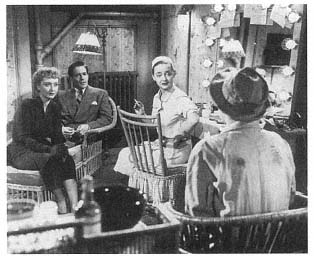
All About Eve
present to past, a shift that will hold good for most or all of the rest of the film. (All of it in How Green ; all but the final scene in Eve , which is a kind of epilogue and a looping of the narrative, oddly parallel to the looping of visuals at the end of How Green .) If we recall the crisis of order posed to classical cinema by an analepsis, we appreciate the importance of this function. One wonders, indeed, if bridging the transition from present to past may not be the primary function of voice-overs in the classical period; that is, whether "voice" is not determined by "order" in classical narrative films, at least in part.
Often, as in How Green and Eve , a voice-over will continue for a certain duration after the bridge from present to past: to insure continuity, to provide orientation and exposition within the world of the flashback, and to reintroduce characters and plot situation within the flashback. Then, when the analepsis is well launched, the film characteristically drops the voice-over and proceeds for the main part of the film in an objective way. About two-thirds of Huw's total narration in How Green is spoken in the opening sequence of the film, until the formal introduction of Bronwen to the family, a duration of about ten minutes. The first 14 of the 25 voice-over speeches in Eve occur in the opening sequence of the film, until we see Eve in the theater alley as she approaches Karen Richards. Also, in both films, the voice-over recedes just before the first big, objective scene, in both cases a vivid set-piece serving to make us forget the introductory voice and to launch the world of the flashback on its own: the wedding of Bronwen and Ivor and the party that follows in How Green ; the introduction of Eve to Margo and company in Eve . Thereafter, in both films, the voice-over returns occasionally to provide brief narrative summaries and to bridge
transitions within the analepsis. This happens 8 times in How Green , 11 times in Eve; for example:
|
Such transition or scene-setting speeches turn their narrators into speaking title cards, pragmatic in the case of How Green , ornate and witty in the case of Eve . But what a comedown from the high-flown openings of both narrations, which even lead us to believe that the films might be about their speakers! Instead Huw is a bystander in most of the scenes in which he appears and is missing altogether from many others. Addison is a bystander at the party scene and others and is missing altogether from even more scenes. Interestingly, each film gives its forgotten narrator one important scene or sequence later: the school sequence for Huw in How Green ; Addison's "killer to killer" confrontation with Eve in Eve .
The voice-over narrator in classical film is a puppet of the narration. One might say the same of character-narrators in fiction, but they at least are always onstage and are built to withstand observation; they also serve all the functions of the narration. The puppet narrators of cinema are jerked on and off stage in a manner that is quite undignified. They may have integrity as characters but they have no integrity as narrators, no resistance to the demands placed upon them; they are nothing but the functions they serve, a collection of odd jobs. They are reeds buffeted by the winds of the narrative; their voices resonate but they are hollow. An important part of their function is to mimic the novelistic voice, the guarantor of experience, subjectivity, and seriousness, with its "I remember" and "I suffer." In fact these inflated "I"s of classical cinema "open" for the main story; they are second-rate acts that
warm up the audience with their sonorities. They are ludicrous stand-ins for the novelistic "I" because, though they wind up elaborately, they have nothing to pitch. For precisely these reasons, of course, voice-over narrators in cinema are interesting; they ruthlessly expose the mechanisms of narration in classical cinema.
This is not to disparage the convention of the voice-over in cinema, which has figured in so many excellent films. It is rather to indicate that if we seek to define voice in cinema, in Genette's sense, we will have to look beyond these voices.
The Critic as Consumer:
Film Study in the University, Vertigo , and the Film Canon
Virginia Wright Wexman
The world of art, a sacred island systematically and ostentatiously opposed to the profane, everyday world of production, a sanctuary for gratuitous, disinterested activity in a universe given over to money and self-interest, offers, like theology in a past epoch, an imaginary anthropology obtained by denial of all the negations really brought about by the economy.
Pierre Bourdieu[1]
Vol. 39, no. 3 (Spring 1986): 32–41.
Though critics customarily consider themselves disinterested observers, their activities are shaped by concrete historical processes. The recent development of a group of film intellectuals within the American academy can be examined as an example of this interaction. Given the body of radical theory produced by many members of this newly constituted intellectual group, one might well assume that the function they have served has been a progressive one. However, these progressive goals operate in a far more limited way than is generally understood. Because the work of film intellectuals leads to practical valuations of film texts, one can view current scholarly practices in the light of these valuations. Why are certain cinematic texts chosen for special attention? Which elements in these texts are singled out for critical discussion?
Film studies, with its fluid and shifting canon, lends itself particularly well to this kind of sociologically oriented inquiry. The past ten years have marked a change in Sight and Sound 's decennial listings of the ten greatest of all time, suggesting that values held by contemporary film scholars and critics are historically shifting.[2] In 1982, four films appeared on the Sight and Sound list that had not appeared on the 1972 list: Singin' in the Rain (1952), The Searchers (1956), The Seven Samurai (1954), and Vertigo (1958). The appearance of the three American titles may be partly accounted for by the continuing vitality of the auteur theory. Also, the growing interest in film's status as cultural production entailing a complex industry and elaborating generic models has certainly influenced such preferences—as well as the lower regard for films like The Passion of Joan of Arc and Persona . Neither of these trends, however, accounts for the fact that three of Sight and Sound 's newly canonized films were made in the United States during the cold-war period of the fifties. An analysis of the politics of contemporary film scholarship must take such historical specifics into account.
Of the three American films on the list, Vertigo is the text that says most about the relation between film aesthetics and the ideology of criticism. Of the three films, Vertigo most owes its preeminence to the opinions of cinema scholars
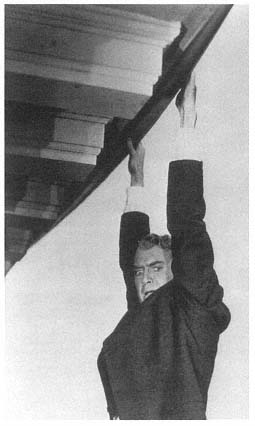
Vertigo
rather than the enthusiasm of less "committed" film fans. Moreover, unlike Singin' in the Rain and The Searchers, Vertigo has generated a sizable body of conflicting critical writing that can be revealingly classified according to ideological positions. In terms of evaluation, what is noteworthy about this critical writing is the centrality it grants to this particular film. The film is canonized even by those who argue against it. As Janet Staiger has pointed out, "Some films will be chosen for extensive discussion and analysis, others will be ignored. . . . As ideal fathers, these select films are given homage or rebelled against."[3]
Critics of Vertigo can be broadly divided into two groups. One line of approach, inaugurated by Robin Wood's pioneering 1967 study, speaks to the issue of Hitchcock as an artist, claiming that Vertigo masterfully manipulates the codes of "pure cinema," thereby revealing the creative genius of its director. By contrast, for another group of critics Vertigo 's value rests on the way it reveals—or enacts—an objectification and fetishization of women which is at the heart of
cinema's codes of voyeuristic pleasure. These critical postures correspond closely to the two roles that Gramsci assigns to intellectuals in society. The first role is the one assigned to traditional intellectuals, who are "the dominant group's subalterns, exercising the subaltern's function of social hegemony and political government."[4] Those who argue Vertigo 's status as "pure cinema" rationalize the hegemonic functions served by particular cinematic institutions at work in the film. The second role Gramsci assigns to intellectuals is an "organic" one, by which a rising group theorizes its own entrance into the upper reaches of the social power structure. From this perspective Vertigo 's feminist critics can be viewed as a subgroup of a larger group of women intellectuals who have elaborated a discourse on women at a moment when women have been entering high-level positions both within and outside of the academy. The progressive project of this group is entangled with methodological constraints that prevent it from addressing broader and more historically specific issues of class, race, and economics.
To better understand the assumptions implicit in the work of the former of these two groups of intellectuals, we can contrast the insights made possible by the task-oriented approach advocated by Wayne Booth, an approach which follows the development of the text with a view to determining what principles governed its shaping. Donald Spoto's recent biography of Hitchcock, which traces the development of Vertigo from the director's purchase of the novel D'entre les morts , offers a wealth of material apposite to this approach.[5] Hitchcock's difficulties in putting together a screenplay led him to engage several different writers for the project, and he ultimately instructed Samuel Taylor to write a script without reading the original novel. Taylor constructed the film's narrative around the director's conceptions for various individual scenes. In the meantime, however, Hitchcock had committed himself to using James Stewart and Kim Novak, then two of the most popular stars in Hollywood. And he had also sent his production designer Henry Bumstead on several trips to San Francisco to scout locations. These circumstances suggest that the stars and locations were primary considerations in the director's mind, and that the actual script and story were a secondary and contingent concern.
Given Hitchcock's highly developed sensitivities about the commercial appeal of his movies, it is easy to understand why these particular features of the film, its stars and its status as travelogue, should have preoccupied him from the start. In a now-classic study, Edgar Morin has examined the role played by stars—especially female stars—in the film industry, which promoted a cult of romantic love based on the mystification of female beauty, manufacturing what it then called "love goddesses." As a successful practitioner within the Hollywood industry, Hitchcock was adept at exploiting the images of such major Hollywood stars as Cary Grant and Grace Kelly.
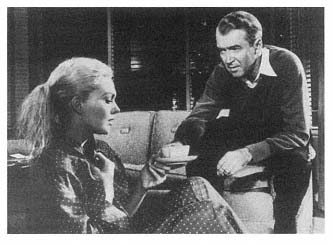
In Vertigo , Kim Novak's position as a manufactured romantic idol is a crucial component of the film's power. It has often been noted that the story of an ordinary young woman who is transformed into a celestial beauty by a controlling man recreates the director's relationships with his female stars, many of whom were also transformed into erotic ideals under Hitchcock's own tutelage. But such a reading of Novak's Madeleine-Judy role, by emphasizing the control exercised by an individual director-auteur over his star, shifts the focus of discussion away from the meaning inherent in the star's own presence. In fact, Hitchcock's obsession with controlling his leading ladies, which grew as his career in films progressed, can be seen as an adaptation that for a long period of time enabled him to function more effectively in the environment of commercialized eroticism that defined the Hollywood style. This pattern of behavior did not emerge until after Hitchcock had embarked on a career in commercial movie-making and did not reach full-blown proportions until the director had established himself in Hollywood. Thus, the individuated analysis of his romantic obsessions posited by Spoto and others requires the addition of the societally determined mediating term represented by the commercialized eroticism of the film industry.
In the case of Kim Novak, control over her image was exercised not just by Hitchcock but more importantly by industry mogul Harry Cohn, president of Columbia Pictures, who arranged to have her constantly watched, forced her to live in her studio dressing room and eat only food prepared by the chef, and called her "the fat Polack."[6] Like Judy, Novak was docile enough to accept this bullying for the most part, while occasionally fighting for a modicum of recognition of her own identity—managing, for instance, to keep her surname despite its ethnic overtones.
Specific aspects of the Novak persona that are invoked in her portrayal of Judy include her well-known preference for the color lavender, brought to mind when Judy tries the appeal she herself might have for Scottie by selecting a lavender dress for their first dinner together. By contrast, Madeleine is associated not with the part of the Novak image that speaks of the ordinary young woman chosen for greatness, but with the star's etherialized, aestheticized beauty. The repeated profile shots of Madeleine not only call to mind Novak's then well-publicised classic profile but also the conventions of relief portraiture found in antique cameos and coins. This association of the star's transcendent beauty with the traditions of high art is further alluded to by the connection between Madeleine and the portrait of Carlotta hanging in the art museum.
The film's skillful manipulation of the Novak persona in the Madeleine-Judy figure opposes the spiritual transcendence of the star as erotic ideal to the quotidian material forces that contribute to her ascendency. Such a portrayal is deeply implicated in the contradictory role assigned to contemporary bour-
Kim Novak (as Madeleine), James Stewart
geois women, who act as purveyors of a mystique of beauty at the same time as they are shaped into consumers of the products of a commercial beauty industry. The importance Hitchcock attached to his stars, creating a script individually tailored to these aspects of her image, reflects his understanding of and collaboration with the practical and conflict-ridden nature of the American film industry's investment in such figures.
The star system, however, is not the only cinematic institution addressed in Vertigo . Hitchcock's predilection for spectacular settings throughout his career has often been remarked on, and this predilection, like his use of stars, plays a significant part in his commercial appeal. In this, he follows a well-defined tradition, for the first documentary films were travelogues, and the more encompassing institutions of commercial cinema itself are partly involved with the project of taking audiences to attractive faraway locales. Thus, the motto of one early studio became: "The world at your fingertips." The early cinema's concern with glamorous settings is not surprising, given the changes taking place in society as a whole at the end of the nineteenth century. Industrialization and vastly improved transportation systems had by then produced an increasingly mobile middle class with a sizable disposable income to spend on travel, an eager audience for cinematic fantasies of escape to alluring, exotic places. One need only recall films such as Around the World in Eighty Days and Indiana Jones and the Temple of Doom to appreciate how central such a travelogue function has remained for today's movie audiences.
The cinema's preoccupation with travel is not without ideological implications. In his book The Tourist: A New Theory of the Leisure Class (New York: Shocken, 1976), Dean MacCannell argues that "tourist attractions are an un-
planned typology of structure that provides direct access to the modern consciousness or 'world view,' that tourist attractions are precisely analogous to the religious symbolism of primitive peoples. . . . This effort of the international middle class to coordinate the differentiations of the world into a single ideology is intimately linked to its capacity to subordinate other peoples to its values, industry and future designs." (2, 13) By disseminating and domesticating the far-off, cinema participates in this rhetoric of tourism.
In Vertigo Hitchcock indulges the touristic impulse by showing all the famous sights of the San Francisco Bay area: the Golden Gate Bridge; the Embarcadero; Ernie's, the city's best-known restaurant; the art museum; a forest of giant sequoias; hilly streets; scenic, oceanside highways; and cable cars. As if to emphasize his function as tour guide, Hitchcock even sets the film's climax in a location that exists solely as a tourist attraction (though it was doctored for the purposes of the plot). Here again, as happened in the case of his stars, Hitchcock selected these picture-postcard settings early in the production process and had the movie's script tailored to accommodate them. Like Kim Novak, San Francisco is part of Vertigo 's beauty, beauty defined by a consumerist function.
Both the romantic ideal of the love goddess and the escapist ideal of the tourist attraction have a material dimension, for both beauty and travel are multi-billion-dollar industries. Though the traces of these two related cinematic institutions are readily observable in Hitchcock's film, they are ignored in the commentaries of its art-oriented critics. Whether there is or is not an "essential" or "pure" cinema, art-oriented critics have used this concept to avoid confronting the specific commercial strategies on which much of Vertigo 's appeal is based. By such time-honored means, borrowed from traditional aesthetics, abstract theoretical formulations enshrine art as a "sanctuary of disinterested activity," while concealing the operations of ideology within it, thereby rationalizing existing social relations.
The feminist critics of Vertigo pose a different issue, for as organic intellectuals such critics work within a discernible political agenda designed to further the interests of the group with which they identify. The question here becomes: how does this agenda operate in practice? Who, exactly, profits?
The approach taken by most contemporary feminist film scholarship limits the application of its conclusions to bourgeois women, a limitation which results not only from its selection of cinematic data but also from the methodology most feminist critics commonly use. The methodology at issue here is psychoanalysis. Inspired by Laura Mulvey's essay "Visual Pleasure and Narrative Cinema," which uses Vertigo as one of its main examples, feminist critics have used psychoanalytic models to open up cinematic texts to a wealth of reading strategies. Following Mulvey, many feminist critics have accepted psychoanalysis as a key to the essential nature of mainstream cinema. Like traditional film
intellectuals, feminists' allegiance to such an idealist position, which some assume explains all commercial narrative film, can obscure the workings of more culturally specific codes within the cinematic text. To derive analyses that can articulate the specific operations of patriarchy within a particular culture, psychoanalytic perspectives must be integrated with other critical models.
Christine Gledhill, questioning this use of psychoanalysis, has argued for a form of cultural analysis that looks not simply to idealized psychoanalytic models but to the specific social practices by which such models are activated.[7] The distinct discourses that construct social reality can be obscured by a critical approach that uses an essentializing psychoanalytic methodology to interpolate cinematic material that yields too readily to such an approach. Indeed, it can be argued that Hitchcock's recurrent preoccupation with psychoanalysis in his films has often served as a "MacGuffin" (to use his term), distracting the viewer's attention from other, more hidden aspects of the text, his shrewd co-optation of a popular discourse that could locate the roots of social dis-ease in psychological rather than economic causes.
For an example of Hitchcock's appropriation of such displacements, consider his comments about what attracted him to Marnie: "The fetish idea. A man who wants to go to bed with a thief, just like other men have a yen for a Chinese woman or a colored woman."[8] Given the widespread interest in psychoanalytic readings of Hitchcock's films, it is noteworthy that no critic has commented on the director's remarkable equation of fetishism with miscegenation here. And, more importantly, no one has observed the workings of a similar displacement of racial and class issues into the sphere of sexuality functioning in the films themselves. Like Hitchcock, feminists committed to psychoanalysis may interpret all cinematic practices in terms of universalizing concepts of fetishization, lack, and voyeuristic exchange. Whether these psychoanalytic operations actually form the essential base of all cinematic art or not, the feminist critics of Hitchcock sometimes tend to describe his films as though they relied solely on such operations. However, a reading of Vertigo which poses history as what Fredric Jameson has called an "absent cause" shows other strategies at work.
In a recent essay Michael Rogin mapped the ideological terrain that forms the background of American films of the cold-war period.[9] Using psychoanalytic theory in conjunction with this historical background, Rogin describes the cold-war period as one in which polarized conceptions of "otherness" were particularly evident. In the popular imagination, such conceptions often focused on women. Images of women were often deployed to displace and domesticate fears of a more ungovernable xenophobic cast, fears of the Russians and of "subversives." Such displacements can be negotiated in the cinematic texts themselves through a strategy of paired oppositions, which develop as the narrative proceeds in such a way as to provide the spectator with increas-
ingly refined definitions of the terms involved. In Vertigo , an analysis of these paired oppositions, which center on the Madeleine-Judy figure, suggests the limitations of psychoanalytically based textual approaches. Issues such as gender difference, regression, and the organization of filmic space through the agency of the gaze, the mainstays of many psychoanalytic readings, may be less central to our understanding of the operation of many filmic texts than many feminists now consider them.
In the case of gender difference, it is important to recognize that more culturally specific differences may exist within this universal opposition. In Vertigo the first of these culturally specific differences initially emphasizes the class contrast between Madeleine and Midge Wood, with whom we see the film's protagonist Scottie Ferguson at the opening of the film. While the all-American Midge appears untainted by conspicuous marks of class, Madeleine is firmly positioned as upper class. Her family owns a shipyard; she lives in a luxurious apartment building and drives an expensive car. First glimpsed amid the opulent surroundings of an expensive restaurant, she also affects, as do most of Hitchcock's heroines, an upper-class accent. Indeed, Scottie's obsession with her, seen in this context, becomes largely an obsession with money and class.
But Madeleine's upper-class image entails its opposite: the lower-class Judy. Though Scottie spends a considerable amount of money trying to recreate this working-class woman into the upper-class figure he originally idolized, the fruitlessness of his attempt is ultimately exposed when he sees Judy's telltale necklace. Unlike the clothes Scottie buys Judy, this necklace cannot be duplicated. Its status as a symbol of family jewels implies the inherited wealth that marks a truly upper-class person: an aristocrat. In one sense, then, Scottie's shock on seeing this necklace can be construed as the shock of the nouveau-riche aspirant who discovers his inability to buy his way into the upper reaches of old-money society.
Scottie's inchoate identification with aristocratic values grows out of his disdain for work. He rejects the idea of gainful employment for himself at the beginning of the film and later tries to persuade both Midge and Judy to follow his example. Though he succeeds with the malleable Judy, Midge is more resistant. When Scottie rejects Midge's parodic portrait of Carlotta, he is rejecting her Yankee practicality (Midge can't take painting seriously because she has to "make a living") and literalness (she demystifies the portrait by treating its subject as just another woman, equal to herself). Midge alienates herself from Scottie in this scene by refusing to take seriously his un-American fantasies of aristocratic elegance and ease.
These fantasies, which are focused on the figure of Madeleine, are fantasies not of America but of Europe. The old-world idea of aristocracy is evoked in repeated associations between Madeleine and Europe: her husband's British ac-
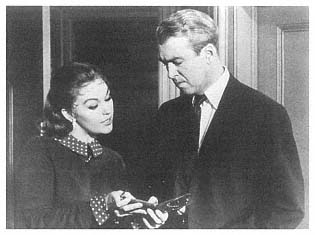
Kim Novak (as Judy), James Stewart
cent; the Viennese accent of Pop Liebl, who recounts her history; and the Spanish-style mission she frequents. Yet by further defining her social position, such associations also imply still another opposition, an opposition focused on the figure of Carlotta Valdez. Carlotta, who grew up in a Spanish mission town but "danced in the cabarets," becomes a presence of charged ambiguity. Is she a descendant of old Spanish aristocracy, or is she lower-class Latino? The film never specifies, preferring instead to situate her in a realm of exotic class marginality. Vertigo 's series of oppositions, beginning with gender difference, leading to class difference and from there to ethnic difference, must stop short with the image of Carlotta: the racial opposition that is the logical extension of this series remains, for Hitchcock, unrepresentable. Yet it is significant that Scottie's nightmare reveals Elster not with the blonde, patrician Madeleine but instead beside the darkly ambiguous Carlotta. In the nightmare, Carlotta represents what ultimately terrorizes Scottie, and the fears Carlotta arouses in him are more culturally specific than either Hitchcock or his feminist critics are in a position to acknowledge.
Vertigo 's buried references to issues of class and race were contained during the fifties as part of a nationalistic ideology that defined American society in terms of its ability to achieve world dominance. In the context of this cultural fantasy, the meaning of the past in Vertigo , so often invoked by critics as a sign of psychological regression, takes on a more political coloration. In the figure of Scottie, the past does indeed connote regression; but Scottie's private dilemma displaces more political connotations attached to the invocation of the past. The film's first reference to the past explicitly connects it to the political sphere: Gavin Elster speaks nostalgically of "the old San Francisco,"
when men had "freedom and power." The cold-war connotations of the phrase "freedom and power" are unmistakable, for America was at the time seeking power on the international scene in the name of freedom, and it justified these aspirations in part by invoking the country's past heroism in "saving the world for freedom" in World War II.
When the past is next invoked in the film, it refers not to politics but to the figure of Carlotta Valdez, whose rich lover long ago abandoned her and took her child. Pop Liebl's explanation of her tragedy recalls Elster's earlier comments: "Men could do these things in those days. They had the freedom and the power." Here the motif of sexual exploitation is central, but Pop Liebl's story also carries overtones of a past era of American imperialism characterized by the freedom and the power to colonize and plunder, whether the object of exploitation was the resources of an underdeveloped country or the body of an underprivileged woman.
As Rogin points out, the word "freedom" has been variously used throughout American history to construct oppositions which could uphold American interests at the expense of a racial, ethnic, or national "other." Such oppositions recast contradictions within American society itself into a discourse of demonology. In the cold-war period, the most salient contradiction existed between the "free" individual and a newly oppressive mass society characterized by sophisticated patterns of surveillance.
In Vertigo such issues are raised through the portrayal of law. Scottie, initially presented as a member of the law-enforcement bureaucracy, withdraws from his responsibilities because he feels he has faltered in carrying out his duty as a watchdog of society's interests. He then becomes a "wanderer," free inasmuch as he is detached from the demands of the law and thus disengaged from the functions of surveillance required in the mass society of fifties America. However, Scottie's relationship with the law is not thereby severed but merely mystified, for his surveillance function merely shifts to a more personalized site: Madeleine's body. But the film insures that this site must also be regarded in relation to the law, for later, at the hearing on Madeleine's death, he is severely chastized by the judge for his failure to perform his "duty." This censurious judgment gains the imprimatur of a higher order when Hitchcock reveals two male clerics seated behind Madeleine's "injured" husband. Finally, when a nun appears in the belltower during the film's concluding scene, Scottie's dilemma is finally displaced from a public, male world into a private, female one. What is initially presented as the suffocating obligations felt by a fifties American bureaucratic functionary to a group of ruling males—Scottie's job on the police force—is completely transformed into a motif of religious guilt centered on sexual desire. At the same time, Scottie's statement in this scene that he wishes to be "free of the past" displaces terms initially presented with specific political connotations into the realm of the private and the personal.
America's cold-war aspirations to global supremacy are expressed in Vertigo not only by the film's depiction of time but also by its depiction of space. One can speak of two opposed conceptions of space operating in Vertigo : the panorama and the vortex. Hitchcock announces this opposition during the credit sequence, in which Saul Bass's abstract designs exploit the cinema's capacity to create two-dimensional patterns that can suggest three-dimensional space by means of an optical illusion. Immediately afterward, in the film's first scene of the rooftop chase, this conception is connected with images of the natural world, images that will be developed throughout the narrative: the panorama of the San Francisco skyline in the background followed by the vortex created by Hitchcock's famous track-out, zoom-in shots depicting Scottie's vertiginous vision of the street below.
The panorama has obvious affinities with the touristic world view described earlier, defining a "picturesque," two-dimensional space that negates the actual forces of production and labor that contributed to its creation. Such a two-dimensional, picture-postcard view appears first in Hitchcock's narrative proper as a backdrop to the apartment belonging to the all-American Midge. Later, however, when Scottie visits Elster's office, the background becomes more ominous, for the scene outside of Elster's window depicts the shipyards, implying another world beyond the ocean and the role played by American industrial supremacy in the domination of this world. At the same time, the dominance-oriented two-shots of Scottie and Elster in this scene shift the terms of spatial perception. In contrast to the shot–reverse shot technique of the earlier scene in Midge's apartment, which isolates characters within their own surrounding space, the power relationships represented in Scottie's first scene with Elster reflect an awareness of how the relative positioning of the human subject within the space may suggest structures of dominance.
As the action progresses, two possible positions are defined: the camera's horizontal tracking movements associated with Madeleine suggest a harmonious integration into the three-dimensional space, while the vertical camera movements associated with Scottie's vertigo suggest the fear of being engulfed by the space. Madeleine is often flanked by portals and archways that begin to define more specifically the depth of the filmic field. The depth of field is more dramatically emphasized in scenes in which the camera tracks toward her and in other scenes where she herself approaches the camera to the strains of Bernard Herrmann's Wagnerian musical score. The alluring invitation implied by this three-dimensional quality, however, accelerates to a frightening pitch of intensity during the vertigo shots. At these points the viewer's harmonious incorporation within the space, which is achieved by the complementary alternation of camera movement toward an object and the movement of the object toward the camera, is compressed into a single, humanly impossible operation. This series of oppositions
is initiated by the early scene in Elster's office, which specifically associates the opening out of the cinematic space with American industrial power and expansionist aspirations, thereby adding an explicitly political dimension to the anxieties over spatial dominance that are so pervasive throughout the film.
The process by which such political anxieties about dominance and otherness are displaced in Vertigo onto the image of the woman is focused on a specific spatial image: the spiral. This image, repeatedly associated with both Madeleine and Carlotta's hairstyles, strikes Scottie powerfully in the art museum scene. The sequence involves both the camera's tracking movement, which invades the filmic space, and the inviting illusion of depth created by the spiral shape of Madeleine's French twist. Many of the film's suppressed issues are condensed into this spiral image, for through it the promise held out by the blonde Madeleine's seductive presence is represented as an invitation to fuse with a hollow shell. The erotic promise of this image is consummated in the final love scene, where the camera circles around the romantic couple in an active imitation of the contours of the spiral associated with Madeleine. Yet, rather than exposing an enticing void into which male fantasies of power and dominance can be projected, Madeleine's confused dependency may conceal the threatening intractability of the alien Carlotta. Thus the inviting horizontal movement suggested by the women's hair leads to the traumatic vertical oscillations created by the spiral of the stairway during the tower sequences. These sequences depict an ultimate loss of control over the cinematic space, and they end with the fatal fall of an exalted female love object who has represented a projection of male power fantasies.
The implications of the film's spatial oppositions, however, finally culminate not in Madeleine and Carlotta but in Judy. If Madeleine, whose head seen from behind is dominated by the spiral of her hairstyle, invites Scottie to merge with a hollow space, Judy represents not a projective male fantasy but an actual woman. After Scottie's first encounter with her, however, Hitchcock's camera executes a similar track forward into the back of Judy's head. Judy's hair, though, does not coil into an inviting spiral. And this time, rather than losing itself in the woman's body offered as a void, the camera decisively reveals the "other" which has been suppressed by the film's romantic fantasy. For the movement culminates as Judy's head turns toward us, and we are then permitted access to her own mental images, images at odds with Scottie's—and the viewer's—partial and mistaken conceptions about her.
In this image of a woman's head turning, Hitchcock focuses on a representation of otherness that uses gender opposition to emphasize the film's theme of romantic love. But this image of otherness, as we have seen, contains far more complex and localized associations than feminist psychoanalytic theory can account for. As Vertigo illustrates, the oppression of women in our culture is intimately re-
lated to particular political conditions, and the forms of its representation often exploit such associations. Indeed, the film's abrupt and unresolved ending can be viewed as a signal of its refusal to confront the implications of its strategies. In Vertigo Hitchcock has masked the ideological workings of racism and xenophobia beneath a discourse of sexuality that is itself idealized as romantic love.
If the text of Hitchcock's film employs the techniques of cinematic art and the motifs of sexual difference, these techniques and motifs function in part to mask less familiar meanings. Though its rhetorical disguises have seduced film scholars, Vertigo is neither a work of pure artistry nor an exercise in essential psychoanalytic truth. Hitchcock, after all, did not create his films in an ivory tower surrounded by cinematic essences; nor did he make them amid the private surroundings of the analytic session. He was a businessman as well as an artist. In 1958 he embarked on a commercial enterprise entitled Vertigo , starring Kim Novak and San Francisco. Cinema scholars have now honored this venture as one of their top ten favorites. Such a valuation reflects not only on its object but also on those who sit in judgment. Gramsci's paradigm of the role played by intellectuals in society suggests the ideological stakes involved in interpretations of cultural texts. Film scholars, like others, have class interests at stake: we are not only critics but also consumers.
Yellow Earth :
Western Analysis and a Non-Western Text
Esther C. M. Yau
Vol. 41, no. 2 (Winter 1987–88): 22–33.
1984. China. The wounds of the Cultural Revolution have been healing for nearly a decade. After the hysterical tides of red flags, the fanatical chanting of political slogans, and militant Mao supporters in khaki green or white shirts and blue slacks paving every inch of Tienanmen Square, come the flashy Toshiba billboards for refrigerators and washing machines, the catchy phrases of "Four Modernizations," and tranquilized consumers in colorful outfits and leather heels crowding the shops of Wangfujing Street. A context of Change. Yet contradiction prevails. Who are these people flocking to local theaters that posted First Blood on their billboards? Are they not the same group that gathered for lessons on anti-spiritual pollution? The Red Book and the pocket calculator are drawn from shirt pockets without haste, just like the old long pipe from the baggy pants of the peasant waiting for the old Master of Heavens to take care of the order of things. In 1984, after the crash of the Gang of Four, when China becomes a phenomenon of the "post"—a nation fragmented by and suffering from the collapse of faith in the modern socialist politics and culture—the search for meaning by the perturbed Chinese character begins to occupy the electric shadows of new Chinese cinema.[1]
At the end of 1984, a few Chinese men who were obsessed with their history and culture—all of them had labored in factories and farms during the Cultural Revolution and just graduated from the Beijing Film Academy—quietly completed Huang Tudi in a very small production unit, the Guangxi Studio, in Southern China. A serious feature that had basically eluded political censorship, Huang Tudi (which meant Yellow Earth ) was soon regarded as the most significant stylistic breakthrough in new Chinese cinema. It won several festival prizes, started major debates at home about filmmaking, and interested international film scholars.[2]
Safely set in the 1930s, Yellow Earth tells the story of an encounter between a soldier and some peasants. Despite its ambitious attempt to capture both the richly nourishing and the quietly destructive elements of an ancient civilization
already torn apart in the late nineteenth century, the film's story and its use of folksongs/folktale as device and structure is deceptively simple and unpretentious. In fact, the film's conception and its musical mode were originally derived from one of the trite literary screenplays which glorified the peasants and the earlier years of socialist revolution: an Eighth Route Army soldier influenced a peasant girl to struggle away from her feudal family.[3] Such a commonplace narrative of misunderstanding-enlightenment-liberation-trial-triumph or its variations would be just another boring cliché to the audience familiar with socialist myths, while the singing and romance could be a welcome diversion. Dissatisfied with the original story but captivated by the folk-tale elements, director Chen Kaige and his young classmates—all in their early thirties—scouted the Shaanxi Province in northwestern China for months on foot. Their anthropological observations of the local people and their subcultures both enriched and shaped the narrative, cultural, and aesthetic elements in the film.[4] Consequently, they brought onto the international screen a very different version of Chinese people—hardworking, hungry, and benevolent peasants who look inactive but whose storage of vitality would be released in their struggles for survival and in their celebration of living. The structure of the original story was kept, but Yellow Earth has woven a very troubling picture of Chinese feudal culture in human terms that had never been conjured up so vividly before by urban intellectuals.
The film's narrative: 1937. The socialist revolution has started in western China, but most other areas are still controlled by the Guomindang. Some Eighth Route Army soldiers are sent to the still "unliberated" western highlands of Shaanbei to collect folk tunes for army songs. Film begins. Spring, 1939. An Eighth Route Army soldier, Gu Qing, reaches a village in which a feudal marriage between a young bride and a middle-aged peasant is taking place. Later, the soldier is hosted in the cave home of a middle-aged widower peasant living with his young daughter and son. Gu Qing works in the fields with them and tells them of the social changes brought about by the revolution, which include the army women's chances to become literate and to have freedom of marriage. The peasant's daughter, Cuiqiao, is interested in Gu Qing's stories about life outside the village, and she sings a number of "sour tunes" about herself. The peasant's son, Hanhan, sings a bed-wetting song for Gu Qing, and is taught a revolutionary song in return.[5] The young girl learns that her father has accepted the village matchmaker's arrangement for her betrothal. Soon, the soldier announces his departure. Before he leaves, the peasant sings him a "sour tune," and Cuiqiao privately begs him to take her away to join the army. Gu Qing refuses on grounds of public officers' rules but promises to apply for her and to return to the village once permission is granted. Soon after his departure, Cuiqiao's feudal marriage with a middle-
aged peasant takes place. At the army base, Gu Qing watches some peasants drum-dancing to soldiers going off to join the anti-Japanese war. Back in the village, Cuiqiao decides to run away to join the army herself. She disappears crossing the Yellow River while singing the revolutionary song. Another spring comes. There is a drought on the land. As the soldier returns to the village, he sees that a prayer for rain involving all the male peasants is taking place. Fanatic with their prayers, nobody notices Gu Qing's return, except the peasant's young son. In the final shots he rushes to meet the soldier, struggling against the rush of worshippers. End of story.
Yellow Earth poses a number of issues that intrigued both censors and the local audience. The film seems to be ironic: the soldier's failure to bring about any change (whether material or ideological) in the face of invincible feudalism and superstition among the masses transgresses socialist literary standards and rejects the official signifieds. However, such an irony is destabilized or even reversed within the film, in the sequences depicting the vivacious drum-dancing by the liberated peasants and the positive reactions of the young generation (i.e., Cuiqiao and Hanhan) towards revolution. The censors were highly dissatisfied with the film's "indulgence with poverty and backwardness, projecting a negative image of the country." Still, there were no politically offensive sequences to lead to full-scale denunciation and banning.[6] To the audience used to tear-jerking melodramas (in the Chinese case, those of Xie Jin, who is by far the most successful and popular director[7] ), Yellow Earth has missed most of the opportune moments for dialogue and tension, and is thus unnecessarily opaque and flat. For example, according to typical Chinese melodrama, the scenes where Cuiqiao is forced to marry an older stranger, and the one when her tiny boat disappears from the turbulent Yellow River, would both be exploited as moments for pathos. But here they are treated metonymically: in the first, the rough dark hand extending from off-screen to unveil the red headcloth of the bride is all one sees of her feudalist "victimizer"; in the second instance, the empty shots of the river simply obscure the question of her death. In both situations, some emotional impact is conveyed vocally, in the first by the frightened breathing of the bride, and in the second by the interruption of her singing. But the cinematic construction is incomplete, creating an uncertainty in meaning and a distancing effect in an audience trained on melodrama and classical editing. Nevertheless, when the film was premiered at the 1985 Hong Kong International Film Festival, it was lauded immediately as "an outstanding breakthrough," "expressing deep sentiments poured onto one's national roots" and "a bold exploration of film language." Such an enthusiastic reception modified the derogatory official reaction towards the film (similar to some initial Western reception, but for different political reasons), and in turn prompted the local urbanites to give it some box-office support.[8]
Aesthetically speaking, Yellow Earth is a significant instance of a non-Western alternative in recent narrative film-making. The static views of distant ravines and slopes of the Loess Plateau resemble a Chinese scroll-painting of the Chang'an School. Consistent with Chinese art, Zhang Yimou's cinematography works with a limited range of colors, natural lighting, and a non-perspectival use of filmic space that aspires to a Taoist thought: "Silent is the Roaring Sound, Formless is the Image Grand."[9] Centrifugal spatial configurations open up to a consciousness that is not moved by desire but rather by the lack of it—the "telling" moments are often represented in extreme long shots with little depth when sky and horizon are proportioned to an extreme, leaving a lot of "empty spaces" within the frame. The tyranny of (socialist) signifiers and their signifieds is contested in this approach in which classical Chinese painting's representation of nature is deployed to create an appearance of a "zero" political coding. Indeed, the film's political discourse has little to do with official socialism; rather, it begins with a radical departure from the (imported) mainstream style and (opportunist) priorities of narrative film-making in China. One may even suggest that Yellow Earth is an "avant-gardist" attempt by young Chinese film-makers taking cover under the abstractionist ambiguities of classical Chinese painting.[10]
To film-makers and scholars, then, Yellow Earth raises some intriguing questions: What is the relationship between the aesthetic practice and the political discourse of this film? In what way is the text different from and incommensurable with the master narratives (socialist dogma, mainstream film-making, classical editing style, etc.), in what way is it "already written" (by patriarchy, especially) as an ideological production of that culture and society, and finally, how does this non-Western text elude the logocentric character of Western textual analysis as well as the sweeping historicism of cultural criticism?[11]
This essay will address the above questions by opening up the text of Yellow Earth (as many modernist texts have been pried open) with sets of contemporary Western methods of close reading—cine-structuralist, Barthesian post-structuralist, neo-Marxian culturalist, and feminist discursive. This will place Yellow Earth among the many parsimoniously plural texts and satisfy the relentless decipherers of signifieds and their curiosity for an oriental text. The following discussion of this text will show that the movement of the narrative and text of Yellow Earth involves the interweaving and work of four structurally balanced strands (micro-narratives) on three levels: a diegetic level (for the construction of and inquiry about cultural and historical meaning), a critical level (for the disowning and fragmentation of the socialist discourses), and a discursive level (for the polyvocal articulations of and about Chinese aesthetics and feudalist patriarchy).[12] In this way, I hope to identify certain premises of Chinese cosmological thinking and philosophy as related in and
through this text. In this analytic process, the contextual reading of Chinese culture and political history will show, however, the limitations of textual analysis and hence its critique.[13]
I shall begin with a brief description of the organization of the four narrative strands and their function on both diegetic and critical levels. The Lévi-Straussian structural analysis of myths is initially useful: the peasant father imposes feudal rules on Cuiqiao, the daughter (he marries her off to stabilize the kinship system), and the soldier imposes public officers' rules on her as well (he prevents her from joining the army before securing official approval). Thus, even though the host-guest relationship of the peasant and the soldier mobilizes other pairs of antinomies such as agriculture/warfare, subsistence/revolution, backwardness/modernization, the pattern of binaries breaks down when it comes to religion/politics, since both signify, in Chinese thinking, patriarchal power as a guardian figure. In addition, Hanhan, the young male heir in the film, counteracts the establishment (runs in the reverse direction of the praying patriarchs) in the same way Cuiqiao does (rows the boat against the Yellow River currents for her own liberation). Again, the antinomy peasant/soldier is destabilized, as myth is often disassembled in history—that is, the mythic glory of hierarchic dynasties and the revolutionary success of urban militia breaks down when confronted by the historical sensibility of the post–Cultural Revolution period.
There are four terms of description: brother, sister, father, soldier. While there is a relationship of consanguinity and descent, both are complicated by the problematic relation of affinity: Cuiqiao's intimacy with Hanhan and their distance from the peasant father is more excessive while romance is taboo and marriage is ritual in the film. The prohibition of incest among family members (Cuiqiao with her brother or father) is transferred to prohibition of romantic involvement between Cuiqiao and the soldier, enforced at the cost of the girl's life.[14] Hence, the textual alignment of patriarchy with sexual repression. However, the film text is not to be confused with an anthropological account. As both Fredric Jameson and Brian Henderson point out, historicism is at work in the complex mode of sign production and in reading.[15] Hence this text would preferably be read with a historical knowledge of the Communist Party's courtship with the peasants and its reconstruction of man [sic ] through the construction of socialist manhood—which reserves desire for the perfection of the ideological and economic revolution, while the liberation of women (its success a much-debated topic) becomes an apparatus for the Party's repression of male sexuality, besides being a means for winning a good reputation. Hence the position of contemporary Chinese women, generally speaking, involves a negotiation between patriarchy and socialist feminism in ways more complicated than what one deduces from the Lévi-Straussian analysis of kinship systems.
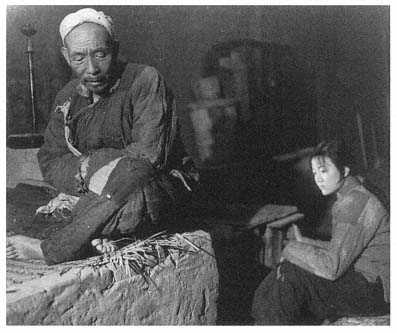
Yellow Earth: Father and daughter
Now I shall proceed to a more detailed (though non-exhaustive) discussion of what is at work in each of the micro-narratives as narrative strands, as well as the contextual readings relevant to the textual strategies.
First Narrative Strand:
The Peasant's Story
The scenes assembled for the first narrative strand have a strong ethnographic nature: the material relation between the Shaanbei peasants and their land is documented through the repetitive activities of ploughing land on bare slopes, getting water every day from the Yellow River ten miles away, tending sheep, cooking, and quiet residence inside the cave home, while marriages and rain prayers are treated with a moderate amount of exotic interest—of the urban Han people looking at their rural counterparts. The peasants are depicted as people of spare words (Cuiqiao's father even sings little: "What to sing about when [one is] neither happy nor sad?"). They have a practical philosophy (their aphorism: "friends of wine and meat, spouse of rice and flour") and they show a paternal benevolence (Cuiqiao's father only sings for the soldier for fear that the latter may lose a job if not enough folk tunes are collected). Obviously, anthropological details have been pretty well attended to.
Meaning is assigned according to a historical or even ontological dependence of peasants on their motherly Land and River. This signifying structure is first of all spatially articulated: the Loess landscape with its fascinating ancient face is a silent but major figure both in Chinese painting and in this film. Consistent with the "high and distant" perspective in scroll painting is the decentered framing with the spatial contemplation of miniaturized peasants as black dots laboring to cross the vast spans of warm yellow land to get to the river or their cave homes.[16] No collective farming appears in this film, and neither planting nor harvesting modify this relationship. The symbolic representation of an ancient agrarian sensibility is condensed in shots that include the bare details of one man, one cow, and one tree within the frame in which the horizon is always set at the upper level and the land, impressive with deep ravines, appears almost flattened. In an inconspicuous way, the Yellow River's meaning is also contemplated: the peasants are nourished by it and are sometimes destroyed by it. A narrative function is attached: this is a place in dire need of reform, and it is also stubbornly resistant. The state of this land and people accounts for the delay of enlightenment or modernity—there is an unquestioning reliance on metaphysical meaning, be it the Old Master of Heavens or the Dragon King of the Sea, but which is tied so closely to the survival of the village. The narrative refusal of and enthusiasm for revolution are motivated: the ideology of survival is a much stronger instinct than the passion for ideals. But to the peasants, the Party could have been one of the rain gods.
There is a vocal part to this cosmological expression as well, articulated dialectically for a critical purpose. We shall attend to three voices: the first, that of the peasant's respect for the land: "This old yellow earth, it lets you step on it with one foot and then another, turn it over with one plough after another. Can you take that like it does? Shouldn't you respect it?" A classical form of deification borne from a genuine, everyday relationship. Then it is countered by the second, the soldier's voice: "We collect folk songs—to spread out—to let the public know what we suffering people are sacrificing for, why we farmers [my emphasis] need a revolution." Gu Qing offers a rational reading of the agrarian beliefs; his statement contains a simple dialectic—the good earth brings only poverty, and the way out is revolution. Yet his statement and his belief are but a modernized form of deification: the revolution and its ultimate signified (the Revolutionary Leader) are offered to replace the mythic beliefs through a (false) identification by the soldier with the peasants ("Our Chairman likes folk songs," says the soldier). Blind loyalty (of peasants to land) finds homology in, and is renarrativized by, a rational discourse (of soldier to his Leader). The ancient structure of power changes hand here; thereafter, the feudalist circulation of women and socialist liberation of women will also remain homological.
As explicit contradiction between the first two voices remains unresolved, a major clash breaks out in the form of a third voice, which appears in the rain prayer sequence. Assembled in their desiccated land, the hungry peasants chant in one voice: "Dragon King of the Sea, Saves Tens of Thousands of People, Breezes and Drizzles, Saves Tens of Thousands of People." Desperation capsuled: the hungry bow fervently to the Heavens, then to their land, and then to their totemic Dragon King of the Sea, in a primitive form of survival instinct. At this moment the soldier appears (his return to the village) from a distance, silent. A 180° shot/reverse shot organizes their (non)encounter: a frontal view of the approaching soldier, followed by a rear view of the peasants whose collective blindness repudiates what the soldier signifies (remember his song "The Communist Party Saves Tens of Thousands of People"). In this summary moment of the people's agony and the film's most searing questioning of the Revolution's potential, the multiple signifieds are produced in and through a mirroring structure: the soldier's failure reflected by the peasants' behavior and the peasants' failure in the soldier's presence.
At the outset, two dialectical relationships are set up explicitly in the text, one against the other: between peasant and nonpeasant, and between peasant and land. The roots of feudalism, through this first narrative strand, are traced to their economic and cultural bases, and are compared in a striking way to Chinese socialism. In this manner, the whole micro-narrative is historicized to suggest reflections on contemporary China's economic and political fiascos. But there is another relationship between the filmic space and the audience's (focal) gaze. The nonperspectival presentation of landscapes in some shots and sequences often leads one's gaze to linear movements within the frame, following the contours of the yellow earth and the occasional appearance and disappearance of human figures in depth on an empty and seemingly flat surface. The land stretches within the frame, both horizontally and vertically, with an overpowering sense of scale and yet without being menacing. In these shots and sequences, the desire of one's gaze is not answered by the classical Western style of suturing; indeed it may even be frustrated.[17] Rather, this desire is dispersed in the decentered movement of the gaze (and shifts in eye level as well) at a centrifugal representation of symbolically limitless space. Such an unfocused spatial consciousness (maintained also by non-classical editing style) has a dialectical relationship with one's pleasure-seeking consciousness. It frustrates if one looks for phallocentric (or feminist, for that matter) obsessions within an appropriatable space, and it satisfies if one lets the sense of endlessness/emptiness take care of one's desire (i.e., a passage without narrative hold). In these instances, one sees an image without becoming its captive; in other words, one is not just the product of cinematic discourse (of shot/reverse shot, in particular), but still circulates within that discourse almost as "non-subject" (i.e., not chained tightly to signification).
Within the text of Yellow Earth , one may say, two kinds of pleasures are set up: a hermeneutic movement prompts the organization of cinematic discourse to hold interest, while the Taoist aesthetic contemplation releases that narrative hold from time to time. Most of the moments are assigned meaning and absences of narrative image are filled, though some have evaded meaning in the rationalist sense. When the latter occurs, the rigorous theoretical discourses one uses for deciphering are sometimes gently eluded.
Second Narrative Strand:
The Daughter's Story
Inasmuch as the sense of social identity defines the person within Chinese society, individuals in Chinese films are often cast as nonautonomous entities within determining familial, social, and national frameworks. Ever since the 1920s, the portrayals of individuals in films have been inextricably linked to institutions and do not reach resolution outside the latter. Hence, unlike the classical Hollywood style, homogeneity is not restored through the reconciliation of female desires with the male ones, and the ways of looking are not structured according to manipulations of visual pleasure (coding the erotic, specifically) in the language of the Western patriarchal order. With an integration of socialism with Confucian values, film texts after 1949 have often coded the political into both narrative development and visual structures, hence appropriating scopophilia for an asexual idealization. In the post–Cultural Revolution context, then, the critique of such a repressive practice naturally falls on the desexualizing (hence dehumanizing) discourses in the earlier years and their impact on the cultural and human psyche.[18]
The plotting of Yellow Earth , following the doomed fate of Cuiqiao the daughter, seems to have integrated the above view of social identity with the recent critique of dehumanizing political discourses. Within the second narrative strand, the exchange of women in paternally arranged marriages is chosen as the signifier of feudalist victimization of women, while the usual clichés of cruel fathers or class villains are replaced by kind paternal figures. The iconic use of feudal marriage ceremonies has become common literary and filmic practice since the 1930s, but compared with other texts, this one is more subtle and complex in its enunciation of sympathy for women.[19] In this regard, we may undertake to identify two sets of homological structures in the text that function for the above purpose. It is through the narrative and cinematic construction of these structures that Yellow Earth made its statement on patriarchal power as manifested in cultural, social, and political practices.
The first set of homological structures involves the spatial construction of two marriage processions, each characterized by a montage in close-up of the
advancing components (trumpet players, donkey, dowry, the red palanquin and its carriers) in more or less frontal views. In each case, the repetitive and excessive appearance of red, which culturally denotes happiness, fortune, and spontaneity, is reversed in its connotative meaning within the dramatic context of the oppressive marriages. More significantly, the absence/presence of Cuiqiao as an intradiegetic spectator and her look become a linchpin to that system of signification. In the first marriage sequence, the bride is led from the palanquin to kneel with the groom before the ancestor's plate and then taken to their bedroom. Meanwhile, Cuiqiao as a spectator is referred to three or four times in separate shots, establishing her looking as a significant reading of the movement of the narrative. Yet she is not detached from that narrative at all. Seeing her framed as standing at the doorway where Confucius's code of behavior for women is written, one is constantly reminded that Cuiqiao's inscription will be similarly completed (through marriage) within the Confucian code.[20] Her look identifies her with the scene of marriage, and also relays to the audience her narrative image as a young rural female. The victimizing structure (feudalist patriarchy) and the potential victim (Cuiqiao) are joined through a shot/reverse-shot method, mobilized by her looking which coded the social and the cultural into the signifying system here.
In the second marriage sequence, the similar analysis in close-up of the advancing procession (by a similar editing style) performs an act of recall, which as a transformed version of the first marriage sequence reminds the audience of Cuiqiao's role as the intradiegetic spectator previously. In this instance, however, Cuiqiao is the bride, locked behind the dull black door of the palanquin covered by a dazzlingly red cloth. The big close-up of the palanquin, however, suggests her presence within the shot (hidden), in depth, and going through the process of "fulfilling" the inscription predicted earlier on for her against her wish for freedom. The palanquin replaces her look but points to her absence/presence. At the same time, Hanhan, her quiet brother, replaces Cuiqiao as an intradiegetic spectator looking (almost at us) from the back of the palanquin, figuring her absence and her silence. Hanhan as the brother represents an ideal form of male sympathy in that context, yet as the son and heir of a feudal system, he is also potentially responsible for the perpetuation of this victimization. In this manner, the text shifts from a possible statement on class (backwardness of peasants before the Liberation) to a statement of culture (the closed system of patriarchy) to locate the woman's tragedy. With an intertextual understanding of most post-1949 Chinese films presenting feudal marriages, this cultural statement becomes a subtle comment on the (pro-revolutionary) textual appropriations of folk rituals for political rhetorics.
The second set of homological structures appears in two pairs of narrative relationships between three characters (between Cuiqiao's father and Cuiqiao, and
between Gu Qing the soldier and Cuiqiao) concerning the subject of women's (and Cuiqiao's) fate. Initially, one finds the first relationship a negative one while the second is positive, i.e., the father being feudal but the soldier liberating. This is encapsulated in a dialogue in which the soldier attempts to convince the peasants that women in socialist-administered regions receive education and choose their own husbands, and Cuiqiao's father answers: "How can that be? We farmers have rules." However, when one compares the peasants' exchange of women for the survival of the village and the revolutionaries' liberation of women for the promotion of the cause, then one finds both relationships being similarly fixated on woman as the Other in their production of meaning. Such a homology, nevertheless, is asymmetrical in presentation. On the one hand, the film is direct about the negative implications of the patrilinear family though without falling into a simple feminist logic (Cuiqiao's father sympathizes with women's tragedy in the sour tune he sings for the soldier). On the other, there is no questioning about the socialist recruitment of women (and Cuiqiao's failure to join the army is regarded as regrettable). The critique falls on another issue: Gu Qing's refusal to take Cuiqiao along with him because "We public officers have rules, we have to get the leader's approval." Thus it is nongendered bureaucracy that is at stake here, and not exactly the patriarchal aspects of the feudalist and socialist structures, which can only be identified from an extratextual position.
The suspected drowning of Cuiqiao, then, can be read as the textual negotiation with the symbolic loss of meaning: she is to be punished (by patriarchy, of course) for overturning the peasants' rule (by leaving her marriage), for brushing aside the public officers' rule (by leaving to join the army without permission), and for challenging nature's rule (by crossing the Yellow River when the currents are at their strongest).
When Cuiqiao is alive, the sour tunes she sings fill the film's sound track—musical signifiers narrating the sadness and the beauty of "yin." Her death, though tragic, brings into play the all-male spectacles in the text: drum-dancing and rain-prayer sequences each celebrating the strength and attraction of "yang," so much suppressed when women's issues were part of the mainstream political mores.[21] Here one detects the "split interest" of the text in these instances—the nonpolitical assignment of bearers of meaning (rather than the nonsexist) prescribes a masculine rather than feminine perspective of the narrative images of man and woman. That is to say, since the position of men and women in this patriarchal culture has been rearranged for the last three decades, first according to everyone's class background, then with a paternal favoring (as bias and strategy) of women, the text's critique of socialist discourses become its own articulation of a male perspective. In this way, this text does not escape being "overdetermined" by culture and society, although in some ways by default.
Third Narrative Strand:
The Eighth Route Army Soldier's Story
Since the Yan'an Forum for writers in 1942, literary writing in China followed a master narrative that privileged class consciousness over individual creativity.[22] In revolutionary realism, character types (and stereotypes) were considered the most effective methods of interpellating the masses during economic or political movements. Literary and filmic discourses on the social being dictate a structure of dichotomies: proletariat/bourgeois, Party members/non–Party members, allies/enemies, peasants/landlords, etc. It was not until 1978 that "wound literature" gave an ironic bent to the hagiographic mode for Party members and cadres. Still, such writing found shelter in specificity—for example, Xie Jin's The Legend of Tianyun Mountain and other adaptations from wound literature were bold in questioning the political persecution of intellectuals during the terrifying decade, unmistakably attributing the causes of people's suffering to the influences of the Gang of Four. Dichotomy, however, was basically maintained even though the introduction of good cadre/bad cadre did cause some reshuffling in the antinomies. Meanwhile, the master narrative remained intact, with authority diminished but the direct questioning of it taboo.[23]
The figure of an Eighth Route Army soldier and Party member in Yellow Earth , therefore, was not written without technical caution and political subtleties. A number of alterations to humanize the soldier were made during adaptation which to some extent decentralized his position in the narrative. Nevertheless, the rectitude of a revolutionary perspective and its influence on the peasants were not the least mitigated—that is to say, the third narrative strand sets the three others in motion. Thus, even when the representation of the Party member may be more in line with the popular notion, there is a level of operation that makes socialist interpretation plausible. One may say that with an audience used to being prompted by dialogue and behavior, the figure of Gu Qing does not contest the proper image of a revolutionary military man.
As a signifying structure, the soldier's story functions as (in)difference and as metonymy, which is where the ironic mode works. The figures of that ancient agrarian subculture are no longer the same when Gu Qing, the outsider, enters—they are transformed under the soldier's gaze of bewilderment, which subsequently exerts its critical import. It is the third strand that begins the braiding process among the four and is responsible for the climaxes: the daughter no longer submits to her father's wishes, the son abandons the rain-prayer ceremony. Yet, these changes take place virtually outside Gu Qing's knowledge: he is ignorant of Cuiqiao's dilemma (except about women's fate in
a general way) and of the peasants' problem of survival (except in broad terms of their poverty). The Party's political courtship with the peasants is metonymically dealt with here, in the prohibition of romance (as lack of knowledge) between Gu Qing and Cuiqiao, and also powerfully in the last scene of rain prayer which brought into circulation "hunger" as the peasants' signified (versus the power elite's lack of experience of it) for their rural human–land and marriage relationships. Tension between history and ideology was again condensed, the three to four decades' national history of socialism contesting to little avail the five thousand years' national ideology of subsistence. The peasants' hospitable reception of Gu Qing and Cuiqiao's idealistic trust in the Party further reinforce the ironic mode—difference is not a simple dichotomy and often works in the areas least expected. Then, none could go very far: Cuiqiao disappears in the Yellow River, the peasants are dying of drought, while the totemic figure of the Sea Dragon King dominates the scene, lifted by worshippers who want their lives saved. The discourse here is historicist: the cultural and epistemological barriers (of both Party and people) to the capitalist market economy in the 1980s motivates this myth of survival. Yet, it is also historical: the gods, emperors, leaders, all have been sought after by people in disaster, and made disasters by people.
The Fourth Strand:
Hanhan's Story
A quiet young boy with a blank facial expression, Hanhan moves almost inconspicuously as a curious figure in the scenes. One may even ponder a Brechtian address made possible by this marginal but conscious presence. Almost uninscribed by culture, and, to some extent, by the text itself, Hanhan has the greatest degree of differentiation (i.e., Hanhan = X) and exists to be taken up by the three other narrative strands for signification.[24]
As a peasant's son, Hanhan is heir to land, feudalism, and patriarchy. As a brother to Cuiqiao, he is the displaced site of her repressed feminine love and its failure. As a little pal of Gu Qing's he is the first person to learn the song and spirit of revolution. Yet his story is also underdeveloped. In other words, Hanhan is neither unconnected nor fixated in the textual generation of meaning. Contrary to the marked positions of other song singers (of either sour tunes or revolutionary songs), Hanhan is more ambiguous with his short "bed-wetting song" (which made unrefined jokes with both the Sea Dragon King and the son-in-law) before the soldier recruits his voice for the revolutionary song, which he sings only once. In the scene where he is already made part of the fanatic horde of worshippers, Hanhan turns towards
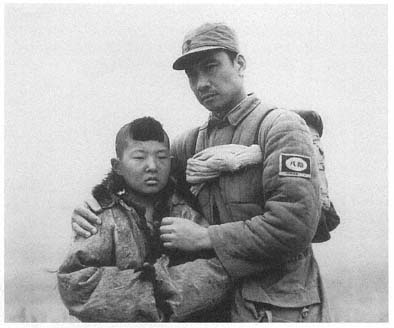
"The silent, blank face": Hanhan and the soldier in Yellow Earth
the sight of the soldier as the source of possible change in an act of individual decision.
However, it is not Hanhan the literary figure that escapes inscription. Indeed, pressured by political demands, the textual movement of Hanhan is along the trajectory of "liberation," though there is no intention of completing it. The circulation of Hanhan (as X) along the various narrative strands is, significantly, a production of textual interweaving. When conventional meaning in that society has been fragmented and questioned within the text, Hanhan (as a textual figure) functions as the desire for meaning. One may venture to say Hanhan is the signifier of that meaning—an insight for history and culture with an urge for change, portrayed as a childish moment before inscription, before meaning is fixed at the level of the political and agrarian institutions. Therefore the silent, blank face, because to speak, to have a facial expression, is to signify, to politicize.
A braid? Perhaps, as one woven by culture in society, and not flaunted as a fetish. Since the nineteenth century, major historical events in China (wars, national calamities, revolutions, etc.) have made four topics crucial to national consciousness: feudalism, subsistence, socialism, and modernization, and discourses are prompted in relation to them in numerous literary and cultural texts. In 1984, when contemporary China struggles with the evil spells of the
Cultural Revolution and begins flirting once again with the capitalist market economy, discourses related to the four topics reappear in terms of current issues: will the agrarian mentality of its people prevent China from becoming a modern nation? Will feudal relations persist in spite of the lure of individualist entrepreneurship? Will the country's recent radical economic move (as in the Great Leap Forward) bring another large-scale fiasco? Is the Communist Party leadership still competent for the changing 1980s? Will a second Cultural Revolution occur soon? As technology and business turn corporate and global, the answers to these questions can no longer be found in an isolated situation. The China that partakes in the world's market economy no longer operates in an "ideological context" that is uniquely Chinese (as it had during the Cultural Revolution). Inevitably (and maybe unfortunately), this changing, modernizing "ideological context" in China also informs the "avant-gardist" project of Yellow Earth which has focused its criticism only on the patriarchal and feudal ideologies of that culture. Arguably, then, Yellow Earth 's modernist power of critique of Chinese culture and history comes from its subtextual, noncritical proposition of capitalist-democracy as an alternative; it is (also arguably) this grain in the text that attracts the global-intellectual as well.
An historicist reading of texts and contexts is a powerful analytic practice. In the case of Yellow Earth , such a reading enables one to relate the film's textual strategies to the specific political and cultural context, while at the same time exposing some of the text's symptoms. However, there still remains a need to locate Yellow Earth 's difference from other interesting Chinese films made during the same period. Wu Tianming's Life (1984), for example, deals with the disparity between intellectual and agrarian life as an important subcultural dichotomy in Chinese identity and boldly pits individual motivation against class issues. Again, such a film is possible in China only in the 1980s. Yet, one may argue that discursive constraints are not fully watertight in their operations. With respect to Yellow Earth , there is a presence of a certain "negative dialectics" that seems to run counter to its grain of modernist activities and does not yield to an historicist reading. It is, again, the simple Taoist philosophy which (dis)empowers the text by (non)affirming speaking and looking: "Silent is the Roaring Sound, Formless is the Image Grand." There are many such instances in the film: when the human voice is absent and nobody looks, history and culture are present in these moments of power(lessness) of the text. With this philosophy, perhaps, we may be able to contemplate the power(lessness) of our reading of the text.
Popular Culture and Oral Traditions in African Film
Manthia Diawara
Vol. 41, no. 3 (Spring 1988): 6–14.
In spite of the increasing number of African films released in the course of the last 20 years (from Borom Sarret in 1963 to Nyamanton [The Garbage Boys ] in 1986), there has not been an African film criticism as enlightening and provocative as the criticism generated by the Brazilian Cinema Novo, the theories of Imperfect Cinema, and the recent debates around Third Cinema.[1] This gap must be filled to overcome the repetitious nature of criticism which has addressed itself to African film in the last 25 years and to make possible the definition of a dynamic aesthetic proper to Africa. The lack of African critics who know African traditions is at fault, as well as the critical practice of the West, where the ethnocentrism of European and American film critics has limited them to evaluating African cinema through the prism of Western film language. Thus, they refuse to look at African cinema "straight in the eyes." They think that that cinema is in the process of finding its individuality, that the film-makers have not mastered yet the film medium, that the camera style is still primitive in African films.
European critics are afraid to look at African cinema in the same manner that Africans used to be afraid to watch the first movies from Europe. According to Amadou Hampate Ba, the wise man of Bandiangara, when film was introduced in his village in 1935, the Imam and the head of the village accused it of being loaded with lies, tricks, and anti-Islamic goals. In order to protect the village against this diabolical invention imposed upon them by the colonial administrator, the Imam commanded women and children to stay at home. Only men came to the projection and they closed their eyes for the entire length of the film. At the end, the men told the administrator that women and children could not come because they were afraid of the images in motion on the screen.[2]
Versions of this paper were presented to the colloquium of Film and Oral Literature in Ouagadougou at the 10th Pan-African Film Festival, and to the Center for Black Studies at the University of California, Santa Barbara. I would like to thank the University of California at Santa Barbara for research and travel support in writing the paper.
Today, African cinema must combat this resistance to foreign images. Europeans close their eyes in order not to see the questioning of Western values, the reaffirmation of cultures repressed by the West, and anti-neocolonialist discourses. European critics sent to view these films, in another form of the reactions like those of Amadou Hampate Ba's village chief, bring back inevitably indulgent and nonanalytical comments on African cinema.
To analyze African cinema, one must first understand that 25 years of film production have necessarily created an aesthetic tradition which African filmmakers use as a point of reference which they either follow or contest. An African aesthetic does not come merely from European cinema. To avoid making African cinema into an imperfect appendix to European cinema, one must question Africa itself, and African traditions, to discover the originality of its films. In his article "Sur les formes traditionnelles du roman africain," Mahamadou Kane wrote that "the originality of the African novel must be found more precisely in its relation with the forms of oral literature from 'Black Africa'."[3] In the same article, Kane compared the oral storyteller to the novelist, exploring the themes, the narrative devices, and other features of the novel which also form the basis of the oral tale. He also showed that the novelist, as well as the story-teller, uses realism as a means of expression, resorting to a linear story with one action which enfolds around three units of time (departure, arrival, and return). Like the traditional story-teller, the novelist opts for a didactic enunciation and, consequently, reproduces in the text the apprenticeship of life as well as moral and social codes.
In this article, I will try to bring out the relations between the oral tradition and African cinema in the same manner that Kane does for the novel. I will compare the griot (the bard) to the film-maker, looking particularly at their reproduction of traditional modes of being, so as to show the similarities and the differences between their works.
First of all, it seems logical to underline the fundamental difference between oral literature and cinema. The means put into play in the construction of a film—the camera movement, close-ups, and shot/reverse-shots—are not the same as those used by the story-teller. Indeed, the latter enunciates by incarnating characters one by one, dominating the narrative by his or her presence. The griot depends on spoken language as well as on music to actualize the story. The film-maker, on the contrary, uses the means of mechanical reproduction to give shape to the story. Whereas oral literature speaks of life, cinema reproduces an impression of life.[4]
Putting this difference aside, can one say that the originality of African cinema must be found in the oral tradition? Can one also overlook the notion that African cinema had had nothing to inherit when it started its development?[5] According to this postulate, there would exist only one film language,
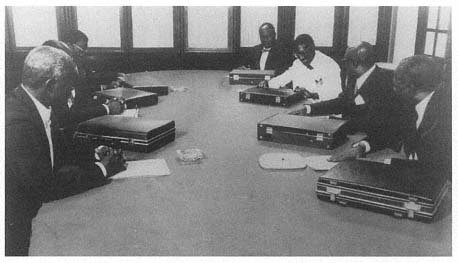
Ousmane Sembene's Xala
(New Yorker Films)
the one to which the West has given birth and which it has perfected. The black film-maker would then only have to place the content of his/her work in a framework that takes its condition of possibility from the rules and precepts already elaborated by Western masters.
However, when African films are examined, one sees that all the directors resort in different ways to oral story-telling forms. As Kane noted in regard to the novelist, the film-maker too is influenced, consciously or unconsciously, by the story-teller's techniques of narrating. "At night, he/she used to be fed with oral tales, historical or cosmogonical legends . . . very often, he/she grew up in a milieu which had a specific mentality as regards the forms of discourse, a sensibility which expressed itself in particular ways."[6]
First it is important to look at the manner in which popular cultures are filmed in African cinema, because such popular practices as song and dance, the performance of the griot, and the representation of African social systems such as polygamy are often used to create the effect of the real in the films. In Xala (Ousmane Sembene's 1974 film about independence and the impotence of the new leaders), for example, after the Africans have taken control of the Chamber of Commerce, song and dance are represented to accentuate the transition of power in the story as a return to authenticity. The dance occurring at the beginning of the film, instead of having a fixed exotic meaning as in anthropological films about Africa, is a spectacle open to several interpretations. First one can see in it the desire of the new public employees to be considered traditional, and
therefore authentic. But one soon realizes that the dance and music outside are used as masks to hide the incompetence of the new leaders inside, who accept bribes from the very Frenchmen they had kicked out. Finally, the dance connotes in an ironic manner the representation of half-naked Africans who are always dancing in European and American films. At the level of the signified, song and dance in Xala position the spectators to criticize the superficial use of tradition by politicians. The opening scene helps the audience build a revolutionary attitude relative to the regressive behavior of the characters in the film.
In Visages de Femmes (Faces of Women , a 1985 film by Desiré Ecaré, which tells two different stories about two women in Ivory Coast), song and dance are narrative processes which move the story forward. In this film song and dance, at the beginning and end of the river love scene, constitute a mini-narrative with a beginning, middle, and end. Through their performance, the women tell the story of how a boy and a girl deceived everybody and met in the river to make love. In Xala Sembene negates the Hollywood stereotypes of exotic Africans and gives a contextual interpretation to song and dance, but in Visages de Femmes Ecaré emphasizes the manner in which song and dance in Africa are used to inform people of what is taking place behind their backs. This balletic cinema, or a cinema that dances in order to tell its story, has its parallel in at least one West African popular theater, the Koteba , which also can imitate all forms of representation through dance.
As the dancers of Visages de Femmes , in their colorful attire, move to the beat of the music in harmony with the rhythm of the editing and the camera movements, one cannot help but think that Ecaré has invented a new language for African cinema. But how is this aesthetization of an African popular culture, which pushes the spectator to identify with the dancing women, different from the old tradition of constructing the body of women as the site of desire in Western cinema? Furthermore it seems that the dance scene, through the use of medium close-ups of women's feet, arms, and heads, is addressed to the desire of the male spectator, and thus contradicts the love-making in the river, which seems to proclaim the sexual freedom of African women. In other words, as Ecaré places song and dance in African cinema, away from anthropological and Hollywood films, he surrenders to the sexist codes of African popular culture which undermine his very attempt to keep alive in Visages de Femmes the political commitment of African directors.
This brief analysis of the representation of song and dance in Xala and Visages de Femmes reveals that the appropriation of popular culture by the fiction film in Africa creates a movement away from Western film language, toward a predominance of traditional narrative codes. Sembene leads this movement by first negating European stereotypes of song and dance in Africa, and by putting into question the African elite's attempt to exploit these popular forms for its
own gains. Ecaré's desire to let African dance and song speak in a cinematic language coincides with a phallocentric construction of the characters which turns them into objects of desire for the spectator. Visages de Femmes teaches us, thus, the necessity for the film-maker to interrogate popular culture in order to divest it of its manifest and/or repressed phallocentrism.
As regards social practices such as polygamy in African film, two examples suffice to illustrate its cinematic representation. In Sey Seyeti (One Man, Several Women , 1980), Ben Diogaye Beye puts polygamy and modernity into play in order to bring to light the contradictions in a contemporary African society. Beye constructs polygamy as the common denominator of the problems of several men in the film, and ends by focusing on the freedom of a young woman who is forced to marry an older man. There is no central story in Sey Seyeti , which tells one anecdote after another, using polygamy as the over-determining factor. This complex film, which runs the risk of confusing the spectator in the West about the relationships among many characters, or of being dismissed as an example of African avant-garde, shocked the inhabitants of Senegal. When it was released, the film provoked an unprecedented reaction in the press from sociologists, ethnologists, and politicians. Beye was accused by some for looking at polygamy, an African custom, with European eyes, and praised by others for boldly exposing a regressive practice which no longer finds its justification in modern Senegal. The fact that Sey Seyeti shocked African audiences, while its message remains opaque or confusing to the spectator in the West, indicates that Beye simultaneously fashioned an African film language while attempting to shed light on the repressiveness of a popular practice such as polygamy.
In Finye (The Wind , by Souleymane Cissé, 1983), polygamy is a principal theme. One of the scenes in this film debunks polygamy by exposing its internal contradictions. Indeed, the youngest of the governor's wives takes the initiative in the quest for a lover by expressing her desire for a young man of her age. The man this young woman chases also happens to be the lover of the governor's daughter. Symbolically, therefore, both women have become the governor's daughters and/or wives because they have the same object of desire. What becomes an issue in this scene is polygamy's inability to answer to the emerging needs of sexual freedom in Africa. But the tradition of polygamy is more seriously questioned in the film by the belittling of its social and economic meaning. Women play the role of respectful spouses, who submit to their husbands in order to cheat on them even better and to get from them what they want. For example, in another scene the oldest and the youngest wives stage a mock fight to distract the husband from his commitment to punish a disloyal daughter. As for the governor/husband marrying three wives, which in the past would have served to emphasize his prestige, this now appears as a movement toward the
weakening of moral and social values. The youngest wife squanders his money, drinks whiskey, and smokes in front of him. These signs of depravity in a traditional Islamic society are ascribed to modernity and the persistence of polygamy. An understanding of local culture (anthropological signs) is necessary to appreciate the play of the actors as authoritative and phallocentric husband, or oldest and youngest wives. One has to go beyond the simplistic conception of art as functional in Africa and see, for example, the aesthetics over-determined by polygamy in the comic scene of the mock fight between the wives.
The figure of the griot, symbol of the oral tradition, has also been often represented in African films. Historians of African cinema have already studied the griot's presence in Sembene's films. In a pioneering article on the subject, Mbye Cham argues that Sembene sees himself as "the mouth and ears of his people," and in his role as a film-maker, he "prefers to amalgamate, adapt, develop, and enhance certain features of the gewel [griot] and the Lekbat [story-teller]."[7] In her book The Cinema of Sembene Ousmane (1984), Françoise Pfaff compares Sembene's cinematic techniques with the griot's narrative techniques. She also analyzes the representation of the griot in films such as Niaye, Borom Sarret, Xala , and Ceddo . I will limit myself to the figure of the griot seen in a scene of Borom Sarret : fat, well dressed, and even with a gold tooth. By contrast the "Borom Sarret" (cart driver) is skinny, poorly dressed, and tired from his work. The opposition between these two characters is so striking that it reminds one of an earlier scene where Sembene uses high- and low-angle shots to contrast the cart driver with a crippled beggar who crawls on all fours.
As money is transferred from the cart driver to the griot, one sees tradition as tainted with obvious corruption. The griot turns tradition into a tool of exploitation when he evokes the cart driver's past nobility in order to take away all the money he has earned for the morning labor. The griot's narrative about the cart driver, which would have been authoritative in oral tradition, is debunked here as exploitative and not inclusive of the contemporary realities that oppress the cart driver. Sembene transcends the griot, therefore, and surrounds him and his old narrative with a new vision which traces the mechanism by which people such as the cart driver are exploited. It is important to notice that in the same scene, as the griot goes on taking the cart driver's money, one young boy shines the shoes of another who is stronger and who leaves without paying. Here again Sembene uses high- and low-angle shots, as he does throughout the length of the film to maintain this hierarchy of power not only between people, but also between the two sides of the city.
The richness of this scene is such that it shows the spectator that a return to tradition, to authenticity, does not always bring about solutions to the problems of Africans such as the cart driver. While criticizing the inhuman westernization of the inhabitants of the Europeanized side of the city, the "Plateau," Borom
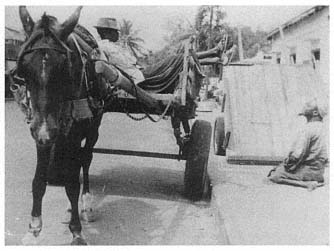
Cart driver and griot: Borom Sarret
(New Yorker Films)
Sarret questions the unconditional return to tradition. Sembene creates a distance between spectators and the characters in the film which enables the spectators to criticize themselves in their tradition. This cinematic language takes its form and content from the figure of the griot, symbol of the oral tradition which Sembene uses as his point of departure. The difference between this first film by Africa's leading director and Western films resides in Sembene's ability to transform Western cinema's exotic characters like the griot and the cart driver into thematic as well as structural elements for the content and the form of his film language.
In Djeli (The Griot , 1981), on the contrary, Lancine Fadika-Kramo resists this transcendence of the griot's art form. He posits the griot as the point of departure and the master of narrative. Djeli starts with a flashback retracing the griot's mythic origin in order to put into question the hierarchies of the caste system. According to this rhetoric, the griot was originally a hunter who changed trades to become a singer, story-teller, and musician. Interestingly enough, another West African myth of origins, "Gassire's Lute," states that the griot was a brave warrior who, tired of killing, turned into a musician to follow and entertain the warriors.[8]Djeli blames the caste system for the contemporary negative image of griots as inferior to other social groups. To show that this definition of griots is opposed to any revolution of ideas, to love and life, Fadika creates a love story between a man from the griot caste and a woman from another social group so as to reveal the regressiveness of caste systems which suppress such a possibility. The aesthetic in Djeli defines itself as a movement out of the stagnation of caste hierarchies, towards a transformation of tradition into an equalitarian system. It is in this sense that the film valorizes "Djeli-ya"—the state of being a griot—through beautiful images of the griottes (female artists), slow-motion shots of
griottes singing and dancing, and the flashback which shows that griots were originally equal to other groups. The film positions the spectator to get rid of hierarchical notions, to enjoy the art of the griot, and to see a coincidence between the rehabilitation of griots and progress in Africa.
Finally, in Jom (1981), Ababakar Samb paints a romantic figure of griots. According to Samb, they are the historians, the educators, and the guardians of people's conscience. In Jom the griot is the main character, the omniscient narrator of the different sketches that form the film, and the immortal persona who travels through time and space. He remains unchanged by age and by the weapons used by the enemies of tradition. Neither money nor fear can corrupt him. He is the griot of the poor as well as of the rich. Samb's griot, like Sembene's narrator in Borom Sarret , is a committed activist who fights for the right of the oppressed. He provides leadership and moral support to the factory workers who are on strike, ridicules the eccentricities of the nouveaux riches in Africa, and praises the courage and dignity of the migrant workers who had to leave their villages because of the drought.
Samb's construction of the griot and his narrative as master and model respectively for African cinema has for a consequence the subordination of the film-maker's narrative to that of the griot and the creation of a nostalgic mood to serve as a refuge for the spectator. The figure of the griot is used to reinvent a beautiful image of the past. Unlike Sembene, who puts the griot's narrative within a larger narrative, Samb surrenders to the narrative authority of the griot. This romanticization of the griot defines Samb's film language, which valorizes tradition as characterized in the film by authenticity, dignity, and truth, and negates modernism as characterized by alienation, colonialism, and exploitation. Jom positions the spectator to identify with tradition without any attempt at self-criticism: everything positive is pushed on the side of tradition and everything negative on the side of modernism.
Up to now, I have shown the manner in which elements of popular culture have been incorporated into cinema. I will show now how the structure of oral literature has helped to shape the originality of African cinema. At the beginning of this article, I pointed out that film-makers, like novelists, are influenced, consciously or not, by the narrative forms of the oral story-teller. They have been initiated into oral tradition before going to Western schools. The way the story-tellers narrate becomes their point of reference when they take their first steps at a film school. During the rest of their careers, they are bound to be dealing with oral tradition, to move it sometimes, contrasting it with the modern forms of the novel and of cinema, or even to repress it. One can see the influence of oral tradition in all African films, including Xala, The Money Order, Finye , and Baara (The Porter) , even where the narrative forms of the classic novel and cinema dominate.
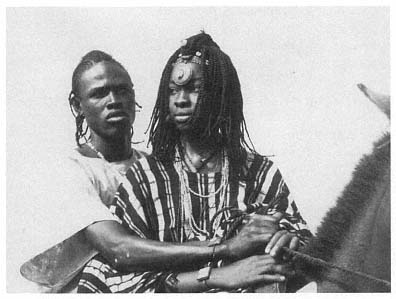
Sembene's Ceddo
(New Yorker Films)
Elsewhere, I showed how Gaston Kabore's Wend Kuuni (The Gift of God , 1983) makes orality its subject and questions the hermetic and conservative structure of tradition in oral literature.[9] One can also mention Sembene's Ceddo as another film which takes the oral tradition for a principal subject and transforms its structure into a revolutionary statement. Sembene's The Money Order is a historical landmark because, for the first time in a film by an African director, the actors speak an African language. But it is in Ceddo that Sembene posits an archeology of discourse in Africa. The richness of the language in proverbs and sayings, the power of the spoken word and of the speaker, are all represented in Ceddo . In the king's court, the discursive space defines itself by including some as members of the discourse in a hierarchical order and by excluding others. The griot, to use the words of Camara Laye, is master of discourse. He controls its distribution and its impact. He is the one through whom the speaking members communicate.
Let's examine the manner in which the subject of orality determines the form of narration in the film. In order to represent the discursive space, the director creates a mise-en-scène in which the griot occupies the center of the circle formed by the king's court, the Imam, the missionary, and the Ceddoes. The fast editing style of European films is replaced by long takes in deep-focus shots. It is as if the camera has taken the griot's position so as to reveal the directions of speech. There are very few camera movements and close-ups. Shot/reverse-
shots are avoided so as not to give the impression that one is dealing with a dialogue scene similar to the ones in Western films.
However, Sembene, like the griot, also makes his presence felt at several points in the diegesis. He is physically present as a Ceddo, carrying firewood on his head, discussing the issue of exile with other Ceddoes, and during the Imam's baptizing of Ceddoes. The use of close-ups of human faces and of objects, in this film where long shots dominate the narration, reveals a didactic intervention on the part of the director. Thus Sembene, like the oral storyteller, determines the reading of the signs for the viewer.
The travel of initiation or the educational quest, which constitutes the structural cell of oral literature, is also an important motif in African cinema (cf. Borom Sarret, La Noire de . . ., L'Exile, Lettre Paysanne, Wend Kuuni, Njangane, Touki Bouki , etc.). The quest defines itself as a movement from the village to the city and ends with the return to the village. One can also interpret it as an alienation and a return to authenticity, as is shown at the end of Touki Bouki , for example.
Ceddo also moves its characters so as to bring them to an awakening of consciousness. The princess, first kidnapped by the Ceddoes, realizes the exploitation of her people by the Imam and joins the Ceddoes in their resistance against the tyranny of the Imam. What above all differentiates Ceddo from the oral narration is its closure. In the oral tradition, the physical return symbolizes the return to the status quo. The griot is conservative and his story helps to reinforce traditional values. In oral traditions, the story is always closed so as not to leave any ambiguity about interpretations. In Ceddo , on the contrary, the return denotes the union of the princess and the Ceddoes. Thus the end of the film, a freeze frame, announces the new day pregnant with several possibilities.
Finally, I will end this study by showing the manner in which one of the best films of the Pan-African Film Festival (FESPACO 1987), Cheick Oumar Sissoko's Nyamanton (see FQ , Winter 1987–88), continues the African film language I have sought to define above. Nyamanton constitutes an educational quest, or an initiation trip for the two main characters, Kalifa and Fanta, who travel daily from their home to the neighborhood where they work. The home symbolizes the interior space where tradition is a refuge, safeguarding parental relations. The children play with their grandparents and the resulting laughs help the family go through their daily difficulties. The city represents the outside, the change of setting and imminent danger. The trips between home and the city enable the children to witness the injustice present in their society and to question its permanence.
Nyamanton , too, like Ceddo , goes beyond the mere imitation of orality to question the griot who is the master of discourse. In one scene Kalifa says to his friend, Aliou, that his father is the greatest liar after Jali Baba, Mali's famous griot. Aliou answers that griots do not lie, that what they say is the true
story and that Kalifa ignores their value. Aliou then starts imitating Jali Baba and sings his friend's praises. One sees in this scene the definition of the griot as a historian on the one hand and, on the other hand, as an artist whose play with words ranks him with liars. But more important than this reference to the figure of the griot and his narrative is the fact that the director's world view takes the place of that of the griot as the most authoritative in the thematization of the kids' relation to everyday life in Africa. In oral tradition, it is through the griot's point of view that one sees and realizes the universe around one. In film, the camera replaces the griot as the director's eyes and constructs the new images of Africa for the spectator. It is in this sense that one says that the African film-maker has replaced the griot in the rewriting of history.
Nyamanton is constructed mostly with long shots. These shots show clearly the space occupied by the women at the house door and Kalifa's father under the tree. The father has to yell when he communicates with women because of the distance separating them. In order to remain within the limits of realism as regards the representation of such spaces, the camera occupies the center between the women and the father, as was the case with the griot in Ceddo . Here, too, close-ups and shot/reverse-shots are avoided as much as possible.
At first sight, this narrative expedient may be dismissed as simply a primitive use of the camera in an attempt to economize on editing. Thus a hasty comparison with Western cinema might bring one to the conclusion that African films lack action. But an analysis based on the forms of oral tradition will highlight the originality of African film language in Nyamanton . First, one can see through an ethnographic insight that the long shots serve better to create the effect of verisimilitude in the narrative. The external space in Africa is less characterized by the display of emotion and closeness between man and woman, and more by a designation of man's space and woman's space in society. The narrator imitates this reality by using mostly long shots and by describing the emotion of the characters instead of showing it. The griot's influence on the film-maker brings about the fact that subjective shots do not always have the same significance in African cinema as in Western cinema. Close-ups of a child's face or of a pack of cigarettes in Nyamanton , for example, are not objects seen by a character but their description by the director/narrator for the spectator. Even the flashforward in the film is a description of the mother coming to an understanding of the situation in which she finds herself. Instead of effacing himself and realizing the story through different characters' narrations, the director in Nyamanton always carries the camera on his shoulder and, like the griot, dominates the narrative with his presence. While Western directors often achieve recognition by letting the story tell itself, African directors, like the griots, master their craft by impressing the spectator with their narrative performance. This may be because, with the griots, one achieves fame not by being the author of new texts but
by being able to reproduce the best versions of old texts. Nyamanton is a new version of such African films in which tradition clashes with modernity, and the popularity of its director lies in the manner in which he describes the most memorable episodes of the clash.
The choice of Nyamanton for the title of the film is also interesting in the context of oral tradition. Etymologically, "Nyamanton" comes from the prefix "Nyama," which in Bambara and Mandinka may be translated as "potentially dangerous forces released through the performance or violation of ritual."[10] "Nyaman" with an "n" at the end means trash. Thus a popular song in West Africa likens Sunjata, King of Mali in the thirteenth century, to a dump-site which hides everything underneath itself, but which cannot be covered by other things. Literally the song refers to Sunjata's vital force which protects his people and which harms his enemies like the plague released from a "Nyama" or from the violation of ritual.[11]
When the title of the film is interpreted in the context of "Nyama" as a West African trope, one sees how Sissoko positions the spectator to take a personal responsibility in reducing the children's future to trash collection, and to fear the retribution of "Nyama." Sunjata, too, had a difficult childhood, and those who were responsible were punished. On the other hand, the likening of the children to Sunjata leads the spectator to identify them with the collective future of Africa. As in Ceddo , orality is here again made the subject of the film in order to arraign the repressive forces of tradition and modernism.
Finally, the oral tradition also influenced the French title of the film, La leçon des ordures (The Lesson of Garbage) . Sissoko wanted to oppose to "The Lesson of Things," which students in Francophone Africa learn every morning from French textbooks, the lessons learnt about Malian society by Kalifa and Aliou through their work as garbage boys. As "leçon des choses" becomes interchangeable with "leçon des ordures," and both are little more than "Nyaman," the film creates the necessity to question the lessons inherited from the former colonial powers. There is no doubt that the form of African cinema is influenced by its traditional content. Understanding the role played by the oral tradition in African film enables the critic to see how the film-maker has transformed this tradition into a new ideology. But it is also possible to study the way in which the African content has changed the cinematic language of the West. This is what transpires when one examines the strategies by which film has incorporated African traditions. The African director makes conscious and unconscious references to the griot's narrative techniques.
The Subversive Potential of the Pseudo-iterative
Marsha Kinder
Vol. 43, no. 2 (Winter 1989–90): 2–16.
The iterative was introduced into contemporary narrative theory by French narratologist Gérard Genette in his ground-breaking work Narrative Discourse , where he considers "narrative frequency , that is, the relations of frequency (or, more simply, of repetition) between the narrative and the diegesis," which he claims is "one of the main aspects of narrative temporality." He describes the iterative as a type of narrative "where a single narrative utterance takes upon itself several occurrences together of the same event (in other words, . . . several events considered only in terms of their analogy)"—as in the example "every day of the week I went to bed early." Genette acknowledges that the identity of these multiple occurrences is debatable (i.e., that each instance of going to bed has its unique variations) and "that the 'repetition' is in fact a mental construction, which eliminates from each occurrence everything belonging to it that is peculiar to itself, in order to preserve only what it shares with all the others of the same class, which is an abstraction." Nevertheless, he defines the iterative as "narrating one time (or rather: at one time ) what happened n times "; as opposed to narrating one time what happened one time (the singulative —as in the example "Yesterday, I went to bed early"); or narrating n times what happened n times (the anaphoric , as in "Monday I went to bed early, Tuesday I went to bed early, Wednesday I went to bed early, etc.," which is merely a multiple form of the singulative); or narrating n times what happened one time (the repeating narrative, as in "Yesterday I went to bed early, yesterday I went to bed early").[1]
Usually signalled in verbal discourse by the use of the imperfect tense ("I used to go to bed early") and normally limited to a subordinate descriptive function in classical literary narrative, the iterative aspect, according to Genette, can be traced all the way back to Homer, but was first liberated from "functional dependence" by Flaubert in Madame Bovary and most fully expanded "in textual scope, in thematic importance and in degree of technical elaboration" by Proust in A la Recherche du temps perdu , where it becomes
a key component of his radical innovation. What I intend to do in this essay is to explore how the elaboration of the iterative functions in filmic narrative and the filmic means by which it is signalled, particularly in works that attempt to make a radical break from existing narrative conventions.
The Pseudo-iterative in Hollywood Classical Cinema
Although Genette's elaboration of the iterative is commonly assumed to be one of his most important contributions to narrative theory, there has been surprisingly little application of this concept to cinema. A notable exception is Brian Henderson's essay, "Tense, Mood, and Voice in Film (Notes After Genette)," in which he attempts to describe how the iterative functions in classical Hollywood cinema in contrast to classical literary narrative. After noting that "in classical cinema, as in the classical novel, the iterative nearly always has an information or background function subordinate to singulative scenes," Henderson perceptively observes that what is far more central to cinema than to literature is the "pseudo-iterative"—an unusual mode that Genette finds in Proust and that he defines as "scenes presented, particularly by their wording in the imperfect, as iterative, whereas their richness and precision of detail ensure that no reader can seriously believe they occur and reoccur in that manner, several times, without any variation" (Genette, p. 121). Henderson notes:
This happens occasionally in Proust; in cinema it is pervasive because "richness and precision of detail" seem to be inherent in photography and sound recording, at least in those practices of them engaged in by most films.[2]
Pursuing his comparison of the ways the iterative functions in cinema as opposed to literature, Henderson describes the opening scene from How Green Was My Valley (1941), where Huw's voice-over first establishes the iterative mode through his description of a typical day and through his repeated use of the word "would" (e.g., "Someone would strike up a song and the valley would ring with the sound of many voices . . .") and then slips almost imperceptibly into the singulative ("It was on this afternoon that I first met Bron . . .").
Henderson observes:
Most interesting, theoretically, is how and why such a slippage is possible in cinematic iterative; it would not be in literary narrative. Are the images neutrally either iterative or singulative, depending upon a voice-
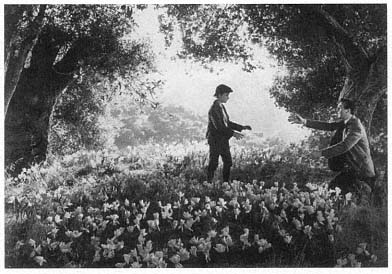
How Green Was My Valley
over to define their temporal status? If so, then the continuity of the images may sustain us through a shift in tense, while the changed verbal tense tells us how to read the images. (Henderson, pp. 11–12)
Genette interprets analogous slippages in Proust (i.e., when he "inadvertently lets a necessarily singulative passé simple into the middle of a scene presented as iterative") as "so many signs that the writer himself sometimes 'lives' such scenes with an intensity that makes him forget the distinction of aspects." Rather than seeing them as a conscious artistic strategy, Genette reads them as "confusions" that "reflect in Proust a sort of intoxication with the iterative " (p. 123)—an intoxication that presumably is transmitted to the reader. I would argue that the particular form of pseudo-iterative that operates in classical Hollywood cinema generates in the spectator an intoxication with the singulative —an intoxication which uses iterative implications to naturalize the singulative and which renders the slippage between the two aspects invisible.
But this explanation doesn't really address Henderson's question of why subtler slippages are possible in classical cinema in contrast to classical literature. One could argue that (even beyond the issue of fictional reference within the diegesis) the specific nature of the cinematic apparatus constructs an inevitable slippage between the singulative and the iterative, which are established and associated respectively with the stages of production and exhibition. That is, in front of the camera and microphone, the footage seemingly speaks in the singulative, either in the present tense or in the simple past by
capturing and embalming the present moment ("this event is happening now as it is being recorded," or "this event happened in front of the camera and microphone").[3] In the theater at the point of exhibition and reception (and even during the post-production stage, where a single utterance may be constructed out of multiple takes), the footage of images and sounds recorded in the past could be read as speaking in the iterative ("the event now being uttered/projected used to occur while this scene was being shot and in all previous projections"). In a discourse that tries to efface all traces of this dual system, such as Hollywood classical cinema, the emphasis is primarily on the singulative and on the illusory construction of a present tense; references to the past tend to be clearly marked out by voice-overs and/or flashbacks, as in the example Henderson cites from How Green Was My Valley .
One could also argue that the slippage into the iterative is more easily accomplished in cinema because, unlike the sentence, the film utterance is initially atemporal and its tense is therefore established contextually by discourse. That is, the film utterance is not required to have a tense and therefore (unlike the literary utterance) there is not always a clearly established tense for the iterative to suspend or displace. On the other hand, as Edward Branigan has pointed out, spatial relations in the film utterance must be clearly defined (that is, the camera must be somewhere ).[4] This might suggest that in cinema there is a tendency to spatialize the iterative—i.e., to use spatial relations to generate iterative implications of frequency.
Thus, I would argue that it is not only voice-overs that can redefine the aspect of frequency of any cinematic image or scene, especially those involving spatial relations and representations of typicality, but also other stylistic operations within a narrative. In classical Hollywood cinema, it's the iterative aspect that tends to remain hidden; and that's why, as Henderson observes, when the iterative aspect is acknowledged, it is nearly always subordinated as mere descriptive background to what appear to be singulative events, whose distinguishing details are frequently accentuated by close-ups, editing codes of continuity (such as shot/reverse shot), or foregrounding of linear plot structure. This emphasis is hardly surprising since, as Genette observes, the singulative form of narrative is "so common, and apparently considered so 'normal' that it bears no name" (p. 114); that's why he coins the neologism singulative . Thus, it's the singulative nature of cinema that always tends to be foregrounded in classical cinema, even when those singular events take on what I would call an "iterative implication." This implication suggests that this particular narrative is a single telling of a class of events that habitually or typically occur in this set of circumstances, period, or culture—a dimension that is consistent with Aristotelian norms of probability and strongly reinforced by the normative power of popular Hollywood gen-
res. Yet because this iterative aspect is only implicit (and somewhat analogical rather than strictly grammatical) and the precision of rich detail literally foregrounded, "some [as Henderson cautiously observes] might take an ultra-literal position and say that this makes the iterative impossible in cinema; its images and sounds are always singulative" (p. 12).
I am arguing precisely the opposite position: namely, that the iterative is inherent in cinema, either through the pseudo-iterative (as defined by Genette and modified by Henderson, where there is an explicit acknowledgement that the event is presented in the iterative aspect despite the rich perceptual detail in the image), or through the iterative implication (where the acknowledgement of the iterative repetition is only implicit and positioned within a scene presented as singulative). One might reasonably object at this point that my usage of the term iterative may have moved too far away from its strictly grammatical usage in Narrative Discourse , yet Genette himself acknowledges that his grammatical terms "are merely borrowed" and that he makes "no pretense of basing them on rigorous homologies" (p. 32).
Genette confines the iterative to temporal relations and to utterances about past events. Yet by acknowledging that iterative repetition depends on the mental construction of a class (or paradigm) of similar instances, he opens a space within the iterative for the issue of typicality. Since temporality, as we have seen, is not foregrounded in film the way it is in literature, I am arguing that it is this issue of typicality that is usually foregrounded by the iterative in cinema. Within Hollywood classical cinema, the combination of rich perceptual detail and strong emphasis on genre not only generates iterative implications, but also uses them to naturalize the singulative event. The combination suggests that this particular narrative utterance is realistic or truthful in the sense of being habitual, typical, or inevitable, while the determination (the diachronic limits of the series) and the specification (of how frequently it occurs) are significantly left indefinite. Often a classical film will begin with scenes depicting normal, typical actions, from which the singulative narrative will soon deviate; though such scenes are technically presented in the singulative, they carry iterative implications (particularly through spatial relations) that are extended to the singulative plot.
Two brief examples should suffice. Duel in the Sun (1946) opens with an extravagant prologue, in which a lushly colored landscape and overblown literary voice-over boldly place the story of Pearl Chavez in the mythic past. Although we are told that this legend and the figurative stone that commemorates it have withstood the test of time, it's the dramatic setting (rather than the particular moment) that is truly singular. Pearl's uniqueness is explicitly symbolized by a rare cactus flower that blooms every year, but only here in this unique space
where she and her lover died. Though clearly presented as extraordinary, this opening supposedly depicts what happened many times (the blooming of the flower, the survival of the stone, the telling of her story). Yet, this prologue arouses our curiosity not about these repetitions (which are only the background), but about the dramatic climax—the death of "the wild young lovers"—which already occurred in the past, but toward which the singulative narrative will inevitably be moving.
Once inside the story, we are immediately confronted with the same conflation of the habitual action with the extraordinary singulative event. We move directly to a close shot of the young Pearl as she dances seductively for a group of youngsters outside the Presidio, and then inside where her mother is doing a similar dance for scores of men and where her father is losing at cards ("broke again?") and being humiliated by the other players ("he's not so fancy about his wife"). By being introduced to these characters through these actions, we assume that they perform them every night, yet simultaneously we realize that this night will lead to a singulative climax. Both dancers are approached by a man who makes the iterative trace between them explicit (telling Pearl, "like mother, like daughter") and who triggers the slippage into the singulative (by kissing Pearl's mother in front of her husband and by taking her off to make love). While implying the previous series, this single utterance explicitly depicts only the final humiliation, which leads Pearl's father to shoot his wife and her lover as Pearl and we look on, intoxicated with the singulative. Yet the prologue enables us to see the iterative implications in this action: to realize that Pearl met a fate similar to her mother's, and to read both of these framing melodramatic climaxes as probable, inevitable, foretold.
A Place in the Sun (1951) opens with a long shot of a hitchhiker with a suitcase trying to thumb a ride from a passing car on a curved highway. It's a familiar image we all recognize, although the time, place, and character are ambiguous. At first we can't see him very well because he has his back to the camera and his body is partially covered by the opening titles which appear over this scene. But, because of his suitcase, we assume he has hitchhiked a long way, and that this filmic utterance is meant to depict an action that has been repeated along many different stretches of highway. Gradually, as the titles conclude, he backs toward the camera in the foreground. As soon as he turns around, this image ceases to function as background and slips into the singulative: for we recognize the extraordinary face of the young Montgomery Clift and the camera moves in for a tight, fully lit close-up of his half smile as something unusual captures his attention. Then there's a cut to the object of his gaze—an outdoor poster of a glamour girl, with the headline "It's an Eastman." At that very moment a horn from a passing car draws his attention back to the road just in time to see Elizabeth Taylor (who turns out to be his rich cousin, an Eastman) driving
by in a Cadillac convertible. The contrived convergence of image, name, and vehicle prefigure the inevitable conclusion toward which the singulative linear narrative will be driving. Like the roadside collision of Oedipus and Laius, this coincidence appears to be predestined. It expresses the young man's intoxication with the singulative assumptions of romance: the belief that she's the love of his life, his single chance for happiness, his missed opportunity—a belief that will lead him to consider murder. But now this elusive object of desire drives out of sight and, as if awakened from his revery, he goes over to the dilapidated truck that has stopped to give him a ride. In this opening, the contrast between typicality and singulative romance is figured as a choice between two narrative vehicles (the truck that could have driven out of Grapes of Wrath and the glamorous convertible that belongs to bourgeois melodrama) and between the long shot and the large facial close-up. The narrative will constantly maneuver between these two modes, using the iterative traces of drab typicality to intensify the desirability of the singulative romance.
Although (unlike How Green Was My Valley ) neither of these openings uses the pseudo-iterative, they still use iterative implications to naturalize the linear drive of the narrative and to intensify the intoxication with the singulative. Yet the slippage between the iterative and the singulative remains barely visible.
But if the iterative implications and the slippage between the two aspects were ever foregrounded, then they would potentially call attention to the process of naturalizing ideology through the reading of singulative events of fiction as universal truth, a reading that reinforces the dominant cultural paradigms and genres. This is precisely what happens in a wide range of films where the narrative experimentation is designed to make a sharp break from the prevailing conventions of narrative discourse.
In the rest of this essay, I will explore a few examples of how such foregrounding functions in two quite different filmic contexts: Italian neorealism, where narrative discourse was intentionally distinguished from the dominant practice of Hollywood classical cinema; and the radical feminist avant-garde of the late 1970s and 80s, where one of the primary goals of narrative experimentation was to subvert the sadistic drive of the oedipal plot, that key master narrative of Western patriarchal culture.[5] I will argue that, despite the striking differences in the historical, cultural, and stylistic contexts of these two kinds of subversive film practice, the specific texts under analysis all use the foregrounded slippage between iterative and singulative to undermine the linear drive of the narrative and to retrain the spectator for a more attentive, speculative reading of richly detailed images and sounds. In these analyses, I do not mean to exaggerate the stylistic unity of these two contexts or to suggest that either of them functions as a monolithic entity; rather, I merely want to sketch some broad stylistic tendencies in their usage and signalling of the iterative aspect of narrative.
Italian Neorealism:
The Pseudo-iterative as Narrative Rupture in Umberto D and Il Posto
Within the neorealist aesthetic, rich photographic detail frequently functions to express not the singulative (as in Hollywood classical cinema) but the iterative. Although the iterative is sometimes signalled by voice-overs (as in films like La Terra Trema, Paisà , and Amore in città ), it more typically is marked by visual operations, particularly through spatial determinations. The referential interplay between the singulative event and the paradigm it represents is frequently played out spatially in terms of foreground and background. Yet, the iterative background is not merely "descriptive" or subordinate as in Hollywood classical cinema, but at least co-equal, normative, and determinant in ideological terms—relations that can be established by spatial or temporal continuity through depth composition or long takes punctuated by ellipses. Individuals and their actions are chosen precisely because they are representative and typical in an iterative sense; the anonymous characters in the background are not used merely as a backdrop against which to distinguish the singularity of the protagonist (a singularity which then is invisibly transformed into a norm as in classical Hollywood cinema), but rather as a means of explicitly acknowledging the iterative aspect and the slippage between it and the singulative dimensions of this particular occurrence within the series.
For example, the singular protagonists of DeSica's Bicycle Thief and Umberto D are introduced within a crowd, from which they are visibly selected for foregrounding during an habitual event (a daily hiring of workers, or one of the frequent impromptu demonstrations in postwar Rome). Yet it's the typicality of these characters and their events that are valued and repeatedly emphasized, not their singularity. Similarly, the multiple protagonists of Rossellini's Open City and Paisà emerge from events involving large numbers of people, events that are already in progress and that are presumed to be illustrative of a common series that frequently occurred during a specific historical period in a specific location. The precision of detail in the image helps identify the paradigm to which the particular characters and events belong; the long take and depth focus, and even the montage structure at the opening of Umberto D and Shoeshine , continue to acknowledge the connection between the individual and the paradigm, between the singulative and the iterative aspects.
Umberto D (1951)
The use of visual codes to express the neorealist intoxication with the pseudo-iterative and to control the slippage between the iterative and the singulative can be demonstrated in a celebrated sequence from Umberto D , which is frequently
cited as the "purest" example of the neorealist aesthetic. The sequence where the pregnant maid does her morning chores seems to contribute nothing whatever to the advancement of the narrative line; rather, it merely presents her ordinary daily moves. Bazin calls it "a perfect illustration of [the DeSica–Zavattini] approach to narrative, . . . the exact opposite of that 'art of ellipsis' . . . [which] presupposes analysis and choice." He defines it as "the succession of concrete instants of life, no one of which can be said to be more important than another, for their ontological equality destroys drama at its very basis."[6]
By presenting the maid's ordinary morning routines, this totally nonverbal sequence clearly foregrounds the iterative. Yet, perhaps even more important for my argument here, it also trains the spectator in how to read the familiar moves both of the maid and of the camera and editing and to thereby deduce what she is probably thinking. Moreover, these cognitive tasks will be required later in the two singulative events that are crucial to the narrative line—the two moments when the old man Umberto contemplates suicide. Thus, in this sense, the sequence does contribute to the narrative by renegotiating the relationship between the iterative and the singulative, a relationship which proves essential to our understanding of what happens in the film.
In the representation of this particular morning our attention is first drawn to the old man Umberto who stands in the foreground, phoning the ambulance to take him away to the hospital, arranging a singulative event that will distinguish this day from all others. The maid appears behind him in the background, as part of the ordinary context against which Umberto's singulative event is to be read. When the film cuts to the maid, lying on her back in bed, there is a noticeable slippage to the iterative, which now takes over the foreground. Her ordinary morning routines fill in the time (or temporal gap in the narrative) that it takes the ambulance to come for Umberto. As Bazin suggests, this sequence rejects narrative ellipsis.
Yet Bazin fails to notice that the way her actions are represented visually is not always consistent with what we normally identify as the neorealist aesthetic. For example, this sequence does not rely on the long take, but has at least seventeen intra-sequence cuts. In the very first shot, the maid rubs her eyes, drawing our attention to her gaze. Then there's a cut to the object of her gaze—an upward-angle long shot of a cat walking across the roof seen through a screen-like surface with a striking graphic design. This shot stands out, not because it depicts an unusual event (undoubtedly, like the maid, the cat is pursuing its daily morning routines), but because the almost abstract formalism of the visuals is not characteristic of the neorealist aesthetic. This shot is followed by a cut back to the maid, which then moves in closer to her gaze, anchoring it firmly within the suturing structure (shot/reverse shot/shot) normally associated with classical Hollywood cinema. This suture works toward the kind of emotional identification that is also typical of DeSica and Zavattini. Then the camera follows the
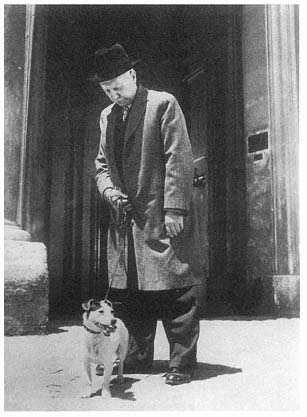
Umberto D
maid into the kitchen where we see her performing a number of household tasks in a series of long and medium shots more typical of neorealism. Three shots later there is a medium shot of her through the window, and then she and the camera move toward each other, a convergence which again calls our attention both to her gaze and to our own. The reverse shot reveals the object of her gaze in an exterior long shot—a white cat walking along the slanted roof, evoking the earlier more abstract image of the cat through the screen, and then there's a cut back to her gaze through the window.
Despite Bazin's claims that no one instant in this sequence is more important than any other, the formal repetition (of the shot/reverse shot suture, of the camera moving in closer to her gaze, and of the cat imagery) privileges these two moments. This repeated pattern leads us not only to identify with the young maid, but also to speculate on her thoughts: perhaps she, too, is identifying with the feline, envying its freedom, particularly in light of her pregnant condition. This hypothesis is strengthened a little later when she looks down at her slightly swollen belly,
and the camera moves in tighter, almost to a close-up of her face, which reveals her eyes blinking, as if to ward off the tears that will appear a few moments later. What's really at stake here is not whether we reach a "correct" interpretation of what she is thinking, but rather that we learn how to read the phenomenology of her moves and how to recognize the filmic codes that elicit such speculations.
All three of the visual codes that have been foregrounded in this sequence through repetition—the shot/reverse shot suture, the striking camera movement (or zoom) that closes in on the gaze, and the accelerated tempo of the cutting—are used again later (and intensified through the accompaniment of dramatic non-diegetic music) in the two melodramatic sequences, where Umberto considers suicide: first, when he stands at his window staring at the streetcar tracks below, and finally, when he carries his dog to the railroad tracks and nearly lunges in the path of an on-coming train. In both cases he is prevented from acting out his suicidal impulse by the presence of the dog, another inarticulate creature (like the cat in the maid's morning sequence, or like the anonymous poor backgrounded by the narrative) whose readable gestures serve as the basis of emotional identification for spectators trained by the neorealist aesthetic. If we are un able to read these silent moves and gestures (or what Pasolini would later call im-signs ), then we prove to be less trainable than Umberto's clever little mutt, whose ability to decipher these nonverbal signs saves both himself and his master.
Il Posto (1961)
The spectatorial retraining function of the neorealist pseudo-iterative is perhaps most notable in Ermanno Olmi's Il Posto (The Job , aka The Sound of Trumpets , 1961). Unlike the earlier classics within the movement, this latter-day neorealist work documents not the economic failure of the poor but rather the "successful" entry of a timid young man from a Lombardy suburb into the dehumanizing world of bureaucracy in Milan—"that city" which (we are told in an opening title) "is primarily a place to work." Not only is Domenico's typicality underlined by this title and by the scores of other young people who surround him at work, in the busy streets of Milan, or in his own suburban tenement, but at one point in this fairly conventional linear narrative there is a dramatic rupture that marks a sudden slippage into the iterative—a rupture that is far more blatant than the maid sequence in Umberto D .
Up to that point the narrative has consistently followed the inarticulate Domenico, leading us to focus on his closely observed movements and to read his facial expressions and gestures (almost as if we were watching a silent film). Now it presents a series of brief elliptical scenes (linked by dissolves) which show how five clerks from one office typically spend their evenings: working on
a novel, cultivating a dashing appearance, retaining vestigial possessions from a lost aristocratic past, singing arias at a cafe, interacting with a difficult son. Ironically, though these scenes differentiate the clerks by revealing the various ways in which they try to preserve their individual identity, the narrative form in which they are presented suggests an illustrative montage, which stresses the typicality rather than the uniqueness of the behavior depicted. Depending on how one sees its articulation with the scene that introduces it, this sequence could be read either as what Genette calls the generalizing, external iteration , where an iterative passage within a singulative scene "opens a window onto the external period," or as the internal, synthesizing iteration , where there is an "enumeration of a certain number of classes of occurrences, each of which synthesizes several events . . . not over a wider period of time, but over the period of time of the scene itself" (pp. 118–119).
The series is introduced by a conversation in the office between two co-workers who are speculating about a near-sighted clerk, calling him "a sneaky type." Then there's a cut to that same clerk at home alone in his sparsely furnished room, laboring over a manuscript. When his landlady spies on him through a keyhole, she admits that she's unable to tell what kind of writing he's doing ("God knows what he's writing!") but she does identify the activity as iterative by explicitly telling us that he does it every night. The voyeuristic motivation for the scene, its minimalism and ambiguity, its emphasis on interpretation, its punctuating dissolves—all raise the additional possibility that this scene may represent not what the near-sighted clerk actually does on that or any other specific night, but rather merely a reasonable speculation.
By the time we reach the fifth scene, where the middle-aged woman clerk discovers her wallet is empty and painfully concludes that she's been robbed by her son, the narrative seems to have slipped back to the singulative, preparing us for the cut back to the office where the camera pans across the other clerks as they stare at the same poor woman who sits at her desk silently weeping. This narrative continuity tends to anchor this particular elliptical scene temporally, locating it specifically during the previous night, but still leaving ambiguous whether the scenes of the other four clerks also took place during that same night, or whether the scene leading into the montage (the co-workers speculating about the "sneaky" near-sighted clerk) occurred on the same day as the scene that followed it. Yet, since we learned in an earlier scene that this same woman had previously been late to work three times this month (presumably because of similar problems with her son), even this specific incident could be read as merely one typical illustration of what causes her daily misery.
This disruptive sequence of elliptical scenes is evoked again near the end of the film, when there's a direct cut from the gaiety of a New Year's Eve party to the silent panning across the same clerks as they grimly stare at the empty desk
of their near-sighted co-worker, and then to a montage of artistic stills of his empty room, linked by dissolves. Not only does this dramatic rupture signify death (both in the narrative and in the linear structure of a man's life), it also creates an opening for the protagonist Domenico, which allows him to advance from messenger boy to clerk. Thus, this rupture helps to transform our reading of the film—from the singulative story of a young white-collar worker finding his place in the world, to an iterative account of the recurring cycle in which workers struggle to maintain their humanity within a dehumanizing bureaucracy, a cycle which is part of Italy's so-called economic miracle. This rupture also exposes the narrative gaps that have been there all along (e.g., the stories of minor characters or losers, like the married man who failed the examination and didn't get the job). It also brings to mind earlier montage sequences in the film, like the montage of urban construction that is part of the literal background for Domenico's and Antonietta's lunch break in the city and also the historical background of industrialization, which proves more instrumental than the narrative in determining their future. And, on a more abstract level, it also reveals the structural similarity between ellipses and montage (which had always been so ambiguous in Bazin's treatment of Rossellini and the neorealist aesthetic).
The blatancy of the iterative dimension in these narrative ruptures also calls attention to the more subtle iterative implications in other, more conventional sequences—i.e., to the various ways in which characters and actions are positioned within paradigms and repetitive cycles. For example, we see how Domenico's interaction with the cold patriarchal boss and his warm, mediating maternal secretary echoes his relationship with his parents. We perceive how the spatial arrangement of the rows of clerks facing their supervisor duplicates the classroom hierarchy between students and teacher. We recognize traces of the dehumanizing fascist aesthetic in the over-sized scale of the corporate lobby, with its rigid rules (only four to an elevator) and uniformed staff (someone even jokingly asks Domenico whether he's a member of the Gestapo). We recall the book-strap that Domenico is forced to pass down to his younger brother in the opening sequence, or his careful observance of other customers in the coffee bar to learn how to tip and what to do with his cup, or his watching through the window to see how the previous group of applicants is responding to the physical exam.
By specularizing this iterative aspect, the film reminds us that we also learn such conventions from watching movies. Even Il Posto is self-consciously positioned within the paradigm of neorealism, but with its historical "difference" duly noted. In one scene an old man enters the corporate building, having mistaken it for the welfare office. When he asks for the office that gives out money to the poor, he's told he's in the wrong building. He could just as easily have been told that he's in the wrong movie, for clearly he belongs in a neorealist classic like Bicycle Thief or Umberto D . Yet it's easy to understand his error
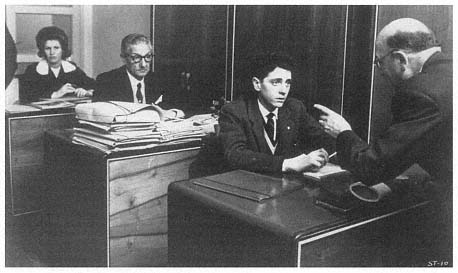
Olmi's Il Posto: The spatial arrangement of the rows of desks facing the supervisor
duplicates the classroom hierarchy between students and teachers.
because the architecture (of the corporate building and welfare office) and the film aesthetic (of Il Posto and neorealist classics) look very similar.
The neorealist classic that is singled out for specific comparison is quite properly Umberto D , which helped to mark the end of the movement as well as its entry into the world of middle-class white-collar workers. Il Posto recycles many images that are found in Umberto D : the cafeteria with its cheap food, the niggardly landlady who harasses the lonely bureaucrat, and the old man with a small dog riding on a streetcar. In one sequence, when the young applicants are being led down the street in an orderly line, an old man with a dog asks what is going on. When Domenico tells him it's for a job, the old man remarks, "That's a laugh!" We can't help but be reminded of the retired bureaucrat Umberto, who knows from bitter experience that disappointment awaits these prospective white-collar workers. Yet while he probably thinks it has to do with material conditions like inadequate pensions, here the problem is seen as the dehumanization of the individual. Such a view can also be found in the silent comedies of Chaplin and Keaton, many of whose conventions are also absorbed in Il Posto and whose basic humanism was seen by Bazin as compatible with neorealism. Thus, Il Posto is not merely an updated version of Umberto D ; rather, it offers a different analysis of the problems, one that extends ever further back to the beginnings of both cinema and industrialization. In this way, the film's intertextuality (both with neorealism and American silent comedy) names the paradigm to
which the film belongs and becomes another means of marking a slippage into the iterative.
In such a reading of the film, there is no need for narrative closure. Thus, we are not disappointed that we never find out whether Domenico gets the girl or gets ahead to the front row. What we see represented is one man's entry and another's exit from the same subject position, which has been constructed by the economic system of postwar Italy. The linearity of the narrative is shown to be merely an illusion of progress, of getting ahead. This reading is underscored by the emblematic ending, where the "personal" belongings (including the unread life work) of the dead clerk are carelessly tossed aside while another worker turns the handle of a mimeograph machine, producing identical copies from a single master. As we see a large facial close-up of Domenico, blinking with discomfort in his new post, and then see the film title Il Posto (which in Italian refers both to the "position" and to the victorious sound of trumpets) superimposed on his face, we hear the repetitive droning of the mimeograph machine. The extreme length of the close-up gives us time to speculate on what the young man may be thinking: perhaps, that this is a sound, not of economic triumph, but of spiritual defeat.
In these sequences from Umberto D and Il Posto , the neorealist intoxication with the iterative immerses the spectator not in the emotional intensity of personal memory as in Proust, but in the ideological relations between individual and collective experience.
The Feminist Avant-garde:
The Pseudo-iterative as Semiotic Transgression in Toute une nuit
The radical experimentation in Chantal Akerman's Toute une nuit (1982) goes much further in deconstructing traditional narrative and in revealing how the slippage between the iterative and the singulative helps to naturalize dominant ideology. The film challenges not only woman's position in narrative, but also the very structure of narrative and language, for they are the primary signifying systems that have held women in captivity under patriarchy by making their subordination seem natural and inevitable rather than culturally inscribed.
Instead of leading us into emotional identification with the characters on screen, the film enables us to see that, as in all movies, the specific images and sounds have been selected from familiar cultural paradigms and combined to generate narratives. In Toute une nuit we find the traditional vocabulary and moves of the melodramatic narrative: the rendezvous, separations, and reunions, the
romantic triangles, balcony scenes, and slow dances, the taxis, telephones, and cigarettes, the waiting women and even waiting men—in short, the problems of the couple. Yet there is no driving linear thrust and no climactic "big bang" resolutions. Instead, these familiar components are positioned within a comfortably paced, rhythmic cycle of recurrence that grants us plenty of time for the perceptual pleasure of savoring the painterly visuals (with their strong graphic compositions and lush colors) and the rich textures of sound and image (with their unpredictable rhythms). And also plenty of time for the conceptual pleasure of enjoying the wit and of figuring out how these components are connected.
The title, Toute une nuit (a whole night), immediately foregrounds the dual axes of selection and combination—those linchpins of Saussurian and Jakobsonian semiotics. On the one hand, the title designates a temporal unit based on a natural cycle, night and day (a primordial opposition like male and female). Yet, since the film is only 91 minutes long, there must be omissions, so the artistic process of human selection (which is necessarily culturally coded) is also involved. While the toute stresses the illusion of unity and completeness, the indefinite article une acknowledges the selection of one discrete unit from the paradigm.
Both Roman Jakobson and Roland Barthes recognized that the reversal of these axes of selection and combination is a form of "semiotic transgression" with great subversive potential. According to Barthes,
It is probably around this transgression that a great number of creative phenomena are situated, as if perhaps there were here a junction between the field of aesthetics and the defections from the semantic system. The chief transgression is obviously the extension of a paradigm on to the syntagmatic plane, since normally only one term of the operation is actualized, the other (or others) remaining potential: this is what would happen, broadly speaking, if one attempted to elaborate a discourse by putting one after the other all the terms of the same declension.[7]
In Toute une nuit Akerman commits this "semiotic transgression" by reversing the two axes of selection and combination. Instead of selecting units from different paradigms and combining them together in a linear fashion to create a story, she strings together units from the same paradigm, thereby extending a paradigm on to the syntagmatic plane. This transgression reveals the grammar of melodrama and its naturalized slippage from the singulative to the iterative and frustrates the conventional demand for the linear drive of the story.
The opening montage immediately foregrounds the cinematic process of selection and combination. It selects and combines images—of a street, traffic, a
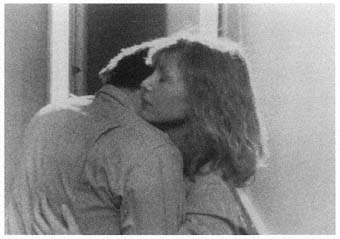
Toute une nuit
fence, a woman walking, a man going downstairs, someone getting on a streetcar, a car driving toward the camera, its headlights beaming, a very young couple huddling together inside—and sounds of traffic, of a pop song on the radio, of footsteps. These typical sights and sounds of a city at night are mobile units of signification that will be recombined in a variety of ways to generate mini-stories in the 90 minutes that follow. We don't yet know whether this is documentary footage of ordinary people or actors performing in a fiction. We don't yet understand the connections between the shots—if the couple in the vehicle is in any way connected to the woman walking or to the man descending the stairs. Yet the formal structure of the editing leads us to consider such connections. This opening also strongly evokes the iterative—or more specifically, what Genette calls "the synthesizing iteration," where the scene is "synthesized by a sort of paradigmatic classification of the events composing it" (pp. 118–119). The brief scenes are presented in such a way as to suggest that these or similar events occur every night—an aspect that was already implicit in the title Toute une nuit and that will be intensified in the sequences that follow by having so many different sets of characters of different ages, gender, and class perform similar moves. Thus the film demonstrates the iterative's subtle slippage, not only with the singulative, but also with the anaphoric (narrating n times what happens n times) and the repeating form of narrative (narrating n times what happens once). It extends onto the syntagmatic plane the full paradigm not only of melodrama but also of narrative frequency.
The first dramatic sequence that follows seems to narrow the narrative choices. It moves indoors to observe a single character in a long take with a distanced, static camera. We recognize signifiers of fiction: the actress Aurore
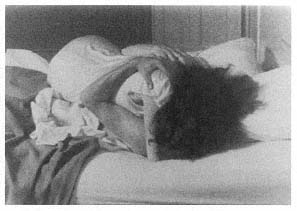
Toute une nuit
Clément, who starred in a previous Akerman film, Les Rendezvous d'Anna . We also recognize conventions of melodrama: the red low-cut dress that suggests she's not a virgin. After restlessly pacing, phoning a man and then hanging up, she says dramatically, "I love him." Suddenly she leaves the room and goes out into the night to hail a cab, walking past men loitering in the street and past the cafe which is the diegetic source for the Middle-Eastern music on the sound track. After she and the taxi have driven off, the camera holds on the space, raising the question: what is more important, the characters and their actions, or the spaces in which they are positioned? Such spaces are foregrounded in the film's opening montage, are associated with the role of women in the traditional male-dominated narrative, and are privileged by the Proustian form of iterative (for, as Genette observes, the "Proustian creature" is "as little sensitive to the individuality of moments as he is spontaneously sensitive to the individuality of places," p. 123). Eventually the camera leads us to the woman's destination, the man's apartment where she watches him pacing upstairs, just as she had earlier been pacing.
This sequence leads us to believe the story has begun , but it has its deviations from traditional narrative: not only the pause at the space left by the taxi (which suggests a reluctance to pursue the linear drive of the story), but also the reversals in gender. Here it's not the man but the woman who actively pursues erotic desire. Here it's the woman who leads the camera and the story to her destination, controlling the erotic gaze as the voyeur, and the man who is the object of her gaze.
Much later in the film we will return to this same woman, admitting a man (perhaps the same man) into her apartment. And in the final sequence, we will return to this same woman reflecting on this or a similar object of desire, even though she will be in the arms of another man. It doesn't seem to matter
whether it is the same man, for they all seem to function as substitutable members of the same paradigm, the object of desire, just as she (as a shifter) has been selected from this same paradigm by the man whom we now see embracing her. And we recognize a similar interchangeability for all of the characters in the film—all belonging to the paradigms of pursuer and pursued within this grammar of romance. In the final sequence she will receive a return phone call from her lover and deliver a repetitive monologue on their relationship, which will fragment him as she considers why she loves him ("Maybe it's his mouth . . . or his eyes . . . or his chin . . . or the way he talks . . ."), just as women have traditionally been fragmented in Hollywood classical cinema. This monologue also offers other reasons for her desire that depend on the contexts of the setting ("I'm so tired . . . it's so hot . . . I should have gone on holiday . . . the music is so lovely") and on the strangeness of the narrative ("I can't understand it"). Ironically, these recurrences of this woman's pursuit of desire provide the film with a false promise of narrative continuity and perfect narrative closure for a film without a story, or more precisely, a film with too many stories that are unconventionally short, or a film with all of the linguistic signs of melodrama but combined in an unconventional syntax.
The three brief sequences that follow make us realize that our initial expectations about the first dramatic sequence are wrong. They provide no linear development of that story; the same woman does not reappear. Eventually we realize that all four sequences are examples from the same paradigm: of a man and woman getting (or not getting) together, four variations on the problematic couple in the same situation all strung together on the syntagmatic plane. And this situation is merely one paradigm in the grammar of romance. Moreover, all four sequences function as pseudo-iterative. Like Proust's A la Recherche du temps perdu , the narrative which Genette selects as the single focus of his theoretical analysis, Toute une nuit liberates the iterative from its purely descriptive function. In showing not what happened a single time, but what used to happen and still happens, typically, regularly, ritually, or every night, it explores and expands the iterative aspect—"in textual scope, in thematic importance, in degree of technical elaboration" (p. 117). Akerman demonstrates how such elaboration can take on a subversive function in cinema where, because of the realistic (or indexical) potential of the photographic image, the iterative aspect calls attention to the process of naturalizing the ideology carried by singulative instances of fiction—as if they were the inevitable Truth, as if we spectators can never escape these paradigms of gender and romance.
Here is what we actually see in these three sequences. In the first, a woman in a red jacket is seated in a cafe, waiting in the foreground, with men shooting pool in the background. A man enters, pauses at the door, and then he and the
woman passionately embrace. This scene brings to our attention certain binary oppositions: coming together or not coming together (as in the previous sequence), foreground versus background, stillness versus movement. These binary oppositions apply not only thematically to the issue of romantic relationships but also reflexively to the issue of what constitutes narrative.
In the second sequence, a man and a woman are seated apart at separate tables in a cafe. Each stares at a glass, each turns to the other as the other turns away. The man gets up to leave, then the woman gets up to leave. The man returns and they suddenly embrace. Their actions are separate but parallel, like the sequences in this narrative, but then they unpredictably cohere, like the film's false narrative closure in the final sequence. The dynamics of space and the gestural movements of the characters become pointedly expressive. There is no verbal language to distract us. We recognize the meaning of these gestural movements by comparing and contrasting them with the similar movements we saw in the previous two sequences. The repetitions with variations help to code them and make us read them as language. It's a language we know from our past: from silent cinema, and from our infantile days before speech. It's a gestural language that semioticians like Pasolini and Eco have tried to theorize and that was foregrounded in the sequences we analyzed from Umberto D and Il Posto . After seeing this sequence in Toute une nuit , we will be more conscious of gestural and spatial language in all of the scenes that follow.
In the third sequence, three persons (two young men and a woman) are seated together in the same cafe, smoking. Suddenly one man gets up and leaves, then the second young man follows, then the woman. All three stand outside the cafe in the street. The blond man asks the woman: "Who are you going with?" After pausing a moment and getting no verbal response, both men walk off screen in opposite directions (left and right), and the woman moves directly toward the camera out of the frame. It's the first scene that explicitly foregrounds the romantic triangle and the dynamics of selection that control narrative as well as romance—the choice of which character to follow. It also evokes the first dramatic sequence with Aurore Clément in at least three formal ways: by returning to the use of verbal language (with only the second line of dialogue in the film), by repeating the option of not getting together , and by relying on the combination of interior and exterior scenes. In struggling to perceive coherence, we find ourselves making connections between sequences on formal rather than on narrative grounds.
At this point, the film makes another unexpected move. For the first time it returns to characters from an earlier sequence—to the lovers who had sat apart at the cafe. Now we watch them dancing passionately to a romantic song on the juke box. Once again, the narrative rules of the film are altered, causing us to adjust our expectations, but also granting us an immediate sensory pleasure in
the schmaltzy music on the sound track and in the lyrical image of the lovers dancing in the smoky cafe. Within the luminous blue-green light, the movements of the woman's vibrant hair and the couple's swaying bodies compete with the slow graceful swirling of the smoke deep in the background. Sound and image also compete for our attention. The emotional excessiveness of the music underlines the recurrence of getting together—not only the romantic reunion of the dancing couple, but also the narrative reunion of subject and spectator.
After this first reappearance of characters, the film can move on to other paradigms—of waiting and meeting, of coming and going, of sleeping and waking. The reappearance of the characters at this point no longer threatens to undermine the radical ruptures of the narrative, but to extend their scope. From here on, there will be many such reappearances, including those of Aurore Clément that offer false narrative continuity and closure. We are led to realize that such reappearances are merely another form of structural repetition—like the reappearance of actions, settings, objects, and sounds. The characters are no longer singular, they no longer hold a privileged place in the narrative; no longer can they draw our attention away from all of the subtle perceptual shifts that comprise the text. The film is free to create a rich intertextuality among its own mini-stories which comprise their own paradigm—one that partially overlaps with melodrama, that most pervasive and malleable of all movie genres.
By repeatedly seeing the same banal actions freed from the context of a single continuous story, we are led to observe (almost from an ethnographic perspective) how the subtle differences in their performance communicate meaning. They become defamiliarized; they become an infinite play of difference within a closed system. For example, one woman leans against a wall as she anxiously waits for her lover, then paces restlessly before she impatiently walks off alone into the night. Later, in a different sequence, another woman, somewhat older, also appears to be waiting as she leans against a wall and smokes a cigarette. Yet she displays no restlessness or impatience, but rather a savoring of the slow pace. Then we hear someone calling "mama" from inside the building. At first the woman doesn't respond. Finally she turns, puts out her cigarette, and goes inside. We realize she hasn't been waiting at all, but temporarily suspending her role as mother, taking a break. (I am told this woman is Chantal Akerman's actual mother.) The single word confirms how we read the subtle differences in the images. It also makes us see how we privilege verbal language, which is controlled by patriarchy, and how we distrust gestural language, so crucial to mother-child intersubjectivity during the pre-oedipal phase.
In another sequence a young girl enters a cafe and approaches a middleaged man, saying, "Let's dance." He begins to clown, parodying his version of how young people dance these days. But her moves prevail: she wants to slow dance in a close embrace. Despite her age and gender, she leads every aspect of
the encounter and also decides when the dance and the sequence are over, as she abandons her partner and the frame. From this point on, we watch the age of the characters more closely and the power dynamics of their movements.
In another sequence a young man goes upstairs with loud footsteps that express a bold defiance and determination mixed with anger. Then he knocks on the door, at first playfully, tapping out a well-known rhythm; then his tone shifts and his knocks become loud, insistent, and aggressive. Suddenly he stops, sits on the stairs and waits, and listens to the footsteps of someone else we never see. The sounds of the footsteps and knockings at the door, which recur throughout the entire film, communicate with such specificity in this sequence that their meanings cannot be missed. They lead us to listen to all other sounds in the film with far greater attention.
By denying us a single unifying story, by frequently pitting word against visual image and nonverbal sound, by discouraging us from identifying with any of the anonymous characters, by denying us a single unified subject position, by calling our attention to the blatant stylization of structure, by reversing the axes of selection and combination, by elaborating the iterative aspect and by foregrounding the slippage between the iterative and the singulative, Toute une nuit makes us change the way we read a film.
Though perhaps less radical in their demands on the spectator, the two neorealist films discussed in this essay also require a similar shift in reading, one that de-emphasizes the narrative line and that leads one to interpret gestural language and rich perceptual detail. It's as if the foregrounding of the slippage between the iterative and the singulative helps one to see both the distinctiveness of the present image and its deep immersion in a system of representation. And it's the duality of this perception that helps empower one as an active spectator who is capable of resisting the singular closed reading and of perceiving the iterative traces of collective history and dominant ideology.