
8.4.4—
What CCTI Does Not Do
What CCTI notably does not seem to do is provide more than an demarcation account of meaning-assignments. It is not clear that it is even an attempt to provide an account of meaningfulness for mental states; and if it is so intended, the account it provides is woefully inadequate. I shall attempt to argue this in two different ways. First, I shall argue that CCTI does not provide so much as a demarcation criterion for meaningfulness (as opposed to meaning assignments ), and hence cannot provide an explanation of meaningfulness, since an account that explains will also provide a demarcation criterion. Second, I shall argue that CCTI lacks the right sort of explanatory character to explain the intentionality of the mental.
8.4.4.1—
Failure to Demarcate the Meaningful
While causal covariation may or may not provide a demarcation criterion for meaning assignments , it does not provide a demarcation criterion for meaningfulness —that is, for separating things that mean something from those that mean nothing . For the notion of causal covariation is cashed out in terms of regular causation, and regular causation is a feature not just of mental states and processes, but of objects and events generally. The overall project here is to explain the mental-semantic properties of mental states in terms of some set N of naturalistic properties, and the proposal at hand is that N-properties are causal covariation relations. But this set of properties has a domain far broader than that of mental representations: any number of objects and events not implicated in thoughts have characteristic causes, and hence have N-properties. Cow-thoughts are not the only things reliably caused by cows: so are mooing noises, stampedes, and cowpies, to name a few. The CCTI cannot be a viable demarcation criterion of meaningfulness, because it does not distinguish thoughts about cows from stampedes and cowpies. And this is surely a demarcation we should expect a theory that accounted for meaningfulness to entail. So either we must impute mental-semantic properties to all kinds of objects and events, endowing much of nature with content, or we must allow that something more than N-properties are required to explain mental-semantics.
The obvious strategy for sidestepping this objection is to point out that, while representations may share N-properties with many other sorts of objects, it is only mental representations that take part in the relations characteristic of intentional states. There may appear to be a threat of endowing the world with content—namely, with MR-semantic properties. But remember that the word 'semantic' in "MR-semantic" is not doing much work, since we have defined the expression 'MR-semantic properties' in terms of causal covariation. Thus in allowing most of nature to have MR-semantic properties, we have not endowed them with anything counterintuitive, even though the word 'semantic' might suggest as much. Moreover, CCTI, as we have formulated it, involves more than causal covariation: it involves explicit reference to the effect that the items that have MR-semantic properties are also part of an intentional state . It is this additional fact that differentiates them from objects in nature generally. To use some terminology that has not yet been used here, we might say that indication or natural meaning plays a role in the production of mental-meaning only when the indicator is present in an organism in one of the functional relations characteristic of intentional attitudes . Or, to put it slightly differently,
the domain over which the CCTI is quantified is not all objects, but all objects that are representations involved in intentional states.
There is something appealing about this strategy, but it is important to note that it violates one of the fundamental canons of CTM: namely, that the semantic properties of mental states be "inherited" from the "semantic properties" of representations. According to the formulation in the previous paragraph, however, this is not the case: mental-semantic properties are not explicable solely in terms of MR-semantic properties of representations, but in terms of MR-semantic properties of representations plus something else . Worse yet, this "something else" seems to consist precisely in the fact that the representations are elements of an intentional state! But if we must allude to the fact that representations are part of an intentional state to make CCTI proof against the semantification of nature, we have failed to provide a naturalistic explanation of mental-meaning, since part of our account still presumes the intentional rather than explaining it. It is, of course, possible to begin by assuming intentionality, and then asking the question of what kinds of natural properties are involved in the realization of intentional states; and if we do this, we need not worry about the fact that part of what differentiates mental representations from other things that participate in causal covariation is that they also play a role in intentional states. But if we do this, we are no longer seeking an account that provides supervenience or explanatory insight. And this, it would seem, is less than CTM's advocates generally desire by way of an "account of intentionality" (even if it is, in my view, a far more sensible strategy).
The upshot of this is that CCTI does not succeed in providing a criterion for the demarcation of the meaningful from the meaningless. It is not really clear that it was intended to provide such a criterion, but it fails to do so regardless. It follows from this a forteriori that it does not provide an explanation of meaningfulness, since an explanation would also provide a demarcation criterion.
8.4.4.2—
Why CCTI Does Not Explain Meaningfulness
It is also possible to tackle the issue of the explanation of meaningfulness by way of a frontal assault. And it seems prudent to do this, since someone might be inclined to try to rescue CCTI as a potential demarcation criterion for meaningfulness by way of some clever patchwork, much as Fodor has tried to rescue it as a criterion for meaning assignment by way of the notion of asymmetric dependence. To do so, however, would be to miss a much more serious point. The deep problem with CCTI is not that
I have some clever counterexamples that it has failed to catch in its net, and that might be brought into line with the insertion of an additional clause or two. The deep problem, rather, is that causal covariation is just not suited to explaining why some X is capable of meaning something rather than nothing. Causality is just too bland a notion for that task, and fancy patchwork would only serve to reveal this problem rather than to remedy it.
Now the way I should like to be able to proceed here would be to provide a really tight and compelling analysis of explanation and then give a knock-down argument to the effect that CCTI does not fit that analysis if the explanandum is meaningfulness. Explanation, however, is a notion that is notoriously difficult to analyze, and I shall have to content myself with a slightly more roundabout course for getting to the same conclusion: I shall attempt to establish one of the crucial "marks" of successful explanations, and then attempt to argue that the account of intentionality offered by CTM lacks this mark.
One characteristic of successful explanation is the kind of reaction it produces: the "Aha!" reaction that comes with new insight. Suppose I have some familiarity with some phenomenon P , with a set S of notable features. Now suppose that I try to explain P by means of an explanation E , cast in terms of some set of entities and relations X . Now E succeeds as an explanation to the extent that understanding X gives me insight into S —that is, to the extent that upon understanding X I become inclined to say, "Ah, now I see why things in S are as they are." Indeed, in the ideal case, understanding of X should be sufficient for me to infer S , even if I have no prior knowledge of S . Someone with an adequate knowledge of the behavior of physical particles, for example, would be able to derive the notion of "valence" and the laws of thermodynamics, and hence particle theories provide first-rate explanations for these other phenomena. Of course, in practice the process of explanation progresses in the other direction, but an ideal grasp of the explaining phenomena could be sufficient to allow for the derivation of the explained phenomena. This idea that an ideal explanation should allow the derivation of one phenomenon from another (e.g., a more complex one from a simpler one) is part and parcel of the Galilean method of resolution and composition that has informed much of modern science and modern philosophy of science, and is found notably in recent philosophy of science in both reductionist and supervenience accounts.
8.4.4.3—
Instantiation and Realization
I think that the weakest sort of explanation meeting this strong requirement is what Robert Cummins (1983) calls an "instantiation analysis."
(There are stronger sorts of explanation meeting it as well, of course, such as reductions.) Cummins proposes the notion of an "instantiation analysis" as a way of understanding theories that identify instantiations of a property P in a system S by specifying organizations of components of S that would count as instantiations. An instantiation analysis of a property P in a system S has the following form:
| ||||||||
Instantiation analyses are distinguished from reductions (ibid., 22-26) by the fact that a single property can have multiple instantiations in different systems, whereas the reduction of a property requires a unique specification of conditions under which it is present. But the instantiating property is intended to explain the presence of the instantiated property. Indeed, Cummins writes that one should be able to derive a proposition of the form (6i) from a description of the properties of the components of the system, and that when we can do this we can "understand how P is instantiated in S" (ibid., 18, emphasis added). That is, from a specification of the properties of the components of the system in the form
(6a) The properties of C1 . . . Cn are <whatever>, respectively,
we should be able to derive
(6i) Anything having components C1 . . . Cn organized in manner O—i.e., having analysis [C1 . . . Cn , O]—has property P:
Thus, with an instantiation analysis, supplying a description of the interrelations of the components of a system S should be enough to show that a property P is instantiated in S , because one can derive the conclusion that S has P from a statement such as (6i), and one can, in turn, derive (6i) just from a description components of S —that is, from a statement such as (6a). And since one can derive the conclusion that P is instantiated in S in this way, providing such an analysis should be sufficient to allay doubts that P can be instantiated in S: given a proper description of the components of S , one can, quite simply, infer the instantiation of P in S .
We may also distinguish the notion of an instantiation analysis from that of a weaker sort of account, which I shall call a realization account . A realization account provides a specification of how a property P is realized in a system S through the satisfactions of some set of conditions C1 , . . . , Cn —but without any implication that the satisfaction of C1 , . . . , Cn provides a metaphysically sufficient condition for the presence of P . I shall give several examples:
(1) There are individual objects that have a particular status, such as the Victoria Crown kept in the Tower of London or the Mona Lisa. One could, in principle, give a complete physical description of the matter through which the Mona Lisa is realized. But meeting that description does not provide a sufficient condition for being the Mona Lisa. Additional objects meeting that description would not be additional Mona Lisas, but perfect forgeries. Likewise, there are object-kinds such as "dollar bill" that must be realized through objects with a particular physical description. But once again, meeting that description alone does not make something a genuine dollar bill. If you or I make one, it is a forgery. Dollar bills are realized through particular material configurations, but no instantiation analysis of dollar bills is possible.
(2) Some kinds of human attributes are realized through a person's behavior without the behavior itself providing a sufficient criterion for the presence of the attribute. For example, Jones and Smith may both give a substantial portion of their resources to persons in need, yet in a very different spirit. It may be that Jones does so because he is generous, while Smith does so only because he believes that it is the sole way of saving himself from the flames of hell. Jones's behavior is a realization of generosity, while Smith's is not, even if the behaviors themselves are indistinguishable.
(3) We have seen that there are certain senses in which a computer may be said to perform such operations as adding two numbers. Such operations may be said to be realized through the processes that take place in the computer's components. But a specification of the processes that take place in the computer's components does not provide a sufficient condition for the computer's overall behavior counting as addition, because it only counts as addition by virtue of meaning-bestowing intentions or conventions of designers, programmers, or users, and these are not mentioned in specifications of the interactions of the components through which the adding process is realized in the machine.
Now there is an important methodological and theoretical difference
between instantiation analyses and realization accounts. Realization accounts proceed on the assumption that one may sensibly talk about the property P being realized in some system S . They do nothing, and can do nothing, to show that the organization of components of S would result in the presence of P . Indeed, it need not result in it—a particular set of behaviors might be a realization of jealousy or a realization of a fear of perdition, and a certain configuration of matter only counts as the Victoria Crown or a dollar bill in the context of particular institutional facts and historical acts. Realization accounts do not require even supervenience.
As a consequence, a realization account could not do anything to allay doubts about P 's being susceptible to realization in S: it proceeds on the assumption that P can be realized in S , and hence cannot justify that assumption. In the case of instantiation analysis, by contrast, one can infer the conditions for the ascription of P from a description of the components of S . As a result, providing an instantiation analysis of P in S also serves to vindicate the claim that P can be instantiated in a system like S . It vindicates it because it shows that it can be so. A realization account, on the other hand, does not in any comparable sense show that a property P can be instantiated in a system S . If someone is inclined to doubt that Jones is capable of generosity, for example, pointing to Jones's sizable donations to various charities will not prove the doubt to be mistaken. The donations might, of course, be realizations of generosity in Jones, but it might alternatively be the case that Jones really is incapable of generosity, and is merely giving of his wealth because he is trying to buy his way into heaven. Showing how a property is realized in a system gives us insight into the property and the system in which it is realized, but the resulting description cannot be used to demonstrate that the property is realized in the system or even that it can be .
8.4.4.4—
Instantiation and the Explanation of Meaningfulness
Now I think it should be clear that in order to explain meaningfulness in naturalistic terms, it would be necessary to provide something on the order of an instantiation analysis for meaningfulness—that is, to provide an account such that an adequate understanding of the explaining properties would be sufficient to ground inferential knowledge of the properties explained as well. It also seems clear that, as an explaining property, causal covariation does not come within a country mile of meeting this condition. Causal covariation might very well provide what is needed for
seeing why some thoughts are about one thing and other thoughts are about something else. (Then again it might not—I have no interest in taking sides here.) What it does not do is provide understanding of why causal regularities might contribute to meanings in the case of mental states while failing to do so in all of the other cases of causal covariation occurring in nature . And it is precisely here that the problem of meaningfulness lies.
Nor will any minor patchwork help in the slightest. Asymmetric dependence, for example, is of no assistance here. That can, at best, explain why my thought does not mean "dingo" or "dog-or-dingo." About why it means "dog"—or, more to the point, why it means something and other things caused by dogs do not (let the reader's imagination run wild)—is in no wise clarified by the notion of causal covariation.
Robert Cummins has suggested to me an alternative way of making this point: theoretical identifications, such as the identification of heat with a kind of motion, are of interest only insofar as they help us to understand something about the phenomena that are being explained. Descartes (Le Monde, chap. 2), for example, rejects the Scholastic view that "fire" or "heat" names a kind of substance in favor of the view that fire involves a kind of change of state in the matter of the combustible material, and that heat consists in the increased level of agitation of the matter. Other theorists were impressed by such factors as the ability to convert mechanical force into heat (as when a nail gets hot when it is driven by a hammer) and back again (as in the case of a steam engine). Viewing heat in terms of the motion of matter (and ultimately in terms of kinetic energy) allows us to understand why iron glows when heated and why nails get hot when pounded with a hammer. Now if CCTI is to be of interest as an explanation of intentionality, one would at very least expect there to be something about intentional states that we are able to understand better once we view them through the lens provided by the theory. But in fact there seems to be nothing of the sort. There was perhaps once hope of such a result when causal theorists were more inclined to identify content with information, and hence to view the causal chains involved in their accounts as being chains of information transmission. But the incompatibility of strict information accounts with misrepresentation has caused causal theories such as CCTI to abandon this identification. Information at least looked like an intuitively plausible candidate for explaining "aboutness" in a way that causation does not. If there is anything about intentional states that is explained by CCTI, its nature needs to be more clearly shown. In short, it does not
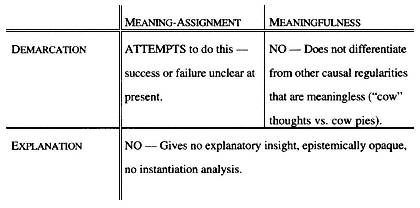
Figure 10
seem that CCTI explains the nature of intentionality; and indeed, it is not clear that there is anything of interest about intentionality that it does explain.
In summary then, CCTI seems at best to supply a demarcation criterion for meaning assignments, and neither an explanation of the same nor any sort of account of meaningfulness (see fig. 10).