
Descent and the Temple Cults of Chettinad
From the Nakarattar point of view, superior political authorities granted and confirmed their rights of ownership over Chettinad lands and temples,
| ||||||||||||||||||||||||||||||||||||||||
both in their legendary past and in the recent colonial period. Nakarattars renewed these ritual and political rights over the centuries by their faithful discharge of kingly responsibilities for temple endowment, maintenance, management, and protection. Beyond this, however, Nakarattars believed that recruitment into temple-centered cults, collective (but segmented) ownership of temples, and succession to the office of temple trustee were all based primarily on rules of agnatic transmission across generations. They drew on their beliefs about agnatic descent, inheritance, and succession when using their traditional history as a charter to guide and justify behavior.[9]
Few Nakarattar businessmen had studied systematic Hindu theories of descent and heritability. Moreover, Nakarattars employed a non-
Brahmanic, nontextual vocabulary for naming their descent groups. But, in spite of terminological differences from Vedic texts and Brahmanical teachings, Nakarattar beliefs generally coincided with classical textual doctrine about substantive and moral inheritance. In particular, Nakarattars employed ideas about descent through the male line to assign membership in four distinct kin groups, and membership in each group carried with it a set of moral rights and obligations. These groups—referred to as pullis, valavus, pirivus, kuttikkira pankalis , and kovils (see Chapter 8)—formed a nested taxonomy corresponding roughly to Brahmanic groups identified in the Dharmasastras as parivara, kula , and gotra . They also corresponded to anthropological analytic concepts of conjugal family, joint family or minimal lineage segment, localized lineage segment, maximal lineage segment, and nonlocalized clan (see Figure 14).[10]
The important property that all of these kin groups shared was that characteristic rights and duties at each level of Nakarattar kinship structure were transmitted through the male line, even if the group in question was not defined solely in terms of a descent group (e.g., the pulli or the village-based lineage segment). To be a Nakarattar, then, was to inherit the substantive and moral qualities of the kin groups to which one belonged. In the context of these beliefs, the initial Pandyan grant of the rights and obligations of Chettinad rulership to immigrant Nakarattar ancestors constituted a heritable moral code that devolved upon subsequent generations of Nakarattars.[11]
The issue is not straightforward. There exist apparent discrepancies between Nakarattar social organization as depicted in traditional caste histories and Nakarattar social organization as seen during the colonial period. It is true that both legendary and colonial Nakarattars were segmented into nine descent groups that were indexed by membership in an identical set of temple cults. But temple cult membership among ancestral descent groups was determined by village residence. By contrast, few colonial Nakarattars resided in the villages of their nine clan temples. In fact, the majority dwelt in ninety-six (now seventy-eight) Nakarattar residential villages throughout Chettinad.[12] More fundamentally, settlement in a residential village during the colonial past and membership in the cult of that village's temple did not require Nakarattars to relinquish membership in the clan temple from which they ultimately were descended. On the contrary, Nakarattars during the colonial period exhibited what can be idealized as a two-tier organization, in which every individual was simultaneously a member in the temple cults of both his clan and his village.
The two kinds of temples shared many similarities and a few notable differences beyond those already indicated. Both generated income by
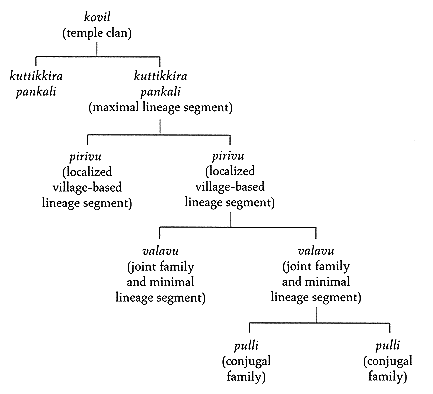
Figure 14.
Nakarattar descent-based cults.
attracting endowments from their members, by tithing their members annually with a nominal head tax per family (pulli vari ), and by tithing their richest members with occasional taxes called asti vari . Both kinds of temples received additional income from productive devastanam property such as the tax-free agricultural estates called inams . The largest clan temples had huge memberships that extended throughout the villages of Chettinad. All but one of the clan temples spread its congregation among from fifteen to fifty-four villages (see Figure 15). Conversely, village temple memberships were confined, by definition, to a single village. In the larger towns such as Devakottai or Karaikudi, there might be more than one residential temple; the congregation of each temple corresponded to a section or neighborhood of the town.
There were qualitative and quantitative differences in the kinds of worship that occurred in clan and village temples. Clan temples celebrated one or two collective festivals each year and played a ceremonial role in the marriages of their members. But they were not the primary focus of wor-
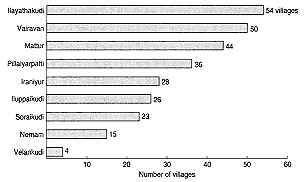
Figure 15.
Representation of Nakarattar temple clans in Chettinad villages, ca. 1930.
Source: Temple census in Ramanathan Chettiar (1953).
ship for rites concerning the welfare of the village, as was the village Siva temple. Consequently, they were not a frequent focus of worship for their members. In contrast, village temples staged six or seven seasonal festivals that also served as occasions for celebrating their members' life-cycle ceremonies.[13] In other words, village temples were more intimately bound up in the lives of their members than were clan temples.
Despite these differences, and despite my characterization of clan temples and village temples as two distinct institutions, they are best viewed as distinct only on an idealized or structural level. From a processual or diachronic point of view, they emerge as extreme ends on a continuum of descent-based cults that reflect an inverse relationship between the genealogical depth of a descent group and the presence or absence of common residence as criteria for participation. These processes can be observed in examples of the evolution of such cults from their beginnings as family rites of ghost propitiation and ancestor worship.
Among the Nakarattar, women seem particularly prone to processes of deification. If they die before their husbands, and especially if they die before giving birth to children, their ghosts (peys ) are regarded as potential sources of both supernatural danger and supernatural blessings. In the case of one family whom I came to know, my informant's father's sister had died thirty days after her wedding at the age of twelve. The family now refer to her as their kula teyvam (family deity) and address her as teyvata (goddess), not pey (ghost). Following her death, she appeared nightly to her natal family in their dreams and asked for homage in return for protection. As part of the cult of their kula teyvam , the family maintains a special box containing saris, jewels, or other articles that once
belonged to the dead girl or that were subsequently given to her spirit (avi ).[14] For example, my informant's father promised his sister's spirit a diamond necklace in return for a son. When my informant was born, his father kept his word. The box for the family's kula teyvam is kept in a special room called a sami arai ("god room" or shrine) belonging to my informant's father's hearthhold (pulli ) in the house of his joint family (valavu ). The family worships their kula teyvam in a ceremonial rite called a pataippu at least once a year and sometimes as frequently as four times a year. Pataippus are not performed on any regularly marked occasion, but are carried out as part of important life-cycle ceremonies undergone by members of the family (e.g., on the birth of a son or the marriage of a daughter). Paitaippus may also be performed before any family member undertakes a major business venture or travels abroad. When a pataippu is performed, the kula teyvam's possessions are cleaned and displayed before her portrait in the sami arai . New gifts are offered and foods including kanji (a ground rice porridge), fruit, and betel are given. Afterwards, prasad (the sacramental food and betel) is distributed to the assembled family and invited relatives, who consume it.
In another case, four dead women of previous generations are worshipped collectively in a pataippu ceremony by the lineage segment into which the women had married. This lineage segment included several valavus comprising all of the lineage members in a single village (pirivu ). It did not include members from valavus residing in other villages, who nevertheless shared membership in their maximal lineage segment, the kuttikkira pankali . The separate identities of the deceased women are largely fused in the minds of their descendants, whose offerings are made simply to a single kula teyvam referred to, again, as teyvata . In still other cases, family kula teyvams have entirely lost their identities as ancestors and are worshipped in discrete shrines or at their own temples as local village goddesses. Finally, in another case (described below), a large kuttikkira pankali had segmented into several subdivisions (pirivus ) distributed among three different villages. Each subdivision worships the deity of its residential village. But members of all the subdivisions celebrate their common descent once a year by returning to their ancestral village for collective worship of their kula teyvam .
Taken together, these cases illustrate a general process by which rites of ancestor worship have evolved into regional cults of major deities. Pulli -based ancestor cults grew organically with their pulli as the husband claimed his inheritance, partitioned the valavu into which he had been born, and formed an independent valavu with himself as senior male. Where such valavus were influential and wealthy members of their resi-
dential village, they often endowed a shrine in a local temple or endowed a completely new temple to house the cult of their ancestor and to serve as a place for its worship. In some cases, other villagers (both Nakarattar and non-Nakarattar) took an increasingly large part in rites of worship, especially if the deity gained a reputation for granting boons and causing or averting suffering. If valavus from the village moved to a new residential village, they retained ties with their ancestral village by continued participation in major rites at the temple of their kula teyvam . Meanwhile, as descendants of the founding family, they retained a special position in the management of the temple's endowment (kattalai ) and in the offering of continuing gifts to the deity and receipt of honors from the deity. Eventually, the ancestral ghost of many families assumed the trappings of a non-Brahmanic village deity: a guardian god or goddess.[15] Ultimately, what was once a private deity might become "sanskritized" (Srinivas 1952), assuming more and more of the traits associated with Brahmanical deities.
As cults underwent this gradual evolutionary process, their membership also changed, from the single pulli that began the cult as a rite of ancestor worship, to all the valavu of a single village who propitiated the ancestor of one of their members as a village deity, to, finally, a multivillage cult whose members saw the efficacy of their worship as confirmation that their kula teyvam was a high Hindu deity to which they had particular claim as an hereditary right. The difference between the cult's early stages and its later stages lies in the number of families that recognized the deity as their kula teyvam , and in the multiplication of residential villages to which these families had migrated.
This scenario represents an admittedly speculative account. But it is based on processes that have been observed in Chettinad during the last hundred years. I offer it as a plausible theory for the formation of clan and village cults observable throughout Nakarattar history and as a link between Nakarattar social organization during the colonial period and Nakarattar social organization as depicted in the story of their migration to Chettinad. If I am correct, it should be possible to identify transitional cults between the clan and village cults that characterize Nakarattar two-tier social structure.[16]
This is precisely what we do find in Chettinad. On one hand, the cults of widely dispersed Nakarattar clans are constituted of very old descent groups, whose constituent lineage groups live in multiple villages, who no longer maintain memories of consanguineal connections, and who do not collectively observe the rituals that would therefore apply. On the other hand, members of cults for Nakarattar village deities are constituted of younger descent groups, whose members reside in the same village and
who maintain consanguineal relationships through the observance of ritual obligations tied to village residence and to mutual observance of each other's life-cycle ceremonies. In addition, however, it is possible to find descent-based cults that fall structurally midway between clan and village temples. Their members reside in multiple villages, but their subdivisions retain consanguineal relationships and some common ritual observances in the village of their apical ancestor. In other words, the two-tier idealization of Nakarattar social structure marks the polar ends of a culturally recognized continuum of descent-based cults of worship that vary along the inverted axes of genealogical depth and residential requirements for membership. The following two sections of this chapter explore in more detail differences in the membership, organization, and management of each of these two types of cults and their intermediate variants.