
Supply Shocks
Besides the institutional features noted above, new factors have been present in the world economy since the early seventies that have aggravated the inflationary problem
[7] See J. Tobin, "Stabilization Policy Ten Years After," Brookings Papers on Economic Activity, No. 1, 1980.
[8] K. Arrow, "Toward a Theory of Price Adjustments," in M. Abramovitz, ed., The Allocation of Economic Resources (Stanford University Press, 1959).
and have rendered conventional stabilization policies even more ineffective in dealing with it.
Price rigidity in the administered-price sector has been accompanied by external shocks originating mainly in the flexible-price sector. It is the international price of food, energy, and raw materials that has increased sharply and discontinuously due to a number of unpredictable events like bad crops, cartel agreements, and raw materials scarcity.
External price shocks have been internalized mostly in terms of higher domestic inflation and partly in terms of lower output and higher unemployment. The direct effect of higher external prices is that of reducing the purchasing power of domestically generated production and income but not necessarily of reducing production in physical terms. But an indirect effect is that, given global supply constraints, unless the largest consumers (the industrial countries) reduce their demand by slowing down their growth rates, new price increases will follow.[9] Slower growth in the industrial economies sets a worldwide recessionary tendency. Thus, the original price hike results in idle capacity and unemployment in most economies.
Another indirect effect of the "new inflation" generated by supply shocks is that if it is dealt with by conventional demand management policies, it will result mostly in recession and unemployment, and inflationary pressures will not be abated to a significant extent. If every time an external shock occurs, the monetary authority reacts by deflating the economy, excess capacity and unemployment will become a more or less permanent feature. Given limited downward flexibility in prices and exogenous price shocks, permanent recession will most likely be accompanied by permanent inflation.
How can a situation like this be dealt with? There are three possible courses of action: to accommodate the external shocks, to engineer a recession as large as necessary to compen-
[9] Tobin, "Stabilization Policy."
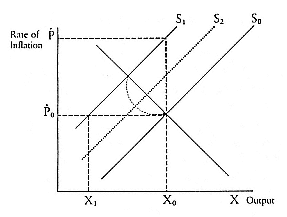
Figure 2
Supply Shocks
sate for the upward pressure in prices, or to deal with the problem from the supply side, that is, by applying supply "disinflationary shocks."[10] These three possibilities are illustrated in Figure 2.
The exogenous supply shock, like an increase in the price of oil, is shown by the upward shift in the supply curve from S0 to S1 . Costs are now higher per unit of output. Prices are increased according to the markup rule.
The first adjustment possibility is an accommodation to higher external prices. It means compensating for the potential unemployment effect of the price shock by expanding the level of expenditures. Sectors that might be hard hit by the higher external prices and that consequently would reduce output and lay off workers are directly subsidized by the government. The policy avoids unemployment but internalizes a higher rate of
[10] The expression is from A. Okun and G. Perry, "Innovative Policies to Slow Inflation," Brookings Papers on Economic Activity, No. 2, 1978.
inflation. Output stays constant at X0 , but the rate of inflation goes up from P0 to P1 (see Figure 2).
A second policy would consist in trying to maintain the rate of inflation prevailing before the price shock by reducing expenditures. In this case most of the adjustment will come through output and employment reduction while the rate of inflation will converge to the original lower level slowly due to the institutional and structural rigidities for the downward movement of prices and wages that we referred to in the previous section. Output will go down from X0 to X1 in order to maintain the rate of inflation constant at P0 in the face of the external shock (see Figure 2).
A third type of policies would consist in dealing with the problem from the supply side, where in fact it originated. Three main alternatives seem to be available here. One is to administer supply "disinflationary shocks," compensating higher costs by reducing such domestic cost components as production taxes, social security contributions, or wages. A second one is to put the emphasis in productivity increases as a way of counter-acting the upward trend in variable costs. This is the rationale for business tax reductions and investment incentives policy that is so much a part of so-called supply-side economics. The third alternative is to neutralize the acceleration in the rate of cost and price increases by a consistent application of an incomes policy that would "guide" wages and prices downward so that the cost of adjustment to higher raw materials prices is evenly distributed between wage and profit earners. The effect of any of these courses of action is to shift the supply curve from S1 gradually to S0 . The path toward the original level of inflation and output P0 and X0 is probably less costly in terms of time and output losses.
In sum, (1) the structure of modern economies is characterized by the existence of a large segment of the economy where prices and wages are administered, that is, they are set through
a variety of institutional mechanisms independently of short-term demand conditions;[11] (2) prices in the administered sector are fixed by firms as a markup over long-run "normal" variable costs, and wages as a function of relative wages in other firms and sectors and of expected inflation; (3) this kind of price and wage setting in a modern economy, where the administered-price sector is predominant, has two consequences: given that prices and wages are not influenced by short-run demand changes, a policy of demand contraction, as orthodox stabilization policies are, will not affect prices and wages in a significant manner, in the short run.[12] Another consequence is that since wages depend on relative earnings elsewhere, it suffices that some firms obtain a generous wage settlement for this to start a chain reaction demanding higher wages in other sectors. Wages are more flexible in an upward than in a downward direction; and (4) external price shocks, like those experienced in the 1970s and 1980s in the world economy, by increasing costs, make the process of adjustment through the demand side even more costly.