
46—
Tai Ming-shih (1653–1713)
Tai Ming-shih was a scholar and essayist from T'ung-ch'eng, An-hui, a town that later gave birth to an orthodox literary school whose ethical ideals were to dominate prose writing during the eighteenth and nineteenth centuries. Because his family was impoverished, he became a teacher at the age of twenty, instructing students in ancient prose and history. An avid traveler who left several travel accounts, he also collected much information on the history of the Ming dynasty and wrote a number of historical essays that expressed nationalist sentiments. It was not until 1709, at the age of fifty-six, that he became a Metropolitan Graduate and was appointed a junior compiler in the Han-lin Academy. Two years later, however, he was caught up in a major literary inquisition when it was found that his Collected Works from South Mountain (Nan-shan chi ) contained the reign era of one of the Ming pretenders. Tai was imprisoned and later executed along with several hundred others involved in the purge. His writings were also ordered destroyed, and it was not until a century later that a descendant rescued scattered literary remains and reprinted them.
Tai Ming-shih's literary ideals had a formative influence on later T'ung-ch'eng writers, for he considered ethical meaning (i-li ) as the foundation of literary values and held that verbal style was secondary to "coherence" (ching ), "spirit" (shen ), and "vital force" (ch'i ). Tai, however, was another member of that ambivalent generation of late-seventeenth-century Chinese scholars: although he remained highly critical of the moral and intellectual failings of his class, which he felt had contributed to the fall of the Ming, he found no alternative to collaborating with the Manchus as the best hope for preserving order and traditional Chinese values.
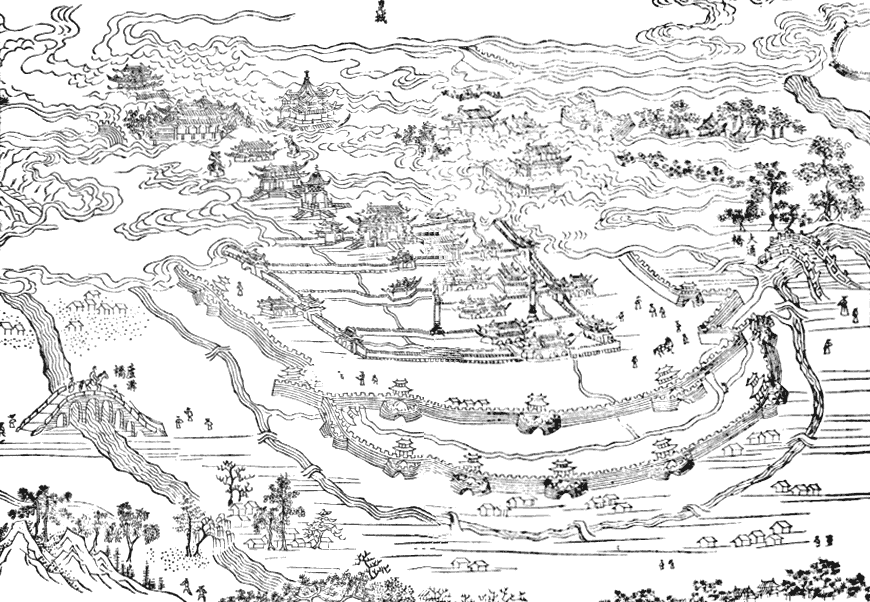
Fig. 59.
Arriving in the Capital. From Fu Tse-hung, Hsing-shui chin-chien (1725), British Library, London. The travelers in the
lower left are crossing the Reed Channel (Marco Polo) Bridge, arriving in Peking along the same route as Tai Ming-shih.
Tai kept a travel diary of a 1695 journey from Nanking to the Ch'ing capital in Peking. Though in the tradition of the Sung dynasty diaries, his differs in several respects. For one thing, it is written in a far more subjective vein, reflecting the growth of autobiographical consciousness in the seventeenth century. The personality of the traveler is revealed in a number of incidents in which a variety of people are encountered; their interaction is captured in vivid dialogue, and a moral is drawn in each case. Tai's vision of the world is also much broader than that of earlier diarists, approaching that of a novelist or the painter of genre scenes. Like a narrative handscroll, his journey depicts a sequence of dramatized episodes. History (including recent events of the late Ming), lyrical Nature, a primitivist longing for rural life, social realism, political critique, personal anxieties, vignettes of people from different classes, as well as deception and discomfort all shape Tai's experience of travel. His realism includes ironic perceptions: unexpected joys alternate with the rigors of the road to produce contrasting moods. The diary ends on a fulminating note as Tai informs us that its function was to record the actuality of his trip, especially his final humiliation by customs officials in the capital.
Diary of a Journey North in the Year I-hai  (1695)
On the ninth day of the sixth month [July 19], I crossed the Long River at Chiang-ning.[1] Prior to this, Liu Ta-shan of P'u-k'ou[2] had visited me and invited me to accompany him on a journey to Yen,[3] but I lacked the funds to cover expenses and could not go. This time, Hsü Wei-san and his younger brother, Wen-hu, came to see me off. Shortly afterward, Kuo Han-chan and Wu Yu-hsien also arrived. We took a boat at Chin-ling Lock, which was a few dozen or so paces from my home. On board, I bowed and bid farewell to these friends, while the Hsü brothers escorted me farther to the Bridge of Military Pacification before disembarking, an expression of their unwillingness to see me depart. On this day the wind was favorable, and before noon I reached P'u-k'ou, where I spent the night at Liu Ta-shan's home. Ta-shan had other business and could not accompany me. But Cheng P'ang-jo of Chiang-ning just happened to be staying at Ta-shan's home. P'ang-jo said that he possessed a technique for manufacturing gold and silver, telling me, "My friend, you are about to brave the summer heat and travel in order to sell your writings and support your parents. This
world is vast indeed. Will anyone truly understand you? But if you practice this skill of mine successfully, my friend, will you ever have to worry about poverty?" I laughed and nodded.
The next day [July 20], I stayed at Morning Hill. I had traveled a mile or so when I saw grain glistening in the fields on all four sides. Old and young, men and women, were all weeding in the fields. It is the custom north of the Long River for women also to work in the fields. Compared to the way men in the northwest loaf about unproductively, this is certainly a fine custom. At one point, I dismounted and walked along, passing a farmhouse where the man was carrying night soil to fertilize the garden while the wife was drawing water from a well and washing clothes. By the gate were trellises with bean and melon vines as well as a number of trees in full flourish. Boys and girls were laughing and screaming; cocks were crowing, dogs barking. I gazed longingly at them and thought that this family possessed everything it needed. I regretted how far inferior my condition was compared to theirs.
The next day [July 21], I reached Ch'u Prefecture[4] and crossed Vermilion Dragon Bridge, the place where Minister Lu and General Tsu defeated Li Tzu-ch'eng.[5] My ambition to take an active role in the world was stirred. I crossed Gateway Mountain and encountered Chu Tzu-lü of Su-sung and Tsan Yüan-yen of Huai-ning,[6] who had come from Shaan-hsi. We had not met for three years and we were overjoyed to see each other. Setting out on foot together, hand in hand, we walked over to a house along the road where we engaged in animated conversation. The villagers all came and stood around us to listen. After a long while we parted. I crossed Millstone Mountain. Its form was steep and precipitous, layered, and winding around, hence its name. It is a strategic place in Ch'u Prefecture. That evening, I stayed at an inn at Mount Tai Station in Ting-yüan.[7]
The next day [July 22], I stayed at Yellow Clay Hill in Feng-yang.[8] On the road I met Ts'ai Chi-sheng from T'ai-p'ing,[9] who was coming from the north. At dusk I said to the horseman, "It has been insufferably hot these past few days. All the other travelers have been going by night. We should proceed in the moonlight." So we set out at the third watch [11:00 P.M.—1:00 A.M.]. After traveling about a mile and a half I saw clouds arising in the northwest. After a while they filled the entire sky. There was much thunder and lightning and a huge rain fell like a river. Though I hurried to don rain clothes, my garments were already soaked through. We proceeded to General Station as the rain grew heavier. We knocked on the doors of all the inns thereabouts, but none answered. The horseman managed to find a thatched shelter in the
darkness and we sought protection beneath it for a while. By the time the rain stopped it was already dawn, but the roads had been completely inundated to the point where even the field paths could not be distinguished. I sighed to myself over how impossible it is to govern the world if the power of water is not controlled. But with an able official, this district could be well governed. Unfortunately, no one is concerned about this.
I looked up at how beautiful the clouds were. Some resembled people; some, lions and elephants; some, mountains; some, grotesque rocks; some, trees, as they suddenly changed into myriad forms. I used to maintain that viewing clouds is best at sunset and after a rain. I never realized that clouds viewed at sunrise can also be beautiful. On this day we traveled only fourteen miles or so, reaching Lin-huai.[10] I sent someone into the town to call on Chu Chien-hsüeh, but he happened to have gone out. At twilight, I took a walk outside the city wall and saw lotuses in the moat just then in full bloom. A cool breeze faintly stirred them so that their fragrance struck me. I walked back and forth around them for a long while, finally reaching the inn, where I spent the night.
The next day [July 23], I crossed the Huai River. Previously there was a pontoon bridge at Lin-huai that all travelers used. But now the bridge is in disrepair, and the boatmen here have slyly profited quite a bit from this. I crossed and, as I disembarked, a man sank down into the mud helping me ashore. I almost fell in myself before several men onshore came and together pulled me up, so I was saved. On this day I traveled thirty miles, spending the night at Long Wall Village in Ling-pi District.[11]
The next day was Full Moon [July 25].[12] I traveled more than twenty-five miles and stayed at Wilderness Village in Su-chou.[13] The rooms were damp and cramped, the walls were crumbling, and there were no doors. The horseman was a friend of the innkeeper, so he insisted on staying here. I refused, but the innkeeper said, "It's only for one night, why insist on comfort?" So I gave in. It had been threatening to rain all day long but never did. When I arose at the third watch, the innkeeper kept on demanding an exorbitant payment. I traveled ten or fifteen miles under the moonlight, and suffered so in my bowels that I could not eat anything. I spent the night in an inn in Ch'u Village Station.
On the seventeenth [July 27], I crossed the Yellow River and spent the night on the north bank. During the night I passed Min-tzu Township, where Min-tzu's Temple is located.[14] It was the hometown of Empress Hsiao-tz'u of the Ming.[15] In the Hsü-chou-Su-chou area, the mountains twist and turn, the atmosphere is dense. Along the
banks of the Yellow River in Hsü-chou the landscape is particularly majestic, forming a protective screen around the southeast. In the future, a man of distinction will undoubtedly arise from here. I looked off at the Terrace of Sporting Horses;[16] it seemed to have collapsed in ruins. In the past, when Su Shih served as prefect of Hsü-chou, he said, "A thousand men could be stationed on the Terrace of Sporting Horses and it would form a defensive wing for the prefecture."[17] But to hold Hsü-chou, it is necessary first to hold the Yellow River. On this day it was extremely hot, and when I reached the inn I drank several pints of water. Suddenly, the sound of crashing thunder broke out, violent wind and rain arrived, a coolness arose, and my thirst was quenched. That evening, the condition of my bowels worsened and I could not fall asleep—I kept on sweating profusely. The next day [July 28], I spent the night at Benefit the Nation Station.[18] I recall how, in the sixth month of the year chi-szu [July-August 1689], I traveled to Peking from Chi-nan along with Liu Yen-chieh of Wu-hsi. Yen-chieh was corpulent and feared the heat. He envied my ability to endure the hardships of winter and summer. That was only six years ago, but on this journey I felt quite weary and fatigued. Time just slips by, passing rapidly as my vitality starts to weaken. How can I hope to exert myself further so as to play a role in the world? I felt my thighs getting fat[19] and grasped my wrist in consternation as I dolefully uttered three sighs.
The next day [July 29], I spent the night at a place called Sandy River Inn in T'eng District.[20] And the next day [July 30], I spent the night at a place called East Bank Inn in Tsou District.[21] On this day I passed the Temple of Mencius,[22] which I entered and paid homage to him. I wanted to climb Mount I,[23] but it was extremely hot, and moreover I was thirsty, so I could not make the climb. The next day [July 31], I spent the night in Wen-shang.[24] Formerly when I passed through Wen-shang I wrote poems on the theme of "lamenting antiquity," but I lost the manuscript. I can still remember two lines:
How pitiful, the lady of Ch'i traveling on the road to Lu;
How could a disciple of Confucius submit to Chi-sun![25]
I cannot remember the rest. The next day [August 1], I spent the night in the old district town of Tung-o.[26] It rained that day. On the other side of the wall at the inn I could hear a group drinking and playing a guessing game. Before long they started shouting and fighting. I went out to have a look and saw two men thoroughly drunk. They were
brawling in the mud, which was smeared all over their faces so that they were unrecognizable. The wives of each of them stood up for their husbands and reviled each other. It only broke up toward evening. I realized that there was indeed good reason behind an ancient king's injunction against groups of people becoming drunk.[27]
The next day [August 2], I spent the night at Ch'ih-p'ing.[28] And the day after that I passed through Kao-t'ang[29] and spent the evening at Waist Station.[30] From Ch'ih-p'ing northward, the road was completely inundated. Each day I had to make unexpected detours. I heard that the water damage was even more severe in the Yen and Chao areas[31] and that all northbound travelers were suffering from its ravages. On the twenty-sixth [August 5], I spent the night at Fu-ch'eng.[32] At night I dreamed of old Miss P'ei. I owed a debt of gratitude to her and had not been able to discharge it. In the second month of this year (March—April) she fell ill and died in her home. I was in Chiang-ning and unable to attend her funeral. I often feel regret about her deep in my heart. From the second month up to now, she has appeared many times in my dreams.
On the twenty-seventh [August 6], I spent the night at Shang Family Grove;[33] the twenty-eighth [August 7], at Jen-ch'iu;[34] the twenty-ninth [August 8], at White Channel,[35] which was formerly the border between the Sung and Liao kingdoms. On the first day of the seventh month [August 10], I spent the night in Liang Township.[36] On this day I passed through Cho Prefecture[37] and called on Fang Pao at his home,[38] but just then he had gone into the capital. In Chin-ling we used to visit each other every day, but now we had not met for four months. I had planned on spending two nights of conversation with him, but it was not to be. When I got to the capital, Fang Pao had already returned to Cho Prefecture. Because the flood waters had blocked the roads, we each took a different detour and missed each other.
North of Jen-ch'iu the rivers had overflowed; bridges had collapsed all over so that travelers had to take boats for ten or fifteen miles before coming upon land. And after traveling on land for a few miles, or for some ten or fifteen miles, a boat had to be taken again. In the past, during the T'ien-ch'i era [1621–1627], Tso Kuang-tou[39] from my home district served as a censor in charge of the State Farms Bureau. He developed projects for water control in the north like those employed in the Chiang-nan area. After Tso's death, these projects were abandoned—truly a pity!
On the second day of the month [August 11], I reached the capital. At Reed Channel Bridge[40] and the Gate of Manifest Rightness, there
were guards who subjected travelers to excessive demands for money. For the slightest failure to please them, even the wrappings around one's baggage would be taxed. This is the way customs officials always behave. The traveler fears being delayed, so he willingly pays up to satisfy them. Only travelers on foot are exempt. As for this highway robbery carried out practically in front of the emperor, some may consider it a minor matter not worth worrying about, but they do not realize that the problems of the world all originate in "things not worth worrying about." That day it rained heavily. My boxes of books all wrapped up with cloth had been opened by the customs inspectors and were soaked through. Smeared with mud, I arrived at the residence of His Excellency Chang, Minister of Rites.[41] This is the fourth time I have visited the capital and I cannot begin to express my sense of humiliation and regret! I therefore took up a brush by lantern light and wrote down the outline of these events.[42]
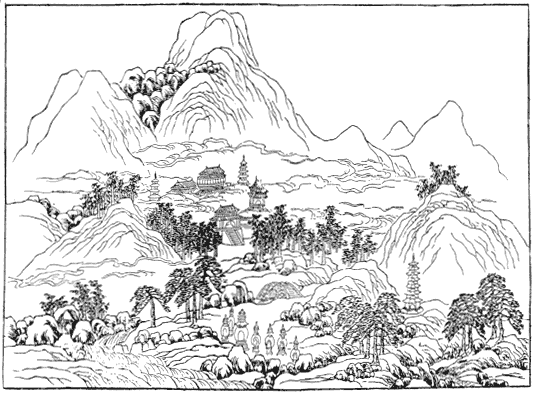
Fig. 60.
Geese Pond Mountain . From T'ien-hsia ming-shan sheng-kai chi
(Hong Kong, n.d.; rpt. of Ch'ung-chen era [1628–1644] ed.).