
The Story of the Marine Quarter
The divergence of the Marine Quarter and the casbah became definitive in the 1930s. In response to the debates to create a truly appropriate capital for French Africa, René Danger, Henri Prost, and Maurice Rotival drafted the first master plan for Algiers, which was approved in 1931. In accordance with the new enthusiasm for "urbanism" among French technocrats and administrators, the three architects were applauded as "true 'urbanistes' of highest quality, and of an indisputable fame."[94] This statement implicitly expressed doubt about Le Corbusier's credibility as an urbanist at the time when he had started working on his alternative designs for Algiers.
Within the framework provided by the master plan, Tony Socard, an

Figure 23.
Aerial view of the Marine Quarter, with the casbah behind, 1935.
architect working with Prost, developed a project for the Marine Quarter that was based largely on Redon's earlier scheme.[95] In the early 1930s, this quarter was densely inhabited by a low-income cosmopolitan population, mainly consisting of Neapolitan Italians, Spaniards, Jews, and "indigenous immigrants" (Fig. 23). Its street network was inaccessible to motor vehicles and its buildings extremely fragile—as witnessed by a building collapse on Rue des Consuls in 1929 in which over fifty people were killed. It was generally agreed that there was little here worthy of preservation. René Lespès defined the Marine Quarter at the time as "a small town, bastard, neither Moorish, nor entirely European." Joseph Sintes reaffirmed Lespès' statement by arguing that "this old quarter responded neither to aesthetics, nor to material or moral hygiene," the last reference to the scale of prostitution.[96] The few protests from the Comité du Vieil Alger to preserve several small and scattered "historic corners" were rebuffed (even by members of the committee itself) as "false Orientalism . . . now outmoded."[97] It was common sentiment that there was nothing worth saving from the residential and commercial framework and that valuable fragments—columns, tiles, woodwork, etc.—could easily be salvaged for incorporation into new buildings.[98]
The Marine Quarter was of crucial importance to Algiers, however, because it provided the connection to the harbor. It had also maintained a commercial character, with the Rue Bab el-Oued as the center of this activity, being the first stop for people descending from the casbah. Yet Bab el-Oued was lined with small shops that were deemed no longer efficient.[99] The presence of the two "untouchable" monuments, al-Kabir and al-Jadid mosques, caused several daily visits by Muslims in large numbers, inevitably making the quarter a meeting place—a notion that Le Corbusier would expand into a "meeting place" between the two cultures.
Socard's plan aimed to destroy the quarter entirely with the exception of the two historic mosques; their asymmetrical relationship, which betrayed the essence of Beaux-Arts urban design, would be "corrected" with landscaping (Fig. 24). A "magnificent boulevard," 450 meters long and 30 meters wide, would pass between the two mosques and act as the "great collector" of traffic circulating between Bab el-Oued and the streets to the west and northwest, on the one hand, and the waterfront and the ramps of the harbor, on the other. The Rue Bab el-Oued would be enlarged to 22 meters; the west part of the quarter would be divided into four sections by means of 16-meter and 10-meter streets, each part occupied by a building with a large garden court. The patchwork of houses between the Place du Gouvernement and Rue Mahon were to be demolished to give way to a park that would include the landscaped plaza in front of the al-Jadid Mosque and end in a curve to the west; the curve would be reflected on the east side of the grand avenue, creating a transversal axis. The east part of the quarter was differentiated as the locus of institutions, such as the chamber of commerce, stockmarket, Palace of Justice, library, and possibly the National School of Fine Arts. The project was seen as favorable in terms of circulation and a well-balanced distribution of built and open spaces; the resulting displacement of about fifteen thousand people would be resolved by settling them into the new housing projects.[100]
The project came under the attack of critics defending a more radical approach sympathetic to Le Corbusier's ideas. Emphasizing the importance of "scientific control by urbanists who know their job" and agreeing on the necessity to change the scale of the quarter, Jean-Pierre Fauve expressed his dissatisfaction with the Prost-Socard plan. According to Fauve, this plan was not "large enough." The widening of Bab el-Oued as proposed by Prost and Socard was in the spirit of the plans applied in Algiers in the 1850s and thus on a pre-automobile scale. The 35-meter width envisioned for the grand avenue was not daring enough, either.

Figure 24.
Tony Socard, plan for the Marine Quarter, 1935. Al-Jadid and al-Kabir
mosques are labeled 6 and 7, respectively. The buildings marked in black
form the institutional complex.
The best solution would be a ville radieuse , a radiant city that would let the sun in by decreasing the built surface and increasing the open space.[101]
Fauve also criticized Prost's overall master plan for shifting the city center away from old Algiers toward Agha in the south. Arguing that centers historically develop according to many good reasons, he challenged the Prost plan for not being functional and for turning its back on the history of Algiers. There was also a political issue at stake: as the capital, Algiers had a most important mission as a "Franco-Muslim" city. The Place du Gouvernement, the contact point of the two communities, had to remain the center of the city.[102]
Le Corbusier's designs preserved the central functions of the Marine
Quarter. In the 1932 plan, for example, a skyscraper sheltered the main activities of the cité d'affaires .[103] The "air belt" that separated the casbah from new Algiers began at this point with the proposal for a bridge-like structure that connected the skyscraper to the residential buildings for the Europeans on the hills above the casbah. Le Corbusier's successive proposals elaborated on the idea of the Marine Quarter as the "business center" and "civic center" of Algiers. Cleared and rebuilt with large blocks that left plenty of open space for parks and gardens, the quarter would provide the link between the European and Arab cities. Certain Arab institutions, such as offices, shops, and meeting halls, would be placed here. Le Corbusier maintained that the location was most convenient for overlapping functions because of its proximity to the port, its centrality in terms of future growth, and its significance as a historical axis for Arabs. The two mosques to be preserved, but cleared of the impeding fabric, would be returned to their original condition, sitting on a rock base. The presence of the new "indigenous institutions" in a "vast ensemble of new [and] grand Muslim architecture, as monumental as it would be picturesque," would complement the historic buildings.[104] In short, Le Corbusier's cleansing in the Marine Quarter would be urbanistic, architectural, and social, at once providing for controlled activities for Arabs and racial contact in an ordered environment.
After a long political battle, laced with intrigue, concessions, and compromises between the urban administration and Le Corbusier and his defenders, his project was rejected definitively in 1942 and the Prost plan was revived.[105] The war years stalled its implementation, however, and only in 1945 was the grand axis, Avenue du 8 Novembre (now Avenue du 1 Novembre), opened to circulation. The demolitions rekindled the sentiments of the citizens who feared the loss of their historic heritage. In a public letter, well-respected Algerian theologian and intellectual Omar Racim likened the destruction of Algiers to that of Hiroshima and argued that with the opening of the Avenue du 8 Novembre the mosques were "chipped" and found themselves as "old people deformed by age who in vain tried to hide their shame caused by their infirmities." He bitterly wondered when the city officials would "bury Algiers alive" by demolishing whatever was left of the old city in order to sell its pieces to tourists as relics.[106]
To enable the construction of the new artery, 340 buildings, covering an area of 45,800 square meters, were demolished, and 11,000 residents and 380 shopkeepers were evacuated (Fig. 25). Meanwhile 1,456 units of
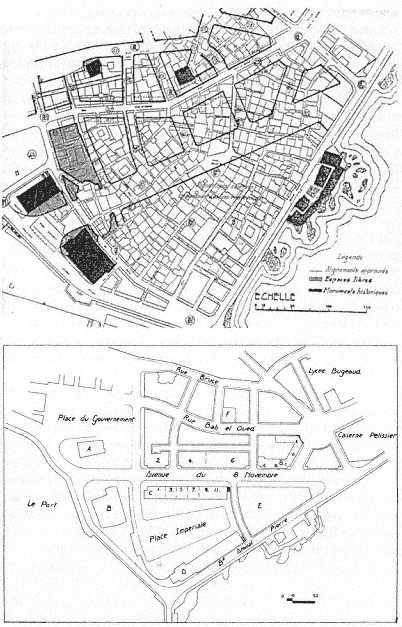
Figure 25.
(above) Plan showing the extent of demolitions proposed by Socard's
project for the Marine Quarter. Figure 26. (below) Plan for the Marine
Quarter, 1950.
housing (amounting to 3,628 rooms) were constructed elsewhere, the city expropriated about 500 more buildings, and the construction of the first residential complex in the Marine Quarter was begun. P. Loviconi, the adjunct secretary general of the communal administration, summarized the status of the project in 1949, indicating clearly the extent of the demolition and construction work to be done.[107]
In 1950, a slight alteration to the project introduced a trapezoidal public place, the Place Impériale, open to the waterfront on the south but surrounded by buildings sheltering residential units and offices on the other three sides (Fig. 26). The Palace of Justice would define its narrow north side, and a skyscraper would be placed to the east, reviving Le Corbusier's 1932 scheme.[108] This project stalled again.
Mayor Jacques Chevallier refueled the efforts to renovate the Marine Quarter in a final, but doomed, attempt. By this time, the housing conditions had become even more urgent and the existing stock alarmingly decrepit. The 550 buildings over an area of 89,000 square meters, sheltering 18,000 to 20,000 residents, with densities approaching 1,500 people per hectare, were estimated unsalvageable in the Marine Quarter. The city official reiterated that there was no other solution than razing the area and rebuilding it.[109]
The project was commissioned to Gérald Hanning, who brought back the design principles of Le Corbusier's cité d'affaires without linking it to the heights. Hanning proposed to reduce the number of motor vehicles in the quarter by designating a peripheral route to transit traffic. Treated as a tabula rasa, the area was reorganized with tall blocks placed perpendicular to the casbah, with the highest structure at the tip of the triangle extending to the sea (Fig. 27). Hanning's rationalization of this decision focused on providing intriguing city views from the water and sea views from the hills. Four to five thousand people would be resettled in the new housing (the remaining population was to be transferred to the new projects in the Bab el-Oued Quarter), and the densities would not exceed four hundred persons per hectare.[110]
Hanning's project did not lead to any of the turmoil Le Corbusier had experienced two decades earlier. It was approved with great pride on the premise that "the orthogonal conception of the buildings will give the quarter an agreeable ambiance while providing for large open spaces between the buildings."[111]
Hanning proposed a "historic" enclave amid the entirely new buildings, a quiet spot between the two mosques below the Place du Gouvernement. Isolating the historic monuments from the modern quarter

Figure 27.
Gérald Hanning, project for the Marine Quarter, photomontage, 1959.
would put an end to their "suffering" and give them back their religious and artistic value, according to the architect. The Place du Gouvernement was to be enclosed on the north side by a horizontal block four stories high. Considering the area between Avenue du 8 Novembre and the foot of the casbah a transition zone, Hanning laid out here a network of short, rather narrow streets lined with modern, courtyard houses. In another attempt to relate to the casbah, the architect allowed for small shops on the ground level of the tall buildings that would correspond to the scale of souks and hence make the transition between the old city and the new quarters smoother.[112]
The project was received enthusiastically, despite its acknowledged departure from the urban structure of old Algiers, and this approval was solidified in a municipal publication. Hanning's project was promoted as another harmonious layer to the historic complexity of Algiers, characterized not by a stylistic and formal uniformity, but on the contrary, by a "happy juxtaposition of forms, of volumes put in place during centuries." Reconstituting preexisting structures had never been a concern before, and modern planners would be wise to pursue this philosophy.[113]
Like other ambitious projects envisioned for the Marine Quarter, Hanning's proposal was not implemented, except for demolitions on both sides of the Avenue du 8 Novembre and the rehousing of the inhabitants. While many residents were relocated in the new housing settlements on the hills of Bab el-Oued, the lack of available units forced others to move to the already crowded casbah, raising the densities to unbearable limits.[114] At the conclusion of the war, after eighty years of grand visions for the Marine Quarter, the Algerian administration inherited a wasteland of sorts—largely demolished, but not reorganized.