
Culture Wars and the Backlash Against Elvis Presley
The tension between accepting rock 'n' roll as a modernizing agent and viewing it as the embodiment of a threat to social stability was manifested in the press and the public mind-set during the mid-to-late 1950s. This conflict mirrored the profound changes present in everyday life: the increased cultural and economic ties with the United States, manifested especially in the rising consumer culture; the rapid transformation of the urban environment, reflected in both the development of new public works and increased rural migration to the capital; a political environment in which the rhetoric of the Revolutionary Family belied the reality of a closed political system. The official heroes of the Revolution had come to have less relevance for a new generation of urban youth who discovered a closer connection with James Dean and Elvis Presley than with Benito Juárez or Emiliano Zapata, much less Jorge Negrete or Javier Solís (both renowned ranchera singers). This fact was not lost on concerned editorialists and members of the government. "Foreign influence, that which is established by stronger countries over those which are economically weaker," one writer editorialized, "shines itself directly in the environment.... James Dean is the mirror where today's youth look."[94] "The struggle is an arduous one," another editorial stated, "because concepts and habits from other countries and races have filtered into Mexico which differ diametrically from the nature of our lives and ideology."[95] Signposts of cultural hybridization were everywhere. While some may have seen this as heralding a liberalization of authoritarian values, others viewed the changes with alarm. The clearest culprit was the influence of an increasingly globalized mass-media culture, which transformed figures such as Brando, Dean, and Presley into teenage idols, whose dress, gestures, and even language became incorporated into the lexicon of everyday rebellion:
The majority of these young punks are dressed extravagantly, not only Texan style [that is, blue jeans and boots] but in clothing never before admitted under the criterion that we have for these things, and imitating the styles which appear in the cinema, foreign magazines and among some exotic visiting artists. Becoming lost is the unity within the family and respect for one's elders, in the belief that the norms and customs that structured the home are now "old fashioned" and don't match up to the demands of modern development.[96]
Nothing less than the future direction of society itself was at risk in these cultural transformations.
What was at stake in the triumph of one discourse over the other was a cultural framework through which the process of modernization could be negotiated. At one extreme, embracing a version of rock 'n' roll stripped of meaningful social conflict suggested the possibility of experiencing the pleasures of modernity without the pain of the social costs of adjustment. At the other extreme, demonizing the youth culture by linking it with social disorder served as a prop to resist the unsettling transformations of an economy that was undergoing rapid changes in social and cultural values. In this, there was a curious coincidence of criticism from both conservatives and leftists. For example, the famed muralist David Alfaro Siqueiros, a life-long communist who was later jailed for his support of striking workers, was quoted in 1957 as saying: "Pornographic films and rock 'n' roll and its derivatives have [brought] Mexican youth to the border of an irredeemable moral crisis."[97] Rock 'n' roll had emerged as a central fixture in the struggle over the terms of Mexican modernity.
By the start of 1957, the mania for rock 'n' roll had begun to reach new heights. In January it was announced that Mexico City would stage its first " 'Rock 'n Roll Festival' ... with the participation of the most important bands, jazz groups and interpreters of this new rhythm." The public was invited "to take part in the [radio and television] transmission [by] dancing and singing rock'n roll."[98] As Federico Arana observes, "The public was so enthusiastic for the new rhythm that no one was shocked by the news appearing in the press that Elvis would be coming to Mexico," an event strongly lobbied against by the Mexican League of Decency.[99] Though Presley was said to have declined an invitation to participate in the festival, he donated a guitar, "an exact replica of the one which he uses, so that it can be presented to the best jazz group which interprets rock'n roll."[100] Shortly thereafter, a Mexico City radio station carried an exclusive interview with Presley. Calling him "a consecrated artist," a newspaper reviewer noted that the interview "plainly confirms the prestige of 'Champion of Musical Hits' which the radio-listening public of Mexico has granted to [Radio Exitos],"[101] one of two stations (Radio Mil was the second) dedicated to serving a younger-generation listening audience during the late 1950s.
The emergent cultural wars over rock 'n' roll, however, took a dramatic turn shortly thereafter. On 19 February a comment gleaned from an alleged border interview with Elvis Presley appeared in a sidebar of the gossip columnist, Federico de León, in which the rock 'n' roll star was quoted
as saying, "I'd rather kiss three black girls than a Mexican." Two days later, a Mexican woman was quoted in the same column as saying, "I'd rather kiss three dogs than one Elvis Presley." At first unnoticed by the public at large, this exchange soon unleashed a torrent of anti-Presley criticism that sustained a powerful backlash against Presley and the mass media itself. Most people now dismiss the remark as completely false, some even attributing it to an act of political vengeance against Presley. For instance, Herbe Pompeyo of Polygram Records in Mexico City claims that a "high-up Mexican political figure" wanted to contract Presley for a private party, for which he sent the performer a blank check to fill in as he wished. Presley, according to the story, returned the blank check, so the politico, extremely offended, invented the storyline about Elvis not liking Mexican women.[102] For Arana, who went to great lengths to investigate the credibility of de León's citation, the quotation amounted to nothing short of a conspiracy by "government officials [and] the newspapers in which they collaborate"[103] to "liquidate the rock and roll monster"[104] that had been unleashed by the mass media. In fact, even at the time different commentators questioned the authenticity of the quotation. In one case, a writer drew the connection to conservative opponents seeking to "indefinitely proscribe this rhythm,"[105] as had recently occurred in Cuba. There, during the waning days of Fulgencio Batista's dictatorship, rock 'n' roll was denounced as "immoral and profane and offensive to public morals and good customs."[106] In an effort to defend his own honor—and record sales—Presley responded to the charges by answering that he "has never used disrespectful terms for Mexican women." Moreover, "a certified copy of this declaration" would be immediately available in Mexico for his fans.[107]
Fallout from the alleged comment, true or false, nonetheless had an immediate impact on the direction of public discourse. What is especially interesting is the way in which this response was couched in gendered terms, rather than directly challenging the comment as racist.[108] Radio Exitos, which only a short time before had received accolades for its exclusive interview with Presley, announced that it was now leading a boycott of the "insolent artist" after having read de León's column over the air. The station, described as "enjoying the largest youth audience in the capital," reportedly received "thousands of telephone calls from all social strata supporting the decision to completely suppress [Presley's] records."[109] The reporter who filed this story made little effort to hide his bias: "Quite commendable is the action taken by this radio station, which spontaneously came out in defense of the dignity of Mexican women." Next to the article
is a large photograph of Presley, mouth open and eyes angled downward, in an open-collared shirt and sports jacket. The caption reads, "He's very manly," an assertion mocked by the accompanying text: "Dressed in woman's clothing, nobody would say he's a man."[110]
That Presley had gone from the epitome of virility to being called a transvestite was actually a short leap in gendered logic. By challenging the traditional boundaries of dance performance—for a man, shaking hips and contorting lips were considered "feminine" gestures—Presley had actually made himself vulnerable to the charge of maricón (homosexual). Attacking Presley thus became linked to a reaffirmation of Mexican masculinity, which had been undermined not only by the popularity of this imported idol (who shook his hips and sneered) but also by the "modern values" he heralded. His emasculation by the press can best be described as a rhetorical strategy for the strengthening of a heroic nationalism subverted by the transnational mass media. The latter were blamed for having introduced competing male icons of authority and, thus, for displacing an image of youth as obedient and of women, in particular, as the bearers of "proper education and values." Presley had institutionalized a gaze of defiance and a gesture of chaos—the confrontational, unbounded territory introduced by rock 'n' roll—which challenged society by its direct appeal to youth. After all, it was Presley and his ilk who, by seducing the hearts of young Mexican women (and inducing Mexican men to mimic him), had cast a spell on countless youth, drawing them away from the traditional values and national heroes propagated by the PRI. Questioning Presley's manliness was one way of undermining his authority as a sex symbol and role model.
The uproar over Presley's alleged remark came just days before the release of a musical-spoof film entitled Los chiflados del rock'n roll . By examining the transformation in marketing of this film we capture a glimpse of the significance of the Presley uproar. Roughly translated as, "Crazed for Rock'n Roll," the film featured renowned ranchera performers Agustín Lara, Pedro Vargas, and Luis Aguilar and thus fell well within the boundaries of a discourse on rock 'n' roll as novel musical style rather than youth rebellion. A reviewer noted that the film "neither exalted Presley, nor had the slightest relationship with his excesses."[111] But the timing was such that the producer, Guillermo Calderón, faced pressures from groups organizing against Elvis Presley to prevent the film's release.[112] Overnight, advertisements for the movie changed dramatically to incorporate the dispute over Presley. Whereas earlier advertisements had featured caricatured drawings of the featured artists, now they juxtaposed a series of well-
armed, male "revolutionary" fighters (in large sombreros) firing point blank at a feminized Elvis Presley—tight pants revealing hips distorted to exaggeration—under the heading, "Die Elvis Presley!" (see Figure 1). Cheering on these "revolutionaries" are drawings of full-busted women in bikinis, Playboy-bunny versions of the legendary adelitas (female followers of the revolutionary struggle).[113] During this same period, leaders of the Federación Estudiantil Universitaria (FEU), a powerful student group linked to conservative elements of the government, planned "a gigantic protest against the dancer and actor ... during which there will be a 'burning' of [Presley's] records ... who, in public declarations, sought to defile the Mexican Woman."[114] Playing on this theme of a public bonfire, a subsequent advertisement for Los chiflados announced that the film was in its "second 'burning' week!" The text continued:
Burn his records!
His forelock!
His photos!
His guitar!
Burn everything that you wish, but ...
Put yourself in a good mood by coming to a 'burn'
With the true kings of fun and of Rock'n Roll![115]
A different advertisement for the film played even more directly on the idea of Mexican machismo as the safeguard of patriarchal values, this time by linking it with rock 'n' roll itself: "Long live the authentic kings of rock 'n' roll, valiant and 'profligate' ... but incapable of lacking respect for a woman!" Adding emphasis to the notion that Mexican men were in fact superior to their U.S. counterparts, the text continued: "Even if she's light-skinned [güera ] and doesn't speak Spanish!"[116] Mexicans, in other words, did not need an outsider to teach them how to be "real men." Moreover, they had their own men capable of performing rock 'n' roll (e.g. Agustín Lara), but within the gendered boundaries of respect that delineated buenas costumbres. This respect presumably preserved the modernizing aspects of rock 'n' roll along with its machismo, while policing it from falling into desmadre.
Complicating the public's response to Presley's remark were the contradictions encoded in the youth culture itself. On one hand, rock 'n' roll symbolized the leveling of an older order. The rock 'n' roll gesture—characterized by rupture and defiance—directly challenged the steady gaze of parental authority, substituting rebellion for obedience. Such defiance,
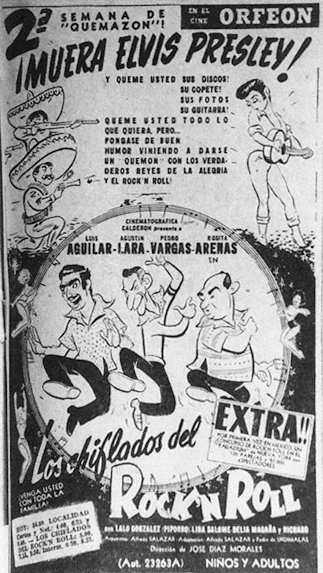
Figure 1.
Following the scandal over Elvis Presley's alleged comment,
movie advertisements for Los chiflados del rock'n roll
changed dramatically. Source: Excélsior, 9 March 1957, A21.
in turn, opened up a critical space for women, who began to question their own subordinate role. This relationship between policing the boundaries of respect for one's elders and upholding patriarchal authority over women was made explicit in the conflict over Presley. One writer, for example, made little effort to hide his antagonism toward rock 'n' roll, emphasizing the view that Mexican honor and virility were at stake in the protests against Presley: "Fortunately the Mexican [man] has a high sense of dignity, respect for women, virility and authentic probity that loathes anything that offends the Mexican woman. The sentiment of repulsion toward the wretched and unsettling rhythm has flown toward the four cardinal points since we learned about the infamous insult that was hurled at our women from one of [Presley's] television programs in the United States."[117] To be sure, the most reactionary elements rallied to the cause of rock's expulsion. Federico de León, responsible for publishing the alleged Presley remark, thus wrote triumphantly (though prematurely) that "Mexico is celebrating the funerals of 'rock 'n' roll.' "[118]
On the other hand, rock 'n' roll embodied a concept of modernity that coincided with the progressive, consumer-oriented platform of the Revolutionary Family itself. Rock 'n' roll's spirit of innovation and restless energy offered an image of youthful exuberance and progressive change that symbolized a nation on the move, one bounding out of the poverty and backwardness associated with the pre-World War II period toward a new Mexico, allied with the United States and confident to be host of the Olympics in the decade ahead. Suppressing the styles of youth was a reflection of closed-mindedness, for one must keep pace with the times. "Youth of today," argued one writer, "shake to modern rhythms just as others before them did to the rhythms of their era."[119] In fact, the student group that organized the burning of Presley records, the FEU, sought to isolate Presley from the rock 'n' roll trend in general by announcing that the "struggle is not exactly against rock and roll, but against Presley who offended our women with his public remarks."[120] For the "modernizers," therefore, ultimately the question was how to censor the noxious influences of the mass media while retaining the modernizing elements so basic to an image of progress. "The advantage" for Mexico, according to one editorialist, "is that in spite of the 'rock and rollers,' our youth, in the majority, have not lost their sense of responsibility toward their country, the family, and themselves."[121] Preserving these values within the framework of a modernizing ideology was the task at hand. Hence the battle against Presley became less a struggle against rock 'n' roll per se, except by the rhythm's most
ardent detractors, than a struggle to protect the buenas costumbres that undergirded a patriarchal society and state.