
Odyssey 5.424-44: Formulaic Structure and Traditional Rules
In what follows I shall continue to compare the explanations of traditional structure offered by conventional formulaic theory on the one hand and by traditional rules on the other. As a sample passage for this exercise I have chosen Odyssey 5.424-44, part of the description of the hero's tribulations at sea after having been advised by the goddess Ino to leave his storm-battered raft. This selection was not made at random, for I wanted the sample passage to fulfill at least two conditions: that it not be an instance of a much-used theme, so that we might avoid too heavy (and unrepresentative) verbatim repetition of formulaic diction;[18] and that it be as far as possible a sample without any special, unusual structure, so that it would be likely to contain a cross-section of phraseology. We are looking, in other words, for an "average"
[18] Cf. the criteria espoused in Russo 1976.
Homeric passage, one that is neither highly conventional nor (at least apparently) highly idiosyncratic.
The reader will notice that these lines also contain a simile (at 4.432-35), and the question may arise as to whether the analysis of the diction is representative because of the inclusion of such a figure. Again, this choice was quite intentional, since I feel that any theory worth the name should be able to account for all types of phraseology encountered in Homeric narrative, not just this or that subset of the phraseology. While his approach is different from that advocated in this volume, William C. Scott (1974, 136) puts the matter neatly in referring to the similes that occur more than once in Homer: "Consistency in analyzing components of oral poetry demands that the repeated similes be treated as units which were as traditional and autonomous, but also as adaptable, as the basic arming and banquet scenes."[19] However we interpret the similes, we must agree that they are part of Homeric narrative, and so we must deal with their phraseology.[20]
Before presenting my formulaic analysis of 5.424-44, let me set the ground rules for my working notion of formula and formulaic in Homeric phraseology, remaining quite aware, as indicated in the first two sections of this analysis, that even the most carefully defined units will fall short of uniform interpretation by all investigators.[21] Perhaps the most explicit way of accomplishing this definition of units is first to quote the principles followed by Albert Lord in his widely known article "Homer as Oral Poet" (1967a), and then to comment on each principle before presenting certain modifications or additions of my own. Here, then, are Lord's principles (pp. 25-26):
1. Declension or conjugation of one or more elements in the phrase, providing the metrical length of the phrase remains unchanged.
2. Metathesis, or inversion, or, in general, any change in the order of the
[19] Scott (1974, 140) conceives of a kind of storehouse of similes from which the poet could draw: "While it is impossible to identify which similes were taken with little or no alteration from the pool of traditional oral units, the examination of the repeated similes demonstrates that the poet did draw upon such a source at the very least seven times." The most recent full study of the similes by Carroll Moulton (1977) agrees in principle with Scott's approach, although Moulton believes that it is not proven that the similes are themselves oral. He feels, in concert with G. S. Kirk (1962) and others, that Homer was the "monumental composer" who put the poems into their present form, and that an oral tradition was certainly involved at some point in their history. Whether the poems as we have them were oral compositions he leaves an open question.
[20] As Moulton (1977, 125-26) points out (proceeding from Fenik 1974, 143-44), there are monologues at 408-23 and 465-73 that form a kind of ting or envelope around our sample passage. Both of these monologues are followed and elaborated by similes (432-35 and 488-91, respectively) which signal Odysseus's "endurance in adversity," a major theme of the epic and a quality that "will lead to his ultimate triumph." This conception of structure may account for the texture of the narrative in our sample.
[21] Cf. Russo 1976.
words in the phrases as long as the metrical length is preserved and the meaning remains unchanged.
3. Repetition of a formula, even if it be in another part of the line from that of the verse being analyzed.
4. In dividing the hexameter into parts one should consider that there may be lines that should be treated as a whole, that cannot readily be broken into parts. Otherwise there may be normally two or three parts to the verse.
5. When a single word is repeated in the same position in a line, it is conclusive evidence in itself for a formula only if the single word occupies the entire part of the line, as happens sometimes with the run-on word or at the end of a line. Otherwise the repetition of a single word in the same position in the line is permissible as evidence only if it is part of a system, which would include the phrase being tested.
To principle number 1 there can hardly be any objection, since morphology is a fact of formulaic life in all three traditions studied in this volume (although they tolerate different kinds and degrees of morphological variation). I would add only the words and texture to length , since a morphological change that also modifies metrical word-type can affect placement and therefore formulaic structure. The same addition is even more important in principle number 2, since inversion and other changes take place relatively seldom in Homeric phraseology without running afoul of the delicate balance of the inner metric of the hexameter. Once again, the Serbo-Croatian deseterac and Old English alliterative line tolerate this kind of change much more readily than the hexameter. The third principle pertains to relatively few cases in Homeric diction, again because of the complex weave of the prosody. Principle 4 proves extremely important, since, as predicted at the outset of this chapter, the prosody allows, or even encourages, the formation and maintenance of units of different sizes. I would add what I consider to be an important modification to this principle, a modification already borne out in our first two analyses: namely, that line and hemistich patterns are not necessarily to be treated exclusively as either the one or the other. We have seen above, for example, that a hemistich formula or system can also participate in a whole-line formula or system, so that in certain cases it is impossible to isolate the "kernel" of a group of related phrases. As for the fifth principle, the idea of making sure that single words have some phraseological context in order to be considered as individual elements in the diction is an excellent one, and we shall have more to say on that score as we go over examples of that phenomenon in the discussion that follows the marked passage below.
Every investigator must make some assumptions about what constitutes valid evidence, and, pace those who seek after the chimera of absolute uniformity,[22] scholars will disagree about close cases. In order to make the following
[22] Gf. Miletich 1976.
quantitative analysis as uniformly productive of formulas and systems as possible (this goal in turn being an effort to be as open-minded as is practical about the explicative power of conventional formulaic theory), I have resolved the "close cases" in favor of formulas and systems. That is, in those instances which might be better explained by simple word-type localization than by positing formulaic structure, I have for the purpose of the initial quantification called the units "formulaic." In the discussion that follows the analysis, of course, I examine other methods of explanation.
One more assumption should be noted. In concert with what we have learned about prosody and phraseology in chapter 3 and earlier in this chapter, I take the minimal phraseological unit to be the hemistich, not the colon. The latter, we recall, is normatively a unit of meter rather than of phraseology, although the emphasis in that formulation and others must remain on normatively . Colonic "words" and phrases do in fact develop, especially in the C1 fourth colon, where, as we have seen, the metrical extent of the line-part is within three morae equal to that of a (B2) second hemistich. There simply is no easy answer to this quandary, no place to draw the line absolutely without mismarking a reasonably large percentage of the diction. The fact that I choose to draw it here does not mean that I do not recognize colonic formulas, particularly noun-epithet formulas like glaukôpis Athênê Even though under my set of assumptions such phrases are taken as parts of formulaic systems and not as formulas in their own right, the final percentages of "formula plus formulaic" will remain the same. What is more, using the hemistich as the minimal unit of phraseology allows a quantitatively defensible scheme of representation, since we can calculate percentages based on hemistichs and whole lines. Otherwise, calculation would either have to proceed by cola or have to place formulas and systems of various lengths against a single standard. Both alternatives are fatally flawed.[23]
What follows, then, is a formulaic analysis of 5.424-44 carried out under the principles established and discussed above. The Greek text is underlined to reflect those words which actually occur elsewhere in what I take (with generous definition) to be formulas or systems, with the minimum unit of phraseology understood to be the hemistich. Wherever the structure of a line is such that one could posit either a hemistich or a whole-line unit, I have consistently marked and counted it as an instance of the larger, whole-line
[23] One cannot use cola as a base because not only is the colon normatively a metrical unit, but many cola are much too short to provide a site for formulaic structure (consider the three-mora third colon between a B2 and a C1 caesura, which would have to be assessed for formulaic character if cola were used as a basis for calculation). The other alternative, calculating the percentage occurrence of phrases of various lengths against a uniform standard, is logically untenable.
We also recall that the present analysis has as its goal only a diagnostic examination of formulaic theory, and not a determination of orality on the basis of formulaic density.
unit.[24] Likewise, if both an exact repetition and inexact, formulaically related phrases occur, I have taken the line or hemistich as a formula without further notation. My literal translation of the passage is appended, along with a summary of the results and supporting evidence for the judgments made about individual lines (at least one comparand for each unit identified).
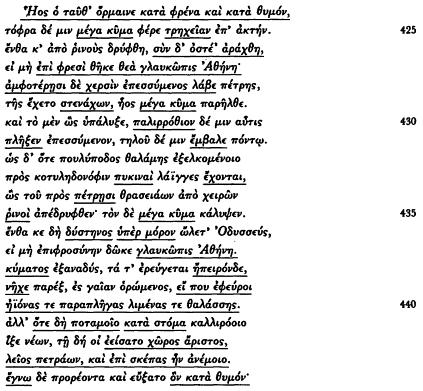
While he was truning these things over in his mind and in his heart,
Just then a great wave bore him toward the rugged shore. 425
His skin would have been torn, his bones all battered together
Had not the flashing-eyed goddess Athena inspired him.
As he was rushing on he grasped a rock with both hands
And, groaning, held on while the great wave passed over.
And in this way he escaped the wave at first, but suing back again 430
[24] It is important to note that not all lines that show two hemistich systems can support the hypothesis of a whole-line system. Some hemistich patterns are conjunctive , in that they fore a larger whole as well as two smaller patterns, and others are disjunctive , in that they occur together only once in the Odyssey and therefore cannot be shown to fore a whole-line traditional unit.
It struck him rushing on, and cast him far out into the sea.
As when an octopus is dragged from its lair
And the close-packed stones are held in its suckers,
So the skin was torn from Odysseus' hands
By the rocks. And the great wave covered him over. 435
Then, having reached beyond his measure, Odysseus had surely
perished, miserable,
If flashing-eyed Athena had not given him presence of mind.
Emerging out of the wave, which belched in to the land,
He swam close by, looking toward land to see whether
He could discover the sloping shores and harbors of the sea. 440
But when indeed, swimming along, he came to the mouth
Of the fair-flowing river, the best place presented itself to him,
Free from rocks, and there was shelter against the wind.
And he saw the river flowing out and prayed in his heart.
The list below summarizes the analysis carried out on Odyssey 5.424-44 (see also the formulaic density statistics in table 18).
5.424 | whole-line formula (4-120, 5.365) |
5.425 | hemistich 1 formulaic (3.295 plus 12 × mega kuma ) |
hem. 2 formulaic (14.1) | |
5.426 | hem. 2 formulaic (12.412) |
5.427 | whole-line system (16.291 and 4 × add.) |
5.428 | hem. 1 formula (4.116, 24.316) |
hem. 2 formulaic (22.307, 22.310) | |
5.429 | hem. 1 formulaic (9.415) |
hem. 2 formulaic (see 5.425, hem. 1 above) | |
5.430 | hem. 2 formulaic (9.485) |
5.431 | hem. 1 formulaic (18.57 and 2 × add.) |
hem. 2 formulaic (1.438 and 6 × add.) | |
5.432 | no related phrases |
5.433 | hem. 2 formulaic (5.329) |
5.434 | hem. 1 formulaic (5.156) |
5.435 | hem. 1 formulaic (14.134, 21.301) |
hem. 2 formulaic (see 5.425, hem. 1 above) | |
5.436 | hem. 1 formulaic (6.206 and 10 × add.) |
hem. 2 formulaic (1.34, 1.35) | |
5.437 | hem. 2 formulaic (1.44 and 48 × add. in nom. case) |
5.438 | hem. 1 formulaic (5.257) |
hem. 2 formulaic (5.56 and 6 × add.) | |
5.439 | hem. 1 formulaic (5.399) |
hem. 2 formulaic (5.417) | |
5.440 | whole-line formula (5.418) |
5.441 | hem. 1 formulaic (6.85, 12.1) |
hem. 2 formulaic (18.97) | |
5.442 | hem. 2 formula (7.281) |
TABLE 18. | |||
Level | Formula | Formulaic System | Formula and |
Line | 3/21 = 14.3%a | 1/21 = 4.8% | 4/21 = 19.0% |
First hemistichb | 4/21 = 19.0% | 11/21 = 52.4% | 15/21 = 71.4% |
Second hemistich | 4/21 = 19.0% | 15/21 = 71.4% | 19/21 = 90.5% |
Both hemistichs (average) | 8/42 = 19.0% | 26/42 = 61.9% | 34/42 = 81.0% |
a Verbatim formula | |||
b For the purposes of quantification only, I have counted each whole-line repeat as a repeat in each hemistich. As explained in note 24, this categorization ignores the difference between conjunctive and disjunctive hemistich patterns. See further the discussion below of 5.424-44. | |||
5.443 | whole-line formula (7.282) |
5.444 | hem. 1 formulaic (11.390 and 4 × add.) |
hem. 2 formulaic (20.59 and 2 × add. hon kata thumon ; total of 20 × kata thumon ) |