
10
Things Fall Apart: The Rise of Debt, the Fall of Marcos, and the Opportunity for Change
by Robin Broad and John Cavanagh
The prolonged postwar economic boom had suffered downturns before. But these had always been short, and upturns had always followed. In 1982, debt crises erupted across the Third World in rapid succession. This time, the world economy, in a downturn since 1980, did not bounce back. Crisis followed upon crisis. The cycle seemed to have been broken. By 1986, still no upswing appeared and economies that were heavily dependent on the world economy—including even the "miracle" NICs—were in various states of recession or ruin.
As opportunities for profit in the Third World dwindled, transnational banks and corporations refocused their sights back on the developed world. Four years as the lead international institution in this era of debt crisis management left the IMF almost universally despised across the South—and nearly broke. So, the next heir to the international debt and development management throne was anointed: the World Bank, which (with U.S. government blessing) chose structural adjustment of the Philippine variety as its cure-all.
The model Philippines, having been opened up to the world economy
in new and expanded ways in the early 1980s through the structural adjustment process, fared among the worst of the debtor nations. Internal corruption and cronyism combined with collapsing export earnings to plunge the country into deep economic and then political crisis. Only those Filipinos who managed to salt dollars away abroad through secret and often illegal capital flight seemed able to avoid the worst of this all-encompassing crisis.
Indeed, in many respects, the one relic of value that a fleeing Ferdinand Marcos left his successor was a negative example: a two-decade blueprint for guaranteed economic disaster. There was much to learn from studying Marcos's mistakes. For in the failure of Marcos, the World Bank, and the IMF lay important lessons that might be applied to another approach to development—one placing people before the market.
The Slide Continues
One of the most tragic commentaries on the state of the world economy and North-South relations appeared in 1983 and has been a yearly occurrence ever since: a net transfer of resources out of the developing world and into the developed world. This marked a first in postwar history. In the late 1970s and early 1980s, new international private, bilateral, and multilateral lending plus transnational investment had exceeded developing-country outflows of debt service and investment income by approximately $40 billion annually (see Table 12). In 1982, however, as debt service payments leaped to $50 billion, the positive net inflow was almost erased, and it has grown into an ever larger outflow each year since. By 1985, owing largely to the retreat of TNBs in extending new loans, the net outflow surpassed $31 billion; Latin America, which boasted nearly all the major debtors, was the region hardest hit.
Yet, the World Bank and IMF took advantage of this period of decline and retreat to vastly expand their involvement in economic policy-making in those developing countries. Each year during this period, the World Bank's World Development Report got prettier, the graphics sharper, the colors more varied. One thing, however, has remained constant over the decade of the 1980s: Bank growth projections for both output and trade have—year after year after year turned out to be far higher than what was subsequently achieved.[1] Rather than correcting this annual over-
Table 12. Net Transfer of Resources to Developing Countries, 1979-1985 ($ billions) | ||||||||
1979 | 1980 | 1981 | 1982 | 1983 | 1984 | 1985a | ||
Mediated through all creditsb | ||||||||
Net capital flow | 47.9 | 54.2 | 62.5 | 50.8 | 39.7 | 32.0 | 13 | |
Net interest paid | -17.2 | -23.6 | -34.8 | -50.0 | -48.3 | -53.9 | -54 | |
Net transfer | 30.7 | 30.6 | 27.7 | 0.8 | -8.6 | -22.0 | -41 | |
Mediated through direct investment | ||||||||
Net flow of investment | 10.1 | 9.8 | 14.2 | 12.0 | 8.9 | 8.5 | 9 | |
Net direct investment income | -11.4 | -13.7 | -13.5 | -13.1 | -11.6 | -11.3 | -13 | |
Net transfer | -1.3 | -4.0 | 0.7 | -1.1 | -2.7 | -2.8 | -4 | |
Through official grants | 12.0 | 12.7 | 13.1 | 10.7 | 11.0 | 12.3 | 14 | |
Total net transfer | 41.4 | 39.3 | 41.5 | 10.4 | -0.3 | -12.5 | -31 | |
To Latin America and Caribbeanc | 15.6 | 11.9 | 11.4 | -16.7 | -25.9 | -23.2 | -30 | |
To sub-Saharan Africad | 6.4 | 6.0 | 9.5 | 10.1 | 7.9 | 0.8 | 1 | |
SOURCE : United Nations, Department of International and Social Affairs, World Economic Survey 1986: Current Trends and Policies in the World Economy , 1986, p. 74, table IV.4. | ||||||||
NOTE : Net flow of foreign financial resources available for imports of goods and services (i.e., after payment of income on foreign capital outstanding). All flows are inflows minus outflows of residents and nonresidents. Sample of 93 developing countries. | ||||||||
a Estimates, rounded to nearest billion dollars. | ||||||||
b Includes all official bilateral and multilateral credits, including use of IMF credit, and all private credits, short-term as well as long-term. | ||||||||
c Thirty-one developing countries or territories, accounting for about 92 percent of the trade of the region. | ||||||||
d Thirty-seven countries, accounting for about 92 percent of the trade of the flail group. | ||||||||
optimism, the Bank seems to have realized that few take the time to go back and check whether projections matched reality. To the contrary, the high projections have served admirably to justify Bank policy prescriptions that have continued to urge export-oriented development.
With the exception of 1984, when global output and trade advanced at their pre-1980 rates, the first half of the 1980s has been disastrous for most of the world economy. After a decade (1971-1980) in which output grew at over 4 percent annually and trade barreled along at over 5 percent, the years from 1981 to 1985 were bleak: output grew at an average 2.7 percent per year, and trade at 2.8 percent. These latter figures are far more dismal if Eastern Europe and China are excluded: output over those five years grew only 1.4 percent in developing countries and 2.3 percent in the developed world.[2] The volume and value of developing-country exports actually declined over the period, as did the value of imports; the volume of imports stagnated.[3]
Rising protectionism even affected the fastest-growing NICs: South Korea, Taiwan, Singapore, and Hong Kong. After two decades of nearly 9 percent annual average growth of GDP, these four countries slowed to an average of 2.3 percent in 1985.[4] Hardest hit was Singapore, whose exports of goods and services are twice the size of its GDP; its economy actually shrank 1.7 percent in 1985.
By the mid-1980s, the three factors that had already been identified in 1982 as impediments to the export success of the thirty-odd would-be NICs only worsened: the slowdown of trade, the growth of protectionism, and the proliferation of other would-be NICs competing for the same, stagnating manufactures markets. Malaysia, for example, one of the would-be NIC stars in the late 1970s and early 1980s, was talking about the possible exhaustion of its export-led and import-dependent EPZ-based development path. Its change of heart was based on falling manufactured exports and employment, which, in turn, convinced many remaining workers to take "voluntary" wage cuts of Up to 20 percent.[5]
Part of the trade slowdown, particularly among the debt-ridden NICs and would-be NICs, was attributable to the particular brand of debt crisis management engineered by the IMF. The debt crisis exploded onto the financial pages the world over in mid-1982, when the Mexican government announced it could no longer meet debt service payments. Banks refused to lend further without an IMF seal of approval, and between 1982
and 1985, ninety-eight IMF standby arrangements and extended fired facilities were signed with developing countries.[6] IMF agreements invariably included currency devaluations, which lowered prices of exports (hence making them more attractive to the buyer) and raised local currency costs of imports.
Through such policies, the IMF managed to turn a $22 billion trade deficit for the twenty largest debtor nations in 1981 into a $25 billion surplus by 1985 (see Table 13). This incredible turnabout was not accomplished through an increase in export value; almost all of it reflected a sharp decline in imports of everything from consumer goods to vital intermediate goods and raw materials for industry. It could convincingly be argued that the IMF's import austerity was undermining the very industrialization that the World Bank claimed to be supporting. Export value failed to grow in large part because of the inevitable glut effect of more countries exporting more of the same products. In such circumstances, prices could only fall. Between 1981 and 1985, world prices of food commodities dropped at an average annual rate of 15 percent; agricultural raw materials at 7 percent; minerals and metals at 6 percent.[7]
IMF debt management was undeniably disastrous for trade. By the mid-1980s, however, as the prime mechanism for debt management shifted from IMF "austerity" to World Bank "adjustment," the Bank claimed that a revival of world trade was just around the corner. Indeed, already in its 1986 World Development Report , the Bank was heralding 1985-1995 as "a decade of opportunity" that would see world trade grow again at well over 5 percent annually.[8]
Such optimism, however, is likely to prove as far off the mark as the Bank's annual projections in early World Development Reports , for reasons beyond World Bank officials' purview. For even assuming a miraculous about-face in debt management, there are, as the United Nations has argued, "longer-term factors" behind the slowdown in world trade—factors "such as resource-saving innovations, competition from synthetic materials and shifts in consumer preferences towards services."[9]
A single anecdote typifies these longer-term structural shifts in commodity markets. Before 1981, the single largest consumer of the world's sugar was Coca-Cola. But that year, in a move rapidly emulated by other soft-drink giants, Coke stopped using sugar as its sweetener and raw material and instead turned to corn syrup. Two years later, Coke shifted its diet
Table 13. Trade and Current-Account Balances for the Twenty Largest Debtors, 1980-1985 ($ billions) | ||||||
1980 | 1981 | 1982 | 1983 | 1984 | 1985a | |
Exports | 201.6 | 209.9 | 193.2 | 192.8 | 212.9 | 212.0 |
Imports, f.o.b. | -210.0 | -231.7 | -207.4 | -184.0 | -185.6 | -187.5 |
Balance of trade | -8.4 | -21.9 | -14.2 | 8.8 | 27.3 | 24.5 |
Net services & private transfers | -30.5 | -45.0 | -55.5 | -42.1 | -44.2 | -42.0 |
Current account | -38.9 | -66.9 | -69.7 | -33.3 | -16.9 | -17.5 |
SOURCE : United Nations, Department of International and Social Affairs, World Economic Survey 1986: Current Trends and Policies in the World Economy , 1986, p. 175, table A.V.10. | ||||||
NOTE : As of the end of 1981, the debtors were Algeria, Argentina, Brazil, Chile, Colombia, Egypt, India, Indonesia, Israel, Mexico, Morocco, Nigeria, Pakistan, Peru, Philippines, South Korea, Thailand, Turkey, Venezuela, and Yugoslavia. | ||||||
a Preliminary estimates, rounded to nearest half-billion dollars. | ||||||
soft-drink sweetener to a biotech product, aspertame. These simple decisions by Coca-Cola changed the lives of millions of sugercane cutters across the Third World. Advances in plastics, synthetic fibers, food chemistry, and biotechnology are bringing similar and far-reaching changes in other markets.
Longer-term trade shifts reach beyond the raw-materials-input stage. Consider semiconductors, the centerpiece of export-led light manufacturing in many of the would-be NICs. In 1985, the Wall Street Journal described a U.S. factory of the transnational corporation Schlumberger. In a Maine subsidiary of the firm, highly automated machines weld semiconductor chips onto matchbook-sized metal frames. One person monitors eight machines that turn out 5,120 circuits per hour. Just a year before, a worker in Singapore had performed the same job for the TNC—producing only 120 circuits per hour. Schlumberger is not alone; United Technologies, National Semiconductors, and others are following suit.[10]
A year later, the Journal reported equally portentous developments in the other centerpiece of light manufacturing: "a machine that does what no machine has been able to do before: automatically construct the sleeves for a man's coat and sew them onto the body of the jacket." The producer is none other than the corporation that created the last major breakthrough in apparel over a century ago: Singer of sewing-machine fame. In a parallel move, Japanese engineers, bankrolled by the powerful Japanese Ministry of International Trade and Industry, are working toward the following:
Fashion designers would design fashions on computers, and robots would do the rest. Lasers would cut fabric into precise pieces; robots would sort and group the pieces; unmanned machines would sew backs to fronts, liners to pockets and buttons to sleeves.
Down the line, a robot would pick up a half-finished suit and put it on a mannequin; robots with sewing-machine arms would reach over and sew on sleeves and collars; other robots would inspect the suit and send it: to be shipped.[11]
Needless to say, these robotized factories will not be "footloose"; they will not be located in Malaysia, Singapore, or the Philippines—or any of the other NICs or would-be NICs. Rather, many global assembly lines appear to be coming home to the developed world.
There were ominous warnings for World Bank industrial structural adjustment strategies in these new corporate technologies. As more corpo-
rations organize full assembly-line operations in one country, the world market stands to lose a substantial amount of trade in semiprocessed components. Furthermore, the Third World no longer holds as much attraction as it did a decade ago for transnational corporate investment.
At the same time, in the wake of the eruption of the debt crisis, transnational banks the other major source of private financing in developing countries—have been unequivocal in their abandonment of the Third World. In 1983, international bank lending to developing countries (excluding offshore bank centers) totaled $35 billion. By 1985, a mere $3 billion in new lending trickled in.[12]
For transnational corporations, the decision whether to stay or leave has been more complicated. The low wages, absence of workers' rights, lax environmental standards, and other incentives that have lured corporations into the Third World for over a century remain. Indeed, the competition among developing countries to offer even greater incentives has intensified in the last four years. What has changed is not only automation but also the growth of uncertainty. Foreign investment has been highly concentrated in the NICs and would-be NICs, that is, the major debtors, led by Brazil, Mexico, Malaysia, and the Philippines.[13] As such troubled debtors struggle to meet debt service payments, many have imposed strict foreign-exchange restrictions, making it increasingly difficult for corporations to get dollars out of host countries. TNCs have reacted by cutting back on new foreign investment, although by no means as drastically as TNBs have cut lending. Net foreign investment flows to the developing world surpassed $10 billion for the first time in 1979 and peaked in 1981 and 1982 at $14.2 billion and $12.0 billion, respectively. Since 1983, however, the total has fluctuated in the $8-$9 billion range.[14] For the seven leading Latin American debtors and foreign-investment recipients, net new direct investment reached a $4.5 billion high in 1981 and has hovered in the $2.0-$2.8 billion range ever since.[15]
In sum, the traditional external private sources of capital, transnational banks and corporations, have, at least in the short term, reduced the rapid increase in Third World involvement that characterized their activities in the 1960s and 1970s.
Glory Days?
As the role of private transnational capital diminished over the four years following the 1982 outbreak of the debt crisis, the stage was set for the multilateral financial institutions to play far greater roles than their founders had ever imagined. In 1982, it was the IMF that was to be thrown centerstage in an international financial system in crisis. Postwar Philippine history is testimony to the important role the IMF has long played as a global financial phenomenon, but 1982 ushered in a new era.
It is difficult to summarize briefly the varied currents that flowed into the international debt crisis and why the situation came to a head in so many countries almost simultaneously. The World Bank certainly played a major role throughout the 1970s by encouraging a model of development based on heavy borrowing. Beyond the Bank, the crisis, in simplest terms, is rooted in the sustained overborrowing of the late 1960s and 1970s, which was stimulated by historically low real interest rates and still-expanding markets for Third World exports. After 1979, both conditions tragically reversed. Within eighteen months, interest rates jumped to double digits and rose as high as 20 percent, while world trade foundered.[16] Mexico's announcement in August 1982 that it could no longer service its debt opened the floodgates for dozens of similar announcements in the ensuing four years.
The task the IMF faced was daunting not only because of the number of countries involved, but also because small and medium-sized banks cajoled into the lending spree of the 1970s now saw the handwriting on the wall. Many wanted out, and hence far more of the IMF's energy than had been the case in the past was directed toward harnessing increasingly "involuntary" commercial bank resources.
Not only were IMF agreements more numerous; they were bigger—much bigger. Jumbo IMF loans to Brazil and Mexico skipped beyond the usual several hundred million dollar figures to several billion dollars. By the end of fiscal year 1983, thirty-nine nations had standby agreements, the largest number of IMF clients at one time ever. That year and the next, IMF loans to developing countries surpassed $10 billion.[17]
Glory days, however, these were not. Three problems came into clear focus by 1984-1985: the IMF was growing unpopular across the Third World, it was running out of money, and the crisis was only getting worse.
Table 14. Extended Fund Facilities of $50 Million or More, July 1982 to June 1986 | ||
Year of Approval | Amount (million SDR) | |
† Mexico | 1983 | 3,410.63 |
† Brazil | 1983 | 4,239.38 |
* Dominican Republic | 1983 | 371.25a |
Malawi | 1983 | 100.00 |
* Chile | 1985 | 750.00 |
SOURCE : Information provided by the IMF, July 1986. | ||
a Canceled before completion. | ||
* Would-be NIC. | ||
† NIC. | ||
An indication of countries' wariness of the Fund is that only one extended fund facility was signed in the three years after September 1983 (see Table 14). The Fund's "bad guy" image became so pervasive that in 1984 it attempted to refute its critics across the globe by publishing a pamphlet, under the authorship of managing director de Larosière, entitled "Does the Fund Impose Austerity?"
Cash flow at the IMF became a problem by the mid-1980s because of the inordinately short repayment schedules demanded by the Fund, which was, after all, set up to be a short-term lender. Most IMF facilities must be repaid three to five years after drawing.[18] Hence, the large 1982 drawings already fell due beginning in 1985. So, from a high of $11.1 billion in 1983, net flows of IMF lending (new drawings minus repayments) plummeted to $0.2 billion in 1985.[19] By mid-1986, six countries were so far behind in repayments that they were declared ineligible for IMF lending.[20] That same year, Third World debt for the first time passed the trillion dollar mark.[21]
In a last gasp, the IMF created its own "structural adjustment facility" in March 1986.[22] As against the World, Bank's emphasis on would-be NICs, this facility was "designed to assist low-income member countries with protracted balance of payments problems adopt medium term macroeconomic and structural adjustment programs to help correct distortions in their economies."[23] In fact, one could argue that the new facility was set up to bail the IMF out of a repayments crisis it began facing in Africa in
1985. Between 1980 and 1985, the IMF disbursed over $7 billion to African nations.[24] By 1985, the Sudan, Liberia, Zambia, and the Gambia had fallen into arrears with the Fund; other countries, struggling to make payments, appeared likely to follow.
This increasing realization that short-term instruments were inadequate to meet the problem at hand thrust the World Bank into undisputed leadership in the debt/adjustment arena in late 1985. The World Bank had been moving toward this new role as early as 1980, with its first structural adjustment loans. In 1983, it took two further steps to enhance its capabilities as both crisis and macroeconomic policy manager. That year, it launched a major effort to shore up lagging transnational bank interest in the Third World. Watching World Bank-TNB co-financing operations suddenly drop 50 percent from 1982 to 1983, the Bank revised its co-financing instruments so that either it participated directly in commercial bank loans (with repayments going first to the commercial bank and later to the World Bank) or it guaranteed repayment of later parts of commercial loans.[25] The new co-financing instruments were to prove vital, for example, in convincing reluctant banks to join a billion-dollar financial package from Chile's major creditors in 1985.[26]
In February 1983, the World Bank addressed the immediate liquidity problems facing a number of developing countries by creating a Special Assistance Program to disburse already committed money more rapidly.[27] As was now the Usual practice, the program was not without its conditions. In the words of Bank President A. W. (Tom) Clausen: "We will accelerate disbursements only to those countries which indeed take needed policy action to overcome their economic difficulties."[28]
Two significant expansions of World Bank activities followed in 1985. One was the creation of the Multilateral Investment Guarantee Agency (MIGA) to stimulate private capital flows to developing countries. Expanding on the concept of the U.S. Overseas Private Investment Corporation, MIGA guarantees TNC investments against noncommercial risks and also provides technical assistance and information on investment opportunities.[29] Just as co-financing made the Bank an effective catalyst for transnational bank lending, MIGA gave it a foothold for stimulating transnational corporation investment. Expanding in another direction, the Bank created its own Special Facility for Africa, a three-year program with fast-disbursing resources of $1.2 billion, reinforced by the IMF's new structural adjustment facility.
Beyond these new facilities, however, the most significant transformation within the World Bank between 1982 and 1986 did not involve any new legislation or amendment or opening ceremony: it was the rapid rise of the early 1980s Philippine-type nonproject lending from a peripheral activity of the Bank to its most important activity. This involved both the expansion of structural adjustment loans and the rapid increase of sectoral and other nonproject loans with structural adjustment-style conditionality.[30] Indeed, by the launching of the Baker Plan in October 1985, in many developing countries the World Bank was already a more influential policy agent than the IMF or any other external institution.
Structural adjustment loans jumped from $355 million in Bank commitments in fiscal year 1980 to $1,272 million in 1984—or, in percentage terms, from just over 3 percent of total 1980 Bank lending to more than 8 percent four years later.[31] By Bank rules, SALs were not to exceed 10 percent of annual total lending. But as SALs approached this limit in i985, the Bank, with the blessings of the United States, upped the limit to 20 percent.[32]
Of eighteen SALs equal to or over $50 million approved between July 1982 and June 1986, nine were to would-be NICs, one to a NIC (see Table 15). The loans focused on areas vital to balance of payments: industry, energy, agriculture, and institutional reform.[33] With experience, the World Bank expanded not only the number of sectors covered but also the conditionality attached to each loan. Kenya's first SAL came with nine conditions; its second, forty-five. Turkeys first SAL had eleven conditions to be met; its second, eighty-five.[34]
As structural adjustment loans became multisectoral and more complicated, many developing countries opted for less ambitious sector loans that accomplished the same macroeconomic adjustment goals but on a somewhat smaller scale. Moreover, over the years since the Philippine experiment, SALs had become explicitly linked to IMF agreements, whereas sector loans were not—although the "close collaboration" between the two institutions remained.[35] Sector loans, like SALs, were generally disbursed in tranches so that the Bank could closely monitor compliance with conditions.
From about 4 percent of World Bank commitments during fiscal years 1979-1985, sector adjustment operations shot up to 10.3 percent in 1985. Once again, would-be NICs and NICs were priority countries for sector loans. Some of these stood as follow-ups to SALs, like the $178 mil-
Table 15. Structural Adjustment Loans of $50 Million or More, July 1982 to June 1986 | ||
Year of Approvala | Amount ($ million) | |
Jamaica | 1983 | 60.2 |
1985 | 55.0 | |
* Kenya | 1983 | 130.9 |
* Philippines | 1983 | 302.3 |
* Thailand | 1983 | 175.5 |
* Turkey | 1983 | 300.8 |
1984 | 376.0 | |
Yugoslavia | 1983 | 275.0 |
* Ivory Coast | 1984 | 250.7 |
† South Korea | 1984 | 300.0 |
Malawi | 1984 | 55.0 |
1986 | 99.0 | |
Panama | 1984 | 60.2 |
* Colombia | 1985 | 300.0 |
* Costa Rica | 1985 | 80.0 |
* Chile | 1986 | 250.0 |
Niger | 1986 | 60.0 |
Guinea | 1986 | 50.0 |
SOURCE : Information provided by the World Bank, July 1986. | ||
a Year refers to World Bank fiscal year, which begins on July 1 of the preceding year. | ||
* Would-be NIC. | ||
† NIC. | ||
lion loan to Pakistan to continue the reforms begun under that would-be NIC's 1981 SAL. Others were disbursed sequentially, such as Morocco's 1984 and 1986 industrial and trade policy adjustment loans (which were initiated only after negotiations for a single comprehensive SAL fell apart in 1981). Still others were disbursed simultaneously (as in Brazil) or, on occasion, were to build up to a SAL. But in each case, the reforms pushed by the Bank resembled those of a SAL—for example, a $300 million trade policy sector loan to Colombia in 1985 sought to "tilt the economy towards the promotion of exports," while South Korea received an industrial finance sector loan. In effect, these were single-sector SALs, very much out of the model of the Bank's earlier Philippine industrial SAL or its financial-sector apex loan.[36]
By the fiscal year ending in June 1986, fully a third of Bank lending was nonproject, policy-oriented; in Latin America this figure rose as high as
40 percent.[37] The lending was highly concentrated, not in the poorest countries, but in the NIC and would-be NIC debtor nations. In 1985, for example, World Bank lending to the top ten debtors rose 47 percent over the previous year, as against an overall increase in Bank lending of 16 percent.
Where did all this lending leave the would-be NICs? Statistics on the first third of the decade display a dismal record on the trade front. All but one of the thirty-one would-be NICs registered average growth in the value of exports of over 12 percent annually through the 1970s. But only three registered positive growth rates in exports for both 1981-1982 and 1982-1983. Fifteen watched export values drop in one of those years, and thirteen suffered export drops in both years (see Table 16). Still, the Bank pressed on.
Former U.S. Congressman Barber Conable's ascension to the World Bank presidency in July 1986 signaled an intensification of the shift from project- to policy-oriented lending. In his very first news conference, Conable said he expected to change Bank structure and operations to some degree "because of the consensus that the Bank should move more toward adjustment lending and less toward project lending."[38]
The partial vacuum in external finance to the Third World left by retreating private banks, corporations, and the IMF—was being filled in by the World Bank with gusto and with a strong orientation toward its version of structural adjustment. And there were few indications that the Bank's post-1986 expanded role would be any less devastating on wide strata within the developing countries than its 1980 lending had been on the Philippines.
From Bad to Worse: The Philippines, 1983-1986
If the early to mid-1980s were rough on the would-be NICs in general, they were outright brutal for the Philippines. After one month in office in early 1986, Philippine Finance Minister Jaime Ongpin ticked off item after item to impress his U.S. creditors with the seriousness of the development debacle inherited by the Aquino government: "negative GNP growth rate almost 10 percent for '84 and '85 combined . . . real unemployment is probably 15-20 percent and underemployment 35 to 40 percent . . . manufacturing capacity utilization is generally running below 50 percent."[39] And the light-manufacturing industrial sector—the sector that
Table 16. Export Performance of the Would-Be NICs | |||
Average Annual Growth in Export Value (% f.o.b.) | |||
1970-1980 | 1981-1982 | 1982-1983 | |
Indonesia | 35.9 | -11.3 | -5.3 |
Jordan | 34.9 | 2.9 | -23.1 |
Ecuador | 30.4 | -7.9 | -5.9 |
Syrian Arab Republic | 27.2 | -3.7 | -6.2 |
Tunisia | 27.0 | -19.2 | -7.2 |
Thailand | 24.7 | -1.3 | -8.3 |
Malaysia | 24.2 | 2.2 | 17.4 |
Ivory Coast | 23.0 | -11.8 | -7.5 |
Venezuela | 20.3 | -18.3 | -8.8 |
Bolivia | 19.9 | -8.6 | -9.0 |
Colombia | 19.6 | 4.7 | -0.5 |
Guatemala | 19.6 | -8.6 | 3.5 |
Rwanda | 19.0 | 2.3 | -12.2 |
Paraguay | 18.8 | 11.5 | -13.9 |
Costa Rica | 18.3 | -13.5 | -0.6 |
Argentina | 18.0 | -14.7 | 0.5 |
Cyprus | 17.9 | -0.2 | -11.0 |
Honduras | 17.8 | -13.3 | 5.8 |
Uruguay | 17.8 | -15.8 | 2.2 |
Philippines | 17.5 | -12.3 | -0.3 |
Kenya | 17.3 | -17.7 | -0.3 |
Turkey | 16.2 | 20.9 | 0.2 |
Chile | 16.1 | -5.0 | 3.4 |
Morocco | 16.1 | -11.3 | 0.1 |
Dominican Republic | 15.5 | -35.4 | 2.2 |
Senegal | 15.4 | 7.9 | 11.1 |
Peru | 14.6 | 1.2 | -8.4 |
Sri Lanka | 13.6 | -2.8 | 10.6 |
Pakistan | 13.3 | -16.8 | 31.5 |
Egypt | 12.9 | -3.5 | 3.0 |
Zambia | 1.2 | -1.4 | -21.5 |
SOURCE : UNCTAD, Handbook of International Trade and Development Statistics, 1985: Supplement (Geneva: UNCTAD, 1985), pp. 16-20, table 1.5. | |||
was supposed to have brought the Philippines up the development ladder to become a NIC—was in such a painfully battered state that it was sliding backward.
The fact that most would-be NICs experienced slow growth during this period while the Philippines actually slipped into reverse indicates that behind the accelerating decline of the Philippine economy lie not only external but also internal factors. Some observers (including Minister Jaime Ongpin, brother of Marcos's Industry Minister Roberto Ongpin) place most of the blame for the poor Philippine performance on domestic causes—"years of reckless Marcos extravagance and corruption,"[40] topped with capital flight and uncontrolled cronies. This, however, is only part of the story.
Internal factors behind the economic slide find their roots far back in the Marcos presidency when the first favors were meted out to those who would become Marcos's powerful cronies—golfing buddies, old college fraternity brothers, close relatives. Yet, although cronyism exacerbated the inequalities and inefficiencies in the Philippine economy, it was only after the August 1983 assassination of Benigno Aquino on the tarmac of the Manila International Airport that commentators (both domestic and international) began to speak of the economy getting out of control.[41]
A peasant- and worker-based opposition to Marcos had been growing steadily since 1968, but the events of August 1983 set into motion a middle-and upper-class revolt that, by 1986, was also to encompass (and, to some · extent, be led by) significant segments of the Roman Catholic Church and the military. And, in 1984, amid rising bankruptcies, layoffs, and corruption, prominent members of the Makati business elite including future Aquino ministers Jaime Ongpin and Jose Concepcion—joined the ranks of outspoken opponents of the regime.[42] Demonstrations—often more like parties or fiestas—involving ever larger numbers of this new alliance of malcontents became weekly occurrences in major cities.
So too the financial and popular press in the Philippines and abroad began regular chronicles of a related malaise: growing capital flight. Finance Minister Cesar Virata admitted that capital flight exceeded $2 million per day in the third quarter of 1983.[43] Eight months after the Aquino assassination, one Western diplomat estimated that 30 percent of Philippine government spending was being diverted to corrupt purposes, most of
it sent abroad—compared to about 10 percent in "normal" developing countries.[44]
But the kiss of death for the Marcos regime can be traced to an external event two years after Aquino's murder: an August 1985 U.S. government interagency meeting at which all participants (State, Treasury, Defense, Central Intelligence Agency, etc.) reportedly agreed that Marcos had to be pressured to share power with members of the pro-American elite opposition.[45] Throughout 1985, a series of Reagan administration special envoys, from CIA Director William Casey to Senator Paul Laxalt, urged early presidential elections on Marcos.
By late 1985, Marcos could no longer ignore the message. The Philippine president, hoping to catch a divided opposition off guard, announced on a November 1985 U.S. television program hosted by David Brinkley that elections would be held in February 1986. The announcement venue was suggested by Laxalt—and, ironically, it meant that U.S. audiences heard the news before would-be Filipino voters.[46]
That the elite opposition laid aside petty and not-so-petty differences and catalyzed their support quickly behind candidate Corazon Aquino surprised almost all observers, as did her apparent victory at the February 7 ballot box. Marcos made a bumbling attempt to doctor the results, but his taste of victory was brief. Two weeks after the "snap election," as the U.S. Congress moved to cut off military aid, segments of a growing reform movement in the Philippine military broke ranks with Marcos and led a four-day "snap revolution" that culminated in Aquino's inauguration on February 25.[47]
The role that the World Bank and the IMF played in the Philippine political economy over the three-year period leading up to February 1986 was particularly intense, as was the popular reaction to it. As a 1985 Far Eastern Economic Review special edition on the Bank and the Fund highlighted: "It is rare that an anti-government demonstration ends without some speaker lambasting the World Bank for its 'imperialist' lending practices, citing it as a tool of American economic domination of developing nations. . .. The Bank is also chastised frequently for using the Philippines as its 'guinea pig' for unproven development-lending programmes."[48]
Between 1983 and the fall of the Marcos regime, the IMF extended two standby arrangements, both after longer than usual negotiations, and the World Bank arranged a second SAL, a heavily conditioned agricultural in-
put nonproject loan, and several project loans (see Figure 5). Stagnation in world trade and spiraling Philippine debt service made these years thankless ones for the Bank and the Fund. In this hostile environment for growth, the Bank and the IMF viewed with more and more displeasure Marcos's cronies who, their transnational affiliations notwithstanding, were seen as increasingly uncompetitive and unwilling to shed their special privileges. Although the Fund grabbed the upper hand in debt management between 1983 and 1985 (after having stepped into the background, behind the Bank, during the negotiation and implementation of SAL I in 1979-1982), both institutions collaborated closely in fighting crony monopolies and in pushing institutional reform. During this whole period, "structural adjustment" remained the paramount slogan of both the multilateral institutions and the Philippine technocrats.
What stands out in the IMF's interventions in the post, 1982 period is a fourteen-month stretch, starting in October 1983 (when the February 1983 Philippine standby fell apart), of heated negotiations over a new standby arrangement for SD R 615 million. The period spanned five ninety-day moratoriums on repayment of Philippine debt principal, and at least four draft letters of intent to the IMF before final agreement could be reached. Mission after mission from the IMF flew in and out of Manila, grappling with the exchange rate, the capital flight hemorrhage, a Central Bank scandal involving falsified foreign-exchange statements, a shrinking GNP, huge current account deficits, and Philippine government intransigence in dismantling crony-run sugar and coconut monopolies. Creditor banks and the World Bank put their collective muscle behind the IMF demands by dramatically restricting badly needed credit over the negotiation period (see Figure 5). In the end, the Philippine government gave in on all counts. President Marcos gave a television address announcing the long-awaited agreement and calling on Filipinos to "buckle down" and weather the sacrifices that would accompany a further devaluation, new taxes, rising inflation, and higher gasoline prices.[49]
If the mid-1982 to mid-1986 period was grueling and somewhat frustrating for the IMF, it was even more so for the World Bank. In early 1982, the World Bank had great plans for expanding its Philippine experiment: by mid-decade it hoped to have sealed agreement on a total of three SALs (including one focusing on export agriculture) as well as several sector-specific loans following textile- and coconut-sector restructuring work.
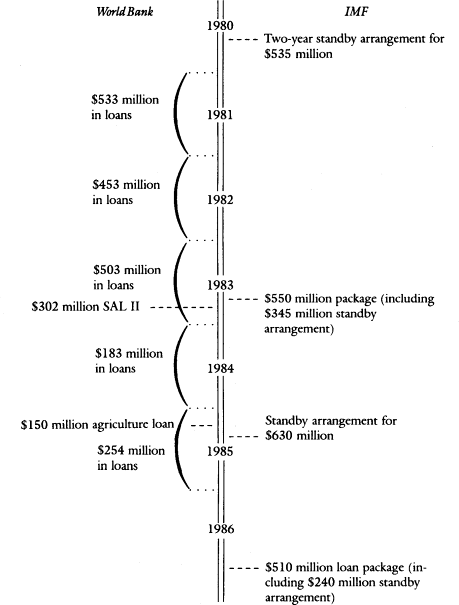
Figure 5.
Timeline: The World Bank and the IMF in the Philippines
Source: Information provided by the World Bank and the IMF, July 1986.
Instead, by the fall of Marcos, Only two SALs had been completed, the textile-sector loan had been an acknowledged failure, and no other sector loans had passed the tentative stage. These four years of pent-up frustration and discouragement perhaps explain the deluge of 1986 World Bank missions to the Philippines after President Aquino's inauguration. There was a lot of catching up to do.
But in April 1983, when SAL II was signed, the World Bank assessment of the policy changes initiated by SAL I was still rosy: "Despite the international recession and the ensuing domestic economic difficulties, implementation of the program has been good."[50] SAL II was designed to build on this success in the words of the World Bank, to "extend the guiding principle of comparative advantage" in garments, electronics, electrical equipment, leatherware, and other light manufactures.[51] SAL II included a continuation of SAL I's tariff and import reform and added a new industrial-incentives policy geared "to allow market forces to play a greater role" by compensating export firms for "market imperfections."[52] The loan also targeted certain tax changes, reform of public resource management, and restructuring of the Philippine energy sector.
As recently as February 1984, the Philippine SAL program still received rave reviews, this time from the U.S. government. Looking ahead to 1986-1990, the Manila office of the U.S. Agency for International Development forecast:
The structural improvements in the allocation and efficiency of resource use should make it possible to restore higher economic growth. . .. This rate of growth will be achieved mainly as a result of improved performance of the manufacturing sector due to the restructuring of domestic industries and the expansion of manufactured exports.[53]
But it would be only a matter of months before the Philippines' dismal economic performance smashed any such hopes. In the midst of the decline, the World Bank indefinitely postponed its third SAL, which was to have initiated a broad range of agricultural-sector reforms to increase cash crop exports and end monopolistic control of key subsectors, as well as to further earlier SAL reforms in the energy sector and in public finance. SAL III was shelved, in part, because the IMF was pursuing similar agricultural-sector reforms in its marathon debt-management negotiations. A further blow to the Bank was sustained in September 1984 when the U.S. executive director (under orders from the Treasury Department) voted against a
$150 million World Bank agricultural-inputs loan to the Philippines as an expression of displeasure at Marcos's footdragging on initiating reforms.[54] U.S. government public apprehension over Marcos dates from this vote, as do the seeds of World Bank doubts that serious policy reforms could continue to be implemented through a Marcos government increasingly inflexible in the face of growing opposition.
Industry and Finance: The SAL Record
Industry-related SAL reforms provide an example of a case where the Bank could rightly claim that many, if not most, of its policy conditions were carried through by the Philippine government. Yet the result, by almost any standard, was disaster.
SAL I was the centerpiece of the industrial-reform effort, reinforced by the textile-sector loan and part of SAL II. Key to these reforms was trade liberalization, through both tariff reform and relaxation of import controls. The first was largely a success—tariff rates on most items were reduced to the targeted range of 0-50 percent, with the average import tariff at 25 percent.[55]
Lifting of import controls was another story. As the IMF negotiations of late 1983 to late 1984 delayed badly needed injections of fresh foreign exchange, balance-of-payments difficulties worsened and a number of stop-gap controls (on both imports and exchange) were reintroduced. These, the World Bank understood, "were temporary and necessitated by the exceptional financial situation" and the Banks mid-term review of SAL II reforms in 1984 still declared satisfaction at the "substantial progress" of Philippine government reform efforts.[56] By 1986, however, there seemed to be a difference of opinion, with one World Bank official arguing that such import restrictions had intensified to the point where they "probably neutralized the effects of tariff reform."[57]
Export promotion, another SAL reform goal, was largely carried out as promised, but efforts to spread export incentives through export processing zones met with only limited success. Blueprints to create as many as a dozen more EPZs or industrial estates across the archipelago were shelved; indeed, only one new zone was opened in the wake of the SALs. This was the Cavite Export Processing Zone, formally opened as one of Marcos's last acts as president in January 1986 with the remarkable claim, "The
story of our overall economic performance provides ample proof of the efficacy and validity of the wide-ranging social and economic reforms that we have instituted in the decade just past."[58]
One other SAL reform, a more flexible exchange-rate policy, was bolstered by subsequent IMF negotiations and was a clear success. The initial "free float" that accompanied the SAL was followed by almost yearly de-valuations to the extent that a 1980 rate of 7.5 pesos to the dollar eroded to 20 pesos to the dollar by 1985.
Less success greeted the textile-sector modernization loan. Few Philippine textile firms even applied for the loan, owing to a combination of sluggish world textile markets and the firms' inability to raise enough internal company resources to finance the required 25 percent local contribution. After several years of no takers, the World Bank temporarily re-programmed most of the foreign exchange into short-term loans to finance raw materials for nontraditional-export industries (an act that itself seemed to acknowledge the pitfalls of building an import-dependent export sector) before canceling the loan in mid-1985.[59]
Moving from the Philippine government's performance in implementing the loans' conditions to the resulting performance of the economy, a decidedly more negative picture emerges. Perhaps in only one measure was the drive toward light manufactures a success. Whereas in 1970 light manufactures made up only 9 percent of Philippine exports, their share jumped to 48 percent, or nearly half, by 1983. Electronics rose to 21 percent of total exports and garments to 11 percent, both shoving aside the traditional leaders, coconut oil (with 10 percent in 1983) and sugar (with 6 percent).[60] But successful transformation of apparel and semiconductors into the mainstay of Philippine exports had its down side: as early as 1982, light manufactures began to experience difficulties finding markets. After enjoying growth rates of 32 percent in 1980 and 19 percent in 1981, Philippine nontraditional-manufactures exports skidded to a near halt with only 1.1 percent growth in 1982 and 0.5 percent in 1983.[61]
The years 1984 and, particularly, 1985 were even less kind to light-manufacturing exports. Sales of export-oriented light manufactures declined 11 percent in 1984, 43 percent for apparel.[62] Electronics exports were pummeled the following year as the computer industry suffered flagging sales in the three main markets for Philippine-assembled chips: the United States, the United Kingdom, and Japan. In 1985 alone, Philippine
semiconductor exports dove from $910 million to $711 million.[63] It is tragicomic to reread the export projections contained in the economic memorandum that the Philippine government presented to the IMF and 483 creditor banks in 1985. On paper, exports were slated to increase 10 percent that year; instead they dropped 14 or 15 percent—to total only $4.7 billion, as opposed to the $2.8 billion in debt service the Philippines owed on interest alone that year.[64]
The fabled surge in jobs in the "labor-intensive" nontraditional-manufacturing sectors also failed to materialize. Between 1980 and 1985, total employment in export-oriented light-manufacturing sectors fell 1.2 percent—7.0 percent for apparel, 1.4 percent for electronics.[65] After five years of structural adjustment, fewer people were employed in the targeted sectors than when the experiment began—and this despite lavish subsidies and incentives.
Millions of workers were laid off during the first half of the 1980s.[66] The Far Eastern Economic Review , for example, reported one survey that claimed that three million people (15 percent of the work force) lost their jobs between January 1984 and January 1985.[67] In the process, hundreds of firms went bankrupt. The Philippine Securities and Exchange Commission reported close to 200 corporate dissolutions both in 1982 and in 1983.[68] The rate escalated in subsequent years: in the first quarter of 1985 alone, 800 of the country's top 2,000 corporations ceased operations, most temporarily, some for good.[69]
Although national entrepreneurs were hardest hit, EPZs did not prove to be the promised showcases of bustling activity. After reaching a peak employment of 27,000 in 1981, the largest zone, Bataan, lost Mattel, Ford, and twenty-seven other firms; employment dropped to 14,000 by 1986.[70] That year, only fifty-eight firms were operating in all the EPZs combined: of these, twenty-four produced textiles and apparel and ten assembled semiconductors and consumer electronics.[71] Only 10 to 15 percent of the supposedly enticing infrastructure facilities in the zones were, then, actually being utilized.[72]
Some transnationals, such as Mattel, vacated the premises as their tax holidays expired, shifting their Barbie dolls closer to Manila as they planned their exodus to neighboring countries and new tax holidays. Others, such as Baxter Travenol and General Motors, left in response to the uncertainty generated by foreign-exchange shortages, labor unrest, and political insta-
bility.[73] Still others, unable to transfer dollars out of the Philippines because of strict exchange controls, made the most out of the situation by using their peso profits to expand their Philippine operations.[74] Overall, however, the country was no longer viewed as an attractive spot for new TNC investment.
The sorry state of Philippine light-manufactured exports was communicated by Aquino's new finance minister, Jaime Ongpin, to the World Bank in March 1986. Textiles and semiconductors, Ongpin confided to the visiting mission, "were in such bad shape that they are asking for a government bail-out."[75]
But the World Bank would hear of no such pessimism. Refusing to shoulder any blame for the Philippine economic collapse, the Bank instead took the opportunity of the change in government in 1986 to embark on a "revival" of its industrial-sector SAL reforms. In the words of one Bank official involved in the Philippine mission: "The [early SAL] policy reforms contemplated were . . . largely derailed by the economic and financial crisis which erupted in 1983. The effects of this crisis itself present a new opportunity for reform such that industrial growth can now be re-ignited."[76] Why? The Bank explained elsewhere:
Paradoxically, there are many features in the current situation which make it a fortuitous time to implement such a revival.
Many of the ill conceived industries that were spawned in the heady 1970s have already met their own natural death. In normal circumstances, phasing out uncompetitive industries is a painful process and usually politically infeasible. Industrial restructuring then becomes difficult to implement. In the Philip- pines' case, this pain has, perforce, already been borne and it is therefore now much easier to develop a competitive industrial structure more suited to the Philippine comparative advantage. . . The misfortunes of the last few years have increased the relative real wage difference between the Philippines and its key competitive neighbors.. —with presumably little change in relative skill composition.[77]
For what it was worth, the World Bank certainly knew how to make the most out of a gloomy situation. And to further convince the Aquino government that a rerun of the SAL I experiment was the way to go, the Bank threw in another one of its rosy, but totally unsubstantiated, projections: "With world GNP recovering, a major expansion of Philippine manufactured exports cannot be ruled out in the medium term."[78]
Shifting from industry to finance, a similarly dismal picture emerges. The centerpiece of the 1980 World Bank reforms had been the secretive, high-level apex unit built inside the Central Bank. The plan for the units future had been grand: World Bank and transnational bank loans would be channeled by the apex unit through accredited participatory banks into medium- and long-term loans for industry. But by 1986, only eight financial institutions had been accredited (seven of them universal banks) and less than a fifth of the available $250 million had been borrowed.[79]
Partial blame for the failure lies with the stagnant conditions the industrial sector faced over these years. Another portion of the blame could, however, be placed on the IMF and the World Bank themselves for other policy advice they were giving the Philippine government at the same time—specifically, their insistence on devaluation. Since the apex unit passed foreign-exchange risks on to the final industrial borrower, the steadily depreciating peso made the loans far less attractive and more risky.
The financial restructuring did succeed, however, in speeding up concentration in the sector. The centerpiece of the financial sector was a group of about thirty commercial banks that, by 1983, controlled three-quarters of the banking sector's total assets. By that year, ten of the banks had grown enough—several through large mergers—to amass a capital base in excess of 500 million pesos, which qualified them as expanded commercial banks (or universal banks).[80]
As Bank and Philippine technocrats had intended, the major victims of consolidation were the smaller members of the sector. Between January 1984 and May 1986, 168 financial institutions went under, most of them rural banks.[81] The more than 1,000 rural and thrift banks in 1984 accounted for only 6 percent of bank assets; this share fell to 4 percent in 1985. That year, 543 of the country's 949 rural banks—that is, more than half of them—were reported in trouble.[82] But the downturn was so severe that not only the small were threatened. In early 1984, the Wall Street Journal could report that "about 10 of the country's 34 commercial banks have been hard hit. . .. The banks traditionally have made profits by lending to importers who, lacking foreign exchange, recently have had to either cut back or even close down operations."[83]
In the midst of the 1984 slowdown, a new Central Bank governor, transnationalist Jose Fernandez, echoed expanded-commercial-bank over-
seer Armand Fabella's battle cry of some four years earlier and launched a "crusade" to consolidate and strengthen the financial sector. Virtually the next day, as testimony that no domestic bank was too large for the merger block, one expanded commercial bank (Bank of the Philippine Islands, 20 percent owned by Morgan Guaranty) acquired another expanded commercial bank (Family Bank and Trust Company, which had been the Philippines' largest savings bank). The marriage created the largest private commercial bank in the country.[84]
Throughout this weeding Out of the "men from the boys," the four transnational banks with fully foreign-owned branches in the Philippines fared best. A fifth of the growth of assets and deposits of all commercial banks between 1981 and 1984 was accounted for by the four transnational banks among them. These four also registered the highest profit rates, as individual savers and businesses shifted their deposits from smaller banks to the TNBs.[85]
What did the Aquino government learn from the financial-sector reforms? In March 1986 private conversations with the World Bank, new Finance Minister Jaime Ongpin suggested extending the World Banks apex-type financing of the industrial-export sector to the agricultural-export sector much as the World Bank had intended with its ill-fated SAL III. Ongpin's plan mimicked what the Bank had done in the early 1980s: he envisioned "an apex institution receiving mostly foreign soft money and Government equity and then using financial intermediaries whose resources would be matched on a 50/50 basis by the Apex's resources and be passed on to agricultural ventures as equity contribution again on a 50/50 basis."[86]
The World Bank also promised the Aquino government a financial-sector mission in fiscal year 1987 to set financial-sector reforms in motion once again. Just as the Bank was serving the Aquino government the same platter of industrial-sector reforms, there were indications that the suggested financial-sector reforms would hold few surprises. For in the financial-sector failure, as in the industrial-sector failure, the World Bank read exactly what it wanted and no more. A Bank official involved in the industry-sector missions put it this way: "Given the depressed state of the economy at present, there is almost no demand for such funds [apex term financing for industry] but as an economic recovery is launched the non-
availability of term finance could become a serious constraint impeding industrial expansion."[87] It was just like a returning door-to-door salesman, with only one set of wares to sell.
Triple Alliance Revisited
In previous chapters, analysis has focused on two sets of triple alliances that historically have advanced a transnationalist-oriented model of development. One is a domestic alliance, among transnationalist factions of government, industry, and finance. The other, first identified by Peter Evans in his work on Brazil, links transnational capital, the domestic government, and domestic business interests. Both alliances, it was argued, were strengthened during the structural adjustment drive of 1979 to 1982. How did they weather the attempted implementation of structural adjustment in a period of international and domestic crisis?
The major readjustment of the domestic alliance involved the rapid decline of transnationalist Marcos cronies in both their financial and their industrial ventures. Built on heavy borrowing and political favors, many of those ventures collapsed as credit dried up. The collapse began in earnest in the wake of the 1981 flight of textile entrepreneur Dewey Dee. From the outset, the Philippine government made the decision to bail out the leading crony banks and corporations before they sank, often to the tune of more than one billion pesos. American researcher John Lind studied fourteen Philippine firms and financial institutions that had been merged into eight larger entities and then "rescued" through major government bail-outs between 1981 and 1984. These included such giants as Delta Motors, the Toyota assembly firm, and CDCP, once the largest construction firm in Southeast Asia. Of the merged eight, six had been owned by three cronies alone: Herminio Disini, Rodolfo Cuenca, and Ricardo Silverio.[88]
Most of the bailouts were effected through the government National Development Corporation (NDC) and three government banks. The bailouts left the government not only with foundering businesses but also with responsibility for the corporations' massive foreign debt. Through the NDC's new equity in four of these eight large bailouts, for example, the government took on close to one billion dollars in foreign debt.[89]
Many non-crony businesspeople, including transnationalists such as Jaime Ongpin, then president of Benguet Corporation, grew furious that
government resources were being squandered on obviously "bad assets."[90] Ongpin claimed that Marcos let the cronies hang on to the most profitable companies in their empires: "The government takes all the lemons and lets them keep the plums. But if you're not a crony, the government takes everything."[91] The financial squeeze, in other words, led to a crack in the domestic triple alliance, pushing transnationalist cronies closer to Marcos while pulling non-crony transnationalists into the Marcos opposition. It also created tensions in the other triple alliance, the one involving transnational capital. Both cracks would later contribute to Marcos's downfall.
Evans, in his studies of Brazil, unveiled similar tensions emerging among members of the second triple alliance: "a less beneficial external environment . . . reduced the set of policies consistent with the continued profitability of both transnational corporations . . . and local capital, and brought the contradictory nature of dependent development to the fore much more quickly than might otherwise have been the case."[92]
By 1984, the Philippine situation had gotten so far out of hand that one U.S. banker commented, "I thought 18 months ago that the technocrats were running a first-class operation. I've since learned that they're running a zoo out there."[93] At that point, the World Bank, the IMF, and creditor banks openly lined up with the Ongpin non-crony faction and launched an attack against the worst excesses of "crony capitalism." It was a carefully planned attack: the Fund in the marathon negotiating sessions for its 1984 standby arrangement, the Bank in its agricultural-inputs loan of 1984, and the U.S. government in its "no" vote of that World Bank loan all targeted the sugar monopoly of Roberto Benedicto and the coconut monopoly of Eduardo Cojuangco.
Marcos took several small steps in an attempt to re-cement the cracked alliance and appease his transnational allies overseas. In December 1983, Marcos decreed that foreign investors could hold up to 100 percent of certain domestic industries.[94] Less than a month later, following the discovery of falsified statistics at the Central Bank, Marcos appointed Jose Fernandez as the new Central Bank governor. Fernandez had won the confidence of transnational bankers as president of Far East Bank and Trust Company, a universal bank owned in part by Mitsui Bank and Chemical Bank. Finally, in August of 1984, Marcos partially dismantled the monopoly in sugar trading.[95]
But, in retrospect, Marcos's steps were too little and too late. The efforts
of his growing corps of technocrats in key government posts notwithstanding, in the wake of his crony bailouts Marcos was never to regain the full confidence of the Bank, the Fund, creditor banks, or the U.S. government. By mid-1985, these external forces were actively looking for non-crony transnationalist elements with whom Marcos could be coerced to share power. Understandably, Jaime Ongpin headed many of their lists.
It was perhaps with this knowledge that President Corazon Aquino chose Ongpin as her finance minister and quickly sent him on a trip to Washington. His assurances that the foreign debt would be fully honored were met with great relief. And whereas Marcos acquired crony companies, the Aquino government sought to sell them off. Trade and Industry Minister Concepcion indicated in June 1986 that the government planned to liquidate or divest itself of about half of the seventy-nine corporations that the government-owned NDC had taken under its wing.[96]
Who would take the cronies' place in these corporations? Consider the saga of Interbank, the failing universal bank formed from a merger of crony Herminio Disini's three financial institutions in the early 1980s. During the financial crisis, the government-owned DBP had bailed Interbank out, taken it over, and later transferred it to the government-owned NDC. When the Aquino government put Interbank on the auction block in 1986, the American Express International Banking Corporation became owner of a 40 percent share, using as its bid an equivalent reduction in debt owed to it by the Philippines.[97] In other words, the moves to privatize would bring the Philippine financial sector—and the Aquino government—closer to a few transnational banks.
Overall, despite pressure from nationalists in her government, President Aquino in her first year in office demonstrated a willingness to let her transnationalist economic ministers attempt to revive the World Bank/IMF style of export-led structural adjustment. Marcos had failed in his attempt because of stagnation in the world economy and because of his cronies, but it is clear that even had he achieved success, it would not have been a victory for the majority of Filipinos.
The course launched by Aquino's leading economic ministers, Ongpin and Fernandez, seems similarly destined to fail. Not only does the world economic climate remain hostile, but also transnational capital—with the exception of "captive" creditor transnational banks—is no longer interested in new Philippine involvement. In such a brutal external environ-
ment, development strategies desperately demand rethinking. Some of that rethinking is already going on and deserves greater exposure.
Rethinking Development
During the dozens of interviews with Philippine, World Bank, and IMF technocrats conducted in the early 1980s, an implicit view of development continually emerged. Economic growth with political stability, almost all these transnationalists believed, could be achieved through one fairly universal set of policy instruments: free trade and investment. Let free-market forces determine prices. Guarantee that those economic sectors geared to the world market receive primacy in the allocation of state resources. And, accordingly, the global capitalist world's free-market capitalism and tech-nocratic modernization would ensure the ideal environment for these policies—the expansion of world trade.
This, in a nutshell, was the dominant version of structural adjustment—the one path to growth and development—that was seen as a given by those interviewed. The rules were viewed as objective ones. Few doubted that the entire population would benefit from such an approach, perhaps not in the short term, but at least in the end. This approach was presented as a science, and the language the technocrats used to portray policy choices enhanced this aura of objective correctness. Their own market interventions, those promoting exports, became "incentives"; interventions leading in any other direction were called "distortions."
This book has argued, through a case study, that this version of structural adjustment certainly assisted some, just as it certainly hindered others. In particular, the Philippine industrial structural adjustment aided a select group of transnationalist entrepreneurs and hurt smaller national entrepreneurs and industrial workers. The approach was entirely from the top down and involved no participation from those most adversely affected. One person's "incentives" were another's "distortions."
A more global example of this reality surfaced in the mid-1980s when World Bank agricultural-export loans helped propel vast quantities of Third World cash crops—Argentine grain, Malaysian palm oil, Thai rice, etc.—onto world markets. U.S. farmers, hurt as they lost markets to these lower-cost Third World competitors, lashed out against the World Bank loans as "unfair subsidies." Similarly, cheap wages are viewed as an "incen-
tive" by some and as a gross violation of labor rights by others. The diagnosis differs depending on where you stand.
In this sense, it is difficult to judge development experiments as total successes or failures: most tend to help some groups and to hurt others. That many in the Bank and the Fund acknowledged Philippine development to be a failure by the end of the Marcos reign was because they measured it against one indicator: growth. And they blamed the dismal growth statistics not on their own models but on the slowdown of world trade and the excesses of Marcos's cronies.
When pushed on that acknowledged failure, the transnationalists (be they Bank, Fund, or Philippine officials) usually throw back a two-pronged defense: "What? Are you against adjustment?" and "Well, if you're against export-led growth, then you're for import substitution—which didn't work any better and certainly left many more distortions."
The short answer to both charges is no. Of course, there is a need for adjustment of structures. The question is, adjustment for whom? There are no easy answers or universal models—although there are certainly more options than just export-led growth or import-substitution industrialization.
Instead, two principles may be posited on which any version of adjustment that furthers genuine development should be based. First, developing countries should diversify and reduce their dependence on the world economy. Diversification would prevent economic (or political) events in one developed country or region from thoroughly disrupting everyday life and medium- to long-range planning. Reduction does not mean autarky. It means carefully rethinking trade and financial linkages so that they conform to a development logic that is internally consistent, rather than geared to the demands of Western corporations and consumers. This is important not only because we appear to be in the midst of a new era of vastly reduced growth of global markets.[98] It is important also in order to regain sovereignty over national economic events, a goal that political independence granted to very few developing countries. As the world economy has become more integrated, effective sovereignty across the developing world has waned.
Second, people—their dignity, their participation, and their empowerment, as well as the satisfaction of their basic needs—should be the primary goal of any development effort. Given the grossly unequal distribution of wealth and income that characterizes most of the Third World,
this means placing redistribution and equity policies at the very top of the adjustment priority list. It also means setting up a development process in which people participate in making decisions and planning projects that affect their lives where inhabitants of an area decide what kind of projects they want and what kinds they can afford. This is very different from the more typical situation in which those who will be affected sit passively on the sidelines watching World Bank teams scurry in and out of the country, planning with top government officials how to irrigate farmlands, generate electricity, improve road facilities, and so on—changes the majority of the supposed beneficiaries may or may not want or be able to afford. The Bank missions, in their orderly technocratic fashion, have become all-knowing; the people, unconsulted.
Some at the World Bank would argue that they agree with this second principle and, moreover, that the Bank has taken it seriously ever since the 1974 publication of its "semiofficial" volume (produced jointly with the Institute of Development Studies in Sussex, England), Redistribution with Growth . That volume concluded that "the cross-section evidence does not support the view that a high rate of economic growth has an adverse effect upon relative equality," and it argued for the twin pursuit of growth policies with projects aimed to increase the productivity, income, and output of the poor.[99] Bank President Robert McNamara immediately picked up on this, steering the Bank toward both export-led structural adjustment and an increased emphasis on project lending for rural development, urban slum improvement, small-scale enterprises, and population planning.
The problems with this approach were plentiful,[100] but two stand out. First, the Bank (particularly since 1979) placed primary emphasis on the export-led structural adjustment policies. Although the World Bank publicly said that a "purpose of adjustment is to establish a policy framework more favorable to growth which is a prerequisite to the alleviation of poverty,"[101] we have seen how in the Philippines adjustment contributed instead to a substantial rise in joblessness. Only as a secondary priority did the Bank come in with its poverty-oriented projects to patch up the damage already done. People-oriented development must, rather, be the center-piece—not a hoped-for side effect or an attempt to reduce a potentially troublesome aftereffect.
Second, the Bank seldom seriously consulted the intended local beneficiaries of its poverty-related projects. A fascinating glimpse of this was
afforded by accompanying a disgruntled Philippine mayor through the World Bank in 1981—in the midst of the Philippine SAL process. He had come to attempt to extricate his city from a World Bank "slum improvement" loan to which the mayor who preceded him had agreed. The new mayor found that the majority of the intended beneficiaries had no idea that the improvements constituted a loan they themselves would have to repay through increased rents and that, in fact, they would be financially unable to afford the higher monthly rents. The discovery shocked the mayor enough to prompt him to go right to the source of the problem: the World Bank's Washington headquarters. Once there, the mayor was told to go home: the loan was already signed and the World Bank dealt only with the relevant national-level housing authority, not with elected mayors. The slum dwellers would pay those increased rents or face eviction.
The technocrats' other frequently mentioned defense of export-led growth—the reference to the failures of import-substitution industrialization—is certainly partially true. Import substitution, as practiced widely in the Third World in the 1950s, was largely inefficient, costly, and rarely moved beyond production of light consumer goods.[102] Yet, the defense itself is a sad commentary on both the state of development economics and the technocrats' visions of development. In many of their minds, developing countries had and continue to have only two choices: export-led growth, or import-substitution industrialization. If you are against one, you must be for the other.
Part of the reason for this narrow conception of options is found in the tragic 1982 reflection on the field of development economics by one of the giants of development thinking, Albert Hirschman: "The old liveliness is no longer there . . . new ideas are even harder to come by and . . . the field is not adequately reproducing itself."[103] Around the same time, development economist Paul Streeten wrote, "At the end of the day . . . we must confess that we do not know what causes development and therefore lack a clear agenda for research." [104]
Despite this withering of the development debate in academic circles, the field is and has long been far richer than a choice between export-led or import-substitution strategies. Indeed, what is needed is not "new ideas." What is needed is a revival of the debate over a wide spectrum of analyses and experiences that have been offered over the past two decades. Many
have brought fresh perspectives to the questions of linkages with the world economy and people-oriented development.
To provide a flavor of some of the offerings, six are mentioned six among many that should have led to robust debate during the last ten years but instead were drowned by the dominant paradigm of development:
1975-1977: Publications of the Dag Hammarskjöld Foundation in Sweden spell out approaches and strategies for "another development" focused on fulfillment of material needs (employment, habitat, health) and nonmaterial needs (education, democratic rights, spiritual fulfillment) in an ecologically sound and self-reliant manner.[105] The Foundation expands on this in subsequent years, calling for "another development with women."[106]
1978: A debate is launched over the costs and benefits of various degrees of openness to the world economy. Carlos Díaz-Alejandro and others argue the merits of "selective delinking" from the world economy.[107]
1980: African nations meeting in a special session of the Organization of African Unity draft a blueprint for African self-reliance. This Lagos Plan of Action identifies an increase in indigenous food production and distribution as their top development priority.[108]
1985-1987: UNICEF carries out a series of studies on the impact of debt and world economic crises on children. From this evolves the notion of "adjustment with a human face."[109]
1985: The Inter-American Development Bank (IDB, the mini-World Bank for the Latin American and Caribbean region) shocks its major donor, the United States, by using the IDB annual survey on economic and social progress in Latin America to give voice to criticism of the dominant model of structural adjustment. The survey reviews the evolving schools of thought on development in Latin America and argues that a neo-structuralist consensus is emerging which rejects both the short-term policies of IMF adjustment and the longer-term policies of export-led growth.[110] From 1985 on, the debate widens from theory to practice as fledgling democratic governments in Argentina, Brazil, and Peru initiate their own brands of anti-inflationary programs and explicitly reject traditional IMF guidelines and expertise.[111]
1979-1986: The Nicaraguan development experiment provides a tu-
multuous testing ground for people's participation in development. Local popular organizations and ongoing literacy and health campaigns strive to empower people by involving them in the development process.[112]
In the Philippines, similar debates and experiments are being launched and revived with the new political opening—the apertura , as they say in Latin America—that has accompanied the Aquino government's assumption of power. In 1986, both a study by a team of academics and a draft agenda for "people-powered" development by the government's National Economic and Development Authority publicly initiated discussions on the best routes to a new set of goals: generating employment, respecting workers' rights, lowering the debt service payments, alleviating poverty, and ending crony-type abuses.[113]
A resuscitated national press and popular education publications are helping make this a debate among the Filipino people. The Manila-based Ibon Databank research group, for example, has disseminated highly accessible, nontechnocratic summaries, discussions, and critiques of the NEDA plan throughout the country.[114] At the same time, popular organizations representing various social sectors and coalitions have responded with their own development goals. The multisectoral, nationalist coalition Bagong Alyansang Makabayan (BAYAN, or New Patriotic Alliance), for instance, has articulated popular demands for genuine land reform, foreign capital controls, and increased linkages between domestically oriented agriculture and industry: The National Economic Protectionism Association, fairly dormant during the years of martial law, has rejoined the debate with a young generation of economic nationalists joining the old to plot a new path to "Filipino First."
These debates will continue to grow in intensity in the Philippines and across the rest of the Third World. The World Bank and the IMF seem intent on ignoring or attempting to sidetrack these voices for as long as possible.[115] Indeed, the Bank and the Fund will use the pressures of the debt crisis and the desperate need of many countries for external credit to continue to impose their model of development and adjustment. The economic and political power of these institutions is enormous—and daunting. It translates into access to the international press, an ability to dominate establishment development circles, and a strong influence on the popular debate on development.
The challenge that faces the development community is to confront the orthodoxy head on. Each case of structural adjustment must be studied and debated thoroughly. And through this, the questions must be refocused. For it is not a matter of whether or not to adjust. It is, rather, adjustment for whom?