
Some Recent Results from Coda Wave Analysis
The coda waves of local earthquakes have been studied extensively by a stochastic modeling approach, as summarized in a recent review by Herraiz and Espinosa (1986). The most remarkable feature of coda waves is their independence of the source-receiver path, as demonstrated by Aki (1969), Aki and Chouet (1975), Rautian and Khalturin (1978), and Tsujiura (1978), among others, for various parts of the Earth. To illustrate this independence, figure 3 shows the records of a local earthquake recorded by the NORSAR
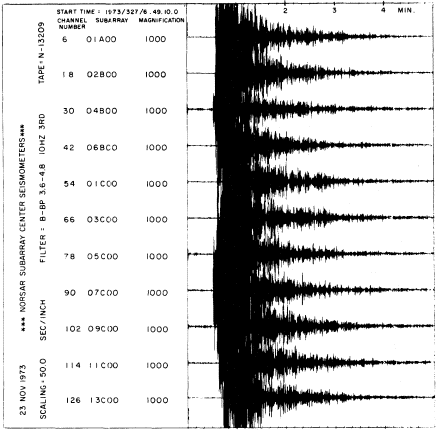
Figure 3
Short-period (band pass from 3.6 to 4.8 Hz) records of a local earthquake at
various subarray centers of the NORSAR array. The epicentral distance is a
few kilometers to the closest subarray and more than 100 km to the farthest.
The decay of coda amplitude shows no dependence on the distance between
the earthquake source and seismograph station.
array with an aperture of about 100 km. The epicentral distance is a few kilometers from the closest subarray and more than 100 km from the farthest. The direct P- and S-waves (not recognizable in fig. 3) do, of course, vary strongly among the subarrays, but the amplitudes of the coda waves and the manner of their decay are roughly the same for all subarrays, despite the great differences in source-receiver distance.
The above simple and clear observation demands explanations. A deterministic modeling of coda waves, however, is impossible because we don't know the details of small-scale heterogeneity in the Earth that may be affecting observed coda waves.
The above observation can be explained if coda waves are backscattered waves from heterogeneities distributed randomly throughout the lithosphere. Assuming further that they are due to single S-to-S backscattering, Aki and Chouet (1975) obtained the power spectrum of coda waves at a lapse time t (measured from the origin time) for the case of coincident source and receiver

where ß is the S-wave velocity, g (p ) is the backscattering coefficient, ø0 (w , r ) is the Fourier transform of primary S-waves observed at a distance r from the source location, and Qc is the apparent quality factor obtained by fitting equation (1) to the observed envelope of coda waves. If the assumption of S-to-S single scattering is correct, Qc should be equal to Qß of direct shear waves, which was confirmed, at least for Japan, by Aki (1980).
Singh and Herrmann (1983) estimated Qc at 1 Hz in the continental United States and found a very strong positive correlation between Qc –1 and regional tectonic activity. Their spatial resolution for the Qc–1 measurement, however, was limited to about 1,000 km because they used the time window from about 100s to 1,000 s due to the great distance between the epicenter and the station. Because of this poor spatial resolution, areas, such as New Madrid and Charleston, with historic seismicity could not be identified as low-Q areas.
To study the relationship between Q–1 and historic seismicity, we need higher spatial resolution than 1,000 km for the Q–1 measurement, as well as better seismicity records. China has one of the most complete catalogs of historic earthquakes and relatively uniform and dense distribution of local seismic stations.
Jin and Aki (1987) applied Herrmann's (1980) method of determining Qc to more than 1,000 seismograms from local earthquakes near eighty-two stations distributed throughout China. The resultant Qc value at 1 Hz is plotted at each station in figure 4, where contours of constant Qc are drawn for Qc = 100, 200, 400, 600, and 1,000. The resultant contour map of Qc divides the mainland of China into several high-Q and low-Q regions. This map shows much more detailed variation of Qc than that obtained by Singh and Herrmann (1983) for the United States, because the latter is based on the coda data for the lapse-time window from 100 s to 1,000 s, while the map for China is based on the coda data for the lapse-time window up to about 100 s.
The contour map of Qc is compared with epicenters of major earthquakes (M > 7 ) in figure 5. We find a very strong correlation between them: seismically active regions such as Tibet, western Yunnan, and northern North China correspond to low-Q regions, and stable regions such as the Ordos plateau, middle-east China, and the desert in southern Xinjiang have very high Q.
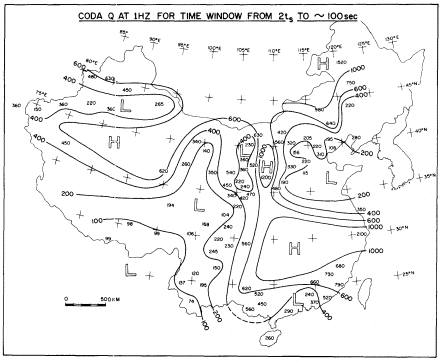
Figure 4
The values of Q c in mainland China at 1 Hz from the time window from
twice the S travel time to about 100 s, and the contours of constant Qc
for Qc = 100, 200, 400, 600, and 1,000.
Two different symbols are used to distinguish earthquakes that occurred before 1700 from those that occurred after 1700. As is well known among Chinese seismologists, there has been a migration of epicenters from west to east during the last 300 years in North China. It is interesting to note that current Q values for the region active before 1700 are about twice as high as those for the region currently active. This result suggests that the low-Q region might have migrated together with the high seismicity. This suggestion has been confirmed by the Q value estimated by Chen and Nuttli (1984) using the map of intensity decay. Jin and Aki (1987) found that the Q value measured from the intensity decay for an earthquake that occurred before 1700 in the northern North China area was indeed about half the current Q value measured by the coda method.
Thus, the analysis of coda waves by a stochastic modeling approach leads to an extraordinary finding that the Q value changed by a factor of two in about three hundred years.
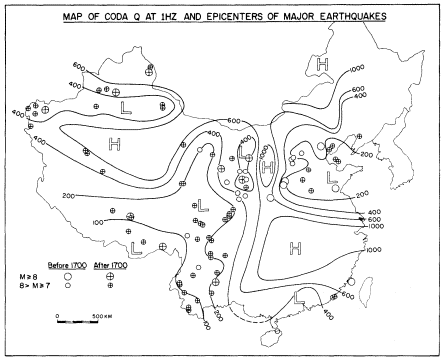
Figure 5
Map of Qc at 1 Hz and epicenters of major earthquakes with M > 7. Different
symbols are used for earthquakes that occurred before and after 1700.