
Better to Die Free
During the years of the oil industry's expansion from 1911 to 1915, there was very little labor unrest. Workers for the foreign oil companies received salaries superior to any other work in the nation, and they had yet to experience any ill effects of their proletarianization. But beginning in 1915, they quickly perceived the costs of depending upon selling their labor power. Wartime and revolutionary inflation eroded their high standards of living. Ordinarily, workers would not have been motivated to strike if they were being laid off, when those still having jobs became quite conservative. Tampico and
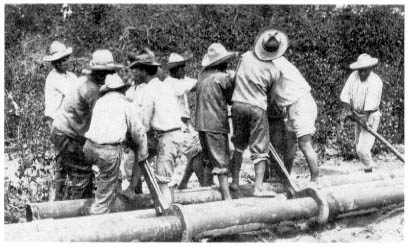
Fig. 16.
Laying pipe, c. 1920. Mexican workers of Jersey Standard's Transcontinental
Petroleum Company use pipe tongs to assemble an oil pipeline near Tampico.
Courtesy of M. Philo Maier.
Minatitlán were full-employment towns during the years of the European war and Mexican Revolution. Workers struck when the terms of employment favored them and when companies could not easily find suitable replacements. Moreover, the so-called labor aristocrats, the relatively privileged workers who had skills and higher pay, could be quite militant.[108] They certainly were in the oil zone. Although oil-field workers suffered the revolutionary depredations, refinery workers led the strikes. What is more, the most skilled of the refinery laborers organized unions, often advised if not led by members of the bourgeoisie like lawyers and school teachers. Also, the workers acted upon their heritage of appealing to political authorities for redress of grievances. New revolutionary politicians responded, so long as the workers did not disrupt the collection of taxes from the foreign companies. This was not particularly revolutionary. The workers never demanded a redistribution of property or the elimination of foreign capital. Instead, they pressed for reforms and a degree of income redistribution to blunt the worst aspects of their new status as proletarians. The Revolution aided them.
The Tampico oil workers began to feel the first pinches of inflation and food scarcity in 1915. On the strength of full-employment expansion in the industry, they responded with demands for higher wages.
The skilled workers had first organized a grouping of "Artesanos Latinos Profesionales" in 1913, under the leadership of a Spanish carpenter and several local teachers. A different group of skilled employees at the El Aguila refinery formed another organization, the Unión de Petroleros Mexicanos. Firemen, still men, carpenters, and mechanics formed its governing council. In April 1915, the workers at Minatitlán carried out a three-day work stoppage, demanding a 100 percent increase in their pay. First Chief Carranza and Governor Aguilar quickly offered protection to the 150 British employees at Minatitlán. Meanwhile, the workers gained a pay increase and the nine-hour day.[109] The strike that broke out on the morning of 27 May at the Standard Oil topping plant in Tampico had as its main objective the eight-hour day. Colonel Espinoza summoned plant superintendent C. O. Meyer to military headquarters and told him to accede to the strikers' demands. "He asked me, too, if it was certain that work had ceased in the plant and if some workers had crossed the strikers' picketline," Meyer reported. The superintendent admitted that he had encouraged a breach of the picket line because the workers had refused to return to work.[110] Meyer was not deported, after all.
The leadership of the Casa del Obrero Mundial also sought to reduce the employer's absolute control of the workplace. One thousand Huasteca workers went out in July to force the company's recognition of their union. Local authorities immediately guaranteed protection of company property, and the American employees kept the plant operating. El Aguila's laborers walked out in sympathy, though neither company would consider recognition of the unions involved. Apparently, wages were not an issue, since the company had just agreed to a 50 to 100 percent pay increase.[111] The struggle aroused the Mexican workers' resentment toward the Chinese and American laborers, none of whom were involved in the Mexican unions. Huasteca strikers demanded that the Chinese cooks be dismissed, but the company refused to give in. Some intimidation of nonstriking Mexican workers occurred. Casa sympathizers "intercepted the few who are working while they were returning to their home for dinner and threatened to kill them."[112] Andrés Araujo, general secretary of the El Aguila union, issued a stern warning to all foreign employees of the company. If the minority of workers do not respect the will of the majority, he said, the strike committee "shall exercise the force of direct action in order to have them comply by means of brute force what they do not and cannot understand by the light of reason."[113]
The labor leaders appealed to national political and military figures. They wrote to Gen. Pablo González, complaining of the "chaos" at the El Aguila plant and how "the bourgeoisie" was violating the general's own "progressive" decrees. He had designated an associate to intervene and mediate a previous dispute, which gained a wage increase for the boatmen. Nevertheless, General González requested advice from Pastor Rouaix, then an assistant secretary of the Ministry of Development, on how to deal with the petroleum companies. He said he wanted to be able to settle future strikes favorably for both parties but especially for the interests of the workers.[114] For the most part, the military authorities wanted to prevent the destruction of property so that the city's economy would not suffer.
Labor used more coercion in November when the Casa-affiliated union of the Colonia Transportation Company struck for the eight-hour day. The Colonia operated the water transport and motor launches under contract to the oil companies. The men on the picket lines intimidated those attempting to cross them and set fire to several company buildings. "Owing to the fact that there are about ten or fifteen thousand workmen and only three or four hundred soldiers in Tampico," reported the American consul, "the situation is a very delicate one and the military forces are afraid to forcibly resist the workmen for fear of creating riots."[115] The year 1915 ended on this distinctive note.
The struggle continued into the next year. In January 1916, the El Aguila workers at Minatitlán once again went on strike over wage issues. The state governor did not favor the strikers and on the sixth day persuaded the men to return to work. They walked off their jobs again in February. The strikers resented being paid in inflated Mexican paper money and demanded gold pesos. The strike spread to the nearby oil fields of Ixhuatlán and Nanchital, and crews on the coastal tank steamers agitated for a 20 percent pay increase. El Aguila's superintendent Gulston reported that the strikes were the result of "the great fluctuations in exchange and the consequent increased cost of living, and to the agitation existing on account of the Unions and their agitators."[116] By April, Tampico unions belonging to the Casa del Obrero Mundial sent ultimatums to employers. They demanded that the wages be paid on the basis of the Mexican gold peso and that the men receive their wages once a week rather than bimonthly. They also wanted an eight-hour day at the same daily (ten-hour) wage. Responding to the breakdown of the Mexico City alliance between the Casa and Carranza,
General Nafarrete sent troops against the strikers. He rounded up several union leaders. Moreover, the general instructed the unions to submit their grievances to him rather than to the employers.[117] State repression was just as ineffective in Tampico as in Mexico City. The workers continued to carry out the strikes, even if the Casa's leadership was thrown into doubt by sudden political disfavor.
General unrest among the workers resulted over wages — not union recognition — in the late spring of 1916. They demanded that the company pay them their wages equivalent in gold. But the companies calculated that the gold value of the peso was thirty cents (U.S.), whereas the workers insisted on the traditional gold value of fifty cents. Companies also resisted giving in to the eight-hour day. Once again, General Nafarrete attempted to negotiate, for he was not willing to permit the workers to riot. He expressed disgust at the recalcitrant attitude of the companies, which had discharged some of the strikers. Nafarrete assembled the workers in a mass meeting and told them to return to work for the pay raise that he had negotiated. The eight-hour day would be discussed later. The military commandant also informed strikers that if they started trouble, he would shoot them. The May unrest did not end with Nafarrete's intervention. Police arrested three foreign workers after an African-American boatman shot several Mexican picketers attempting to prevent the departure of an oil launch.[118]
Not all laborers sympathized with this agitation. It is probable that if authorities had not guaranteed the safety of nonstriking workers, many workers would have joined the strikers out of fear. General Magaña, chief of the local garrison, promptly called in the agitators, however, and warned them that he would not permit the slightest act against the right to work or against property. He held the labor leaders personally responsible for the commission of any such acts. The posting of soldiers around the city — military authorities were already edgy about pelaecista activity — calmed the labor situation, even though the companies had not yet endorsed the eight-hour day. Finally, the local military authorities wearied of the labor unrest. They decreed that the army was the supreme arbitrator of all wage and labor matters. They directed foreign businesses to pay all wages on the basis of the Mexican gold standard, regardless of the value of paper money. Any employer not willing to do so was invited to leave Mexico. The oil companies quietly agreed to pay on the gold standard but still refused to accede to the eight-hour day, obviously with the approval of the military.[119] The
men were satisfied and returned to work, putting off further demands for a more appropriate time.
Labor agitation continued throughout the summertime. At the end of June 1916, responding to the popular disapproval of Pershing's expedition in Chihuahua, spokesmen at a labor rally denounced the Americans and promised to destroy the refineries if the marines landed. Meanwhile, General Nafarrete moved to repress another anarchist-inspired call for a general strike in Tampico. Nafarrete had just won the local election to attend the constitutional convention in Querétaro. "I speak to you without my commission as general, as I promised", he said following his election, "because political imposition is repugnant to me; today we are instituting a democratic government, and I desire not only to speak democratically, but also to demonstrate with deeds that I am a democrat."[120] Although Nafarrete was not a worker himself, his experience in Tampico informed him well as to the demands of the workers for a minimum wage and for the eight-hour day. These essentially working-class demands — and the state's role as labor mediator — found their way into the constitution, which should not cause surprise.
Even as the constituyentes met in December of 1916, labor activities continued in an effort to raise wages again to meet the steady rise in the cost of living. The Minatitlán refinery workers of El Aguila gained the concessions of being paid principally in silver currency and of receiving food tickets to supplement their income. Then the day laborers mounted a two-day strike at the Tampico refinery. They wanted higher wages to offset rising food prices.[121] Some nonstrikers were prevented from crossing the picket lines, and the general secretary of the journeymen's union exhorted all workers to practice self-discipline and mutual support.
With profound indignation we have seen the villainous tyranny with which the companies treat us and especially El Aguila and Huasteca and others which impose laws that appear that we are in Babylon, without there being anyone to oppose this evil. In view of this, this union has agreed to request a pay increase of 75% over present salaries and that we be paid on the Saturday of each week.
Labor leaders invited their compatriots in other industries to mount a sympathy strike. "Compañeros: To the fight," they said; "do not fear death, because dying free is better than living as a slave."[122] Combative rhetoric for a simple pay raise.
By that time, the local Constitutional authorities had again run out of patience. They received a directive from Carranza to punish with
death the acts of inciting to strike and promoting property destruction. Dispatched to the El Aguila refinery, troops apprehended and shot Manuel Rodríguez, thought to be the strike agitator. In fact, the real union leader was named Luis Rodríguez.[123] But the year 1916 ended with several patterns quite well established. Military officers at Tampico had already taken an active role in mediating labor disputes, forcing the companies to pay wage increases while also protecting their property. No constitutional authority as yet had required this intervention — but it was customary in Mexico. Workers had made known to authorities their demands for the eight-hour day and for wages that compensated them for higher prices. As they attempted to reestablish the political order in the final years of the Revolution, the bourgeois politicians could not have failed to understand: the workers were imposing certain economic reforms as a price of industrial peace. If the constituyentes intended Article 123 as a palliative — and they probably did — they were mistaken. Buoyed finally by the state's formal recognition of proletarian rights, workers now redoubled their efforts to press their demands. Dependent they may have been, but oil workers were not helpless.