
Good Greeks and Bad Greeks
In his capacity as attacker of provincials Cicero appears in an unfavorable light, exploiting the vulnerabilities of those who could be made to appear outside the pale of what continued to be, at least in its upper echelons, a narrow, conservative society.[3] It is particularly fortunate for
[2] While the establishment in 149 B.C. of the Quaestio de rebus repetundis (known as the "extortion court") demonstrated Roman willingness to provide an opportunity for provincials to seek redress for ill treatment received at the hands of their governors (whose authority during the period of magistracy abroad was all but absolute), nevertheless the long history of this court points as well to the severity and continuity of Roman abuse of provincials. For a political and legal analysis of the functioning of such courts, see Gruen, Roman Politics . (Gruen, App. E, 304–10, gives a summary of trials between 149 and 78 B.C. , including de repetundis cases.)
[3] On the composition of society in Cicero's day, see Wood, Cicero's Thought, 14–41.
our study of Cicero's manipulation of arguments relating to ethnic character (if not for our belief in Cicero's unwavering high-mindedness) that among the orator's extant works there is one, the Verrines, in which the orator assumed the role of defender of the rights of Greek provincials, while in the Pro Flacco we see him defending a Roman governor accused of trampling on those same rights. A comparison of these works is also of special interest here because in them Cicero used geographical determinants to distinguish Greeks whose character was supposedly consonant with the prevailing negative stereotype from those whose admirable traits made them exceptions to the rule. Before embarking on an analysis of these speeches, however, let us turn briefly to two other orations in which, as in the Pro Flacco, Cicero was asked to defend the former governor of a province. Although the Pro Fonteio and the Pro Scauro were concerned with impeaching the credibility of the Gauls and Sardinians rather than the Greeks, these speeches provide a revealing introduction to the general strategies used by Cicero in attacking non-Romans—strategies that could be adapted for use against a variety of ethnic opponents.
In the Pro Fonteio, dated 69 B.C. , Cicero defended Marcus Fonteius, who was accused of misconduct during his two-year praetorship in Gaul. Cicero praises Fonteius as a military man of outstanding talents, one of an increasingly rare breed on whom the Republic depended for its safety, a worthy heir to the seasoned campaigners of previous generations (42–43). Against the valiant Fonteius stand the Gauls, ranged before him now in court as once they had been on Gallic battlefields. These barbarian witnesses, according to Cicero, are incapable of providing trustworthy evidence, since they have no sense of the enormous burden of giving sworn testimony. One has only to compare the behavior on the witness stand of even the lowliest Roman to the most honorable of Gauls to realize the truth of this statement. The Roman is filled with anxiety lest he seem to betray the modesty and good faith (28: pudoris ac religionis ) required of him; the Gaul, on the other hand, is unconcerned with his reputation and speaks with a boldness that betrays his unreliability. This willingness to disregard the sanctity of the oath is hardly surprising, Cicero points out, as the Gauls are a race distinct from all others, feeling neither fear of nor respect for the immortal gods. Cicero supports this contention by reminding his listeners of the attack on Delphi by Gallic raiders in the third century and of the Gallic sack of Rome at the beginning of the fourth century, and by referring to the Gauls' "savage and barbaric custom" (31: immanem ac barbaram
consuetudinem ) of sacrificing human beings to placate their angry gods (30–31).
While claiming that no scruples restrained the Gauls from violating their oath and giving false testimony against Fonteius, Cicero at the same time imputes to the foreigners a compelling motive for committing perjury: their implacable hostility to Roman rule. According to the orator, the Gauls harbor the resentment of the recently conquered and begrudge the money, men, and grain they are forced to render to their new masters (12–14, 17). This resentment is expressed with a ferocity that sets them apart from all other peoples. They are "most hostile and most savage" (41: inimicissimis atque immanissimis ) and "the most implacable and most cruel enemies of the Roman people" (43: inimicissimis populo Romano nationibus et crudelissimis ). The repetition in different forms of the words iracundia (15), iratus (18, 21, 36), cupidus (21, 29, 32), temere (29), libido (4, 36, 49), immanis (31, 33, 41, 44), and crudelis (43) in connection with the Gauls further reinforces this image of a wild and threatening race, awed by neither men nor gods, consumed with a desire for revenge against their conquerors. And because the prosecution apparently had presented no hostile witnesses from among the Roman citizens resident or doing business in Gaul, Cicero is able to claim that the case could be seen as a battle between all those loyal to the state and the barbarian hordes. On one side are the Gauls, traditional enemies of Rome, once more to be seen parading about Rome in their absurd garb, uttering threats against the Republic in the very Forum of the Roman people (33). Ranged on Fonteius's side—that is, on the Roman side—are all the Roman citizens of Gaul, the Roman colony of Narbo Martius, and the friendly Greek city-state of Massilia (14–15, 45–46). Even the other provinces oppose this Gallic attack on the homeland, for protecting Fonteius on one wing, says Cicero, stands Macedonia, which owes a debt of gratitude to the accused for his successful campaigns against its Thracian enemies; on the other wing is Further Spain, which "is able to resist the passion (cupiditati ) of these [Gauls] not only by its loyalty (religione ) but is able to refute the perjury of these wicked men by its testimony and praises" (45) .[4]
A somewhat different, but no less damning, picture of provincial wit-
[4] For Roman stereotypes of Gauls see Balsdon, Romans and Aliens, 65–66, 214–15.
nesses can be found in the Pro Scauro .[5] Although the speech is preserved only in two large fragments, enough of the oration is extant for us to trace the orator's plan of attack in dealing with the Sardinian witnesses whose testimony formed the mainstay of the prosecution's case. Cicero prefaces his remarks on the Sardinians with a commonplace elevating the importance of argument over the evidence of witnesses (15–16).[6] He then declares that in this case in which the witnesses are all of "one complexion, one voice, and one nation" (19: unus color, una vox, una natio ), he will not attempt to take them on individually but will confront the whole army in a single great encounter. This he proceeds to do, after revealing that the impetus for the case had actually been supplied by the consul, Appius Claudius Pulcher. According to Cicero, ApPius had hoped that by encouraging the prosecution he could undermine the consular campaign of Scaurus and thereby secure the election of his brother Gaius (31–37).
The attack on the testimony of the Sardinians occupies sections 38 through 45, which was, presumably, the central portion of the argument. Cicero begins by alleging that the unanimity of the Sardinian responses proved their testimony to be a fabrication, created out of greed for the rewards promised them by Appius and the prosecution (38). He then expands upon the failings of the race that would make these charges of conspiracy and perjury believable. While disavowing any prejudice against the Sardinians, Cicero remarks that even if they were to come as honest witnesses, the "reputation of the race" (41: gentis . . . famam ) was such that they ought to be amazed whenever they were taken at their word.[7] Cicero's audience is then presented with the orator's account of the history of racial degeneration that had produced the Sardinian people. He declares:
All the memorials and all the historical records of antiquity have revealed to us that the Phoenician race is the most deceptive of all (42: fallacissimum );
[5] On Scaurus and the political background to the speech, see Henderson, "The Career of Scaurus"; Courtney, "The Prosecution of Scaurus."
[6] Quint. 5.7.3: In actionibus primum generaliter pro testibus atque in testis dici solet. Est hic communis locus, cum pars altera nullam firmiorem probationem esse contendit quam quae sit hominum scientia nixa, altera ad detrahendam illis fidem omnia per quae fieri soleant falsa testimonia enumerat. Cf. Lausberg, Handbuch, 1:192–93 (§354).
[7] For the negative stereotype of Sardinians, see Cic. Fam. 7.24.1; Tac. Ann. 2.85; Mart. 4.60.6; Paus. 10.17.1–7. See also Rowland, "Sardinians in the Roman Empire."
the Poeni, who sprang from them, proved by the many revolts of the Carthaginians and the many treaties they violated and broke that they had in no way declined from their ancestors; after elements of the African race were mixed in with this stock, the resulting Sardi were not led forth and settled in Sardinia but were rather marooned and exiled there by the Poeni. Wherefore, since there was nothing healthy in the pure stock of this race, how greatly corrupted should we judge it after so many such racial interminglings?
(42–43)
The orator hastens to note that there were certain Sardinians—notably those who were his own friends and those who were supporters of Scaurus—who, by their personal excellence, had overcome the shortcomings of their heritage; these men, however, were only exceptions to the generally recognized rule that the majority of Sardi were "without loyalty and without any bond or tie" (44: sine fide, sine societate et coniunctione ) that connected them to the Roman people.
In the Pro Fonteio and the Pro Scauro Cicero has varied the type of ethnic attack with the peoples who are the target of the attack. The Gauls are made to seem by far the more formidable of the two races. They are a savage, cruel, and angry lot who believe they can intimidate the Roman judicial system with their fierce threats. Towards the Sardinians Cicero assumes a more contemptuous tone, speaking of their slavishness, sordidness, and moral worthlessness. In both cases, however, the final judgment is identical: neither race is capable of observing the fides and religio that guarantee the weight and credibility of their testimony.
These two terms, which appear several times in the two speeches, are of broad significance and are difficult of exact definition. Fides was used to describe the quality that produced the conviction that an individual could be trusted—whether as family member, friend, patron, client, business associate, magistrate, or witness—as well as to describe the conviction itself (thus it meant both "trustworthiness" and "trust"). A breach of fides between citizens was an offense on several levels: such an action could be grounds for social stigma and political attack; it could constitute the basis for an action at law; and it was a religious offense, a sin against the gods, even in cases where fides was not guaranteed by an explicit oath (although the close relationship between fides and oath was surely the basis for its religious aspect).[8]Fides was also a trait as-
[8] See Rosc. Am. 116 for fides between partners. For a philosophical definition of fides, see Cic. Off. 1.23: Fundamentum autem est iustitiae fides, id est dictorum conventorumque constantia et veritas. Ex quo, quamquam hoc videbitur fortasse cuipiam durius, tamen audeamus imitari Stoicos, qui studiose exquirunt, unde verba sint ducta, credamusque, quia fiat, quod dictum est, appellatam fidem. See also Heinze, "Fides"; Fraenkel, "Zur Geschichte des Wortes fides "; Earl, Moral and Political Tradition, 33; Latte, Römische Religions-geschichte, 237, 273.
signed to states as well as individuals: in the case of provinces and allies it signified the loyalty, trustworthiness, respect, and obedience the conquered owed their masters, at least in Roman eyes.[9] In the case of the Gauls, it is Cicero's contention that their fierce hostility to Rome in general and to its representative, Fonteius, in particular rendered them incapable of giving honest testimony.[10] Cicero thus ties their lack of fides —in the sense of attachment and loyalty to Rome—to their lack of fides or trustworthiness as sworn witnesses. The Sardi, who are likewise without fides, both in the sense of loyalty to Rome and credibility as witnesses, are not so because of anger or hostility at their lot but because they are a frivolous and contemptible race, motivated by greed. According to Cicero they believe that the difference between freedom and slavery is simply the opportunity to lie with impunity (38).[11]
The second term, religio, is perhaps even more difficult to define. It may be described in general as a scrupulousness derived from a sense of religious piety. Religio placed constraints on the actions of an individual towards people and things thought to be sacred or of concern to the gods. Religio guaranteed, for instance, the strict and solemn observance both of religious festivals and of honors to the deities; it also required that objects of public and private veneration be treated with respect; and it restrained the individual from lying under oath. The term is of particular importance in Cicero's attack on the Gauls. As noted, the orator attempts to create a picture of the race as a terrifying people who knew no fear, even of the gods. While other races fought for their divinities, declares Cicero, the Gauls alone "waged war against the immortal gods themselves" (Font. 30). No awe of divine prohibitions, therefore,
[9] On the application of the concept to international relations, see Badian, Foreign Clientelae .
[10] Julius Victor Ars rhet. 15 (in Halm, Rhetores Latini minores, 423): Licet etiam principales quaestiones in principio praecerpere, sed praecursu solo atque tactu, non ut de his quaeri videatur, quomodo pro Flacco et pro Fonteio Marcus Tullius, nihil agi illo iudicio, nisi ut magistratus in provinciis non audeant imperare sociis, quod ex usu rei publicae sit.
[11] Slaves could give testimony only under torture.
could restrain them from exercising their hostility and anger against Fonteius by perjuring themselves under oath.
The Defense of Flaccus
The trial of L. Valerius Flaccus took place four years after Cicero's suppression of the Catilinarian conspiracy. The great swell of popularity that had carried him through the year of his consulship had ebbed during the following years, and by the time of Flaccus's trial in 59 B.C. Cicero and others who had been instrumental in bringing about the executions of the conspirators were being hard pressed by the attacks of the popular party. Flaccus could be numbered among this group, for, as praetor in 63 B.C. , he had been responsible for the apprehension of Volturcius and the Gauls at the Milvian Bridge. The sealed messages seized at this time and later read before the Senate had provided the damning evidence that ultimately led to the conviction and death of the leading conspirators who had remained in Rome after Catiline's departure.
It is Cicero's allusions to Flaccus's participation in these earlier events that bind the speech together.[12] The Pro Fonteio makes clear that a common feature of the defense of provincial governors was an appeal to the military record of the accused. This appeal might focus on past campaigns that demonstrated the indispensable service the accused had rendered to the Republic and would again render if acquitted of the charges against him. Alternately, an orator might choose to praise his client's military record during the actual period of his provincial government in an attempt to convince a jury that disregard of the interests of their former enemies could be excused in one zealously devoted to maintaining the security of the state. In the case of Flaccus, this appeal to the military service of the accused does not focus primarily on Flaccus's foreign campaigns. Rather, the speech begins and ends with references to the role Flaccus played during the Catilinarian crisis (1–5, 101–6). This emphasis on Flaccus's actions in 63 B.C. serves an important purpose in
[12] Humbert, Les plaidoyers écrits, 222–35, argued that the extant work represents a mélange. Contra, see Webster, Pro Flacco, App. A. The extant speech does not include a famous witticism that supposedly saved the guilty defendant: Macrob. Sat. 2.1.13 ([Cicero ] in quibus causis, cum nocentissimos reos tueretur, victoriam iocis adeptus est: ut ecce Pro L. Flacco, quem repetundarum reum ioci opportunitate de manifestissimis criminibus exemit. Is iocus in oratione non extat, mihi ex libro Furii Bibaculi notus est ). On Cicero's overall strategy in the speech, see Classen, "La difesa di Valerio Flacco."
addition to that of highlighting his martial prowess: in these passages Cicero draws on his auctoritas by reminding his audience once again of his role in saving the state. His listeners are led to recall that in the domestic campaign in which the accused had served so gloriously he had played the role of lieutenant to Cicero himself, the dux togatus .[13] At the same time, this tactic shows Cicero once more wedding himself to the character, career, and fate of his client. The jury who heard the case was asked to pass judgment not simply on Flaccus and his provincial command but also on Cicero and his conduct of the consulship of 63 B.C.
If the strategy pursued at the beginning and end of the speech is easily identifiable, the appeal made within the body of the speech is equally familiar from the Pro Fonteio and the Pro Scauro, for much of the oration is occupied with Cicero's attempt to undermine the credibility of the prosecution's evidence by an ethnic attack on the provincials who had supplied this evidence. Just as he had in the Pro Scauro, he argues that in the case of unknown foreign witnesses he has been compelled to discredit them as a group rather than individually (23); and, as in the Pro Scauro, he contends that in this case the evidence against his client has been provided by a race "least trustworthy of all in giving testimony" (23: natio minime in testimoniis dicendis religiosa ). The orator begins his discussion of the testimony of the witnesses by asking his audience to recall that the one factor that was common among them was that they were Greeks (9). Declaring that there was no one less likely to be hostile to the Greeks than he, Cicero goes on to admit the excellence of the race in "literature, the knowledge of many arts, the charm of their discourse, the sharpness of their wits, and the copiousness of their speech" (9: tribuo illis litteras, do multarum artium disciplinam, non adimo sermonis leporem, ingeniorum acumen, dicendi copiam ). He then states that for all their talents they were conspicuously lacking in one respect: they had no understanding of the religious scruples (religionem ) or good faith (fidem ) required of one giving testimony (9). In his attack on the Gallic witnesses in the Pro Fonteio Cicero had attempted to prove the unreliability of the witnesses by comparing the behavior of the Roman and the Gaul. Here, the same technique has been used in describing Greek witnesses. Whereas the Roman, says Cicero, schooled in traditional customs and discipline, is scrupulously honest
[13] See Cat. 2.28 (uno togato duce et imperatore ); 3.15, 23; Sull. 85; Har. resp. 49 (togatum domestici belli exstinctorem ); and Nicolet, "Consul togatus," 240–45.
under oath and can hardly be induced to make hostile statements even against his enemies, the Greeks are concerned only with advancing their own interests and winning the verbal contest between themselves and their questioner. They choose as their representatives, therefore, neither the finest men nor the most respected but those who are the best talkers. To them, says the orator, "a sworn oath is a joke, giving testimony is a game, and their reputation before you but a shadow" (12). Cicero adds that his oration would indeed be without end if he were to dilate further upon the inconstancy (12: levitatem ) of the whole Greek race in giving evidence.
In these remarks, and in similar passages made in reference to individual Greek witnesses, Cicero drew on the Roman stereotype of the Greeks and, indeed, of many of the inhabitants of the eastern Mediterranean. While the Gauls of the Pro Fonteio were pictured as savage and half-civilized, the Greeks were commonly attacked as overcivilized. They were said to be a people without scruples, a race of actors, ready to adapt their behavior to their ends. According to this stereotype, their failings were not of intellect but of character, so that even the talents for which Cicero had praised them at the beginning of the speech—cleverness, loquacity, verbal facility—formed part of the indictment against them. At several points Cicero hints that the motivation for the perjured testimony of the Greeks went beyond their inability to understand the sanctity of the oath; it expressed the "barbarian cruelty" and hostility towards Roman rule that had led them in 88 B.C. to embark on the mass slaughter of Roman citizens at the beginning of the First Mithridatic War (60–61). This line of argument, however—crucial to the Pro Fonteio —is soft-pedalled in this speech, and it is the levitas of the Greeks that becomes the theme repeated throughout, a levitas that is implicitly contrasted with the gravitas of the Romans.[14]
Cicero not only had to contend with the Greeks who journeyed to Rome to testify in person against Flaccus; he also had to undermine the effect of the resolutions against the defendant that had been passed by various towns within the province and introduced in evidence by the prosecution. Again, Cicero's strategy was to attack the entire race. As
[14] See 12 (levitatem ), 19 (levissimi; levissimae nationis ), 24 (levitate ), 36 (nullam gravitatem ), 37 (levitatem ), 38 (leves ), 57 (levitas ), 61 (levitate ), 63 (contrasting the gravitas of the Massilians), and 71 (levitate ). The word signifies untrustworthiness, mental mobility, lack of steadfastness, and infidelity. Levitas is a characteristic of all barbarians.
he had earlier in the speech compared the behavior of Roman witnesses when giving testimony with that of the Greeks, he also contrasts the wise arrangements for the debate and passage of public resolutions the Romans had inherited from their ancestors with those that prevailed in the Greek world. Whereas the Romans debated political questions on one day and voted on these same resolutions only three days later in orderly assemblies (comitia ) in which the people were strictly divided according to rank, the Greeks allowed debate and voting to go on at the same meeting. Worse, they remained seated at such meetings and allowed the most crude and ignorant individuals to express their opinions. How was it surprising, then, if the prosecutor had been able to persuade the assemblies of the various states to pass rash and misleading resolutions against his client?[15]
Cicero supports this attack with several arguments that make use of the rhetorical figure called "the less and the more."[16] If Athens at its acme suffered from the effects of this disastrous system, he asks, how much more the Asian Greek states of Phrygia and Mysia (17)? And if political meetings had frequently been lashed by popular storms in Rome, "this most serious and restrained of states," a place in which the Curia, "the punisher of rashness and governor of our sense of duty," keeps watch upon the Rostra, how could one put any faith in the resolutions of the Greeks (57)? Alluding with disdain to the cobblers, belt makers, shopkeepers, and other "dregs of society" allowed to make public policy in these lands, Cicero declares to his audience that "when you hear these resolutions you are not hearing sworn testimony, but rather the rashness of the crowd, the voice of the most contemptible of citizens, the roaring of the ignorant, the impassioned assembly of the least trustworthy of races" (19).
The philosophical sources of this virulent attack on the Greek democratic system can be traced back to Greece itself. Cicero's condemnation of the fickle masses who are swayed by the oratory of the imperiti echoes Plato's attacks on rhetoric in the Gorgias and the Phaedrus, in which Socrates warns of the perilous condition of a state in which paid educators taught the tricks of persuasion without considering how those tricks might be used, and in which neither those who led nor those who were led understood the true nature of justice. The Platonic ideal
[15] On the resolutions of the Greeks, see Flac. 15–19, 23, 57–58.
[16] This is a form of the locus a comparatione, used in the argumentum . See Lausberg, Handbuch, 1:218–20 (§§395–97).
found in the Republic —of a state in which the governors were a special class, distinguished from the governed by birth, training, and education—was not realized in the Roman constitution, but Cicero indicates in the Pro Flacco that the superiority of the Roman system to that of the Greeks lay in the degree to which it repressed the whims of the ignorant masses and strengthened the control of the superior few. Thus the basic questions at issue in the passages dealing with the validity of the resolutions passed by the Greek assemblies had a long history in ancient political philosophy. Cicero's tone in these passages, however, is anything but philosophical. Fear and hostility are equally evident, a fact that reminds us that we are here reading not a single but a twofold indictment: in Cicero's view the seditious assemblies of the Greeks found their counterpart in the "great tempests" (57: quantos fluctus ) aroused at the political rallies at Rome.[17] This attitude might at first seem surprising in a man who had risen to prominence through his skill in persuading these very masses. It should be remembered, however, that the Pro Flacco was delivered only a few months before Cicero was driven into exile, and perhaps we may detect within it the heartfelt sentiments of a man who was at the time feeling increasingly imperiled by the frequent displays of mass disorder and violence orchestrated by his enemies.
The section of the speech that treats the evidence both of individual witnesses and of the Greeks as a people ends with a broad condemnation of the race as untrustworthy (57: levitas propria Graecorum ) and their political institutions as corrupt (57: in contione seditiosa valeat oratio ). Cicero could hardly abandon the argument here, however, since a number of Greek communities had sent documents and witnesses supporting Flaccus. Some strategy had to be found that would induce the audience, on the one hand, to dismiss the evidence of the Greeks presented by the prosecution as the expression of the duplicity of the race, while, on the other, to accept the defense's evidence, which likewise had been furnished by a number of Greek states. Cicero's solution to the problem was to make distinctions between the trustworthy Greeks who supported the defense and the lying Greeks on whom the prosecution
[17] For further discussion of Cicero's characterizations of Athenian democracy, see Soós, "Ciceros Betrachtungen über die Institutionen der athenischen Demokratie." Cicero also implies that it was the presence of Jews and other foreigners that was turning the Roman assemblies into a mirror of those of the Greeks (66). On the negative characterization of Jews and Judaism, see also 67 (barbarae superstitioni ) and 69.
relied. He had also made distinctions in the case of the Sardinians in the Pro Scauro by stating that through a personal achievement of character certain Sardinians had overcome the debased heritage of their people. Here, however, it is chiefly geography that matters. In sections 62–66 Cicero attempts to oppose the character and habits of the Asian Greeks to those of the European Greeks. He begins with several laudes urbium, praising Athens for its invention of "civilization, learning, religion, agriculture, justice, and law" (62: humanitas, doctrina, religio, fruges, iura, leges ), Sparta for the bravery of its citizens and the antiquity of its laws and customs, and Massilia (Marseille), which, in spite of being cut off from other civilized states and surrounded by the barbaric tribes of Gaul, was so well governed by the wisdom of its best citizens (63: optimatium consilio ) that it surpassed not only Greece but all other places on earth in its customs and eminence (63: disciplinam atque gravitatem non solum Graeciae, sed haud sciam an cunctis gentibus anteponendam ).[18] He then goes on to prove the "worthlessness, unreliability, and greed" (66) of the Asians by quoting a number of Greek proverbs that expressed contempt for Phrygians, Carians, Mysians, and Lydians.[19]
Cicero's elevation of the mainland and western Greeks over Asian Greeks stands in sharp contrast to passages in other speeches where praise of Greece is scanty and nearly always restricted to the glories of the past. Here, however, it is implied that the inhabitants of the mainland have not degenerated greatly from the nobility of their ancestors. Although in the case of Athens allusions to contemporary achievements are conspicuously absent, nevertheless it is the differences in character between "European" Greeks (64: locum . . . Europae tenet ) and Asian Greeks on which the argument turns, not the difference between the Greeks of the past and those of the present. This ethnographical opposition between Europe and Asia is one that was common in Greek literature and that probably arose first in the period of the Persian wars, as the Greeks, and especially the Athenians, attempted to articulate the grounds for their moral and military superiority over their Asian enemies.[20] We have noted how stereotypes contrasting the bravery of the Greeks and the slavish weakness of the Asians were supported by pseu-
[18] On laudes urbium, see Classen, Die Stadt, esp. 4–5. For similar praises of Athens, cf. Isoc. Paneg. and Panath.
[19] For an objective account of early interactions between Greeks, Lydians, and Carians, see Carratelli, "Europa ed Asia," 7.
[20] See Carratelli, "Europa ed Asia," 5–9.
doscientific theories within the corpus of the Hippocratic writings.[21] What makes Cicero's adoption of this distinction striking is that to the Roman the world was commonly divided in ethnological terms between East and West, with Greece often seen as part of the corrupt East, where weakness, dishonesty, and chicanery prevailed; within the Pro Flacco, however, Cicero has resuscitated the ancient Greek point of view, focusing on the ethical contrasts between Europe (which included Greece) and Asia. It is to be remembered as well that the topos as it appears in ancient Greek literature (including the proverbs quoted by Cicero) generally depended on a contrast between the non-Greek and the Greek, while Cicero has used the same topos to posit an ethical distinction between Greek and Greek.
Having pronounced a blanket condemnation upon Asian Greeks, Cicero was faced with the necessity of giving his listeners a reason to believe the testimony of the people of the Lydian town of Apollonis who had sent depositions in support of Flaccus. He describes the inhabitants of Apollonis as the people who are "in all Asia the most thrifty, the most pious, and the most removed from the luxury and unreliability of the Greeks" (71: tota ex Asia frugalissimi, sanctissimi, a Graecorum luxuna et levitate remotissimi ). They are further described as "fathers of families who are satisfied with what they have, farmers, and rustics" (71: patres familias suo contenti, aratores, rusticani ). While the Apollonians' land is indeed rich, it is through "hard work and cultivation" (71: diligentia culturaque ) that it is made better. This description of the Apollonians as stereotypically virtuous farmers exempts them from the racial attack that Cicero has launched against their neighbors. The contrast with the stereotype of the Asian Greek he has played on in the rest of the speech could not be greater. While the ordinary Greek is untrustworthy because of his quick and deceptive mind and tongue, the Apollonians, who seem to inhabit a kind of isolated, Golden Age land where justice prevails, have no share in such negative traits.
Both the distinction between European and Asian Greeks and that between the Apollonians and the majority of Asian Greeks are reiter-
[21] See above, pp. 142–45. For Roman attitudes towards Greeks (and further bibliography), see Balsdon, Romans and Aliens, 30–54. For Cicero's attitude, see Clavel, De Cicerone Graecorum interprete; Trouard, Cicero's Attitude towards the Greeks; Guite, "Cicero's Attitude to the Greeks." In some sources the division between East and West was cast as a division between Asia and Europe; see Varro LL 5.4; cf. Luc. Phars. 9.411.
ated in the peroration. As in the Pro Fonteio, Cicero depicts state ranged against state, province against province. On one side are Flaccus's enemies, the majority of the Greek city-states in Asia, whose faithlessness has been amply demonstrated. On the other side are the good Asians (that is, the farmers of Apollonis); the provinces of Gaul, Cilicia, Spain, and Crete; the Massilians, Rhodians, Spartans, and Athenians; as well as Achaea, Thessaly, and Boeotia—all of whom, says Cicero, stand in opposition to the Lydian, Phrygian, and Mysian Greeks (100).
The Prosecution of Verres
Speeches like the Pro Flacco, the Pro Fonteio, and the Pro Scauro make clear that attacks on foreign ethnic groups were a staple of Ciceronian and presumably Latin rhetoric. It is with a certain sense of relief that we turn from the barrage of ethnic bigotry that played such an important part in these speeches to a further consideration of the strategy of persuasion found in the Verrines . Here the results of my earlier analysis of Cicero's indictment of Verres for his theft of statues and precious works of art—an analysis that focused almost exclusively on the fourth part of the Second Action—can be incorporated into a consideration of Cicero's exploitation in the work as a whole of certain commonplaces, especially those that depended on ethical and ethnic stereotypes.
The prosecution of Verres occurred in 70 B.C. , early in Cicero's career but not nearly so early as, for instance, the prosecution of Caelius was in the career of young Atratinus. At the time of the trial Cicero was thirty-six years old, a mature and experienced orator, well prepared to prosecute the case that would establish his preeminence in forensic oratory and launch his political career. The Verrines represents the only extant speech in which Cicero's powers of persuasion were brought to bear on the side of provincials seeking redress for the abuse they had suffered under Roman rule, and the orator himself was justifiably proud of his handling of the case.[22] Even in the midst of an attack on the
[22] Even in the case of the execrable Verres, there have been modern attempts at rehabilitation. See Martorana, "La Venus di Verre." Dilke, "Divided Loyalties in Eastern Sicily," argues that Cicero's rhetorical exaggeration has hidden the degree of support enjoyed by Verres in certain parts of Sicily. Contra, see Pritchard, "Gaius Verres." For the identities of those who aided Verres' crimes in Sicily, see Classen, "Verres' Gehilfen in Sizilien." For the importance of the case in establishing Cicero's dominance in forensic oratory, see Smallwood, "The Trial of Verres."
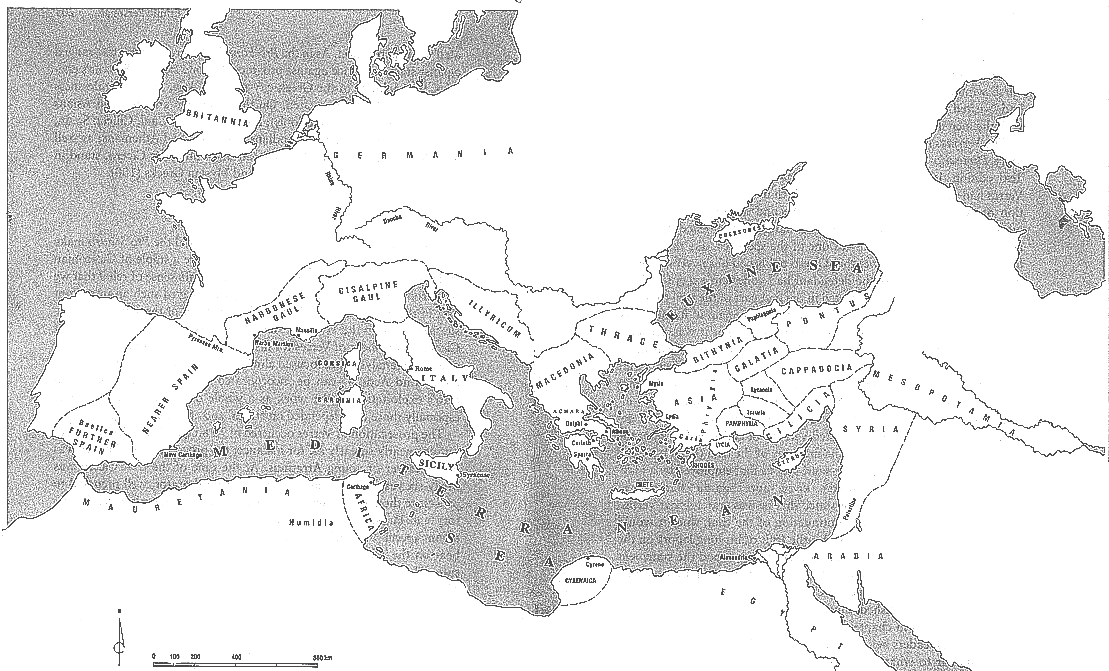
Fig. 4.
The Roman World, 63 B.C. At this time the imperium Romanum included the provinces of Sicily, Sardinia and Corsica, Cisalpine Gaul, Narbonese Gaul, Nearer Spain, Further Spain, Africa, Asia, Macedonia and Achaea, Illyricum, Bithynia, Cyrenaica and Crete, and Cilicia (probably including Pamphylia). At the conclusion of the Third Mithridatic War (62 B.C. ), Pompey organized the new provinces of Bithynia-Pontus (including Paphlagonia) and Syria. Gaul from the Rhine to the Pyrenees became a Roman province as the result of Julius Caesar's campaigns of 58–50 B.C. In 63 B.C. Mauretania, Numidia, Egypt, Cappadocia, and Galatia were nominally independent client kingdoms.
evidence of Sardinian provincials in the Pro Scauro he refers proudly to the events preceding Verres' trial, recalling how he had made his way in harsh winter through the valleys and hills of Agrigentum and how he had "visited the cottages of the Sicilian farmers" and had even spoken with the men in the fields as they stood sweating at the plough (25).
The Verrines is a massive work, comprising, together with the preliminary Divinatio in Caecilium, over 450 pages in the Oxford Classical Text edition. It is divided into two parts: the First Action, at which Verres had actually been present and which had preceded the introduction of evidence at the trial; and the Second Action, a much longer work, whose five parts summarized the charges and evidence against the accused. The Second Action was one of the speeches (like the Pro Milone or the second Philippic ) that Cicero published but never delivered, since prior to its delivery the defendant had gone into exile, forced by the mountain of evidence presented in the first part of the trial to realize his conviction would be inevitable if he were to remain in Rome.[23] The Second Action maintained the illusion, however, that it was delivered orally and that Verres was present to hear it. This pretense was in no way an attempt on Cicero's part to mislead his readers. In fact, so far from trying to deceive them, he has capitalized on their knowledge that what he states as fact within the speech was patently untrue. For instance, when Cicero declared that many were surprised to see the defendant in court since it was assumed Verres would flee the city after the damning evidence presented in the first part of the trial (II.1.1), he was making use of irony: irony of the same sort as that employed by a playwright whose audience is allowed to know more than the characters in the play. Again, when the orator stated that he was grateful that Verres' presence had necessitated the continuation of the trial, since it would allow him the opportunity to exhibit the fruit of his long labors on the case (II.1.2), Cicero's ancient readers clearly understood the statement as an explanation both for the pretense within the speech that the trial had actually gone forward and for Cicero's publication of the work.
The Verrines as published, then, depended on a fiction, and my analysis, both here and in chapter 3, has acquiesced in this fiction. Cicero would have his readers believe that the Second Action was a continuous oration similar to what he would have given if the trial had actually continued, and my discussion of it accepts this premise and goes on to
[23] On events subsequent to the First Action, see Venturini, "La conclusione del processo di Verre."
consider how Cicero went about persuading his hypothetical audience. My confidence that this is a sensible way of reading the speech grows out of the observation that its rhetorical strategy is closely related to that found in the Pro Scauro, Pro Fonteio, and Pro Flacco, speeches that actually were delivered. This does not mean, of course, that one finds the same arguments in the Verrines as those advanced in the speeches in which Cicero defended provincial governors; rather, it is the opposite side of the coin, the counter arguments to those discussed above, that Cicero exploits in the prosecution of Verres.[24]
While arguments relating to ethnic stereotypes will be the focus of my discussion, it is instructive to note that a number of other commonplace arguments, which figure prominently in the speeches on behalf of provincial governors, have also been treated from an opposite viewpoint in the Verrines . In his speeches in defense of provincial governors, for instance, Cicero not only attempts to discount the evidence of individual witnesses; he also makes use of commonplaces questioning the importance of witnesses in general by elevating the relative position of argument through probabilities as a means of proof.[25] In the Pro Fonteio (21–27) Cicero devotes a long passage to the need for jurors to assess critically, rather than simply to credit without question, the testimony of witnesses; in the Pro Scauro he calls argument "the voice of
[24] It is argued that the unusual length and literary elaboration of the Second Action of the Verrines reveals its artificiality. But many of the orations that Cicero actually delivered represented only part of the case for the defense or the prosecution, since several defenders or accusers frequently spoke in sequence during a case. If the Verrines had gone forward, Cicero's would have been the sole prosecuting speech, and perhaps its length and elaboration are, in fact, much closer to what would have been delivered than hitherto imagined. Contra, see, among others, Fuhrmann, "Tecniche narrative," 41–42. Fuhrmann also argues that Cicero's narrative technique, in which he chooses to turn the oration into a series of exemplary and representative stories, reveals the literary, rather than the forensic, nature of the Second Action. It seems to me, however, that what Fuhrmann is describing is the only possible manner in which Cicero could have effectively organized such an extensive mass of evidence. Fuhrmann's objection that Cicero repeats in exposition material that would have been familiar to the jury from the First Action lacks force, unless we assume the jurors (who would have heard the Second Action only after an extended recess) possessed powers of memory and organization as prodigious as Cicero's own.
[25] Quintilian mentions the commonplace concerning the relative value of witnesses and argument in his criticism of orators who simply memorized such topoi and used them unaltered in numerous cases (2.4.27).
reality, the token of nature, the imprint of truth" (16) and demeans the reliability of witnesses, who may easily be "driven, swayed, formed and diverted" (15). In rhetorical theory, evidence from witnesses, documents, legal precedents, tortures, and the like was termed "inartificial proof." While such proofs were simply "found" by the orator, the arguments that constituted "artificial proofs" were "invented" by him. Somewhat surprisingly to the modern, ancient rhetoricians often maintained the superiority of argument over evidence. Aristotle in particular gave short shrift to the subject of inartificial proof, reflecting the belief that such proofs were an adjunct rather than an integral part of rhetoric and that the handling of them was self-evident.[26] Even in Aristotle's time, however, it was realized that the impact of inartificial proofs could be strengthened or undermined by rhetorical argument, and as early as the fifth century B.C. a number of commonplaces had been evolved to aid the orator in inventing ways to deal with them.
Cicero was well prepared to adopt the Aristotelian point of view—that argument from probabilities was superior to direct evidence—when it suited him. He subscribed to the view that "witnesses could bend the truth, documents could be altered, slaves might lie under torture, but the rational force of argument from probability was irrefutable" in speeches such as the Pro Fonteio and Pro Scauro, in which the bulk of the inartificial proof told against his client.[27] In the prosecution of Verres, however, we see Cicero arguing the opposite side of the question. The orator had proved his case in the First Action by forgoing the customary extended opening speech and instead proceeding quickly to the presentation of direct evidence. In spite of the fact that the Second Action is the script for a highly elaborated performance, making use of the entire panoply of rhetorical weapons to rouse the passions of the audience, the orator wished to make it appear that he continued to rely primarily on objective, rather than subjective, proof. He therefore bypassed the usual inquiry into the private life and habits of the accused, a standard strategy of proof through probability, and restricted himself to
[26] Aristotle's disdain for the subject would have stemmed from the philosopher's desire to found the art of rhetoric on the basis of rational predictability. According to this point of view, the proof through argument that an event should have occurred was superior to proof by direct evidence that it did (Arist. Rhet. 1.2.2 (1355b35–39), 1.15.1–33 (1375a22–1377b12); Kennedy, Aristotle, 108–18). See above, p. 25.
[27] Cf. Flac. 23.
the discussion of specific crimes committed in public office, making frequent references to the witnesses and documents he had introduced to prove his contentions.[28] Cicero's attitude here, so different from that found in the trials in which he defended provincial governors, is summarized in his remark to Verres' advocate, Hortensius: "In this kind of trial, when someone is said to have stolen or appropriated something, who in the world pays attention to us? Is not the entire attention of the judges focused on either the documents or the witnesses?" (II.1.27).
A similar attempt to anticipate the arguments of the defense also appears when Cicero treats the topic of the interest of the state vis-à-vis that of the accused. As has been shown, a key element in the defense of Roman governors accused under the de repetundis laws was the presentation of the case as one that pitted the interests of the Roman state, represented by the accused, against the supposed interests of an isolated group of provincials who claimed to have suffered abuse at the hands of the accused. This tactic, which represents a variation on commonplaces concerning expediency and justice and which was traditionally assigned by ancient rhetoric to the province of deliberative oratory, is of great importance in forensic speeches of this kind.[29] While no ancient orator would have claimed outright to favor injustice towards conquered peoples, he may well, as in Cicero's defenses of Fonteius and Flaccus, have argued the patriotic necessity of the actions of the accused, whatever the complaints of the resentful provincials. In the Verrines Cicero employs a variety of tactics to prevent his opponents from exploiting this strategy.[30] He points out to anyone who might claim that Verres should be acquitted because the Roman citizens of Sicily supported him that the extortion court had been instituted specifically for the purpose of hearing the complaints of Rome's allies, not its citizens (II.2.15). He
[28] Quintilian states that it required the greatest force of eloquence to refute inartificial proofs, and goes on to give general advice to the orator faced with the need to deny or mitigate such material (5.1.1–2).
[29] Quint. 3.8.1–3, 30; cf. Cic. Off. 3.40.
[30] The second speech of the Second Action even includes Cicero's ironic reference to the commonplace of the defendant's counsel, "Save this man for the Republic" (II.2.76: Retinete, retinete hominem in civitate, iudices; parcite et conservate ut sit qui vobiscum res iudicet qui in senatu sine ulla cupiditate de bello et pace sententiam ferat ). For a general analysis of Cicero's exploitation (in the Divinatio in Caecilium and In Verrem I) of the political circumstances that surrounded this trial, see Neumeister, Grundsätze der forensischen Rhetorik, 35–46.
then hastens to add that, in fact, it was not the provincials alone who complained of Verres' conduct but a large number of Roman citizens residing and doing business in Sicily. The orator then declares that if Verres' administration had been satisfactory to any race, whether Sicilian or Roman, or to any order, whether farmer, stockbreeder, or merchant, he would be content to see the defendant freed.
Perhaps most important to Cicero's efforts to prevent the case from turning into a matter of "us versus them" was his refusal to base his demand for Verres' conviction simply on the sympathy and pity owed the abused Sicilians; at every point he connects the idea of justice for the Sicilians with the larger issue of the interests of the Roman state. At the very outset of the First Action he warns the jury that a corrupt verdict in the case would bring about the final discredit of senatorial juries and the transfer of the extortion court to the equites (I.3). He introduces numerous witnesses and documents to prove that Verres had committed crimes not only against provincials but also against Roman citizens throughout his career as legate in Asia, praetor in Rome, and propraetor in Sicily.[31] In the third part of the Second Action, Cicero complains as much about the harm done to Rome by the disruption of the Sicilian grain supply and the collection of taxes as about the sufferings of the Sicilians.[32] In the fourth part, as has been shown, he constantly attempts to transform the artworks stolen by Verres into symbols of the just, stable, and profitable Roman rule that had existed before Verres' tenure of power. Finally, to prevent the prosecution from implying that Verres' assault on human rights in Sicily was justified by the exigencies of the military situation there, Cicero charges in the fifth part of the Second Action that Verres has been criminally incompetent in his attempts to secure the island from piratical activity and even suggests that the former governor had colluded with the pirates.[33]
The Character of Verres and of the Sicilians
One sees from the above how adroitly Cicero as prosecutor anticipated and undermined the strategies that his opponent Hortensius might have used to defend Verres and that Cicero himself would later call on in
[31] II.1.9, 14, 90–94, 104–14; 2.17, 30, 166; 3.6, 93–96; 4.26, 37, 42, 46, 58; 5.69, 72–75, 77, 136–37, 139–73.
[32] II.3.11, 43, 48, 82–83, 120, 122, 127, 137, 201, 226.
[33] II.5.60–79, 82. On pirates, cf. II.1.9.
defending clients like Fonteius, Scaurus, and Flaccus. But of all the strategies he could have anticipated from the defense, the most predictable and potentially the most dangerous was a racial attack against the Greeks in Sicily along the same lines as that which he would himself launch against the Asian Greeks in the Pro Flacco . How did Cicero forestall such an attack? One method was to anticipate the thrust of the defense's attack and to turn it back against his opponents. We have seen that in the speeches on behalf of provincial governors Cicero focused on the lack of fides and religio to be expected from foreign witnesses. In the Verrines Cicero counters this anticipated tactic from his opponents by attacking Verres on just these issues: throughout the First and Second Actions Cicero depicts Verres as a tyrant to whom human and divine laws were without force and whose entire public career represented a series of outrages against the obligations he owed to both.
Cicero's indictment of Verres for his violations of fides operates on a number of levels. In the first speech of the Second Action (devoted to Verres' career before his governorship of Sicily) he speaks of the defendant's betrayal of the trust placed in him by his superiors, describing his embezzlement of money when serving as quaestor in Gaul under the consul Cn. Carbo and of his later abandonment of this post (II.1.34–40). He refers as well to Verres' betrayal of the man whom he then served under as legate and proquaestor, Cn. Dolabella (II.1.41–102). Since the assignment of the quaestors to their provinces was made by lot, and since the lot was believed to be divinely guided, the orator presents the betrayal of the relationship between Verres and his superiors as both moral and religious corruption. Verres is, in addition, stigmatized for his violations of fides towards those under his magisterial power. Cicero implies, in fact, that Verres was at his worst in his treatment of those who were most dependent on his good faith. In the course of the account of Verres' career in the East Cicero frequently chooses to expand upon those crimes that show the accused preying upon provincials, especially women and children. The story of the affair at Lampsacus, in which Verres' lust for a young woman leads to the death of the father and brother who try to protect her, and the account of the legacy of the boy Junius fit into this pattern of exploitation of the vulnerable.[34] Such incidents also form a prelude to the revelation in parts 2 through 5 of the Second Action of Verres' greatest betrayal of fides: his abuse dur-
[34] Lampsacus affair: II.1.63–85; story of Junius: II.1.129–54.
ing his provincial governorship of the Sicilians, whose well-being had been entrusted to him by the state.
In chapter 3 I noted Cicero's attempt to paint Verres in the colors of the rhetorical tyrant. This strategy overlaps with the orator's attacks on Verres as a man without religious scruples, for the tyrant is a despiser not only of human beings but of the gods as well. Throughout the Verrines Cicero accuses Verres of a veritable war against the gods, repeatedly making use of the term religio in doing so.[35] One crucial part of this attack turns on the defendant's appropriation of statues and works of art in the eastern Mediterranean and in Sicily. Since most of these were objects of veneration taken from temples or from shrines within private homes, their theft could be characterized as a religious offense. This strategy is introduced in the Divinatio in Caecilium, a speech in which Cicero argued his own claims to represent the Sicilians in the prosecution of Verres over the claims of a certain Caecilius. He begins the oration with the statement that the Sicilians could hardly appeal to their gods for help, as they had already been stolen by Verres. According to Cicero, the defendant had removed "the holiest images from the most sacred shrines" (Div. Caec. 3: simulacra sanctissima . . . ex delubris religiosissimis ). The idea is prominent as well in the First Action, a summary of the crimes of the accused, in which Cicero alludes to Verres' plundering of the holy places of Asia and Pamphylia, as well as of Sicily. In the prooemium of the Second Action, Cicero voices the theme that will resound throughout all five parts of the work: that it is the gods themselves who seek justice in the trial of Verres. He declares:
[35] Verr. II.1.6: multa enim et in deos et in homines impie nefarieque commisit; 4.72: ita sese in ea provincia per triennium gessit ut ab isto non solum hominibus verum etiam dis immortalibus bellum indictum putaretur; 5.188: ceteros item deos deasque omnis . . . quorum templis et religionibus iste . . . bellum sacrilegum semper impiumque habuit indictum. Cf. Font. 30. In his indictment of the defendant's offenses against various divinities, Cicero had to deal with the fact that Verres had fostered a close connection between himself and the powerful shrine of Venus Erycina in northwestern Sicily. Cicero solves this problem by focusing on the Sicilian cult of Ceres at Henna and by depicting Verres' devotion to Venus and Cupid as a mask for his greed and an expression of his libidinousness. See della Corte, "Conflitto di culti"; von Albrecht, "Cicero und die Götter Siziliens"; Martorana, "La Venus di Verre." Martorana, unlike della Corte and von Albrecht, sees Verres' support of the cult of Venus Erycina as a patriotic attempt to maintain and strengthen the link between the island and Roman imperium .
The gods of our fathers are taking him away for punishment because he was a man who could tear sons from the embrace of their parents in order to execute them and even demand that the parents pay him a price in order to bury their children. The holy rites and ceremonies of all the violated shrines and temples, the images of the gods, which were not only taken away from their temples but even allowed to lie hidden and neglected in the shadows, do not allow his mind any rest from madness and insanity. . . . We not only seek that this man be condemned so that property might be restored to those from whom it was stolen; the violated sanctity of the immortal gods must also be expiated.
(II.1.7–8)
Cicero then presents within the Second Action a seemingly unending catalogue of outrages against religious sensibilities.
At the same time that he was attempting to create for his audience a vivid picture of Verres as a man devoid of any sense of duty to men or to the gods, Cicero hoped to characterize the Sicilians as a race especially distinguished by such sensibilities, praising in particular their trustworthiness as allies and their pious respect for what they conceived of as their religious obligations. The introduction to the entire excursus on the crimes committed by Verres in Sicily begins with a passage devoted to the island's special bonds to Rome. Sicily is praised as the first province to be acquired by the Republic, the "jewel of the empire" (II.2.2: ornamentum imperi ). Once the island had been reduced, says Cicero, it never wavered in its loyalty (fides ) and goodwill (benevolentia ) towards the Roman people. For this reason Africanus had adorned its cities after the fall of Carthage, and Marcellus had allowed even hostile Syracuse to remain standing. This "storehouse of the Republic" had long fed and equipped the Romans and their armies, even during the dark days of the Social War. Cicero refers also to the fact that Sicily had proved a source of extensive profits both to those who exploited its riches from afar and to the many Roman citizens who had settled there. It is a great advantage to many citizens, he states, that they may repair to this province, which is "close at hand, loyal, and rich in resources" (II.2.6: propinquam fidelem fructuosamque provinciam ). The source of Sicily's outstanding loyalty to Rome is then revealed to be the character of its inhabitants. Cicero claims that the Sicilians are nothing like other Greeks, whose vices include laziness and excess (II.2.7: desidia . . . luxuries ); rather, they possess the virtues of endurance, bravery, and frugality (II.2.7: patientia virtus frugalitasque ), traits that remind the orator not of the Romans of the present but of those of the past. He goes on to
praise the great industriousness, thrift, and diligence of the Sicilians (II.2.7: summus labor . . . summa parsimonia summa diligentia ). They also are unassuming individuals who bear injustice and oppression without murmur (II.2.8–10). Only the outrages perpetrated by Verres have forced them to seek legal redress, and if this desperate plea for justice fails, they will simply abandon their homes. The diction and thought of such passages are clear enough: as with the Apollonians of the Pro Flacco, the virtues of the Sicilians are the stereotypical virtues of farmers, a class that Cicero says constitutes the heart both of the Republic as a whole and of the island of Sicily in particular (II.2.149). Although it is true that within the corpus of the Verrines Cicero characterizes the inhabitants of Sicily in various ways, depending on shifts in emphasis and changes in rhetorical goals, this attribution of stereotypical rustic virtues to the Sicilians recurs throughout. In one passage we even discover the scene, familiar from the Pro Roscio, of the innocent and confused countryman in the city. When Cicero is challenging the intent of a clause in a tax law allowing farmers to sue in disputes with tithe collectors he accuses Verres of "dragging men from the field to the forum, from cultivating the earth to the benches of the law courts, from the familiarity of rustic affairs to the unknown milieu of litigations and legal judgments" (II.3.26: Ex agro homines traducis in forum, ab aratro ad subsellia, ab usu rerum rusticarum ad insolitam litem atque iudicium ).
Cicero's strategy in the Second Action, then, was to forestall the defense's anticipated attack on the witnesses as untrustworthy foreigners by characterizing the Sicilians as typical farmers rather than typical Greeks. This strategy was surely an obvious one, since Sicily was blessed with an abundance of rich farmland and was renowned in antiquity for its rich agricultural produce. As Cicero remarks, "The entire utility and advantage of the province of Sicily insofar as it relates to the interests of the Roman people consists chiefly in the matter of grain" (II.3.11). The strategy was also one that could be easily exploited in the third part of the Second Action, an extensive part of the speech dealing with the crimes committed by Verres against Sicilian farmers (divided by the orator into sections dealing with the tithe on grain, the purchase of grain, and grain commutation).
When Cicero came to the fourth part of the Second Action he faced a more difficult task, since he was compelled to speak at length about the various statues and works of art stolen or extorted by Verres from Sicil-
ian city-states and individuals. As previously noted, the accusations of Verres' appropriation of cult statues from the very temples of the gods added great force to Cicero's depiction of the defendant as an impious tyrant. The difficulty such material raised, however, was that the complainants here could not be portrayed as simple farmers but were clearly men of means and sophistication. The Sicilian witnesses who accused Verres of removing precious works of art belonging to them or their cities might therefore have served to reinforce the negative stereotype of all Greeks as a race characterized by luxuria and vanitas . Cicero solves this problem by depicting the desire of the Sicilians for the return of their property as an expression not of luxuria but of a special sort of religio . As has been demonstrated, the passages dealing with particular objects removed by Verres emphasize their value as religious or patriotic symbols rather than as precious works of art. The strategy is best articulated in a passage in which Cicero speaks in general of the attachment of the Greeks to statues, paintings, and works of this sort, objects that he and his audience deemed of little worth (II.4.124, 132–34). He states:
All [the Greeks] are affected by religious scruples (religione ) and believe that the [statues of] their ancestral gods, handed down from their ancestors, should be carefully kept and worshipped by them. And further, these ornaments, these works and artistic objects, statues, and pictures, afford the Greeks an unusual degree of pleasure. Therefore, when we hear their complaints we can understand why these events seem so bitter to them while we, perhaps, view them as insignificant trifles.
(II.4.132)
The tone throughout the passage is unmistakably condescending. Yet it should be seen that Cicero has effectively stolen the defense attorney's thunder. He has agreed to the proposition that the Sicilians, like all Greeks, placed an inordinate value on ornamental objects, statues, paintings, and the like. But he converts this attachment to such "trifles" into the non-Roman expression of one of the most Roman of virtues, religio .