
11—
"Property of Every Kind":
Ranching and Farming During the Gold-Rush Era
Lawrence James Jelinek
The Gold Rush brought about profound changes in California agriculture. Prior to 1848 California had been defined by its almost self-sufficient missions, complete with herds, gardens, and orchards nourished by the introduction of irrigation. With the emergence of the Californio ranchos after the 1820s, the hide and tallow trade had fueled the economy, and modest progress had been made in the pueblos, especially Los Angeles, by the expansion of its irrigation system. Following the Mexican-American War, between 1846 and 1848, some growth occurred in farming by Americans and immigrant settlers, particularly in the valleys of northern and central California. With the discovery of gold, new settlers and higher cattle prices gave the rancheros short-term prosperity, but they also contributed to the demise of the open-range cattle grazing era. Once the gold fever had begun to wear off, many newcomers abandoned mining and took up agriculture. By 1872, cattle ranching had changed from primarily open-range grazing to breeding and fattening ranches. Wheat had become a major export crop with major profits. Finally, fruit cultivation had grown in importance throughout the state.[1]
Changes in California's population and demographics reflected the tide of the Gold Rush and dramatically stimulated agricultural markets and production systems. At the beginning of 1849 the state's population, excluding Native Americans, was estimated to be only 26,000, but by the end of that year, the population had risen to approximately 115,000. Males seeking gold were in large measure responsible for California's growth to 225,000 people by 1852. As the gold seekers turned into set-tiers and established families, the population continued to burgeon to 380,000 in 1860 and 560,000 by 1870.
Rancheros found a new market for their cattle, as beef became a highly sought commodity to feed the growing population of the mining communities. The hide
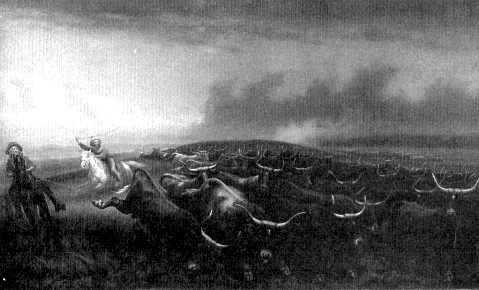
A California cattle roundup, as portrayed by the British-born historical painter James
Walker, who came west in 1875 and executed several paintings, including this one,
from drawings made while visiting Rancho Santa Margarita. By the time of Walker's
arrival, the great days of the open range and the long drives north had passed, and
cattle raising was largely confined to breeding and fattening ranches. California
Historical Society .
trade declined as beef cattle prices in the mining districts rose from four dollars a head before the Gold Rush to five hundred dollars a head at its high point in 1849. Herds of seven hundred to a thousand animals were driven by vaqueros from southern California up through the San Joaquin Valley or along coastal trails to grazing ranges outside Sacramento, Stockton, and San Francisco. There the herds were sold to buyers for processing.[2]
Mine and town demands soon outstripped the ability of rancheros to supply them with enough good beef. They also found competition from cattlemen in Texas, the Middle West, and Mexico, who began driving herds overland to the Sacramento Valley. By 1855, up to forty thousand head of cattle were driven to California annually. About this time sheep drives were also begun. California's herds included only 17,500 sheep in 1850. New Mexico, Chihuahua, and the Middle West sent herds numbering 135,000 head in 1850 and 200,000 head in 1856, the peak years for such drives.[3]
The rancheros enjoyed substantial profits from the livestock boom, but failed to forestall the bust that was to follow. Instead of restocking their herds by introducing the meatier American stock, rancheros assumed little had changed in the switch from hides to beef. They spent their profits lavishly and went into debt, often at a
rate of 5 percent a month, compounded, making them vulnerable to the changes that followed.[4]
In 1856, a severe drought caused heavy losses of California cattle. Many rancheros had already incurred serious debt because of competition with the better breeds of American cattle and sheep, which lowered the price of California-raised cattle. These problems were exacerbated by property taxes levied by a legislature controlled by northerners, especially miners, who held more personal property than real property, and who insisted that the property tax pay for state expenditures. As a result, rancheros began to lose their herds, their lands, and their homes, ending the "golden age of the cattle business."
The Treaty of Guadalupe Hidalgo (1848) accorded Californios American citizenship and obligated the U.S. government to confirm their valid claims to "property of every kind." Miners, however, who decided to switch from mining to agriculture, demanded that the federal government allow them their American birthright to claim homesteads. Land, which had been cheap when the treaty was signed, was suddenly made valuable by the Gold Rush. Congress did nothing to resolve the issue, failing to pass land legislation as it had previously done for Oregon and Washington, which would have enabled settlers to claim free homesteads of from 320 to 640 acres on public land in return for occupying the new territory. Newcomers refused to accept the idea that the government would allow several hundred "defeated Mexicans" to control millions of acres of the choicest land in the state. Hordes of defiant squatters invaded and laid claim to northern rancho lands. Finally, under pressure from these conflicting claims, Congress passed the Land Act of 1851 to determine the validity of all rancho grants.[5]
According to the provisions of the act, each claimant was allowed two years to appear before a three-member land commission to prove title. The commissions judgments could be appealed to the federal district court and then to the U.S. Supreme Court. Once a grant was confirmed, it had to be surveyed and issued a patent by the federal government. In the process of securing a claim, rancheros faced several obstacles. They might lose their claims outright. If their claims were confirmed, the boundaries could be changed, reduced, or increased at the hands of the surveyors. The surveyors were susceptible to squatter intimidations as well as to ranchero bribes. By 1856, when the commission ceased to function, judgment had been made on 813 claims. After the various appeals processes, some of which dragged on for decades, 604 grants were ultimately confirmed and 209 were rejected.
California chroniclers overwhelmingly agree that the Land Act was pro-settler in design and led to immoral and illegal confiscation of the property of Californios. Discrimination was extensive and fundamental. The burden of proof rested on rancheros instead of on the government. Hearings were conducted in English, and no commissioner was able to read documents written in Spanish. American stan-
dards for granting ownership took precedence over the Mexican system, which tended to have fewer archival records and less precise descriptions. Because of cumbersome litigation procedures, which required administrative and judicial hearings in San Francisco and Washington, D.C., to confirm and patent each title, most titles were not cleared for fifteen years. Some commissioners were fair-minded despite the biased framework, but lawyers on both sides of the issue were not. Unnecessary harassment resulted when government lawyers refused to let individual cases serve as precedents. On the other hand, ranchero lawyers demanded large fees that often had to be paid in land or cattle. After extensive litigation, rancheros often found that, although they had won their claims, they had to relinquish much of the land as payment to their lawyers.[6]
On the other hand, distinguished historian of land law Paul W. Gates took the view that the squatters were right, and that the federal government would have been wrong to uphold an essentially unproductive feudal order in American California. Gates claimed that the land commission prolonged the ownership turmoil by showing "too much regard for the inchoate rights of land claimants." Gates pointed out that of the 813 grants, 494 had been made in the 1840s. Many of the grantees failed to meet the occupancy and improvement requirements of the American takeover. In anticipation of higher land values upon completion of the American takeover, many of the 68 grants supposedly made in 1845 and the 87 grants made in 1846 had been fraudulently dated. Even so, a majority of claimants who could provide reasonable proof, even if it was deficient, that they possessed a grant and occupied it, had their claims confirmed. Gates also argued that government lawyers did accept early cases as precedent, and that given the value of ranchero holdings, the ranchero lawyers' fees were not excessive. Gates blamed the loss of ranchero land, cattle, and money on drought, extensive inheritance litigation, high living, taxes, and an inability to become competitive by American standards. He also maintained that from one-quarter to one-third of the transfers of grants from Mexican to non-Mexican owners was due to economic vulnerability, not to the Land Act. Gates did acknowledge that the Land Act failed to provide confirmation losers with a homestead tract out of their rejected claims. He also blamed Congress for being unconcerned about establishing public land boundaries promptly and clearly. This foot-dragging caused squatters and rancheros to resort to violence and deceit against each other.[7]
Historians on both sides agree with Gates concerning the dereliction of Congress. It took Congress three years to pass legislation pertaining to rancho grants and five years to establish a public land survey. By refusing to offer settlers free homesteads promptly, Congress plunged California into some of the most violent land disputes in American history. Clouded rancho land titles hindered economic development in rural and urban California for decades.
The weather delivered the final blow to rancheros, who were already suffering from falling cattle prices, taxes, and litigation. Extensive rainfall in the winter of 1861-62 created a runoff lake approximately 250 to 300 miles long and 20 to 60 miles wide in the Central Valley. Nearly 200,000 head of cattle drowned statewide. This was followed in 1862 to 1864 by the "great drought." Hundreds of thousands of cattle died from dehydration, starvation, and suffocation due to dust inhalation. In one decade, 1860 to 1870, California cattle ranges were reduced from three million head to only 630,000. Unable to sell their cattle for profit, rancheros sold their lands, often at ten cents an acre. By the 1870s, many rancheros had become day laborers in the towns.
Wealthy Americans or immigrants took over most of the ranchos.[8] Concentrated land ownership intensified dramatically in American California as speculators and individuals hopeful of becoming large ranchers and farmers bought most of the public lands that came up for sale in the 1850s and 1860s.
Federal legislation passed in 1851 and 1852 allowed California to finance public needs through the sale of 8,702,140 acres of land given to the state by the federal government. To finance public schools, 5,534,293 acres were to be sold; more than two million acres of swampland were designated for sale and reclamation; 500,000 for internal improvements; 46,080 acres for a university; and 6,400 acres for public buildings. The Morrill Act of 1862 set aside an additional 150,000 acres to finance an agricultural college.
California began disposing of its lands before establishing a state agency to administer the selling, surveying, and patenting of them. The agency that was created in 1858 followed no regular practice of informing the federal government of which lands the state had selected for its public domain or when settlers had laid claim to specific parcels within it. The Preemption Act of 1841 and the Homestead Act of 1862 allowed settlers to claim land within the federal public domain, but claimants were often unsure if the land they had selected was state or federal land, land in dispute, or confirmed rancho land. Collusion between officials in the land offices and speculators and would-be landowners was common. Settlers who had waited a long time for their claims to be certified might find that after making improvements, they had to buy the land from a speculator at an inflated price or abandon it when a "paper owner" refused to sell.
During the 1860s, an estimated eight million acres of public land passed into private ownership, according to Paul W. Gates. Much of this land was limited by legislation to grants of 160 acres. Fifty thousand farms of 160 acres should have been created during the decade, had the land laws been enforced. However, only 7,008 new farms were established, 2,848 of which should have come under the Homestead Act. An undetermined number of the remaining farms were the result of northern rancho land sales.[9] This type of misappropriation was experienced in all other states
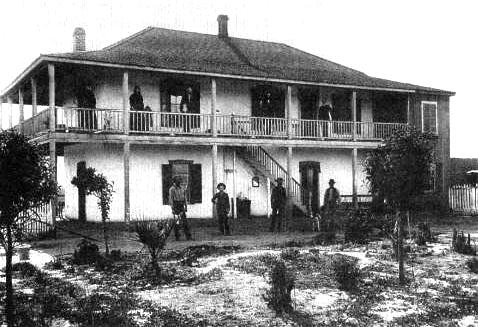
The family of Vicente Lugo poses about 1892 with several hired hands at the country casa
Lugo had built nearly half a century earlier on Rancho San Antonio, granted in 1810 to his
father, Antonio Maríia Lugo. Like other rancheros, Don Vicente saw his once-vast estates
diminished in the 1850s and 1860s through high taxation, expensive litigation, and deadly
drought. As a youth Lugo possessed two leagues of land and ran thousands of head of
cattle over his domain, but by 1870 he was reduced to several hundred acres surrounding
his adobe in present-day Bell Gardens, near Los Angeles. California Historical Society/
Title Insurance and Trust Photo Collection, University of Southern California .
disposing of public land; however, in most of these states large concentrations were eventually broken up. California was unique in the scale of its misappropriation and in the determination of prominent Californians to maintain the greatest concentration of land ownership in the United States. It became so difficult to purchase land at reasonable prices in some regions that some prospective landowners were forced to accept work in the cities and towns, move to the Northwest, or return to their eastern homes. Settlers who could afford to buy land sometimes bore the heaviest burden of taxation because speculators tended not to improve their lands, and thus often paid relatively lower tax assessments.
The most distinctive member of the new land elite was William S. Chapman. Seeing agricultural potential in the vast tracts of the San Joaquin Valley, Chapman quickly became California's largest landowner after arriving from Minnesota in the early 1860s. He bought public land on his own and also in conjunction with a group
of fellow San Francisco businessmen known as the "German Syndicate." By 1871, Chapman owned more than a million acres in the valley that earlier arrivals had scorned as wasteland. Chapman contributed to California's economic growth in many ways. He assisted the valley's farmers in producing large yields of high-quality wheat by experimenting with cultivation techniques. He was instrumental in modernizing the state's cattle industry through the introduction of alfalfa. More importantly, at great personal expense, Chapman, together with other prominent landowners, brought irrigation to large tracts of the valley. They established the Fresno Canal and Irrigation and the San Joaquin and Kings River Canal and Irrigation companies.[10] New crops and new cultivation methods were greatly facilitated by Chapman's willingness to experiment, combined with the availability of irrigation.
Unlike some of his peers, Chapman showed concern over the extensive concentration in land ownership. He sold parcels of land to settlers at substantial but not exorbitant prices, hoping that by helping them get started, their land improvements would increase the value of his remaining holdings. Along these lines he also encouraged colonies to create more concentrated and efficient settlement. A colony of German settlers bought 80,000 acres in Fresno County from Chapman at an average price of $1.80 per acre, only 55 cents an acre more than the federal government was asking for neighboring land. Chapman also donated land, funds, and cultivation information to the membership of the Central Colony of Fresno County in 1875.
Chapman and other large landholders did not escape criticism. The San Francisco Evening Bulletin published a series of articles in 1868 blaming speculators like Chapman for preventing settlers from buying good land at reasonable prices and, as a result, slowing California's development. Chapman wrote a letter to the Bulletin defending the speculator's role in California:
Men who bought of me at $2.50 per acre, payable in one year (with privileges of another year's time, if the crop should fail) have this year harvested a crop which will very nearly ten times over pay back their purchase money. . . . Scores of thousands of bushels of wheat have been raised in that region (the San Joaquin Valley) this year, and hundreds of thousands will be during the coming season, over and above what would have been carried through the Golden Gate, had no "speculator" seen the capacity of that region for wheat raising, and by circulation of documents, and by all other available means directed the attention of farmers to the land in question.
I think you err in charging those who have entered a few hundred thousand acres of Government land (for nine years going begging for a purchaser) with ruining the agricultural prospects of the State by holding lands at an enormous rate, and thus repelling immigration.[11]
Chapman did exercise considerable influence on employees in the federal and state land offices. His use of dummy entrymen to file claims for 160-acre home-
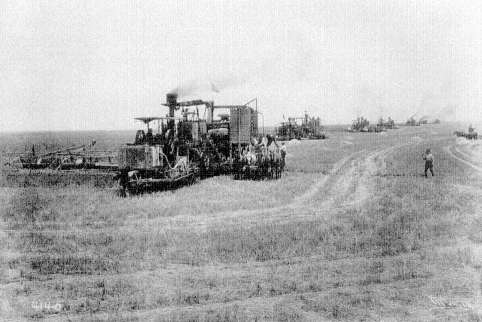
A phalanx of steam-powered harvesters moves across a vast landscape in an image
symbolic of both the immense size of California farms and the astounding richness of
the Golden State's soil. Wheat farming, the first great agricultural industry in California,
was highly mechanized from the outset. Steam plows were introduced as early as 1871,
and before the end of the following decade, huge machines could turn a quarter section
of land in a day. Courtesy California State Library .
steads, which they turned over to him for a prearranged fee, would make it easy to conclude that Chapman built his empire at the ultimate expense of settlers and the state. One should keep in mind, however, that this land had been available, but had remained unclaimed, for a decade or more and that due to federal and state mismanagement of land sales, this land could easily have been purchased by a speculator with a much less developed sense of social consciousness. Since a 160-acre homestead was not large enough to grow wheat profitably, Chapman's insistence that settlers buy larger tracts from him worked to their advantage. Finally, as Chapman pointed out, settlers had not wanted the land until he had demonstrated its potential. Chapman's willingness, furthermore, to supply cultivation information to settlers who bought land from him also provided a service neglected by federal and state agencies.
Henry Miller, a German immigrant, and Henry Lux, an Alsatian immigrant, both wholesale butchers in gold-rush San Francisco, soon surpassed Chapman's holdings. Miller bought rancho land in the northern San Joaquin Valley to pasture
cattle and to grow feed grains. Then in partnership with Lux, Miller increased his purchases by acquiring large tracts of swampland and dry land in the valley. While Lux oversaw their interests in San Francisco, Miller used both straightforward and devious methods to expand their holdings in the valley. Miller bought swampland from the state for no more than $1.25 an acre and was reimbursed his purchase price by the state by swearing that a like amount of money had been spent reclaiming the land. He also acquired large tracts of more expensive land at the same price by claiming to an understaffed state land office that it was swampland. Miller is reputed to have sworn that he crossed these lands by boat. He neglected to say that the boat was resting on a wagon pulled by horses at the time. Eventually, Miller and Lux owned both banks of the San Joaquin River from west of Modesto to near Madera, as well as a fifty-mile strip along the Kern River. They built an empire of more than a million acres by cheaply buying scrip land warrants issued to veterans and then cashing them in to acquire free federal land, by foreclosing on settlers to whom they lent money, and by controlling vast stretches of additional acreage through the possession of water rights. They owned 700,000 acres in the San Joaquin Valley alone. In addition, they had holdings of two million acres in Nevada and Oregon. Miller and Lux were not concerned with concentrated land ownership as Chapman had been. Miller's philosophy was, "Wise men buy land, fools sell."[12]
Other prominent landowners who began their operations in the 1860s were James Ben All Haggin, General Edward F. Beale, James Irvine, and George Hearst. Hag-gin's San Joaquin Valley holdings later formed the basis of the Kern County Land Company. Beale acquired 172,537 acres by purchasing three ranchos for approximately $25,000. Along with Llewellyn Bixby, Dr. Thomas Flint, and Benjamin Flint, Irvine formed the Irvine Ranch, covering more than a hundred thousand acres, from three rancho purchases. Hearst established San Simeon Ranch, along the coast northwest of San Luis Obispo, from three ranchos that originally were part of Mission San Miguel. Many others owned substantial amounts of land, but their holdings did not measure up to the very largest. In response to settler criticism, large landowners claimed that the size of the ranchos was not a problem, rather that the Californios had been unable to make them productive.
Leadership from ranchers like Chapman, Miller and Lux, and Beale helped transform California's cattle industry, which had been decimated by low cattle prices re-suiting from overstocking in 1853 and the droughts of 1856 and 1862 to 1864. These large landowners used their wealth to import meatier and heavier breeding stock and introduce modern feeding and breeding techniques. They also fenced ranges to ensure the quality of their herds. Other large-scale ranchers quickly adopted these methods. Most of the 630,000 head of cattle in California in 1870 were the new stock. The change to beef cattle is reflected in hay production, which increased from 2,038 tons to 551,773 tons between 1850 and 1870. During this period, dairy herds
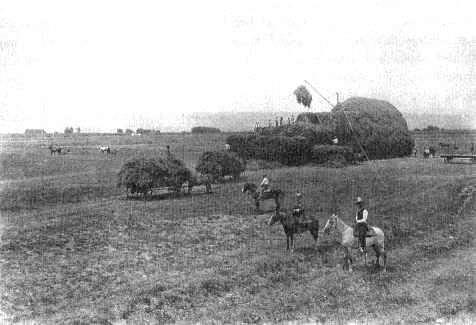
Haying at Buena Vista Farm , one of a series of magnificent mammoth plates made about
1888 or 1889 by Carleton Watkins on the extensive Kern County holdings of James Ben Ali
Haggin, a highly successful lawyer and financier who had come west in the Gold Rush.
Haggin began buying land in Kern County in 1873, and in less than a decade, he and his
associate, William Cart, owned three hundred thousand acres, some forty thousand of
which were under irrigation. Courtesy Huntington Library, San Marino, Calif .
were also introduced, especially around San Francisco Bay and in Humboldt County. Milk cows numbered only 4,280 in the state in 1850, but that number had increased to 164,093 by 1870. California was producing six million pounds of butter and three million pounds of cheese in 1867.
The sheep industry underwent a similar transformation. Sheep had been almost as numerous as cattle in the mission period, but their numbers rapidly declined during the rancho period. Mutton became important during the Gold Rush, surpassing beef as a miner staple until the herds were decimated by the drought of 1862 to 1864. Prominent stockmen such as James Irvine, W. W. Hollister, and Jotham, Llewellyn, and Marcellus Bixby improved sheep quality, a necessity to the resurgence of the industry. In 1849, there were only 20,000 sheep in California, but this number increased to a million in 1860 and 2.75 million in 1870. The stockmen introduced French and Spanish Merinos, English Cotswolds, Leicesters, Southdowns, and even Australian sheep. Improved stock and a demand for wool in the northern states created by the Civil War produced boom conditions until the 1880s. Due to the
poorer quality of the herds in 1860, only two million pounds of wool was marketed, but by 1870, the total had increased to eleven million pounds. Monterey, Los Angeles, San Luis Obispo, and Santa Barbara counties were the centers of the industry. After 1880, the sheep market declined due to the rise of land values, as well as expanding ranches, towns, and farms, which reduced the available pasturage and water supplies, and blocked many of the migration routes.
Crop-cultivation had been brought to a near standstill by gold fever during the early years of the Gold Rush. The exhausting work of placer mining, diminishing supplies of surface gold, and growing numbers of miners led in-state farmers to return to their farms.[13] Many out-of-state rushers who had been farmers returned to the land as well, as feeding the miners became a more stable way of making a living by 1853. Barley had been the principal grain grown by American farmers before the Gold Rush, but due to the needs of miners, wheat became a major grain by 1860, production standing at six million bushels. By 1870, wheat production had increased to 16,750,000 bushels, with 72 percent coming from the Sacramento and northern San Joaquin valleys, the centers of the American farming population. Wheat production on the big ranches, as well as the small farms, caused the supply to quickly outstrip local demand. Although flooding and drought in the early 1860s sharply reduced output, by 1872 railroads had penetrated 150 miles into the San Joaquin Valley, 50 miles into the Sacramento Valley, and 30 miles into the Salinas Valley, which opened prime wheatlands to settlement.
San Francisco middlemen began exporting much of the wheat surplus by sailing ships to Great Britain, Australia, New York, and China during the early 1860s. California's export suffered from uncertain demand and price conditions since each of these markets already had major sources of wheat. Another market for California's crop came from the war-ravaged South, which had put a serious drain on the availability of midwestern and eastern grains. Severe fluctuations in production, combined with the temporary nature of existing export connections, made it unclear if California would fulfill its potential as a major source of wheat. The gold-rush period was important in that the population increase not only reinvigorated cultivation but established it on a substantial scale. As the cattle industry diminished in importance, for the first time in California history, wheat became more important than cattle.
The transition from cattle to cereal production was not healthy in every respect. Wheat is easy to grow, but it depletes the soil. Eager for maximum returns, many large-scale growers ignored good agricultural practices such as soil replenishment and crop rotation. California's grain farms, many of which were established on rented land and hence lacked long-term commitment from growers, were criticized by many rural travelers for their lack of buildings or other signs that owners intended permanent cultivation.
Exploitation of wheat also required wheat growers to put together large gangs of itinerant workers for cutting and threshing. Indeed, because of large landholdings and scant rural population in the state, all types of agriculture relied on itinerant laborers, and because there was a chronic labor shortage in the 1850s and 1860s, Native Americans, Chinese, Mexicans, displaced squatters, and disillusioned miners filled the ranks of these gangs, inadequately at first. Native Americans and Chinese gained acceptance as laborers because they were more readily available, worked hard, and accepted the lowest wages. While Americans and Mexicans tended to bargain and complain individually, Native American and Chinese laborers simplified grower contact with workers by using one of their own as boss and doing what they were told. Minimum decencies given American and Mexican laborers were not accorded to Native American and Chinese laborers.[14] Some of these laborers, which began to include southern and eastern Europeans, became farm entrepreneurs.
Between 1848 and 1872, major strides also were made in fruit growing. Viticulture experienced the most important developments. Through the rancho period, grapes remained important because knowledge was developed about locations and techniques, because there was a market for wine and brandy, and because these commodities were relatively nonperishable. Grape growing became more profitable than any other form of cultivation between 1850 and 1860 because of the heavy consumption of alcohol by miners. This stimulus caused developments in the 1850s that laid the foundation for California's modern wine industry.
Prior to the Gold Rush, grapes had been confined largely to the Los Angeles area, but in order to bring producers closer to the miners and the large urban populations of San Francisco and other rising northern towns, vines were soon planted around San Francisco Bay, in the southern Sacramento Valley, in the northern San Joaquin Valley, and in the Sierra Nevada foothills. The market, however, continued to be dominated by a few prominent Los Angeles-based men such as Pierre and Jean Louis Sansevain, Charles Kohler, John Frohling, and William Wolfskill, who were growers, wine makers, and wine merchants. They were joined by a growing number of smaller-scale growers and unknowledgeable wine makers, who turned out palatable but debased concoctions. In their search for profit, these novices undermined the reputation of California wines for almost fifty years; however, they did determine where most of the state's principal wine growing areas were and were not located.
True viticulture was left to exceptional individuals. Colonel Agoston Haraszthy, a Hungarian nobleman, is generally regarded as the father of California's modern wine industry. Haraszthy came to San Diego from Wisconsin in 1849, searching for relief from asthma and for better economic opportunity. By 1851, Haraszthy had planted the Mission grape and several varieties of Hungarian grapes. He was elected sheriff in 1850 and was elected to the state assembly two years later. During this time
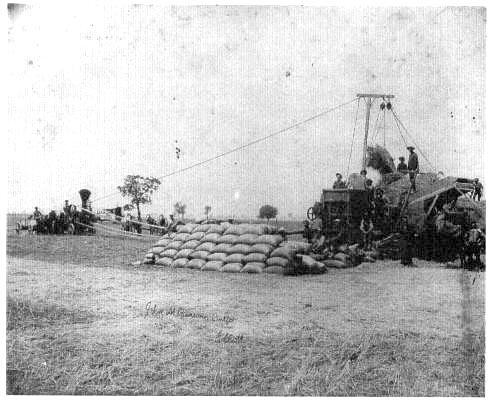
Farm laborers take a rest from the harvest in San Joaquin County to pose for a picture.
Beginning with Indians and then Chinese, a succession of ethnic groups, including
Japanese, Mexicans, and Okies, predominated in the itinerant work gangs that labored in
what Carey McWilliams would term "factories in the field." California Historical Society,
FN-01025 .
he purchased fifty acres near Mission Dolores in San Francisco and a large tract of land near Crystal Springs in what is now San Mateo County. Haraszthy was appointed assayer at the San Francisco branch of the U.S. mint, and he took over the important positions of melter and refiner. When he resigned after being wrongly accused of embezzling gold, Haraszthy subsequently devoted most of his attention to viticulture. He soon realized that coastal fogs adversely affected the sugar content of grapes by depriving them of needed sunlight. In 1857, he bought 560 acres in Sonoma County, an area already proven to have superior grape-growing conditions.
In a year's time, Haraszthy had planted 85,556 vines on his Buena Vista ranch and had 462,000 rooted cuttings in his nursery. In 1860, to improve the quality of California wines, he brought back from Europe 200,000 cuttings and rooted vines representing 1,400 fine varieties. Haraszthy proposed to have the state buy and distrib-
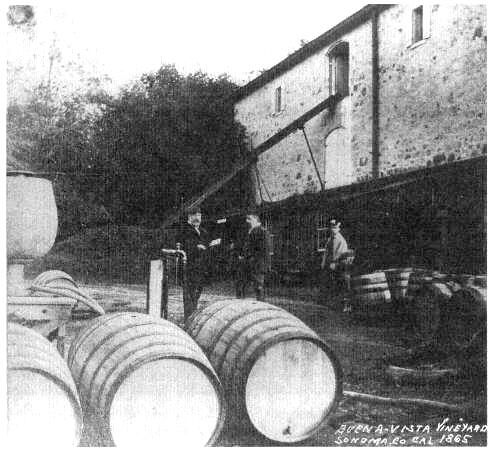
The celebrated viticulturist Agoston Haraszthy stands before his Buena Vista Winery,
near the town of Sonoma, 1865. Although modern scholarship has stripped the enterprising
Hungarian of his title, the "Father of California Viticulture," Haraszthy is acknowledged for
his important role in the development of California winegrowing. He established what was
then the largest vineyard in the United States, imported hundreds of varieties of vinifera,
and vigorously promoted California wines to a national market in his Grape Culture, Wines
and Wine-Making (1862) and other writings. California Historical Society, FN-00301 .
ute the cuttings and vines as well as supervise growing and winemaking operations. Faced with legislative opposition to this expensive plan, he sold many of the cuttings and vines to unskilled vintners. Although progress was noticeably retarded, Haraszthy had been instrumental in introducing improved grape varieties and in moving grapes from a pastoral to a commercial base.[15]
Despite the importance of varietal introductions, the Mission grape dominated the industry until the 1880s. Given the transitional stage of development, vine plant-
ings were nonetheless impressive. There were an estimated one million vines in 1855; only five years later there were eight million and by 1870 there were twenty-eight million vines. At this time some 40,000 acres of bearing and nonbearing vines had been planted, producing two million gallons of wine. Los Angeles County was responsible for one-fourth of this production, with one-sixth coming from Sonoma County. Table grapes also gained in prominence in the 1850s and 1860s to meet the demands of miners and townspeople.
Although orchard fruit underwent expansion during this period as well, its progress was much slower. Deciduous and citrus trees were more expensive to purchase and required a longer maturation period. In a mobile society overly concerned with quick wealth, these factors were a liability. In addition, local consumption was too limited for extensive plantings. While all types of deciduous trees capable of prospering in California had been planted by 1870, apple trees, of which there were twenty varieties, were the most numerous. There were two million apple trees, 750,000 peach trees, and 330,000 pear trees in that year. Modest numbers of almond, walnut, and olive trees were also planted. Sacramento, Sonoma, Yuba, Solano, and Alameda counties had the most deciduous tree plantings, with the San Joaquin Valley accounting for only 7 percent, and the counties from Santa Barbara south containing only 6 percent.
The need for more capital and irrigation combined with less population in the south, and the resistance of southern rancho owners to subdivision, retarded the development of citrus production. Most of the groves, which contained 4,000 orange trees and 600 lemon trees in 1860, belonged to William Wolfskill and were located in Los Angeles County. By 1870, plantings had increased to 45,000 citrus trees in the region, with another 5,000 to 6,000 trees located in the northern counties.
The mounting realization that gold could not permanently underwrite a healthy economy benefited agriculture. The state took action as cultivation gained attention. The State Agricultural Society was chartered in 1854 to establish experimental farms, to hold state fairs and stock shows, and to inspect quality improvements. The State Board of Agriculture, established in 1858, offered bounties on new crops and facilitated the transfer of information from prominent experimenters to other farmers. Before cotton and rice crops had a future in California, bounties were offered on them. The French immigrant Louis Prévost's prediction that silk raising would become the state's most profitable commodity led to the planting of 1.8 million mulberry trees by 1870. Bounties were also offered for sugar cane and tobacco, and after being introduced in E1 Dorado County by Japanese farmers, tea shrubs.
The importance of the Gold Rush to cultivation, according to historian John W. Caughey, can be seen in the state's fence laws. When cattle reigned supreme, the Trespass Act of 1852 required that a farmer had to build a "lawful fence" in order to
collect crop damages from a rancher for livestock depredations. Because of soaring lumber prices, fences, had they been built, would have been worth much more than the land. In 1872 a "no-fence" law was passed, making ranchers responsible for damages caused by their unfenced livestock. Pastoral California had given way to agricultural California.[16]