
7. Speaking of the Dead: The Emergence of the Eulogy among Italian Jewry of the Sixteenth Century
Elliott Horowitz
The question is raised in the Talmud as to whether the eulogy is intended chiefly to honor the dead or the living,[1] and indeed the historian (who must, if he be honest, ask the same question of his own rhetorical discipline[2]) may find himself wondering, while wading through the thickets of dense erudition and luxuriant eloquence sprinkled throughout most of the funerary sermons preached by rabbis of early modern times, what their real subject is. Is it the deceased himself and the shape of his life, or is it the meaning of his death or, indeed, of Death in general? Is death itself, as event and experience, looked by the preacher squarely in the eye, or does he prefer to cleverly gloss some remotely related rabbinic dicta, or to move on, by the by, to academic discussions of the immortality of the soul? Is it knowledge with which the author of the sermon most wants to leave his audience, or sentiment, or perhaps some combination thereof? What, in turn, does his audience seem to expect from him, and who, in fact, does he really address? Does he strive primarily for dramatic effect before a live audience, and is his written sermon essentially a script? Or does he seek rather to construct an elaborate and timeless text, the live presentation of which is a mere formality, which will preserve his own memory no less than that of his purported subject, and serve, moreover, as a lasting monument to their relationship?
The historian, if he perseveres, will find in these sermons some information about the living and some about the dead, some about preachers and some about their audiences. He may, in fact, learn something about the relationship between the living and the dead on the one hand, and preachers and their audiences on the other. It will be harder for him to learn much of value, however, about attitudes toward or conceptions of death, which, when discussed in formal eulogies, generally reflect the somewhat stilted traditions favored by the learned (e.g. of the righteous enjoying everlasting life after their deaths, or of their deaths resulting from the sins of their generation) rather than the more dynamic earthiness of popular views. Although some rabbis may have felt themselves obliged to engage in intellectual slumming from time to time, the opposite seems more often to have been the case: they strained, sometimes rather eclectically, for the upper reaches of the reigning intellectual culture in order to lend an especially dignified tone to the funerary occasion and lofty honor to the memory of the deceased. These sermons may, however, teach us more about the organization of death than about its (perceived) meaning, more about changing conceptions of how a man’s (or less frequently, a woman’s) departure from the world might be made into an elaborately orchestrated event, experienced—from beginning to end—in the public domain, than about attitudes associated with the transition from this world to the next. The two, admittedly, cannot be completely sundered, for the formal aspects of funerary convention undoubtedly convey something of a culture’s underlying notions—and especially its anxieties—concerning the fate of the individual after his death.
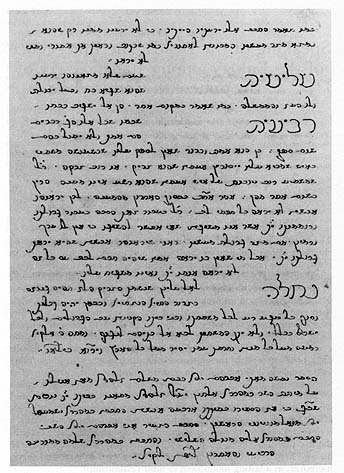
Manuscript page from a collection of funeral sermons of Abraham of Sant’Angelo. Courtesy of the Library of The Jewish Theological Seminary of America. Mic. 5470–1599:20, folio 176a[10].
This chapter, which will concern itself primarily with the culture of Italian Jewry and with the emergence in its midst of formalized funerary preaching during the sixteenth century, will not strive to deal conclusively with even a small number of the questions raised above, nor will it deal comprehensively with all the eulogies, in print and manuscript, surviving from that period. It will, however, try to uncover and, somewhat more tentatively, to explain the beginnings of the phenomenon, while paying special attention to the funeral sermon’s ties to two of the dominant themes in Italian Jewish life of the sixteenth century: the tension between the traditions of Ashkenazic Jewry and those of Mediterranean Jewries (Sephardic as well as native Italian), and the debate over the proper role of kabbalah in Jewish society. Some attention will also be given to the possible impact of late Renaissance culture upon Jewish funerary preaching in Italy.
| • | • | • |
In 1393 the humanist Pier Paolo Vergerio (the elder) composed a funeral oration in memory of Francesco il Vecchio da Carrara, lord of Padua, who died in a Visconti prison. Vergerio’s is the earliest funeral oration yet found by Renaissance scholars which follows classical (as opposed to medieval) norms for oratory. As opposed to the thematic sermons of a more general nature preached by others on the same occasion, Vergerio’s classicizing panegyric focused on Francesco himself, reviewing his virtuous actions in both the private and public realms in a manner which, it has been claimed, “slavishly imitated ancient rhetorical canons.”[3] In the following decades this classicizing form of eulogy became increasingly influential. In 1428, as Hans Baron has shown, the Florentine chancellor and noted humanist Leonardo Bruni modeled his oration on the death of Nanni degli Strozzi, a prominent general in the anti-Viscontean coalition, on the funeral speech of Pericles as reported by Thucydides.[4] A recent study has found, in fact, that of the three oratorical genres inherited from classical antiquity, epideictic (as opposed to judicial and deliberative) oratory, the performative form of rhetorical discourse to which the eulogy belonged, “constituted the leading genre throughout the Italian Renaissance.” More significantly for our purposes, it has been found that Renaissance orators “practiced funeral oratory more extensively than their ancient predecessors ever did.”[5]
These developments evidently had some impact, albeit belated, upon Jewish society in Italy. When, on Lag ba-Omer of 1572, R. Moses Isserles, perhaps the leading Polish rabbinical authority of his time and one who, in his short life, had achieved international recognition, died in Krakow, he was eulogized in the ghetto of Venice by his relative, colleague, and frequent correspondent, R. Samuel Judah Katzenellenbogen. The latter’s was probably not the only eulogy for Isserles that was delivered, but it is evidently the only one whose text was deemed worthy of preservation. This was not because his Polish contemporaries were niggardly in their praise for their great rabbi. R. Solomon Luria, his twin tower in the rabbinic world of sixteenth-century Poland, had written to Isserles during his lifetime that “from Moses [Maimonides] to Moses [Isserles] there has been none like Moses,” and this encomium, never used lightly, was inscribed with even greater permanence upon his tombstone.[6]
Rather, it must be recognized that the funeral sermon was a far less developed literary genre in the culture of sixteenth-century Ashkenazic Jewry than it was among their Italian brethren, among whose Christian neighbors, as noted above, funeral oratory had been especially cultivated since the early Renaissance.[7] What is striking, however, in the case of Rabbi Katzenellenbogen of Venice, is that he too, as he would have been proud to admit (and as his name could scarcely conceal) was an Ashkenazi, but one born and bred in northern Italy.[8] He was thus possessed of a rather different cultural orientation, of which his sermon on the death of Isserles is but a small indication, from those of his ilk beyond the Alps. Despite his clear Ashkenazic affiliations as a member of the Minz rabbinic dynasty,[9] Katzenellenbogen was capable of delivering, very possibly in Italian, funeral sermons of considerable polish and sophistication, if not as dazzling in their rhetorical flourish as those of his Mantuan colleague, R. Judah Moscato.[10] And yet, one might argue that it was precisely on account of those same Ashkenazic affiliations that he was prompted to launch his career as an eloquent public eulogist in Venice with the death in distant Krakow of R. Moses Isserles.
R. Samuel Judah was then just past his fiftieth birthday, and had succeeded his father R. Meir Katzenellenbogen (known also as “Maharam Padovah” and regarded by scholars as the greatest Italian rabbi of the period) to the position of senior member of the Venetian rabbinate, possibly even before the latter’s death in 1565.[11] Of the six eulogies which he later published in Shneim-Asar Derashot, his 1594 collection of selected sermons,[12] five can be assigned at least approximate dates, and of these the earliest is that delivered upon the death of Isserles in 1572.[13] None of the published Jewish funerary sermons from Italy were delivered before that date, although, as we shall see, some delivered as early as fifteen years previously survive in manuscript, and earlier ones may, of course, yet be discovered. It nonetheless appears that the humanistic revolution in funerary oratory inaugurated in Italy by Pier Paolo Vergerio in 1393 had no more than a limited, and certainly delayed, impact on Jewish society.
| • | • | • |
Internal developments stemming originally from outside of Italy, however, may be of greater significance. If Vergerio’s eulogy in memory of Francesco da Carrara is the earliest surviving Renaissance funeral oration to have followed classical norms for oratory, the sermon composed in the same year by the recently (and perhaps forcibly) baptized Profiat Duran, residing then in Perpignan, may be the earliest surviving text of a medieval Hebrew funeral oration. Funerary poetry in the elegiac mode, known as the “kinah,” may be found among Spanish Jewry in relative abundance from the eleventh century through the late thirteenth,[14] but funerary sermons emerge as a written genre only considerably later. Duran sent his to Gerona, upon the death there in 1393 of R. Abraham Tamakh. He explained in an accompanying missive to the latter’s son Joseph, in whose voice the eulogy was written, that he had composed it on account of his love for both the deceased and his son, but more importantly, because he had heard that R. Abraham had not been eulogized properly by those who, he felt, should have done so. On account of his formal apostasy, Duran, who signed the letter off as “your brother the Levite whose song has been spoiled,” was obviously in no position to deliver his Hebrew sermon in person. He therefore composed a text that could be read publicly by Joseph Tamakh as a eulogy for his late father.[15]
Except for such unusual circumstances, it would appear unlikely that a fourteenth-century Jewish funerary sermon (whether in Spain, Provence, or elsewhere in Europe) would be committed to writing and preserved. Of the twelve sermons of Tamakh’s townsman R. Nissim Gerondi (d. c. 1375) which were preserved as a unit and later published, not a single one is a funerary eulogy. By contrast, when some two centuries later R. Samuel Judah Katzenellenbogen of Venice published twelve of his sermons in a collection that was based, as was there acknowledged, upon Gerondi’s model,[16] fully half were eulogies. Something had clearly changed in the matter of Jewish speaking (or writing) of the dead in Western Europe.
Earlier in the sixteenth century (in 1506), R. Samuel Judah’s great-grandfather, R. Judah Minz, died in Padua where, as befitting his position as the leading rabbi of the region and the leader of Ashkenazic Jewry in Italy, he was brought to burial amid great (and to the minds of some, excessive) pomp. According to the eyewitness account of his funeral composed by R. Elijah Capsali, at least three sermons were delivered in honor of the deceased rabbi.[17] Yet none of these has been preserved, and it would appear that they were never formally committed to writing. The eulogy seems still to have been regarded among the Ashkenazic Jews of Padua, even when carried out on a relatively grand scale, more as an “event” to be experienced and remembered than as a “text” to be transcribed and reread—or reused by resourceful preachers.
Among the Iberian exiles who had settled in the Ottoman Empire, however, texts of funerary sermons, transcribed sometimes in advance of their delivery (which did not always actually take place), may be found during the same period in relative abundance. R. Joseph Garçon, a Portuguese exile of Castilian origin, composed no less than twenty such sermons during the first decades of the sixteenth century, most for notable rabbis, while residing in Salonika and then in Damascus.[18] Like Duran a bit more than a century earlier, he would sometimes utilize the ventriloquistic method of addressing the deceased through the voice of a close relative, such as a son or a wife. To a greater degree than Duran’s single sermon, however, those of Garçon would seem to signal a shift from the poetic kinah to the sermonic hesped as the favored form of formal discourse concerning the dead among late medieval Spanish Jewry—a shift which may ultimately have been rooted in the transition from Muslim to Christian influence in its cultural values.[19] The poetic genre did not, of course, disappear—witness the many kinot written upon the death of R. Joseph Caro in 1575[20]—but the audience capable of comprehending (and appreciating) such creations seems to have been shrinking steadily.
In the cultural orbit of the Spanish exiles there is even evidence of sons publicly eulogizing their recently deceased fathers. In 1559 R. Samuel Ashkenazi Jaffe (of Constantinople) composed a highly stylized sermon upon the death of his father, R. Isaac (of Bursa).[21] This is to be contrasted with the Ashkenazic Katzenellenbogen family in Venice, where it would appear that upon the death of the great Maharam in 1565, his son and successor, R. Samuel Judah, either never eulogized him publicly, or delivered on that occasion a sermon less worthy of preservation than the sort later anthologized in his Shneim-Asar Derashot. It may have been less sophisticated in its structure and content as well as in its language (possibly Yiddish),[22] and may never have been committed to writing, just as those delivered in Padua early in the century upon the death of R. Judah Minz seem never to have been written down.
| • | • | • |
If we have no written eulogy of R. Meir Katzenellenbogen by his son and successor, we do have one by the noted scribe and itinerant teacher R. Abraham of Sant’Angelo, which was delivered in Bologna, where he then resided, before a local Jewish confraternity known as “Ḥevrat Nizharim.”[23] Two other eulogies by the same R. Abraham have survived, both delivered during his stay in Bologna, where the presence of a sizable group of Iberian Jews may have helped to create a demand for formal funerary sermons.[24]
Earlier than these, however, is the text of a eulogy copied by R. Abraham which had been delivered by his father-in-law, R. Isaac de Lattes, in nearby Pesaro during the winter of 1557–58, shortly after he had been invited to head a yeshiva there. This would appear to be the earliest known text of a Jewish funeral sermon preached in Italy, predating that of R. Samuel Judah Katzenellenbogen on the death of R. Moses Isserles by some fifteen years, and bringing the beginnings of the hesped as a literary genre in that country closer to where we might expect them—among the Jews of Mediterranean origin (Spanish, Provençal, or native Italian) rather than among the Ashkenazim of the Veneto. R. Isaac de Lattes had come to Italy from southern France in the late 1530s and had spent a decade in Rome, where there were no less than three congregations of Spanish Jews, before moving north.[25] It is therefore likely that he had encountered along the way, if not actually practiced himself, the more formal and textually based style of funerary preaching favored among his contemporaries in the Sephardic diaspora, which rendered the sermon, parallel to the epitaph, as a lasting verbal monument to the memory of the deceased. The importance of being eulogized well in public may have been perceived, moreover, as part of the general importance of dying well in public, which was receiving increasing emphasis among Italian Jewry of the mid-sixteenth century.[26]
R. Abraham Sant’Angelo’s eulogizing style sometimes drew heavily, as we shall see, upon that of his father-in-law, although his sermon on the death of R. Elhanan Yael (Angelo) Fano, the first we shall discuss, exhibits little such influence. Fano had been a banker in Florence early in the sixteenth century but eventually moved to Bologna, where he quickly became one of the Jewish community’s leaders. During the 1530s he was referred to by such figures as R. Azriel Diena of Viadana as “a prince of God” (cf. Gen. 23:6), and Gedalia ibn Yaḥya was later to pair him with Don Samuel Abravanel as one of the two wealthiest Jews in Italy.[27] As befitted his status, R. Elhanan Yael was eulogized in Bologna upon his death not only by R. Abraham of Sant’Angelo, but by three other local rabbis.[28] His funeral, of which we unfortunately have no account, was probably quite a spectacle and undoubtedly included many torches, whose processional use was not yet prohibited for the Jews in the Papal States.[29]
Of the four sermons delivered in Fano’s home, only R. Abraham’s has been preserved, though not in its entirety. Thus his comparison of R. Elhanan Yael with the patriarch Abraham, both of whom received, according to the preacher, four major gifts from God, remains incomplete. We are told of the wealth they both shared, and the children (the second gift) as well as the grandchildren (the third) they lived to see, but the fourth gift which they held in common is revealed on a leaf which has been lost, and can only be conjectured.[30] R. Abraham had elsewhere in his eulogy compared the late R. Elhanan Yael to the patriarch Abraham, seeing the former’s death as having left the community of Bologna without its leader and helmsman.[31] One wonders whether the association between the two was not prompted in some way by the prominent references to the deceased during his lifetime as “a prince of God,”[32] the title acquired by the biblical Abraham, as the preacher R. Abraham’s contemporaries would have known, as part of his real estate deal with the Hittites. The eulogist may also have been struck by R. Elhanan’s near uniqueness in his generation, declaring that “there is hardly one like him in the land, from the rising of the sun to its setting,” making him thus similar to Abraham who, in the words of the prophet Ezekiel “was one,” and was regarded in later Jewish tradition as having been unparalleled in his time.[33] Thus, although there was no obvious connection between the name of the deceased and the biblical patriarch, various textual associations may have been responsible for Rabbi Abraham’s decision to use the figure of Abraham (his own namesake!) as a frame for the former’s eulogy.
The eulogy for R. Mordecai Canaruto, whose death is described as having been both sudden and untimely and who evidently left behind him neither sons nor grandsons,[34] was apparently delivered sometime after 1560,[35] and is as different from that for Fano as were the lives of the two men themselves. It addresses not the community of Bologna as a whole, but the members of its Nizharim confraternity in whose study hall it was delivered. Among them it singles out especially the sons of the “royal princess” (see Ps. 45:14) Fiammetta and the late R. Abraham Pisa, whose teacher and apparently constant companion R. Mordecai had been for more than seven consecutive years.[36] R. Abraham mentions explicitly (though not, perhaps, without some rhetorical exaggeration) that he had been not merely invited but forcefully pressured by the members of the Pisa family (“those glorious ones, my masters and patrons”) and by the Nizharim confraternity to eulogize the deceased, and that he was doing so as an act of obedience. Consequently, he asserted, if his words were to prove unequal to the occasion only they were to blame. In order to be sure that these somewhat delicate phrases came out in actual delivery in precisely the way they were intended, R. Abraham made sure to insert in the margins of his Hebrew text some of the Italian words (in transliteration) that he planned to use: provocato, obbedienza, incolparsi.[37] These were not the only Italian words he inserted in the margins. No less than a dozen such instances occur in the eulogy for Canaruto, although none, curiously, is to be found in the Hebrew text of R. Abraham’s eulogy for R. Elhanan Yael Fano. It would appear then that the latter was transcribed after its delivery, which apparently took place, with little notice, on the day of Fano’s death,[38] whereas the former was written in advance, perhaps for the regular weekly lesson of the Nizharim confraternity which, according to its inaugural statutes, all members were required to attend.[39] Italian would appear, then, to have been the language of actual delivery on both occasions, to which the written text bore a different relation in each instance.
Another readily observable difference in the texts of the two sermons is that the one for Canaruto contains not only references to the teachings of the kabbalists but extensive quotations from the Zohar itself.[40] Both R. Abraham and his father-in-law, R. Isaac de Lattes, had been instrumental in the controversial publication of the Mantua edition of the Zohar (1558–1560) a short time earlier, so his familiarity with the work is hardly surprising. What might surprise us more, however, is the act of launching texts regarded as esoteric into the realm of public preaching. Prior to the publication of the Zohar, as Robert Bonfil has noted, even rabbis of avowedly kabbalistic orientation, such as R. Isaac de Lattes, avoided explicit references to its teachings in their sermons.[41] After its publication, however, the work gradually lost much of its esotericism, and even such intellectually conservative preachers as the Ashkenazic R. Samuel Judah Katzenellenbogen, were, before the century’s end, to make liberal use of the Zohar in their public (and published) sermons.[42]
This would help to explain why he refrained from overt Zoharic references at the more public and official occasion of his eulogy on the death of R. Elhanan Yael Fano, where, as we recall, three other Bolognese rabbis were prominently present, presumably in the company of the local communal establishment. In the more intimate surroundings of the Nizharim confraternity’s study hall, where, moreover, he seems to have taken over the late Canaruto’s position, R. Abraham may have felt freer to break the obsolescent taboo by quoting from the newly published work. Nonetheless, if the eulogy for Canaruto constituted his inaugural lecture before the members of the confraternity, the act required not only a certain amount of daring (unless Canaruto had begun quoting from the Zohar in the sermons he delivered prior to his death) but also some commitment, though not necessarily messianic, to the spread of kabbalah as a form of exoteric wisdom, a commitment for which there is ample evidence from other quarters.[43] His sermon before Ḥevrat Nizharim was, among other things, an act of self-presentation, and in quoting amply from the Zohar R. Abraham was, in effect, saying to its members, “this is what you can now expect from the likes of me.”
It is striking, therefore, that in his third and last surviving eulogy (as well as his longest), also delivered before the members of Bologna’s Nizharim confraternity[44] on the death in 1565 of R. Meir Katzenellenbogen, R. Abraham abstained from quoting the Zohar or any other kabbalistic work. This was probably intended as a diplomatic gesture in the direction, however, not of his audience, which had presumably already become accustomed to hearing him use such sources, but of the deceased, who had been one of the most prominent opponents in Italy of the Zohar’s publication.[45] Yet it is curious that in his eulogy R. Abraham made a point of stating, among the praises of Maharam (whom he knew personally), that the latter had achieved perfection in opinions and in the highest forms of wisdom “ascending to the highest level,” and that through religious study “the secrets and hidden meanings of the Torah were revealed to him.”[46] This would seem to suggest that Italy’s great Ashkenazic rabbi, “Maharam Padovah,” was more kabbalistically inclined, though not necessarily in the direction of Zoharic kabbalah, than some scholars have been willing to acknowledge, and to lend support to the previously disputed testimony that he had compiled a work on practical kabbalah during his lifetime.
The testimony is that of R. Elazar Altschuler of Prague, who early in the seventeenth century claimed to have copied such a work. He asserted that it bore the name of Maharam and contained more than five hundred entries, including medical remedies and discussions of the seventy-two-letter divine name. The work, he claimed, was composed “mostly of practical kabbalah from the delightful book Berit Menuḥah, which is known to the kabbalistic elect” and which, as described more recently by Scholem, combined ecstatic with theosophical mysticism.[47] Yet one modern scholar has seen the attribution of such a work to R. Meir as “nothing other than the invention of a practical kabbalist seeking to lend credence to his craft” and another has been equally skeptical, citing in this connection R. Samuel Judah Katzenellenbogen’s description of himself (in a responsum to Isserles) as “neither a kabbalist nor the son of a kabbalist.”[48] The latter statement, however, which clearly drew upon Amos (7:14, “I am no prophet, nor the son of a prophet”), was obviously intended with some irony, since its immediate continuation (“but I have [in my possession] a kabbalistic commentary on the Song of Unity”) considerably undermines its beginning. It needs qualification, moreover, in light, not only of the familiarity with sephirotic symbolism evinced by its author later in the same passage, but of the no less than thirteen references to the Zohar in R. Samuel Judah’s twelve published sermons. The statement’s truth regarding the father may be roughly equal, therefore, to its degree of veracity regarding the son—and to the truth of its biblical antecedent as well.[49] It would appear, as we shall see further, that historians would do better to accept at face value Altschuler’s straightforward testimony concerning Maharam’s compilation of an essentially derivitive work on practical kabbalah than to treat naively R. Samuel Judah’s clearly ironic statement about his own and his father’s kabbalistic proclivities.[50]
Evidence for such a tendency on the part of Maharam may also be seen in a recently published letter to him by one the sons of Ishmael Rieti, written evidently in 1564, a year before Maharam’s death. The letter, which refers to its recipient in royal terms and speaks also of the great respect which the late Ishmael (a difficult man to impress) harbored for Maharam (and graphically demonstrated to the members of his household) mentions among his many merits that “those who know the [divine] names put their trust in you.” Although the words contain a clear allusion to Psalm 9:11, it seems neither necessary nor appropriate to emend the phrase to read “those who know Your name,” as in the biblical original.[51] Rather, there would appear to be here a reference to Maharam’s expertise in the various versions and vocalizations of the divine name and the uses to which it could be put, described in such works as the Berit Menuḥah, as well, perhaps, as an allusion to his being an actual “master of the name” (ba’al shem).[52] As to how the members of the Rieti family might know about this generally concealed aspect of Maharam, it should be noted that their household tutor during the mid-1550s was R. Isaac de Lattes, who in late 1557 became the father-in-law of their relative (and our preacher) Rabbi Abraham Sant’Angelo.[53]
The aforementioned eulogy written by R. Abraham provides further evidence of Maharam’s “practical” kabbalistic tendency, which, according to his account, seems to have possessed a strong messianic streak as well. After mentioning the great rabbi’s access to the “secrets and hidden meanings of the Torah,” the eulogist goes on to report an incident which occurred while Maharam was on his deathbed. An hour or so before “the expiration of his pure soul” after seventy-eight years,[54] he summoned one of his students named Joseph and instructed him to take a wife who would soon, he claimed, give birth to a male child. The boy was to be named Judah, “and he shall be the Messiah son of Joseph.”[55] R. Abraham seems to have taken this story quite seriously, noting that “a man does not jest in his dying hour” (Baba Batra 175a) and expressing the hope that Maharam’s prophecy would prove correct. What R. Samuel Judah Katzenellenbogen, Maharam’s son and successor who was presumably present at his father’s deathbed, made of this story is less clear, for he, as noted above, either never eulogized his father or, if he did, never saw fit to include his eulogy among the others later published in Shneim-Asar Derashot. One might surmise, if the former was the case, that besides finding the formal eulogy still (in 1565) a bit too richly Italianate for his taste, R. Samuel Judah may have found his father’s dramatic death scene a difficult act to follow.
R. Abraham Sant’Angelo, in tactfully avoiding overt references to, or quotations from, the Zohar in his eulogy for Maharam, may have intended thereby to show respect for a person he regarded not as an antikabbalistic opponent of the Zohar’s publication, but as a figure whose opposition, like that of R. Moses Basola and even R. Jacob Israel Finzi, derived from a position essentially sympathetic to the kabbalah.[56] The motives of Maharam and Basola in their respective oppositional stances during the late 1550s controversy have been discussed in the scholarly literature, with the former generally being regarded as the stauncher and more principled opponent of the Zohar’s publication than the latter, a prominent kabbalist whose reservations seem to have been related primarily to the matter of timing. Yet, as has been noted, Maharam was surprisingly timid in his public stance, clearly waiting for Basola to take the initative in the matter of the proposed ban on the publication or purchase of kabbalistic works.[57]
Although the possibility has been raised that Maharam saw no possibility, on pragmatic grounds, of instituting a ḥerem to halt the publication and sale of kabbalistic works without the support of Basola (who had previously supported their dissemination), it now seems equally possible that the Ashkenazi rabbi’s respect for the great kabbalist was genuine rather than merely tactical, and that he felt it best to defer to his judgment in matters of kabbalah, especially the Zoharic variety.[58] Whatever Maharam’s true motives were, R. Abraham Sant’Angelo, in his 1565 eulogy, could certainly regard him as having been (like Finzi, as well as his own teacher Basola) a “sympathetic” rather than “hostile” opponent of the Zohar’s dissemination, whose position, even after it had been rendered obsolete, was not to be slighted on the occasion of his eulogy.
Although the condition of the manuscript does not allow us to determine with certainty where R. Abraham’s eulogy for Maharam ends, it seems to have concluded with a verse-by-verse gloss, most likely extemporaneous, of the alphabetical section, “Eshet Ḥayyil,” at the end of the final chapter of the book of Proverbs. Read “creatively,” it was a paean not to the biblical “good wife,” but to the soul of the late great rabbi.[59] Although only the presentation of the plan, rather than its actual execution, has been preserved in the written text of the eulogy (which, like that delivered on the death of Canaruto, contains some transliterated Italian words in its margins in order to facilitate smooth delivery), it is likely that R. Abraham, who may not have finished writing his sermon on time (or may not have really tried), managed to carry it off reasonably well. This is because he had already followed the same formula in the conclusion of his earlier sermon on the death of R. Mordecai Canaruto.[60] There, too, however, the written version breaks off before the end, suggesting that the preacher felt that a partial text would suit his needs, but not before he managed to demonstrate the style of “biographical exegesis” to be followed, and to provide some useful information concerning the deceased.
We learn, for example, of the generous sum of fifty gold scudi which, as a devoted son, the late R. Mordecai had sent his parents before the previous Rosh ha-Shana (linked to the words “and he will have no lack of gain” [Prov. 31:11]), and of his regular custom of rising at midnight for Torah study (linked to “She rises while it is yet night” [31:15]).[61] The earlier phrase “and works with willing hands” (31:13) is glossed by R. Abraham as a reference to the novellae and sermons which his predecessor had delivered “in this honorable place of Ḥevrat Nizharim.” The beginning of that verse, “She seeks wool and flax,” seems also to be linked by the eulogist with R. Mordecai’s preaching (punning on the word darshah), but if so, it is the content rather than the locus of the sermon which is addressed: “the reasons for the commandments and the laws, the hidden explanation of ‘sh’atnez,’ [the mingling of] wool and flax, the secret of the [divine] attribute of mercy (‘sod midat ha-raḥamim’)…the secret of the [divine] attribute of justice (‘sod midat ha-din’).”
This would seem to suggest that Canaruto had sought the secret (kabbalistic) reasons for the commandments, and perhaps even preached publicly about them before the members of Nizharim. Yet it would be unwise to accept R. Abraham’s sermonic testimony at face value, for the same gloss of the verse in Proverbs may be found in another text upon which he clearly drew—the eulogy delivered some years earlier in Pesaro by his father-in-law R. Isaac de Lattes, which R. Abraham copied and preserved in his own collection of sermons.[62] There the entire “Eshet Ḥayyil” was glossed as the sermon’s peroration, which helps to explain why R. Abraham was able to jot down only partial (in Maharam’s case very partial) notes concerning the biblical text for those sermons in which he was planning to conclude with it. When in doubt as to what to say about a particular verse, he could always fall back on his father-in-law’s version—which he did at least twice in the eulogy for Canaruto.[63] In addition, then, to the actual “good wife” through whom R. Abraham Sant’Angelo and R. Isaac de Lattes were linked familially, their styles of speaking of the dead were textually linked through the Proverbial “eshet ḥayyil,” who, for a preacher in need, could be “more precious than jewels.”
It should be noted, moreover, that the exegesis of the words “she seeks wool and flax” in Proverbs 31 as alluding to the biblical prohibition of sh’atnez is neither original with R. Isaac de Lattes nor taken from Rabbinic literature, but is rooted rather in the Zohar,[64] the very work in whose dissemination he and and his son-in-law played a vital role. There the “good wife” is the divine Shekhina whose inquiries concerning wool and flax relate to finding out “who it is that joins them together,” for the sake of meting out punishment. For “whoever tries to join them together,” according to the Zohar, “arouses a spirit that is not fit, which then comes over him, for one comes from this side and the other comes from that side. Therefore we are not permitted to join them together.”[65]
The eulogies delivered by R. Abraham Sant’Angelo and R. Isaac de Lattes were joined together not only through their mutual references to those substances whose joining together was prohibited by biblical law, but also, if less directly, by that great work whose publication joined the two men together, the Zohar. Yet in sixteenth-century Italy, one did not necessarily have to consult the Zohar in order to gain access to its interpretations of the commandments. Many of these came to the attention of a wider audience through such commentaries on the Torah as that of R. Menahem Recanati, published in Venice in 1523 and 1545,[66] and especially that of R. Baḥya b. Asher, first published in Naples as early as 1492, and then frequently republished in Italy through the sixteenth century.[67] In the latter work, in fact, the Zoharic explanation for the prohibition of mixing wool and flax in a single garment is presented in extenso, without citation of source, as the kabbalistic explanation, and there too, Proverbs 31:13 is linked with the esoteric interpretation of the commandment.[68] In introducing this teaching in a public sermon preached in Pesaro (where R. Baḥya’s Torah commentary had been published three times earlier in the century), R. Isaac de Lattes was hardly taking a decisive step in the dissemination of the kabbalah, and may even seem to have been carrying coals to Newcastle. There may, nonetheless, have been a deliberate edge to his remarks, which also included a description of the deceased’s soul as returning to the bosom of its “husband” in the garden of Eden.[69]
His sermon was delivered during the winter of 1557–58, just after the publication of the Tikkunei Zohar and the Ferrara edition of Ma’arekhet ha-Elohut (in which Lattes had played a role) but before the appearance, during the summer of 1558, of the first volume of the Zohar together with R. Isaac’s responsum supporting its publication.[70] Moreover, Pesaro, where the sermon was delivered, was in 1557–1558 a community sharply divided on the issue of whether the esotericism of kabbalistic texts should be preserved, or whether they should be released into the open. Of the two leading figures in the community responsible for bringing R. Isaac there, R. Judah (Laudadio) de Blanis, his former teacher (and fellow physician), supported the exoteric tendency characteristic of the more philosophically inclined adherents of the kabbalah.[71] R. Menahem of Foligno, however, the other parnas of the Jewish community, was against publication of the Zohar, and it was he who encouraged R. Jacob Israel Finzi, one of the prime opponents, to take his vigorous stand on the matter.[72]
It is not clear, therefore, if the mystical allusions in R. Isaac’s eulogy, the first known to us in Italy, were part of an attempt to bring the kabbalah further into the open, or whether they were merely a slip of the tongue on the part of a (possibly extemporizing) preacher, in whose learned mind rabbinic and Zoharic teachings might, with equal ease, arise and there converge, and who might have gradually dropped his guard as the sermon approached its end.[73] Unlike the eulogies of R. Abraham Sant’Angelo in Bologna, we do not know whether it was delivered before a general, communal audience, or before a more intimate one, such as the members of a yeshiva or confraternity. In the case of the latter, however, some caution would still have been in order, since among the members of the yeshiva/study confraternity which had invited R. Isaac to Pesaro was not only R. Judah de Blanis, who shared his position in favor of exotericism, but also R. Menahem of Foligno, who clearly did not. Politics aside, R. Isaac would not have wanted to jeopardize the extremely generous one hundred scudi a year contract (for three years) which had apparently been his primary motivation for leaving Bologna.[74] By including in his peroration a kabbalistic gloss on “she seeks wool and flax” which originated with the Zohar but which had been widely disseminated in the published Torah commentary of R. Baḥya, R. Isaac may have been (or felt himself) able to please the proponents of exotericism without unduly upsetting its opponents. As was evident in the sermons of his son-in-law R. Abraham, who was present at a eulogy could affect its content as much as who was being eulogized.
Yet the human subject, as in the case of his sermon on the death of Maharam Padovah, was clearly of importance as well, for on that occasion R. Abraham, in evident deference to the deceased, omitted the overt quotations from the Zohar which he had earlier included in the eulogy for R. Mordecai Canaruto, delivered before the very same audience of Ḥevrat Nizharim. The 1565 sermon on the death of Maharam seems, as I have previously mentioned, also to have concluded with an improvised verse-by-verse gloss of the “Eshet Ḥayyil” section at the end of Proverbs, the sort of improvisation at which R. Abraham may well have become quite adept in the seven years since his father-in-law used that formula in Pesaro. We shall never know, however, whether in his peroration he continued to studiously avoid using Zoharic material, or whether upon reaching the verse “she seeks wool and flax” he dropped his guard and spoke of the secret reasons of the commandments and of the dangers of joining those things that should not be joined. Maharam, according to R. Abraham’s own testimony earlier in the sermon, had come to know “the secrets and hidden meanings of the Torah,” so a kabbalistically tinged gloss of “Eshet Ḥayyil” might have been an appropriate conclusion for his eulogy. But there was always the danger that it might have violated the late great Ashkenazic rabbi’s stand in favor of esotericism. Maharam had been so well known, if controversial, a figure among Italian Jewry of his day that R. Abraham may have decided simply in favor of audience participation—letting his confraternal audience, which had heard him go through “Eshet Ḥayyil” at least once before, decide themselves how to gloss each verse in the hope that they would, like the proverbial good wife, open their mouths in wisdom.
| • | • | • |
R. Samuel Judah Katzenellenbogen, who seems to have sighed silently upon the death of his distinguished father, decided to open his mouth in wisdom before the Jews of Venice some seven years later upon the death (in 1572) of R. Moses Isserles in Krakow. The great Polish rabbi had been not only his relative and correspondent, but also an important ally to the Katzenellenbogen family some twenty years earlier. When the Giustiniani press in Venice released a “no-frills” edition of Maimonides’ Mishneh Torah, intended to undercut the lavish annotated edition Maharam had published there in 1550 (with the competing Bragadini press), Isserles responded by issuing a ban prohibiting all Jews, under pain of excommunication, from purchasing the cheaper edition of the work, a ban which seems to have been quite effective but which ultimately may have led to the tragic burning, some years later, of the Talmud in Italy.[75]
This may explain why R. Samuel Judah did not bother to mention this particular debt of loyalty in his 1572 eulogy. He also made no mention there of the support he had received from the Polish rabbi in another delicate matter—that of imposing, in Venice, the Ashkenazic custom of having women go by night rather than (as according to “Italiani” practice) by day to prepare themselves for (monthly) ritual immersion, an issue which might have caused some members of his (presumably ethnically mixed) audience to bristle with resentment.[76] R. Samuel Judah chose rather to focus on the remarkably wide readership that Isserles had reached through his halakhic writings and the many students he had acquired thereby, citing in this connection the words of Daniel (12:3) that those “who turn the many to righteousness” shall shine “like the stars for ever and ever.”
These writings also had an Ashkenazic agenda, however, in that they gave the opinions of medieval Franco-German authorities greater prominence than they had recently been given by R. Joseph Caro in his influential code, the Shulkhan Arukh. Katzenellenbogen, though, chose rather diplomatically to remain silent about this crucial aspect of Isserles’ oeuvre in the eulogy for him which he delivered in Venice—the city whose publishers (in marked contrast to those in Krakow) were effectively to boycott Isserles’ glosses to the Shulkhan Arukh in their editions of that work until as late as sixty years after his death.[77] A preacher who had been at the helm little more than seven years could not afford to alienate even a small segment of his audience. On the other hand, Katzenellenbogen was evidently keenly aware of the fact that the late Polish rabbi was not likely to receive in Krakow the sort of stylized public sermon commemorating his death that he might be given in the Italian ghetto of Venice. His decision to eulogize him there publicly may thus be compared to Profiat Duran’s decision, some two centuries earlier, to compose a sermon on the death of R. Abraham Tamakh, whom, he feared, had not been eulogized in the grand manner he deserved. It appears then, somewhat paradoxically, that the sermon delivered in Venice upon the death of Isserles, the sermon in which Katzenellenbogen first emerged there as a public eulogist, had much to do with the Ashkenazic bonds between the two rabbis (although these were never mentioned explicitly), but was related also to the Italian standards acquired by Katzenellenbogen. When his father, the great Maharam, died in 1565, R. Samuel Judah knew that he could count on someone else in Italy (even someone, such as R. Abraham Sant’Angelo, who had not always agreed with his father’s views) to eulogize him properly. Upon the death of Isserles in 1572 this was considerably less clear.
Katzenellenbogen chose on that occasion to begin his sermon with a discussion of the famous but enigmatic verses at the end of Daniel (12:2–3): “And many of those who sleep in the dust of the earth shall awake.…And those who are wise shall shine like the brightness [zohar] of the firmament; and those who turn many to righteousness, like the stars for ever and ever.” He offered one explanation which saw an era of abundant and shining wisdom as arriving with the advent of the messianic age and the resurrection of the dead, and another which understood the verse as claiming that the purified bodies of the wise and righteous would shine brightly upon their resurrection. Katzenellenbogen’s stated preference was for the second interpretation, which he saw as the plain meaning (peshuto) and which, he noted, agreed with the opinion of “Naḥmanides and all the kabbalists” (as opposed to that of Maimonides) that resurrection was indeed to be corporeal. In his view, those who had acquired wisdom would shine at that time like the firmament, but those who, like the departed, had also imparted their learning to others (“those who turn many to righteousness”) would shine upon their resurrection with the greater brightness of the stars.
One interpretation of the verse in Daniel that Katzenellenbogen pointedly ignored, however, was the one which R. Isaac de Lattes had quoted some years earlier in his controversial responsum concerning publication of the Zohar, a responsum which had been prominently featured in the famous first edition of Mantua, 1558. Lattes there cited the Zohar’s own view of the verse, especially in the opening sections of the Tikkunei Zohar, as referring quite literally to itself and as justifying, to some degree, an exoteric tendency in kabbalistic matters. He quoted, among others, the following passage: “ ‘And those who are wise’—these are Rabbi Simeon [b. Yoḥai] and his companions, ‘shall shine like the brightness [zohar] of the firmament’…when they created this work there was agreement from above, and it was called Sefer ha-Zohar.”[78]
Katzenellenbogen, though he evinced in his eulogy for Isserles a marked sympathy for the views of the kabbalists, also shows signs of having been struggling there with the question of exotericism. Throughout the bulk of the sermon he seems to have avoided any overt mention of, or quotation from, the Zohar, though these were to figure prominently in some of his later eulogies (e.g. on R. Isaac Foa). At the very end, however, after mentioning another recent death—that, in Safed, of R. Joseph Sagis—there is a sudden turnaround and Katzenellenbogen quotes rather extensively from the same kabbalistic work he had previously excluded in the same sermon. In attempting to explain the deaths of the two rabbis he cites the view of the Zohar that the illness or misfortune with which the righteous are sometimes afflicted can atone for the entire world. “How do we learn this? From the organs of the body. When all the organs are afflicted with a grievous disease, one limb has to suffer in order that all the others may be healed. Which one is it? The arm. The arm is punished and blood is taken from it [by bloodletting], and then all the parts of the body are healed.”[79] Katzenellenbogen goes on to cite from the Zohar the view that under conditions of severe disease, even two arms must suffer. What he skips over between the two passages, however, is the Zoharic proof text: “What proof have we? From the verse ‘He was wounded because of our transgressions, he was crushed because of our iniquities…and with his stripes we are healed’ [Isaiah 53:5]. ‘With his stripes’—this refers to bloodletting…‘we are healed’—healing comes to us, to all parts of the body.”[80]
This last passage seems to have been deleted by Katzenellenbogen in his public sermon not because of its (less than considerable) kabbalistic content, but because of its unavoidable Christological associations for an Italian Jewish audience. It drew upon “the remarkable [biblical] chapter which,” as Driver and Neubauer noted over a century ago, “has for ages formed one of the principal battle-fields between Christians and their Jewish opponents.”[81] Why the Zohar’s author would intentionally use such a verse is a question which need not concern us here.[82] But it was clearly easier for a conservatively inclined rabbi such as Katzenellenbogen to quote liberally from that work in a public sermon than to cite some Christian-sounding passages based on Isaiah 53. Despite Katzenellenbogen’s own conservatism, however, he was careful to pepper his sermon on the death of Isserles with an eclectic range of references which, beyond the Zohar, included the medieval exegetes Ibn Ezra and David Kimḥi, as well as, for the philosophically inclined, Plato (on knowledge) and Maimonides (on resurrection). These learned and somewhat random references seem to have been intended to satisfy as wide an audience as possible,[83] but even in a cosmopolitan Venetian synagogue it is unclear how many of those present would have been pleased to hear that the late R. Moses Isserles had been, like an earlier member (some believed) of his race, “wounded because of our transgressions” or “crushed because of our iniquities.” Although the words were from Isaiah, they had come to be associated in the minds of Italian Jews more with Christian preaching than with Jewish.
In 1597, however, a somewhat spunkier and certainly sprightlier rabbi of native Italian origin, Leon Modena (who was not yet thirty years old), was considerably less careful about avoiding such Christological motifs in the sermon which he delivered in Venice upon the death there of Katzenellenbogen. He was willing to go as far as to assert that the weakness which had begun to afflict the late rabbi since ascending to his position of leadership “was on account of our iniquities, the trembling that had taken hold of him was because of our transgressions, his illness was caused by our sins, and his death the result of our rebelliousness and contentiousness, for he, in his righteousness, would have continued living much longer.”[84] Modena, who was later to compose a learned polemical work against Christianity, undoubtedly knew that he was playing with fire by implicitly comparing Katzenellenbogen with Christ, but perhaps pursued that paradox intentionally as a rhetorical device. He may also have been playfully nodding in the direction of the Christians who, he later claimed, would come to hear his sermons in the ghetto. In the same sermon Modena also compared the late rabbi, less controversially if more explicitly, to Alexander the Great, whose silencing (by death) was said to have paradoxically activated the lips of others.[85]
Modena’s range of Jewish references was also quite wide and rather catholic. He did not fail, despite his avowed hostility to the kabbalah, to quote the Zohar in that same 1597 sermon (as in others), nor did he neglect, in the companion poetic elegy he composed on Katzenellenbogen’s death, to praise the Ashkenazic rabbi for being not only a great judge and able leader, but also beyond possible error in “hidden matters.” Modena’s playful, if perhaps for some contemporaries maddening, eclecticism, even in matters funereal, went considerably beyond that of his Ashkenazic predecessor in both style and substance. Moreover, his consciousness and cultivation of paradox, whether in the use of Christological motifs to explain the death of a pious rabbi, or in his reliance upon the Zohar despite questioning its antiquity, signify a wider shift towards the mannerist sensibility that ushered in the baroque era.[86] There are indications, which I hope to discuss in a future study, that towards the end of his life Katzenellenbogen showed a new openness to the classicizing aesthetic values of the Italian Renaissance. Ironically, however, by that time the baroque, with its emphasis upon conflict rather than harmony, was taking its place in the cultural arena, as can be glimpsed from his younger colleague’s more mannered style of speaking of the dead.
Notes
1. Babylonian Talmud (hereafter B.T.) Sanhedrin, 46b.
2. J. H. Hexter’s masterful essay on “The Rhetoric of History” is worth consulting even by those who have little interest in reading about Bobby Thomson’s 1951 home run. See D. L. Sills, ed., The International Encyclopedia of the Social Sciences (1968), vol. 6, pp. 368–394, reprinted in J. H. Hexter, Doing History (Bloomington, 1971), pp. 15–76.
3. See J. M. McManamon, S. J., Funeral Oratory and the Cultural Ideals of Italian Humanism (Chapel Hill, N.C., 1989), pp. 10–11. On pre-humanist thematic funeral sermons, which “gravitated towards philosophical lectures on issues suggested by the Scriptural theme and only remotely touched on the life of the person eulogized,” see ibid., p. 10. On Vergerio see also idem, “Innovation in Early Humanist Rhetoric: The Oratory of Pier Paolo Vergerio (the Elder), ”Rinascimento n.s. 22 (1982): 3–32.
4. See Hans Baron, The Crisis of the Early Italian Renaissance (revised ed. Princeton, 1966), pp. 412–413. According to Baron “Bruni allowed his eulogy of the dead general to grow into a Florentine counterpart to Pericles’ oration.” See also McManamon, Funeral Oratory, p. 23.
5. McManamon, Funeral Oratory, pp. 34–35. For a discussion of epideictic see also W. H. Beale, “Rhetorical Performative Discourse: A New Theory of Epideictic,” Philosophy and Rhetoric 11 (1978): 221–246.
6. On the date of Isserles’ death and the text of his epitaph, see Asher Siev, ed., She’elot u-Teshuvot ha-Rema (Jerusalem, 1971), p. 13. For Luria’s comment see ibid., no. 67.
7. Note the forty-four-page appendix containing a list of funeral orations delivered in Renaissance Italy ca. 1374–1534 in McManamon, Funeral Oratory, pp. 249–292. As he observes, “at least thirty-five funeral orations had appeared in print by 1500” (ibid., 24–25), so that sixteenth-century Italian Jews seeking to familiarize themselves with the written genre could so with relative ease.
8. For biographical information see the entries by Meyer Kayserling in the Jewish Encyclopedia (hereafter JE) (1901–1906), vol. 7, p. 455, and by Umberto Cassuto in the (German) Encyclopaedia Judaica (1928–1934), vol. 9, pp. 1083–1084. The entry by Shlomo Tal devoted to R. Samuel Judah’s father, R. Meir Katzenellenbogen, in the new Encyclopaedia Judaica (hereafter EJ) (1972), vol. 10, pp. 829–830, contains some information on the son, as well as additional bibliography. More recently see Asher Siev, “R. Shmuel Yehudah Katzenellenbogen,” Ha-darom 34 (1972): 177–201, which is still far from definitive. On the sermons of R. Samuel Judah see the brief but useful study by Gedaliah Nigal, “Derashotav shel R. Shmuel Yehudah Katzenellenbogen,” Sinai 36 (1971–1972): 79–85, and the illuminating comments of Robert Bonfil, Rabbis and Jewish Communities in Renaissance Italy, trans. J. Chipman (New York, 1990), especially pp. 309–311.
9. The famous R. Judah Minz was his great-grandfather, whose granddaughter was married to R. Samuel Judah’s father, R. Meir. On the family as a rabbinic dynasty see Cecil Roth, History of the Jews in Venice (hereafter Venice) (Philadelphia, 1930), p. 280.
10. For the view that Jewish sermons in Italy were delivered in “mellifluous Italian” see Cecil Roth, The Jews in the Renaissance (Philadelphia, 1959), p. 36; Moses Shulvass, The Jews in the World of the Renaissance, trans. E. I. Kose (Leiden, Chicago, 1973), p. 345; and, more recently (and comprehensively) Bonfil, Rabbis 301–302; idem, “Aḥat mi-Derashotav ha-Italkiot shel R. Mordekhai Dato,” Italia 1 (1976) (Hebrew section), pp. 2–3. On the language of delivery see also the general comments of Marc Saperstein, Jewish Preaching 1200–1800, An Anthology (New Haven, London, 1989), pp. 39–44. On Moscato, whose style, as Alexander Altmann noted, “exemplified, and did not merely discourse upon, the humanist concern for ars rhetorica,” see idem, “Ars Rhetorica as Reflected in Some Jewish Figures of the Italian Renaissance,” in B. D. Cooperman, ed., Jewish Thought in the Sixteenth Century (Cambridge, Mass., 1983), pp. 15–21. Note also the comment of Leon Modena on Moscato’s style in Yacob Boksenboim, ed., Iggerot Rabbi Yehuda Aryeh mi-Modena (Tel Aviv, 1984), p. 84. Modena, in his eulogy upon R. Samuel Judah’s death, praised him as possessing not only Scriptural and rabbinic learning, but also “ẓaḥiot” (or possibly “ẓaḥiut”) by which he would seem to mean eloquence or rhetoric. See Leon Modena, Midbar Yehudah (Venice, 1602), 68b. On “ẓaḥut” as a term for rhetoric see Jacob Klatzkin, Thesaurus Philosophicus Linguae Hebraicae (Berlin, 1933), 3: 240.
11. On Maharam see the entries by Max Seligsohn in JE, vol. 7, p. 454, and Umberto Cassuto in the German EJ, vol. 9, p. 1079. More recent studies include Simon Schwarzfuchs, “I responsi di Rabbi Meir da Padova come fonte storica,” Scritti in memoria di Leone Carpi (Milan, Jerusalem, 1967), pp. 112–132; Asher Siev, “Maharam mi-Padovah,” Ha-darom 28 (1969): 160–195; for Maharam as “the greatest rabbi of the period” see Shulvass, Jews in the World of the Renaissance, p. 91, and note the seventeenth-century testimony quoted by Bonfil, Rabbis, p. 132, n. 159 and mentioned also in (the new) EJ, vol. 10, p. 829. On R. Samuel Judah’s rabbinical status in Venice, see Roth, Venice, p. 280; Bonfil, Rabbis, p. 229, n. 86; and M. A. Shulvass, “Venezia,” in J. L. Maimon, ed., Arim ve-Imahot be-Yisrael (Jerusalem, 1950), vol. 4, p. 77.
12. Shneim-Asar Derashot (Venice, 1594). The date of publication is sometimes given erroneously as 1588. See, for example, M. S. Ghirondi in Kerem Ḥemed 3 (1838), p. 95. The number of eulogies in the collection is reported erroneously as five by Joseph Dan, Sifrut ha-Musar veha-Derush (Jerusalem, 1975), p. 197.
13. Besides the one for Isserles (no. 6), sermons were delivered upon the deaths of R. Judah Moscato (no. 3), R. Isaac Foa (no. 5), R. Joseph Caro (no. 10), and R. Zalman (Solomon) Katz (Cohen-Rapa) (n. 11). The sixth, which appears as the final sermon in the collection (whose organization, however, is not chronological), was recited upon the untimely death of an unnamed young man.
14. Moses ibn Ezra composed nearly forty of this variety. On his poems, and on the genre in general, see the excellent chapter (no. 8) in Dan Pagis, Shirat ha-Ḥol ve-Torat ha-Shir le-Moshe ibn Ezra u-Venei Doro (Jerusalem, 1970), pp. 197–224, and the more limited remarks in idem, Ḥiddush u-Masoret be-Shirat ha-Ḥol ha-Ivrit (Jerusalem, 1976), pp. 162–163. See also the book-length study by Israel Levin, Al Mavet: ha-Kinah al ha-Met be-Shirat ha-Ḥol ha-Ivrit bi-Sefarad al Rek’a ha-Kinah ba-Shira ha-Aravit (Tel-Aviv, 1973), together with the critical remarks of Pagis, Ḥiddush u-Masoret, p. 374. Levin’s study ends with the poet Todros Abulafia (d. c. 1300), who composed some thirty kinot. For some Spanish examples between the eleventh and thirteenth centuries see also H. Schirmann, ed., Ha-Shira ha-Ivrit bi-Sefarad uve-Provens, 2 vols. (Jerusalem, Tel Aviv, 1972), nos. 67–70, 257, 334.
15. Profiat Duran, Ma’aseh Efod, eds. J. Friedländer and J. Kohn (Vienna, 1865), pp. 189–197. On Duran see R. W. Emery, “New Light on Profayt Duran ‘The Efodi’,” Jewish Quarterly Review n.s. 58 (1967/68): 328–337 and the sources cited there. For bibliographies of surviving eulogies see Aharon (Adolph) Jellinek, Kuntres ha-Maspid (Berlin, 1884), and the more complete work by Duber (Bernhard) Wachstein. Mafteaḥ ha-Hespedim (Vienna, 1922–32), which nonetheless needs considerable updating.
16. An edition of Gerondi’s twelve sermons had been published in Constantinople earlier in the sixteenth century, and another appeared in Venice in 1596. See M. Steinscheider, Catalogus Librorum Hebraeorum in Bibliotheca Bodleiana (2nd ed. Berlin, 1931) (hereafter CB), p. 2063.
17. See the account of Elijah Capsali, Seder Eliyahu Zuta, ed. Aryeh Shmuelevitz et al. (Jerusalem, 1977), vol. 2, p. 255.
18. See Meir Benayahu, “The Sermons of R. Yosef b. Meir Garson as a Source for the History of the Expulsion from Spain and [the] Sephardic Diaspora,” [Hebrew] Michael 7 (1981): 144–198 passim; Joseph Hacker, “On the Intellectual Character and Self-Perception of Spanish Jewry in [the] Late Fifteenth Century” [Hebrew] Sefunot (new series) 2, no. 17 (1982): 66–69, 82–95.
19. On Arabic influence upon the medieval Spanish kinah see Levin’s study mentioned above (n. 14). On the transition in cultural values see Bernard Septimus, Hispano-Jewish Culture in Transition: The Career and Controversies of Ramah (Cambridge, Mass., 1982). Note there p. 8 on R. Meir Abulafia’s thirteenth-century poem on the death of his sister, in which it is the latter who speaks. On this poetic device see ibid., p. 122, n. 50.
20. See Meir Benayahu, “Kinot Ḥakhmei Italia al R. Yosef Caro,” in R. Yosef Caro: Iyyunim u-Meḥkarim, ed. Y. Raphael (Jerusalem, 1969), pp. 302–359.
21. For the 1559 sermon of R. Samuel Ashkenazi Jaffe see Meir Benayahu, “Hespedo shel R. Shemuel Ashkenazi,” Kobeẓ al Yad 8, no. 18 (1976): 438–449, and the latter’s introductory comments there, pp. 435–437.
22. On the use of Yiddish in Ashkenazic preaching of the sixteenth century see H. H. Ben-Sasson, Hagut ve-Hanhaga (Jerusalem, 1959), p. 39. On Yiddish as the language of preference among Italian Ashkenazim see Shulvass, The Jews in the World of the Renaissance, pp. 222–227, and Riccardo Calimani, The Ghetto of Venice, trans. K. S. Wolfthal (New York, 1987), p. 141.
23. On R. Abraham of Sant’Angelo, known also as R. Abraham b. Meshullam of Modena, see Isaiah Tishby, “The Controversy about the Zohar in the Sixteenth Century in Italy” [Hebrew], in P’raqim: Yearbook of the Schocken Institute for Jewish Research (1967–1968), vol. 1, pp. 131–132 [=idem, Ḥikrei Kabbalah u-Sheluḥoteha (Jerusalem, 1982), vol. 1, pp. 79–80]; Ephraim Kupfer, “New Documents concerning the Controversy about the Publication of the Zohar,” Michael 1 (1973): 304–318 (Hebrew section), and Moshe Idel, “Major Currents in Italian Kabbalah Between 1560–1660,” Italia Judaica (Rome, 1986), vol. 2, pp. 246–247. See also Ya’akov Boksenboim’s biographical sketch in his edition of Iggerot Melamdim: Italia [5]315–[5]351 (1555–1591) (Tel Aviv, 1985), pp. 44–52. The third collection of correspondence published there (pp. 249–361) is mostly between R. Abraham, his students, and the members of his family (such as his father-in-law R. Isaac de Lattes). On the “Nizharim” confraternity see Bonfil, Rabbis, pp. 216–217, and now Bracha Rivlin, “Takkanot Ḥevrat Nizharim be-Bologna mi-Shenat [5]307,” Asufot 3 (1989): 357–396.
24. One of the remaining two was delivered before the members of “Nizharim” upon the death of its previous teacher, R. Mordecai Canaruto, and another, the earliest of the three, delivered on 16 November, 1562, in the home of R. Elhanan Yael Fano, who, until his death, had been the leading figure among the Jews of Bologna. All are contained in ms. Jewish Theological Seminary of America mic. 5470 (hereafter ms. JTSA), no. 37234 in the Institute for Microfilmed Hebrew Manuscripts of the Jewish National and University Library and were noted by Boksenboim, Iggerot Melamdim, p. 50. On Bologna see Isaiah Sonne, “On the History of the Jewish Community of Bologna at the Beginning of the Sixteenth Century” [Hebrew], Hebrew Union College Annual 16 (1942): 35–100. On R. Mordecai Canaruto see Rivlin, “Takkanot Ḥevrat Nizharim,” pp. 358–359. Her transcription of a passage from R. Abraham’s eulogy, however, is far from accurate.
25. This sermon should be added to the one earlier thought to be R. Isaac’s “one extant sermon,” cited by Bonfil (Rabbis, p. 305) from a different manuscript. On de Lattes, whose origins were in Carpentras and Avignon, but who had been in Italy since the late 1530s or early 1540s, see David Fränkel, “Toledot R. Yiẓḥak Yehoshua de Lattes,” Alim 3 (1938): 27–33; the many citations in Bonfil, op. cit., index s.v. “Lattes, Isaac Emmanuel de”; Boksenboim, Iggerot Melamdim, pp. 20–21; and Idel, “Major Currents,” pp. 246–248. On the Spanish congregations in Rome see, most recently, Ariel Toaff, “The Jewish Communities of Catalonia, Aragon, and Castile in 16th-Century Rome,” in The Mediterranean and the Jews, ed. A. Toaff and S. Schwarzfuchs (Ramat Gan, 1989), pp. 249–270.
26. Note for example, the case of Abraham Colonia, a wealthy Jew of Viadana. When he died suddenly in 1556, the local rabbinic authorities ruled that his body should not be accompanied to burial since he did not confess publicly, and was therefore “akin to one who has no place in the next world.” See Ya’akov Boksenboim, ed. (Responsa), Mattanot be-Adam, p. 393. I hope to discuss this theme more extensively in a future study.
27. Moreover, R. Abraham ha-Kohen, Bologna’s leading rabbinical figure until his death in the late 1540s, had been his son-in-law, and R. Menahem Azariah of Fano was his grandson. On his wealth see Gedaliah ibn Yaḥya, Shalshelet ha-Kabbalah (Jerusalem, 1962), p. 153. For other details concerning R. Elhanan Yael and the members of his family, including a family tree of the Fano family, see Robert (Reuven) Bonfil, “New Information Concerning Rabbi Menahem Azariah da Fano and his Age” [Hebrew] in Perakim be-Toledot ha-Ḥevra ha-Yehudit bi-Yemei ha-Beinayim uva-Et ha-Ḥadasha Mukdashim le-Professor Ya’akov Katz, ed. I Etkes and Y. Salmon, (Jerusalem, 1980), pp. 99–101, 134–135, and the sources cited there.
28. The first to speak was R. Ishmael Ḥanina of Valmontone, in accordance with his rank as the first among Bologna’s rabbis, after whom followed R. Abraham, then R. Elijah of Nola, and then R. Solomon Modena, uncle of the yet unborn Leon. On R. Ishmael Ḥanina, who was probably then the teacher of R. Elhanan Yael’s grandson Menahem Azariah, see Bonfil, “New Information,” p. 101, and the many sources cited there, n. 22. Of the two individuals bearing the name Elijah of Nola known to us in sixteenth-century Italy, the one here mentioned is probably the physician and rabbi Elijah b. Joseph of Nola, who is known to have spent time in Bologna. In 1536 he translated a medieval Aristotelian work (by the bishop of Lincoln) from Latin into Hebrew, and is later praised for his learning by both Moses Alatino and David de Pomis. See Moritz Steinschneider, Die hebraische Übersetzungen des Mittelalters und die Juden als Dolmetscher (Berlin, 1893), pp. 126, 476, and the sources cited there, as well as Harry Friedenwald, The Jews and Medicine (New York, 1967), pp. 47, 579, 582, and Cecil Roth, The Jews in the Renaissance, p. 84, who confuses him (p. 150) with the physician and copyist Elijah b. Menahem di Nola of Rome. The latter eventually converted to Christianity, and was known during his period of papal employ (after 1568) by the name Giovanni Paulo Eustachio Renato. On the distinction between the two Elijahs of Nola see Friedenwald, The Jews and Medicine, p. 582 and earlier, Joseph Perles, Beiträge zur Geschichte der hebräischen und aramäischen Studien (Munich, 1884), p. 220. R. Elijah b. Joseph of Nola seems, like many others (such as R. Solomon Modena, concerning whom see below) to have left Bologna shortly before the expulsion of 1569, for we find him among the rabbis of Rome in Nisan, 1568. See Ya’akov Boksenboim, ed., Parshiot (Tel-Aviv, 1986), p. 49. It is likely that the kinah on the death of “the prince of physicians, R. Elijah of Nola of blessed memory,” preserved in ms. Budapest Kaufmann A 539, is for this Elijah b. Joseph. On R. Solomon b. Mordecai Modena of Bologna, who was ordained in 1546 by R. Isaac de Lattes, see Bonfil, Rabbis, pp. 43, 102, 197, and the sources cited there, as well as The Autobiography of a Seventeenth-Century Rabbi: Leon Modena’s Life of Judah, trans. and ed. M. R. Cohen (Princeton, 1988), pp. 76, 78–79, and especially the biographical sketch (by H. Adelman and B. Ravid) on p. 189. See also Ya’akov Boksenboim, ed., Iggerot…Rieti (Tel-Aviv, 1987), p. 11 for a list of letters to and from R. Solomon, and the index s.v. “Modena, Solomon.”
29. On the later prohibition see Cecil Roth, History of the Jews in Italy, p. 384. On the use of torches in R. Judah Minz’s funeral see Capsali (cited above n. 17), pp. 254–255.
30. Ms. JTSA, 174b. On Abraham as grandfather see Louis Ginzberg, The Legends of the Jews, trans. H. Szold (Philadelphia, 1909), vol. 1, pp. 298–299, 316–317. So far as R. Elhanan Yael’s grandchildren are concerned, we know that he had at least two upon his death, since R. Menahem Azariah Fano, who was his father’s second son (the first was Abraham Jedidiah), was born ca. 1548. His immediately younger brother Judah Aryeh was most likely born before the death of their grandfather, but the fourth and youngest of the brothers, Elhanan Yael, was probably born after the death of his namesake in 1562. On the date of R. Menahem Azariah’s birth and the names and order of his brothers see Bonfil, “New Information,” pp. 99, 134.
31. Ms. JTSA, 172b, where he quotes the rabbinic account (B.T. Baba Batra 91a–b) of the reaction of Abraham’s leading contemporaries to his death (“Woe to the world whose leader is gone, woe to the ship whose helmsman is gone”) and applies these to the deceased. Compare also the use of this nautical motif in Solomon ibn Gabirol’s famous poem on the death of R. Hai Gaon. See Schirmann, Ha-Shira ha-Ivrit, no. 70.
32. See Boksenboim, ed., Parshiot, pp. 302, 305, 309, 312.
33. Ms. JTSA, 174b, and compare Ezek. 33:24. Although the straightforward meaning of the verse refers to Abraham’s being only one man (as opposed to many) it was often understood in Jewish exegesis as referring to his uniqueness in his day. See, for example, Midrash Bereshit Rabbah, ed. J. Theodor and Ch. Albeck (repr. Jerusalem, 1965), p. 1171; Midrash Tanhuma, ed. S. Buber, 35b; Zohar 1: 65b.
34. The suddenness of his death is mentioned explicitly (177a) and its untimeliness may be inferred from the use of Gen. 29:7 (“Behold, it is still high day, it is not time…to be gathered”). The absence of male offspring is suggested by the reference to R. Mordecai’s students among the Pisa family as being his spiritual sons—“banav ha-ruḥaniyyim” (ibid.). The conclusion of the eulogy mentions R. Mordecai’s devotion to and support of his parents, but nothing about a wife or children.
35. This is Boksenboim’s conclusion (Iggerot Melamdim, p. 50) based on the fact that R. Moses Basola, who is thought to have died in 1560, is mentioned in the sermon with the blessing of the dead (181b). It should be noted, however, that the sermon refers to such 1550s events as the burning of the Talmud (1553), the papal bull which followed afterwards (apparently the 1554 Cum sicut nuper of Julius III), and the burning at the stake of the twenty-four martyrs of Ancona (1555), in such a way as to suggest that these wounds were still fresh (177a). None of these events are alluded to in the 1562 eulogy for Fano, and they would appear to point to a late 1550s date for the sermon.
36. “Like a loyal and loving father he policed you day and night, so that the designs of your hearts would take on wings like eagles (cf. Is. 40:31) and embrace the bosom (cf. Pr. 5:20) of those actions that are proper, good and honorable” (Ms. JTSA, 177a–b). The model of the resident tutor who was either unmarried or separated from his family and capable thus of devoting full time not only to the teaching of his students but also to the supervision and control of their behavior was common among sixteenth-century Italian Jewry. See my forthcoming article in the Festschrift for Shlomo Simonsohn. The words that I have translated as “policed you” appear in the Hebrew original, as far as I can tell, as “hishter etkhem” but have been transcribed by Rivlin (p. 359) as “haya meyasser otam.” “Hishter” would appear to be a corruption of the “hiph’il” form “hishtir,” concerning which see E. Ben Yehuda, Milon ha-Lashon ha-Ivrit (repr. Jerusalem, New York, 1959), vol. 8, p. 7060. On policing as part of a teacher’s duty, even when teaching older students, see, for example, the 1557 letter appointing R. Isaac de Lattes as head of a yeshiva and study society in Pesaro, in Boksenboim, ed., Iggerot Melamdim, p. 259, and more extensively my forthcoming article mentioned above.
37. Ibid., 177b. The humble apology of the preacher was common in sixteenth-century Jewish sermons, and drew upon the rhetorical tradition of the “exordium.” See David Ruderman, The World of a Renaissance Jew, pp. 16–17; Bonfil, Rabbis, p. 304.
38. See also R. Abraham’s note at its conclusion (quoted by Boksenboim, Iggerot Melamdim, p. 50) where he refers to the sermon as having already been delivered.
39. See the statutes published by Rivlin, “Takkanot Ḥevrat Nizharim,” par. 18 (pp. 365, 374–375).
40. Ms. JTSA, 181b, 182a, 183a–b.
41. Bonfil, Rabbis, p. 305. On the kabbalistic content in R. Isaac’s sermons see further below.
42. See the instances cited by Nigal, “Derashotav,” p. 83. Note there also the list of the other kabbalistic works cited (less frequently) by Katzenellenbogen in his sermons.
43. Note, in addition to his role (together with his father-in-law) in the publication of the Mantuan edition of the Zohar, their joint role in the spread of Yohanan Alemanno’s writings, mentioned by Idel, “Major Currents,” pp. 246–247. Idel sees the two scribes as having influenced through their activity “the direction of kabbalah in Italy and elsewhere.” For the perception in Italy of kabbalah as “exoterical wisdom” see ibid., p. 244. The curriculum followed by one of R. Abraham’s students some years later included, according to the testimony of the latter’s brother, “Halakha [Hebrew] grammar, kabbalah, and music.” See Boksenboim, Iggerot Melamdim, p. 390. Note also R. Abraham’s statements on behalf of spreading kabbalistic wisdom and against the opponents of its dissemination published by Kupfer, “New Documents,” pp. 307–309.
44. Ms. JTSA, 188b.
45. See Simha Assaf, “La-Pulmus al Hadpasat Sifrei Kabbalah,” Sinai 5 (1939–1940), pp. 362, 368 [=idem, Mekorot u-Meḥkarim be-Toledot Yisrael (Jerusalem, 1946), pp. 240, 246]; Tishby, “The Controversy,” 133–135, 137, 150–151, 163–165; Kupfer, “New Documents,” pp. 308–309. Among the sometimes hostile marginal comments by R. Abraham Sant’Angelo in his copy of R. Jacob Israel Finzi’s letter published by Kupfer, one seems to relate directly to R. Meir. In response to Finzi’s claim there that since “the rabbis of Venice, R. Meir [Katzenellenbogen] and his colleagues, had issued a decree on this matter, their voice must be heeded,” according to the Talmudic teaching (B.T. Eruvin 21b) that “the words of the scribes were to be heeded more than those of the Torah,” R. Abraham, after “the words of the scribes” wrote in the margin “but not one like him” (ibid., pp. 308–309). Was this a reference to R. Meir himself (whom R. Abraham was later to eulogize), or to Finzi, the author of the letter he was annotating?
46. Ms. JTSA, 190a. The term used by R. Abraham to describe the type of study through which Maharam reached the highest levels of wisdom is “ha-esek ha-toriyyi,” by which he seems to mean the study of conventional, as opposed to esoteric, texts. On the term “toriyyi” see Klatzkin, Thesaurus, vol. 4, p. 186, where it is defined as religious, dogmatic, or relating to the Torah. The third meaning, however, suggests the possibility that the reference is to Maharam’s involvement in meditations making use of the Torah text, perhaps of the ecstatic-theosophic variety described in the book Berit Menuḥah (concerning which see the following note). Compare the kabbalistic technique advocated by another Italian Ashkenazi, Yohanan Alemanno: “Once one has divested oneself of all material thoughts, let him read only the Torah and the divine names written there. There shall be revealed awesome secrets and such divine visions as may be emanated upon pure clear souls who are prepared to receive them.” See Moshe Idel, “The Magical and Neoplatonic Interpretations of the Kabbalah in the Renaissance,” in Cooperman, ed., Jewish Thought, p. 198. On Alemanno’s influence see ibid., p. 229. The use of Berit Menuḥah by Alemanno was noted by Gershom Scholem, “Chapters from the History of Cabbalistical Literature” [Hebrew], Kiryat Sefer 5 (1929): 276 (I owe this reference to Moshe Idel). On the relationship between R. Abraham Sant’Angelo, who copied some of Alemanno’s manuscripts and possessed autographs of others (see Idel, “Major Currents,” pp. 246–247), and Maharam, see ms. JTSA, 189b, 190b.
47. See Altschuler’s remarks in the Prague, 1610 edition of Sefer Keneh Ḥokhma Keneh Binah (a partial edition of the kabbalistic work Sefer ha-Kanah), 28a, which are quoted extensively both by Tishby, “The Controversy,” p. 165, and Siev, “Maharam,” p. 191. On the Berit Menuḥah, which dates from the mid-fourteenth century but was not published until the mid-seventeenth, see Gershom Scholem, Major Trends in Jewish Mysticism (New York, 1961), pp. 145–146, and his entry on “Abraham b. Isaac of Granada,” its putative author, in EJ, vol. 2., pp. 145–146, as well as the comments on the work in his entry on “Kabbalah,” ibid., vol. 10, pp. 538, 632, where he writes that “this book, which contains lengthy descriptions of visions of the supernal lights attained by meditating on the various vocalizations of the Tetragrammaton, borders on the frontier between ‘speculative Kabbalah’…and ‘practical Kabbalah.’ ” On the essentially magical “practical Kabbalah” see Scholem’s comments, ibid., pp. 632–638, as well as Major Trends, p. 144; idem, The Messianic Idea in Judaism, and Other Essays in Jewish Spirituality (New York, 1971), p. 263, and in his Sabbatai Sevi: The Mystical Messiah, trans. R. J. Z. Werblowsky (Princeton, 1973), p. 75, where it is defined as “the special use of divine mysteries to produce supernatural changes in the world” (see n. 52). On the mystical technique of combining the letters of the divine name see more recently the wide-ranging discussion of Moshe Idel, Kabbalah: New Perspectives (New Haven, 1988), pp. 97–103.
48. The first position is Tishby’s (see the previous note) and the second that of Siev (ibid.) who does not mention him and appears to have arrived at his judgment independently. The responsum to Isserles is no. 126 in Siev’s edition (p. 496, and see there also n. 14). Tishby calls attention to the fact that R. Elazar avoids stating unequivocally that the work was composed by Maharam, describing it rather as “nikra ’al shemo.” I would see this, however, only as an indication of the recognition on his part that the work was largely derivative and that it drew extensively on other sources, especially the Berit Menuḥah. On the accessibility to Maharam of the Berit Menuḥa see the previous two notes. It should be noted also that the fifteenth-century manuscript of the work described in A. Neubauer, Catalogue of the Hebrew Manuscripts in the Bodleian Library (Oxford, 1886–1906), p. 635, as Spanish has now been identified as Ashkenazic. See card no. 19114 in the catalogue of the Institute of Microfilmed Hebrew Manuscripts in the JNUL.
49. As Meir Weiss has recently noted, “There is a distinct probability that Amos expressed himself in an exaggerated fashion.” See his The Bible from Within (Jerusalem 1984), p. 105, and for rabbinic exegesis, p. 102, n. 3. For references to the Zohar in R. Samuel Judah’s sermons see Nigal, “Derashotav,” p. 83, n. 60. The entire sentence in his responsum reads, “I, in my affliction, am neither a kabbalist nor the son of a kabbalist, but I have [in my possession] a kabbalistic commentary on the Song of Unity [Shir ha-Yiḥud], not a comprehensive one, but fragmentary.” If the testimony concerning himself and his father is as ironic as I suggest, the commentary alluded to by R. Samuel Judah may have been part of his father’s own work on practical kabbalah, which according to Altschuler’s description, contained more than five hundred entries and must have been rather fragmentary in character. On the “Song of Unity” in Ashkenazic kabbalah see Joseph Dan, Torat ha-Sod shel Ḥasidei Ashkenaz (Jerusalem, 1968), pp. 171–178.
50. It is possible that R. Samuel Judah was deprecating his own and his father’s kabbalistic stature in relation to that of his correspondent (Isserles), who has been recently described as “the most important Ashkenazi figure who was influenced by Italian philosphical-magical Kabbalah.” See Idel, “Major Currents,” p. 246. Although he chose not to stress it in his eulogy, this aspect of Isserles may have been well known to the younger Katzenellenbogen.
51. The suggestion in favor of emendation is that of Boksenboim, who has published the letter and established its approximate date. See Iggerot…Rieti, pp. 305–306. Boksenboim does not mention the evidence for Maharam’s interest in practical kabbalah. The letter may possibly suggest, as he has noted, that a portrait of Maharam hung in the Rieti household. See ibid., p. 305 and compare Shulvass, The Jews in the World of the Renaissance, p. 235. If this is, in fact, what is intended by the cryptic words, “The likeness of the moon rising was engraved on the walls of our house, a throne to your great name, and upon the likeness of a throne, great love” (cf. Ezekiel 1:26, “and seated above the likeness of a throne was the likeness of a human form”), then the fact that R. Samuel Judah later posed for a portrait, thought by some to be the first portrait of a rabbi, would be yet another example of continuity in the Katzenellenbogen family. The allusions to Ezekiel’s vision, however, may suggest that the reference is not to a portrait which hung in the Rieti home, but to a kabbalistic wall chart containing divine names which had been prepared either by Maharam or according to his instructions. This would dovetail, of course, with the reference to Maharam some lines later in the same letter as one in whom “those who know the names put their trust.” On the knowledge of “names” see also the following note.
52. As Scholem has noted, ba’al shem was the title given, in both popular usage and literary works from the Middle Ages onward, “to one who possessed the secret knowledge of the Tetragrammaton and the other ‘Holy Names,’ and who knew how to work miracles by the power of these names.” He has observed also that “there were large numbers of ba’alei shem, particularly in Germany and Poland, from the sixteenth century onward,” some of whom were, like Maharam, important rabbis and scholars. See G. Scholem, “Ba’al Shem,” EJ, vol. 4, pp. 5–6, and note also idem, On the Kabbalah and its Symbolism, trans. R. Manheim (New York, 1969), p. 200.
53. On R. Isaac’s period of service in the Rieti household see Boksenboim, Iggerot Melamdim, p. 20, and idem, Iggerot…Rieti, pp. 33, 292. Note the letter sent to de Lattes in late 1557 by two sons of Ishmael Rieti congratulating the former on the marriage of his daughter to Sant’Angelo (referred to as “our brother and our flesh”) published by Boksenboim, Iggerot Melamdim, pp. 269–270.
54. The age given by R. Abraham for Maharam Padovah at his death is considerably younger than that which has been traditionally accepted in scholarship (see the sources cited in n. 11 above), as Boksenboim (Iggerot Melamdim, p. 50) has already noted. It is thus less likely that Maharam’s strange behavior at his deathbed (concerning which see below) can be attributed to senility.
55. Ms. JTSA, 190a. On the Messiah son of Joseph, “the dying Messiah who perishes in the Messianic catastrophe,” see Scholem, The Messianic Idea, pp. 18, 97; idem, Sabbetai Sevi, pp. 53, 55–56, 70, 82; and David Tamar, “Luria and Vital as the Messiah Ben Joseph” [Hebrew], Sefunot 7 (1963): 167–177. On messianic speculation in Ashkenazi Hasidism, which may have influenced Maharam, see Dan, Torat ha-Sod, pp. 241–245, and his comments in EJ, vol. 11, pp. 1414–1415.
56. Note also the great respect shown by the Italian scholar Sant’Angelo for the Ashkenazi rabbi, in contrast to the letter (written in late November, 1563) by R. Abraham Rovigo of Ferrara to Maharam in which he accused the latter of blatant favoritism toward Ashkenazim and questioned the basis of his authority to override the decisions of other rabbis. See E. Kupfer, “R. Abraham b. Menahem of Rovigo and his Removal from the Rabbinate” [Hebrew], Sinai 61 (1967): 162, and Bonfil, Rabbis and Jewish Communities, p. 108. Yet it should be noted that Maharam made it difficult for Rovigo to show him respect, calling him a madman (meshuga) twice in one of his rabbinical decisions, and referring there also to his “diseased mind” (Kupfer, “R. Abraham…and his Removal,” p. 159). These words were not easy to take sitting down, even from the leading rabbi of the period.
57. This caused some consternation on the part of such fellow opponents as R. Jacob Israel Finzi. See Simḥa Assaf, “La-Pulmus,” pp. 362, 368; Tishby, “The Controvesy,” pp. 137, 163. On Finzi’s opposition see also his letter, mentioned above, to R. Isaac Porto-Katz of Mantua, published by Kupfer, “New Documents,” pp. 307–309.
58. See Tishby, “The Controversy,” p. 164, who noted how strange it was that Italy’s leading rabbinic authority would need Basola’s approval to institute such a ban, and suggested pragmatic considerations on the part of the former. It should be noted that the two rabbis seem to have entertained similar messianic speculations. Maharam, in 1565, felt that the Messiah son of Joseph would soon be born, whereas Basola had in 1547 predicted that the final redemption would come between 1560–1588. See Isaiah Tishby, “Rabbi Moses Cordovero As He Appears in the Treatise of Rabbi Mordekhai Dato” [Hebrew], Sefunot 7 (1963): 129; “The Controversy,” p. 150 [=idem, Studies, pp. 98, 139]. On messianic speculation in Italy during this period see also David Tamar, “The Messianic Expectations in Italy for the Year 1575” (Hebrew), Sefunot 2 (1958): 61–88.
59. As Boksenboim (Letters, p. 50) notes, at least one page (194) of the sermon is missing, but I do not share his certainty that the conclusion is missing as well. My suspicion is that the short section at the head of page 195a contains the brief notes that R. Abraham made for the conclusion of his eulogy on Maharam. As to why brief notes would suffice, see below. The use of verses describing a “woman of valor” concerning a man was technically facilitated by the fact that the Hebrew word for soul (here: nefesh) takes the feminine. For the earlier use of “Eshet Ḥayyil” as the basis for a lament on a woman see the poem written by R. Eleazar b. Judah of Worms (d. c. 1230) after the martyrdom of his wife Dulcia, published by A. M. Haberman, Sefer Gezerot Ashkenaz ve-Ẓarefat (Jerusalem, 1945), pp. 165–166. See also the English translation in Ivan Marcus, “Mothers, Martyrs, and Moneymakers: Some Jewish Women in Medieval Europe,” Conservative Judaism 38, no. 3 (1986): 34–45. On exegesis of “Eshet Ḥayyil” as a separate unit see the commentary from late fourteenth-century Spain published by L. A. Feldman, “Exegesis of Proverbs XXXI: 10–31 by R. Abraham Tamakh” [Hebrew], in the Samuel K. Mirsky Memorial Volume (Jerusalem, New York, 1970), pp. 85–103. On the use of the first verse of “Eshet Ḥayyil” in the Ashkava prayer for women according to the Sephardi rite, see EJ, vol. 6, p. 887. On the use of an alphabetical scheme, apparently as a mnemonic device, for eulogies, see S. D. Goitein, A Mediterranean Society, vol. 5, “The Individual” (Berkeley, Los Angeles, 1988), pp. 164–165.
60. Ms. JTSA, 186b.
61. Ibid. On this custom in sixteenth-century Italy note Moses Basola’s advice, on explicitly kabbalistic grounds, to engage in Torah study after midnight, in a letter to a student published by Ruth Lamdan, “Two Writings by R. Moshe Basola” [Hebrew], Michael 9 (1985): 181–182. See also, for its actual practice, the 1579 letter of R. Mordecai Foligno in Boksenboim, ed., Iggerot Melamdim, p. 186.
62. Ms. JTSA, 195b. The eulogy was delivered during the week of the pericope of “Bo” in the year 5318, which was late 1557 or early 1558. For whom it was delivered is less clear, since R. Abraham writes cryptically that the eulogy had taken place in Pesaro upon the “fall from heaven of the shining star, son of dawn [cf. Is. 14:12], a cedar in Lebanon.” The Hebrew, “hellel ben shaḥar,” may possibly be a reference (if the first two words are reversed) to a son of R. Judah (Laudadio) de Blanis, the noted Pesaro physician and rabbi, who had been instrumental in bringing R. Isaac de Lattes to head the yeshiva there. The latter was referred to the previous year by Lattes (in a letter to R. Abraham) as “the physician R. Maestro Laudadio de Blanis,” who, he claimed, had been his “shepherd” since 1538–59. See Boksenboim, Iggerot Melamdim, pp. 251, 257–258, 267–269, and, on the Blanis family in general, Ariel Toaff, Gli ebrei a Perugia (Perugia, 1975), pp. 149–150, 158, 162–163 (including a family tree). The deceased may have been Judah-Laudadio’s son Mordecai (Angelo), with whom Lattes is known to have had a special relationship, and concerning whom nothing is known (to me) after June of 1557. See ibid., pp. 267, 391. In a letter of February 1557 to R. Abraham Sant’Angelo, Lattes refers to the sons of R. Judah-Laudadio as “cedars of Lebanon,” (ibid., p. 251) precisely the phrase with which the deceased is described in R. Abraham’s note!
63. Another instance in the written version is on the verse “She puts her hands to the distaff,” (31:19) where the last word (kishor) is read punningly as a reference to the laws of kashrut and those of torts (“ki yigaḥ shor”). See Ms. JTSA 186b and compare ibid., 198a–b. Whether, as seems likely, R. Abraham borrowed further in the oral version, we cannot know for sure. His transcription of the sermon he delivered for R. Elhanan Yael Fano contains no hint, as noted above, of the “Eshet Ḥayyil” formula. R. Abraham may have decided against using it on that more public occasion, since some of those present, especially his fellow rabbis, may have already heard the “Eshet Ḥayyil” rendition straight from the horse’s mouth—during one of his father-in-law’s periods of residence in Bologna. R. Isaac de Lattes is known to have been in Bologna between February and June of 1557 and during the first half 1559 (see Boksenboim, ed., Iggerot Melamdim, p. 20), and may have delivered at least one eulogy there in which he used the “Eshet Ḥayyil” formula.
64. See Zohar 3:51a, 86b, and Isaiah Tishby, Mishnat ha-Zohar (Jerusalem, 1961), vol. 2, pp. 472–476. For wool and flax as symbols of divine justice and divine mercy seee Zohar 3: 259b. For “Sh’atnez” as one of the commandments whose explanation was traditionally regarded as hidden, see, for example, B.T. Yoma 67b.
65. The translation is taken from Isaiah Tishby, The Wisdom of the Zohar, trans. David Goldstein (Oxford, 1989), vol. 3, pp. 1207–1208.
66. See Steinschneider, CB, pp. 1735–1736. His Ta’amei ha-Miẓvot was published in Constantinople in 1544. See also Efraim Gottlieb, “Recanati, Menahem” in EJ, vol. 13, p. 1608.
67. See Efraim Gottlieb, Ha-Kabbalah be-Kitvei Rabbenu Baḥya ben Asher ibn Halawa [Hebrew] (Jerusalem, 1970), p. 9, on the popularity of the work and on the five editions which appeared between 1492 and 1524. Note also the two editions published in Venice in the 1540s and that of Riva di Trento, 1559, mentioned by Steinscheider, CB, p. 779.
68. See Rabbenu Baḥya: Beur ’al ha-Torah, ed. C. Chavel (Jerusalem, 1974), vol. 2, pp. 527–528. The close correspondence between R. Baḥya’s remarks on Lev. 19:19 and those of the Zohar was already noted and stressed by Gottlieb, Ha-Kabbalah, pp. 183–185.
69. Ms. JTSA, 195b. Note also the Zoharic identification of “Eshet Ḥayyil” with the “Shekhina,” the female aspect of the divine presence and the lowest of the ten Sefirot. See Tishby, Mishnat ha-Zohar I (rev. ed. Jerusalem, 1971), p. 240; EJ, vol. 6, p. 887. The eulogy was evidently delivered for someone who combined a kabbalistic tendency with a philosophical inclination, a combination especially common in Italy and characteristic of the “school” of Alemanno (see Idel, “Magical and Neoplatonic Interpretations,” pp. 188–189; “Major Currents,” pp. 245–246). The gloss on the word shalal (“gain,” Ps. 31:12: “he will have no lack of gain”) plays on its similarity to the word shelili (negative), and states about the deceased that “when analyzing the divine attributes he would not fail to do so in negative terms.” This might be an allusion to the demythicized philosophical view of the Sefirot in the negative kabbalistic theology favored by Alemanno and his followers in Italy. See Moshe Idel, “Bein Tefisat ha-Aẓmut le-Tefisat ha-Kelim ba-Kabbalah bi-Tekufat ha-Renesans,” Italia 3 (1982): esp. p. 95 (Hebrew section); idem, “Magical and Neoplatonic Interpretations,” pp. 219–227. De Lattes himself, who claims to have been for some time a teacher of the deceased, was, as was noted above, a follower of Alemanno in matters of kabbalah.
70. For the dates of publication see Tishby, “The Controversy,” p. 131; Boksenboim, ed., Iggerot Melamdim, p. 268.
71. On Pesaro as a split community on the issue see Kupfer, “New Documents,” p. 305; and on R. Judah’s stand in favor of publication see ibid., pp. 305, 310, as well as Boksenboim, ed., Iggerot Melamdim, p. 271. On R. Judah’s possession of a Zoharic manuscript which he put at the disposal of the book’s publishers see Tishby, “The Controversy,” pp. 143–144. For another kabbalistic manuscript in his possession see Toaff, Gli ebrei, pp. 149, 158.
72. See Kupfer, “New Documents,” p. 305, 311–314. Significantly, R. Menahem, no opponent of kabbalah, was also in possession of a manuscript of the Zohar which he attempted to withold from those involved in its publication. See ibid., p. 312.
73. Note, for example, his letter in March of 1557 to R. Abraham, who was engaged but not yet married to his daughter, in which the language and allusions in which his praises for the former are couched move gradually from rabbinic to kabbalistic. See Boksenboim, ed., Iggerot Melamdim, pp. 256–257.
74. See the documents concerning R. Isaac’s invitation to head a yeshiva and/or study society in Pesaro, in Boksenboim, ed., Iggerot Melamdim, p. 258–269 (some of which were originally published by David Fränkel, “Shelosha Mikhtavim le-Toledot R. Yiẓḥak Yehoshua da Lattes,” Alim 3 [1938]: 23–26). For the relative generosity of the contract see Bonfil, Rabbis, p. 162.
75. The events are narrated briefly by Roth, Venice, pp. 255–256, and in greater detail by David Amram, The Makers of Hebrew Books in Italy (Philadelphia, 1909, reprint London, 1963), pp. 254–263. See also Siev, “Maharam,” pp. 183–190, and no. 10 in his edition of She’elot u-Teshuvot ha-Rema.
76. On this matter see Siev’s edition of She’elot u-Teshuvot ha-Rema, nos. 18–19, as well as Leon Modena’s responsum in his Ziknei Yehuda, ed. Shlomo Simonsohn (Jerusalem, 1956), no. 4. See also Boksenboim, Iggerot…Modena, no. 35. On earlier tension between Ashkenazim and Italiani on this issue see Bonfil, Rabbis, 258–260, and the sources cited there.
77. The glosses of Isserles to the Shulkhan Arukh were published as early as the Krakow, 1569–1571 edition of that work, and in subsequent editions which appeared there through the early seventeenth century. The first Venice edition they appeared in, however, was that of 1632, being conspicuously absent from those of the 1570s and of 1598. See H. D. Friedberg, Bet EkedSefarim (2d ed. Tel Aviv, 1954), p. 1005. On Isserles and the Shulhan Arukh see Isadore Twersky, “The Shulkhan Arukh: Enduring Code of Jewish Law,” Judaism 16 (1967): 145–155 [=Judah Goldin ed., The Jewish Expression (New Haven, 1976), pp. 325–334]. It is significant that in contrast to the dozen other Italian rabbis who composed poetic elegies (kinot) on the death of R. Joseph Caro in 1575 (among them, the virtuoso sermonizer R. Judah Moscato), the Ashkenazi Katzenellenbogen evidently felt culturally more at home with the prose genre of the hesped than the poetic one of the kinah. See the thirteen poems published by Benayahu, “Kinot Ḥakhmei Italia,” pp. 302–359.
78. See de Lattes’s responsum in the Mantua 1558 edition of the Zohar, where several Zoharic passages glossing the verse in Daniel are quoted. For the originals see, for example, Zohar 3: 124b; Tikkunei Zohar 1a. See also Tishby, The Wisdom, pp. 19, 1107, 1150.
79. Shneim-Asar Derashot, 34b. The passage, identified there only as coming from the Zohar on the pericope of “Pinḥas,” is from Zohar 3:218a.
80. I follow the translation in Tishby, The Wisdom, p. 1495. Note also the translation in S. R. Driver and A. Neubauer, The Fifty-Third Chapter of Isaiah According to Jewish Interpreters (Oxford, London, 1877), vol. 2, p. 15.
81. Driver and Neubauer, The Fifty-Third Chapter, Preface, p. iii.
82. Note Yehudah Liebes, “Christian Influences in the Zohar,” Jerusalem Studies in Jewish Thought 2 (1982–1983): 43–74 [Hebrew].
83. On Katzenellenbogen’s intellectual eclecticism see Bonfil, Rabbis, pp. 309–311. I am somewhat more inclined to see this eclecticism in terms of the preacher’s need to meet the varied expectations of his audience than as a true reflection of his intellectual profile.
84. Modena, Midbar Yehudah (Venice, 1602), 67b. On the later use of Christo- logical motifs by the kabbalist R. Moses Zacuto and the baroque implications thereof see Robert Bonfil, “Change in the Cultural Patterns of a Jewish Society in Crisis: Italian Jewry at the Close of the Sixteenth Century,” Jewish History 3 (1988):21.
85. On Modena’s polemical work Magen ve-Ḥerev, written shortly before his death, see Shlomo Simonsohn’s introduction to his edition of that work (Jerusalem, 1960). On the comparison of Katzenellenbogen with Alexander the Great see Modena, Midbar Yehudah, 69a. On comparisons with Alexander the Great in Renaissance funeral orations see McMannamon, Funeral Oratory, pp. 47, 99, 103.
86. On the deliberate ambiguities which often puzzle the beholder of late sixteenth-century Italian mannerist art, “which not rarely reveals a hardly veiled licentiousness under the guise of prudery,” see Rudolf Wittkower, Art and Architecture in Italy 1600–1750 (London, 1986), p. 23. On the baroque sensibility and Jewish culture in Italy see now the remarks of David Ruderman, A Valley of Vision: The Heavenly Journey of Abraham ben Hananiah Yagel (Philadelphia, 1990), pp. 65–68.