
6. “Roast Mutton Captivity”
Labor, Trade, and Catholic Missions in Colonial Northern Rhodesia
This chapter and the one that follows are based exclusively on written evidence. Rather than suggesting that written accounts of oral phenomena lose a great deal in transcription and translation, I argue that the very messiness of documentary evidence allows for an analysis of bundled ideas, of the contradictions and confusions of colonial thinking, and the economies, justifications, and policies that thinking created. Unlike chapters 5 and 8, in which oral evidence provides a sequence of who knew what about whom, and where they knew it, in these chapters there are no layers to unravel, no final insights that stripping away images and ideas can promise. Indeed, the written evidence used here is dense and disorganized—priests’ accounts of African ideas about coins and their value follow reports of a strike by catechists, for example. For all the chronological clarity of written sources, the very density of these accounts suggests relationships that, taken together, show what rumors meant on the ground in the colonial Northern Rhodesia.
| • | • | • |
Gossip and Authority
When I was a girl I was taught not to gossip by a school game: we would sit in a circle and someone would whisper a phrase into the ear of the person sitting next to her. By the time the phrase was returned to the first speaker, it was totally deformed—hilarious proof that hearsay distorted facts. I had already published a book based extensively on oral interviews when I realized how insidious this game was, that it rested on two extremely authoritarian principles: that information should be transmitted passively, and that no one has the right to alter or amend received statements.
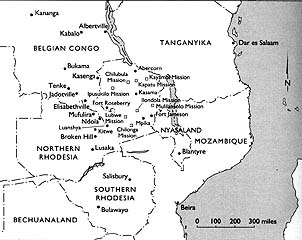
Map 2. The Belgian Congo and Northern Rhodesia
Real life and real gossip and rumormongering are substantially different, however. The purpose of gossiping, rumormongering, and even talking is not to deliver information but to discuss it. Stories transmitted without regard for official versions, stories that are amended and corrected and altered with every retelling, are indeed rumors, but they are also a means by which people debate the issues and concerns embodied in those stories. In a historiography based on such stories, then, there is no one true or accurate version. It is precisely the fact of many variants that is crucial to our understanding the meaning of these stories. Each one, taken on its own, may be interesting and suitable for analysis, but taken together, they form a debate, public discussions and arguments about the issues with which ordinary people are concerned. And, more important, these stories were taken together: they were neither told in isolation nor recounted without contradiction or correction. There was no single established version; there was no single accurate account. Instead, these stories were told, exchanged, criticized, refined, and laughed at—they were part of public knowledge, a way to argue and complain and worry. Taken together, the stories I shall discuss articulated why Africans should have been concerned about the motives and activities of certain groups, whether firemen, tsetse-fly pickets, game scouts, or Catholic priests.
This chapter explores why one congregation of Catholic missionaries was accused of drinking Africans’ blood. It is not a conventional historical narrative. Not only will it lack a beginning, middle, and an end, it will not attempt to tell a coherent story. If vampire accusations have multiple meanings, one chapter in this book should have multiple endings. What follows are three sets of evidence—some historiography, the accusations, and the economics of the missions—and four separate interpretations of the accusations. My goal is not to explain these particular vampire accusations, but to contextualize them, and show how they might be interpreted to form a debate about the priests’ ritual and daily practices. My concerns are not about popular culture as most twentieth-century African historians understand it—music, oral literature, and street wisdoms of various sorts—but about popular debates about ideas: the meaning of sacrifice, food, and blood, and tensions over work and its remuneration.[1] These questions were engendered in the most formal of settings—in schools, during Communion, and in the workplace—but they were debated in a popular form, rumor and gossip.
| • | • | • |
Evidence: Zambian Historiography
This chapter is part of a revision, or at least erosion, of the conventional wisdoms of the history of Zambia that has been going on for a decade. The Northern Province of Zambia (colonial Northern Rhodesia) was historically the catchment area for the mines of Katanga in the then Belgian Congo, the Zambian Copperbelt, and the Lupa Goldfields in southeast Tanganyika. It has been considered a classic labor reserve: rural poverty sent men to the mines, from which they returned when they had earned some money. Copper had been smelted from malachite in the region long before European rule, but new industrial technologies made the copper sulfides found far below the surface accessible. The first mine in Katanga opened in 1906;[2] well into the 1920s, a large proportion of the migrant labor force was from Northern Province.[3] In colonial Northern Rhodesia, there were mines owned by European prospectors as early as 1902, but the development of the Copperbelt there did not begin until 1922 and did not take off until 1927, when there were about 9,000 men employed there. By late 1930, however, there were almost 32,000 Africans working on the Copperbelt.[4] Starting in the 1920s, labor from Northern Province was recruited for both mining and plantation work in Tanganyika; because sisal wages were higher and more reliable, workers tended to stay three years on the sisal plantations of Tanga but an average of six months in the Lupa Goldfields.[5]
Africans’ rural experience was represented by Europeans as one of intense demands for African labor. The diaries of the White Fathers (the Société des Missionnaires d’Afrique) are filled with references to visits by labor recruiters from the Lupa Goldfields, from Copperbelt mines, and from the Union Minière d’Haute Katanga, asserting the inexorable attraction of wage labor: “Recruiters come by car from Ndola and with their promises entice them, hiring a number of workers, whom they transport without charge to the mine. How can the blacks, like big children, resist this?” [6] Men did stay away from the countryside. Even during the Depression—when the number of workers on the Copperbelt dropped from 31,941 to 19,313 by late 1931 and to 6,667 by the end of 1932—many men did not return home, although some went to look for work in Katanga or South Africa.[7] Audrey Richards claims that 40 to 60 percent of Northern Province men were absent from their villages in the early 1930s, although these men were not all working; many were looking for work.[8] James Ferguson, following A. L. Epstein, has challenged the picture of male migrants temporarily working in towns but without urban ties, and has argued that between the 1930s and the 1950s, workers’ movements between urban jobs, and between jobs at a single mine, were at least as commonplace as were workers’ periodic returns to the countryside.[9] Those men who stayed on the Copperbelt during the Depression looked for work and articulated their need for employment in terms of status and community, not just livelihoods. In 1933, the leader of a Bemba workers’ association went to the capital to protest unemployment and low wages: “People like me can’t go home,” he said. “We have settled in the towns, adopted Europeans’ ways, and no longer know village life.” [10] It was not only European ways that made the Copperbelt attractive to Africans; Africans could be hired as skilled labor there as well. By 1935, a white South African trade unionist worried that Copperbelt Africans were already breaching “the sacrosanct line” between unskilled and skilled mine labor.[11] Wage labor seems to have had some advantages for colonial Northern Rhodesians; there was the possibility of advancement, and when there was no work, men could go to Lusaka or Southern Rhodesia and work as domestics.[12]
The peoples of Northern Province, primarily Bemba, practice a slash-and-burn agriculture called citemene. According to Audrey Richards’s painstaking research in the early 1930s, the sexual division of labor of men cutting down trees and clearing land and women planting and harvesting crops and preparing food was disrupted by the demand for male labor on the Copperbelt and in Katanga, and this created “the hungry months” of February, March, and April: there were not enough men to clear fields sufficient for their families’ needs. But Henrietta Moore and Megan Vaughan have argued that citemene was not the main food-producing system among the Bemba; hoed mound gardens were, although tending them was “considered hard and unromantic work by the Bemba.” [13] Indeed, the White Fathers raised tribute for boarding school students based on the number of mound gardens a village had.[14] According to Vaughan and Moore, seasonal food shortages were due, not to the size of women’s citemene gardens, but to the combination of women’s domestic and agricultural tasks at certain times of the year. Women would have faced this seasonal burden whether men were present or not.[15] In the village of Kasaka in 1933, for example, Richards found a ratio of 19 men to 23 women, in her opinion enough men to clear adequate citemene gardens. Food supply was not an issue in Kasaka; women’s work was: Richards’s daily records show that when women’s agricultural labor was particularly heavy, they neglected some time-consuming domestic tasks, such as gathering and cooking, so that “the natives’ diet may be inadequate in certain seasons of the year because the housewife is too busy to provide proper meals.” [16] It would seem that absent men shaped their families’ needs and expectations and ideas about work and money, not their food supply. But the extent of a sexual division of labor in which men migrated and women farmed became the lens through which officials and academics saw Bemba society.
This chapter explores African ideas about the meaning of work, money, food, and to a lesser extent, religion, through vampire accusations. In doing so, I use European sources almost exclusively—the diaries of Catholic missions and district officers’ reports. These texts were not produced in identical circumstances, however. The priests produced two kinds of documentation, the Annual Reports of their order, published by the Mother House in Algeria and the daily diary of each mission station. The Annual Reports are straightforward, if somewhat anguished, records of African affairs—labor recruitment or religious revivals—while the diaries provide a remarkable chronicle of the daily life of the mission. Like many diaries, these record everyday events, and they do not always elaborate on what was well known to the priests themselves. The diarists were more concerned about official support for Protestant missionaries than they were, for example, about the anti-Catholicism of Watchtower after 1920, of which the priests were fairly tolerant.[17] I do not claim to ferret African voices out of these texts, however. I simply use European sources about vampiric priests to reveal African ideas about blood and the issues for which blood was a potent metaphor in the Northern Province of Northern Rhodesia.
| • | • | • |
Evidence: Vampire Accusations
Between the mid 1920s and the mid 1950s, charges that Africans working for Europeans captured other Africans for their blood were commonplace in Northern Rhodesia’s Northern Province. In almost all the accusations, these African vampires went by the generic name banyama. But in almost every outbreak of these accusations that came to the attention of colonial officials, one order of Catholic priests—the Société des Missionnaires d’Afrique, known in Africa and among themselves as the White Fathers, because of their robes— were identified as some of the Europeans behind the banyama.
Between 1928 and 1931, there were periodic panics over banyama in the Kasama District of Northern Province. In some areas it is said, probably with great exaggeration, that no African would go out alone. It was frequently said that the provincial commissioner had met with the Chitimukulu, paramount of the Bemba, to pay him to allow banyama into his country. The White Fathers claimed that “the natives believe that there are two Banyama at Chilubula [their station in Kasama District] whose names are unknown, and that anyone from the mission is accordingly treated with suspicion.” White Fathers both at Chilubula and Ipusukilo, in Luwingu, advocated “strong repressive measures.” [18] In 1932, the monsignor of Chilubula received a handwritten letter in poor English—the White Fathers were a French-speaking order, whose priests spoke Bemba well—which “made gross insults not to be repeated” and called the monsignor “a prince of demons, a serpent, and a sorcerer.” Apparently the work of an African Protestant, it demanded that the White Fathers return to Europe, where God would punish them. It was signed “your good roast mutton captivity, imprisonment, and bandages.” [19] Although it is difficult to surmise very much from the recipient’s summary of such a letter, the transformation of captured Africans into animals or, sometimes, cooked meat is a common feature of Central African vampire stories, and bandages figure prominently in vampire accusations in East and Central Africa.[20]
Although White Fathers were named as banyama during almost every outbreak of these rumors,[21] very little entered the written record, other than that fat priests—like fat administrators—or those with long beards were particularly suspect.[22] By the 1920s and 1930s, Watchtower openly accused Catholics of cannibalism, saying, “bakatolika balaya abantu” ( “Catholics eat people”), but it is not clear whether this reflected or encouraged local opinions.[23] More specific accusations against White Fathers appear in a 1967 article by Vernon Brelsford, the former district commissioner of Chinsali, than there were in his official reports. When he first encountered these rumors in Chinsali in 1939, Brelsford was, if anything, discreet, writing only about Africans’ relative unwillingness to talk about them in any detail.[24] Two decades later, after independence, however, Brelsford recounted anecdotes about the Belgian priest Dom Grégoire Coussement, the most notable banyama in the Luapula Valley. Dom Grégoire was said to be a White Father but was placed by Brelsford at the Dominican mission at Chibondo.[25] Accusations against Dom Grégoire abounded. It was said that a man with two wives, presumably wanting to convert, offered the older one to Dom Grégoire to give to the banyama to be killed, but Dom Grégoire demanded the younger one, and that he “and his minions” kidnapped Africans and imprisoned them in the belfry of his church until he had time to drive them to Elisabethville in his closed van.[26] In the late 1940s, it was said that Dom Grégoire worked for the Belgian government and crossed the Luapula into colonial Northern Rhodesia to capture people there.[27] In 1958, in Northern Rhodesia’s Eastern Province, banyama victims were chosen in advance and “marked in some occult fashion by the White Fathers concerned with the Sign of the Cross which was not visible either to the intended victim or to his fellows but only to the Europeans and their African henchmen.” After enough people were marked, the “victims of the Cross” were collected, taken away, and killed.[28] In 1960, just across the Zambezi River, farm workers believed that on a certain day a whistle would blow and those people who had a cross marked on their clothing would, “acting under an irresistible impulse,” rush to a lorry parked in the nearby veld, which would take them somewhere to be drained of their blood or to be turned into pork or beef.[29]
| • | • | • |
Evidence: Missions and Extractions
There were White Fathers in Northern Rhodesia thirty years before there were banyama accusations. Missions were founded at Mambwe in 1895, Kayambi in 1896, and Chilubula in 1902. The founder of these stations, Père Dupont, had a fearsome local reputation as a sorcerer who shot lions and healed the sick, but he was not very different from other missionaries who established themselves in Africa at the turn of the century.[30] Once the missions were established, however, the White Fathers relied on African catechists to proselytize the countryside—not because the territory of their vicariate was so vast, according to the White Fathers’ historians, but because the competition from the London Missionary Society and Livingstonia Mission was so intense, according to historians of Protestant missions and independent churches.[31] As a result, White Fathers’ missions typically had a few priests for spiritual work—three in Chilubula in the 1920s, but only one at smaller stations like Kapatu or Chilonga—and at least as many “coadjuteurs,” religious brothers who worked to supplement the material well-being of the mission either by supervising construction or making furniture. A very few worked closely with private enterprises.[32] Most of the stations had been founded before 1915; Mulilansolo and Ilondola were founded in the 1930s with the patronage of a French countess. Aside from Chilubula, none of the missions were terribly well-off. (Chilubula was by all accounts the best-provisioned place in Northern Rhodesia: it had wheat fields, herds of pigs, and a talent for charcuterie.) Other stations never managed to grow all their own food, even with student labor, and they frequently had to trade with the countryside. Their schools never had strong government support, and never attracted many students, since, as a French-speaking order, their instruction in English was sometimes poor.[33]
Indeed, White Fathers were accused, not only of vampirism, but of violating the conventions of retail trade. On the Luapula, at least, the White Fathers operated barter stores that did not take money and sometimes exchanged goods for farm labor. At Ipusukilo, one priest rhapsodized about their new barter store
In July 1932, L. G. Mee, a trader, complained to the boma that the White Fathers at Lubwe and Ipusukilo had for some time been selling calico to Africans as well as paying wages in calico.[35] The secretary for native affairs replied that the priests had already been warned about this.[36] The White Fathers at Ipusukilo had been trading cloth for salt, which they then exchanged for grain locally. In August 1932, the boma informed them that trading in salt and cloth was illegal without a general trader’s licence, which they could purchase for 50/- for six months— “an absurd regulation,” the priests complained.[37]built of bricks…open all day long, and the Africans are ready to use it. In it one finds stationery, basic materials, and a wide variety of clothes, for which those who do not have money exchange foodstuffs or work. There are many reasons for the store’s appeal: beads, stamps, paper, envelopes—the things one buys in a store. I have no money. Contribute flour or firewood. I have neither. You are a lazy person, cultivate: on your farm, you will find everything with which to purchase all that you desire. The manager is prevented by an infirmity from hard work, but if you work here and nowhere else, these goods will be given to you.[34]
At Chilubula and other missions, the economics of boarding schools had long disrupted the priests’ relations with the countryside. Money for boarding school students’ clothes had to be raised from tributes from the countryside. But “some parents did not understand that their children in catechism classes must work free on mission farms; recalcitrant students make work impossible.” These students were dismissed “to seek their fortunes elsewhere.” [38] In 1936, boarding school students had to work for the mission for three weeks.[39] In 1939, catechists and students returned to Chilubula without the expected tribute for their upkeep; parents claimed that there were now so many students attending school that it was impossible to subsidize them all. Père Reuter—who had only returned to Chilubula in 1937 after years of supervising the diggers at the Lupa Goldfields in Tanganyika—made a speech to the students. “You have neither paid nor done work,” he said. “If each of you works six days a month, we shall have enough revenue for fifty-four students. Please remember that there are many children in the villages between 10 and 12 years of age who no longer study here. Why?” [40] At Kapatu, eight students ran away because they were asked to work five days a month to pay their school fees.[41] At Ilondola, in 1948, classes were suspended because there was no food for the students. Nevertheless, students were asked to stay at the mission and work for three weeks, “a good occasion to see their spiritual and moral progress.” [42]
Catechists’ wages also caused dissent. In 1906, in Chilubula, catechists demanded that their pay be increased from one shilling a week to one shilling for three days’ work; a few catechists were dismissed, but they did receive a slight increase. In 1931, a group of catechists at Ipusukilo threatened not to hold classes unless their wages were increased; they received a stern lecture, and a few were dismissed.[43] Catechists demanded a tribute of flour in the villages they visited—which they frequently did not receive. During the Depression, catechists were known as kupula, meaning “those who beg for food,” according to the priests, but according to Richards, a derisive term applied to the casual labor that Bemba offered to wealthier households during harvest times, work that was generally spoken of with great contempt.[44] By 1934, catechists earned two shillings a week, the same as unskilled agricultural laborers earned and far less than the 22/- paid surface workers on the Copperbelt. When not working, catechists lived at the mission and grew their own food.[45] In 1940, the White Fathers Mission at Mulilansolo did not have enough money to pay catechists regularly for their tours, which, the father superior lamented, “caused them to do the work of God very quickly.” [46] In 1943, catechists returned from their tour and returned their books, demanding an increase in salary, “A real revolt!” [47]
In 1938, a European in Fort Jameson, in Eastern Province, complained to the boma that the White Fathers at St. Mary’s refused to allow their converts to work for him. The White Fathers insisted that these accusations were false. They claimed that this man ( “a Jew”) had “debauched” the women who worked on his farm, and in protest they had prevented Catholics from working there. Nevertheless, the district commissioner called all the local chiefs to the boma and said, “Be on your guard against this mission, you are not their slaves, missionaries should have no say in this matter.” [48] Two years later, the priests at St. Mary’s complained that wartime economies had caused them to enlist reluctant porters. “We do not have enough money for paying porters, so we request that our Christians carry our luggage. Some are strong and good at heart about this, but others need a little prayer and even then will say they are sick just at the moment of departure.” [49] In 1948, the father superior of St. Mary’s complained that there seemed no end to wartime and even postwar economies: “The salary of unskilled workers is more than three times that of our catechists…they are leaving us, the best ones especially, and it is this continual change in personnel that makes our mission seem secular.” [50] In 1958, the priests were unable to pay their catechists at all, because most of the money for wages had been stolen from a priest’s house.[51]
| • | • | • |
Details: Blood and the Eucharist
How do we link these disparate sets of evidence together? I don’t think it is possible, or even worthwhile. If I argue that vampire accusations mean one thing and not another, it would imply that all the ambiguities meant by blood and priests and the tangled associations of crosses and cars were incidental to these stories. If symbols and metaphors and meanings are indeed complex, layered, and polysemic, how do we write about them? As a rule, historians “prove” things. We argue that one line of reasoning, backed up by evidence, is correct in part by our arrangement of details and data, but also by showing how other lines of reasoning are flawed. If I were to do this now, I might prove that these accusations were indeed about the White Fathers’ labor practices and not about the Mass, blood, or retail trade. This would make for a tight and well-reasoned essay, but it would deform the substance of these accusations. Finding the single “correct” reason for vampire accusations against White Fathers would privilege certain details over others in a way that I have no evidence that the rumormongers actually did. It would, in Hayden White’s ungainly term, “detraumatize” some elements of these stories, and the emplotment of the resulting chapter would have been governed by my narrative strategy, not one grounded in these accusations themselves.[52]
But how do we arrange evidence according to specifications other than our own? As historians, we want to tell stories that have some accuracy, even when they are about things that never happened. We want—or at least I want—to reflect actual events and processes, not just to emplot. The issue is not merely one of interpretation, but of how interpretation might best be done. In the absence of actual, detailed accusations against specific priests or missions, we have no shape or structure of stories to examine. Instead, we must look at details, at ideas about blood, and ingestion, as well as the objects and the images that figure in rumors about blood-drinking priests. We need to scrutinize mission activities closely as well, and look at how daily mission life was conceived, conducted, and paid for. But finding such details, whether about blood or rates of pay, requires that we read missionary and colonialist documents to uncover African categories. This is contradictory; these are not African sources. But these are documents about something Africans believed in and Europeans did not. They are the comments of missionaries and officials on other people’s images, ideas, and notions about bodily fluids. Such readings require that I read European sources exactly as I read oral materials: not for their “truths” but for their details, large and small.[53]
My interpretation therefore begins with a large detail, the Mass, which is not mentioned in banyama accusations. After all, Catholic priests do announce that they drink blood regularly, and they frequently tried to impress that idea on their African converts. “The idea that the Cross is associated with the Eucharist is henceforth stamped clearly in the eyes of the believers. The Father Superior has made a fresco in the church with examples of the proper faith: the luminous cross now dominates the altar where each day we consume the eucharistic sacrifice,” the White Fathers at Kapatu noted with delight at Easter 1929.[54]
Thomas Fox-Pitt, formerly district commissioner in Ndola and Mpika, but later secretary of the Anti-Slavery Society in London, argued in his 1953 essay, “Cannibalism and Christianity,” which the Manchester Guardian refused to publish, that African misunderstandings of European actions led to the vampire accusations against missionaries in Central Africa. It was not the Mass in and of itself that gave rise to certain fears, but the social context in which the Mass took place. From the start, Fox-Pitt wrote, missionaries claimed that accepting their faith would protect Africans from witchcraft. To fearful Africans, “It did not seem unreasonable that the eating of the body and the drinking of the blood of the all powerful man-God should be an antidote to the less powerful magic of the witch who had eaten the flesh of an ordinary person.” He noted that the popular witch-finding movement of the mid 1930s, mucape, used a red liquid “like wine” to identify and kill sorcerers who had not surrendered their amulets; it was an inversion of the Mass. But
[p]arallel with this idea ran the dreadful suspicion that the Europeans who would eat the flesh and drink the blood of their revered leader would feel no compunction about eating Africans if they thought it would benefit them.
As long as the mission churches were open to both Africans and Europeans this suspicion had little to support it for all could see that the Europeans were drinking wine and eating bread like themselves but when the Europeans in the towns began to gather in separate churches and exclude Africans from their services the suspicion grew that the ceremonies performed were different and far more menacing.
It was about at the time of the imposition of the first colour bar churches that Africans began among themselves to accuse Europeans of being “banyama,” the meat men, who capture Africans and eat them or drink their blood.[55]
Did Protestant administrators overestimate the power of the Eucharist, or did they conceptualize banyama as an African discourse about food? Despite the fact that there were medical elements in most banyama accusations—in 1929, blood was said to be needed to cure King George V’s illness, for example, and in 1931, blood was to be forwarded to the Medical Department[56]—in their official and in later academic interpretations, these stories became food stories. Officials blamed banyama on African ideas about the Mass, or on the migrant labor system that left women farmers alone and vulnerable. Even a hastily concocted indigenous origin for the rumors from the mid 1940s was based on the food supply: an aged settler informed officials that whenever the rains were late, Bemba chiefs kidnapped and sacrificed innocent Africans to ensure a bumper harvest.[57] Read individually, these explanations for banyama are all credible, but, as I shall show, taken together they are part of a larger colonial discourse about the food supply in Northern Rhodesia.
In Christian countries the importance of the Eucharist was the miracle of transubstantiation. The eating of Christ had a magical significance that the eating of ordinary people—or ordinary food—lacked.[58] Viewed in its own context, the Eucharist was as horrifying as it was divine: even some of the disciples left Jesus over the prospect of eating his flesh—especially in a way that mocked Passover—but the bread of the Eucharist was not like other bread.[59]
The view from Northern Rhodesia may have lacked many of these connotations. That Catholic priests ate flesh and drank blood may have seemed an unpleasant but plausible boast, and especially since only priests drank the wine, it put them in a new category altogether. Bemba sorcerers, in contrast, began their otherwise mundane careers with an outrage, usually father-daughter incest or intra-clan infanticide.[60] If we understand banyama accusations as popular debates about Catholicism, then the issue here is the literal interpretation of the Mass; transubstantiation does not seem to have taken hold in the popular imagination of the Bemba in the 1930s.[61] The problem for residents of Northern Province was that Catholic priests ate flesh and drank blood, not that bread and wine sometimes became flesh and blood.[62] Indeed, across the border in colonial Katanga, Africans accused white mine compound managers of eating women and the occasional man. People were eaten instead of bread; they were not transformed into bread.[63]
But even with a culturally specific notion of the Eucharist for Northern Rhodesia, we should take Caroline Bynum’s point about medieval women and food seriously: that where food is regularly in short supply and where feeding is an exclusively female domain, the Eucharist takes on a special meaning, the specific form of which is control over food, not people.[64] This is of course not wholly applicable to Central Africa, but the relationship between deforestation, food, and women’s work was a colonial obsession in Northern Rhodesia by the mid 1930s,[65] and administrators tended to contextualize African ideas in those terms. Thus, when Fox-Pitt first encountered rumors about banyama he saw them not as a political issue, but as evidence of the perils of the widespread male migrancy that left women alone, defenseless, and overworked. Chiefs told him that
women everywhere are very nervous about working alone in their gardens far from villages and often run back to the villages in panic because they have seen someone near them in the bush. I have no doubt that this “banyama” story that has been going round the country for the last few years is due to the large number of lonely and unprotected women now in the country. It will go on…as long as the social system of the villages is upset as it has been for the past 15 or 20 years.[66]
But if the flesh of the Eucharist was food, what was the blood? The most commonplace preindustrial assumption in which blood became food was that breast milk was blood transformed by biological and social processes.[67] But the relationship of blood to breast milk, and the qualities of breast milk itself, were not at all clear in Northern Rhodesia. In Land, Labour and Diet in Northern Rhodesia, Richards states emphatically that the Bemba did not consider breast milk food; it was a source of comfort: infants were force-fed gruel from the age of three or four weeks to nourish them.[68] Her earlier work, however, suggests that the Bemba understood that breast milk nourished. One of the apocryphal visions of mucape was a “mythical woman with one breast in front and one behind. The good she would suckle in front, while the wicked would find themselves following willynilly behind.” [69]
If the blood of the Eucharist was food, then the interpretation of banyama becomes another argument—and another popular statement—about the Bemba food supply. Many interpretations of banyama phenomena have rested, not on hunger or food in and of themselves, but in the season of planting and rains, hunger and harvest. Some officials in the 1940s who experienced banyama as a political threat tried to show that banyama was simply a modern-day cover for the human sacrifices that supposedly took place whenever the rains were late.[70] A. L. Epstein’s 1979 psychoanalytic interpretation of banyama replicates some of the colonial discourse about the agricultural cycle in Bemba country. The trauma of weaning was intensified by the seasonal cycle of hunger and plenty in Northern Rhodesia, and this caused “the oral aggression” of beliefs about colonialists who sucked their victims’ blood.[71] In this analysis, blood and breast milk need not be the same substance; the anxiety results from the ways that sucking has become culturally charged.[72] In 1992, Epstein elaborated his analysis of banyama, locating it in Bemba concepts of the body and wholeness.[73] Interpreted in this way, banyama accusations against White Fathers may have reflected what Hugo Hinfelaar, himself a White Father, has seen as Bemba beliefs that priests monopolized concepts of the body and of blood.[74] Accusations against priests may have parodied invasive Catholic dogma—fat priests and fat administrators, men actively engaged in changing what Africans did to their bodies, were particularly suspect.[75] Such accusations also represented elaborate ideas about bodies, both African and European. Indeed, Fox-Pitt placed the origin of banyama rumors in events of 1930, when Africans believed that white men entered the compounds of the Copperbelt and captured Africans by striking each one with “a stick of rubber—mupila—which paralysed him”; Africans were then thrown into a lorry and driven off. “It was thought by authorities that this scare originated from the visits of a feeble minded European youth to the compounds where he frightened African women by sticking them with a blind worm.” [76] The conflation, by administrators or Africans, of body parts and bodily failures—paralysis, feeble-mindedness, genitals and sight—suggests that banyama not be located in beliefs about food but in beliefs about the body and the fluids and functions of which it is comprised.
Was blood a drink in Bemba communities in the 1930s? If so, what kind of drink? According to Brelsford, it was medicinal; Africans believed that their blood and internal organs were needed to cure European diseases. The illness of any well-known European was reason enough for a banyama panic.[77] According to Hinfelaar, the Bemba word umulopa means not only blood but all the fluids that transfer life: vaginal secretions, semen, and blood.[78] In the Bemba theory of procreation, only women passed blood on to their children; men’s blood was not inherited by their children.[79] This theory was beginning to be questioned in the early 1930s when men returned from the Copperbelt demanding bridewealth marriages and rights over children, but the impact of these new ideas on ideas about blood is difficult to ascertain. In both the old and new ideas, however, marriage made blood somewhat magical and very private but still largely female: according to Richards, adultery was said to “mix blood,” and if the wife of an adulterer saw the blood of her husband’s lover, the wife would die.[80] But the blood women shed and the blood men shed were not the same thing in the minds of many Central African peoples.[81] The special, well-publicized attention given to Christ’s blood—or even the blood banyama took (and mixed) indiscriminately from men and women—may have indicated a degree of specificity that was absent in local concepts. The blood of male missionaries—and of anti-European fantasies—may have represented ideas about commodities and the sale of labor power, as well as ideas about nurturance and colors.
It is important here that we look at systems of color classification, both as it applies to the red of blood and to the red or white of wine (a drink forbidden to Africans in the colony).[82] In the West, blood and wine, both as fluids and as metaphors, carried exceptional powers that could make rituals ambiguous and their use in everyday problematic: without the mediation of another liquid or specific meals, they could make miraculous rituals exceptionally complex and layered.[83] But in Northern Rhodesia, wine as an intoxicating liquid seems to have been far less important to Africans than beer was.[84] Wine seems to have been most meaningful when it was red and bottled and drunk by Europeans. A generic red liquid in bottles took on immense power in ways that clerics and administrators could never have anticipated. The bottled red liquid of mucape could kill an unrepentant sorcerer years after he or she had drunk it,[85] and during the banyama scares in Tanganyika in 1931, according to E. E. Hutchins, “bad characters” spilled the contents of “bottles of red ink” bumping into passers-by and then claimed that “they were servants of ‘mumiani’ and now their master’s medicine was lost. Considerable sums as compensation have been extorted from ignorant natives by this old ruse.” Hutchins also reported that a group of European surveyors were accused of being mumiami and threatened so often that they had to be withdrawn from the area because, missionaries told him, “some of them were seen to drink red wine.” [86] In the late 1940s in Tanganyika, the doctor Hope Trant was accused of being banyama by the people who saw her drink red wine with her dinner.[87]
Most Central African matrilineal peoples have a tripartite system of classification based on red, white, and black; these are the only colors for which they possess “names.” Of these colors, red represents life and death, depending on context, while white represents purity and health; black is the color of disease, witchcraft, and death. Because of black’s straightforward qualities and its power, tripartite systems tend to give way to binary systems in which red and white become binary opposites. In ritual practice and daily life, red absorbs some of the qualities of black, and red and white can be seen to contradict each other. Thus, the Ndembu of western Zambia say that semen is blood “purified by water,” while among the Bemba, white paint on a hut washed away the pollution of menstrual blood.[88] In colonial Northern Rhodesia, the contradiction of priests in white robes said to be drinking African blood may have been difficult to tolerate: it announced that the priests were free of any taint that might result from such an action. But Europeans’ power over African blood was not only their real and metaphoric ability to extract it and openly consume it; it was their ability to take it and bottle it and transport it throughout the world.
But what about Fox-Pitt’s second point, that it was not merely Africans beliefs’ about the Mass but racial segregation that left Africans free to imagine such things about the Mass? There were no racially segregated churches in Northern Province, where, as administrators were quick to point out, there were not enough Europeans even to fill all the available government positions.[89] Segregated Masses took place on the Copperbelt, however, performed not by White Fathers but by Jesuits, who arrived at Broken Hill in 1927, or Franciscans, who moved from Broken Hill to Ndola in 1931. The fact that in rumor most priests were known as White Fathers may have referred generically to the color of priests’ robes, and it may also have represented what the color of those robes and the priests who wore them meant to the peoples of Northern Rhodesia.
But if banyama is a literal, local reading of the Mass, how do we account for the time lag between the first Catholic missions among the Bemba in the late 1890s and the first banyama accusations in the late 1920s? The question suggests a mechanical relationship between Catholic practices and African responses; the issue may not be the Mass, but what the Mass meant to Africans at a given time. Thus, it may be more useful to suggest, as Fox-Pitt asserted, that the idea of blood-drinking priests became a powerful source of anxiety because of the political contexts in which those and other practices were thought to take place. Africans were among the first Protestants to evangelize the Bemba, and the heritage of revivalist movements, especially those of John Chilembwe in Nyasaland and Mwana Lesa in Northern Rhodesia, was strong.[90] But after the strike on the Copperbelt in 1935, relations between Christian missionaries and Africans became quite tense. At Luanshya, along with other Europeans, Protestant missionaries had been protected from strikers by machine-guns.[91] Officials later criticized White Fathers for how they had educated the Bemba. White Fathers responded that officials had not done enough to counter Watchtower propaganda—which called the disturbances a “pre-arranged Catholic riot”—but after that, in their churches, White Fathers urged converts to join Catholic Action groups on the Copperbelt and avoid trade unions.[92] The social context of Christian practices and teachings were those of labor, and any explanation of banyama that does not consider labor relations is flawed.
| • | • | • |
Details: Work and Pay
Banyama stories were about Africans who were employed by Europeans to capture other Africans. If we locate vampire accusations against White Fathers in the labor relations of each mission and the wider colony, we get a very different picture, one that may link ideas about the alienation of labor power with those about the circulation of money and commodities and the commoditization of blood. Men from the Northern Province of Northern Rhodesia had been migrant laborers for years—men went to Katanga, the Lupa Goldfields, and the Copperbelt; during the sisal boom of the 1920s, they went to the plantations of Tanganyika Territory—so that the sale of labor power for money was commonplace by the 1930s. What made it remarkable, apparently, was how it was remunerated.
According to Audrey Richards, money had been circulating in the region since the turn of the century, when administrators were charged with encouraging the payment of wages and taxes in cash, rather than in kind. European-owned stores, mainly those of Thom and the African Lakes Company, also encouraged cash transactions. Although Richards insists that, despite the number of men away, the actual use of money in everyday life was limited, her evidence is contradictory. Many Bemba regarded money as a medium for specific transactions. In the late 1920s, for example, a woman on her way to visit her son on the Copperbelt was found dying of starvation with 2/- tied in a cloth: “It had apparently never occurred to her to use the money to buy supplies,” Richards wrote.[93] But within a few years, Richards observed, the use of money created new ties of rights and obligations: if a woman who lived alone, or with one or two married daughters, purchased food with money, she was not obligated to share it. Richards saw “a young couple eat meat alone while almost starving neighbors looked on. They shrugged their shoulders when questioned, and said ‘We bought this meat with money.’” [94] By the early 1930s, money seems to have become a fairly commonplace medium to exchange for male labor. A small brideprice was creeping into Kasama District, and the 10/- given to fathers instead of service was “money to cut trees,” which according to Richards was “the wage for a month’s work at European rates.” [95] My point here is not about the monetization of suitor service, which is part of larger struggles over bridewealth and contested systems of marriage taking place in Bemba country, but that a ritual payment was now reckoned in the language of the labor market, with remuneration measured by time, not work, and at European rates. In this the Bemba were not fetishizing money, giving it properties above and beyond exchange; they were standardizing the relationship of labor power to money. Africans who worked for Europeans for free were ridiculed. At Kayambi in the late 1920s, for example, priests designated two girls to bring reeds to the station for Easter. Although the mission had no authority over them, they seemed willing to do this. Only when they were “abused and insulted” in their villages did the mission agree to pay each girl’s father 2/- for their work.[96]
But how money was used and how money was talked about may have been different in colonial Northern Rhodesia. When talked about, money is an international language that transcends ethnic and political frontiers and proclaims the sophistication of the speaker.[97] Debates and rumors about how money is to be used, however, reveal local concerns about the value of money both as a medium of exchange and as a token of political authority.[98] During the time Richards did her fieldwork, the demand for mine labor dropped precipitously; there was a shortage of money throughout Northern Province, and there were widespread rumors that unemployed copper miners had been promised exemptions from their 1932 taxes.[99] In Isoka District, returning migrants told the district commissioner that “it was no good looking for work in the Tanganyika Territory because the white ants had eaten all the money.” [100] As the suspension of the gold standard came into effect, rumors about the value of currencies circulated. Africans parodied the idea of “face value” amid the dire conditions on the Copperbelt. Men who did not have the money to buy firewood or food claimed that the king of England had been jailed for one month because he demanded “too many taxes” and that the coins with his face on them had lost their value.[101] In 1933, the rumor circulated that British rule was about to end, and that Englishmen would be replaced by black Americans, who would bring American currency; a year later, the gradual withdrawal of South African silver coins from circulation was said to herald the closing of Chinsali boma.[102] Taken together, these rumors reflect the importance of money. Stephen Gudeman’s reworking of Richards has characterized the Bemba village economy as one in which commodities and services circulated among villagers, headmen, chiefs, and ancestors according to customary rules of allocation and distribution.[103] But in the wider, industrialized economy of Northern Rhodesia—at least from the vantage point of Bemba laborers in the 1930s—money did not circulate through commodities but from wage labor to taxation. Money defined the relationship between Africans, Europeans, and the state. The ruptures in these relationships were described in rumors of ingestion, imprisonment, and blood.
What kinds of work relationships obtained at White Fathers’ missions? The priests were not exchanging goods and services for money, or when they were, the amount of money was pathetically small. The barter stores of the Luapula missions, the heavy-handed methods of making Christian men porters—all these contradicted the economic world of which most Bemba had experience. Even boarding schools were subsidized, not by parents’ fees, but by children’s labor. Where the White Fathers did pay in money, those small sums were often contested and sometimes withheld.
The accusations that deformed and parodied conversions, church belfries, and priests’ insistence on monogamy were not popular religion, they were popular economics. Outbreaks of banyama accusations often corresponded with incidents involving unpaid or underpaid catechists. There was a catechists’ strike at Ipusukilo at about the same time that there was an outbreak of banyama rumors in the district; a few months later, the accusations reached Kasama District headquarters at the same time that boarding school students refused to work; banyama accusations came forcibly to the attention of the boma within a week of the threatened strike by catechists at Mulilansolo in 1943;[104] in 1958, the catechists of St. Mary’s were said to mark victims with the sign of the cross the same year that they were not paid at all. This is not to claim that there is a mechanical relationship between banyama accusations and catechists’ wages. The process by which bloodsucking becomes a powerful and credible metaphor is far too complex for that. But I want to suggest that vampire accusations may have taken hold when relations of work and remuneration were severely disfigured. Accusations that the White Fathers sucked African blood may have described a specific labor market.[105]
Stories about vampire priests were an idiom—like strikes and slowdowns—with which labor was debated. Vampire accusations did not just debate the nature of the work catechists and Christians did for White Fathers, they debated the specific form of remuneration. The low and frequently nonexistent salaries paid catechists, the White Fathers’ numerous attempts to monopolize local labor, raised the question, why are these people working? These stories explain—or, if that is too strong a term, account for—why catechists might work without pay, why people might trade at the barter stores. The frequent references to the “minions” of the priests as the true agents of banyama sought to understand and give meaning to work relationships that were unwaged.
But the idea of wage rates, commodity prices, and local labor markets may have been abstractions in rural Northern Rhodesia. During the Depression, at least, the competitive labor markets were hundreds of miles away (and rumored to have no money), and there was no agreed upon social necessity by which wages were set. Barter stores and anxieties about the value of money had seriously distorted the value of commodities and wages. Wages had been set by employers; commodity prices had been set by shopkeepers; sometimes commodities and wages were one and the same. If banyama accusations are to be located in labor relations, it is necessary to look as closely as the sources allow at their generic employers and shopkeepers, the Europeans accused.
| • | • | • |
Details: White Men
How do we read the lack of specificity about the White Fathers in banyama accusations? They were, after all, just a few of the many Europeans who were said to take Africans’ blood. Suppose I suggest that the White Fathers were merely stock characters, like villains in melodrama, in these complex and layered stories, some of many diverse individuals called banyama and made important only by the garbled evidence presented in archives and documents? Suppose I suggest that the real issues in banyama stories were the economic relationships—or un-economic relationships—that gave rise to vampire accusations? What if I locate these accusations in relationships, not events, facts, or figures? In that case the relationship between the catechists’ threatened strikes and banyama accusations of 1943 would be obvious, if mechanistic: the real cause triggered an outburst against imagined practices. What if I locate vampire accusations not only in a parsimonious priesthood but in relations between merchants and patrons? We get the same level of detail about white people—which is not very much—but an accusation firmly rooted in retail trade.
Let me introduce evidence about a white man who was not a priest. Early in January 1944, “a strange man” ran off with a small child in the southern part of Kasama district. “On being arrested this man stated that he belonged to the ‘banyama’ and that he had been sent out by Mr. Glieman (an Abercorn settler) to collect blood.” By late January, he had “changed his story and now states that he ran off with the child as he wished to rape her.” [106]
Unpacking such a story is a challenge. Kidnapped or missing children—singly and in groups—figure in many banyama accusations and Northern Province memoranda of the 1940s. This may have been due to child custody disputes, inasmuch as men who had worked on the Copperbelt increasingly insisted on bridewealth marriages and control over children, or to disputes over pawning.[107] In the early 1930s, for the first time, fathers began pawning their children, the White Fathers noted.[108] In both cases, mother’s brothers might have taken children back to their homes.
But what do we make of the man’s saying that he belonged to the banyama and had been sent to collect blood for a specific white man, Orne Glieman? I assume the man gave what he thought to be the right answer, the answer that he thought would set him free. If he believed, in the words of the parliamentary member for native interests in 1945, the “popular misconception that the Government knows all about what is going on and is conniving in the practices,” [109] claiming that he worked for the European known locally as a banyama may have seemed the wisest possible answer. I cannot assess his second answer nearly as well, because we do not know the circumstances in which it was induced. We can be reasonably certain that this was an answer acceptable to his interrogators, but the first answer took hold locally, and when the man was brought to trial, it was recommended that he not be defended by a district officer—the usual practice— “in view of the widespread suspicion amongst Africans…that the Government in general and the District Commissioner in particular are sympathetic toward the ‘banyama’ cult and are responsible for recent disappearances.” [110]
Why Orne Glieman? There are in fact several reasons why he might have been considered banyama. He was shadowy even by the standards of white settlers in Northern Rhodesia. A Scandinavian, he is remembered as having claimed to be the illegitimate son of the king of Sweden or Denmark, and had come from the Congo to a farm in the Siasi Valley, near Abercorn, in 1927. There his oldest son accidentally shot two Africans, killing one. Glieman senior was involved in “the usual labor disputes in which he was not infrequently defeated, much to his chagrin.” [111] But Glieman was accused of drinking blood, not in Abercorn, but in Kasama, where he worked as a manager for Thom Stores; there he was known as a man who did not treat Africans very well. In 1939 or 1940, he gravely insulted the Chitimukulu, the paramount of the Bemba. The Chitimukulu wanted to buy a length of valve tubing from Glieman for his bicycle. Glieman rudely asked him why he wanted valve tubing when there were plenty of rats’ tails that could be used for the purpose. This caused great offense; there was a boycott of the store, and Glieman was forced to retire to his farm in Abercorn.[112]
Without any oral versions of the Glieman-as-banyama story it is almost impossible to get very much out of this account, but the basics are nonetheless compelling. Here not only was an ordinary economic transaction—the purchase of a commodity with money—refused, but the offensive shopkeeper suggested the transaction be replaced by foraging.[113] The issue was not only that the Chitimukulu was insulted, but how he was insulted: Glieman deformed relationships grounded in money; indeed, he refused them. Vampire accusations not only described unfair extractions, they identified those Europeans who did not participate in the circulation of money. Elsewhere in Southern Africa, blood became a metaphor for money; the difficulties men face in accumulating money—that it burns a hole in their pockets—in so many cultures reflects not only the heat generated by monetary transactions, but the fluidity of cash.[114] Sharon Hutchinson’s work on the Nuer, however, maintains that in actual practice people do not stress the analogy between blood and money, in order to make the differences between money and people clear.[115] But the banyama accusations against the missions, their barter stores, and Orne Glieman suggest that money and blood are situational similes, deployed in very specific instances: when people spoke of blood to describe what money was like, they were defining how money functioned in specific relationships, how it in fact circulated.
There is, however, another reason why Glieman might have been known as banyama—he said he was. Such a terrifying boast would not have been out of character for the man described above, and another European in Northern Rhodesia known as banyama—Arthur Davison, a labor recruiter based at Ndola—was said to have encouraged the rumor, enjoying the celebrity it gave him.[116] But white people do not spread banyama stories; Africans do. Rumors do not take hold because of the credibility of any one person doing the telling, but because of how they articulate and embody the concerns of the people spreading and hearing the rumor.[117] Understanding banyama requires understanding why these beliefs made so much sense to those who believed them.
| • | • | • |
Details: Talk
I want to propose a fourth interpretation, one that returns us to the issues raised in the first part of this chapter. What if I were to argue that each outbreak of banyama rumors was part of a transcolonial movement of vampire accusations, and that the form these accusations took in Northern Rhodesia or Katanga had to do with how local events and actors were inserted into widely told border-crossing stories? What if no specific event or action caused a specific banyama accusation? What if specific events and actions were used to make a transcolonial narrative local? Just as mucape and Watchtower crossed ethnic and colonial frontiers, from Nyasaland to Northern Rhodesia and Katanga and northwest to Tanganyika, vampire accusations also swept the countryside “like the Charleston or mah jong in England some years ago.” [118] But unlike mucape and Watchtower, banyama rumors were an oral genre. Ideas and images were exchanged and amended, and in each new place, they were literally inscribed with characters and actors and equipment specific to local concerns: ideas and images were embodied and emplotted. Thus, in 1931, banyama accusations ranged from Northern Rhodesia to central Tanganyika; in 1943, there were charges that white men drank African blood from Kananga in the lower Congo region through Katanga to Northern Rhodesia’s Northern Province. Across the copperbelts of the colonial Belgian Congo and Northern Rhodesia, different images had different meanings and connotations—white compound managers were the cannibals who terrified African mineworkers in Katanga, while priests and shopkeepers and labor recruiters were said to suck African blood a few hundred miles away. The local Northern Rhodesian meanings of banyama accusations—whether about labor practices or the Mass—are no less clear, however, because these movements were transnational. Vampire accusations were specifically African ways of talking that identified new forms of violence and extraction; the actual description of these forms took place in the new technologies and teleologies of colonial economies: with their Catholic priests, white men with beards, and game rangers, banyama stories foregrounded what was both different and dangerous.
Many of the vampire accusations described in this chapter seem to have taken elements from the Book of Revelations—the invisible mark that identifies victims, the final sound that compels its listeners to follow. These were not only new images but ones specific to religious teachings; their power came from the catechism classes and sermons and readings of which they were a part. Rearranged as the props and ideas in terrifying stories, they may have had different meanings in different places, but they brought priests and mission practices into each retelling.
Vampire accusations were the rumors that debated rates of pay, the currency in which payment took place, and the ways in which Europeans articulated relationships reckoned in money; they debated the new medical and religious meanings of blood, and the importance of customary systems of color classification. Vampire accusations debated these issues with each addition of a new character or a new image. These images and characters had the power to terrify and explain because they touched on so many Northern Rhodesian—or Congolese, or Tanganyikan—experiences and concerns. They had intense meaning because they were told and retold in the vocabularies of people’s daily lives and conflicts. For this reason, there is no one interpretation that fits all banyama rumors, no single analysis that can explain how banyama accusations developed and then faded. Like the blood extracted and abstracted in them, banyama rumors had the fluidity to describe many situations.
Notes
1. I take this point from a somewhat different study of Catholicism in Central Africa, Terence O. Ranger, “Taking Hold of the Land: Holy Places and Pilgrimages in Twentieth-Century Zimbabwe,” Past and Present 117 (1987): 159–90.
2. Daniel R. Headrick, The Tentacles of Progress: Technology Transfer in the Age of Imperialism, 1850–1940 (Oxford: Oxford University Press, 1988), 269–76.
3. Johannes Fabian, Language and Colonial Power: The Appropriation of Swahili in the Former Belgian Congo, 1880–1938 (Cambridge: Cambridge University Press, 1986), 82, 86; John Higginson, A Working Class in the Making: Belgian Colonial Labor Policy, Private Enterprise, and the African Mineworker, 1907–1951 (Madison: University of Wisconsin Press, 1989), 80.
4. Headrick, Tentacles of Progress, 270; Charles Perrings, Black Mineworkers in Central Africa: Industrial Strategies and the Evolution of the African Proletariat in the Copperbelt, 1911–1941 (London: Heinemann, 1979), 47; James Ferguson, “Mobile Workers, Modernist Narratives: A Critique of the Historiography of Transition on the Zambian Copperbelt [Part One],” J. Southern Afr. Studies 16, 3 (September 1990): 395; Arthur Copman Papers, National Archives of Zambia (henceforth cited as NAZ), HM6/CO3/4/2.
5. E. H. Jalland, provincial commissioner, Abercorn, comments on tour report 3/1936; R. L. Parr, district officer, Abercorn, tour report 4/1936; A. F. B. Glennie, district commissioner, Abercorn, tour report 1/1937 (NAZ, SEC2/819, Tour Reports: Abercorn, 1932–36).
6. Société des Missionnaires d’Afrique, Rapports annuels, no. 25 (Algiers: Maison-Carrée, 1929–30), 206, quoting the monsignor of Chilubula Mission. Société des Missionnaires d’Afrique, Rome, Diaire de Chilubula, 22 February 1929, 18 April 1931; and for sisal plantations in Tanganyika, Diaire de Kayambi, 13 June 1922.
7. Ferguson, “Mobile Workers,” 397.
8. Audrey I. Richards, Land, Labour and Diet in Northern Rhodesia: An Economic Study of the Bemba Tribe (London: Oxford University Press, 1939), 23. Men often tried to shirk their marital obligations, saying they were “resting after their work in the mines” or “about to take other jobs ‘soon,’” thus placing a heavy strain on the resources of the matrifocal group (172). Thus migrant labor and participation therein was a social strategy both for household accumulation and household domestic struggles. See also Henrietta L. Moore and Megan Vaughan, Cutting Down Trees: Gender, Nutrition, and Agricultural Change in the Northern Province of Zambia, 1890–1990 (Portsmouth, N.H.: Heinemann, 1994), 47–49.
9. Ferguson, “Mobile Workers,” 402–3; see also A. L. Epstein, Politics in an Urban African Community (Manchester: Manchester University Press, 1958), 5–15.
10. Lewis H. Gann, A History of Northern Rhodesia: Early Days to 1953 (London: Chatto & Windus, 1964), 254, quoted in Ferguson, “Mobile Workers,” 398. This was the description of wage labor that officials seemed to like most: “[T]hose who go further afield are for the most part…those whom the ‘glitter’ of life in the large industrial areas attracts, and those who have tasted the luxuries of life…and have developed a taste for such things” (E. Bolton, district commissioner, Mpika, tour report 2/1938, NAZ, SEC2/836, Mpika Tour Reports, 1933–38).
11. Michael Burawoy, The Colour of Class on the Copper Mines: From African Advancement to Zambianization (Lusaka: Institute for African Studies, 1972), 13.
12. Karen Tranberg Hansen, Distant Companions: Servants and Employers in Zambia, 1900–1985 (Ithaca, N.Y.: Cornell University Press, 1989), 52–54, 75–79; Eustace Njbovu, Luangwa, Zambia, 22 July 1990.
13. Richards, Land, Labour and Diet, 304. This may have been because mound gardens were “considered unglamorous and hard work”; see Moore and Vaughan, Cutting Down Trees, 41, and Jane I. Guyer, “Female Farming in Anthropology and African History,” in Micaela di Leonardo, Gender at the Crossroads of Knowledge: Feminist Anthropology in the Postmodern Era (Berkeley and Los Angeles: University of California Press, 1991), 257–77.
14. Société des Missionnaires d’Afrique, Rome, Diaire de Chilubula, 14 July 1927; Diaire de Kapatu, 31 March 19
15. Moore and Vaughan, Cutting Down Trees, 46–60, 104–12.
16. Richards, Land, Labour and Diet, 176; for an unpacking of this statement, see Moore and Vaughan, Cutting Down Trees, 50–60.
17. Société des Missionnaires d’Afrique, Rome, Diaire de Chilubula, 18 June 1924, 6 September 1926; Diaire de Kapatu, 9 June 1925; Diaire de Ipusukilo, 14 January 1928, 30 April 1935; Diaire de St. Mary’s, 7 March 1938; Diaire de Mulilansolo, 11 May 1942; see also Karen Fields, Revival and Rebellion in Colonial Central Africa (Princeton: Princeton University Press, 1985), 3–13, 129–34.
18. D. Willis, provincial commissioner, Kasama District, “Report on Banyama,” 24 March 1931 (NAZ, ZA1/9/62/2/1); see also Gann, History of Northern Rhodesia, 1964, 321; Mwelwa C. Musambachime, “The Impact of Rumor: The Case of the Banyama (Vampire-Men) in Northern Rhodesia, 1930–1964,” Int. J. Afr. Hist. Studies 21, 2 (1988): 205–9. Willis had the confidence of the White Fathers more than any official who came after him, and he and his French wife were regular visitors at Chilubula; see Diaire de Chilubula, passim.
19. Société des Missionnaires d’Afrique, Rome, Diaire de Chilubula, 18 March 1932.
20. In many vampire accusations, the technologies of Western biomedicine, especially injections and bandages, were used to subdue victims. See K. D. Leaver, “The ‘Transformation of Men to Meat’ Story,” Native Affairs Department Information Sheet No. 20 (Salisbury, November 1960 [National Archives of Zimbabwe, No. 36413]); George Shepperson, Myth and Reality in Malawi (Evanston, Ill.: Northwestern University Press, 1966), 7–8; W. V. Brelsford, “The ‘Banyama’ Myth,” NADA 9, 4 (1967): 54–55; Rik Ceyssens, “Mutumbula: Mythe de l’opprimé,” Cultures et développement 7 (1975): 483–536; Musambachime, “Impact of Rumor,” 207; and esp. chapter 3 above.
21. Gervas Clay, Taunton, Somerset, England, 26 August 1991.
22. Musambachime, “Impact of Rumor,” 208, 211.
23. Mwelwa C. Musambachime, personal communication, 29 January 1992; Fields, Revival and Rebellion, 131–34.
24. V. W. Brelsford, tour report 1, 1939 (NAZ, SEC2/751: Chinsali District Tour Reports, 1939–40).
25. Brelsford, “‘Banyama’ Myth,” 54–55. The mission at Kasenga had been Benedictine—like Dom Grégoire—in the 1940s, but by the time Brelsford wrote his article, the mission had been taken over by the Salesians. The reinscription of both Dom Grégoire and several local missions as White Fathers probably reflects their reputation in Northern Rhodesia. Ian Cunnison, personal communication, 4 February 1992.
26. Brelsford, “‘Banyama’ Myth,” 54–55.
27. Ian Cunnison, field notes from Luapula, March 1949.
28. Brelsford, “‘Banyama’ Myth,” 49–60.
29. Leaver, “‘Men to Meat.’”
30. Andrew Roberts, A History of the Bemba: Political Growth and Change in North-eastern Zambia before 1900 (Madison: University of Wisconsin Press, 1973), 259–69; Brian Garvey, “The Development of the White Fathers’ Mission among the Bemba-Speaking Peoples, 1891–1964” (Ph.D. diss., University of London, 1974), 149–53; Michael O’Shea, Missionaries and Miners: A History of the Beginnings of the Catholic Church in Zambia with Particular Reference to the Copperbelt (Ndola: Mission Press, 1984), 20–25.
31. Garvey, “Development of the White Fathers’ Mission,” 153; Fields, Revival and Rebellion, 129–34; Arie N. Ipenburg, Lubwa: The Presbyterian Mission and the Eastern Bemba (Lusaka: Teresianum Press, 1984), 26–28.
32. Société des Missionnaires d’Afrique, Rapports annuels, no. 19 (1923–24), 189, 206; “Development of the White Fathers’ Mission,” 149ff.
33. Société des Missionnaires d’Afrique, Rome, Diaire de Ilondola, 15 January 1934; Diaire de Kapatu, 7, 12, 18 January 1938; Diaire de Chilubula, 8 June 1931; Hugo H. Hinfelaar, “Religious Change among Bemba-Speaking Women in Zambia” (Ph.D. diss., University of London, 1989), 111–12.
34. Société des Missionnaires d’Afrique, Rome, Diaire de Chifobwe-Ipusukilo, 11 December 1926.
35. P. W. M. Jelf, district officer, Tour Report, Fort Roseberry, June–July 1932 (NAZ, SEC2/888). Mee was with Thom Stores, a manager of which figured in vampire accusations in Northern Province in the mid 1940s. Geoffrey Howe, provincial commissioner, Northern Province to chief secretary, Lusaka, 29 January 1944 (NAZ, SEC2/429, Native Affairs: Banyama); Hugh Macmillan, personal communication, 21 August 1991.
36. J. Moffatt Thomas, secretary for native affairs, 18 August 1932, Tour Reports, Fort Roseberry, June–July 1932 (NAZ, SEC2/888).
37. Société des Missionnaires d’Afrique, Rome, Diaire de Chifobwe-Ipusukilo, 9 August 1932.
38. Société des Missionnaires d’Afrique, Rome, Diaire de Chilubula, 27 December 1931.
39. Ibid., 22 February 1936.
40. Ibid., 27 July 1937, 15 May 1939.
41. Société des Missionnaires d’Afrique, Rome, Diaire de Kapatu, 31 March 1933.
42. Société des Missionnaires d’Afrique, Rome, Diaire de Ilondola, 27 April 1948.
43. Société des Missionnaires d’Afrique, Rome, Diaire de Cibofwe-Ipusukilo, 15–19 April 1931.
44. Société des Missionnaires d’Afrique, Rome, Diaire de Chilubula, 23 February 1927; 14 July 1927; 22 July 1927; 1 May 1928; 16 November 1933; Richards, Land, Labour and Diet, 145. “Only an absolutely destitute person or an imbecile would reckon to subsist in this way as a regular thing,” Richards writes, but she notes that ukupula had become very common in the early 1930s as one of the survival strategies available to “deserted wives…during the bad times of the year,” and a footnote on the same page clarifies the use of the term: “ Ukupula is loosely applied to all forms of scrounging, but technically speaking means labour in return for food only” (Richards, Land, Labour and Diet, 145 and n). The White Fathers’ Bemba-English Dictionary broadly accepts this translation, defining kapula as meaning a person who earns a living helping others (Cape Town: Longmans, Green for Northern Rhodesia and Nyasaland Joint Publications Bureau, 1954), 246.
45. Garvey, “Development of the White Fathers’ Mission,” 155, 157–58. This comparison might have been lost on Africans themselves, since in 1934 there were not many jobs on the Copperbelt; see Moore and Vaughan, Cutting Down Trees, 48–49, 168–70.
46. Société des Missionnaires d’Afrique, Rome, Diaire de Mulilansolo, 21 June 1940.
47. Ibid., 24 December 1943.
48. Société des Missionnaires d’Afrique, Rome, Diaire de St. Mary’s, Fort Jameson, 7 March 1938.
49. Ibid., 2 January 1940.
50. Société des Missionnaires d’Afrique, Rapports annuels, no. 39 (1948–49), 39, 212–13.
51. Société des Missionnaires d’Afrique, Rome, Diaire de St. Mary’s, Fort Jameson, 25 February 1958, 28 April 1958.
52. Hayden White, “Historical Text as Literary Artifact,” in Tropics of Discourse: Essays in Cultural Criticism (Baltimore: Johns Hopkins University Press, 1978), 86–87, and “Interpretation in History,” in ibid., esp. 51–58; see also Peter Lienhardt, “The Interpretation of Rumour,” in J. H. Beattie and R. G. Lienhardt, eds., Studies in Social Anthropology: Essays in Memory of E. E. Evans-Pritchard by his Former Oxford Colleagues (Oxford: Clarendon Press, 1975), 105–31.
53. See Carlo Ginzburg, Clues, Myths and Historical Method, trans. John and Anne Tedeschi (Baltimore: Johns Hopkins University Press, 1988). For all my criticisms of Ginzburg’s use of clues in chapter 2, I am indebted to him on this point and, indeed, in much of this chapter.
54. Société des Missionnaires d’Afrique, Rome, Diaire de Kapatu (Saint-Leon de Kaliminwa), 29 March 1929.
55. Thomas Fox-Pitt, “Cannibalism and Christianity” (1953), Thomas Fox-Pitt Papers, School of Oriental and African Studies, London MS 6/5, Correspondence, 1952–53. Fox-Pitt came to Northern Rhodesia in 1923 and served as a district officer first in Ndola on the Copperbelt, then at Mpika, and, after World War II, in Kitwe. There he encouraged the emerging trade union movement and taught English two evenings a week in an African night school. He was quickly transferred, first to Barotseland in 1948 and then to Fort Jameson in Eastern Province in 1949, but again championed the cause of African labor. In 1951, he was put on the retired list, and he returned to England in 1952, where he became secretary of the Anti-Slavery Society and was closely involved with the nationalist movements of Central Africa. In 1960, he began working for the London Committee of Kenneth Kaunda's United National Independence Party. He returned to Zambia at independence and was awarded the Order of Freedom medal; for the next two years, he served in Zambia's Ministry of Local Government. He retired to England in the late 1960s and died in 1989. Colonel Bray in Nadine Gordimer's novel The Guest of Honor is loosely modeled on Fox-Pitt.
56. Brelsford, “‘Banyama’ Myth,” 49; D. Willis, provincial commissioner, Kasama District, 24 March 1931 (NAZ, ZA1/9/62/2/1); Musambachime, “Impact of Rumor,” 205–7; Wim M. J. van Binsbergen, Religious Change in Zambia (London: Kegan Paul, 1981), 349n.
57. Gervas Clay, district commissioner, Isoka, “Memorandum Concerning ‘banyama’ and ‘mafyeka’ with Special Reference to the Provincial Commissioner, Kasama’s Confidential File on Banyama and to Incidents in the Isoka District during the Latter Part of 1943” (NAZ, SEC2/429, Native Affairs: Banyama, 24 January 1944); R. S. Jeffries to secretary for native affairs, 24 April 1944; LegCo Debates, Hansard, 31 August 1945, cols. 221–22, 248–49, 254–55, in NAZ, SEC2/429, Native Affairs: Banyama. These ideas were based on genuine customs of human sacrifice—to honor departed royalty, not to feed commoners—and a 1920s Bemba bogeyman, Ne Koroma, and some well-placed anti-royalist feeling among educated Bemba; see Société des Missionnaires d’Afrique, Rapports annuels, no. 24 (1924–25), 293–94; Stephen Bwalya, “Customs and Habits of the Bemba” (typescript, Mpika, 1936, Rhodes House, Oxford, RH MSS Afr. s. 1214); and Clay’s memorandum cited above.
58. Caroline Walker Bynum, “Women Mystics and Eucharistic Devotion in the Thirteenth Century,” Women’s Studies 11 (1984): 179–214.
59. Gillian Feeley-Harnik, The Lord’s Table: Eucharist and Passover in Early Christianity (Philadelphia: University of Pennsylvania Press, 1981), 66–67.
60. Richards, Land, Labour and Diet, 456.
61. There is a literature that suggests that “the person of Jesus Christ” is difficult for Africans to incorporate in their belief systems, partly because of his association with a colonial past, and partly because his power is both divine and ancestral; see Mathew Schoffeleers, “Folk Christology in Africa: The Dialectics of the Nganga Paradigm,” Journal of Religion in Africa 19, 2 (1988): 157–83.
62. Where transubstantiation was taken seriously, blood accusations frequently involved the host. European accusations of Jewish ritual murder often included the theft of the host, which was said to turn into a bleeding baby Jesus once outside a church; see R. Po-chia Hsia, The Myth of Ritual Murder: Jews and Magic in Reformation Germany (New Haven: Yale University Press, 1988), 10–12, 50–51, 54–56, 128, 131, 222. Other accusations of ritual murder in Christian times conflated blood and bread: early Christians in Rome were accused of hiding the infants they were about to eat in dough, and a thousand years later, it was said that Jews needed the blood of Christian children to make matzoh; see Bill Ellis, “De Legendis Urbis: Modern Legends in Ancient Rome,” J. of American Folklore 96, 380 (1983): 200–208, and Alan Dundes, “The Ritual Murder or Blood Libel Legend: A Study of Anti-Semitic Victimization through Projective Inversion,” in id., ed., The Blood Libel Legend: A Casebook in Anti-Semitic Folklore (Madison: University of Wisconsin Press, 1991), 337.
63. “Note pour Monsieur Toussaint, Département MOI, Elisabethville, 15 février 1943,” Archives du personnel, Gécamines, Lubumbashi, Democratic Republic of the Congo, loaned me by T. K. Biaya.
64. Caroline Walker Bynum, Holy Feast and Holy Fast: The Religious Significance of Food to Medieval Women (Berkeley and Los Angeles: University of California Press, 1987), 31–112.
65. See Moore and Vaughan, Cutting Down Trees, 33–50.
66. Thomas Fox-Pitt, district commissioner, Mpika, to provincial commissioner, Northern Province, Kasama, 6 March 1939, “Re: Banyama Rumors” (NAZ, SEC2/429, Native Affairs: Banyama).
67. For diverse examples, see Caroline Walker Bynum, “The Body of Christ in the Later Middle Ages: A Reply to Leo Steinberg,” Renaissance Quarterly 39, 3 (1986): 399–439; Paul Farmer, “Bad Blood, Spoiled Milk: Bodily Fluids as Moral Barometers in Rural Haiti,” American Ethnologist 15, 1 (1988): 62–83; and Caroline H. Bledsoe, “Side-Stepping the Postpartum Sex Taboo: Mende Cultural Perceptions of Tinned Milk in Sierra Leone” (MS).
68. Richards, Land, Labour and Diet, 69.
69. Audrey I. Richards, “A Modern Movement of Witchfinders.” Africa 8, 4 (1935): 449. Indeed, children could not suckle from women who had not gone through initiation (Audrey Richards Diaries, 6 March 1931, Audrey Richards Papers, London School of Economics Library, London).
70. Geoffrey Howe, provincial commissioner, Northern Province, Kasama, to chief secretary, Lusaka, 29 January 1944; Cantrel-Robinson, chief secretary, LegCo Debates 31 August 1945, Hansard, cols. 221–22 (NAZ, SEC2/429 Native Affairs: Banyama); Gervas Clay, interview with the author, Taunton, Somerset, England, 26 August 1991.
71. A. L. Epstein, “Unconscious Factors in the Response to Social Crisis: A Case Study from Central Africa,” Psychoanalytic Study of Society 8 (1979): 3–39; see also Alphonse Gintzburger, “Accommodation to Poverty: The Case of Malagasy Peasant Communities,” Cahiers d’ÉEtudes africaines 92, 23–4 (1983): 419–42. Locating active, “irrational” beliefs in hunger or tainted food supplies is not unique to African studies, however; see Georges Lefebvre, The Great Fear of 1789: Rural Panic in Revolutionary France, trans. Joan White (New York: Schocken Books, 1973), and Mary Kilbourne Matossian, Poisons of the Past: Molds, Epidemics, and History (New Haven: Yale University Press, 1989).
72. See Joan Copjec, “Vampires, Breast-Feeding, and Anxiety,” October 58 (1991): 25–43.
73. A. L. Epstein, “Response to Social Crisis: Aspects of Oral Aggression in Central Africa,” in Scenes from African Urban Life: Collected Copperbelt Essays (Edinburgh: Edinburgh University Press, 1992), 158–207.
74. Hinfelaar, “Religious Change,” 90.
75. Musambachime, “Impact of Rumour,” 208; see also Epstein, “Response to Social Crisis,” 167–69.
76. Fox-Pitt, “Cannibalism and Christianity” (cited n. 55 above). A government-owned newspaper sold to Africans described mupila as “white balls of drugs” used by Africans to capture Africans by paralyzing them, causing them to lose their memories, and making their clothes fall off; see P. K. Kanosa, “Banyama— Copper Belt Myth Terrifies the Foolish,” Mutende [Lusaka] 38 (1936) (NAZ, SEC2/429, Native Affairs: Banyama).
77. Brelsford, “‘Banyama’ Myth,” 49.
78. Hinfelaar, “Religious Change,” 8.
79. Audrey I. Richards, “Mother-Right among the Central Bantu,” in E. E. Evans-Pritchard, ed., Essays Presented to C. G. Seligman (1934; reprint, Westport, Conn.: Negro Universities Press, 1970). 276; Hinfelaar, “Religious Change,” 322.
80. Audrey I. Richards, Chisungu: A Girl’s Initiation Ceremony among the Bemba of Zambia (London and New York: Routledge, 1982), 34; Hinfelaar, “Religious Change,” 32.
81. Luc de Heusch, The Drunken King, or, The Origin of the State, trans. Roy Willis (Bloomington: Indiana University Press, 1982), 168–70; Victor Turner, “Color Classification in Ndembu Ritual: A Problem of Primitive Classification,” in The Forest of Symbols: Aspects of Ndembu Rituals (Ithaca, N.Y.: Cornell University Press, 1967), 59–92.
88. Turner, “Color Classification in Ndembu Ritual,” 59–92; Richards, Chisungu, 81.
89. NAZ, SEC2/1297, Northern Province Annual Report, Native Affairs, 1937.
82. In much of British colonial Africa, including Northern Rhodesia, Africans were forbidden to consume “European-type” bottled beers and wine; see Charles Ambler, “Alcohol, Racial Segregation and Popular Politics in Northern Rhodesia,” J. African History 31, 2 (1990): 295–313, and Michael O. West, “‘Equal Rights for All Civilized Men’: Elite Africans and the Quest for ‘European’ Liquor in Colonial Zimbabwe, 1924–1961,” Int. Rev. of Social History 37, 3 (1992): 376–97.
83. Feeley-Harnik, The Lord’s Table, 155–56.
84. Richards, Land, Labour and Diet, 77–81; Ambler, “Alcohol,” 295–305; West, “‘Equal Rights.’”
85. Richards, “Modern Movement of Witchfinders,” 449; Société des Missionnaires d’Afrique, Rome, Diaire de Chilubula, 29 June 1934; Diaire de Kayambi, 5 June 1934.
86. E. E. Hutchins, district officer, Morogoro, “Report on ‘Mumiani’ or ‘Chinjachinja,’” (Tanzania National Archives, film no. MF 15, Morogoro District, vol. 1, part A, sheets 25–26, August 1931, but inserted into file marked 1938). Hutchins believed that European surveyors drinking bottled red wine were one reason the rumor spread through Morogoro. I am grateful to Thaddeus Sunseri for taking notes on this file for me.
87. Hope Trant, Not Merrion Square: Anecdotes of a Woman’s Medical Career in Africa (Toronto: Thornhill Press, 1970), 127–44. I am grateful to Megan Vaughan for this reference.
90. Ipenburg, Lubwa, 5–7; Fields, Revival and Rebellion, 114–23, 163–74, 179–85.
91. Sean Morrow, “‘On the Side of the Robbed’: R. J. B. Moore, Missionary on the Copperbelt, 1933–1941,” J. of Religion in Africa 19, 3 (1989): 249–50.
92. The Golden Age, quoted in Henry S. Meebelo, Reaction to Colonialism: A Prelude to the Politics of Independence in Northern Zambia, 1893–1939 (Manchester: Manchester University Press, 1971), 175; Société des Missionnaires d’Afrique, Rapports annuels, no. 30 (1934–35), 328; ibid., no. 39 (1938–39), 257; Société des Missionnaires d’Afrique, Rome, Diaire de Kapatu, 12 June 1940, 7 October 1940.
93. Richards, Land, Labour and Diet, 220.
94. Ibid., 153.
95. Ibid., 218–20.
96. Société des Missionnaires d’Afrique, Rome, Diaire de Kayambi, 23 January 1927.
97. Olivia Harris, “The Earth and the State: The Sources and the Meanings of Money in North Potosi, Bolivia,” in J. Parry and M. Bloch, eds., Money and the Morality of Exchange (Cambridge: Cambridge University Press, 1989), 233–34; Keith Breckenridge, “‘Money with Dignity’: Migrants, Minelords, and the Cultural Politics of the South African Gold Standard Crisis, 1920–33,” J. African History 36 (1995): 271–304.
98. See Keith Hart, “Heads or Tails? Two Sides of the Coin,” Man, n.s., 21 (1986): 367–86.
99. H. A. Watmore, Tour Report 3/1932 (NAZ, SEC2/835, Tour Reports, Mpika, 1931–33); Breckenridge, “‘Money with Dignity.’”
100. J. W. Sharratt-Horne, district commissioner, tour report, 6/1932 (NAZ, SEC2/767, Isoka Tour Reports, 1932–33). White ants do eat paper money; see Sharon Hutchinson, “The Cattle of Money and the Cattle of Girls among the Nuer, 1930–83,” American Ethnologist, 19, 2 (1992): 294–316.
101. Société des Missionnaires d’Afrique, Rome, Diaire de Chilubula, 10, 14, and 24 February 1932.
102. Musambachime, “Impact of Rumour,” 204; Annual Report on Native Affairs, Chinsali, 1935 (NAZ, SEC2/1298, Annual Report on Native Affairs, Chinsali, 1935–37).
103. Stephen Gudeman, Economics as Culture (London: Routledge, 1986), 100–101.
104. I have taken the chronology of banyama scares from Clay, “Memorandum” (cited n. 57 above).
105. Most of the Europeans accused of being banyama are not mentioned in the written record. The most notorious one was Arthur Davison, a labor recruiter based at Ndola. Musambachime, “Impact of Rumor,” 206; S. R. Denny, “Up and Down the Great North Road” (typescript, 1970, Rhodes House, Oxford, RH MSS Afr. r. 113).
106. Geoffrey Howe, provincial commissioner, Northern Province, Kasama, to chief secretary, Lusaka, 29 January 1944 (NAZ, SEC2/429, Native Affairs: Banyama).
107. Clay, “Memorandum” (cited n. 57 above); John Barnes, Fort Jameson, to J. Clyde Mitchell, 10 October 1948, J. Clyde Mitchell Papers, Rhodes House, Oxford, RH MSS Afr. s. 1998/4/1; John V. Taylor amd Dorothea A. Lehmann, Christians of the Copperbelt: The Growth of the Church in Northern Rhodesia (London: SCM Press, 1961), 114–16; Jane L. Parpart, “Sexuality and Power on the Zambian Copperbelt, 1926–54,” in Norman R. Bennett, ed., Discovering the African Past: Essays in Honor of Daniel F. McCall (Boston: African Studies Center, Boston University, 1987), 57–64. I am grateful to Megan Vaughan for suggesting this line of inquiry to me.
108. Société des Missionnaires d’Afrique, Rome, Diaire de Chilubula, 10 February 1932, 24 June 1932.
109. Bishop of Northern Rhodesia, member for native interests, LegCo Debates, 31 August 1945, Hansard, cols. 221–22 (NAZ, SEC2/429, Native Affairs: Banyama).
110. G. Howe, provincial commissioner, Northern Province, to chief secretary, Lusaka, 29 January 1944; A. T. Williams, for provincial commissioner, Northern Province, Kasama, to registrar of High Court, Livingstone, confidential, 30 April 1944 (NAZ, SEC2/429, Native Affairs: Banyama).
111. Denny, “Up and Down the Great North Road”; Dick Hobson, Showtime: The Agricultural and Commercial Society of Zambia (Lusaka: Agricultural and Commercial Society of Zambia, 1979), 42; Richard Hobson, personal communication, 7 July 1991.
112. Geoffrey Mee, son of L. G. Mee, manager of Thom Stores in Fort Roseberry, 1940–54,, interviewed by Hugh Macmillan, Lusaka, 10 August 1991.
113. Rat tails themselves were a medical metaphor even in such unsophisticated hands as Glieman’s: anti-rat and anti-plague campaigns in East and Central Africa rewarded Africans who brought rat tails to their chiefs, but most of the rat hunting in Central Africa was done by young boys or, less commonly, women; see Megan Vaughan, Curing Their Ills: Colonial Power and African Illness (Stanford: Stanford University Press, 1991), 40–43.
114. Jean Comaroff and John L. Comaroff, “Goodly Beasts, Beastly Goods: Cattle and Commodities in a South African Context,” American Ethnologist 17, 2 (1990): 209.
115. Hutchinson, “Cattle of Money,” 302–3.
116. V. Y. Mudimbe, personal communication, 10 January 1992; “Banyama—Copper Belt Myth Terrifies the Foolish” (cited n. 76 above); “Five Years for African Who Threatened to Kill Broadcasters,” Central African Post [Lusaka], 27 January 1953, 1; W. V. Brelsford, Generations of Men: The European Pioneers of Northern Rhodesia (Salisbury: Stuart, Manning for the Northern Rhodesia Society, 1966), 140–41; Musambachime, “Impact of Rumor,” 206–7. Similarly, according to Anthony Oliver-Smith, “The Pishtaco: Institutionalized Fear in the Peruvian Highlands,” J. American Folklore 82, 326 (1969): 363–68. Peruvian mestizos reported “with much hilarity” that they would kill a pig or a dog and leave its entrails beside blood-drenched clothing to convince Indians that the fat-extracting phantom mestizo of the Highlands was nearby and would punish them for not working harder.
117. See, e.g., Patricia A. Turner, “Church’s Fried Chicken and the Klan: A Rhetorical Analysis of Rumor in the Black Community,” Western Folklore 46, 4 (1987): 294–306; Gary Alan Fine, Manufacturing Tales: Sex and Money in Contemporary Legends (Knoxville: University of Tennessee Press, 1992); Jean-Noël Kapferer, Rumors: Uses, Interpretations, and Images (New Brunswick, N.J.: Transaction Publishers, 1990), 50–51.
118. District officer, Abercorn, 16 June 1934, quoted in Fields, Revival and Rebellion, 87.