
6. The Erosion of Ideology
By the late 1960s Israeli politics was headed for fundamental change. But this is said with the advantage of hindsight; few if any observers foresaw the coming whirlwind at the time. As late as 1971, one of the more perceptive Israeli analysts could still claim that Israeli youth were more dovish than their elders and that “no liberal-centrist or right-wing opposition is likely to gain power within the foreseeable future.” [1] Neither the stunning victory of the 1967 war nor the demoralizing impact of the 1973 war left a sense that basic transformations were underway.
Yet in retrospect the signs of erosion were evident. As time passed, the hold of ideology in daily life was being progressively loosened (in part because governmental services were replacing party functions). The gap between a secularized socialist elite, mainly of Eastern European origin, and a significantly more traditional public, much of it of Middle Eastern origin, was bound to assert itself. But the dominant elite did not bridge the generation gap within its own ranks, let alone reach out to alienated nonEuropean and religious Jews.
Gradually a viable option to Mapai and its Labor Zionist allies emerged. The 1967 war, by reviving dormant territorial issues, contributed to the rise of the nationalist right’s agenda, and the general malaise following the 1973 war cast a giant shadow over Labor’s aura of invincibility. The culmination came in 1977, when the inconceivable occurred and a center-right government came to power after half a century of Labor Zionist hegemony.[2]
What was the significance of this “upheaval” in Israeli politics? Can it be seen as a reassertion of tradition, as the tide of universalizing ideology ebbed and those untouched by it reclaimed the center of national life? Certainly Middle Eastern and religious Jews became more active, more visible, and more influential in politics. The majoritarian features of the early statehood period receded as political parties themselves became less coherent, as their role in the system declined, and as autonomous (and often extraparliamentary) groups made their weight felt. More fundamentally, there was increased challenge to Western liberal and rationalist values and a resurgence of particularistic thinking. The post-1977 period was dominated, some believed, by a “New Zionism” rooted in primordial religious and ethnic sentiments and focused on exclusivist territorial claims. There was concern, as described in chapter 1, that this reassertion of tradition was undermining the strength of democracy.
The overall picture, however, was not so simple. Other trends, connected directly neither to tradition nor to ideology, were also at work in Israel. Modernization brought new technologies, new social patterns, penetration of Westernization in many guises, and new styles of mass politics in public life. Though these social forces contributed mightily to the undermining of classic Zionist ideologies, they also constituted a challenge to tradition no less potent than secular ideology at its peak. Thus, even while traditional forces were reemerging, the process of synthesis between Jewish particularism and universalistic influences continued. But the universalizing pressures came from “modernity” itself more than from spent or declining ideological fervor.
| • | • | • |
Decline of the Classic Consensus
Protracted conflict imposes costs on any political system; emergency measures become routinized and security concerns become the defining issues in politics. In Israel, the left-right spectrum is defined mostly by security and foreign policy positions rather than by socioeconomic issues. In 1977 one survey found no difference between the self-identified left and the self-identified right in Israel regarding socioeconomic gaps.[3] Economic issues became blurred as security concerns dominated political debate. In such a situation, the appeal of an ideology based on class interests is undercut by the change in public priorities.
Paradoxically, the improvement in Israel’s security brought about by the 1967 war also helped to undermine Labor by removing one of the stronger motives to stand behind the existing government. As the risk of actual physical destruction receded, the need to maintain national unity at all costs also lessened. Security remained a dominant fixation, but there was more willingness to bring differences out into the open and less deference to present policies and leaders. Where choices in the past had been “strategic imperatives,” dictated by circumstances over which Israel had no control, more policy options were now available. Sheer survival was no longer the yardstick of all policy.
By the end of the 1970s, with a reduction of the Soviet role in the region and the signing of the Egyptian peace treaty, Israel’s security position was better than it had ever been. The 1982 attack on the PLO in southern Lebanon and the decision to pursue the PLO forces to Beirut represented policy choices that, wise or unwise, would have been impossible in an earlier period. The Lebanon campaign was, as many Israelis saw it, the nation’s first “optional” war—one that policymakers could have chosen to fight at a different time, or in a different way, or not at all.
With more leeway on security issues, the gap between a leftist elite and a more centrist electorate became more visible. In the 1960s the electorate was voting to the left of its opinions on the issues.[4] A large part of the public, despite support of Labor Zionist parties at the polls, had not been swept away by Western socialist or liberal visions. With regard to religious belief the public as a whole was much more traditional than the customary vote of about 15 percent for religious parties would indicate. Surveys done during the 1960s and 1970s showed that up to 30 percent observed most religious law, while an even larger percentage considered itself “traditional” if not wholly observant, and only a minority considered itself wholly secular.[5]
The gap was closing, however. From the 1950s there was a drift of religious Zionist voters to the nationalist right, as the precursor parties of the Likud (rather than Labor Zionist parties) became their preferred second choice.[6] Throughout the 1970s, opinions in the Knesset moved to the right.[7] This reflected both the increased number of Likud members (from twenty-six in 1969 to forty-three in 1977) and the increased hawkishness of the National Religious Party members of parliament.
Contributing to this was another demographic reality. From the 1950s, about half of the electorate consisted of refugees, or the descendants of refugees, from Arab countries. In a pattern common to refugees, these voters tended to be strongly anti-Arab and thus over time increasingly attracted to the more hawkish parties. Having endured as a minority in the Arab world, they saw no injustice in West Bank Arabs continuing to live under Israeli rule.[8] This tendency was reinforced by the identification of Labor Zionism with the privileged elite and the perception that socialism was an alien, Western doctrine not linked to the Jewish tradition. Jews from Arab lands were still basically tied to the Middle Eastern conception of politics, in which ethnic identity is everything and in which deprivation is seen in relation to established authority. As relative latecomers, the immigrants from Middle East countries had started at the bottom of the ladder and had often been exposed to an attitude of superiority on the part of the “Europeans.” That the Establishment espoused an ideology of equality that favored the downtrodden did not seem to help; the fact was that, whatever its theories, the left was the Establishment. After a period of incubation, alienation from the Labor Establishment grew quickly among the younger Middle Eastern generation that had grown up in Israel.
The Likud was attractive to Middle Eastern Jews because it, too, was “outside” the system. They responded to Begin’s warm appeal on traditional historic and religious grounds, as opposed to the cold rationalism of Western liberalism and socialism represented by the Labor Party. For a time Labor’s superior mobilization of new immigrants, backed by its legitimacy as the ruling party and by Ben-Gurion’s image as the founder of the state, succeeded in stemming the tide. But after Ben-Gurion, and with a second generation raised in Israel under Labor hegemony, the shift to the right become inexorable. While an estimated 35 percent of non-European Jews voted for the Likud in 1969, this rose to 45 percent in 1973, to 56 percent in 1977, and to 69 percent in 1981.[9]
What happened was the reassertion of human realities. But at the same time, Labor Zionism was losing its vitality. This may be the inevitable fate of all revolutions that have run their course; in any event, even its staunchest supporters admit that Labor Zionist institutions had become bureaucratized and ossified. As a generation of apparatchiks took over from the ideologues, ideas became less important than securing the benefits of power. There was less access to newcomers—the younger generation, Middle Eastern Jews—precisely at a time when expanded access was needed in order to keep Labor Zionism abreast of demographic changes. The dominant elite developed into what Amos Elon called a “Mandarin class,” and when the concept of an “Establishment” was developed in other contexts, the term was translated into Hebrew and applied to the Israeli scene with no loss in translation.[10]
Symptoms of decay had appeared earlier, when Mapai tore itself apart over the Lavon affair in 1960 to 1961 and 1964 to 1965. This was the first major intraparty issue that did not cut primarily along ideological grounds but was basically a power struggle between party factions (though justified, of course, in ideological language). The unedifying spectacle of “The Affair” undermined Mapai’s claims to moral preeminence and a monopoly on political legitimacy. It could be seen as a “tragedy of success”; Labor Zionism had accomplished its immediate aims and, left with little sense of purpose, sank into a state of organizational sclerosis, surviving in power until 1977 only because no viable alternative emerged before then.[11]
Like most ossified elites, Labor Zionists experienced a serious problem with succession. The transfer of top positions to the new native-born generation took place only in the 1970s, by which time it was overtaken by more profound changes. But in any event, the younger generation was not well-equipped to carry on. The founding generation had not inculcated its ideology deeply in its successors nor trained them adequately in leadership roles.[12] In fact this failure was not limited to the education of a new generation of party leaders; it reflected a broader failure in the socialization of youth to Labor Zionist thinking.
In pursuit of mamlachtiut (civic-mindedness), Labor Zionists undercut their own movement by putting national symbols and values ahead of socialist ideology and party institutions. Much of Labor’s ability to recruit new immigrants had been tied to its ability to deliver benefits. Now this dependence—often the only bond to Labor Zionism—was broken by the growth of government services outside the party system. In particular, it is said, the integration of Labor Zionist schools into the state system robbed the movement of the principal means of passing on its distinctive values.[13] Not only did the new state educational system provide no socialist content, but it was even revised in 1957 to include a “Jewish Consciousness Program” that introduced more particularistic elements into the curriculum.
Secular ideology was under attack on a number of fronts. In 1953, it should be recalled, the integration of the socialist schools into the official network could still be delayed by controversy over the flying of the red flag and the singing of the workers’ anthem on certain days, in schools where a majority of the parents so requested. But the ideologues lost that battle, and advocacy of socialist symbolism in an official setting became passé. Along with most modernizing societies, Israel was experiencing a general decline of ideology as new lifestyles challenged old doctrines. Urbanization and consumerism were replacing agrarian pioneering, and economic rewards were increasingly individual rather than collective.[14] Also, the fountainhead and reservoir that had continuously replenished the ideological vigor of Zionism no longer existed: Eastern European Jewry, as a meaningful source of inspiration and dedicated adherents, had been destroyed. Without roots in their new environment, and without reinforcement from the point of origin, the transplanted creeds of Eastern Europe withered in the alien and inhospitable soil.
External support and inspiration now came from Western Jews, particularly from the large Jewish community in the United States. There was little support for radical doctrines from these quarters. For that matter, by the time of Stalin and his successors, any refugees reaching Israel from Eastern Europe also tended to be congenitally hostile to anything bearing a socialist label.
The lines of social division that developed in Israel simply did not fit classic Labor Zionist thinking. Labor Zionists were the Establishment and paid the price of power by becoming the target of discontent from below. The discontented, many of them Middle Eastern Jews from traditional backgrounds, interpreted their grievances in communal terms or as resentment of established authority rather than in terms of class. In any event, most of the country’s capital investment was in state or Histadrut hands, making organization of workers against private interests very secondary. The one respect in which Labor’s worldview coincided with popular expectations was in the provision of a broad range of governmental services, but this welfare statism was accepted by most groups in Israeli politics.[15] All in all, socialist ideology appeared increasingly irrelevant to Israel’s circumstances, and in time voting patterns became the reverse of what class analysis would predict: Labor veterans moved into the middle class and working-class voters turned to the right.
The erosion of ideology had many expressions. Among the youth, even on kibbutzim, the phrase “preaching Zionism” became a term of derision.[16] The influence of the kibbutz model receded, after its image of agrarian pioneering and collective endeavor had once enjoyed ideological supremacy. The prestige of middle-class occupations rose; by 1976 the highest-status professions in public opinion were biologists, dentists, lawyers, and judges, while kibbutz officials ranked far down in the list.[17] Inequality increased, moving Israel from one of the most egalitarian social structures in the world to a pattern more typical of developed countries, even as class consciousness actually decreased.[18]
Consequently, party- and movement-affiliated institutions declined or became less doctrinaire. The party press was supplanted by independent mass circulation newspapers. Affiliated youth movements, which had been a critical focus of political socialization, declined in importance. Parties themselves moved away from identification with a particular segment of society, becoming more heterogeneous in their composition and appeal. Mapai moved from a predominantly agricultural and pioneering orientation to a largely urban base, drawing in members of the growing middle class. The parties on the right (and especially Herut, with its populist streak) made inroads among the working-class population.[19]
The ideological loosening made it easier for parties to coalesce into larger blocs for electoral purposes, presenting a common list to the electorate. Mapai, Ahdut Ha’avoda, and Rafi (a splinter party established by Ben-Gurion toward the end of his career) merged to form the Israel Labor Party in 1968. From 1969 to 1984, the Labor Party and Mapam presented a single list (the Alignment) in all Israeli elections. The Liberals and Herut formed an electoral list (Gahal) in 1965, and in 1973 this was expanded, with the addition of some smaller parties, to establish the Likud (Unity). In all of this, cooperating parties overcame ideological differences that in an earlier period would have been considered insuperable.
By greatly enlarging the territory under Israeli control, the 1967 war also dealt a severe blow to the classic consensus (see Map 3). This consensus assumed that the 1948 war had settled not only the question of Israel’s existence but also its borders and its character as a predominantly Jewish state. Of course some remained committed in theory to a claim to all of historic Eretz Yisrael, taken in practice to mean the British Mandate in Palestine. But this was not an active issue in political debate. If neighboring Arab states had at the time offered to conclude a peace treaty based on the existing borders (the armistice lines of 1949), a majority in Israel would have readily agreed. The general expectation then was that peace would evolve along these lines, with Jordan assimilating the West Bank and becoming the de facto Palestinian state.
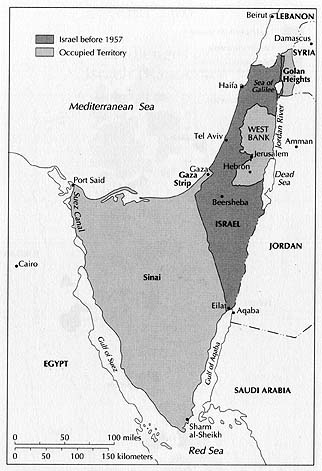
Map 3. Israeli-controlled Territories, 1967
What the 1967 war did, in Avner Yaniv’s words, was “to salvage from oblivion the twin ghosts of Jewish maximalism and Palestinian particularism.” [20] Israel now occupied all of Mandatory Palestine, plus Egyptian Sinai in the south and the Syrian Golan Heights in the north. The war brought to life contentious questions that had been locked in cold storage for twenty years. These questions involved not just the future of territories occupied in war, but the very nature of Israel itself: a relatively compact and homogeneous state with a predominantly Jewish character, or a binational state of two peoples.[21]
Initially, Mapai/Labor policy continued the unofficial preference for a resolution based on de facto division of Palestine with Jordan. It was clearly contemplated that the West Bank (except for East Jerusalem and some minor claims) would be returned to Jordan in exchange for a peace treaty, and likewise the Sinai Peninsula would be restored to Egypt in exchange for a peace treaty, while the Golan Heights would be retained by Israel because of its strategic importance and because of Syrian intransigence. In line with these intentions, the Israeli government adopted a policy of minimal interference in the daily lives of the West Bank population, with one important exception: prohibition of local political organization, since development of a West Bank leadership would undercut the strategy of resolving the conflict by cutting a deal with Jordan.
Labor Zionists also found it hard to reverse past habits. The strength of “practical” Zionism, in the socialist version, had been its success in grassroots settlement, in creating facts on the ground. This had not ceased in 1948; efforts simply shifted to previously unsettled areas within the new armistice lines. Thus many Labor Zionists approached the results of the 1967 war in a similar frame of mind, falling back into a settlement mode. The government itself opened the door by establishing settlements in areas where border changes were anticipated, either for security reasons (the Golan Heights and the Jordan Valley) or because of Jewish settlement there before 1948 (East Jerusalem, the Etzion bloc of settlements near Bethlehem). Regarding the West Bank, this evolved into what became known as the Allon Plan, according to which Israel would establish a security frontier on the Jordan River, but most of the West Bank and nearly all of its Arab population would be demilitarized and returned to Jordan, to which it would be connected by a corridor through the Israeli security belt.[22]
Mapai/Labor also compromised its policy by hitching its wagon to Moshe Dayan, an authentic national hero who had been made minister of defense at the peak of the 1967 crisis and emerged from the victory in a powerful position. Dayan had his own program, enunciated in various versions at various times, for maintaining a permanent Israeli presence in the West Bank. This involved using the West Bank as an opening to the Arab world by a policy of “open bridges” between the West Bank and Jordan, and integrating the West Bank economy and infrastructure with those of Israel.[23]
Thus the Labor Party itself laid the foundation for a program of permanent Israel control of the West Bank (or Judea and Samaria, as traditionally known). Backed by public opinion and legitimized by the actions of the Labor Party, the nationalist right was revitalized and provided with a galvanizing issue ideal to its purposes. It could even appropriate one of Labor’s traditional methods—grassroots settlement activity—in pursuit of its own maximalist aims, over the opposition of Labor. At the same time, Labor faced the challenges of a new era in a state of unilateral intellectual and ideological disarmament.
As Labor’s fortunes declined, the Yom Kippur War of 1973 dealt a punishing blow to public confidence in its ability to lead. As in all wars, there was at first a surge of unity behind the government, which enabled Labor to emerge relatively undamaged in the Knesset elections held a few weeks afterward. But the shock of the unanticipated Egyptian and Syrian attack and initial successes, together with the high casualty rate, undermined Labor’s image as the party that had always successfully defended national security. A deep sense of malaise and demoralization pervaded the nation, and Labor’s leadership came to represent complacency, deterioration, and lack of clear direction. On the eve of the 1973 war, around 60 percent of the Israeli public had perceived the general situation in Israel as positive; after the war, and throughout the 1974–1977 period, this dropped to 10 to 20 percent.[24]
The changing climate finally triggered the long-expected “changing of the guard” to a new generation of Labor leadership (Yitzhak Rabin, Shimon Peres, Yigal Allon). But the Rabin government, in the 1974–1977 period, was unable to reverse the trends already set in motion. Labor continued to suffer from the lack of a sense of direction, which was aggravated by bitter personal rivalries between Rabin and Peres. The general malaise was compounded by scandals in the ruling party, further strengthening the image of a leadership corrupted by its lengthy tenure in office. The evaluation of government performance, which had been 90 percent positive in 1967, had plummeted to 15 percent by mid-1977.[25]
Nevertheless, there was little expectation that the governing party would be cast into the wilderness. It might very well be weakened by the elections, as an angry electorate punished it for its sins, but it was still inconceivable that it would not continue as the core of the Israeli government.[26] However, the visible and not so visible developments that converged in May 1977 changed the face of Israeli politics irrevocably. After half a century on the outside, the Revisionist Zionists, under Menachem Begin, came to power.
The 1977 Likud victory marked in a dramatic way the broadening of the range of difference in relevant political debate, even as a general weakening of ideology was taking place on most fronts. A convergence of developments had undermined prevailing patterns of accommodation and sharpened the differences on standing policy issues. There were, to be sure, still many points of consensus: the primacy of security, dedication to nation-building, social and economic integration (at least within the Jewish community), and welfare statism. But there were also deepening divisions in the body politic, expressed in “a growing intolerance of opponents” and tendencies “to delegitimize them in terms of the seemingly common Zionist themes. . . .” [27] There was need of a new paradigm to describe Israeli society and politics, as the classic Zionist vision of the Jewish state—or at least its Labor Zionist version—became increasingly irrelevant. Such a new paradigm would need to encompass not only the emerging nationalist right but also the more assertive and visible religious communities, both Zionist and haredi (ultra-Orthodox) and—given the demographic realities since 1967—the growing Arab populations both in Israel and in the occupied territories.
There was a loss of consensus on the most basic issue: the very definition of the state that Zionism pursued. The nationalist right reopened the territorial issue and raised the prospect of a state without a Jewish majority. The gulf that opened between competing territorial and demographic conceptions was reinforced and sharpened by an overlapping communal (Ashkenazi-Sephardi) division that had not been politically significant before. The new combination of religion and nationalism, as expressed by the hawkishness of the National Religious Party and the activities of Gush Emunim and similar groups, made political compromise more difficult to achieve. The larger political role of the haredi community added to this difficulty by bringing to the political center groups that continued to challenge basic Zionist premises. Finally, at about the same time the Arab citizens of Israel, who had been politically quiescent for two decades, began to demonstrate increasing political consciousness and sophistication in pursuing their demands through the system (see chapter 9). All in all, the Israeli political system encompassed an extraordinarily broad spectrum of ideological differences, much broader than that of other democratic states.[28]
However, this increased pluralism did not lead to an increase of issue dimensions in Israeli politics. In fact, the dominance of the territorial issue actually led to a partial convergence of the three separate political axes of the past. With socialism on the decline, the socioeconomic dimension was subordinated to divisions on foreign policy. Ahdut Ha’avoda followed the lead of its Labor partners on both issues, while the Liberals and Herut overcame their differences on foreign policy. Choice between parties on economic issues became more and more difficult as party positions became incoherent or indistinguishable from each other. At the same time, as the National Religious Party and other religious groups became more hawkish, the religious dimension also came to parallel security issues to some extent. In the words of one analyst, there was a “gradual reduction of the multidimensional character of the political scene.” [29] Theoretically this could make it easier to achieve coherent majoritarian government—but not when the divisions on the one overriding issue become insurmountable. In this case, the dominance of one political axis in the system produced polarization and deadlock.
| • | • | • |
Reassertion of Tradition?
As classic Labor Zionist ideology declined and the somewhat atypical period of mamlachtiut became a memory, it appeared that traditional political habits—protest, civil religiosity, extraparliamentary politics—were reasserting themselves. Can post-1977 Israeli politics be interpreted as a resurgence of tradition? In some respects it can be, but with caution: other forces are also at work, and in any event the end result has not been a triumph of one worldview over another but polarization and stalemate. There has been no dominant consensus to shape the nation’s response on the key issues of territory and security.
Politically, the deadlock was a result of the decline of Labor and the rise of the right. As Table 2 shows, there was a steady upward trend in Likud strength, from thirty-two seats in 1969 (counting the parties that later joined the Likud), to thirty-nine in 1973 and forty-three in 1977. The long-term steady slide of Labor, from fifty-six seats in 1969 to thirty-nine in 1988, is also apparent. But in 1977 this was magnified by the appearance of the Democratic Movement for Change, a reformist movement led by popular military commander and archeologist Yigael Yadin, whose fifteen seats came primarily at Labor’s expense. This, more than its own electoral success, put Likud in a position to form a government in 1977—but given prevailing trends, this would have happened one or two elections later in any event. Once it had happened, however, the election served to legitimate the Likud in the public mind. There was a significant shift in polling data to support of Likud positions, bringing opinion polls and party support into closer correlation. On the eve of the 1977 elections 61 percent of one sample still claimed to be closest to the Labor position on foreign policy, against only 30 percent for Likud. But immediately after the election and before any other changes had taken place, the same question drew only a 38 percent support for the Alignment’s foreign policy, while identification with the Likud rose to 53 percent.[30] This was not just a change in parties but a watershed in Israeli politics. It brought a new orientation, with new values and political symbols, into equal political legitimacy and at least equal electoral potential with Labor Zionism. It marked the emergence of a truly competitive system, with clearly opposed options, as well as Israel’s first successful transfer of power.
| Year of Election | ||||||||
|---|---|---|---|---|---|---|---|---|
| 1969 | 1973 | 1977 | 1981 | 1984 | 1988 | 1992 | 1996 | |
| Alignment/Labor[a] | 56 | 51 | 32 | 47 | 44 | 39 | 44 | 34 |
| Left[b] | — | 3 | 1 | 1 | 3 | 8 | 12 | 9 |
| Centrist[c] | 10 | 4 | 17 | 4 | 7 | 2 | — | 11 |
| Likud[d] | 26 | 39 | 43 | 48 | 41 | 40 | 32 | 32 |
| Far right | — | — | 2 | 3 | 6 | 7 | 11 | 2 |
| National Religious Party | 12 | 10 | 12 | 6 | 4 | 5 | 6 | 9 |
| Other religious-Zionist | — | — | — | 3 | 3 | — | — | — |
| Haredi | 6 | 5 | 5 | 4 | 6 | 13 | 10 | 14 |
| Radical left/Arab lists | 10 | 8 | 8 | 4 | 6 | 6 | 5 | 9 |
| Source: Compiled by the author. | ||||||||
[a] Includes Labor and Mapam before 1988. | ||||||||
[b] Citizens’ Rights Movement (1973–1988), Mapam (1988), Meretz (1992, 1996). | ||||||||
[c] Independent Liberals (1969–1977), State List (1969), Merkaz Hofshi (1969), Democratic Movement for Change (1977), Telem (1981), Shinui (1981–1988), Yahad (1984), Ometz (1984), Yisrael B’aliya (1996), The Third Way (1996). | ||||||||
[d] In 1969, electoral bloc of Herut and Liberals (Gahal). In 1973, Gahal joined with smaller parties to form the Likud (Unity) electoral bloc. In 1996, Likud formed an electoral alliance with the Tsomet, the major party of the far right, and with Gesher, a Likud splinter group. | ||||||||
The thought that the 1977 elections might have been an aberration was put to rest by the 1981 elections. The Likud continued its slow but steady accretion of strength, gaining an additional five seats over 1977. Furthermore, although the Likud had only a one-vote edge, the remaining seats were held by parties that, by and large, preferred Likud to Labor (religious and nationalist parties accounting for sixteen of the twenty-five seats). Ironically, the election left the religious parties in a better bargaining position, despite a drop in seats, because of the close balance between the two major blocs.
Nevertheless, Likud Prime Minister Yitzhak Shamir (who had succeeded Menachem Begin in September 1983) appeared in a weak position when he was forced to call elections a year early, in July 1984. By this time the inflation rate was estimated at over 400 percent, and Israeli forces were still bogged down in southern Lebanon following the controversial Israeli invasion of that country in 1982. Public opinion polls in the early phase of the campaign predicted a decisive Labor victory—as they had in 1981. In any event, it was widely expected that the election would provide a clear mandate to one or the other of the two major blocs and end the stalemate between the two opposed conceptions that they represented.
This was not to be, however. In defiance of expectations, the 1984 elections produced a balance even more delicate than 1981, forcing Labor and Likud to embark on an era of power-sharing and mutual veto. While consensus on some pressing domestic issues—primarily the economy—proved to be within reach of the two blocs, their shared control of foreign and defense policy was marked by mutual paralysis and rejection of any new departures. To the surprise of most observers and despite repeated threats of collapse, this rickety structure actually lasted out its term of office. In part this could be attributed to the inability of either bloc to form a government on its own and the unwillingness of key parties, at crucial junctures, to face new elections. But it also represented recognition of the need for unity in addressing the country’s economic crisis, a task that could not be accomplished unless both major blocs were willing to share the onus of instituting the tough and unpopular measures required.
Paralysis in foreign policy seemed to be a price most Israelis were willing to pay in return for unity on economic and other domestic matters. It was also a luxury they could afford so long as no credible Palestinian negotiating partner, committed to coexistence with Israel, emerged. The government was thus under little domestic pressure, and only minimal international pressure, to offer any major concessions. In the mid-1980s, international conditions also favored inaction: the Iran-Iraq war preoccupied much of the Arab world, and Egypt was reintegrating back into the Arab fold without withdrawing from the Egypt-Israel peace treaty (though this remained a “cold” peace in most respects). These conditions changed, however, with the onset of sustained Arab unrest (the intifada) in the occupied territories from the end of 1987.
The intifada, unlike the previous sporadic rioting against Israel’s control of the territories, brought about a lasting change on this front. It threatened the country’s international standing and its internal cohesion, posing a sharp challenge that the country’s deadlocked political system was ill equipped to handle. It did not become a blatantly partisan issue, since Labor shared responsibility with Likud, but the future of the territories could no longer be shelved as a political issue. In this context, the scheduled elections of November 1, 1988, like those of 1984, were again a potential turning point that turned nowhere: the two blocs again emerged nearly equal in the number of seats won. But the Likud had a slight edge in postelection bargaining because the balance was held by a reinvigorated religious bloc with eighteen of the 120 Knesset seats. Some of the religious parties were closer to the Likud position on foreign policy and defense, and none of them were likely to sit in the same government with Labor’s secular leftist partners. As a result, Labor was forced to agree to a renewed National Unity Government on less-than-equal terms, with Shamir projected as prime minister for the full four-year term of office.
Basic disagreement over foreign policy still deadlocked the government, despite Shamir’s stronger position. This became more critical after December 1988, when PLO leader Yasir Arafat made his highly publicized declaration renouncing terrorism and calling for a negotiated peace based on coexistence of Israel and a Palestinian state. This statement changed the rules of the diplomatic game, increasing pressure on Israel for something other than the standard negative response. Also, the intifada was having a mixed impact on Israeli opinion: while the public continued to favor severe measures against violence in the territories, there was also a slight but measurable shift in a dovish direction on key long-term questions in Arab-Israeli relations.
By early 1990, the popularity of the National Unity Government had plummeted to the point that three-quarters of the public were unhappy with it.[31] Finally, in March Labor Party leader (and Finance Minister) Peres succeeded in bringing down the government on a no-confidence vote. Bringing down the government did not mean, however, that Peres could offer a viable alternative. After long and intricate maneuvering, Shamir emerged as head of a “narrow” Likud-led government with a bare majority, marking the end of five and a half years of power-sharing by the two major blocs. But this government was also unable to pursue a coherent policy or serve out its full term of office. Shamir’s agreement to participate in the U.S.-initiated peace talks that began in October 1991 led to the defection of the smaller right-wing parties and to the calling of early elections in June 1992.
The 1992 elections produced a narrow margin of sixty-one seats for Labor together with other parties on the left, a “blocking majority” that forestalled formation of another right-religious coalition. On the basis of this slim edge, the Labor-led government of Prime Minister Rabin and Foreign Minister Peres opened up direct negotiations with the Palestine Liberation Organization (PLO), initiating a process that led to the Israel-PLO Declaration of Principles in September 1993, agreement on Israeli withdrawal from Gaza and Jericho in May 1994, and an interim agreement on Palestinian autonomy in October 1995 (see chapter 10). But Israel remained deeply divided between a secular, modernizing, more dovish half and a traditional, conservative, more hawkish half. This was underlined by the 1996 elections where for the first time the electorate had to choose directly between two candidates for prime minister and in which Likud’s Benjamin Netanyahu defeated Labor’s Peres by less than 1 percent of the vote.
The delicacy of the political balance meant that while the public did overwhelmingly support the idea of a peace process, there was still no clear consensus on the nature of the peace. Labor and Likud offered clearly different visions of an overall settlement of the Arab-Israel conflict. The Likud consistently advocated the Israeli right to remain in Judea and Samaria and to expand Jewish settlement there; there would be no Arab sovereignty west of the Jordan River, and Arabs living there would be offered autonomy as individuals but not as a nationality or by territorial definition. Peace would be finalized by the simple signing of peace treaties with bordering Arab states on the basis of existing lines of demarcation. Labor leaders called for some amendment of the pre-1967 borders in Israel’s favor, basically on strategic grounds, but favored withdrawing Israeli control over most of the West Bank in the framework of a permanent peace that would include demilitarization of the returned territory. Initially this meant the “Jordanian option,” which would avoid a Palestinian state by inviting King Hussein back into the West Bank. But in July 1988, King Hussein relinquished all claim to the West Bank and to speaking for Arabs living there, and Labor was eventually forced to deal with the PLO as the only credible representative of the Palestinians.
On the surface, the Likud’s conception was no less ideological than the Labor version: it proclaimed Revisionist tenets of the Jewish right to the entire Land of Israel and a veneration of ethnicity typical of modern nationalism (as described in chapter 3). In this sense, the post-1977 division simply marked the renewal of the intense ideological conflict of the pre-state period, which had been muffled in the first two decades of statehood. But the worldview represented by Menachem Begin also incorporated some new elements, leading some to describe it as a “New Zionism” or as “neoRevisionism.” In the aftermath of the Holocaust, the message became much more emotional, with an even stronger focus on assertive self-defense and a defiant rejection of the outside world.[32]
Revisionism in any variant was, of course, more receptive to claims of Jewish tradition than Labor Zionism had ever been. It embodied a militant and unapologetic affirmation of historical and ethnic roots and the rejection (in theory) of “non-Jewish” secular doctrines. Religious symbolism was assimilated and adapted to a nationalist ethos, creating a new “civil religion” synthesizing these two elements.[33] In its more extreme manifestations, it could even be seen as an atavistic response to modernity, similar to Islamic fundamentalism in rejecting the modern world and calling for a return to one’s own roots.
Modernized secular Zionists saw this as a huge step backward. Uniqueness, rather than normalization, was becoming the watchword. Diaspora mentality “was forcefully returning, uninvited, to the house which Zionism built.” [34] Instead of becoming a nation like other nations, Israelis were again seeing themselves, in the words of Balaam’s blessing, as “a people who shall dwell alone” (Numbers 23:9). Israel was moving from a universalistic, secular, rational, civic orientation to one that was particularistic, religious, mystical, and primordial. It was reverting from an “Israeli” outlook, embodied in the concept of the State of Israel, back to a more “Jewish” self-identity, tied to the idea of Eretz Yisrael.[35] There was a reassertion of tradition after an interlude during which it had been temporarily submerged by a now-receding wave of secular ideology.
The reassertion of tradition could be seen on a number of fronts, from a strengthening of Jewish studies in secular schools to a revival of femininity in daily life. The impact on the role of women is especially instructive. Labor Zionism had taken pride in its progressive stance on women’s issues, reflected in such images as women serving alongside men in the army and Golda Meir’s election as one of the first women heads of government in the world. In truth these images were always overdrawn; Israel was in the forefront as far as legal equality was concerned but lagged behind many other states regarding de facto equality in public life, in the marketplace, and in society at large. Even some of the advances made were rolled back as progressive ideology yielded ground to more traditional attitudes associated with growing religiosity or imported non-Western folkways. For example, the representation of women in the Knesset fell from twelve seats in 1948 (and a high of thirteen in 1955) to a low of seven seats in 1988 and eight seats in 1996.
Religious revivalism and messianism were important dimensions of the new intellectual climate. The establishment of a separate state religious school system, as part of a network of institutions tied to the National Religious Party, had reinforced a distinct religious-Zionist subculture within Israeli society. The younger generation that passed through this network underwent intense socialization into the religious interpretation of Zionism. They served as the basis for Gush Emunim (Bloc of the Faithful), the group that spearheaded the establishment of Jewish settlements throughout the occupied territories.
Gush Emunim was not simply a religious faction but represented more broadly a “revitalization” movement of a type not unknown elsewhere.[36] In reaction to the threat of modern secular culture, such movements seek to revive traditional patterns (as they conceive those patterns). Gush Emunim adherents felt that the movement was acting to realize a divine purpose and that the return of Jews to Eretz Yisrael was the beginning of the final redemption for Jews and for mankind. In seeking to reclaim the entire Jewish homeland, therefore, they were performing a sacred mission. They did not seek the normalization of Jews among the family of nations but rather a return to the concept of chosenness that secular Zionists had tried to abandon. Jews, in this view, have a unique attachment to Eretz Yisrael that transcends the kinds of claims others may have there. The Western civic ideal is not applicable: equality among different peoples is not possible in these circumstances, and democracy is secondary to national rights. Arabs who live in Eretz Yisrael should have full civic rights only if they accept the essential Jewishness of the state; otherwise, they must choose between living there peacefully without full rights, or leaving.
Gush Emunim served as the ideological vanguard of the New Zionism, as the main force behind the settlement movement in the territories, and as a bridge between religious and secular nationalists. In some ways, it was co-opted and used by the leadership of Likud, which shared most of its immediate goals. In another sense, this connection with the ruling party gave Gush Emunim and the settlement movement an influence in public life well beyond what would be expected from the actual size of their membership. The influence of Gush Emunim-style nationalist ideology cannot account, however, for all of the overlap between religious self-identity and support of more hawkish parties. The core supporters of Gush Emunim, and the ideological expressions of nationalism generally, came disproportionately from Jews of European background. The religious orientation of Middle Eastern Jews is generally less doctrinaire and less messianic. In the style of the Middle East, religion is more a matter of traditions and customs tied to group identity than of inviolable sacred ideology. Religious Jews of Middle Eastern background were drawn to the Likud and other secular nationalist parties more by a general sense of ethnic particularism than by ideological fervor. But they were still predisposed more to support of Likud than of Labor, with its secular socialism and Western universalism.
This visceral attraction of Revisionism to many less Westernized Jews, religious and nonreligious, was apparent in some early successes. For example, the first place where the Revisionists gained a majority in a Zionist movement branch was in Tunis, in 1928.[37] This tendency was obscured in the early statehood period, for reasons already outlined (above and chapter 4). But it emerged more strongly as time passed, reinforced by the hostility of refugees toward their lands of origin. Many Middle Eastern Jews related easily to Menachem Begin’s emotional appeal to ethnic sentiment and his unapologetic defense of Jewishness. Middle Eastern Jews also shared with the Likud (before 1977) common ground as outsiders facing a haughty and patronizing Labor Establishment.
The appeal of the right to Middle Eastern Jewish voters was not, therefore, ideological or intellectual primarily, but more attitudinal and emotional. Support of the Likud was a way of breaking the hegemony of a Western-oriented elite, of asserting full and equal membership in Israeli society, and even of turning the tables on those who had been disdainful of them (now it was Labor Zionists who were “less Zionist”). Belief in the historical or God-given right to the entire Land of Israel was less central to this than the social and demographic realities that had shaped the historical experience of Israelis from non-European lands.[38]
The loss of a dominant consensus meant, inevitably, the loss of coherence and strong direction in government. Though one bloc might control the government, it held no monopoly on legitimacy and its ability to make basic changes was limited. There were more autonomous forces to deal with, as new organizations and groups appeared to represent their own interests. The role of parties was weakened, and the cabinet was less able to act with unity and decisiveness. In some ways, these trends marked the reemergence of the pre-state coalition tradition, when power-sharing arrangements were broad and shallow with much less coalition discipline. There was also less coherence within the parties, however, as the hold of ideological camps and movements loosened. In a sense, what was happening was what Peter Medding has called “the breakthrough of society.” [39] This moved Israeli politics closer to underlying human realities and fostered the reemergence of pre-civic patterns of behavior; in the words of one commentator, the loss of governmental coherence was “taking us back to the shtetl” (the Jewish village of Eastern Europe).[40]
The pattern of decentralized bargaining among semiautonomous agencies has emerged even more strongly. Kupat Holim Klalit (the Sick Fund of the Histadrut), which had been a direct participant in making health policy when the Labor Party was in power, became a “veto group” in the setting of that policy.[41] A proposal for a five-day work week was the subject of negotiations between the Histadrut and the Ministry of Finance. Reforms in energy policy were negotiated among the Ministry of Energy, the three major oil companies, and the corporation operating the refineries. The transfer of absorption services for new immigrants from the Jewish Agency to the government was the subject of difficult negotiations between the agency and the Ministry of Absorption, with the Ministry of Finance also involved. The examples could be multiplied extensively, involving a variety of public, semipublic, and private bodies according to the subject involved.
As a result of frustration over their inability to influence policy, Israelis turned—or, perhaps more accurately, returned—increasingly to unofficial and unstructured channels of political action. The level of protest and other forms of direct action had as noted been relatively low during the period of state-building on the civic model. But from the early 1970s there was a steep rise in direct public participation (or “hyper-participation”) in politics, creating greater democracy (in a basic sense) at the cost of greater discord and disorder. As Itzhak Galnoor summarized the situation, “there has been…increased committed participation and more direct impact on steering, accompanied by less stability and greater difficulties in governing.” [42] In short, by the 1980s the incidence of protest and demonstration in Israel surpassed that of almost any other democratic regime.
As measured by Sam Lehman-Wilzig, the frequency of “protest events” in Israel can be divided into four distinct periods. During the first six years of statehood, despite the enormous problems of state-building and mass immigration, there were on the average only fifty-four significant protests or demonstrations annually. With improvement in the economic situation and greater overall stability, this decreased to an average of thirty-nine protest events per year in the domestically quiescent period of 1955–1970. Beginning in 1971—a year marked by the end of an external threat (the war of attrition) and the breakup of the National Unity Government that had ruled since the eve of the 1967 war—the number of protests and demonstrations tripled to an average of 122 per year over the next eight years. At that point, corresponding with the Egyptian peace treaty and the onset of triple-digit inflation, this level of protest almost doubled again, to an average of 202 annually during the following eight years.[43] In 1986 Lehman-Wilzig concluded that Israel was “the most protest-oriented polity in the democratic world today,” pointing out a 1981 survey which showed that 21.5 percent of Israelis had taken part in a protest event while the highest proportion anywhere else was 11 percent, in the United States.[44] Gadi Wolfsfeld, comparing Israel to eight other democratic states, found that only in Italy had a higher percentage of the public participated in a demonstration.[45] In this light, perhaps the most symptomatic political event of post-1977 Israel was the 1982 demonstration by an estimated 400,000 protesters—nearly 20 percent of the country’s adult population—demanding an official inquiry into the Sabra and Shatila massacre in Lebanon (a demand that the government was forced to meet).
In these “old-new” patterns of direct action and confrontational politics, as with traditional Jewish politics, the prevalence of informal bargaining and unclear lines of authority led competing groups and interests to resort to tactics outside of normal procedure. Linking this contemporary surge of protest to classical Jewish “oppositionism,” Lehman-Wilzig argues that “the modern secular State of Israel may be somewhat of a novum in Jewish political history, but the political culture animating it has roots deep in the past.” [46]
The growing frustration with existing channels of political communication and influence, in the 1970s and 1989s, was reflected in the declining role of parties. From Zionism’s earliest days parties had been the dominant channels in politics. But after 1948 the role of parties was undercut by the development of state institutions and bureaucracy, vast changes in demography, growing social and economic complexity, generational change, and the overall decline of ideology. One clear index of this development is the decline in party membership: in the mid-1950s over one-quarter of the Israeli population were members of a political party, but this figure declined to 18 percent in 1969, 13 percent in 1977, and only 8 percent in 1988.[47]
Together with this came a devastating increase in the percentage of those surveyed who said the government was performing “poorly” or “very poorly,” from only 8 percent in 1967 to 81 percent in 1977 (and with similar high percentages for Likud governments in the 1980s).[48] Public frustration with existing channels led to more direct forms of communication, whether as protest or other forms of direct action. It was “the lack of formal opportunities for political communication” or the “blocked opportunities” that lay behind the resort to venerable patterns of confrontational politics. When asked to identify the reasons for Israel’s high level of protest activity, the leading explanation chosen by Israeli respondents was that “the citizen does not have enough other ways to express himself to the authorities.” [49]
There were of course other circumstances that pushed politics into irregular channels. The 1967 war had put on the table issues upon which there was deep division and toward which some groups put principle ahead of adherence to procedure. At the same time, the war also created greater room for such debate by reducing security fears that normally impelled Israelis to unite and submerge their differences. In addition, the second generation from the great influx of Middle Eastern Jews in the 1950s, born or raised in Israel, was less hesitant than its parents in challenging inequities, and this generation was coming to political maturity. Finally, modernization also reinforced the return of extraparliamentary politics; in particular, the introduction of television in the late 1960s greatly enlarged the potential of public drama as a means of getting the attention of nonresponsive leaders.
While there is something “democratic” about direct public involvement on the political stage, there are also drawbacks. As Wolfsfeld puts it, “Israel has developed a participatory democracy, but the modes of participation leave something to be desired.” [50] Politics conducted in the street tends to be episodic, reactive, negative, and something of a blunt instrument. Rewards go to those groups that are best organized, most disruptive, and least ready to compromise, which hardly encourages a civil political discourse. Even in the best circumstances there is a potential threat of violence. Finally, increased recourse to such methods undercuts the ordinary processes of government and fosters disrespect for regular procedures and the rule of law.
All of this is part of a process in which the centralization of the system is challenged and a diffusion of power is taking place. Even in the area of local government, usually considered the most centralized feature of the Israeli system, there has been considerable diffusion of power. As local governments have almost no restriction on their borrowing, they often go deeply into debt and then bargain with the state for funds to repay the loans. So long as local expenditures do not violate state policy, the state usually ends up covering them (the Knesset passed a law to prohibit such practices, but it has not been effective). Even more importantly, there has been a trend in some of the larger municipalities toward increasing financial independence by increasing local taxes and forgoing the fiscal support of the national government upon which they had depended in the past.[51]
More is involved here than protest plain and simple; the diffusion of power and expansion of public involvement extend to other ways of bypassing formal channels of government. In this broader sense, it could be said that Israelis have a penchant for direct action as part of the informal bargaining that takes place. Perhaps this can best be seen by citing the direct actions reported in the Israeli press during one randomly chosen week:
A right-wing group blocks the road between Gaza and Israel with burning tires in order to protest the entrance of Arab labor to Israel.
Na’amat, the women’s division of the Histadrut, conducts a national “referendum” on the issue of economic equality for women.
Young Labor Party activists bring sacks of garbage to the twelfth-floor office of Tel Aviv’s Likud mayor as a strike of municipal sanitation workers continues.
Tel Aviv’s striking garbage collectors try to physically block the work of private contractors hired to remove the accumulated refuse.
Parents and children in a Jerusalem neighborhood stage an unlicensed demonstrationto demand installation of traffic lights in a busy intersection (licenses to demonstrate are usually given for the asking).
Also in Jerusalem, members of a right-wing group try to disrupt an open-air performance of a play they deem objectionable.
A construction firm in Haifa occupies a building it has built for the municipality and refuses to transfer possession until its financial claims are settled.
The municipal offices of Yokne’am, a development town, shut down for two hours to protest the loss of jobs at a local factory.
Eighth-graders in Kiryat Shmonah barricade themselves on the upper floor of their school building following cancellation of a class trip.
A national protest meeting is held in Jerusalem to press Bezek, the government communications company, to remedy defective telephone service.
Right-wing demonstrators block a convoy of vehicles, organized by left-wing groups, that is carrying food supplies into the Gaza strip during a curfew there.[52]
Another dimension of the “old-new” pattern of direct action was the establishment of alternative social and economic networks. The Israeli public has often organized its own informal systems to address unmet needs. Under this rubric are phenomena as varied as the settlers’ movement in the occupied territories, pirate cable television (operating, at one time, in a quarter of Israel’s households), the black market, and private health insurance plans. In the 1970s and 1980s budgetary pressures forced serious cutbacks in government spending, leading to the emergence of “gray education” and “gray medicine” as families made their own arrangements for additional schooling or medical treatment. Likewise, dissatisfaction with police protection sparked an explosion of private security forces, which by the late 1980s outnumbered Israeli police three to one; even in the isolated haredi community, residents organized civil patrols to secure the safety of the streets.[53]
Another “old-new” pattern was the tendency to illegalism, or an attitude of expediency toward the law, a tendency which “is nourished by the venerable tradition of the shtetl.” [54] During the Ben-Gurion period, this tendency remained largely under the surface as the government promoted its version of mamlachtiut, or civic-mindedness, as a cure for age-old habits of circumventing unwanted authority. After Ben-Gurion left the scene, familiar attitudes came back into the open as public scandals multiplied and corruption at higher levels became increasingly open. It appeared that the exploitation of a public position for private or party needs was “almost legitimate,” or so widespread that no guilt was really involved. As extraparliamentary politics became more common, violations of the law by extreme movements were opposed only by political enemies; few figures in public life condemned the illegal acts of groups with which they sympathized.[55] The expansion of protest politics involved a paradox: greater acceptance of the democratic right of protest, but consequently a lessening of respect for orderly procedure and the general rule of law.[56]
To what extent can a decline in support for democratic values be documented? As summarized in chapter 1, the evidence is mixed:
- Respect for political parties, the media, and some other institutions in democratic politics is remarkably low, though not substantially different from some other democratic nations.
- A significant part of the public thinks that Israel is “too democratic,” and such attitudes tend to increase with greater religiosity and decrease with greater education. Again, this is not radically different from other democracies, though Israel tends to the European approach permitting greater curbs on free speech, in the name of public order, than American thinking would customarily permit.[57]
- Where Israeli belief in democracy seems relatively weak is in three particular areas: (a) deference to authority and support of strong leadership, especially when security issues are invoked; (b) sensitivity to the image being projected externally, and consequently demands for controls on the media; and (c) accommodation of non-Jewish minorities on a fair and equal basis. All three of these weaknesses reflect in one way or another the impact or limitations of Jewish historical experience.
- Israel is characterized by “focused intolerance” toward an Arab minority that is clearly identified and linked with a foreign threat, while democracies such as the United States, with a variety of target groups, demonstrate “pluralistic intolerance.”
- The intifada or Arab uprising in the occupied territories, from late 1987, led in the short term to demands for tougher policing, but in the long term to greater readiness for compromise (see chapter 10).
The New Zionism never became dominant in the way classical Labor Zionism had been at its peak. Vociferous debate over the future of the territories continued unabated, with the dominant tone in intellectual and academic circles still set by the doves. (The novelist Amos Oz taunted the hawks: “Why are most of the creative people in the country, heaven help us, ‘leftists’? Is it a conspiracy? Has Damascus bought out Hebrew literature lock, stock, and barrel?”)[58] The political success of the Likud from 1977 to 1992 served to legitimize it as a contender for power, but the effort to substitute Revisionist symbols and myths for established Zionist symbols and myths did not succeed: “The majority of the nation’s educational and cultural elite and leading figures in the media are among the substantial number of Israelis who do not share the cultural definition of political reality staged by the Likud.…” [59]
The Likud’s success in pulling even with Labor at the polls was not achieved on the basis of its ideological appeal alone; in fact, the ideology may on balance have been a handicap. There is substantial evidence that many of those voting for the Likud were actually closer to Labor on issues such as the territories.[60] In other words, by the 1980s the electorate was voting somewhat to the right of its beliefs, just as in the 1950s and 1960s it had voted to the left of its beliefs (see chapter 4). Menachem Begin’s success in attracting votes did not come from his ideology, which he had learned to downplay, but from his appeal to the emotions and sentiments of traditional, religious, and above all Middle Eastern Jews who were alienated from the Labor Zionist Establishment. Begin’s own party, Herut, had by this time completed the transition from ideological movement to modern, bureaucratized political party.[61]
What we have seen, in sum, is a reassertion of traditional Jewish occupational and social patterns, religious beliefs, and non-European influences that ended the dominance of Labor Zionism. Like other “new societies,” Israel moved from ideology to patterns more reflective of its human and material realities.[62] There was a weakening of the “movement style of life” and an accentuation of occupational, economic, and ethnic differences.[63] While politics created society in the yishuv, the more common pattern is now emerging: social realities shape politics.
| • | • | • |
Economic Transition
Israel’s first twenty-five years also stand apart in economic terms. Before the 1970s, Israel was judged to be one of the world’s true economic success stories. With the help of reparations payments from Germany and private aid from Jewish communities, economic growth averaged around 10 percent a year. This was achieved despite the pressures of massive immigration and a level of defense spending (8 to 10 percent of the gross domestic product, or GDP) heavier than that in any other democratic state. Israel did suffer from a chronic negative balance of trade, as well as an overall negative balance of payments, which helped to fuel a high rate of inflation. Nevertheless, until 1966 taxes were sufficient to cover domestic government spending, and taxes consistently took about a quarter of the GDP—not a particularly heavy burden by Western European standards.[64]
The wars of 1967 and 1973 ratcheted defense spending up to new levels where it remained stuck for the time being. After 1967 it rose to over 20 percent of GDP and to 28 percent or more after 1973, peaking somewhere above 30 percent (by most calculations) in 1975.[65] At the same time, with a sixfold increase in world oil prices during this period, the costs of imported energy skyrocketed. Yet there was no offsetting reduction in governmental social spending; in fact pubic services continued to expand, with real spending on health rising 60 percent per capita and on education 80 percent per capita during the 1968–1978 decade. By 1978 Israel ranked fifth in the world in public education expenditure as a proportion of GDP, at 8.5 percent.[66] Though growth had slowed down by this time, the standard of living continued to rise. The result was “the overburdened polity”: a state with unrealistic goals on one side and limited resources, growing demands, loss of cohesion, and a protracted conflict on the other. Part of this problem was that the decline in the level of ideological commitment left the public less willing to delay personal gratification in order to achieve common goals (as earlier Zionists did).[67]
Though there were tax increases, they were insufficient to close the broadening gap between revenue and consumption. Many public services were being provided free of charge or well below cost, and reliance on external sources of funding inevitably grew. “A pattern of over-consumption was created”; in other words, the country was simply living beyond its means.[68] The government’s response to this situation was described by one economist as “schizophrenia”: pressing economic realities were being willfully ignored, and deficit financing was pursued as though large-scale foreign aid and massive borrowing could continue indefinitely into the future.[69]
The results were entirely predictable. As defense spending, public services, and private consumption all rose, gross investment fell from 33 percent of GDP in the 1973–1975 period to 24 percent in the 1980–1983 period.[70] The growth rate of the economy fell to an average of 3.2 percent in the 1976–1989 period, with a low point of 1 to 2 percent in the early 1980s.[71] Israel was not keeping pace with other developed countries; while per capita income stood at 83 percent of the average of the twenty-three most developed economies in 1960, this figure had dropped to 48 percent by 1978.[72] One index of the underlying problem was the level of governmental expenditure in relation to the size of the economy. The weight of public spending in Israel had always been impressive by world standards, running at around 50 percent of GDP, but by the early 1980s this had risen to 75 percent or more of GDP by most accounts, and for some years and by some measures even exceeded the official GDP.[73] The difference was made up by borrowing; net external debt increased from $500 million in 1964 to over $17.7 billion in 1983—a 35-fold expansion.
By the mid-1980s inflation was running at a 300–400 percent annual rate. Despite its supposed commitment to a market economy, the Likud after its 1977 victory found itself no more able politically than Labor to tame the runaway economy (indeed, the Likud’s base of support was disproportionately, and paradoxically, among those most dependent on a continuing high level of government subsidies and services). Though taxes had risen from about 25 percent of GDP to around 50 percent and austerity measures were intermittently attempted (only to be abandoned before elections), the economy remained out of kilter. Inevitably, public services began to decline as the crunch grew more severe, contributing to the development of “gray education,” “gray medicine,” and the other alternative private social service networks described above.
The need for a massive restructuring of the economy was one of the major incentives for formation of the National Unity Government (NUG) after the elections of July 1984. This forced the two major blocs to share responsibility for the unpopular steps required, thus removing the issue from politics. After some false starts, the NUG used its emergency powers in July 1985, to impose a sweeping Economic Stabilization Plan (ESP) that was, like most larger economic policies, the result of hard bargaining among the government, labor, and industry. The ESP included dramatic cuts in government spending and subsidies, strict price controls, severe wage restraints, and devaluation, as well as measures to encourage private sector growth and the liberalization of trade restrictions in order to expose more of the economy to open competition. In part, cuts in government spending were made possible by the 1979 peace treaty with Egypt, Israel’s most powerful enemy; defense spending had already fallen in the early 1980s to under 20 percent of GDP, and the downward trend continued as Israel disengaged from its heavy involvement in Lebanon in the middle of the decade.
The ESP set in motion a gradual turnaround in the Israeli economy. In the short term, of course, it accelerated the deterioration of public services, as well as threatening economic collapse in the agricultural sector (the kibbutz and moshav movements were overburdened with debt). But it was a textbook success in curtailing inflation to the low double-digits; the annual increase in the consumer price index averaged only 18.5 percent from July 1985 through 1991 and fell to 9.4 percent in 1992 (the first single-digit increase since 1970).[74]
In the short term, the ESP also cut the purchasing power of wages by about 30 percent. Wage increases that were intended to compensate for part of this loss were overly generous, however, because the likely rate of inflation was overestimated, and as a result private consumption rebounded and the previous imbalance reappeared in 1988–1989. Fortuitously this distortion was corrected by the wave of mass immigration that began in 1989, with 500,000 new Israelis, mostly from the former Soviet Union, arriving by mid-1994. This increase of roughly 10 percent in the population pushed wages downward again; together with lower interest rates and a more stable and predictable exchange rate for the Israeli shekel, this triggered a period of sustained and impressive growth.[75]
From 1990 to 1995 the Israeli economy grew by 42 percent, near the top among developed economies. The 1995 GDP was $86 billion or $15,500 per capita, putting Israel ahead of many European states. Government spending had returned to a more normal level of about 49 percent of GDP, with defense spending below 10 percent of GDP at that point and falling. Unemployment had fallen to 6 percent.[76]
Serious problems still remained in Israel’s economy and in the scramble over scarce resources; Israel was still an “overburdened polity” by any standard. But after the dramatic economic turnaround it was clear that Israel of the mid-1990s was a modernizing state increasingly drawn into the converging social and economic currents that pull such states together. In some ways Israel, ranked very highly in the number of videocassette recorders and personal computers per capita, was even in the vanguard of the electronic age. More is at work here than economics alone; whether labeled as “modernization” or “Westernization,” Israel, no less than other states and perhaps more than most, was becoming a part of the global village. Are cellular phones, Scandinavian vacations, and TV-age electoral campaigns replacing pioneering ideologies as the universalizing counteweight to reassertive Jewish particularism? Will hard disks rather than hard dogmas serve as the vehicle of civicness and secularization? The very success of Israel’s economic transition calls attention to the changing nature of challenges to tradition in Israeli life and politics.
| • | • | • |
Impact of Modernization
At its most fundamental level modernization is said to involve liberation from traditional authority, a new positive attitude toward change, and a turn from cultural orientations or values to social rationality. A civil society autonomous of the state emerges, as do new social strata (particularly professionals), more complex economic division of labor, and general bureaucratization. The weight of tradition, and its associated particularities, decline as objective forces mold all aspects of life. There is a convergence as societies respond to the same forces, a process which accelerates as these forces become internationalized. Of course, we are reminded, the dichotomy between tradition and modernity is not absolute; traditional societies also can undergo considerable change and modern societies retain considerable diversity, often incorporating traditional elements in a variety of ways. But modernization still involves a number of common universalizing tendencies.[77]
In terms of these basic definitions, Israel has long been a modernizing or modernized society. Zionism was itself part of a broad historical challenge to old identities and value orientations. Jews were to join other peoples in a process of nation-building, creating a new order consonant with the progressive currents of the time. Zionism, and Israeli society, were attuned to, and even fixated on, technological innovation and prevailing models of social and economic development. The yishuv and the state, like other modernizing societies, underwent increased social mobilization, organizational diversification and proliferation, rationalized regulation and allocation (market mechanisms, voting), greater division of labor and occupational specialization, enhanced social mobility, urbanization, secularization, expansion of media, and diffusion of political power.[78]
This process—long and slow but cumulative—was obscured by ideological habits of thought and revived resistance of traditionalists. But by the 1980s and 1990s, with the decline of ideology, the pressures of modernity were taking center stage. In the third great revolution of the modern era—that of information technology, following the earlier industrial and scientific revolutions—Israel was not only a full participant but was even at the forefront in certain respects. The electronic age was integrating Israel into the larger world in ways that the founders of Zionism could hardly have imagined, while at the same time rewriting the rules of Israeli politics.
The impact of modernization on politics, as generally understood, is to create a more diversified political structure, to extend the scope of law and administration into all spheres, to spread power more widely, to weaken traditional elites and traditional sources of legitimation, and to foster a new accountability in which the ruled participate more directly in selection of the rulers and in setting major policies.[79] In the Israeli case, this has been expressed by diffusion of power within and among parties, decline of party dominance, emergence of new kinds of political actors, a new “mass politics” based more on personalities and less on issues, greater electoral fluidity and volatility, and the strengthening of administrative and legislative regularity.
“Mass politics” meant appeals to a broad central spectrum of the electorate, to a large floating vote influenced more by the images of leading candidates and by general public mood than by ideological loyalties. This was closely linked to the changing role of the media. Since late 1968 television had come to play a large role in election campaigns and in shaping public images of candidates and issues, in place of the classic party-sponsored political rallies of the past. The party press, which had once dominated the newspaper scene, was pushed aside by the popular independent papers more closely tuned to the general public mood.
The correlation of voting to party platforms was strikingly weak; if voters had for certain historical reasons voted to the left of their beliefs during the glory days of Labor Zionism, they now deviated in the other direction because of a general weakening of ideology and the presence of personal and emotional factors that overshadowed the issues. About half of the voters remained loyal to their parties through several elections—a proportion higher than in other Western democracies—but this still left a considerable floating vote that could potentially cause a radical shift in power any time it flowed more in one direction than the other.[80] The shift from issue-centered politics to image-centered media campaigns sparked the emergence of populist appeals in election campaigns; in 1981, for example, the government in power made imported television sets and videocassette recorders much cheaper to buy—at the cost of great damage to the nation’s balance of payments—in order to create a more favorable climate on election day. To some observers, there was even a risk that the system might become too responsive, moving from tight party control to unrestrained populism and demagoguery.[81]
Another aspect of the loosening party system, and one generally regarded positively, was the democratization that took place within the parties. In the past party leaderships had tightly controlled the selection and ranking of Knesset candidates, thus insuring fairly strong party discipline. By the early 1980s there was some loosening of this process as candidate selection, in at least its early stages, was passed on to broader and more representative party bodies. In 1988 the Labor Party chose most of its candidates through twenty-three councils of district branches with the final ranking done by the Central Committee (a body of 1,267 members), a procedure that led to the rejection of some prominent party figures (Abba Eban in particular).[82]
By 1992 Labor had moved all the way to a full-fledged primary system for both Knesset candidates and for selection of party leader, with all registered party members eligible to vote in the election that replaced Shimon Peres with Yitzhak Rabin. The ensuing general election was also unusually personalized, with Rabin’s supporters and opponents both focusing on his personal strengths and weaknesses in the confrontation with the comparatively less popular Yitzhak Shamir. Other parties were undergoing similar transitions during this period; in March 1993, the Likud replaced Shamir as party leader with Benjamin Netanyahu in its first general party primaries.
The new open elections did change party slates to some degree, at least in bringing in younger candidates and increasing representation of Jews from Asia and Africa, though they were less successful in increasing the numbers of women and Arab candidates. More broadly, like modern parties elsewhere Israeli political institutions were becoming less ideological. In place of the old party ties centered around youth movements, newspapers, and other elements of the “movement” style of life, they now waged modern election campaigns aimed at the amorphous middle of the political spectrum with hired U.S. political consultants and public relations firms. Differences on issues were blurred, especially in the realm of economic policy where the gap between the two major blocs had long been narrowing. The Labor Party had long subsidized business interests, for example, and the Likud after 1977 continued to do so despite its supposed commitment to a free market. And while more voters identified with the right than had been the case before 1977, a majority (60 percent in one survey) continued to support socialism and to oppose reduction of the state’s role in the economy.[83] Even differences on the occupied territories narrowed somewhat, as both Labor and Likud moved toward autonomy as at least an interim solution; debate now focused on the scope of autonomy and whether it would be the permanent solution. While “polarization” between hawks and doves was a major concern of the early 1980s, commentators a decade later were remarking over a lessening of distance between the two camps and the incorporation of more extreme groups back into the two major parties.[84]
Israelis were turning more to other bodies for services and channels of access previously provided by parties, as reflected in the expansion of governmental activities and the proliferation of other political, social, and economic groups. Parties, it seemed, were simply becoming less important. Or were they? It could be argued that it was primarily the parties’ mode of operation and electoral behavior that changed, and that once an election was over they were no less important than before. Parties still held the key to forming governing coalitions and negotiating government policy.
In other respects, modernization or Westernization of Israeli public life also contributed to greater regularization and rationalization in areas where a predisposition in this direction existed. The best expression of this was in the legal and judicial sphere, though the picture regarding attitudes toward the law is somewhat contradictory; two opposed trends were operating at the same time. On one hand, “illegalism” accompanied the growth of extraparliamentary politics and the breakdown of the tight Ben-Gurion system. Yet at the same time there was often more tolerance in practice, politics was more competitive, groups at the margin of the system were now drawn within it, and arbitrary procedures were reduced in a number of specific areas.[85]
To be sure, Israel remained one of only seven nations, and only three democratic nations (together with the United Kingdom and New Zealand), that have never had a formal, entrenched, written constitution.[86] But part of the progress toward a civic legal order was passage of nine of the eleven Basic Laws projected as building blocks for such a constitution, as well as two pieces of what was to have been the tenth Basic Law. Put together these Basic Laws are an impressive body of “constitutional” material (see Table 3).
| Year enacted | |
|---|---|
| The Knesset | 1958 |
| Israel Lands | 1960 |
| President of the State | 1964 |
| The Government | 1968 |
| The State Economy | 1971 |
| Israel Defense Forces | 1976 |
| Jerusalem, Capital of Israel | 1980 |
| The Judicature | 1984 |
| The State Comptroller | 1987 |
| Freedom of Occupation | 1992 |
| Human Dignity and Freedom | 1992 |
The last two laws listed in Table 3 were to have been part of a Basic Law on Civil Rights, but they were passed separately when other parts of that proposed law bogged down in controversies over security concerns and religious opposition. The projected eleventh Basic Law, on Legislation, also raises religious objections since it affirms the legitimacy of nonreligious sources of law; thus, completing the process of writing Basic Laws is problematic. Only specified clauses in some of the Basic Laws are entrenched to any extent, requiring an absolute majority (or in one case a majority of 80 members) of the Knesset for any change; otherwise any of these provisions can, like an ordinary piece of legislation, be changed or invalidated by a simple majority of those voting (as they in fact have been). In essence, for the constitution as a whole to be entrenched the Knesset will have to vote away its own prerogatives, an act rare in the annals of legislative history.[87]
Nevertheless the net result of this process has been a steady growth of constitutionality over time. The basic contours of Israel’s political and legal order has stabilized and are not going to be suddenly or arbitrarily changed. Apart from the Basic Laws, some other documents and Knesset laws also have an aura of basic definition of government about them: the Declaration of Independence, the Law of Return (1950) asserting the Jewish link to Israel, the 1952 law specifying the status of the World Zionist Organization and the Jewish Agency, the Equal Rights for Women Law (1951), and others.
The solidification of the court system also has advanced the rule of law. In this area tradition and modernity go hand in hand: courts and legal institutions have always played a central role in Jewish life, while in a contemporary context they are a prime vehicle for instilling the civic ethic.[88] Of course Israeli courts, like other features of public life, come in a variety of shapes and sizes. There is in fact a loosely coordinated set of court systems: civil courts, military courts, and religious courts (in fourteen different recognized religious communities). Of these the civil courts are the most instrumental in promoting democracy and the rule of law, while military and religious courts tend to draw on and strengthen group identity and solidarity.[89]
The judiciary remains one of the most important channels of Western influence. The Supreme Court is particularly important in promoting universalist values. Sitting as the High Court of Justice, it exercises an equity jurisdiction as a court of first instance as well as appeal, intervening to protect individuals from government arbitrariness. The court has increasingly applied principles of natural justice to legislation and administrative measures, adding safeguards to existing procedures and curtailing actions said to impinge on human rights. It has also expanded its jurisdiction to cover such areas as internal decisions of the Knesset and the substance of security claims made by the government.[90]
The Israeli system remains majoritarian in that a Knesset majority is still sovereign; ordinarily acts of the Knesset cannot be invalidated by the courts. But even in this regard the scope of judicial review has been expanded somewhat. In 1969 the Supreme Court, sitting as the High Court of Justice, invalidated an election financing law that conflicted with an entrenched provision of a Basic Law but had not been passed by the absolute majority needed to amend that Basic Law (Bergman v. Minister of Finance). The Knesset subsequently passed a new law consistent with the Basic Law, while at the same time mobilizing the necessary sixty-one votes. Similar court actions were taken in 1981 and 1982, again negating changes in entrenched provisions of Basic Laws passed without the absolute majority required by these provisions. In essence the High Court was simply forcing the Knesset to observe its own rules, while recognizing the right of the Knesset to change any legislation, including Basic Laws and the rules themselves, so long as proper procedure was followed. On the other hand the proposed Basic Law: Legislation would give all Basic Laws a superior status, requiring an absolute majority at all stages for changes and providing formally for judicial review; if passed this would again increase the constitutionality of the Israeli system.[91]
Finally, there was increasing resort to quasi-judicial official commissions of inquiry set up under the 1968 Commissions of Inquiry Law, empowered to require all officials—even the prime minister—to testify and supply evidence, and to issue specific recommendations that are generally implemented. Such commissions sorted out a number of front-page controversies, including lack of preparedness in the 1973 Yom Kippur War, failure to prevent the massacre of Palestinians in Lebanese refugee camps (Sabra and Shatila) in 1982, collapse of the bank shares market in 1983, controversy over the interrogation methods of the General Security Service in 1986, and the 1994 massacre of Moslem worshippers by a Jewish settler in Hebron’s Tomb of the Patriarchs.
At the same time Knesset legislation accumulated over time, gradually replacing older Ottoman and British laws and creating the basis of a unified and rationalized code of law. The role of common law diminished as the gaps in existing laws were filled in. Executive discretion has been narrowed as laws become more detailed, and ministerial regulations are reviewed more consistently by Knesset committees. Knesset procedures have also been tightened, with committees meeting more often and maintaining a closer watch over government activities and finances.[92]
Among the areas in which governmental powers have been more carefully defined is wiretapping, where a 1979 act detailed procedures designed to prevent arbitrary or unjustified invasions of privacy. In addition, over time governmental secrecy loosened considerably: public debate over strategic issues (even nuclear weapons) became less restrained, the inner workings of government (never totally hidden) became more visible, and information on sensitive topics became more available.[93] For example, efforts to contain information about the 1986 arrest of former nuclear technician Mordechai Vanunu provide an interesting contrast to the Lavon affair some thirty years earlier. While details of the Lavon affair became public knowledge only years after the fact, the sensational story of Vanunu passing Israel’s nuclear secrets to the Sunday Times (in London), and his subsequent abduction to Israel, swiftly became public knowledge (even though his trial was conducted in secret).
Progress was even made in regularizing some of the more controversial emergency regulations. Following the assumption of power by the right-wing Likud bloc in 1977, a law replacing Regulation 111 of the 1945 Defense Regulations (on administrative detention) with more circumscribed procedures and abolishing the deportation measures in Regulation 112 (within Israel itself), was enacted in 1979. In contrast to the British regulations, the new law required judicial approval of any detention within forty-eight hours (as with ordinary police arrests). Judicial review explicitly includes examination of the “objective reasons of state security” that justify the detention. Amnon Rubinstein, who had been among the leading critics of previous arrangements, called the new law a “most liberal arrangement—almost without precedent in countries facing emergency situations and war. . . .” [94] Judged by international human rights standards, the 1979 Emergency Detention Law meets the International Law Association standards on administrative detention: procedures set by law, the right to be informed of grounds for detention, the right to consult a lawyer, judicial review, limited duration, and humane treatment. Only on publication of the names of the detainees is Israeli practice remiss.[95]
According to the International Commission of Jurists, as of 1985 at least eighty-five countries had laws permitting preventive detention.[96] Compared even to such nations as Great Britain (especially in Northern Ireland), Canada (where 450 French Canadians were detained in 1970), or the United States in its treatment of the Japanese during World War II, the 1979 Israeli law, as applied, seems unexceptional. This, however, raises another question: if this most problematic part of the 1945 British Defense Regulations can be successfully replaced by “ordinary” legislation, then why are the rest of them still on the books?
The issuance of emergency regulations under Section 9 of the Law and Administration Ordinance, on the other hand, seems at first glance to have skyrocketed. The number of new regulations jumped to an annual average of nearly twenty after the mid-1970s. But most of this quantitative leap is a result of an explosion of regulations authorizing return-to-work orders to striking public employees. Of the 144 new regulations in the 1975–1982 period, 124 were of this type, meaning that the underlying pattern had not significantly altered. At the rate of two to three a year, non-work-related emergency regulations were being enacted less frequently than during the first fifteen years of the state’s existence, and a large proportion of these came during the 1982 Lebanese War.[97]
In 1985 Section 9 was used by the National Unity Government to enact the broad-ranging and drastic Economic Stabilization Program. The emergency regulations, signed by both Shimon Peres of Labor as prime minister and Yitzhak Modai of Likud as minister of finance, established strict controls on wages, prices, conditions of employment, taxes, welfare, and number of public employees, superseding all previous laws and agreements. Leaders of both major parties defended the unusual use of emergency powers on grounds that the economic crisis was threatening imminent disaster and that getting such a program through the Knesset expeditiously was a practical impossibility given the range and importance of interests affected. Nevertheless, there were strong reactions from many sources, including condemnation by a former minister of justice and some calls for resignation of the attorney general, who had approved the use of Section 9.[98]
Considering the amount of discretion available and the absence of firm institutional obstacles in a system without a written constitution or bill of rights, the use of emergency powers in Israel has been modest. The same might be said in comparison to other nations; for example, the British Emergency Powers (Defense) Acts of 1939 and 1940 (in Britain itself) went much further than Israeli laws or practice, and many of the provisions were continued after the war, until as late as 1959.[99] Nevertheless, an alert civil libertarian could easily identify several areas of weakness in the application of Israeli emergency powers. Among these would be the use of emergency regulations in nonemergency situations, the remaining limitations on judicial review, defective safeguards in the administrative process itself, the unequal application of emergency rules, and the use of measures questionable in themselves.
| • | • | • |
Israelis vs. Jews?
While policy differences between the two major blocs on certain issues may have narrowed, the pressures of modernity seem to have sharpened a more basic kind of polarization. As Myron Aronoff notes, the most serious division among Jews in Israel continues to be “the basic, conflicting, and even contradictory interpretations over what should be the exact Jewish character of Israel as a Jewish state. . . .” [100] Aronoff further defines this polarization in terms that echo the age-old struggle between particularity and universalism:
The nation is polarized between those who emphasize the duty of the Jewish people to colonize and incorporate the ancient biblical heartland of the state of Israel (Judea and Samaria, or the West Bank) at any cost, and those who argue that to do so would threaten both the Jewish and the democratic character of the state and would make the perpetuation of war inevitable. There is an equally deep division between those who argue that the Jewish character of the state should be based on conformity with religious tradition and law, and those who strongly reject this position, arguing for a democratic, liberal, and humanistic adaptation of Jewish values to contemporary contexts.[101]
These two cleavages coincide to a great extent, though not completely. Those who celebrate particular Jewish values and traditions tend to be more hawkish on territorial issues, while those who feel comfortable as part of modern secular Western culture are more likely to apply a liberal critique to continued Israeli occupation of the West Bank and Gaza. There is also a rough correlation to the intensity of nationalism: the first approach, Nationalist or Ultranationalist Zionism, stresses “the singularity of the Jewish people and the isolation of Israel” because of irremediable hostility of non-Jews toward Jews, while the second orientation, Humanist Zionism, calls for the normalization and integration of the Jewish state into a world of states, with Israel as “a light unto the nations” in the achievement of universally recognized values.[102] This dichotomy also corresponds to Baruch Kimmerling’s two definitions of the collectivity: (1) Eretz Yisrael, based on primordial kinship ties among all Jews, historical borders, and traditional Jewish law; and (2) the State of Israel, stressing the Western civic model, negotiated borders, and Israeli secular law.[103] Or to put it on the simplest level, as some observers have suggested, the Israeli public may divide into “Jews,” particularistic and tradition-oriented, and “Israelis,” building a new national identity among the free nations of the West.[104]
The strength of the “Israeli” orientation is not entirely a product of modernization; it is also testimony to the continuing influence of secular Zionism, including the Labor Zionist variant. Labor Zionism has been undermined by the natural decline of ideology in a poststatehood society, a massive influx of immigrants indifferent or even hostile to socialism, the inevitable bureaucratic sclerosis of a long-dominant group and growth of resentment toward it, and a continuing preoccupation with military security and a hostile environment. Yet there is a tendency to exaggerate its decline, in part because the extent of its domination during its peak was also exaggerated. As we have seen, Labor Zionism never enjoyed real ideological hegemony, so its decline as ideology is hardly unexpected. At the same time, its institutions—the Histadrut, kibbutzim and moshavim, cooperative enterprises in the economy, the welfare state, much of the basic structure of government—survive as key elements in Israeli life. Though the agrarian ideal has to be seen in perspective in a country that is overwhelmingly urban, that part of European Zionism that represented a rebellion against traditional Jewish life in Eastern Europe still has an imprint on contemporary life. Old Jewish habits may be emerging as classic Labor Zionist ideology declines, but it can be argued that without this ideology, there would have been no state.
Will polarization between “Jews” and “Israelis” continue and deepen? Or will the pressures of modernity bring about renewed synthesis, parallel to the earlier de facto synthesis between tradition and change? There are signs that many Israelis are in fact beginning to reconcile the conflicting forces in ways that make sense to them. A religious peace movement defines itself as a choice between secular liberal humanism and religiously based nationalism. Similarly, a Sephardi group advocates both Jewish values and peaceful integration into the region.[105] The growth of “civil religion” (see chapter 8) is testimony to dissatisfaction with both total secularism and unchanging orthodoxy. Religious schools teach computing skills—and revolutionize talmudic scholarship by computerizing it—while free-thinking kibbutzim build their first synagogues.
Both universalism and particularism are basic to Jewish history; the tension between them may be the key dynamic in the unfolding of this history. In the end, Israel will, no doubt, develop into a society and a polity that is both modern and Jewish. Jews are a people who live by their traditions, even when rebelling against them.
Notes
1. Amos Elon, The Israelis: Founders and Sons (Holt, Rinehart and Winston, 1971), 146, 260. Elon’s book is the classic study of the generation gap.
2. As Baruch Kimmerling points out, the choice of 1967 or 1977 as the decisive turning point reflects a decision on what was critical in the change: the basic definition of the geographic unit (in 1967) or the change of elites (in 1977). There are of course others who see neither change as basic. Here both changes are regarded as important facets of a fundamental transformation that took place over an extended period and that cannot easily be represented by a single year. However, I agree with Kimmerling that the 1967 war unleashed basic forces for change and that no analysis of the post-1967 system that omits the occupied territories can be considered complete (the territories are dealt with here in chapter 10). See Kimmerling, “Sociology, Ideology and Nation Building: The Palestinians and Their Meaning in Israeli Sociology,” American Sociological Review 57 (August 1992): 446–60.
3. Eva Etzioni-Halevy with Rina Shapira, Political Culture in Israel (Praeger, 1977), 30–31; see also Virginia R. Dominguez, “The Language of Left and Right in Israeli Politics,” in Cross-Currents in Israeli Culture and Politics, ed. Myron J. Aronoff (Transaction Books, 1984), 92–93.
4. Asher Arian, Ideological Change in Israel (Case Western Reserve University Press, 1968), 36, 43, 52–53.
5. Yehuda Ben-Meir and Peri Kedem, “An Index of Religiosity for the Jewish Population in Israel” (in Hebrew), Megamot 24 (February 1979): 353–62; Baruch Kimmerling, “Between the Primordial and Civil Definitions of the Collective Identity: Eretz Yisrael or the State of Israel?” in Comparative Social Dynamics: Essays in Honor of Shmuel Eisenstadt, ed. M. Lissak, E. Cohen, and U. Almagor (Westview Press, 1984), 269.
6. Abraham Diskin, “The 1977 Interparty Distances: A Three-Level Analysis,” in The Elections in Israel 1977, ed. Asher Arian (Academic Press, 1980), 213–29; Michael Wolffsohn, Israel: Polity, Society and Economy 1882–1986 (Humanities Press International, 1987), 42.
7. Avner Yaniv and Fabian Pascal, “Doves, Hawks and Other Birds of a Feather: The Distribution of Israeli Parliamentary Opinion on the Future of the Occupied Territories 1967–1977,” British Journal of Political Science 10 (April 1980): 260–67.
8. Mina Zemach, Positions of the Jewish Majority in Israel toward the Arab Minority (Van Leer Institute, 1980); Nadav Safran, Israel: The Embattled Ally (Harvard University Press, 1978), 89–94; Dan Horowitz, “More than a Change in Government,” Jerusalem Quarterly 5 (Fall 1977): 9–13; Asher Arian, “Elections 1981: Competitiveness and Polarization,” Jerusalem Quarterly 21 (Fall 1981): 16–27; Daniel Elazar, “Israel’s New Majority,” Commentary 75 (March 1983): 33–39.
9. Wolffsohn, Israel, 150; see also Arnold Lewis, “Ethnic Politics and the Foreign Policy Debate in Israel,” in Cross-Currents in Israeli Culture and Politics, ed. Myron J. Aronoff (Transaction Books, 1984), 30; for an explanation of Likud’s attraction to religious voters, see Kenneth Wald and Samuel Shye, “Religious Influence in Electoral Behavior: The Role of Institutional and Social Forces in Israel,” paper presented at annual meeting of the Midwest Political Science Association, Chicago, April 1993.
10. Elon, The Israelis, 303–4. See also Shmuel Eisenstadt, The Transformation of Israeli Society (Westview, 1985), 405–6; Yaacov Hasdai, Truth in the Shadow of War, trans. Moshe Kohn (Zmora, Bitan, Modan, 1979), 171–72; Myron J. Aronoff, Israeli Visions and Divisions: Cultural Change and Political Conflict (Transaction Publishers, 1989), 5–6. The classic portrait of the Labor Zionist Establishment is Yuval Elizur and Eliahu Salpeter, Who Rules Israel? (Harper and Row, 1973).
11. The thesis of Mapai’s self-destruction in the early 1960s is developed by Avram Schweitzer, Israel: The Changing National Agenda (Croom Helm, 1986); on the Lavon affair, see Nathan Yanai, “The Political Affair: A Framework for Comparative Discussion,” Comparative Politics (January 1990): 185–98.
12. Yonathan Shapiro, The Successor Generation (in Hebrew) (Sifriat Po’alim, 1984); see critique by Kimmerling, “Discontinuities of Elite Recruitment in Israeli Society,” in Books on Israel, ed. Ian S. Lustick (State University of New York Press, 1988), 31–36; see also Elon, The Israelis.
13. This is one of the principal theses in Mitchell Cohen, Zion and State: Nation, Class and the Shaping of Modern Israel (Basil Blackwell, 1987).
14. For a contemporary portrait of this process see Shmuel Eisenstadt, Israeli Society (Weidenfeld and Nicolson, 1967), esp. 211 ff.
15. A fuller explanation for the lack of class consciousness in the development of Israeli society is given in Dan Horowitz and Moshe Lissak, Trouble in Utopia: The Overburdened Polity of Israel (State University of New York Press, 1989), 86–92.
16. Jay Y. Gonen, A Psychohistory of Zionism (Mason/Charter, 1975), 117–18.
17. Vered Krauss, “The Social Ranking of Professions in Israel” (Ph.D. dissertation, Hebrew University, 1976), cited in Wolffsohn, Israel, 34.
18. Horowitz and Lissak, Trouble in Utopia, 83–86.
19. Medding, The Founding of Israeli Democracy, 1948–1967 (Oxford University Press, 1990), 44–47, 64–67.
20. Avner Yaniv, “Israel National Security in the 1980s: The Crisis of Overload,” in Israel after Begin, ed. Gregory S. Mahler (State University of New York Press, 1990), 105.
21. Aronoff, Israeli Visions, 26; Schweitzer, Israel, 147–48; Itzhak Galnoor, “Israeli Society and Politics,” in The Impact of the Six-Day War, ed. Stephen J. Roth (Macmillan, 1988), 193–94; Baruch Kimmerling, Zionism and Territory: The SocioTerritorial Dimensions of Zionist Politics, Research Series No. 51 (Institute of International Studies, University of California, 1983), 234–35.
22. For similar discussions see Gershon Shafir, “Ideological Politics or the Politics of Demography: The Aftermath of the Six-Day War,” in Critical Essays on Israeli Society, Politics, and Culture, ed. Ian S. Lustick and Barry Rubin (State University of New York Press, 1991), 48–53; Gregory S. Mahler, Israel: Government and Politics in a Maturing State (Harcourt Brace Jovanovich, 1990), 238; Gonen, Psychohistory, 143–44.
23. Schweitzer, Israel, esp. 76.
24. Polling data from the Continuing Survey of the Israel Institute of Applied Social Research, as reported in Russell A. Stone, Social Change in Israel: Attitudes and Events, 1967–1979 (Praeger, 1982), 149–55. See also Etzioni-Halevy with Shapira, Political Culture, 193.
25. Stone, Social Change, 265, 268–71.
26. A search of academic literature for this period uncovered only one clear prediction of the 1977 upheaval: David Nahmias, in 1976, pointed out that the right and the religious parties together were only nine seats short of a majority and that “such a coalition would end the political dominance of Labour”; Nahmias, “The Right Wing Opposition in Israel,” Political Studies 24 (September 1976): 268–80. Don Peretz, in “The War Election and Israel’s Eighth Knesset,” Middle East Journal 28 (Spring 1974): 111–25, and Asher Arian, in “Were the 1973 Elections in Israel Critical?” Comparative Politics 8 (October, 1975): 152–65, also suggested this possibility.
27. Eisenstadt, Transformation, 505; for a critique of Eisenstadt that calls for a more pluralistic paradigm of Israeli society, see Ian S. Lustick, “The Voice of a Sociologist; the Task of an Historian; the Limits of a Paradigm,” in Books on Israel, ed. Ian S. Lustick (State University of New York Press, 1988), 10. A contemporary study that focuses largely on the breakdown of consensus is Peter Grose, A Changing Israel (Vintage Books, 1985).
28. See the comparison in John L. Sullivan, Michal Shamir, Patrick Walsh, and Nigel S. Roberts, Political Tolerance in Context: Support for Unpopular Minorities in Israel, New Zealand, and the United States (Westview Press, 1985), 137–38; see also Itzhak Galnoor, “Israeli Democracy in Transition,” Studies in Contemporary Jewry 5 (1989): 142–43.
29. Emanuel Gutmann, “Parliamentary Elites: Israel,” in Electoral Politics in the Middle East: Issues, Voters and Elites, ed. Jacob M. Landau, Ergun Ozbudun, and Frank Tachau (Croom Helm, 1980), 294. See also Yaniv and Pascal, “Doves, Hawks,” 260–67.
30. Asher Arian, “The Passing of Dominance,” Jerusalem Quarterly 5 (Fall 1977): 26–27.
31. In a Modi’in Ezrachi poll in January 1990, 75.7 percent of the respondents said they were “dissatisfied” or “very dissatisfied” with the National Unity Government (data supplied to author).
32. Ofra Seliktar, New Zionism and the Foreign Policy System of Israel (Southern Illinois University Press, 1986); Ilan Peleg, Begin’s Foreign Policy, 1977–1983: Israel’s Move to the Right (Greenwood Press, 1987); for a fuller picture of Begin’s thinking, see his own account: Begin, The Revolt (Henry Schuman, 1951); and also Sasson Sofer, Begin: An Anatomy of Leadership (Basil Blackwell, 1988).
33. Charles Liebman and Eliezer Don-Yehiya, Civil Religion in Israel: Traditional Judaism and Political Culture in the Jewish State (University of California Press, 1983); Aronoff, “Political Polarization: Contradictory Interpretations of Israeli Reality,” in Cross-Currents in Israeli Culture and Politics, ed. Myron J. Aronoff (Transaction Books, 1984), 8, and idem, Israeli Visions, 62.
34. Amnon Rubinstein, The Zionist Dream Revisited (Schocken Books, 1984), 88.
35. Kimmerling, “Between the Primordial and Civil Definitions,” 266–69, 272, 276; Charles S. Liebman, “Conceptions of ‘State of Israel’ in Israeli Society” (in Hebrew), Medina, Mimshal, V’yahasim Benle’umiim [State, Government, and International Relations], no. 30 (Winter 1989): 51–60; Shmuel N. Eisenstadt, Jewish Civilization: The Jewish Historical Experience in a Comparative Perspective (State University of New York Press, 1992), 200–201, 214, 223.
36. Aronoff, Israeli Visions, 70, 73, 85–86; Shafir, “Ideological Politics,” 55–56. See also chapter 10.
37. Kimmerling, “Between the Primordial and Civil Definitions,” 271.
38. Similar evaluations can be found in Arnold Lewis, “Ethnic Politics,” 32, 33, 35; Aronoff, Israeli Visions, 30, 108; and Wolffsohn, Israel, 155.
39. Medding, Founding of Israeli Democracy, 229; see also Galnoor, “Israeli Democracy,” 144–45; and Nathan Yanai, “Ben-Gurion’s Concept of Mamlachtiut and the Forming Reality of the State of Israel,” Jewish Political Studies Review 1 (Spring 1989): 160.
40. Yosef Goell, “Likud Incompetents Are Taking Us Back to the Shtetl,” Jerusalem Post International Edition, 11 January 1992. Goell recalls the 1950s comment of a visiting professor that the best way to understand Israeli politics “was to first get a good understanding of how a typical synagogue was run in the ‘the Old Country’ of Eastern Europe or in the large Jewish immigrant centers in the U.S.”
41. Yair Zalmanovitch, “The Struggle over the Determination of Israeli Health Policy” (in Hebrew), paper presented at the annual meeting of the Israel Political Science Association, May 1988.
42. Itzhak Galnoor, Steering the Polity: Communication and Politics in Israel (Sage, 1982), 375; on “hyper-participation” see Sam Lehman-Wilzig, “Demoskraty in the Mega-Polis: Hyper-Participation in the Post-Industrial Age,” in The Future of Politics: Governance, Movements, and World Order, ed. William Page (St. Martin’s Press, 1983), 221–29.
43. Sam Lehman-Wilzig, Stiff-Necked People, Bottle-Necked System: The Evolution and Roots of Israeli Public Protest, 1949–1986 (Indiana University Press, 1990), 27–45.
44. Sam Lehman-Wilzig, “Conflict as Communication—Public Protest in Israel, 1950–1982,” in, Conflict and Consensus in Jewish Political Life, ed. Stuart A. Cohen and Eliezer Don-Yehiya (Bar-Ilan University Press, 1986), 128–29.
45. Wolfsfeld, The Politics of Provocation: Participation and Protest in Israel (State University of New York Press, 1988), 25. The Israeli data is from a survey conducted in 1984, while data on other countries is from S. M. Barnes and M. Kaase, eds., Political Action: Mass Participation in Five Western Democracies (Sage, 1979).
46. Lehman-Wilzig, Stiff-Necked People, 78 (emphasis in the original).
47. First figure from Emanuel Gutmann, “Citizen Participation in Political Life: Israel,” International Social Science Journal 12 (1960): 55, cited in Lehman-Wilzig, Stiff-Necked People, 97; other figures from Asher Arian, Politics in Israel: The Second Generation, rev. ed. (Chatham House, 1989), 118.
48. Wolfsfeld, Politics of Provocation, 14, 16.
49. Lehman-Wilzig, Stiff-Necked People, 108–10; Wolfsfeld, Politics of Provocation, 13–16.
50. Ibid., 164.
51. Daniel Elazar, Israel: Building a New Society (Indiana University Press, 1986), 4, 85–86, 91, 100–101, 238–39; Ira Sharkansky, What Makes Israel Tick: How Domestic Policy-Makers Cope with Constraints (Nelson-Hall, 1985), 29.
52. The above events were reported in Ma’ariv and Yediot Ahronot (Israel’s popular Hebrew-language daily newspapers) during the week of 29 May 4 June 1989.
53. For an account of private networks in various areas, see Sam Lehman-Wilzig, Wildfire: Grassroots Protest in Israel in the Post-Socialist Era (State University of New York Press, 1992), esp. 163; on the size of Israel’s estimated “black economy,” judged to be substantially larger than that of other developed states, see Ben-Zion Zilberfarb, “Estimates of the Black Economy in Israel and Overseas” (in Hebrew), Riv’on Le’Kalkala, no. 122 (October 1984): 320–22; on the size of private security forces see Nachman Ben-Yehuda, “The Social Meaning of Alternative Systems: Some Exploratory Notes,” in The Israeli State and Society: Boundaries and Frontiers, ed. Baruch Kimmerling (State University of New York Press, 1989), 157–58; on a haredi patrol in Kiryat Sanz, Jerusalem, see Richard Primus, “On Your Walls” (in Hebrew), Ma’ariv, 6 August 1991.
54. Ehud Sprinzak, Every Man Whatsoever Is Right in His Own Eyes—Illegalism in Israeli Society (in Hebrew)(Sifriat Po’alim, 1986), 148.
55. Ibid., 14, 58–69, 93–119.
56. Menachem Hofnung, Israel—Security Needs vs. the Rule of Law (in Hebrew) (Nevo, 1991), 198.
57. Sullivan et al., Political Tolerance, 19.
58. Amos Oz, In the Land of Israel (The Hogarth Press, 1983), 151.
59. Aronof, Israeli Visions, 64; see also 13, 43, 124–25; Lilly Weissbrod, “Protest and Dissidence in Israel,” in Cross-Currents in Israeli Culture and Politics, ed. Myron J. Aronoff (Transaction Books, 1984), 53–54, 66–67.
60. Avraham Diskin, Elections and Voters in Israel (Praeger, 1991), 145–46.
61. Aronof, “Political Polarization,” 11; Alan S. Zuckerman, Hannah Herzog, and Michal Shamir, “The Party’s Just Begun: Herut Activists in Power and after Begin,” in Israel after Begin, ed. Gregory S. Mahler (State University of New York Press, 1990), 235–55. Zuckerman, Herzog, and Shamir document the transition in Herut, with illuminating quotations from party veterans on the loss of ideological commitment.
62. For discussion of this point, see Daniel Elazar, Israel: Building a New Society (Indiana University Press, 1986), 185–206.
63. Shmuel N. Eisenstadt, Israeli Society (Basic Books, 1967), 211–14.
64. Yoram Ben-Porath, “Introduction,” in The Israeli Economy: Maturing through Crises, ed. Yoram Ben-Porath (Harvard University Press, 1986), 1; Eitan Berglas, “Defense and the Economy: The Israeli Experience,” Discussion Paper No. 83.01 (The Maurice Falk Institute for Economic Research in Israel, 1983), 41–43; idem, “Defense and the Economy,” in Israeli Economy: Maturing through Crises, ed. Yoram BenPorath (Harvard University Press, 1986), 186–87; Wolffsohn, Israel, 248–55.
65. Berglas, Defense and the Economy, 176; Merrill Lynch, The Israeli Economy (Merrill Lynch & Co., Global Securities Research and Economics Group, International Economics Department, 1994), 18.
66. Gur Ofer, “Public Spending on Civilian Services,” in Israeli Economy: Maturing through Crises, ed. Yoram Ben-Porath (Harvard University Press, 1986), 192–93, 199; Charles Lewis Taylor and David A. Jodice, World Handbook of Political and Social Indicators (Yale University Press, 1983), 28–30.
67. Horowitz and Lissak, Trouble in Utopia, 250–257.
68. Schweizer, Israel, 111; Ofer, “Public Spending,” 208.
69. Ben-Porat, “Introduction,” 18.
70. Ofer, “Public Spending,” 194.
71. Statistical Abstract of Israel for years covered, reported in Merrill Lynch, Israeli Economy, 5.
72. United Nations Statistical Yearbook, 1979–1980, reported in Sharkansky, What Makes Israel Tick, 19.
73. See the discussion in Lehman-Wilzig, Wildfire, 69–70.
74. Bank of Israel, Annual Report (Israel Information Service, 1992; INTERNET).
75. Ibid. On developments during the 1980s see also Asaf Razin and Efraim Sadka, The Economy of Israel: Malaise and Promise (University of Chicago Press, 1994).
76. Israel Ministry of Finance (Israel Information Service; INTERNET).
77. Shmuel Eisenstadt, Tradition, Change, and Modernity (John Wiley and Sons, 1973), 3–21; see also Karl Deutsch, “Social Mobilization and Political Development,” American Political Science Review 55 (September 1961): 17–24; Daniel Lerner, The Passing of Traditional Society: Modernizing the Middle East (The Free Press, 1958).
78. Eisenstadt, Tradition, Change, 23–25.
79. Ibid., 24.
80. Diskin, Elections and Voters, 142; Wolffsohn, Israel, 26.
81. Shulamit Har Even, “Israeli Democracy: The Current Picture” (in Hebrew), Yediot Ahronot, 12 October 1986; Alex Radian, “The Policy Formation—Electoral Economic Cycle 1955–1981,” in The Roots of Begin’s Success, ed. Abraham Diskin, Dan Caspi, and Emanuel Gutmann (Croom Helm and St. Martin’s Press, 1984), 239.
82. Steven A. Hoffman, “Candidate Selection in Israel’s Parliament: The Realities of Change,” Middle East Journal 34 (1980): 157; Diskin, Elections and Voters, 164–65; Myron J. Aronoff, “Better Late than Never: Democratization in the Labor Party,” in Israel after Begin, ed. Gregory S. Mahler (State University of New York Press, 1990), 257–71.
83. Wolffsohn, Israel, 185–86, 213–15.
84. David Makovsky, “Poisonous Politics Are Becoming Passé,” Jerusalem Post International Edition, 11 January 1992; Aronoff, Israeli Visions, xxi, 102.
85. Sprinzak, Every Man Whatsoever, 148–53, 159–74; Hofnung, Israel—Security Needs, 219, 223–24.
86. Martin Edelman, Courts, Politics, and Culture in Israel (University Press of Virginia, 1994), 6, 133; Albert Blaustein and Gisbert Flanz, eds., Constitutions of the Countries of the World, rev. ed. (Oceana Publications, 1992). The four nondemocratic countries are Oman, Qatar, Saudi Arabia, and the United Arab Emirates.
87. For a good discussion of Israel’s Basic Laws see Susan Hattis Rolef, ed., Political Dictionary of the State of Israel (Jerusalem Publishing House, 1993), 54–56, 356.
88. Elazar, Israel: Building a New Society, 189–90; see also Edelman, Courts, Politics, and Culture, whose central thesis is that the Israeli court system must be understood in relation to the underlying political culture.
89. Elazar, Israel: Building a New Society, esp. 5, 119.
90. Ibid., 32, 42, 46; Edelman, “The Judicialization of Politics,” International Political Science Review 15 (April 1994): 177–86.
91. Elazar, Israel: Building a New Society, 9 ff.; Samuel Sager, The Parliamentary System of Israel (Syracuse University Press, 1985), 41.
92. Daniel Friedmann, The Effect of Foreign Law on the Law of Israel (Israel Law Review Association, 1975), 119–20; Sager, Parliamentary System, 222–25.
93. Itzhak Galnoor, “Secrecy,” in Government Secrecy in Democracies, ed. Itzhak Galnoor (Harper and Row, 1977), 195; Daniel Shimshoni, Israeli Democracy: The Middle of the Journey (The Free Press, 1982), 91–93.
94. Amnon Rubinstein, The Constitutional Law of the State of Israel (in Hebrew) (Schocken, 1980), 220; see analysis of law, 220–23. Also, Simon Shetreet, “A Contemporary Model of Emergency Detention Law: An Assessment of the Israeli Law,” Israel Yearbook on Human Rights 14 (1984), esp. 186; and Hans Klinghoffer, “Preventive Detention for Reasons of Security” (in Hebrew), Mishpatim 11 (1981): 286–89.
95. Shetreet, “A Contemporary Model,” 218–19.
96. Niall MacDermot, “Draft Intervention on Administrative Detention to the U.N. Commission on Human Rights,” ICJ Newsletter, no. 24 (January/March 1985): 53.
97. Mordechai Mironi, Return-to-Work Orders: Government Intervention in Labor Disputes through Emergency Regulations and Work Injunctions (in Hebrew)(The Institute for Social and Labor Research, University of Tel Aviv, 1983), 17–18; also, Kovetz Hatakanot for the years involved.
98. The emergency regulations were published in the Israel press on 8 July 1985; see, for example, Ma’ariv and Yediot Ahronot of that date. The interview with the former justice minister, Haim Tsadok, is in Davar, 8 July 1985.
99. Rubinstein, Constitutional Law, 219.
100. Aronoff, Israeli Visions, xix; see also xxi, 37–38, 155.
101. Ibid., 133.
102. Ibid., 133–35.
103. Kimmerling, “Between the Primordial and Civil Definitions,” 273, 277.
104. Yoav Peled, “Retreat from Modernity: The Ascendance of Jewish Nationalism in the Jewish State,” paper presented at the annual meeting, American Political Science Association, San Francisco, August 30–September 2, 1990; Wolffsohn, Israel, 176; Ilan Peleg, “The Peace Process and Israel’s Political Culture: A Kulturkampf in the Making,” paper presented at annual meeting of the American Political Science Association, Chicago, September 1–4, 1995; Joseph Agassi, Religion and Nationality: Towards an Israeli National Identity (in Hebrew)(Papyrus, Tel Aviv University, 1984); Boas Evron, Jewish State or Israeli Nation? (Indiana University Press, 1995).
105. Aronoff, Israeli Visions, 109–11, 114.