
5. Violence and Poverty in a City Divided
The intelligentsia should not only stop dreaming of a fusion with the people—we should fear the people more than all the executions carried out by the authorities, and hail this government that alone, with its bayonets and prisons, still protects us from the fury of the masses.
After a brief and somewhat illusory hiatus, hooligans returned to the Petersburg streets in the 1910s. By this time hooliganism had become a national phenomenon and a symbol with a myriad of uses and meanings. Between 1912 and 1914, when political discontent and labor unrest were also simmering, hooliganism not only became a serious crime problem, but many of its characteristics surfaced in discussions about the working class and destitute poor. Optimism about social stability and assimilation subsided, as a result, and the lower classes were further distanced from the rest of society as all the poor came to be identified with defiant and criminal elements.
By the 1910s, Petersburg was experiencing conditions not unlike those that accompanied the first wave of hooliganism before 1905. The 1910s were years of industrial upsurge and economic change, burgeoning discontent and political unrest, and, perhaps most important of all, renewed migration from the countryside. Between 1908 and 1914 the capital’s population increased by about 350,000 people, making it a city of about 2.2 million, the fifth largest in Europe.[1] But in other ways St. Petersburg was a city irrevocably changed by revolution. People experienced the changes in city life in different ways, depending primarily on which affected them most, but two features of the post-1907 city touched everyone. The new wave of migrants confronted a population with vivid memories of a revolution just past. In 1905, for the first time in Russian history, millions of poor and working-class people seized the city’s streets, demonstrated their unity, and expressed their demands in public. Even supporters of the mass movement must have been impressed by the people’s power to disrupt public life, both for good and for ill. But the popular movement was never entirely peaceful, and the power of the masses also found expression in violence of all kinds, from petty vandalism to military mutinies to the armed uprisings of December 1905.
In subsequent years, the violence of the 1905–1907 Revolution served as a springboard for everything from evaluating the lessons of the revolution and plotting future courses to understanding the national character. Working-class violence has provoked controversy from 1905 to the present day. Lenin and other social democratic leaders began to worry about their ability to control the pace and direction of popular unrest. Revolutionary violence motivated the central government to embark on major police and judicial reform efforts.[2] In belles lettres, popular violence was a catalyst in Blok’s exploration of the cultural chasm separating the intelligentsia and the Russian people, and, as we have seen, one of the main characters in Bely’s Petersburg is a bomb. In Vekhi (Signposts), the essay collection that created a furor about the role of the intelligentsia and its relationship with the people, revolutionary violence was proof of the moral bankruptcy of the intelligentsia and its failure to lead Russia in the right direction.[3] And as we will see, popular and commercial literature also contributed to placing violence in the spotlight of public discourse.
While Petersburgers were haunted by memories of the revolutionary violence just past, they were also forced to cope with an upsurge in actual street violence, which again confronted them as an ever-present fact of daily life. But what kind of violence was this? For Petersburgers (and others) after the revolution, criminal street violence was not entirely divorced from revolution violence, but neither were the two identical. Criminal and revolutionary violence proliferated at approximately the same times and seemed to be rooted in some of the same troubling features of urban social and economic life. All kinds of violent crime were on the rise in the 1910s, but hooliganism accounted for a lion’s share of the everyday violence that captured public attention. As a menace that linked a social and cultural challenge with displays of criminal aggression, it blurred the distinctions between political and criminal violence and once again provided useful images for ordering social reality. But hooliganism itself was changing—both hooligan crimes and the images they evoked. As the hooligans became more aggressive, new and more violent crimes fell under the hooligan umbrella. The aspects of hooliganism that prevailed in public discourse in the 1910s were its most hopeless features: hooligans seemed more alienated from society, more incorrigible, more irresponsible. As conditions for the lower classes in St. Petersburg seemed to deteriorate, as the hooligan label was used more freely, and as society’s interest in the poor increased, Peterburgskii listok and an increasing number of diverse publications discovered in the slums a world permeated with hooligan values and behaviors. This process culminated in the July 1914 general strike, which brought hooligan violence to the fore again, but this time as a factor in an action explicitly associated with the labor movement.
The prevalence of violence—on the streets and in writing—is key to understanding the social polarization and fragmentation of the interrevolutionary years. Violence was often represented as the polar opposite of civilization and culture. It signified a lack of culture (variously defined), a deficient conscience, an immature or bankrupt polity. For some it was the source of Russia’s ills, for others a symptom, and for still others the solution that would clear the air of all stale and musty ideas and allow Russia to begin again from scratch. The people who held these diverse views crossed class and other boundaries, so that it is impossible to link ideas with single social groups. Hooligans played a role in shaping this discourse by marking the violent dangers of the street with their taunting defiance, iconoclasm, and threats.
Thus the reasons for the revival of hooliganism and hooligan notoriety when the phenomenon reemerged after 1910 were in part similar to the reasons for the first wave. Hooligans were emboldened by the breakdown of police authority during the renewal of labor activism just as they had been in the early years of the century, especially in 1905–6. And as workers pressed their demands increasingly vocally in 1912 and afterwards, their presence in the city once again became unavoidable, lending threats of hooliganism added potency. By 1912, hooligans were using new tactics, and hooliganism was developing new layers of meaning, which together multiplied the effectiveness of hooliganism as a challenge and a symbol.
| • | • | • |
Hooliganism: “The Beastly Deed”
Hooligan offenses declined briefly after 1907 only to return, with a vengeance, around 1910. Late in 1906 the police briefly regained control of the streets by expelling hooligans, prostitutes, and other “shady characters” from the city center. Newspaper reports of hooliganism diminished, and according to the chief of the mirovoi sud prison, the “energetic police campaign” was responsible for the decrease in the number of hooligans who ended up in the House of Detention in 1906 and 1907.[4]
The decline of hooliganism as news and in crime rates, however, did not indicate the disappearance of hooligans altogether. Court statistics exaggerated the decline of hooliganism because, as discussed previously, most of those apprehended by the police for hooligan offenses between 1907 and 1910 were processed by the gradonachal’nik under the authority of binding decrees rather than through the judicial system.[5] If we take such cases into account, hooligan crimes may have reached pre-1905 levels on the streets several years before the Justice of the Peace statistics caught up with them. Already by 1909 the prison administration reported that among increases in those sentenced to mirovoi prison terms, the greatest increases were for offenses against public peace and order—typical hooligan crimes.[6]
In addition to the statistical misrepresentations, the exile of hooligans and other “shady characters” from the capital was accompanied by the first widespread appearances of hooliganism in the countryside, suggesting merely a temporary shift of venue. And judging from the immediate attention hooliganism received in Gazeta-kopeika when it began publication in 1908, it is likely that hooligans continued to operate in the neighborhoods of the city’s periphery as well. In central St. Petersburg, the sweeps of 1906–7 succeeded in eradicating the sharp increase in hooliganism that coincided with political unrest when hooligans took advantage of the breakdown of authority. But starting in 1908, and especially after 1910, hooligan crime rates reestablished the steady climb that had been interrupted—and transformed—by the revolution. By 1912 Peterburgskii listok was portraying St. Petersburg as a city teeming with crime and disorder, against which the police struggled in vain (see figs. 10 and 11).
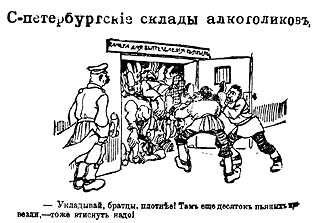
Figure 10. The St. Petersburg Warehouses for Alcoholics (September 5, 1913). (The inscription over the door says “Sobering-up Station.”) “Shove ’em in, brothers—tighter! We’ve got dozens more drunks on the way.”
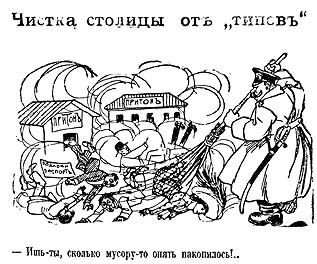
Figure 11. Cleansing the Capital of “Shady Types” (October 28, 1912). “Look at that, will you! See how much trash has piled up again.”
Renewed coverage of hooliganism in the commercial press briefly preceded the upsurge in working-class unrest sparked by the Lena Gold Fields massacre of 1912, when government troops fired upon striking workers. The differences we see in the representation of hooliganism in this period are a reminder of this crime’s elasticity and that newspaper descriptions of hooligan offenses were always at least partly shaped by prevailing social and cultural concerns. Curiosity about the city’s poor population was on the rise, but the wariness and hostility toward the lower classes that had been exhibited before 1905 were tinged with fears of mass power and mass violence and a lack of faith in the government’s ability to avert lower-class disorder. The boulevard press reflected and contributed to the new cultural context of the 1910s.[7] The lifting of most forms of preliminary censorship in 1906 created new possibilities for expression in the press. The relaxation of censorship and the competition among the burgeoning number of newspapers that appeared after the revolution allowed increasing commercialization and an emphasis on news that sells. Crime news had always been popular, but it was given far greater prominence than ever before. More space was allotted to crime stories, and more melodrama evoked by the language used to report crime. In 1910 Peterburgskii listok introduced a second crime column. While the old one continued to list criminal offenses, accidents, fires, and so forth, other incidents of the same sort now appeared under the heading “Events of the Petersburg Day” (Sobytiia Peterburgskogo dnia), giving crime news in particular added visibility. At least two columns wide and several inches long, “Events” drew attention to crime news with bold headlines and graphic language.
The new visibility and violence of street crime was reflected in (and explained by) the language of crime reporting. Gruesome murders, vicious brawls and attacks, pitiful suicides, and tragic accidents were all treated in more explicit and more dramatic prose than before. Reports in the crime columns emphasized heart-stopping details with vivid, gory language. Blood flowed “in pools”; victims were “beaten to a pulp.” Succinct allusions to stab wounds were replaced with grisly specifics. A knifing was now “a multitude of wounds that ripped and bruised the flesh.”[8] Victims were no longer simply beaten or stabbed in the side. One man was dragged into a courtyard and then cruelly and horribly beaten until his head was shattered, his nose broken, and his body punctured with stab wounds.[9] The son of an army ensign was attacked by hooligans who “literally riddled [him] with holes.”[10] A construction worker, returning home from work late at night on payday, was attacked by hooligans who “knocked him off his feet, stabbed him, tied his mouth, and stripped him. Then they tossed him—bloody, unconscious, and naked—into the canal.”[11] Titles of the reports also highlighted violence. “Blood for Blood,” “A Nightmarish Crime,” and “A Bloody Attack” emphasized the gory consequences of the hooligan threat.[12] The epithet “beast” figured often in various forms in the titles: “A Beastly Murder,” “A Beastly Attack,” “Hooligan Beastliness,” and “A Beastly Hooligan Deed” were all popular, along with the familiar “Rule of the Knife.”[13] This is not to say that the boulevard press never used such language before 1905 or that violence did not appear earlier in other popular genres. Isolated examples of blood and gore can be found in Peterburgskii listok in the nineteenth century and more often in the serial fiction that appeared in the boulevard press, but, comparing the two periods, one cannot help but be struck by the radical shift in tone conveyed by the verbal and graphic portrayal of crime that occurred after 1907.[14]
The lurid language of crime reporting was indicative of a change in the tone of the boulevard press as a whole. Peterburgskii listok became more explicitly commercial, with larger, more elaborate advertisements.[15] It began to employ bigger, eye-catching headlines with a fashionable art nouveau touch. More drawings accompanied news stories, and cartoons lampooned political and cultural figures more frequently. Indeed much of the reporting in interrevolutionary Peterburgskii listok was now genuinely sensationalistic, if that is taken to mean that it was written in such a way as to arouse an emotional and superficial response rather than a thoughtful and reasoned one. The visual presentation of news and information was designed to grab attention, evocative language was used to elicit emotions, and drawings brought points home in an immediate way. In addition, the quantity of light news, human-interest stories, and humor had increased since pre-1905 days.
On the other hand, it is important to remember that Peterburgskii listok continued to provide wide coverage of news on national and international issues. It published detailed bulletins on Russia’s relations with other nations, daily reports of State Duma meetings when the Duma was in session, news of the Orthodox church and clergy, and elaborate dispatches on important news stories. The Lena Gold Fields massacre was covered and harshly condemned, as was the notorious Beilis case, when the tsarist government knowingly and blatantly supported the false accusation of ritual murder against the Jew Mendel Beilis.[16] The cholera epidemic and other public health hazards, the reform of the local judicial system, national conventions on alcohol abuse and the status of women, to name only a few examples, were reported in detail. And, as before, Peterburgskii listok remained an exhaustive source for information about local entertainment and events: society meetings, theatrical productions, art exhibits, sports (bicycle racing was popular in this period), and local government news and scandal. Thus Peterburgskii listok was still a valuable source of both news and information for Petersburg readers and a font of scandal, gossip, and sensation. As in the earlier period, the newspaper’s sensationalism remains a useful indicator of the rise in concern about crime and poverty, and the heightened, ritualized language of crime reporting allows us to see which details caught the popular imagination and shaped its perception of the urban milieu.
Representations of hooliganism in the 1910s marked different features of the phenomenon than those emphasized during the first wave. In the early years of the century the reporting accentuated the hooligans’ ubiquity, moral outrageousness, unabashed insolence, and the threat they posed to public order. After the 1905–1907 Revolution the feature of hooliganism that the new language most consistently stressed was its fearsome physical violence. Serious, even fatal, knife attacks had always been a component of hooliganism in St. Petersburg, but especially after 1912 these brutal attacks came to dominate urban hooliganism. Reports of violent hooligan crimes multiplied, and fewer incidents of hooliganism displayed the outraged propriety of previous years. Only rarely does one find the indignant outcry against hooligan nakhal’ that so often accompanied hooligan reports before 1905. Irritating people on the streets with rowdy, uncouth behavior, harassing people by bumping into them or whistling at them, and destroying property by throwing rocks through windows were rarely noted in the popular press in the capital after 1910. Nor were there frequent reports of hooligans taking control of whole neighborhoods or ruling over certain streets and squares, not because hooligans were less irritating or less visible than in the past, but because their presence had become so commonplace.
Hooligan nakhal’ was not altogether missing from popular portraits of hooliganism in this period but tended to surface in publications other than the boulevard press. Svirskii’s sketch on hooliganism included several such examples. One young hooligan interviewed in a flophouse tells the author how delighted he would be to find the whole city on strike in the morning, so that he could walk in the middle of the road: “Any fool can walk on the sidewalk. So to walk in the road is like complete freedom! No trams. No carriages. It’s great! You walk along, swinging your arms, exactly as you please.”[17] Other sources, as we have seen, including judicial and police reports, and especially reports of hooliganism in the countryside, continued to mix insolent and violent offenses.
The boulevard press, however, concentrated on hooligan violence and by publicizing violent crime contributed to making the city seem a threatening and frightening place. Not only did the crime chronicles report a higher number of more dangerous crimes, described in more graphic language, but many other writers and columnists were at pains to underline the contrast between the danger of hooligan violence after 1910 and that of the years before 1905. In 1912, Peterburgskii listok reported that one Petersburg neighborhood “declared war” on hooligans and found it necessary to ask for armed guards to protect residents against hooligan attacks. At a construction site, where hooligan rowdiness and attacks on guards had gotten out of hand, a city official called for “armed battle” against hooligans.[18]Gazeta-kopeika, the working-class daily, whose readership was likely to have different social fears but similar concerns for physical safety, also reported an increase in hooligan violence after 1912.[19] The columnist O. I. Blotermants, writing under the pseudonym “Skitalets,” wrote in 1913 that “newspapers may be printed on white paper, but in our time their pages seem to be covered with blood.”[20] In another article, he noted the unprecedented danger of street violence now that hooligans were armed with revolvers as well as with knives: “They are all armed, as if at war.”[21] These are all, to be sure, representations of crime as increasingly violent rather than proof of an increase in the actual number of violent crimes committed. But these representations demonstrate, at the very least, that a variety of sources, and not only Peterburgskii listok with its long-standing fears of hooliganism, portrayed crime as increasingly violent and threatening.
The representations, moreover, are supported by the sharp rise in indictments for all forms of violent crime during this period in St. Petersburg and in the empire as a whole (see table 5 in the Appendix). Murder rates, which more than other crimes tend to be divorced from the kinds of political and cultural considerations discussed here, rose steadily after the turn of the century. Indictments in St. Petersburg were astoundingly high (though prosecution rates were much lower), with 501 indictments for murder in 1908, and 794 in 1913. All kinds of public attacks on women— from aggravating verbal assaults to rape—increased steadily throughout the period. Armed robbery increased by 62 percent between 1901 and 1912, an increase greater than all other forms of theft excluding horse theft.[22]
Violent hooliganism in this period bore some similarity to the back-street muggings of the pre-1905 period, but it also appeared in suggestive new forms and was portrayed in revealing new ways. To begin with, it became common for Peterburgskii listok writers to pinpoint a new kind of danger by labeling some violent hooligans “apaches” (apashi).[23] By identifying hooligan muggers with Native Americans of fabled savagery, they shifted emphasis away from the overtones of class conflict inherent in pre-1905 depictions of hooligan defiance. The label “apache” distanced the hooligans from the boulevard-press readership—moving them figuratively across the ocean to an alien continent still “wild” by European standards—and it colored hooliganism with the cultural stereotypes of the barbarism and primitivism associated with native peoples who in the eyes of many, represented the polar opposite of civilization. Of course, the word hooligan was also foreign, and thus dissonant in Russian, but it was clearly European, and thus closer to home, and it summoned images of buffoonery as well as of danger.
Bloody back-street stabbings, in particular, dominated the crimecolumn reports of hooliganism in the 1910s. Two Peterburgskii listok articles from the spring of 1912 that claimed to describe “the most interesting” and “the most characteristic” cases of the recent rash of hooliganism listed the kind of bloody attack that had become typical, and both articles made it clear that these examples were only a small sample of similar crimes.[24] Reports now usually indicated when attacks ended in fatalities.[25] In late April 1912 the report of a typical hooligan attack was accompanied by a large drawing of the incident: a fairly well-dressed man, hat still on, lying in a pool of blood, with a street policeman kneeling beside him, and a detective looking on sorrowfully but helplessly (fig. 12). Knife-wielding hooligans attacked members of the middle and upper classes somewhat more often in this period, though such attacks were still unusual.[26] The number of violent attacks on women also rose. Peterburgskii listok reported cases in which women were stabbed for refusing to give hooligans money, in which attacks were preceded by a volley of “nasty words,” and in which the victims were identified as prostitutes brutalized by men known to them, often their pimps.[27]
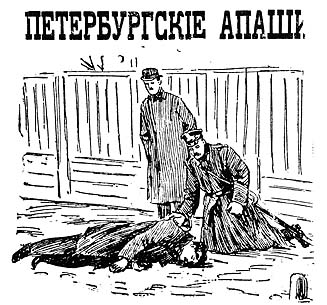
Figure 12. Petersburg Apaches (April 25, 1912).
Just as in the earlier wave of hooliganism, many of these attacks were committed against strangers “for no reason at all.” When causes or motives were given they tended to be presented as extremely petty or incomprehensible, but, unlike in the earlier cases, these conclusions were derived from the hooligans themselves. One hooligan, caught throwing cobblestones at a woman buying oranges from a street peddler, explained himself with a sullen “Just ’cause” (prosto tak). In another case four hooligans stabbed a man because he accidentally bumped into one of them on the street.[28] In numerous cases the victims were stabbed or knocked off their feet or beaten “to a pulp” for refusing to hand over whatever money the hooligans demanded, usually just a few kopecks, often for vodka.[29] More often now, weapons of various kinds were mentioned in the reports. The hooligans’ weapon of choice was a dagger, but they also used sticks, stones, brass knuckles, giri, hammers, and other heavy or pointed objects. Revolvers appeared sometimes and even, in one case, forks and knives stolen from a tea shop.[30]
Mass violence in the form of hooligan brawls also reappeared in the pages of the boulevard press after 1910. One crime specialist writing in this period described fighting as “the hooligans’ favorite activity, where they eagerly test their powers.”[31] In contrast to 1905–6, when some of the biggest brawls occurred in the city center, most of these took place in outlying, lower-class districts or in the areas of Vasilevskii Island with mixed populations. On numerous occasions the policemen and dvorniki arriving on the scene were unable to check the fighting.[32] Many, but not all, of these brawls were identified as episodes of gang warfare.
Gang violence played a larger role in this wave of hooliganism than in the earlier wave. Peterburgskii listok informed its readers about warfare among organized youth gangs with established identities, names, leaders, and specified turf. The gang encounters, identified as hooliganism, were nastier and bloodier than either the fighting between the Gaida and the Roshcha gangs immediately after the turn of the century or traditional, recreational brawling, and, as reports often comment, gang fighting usually flared up over petty disputes. But while the immediate pretext for a brawl seemed trivial to Peterburgskii listok reporters, they fed long-smoldering animosities and provoked cycles of violent retribution. In 1911 the report of one such reckoning began by noting the “hooligans who love ‘loafing’ and ‘stirring up trouble’ (’nichegonedelanie i vol’nitsa’) have begun assembling in the taverns on Vasilevskii Island’s 7th Line.” In one of these taverns a fight broke out “over something trivial” between “Kolka the Tailor” and “Serezha the Coachman,” leaders of rival neighborhood gangs. The proprietor called the dvornik and the police, who threw the boys out of the tavern and left. A little while later the police returned to find Kolka the Tailor in a pool of blood.[33] Another gang war resulted in the death of a major gang leader, “Black Vaska,” and the arrest of ten of the gang members involved in the fatal stabbing.[34] When their case came to court, it acquired considerable public notoriety. A standing-room-only crowd attended the trial, including many of the gang members still at large. The main defendant, Vasily Andreev, maintained that he attacked Black Vaska in self-defense, but neither the prosecutor nor the trial reporter gave him much credence. The prosecutor encouraged the jury to consider the social significance of the case in deciding Andreev’s fate, “inasmuch as society is being tormented under the weight of hooliganism.” To no one’s surprise, the jury found Andreev guilty.[35] The violent repercussions from this incident continued to find their way into the crime chronicles throughout the summer and into the fall of 1912, which led one reporter to conclude that “despite all efforts on the part of the police, warring hooligan factions were stirring panic within the local population.”[36]
This coverage of gang warfare in the boulevard press suggests a new dimension in public fears of violence between 1912 and 1914 and a sense of revulsion at the squandering of life over trivial or incomprehensible rivalries. The depth of amorality and uncivilized behavior that gang members displayed was underscored by the routine references to the hooligan’s weapons—knives, clubs, rocks, and metal shards—and the formulaic “pools of blood.” Three-quarters of a century of sociology and efforts at prevention have done nothing to stop gang warfare, but in early twentieth-century Petersburg little effort was made even to probe the causes of youth gang violence. In the interrevolutionary period police and press alike presented gang violence as one more manifestation of the lower-class barbarism hooliganism had come to represent.
The contrast with earlier references to gangs in the boulevard press is striking. In their 1901 letter to Peterburgskii listok the “Landlords of the Petersburg Side” mentioned two gangs by name, the Gaida and the Roshcha, but their letter conveyed little sense of the hooligans as organized fraternities. They were more concerned with the gang members’ petty offenses, their insolence, and their ability to control the streets than with the physical danger they may have posed. Social, more than physical, peril worried the Petersburg Side landowners in 1901. The interrevolutionary portrait of gangs also contrasts sharply with the depiction of the Gaida and Roshcha that appeared in Peterburgskaia gazeta in 1905 (which stressed the gangs’ honor code). The same contrast, between an earlier, more positive, romanticized tone and the more violent, hostile one in the 1912–14 period, applied to Peterburgskii listok depictions of lower-class life as a whole, as will be discussed below. After 1911, public hooligan fighting (both brawling and gang warfare) seemed less theatrical, less a spectacle than a recognized form of lower-class male behavior. It was no longer a surprise to boulevard-press readers that young, lower-class men beat one another up, whether for recreation, vengeance, or for “no reason at all.” In general, there was less emphasis on finding motives for mass fights, other than as incidents of gang warfare, in which case they occurred for “trivial” reasons or for revenge. Brawling had once again become a major disruptive force in the city’s social life, but now it was treated more like an ordinary crime, one form of “disturbing the peace.”
The elements of social and cultural rebellion had not been entirely eliminated from brawling or other forms of violent hooliganism, but in the boulevard press they had become implicit rather than explicit. The cultural issue that continued to mark these incidents as hooliganism was no longer one of open conflict but rather of yawning cultural difference. The combatants in this cultural conflict had retreated from face-to-face combat to view one another from a greater distance. Hooligans were coming to seem alien in new ways: a breed apart. Hooligan violence became more of an anthropological curiosity that the boulevard press could treat with some detachment. But the absence of direct challenge in this period did not mean that hooliganism lost its social and cultural potency in Peterburgskii listok. Hooligan violence was still a sign of the low level of civilization among the lower classes, but now not because it was novel and shocking, rather because it had become common and expected. When, in the past, hooligans chose to offend and assault they seemed to be making conscious choices to defy respectable society. Thus, in theory, they were still susceptible to cultural improvement designed to teach them to refrain from making such choices. But the depiction of hooligans as recklessly and thoughtlessly violent in the 1910s emphasized their disregard for the value of human life, which placed them beyond the cultural influence of respectable society. Hooliganism came to represent an inherent and enduring lack of civilization among certain segments of the poor population. If, as a result, the hooligans did not pose an immediate threat to respectable pedestrians, they posed an even more depressing long-term threat because they now seemed to be impervious to the influence of the uplifting values of cultured society. They seemed altogether beyond redemption. Violent hooligans, brawlers, and muggers were now situated at a greater distance from respectable society, geographically and sociologically, as well as culturally. In this way the boulevard press was able to convey a world in which official authority was weakened, and the social fabric was fraying, but while the future of the country as a whole might be in doubt, the readers of the boulevard press could feel personally secure, at least compared with the period before 1905. Violence was everywhere, but the uncontrolled violence that erupted on the streets of central St. Petersburg in 1905–6 was not being repeated.
The treatment of hooliganism in Gazeta-kopeika again provides an illuminating contrast to the portrait painted in Peterburgskii listok and Peterburgskaia gazeta. While Gazeta-kopeika depicted hooliganism as a serious crime problem, it was purely a crime problem. Hooliganism was not seen as a threat to civilized social order but rather as an everyday danger for the inhabitants of the city’s lower-class neighborhoods.[37]Gazeta-kopeika reported none of the kind of nakhal’ or rowdiness portrayed in the other boulevard papers. It primarily reported cases of violent physical assault. These it reported with about the same regularity as the other newspapers. Hooliganism was also the subject of a number of articles by Gazeta-kopeika’s regular columnist Skitalets. In January 1913 Skitalets received a barrage of letters from workers and other residents of the far western end of Vasilevskii Island in response to a column he had written on the “horrors of hooliganism” in Russian villages. The readers wrote to inform him that the “horrors of hooliganism” were every bit as dangerous in their Petersburg neighborhood as in the countryside. One of the landlords in that neighborhood also wrote, confirming the workers’ stories about the hooligans terrorizing his building. They not only “control the streets,” he declared, but the hooligans repeatedly entered the building and demanded money from the workers living there. Their boldness was not, it should be emphasized, portrayed as brazen nakhal’ in the Gazeta-kopeika correspondence. When the landlord became enraged and offered to “take up his pen,” the workers, fearing retribution, begged him not to publicize their complaints. So he signed his letter “X.”[38] The story not only reveals workers’ fears of hooliganism but provides a working-class echo of the fears of the “Landlords of the Petersburg Side.” Significantly, the working-class version is conspicuously lacking in features of social and cultural conflict.
Cases of abduction and rape were reported relatively infrequently in Gazeta-kopeika, but a dozen or so did appear over the course of the years 1912–14. In one case described as hooliganism a group of sixteen- to eighteen-year-olds abducted two teenage girls, the children of well-to-do families, who had lost their way in the dangerous streets at the western end of Vasilevskii Island. The hooligans robbed the girls, undressed them, and then led one off to a shed. She was never seen again. The other girls was beaten and, the article inferred, sexually assaulted. When she awakened the following morning, bruised and alone, she found her way to the local police station.[39] In contrast I was unable to find a single case of rape or abduction reported in Peterburgskii listok between 1900 and 1914, and only one case of sexual assault appeared in Peterburgskaia gazeta during these years (an unusual one in which a young girl was raped by a policeman), suggesting, perhaps, a respectable ban on some sensitive topics in these newspapers.[40]
Gazeta-kopeika consistently made an unambiguous distinction between respectable workers and the criminal element. That distinction, still clear in Peterburgskii listok during the revolutionary disorders in 1905–7, was increasingly blurred later on. In Peterburgskii listok and Peterburgskaia gazeta, descriptions of the hooligans’ social identities reinforced the sense conveyed by reports of their offenses that while hooligan violence was a sign of lower-class degeneracy, it was now located at some clearly defined remove from respectable society. In contrast to the revolutionary period, participants in hooligan offenses were identified more often as workers (or worker-hooligans or workers and hooligans). When their occupations were also listed, however, it is clear that the hooligans’ actual occupations had not changed. Even though people engaging in hooligan behavior were now identified either as workers or hooligans, they were still primarily unskilled and casual laborers who worked in factories by day and made trouble after work and on weekends, apprentices and runaway apprentices, and people “with no specified occupation” (bez opredelennogo zaniatiia)—a category reserved for those who were considered to be unemployed by choice. People who committed hooligan crimes were referred to as workers and former workers, homeless vagabonds, workers at rival factories, men who went to work in factories but consorted with hooligans and the unemployed after work, unskilled workers, chernorabochie, and apprentices. In one case an “unemployed peasant attacked a worker-peasant.”[41]
The closer association of hooliganism with the working class might, in another context, be expected to confer a greater legitimacy on hooligans, given the sympathetic treatment the labor movement received in the boulevard press in 1905–7. But times had changed. The violence, irrationality, and pettiness perceived in hooligan behavior and the hooligans’ insolent rejection of respectable culture, in other words the features that made hooligans seem impervious to efforts to “raise their intellectual and moral level,” to civilize them, now tinted the boulevard-press portrait of workers and other members of the lower classes. This is not to say that the poor population was portrayed as a “dangerous class” in the pathological sense Chevalier intended in his classic study of the connection between the criminal and the non-criminal poor in early nineteenth-century Paris. In contrast to the situation in Russia, in France “it was an unquestioned assumption of middle-class opinion throughout the [nineteenth century] that those most likely to participate in revolution were also those most likely to indulge in crime.”[42] In Peterburgskii listok and similar publications, the lower-class population was not portrayed as an undifferentiated and actively disruptive or revolutionary force in society. Distinctions were still made between the working poor, the destitute, and the criminal poor. But images of the lower classes (workers included) in a variety of sources increasingly endowed the poor as a whole with the primitivism, lack of culture, and hostility to respectable and civilized values associated with hooliganism. The blurring of distinctions between hooligans and the respectable poor in the 1912–14 period can be found in discussions of two separate issues: living conditions in the city’s slum neighborhoods and the upsurge in labor activism. Peterburgskii listok and other commercial literature written primarily for middle-class consumption portrayed conditions in the slums and the people who lived there in far more negative terms than they had prior to the great waves of migration in the 1890s and 1910s. Second, in the absence of a general revolutionary movement, the concurrent revival of labor unrest and hooligan activity made them seem closely connected. As we will see, the character of labor unrest in 1914 proved such a perception to be true.
| • | • | • |
Images of the Poor in Commercial Literature
Shifts in popular opinion are notoriously difficult to pin down and demonstrate. Isolated examples of distrust and hostility toward the poor can be found in the Petersburg press during all the great waves of migration to the city, when new generations of rich and poor, peasant and urbanite, privileged and unprivileged, suddenly confronted each other in high densities. Positive views of the poor were not unknown in the 1910s, and the shifting attitudes were not universal: some forms of poverty continued to be presented sympathetically throughout the period. Nonetheless, Peterburgskii listok and other boulevard newspapers, as well as sketches about the poor written for the same audience but published in book form, convey the unmistakable overall impression that attitudes toward the poor population had shifted significantly from a wary sympathy (based as much on ignorance and romanticization as on compassion) to feelings of fear, horror, and contempt.
In most cities concern about the poor ebbs and flows. The 1890s not only witnessed the beginning of the mass peasant influx into the capital, but the decade was marked by an abundant increase in reading material about the city and its poor population. With literacy rising and technology able to speed the gathering and publishing of the news, newspapers attracted a mass audience for the first time, and they provided a wealth of information about the city. A new generation of writers and journalists began addressing the growing middle-class audience. In St. Petersburg, Aleksei Svirskii, A. A. Bakhtiarov, V. I. Binshtok, and many anonymous journalists published articles, exposés, and sketches about the poor and the criminal underworld in commercial newspapers and books.[43]
Sketches, or ocherki, complemented the coverage of the social issues dealt with in the news, fiction, and columns of the daily press. The genre differed from the serial fiction about crime and poverty in the mass-circulation press in that it comprised a unique mingling of reportage and fiction. Using firsthand research among the criminal and poor population, sketch writers employed fictional characters, introduced as typical representatives of their milieu, to illustrate social problems. Invented dialogue brought the characters to life and increased their verisimilitude. The form allowed writers to treat social problems with a depth not possible in short news articles. The use of fictional or composite portraits enabled them to present serious social issues in an accessible and familiar form, without sacrificing the credibility of their “scientific investigation.”[44]
By the 1910s the quantity of information about the Petersburg poor reached a high-water mark. Portraits of the people living in inner-city basements and working-class suburbs that were provided daily in the boulevard press, the deluge of commercial (as well as professional) literature about poverty, alcoholism, prostitution, begging, vagabondage, and crime, and the number of city commissions that visited slums and flophouses and were reported in Peterburgskii listok reveal a city curious, and worried, about its poor inhabitants—not that this concern enabled the poor to leave their basements behind, or that popular curiosity produced much in the way of practical relief. Curiosity produced neither action nor understanding, and familiarity, in this case, bred contempt.[45]
The declining sympathy found in commercial literature on the poor is striking for its contrast not only with earlier journalistic treatments but with the hopes of the nineteenth-century intelligentsia and with the traditional Russian views of poverty and crime, which had dominated the commercial literature during the first phases of urbanization. As late as the 1890s, Russian attitudes rooted in Orthodox teaching favored the poor and the criminal with sympathy for their plight. Destitution had been understood, in the words of a recent historian, as the “result of a myriad of individual accidents and circumstances, a personal misfortune rather than a social phenomenon.”[46] Just as poverty was viewed as something other than a voluntary condition, so was the world of crime a place into which ordinary unfortunates might easily slip in straitened circumstances.[47]
In the period between 1907 and 1914, commercial literature presented an increasingly depressing picture of life for the city’s poor. Significantly, the horrifying material conditions in the city’s slums described at the end of the tsarist era differed hardly at all from descriptions that had been appearing in waves throughout the nineteenth century: filth, overcrowding, and disease in damp and dark rooms teeming with vermin of all kinds were stock images in the literature on the slums both in Russia and in the West. However, depictions of the inhabitants of the city’s slums changed markedly for the worse. The ordinary poor, neither criminal nor hooligan, suffered a fall in these portraits from sympathetic folk to frightening creatures.[48]
Generally speaking, the literature of the 1890s and very early 1900s presented the poor as a colorful lot, worthy of compassion. Their way of life, with its unique songs, language, and curious mores, could be entertaining rather than threatening. The petty criminals among the poor were depicted as people who strayed or fell into a life of crime. Sketches and newspaper columns presented them as victims of society and misfortune, but it was their weakness of character rather than economic injustice that made these people susceptible to misfortune. Only the weak were victimized by society’s slings and arrows, but they remained sympathetic, because, despite their moral failings, they were still victims. As victims they presented no serious threat to the health and stability of respectable society, either because they were considered reformable or because they were more dangerous to themselves than to society at large. Indeed, journalists and writers of the 1890s intentionally chose subjects who could be presented sympathetically—prostitutes, alcoholic vagabonds, and petty thieves, rather than hardened, violent criminals—in order to awaken the self-satisfied and apathetic middle class to the misfortunes of the poor.[49] Criminals were still treated as people to be saved or reformed. Petty thieves, beggars, and prostitutes were depicted as an exotic and intriguing population, more to be pitied than feared or despised.
Taking such an approach was a humorous 1901 column in Peterburgskii listok on popular mores in the capital, entitled “The People’s Resort”:
Others sang and told stories, slept peacefully, drank vodka with pickles, and threw each other into the water. True, they cheated at cards, their tales concerned petty thieving expeditions, both men and women spoke a crude language, and the vodka-drinking troika in this scene was (presumably shockingly) female. But while this article and others like it were patronizing, they were playful, and only mildly censorious; the moral opprobrium was implicit, not laid on with a thick rhetorical brush.With the arrival of the warm weather everyone is going off to their resorts, and the denizens of the famous Viazemskaia Lavra [an enormous flophouse, well known for sheltering the destitute and criminal] are no exception. Their favorite resort: the shores of the Obvodyni Canal. The rich go to Sicily, people of middle means to the Crimea, those with modest means can get as far as Novaia Derevnia or Ozerki [Petersburg suburbs], but the poor choose the banks of the Obvodnyi.…We visited on a Sunday afternoon at about four o’clock. The shores were everywhere covered with people in picturesque poses. Killing time. Playing cards for imaginary stakes.
—The whole Haymarket, wares included, for the Jack! cried one.
—The Warsaw station for the Queen…![50]
Beggars received a mixed treatment in pre-1905 Peterburgskii listok. They were still depicted with considerable sympathy, though they had been viewed as a nuisance and a serious social problem since at least the 1860s. While their claims and needs were often treated with skepticism, and they were increasingly portrayed as swindlers and charlatans, they were for the most part still seen as unfortunates. This was especially true of the press portrait of children begging: “one of the saddest sights in St. Petersburg.”[51] One writer observed in 1902 that it was a shame that the proliferation of beggars in the capital was beginning to dull people’s sympathy for them, because they each had “some genuinely tragic past.” They were “pitiable,” even if “it is probably an act, dreamed up by some professional beggar.”[52] Bradley noted that while some writers portrayed the beggars in Moscow as revolting and annoying frauds, they were seen by many others as “picturesque extremes of the ordinary life of the streets,” as “possessors of some inner virtue, as quintessential representatives of the Russian people.”[53] Suggestions in Peterburgskii listok for reducing the extraordinary number of beggars in the capital (some estimated that 30,000 professional beggars roamed Petersburg’s streets at the turn of the century) focused on the development of public and private assistance programs.[54]
During the 1905–1907 Revolution the number of beggars in St. Petersburg skyrocketed, and their image in the press began rapidly to deteriorate. By 1912 beggars had lost their folksy charm in the Petersburg boulevard press. Not only had their entreaties become intolerable, but the beggars were almost exclusively portrayed in Peterburgskii listok as frauds, who “earn more begging than many regular workers.”[55] A letter to the editor expressed pity for the homeless and hungry but wondered whether beggars would ever be capable of developing the work habits and attitudes necessary to settle down and support themselves.[56] One article complained in 1906 that the bureau responsible for keeping an eye on the city’s beggars was unable to do its job properly.[57] The bureau responded that the beggars were becoming aggressive and defiant: the revolution ignited ferment among beggars, provoking outbursts, disobedience, and even an open attack on the bureau.[58] Although the situation stabilized after the revolution was suppressed, by 1912 the number of beggars once again reached a staggering height. In 1913 one writer connected beggars directly with the growth of crime.[59] A 1914 article claimed that not only had the number of beggars on the trams grown, but so had their brazenness: “Often just as one is giving them something, they turn into pickpockets, very deftly cleaning out the pockets and wallets of the public. These tram-car beggars can be seen not only on the periphery, but even in the center of the capital.”[60] Writing under a new pseudonym, the author of “The People’s Resort” observed the degeneration of the neighborhood just east of the Winter Palace: “On Mars Field, the skating rink, observatory, and ‘panorama’ display are gone. The only remaining structure is a cement shed…now known as ‘Vagabond Villa,’ because it has become a shelter for all sorts of beggars and passportless tramps.”[61] In at least one case beggars were identified explicitly as hooligans. A Peterburgskii listok reader wrote in to point out that
anyone wanting proof that hooliganism in Petersburg has blossomed in full flower need only take a ride on the Lesnaia horse tram. One hardly enters the car (which, by the way, is filthy, with rags full of holes for curtains) before being surrounded by beggars: men and women, but for the most part children. Impudent and familiar, in rags intended to evoke pity, they approach their victims and pester them until they can be made to part with three or four kopecks.[62]
This view of the poor as aggressor rather than victim and these qualities of degeneracy and doubtful morality dominated other reports about the slums in the 1910s even when they did not include hooligans. This is not to say that the newspaper never distinguished between what it considered the respectable and the degenerate poor, but that now its reporting emphasized the less savory aspects of poverty, including those similar to hooligan characteristics.
Such human-interest stories may have helped sell newspapers, but they also accurately reflected major concerns of the day. During this period national conventions were held in the capital on the problems of prostitution, alcoholism, and crime, to name only the most prominent, which Peterburgskii listok duly reported, often in detail. In 1913 and 1914, a number of city conferences and official excursions to the slums were undertaken by St. Petersburg officials to see conditions there for themselves. Their observations were also reported in great detail in Peterburgskii listok, introducing the newspaper’s readers to the reality behind the crime columns and official pronouncements. These articles offered information about the poor in a context that differed from serial fiction set in the slums and from columnists’ feuilletons or commentary on social problems. Fiction presented social background information as incidental and as part of a tale of unique circumstances. Feuilletons and commentary generally came clothed in the opinions of a single individual. However illusory, the articles reporting on official investigations conveyed a higher degree of objectivity and realism, as eyewitness accounts carried out under the mantle of officialdom.
The subject of a number of official investigations in 1913 and 1914 was the “Kholmushki,” a huge complex of tenements and shops that housed about 2,500 people in 130 or so apartments.[63] The Peterburgskii listok report on the official excursions there featured the casual collusion of poverty and crime in Kholmushki. The police, for example, found it impossible to catch people fencing stolen goods there because shopowners covered themselves by operating under legitimate sales licenses. It seemed that the local inhabitants, even apparently respectable ones, accepted as normal the crime and depravity that surrounded them. The city investigators found drunkards “at every step” lying unconscious in the filth on the road or wobbling along with the help of a drinking pal, but it was not the number of drunks that shocked the investigators; rather, as described in one report,
The shift here was primarily one of emphasis, which now stressed the degradations of slum inhabitants rather than their misfortunes. What shocked the official visitors in 1913 was not the number of drunks on the streets, but the way the local population accepted their appalling, immodest behavior without blinking.they are remarkable for the fact that with very few exceptions and despite the cold and frozen wet snow they appear practically without clothes on.…Unfastened trousers, some rags instead of a shirt, and literally not one of the necessities of ordinary human apparel. Here, also, some questionable women with hand baskets even carry on a lively trade in these horrible rags and worse. People undress under the nearest gate and even right on the street, in full view, without attracting any special surprise or curiosity. Obviously this is a common business.[64]
“Vaskina Village,” named for the slumlord who owned the complex of buildings on Vasilevskii Island, was known for its sheltering of “suspicious types” alongside honest workers. A city commission in 1914 found people living in “nasty, dark corners” and in basement apartments whose floors were “literally covered with puddles from sanitation pipes and cesspools.” Outside, people were living in cowsheds. The cows and milkmen ate, slept, and lived next to one another. This “seedbed of contagion,” where cholera, scarlet fever, diphtheria, and typhus flourished, was all the more dangerous since its 5,000 inhabitants included milkmen, tramdrivers, and cigarette makers who carried the germs all over the capital.[65] Another official expedition visited “Tolkuchka,” a market that was “undoubtedly, the source of much disease,” where “all the poor of Petersburg come to shop.” According to the expedition’s report, “secondhand linen and clothing is sold unwashed and undisinfected. And, of course, much of it is stolen goods; so it is sold as quickly as possible.”[66]
The dread that crime and disease propagated in these filthy “seedbeds” would spread to the rest of the city permeated the Peterburgskii listok reports of official tours of the slums. Fears that moral contagion spread through flophouses and slums like the cholera and typhus also bred there dated at least from the spurt of urbanization that occurred in the 1860s. At that time, the police viewed the housing shortage as a police problem, because the mixture of “honest laborers” with criminals created a potentially dangerous situation.[67] By the 1910s the fears seemed to have become reality. Like the middle-class juvenile crime specialists, boulevard-press writers (though not in Gazeta-kopeika) took for granted that the flophouse was a “seedbed of crime” because the criminal and the poor lived side by side there.[68] Epidemics and crime were, of course, genuine threats to the well-being and stability of urban society. But by tying poverty, crime, and disease into one tight knot Peterburgskii listok made the poor as a whole responsible for placing the rest of society in jeopardy.
Sympathy for the inhabitants of the city’s slums was noticeably absent in these reports. Even when children were discussed, the emphasis was on their lack of parental supervision, their amoral upbringing, their susceptibility to the depraved influence of the street, and the danger that could be expected from them in the future. The scenes described during this period, the tone and language used to portray slum dwellers, and the increased number of articles devoted to slum investigations revived the view of the poor as an alien species, to whose dwellings it was necessary to travel in special expeditions. But, unlike earlier portraits, the poor now lacked colorful language and mores, and they had become hopelessly mired in a world of depravity, destitution, and disease.
The contrast between the images of the 1890s and those of the 1910s is especially striking in the work of authors whose careers spanned the whole period. One such writer was Aleksei Svirskii, one of the most prolific authors of sketches about Petersburg street life, some of which have already been cited. Svirskii was a remarkable writer who grew up in the slums of St. Petersburg and Zhitomir and later tramped around the empire. In Rostov-on-Don, newspapers began to publish his impressions of life on the road. Then in the 1890s Svirskii settled in St. Petersburg, where he became a successful journalist and an unsuccessful publisher.[69] His sketches about slum dwellers displayed a remarkable shift in both images and purpose. The Lost Ones (Pogibshie liudi), a collection of his sketches published in 1898, was suffused with sympathy for his subjects: vagabonds, homeless beggars, alcoholics, prostitutes, and petty criminals. In the introduction, Svirskii explained that he felt compelled to write about the underworld, to describe even its most unpleasant features, in order to acquaint the well-fed and the comfortable with the poor and the fallen: “Turn your gaze right over here for a moment, to the gloomy dives. For one minute, stifle your aversion and look to what depths has fallen your neighbor, your brother in Christ.”[70] The readership Svirskii addressed, the materialistic “new bourgeoisie,” had become apathetic to the plight of the poor, though not yet overtly hostile. “But no,” he continued, “you haven’t the time, you have to try on a new dress, make purchases, prepare for a masquerade.”[71]
Svirskii’s strategy was to arouse pity and compassion by portraying slum dwellers as people deserving of sympathy—people who shared with the reader basic human characteristics. He chose figures that his genteel readership might easily recognize. Often they had “fallen” from some respectable position in society—an educated civil servant or a highly placed merchant, forced by misfortune to live in poverty among the “dark” and ignorant. He often wrote about the classic “fallen”: the innocent girl forced by circumstance into prostitution.[72] None of these characters were evil; they were presented as victims of chance, of some individual injustice, or of just plain bad luck. Most of them were aware of what they had lost and were ashamed of their fall.[73] Explicit social analysis was meager here; long-term causes and solutions were not discussed. Injustice was personal and individual rather than social.
Svirskii successfully humanized these victims of misfortune, whose world was so alien to his readers. Not only was he familiar with the customs and the argot of the world he described, but he had genuine sympathy for its inhabitants and definite, if not especially subtle, ideas about how people ended up there. His naturalistic descriptions make for vivid reading, and his use of reported conversations brings the reader closer to the story, to the unfamiliar characters and settings. Svirskii did not romanticize the life of the underworld—on the contrary, he represented it as a lonely, frightening existence. But the figures that emerged from these early portraits often appeared heroic in their ability to maintain their humanity in such conditions. Even those who appeared to have repressed all moral instinct, Svirskii showed, could be coaxed into confessing their shame and their remorse over the life they were leading. Although they treated each other roughly, often mocked each other, and led lives “resembling moral death,” they were still capable of deep kindness toward one another.[74] Even the most desperate characters in these sketches, the regulars in the infamous Makokin flophouse, were relatively tame. Their worse transgression in Svirskii’s telling was to arrive early at the overcrowded flop in order to rent a cot and resell it to latecomers at a profit.[75]
Individual misfortune dominated Svirskii’s analysis of crime and vice, but he did not ignore the social environment altogether. Svirskii viewed social conditions as alienating, as derailing the development of a moral sensibility, and as preventing proper socialization. This view was similar to that of the prevailing school of criminology in this period, the “sociological” school.[76] But where specialists saw in this a call for social change, Svirskii emphasized the uniqueness of individual circumstances that led to “fall” and criminal transgression. Both viewed transgressors as victims, not entirely responsible for their actions, but Svirskii was relatively sanguine about the threat to society posed by his indigents and criminals. In discussing prostitutes, for example, Svirskii rejected the notion (which he attributed to Guy de Maupassant) that “laziness and love of finery” led lower-class girls into prostitution.[77] Noting that prostitutes were most often those girls who had been forced to live away from home and work in factories and shops, he explained that they were not only no longer subject to the moral constraints of family life but were vulnerable to the notorious advances of lecherous factory foremen.[78] Similar circumstances explain what drew petty criminals away from legal wage labor. Torn away from the moral upbringing parents offered, some individuals had no strength to resist immoral or illegal propositions or to survive what for others might have been temporary setbacks.
Children, too, entered the ranks of the fallen through a combination of moral weakness and social circumstances. Svirskii estimated that in Rostov-on-Don, where some of his first sketches were set, 200 to 300 children supported themselves solely by begging and stealing. One found children among the fallen, he believed, because the frequency of extramarital sex, especially among workers, produced unwanted children. Not much good could be expected from the offspring of these “fleeting unions,” Svirskii wrote, when their mothers worked long days in the factories, and their fathers either wanted nothing to do with them or could not support their families because they lived in a drunken stupor.[79] Still, the one child whose fall from innocence Svirskii described in detail, “Zhenka the Fist,” was never depicted as dangerous or evil, only as amoral and misguided: Svirskii began Zhenka’s story with a heartfelt declaration of his love for the boy.[80]
Not all the people who appeared in these early sketches won Svirskii’s sympathy, however. A few, briefly glimpsed, foreshadowed what was to come: men and women drinking in the back room of a tearoom, for example, were described as “amoral, crude, and drunk.”[81] But even these characters were portrayed as victims. It was society that threatened their survival and their morality; they posed no serious threat to society.
In 1914, Svirskii published another sketch about the Petersburg underworld, “The Hooligans of Petersburg.” It was published not in a collection with other sketches or similar literature but in a book designed as an introductory guide to the city, Petersburg and Its Life.[82] Svirskii’s article is a typical sketch—it describes in evocative language and detail the author’s encounters with a motley group of individual hooligans, reproducing their conversations and conveying his moral and social judgments. The other articles, however, are short surveys of the Petersburg economy, history, geography, architecture, museums, scientific institutions, demography, adult education, and working class, written by recognized specialists in a scholarly, if simplified, form. The inclusion of Svirskii’s sketch in such a collection testifies both to the importance of the subject and to the reliability of the author. In the midst of the more detached essays the lively style of the sketch reinforced the unrelievedly grim picture Svirskii painted. In the 1914 sketch, the unfortunate victims and outcasts of 1898 were replaced by desperate and degenerate hooligans, in the words of one of the author’s unnamed underworld informants, “an entirely new breed that came into being not long ago.”[83] There were no innocent victims now; even the children were already hopelessly depraved. The people in this sketch sank to the lower depths not out of poverty or because they lacked parental guidance, but because they were bad to begin with. The underworld for which Svirskii had once tried to stir sympathy had become an alien otherworld, and the people who lived there, who formerly called forth compassion, now provoked only revulsion and fear.
Svirskii returned to the same flophouses he had described in the 1898 sketches and produced this description of the hooligans and their milieu:
This paragraph streamed from the pen of the same man who in 1898 had informed his readers that the poor, including the criminal, were human beings and deserving of society’s compassion and understanding. In 1898 he had written thatThree days and two nights I passed among people who had fallen out of life. They are not living, these people, but moldering like charred logs left scattered after a fire. In the gloomy half-light of the dirty dives, in crowded, bug-infested flophouses, in the tearooms and taverns and the dens of cheap debauchery—everywhere where vodka, women, and children are sold—I encountered people who no longer resembled human beings. There, down below, people believe in nothing, love no one, and are not bothered by anything. Their language is wretched and pallid, consisting of a few dozen vile words and curses. Their songs are the same. I remember how I shuddered when I heard the singing of some ten-year-old child-prostitutes (shkits). Flat-chested, scrawny, slovenly girls with weak, unsteady voices glorifying Nevskii, pimps, murder, and wicked diseases. From their childish, but already befouled, lips fell the shameless words of a monstrous song composed of festering evil.[84]
In the 1914 sketch the physical setting was described in the same stock phrases about dark, damp, and overcrowding that had long characterized writing about the slums; but the people were “of an entirely new breed”:all of these outcasts (otvershennye oborvantsy) are people. Hearts beat in their chests, just as in the rest of us; they feel and think as we do; and like us they are susceptible to deep suffering and torment.[85]
Svirskii concluded: “I became frightened for him. Fifteen years ago I did not meet such children in the slums.”[87]Zhenka is a typical hooligan: he does not recognize any laws, and he has lost all understanding of good and evil. He does not believe in God or the devil, and to everything else, including his own existence, he is totally indifferent.[86]
“Mitka the Lunatic” typified Petersburg’s adult hooligans. Mitka was about twenty-five years old; he was tall, lean, and lazy with big, grey eyes “that are twinkling now but were lackluster and apathetic when he was sober.”[88] Like the majority of hooligans, Mitka had “a low forehead, a vacant expression, an apathetic face, and, in the local parlance, his brain is asleep.…[His] view of life is simple and categorical: all earthly beings are lice, all people are insects.”[89]
The stark dehumanization of these portraits placed the hooligans of 1914 beyond morality, beyond even evil. They were immune to socialization and impervious to rehabilitation. As a result they symbolized the limits of social authority, and they became fearful, rather than pitiable, creatures. Svirskii’s sojourn among the hooligans ended “in the grey dawn of a foul morning” as he emerged onto the street after a final night watching degenerate men and women abuse one another in the tavern known as The Blindman. A party of convicts was shuffling down the street toward him, presumably beginning their long journey on foot to prison in Siberia. A coachman, asleep in his carriage, was roused by their steps. The old man crossed himself and, echoing Svirskii’s thoughts, mumbled: “Lord save us and have mercy upon us.”[90]
It would be difficult to imagine a more striking contrast than that between Svirskii’s plea for sympathy in the introduction to his first sketches and the coachman’s prayer that ends this one. Svirskii had given up trying to enlighten the public. Now he was sounding a warning. In his earlier pieces he did not call for social change, because he believed that personal weakness and the exigencies of fate would continue to doom individuals to lives outside the bounds of law and conventional morality. Nonetheless, he had felt that society’s knowledge and compassion would diminish the power of the circumstances that tempted the weak. By 1914 compassion was barely possible, and knowledge brought disillusionment rather than change, relief, or hope. Throughout his life Svirskii wrote inclusively about the poor: his Petersburg included people on both sides of the law as well as those who slipped back and forth across that line. But in the 1890s Svirskii had chosen to focus on people whose undeveloped moral fiber made them victims of chance and weakness: society’s victims. In 1914 his slums were dominated by people whose morals made them little better than beasts: society’s foes.
The representations of the poor in Peterburgskii listok and in Svirskii’s sketches convey not only the hopelessness of poverty in the last years of tsarist rule but also the disillusionment of a particular segment of society with its own efforts. Hopes for “civilizing” the lower classes seemed all the more remote after generations of cultural measures, however halfhearted, had failed to minimize degradation and degeneracy. The crime-ridden and disease-infested slums were presented in Peterburgskii listok and in sketches as a reminder of the fragility of civilization in St. Petersburg. One excursion to the slums set out to see “what sort of things are possible in the twentieth century, in a city that pretends to call itself ‘cultured’ and ‘advanced.’ ”[91] The same observers were increasingly skeptical of the influence cultural measures might have in eradicating crime and vice in this population. They were beginning to call into question the value of civilizing efforts still being undertaken to help the poor escape from the destructive effects of poverty. “These holiday hot dogs and glasses of tea,” wrote one commentator, and “Sunday soccer games and skiing expeditions” were only a “microscopic drop in the sea,” unable to provide even children with the moral education necessary to fight those effects.[92] Significantly, these opinions appeared not in the conservative press, where skepticism concerning cultural measures and a preference for coercion and punishment predominated, but in a politically liberal newspaper, and one that in many ways had been socially more moderate as well.
It is important to remember that these articles about slum social conditions did not appear separately in monographic publications but in newspapers devoted to describing the whole range of city issues and events. The findings of official investigations were published alongside reports of the latest hooligan feats, increasingly bloody crime columns, commentary on local government apathy, news of war and unrest in the Balkans, as well as serial fiction, entertainment news, advertising, and more. These pieces came together, confirming and contradicting one another, to provide a multilayered image of the city and a particular portrait of the lower classes and their place in the city.
The depictions of the poor that appeared between 1912 and 1914 echo those associated with hooliganism that had been appearing since the beginning of the century. Increasingly, the non-criminal poor were identified with hooligan qualities, such as an acceptance of their own degradation and yet an insolent rejection of the leading role and civilizing efforts of the cultured classes. In the boulevard press the association was often only implied, but in Svirskii’s sketches the connection was explicit.[93] Thus while the Russian lower classes were not viewed as a single subversive underclass in Chevalier’s terms, they were represented in boulevard literature as alien and incorrigible—unable and often unwilling to assimilate to civilized society. As such, they hindered the progress and social integration that had been the goal of the educated elite for almost a century.
Historians who have studied society’s attitudes toward the poor and criminal in the nineteenth century have shown that some Russian observers were horrified by the “moral decline” of the poor long before the twentieth century.[94] In the 1910s, however, harsh, naturalistic representations of the lower classes were no longer softened by traditional sympathies or by the optimism of the Great Reform era. What then eroded sympathy and optimism? The Revolution of 1905–1907 was an obvious watershed, but the revolution was not the only event to shape public perceptions across class lines. The greatest shifts in perceptions, at least in connection with the issues discussed here, were more closely related to the two great waves of migration to the capital, in the late 1890s and the early 1910s, than to the revolution itself. The sheer number of migrants, their demographic weight and their needs, altered the character of the city and was impossible to ignore. It is not that the new migrants were necessarily rowdier or less submissive. In fact the peasants, women, and children entering the work force in the 1910s may have been more obsequious and less likely to challenge openly the authority of social conventions.[95] But the mass of migrants made their presence felt (in addition to bringing cultural conflict) in the creation of new urban problems, which appeared when their basic material needs were evaded by the municipal and central governments. By the 1910s, solutions to the city’s political and social problems seemed particularly elusive. The tsarist government distrusted public initiative and yet offered few programs of its own and little encouragement. In St. Petersburg, the city government was equally bewildered (once it marginally overcame its indifference) in the face of unrelenting poverty, recurring disease, and multiplying crime. The consequences of neglected poverty were—aside from political opposition— alienation, degradation, and hooligan defiance. Yet the actual links between hooliganism and its social sources were difficult to discern and poorly understood.
Old solutions, whether repression or cultural development, seemed increasingly unlikely to alter the situation of the deeply “uncultured.” Many people, including those writing for Peterburgskii listok, found coercion and repression reprehensible and yet found no new solutions at hand. The despair of the poor was matched by that of many leading voices of reform. Society leaders on the left and the right expressed a sense of fatigue, exhaustion, and inertia; others spoke of a deep spiritual malaise in the face of the central government’s continual pettiness and obstruction.[96] The government’s abdication of responsibility for social welfare was deeply felt and sharply criticized in the pages of Peterburgskii listok, among other publications. The massacre of workers at the Lena Gold Fields in 1912 not only sparked the resurgence of the labor movement but also elicited sharp condemnation from educated society and the press. In 1913 the central government’s disgraceful behavior in the Beilis case became a powerful symbol of its failure to provide moral leadership in troubled times.
The evolution of the mass-circulation press after the 1905–1907 Revolution was also instrumental in shaping readers’ attitudes about the poor and about the ability of state and society to resolve social issues. There were more newspapers, each selling more copies and spreading more news about state and society. Whole categories of social issues that had been forbidden earlier entered public discourse when preliminary censorship was abolished in 1906. Much of the news connected with social issues was bad, and hooliganism was mentioned often in connection with other problems. Not only were crime rates in almost every category rising, but the rates were announced repeatedly in the press, and no government official could express confidence about controlling crime. In 1913 when Peterburgskii listok writer N. reported that the prison population had been rising steadily since 1897 and that the Ministry of Justice gloomily predicted that it would not soon decrease, he cited a ministry official who blamed hooliganism, “the struggle against which is extraordinarily difficult, it is a broad stream now spilling over its banks.”[97] While living standards for the minority of skilled workers were rising in the 1910s, the massive migration of unskilled peasants into a city unprepared to provide for them increased the number of people living at a bare subsistence level.[98] The professional and scientific discussion of these issues in Russia had the ironic effect of making social problems seem all the more difficult, even when the professional specialists were relatively optimistic, as in the case of the local judicial reformers. While in Germany professional attention to crime, poverty, disease, prostitution, and other social problems in the imperial and Weimar periods spread confidence that problems could be solved through scientific methods, in Russia the opposite occurred. The sudden publicity for social ills caused by an increase in national meetings and public discussions, combined with the lack of government support for social programs, only intensified despair.[99]
Images of the lower classes were also affected by the kind of issues with which they were juxtaposed in both the boulevard press and leading political journals and official circles. Beginning in the last years of the revolution and continuing after 1907, revolutionary violence and criminal violence each received a great deal of public attention. From the late 1890s the two seemed to ebb and flow side by side. This impression was reinforced in the period between 1912 and 1914 when both labor unrest and hooligan violence were on the rise, but unaccompanied by open revolutionary activity on the part of the educated elite akin to their activities of 1905. As a result, criminal violence and working-class violence were conflated in public images. Some members of the conservative nobility, as well as some urban commentators, believed that the lower-class violence during the 1905–1907 Revolution encouraged and even legitimated peasant, worker, and criminal street violence in subsequent years. Riabchenko, an extreme right-wing observer, wrote that
Similar views were expressed by respectable scholars. Tarnovskii, the chief statistician for the Ministry of Justice, whose authoritative articles on crime statistics were widely printed in the commercial press, claimed that revolutionary violence pervaded the popular mentality and mingled with justifications for criminal violence:after the revolutionary movement…that manifested itself in a disturbance extremely destructive for the government and whose consequences were deeply reflected in popular life, a special type of criminal malevolence known as hooliganism, both petty and serious, was bolstered and allowed to take root.[100]
Before 1905, Tarnovskii’s view of social and cultural progress had been an optimistic one. By 1908 he feared that the commingling of revolutionary and criminal violence presented a serious threat to society in the immediate future.The increase in robbery and violence are easily explained by the changed psychological mood of the masses…at moments when society is seized by revolutionary ferment. During periods of unrest, the masses idolize the kind of dashing and brave violence that comes to the fore, which manifests itself in struggle with the government as well as attacks on the person and property of the privileged classes.…The ordinary criminals…acquire their own halo as “warriors” in a struggle against the unjust economic bases of state and society.[101]
Similar fears were expressed among moderate leftists and liberals by 1914, though in more muted tones. Gessen wrote in Rech that the ominous hostility between classes was not a result of deep-seated disagreements but of an “unhealthy atmosphere” that prevented society from overcoming its differences. That atmosphere was produced not by political infighting but by “the continuing decline of morals, a kind of unquenchable thirst for sensations, the growth of monstrous crimes, and unceasing brazenness.”[102] Elsewhere Gessen explained that the thirst for sensations referred not only to the decadent sexuality of the day but to the desire of the “right-wing” reading public for news about violent crime and their eagerness to conclude that the growth of crime was evidence of a “dangerous, undisciplined willfulness.” For his part, Gessen believed that there was hopeful evidence of cultural development among the lower classes, and he remained optimistic about lower-class assimilation, but he also understood that more negative views of the people were common, that they were connected to ideas about lower-class criminality, and that they were responsible for polarizing society.[103]
Others among the educated elite, most of whom were liberals, remained firmly optimistic about lower-class cultural development and the potential for social stability. The editors and writers for major daily newspapers from Russkoe slovo [The Russian Word] and Gazeta-kopeika on the left and center (but not Peterburgskii listok) to Novoe vremia on the right continued to believe that workers shared their cultural aspirations and in the absence of government authority and respect looked to educated society for leadership.[104] These writers and publicists were proved disastrously wrong in 1917 when the opportunity for common cause finally appeared, yet the educated elite and liberal middle classes found themselves targets of lower-class distrust and scorn. These liberals shared with their contemporaries among social democrats as well as the anti-revolutionary Vekhi writers (in other words, the old intelligentsia) a belief in cultural and political tutelage by the intelligentsia. Gessen, Lenin, and Peter Struve (Vekhi’s guiding force) all assumed that their own political and cultural codes provided models for the deficient lower classes to adopt. None had a moment’s tolerance for characteristic lower-class activities—what Gessen labeled sensationalism, Lenin spontaneity, and Struve mindless violence—which rejected intelligentsia hegemony. Nor did they have the patience to try to understand such behavior. Mikhail Gershenzon’s infamous declaration, quoted at the outset of this chapter and seized upon repeatedly in the polemic that followed the publication of Vekhi, is an exception here. While Gershenzon made no effort to distinguish criminal from political violence, he understood as well as anyone that radical revolutionary violence not only was a product of socialist agitation but was combined with lower-class self-assertion and hostility toward all the privileged, including the intelligentsia. He recognized how wrong the intelligentsia had been in believing
On the radical left, of course, social democrats had long been concerned about the potential for eruptions of violence more criminal than revolutionary. The Menshevik response in the 1910s was to celebrate their creation of a worker-intelligentsia, the product of their own political-cultural improvement programs, while the Bolsheviks, and Lenin in particular, were sincerely worried about the workers’ capacity for violent action independent of party directive.[106]that the people differ from us only by the degree of their education, and that if it weren’t for the obstacles imposed by authority we would have long since transfused our knowledge into them and become of one flesh with them. That the people’s soul is qualitatively different from ours never even occurred to us.[105]
Thus while educated society continued to believe (though from a variety of perspectives) that its own values should provide models for the lower classes, many among the educated began to fear that the poor were sinking below the influence of the cultured elite, and they began to perceive the hostility and bitterness of the poor as directed toward society as a whole. The intelligentsia could not agree on the causes or likely outcome of lower-class discontent, but except among a group of moderate liberals and publicists, expectations for a peaceful outcome were rare. Of course, social tensions alone are not enough to spark major political crises, and other societies have survived similar bouts of social fragmentation. But in St. Petersburg stability was eroded by the widespread perception that Russia’s problems could not be resolved. Just as Bely portrayed a city in which fragmentation was spinning out of control, the boulevard literature discussed here presented the degradation of the poor as irreversible and the distance between classes as unbridgeable.[107]
In 1914, conflated perceptions of crime, poverty, and political unrest were reinforced when workers in St. Petersburg began to engage in petty violence in the political and economic struggle. Until 1914 the boulevard press imputed hooligan characteristics to the non-criminal, but still largely marginal, members of the lower classes: beggars, vagabonds, ragpickers, the poorest of the poor, and the inhabitants of the worst slums. However, the disruptive and violent tactics workers employed bore a strong resemblance to the hooligan violence many workers had eschewed in the organized revolutionary struggle of 1905. When they engaged in violence, a variety of newspapers labeled their actions hooliganism. In St. Petersburg this process culminated in the general strike of July 1914. The July general strike exemplifies how hooligan behavior had spread among the lower classes and how images of hooliganism, with all the connotations that had evolved since 1900, provided a symbol that respectable society could use to orient its understanding of the lower classes in action.
| • | • | • |
The St. Petersburg General Strike of July 1914
At the beginning of July 1914, as the European powers prepared for war, the workers of St. Petersburg organized a massive general strike that involved the active participation of more than half the factory labor force, brought the city’s tram and trolley lines to a halt, and closed most of the manufacturing and commercial establishments in the capital.[108] The strike captured the attention of the highest authorities and was widely reported in the press. From the outset it was remarkable for the violence workers employed to express their hostility to authority and to resist official attempts to terminate the strike. Almost all accounts of the strike, contemporary and historical, have emphasized the workers’ violence, but they have differed fundamentally in their interpretations of its significance. Historians in particular have had trouble explaining the violence connected with the strike, in part because they have relied on official police reports and politically liberal and social democratic sources, all of which viewed the labor violence in expressly political terms. But political, and even some social, analyses of labor unrest in 1914 cannot account for the types and extent of violence that occurred during the July strike. After the remarkable discipline and organization in 1905 and two decades of political organizing the inescapable evidence of hooliganism in working-class violence came as a surprise. Peterburgskii listok and the other newspapers that labeled the strike violence hooliganism provide a different perspective on the events. In this case, the concept of hooliganism not only provided contemporaries with a symbolic reference point for understanding what happened in July 1914, it also helps us understand an ambiguous instance of working-class unrest.
The Petersburg general strike capped a two-year upsurge in labor unrest sparked by the government’s massacre of workers at the Lena Gold Fields in 1912.[109] By July 1914 the situation in the capital was already “extremely tense.”[110] In the previous month, there had been 118 strikes, including 59 at metal-processing plants. The upsurge in labor activism coincided with the spread of an acute sense of political crisis among the educated classes, as noted earlier. “We live on a volcano,” warned one of the most conservative newspapers in the empire, Kievlianin (The Kievan); this sentiment, however, was echoed in publications from the moderate to the radical left as well.[111]
Word of a general strike among oil-field workers in Baku had reached the capital in June, and support had been growing among workers for a display of solidarity. The Petersburg Committee of the Bolshevik party issued a leaflet calling for workers to leave work one hour early on July 1.[112] When the St. Petersburg gradonachal’nik prohibited even the collection of money or provisions for the Baku strikers, rallies and one-hour strikes broke out all over the city. But what was originally called as a sympathy strike in solidarity with the oil workers of Baku was quickly transformed. On July 3, an estimated 12,000 workers attending a rally on the Baku question at the Putilov works refused to obey police demands to disperse. What happened next is unclear. All unofficial sources agree that bullets were fired, leaving 2 men dead and 50 wounded. But the government claimed that the confrontation never occurred and that reports of the melee, spreading quickly around the city, were nothing but rumors.[113] In any case, the Bolshevik Petersburg Committee responded by calling for a three-day general strike.[114] The next day at least 80,000 workers left the job in outrage over the government violence against the Putilov workers.[115]
During the next few days, Bolshevik organizers repeatedly called on workers to “restrain themselves from excesses,”[116] but in vain. Confrontations between striking workers and government authorities turned to violence from the very start. On the morning of July 4, a Friday, and on July 5, many workers left their jobs to join the growing crowds gathering on the streets for impromptu rallies and demonstrations. Singing revolutionary songs and carrying red flags, strikers marched from factory to factory, encouraging workers to join the strike. Most of the violence in July occurred either in confrontations with the police or troops or in the destruction of city property. In scores of incidents throughout the city, but especially in the Vyborg and Narva districts and along the Obvodnyi Canal, crowds of workers answered government demands to disperse with volleys of rocks and cobblestones. The troops responded with drawn swords and bullets. In Narva on July 4, 9 policemen had to be treated for rock-inflicted injuries, and 4 workers were hospitalized with gunshot wounds.[117] The incidents of July 4 and 5 were evidence of the workers’ deep antagonism toward the police and their readiness to engage in direct confrontations with authority, but they were mild compared with the events of the following week.
Because July 6 was a Sunday, plans were made for concerted citywide demonstrations on Monday, July 7. The timing was especially sensitive from the government’s point of view, because the strike coincided with the state visit of Raymond Poincaré, the French prime minister, who arrived in the Russian capital to cement relations between Russia and France. In the midst of the international crisis, the government wanted to preserve domestic tranquility in order to display Russia’s stability as an ally.[118] Its wish was not granted. Between July 7 and 10 the strike unleashed a storm of violence against the authorities and symbols of authority such as had not been seen since the 1905–1907 Revolution.
Rock and revolver clashes with the police now spread to every factory district of the capital. On Ligovskaia Street (the same “Ligovka” famous for its criminal haunts and hooligan gangs) strikers marching from the Obvodnyi Canal toward Nevskii Prospekt closed factories, shops, and trading stalls and interrupted trolley and horse-tram traffic. At the biscuit and chocolate factory on Ligovskaia, strikers singing revolutionary songs bombarded and broke down the factory gates, which provoked a battle of rocks with the police. The same scene was repeated numerous times in the Vyborg, Narva, and Moscow Gates districts, on Vasilevskii Island and the Petersburg Side, and at railroad stations and along railroad lines. Observers on all sides noticed that women and young children participated in every form of violent confrontation, from throwing rocks to vandalism, which made the clashes all the more disturbing. Some workers, futilely trying to limit the rioting, shut down liquor stores and taverns; others broke into them and looted. Commercial life came to a stop in every district of the city except the very center—along Nevskii Prospekt and in government offices. But while life in the center appeared to be operating more or less normally, Kazan Square had to be closed, and tranquility on the remainder of Nevskii Prospekt was maintained only with extraordinary effort by the police (reinforced with Cossack and military detachments) to divert strikers onto side streets and prevent the workers of Vyborg, Vasilevskii Island, and the Petersburg Side from crossing the Neva.[119]
Liberal Rech described the scenes of destruction in some detail; Novoe vremia, Gazeta-kopeika, and Peterburgskii listok reported daily on the accelerating violence, and they all decried the wanton and reckless vandalism. What impressed all contemporary observers as extraordinary and alarming were the workers’ attacks on city property, especially the trolley and tram lines. In Vyborg, strikers interrupted tram traffic, removed the trams’ steering levers, and broke all their windows. Workers evicted passengers, chased away horses, and would have pushed tram cars off their tracks if a police contingent had not arrived to save the trams. On July 7 alone drivers and conductors in seven separate instances were injured by rocks. In the Moscow Gates district, tram traffic was halted altogether along Ligovskaia Street. On July 9, the tramdrivers and conductors themselves refused to work; so tram traffic was almost completely halted. Scores of tram and trolley cars were vandalized—windows broken, seats slashed, and machinery wrecked—causing an estimated 150,000 rubles of damage. Only on Nevskii Prospekt did traffic run without obstacle, but only as a result of special police guards and protection. Furthermore, although many central streets were free from violence or disruption, the absence of trams and trolleys in outlying districts made it difficult for the civil servants and white-collar workers who staffed the central offices and stores to make their way to work in the center.
The vandalism, the interruption of traffic, the building of barricades, the open clashes with the police, and the uprooting of telegraph poles, as well as other isolated forms of violence, such as an attempt to burn down the bridge connecting Vyborg and the Petersburg Side, alarmed the government sufficiently to send the Minister of Internal Affairs on a tour of the ravaged neighborhoods on July 9. But bloody confrontations and violent destruction continued through the day and night of July 10. Trams in many parts of the city ran only under Cossack guard, and a conductor on a Ligovskaia tram who tried to reason peacefully with workers faced a barrage of stones. On the evening of July 10 dozens of violent clashes occurred. In Vyborg 6 young men were reported killed and 20 injured in battles with the police. On Miasnaia Street just north of the Obvodnyi Canal, workers sang revolutionary songs while attacking a tavern with pikes and boards. Arriving policemen were met with flying rocks. Six “ringleaders” were arrested, but not before one policeman was sent unconscious to the hospital. Only on Friday, July 11, were there signs that the strike was losing steam. The trams began running again, though only under heavy guard and despite continued worker attacks. Workers began trickling back to their jobs even on Friday and Saturday, but more than 100,000 workers stayed out, and violent confrontations continued sporadically throughout the weekend. An energetic effort was mounted to repair the broken trolley and tram cars to get them back on the streets. Peterburgskii listok ran a quarter-page drawing of the repairs. On Monday, July 14, at least 70,000 workers were still out, but most factories and plants were open, and no demonstrations occurred. The next day many enterprises returned to regular production schedules. Not until July 17, however, did normal operations resume. Two weeks later Russia was at war.
Leopold Haimson was the first to recognize the significance of the July 1914 general strike and to emphasize the scope and importance of the strikers’ violence. Seeking to explain the resurgence of labor unrest between 1912 and 1914, which exploded in the general strike in July 1914, Haimson found that labor activism was concentrated among the more skilled, urbanized, and better-paid workers, rather than among the new migrants or “raw recruits” he had singled out in his earlier essay. He argued that “working-class identity and solidarity” and working-class militance were especially pronounced in the newer, more technologically advanced metal-processing plants, where, as Heather Hogan has shown, the rationalization of production robbed skilled workers of their autonomy, their control over their work, and their pride.[120] Consequently, many 1912–14 strikes took on a new feature. Neither purely political nor economic, they became “demonstrative” in character, as “highly politicized workers” protested the new conditions of their jobs, not on purely economic grounds but in anger over their loss of autonomy and control. Thus, the “politically more militant strata of workers” were involved in a struggle that was not simply “more political” but had become a more “generalized and explosive struggle against all forms of authority.”[121] The workers’ antagonism toward a broad set of enemies corresponded, according to Haimson, to the Bolsheviks’ vision of oppression and brought “politically ‘advanced,’ ‘conscious’ workers” into the Bolshevik camp “on the basis of a political identification with and commitment to social democracy.”[122]
Haimson’s pioneering insight into the way the strike contributed to the process of social polarization and indeed his elaboration of the process of polarization itself have shaped our understanding of the whole period, but his characterization of the strikers and the strike violence as militant, radical, and highly politicized raises some questions. Recently, British historian Robert McKean has argued that the strikers were not in fact acting out of political motives, that the Bolsheviks had little influence on the strike or allegiance from the workers involved, and that the strike was not a sign of imminent revolution: it never included the whole working class of the capital, it did not spark strikes in other cities, and it failed to win the support of educated society. But while outlining the events of the strike, McKean barely acknowledged the strikers themselves, and he dismissed their violence as “impetuous,” “ill-advised, one-sided, and fruitless,” a sign only of workers’ bitterness over factory and economic conditions.[123] The July 1914 strike was indeed a display of generalized anti-authoritarianism, and its violence was significant to contemporaries, but in order to understand that significance we need to examine more closely the strikers involved and their portrayal in contemporary sources. If they were politicized and conscious skilled workers protesting in a general way against their loss of autonomy, why would they resort to the kinds of petty violence associated with unskilled and un-conscious workers? If they were responding to Bolshevik maximalism, why would they engage in behavior the Bolsheviks did everything they could to prevent? Although skilled and highly paid workers in the most technologically advanced plants had new reasons to strike, and although they increasingly switched their allegiance to Bolshevik party representatives and programs, neither shift accounts for the tactics workers used once they got out on the streets. Soviet and Western historians have adduced considerable evidence from police reports, strike statistics, political commentary, and newspapers to show the growing radicalism of Petersburg’s workers. They have assumed that worker radicalism was both political and socialist, but they have consistently ignored the actual methods workers used to express their radicalism. Working-class actions in the July 1914 strike confounded both Bolshevik strategy and modern social science theories of working-class evolution. Instead of a mature, organized, disciplined demonstration of political opposition or an outright armed uprising, workers singing revolutionary songs and carrying red flags threw rocks and went on a rampage. They broke windows, assaulted policemen and civil servants, looted liquor stores and taverns, destroyed trams and trolley cars, set fire to a bridge, and uprooted telegraph poles.[124] Violence of this sort had not occurred on anything like this scale since 1906. Yet when similar actions, such as clashes with the police or looting and rioting, had occurred during the 1905–1907 Revolution they were not labeled hooliganism.[125]
The most serious damage the strikers did, and the object of the greatest public censure, was the vandalism of tram lines and cars. Peterburgskii listok writers condemned the destruction of the trams as irrational, “stupid, and savage.”[126] But the trams were not an irrational choice. The workers must have understood the importance of trams to the smooth functioning of the city economy; thus they were a rational and purposive target (tram lines were specifically mentioned in the Bolshevik leaflet calling for a general strike). Since the tram drivers were reluctant to join the strike, it may have been necessary to destroy the trams to stop them from running. But trams had a personal and symbolic significance for lower-class Petersburgers as well: they were a symbol of economic privilege in a city where most workers could not afford to ride them.[127] While the repair points and terminal stations were located in working-class quarters, the trams themselves served privileged society. Attacking trams may have been self-defeating, but it was neither random nor irrational nor incomprehensible. The strikers used hooligan tactics to take their struggle beyond the workplace and beyond the political arena to assault a symbol of authority and privilege in general.
This was exactly the kind of behavior social democrats sought to eliminate among workers; so its resilience and its magnitude during the last great prewar general strike calls into question the depth of the influence Bolsheviks exerted over workers. The sources’ orientation toward political explanations along with historians’ expectations of how politicized workers should behave have made it difficult to understand strike violence of this sort.[128] Viewing the violence of July 1914 as a form of hooliganism helps resolve questions about who the strikers were and why they resorted to violence.
Peterburgskii listok’s correspondents immediately recognized what Haimson called the generalized anti-authoritarianism in the strikers’ violence as one of the behaviors the newspaper had long labeled hooliganism. This was the first time, however, that the newspaper labeled as hooligans workers acting as workers, engaging in a labor action. We do not have to accept the pejorative and value-laden or even the cultural connotations associated with hooliganism in Peterburgskii listok to see that the tactics strikers used were not some atavistic survival of a primitive stage in the Russian labor movement, but that they resembled hooligan antiauthoritarianism. As one Peterburgskii listok writer put it, “This is a strike?!”[129]
Hooligans were people who, for the most part, stood not only outside privileged society, but also outside both the peasant culture that they had left and the working-class culture to which they had not fully assimilated. If their tangential status prevented them from developing a disciplined, political sensibility, it allowed them to develop a keen sense of the balance of power in everyday life. Hooligans used petty violence to intimidate, to attract attention, and to assert their own authority over people with far greater wealth and political power. It should not be surprising that the hooligans’ ability to assert their defiance of informal social authority and formal police authority and to intimidate privileged individuals on the streets should appeal to workers whose own autonomy and authority were under attack. By throwing rocks and destroying tram cars, workers on a huge scale were engaging in behavior that resembled the hooligans’ assault on privileged society, both literally on the street and more figuratively against the symbols of privilege and authority. Working-class violence in July 1914 needs to be seen at least in part as defiance of the same cultural and social authority that hooligans had been attacking on the streets of the capital since the turn of the century. Strikers may have been acting irresponsibly or even counterproductively, but their actions were directed against specific targets and specific forms of oppression and injustice. As a result, their actions, however undisciplined and however apolitical, did not detract from but contributed to the general revolutionary upheaval. Their rage frightened educated and privileged society, the radical intelligentsia included. Their hooligan turn toward broader, more generally anti-authoritarian action may have been more revolutionary (in the sense that it sprang from a desire to destroy existing power relations and contributed to the breakdown of authority), but it was hardly more socialist, much less Bolshevik.[130]
It is probably impossible to determine exactly which workers threw rocks and wrecked tram cars, since arrest records do not usually include such detail.[131] Almost all the primary and historical treatments of July 1914 assume that the violent strikers were from the skilled, urbanized, and militant vanguard; that is, workers who had been attracted to Bolshevik maximalism during the 1912–14 upsurge in labor unrest. During the 1912–14 period it was those from factories with a high percentage of skilled, well-paid, urbanized, and literate workers who were most likely to engage in political and demonstrative (that is, generally antiauthoritarian) strikes.[132] Newspapers and police reports all associated the violent actions of July 1914 with workers singing revolutionary songs and carrying red flags. If it is true that the violent strikers of 1914 were among the highly skilled and highly politicized, then their adoption of hooligan tactics shows a remarkable rejection of social democratic tutelage and worker-intelligentsia cultural aspirations, as well as a significant shift in their disciplined mentality to encompass symbolic attacks on privileged society at large.
But while the evidence for the involvement of such workers is suggestive, it is not conclusive. The factories where strikes most often occurred (one of the measures of labor radicalism) were the new, technologically advanced factories where the most militant workers were employed. But these factories also engaged increasing numbers of unskilled, “new” workers: peasants, women, and children. Furthermore, there is no hard evidence to prove that the rock throwers and tram wreckers were not the same kinds of people who engaged in hooligan rowdiness in 1905–7 or after: that is, the less skilled, marginal, temporary or casual workers. The crowds that sang revolutionary songs and carried red flags were undoubtedly composed of a wide variety of workers. Although women and teenagers were not unknown among skilled and radical workers, they were rare. Yet women and young children were seen throwing rocks, wrecking trams, and uprooting telegraph poles, and at least one woman stood out in the crowd that tried to stop the railroad traffic. There is no telling whether militant workers led incidents of violence or whether violence occurred when the politically oriented leaders were superseded by those in the crowd with more violent proclivities and no idea how to sing the “Marseillaise” or “Internationale.”[133]
If hooligan tactics were carried out primarily by unskilled workers or standard hooligan types, rather than the skilled and politicized, we have to rethink our understanding of the strike as a revolutionary moment and reconsider the appearance of labor violence as evidence of a turn toward labor militance. It is difficult, in this case, to see 1914 as a step toward a working-class socialist revolution rooted in a more-or-less developed proletarian consciousness. On the other hand, the appearance of widespread hooliganism in the midst of the general strike in July 1914 makes it clear that workers, broadly defined, had evolved a very clear sense of their place in society, of links among all workers, even if only in opposition to privileged society and its police protectors, and they found a willingness to demonstrate together against society. Unlike 1905–6, when hooliganism usually followed in the wake of labor demonstrations, here the two coincided. This concurrence certainly created a more dangerous and unstable situation (not only, I might add, for the tsarist government but for any postrevolutionary state as well), though not necessarily a more radical or socialist one.
This was exactly the scenario social democrats had always feared. Workers’ petty violence would endanger the movement as a whole by opening the door to spontaneous and self-destructive actions, thereby allowing the movement to slip from social democratic control. Social democrats also feared that popular violence would undermine society’s sympathy for the workers’ cause, considered necessary until autocracy was overthrown.[134] Judging from press coverage of July 1914, this came about only in part and based not exclusively on political criteria. The liberals who wrote for Rech were more concerned with attacking the government than commenting directly on the workers’ violence. Their coverage of the strike described the violent confrontations not in daily reports from around the city as Peterburgskii listok did, but in a few highly evocative descriptions of chaotic rioting and destruction. Commentators wrote that the events represented an understandable response to the government’s willingness to quell the strike with force, but an unstated horror comes through in the juxtaposition of the workers’ rioting and the liberals’ dispassionate critique.[135] One Rech correspondent wrote that despite the existence of a constitution, the labor movement had been forced underground, where workers were prone to adopt extremist slogans, and had come to the point where workers were “prepared to do anything and stop at nothing.”[136] In general, Rech writers stuck to their position that social ills could not be solved in a country where basic civil and political rights were not guaranteed. They underscored the workers’ deep bitterness, and they warned readers that any semblance of calm during and after the strike was deceptive, but they avoided criticizing the workers, and, in fact, while Rech writers described the violence, they refrained from analyzing the many issues that violence raised.
Novoe vremia also reported extensively on the July 1914 strike and, as a conservative newspaper, naturally deplored the strikers’ hooligan tactics. But Novoe vremia writers, perhaps surprisingly, did not dismiss the strikers’ violence as the work of an irrational mob.[137] Instead they recognized from the beginning the social and cultural roots of lower-class hostility toward the government and privileged society. Novoe vremia’s lengthy analysis of the strike’s violence was highly critical of the government for prohibiting the development of popular, even socialist, political activity, which would have channeled worker discontent into legal, peaceful forms. Unlike Rech, Novoe vremia went on to blame society as well. “It is possible,” one article began,
The author saw no logic or idea behind the strikers’ violence and agreed that it was self-defeating: “Turning over tram cars is not the same as turning over the government or the social structure.” But at the same time the writer recognized that the violence was a “grave blow at all society,…savage violence against the peaceful population.”[139]Novoe vremia blamed the government for ignoring workers’ needs and hindering the free development of “cultural and class consciousness among workers,” which led workers only into the arms of agitators. “But let’s be fair and impartial,” it went on,that never before has the capital of the empire felt so painfully the disintegration of life, the fragmentation of the group interests of the various strata of the population, which are growing and deepening every day. Our leadership and central government should understand that an entire human anthill is forming, which has become independent of the center and absolutely alien to it spiritually. It is animated by aspirations and inclinations that mystify us, and to an obvious degree is already hostile to us.[138]
Strike violence did alienate the sympathies of society, but it also focused attention on the broader responsibility of elite society and on the cultural and social hostility the unprivileged harbored against society in a way that economic and political strikes aimed directly against employers and the government could not. To the extent that labor violence awakened society to its responsibility for social problems and to the extent that it displayed working-class power and its bitterness against society at large it should not be considered an exclusively self-defeating weapon.the moral responsibility for the very possibility of such criminal and destructive use of the dark working-class crowd undeniably lies with the authorities and with society, which did not devote enough attention to resolving expeditiously the most vital issues raised by the Worker Question.[140]
Peterburgskii listok’s commentary on the strike was even less sympathetic than that of the conservative Novoe vremia. Although Peterburgskii listok remained moderately liberal on political issues and critical of both the central and local government’s activities on behalf of the capital’s poor population, the coverage of July 1914 is evidence of the newspaper’s increasingly critical perspective on the working classes. From the first days of the strike, when workers and police exchanged rocks and bullets, but even before widespread hooligan vandalism and rioting occurred, Peterburgskii listok presented the events from the perspective of the police and the central authorities. Its correspondents depicted the clashes as battles in which the legitimate forces of order were besieged by unruly and aggressive workers.[141]Peterburgskii listok deplored the workers’ violence, withheld support for the workers, and showed no sympathy for their cause. The labor issues involved and the workers’ political grievances were mentioned only briefy in each article and usually only after the summation of the day’s violence.[142] Like other newspapers, Peterburgskii listok labeled as hooligans the workers engaged in violence and emphasized the “hooligan” nature of the strikers’ tactics, by which was meant their defiant, reckless, incomprehensible, and irresponsible behavior. Even where the newspaper distinguished between “hooligan” strikers and “well-known” or “long-time” hooligans, they were shown acting in concert. The strike was characterized in Peterburgskii listok by the close connection between hooligans and workers as well as between hooliganism and labor militance.[143]
This was in sharp contrast to the newspaper’s stance in 1905–7, when Peterburgskii listok clearly differentiated hooliganism (mugging, rioting, and rock throwing at policemen) from labor strikes and demonstrations and strongly supported the latter. It also differs from the newspaper’s coverage of working-class demonstrations as recently as the months immediately preceding July. On the anniversary of the 1905 Bloody Sunday massacre, a one-day strike involving 140,000 workers produced political demonstrations all along Nevskii Prospekt. Detailed coverage appeared the next day in Peterburgskii listok in an exceptionally prominent article with a big, bold headline. The report depicted an “unrecognizable” Nevskii Prospekt as marching workers (and “almost no students”), surrounded by a tight cordon of police brigades, made their way along the street, stopping to sing revolutionary songs at strategic spots along the avenue, in front of the Kazan Cathedral, the City Duma, the Armenian Church, the Arcade department store, and the Imperial Library. The tension between the workers and the police who surrounded them was palpable, and the potential for an eruption very high. Nonetheless, Peterburgskii listok made clear that it viewed the police effort as excessive and did not view the workers as “dangerous.”[144] Even later on in the spring, when striking workers began fighting the police with rocks and cobblestones, Peterburgskii listok presented the events as seriously disruptive but avoided censuring the workers involved.[145]
In other words, it was not workers’ violence per se that was appalling in July 1914 but the furious and irresponsible destruction of public property that in the eyes of Peterburgskii listok (and Novoe vremia and Gazeta-kopeika as well) had no connection with workers’ legitimate economic needs or political desires. Peterburgskii listok’s editorial comment on the July strike emphasized the workers’ irrationality and self-destructiveness.[146] Instead of blaming the government for ignoring working-class needs, the correspondent P-v condemned the workers for launching a strike that interfered with arms production and national security when Europe was on the precipice of war, a type of strike prohibited even in the “most enlightened and advanced” states. P-v claimed to have no quarrel with economic strikes that truly benefited workers, but found neither rhyme nor reason in the events of the week past. For P-v (and the other strike correspondents) the July violence ought to have made the general strike an anomaly, as distinct as hooliganism had been in 1905–7 from what he called “the real, serious labor movement,” which, as P-v put it, was “tarnished by the street outbursts.” But by 1914 the increasing willingness of workers to proclaim their revolutionary spirit openly and, more important, to employ violence against authority made workers and hooligans less easy to distinguish.
Because Peterburgskii listok had focused on hooliganism for more than a decade, it provided a historical perspective for understanding the violence of July 1914 by making explicit what was implicit in other accounts. The workers’ adoption of behavior that the newspaper had been the first to identify and publicize, their “wild and savage” attack against state and society, could be seen in Peterburgskii listok only as a deterioration of the labor movement, not as a sign of increasing militance or radicalism. This interpretation corresponds to the newspaper’s increasingly negative view of the lower classes as a whole.
The Peterburgskii listok perspective on the July general strike suggests solutions to some of the unanswered questions about violence in earlier accounts. We still do not know who or what kind of workers participated in the strike violence, but since activist workers and their intelligentsia mentors almost always eschewed reckless violence, it seems logical to look elsewhere. For the first time hooligan violence occurred on a large scale in direct connection with strike activities; thus it differed from earlier hooliganism, which had always either followed labor unrest, as in 1905–6, or occurred independently of labor activism in ordinary street rowdiness and assaults. We need first of all to remember that the lines separating workers, casual workers, and sometime hooligans remained fluid and accommodated a great deal of flow back and forth. It seems likely that the violent strikers were grouped somewhere in between habitual hooligans and “militant” or “conscious” workers. In that case we must conclude that some ordinary workers—men, women, and children—adopted hooligan tactics and shared something of the hooligan mentality that encouraged the use of extreme public methods of defiance and self-assertion to lash out at symbols of authority and at authority itself. In other words, workers acting as workers had some hooligan attributes: their violence resembled hooliganism in its fury, its defiance, and its attack on local symbols and powers rather than on central political ones. If the July violence left few permanent traces in the way of significant concessions or improvements, it made a deep impression on privileged observers of all kinds, and we can reasonably imagine that it marked the experience of the participants as well. Furthermore, there was method in the strikers’ madness. Though the July violence may have been self-defeating, the targets of violence were anything but meaningless or incomprehensible. Trams, policemen, Cossacks, power lines, and bridges were all either symbols or instruments of power and authority in the city. So while Peterburgskii listok decried the violence as irresponsible, its identification of the violence as hooliganism alerts us to a layer of cultural and social defiance in the labor movement that was inherent in hooliganism. The general anti-authoritarianism Haimson discerned among skilled workers was, in fact, a more widespread attribute of lower-class protest as a whole during these last years of imperial rule.
| • | • | • |
By using violence to attack authority in general and by provoking society’s revulsion at the sight, the strike of July 1914 made a major contribution to the polarization of society along lines associated with hooliganism, between the “cultured” and the “uncultured.” The illustrated weekly magazine Niva made this explicit by criticizing workers’ participation in vandalism and political demonstrations, calling for them to limit themselves to “normal and cultured” behavior: peaceful strikes over immediate economic issues.[147] But polarization was not occurring exclusively between the critical actors of 1905—the workers and the intelligentsia. Historians have focused on that split, in part because contemporaries did, but in part because they have seen that alliance as crucial to any attempt to overthrow the autocracy. This study of hooliganism, poverty, and violence makes it clear that polarization occurred in relative degrees and among a multiplicity of social groups. While workers adopted hooligan tactics in 1914, there is no corresponding evidence of a decline in the animosity between skilled, urbanized workers and the unskilled or casual, “new” workers. And, as the disparate treatments of labor violence in Rech, Novoe vremia, and Peterburgskii listok show, there was by 1914 considerable variation among attitudes in educated, privileged, and respectable society toward the poor population as a whole, the legitimacy of working-class grievances and actions, and the potential for social stability. This study should also make it clear that relations between the workers and the intelligentsia occurred in an urban environment amid a great diversity of people in new and shifting social groups who may have had little direct impact on the outcome of major political events, but who formed the parameters within which the politically active behaved and were understood.
The July 1914 strike exposed the disintegration of the hopeful ties that united the privileged and the poor in 1905. While many people saw fragmentation and polarization in 1914, only a prescient few explicitly understood the basic social and cultural aspects of popular antagonism toward society. Those who did linked polarization with anti-social behavior like hooliganism. Novoe vremia understood that link only partially; Peterburgskii listok only implicitly. Gessen only reluctantly saw popular criminality as a cause of polarization, but coverage of the general strike in Rech showed that, even among liberals, labor violence and lower-class animosity were eroding belief in the potential for a common front. The most famous apocalyptic seer in this period was, of course, Alexander Blok, whose speeches and essays on the chasm separating educated society from the people caused a furor in 1908, when he began voicing his ideas. He was denounced by the radical intelligentsia and dismissed by the artistic intelligentsia, but his ideas were increasingly echoed toward 1914, and they were vindicated by the popular fury against society that was unleashed first in July 1914 and then in the 1917 revolutions.[148] Blok pointed out over and over again that educated society had never understood what the people wanted and that the intelligentsia had itself become ossified and obsolete as a leading force in society. He believed that the greatest creative force in Russia resided in the people but that centuries of oppression and misunderstanding had turned the people not only against the government but against all of privileged society and had transformed their creative potential into a violent, destructive rage. In one of the essays he wrote on this theme, “Stikhiia i kul’tura” (The Elemental and Culture), Blok portrayed the people as a volcano ready to erupt. But Blok’s view was never specifically political. It was rooted in an acute, if immobilizing, understanding of cultural difference and its consequences. Therefore it is no accident that Blok’s illustration of the people’s spirit in “Stikhiia i kul’tura” was a hooligan song:
Blok’s view of popular rebellion encompassed the brazen defiance of cultural norms and social authority that could be equally self-destructive and life-affirming. Although Blok has been dismissed as a politically naive mystic, his lack of political acumen was matched by an extraordinary instinct for the cultural and social dislocations of his time. In fact, it was precisely his neglect of the political that allowed him to see the power inherent in the hooligan’s elemental contempt for culture and to see that contempt spreading among the people.
У нас ножики литые Гири кованые Мы ребята холостые Практикованные… Пусть нас жарят и калят Размазуриков-ребят—
Мы начальству не уважим Лучще сядем в каземат Ах ты, книжка-складенец В каторгу дорожка Пострадает молодец За тебя немножко…
Our little knives are made of steel Our rocks on ropes are iron-cast We’ve been around We’ve seen it all . . . Let ’em broil us and roast us We’re the boys who steal from everyone Even the cops don’t really scare us A spell in jail will be just fine . . . Oh you, switch-blade of mine, This road leads to hard labor Where a bold lad Will suffer for you a little . . .[149]
Notes
1. Behind only London, Paris, Vienna, and Berlin. See Kruze and Kutsentov, “Naselenie Peterburga,” 105.
2. Neil Weissman, Reform in Tsarist Russia: The State Bureaucracy and Local Government, 1900–1914 (New Brunswick, N.J., 1981), 202–20; for the critical role of hooliganism in influencing police and court reform, see also Mezhduvedomstvennaia komissiia po preobrazovaniiu politsii v imperii pod predsedatel’stvom senatora A. A. Makarova (St. Petersburg, 1910–11); Z. M. Zil’berberg, Zakon 15 iiunia 1912 goda o preobrazovanii mestnogo suda (Moscow, 1914).
3. Although revolutionary violence is often mentioned only obliquely in Vekhi, responses to revolutionary violence and to the radical intelligentsia’s encouragement of violence underlie each essay; see S. Bulgakov, “Heroism and Asceticism,” 40–44; M. Gershenzon, “Creative Self-Cognition,” 77–81; A. Izgoev, “Educated Youth,” 110–11; Struve’s article opens with a characterization of 1905 as analogous to the Time of Troubles and the Razin and Pugachev peasant uprisings (“The Intelligentsia and Revolution,” 138–41, 146–47, 150–51); Semen Frank, “The Ethic of Nihilism,” 170–72; all in Landmarks: A Collection of Essays on the Russian Intelligentsia, 1909, trans. Marian Schwartz and ed. Boris Shragin and Albert Todd (New York, 1977).
4. PMS 1906, 205, 210; PMS 1907, 202.
5. When the gradonachal’nik stopped processing these cases in 1910, the mirovoi sud immediately showed an upsurge in trial, conviction, and imprisonment rates for hooligan crimes. Not only did absolute figures for trial and conviction rates rise when the mirovoi court regained its full jurisdiction over these crimes, but in 1910 hooligan-like crimes accounted for two-thirds of those sentenced to the mirovoi House of Detection, and this percentage rose steadily thereafter. See PMS 1906, 199; PMS 1907, 202.
6. PMS 1909, 170. In 1910 the prison chief stated that in addition to the return of hooliganism to his jurisdiction, the general increase in “police repression of petty crime” was responsible for rising rates, now that those arrested were again appearing before Justices of the Peace; PMS 1910, 132.
7. With the appearance of Gazeta-kopeika in St. Petersburg and its cousins in many other cities, the term “boulevard press” no longer referred only to the primarily middle-class newspapers such as Peterburgskii listok; in this chapter I use the term only when it refers to all the newspapers of the street; otherwise I name the newspapers specifically.
8. “DP: Peterburgskie apashi,” PL, March 30, 1912.
9. “DP: Zverstvo khuliganov,” PL, March 21, 1911.
10. K., “Khuligany v Strel’be i ikh rasprava,” PL, February 1, 1913.
11. “SPd: Zverskoe napadenie khuliganov,” PL, July 28, 1912.
12. For examples see “SPd,” PL, February 12, 1912, February 14, 1912, May 4, 1913, May 5, 1913, April 16, 1914.
13. “Zverskoe ubiistvo” was accompanied by a suggestive drawing in PL, February 12, 1912; see also examples in “SPd,” PL, July 28, 1912, March 2, 1913, May 10, 1913, May 12, 1913.
14. On violence in popular bandit and detective stories see Brooks, When Russia Learned to Read, 186–88; on violence in rural crime, see Frank, “Popular Justice”; and Frierson, “Crime and Punishment”; on early boulevard-press violence see McReynolds, The News, 106.
15. In 1906, advertisements typically filled half of the first page of PL and the final one or two pages out of approximately six to ten total pages. On September 1, 1913 advertisements covered all of page 1, a corner of page 2, and all of pages 12–18.
16. A Rech’ writer complained in July 1914 that the boulevard press ignored substantive issues in favor of sensationalistic scandals, such as the attempts to murder Rasputin, but in fact both Peterburgskii listok and Gazeta-kopeika devoted considerable attention to national and local political issues; Peterburgskii listok covered the Beilis trial in minute detail and with scathing criticism of the Ministry of Justice; see “Za nedeliu,” Rech’, July 7, 1914; on the Beilis case, see, for example, the full-page treatment in PL, October 1, 1913; on Lena see articles daily after April 5, 1912.
17. Svirskii, “Peterburgskie khuligany,” 252, also 266.
18. “Voina goroda s khuliganami,” PL, July 24, 1912.
19. Skitalets, “Pod nozhom,” GK, January 10, 1913.
20. Skitalets, “Ozverenie,” GK, January 16, 1913.
21. Skitalets, “Pod nozhom,” GK, January 10, 1913. It is also worth noting that when Moscow and St. Petersburg mirovoi sud officials defined hooliganism in 1912 in response to the Ministry of Justice inquiry, the Petersburg justices’ description included much more violent crimes among those considered hooliganism. See “Otzyv Moskovskogo,” 231–32; PMS 1913, 276.
22. Ministerstvo iustitsii, Svod statisticheskikh svedenii po delam ugolovnym [1872–1907] (St. Petersburg, 1873–1908); Svod statisticheskikh svedenii o podsudimykh, opravdannykh, i osuzhdennykh [1908–1914] (St. Petersburg, 1909–15); Mel’nikov, “Kolebaniia prestupnosti,” 72.
23. The French used “apache” for knife-wielding muggers who appeared in Paris around 1906; see Nye, Crime, Madness, and Politics, 180–226; Zaslavskii, “Bor’ba,” 127. Slightly later the German working-class gangs who beat up Hitler Youth groups also called themselves Red Apaches and Navajos; see Rosenhaft, “Organizing the ‘Lumpenproletariat,’ ” 185; and Peukert, Inside Nazi Germany, 154–67.
24. “Peterburgskie apashi,” PL, March 28, 1912; “SPd,” PL, April 17, 1912.
25. For examples see PL, March 15, 1911, June 17, 1911, March 10, 1912, April 30, 1913, May 26, 1913, August 17, 1913, January 28, 1914. In the past, victims may have died from knife wounds received in hooligan attacks, but reports rarely mentioned it.
26. Among others, a “well-dressed pedestrian”: “DP: Zverstvo khuliganov,” PL, March 21, 1911; a merchant: “DP: Ograblennyi khuliganami,” PL, May 21, 1911; another merchant: “DP: Kupets—zhertva khuliganov,” PL, May 22, 1912; a teacher, son of a colonel: “SPd: Khuliganskoe napadenie na realista,” PL, March 14, 1913.
27. Some examples are “DP: Nozhovshchina,” January 3, 1912; “DP: Peterburgskie apashi,” January 8, 1912; “SPd,” April 17, 1912; “Peterburgskie apashi,” March 28, 1912; and “Peterburgskie apashi,” May 10, 1912; “SPd: Lovelas-khuligan,” January 28, 1913; “SPd: Podvigi khuliganov Aleksandrovskogo parka,” April 15, 1914; “DP: Peterburgskie apashi,” February 14, 1912; all PL.
28. “SPd: Zverskii postupok khuligana,” PL, May 12, 1913; “DP: Zhertva khuliganov-podrostkov,” PL, September 25, 1913.
29. For examples see “SPd: Napadenie khuligana na artist,” PL, January 15, 1911; “DP: Ulichnyi razboi,” PL, May 19, 1912; “SPd: Khuliganskie napadeniia,” PL, February 27, 1913; “DP: Khuliganskie napadeniia,” PL, January 6, 1914.
30. “DP: Peterburgskie apashi,” PL, April 11, 1912; “SPd: Razboinoe napadenie za Narvskoi zastavoi,” PL, January 23, 1913; see also reports of brawls in GK, January 3 and 10, 1913; [untitled article], GK, January 15, 1912; “Proisshestviia: Srazhenie rabochikh,” GK, July 2, 1912. “Proisshestviia” was Gazeta-kopeika’s crime column.
31. A. V. Likhachev, “Ob usilenii nakazanii dlia khuliganov,” 93.
32. “SPd: Grandioznoe poboishche v Galernoi Gavani,” PL, August 13, 1912; “Krovavoe poboishche rabochikh,” PL, September 16, 1912.
33. “SPd: Podvigi khuliganskoi vol’nitsy,” PL, June 15, 1911.
34. “Gibel’ atamana khuliganov,” PL, August 6, 1912.
35. “Vasil’eostrovskie khuligany: Vchera 13;shII v okruzhnom sude,” PL, February 14, 1913. The Gazeta-kopeika report of the same crime and trial echoed the PL report; see “Sud: Parad khuliganov,” GK, February 14, 1913.
36. “Gibel’ atamana khuliganov,” PL, August 6, 1912. Police comments on gang activity corroborate information the boulevard press presented, with tantalizing but limited evidence on street gangs. For example, in 1911 the chief of the police department’s investigative unit boasted that police efforts in the year past brought gang activity in St. Petersburg under control: there had been five particularly large gangs (Koltovskaia, Roshchinskaia, Peskovskaia, Zheleznovodskaia, and Gaidovskaia, all mentioned at one time or another in crime reports), but according to the chief of police “[now] only memories of them remain”; a year later he would have cause to eat those words when vicious gang fighting again spilled blood on numerous city streets (cited in Vestnik, “Bor’ba s khuliganami: Beseda s I. O. Nachal’nika sysknoi politsii K. P. Marshalkom,” PG, August 14, 1911).
37. Occasionally GK’s hooligan victims included members of the upper classes. See, for example, “Proisshestviia: Napadenie khuliganov na kuptsa,” GK, December 29, 1912.
38. Skitalets, “Pod nozhom,” GK, January 10, 1913.
39. “Khuliganstvo v stolitse,” GK, November 20, 1912.
40. “Sudebnaia khronika: Nasilie gorodovogo nad devushkoi,” PG, July 6, 1906.
41. “SPd: Podvigi khuliganskoi vol’nitsy,” PL, June 15, 1911; “SPd: Peterburgskie apashi,” PL, January 1, 1912; “DP: Nozhevshchina,” PL, January 16, 1912; “SPd: Peterburgskie apashi,” PL, March 3, 1912; “SPd: Napadenie na chasovogo,” PL, August 29, 1912; “SPd: Dikoe khuliganskoe ubiistvo,” PL, June 5, 1913; “SPd: Khuliganskaia rasprava,” PL, July 29, 1913; K-v, “Khuliganstvo i shoffery,” PL, August 17, 1913; “SPd: Napadenie khuliganov na dvornikov,” PL, September 30, 1913; “DP. Khuliganskaia rasprava,” PL, January 16, 1914.
42. Robert Tombs, “Crime and the Security of the State: The ‘Dangerous Class’ and Insurrection in Nineteenth-Century Paris,” in Crime and the Law: The Social History of Crime in Western Europe since 1500, ed. V. A. C. Gatrell, Bruce Lenman, and Geoffrey Parker (London, 1980), 214; see also Chevalier, Laboring and Dangerous Classes.
43. Svirskii will be discussed below. Bakhtiarov wrote Briukho Peterburga (St. Petersburg, 1888), Proletariat i ulichnye tipy Peterburga (St. Petersburg, 1895), Otpetye liudi (St. Petersburg, 1903), and Bosiaki: Ocherki s naturi (St. Petersburg, 1903); Binshtok wrote Gde i kak iutitsia Peterburgskaia bednota (St. Petersburg, 1903). On Moscow writers see Joseph Bradley, “The Writer and the City in Late Imperial Russia,” The Slavonic and East European Review, vol. 64, no. 3 (July 1986); and McReynolds, The News, 145–67.
44. The sketch has received scant attention from scholars in comparison with its more famous cousin, the feuilleton. See A. G. Tseitlin, Stanovlenie realizma v russkoi literature: Russkii fiziologicheskii ocherk (Moscow, 1965); Maksim Gor’kii, letter to I. F. Zhiga, August 15, 1929, Sobranie sochinenii v tritsati tomakh, vol. 30 (Moscow, 1955); E. I. Zhurbina, Ustoichivye temy (Moscow, 1974); Gary Saul Morson, The Boundaries of Genre: Dostoevskii’s “Diary of a Writer” and the Traditions of Literary Utopia (Austin, Tex., 1981); Joseph Frank, Dostoevsky: The Stir of Liberation, 1860–1865 (Princeton, 1986), 216–25.
45. On popular and official attitudes toward poverty in Moscow that emphasize the work of “reformers” seeking to “civilize” the urban poor, see Bradley, Muzhik and Muscovite; in his survey of Moscow literature on the poor Bradley does not note the corrosion of the reformers’ faith, but he also does not treat the last decade of tsarist rule as a distinct period.
46. Lindenmeyr, “A Russian Experiment,” 434.
47. Such is the perspective in the most famous (and sympathetic) treatment of the Petersburg slums from the 1860s, the mammoth Peterburgskie trushchoby by Vsevolod Krestovskii. Published originally in installments in Otechestvennye zapiski (1864) and Peterburgskii listok (1864–65), it was republished as the first two volumes of V. V. Krestovskii, Polnoe sobranie sochinenii (St. Petersburg, 1898). Krestovskii relied heavily on Eugène Sue’s Les mystères de Paris for his plot, but his exhaustive descriptive details of the life and lingo of the poor and criminal underground were the result of his own research in the prisons, hospitals, courts, and tenements of St. Petersburg. See also a sample of such views in Chalidze, Criminal Russia, 3–11; S. V. Maksimov, Sibir’ i katorga (St. Petersburg, 1891), of which vol. 1 is entitled Neschastnye (The Unfortunates).
48. Similar shifts in popular literature’s images of the poor in England have been discussed by Jones in Outcast London, 280–314.
49. It should be added that the professional criminal underworld was also romanticized at this time: it was often regarded with a mixture of awe and admiration for the code of honor according to which criminals were said to have lived, or as a tantalizing but ultimately costly escape from the restrictions of respectable social life. On the code of honor and the decline of romantic attitudes toward it, see, for example, Aborigen, Krovavye letopisi Peterburga: Prestupnyi mir i bor’ba s nim (St. Petersburg, 1914); on criminals’ and bandits’ escape from society, see Brooks, When Russia Learned to Read, 174–213.
50. Dosuzhii (I. N. Gerson), “Narodnyi kurort,” PL, April 17, 1901.
51. “Deti-brodiazhki,” PL, March 7, 1901.
52. Avgur, “Komu pomogat’?” PL, April 12, 1902.
53. Bradley, Muzhik and Muscovite, 253–59.
54. “Nishchenstvo,” PL, March 4, 1903. In contrast, the police and city officials favored workhouses not only for “discipline” but for punishment of “recidivists”; TsGAOR, fond 102, delo 40, chast’ 2, listy 9–26.
55. K. L-dov, “Nishchenstvo v stolitse,” PL, August 30, 1913; Zriachii (I. N. Gerson), “ ‘Villa Brodiaga’,” PL, June 8, 1914; “Interesy dnia: Peterburgskie nishchie,” PG, August 3, 1906.
56. I. M-v, “Iz kipy zaiavlenii: Deti-nishchenki,” PL, December 31, 1905.
57. “Gorodskie dela,” PL, July 20, 1906.
58. “Sredi nishchikh,” PL, July 20, 1906.
59. K. L-dov, “Nishchenstvo v stolitse,” PL, August 30, 1913.
60. “Listok: Nishchie v tramvaiakh,” PL, March 8, 1914.
61. Zriachii, “ ‘Villa Brodiaga’,” PL, June 18, 1914.
62. M., “Iz kipy zaiavlenii: Khuliganskaia idilliia,” PL, July 30, 1906.
63. “Peterburgskie trushchoby,” PL, February 15, 1914.
64. M. B., “Peterburgskie trushchoby,” PL, October 31, 1913.
65. D., “Uzhasy ‘Vas’kinoi derevni’,” PL, April 27, 1914.
66. D., “Peterburgskie trushchoby: Novaia ekskursiia glasnykh,” PL, May 4, 1914.
67. Bradley, Muzhik and Muscovite, 271–72; see also Zelnik, Labor and Society, 279–80.
68. See, for example, B. Ivolgin, “Nochlezhnye doma,” PL, June 8, 1911.
69. On Svirskii’s own life, see “Avtobiografiia,” Polnoe sobranie sochinenii, vol. 1 (Moscow and Leningrad, 1930), 21–24; and in the same volume, I. N. Kubikov, “A. I. Svirskii,” 7–18. Svirskii also wrote a long version that is part picaresque adventure novel, part bildungsroman, Istoriia moei zhizni (Moscow, 1947). His most famous work today is Ryzhik (Moscow, 1940), yet another version of his childhood, written for adolescent readers. In St. Petersburg, Svirskii published a “boulevard newspaper,” Novaia gazeta, similar to Peterburgskii listok but aimed at a more literate audience, which ran for a few months in 1906 and 1907; he also edited and published Rubikon, a literary journal that included popular potboilers alongside works by the leading writers and poets of the Silver Age, which lasted for eight numbers in 1914.
70. A. I. Svirskii, Pogibshie liudi, vol. 1 (St. Petersburg, 1898), 7. See also, for example, Bakhtiarov, Proletariat i ulichnye tipy; id., Bosiaki; Binshtok, Gde i kak iutitsia Peterburgskaia bednota; and S. I. Elpat’evskii, “Na perepisi: V Viazemskoi lavre,” Russkoe bogatstvo 2 (1897).
71. Svirskii, Pogibshie liudi, vol. 1, p. 7.
72. Ibid., 2, 11–19, 57–71, and passim.
73. Ibid., 19, 26–27, 58.
74. Ibid., 15, 20, 27, 29, and 52–53.
75. Ibid., 54.
76. For the basic ideas of the “sociological” school and its debates with the “anthropological” school, see Ostroumov, Prestupnost’ i ee prichiny, 238–70.
77. Svirskii, Pogibshie liudi, vol. 1, pp. 68–69.
78. Ibid., 69–70.
79. Ibid., 219–20.
80. Ibid., 221.
81. Ibid., 9, 72–80.
82. Svirskii, “Peterburgskie khuligany.” See p. 104, n. 21.
83. Ibid., 258.
84. Ibid., 260.
85. Svirskii, Pogibshie liudi, vol. 1, p. 29.
86. Svirskii, “Peterburgskie khuligany,” 263.
87. Ibid., 253.
88. Ibid., 268.
89. Ibid., 269.
90. Of all the incantations he might have chosen, Svirskii opted to pray for mercy for us, not them (“Peterburgskie khuligany,” 276).
91. M. B., “Peterburgskie trushchoby,” PL, October 31, 1913.
92. Izbiratel’, “Peterburgskie deti ulitsy,” PL, February 25, 1914.
93. Svirskii, “Peterburgskie khuligany,” 259ff.
94. For example, Bater, St. Petersburg, 201; Zelnik, Labor and Society, 240–83; Bradley, Muzhik and Muscovite, 249–91.
95. They were also less likely to unionize; see Bonnell, Roots of Revolution, 367.
96. I. V. Gessen, Lev Tikhomirov, and S. S. Ol’denburg, quoted in Rogger, “Russia in 1914,” 102; S. Galai, “A Liberal’s Vision of Russia’s Future, 1905–1914: The Case of Ivan Petrunkevich,” in Russian and East European History: Selected Papers from the Second World Congress, ed. R. C. Elwood (Berkeley, 1984).
97. N, “Rost’ prestupnosti,” PL, September 26, 1913.
98. Kruze and Kutsentov, “Naselenie Peterburga,” 115–22.
99. Detlev J. K. Peukert, The Weimar Republic: The Crisis of Classical Modernity, trans. Richard Deveson (New York, 1989), 134–35.
100. Riabchenko, O bor’be, 5.
101. E. N. Tarnovskii, “Dvizhenie prestupnosti v Rossiiskoi imperii, 1899–1908,” Zhurnal ministerstva iustitsii 9 (1909).
102. I. V. Gessen, “Vnutrennaia zhizn’,” Ezhegodnik gazety Rech’ na 1914 god (St. Petersburg, 1915), 25. His example of “brazenness” was the slashing of Repin’s painting, a case that won attention for the futurists, whom Repin blamed for indirectly inciting the attack; see p. 145, n. 114.
103. I. V. Gessen, Rech’, January 1, 1914 [lead editorial]. Many leading liberals were less sanguine, as is well known; for Petrunkevich’s expectation of the “revenge of the poor” see Galai, “A Liberal’s Vision,” 112.
104. McReynolds, The News, 224–25, 251–52; Thurston, Liberal City, 189–90, 212; on Novoe vremia see David R. Costello, “Novoe vremia and the Conservative Dilemma, 1911–1914,” Russian Review, vol. 37, no. 1 (1978): 30–50.
105. Gershenzon, “Creative Self-Cognition,” 77–81.
106. Haimson, “Social Stability,” Part 1, 638–39.
107. For accounts of the crisis atmosphere in educated society see Haimson, “Social Stability,” Part 2; Rogger, “Russia in 1914”; and W. Bruce Lincoln, In War’s Dark Shadow: The Russians before the Great War (New York, 1983), 389–99.
108. Few historians have analyzed the strike in any detail; see Haimson, “Social Stability”; Haimson and Petrusha, “Two Strike Waves”; Haimson, “Structural Processes of Change and Changing Patterns of Labor Unrest: The Case of the Metal-Processing Industry in Imperial Russia, 1890–1914,” in Strikes, Wars, and Revolutions in an International Perspective, ed. Leopold Haimson and Charles Tilly (Cambridge, 1989); id., “Labor Unrest in Imperial Russia on the Eve of the First World War: The Roles of Conjunctural Phenomena, Events, and Individual and Collective Actors,” in Strikes, Wars, and Revolutions; G. A. Arutiunov, Rabochee dvizhenie v Rossii v periode novogo revoliutsionnogo pod"ema, 1910–1914 (Moscow, 1975); E. E. Kruze, Peterburgskie rabochie v 1912–1914 godakh (Moscow and Leningrad, 1961). See also Heather Hogan, “Industrial Rationalization and the Roots of Labor Militance in the St. Petersburg Metalworking Industry, 1901–1914,” Russian Review, vol. 42, no. 2 (1983); id., “Scientific Management and the Changing Nature of Work in the St. Petersburg Metalworking Industry, 1900–1914,” in Strikes, Wars, and Revolutions; Robert McKean devotes a chapter to July 1914 in St. Petersburg between Revolutions: Workers and Revolutionaries, June 1907–February 1917 (New Haven, 1990), 297–317; documents on the strike are in Rabochee dvizhenie v Petrograde v gody novogo revoliutsionnogo pod"ema, 1912–1917 gg., ed. I. I. Korablev (Leningrad, 1958); and Proletarskaia revoliutsiia [hereafter PR] 8–9 (1924), which also published numerous memoirs: PR 30 (1924), 44 (1925); on worker radicalization in 1914, see Bonnell, Roots of Rebellion, 390–438.
109. The following account is based on the document sources in n. 108 above and the following newspapers: Peterburgskii listok, Gazeta-kopeika, Rech’, Novoe vremia, and Trudovaia Pravda. There is very little disagreement among the sources over the course of events. Among newspapers, the strike was covered most thoroughly in Peterburgskii listok; PL included both official communiqués and its own correspondents’ reports from around the city. Each newspaper had its own interpretation of the strikers’ violence, which will be discussed below.
110. Since the beginning of the year Petersburg workers had been increasingly restive. On the anniversary of Bloody Sunday 100,000 workers had gone on strike, 250,000 workers struck on May Day, and during the course of the month of May, 476,762 workers engaged in political strikes in the capital. Kruze, Peterburgskie rabochie, 306, 318–20.
111. Quoted in Rogger, “Russia in 1914,” 95.
112. The Bolshevik leaflet explicitly declined to call a general strike (“We still will not now engage in a struggle using Baku’s methods. We will now only support the struggle of our Baku comrades”), calling instead for the one-hour strike (Rabochee dvizhenie, 209–10).
113. Kruze, Peterburgskie rabochie, 307–10; Rabochee dvizhenie, 209–14. On government denials, see Rabochee dvizhenie, 213; PL published the official report in an article by A. Ch., “Den’ krovavykh stolknovenii,” PL, July 5, 1914; and “Za nedeliu,” Rech’, July 7, 1914; “K stolknoveniiu na Putilovskom zavode,” GK, July 5, 1914.
114. Rabochee dvizhenie, 214–15.
115. Figures for the number of strikers vary. Arutiunov, Rabochee dvizhenie v Rossii, 373, compares Okhranka figures with those published in newspapers (social democratic, moderate liberal) and those culled from official reports. The Peterburgskii listok figures fell between the two.
116. Arutiunov, Rabochee dvizheniev Rossii, 365, 371; Rabochee dvizhenie, 231–32.
117. Rabochee dvizhenie, 216; A. Ch., “Den’ krovavykh stolknovenii,” PL, July 5, 1914.
118. Though it seems doubtful, it is hard to know whether the strikers intended their demonstration to coincide with Poincaré’s arrival, but some observers believed the workers purposely sought to disrupt the visit. See Rogger, “Russia in 1914,” 99–101; “Rabochee dvizhenie,” Rech’, July 12, 1914; the Peterburgskii listok analyst believed that it harmed the peace effort, though workers had not intended it; see V. P-v, “Nedelia zabastovok,” PL, July 13, 1914.
119. Strikers did reach Nevskii at its intersection with Ligovskaia, near the Nikolaevskii Station, but this was at the far end of Nevskii, barely considered fashionable and central; “Zabastovki i ulichnyi bezporiadki,” Novoe vremia, July 10, 1914.
120. Haimson, “Structural Processes,” 387–94.
121. Ibid., 397; Haimson and Petrusha, “Two Strike Waves,” 132–33, 144.
122. Haimson, “Labor Unrest,” 507–9.
123. McKean, St. Petersburg, 306; also see 304–5, 315–17.
124. Hogan even mentions that in two earlier strikes workers smashed time clocks and turnstiles (“Industrial Rationalization” 180). Haimson rightly notes that this kind of violence differed significantly from earlier forms of Luddism because the Russian workers were not trying to return to an earlier work process but rather to regain lost autonomy and control over the modern work process (though even here the distinction is a fine one) (“Structural Processes,” 392).
125. Petty violence and vandalism had long been a part of the labor movement in other regions, as Wynn has shown in Workers, Strikes, and Pogroms, his study of the Donbass-Dnepr Bend, but either its role in St. Petersburg was less widespread or it has been underestimated. Research at this point shows that workers used petty violence only on occasion and in isolated instances; see Surh, 1905, 196, 313; and Hogan, “Industrial Rationalization,” 180.
126. V. P-v, “Nedelia zabastovok,” PL, July 13, 1914.
127. E. E. Kruze, Usloviia truda i byta rabochego klassa Rossii v 1900–1914 godakh (Leningrad, 1981), 95–96. The City Duma discussed lowering the fare, which was higher than even the most expensive tram fares in Western Europe. Semen Kanatchikov recalled that he could afford to ride the horse-drawn trolley when he was employed in Moscow as a skilled pattern maker earning more than a ruble and a half per day, but when he lost his job he was forced to tramp the city on foot looking for work. When he first moved to St. Petersburg and found work in the Vyborg quarter but lived in the Nevskii Gates region he was forced to walk the distance of five or so miles each way until he could find a place to live near his job; see Zelnik, A Radical Worker, 76, 86; Bater, St. Petersburg, 271–72, 277, 281–84, 320, 332.
128. Both tsarist police reports and social democrats depicted labor unrest as a battle in the war between the state and its political enemies, the revolutionary parties; see, for example, Rabochee dvizhenie, 211–12.
129. V. P-v, “Nedelia zabastovok,” PL, July 13, 1914.
130. As Haimson noted, Lenin himself feared that the Bolsheviks’ maximalist appeal would unleash popular violence; see Haimson, “Social Stability,” Part 1, 639; and Bonnell, Roots of Revolution, 406.
131. Sosloviia, age, place of origin, length of residence in St. Petersburg, or place of employment are not definitive evidence of skill or radicalism. Even occupation, which rarely appears in documents connected with strikes or demonstrations, is ambiguous, since many occupational categories included skilled and unskilled jobs. Haimson has shown that workers in cities with a high concentration of industry, a high concentration of large plants, and higher average levels of pay had a higher propensity to strike. He also shows that metalworkers in the capital accounted for a vastly disproportionate number of strikers, and metal plants for a disproportionate number of strikes during the 1912–14 period, but none of this is conclusive evidence that the people who threw rocks and wrecked trams were highly skilled, highly paid, or highly politicized, nor does it prove that the workers who sang revolutionary songs were the same workers who flung rocks at policemen, or that the rock throwers were also tram wreckers; see Haimson and Petrusha, “Two Strike Waves,” 113–22.
132. Haimson and Petrusha, “Two Strike Waves,” 113–22.
133. Rabochee dvizhenie, 216–38; A. P-ii, “Zabastovki v stolitse,” PL, July 10, 1914; id., “Zabastovki v stolitse,” PL, July 11, 1914; V. P-v, “Nedelia zabastovok,” PL, July 13, 1914; “Zabastovki i ulichnye bezporiadki,” NV, July 10, 1914.
134. It is not entirely clear that liberal sympathy for the workers’ cause was all that advantageous to workers, but Marxists considered it necessary at this historical stage.
135. Rech’, July 12, 1914 [lead editorial].
136. “Rabochee dvizhenie,” Rech’, July 12, 1914.
137. Novoe vremia viewed hooliganism as the result of government incompetence and neglect even before the 1914 violence; see Costello, “Novoe vremia,” 46–47.
138. “V tine revoliutsionnogo khuliganstva,” NV, July 11, 1914.
139. Ibid.
140. Ibid.; my emphasis.
141. A. Ch., “Den’ krovavykh stolknovenii,” PL, July 5, 1914; id., “Zabastovka rabochikh,” PL, July 6, 1914.
142. A. P-ii, “Zabastovki v stolitse,” PL, July 10, 1914.
143. “Zabastovki v stolitse,” PL, July 8, 1914; A. P-ii, “Zabastovki v stolitse,” PL, July 10, 1914, July 11, 1914, and July 13, 1914.
144. “Deviatoe ianvaria v Peterburge,” PL, January 10, 1914.
145. For example, “Vcherashnye zabastovki rabochikh,” PL, March 14, 1914.
146. V. P-v, “Nedelia zabastovok,” PL, July 13, 1914.
147. “Kul’turnaia bor’ba s zabastovkami (voprosy vnutrennei zhizni),” Niva, May 3, 1914.
148. On Blok, the development of his social ideas, and some of the responses to these ideas, see Avril Pyman, The Life of Aleksandr Blok, 2 vols. (Oxford, 1979).
149. “Stikhiia i kul’tura,” Sobranie sochinenii v shesti tomakh, vol. 4 (Leningrad, 1982), 123. Blok’s source for the song was Nikolai Kliuev, the “peasant-poet,” with whom he carried on an extended and at times rancorous correspondence. The song clearly mixes two genres: the first eight lines are typical of hooligan chastushki, recorded in European Russia in the early twentieth century, while the last four lines more closely resemble much older songs associated with Siberian exile, prison, and hard labor, whose roots are in rural folk tale and song; see N. M. Iadrintsev, Russkaia obshchina v tiur’me i ssylke (St. Petersburg, 1872), 86–123; Maksimov, Sibir’ i katorga, 331–75; K. M. Azadovskii, “Olonetskaia derevnia posle pervoi russkoi revoliutsii (stat’ia N. A. Kliueva ‘S rodnogo berega’),” Russkii fol’klor 15 (1975): 199–209.