
5. Mad Mullas and Englishmen
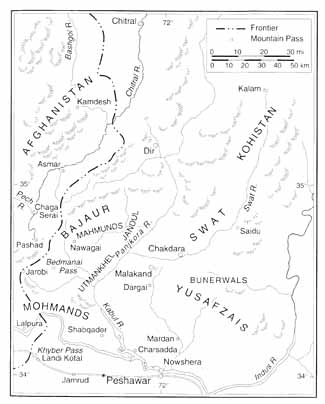
North-West Frontier Province, circa 1897.
| • | • | • |
Latest Intelligence Rising In the Swat Valley
(From our correspondents)
Simla, July 27
| • | • | • |
Yet another proof has been given of the wave of fanaticism which is sweeping along the North-West frontier of India. Malakand was the scene last night of some sharp fighting, a sudden tribal rising in the Swat Valley taking place during the day. The story is a curious one, as showing how quickly tribesmen can gather and how readily they respond to an appeal to their fanaticism.
The garrison at Malakand consists of one squadron of the 11th Bengal Lancers, No. 8 Bengal mountain battery, one company of Sappers, the 24th and 31st Punjab Infantry, and the 45th Sikhs, or about 3,000 men, of whom 200 infantry and 25 cavalry held the Chakdara post guarding the bridge across the Swat river, on the road to Chitral. Colonel Meiklejohn commands this brigade. Since the Chitral campaign came to an end the Swat Valley has been perfectly peaceful. The trade with Bajaur and the neighbouring countries has developed considerably, and the Swatis generally have been contented. The Chitral road has been kept open by tribal levies, and no signs of disaffection have ever been apparent. The sons of the late Akhund of Swat have, it is true, tried to excite fanaticism, but hitherto unsuccessfully.
Yesterday, without the least warning, the attitude of the population in the Lower Swat Valley underwent a sudden change. The first news which reached Malakand was that a disturbance had taken place at Thana, near Chakdara bridge. A few hours later further news was received that the “mad mullah,” a priest who is apparently well known locally, had gathered about him a number of armed men with the view of raising a jehad. In the evening it was reported that he was advancing down the valley towards Malakand. Preparations were made to send out a column early the next morning and disperse the gathering. The tribal levies, who fled as the mullah advanced, reported that Malakand itself would be attacked at 3 a.m. The camp was, consequently, on the alert, but the attack was delivered at half-past 10 that night—a very unusual hour for Pathans to attempt a surprise.
In the fight which ensued Honorary Lieutenant Manley, of the Commissariat, was killed; and Lieutenant-Colonel Lamb, of the 24th Punjab Infantry, Major Herbert, staff officer, Major Taylor, 45th Sikhs, and Lieutenant Watling, Royal Engineers, were wounded. The returns of casualties among the rank and file have not yet been received.
Colonel Meiklejohn ordered up the Guides from Mardan to strengthen the garrison, and at daybreak sent out a column consisting of a squadron of cavalry, four guns, and the 31st Punjab Infantry, to reconnoitre towards Chakdara and pursue the enemy. It was then discovered that the whole valley was up in arms, and it was impossible to open communication with the Chakdara post. The tribesmen were plainly not disheartened by the failure of their night attack, but were prepared to renew hostilities. Colonel Meiklejohn accordingly concentrated the garrison in the entrenched position on the Malakand ridge, withdrawing the troops from the north Malakand camp, which was rather exposed. At the same time he telegraphed for reinforcements to be sent immediately.
Orders were at once issued from the Punjab command headquarters directing four regiments of infantry, a mountain battery, and the remaining three squadrons of the 11th Bengal Lancers at Nowshera to move as quickly as possible. This was confirmed by the authorities here.
But little anxiety is felt regarding the Chakdara post, as it is impregnable against any force not armed with artillery. It is well provisioned, and the small body of troops have plenty of ammunition. It is nine miles from Malakand, on the further bank of the Swat river, and commands the suspension bridge, but the latter may be wrecked at night. The Guides should reach Colonel Meiklejohn this evening, as they were to make a double march of 24 miles. Malakand, which is a fortified position, is too strong to be stormed, but the garrison must be reinforced in order that the Swat Valley may be kept clear and that Chakdara may be relieved. Unless this be done, the rising may spread among the neighbouring clans. The news of the attack quickly became known along the frontier, and it may possibly have an effect in Waziristan, stimulating the tribesmen there to action against Major-General Corrie Bird's force in the Tochi Valley. So far, no opposition whatever has been met with there.
| • | • | • |
A Passage To India
Winston Churchill was winning money at the Goodwood Races when he heard the news that a tribal uprising had broken out on the northwest frontier of India.[1] Within a matter of hours, the young cavalry officer, who was then on home leave in England from his regiment in Bangalore, booked return passage on the Indian Mail. He also sent off a telegram to an old family friend, General Bindon Blood, who had been appointed to head the column that was being dispatched to relieve the two garrisons at Malakand and Chakdara map 4) then under siege. General Blood had once made a casual promise to Churchill that he would include him in a future campaign, and with this promise in mind, Churchill set off for the frontier.
To understand Churchill's excitement, one must consider the circumstances. The year was 1897, the British Empire was ascendant around the globe, and that summer Her Royal Majesty Queen Victoria was celebrating the Diamond Jubilee marking her sixtieth year on the throne. The day before the news of the frontier uprising reached London, Churchill had enjoyed a major milestone in his young career when he delivered his first public address to a picnic meeting of the Primrose League of Bath. Churchill's principal theme had been the importance of maintaining the grand empire fashioned during Victoria's reign. Despite the lamentations of “croakers” who believed the British Empire must soon go the way of Babylon, Carthage, and Rome, Churchill urged his listeners to stay the course. The British people, he proclaimed, must continue to pursue “that course marked out for us by an all-wise hand and carry out our mission of bearing peace, civilisation and good government to the uttermost ends of the earth.”[2]
Coming on the heels of his first foray into the political arena, the uprising in India offered Churchill an opportunity to dramatically demonstrate the principles he had articulated in his speech. By the time he arrived on the frontier, however, the first wave of the uprising had crested without any major loss being suffered. Most of those who had participated in the siege at Malakand and Chakdara had returned to their homes, but other installations were still under assault, and the job of punishing those responsible for inciting the insurrection remained. General Blood received that assignment—to push into the tribal districts to the north and west of Malakand up to the Afghan border and discipline those who had “dared violate the Pax Britannica.” While he was unable to gain assignment to Blood's staff, Churchill did manage to secure a position as a war correspondent attached to his command. With the assistance of his mother in London, Churchill also succeeded in getting a newspaper, The Daily Telegraph, to publish his dispatches from the field.[3]
In this fashion, the political career of one of the twentieth century's great statesmen and politicians was launched, but my concern is not so much with the man as with what he witnessed and what he reported. Whereas Churchill's person and life are almost invariably set in the foreground of whatever scene he happened onto (including this one), he will hereafter in this chapter occupy a subordinate role to the other actors who shared the stage with him that summer, actors who have traditionally been cast in supporting roles or as stock heavies in the drama of colonial encounter. Using Churchill's own descriptions of that summer, along with those of other contemporary British journalists and Pakhtu oral accounts collected in the course of my fieldwork, I will try to reconstitute the moral significance of this encounter as it was constructed and understood by those on the Afghan side of the battlefield. Before doing so, however, we must first understand how the British constructed the events of 1897 and the kind of moral value they saw unfolding in these “uttermost” reaches of British authority.
| • | • | • |
The Events of 1897 and Their Explanation
The frontier disturbances that Churchill took such pains to witness began where local political authorities least expected trouble and were initiated by an unlikely antagonist. For some months, British officials had been reporting improved relations with the local people of the Swat valley, and after several years of intermittent hostility, it finally appeared that calm had settled on the region. The postal service now delivered mail to and from the valley, and a medical dispensary located alongside the Chakdara fort was treating patients from the neighboring communities. Most telling of all perhaps, British officers found that they could ride “about freely among the fierce hill men” and were even being “invited to settle many disputes, which would formerly have been left to armed force.”[4]
In early July, however, the first hints of disaffection began to appear. The native markets were abuzz with rumors that “great events were impending.” At the center of these reports was an obscure faqir and sometime malcontent named Saidullah, whom the British authorities henceforth referred to as the “Mad Fakir of Swat.” A native of the region who long before had abandoned his family and home to become a religious mendicant, Saidullah had begun making declarations of an impending holy war in which he would be aided by supernatural forces.[5] A crowd had gathered to hear him, and as it swelled his rhetoric became more inflamed until finally, on the afternoon of July 26, he had set off to attack the British garrisons at Chakdara and Malakand.
Followed at first by only a few of his fellow mendicants and a handful of teenage boys, Saidullah attracted new adherents in each village he passed, gathering some five thousand by the time he reached the fort at Chakdara, located at the confluence of the Panjkora and Swat Rivers, just north of the Malakand Pass that linked the tribal territories with the Peshawar plains to the south. Although their weaponry consisted mostly of primitive flintlocks, swords, and staves, the followers of the Fakir mounted an assault that lasted four days and might have led to the capture of the Chakdara garrison had it not been for the arrival of General Blood's relief column on the first day of August.
The timely relief of the cavalry succeeded in breaking the siege at Chakdara, but no sooner had this uprising subsided than other, equally serious tribal risings broke out in nearby areas along the frontier from the Kohat district in the southwest (where the Orakzais and neighboring tribes attacked a British base on the Samana Ridge) to the Tirah and Khyber districts, directly west of Peshawar (where Afridi and Shinwari tribes attacked British posts protecting the strategically vital Khyber Pass), to the Mohmand territory (where a force of Mohmand, Mahmund, and other cross-border tribes attacked the British fort at Shabqader and the neighboring market at Shankargar, just nineteen miles from Peshawar itself). Although none of these attacks ultimately succeeded in dislodging any of the British garrisons in the region, the simultaneous appearance of so many attacks was worrisome to the British administration.
Since the infamous “Mutiny” of 1857, India had been free of widespread insurrection, but the passing of time and the ensuing peace had failed to assuage the fear inspired by that episode. During the travails of 1857, one of the saving graces for the British had been the failure of the frontier tribes to join the general rebellion, and it had been widely concluded from this experience that, however tough an opponent the tribes were on their home ground, their potential danger to the Raj was mitigated by their inability to make common cause among themselves or to coordinate their actions with others outside their home territory. Such was the received wisdom, but here were these notoriously fractious tribes mounting coordinated assaults on well-fortified garrisons and demonstrating a degree of organization unprecedented in the history of British rule in India. And it also appeared that the decision to initiate the attacks had been influenced by external factors of the sort to which the frontier tribes had previously been oblivious.
In his reports from the frontier, Churchill noted that the tribes were more cognizant of outside events than they had ever been in the past. One reason for this was that the Afghan amir, Abdur Rahman, had been “meddling” in frontier affairs—inviting delegations of tribal elders to meetings in Kabul, keeping large numbers of troops near the border, distributing pamphlets in the tribal areas on the proper conduct of jihad. From the British point of view, the Amir's actions were annoying and provocative, but even without his assistance, the tribes simply knew more about what was going on in the outside world than they had in the past, and they also appeared to have more sense of the possible implication of distant events on political relations at home. A recent victory by the Ottoman Turks over a Greek army had raised hopes in India and the tribal borderlands of an impending Islamic revival, and news of the seizure of Aden and the Suez Canal had likewise encouraged the belief that Great Britain would shortly lose its ability to secure troop reinforcements from Europe.
In explaining the sudden spread of such rumors, Churchill assigned blame to one group in particular—the mullas. It was their vitriolic preaching that had made the tribes aware of distant worlds, their slanders that had magnified British problems in other lands, and their incitement that had produced “a `boom' in Mohammedanism” in the remote villages up and down the frontier. The motivation of the mullas was not difficult to discern, for in Churchill's view, despite their backward beliefs and practices, they had the “quick intelligence” to recognize that “contact with civilisation assails the superstition, and credulity, on which the wealth and influence of the Mullah depend.”[6] So long as British arms produced security in the region and an increase in trade and communication with the outside world, the authority of the mullas was bound to suffer. Therefore, it was critical for them to find a pretext to fight back and reassert their former authority among their tribal followers.
The mullas could not accomplish this task alone. They needed a catalyst capable of “firing the mine.” In 1897 that catalyst was discovered in the person of the faqir Saidullah, who, in his apparent derangement, was “convinced alike of his Divine mission and miraculous powers.”[7] In Churchill's terms, the frontier uprising was comparable in its intensity and irrationality to the ill-fated Children's Crusade. Playing the role of Peter the Hermit on this occasion was Saidullah. He was the one who marched at the head of his credulous followers into the fiery crucible, but just as Peter had had “regular bishops and cardinals of the Church” standing off to the side, ready to reap the benefits of popular enthusiasm and sacrifice, so Saidullah was surrounded by “crafty politicians,” anxious to “seize the opportunity and fan the flame.”[8] According to Churchill, these were the masterminds behind the plot of insurrection, and foremost among their number was none other than the Mulla of Hadda.
The Mulla of Hadda casts an ominous shadow in Churchill's writings. Little was known about him, particularly compared to Saidullah, but that lacuna only seemed to increase his stature and significance in British eyes: “In the heart of the wild and dismal mountain region in which these fierce tribesmen dwell, are the temple and village of Jarobi, the one a consecrated hovel, the other a fortified slum. This obscure and undisturbed retreat was the residence of a priest of great age and of peculiar holiness, known to fame as the Hadda Mullah. His name is Najim-ud-din.”[9]
Though no one knew much about the Mulla, spies among the tribes had been telling tales about him for years, and it was known that he was a steadfast foe of British influence. The most notable example of his belligerence had come two years earlier when he had taken the lead in organizing a tribal blockade of a column attempting to relieve the British garrison at Chitral, which was then under siege. Since that time, spies had reported other instances of the Mulla preaching to the tribes against British rule in India and of his attempts to coordinate other religious leaders in an effort to destroy British influence in the region.
In the summer of 1897, these efforts finally bore fruit, and Churchill was ready to offer his explanation for the Mulla's success. The first reason he provided was the predilection of the illiterate tribes for taking rumors at face value and passing hearsay on as truth: “The bazaars of India are always full of marvelous tales. A single unimportant fact is exaggerated, and distorted, till it becomes unrecognizable. From it, a thousand wild, illogical, and fantastic conclusions, are drawn. These again are circulated as facts. So the game goes on.”[10] In the normal course of events, such stories and rumors do not amount to much, but because of the coordination provided by the Mulla and his allies in the early summer, “a vast, but silent agitation was begun.” “Messengers passed to and fro among the tribes. Whispers of war, a holy war, were breathed to a race intensely passionate and fanatical. Vast and mysterious agencies, the force of which are incomprehensible to rational minds, were employed. The tribes were taught to expect prodigious events.”[11] In this fashion, rumors had swept through the bazaar and on into the mountain villages, transforming a slightly crazed malcontent into a “mighty man who had arisen to lead them.” Likewise, the coincidental occurrence of a number of separate events in different parts of the world were trumped up as a sign that “a great day for Islam was at hand. … The English would be swept away. By the time of the new moon, not one would remain.”[12]
A second, related factor in creating the synergy between visionary leader and his credible followers was their conviction that he could perform miracles:
Had the `Mad Mullah' called on them to follow him to attack Malakand and Chakdara they would have refused. Instead he worked miracles. He sat at his house and all who came to visit him brought him a small offering of food or money, in return for which he gave them a little rice. As his stores were continually replenished he might claim to have fed thousands. He asserted that he was invisible at nights. Looking into his room they saw no one. At these things they marvelled. Finally he declared that he would destroy the infidel. He wanted no help. No one should share the honours. The heavens would open and an army would descend. The more he protested he did not want them the more exceedingly they came.[13]
Related to the belief in the Mad Fakir's miraculous powers was the sense apparently shared by his followers that, so long as they followed their leader, they themselves would be invulnerable to harm. Thus, for most, “bullets would be turned to water,” and for the rest, those struck and killed following the Fakir into battle, their succor was the knowledge that a final resting place had been prepared for them “degrees above the Caa[b]a itself”[14] According to Churchill, this belief remained unshaken even after the fighting at Chakdara, where the tribal army had seen a quarter of its number fall upon the field: “Only those who doubted had perished, said the Mullah, and displayed a bruise which was, he informed them, the sole effect of a twelve-pound shrapnel shell on his weird person.”[15]
In Churchill's analysis, it is clear that the irrational plays an exceedingly important role in his explanation for the uprising's success. For him, the existence of religious leaders claiming miraculous powers and the readiness of the local people to believe such claims provided irrefutable evidence of the barbaric nature of Britain's adversaries and, concomitantly, the impossibility of sustaining a rational negotiation with them: “Were [the tribes] amenable to logical reasoning, the improvement in their condition and the strength of their adversaries would have convinced them of the folly of an outbreak. But in a land of fanatics common sense does not exist.”[16]
For Churchill, this conclusion had important practical consequences for how the colonial authorities should conduct themselves. One could not negotiate with savages. The only language such people could understand was force. “Pax Britannica” had been “violated,” and it remained for the authorities to avenge this injury and to teach the tribes the only sort of lesson they were capable of absorbing. Half-measures would not do the trick. The tribes had tasted blood and would undoubtedly mount similar attacks in the future if the government failed to punish those responsible for the trespass and provide an object lesson for those who believed in the miraculous power of their mullas to protect them from harm. To Churchill, this was not simply a political skirmish between the government and a band of malcontent mullas for control of a few outposts; it was more profoundly a battle for the soul of India, a battle that pitted the forward march of civilization against the backward slide of ignorance and superstition.
| • | • | • |
Waging Jihad
In Churchill's writings on the uprising, it is apparent that the author seeks to deny his enemy any claim to moral status by establishing the premise that he is fanatical. “Fanaticism” serves as the central trope of Churchill's polemic and fixes the personae of the Mulla of Hadda and Mad Fakir in Churchill's texts much as “cruelty” fixed Abdur Rahman in the writings of Curzon and Martin. And just as I argued in chapter 3 for the value of decoding “cruelty” as a first step toward seeing the Amir clearly, so I would argue here that “fanaticism” must also be taken seriously, explicated, and worked through in order to understand the Mulla in something like a neutral manner. Fanaticism may be a biased term, but it still describes something real that must be deciphered if we are to understand the nature of religious authority and the reasons why the normally insular border tribes chose to follow religious leaders into battle.
In his efforts to deal with the quality of the irrational in the relationship of leaders and followers, Max Weber borrowed the term charisma from Christian theology to signify “a certain quality of an individual personality by virtue of which he is set apart from ordinary men and treated as endowed with supernatural, superhuman, or at least specifically exceptional powers or qualities. These are such as are not accessible to the ordinary person, but are regarded as of divine origin or as exemplary, and on the basis of them the individual concerned is treated as a leader.”[17] Weber goes on to note that, “in primitive circumstances,” a “peculiar kind of deference” is paid to certain kinds of people—leaders in the hunt, great healers, prophets, heroes in warfare—whose capacities and accomplishments seem so far beyond the ordinary that they can only be explained by attributing to them some sort of “magical power.”[18]
Weber's definition of charisma retains a quality of vagueness at its core despite his attempts to specify the circumstances within which charisma appears. This vagueness, along with its ubiquity in contemporary social commentary, has led many scholars to reject the term outright, but no one has been able to suggest a better word or to dispel the sense that, however murky it might be, charisma still refers to something real. Whether we choose to define it or not, there is a persistent tendency in human affairs for groups of people to attribute uncanny powers to some individuals and to celebrate and sometimes venerate those who are thus set apart. In the absence of any alternative way of designating that quality of person and relationship, charisma retains its usefulness, a usefulness that is increased in this instance by the fact that the word itself derives from the same root as the term kiramat (miracle).[19]
Using Weber's analysis of charisma and its association with the miraculous as a starting point, I want to consider in some depth the role of miracles in the uprising/jihad of 1897. Miracles are clearly at the heart of Churchill's attribution of fanaticism to the tribesmen, but they also seem to have been central to what was actually going on that summer and so are critical to understanding the nature of religious authority. In addition to examining the role of miracles in the jihad, I also want to consider how religious identity and the social formation of religious organization influenced the events of 1897. Here again, Weber's analysis provides an essential starting point, specifically his discussion of the “routinization” of charismatic authority.[20] In contrast to Weber's approach, however, which posits routinization as a later and fundamentally corrupting process, my position is that the appearance of new forms of charismatic authority depends upon prior social and cultural forms.
Just as miracle stories are comprehensible and compelling insofar as they are retellings of older tales, so it is generally the case that each new charismatic leader builds a reputation for himself to the degree that he is familiar with and connected to an ongoing routinized tradition. It could be argued that the tariqat system as a whole stands outside the profane sphere of everyday life and that the example of Najmuddin choosing to build his center in the desert of Hadda proves that to be the case. Likewise, the “anti-economizing” attitude of the Mulla in relation to the wealth circulating through his langar is another example of the way in which the tariqat stands apart from the economic concerns of the society at large. The point I want to make here, however, is that charismatic authority is inherently and necessarily routinized, that its emergence at any particular time is, in fact, a reemergence dependent upon the prior existence of a cultural framework that allows the person and the message of the charismatic leader to appear as something already familiar to the people and therefore a recognizable and legitimate basis for collective political action.
Most of the information that I have been able to collect on the ideological and organizational aspects of the 1897 jihad comes from British archival sources. In the course of my interviews with the offspring of the Mulla's disciples (and a few Mohmand tribesmen from the area where Hadda Sahib resided during his exile from Afghanistan), I found only one set of stories that clearly dealt with the jihad of 1897. However, that set of stories pertains to the denouement of the jihad and is of little help in discovering why the Mad Fakir's first appearance in Swat was greeted with such enthusiasm. (The multiple versions of this story do help with understanding the ultimate meaning of the events of 1897, as will be seen in the last section of this chapter.)
To understand that first stage of the jihad, I will rely on British sources, and consequently will apply the basic principles deduced from the miracle stories in the preceding chapter to the analysis of the British records. Because most of the events during the first stage (and the records pertaining to them) revolve around the Mad Fakir and not Hadda Sahib, I will divide the following analysis into two parts, the first of which has to do with the role of miracles in the actions and pronouncements of the Mad Fakir and the second of which concerns Hadda Sahib himself and his role in organizing and coordinating the tribal armies that both he and the Mad Fakir helped to galvanize into action.
The Scaffolding of Rhetoric
About the 20th and 21st, the Fakir began giving out that he had heavenly hosts with him, that his mission was to turn the British off the Malakand and out of Peshawar, as our rule of 60 years there was up. He claimed to have been visited by all deceased Fakirs, who told him the mouths of our guns and rifles would be closed, and that our bullets would be turned to water; that he had only to throw stones into the Swat river, and each stone he threw would have on us the effect of a gun. He gave out that he had no need of human assistance, as the heavenly hosts with him were sufficient.[21]
| • | • | • |
The first point I would like to make about Saidullah's role in the events of 1897 concerns the miracles that he promised and the way in which these miracles occurred. As mentioned earlier, Churchill and other British commentators were quick to point to miraculous doings as evidence of the unscrupulousness of religious leaders and the primitiveness of the tribes. The “fanaticism” so apparent that summer was the result of these two factors. Setting aside this judgment, I will examine some of the reports of the Mad Fakir's miracles themselves before attempting to consider what sense might be made of them. The first such reports that I was able to discover were dated July 18 and indicated that the Fakir had appeared in the area, “professing that one small pot of rice, which he had with him, was sufficient to feed multitudes.” He also indicated that he was able to “multiply to the vision of people a few small flags that he had with him,” these flags apparently representing the emblems that the people were accustomed to taking into battle with them (thereby implying that their own number would magically multiply).[22]
The next report was the one above concerning the events of July 20 and 21. From this account, it would appear that the Fakir was claiming divine assistance in his plan: from an invisible “heavenly host” that accompanied him, as well as from “all deceased Fakirs” who were guiding his actions and providing magical protection to those who accompanied him. The reason for their assistance was apparent: the end of one historical era—that of colonial domination—was upon them, and another was beginning—that of Islamic rule. Perhaps to emphasize the larger historical design of which they were a part, the Fakir announced to those around him that one of the several adolescent boys who accompanied him was “the heir to the throne of Delhi,” and he dramatized this assertion by crowning him on the spot with “a puggrie [turban].”[23]
The response to the Mad Fakir's claims was apparently negligible at first, and he had to be prevented by the people from setting out against the British fort at Chakdara alone. A number of the local chiefs who were on the British payroll spoke out against him, but their exertions seem to have helped rather than hindered his cause. The recent introduction of a policy of providing allowances for local leaders seems to have created resentment and suspicion in the populace, and the efforts of allowance-holders to detain the Fakir appear to have crystallized these resentments and suspicions and drawn the people to a leader who stood ready to oppose all aspects of colonial intrusions into the region.
Whatever it was that finally impelled the people to support the Fakir, we do know that once he had gained a few adherents to his cause, the number of his supporters increased suddenly and exponentially until he had an estimated eight thousand people trailing behind him as he headed down the valley toward the British garrisons at Chakdara and Malakand. The decision of large numbers of people to join the movement appears to have been undertaken without premeditation or planning. That, at least, is the sense one gets from some of the intelligence reports, one of which indicates that the followers of the Mad Fakir were so convinced of his message that they took no measures to prepare for a possible setback: “Cattle and grain, &c., had all been left in the villages, and at Chakdarra the bridge over the Swat river and the cavalry horses in the post, though entirely exposed, were left practically unmolested in the confident feeling that they would be useful when the post was captured.”[24]
This and other similar reports indicate that the Mad Fakir's attack was a classic example of a charismatic leader mobilizing people toward millenarian objectives. Thus, one finds here, as in accounts of other millenarian movements, the appearance of a leader promising to reclaim a lost glory by defeating a foreign power that is perceived as responsible for present corruptions. There are also promises of supernatural support, including immunity from the effects of the enemy's weapons for all those who support the leader, and a general lack of concern for the practical needs of the movement (the pervasive feeling being one of unwavering belief in the imminent victory and the consequent irrelevance of logistical concerns). Finally, here as in other accounts, there is apparent the belief that a mythical plan is about to be realized in the domain of real events and that those who participate in the fulfillment of that plan will themselves attain an appropriate reward.
All of these elements are evident in this case, but my interests are less in the practical and political causes of the uprising than in its ideology. In particular, I am concerned with how the Mad Fakir used the medium of miracle stories to embody the principles of sacred authority that were discussed in the previous chapter. In exploring these issues, I will be enlisting the services of an unlikely ally, none other than Winston Churchill himself, and the source of his assistance is an obscure essay entitled “The Scaffolding of Rhetoric.”[25] To the best of my knowledge, this essay was never published prior to its appearance in a posthumous collection of Churchill's correspondence and writings, and I have never seen any reference to the work in the recent biographies of Churchill's life; but whatever the reasons for its undeserved obscurity, the essay is of great utility to this project for several reasons.
First, it was written in the summer of 1897, when Churchill made his trip to India. In fact it appears likely that Churchill failed to complete the essay precisely because of his sudden decision to leave England to witness the frontier uprising firsthand. The timing of the essay is of at least marginal interest since its contemporaneity with the events under discussion does afford some insight into Churchill's concerns on the eve of his journey to the frontier. Second, and of more relevance to this work, however, is what the essay says about charismatic authority and the mobilization of popular support in general. Churchill, of course, did not use the term charisma. His discourse is rather about rhetoric and oratory, but the essay nevertheless provides acute insights about the dynamics of popular mobilization from a man who was himself embarking on a career that would make him one of the great charismatic leaders of his time.
The work is essentially a treatise on the sources and requirements of effective political oratory, and Churchill begins it by asserting that the “direct, though not the admitted, object” of political rhetoric is “to allay the commonplace influences and critical faculties” of an audience. One primary attribute which any orator requires for accomplishing this objective is a “striking presence” caused, for example, by a slight speech impediment or even a physical deformity. It matters also that the orator himself believes, if only for the duration of his performance, what he is saying: “The orator is the embodiment of the passions of the multitude. Before he can inspire them with any emotion he must be swayed by it himself.”[26]
Besides the personal qualities of the speaker, the quality of the speech itself is significant, and Churchill points to a number of elements in a speech that cause audiences to come under an orator's sway. These elements include the correctness of diction, the rhythm of phrasing, and the overall accumulation of argument that creates a coherent picture and allows the audience to “anticipate the conclusion.” More important than these factors, however, is the use of “analogy,” through which the orator can “translate an established truth into simple language” or “adventurously aspire to reveal the unknown.” While admitting that “argument by analogy leads to conviction rather than to proof, and has often led to glaring error,” Churchill discerns that the reason why analogies are so effective in oratory is that they “favor the belief that the unknown is only an extension of the known: that the abstract and the concrete are ruled by similar principles: that the finite and the infinite are homogeneous. An apt analogy connects or appears to connect these distant spheres.”[27]
Using Churchill's analysis as a point of departure, we can identify certain similarities between the rhetorical principles governing traditional political oratory and those governing the speech and behavior of Saidullah, the faqir who initiated the upheaval in Swat. The first matter to consider in this regard is the person of Saidullah himself.[28] While I have been unable to ascertain any evidence as to Saidullah's appearance, I have discovered several of the names by which he was known, names which provide indications of his social persona. The first of these names was sartor faqir (“black-headed faqir”), which apparently referred to the fact that Saidullah went about in public without any turban, cap, or shawl. Given that men in this region invariably wear some sort of head covering when they venture out into the world, Saidullah's apparent failure to do so might indicate a general lack of concern on his part for the usual markers of social propriety.
So too does a second name by which he was known, a name that is similar to the British sobriquet “the Mad Fakir.” This name is lewanai faqir, which can also be translated as “mad faqir,” but which does not convey the same sense as that intended by the British in their usage of the term. Thus, rather than connoting psychological impairment or mental deficiency, native reference to Saidullah's “madness” implies that he was subject to a kind of “intoxication” that can occur when a spiritual adept comes into close proximity to God. Such a person succeeds in approaching God but cannot absorb the experience in any sustained or coherent fashion. Nearness to God overwhelms him, and he is left permanently, if intermittently, impaired, liable to fits of irrational behavior, and always capable of channeling through himself extraordinary bursts of divine power.
Given his status as a “mad faqir” and the elements of his personal history indicating that he was frequently at odds with local authorities and local custom, it is fair to say that Saidullah was a most “striking presence,” even if not of the sort Churchill had in mind.[29] In Swat, as elsewhere in South Asia, the religious mendicant is seen in every town and many villages. Most are ignored, except when they pester passers-by for alms. Many people feel some resentment toward them, secretly suspecting that they have taken up the lifestyle of a faqir to shirk other responsibilities and smoke hashish. At the same time, however, few of those who distrust the motives of faqirs would be willing to openly declare their suspicions. The reason for this hesitancy is simple: people recognize that no matter how many mendacious mendicants might be out there in the world, some are for real, and who can tell the one from the other? Besides, too many stories—stories like the ones recounted in the previous chapter involving Hazrat Sahib of Butkhak and Amir Abdur Rahman—attest to the unhappy fate of those who abuse the faithful of God.
Whether Saidullah consciously intended to draw on the legacy of such stories is impossible to know, but one can say with conviction, if not certainty, that all of those whom Saidullah would have encountered in the summer of 1897 would have been familiar with tales of poor faqirs humbling the mighty. One also suspects that in claiming “to have been visited by all deceased Fakirs,” Saidullah was specifically calling attention to this legacy and his presumptive status as standard bearer for all those who have ever battled tyranny while wearing the raiments of religious poverty.
Similarly, in declaring that heavenly hosts would soon descend, that bullets would be turned to water, and that a pot of rice could feed a multitude, the Fakir was not simply “making up” stories, but was rather drawing on deeply rooted narrative traditions with which his audience was abundantly familiar. In this way, the miracles that the Fakir claimed for the future represented events that (as the “twice-told” tales from chapter 3 illustrated) had occurred repeatedly in the past. The fact that his promises could be found in extant narratives did not make them less plausible. On the contrary, the quality of the familiar made them more believable because the possibility of such phenomena occurring had already been attested to in the time-honored arena of legend.
At the same time, it can be argued that miracles function in the discourse of the Fakir like the “apt analogy” of Western political rhetoric in that they too “allay commonplace influences and critical faculties” by making the unknown “an extension of the known.” The essential talent of all great political persuaders, whatever their medium of expression or cultural context, is their ability to “appeal to the everyday knowledge of the hearer” in such a way that the hearer will be tempted “to decide the problems that have baffled his powers of reason by the standard of the nursery and the heart.”[30]
Like analogies and metaphors, miracle stories make concrete but inchoate experience subordinate to the abstract design of something larger than the experience itself while also making the larger design immediate and perceptible in the concrete instance. When reality is seen through the lens of miracles, transient events are perceived as coherent and directed toward the fulfillment of a larger plan unfolding in time. Miracles thus convey a sense of unity to events that are normally experienced as discontinuous and enable those sensible to the continuity of events to see themselves as part of an ongoing story moving toward its necessary and predetermined conclusion. It matters not that those who believe in the miracles do not understand the nature of the larger design. What matters is that the situation before them, a situation which has no apparent solution, is seen not only to have an outcome but a self-evident and necessary one at that.
Extending our comparison a bit further, we can say that the efficacy of both miracles and metaphors derives not only from their capacity for making people “see” the world in a certain way but also from the fact that they implicate their audiences in their own resolution. That is to say that miracles and metaphors carry with them an implicit sense of moral culpability, so that those who “see” the world anew also “feel” themselves to be responsible for achieving the outcome predicated by the figure. An example of the manipulation of the moral determinacy of metaphor can be seen in the following dispatch written by Churchill and published in The Daily Telegraph:
Starting with the assumption that our Empire in India is worth holding, and admitting the possibility that others besides ourselves might wish to possess it, it obviously becomes our duty to adopt measures for its safety. … The most natural way of preventing an enemy from entering a house is to hold the door and windows; and the general consensus of opinion is that to secure India it is necessary to hold the passes of the mountains.[31]
The Londoner reading his newspaper over breakfast may know nothing of India, but he recognizes the imperative of defending what is his and taking reasonable precautions to prevent others from getting the idea that his property could be theirs. What he does not know about India is excluded by the metaphor. The weight of familiar knowledge from the realm of his own experience as a citizen and homeowner thus leads him to ignore what he does not understand—India—and to accept the immediately accessible logic of similarity over the more intractable mystery of difference. In this way, the metaphor serves literally to domesticate what is strange while also pointing to the moral necessity of pursuing a particular line of political action that derives from the sense of inevitability imparted by the figure.
The sense of inevitability is contained in two additional metaphors of imperial control quoted by Churchill in “The Scaffolding of Rhetoric”:
They (Frontier wars) are but the surf that marks the edge and advance of the wave of civilization.
The first of these quotations was penned by the then prime minister, Lord Salisbury, and uses nature to inculcate a sense of the futility of opposing an inexorable process—the advance of civilization. Never mind that the metaphor also implies that civilization is static rather than progressive; the dominant image is of the wave advancing against sometimes dramatic but ultimately ineffectual resistance. The second example, attributed to Lord Randolph Churchill, Winston's father, implicates the same natural phenomenon but to a different end. Civilization is not nature here but that which tames and subdues nature—in this instance, the uncivilized peoples of India.Our rule in India is, as it were, a sheet of oil spread over and keeping free from storms a vast and profound ocean of humanity.[32]
As was the case with the miracles of the Mad Fakir, Churchill's analogies present to the imagination of those responsive to them “a series of vivid impressions which are replaced before they can be too closely examined and vanish before they can be assailed.”[33] Along with the impressions they create, the figures also engender a sense of providence (called “Allah” by one side, “civilization” by the other) operating in ineluctable and inexorable ways in human affairs. This sense of the providential, in turn, inculcates an attitude both of anticipation for what will happen in the future and of personal responsibility for the proper resolution of the situation framed by the metaphor.
In promising the appearance of heavenly hosts who would protect his supporters from bullets and fill his pot with rice to feed the multitudes, Saidullah was involving himself in a discursive operation that differed from that remarked upon by Churchill more in its cultural content than in its basic constitution. The promises he made were all promises that the people had heard before in the form of stories. In those stories the promises came true, and there was no reason to believe they wouldn't come true in this instance as well, so long as those who listened accepted their role in the resolution of the unfolding narrative. The genius of the Mad Fakir was thus the genius of all great political leaders—Winston Churchill not least among them—of creating through words the vision of a grand historical design and then making those who are susceptible to this vision aware of their own responsibility for its realization.
The Organization of Charisma
Help from God (awaits us) and victory is at hand. Let it, after compliments, be understood by, and known to, the followers of the greatest of the prophets, vis, all the people of Ningrahar, the Shinwaris and others, that the people of Swat, Bajaur and Boner have all united together and succeeded in annihilating the troops of the infidels stationed in Swat, and have plundered their property. All the Muslims are therefore hereby informed that the Mohmands as a body have joined me in advancing upon (Shankargarh) via Gandab for the purpose of carrying on a jehad. It is hoped that you on receipt of this letter will rise up, if sitting, and start, if standing, and taking the necessary supplies with you, come without fail as soon as possible. God willing, the time has come when the `kafirs' (infidels) should disappear. Be not idle. What more should I insist upon. Peace be upon you.
| • | • | • |
I want to turn now from the miracles of the Mad Fakir to the role played by the Mulla of Hadda in organizing the insurgency. We have seen that the promise of miraculous events was an important precondition for gaining the people's confidence, but the Fakir's role, which was to light the spark, was short-lived. The same was not true of the Mulla of Hadda. While the Fakir was essentially a solitary figure (his solitariness being in many respects the key to his charisma) who had neither the resources nor the capabilities to extend his authority much beyond the range of his own voice and person, Hadda Sahib was connected to an extensive network of support and identification through the tariqat system, which provided him with an organizational structure that was unique in the area. As we have seen, tribes represent the dominant form of social organization in the region and one that has a particular resiliency in the face of state encroachment, but tribes also tend to be insular in orientation and provide neither the idioms of relationship that would allow for more far-reaching alliances nor the resources to support a widespread and sustained mobilization of manpower.
The Mulla, on the other hand, had symbolic and practical resources available to him that the tribes did not. Most importantly of course, he had Islam, which represented the only ideology that was capable of uniting disparate individuals and social polities under a common flag. Whereas honor was essentially a particularizing code of conduct that specified the local community as the primary context of moral suasion, Islam was something quite different: a universal system that leveled (if it did not erase) particular marks of identity while delineating a separate and distinct code of moral conduct applicable to all and arbitrated impartially by an implacable deity impressed more by self-effacing piety than self-affirming performances of personal honor. However, while Islam represents a separate moral system from that of honor and tribe, leaders like the Mulla of Hadda were successful to the degree that they could operate within both worlds. Islam could provide an ideological framework for joint action, but it could do so most effectively when those in charge were able to implicate honor and tribe to the cause of Islam rather than drawing attention to the differences between them. This was not an easy task, and the Mulla's organization of the 1897 uprising represents an example of the potentialities and perils inherent in the operation of reconciling Islam and honor for even a limited amount of time and in a circumscribed context.
In the letter that begins this section, we see one dimension of the Mulla's use of honor and Islam within the same ethical frame. Despite being limited in the kind of conclusions we can make because we only have an English translation and not the original document to work from, it is still possible to see in this letter the way in which Hadda Sahib was drawing on his own reputation as a man of God to impose an ethical obligation on those to whom he is writing. In this letter, the Mulla begins by addressing his readers not as Shinwaris and Ningraharis, but rather as “followers of the greatest of the prophets.” This is the identity that he wishes to invoke, and it is to their responsibilities as Muhammad's followers that he wishes to draw their attention. At the same time, however, tribal identity does indeed matter and is implicitly manipulated in this message, for the Mulla well knows that to tell one tribe about the heroic actions of another tribe is to goad them to respond in kind. In the culture of honor, all deeds are enmeshed in a dialectic of challenge and response, and consequently when the Mulla tells the Shinwaris that the Mohmands have already accomplished a great deed, he is also implicitly challenging them to match it.
That sense of challenge that is set up throughout the letter is finally solidified in the last lines of the message when he asks rhetorically, “What more should I insist upon.” In articulating the point of his letter in this indirect manner he puts the onus of response on those who hear the message. If we assume that a letter such as this would have been read aloud in public assembly, we can see that what the Mulla is doing is setting forth to the group at large the framework of the challenge (the context of an ongoing jihad and the prior action of other tribes in answering the call) and then articulating the challenge itself as a question to which those who hear the message must respond if they do not want to be publicly humiliated by failing to meet the challenge.
A second feature of the message is the way in which the Mulla encodes his own authority. Significantly, he does not order anyone to do anything. To do so would have been to involve his reader/listeners in a hierarchical relationship. Those who were disciples of the Mulla would presumably have been willing to accept an order from their pir, but others probably would not have been and might also have viewed acceptance as a diminution of their own pride of person and autonomy of action. This being the case, it was a far more effective strategy for Hadda Sahib not to command anyone, but rather to put himself in the position of directing the divisive energies of tribal honor to the cause of Islam. The letter effects this end by framing its intent not as an order but rather as a sort of public service announcement: this is who you are (followers of the greatest of the prophets), this is what other groups have done, and this is what you too should do if you want to be judged as their equal.
The “public service” tone of the message is, of course, disingenuous. The Mulla clearly means to prod the tribes to action, but the tone of the letter preserves Hadda Sahib's attitude of indifference to the dynamics of honor and highlights his sole concern for the preservation and betterment of Islam. While we cannot say with any certainty how the message was interpreted by its recipients, a sense of the persuasiveness of his requests for assistance can be at least tentatively gauged from the following letter from representatives of the Khani Khel section of the Chamkani tribe to Sir William Lockhart after the latter had asked the tribe not to join in the uprising: “We cannot deviate from obeying the orders that may be issued (for us) by the Fakir of Swat, the Adda Mullah, the Akka Khel Mullah, and all followers of Islam. It is allowable if our necks are cut off by one single blow from a sword (in obeying their orders). If they make peace with you, we are also at peace, or else we shall sacrifice our lives.”[35]
Beyond the ideological advantages which Islam offered, the Mulla also had the practical resources of the tariqat system to draw on in his efforts to organize the jihad. If these resources were not as bountiful as those possessed by the state, they were certainly more potent than those of any individual tribe, and they were also more readily available than the resources of the state, which had to be brought in from outside. The first of these resources which the tariqat system made available was the network of communication that it afforded him and that allowed him to rally support from far-flung and otherwise disconnected tribes and locales on both sides of the border. Throughout the summer and fall of 1897, British reports testify to the extensiveness of Hadda Sahib's network, as British agents continually uncover evidence of agents carrying messages back and forth between him and the different fronts.[36]
The Mohmand territory where the Mulla made his own headquarters was not only relatively protected from British reprisal, it was also probably the most central point from which to maintain communications with the northern front at Swat, the more southerly fronts along the Khyber and in the Afridi Tirah, and Afghan tribes further removed from the border. Those with whom Hadda Sahib was in communication before and during the summer and fall of 1897 included first the Mad Fakir in Swat, who was certainly acting in concert with the Mulla and who may even have been following his orders.[37] In addition, the Mulla also maintained contact with several leaders who, like himself, had some prior connection to the Akhund of Swat, including the sons and grandsons of the Akhund, the so-called Mianguls of Swat, and the Palam Mulla of Dir who, like Hadda Sahib, was one of the deputies of the Akhund. The Mulla also drew heavily upon his own deputies (the name of Sufi Sahib of Batikot is mentioned most often and prominently in British dispatches) for assistance in rallying support from inside Afghanistan, and he also kept in frequent communication with other religious leaders like himself, such as Mulla Said Akbar and the Akka Khel Mulla (the principal religious leaders of the Afridis) and the Karabagh Mulla, the dominant religious figure in Kohat District.[38]
The main conduits in this communications network were the shaykhs and talebs who studied with and accepted orders from Hadda Sahib. Having relinquished ties of family and become his disciples, these individuals were free of other obligations and allegiances that might have divided their loyalties and undermined their obedience to their leader. Furthermore, their lack of other ties and their status as followers of a religious leader enabled the Mulla's men to “move quietly about the country, attract but little notice, and then work more successfully than the known Mullahs with whom they are associated.” In the opinion of Harold Deane, the political agent in Malakand at the time of the uprising, it was these students, even more than the leaders like Hadda Sahib himself, who had the larger hand “in creating uneasiness and in trying to rouse the people to a jehad.”[39]
Another resource upon which the Mulla could presumably draw was the langar. As previously indicated, Hadda Sahib and his deputies fed large numbers of people in their langars, and one of the sources of their authority was their reputation for always being able to find enough food to feed their guests. This reputation was probably one of the reasons why followers of the Mad Fakir left cattle and crops undisturbed on their way to assault Chakdara. It also seems to have informed the attitude of many of the Mulla's adherents as well, and for a while, at least, it appears that he was able to keep up with demand since there are reports of men carrying loads of food to Mohmand prior to the battle of Shabqader.
It is fair to presume that if the battle had gone more in the favor of the Mulla's forces (particularly if they had succeeded in capturing the Hindu market at Shankargar), then the supplies at their disposal would have sufficed to keep his reputation intact. It did not, and this failure seems to have exposed Hadda Sahib to rebuke and eroded the foundation upon which he had based his authority. Reports indicate that in the days after the assault on Shabqader, as the Mulla waited for reinforcements and additional supplies, the late summer monsoons spoiled both a good deal of the food and much of the ammunition that the tribal force had at its disposal.
The combination of the military defeat that they had suffered, along with the rain and the protracted waiting that ensued following the retreat from Shabqader, also seems to have encouraged a general attitude of belligerence and disrespect in the Mulla's camp that was recounted in British reports with barely suppressed glee:
According to a second report,The Mullah had a felt (`namad') and a charpoy only and the Ghazis were far and off over the hills lying behind the rocks disaffected with the Mullah. The Ghazis were complaining that good food as promised was not supplied to them from the `langar.' Some were supplied with food and others were not fed for two days. Bread and atta were pouring into the Mullah from all sides, but nearly half reached him, half being spoiled by the rains and thus rendered unfit for eating.[40]
The Mullah said he awaited the outbreak of the Afridis when he would renew the ghaza; this time the arrangements had not been satisfactory, and moreover the Mohmands behaved villainously. The people secretly laughed at what he said, and remarked that after the present experience it was impossible for any one to flock to his standard again.[41]
Other followers of the Mulla were likewise quoted as saying, “We have seen the Mullah's greatness; he was boasting that he could provide food for 10,000 men twice a day, but he could not feed more than 200 even once a day.”[42] Perhaps most humiliating of all, and most happily welcomed by the British, was the report in late September of Hadda Sahib's ignominious fall from grace following his final skirmish with British forces:
There is a good story told that, during the attack on the Badmanai Pass, the Hadda Mullah was seen personally riding among the flying foe, but his pony fell in an awkward place, and they put him into a litter and carried him off. There were women close by, refugees from the villages, who cursed him in their choicest tongue for the trouble he had brought upon them.[43]
| • | • | • |
The Fault Lines of Authority
Whether they are true or imagined, stories of the Mulla being laughed at by his followers and cursed by local women force us to consider the question of why the uprising failed. There are a number of obvious factors, among them the apparent superiority of British arms and organization. The British units had at their disposal the best arms and equipment available at the time, and after several generations on the frontier British and Indian soldiers knew how to use them to maximum effectiveness. The frontier tribesmen, on the other hand, had inferior armaments and none of the siege machinery that would have allowed them to breach the well-fortified battlements of British outposts. In addition, the tribesmen also lacked the military organization and discipline that enabled the British to keep men in the field for extended periods of time. In the tribal army, or lashkar, each lineage and group fought under its own flag and maintained its autonomy of action. Tribal warriors were loath to accept the authority of any leader, whether it was from within or outside their own group, and this meant that decisions had to be made by consensus.
Tribesmen also resisted the idea of assigning specific roles to different groups, and the notion that an army would work more effectively if some among them accepted a logistical role to ensure the regular shipment of necessary food and supplies was insupportable. Pakhtuns have long looked to battle as an opportunity for besting their personal rivals every bit as much as for gaining larger victories, and this ethos meant that few were willing to accept subordinate or specialized roles. It also meant that many tribesmen, at least in the first stages of confrontation, were willing to go out onto the open field to meet the British enemy face-to-face. This willingness to expose oneself to risk for the sake of honor was well and good when the enemy consisted of other tribesmen, armed like oneself with sword, shield, and flintlock, but it was another matter altogether when the enemy across the way had mounted lancers, maxim guns, artillery pieces, and the latest repeating rifles.[44]
Such problems did not afflict the British army, and as a result of their superior organization, they were able to maintain an extended line of defense around the perimeter of their territory, to sustain logistical support for these perimeter bases over long periods of time, and to respond quickly to threats against these bases. The tribal lashkar was a highly effective military organization in its own way as well, but its limitations were exposed in situations of protracted, stationary combat such as occurred in the summer of 1897. If one could imagine such a thing as a bestiary of military forms, the lashkar would perhaps be compared with the shark in the sense that it is a ruthlessly effective killing organism so long as it sustains its forward momentum. Once it is forced to stop moving, however, the lashkar, like the shark, quickly suffocates and dies. An operation of the size undertaken by the tribes in 1897 required logistical support of the sort that the lashkar could not provide. The number of men attracted by the charismatic promises of the leaders exceeded the ability of those leaders to meet their daily needs, and, as the Mulla discovered to his discomfort, an extended period of inactivity between battles was impossible to sustain, even if one did have the resources of various local langars to fall back upon.
In addition to these logistical problems, Hadda Sahib and his allies were also undermined by political divisions, among them the disloyalty of local potentates who seem to have found the prospect of a successful jihad nearly as threatening as did the British themselves. As Lionel James noted, “In almost every area of revolt the Khans and privileged groups were in secret touch with the British, fearing political anarchy and the uncontrollable and unpredictable religious fanaticism of the `mullahs'. The predictable dilemma was either to choose the uncertain path to `national' and religious glory or risk local opprobrium by keeping their options open through contact with the imperial powers.”[45]
A second factor in the failure of the uprisings involved the ambiguous role of Amir Abdur Rahman, the old foe of the Mulla, who appears to have mitigated Hadda Sahib's success by first appearing to offer him support for his enterprise and then taking it away. Given the history of animosity between the Amir and the Mulla, one would assume that the Amir would have opposed any adventure in which the Hadda Mulla had a hand. In the same way, it is equally difficult to imagine Hadda Sahib seeking the support of a ruler who had tried to arrest him (and, reportedly, to kill him) and who had imprisoned a number of his principal deputies. More than anything else, however, the Amir was a political realist, and he would have recognized the advantage of having an insurgency mounted against the colonial power on his eastern border without his having to take a leading role. If the insurgency were successful, it would mean that he would have a much freer hand in dealing with the frontier tribes and less to worry about in terms of the British exercising their influence on “his” tribes. If the insurgency failed, then the Mulla himself, along with his allies, would perhaps permanently tarnish their own reputations with their followers. Either way, the Amir came out ahead.
From Hadda Sahib's point of view, alliance with the Afghan state offered several important advantages, regardless of the history of animosity between himself and the Amir. One advantage was obviously that of greater manpower, better armaments, and more reliable supplies. A second advantage was doctrinal. Hadda Sahib does not appear to have imagined himself a king: his rejection of the Shinwari offer of such a title is evidence of this. But, at the same time, he also certainly recognized the importance of such a title, particularly in a time of conflict. Only a properly ordained ruler was entitled to declare a jihad, and without such a declaration any conflict, including even one against an infidel power like Great Britain, was illegitimate. This implied, among other things, that those who died in the course of the conflict would not be considered Islamic martyrs (shahidan).
For their part, the British were convinced that the Amir was helping the insurgents, and their correspondence from the summer of the uprising is replete with signs and signals of the Amir's real intentions:
- “Sixty copies of the `Targhib-ul-Jehad' and the `Taqwim-ud-din' [two pamphlets on jihad written by the Amir] have reached the Mullah Sahib of Adda from Kunar Haka.…The Hakim [governor] of Kunar has sent 200 `kharwars' of wheat and 5 `kharwars' of barley to help Mullah Sahib's supplies”;
- Despite the fact that Hadda Sahib had been expelled by Amir Abdur Rahman, they were said to be on good terms and his Commander-in-Chief was reported to have been in communication with the Mulla and to have sent him cash;
- The Amir's officials were secretly encouraging the uprising and are reported to have given the Mulla 25,000 rupees through Sahibzada Jilam of Kama.[46]
Despite the cumulative evidence of such reports, it seems clear that the Amir couched whatever support he offered in such a way that he could never be held accountable for it. Public statements to tribal leaders (which, he was certainly aware, were being reported to British authorities) were noncommittal at best and dismissive at worst.[47] Whatever aid he might have sent to the rebels seems to have been handled through third parties and was of such limited quantity and value that it provided little in the way of practical help or encouragement to the overmatched tribesmen.[48] Likewise, letters sent by Abdur Rahman to the British themselves were supportive of their position and promised assistance in reining in recalcitrant tribes.[49]
Even his incendiary pamphlets on jihad were phrased in such a way that conditioned his support for military action on certain requirements being met, the most important of which was that a jihad be formally declared by the lawful Islamic ruler of the realm. From the British point of view, of course, such rhetorical ambiguity was simply an example of Abdur Rahman's skill in the arts of political manipulation. With “true Oriental subtilty [sic],” one colonial writer noted, he sought to veil the most important passages of his pamphlets with “a double meaning” that allowed him to “argue from either standpoint. If it suited the Amir to set the mechanism working, it evidently has not suited him to openly aid the working of the machine, though he possibly can find means to supply the necessary lubricants, even when expressing righteous indignation at the attitude of the frontier fanatics.”[50]
While there is undoubtedly some truth to the judgment that Abdur Rahman recognized the strategic advantages of playing both sides against the middle, it is also true that the matter of who had the right to declare a jihad was tremendously important to him. Religious leaders had great appeal in Afghanistan and, on average, far greater longevity than rulers. During his tenure in office, Abdur Rahman had discovered the weaknesses of most of the leaders who challenged his right to rule. Some could be bought off, some could be lured into compromising positions, and those who didn't have sufficient support he was able to simply eliminate. Hadda Sahib, however, was one of the few, perhaps the only, religious leader who consistently stymied the Amir, staying just beyond his grasp and outside of his control.[51] Consequently, it was important for the Amir to preserve what advantages he had, and one of these advantages was certainly the doctrine that only an Islamic ruler could declare a jihad.
A final factor in the failure of the uprisings had to do with the Mulla's dependence on the tribes themselves. Many of the most important tribal maliks received allowances from the British which they were loath to endanger, and his location in Mohmand also seems to have harmed his ability to function as independently as he had been able to while he was living in Hadda. Thus, while Abdur Rahman was undoubtedly right in being leery of the Mulla's potential for causing him trouble, it was also true that once the Amir had forced Hadda Sahib to take refuge with the Mohmand, his ability to accomplish his political objectives was compromised.
As long as Hadda Sahib was living in Mohmand, his access to his disciples was limited. When he lived in Hadda, close to Jalalabad, anyone who wanted to visit him had only to make the short journey from the city. In the fastness of Mohmand, on the other hand, he was largely cut off from his supporters and dependent on messengers to communicate with his followers in other areas. Thus, despite the relative freedom that the Mulla enjoyed among the tribes and despite the central location of the Mohmand territory along the border, this was still a mountainous area without roads or centers where people from different backgrounds could gather. During the summer of 1897, this isolation not only hampered Hadda Sahib's ability to coordinate strategy between the different fronts, but also limited his ability to personally rally support.
Beyond this, the Mulla's residence with the Mohmands limited his autonomy of person and his status as a religious figure. When he was located in his own center, he was in charge, he was “sahib of Hadda.” In Mohmand, his position was restricted. Every move had to be negotiated, often with tribal leaders who, as indicated, were receiving allowances from the British and therefore hesitant to throw their support behind a religious figure who threatened not only to eliminate a reliable source of income but also to introduce new moral demands into the universe of tribal relations.
One concrete indication of how the moral demands of the Mulla came into conflict with the moral demands of tribal honor can be seen in the following report that explained why Hadda Sahib was encountering resistance in his efforts to have his followers support the uprising in Swat: “The tribesmen refused to go towards Swat, because it would be impossible for them to bring back their dead and wounded from so great a distance, but they said that if the Mullah would lead a jehad somewhere closer to their homes they would join him.”[52] Time and again in the course of Afghan history, one encounters this reticence over fighting too far from home. On one level, what this phenomenon reveals is a concern for the proper disposition of the dead, but on a deeper level it reflects both the insularity of tribal morality and the ambivalent regard which the tribes have for Islam. If truly committed to the cause, the final resting place of the body would not matter: those who die in jihad are (to reprise the words of Talabuddin Akhundzada) “pure martyrs” and no one need concern themselves with the mortal remains or cultural fallout from their deaths. But, as Sultan Muhammad reminded his father, the dead mind their own business. The living remain behind, and they must keep one eye on those around them even if they choose to focus the other eye on heaven.
| • | • | • |
Tales of Jarobi Glen
Having considered some of the reasons why the jihad of 1897 failed in its efforts to dislodge the British from the frontier, I want to turn to another question that is more puzzling than why the rebellion itself faltered. Given that the Mulla did indeed fail in his efforts to end British rule in the frontier, what were the consequences of this failure for his reputation? Since he is remembered by Afghans today as one of the great saints in their history, we must assume that his reputation remained intact, but if this is the case, how exactly did his reputation survive the defeat of his miraculous claims to divine assistance? Most miraculous promises, we must assume, do not come true. Most claims to supernatural assistance in the prosecution of political objectives ultimately run afoul of practical reality. How then do charismatic leaders like the Mulla of Hadda survive as viable foci of public respect? How is it that their moral authority continues to prosper even when their promises prove hollow?
This is, of course, a complex problem and one that belies simple answers, but in order to propose at least a partial solution, I want to direct our attention back to the realm of stories in which we began our investigation and to the role of stories in encoding the moral imperatives by which particular societies choose to live. So let us consider the denouement of events in the late summer of 1897, as those events are recounted from the different points of view of those who were involved in the confrontation. The first of these is a journalistic account written by a British reporter named H. Woosnam Mills, who accompanied the expeditionary force into the Mohmand tribal territory in pursuit of the Mulla of Hadda. The second version of the events of that summer is a miracle story that was told to me by a descendant of one of the Mulla of Hadda's deputies. The third and final version of events is contained in a story told by a Mohmand tribesman whose grandfather was also a participant in the uprising and who claimed to be with the Mulla of Hadda during the climactic engagement with the British.
Mills's Tale
After relieving the Chakdara and Malakand garrisons, General Bindon Blood, Churchill's sponsor and family friend, assumed charge of a punitive expedition against the rebellious tribes of Swat and Mohmand. Designated the Malakand Field Force, General Blood's column first secured the submission of the villages of lower Swat directly involved in the siege of the Malakand and Chakdara forts, then turned west to confront the Mohmand and Mahmund tribes that had participated in the attack on the Shabqader fort and Shankargar bazaar. In the course of their westerly traverse into the Mohmand territory, Blood's original force was joined by a second column under General Elles—the Mohmand Field Force—that had been hurriedly assembled in Peshawar in the wake of the uprising. The explicit objectives of the combined operation were, first, to disperse and punish the tribes that had undertaken the assault and, second, to apprehend the author of their discontents, the Mulla of Hadda. From their intelligence reports, the British authorities knew that the Mulla had made his headquarters in the most inaccessible part of the Mohmand territory, astride the border between India and Afghanistan. The location they set their sights upon was the little village of Jarobi, a place that had attained an almost mythical stature in British eyes due to the Mulla's residence there and the fact that no foreigner had ever laid eyes upon it.
As the two columns marched toward the Mulla's stronghold, the British encountered stiff resistance, especially while crossing the Bedmanai Pass (where the Hadda Sahib had reportedly fallen from his horse in his hurry to escape the onrushing British troops). Following this encounter, the only difficulty faced by the invading force was fatigue induced by the stifling heat and “tier upon tier of dusty waste-stretches.” The aridity and barrenness of the landscape was sufficiently oppressive, in fact, to cause Mills to wonder if, in fact, the much fabled “Jarobi, the valley of the Mohmands, which overflows with milk and honey” was “but a myth”.[53] Such doubts were assuaged, however, when they crossed the pass leading into the undefended valley, and gray hills and dusty plains gave way to a very different scene:
When the tower was reached at last, the beautiful valley which no European had gazed upon before broke upon the view. … The valley opened out and the far side was lost in a lofty range. On the right the hills were lower and gracefully wooded with walnut and pine, while as stepping-stones to the centre of the valley the green fields of Indian corn rose in succeeding tiers, and there on a knoll with a deep grove at its foot stood Jarobi proper,—the home of the Mad Mullah—nestling against the wooded spurs which rose away from behind it melting away into the bleak barrenness of the separating range.[54]
Before the troops could descend into the valley that they had traveled so far to conquer, however, their progress was suddenly interrupted from an unexpected quarter:
As the first white men shaded their eyes to the scene, the elements joined, and as if in disapprobation of the sacrilegious advance, dense storm clouds rolled over the peaks and vivid lightning played above the sacred spot, while the artillery of heaven reverberated across the peaceful valley; an ominous forecast of the rude awakening which was about to come.[55]
The odd congruence of natural and human events did not deter the column from continuing on its mission, for even as the monsoon rains were gathering above them, two companies of the 20th Punjab Infantry and a detachment of miners from the Bengal Sappers began their work of destruction, first blowing up the tower that commanded the entrance to the valley and then proceeding on into the village itself, which they intended to burn to the ground. “As they came abreast of the village,” however, “the heavy clouds brought rain and hail, and a bitter wind chilled all to the bone as they plodded up the Pass.”[56]
To the accompaniment of hail and lightning, the first wave of British troops entered the deserted village to carry out their appointed mission. The only resistance that was encountered came from five swordsmen who had remained behind in the village mosque after the other villagers had fled the scene. No one knows who these swordsmen were or what their mission was, but they “rushed on the 20th Punjab Infantry and died, undoubtedly in their own way, as a sacrifice.”[57] While the Sappers “applied the fatal torch” to Jarobi, the infantry pressed on up the narrow defile which was said “to lead to the Mullah's retreat.” Here, “a blaze of fire was poured in from either side, and it was evident that the defile was held by the enemy in force.”
The fire was heavy, and four or five men dropped in as many seconds. In the meantime, the firing having declared the position to General Westmacott in the rear, No. 3 Mountain Battery was ordered up, and it made beautiful practice on the hills crowning the left of the 20th, while the remaining half battalion was pushed up to the defile in support. A few minutes after the guns came into action the whole of the valley was in flames, and the main object of the expedition had been attained.[58]
As night was approaching and “a retirement in the dark would not have been desirable, at 3–30 the `retire' was sounded,” and the British troops began their retreat from the defile “under a harassing fire from the most daring of the cragsmen who held on to their rear. … By 5 the dangerous part of a most treacherous valley had been cleared and by 5–30 the whole of the troops engaged were in camp.” All that remained before “the curtain was finally rung down” was for General Blood's troops to conduct a “Political walk-round.”[59] For the most part, this consisted of a demonstration of force and intimidation, one aspect of which was the prying loose of money, arms, grain, and forage from tribes that “owed” what could be extracted as compensation for having acted in a hostile fashion toward the government of India. Hostages were also taken from those tribes failing to turn over the stipulated penalties, new passes and routes were reconnoitered, and all the while an orderly and unhurried retreat was carried out.
Rohani's Tale
Before commenting on the preceding reconstruction of events, I first turn to the account of this confrontation that has been preserved by descendants of the Mulla's deputies. I have collected several versions of this story from various informants, but the one I have chosen to include is the most complete. The narrator is Maulavi Ahmad Gul Rohani, a grandson of Ustad Sahib of Hadda, the deputy who took over the Hadda center after the Mulla's death. Maulavi Ahmad Gul was a judge and religious teacher in Afghanistan prior to the Marxist revolution, and he told me the story during the course of an interview in Peshawar in 1984. This account was introduced with the statement that it was a story “we have heard from our elders:”
One day the late respected Najmuddin Akhundzada [the Mulla of Hadda], may peace be upon him, gathered [his forces] in Jarobi, and from there they attacked the English and assaulted them and did jihad against them. The English were faced with great trouble because of him. Finally, they brought their troops near the village and gathered there. They called the people of the village and took their elders and brought them to the governor and told them, “If you accept these three demands of ours, fine. Otherwise, I will destroy your village and kill all of your women and children.
They said, “What are these demands?”
[The general] replied, “First, you must sacrifice Najmuddin Akhundzada Sahib (may peace be upon him) so that we will be saved from troublemaking and sit comfortably. And if you can't do this, send him from your village so you won't be caused trouble and difficulties. Then it will be between him and us. If you don't give him a place to stay, he will go back to Afghanistan.”
These were their demands, and the people of the village returned with great worry, grief, and sorrow. They consulted among themselves how it would be possible to disclose these conditions to sahib-i mubarak [Blessed Master] and tell him the English words. Finally, they said, “Let us go and consult with Sahib-i Mubarak,” and they told him the whole story, that “you must either be martyred or surrendered or sent out from the village.”
Sahib-i Mubarak told them, “I will go and sit on the mountain. You go and tell the English, `We have sent Sahib-i Mubarak from our village. Now it is between you and him.”'
Sahib-i Mubarak went to the mountain and started his worship of God. Then he started his nawafil prayers. He was saying his nawafil prayers, and the white beards came to the English and talked to their armies, and they told them, “See! We have sent Sahib-i Mubarak from our village. See! He is sitting on the mountain. Now if you want to capture him or martyr him, do as you wish.”
The commander ordered his soldiers—foot and cavalry—to go and surround Sahib-i Mubarak and take him alive and bring him. From there, the English forces moved and were running and finally had almost reached him. Because of his blessed prayers (he was busy with his humble prayers), because he was busy humbly and secretly praying to God (his only creator, the Master of the Universe, and he took refuge in God), by the blessing of God, bees swarmed down on the English, and the bees attacked, and every one of their soldiers was faced with hundreds of bees, and they stung them. Some fell from their horses, and some fell while running, and some died, and some fled.
Thus, they faced defeat, and they came and told their commander, “We were faced with this kind of plague and disaster that all of our bodies were filled with painful poison, and we were unable to reach [the Mulla]. God sent bees against us.”
Then [the commander] communicated with his headquarters and told the story to them—that such things had happened up to this minute. “What can we do now?”
Then [the villagers] ordered them, “Take your dead bodies and come, and don't cause him any more trouble.” And they confessed, “Even if there is no one with him and he has no weapons or equipment, our power cannot conquer this faqir who has spent his life in the clothing of poverty and piety. This is truly a miraculous and courageous faqir!”
| • | • | • |
There are no dates attached to this version of events, and none are remembered. The context in which this miraculous occurrence took place had been forgotten by the narrator, if indeed he had ever known much about it. The only reason we know that the narrative concerns the same events as those in the first account is the setting in Jarobi and the involvement of the Mulla of Hadda. Older informants who have been asked to recount additional stories from this time that they might have heard from their elders do not recall any others. This is the story they remember, and while there are significant variations in how the story is told and what elements are emphasized, the miracle of the bees is the central event in all of the versions.
In considering the relationship between the British history and that told by the Mulla's followers, it is appropriate to begin by mentioning the elements that they share in common. This would include the following “facts:” The British came to Jarobi to capture the Mulla, but he was absent from the village. After a confrontation in the mountains outside the village, the British retired from the valley without capturing the Mulla. Finally, both accounts come to closure through an act of submission on the part of the enemy.
Beyond the general similarity of outline, the most intriguing element common to both stories is certainly the “natural” event at the center of each, for it is in this depiction that we recognize that this is the same historical event differently cast in two forms of remembrance. It is also in the representation of this “storm” that we see the most telling difference in the cultural perspectives of the two protagonists. For the British author, the onset of a violent hailstorm at the moment of the expedition's arrival at Jarobi is given an ironic significance. The odd synchronicity of the natural and human events leads the author to introduce the notion of supernatural intelligence conspiring to resist “the sacrilegious advance.” The “artillery of heaven,” however, is seen to be no match for the “destroying cartridge” of the Sappers, and the supernatural intervention proves to be no more than “an ominous forecast” of the more potent “awakening” about to come in the form of the British expeditionary force as it moves forward to level the village. The effect of this passage is then to appropriate and, through irony, dissolve the sacred world view associated with the Mulla within the rationalizing framework of the British. In the second narrative, however, irony is also implied but in relation to those who believe themselves all powerful when in fact they are powerless before God. This ironic relationship is demonstrated in the initial arrogance of the British and their subsequent humiliation at the hands of the humble faqir.
At the heart of these two stories are very different understandings of the world and of human and divine agency within it. The different metaphysical principles embodied in the narratives can both be exemplified by reference to the same organizing figure: a figure that conveys opposed meanings to the different protagonists and that neatly concretizes the difference that we earlier noted between miracles and metaphors. That figure is often discovered in British colonial accounts and is associated with the act of “lifting the veil” or “lifting purdah” and can be seen in the following example taken from Mills's account of the Mohmand expedition: “As far as the Baizais [Mohmands] are concerned, they never can boast that their purdah has not been lifted, that a Sirkar's [government] force has not swept through their country, and in accordance with the nature of things, it may be fairly presumed that they will keep clear of raids in our territory for many a long day.”[60]
On one level, the use of this metaphor expresses the moral duty of civilized society (reprising Churchill's Primrose League speech cited at the beginning of this chapter) to bear “peace, civilisation and good government to the uttermost ends of the earth.” Since the tribes lived in what Churchill termed “the unpenetrable gloom of barbarism,” it was incumbent upon those blessed by rationality and common sense to push back the curtain of superstition and dispel the darkness. In addition to this abstract reading of the metaphor, a more straightforward sense conveyed by the figure has to do with the political act of asserting dominion.
Thus, the figure connotes the idea of pushing through an impediment to imperial rule, and it does so in terms that are culturally significant to those over whom the colonial power seeks to assert its authority. Specifically, it appropriates the emotionally charged symbol of purdah, the cloth screen or veil used to conceal women and the private space of the home from the public gaze of outsiders. As employed by Mills (and many other colonial writers), the nature of the appropriation is clearly spelled out: invading tribal space is an act of penetrating private space and, as such, an affront to tribal honor that is equivalent to having one's domestic quarters violated by strangers. The British troops are the ones in a position to boast. Their force is the greater one; the tribes must endure the shame of trespass, a shame which British colonial officers well knew had a visceral and highly personal quality to it.
By construing the invasion in these terms, Mills and like-minded writers were in some respects simply putting the best slant on a political reality that had not worked out as well as they would have desired. Despite their superiority in weapons and organization, the British found permanent occupation of the tribal territories to be impractical and, in the final analysis, impossible. Consequently, the effectiveness of campaigns such as the Mohmand expedition depended as much on the exercise of symbolic domination as on actual control. In this instance, symbolic domination was achieved through the act of trespass itself, which was also an act of observation.
As Foucault and others have argued, observation is both a condition and an expression of power; but here the particular salience of observation is in relation to the tribal context—a context in which public and private space are strictly delimited and where trespass is an offense requiring armed retaliation.[61] Although few British officers and even fewer journalists were familiar with the cultural dynamics of honor among the frontier tribes, they were well aware that tribesmen, like their own subject populations in India, placed considerable importance on the sanctity of purdah; they also realized that the act, figurative or literal, of “lifting the veil” was a way of empowering themselves (in their own terms) by unmanning their adversaries (in theirs).
That at least is one way to interpret the metaphor of “lifting the veil,” but there is another, and it is this other interpretation which allows us to understand how the Mulla and his followers achieved their own symbolic victory during the battle of Jarobi Glen and how an apparent humiliation could be turned into a signal success. This alternative interpretation derives from the mystical significance of the term “lifting the veil” as it is understood in Sufi cosmology. As indicated earlier in this chapter, the metaphor of “lifting the veil” is a way of talking about the saint's power to perform miracles by drawing upon the resources and potentialities of the hidden realm of the batin, the domain of divine power, to shape events in the world immediately apparent to us.
Although caution must be exercised in making connections between the universe of Sufi cosmology and the domain of social and political relations, it can be argued that the figure of the lifted veil has a paradigmatic significance that informs the moral imperative of the Afghan account equally as well as it does that of Mills. In the story of the bees, divine intervention is brought about when the Mulla moves outside the bounds of human society to devote himself completely to God. Maulavi Ahmad Gul, the narrator of the story, refers several times to the fact that the Mulla was absorbed in worshipping God, and he specifically mentions that the Mulla was engaged in “nawafil” prayers. This is a potentially significant detail given the fact that the narrator of the story was himself a Sufi and religious scholar and might be presumed to have been familiar with the well-known tradition from the life of the Prophet, according to which God told Muhammad: “When my servant seeks to approach Me through super[er]ogatory works, I entirely love him. And when I love him I become the hearing through which he heareth, the sight through which he seeth, the hand with which he graspeth, the foot with which he walketh.”[62]
This tradition is a principal part of the evidence for the belief that men can enter into a state of “nearness” to God through acts of supererogatory worship (qurban nawafil) and that God will show His love to those who enter this state through the performance of miracles. Thus, by indicating that Hadda Sahib engaged in nawafil prayers, the narrator appears to be indicating that the Mulla was entering the state of “unveiledness” within which a miracle could be manifested and the Mulla's power as beloved of God revealed to others.[63]
This act of mystical unveiling is the central focus of the second historical narrative, just as the political act of lifting the veil is of the first. Thus juxtaposed, the unveiling in the first becomes an ironic counterpoint of the second, for the British attempt to lift the veil concealing the Mulla provides the condition for the revelation of God's miraculous control over human affairs. That is, of course, quite contrary to what British officials intended to accomplish through their punitive campaign, and it leads to the conclusion that if it is power that allows the British to create their image of the “Mad Mullah,” then it is the capacity of this latter individual to use the condition of powerlessness to create himself (or at least to be retrospectively recreated through the transformative medium of miracle stories) that allows charisma to endure.
The British effort to make the Mulla visible and subject to the constraints of their metaphors, their plots, and their terms of narrative closure may effect this end for themselves; however, it failed in relation to the people of the frontier for the simple reason that they have succeeded in remembering the encounter in a way that reflects their own sense of moral determinacy. British reports of the Mulla's defeat gather dust in the archives. No one particularly recalls that in 1897 British troops managed to part the curtain and penetrate to the very heart of tribal territory. What is remembered, at least by some, is that a long-dead saint was saved by the miraculous appearance of bees. Through this story, a divine act of intervention that reaffirmed the Mulla's status as one of God's beloved has eclipsed evidence of his human vulnerability and his defeat at the hands of the British. Defeat may indeed have been his fate, but the events of that day were soon consigned to the domain of narrative, and it is within that domain that the possibility of future miracles and future leaders like the Mulla of Hadda remained alive.
Shahmund's Tale
And so it would appear to conclude—the British and the Mulla, each claiming (or having claimed for them) a kind of victory for their labors, each framing their victories in an unassailable language of moral necessity. But, the situation becomes more complicated when we add a third version of events from an altogether different source: the Mohmand tribesmen who were the other principal party in the battle of Jarobi.[64] The narrator of this third account is the Mohmand elder, Shahmund (who was quoted in the first chapter on the subject of what a man inherits from his parents). Shahmund comes from a branch of the Mohmand tribe, the group with whom the Mulla had been living for most of the decade prior to the uprisings of 1897. Shahmund's account goes like this.
My grandfather told me that Hadda Sahib was staying temporarily at the Taib mosque in Dara Adam Khel when the ferangi [English] attacked the Khawezai tribe who lived there. Many other tribes such as the Musa Khel marched toward Dara to help and take part in the battle. My grandfather told me that Hadda Sahib lived in Dara at that time, but he did not have a horse to take part in the battle.
My grandfather said, “Since he was a very old man, I offered to carry him on my back to the battlefield. He was very eager to take part in the battle, so he accepted my offer and I had the opportunity of serving him for a good cause.”
My grandfather said that he was pretty sure that he could carry Hadda Sahib for a long distance because he was very skinny. I must mention that my grandfather was one of Hadda Sahib's sincere and loyal followers. My grandfather said, “When we got close to the battlefield, Hadda Sahib said, `Pahlawan Shaykh [mighty shaykh], let me down!”'
Then Hadda Sahib prayed for the help of God. My grandfather said that he was impatiently waiting for the results of the praying when suddenly dark clouds covered the sky and a heavy rain started to fall. Meanwhile an army of bees, hornets, and wasps appeared over the English army and from the other side the tribesmen attacked them. In a matter of a few hours the army was almost completely defeated. The hailstones were pouring down like bullets from the sky.
Amazingly, the army was defeated more easily than anyone could have ever expected. The skulls of their horses' heads are still over there in that place where the battle was fought. The Mohmands followed them all the way to Shabqader, shouting, “Allah Akbar, Allah Akbar! [God is Great! God is Great!]” This was a very clear miracle of his.
| • | • | • |
When I reencountered this story after it had been transcribed from tape, I noticed elements in Maulavi Ahmad Gul's version of events that I had failed to appreciate when I first heard it. One such element is the way in which the Maulavi's story depicts the Mohmand tribesmen as passive and even somewhat craven in their relations with the British. Thus, when the people return to the village after being informed of the British demands, they are represented as being full of “worry, grief, and sorrow.” We can almost imagine them bemoaning their fate and wringing their hands before finally concluding that the Mulla alone can decide what to do. When Hadda Sahib goes off by himself to confront the British on the mountaintop, no Mohmands are depicted as being present, and no mention is made of the Mohmands being involved in any way in the ensuing battle. When the Mulla leaves the village, they essentially wash their hands of the struggle by saying, “Now it is between you [the British] and him.”
In the Afghan scheme of things, the people presented in this account are more like peasants than tribesmen and more like women than men, as seen in a variety of ways, one of the most telling of which is the depiction of the tribal elders as intermediaries with the British side. In tribal custom, when one party to a dispute wants to sue for peace, they will send a delegation of mullas (or other religious functionaries), carrying with them a Qur’an and often accompanied by a group of women, to negotiate with the other side. Mullas and women can perform this role because they are considered noncombatants. While the mullas discuss the terms of a truce, the women will sit in the domestic quarters of the other side until arrangements have been made, and then they return to their own people. In this story, however, the usual roles are switched as the Mulla remains behind while the elders go off to hear the British general announce his conditions for withdrawing from the area.
In keeping with the place assigned to them in the story, the Mohmands play no role in the ensuing combat. Hadda Sahib bravely goes forth to meet his destiny, but the villagers fearfully stand apart from the fray. No one steps forward to protect the Mulla from the British. No man among them is willing to rise up to defend the old man who has been resident among them for so many years. What is not stated here is that such passivity would open the Mohmand to the vilest criticism, for in their unwillingness to protect the Mulla, the Mohmand villagers would be violating a fundamental obligation in tribal culture: that of defending those who have taken refuge among them. The Mulla may have been among them a very long time. He may even have overstayed his welcome, but he was still a guest of the tribe, and the men of the tribe were obligated to defend his life with their own.
Although such behavior would be considered contemptible in the tribal world, its depiction here is intended not to sully the reputation of the Mohmand but rather to advance that of the Mulla. The Mohmands (who are never referred to in the Maulavi's story by name) serve simply as stock characters. Their point of view is unimportant to the story, which is more concerned with finding evidence of victory in the incident of defeat. What might have been a doubly humiliating reversal for the Mulla (his rejection by the tribe and his defeat by the British) is thus turned into a moment of mastery over both the local tribesmen and the encroaching forces of state rule.
Not surprisingly, the Mohmand narrative doesn't view the tribe's relation to the Mulla or their involvement in the battle in exactly the same terms as that of the Mulla's disciple. In Shahmund's rendition, Hadda Sahib plays a major role in the battle, but so also do the Mohmands. The first mention of the Mulla in this alternative account is of his being in one of the local mosques when the war broke out between the “ferangi” and the local people (not, significantly, between the British and the Mulla). Following this introduction, the narrator notes that the Mulla didn't have a horse at the time, that he was (apparently) old and frail, and that the narrator's grandfather, who was one of the Mulla's disciples, offered to carry him on his back.
In none of this is there any sense of subservience. Rather, one gets the impression of a younger man with strength to spare shouldering the burden of an elderly and infirm man who might have some trouble taking care of himself. Hadda Sahib himself is in no way abased in this depiction, for after telling us how his grandfather carried him on his back, the narrator goes on to describe how the Mulla ordered the younger man to set him down when they reached the battlefield. Just as the younger man has provided a service for the old man and, in the process, demonstrated his strength, it is now time for the Mulla to come to the aid of his followers by demonstrating the power that is at his command.
The next section of the story contains elements similar to ones found in both the British version and Maulavi Ahmad Gul's, for here rain and hailstones, as well as a variety of swarming insects, suddenly appear to greet the British troops. It is perhaps significant that Shahmund's account mentions the appearance of more natural elements than any of the others: rain, hail, and, in the insect category, hornets and wasps, along with the bees of which we have already heard. The contrast between Shahmund's version of events and Maulavi Ahmad Gul's makes one suspect that, for the Maulavi, bees were sufficient. The confrontation he depicts, after all, was not a clash of arms and men, but “a kind of plague and disaster” in which the bodies of the dead filled up with poison, and all who did not die a presumably excruciating death were forced to escape panic-stricken from the battlefield.
Shahmund's version of the engagement with the British troops has a mythic cast to it as well, but of an entirely different sort than in the other account. His template is not a biblical plague but a heroic battle in which ancestors join in common cause to counter an invading army and send them fleeing in headlong retreat. In keeping with this orientation, Shahmund's story has a firmer sense of the tribal setting within which the action transpires. The narrator, after all, has lived near Jarobi most of his life and knows the terrain on which the battle took place. To my knowledge, Maulavi Ahmad Gul never went anywhere near the locations he describes (having lived most of his life in and around Jalalabad) and would not know, for example, that in a particular spot near Jarobi one can find the bleached skulls of horses that, according to local lore, date back to this very battle. He would also be unaware that in Mohmand territory travelers are as likely to encounter hornets and wasps as they are bees, which tells us, of course, that these insects are not from some other world (like the fruits Abdul Baqi brought back from Koh-i Qaf) but rather local creatures enlisted (like the tribesmen themselves) to assist in the cause of vanquishing an invading army.
Beyond the mythic or ordinary identity of the creatures, another point of difference between the two accounts has to do with how much credit the bees should receive for the outcome of the battle. As Shahmund tells the tale, the insects are present when the battle is joined, but they are not given credit for carrying the day. Rather, it would appear to be a joint victory in which the Mulla plays his role and the Mohmands theirs. Neither role is clearly more important than the other, and both are represented as contributing to the general good.[65] In this way, the Mulla's role is certainly not dismissed in Shahmund's account (as the Mohmand role is negated in Maulavi Ahmad Gul's rendition), but it is also not represented as decisive. Shahmund judiciously divides responsibility by indicating that both the Mulla and the Mohmands deserve credit for expelling the British from the valley. Both participated, and both share in the glory of the moment.
The Trouble with Heroes
In the earlier chapters on Sultan Muhammad Khan and Amir Abdur Rahman, the existence of alternative endings to the stories raised the possibility that the stories had more ambiguous meanings encoded within them than first might be supposed. The same can be said of these alternative versions of the battle of Jarobi Glen, for in reading them one is forced to reevaluate whose victory this is and how it is to be decided. In the British narrative, victory belongs to the best armed and organized, but it is a victory that belongs as well to the most advanced. The act of penetrating the territory of the Mohmands plays out on a small scale the grander project of civilization overcoming barbarism, of reason vanquishing superstition.
The Mohmand version shares one element with the British account: it valorizes great deeds and the image of men contesting with one another on the field of battle. Tribesman and statesman alike glorified this ideal, but beyond this one shared aspect, there is only difference. Shahmund's story centers on his grandfather's actions, and the story itself figures as part of his own patrimony. History is an inheritance—it is the flesh and sinew that animates and quickens the genealogical skeleton around which social life is organized. Shahmund's story illustrates this idea and also the way in which tribal histories, like tribal genealogies themselves, turn inward, for ultimately it is not what objectively happened on a particular day that matters but what one's ancestors accomplished before the eyes of their peers.
Maulavi Ahmad Gul's story is like the British version as well in one regard, for it also encodes a more universal interpretation of history than does the more narrowly focused Mohmand account. For the British, the events in Jarobi could be seen as a simulacrum of larger historical processes, and the same is true for the Mulla's disciples who envision in Hadda Sahib's miraculous escape the intervention of God on behalf of one whom He has chosen as His wali, His friend. Beyond this, the story also reveals in crystallized form the transmutation of power from powerlessness that is at the center of the Sufi's world view and practice. Thus, even though the Mulla faces the onrushing might of the British Raj without aid of weapon or ally, we see that he is precisely where he wants to be. He has chosen his fate, and as he ascends the mountaintop, we realize that he is not approaching the end of his power but rather the source of its renewal. On the mountaintop, he is exposed for all to see, but he is also alone, a solitary figure, turned inward in prayer. The image that returns to me when I imagine the scene is of the Sufi adept alone in the dark recesses of the meditation chamber, bent and rocking as he rhythmically and repeatedly recites the formulas of zikr. In this instance, however, the Mulla is not alone in a room; he sits atop a mountain peak and harnesses the power that is his life's work, the power of the ascetic, the power of the marginal man to defy comprehension or capture.
The discrepancies between the three accounts are revealing but so too is the element that all of the stories share—namely, the sense of the Mulla's difference and of the strange combination of power and powerlessness that he seems to have embodied. To some extent, these attributes are unique to the pir, but on another level, they are ones that the Mulla shares with the other two heroes we have been examining in this book. In this regard, I would note the similarities that exist among three striking scenes from each of these lives. These are, first, the moment recorded by a British observer of the Mulla falling from his horse at the Bedmanai Pass and being spat on by tribal women for the harm he had brought them; second, the recollection by Samiullah Safi of his father dismounting from his horse each time he passed the house of one of the women whose relatives he had killed; and, third, Frank Martin's description of how Abdur Rahman's body could not be carried through the streets of his own capital for fear that it would be torn apart by furious mobs.
At these moments, we see that the authority wielded by these figures was less secure than we might have originally supposed. In each case, we see the hero of the story standing apart from his society—the man of determination and action suddenly reduced in stature, unable to pass safely among his own people for fear of the retribution that might befall him, retribution that his own actions, his own relentlessness have engendered. Veneration is thus shown to be transmutable into belligerence and disdain, and, to the extent that their authority rested on some form of controlled violence, we see that violence to be of a mimetic nature and capable of changing signs, so that the energies that had been originally projected outward onto other objects can as easily reverse themselves and implode upon their progenitors.
In considering the significance and similarity of these three scenes of heroes scorned, it is worth remembering the etymology of the word qahraman (hero) that was discussed in the introduction of this book. The hero is the one who harnesses fury, who molds passionate anger into exemplary violence. By its very nature, this operation must be full of hidden perils, and, by his very nature, the hero as the alchemist of this transformation must be a dangerous figure, to himself and to society at large. Images such as these—of heroes vilified and violence redirected—remind us that the qualities embodied in the hero are at their root deeply antagonistic to the common pursuit, that they threaten the security and happiness of the many, even as they provide them with an avenue of meaning and transcendence. They also remind us that the moral imagination is more complex than it is sometimes thought to be and capable of redirections and reversals even within the protected realm of the story.
| • | • | • |
Conclusion
In the introduction, I indicated that my objective was to shed light on the sources of the contemporary civil strife laying waste to Afghanistan. I was interested in uncovering the “deep structure” of the Afghan conflict beneath the level of competing parties, sects, ethnic groups, and tribes. The most significant fault lines of Afghan society were not those one reads about so often in the news reports, nor could the blame be laid entirely at the feet of the various outsiders who have interfered in Afghanistan's internal affairs over the years. Rather, I contended that Afghanistan's central problem was Afghanistan itself, specifically certain profound moral contradictions that have inhibited the country from forging a coherent civil society. These contradictions are deeply rooted in Afghan culture, but they have come to the fore in the last one hundred years, since the advent of the nation-state, the laying down of permanent borders, and the attempt to establish an extensive state bureaucracy and to invest that bureaucracy with novel forms of authority and control.
I have not attempted to explain these latter developments but rather to lay a conceptual foundation for understanding why these efforts have failed to bear fruit by revealing, in as pure a form as possible, the central moral schemas that Afghans bring to bear in the conduct of their political affairs. The form that this analysis has taken has been that of an exegesis of key texts that I have encountered over many years of living in and near Afghanistan and researching its history and culture. In giving priority to stories, my intention has not been to argue that politics can be reduced to texts (of any sort) or that Afghanistan has floundered because of the inadequacy of its narratives or of its exemplary figures. Instead, my objective has been to provide a foundation for the analysis of the moral codes undergirding Afghan political life and to lay bare certain contradictions within and between these moral codes—contradictions that helped to bring about the conflict in Afghanistan and that have subsequently impeded efforts to create a civil society.
In recounting and analyzing the story of Sultan Muhammad, I wanted to succinctly illustrate both the compulsion of honor as a basis for individual action and its potential destructiveness for social and political relations. The autobiography of Abdur Rahman provided a case study of the moral imperative of kingship and the way rulers can use Islam and honor to supplement their own claims to authority; however, Abdur Rahman also proved a complex figure whose claims to virtue and right—and the means he employed to instantiate those claims—ultimately outstripped the moral basis on which those claims were premised. As with Sultan Muhammad, the extremity to which Abdur Rahman went in his treatment of those around him appears not to have been simply the result of ambition or greed. In both cases there is evidence that extremity of action was the result of the protagonist advancing the moral logic of his position to its ultimate conclusion. Seen through the lens of miracle stories, the Mulla of Hadda appeared as an extreme figure of a somewhat different stripe. Both Abdur Rahman and Sultan Muhammad justified their actions on religious grounds and assumed their success to be evidence of divine support. Abdur Rahman went a step further in his use of dreams as a vehicle for legitimating his right to authority and in his assertion of divine intervention at critical junctures of his life story; however, neither the Amir nor the khan ever professed (or had professed for them) that they were capable of flying off to mythic realms, multiplying pots of food, or otherwise evading the laws of nature.
The Mulla's miraculous capabilities were an important source of his authority, but it is clear that these capabilities (and the heightened expectations that resulted from them) were the source of his greatest vulnerability as well. Indeed, in all three cases, the greatness of the man and of his claims to authority served to magnify his potential weakness, a weakness that in all three cases was represented in terms of exposure—of the great man being unveiled for all to see as counterfeit and insubstantial. This is a quality that all three sets of stories impart to the lives they depict, and in doing so they provide telling evidence of the contradictions lying at the heart of each of these moral codes. I would also contend, however, that something else is revealed as well—namely, the instability that all three moral codes share (individually and collectively), an instability that prevents their coalescing in any coherent fashion for any length of time.
The events of 1897 provide a case study of one attempt to overcome the inherent contradictions dividing Islam, honor, and rule as bases of political action and relationship. The ultimate failure of the jihad initiated by the Mulla of Hadda in the summer of that year can be attributed to a number of circumstantial factors, of course: the superior organization and firepower of the British, the difficulty of mobilizing and coordinating scattered groups of fighters over long distances for protracted periods of time. Factors such these were significant to the outcome of the jihad, but to me they are also insufficient by themselves, or at least tell only part of the story. The evidence assembled in this chapter is hardly conclusive; however, it does provide evidence that the Mulla and his religious allies had problems other than the British army; for example, there are suggestions that various tribes were working at cross-purposes to the Mulla, even while nominally supporting him, just as there are also indications that the Afghan amir was undermining the Mulla's efforts even as he was offering nominal assistance and support.
It is, of course, the case that such evidence need not be taken as proof of deep-seated structural differences between honor, Islam, and rule. A more obvious explanation would center on the personal rivalry and apprehension felt by both tribesmen and Amir that any power gained by the Mulla would be power lost to them. I don't negate the importance of this explanation, but I also don't believe it to be sufficient or satisfactory—first, because it ultimately lays the impetus and direction of historical events entirely at the feet of a few ambitious men and, second, because it discounts the role of the masses who choose either to follow the great or to ignore their call. In the final analysis, I cannot say why large numbers of tribesmen chose to follow the Mad Fakir in his precipitous siege of the Chakdara fort in July 1897. Nor can I say why, a few days later, his throng of ardent supporters began to dissipate and decrease. I am equally hesitant, however, to parrot Churchill by arguing that it all had to do with the enthusiasm of the moment, with some sense of irrational euphoria that caused the tribesmen to briefly pitch forward into a utopian dreamscape. An element of utopianism certainly pervaded the Mad Fakir's message, but underwriting this utopianism was a strongly anchored belief in the potentiality of God to intercede in the affairs of humans and of the role of certain sorts of culturally familiar humans to act as mediators for such intercession. Likewise, whereas the frustration of the Mad Fakir's plans may have led his erstwhile followers to question his charismatic claims and to return to a more realistic cast of mind, it is also the case that there was strong impetus to regain the moral sphere centered on family and tribe and to leave behind the more unfamiliar sphere of intense religious devotion and the submissive cast of mind that it entailed.
The point I want to emphasize is that, while it is impossible to ascertain exactly what is going on in people's minds when they make choices, we must nevertheless avoid the tendency to reduce those choices to mere expediency, psychology, or ambition. My goal here has been to outline an alternative reading of history in which actions are premised on moral grounds. Such grounds and consequences are never straightforward or deterministic. Pakhtuns, no less so than other groups, have available alternative moral maps to guide them in their life decisions. In retelling and analyzing the stories collected in this book, I have attempted to provide some sense of what those maps might look like and how they might be read. But I have also tried to indicate the inconsistencies that exist between these maps and the paradoxes and complexities that an individual faces in trying to reconcile the routes that each map offers with the decisions he faces in his life. Reading a chart is not the same thing as taking a journey, of course, and the particular texts and tracings brought together here likewise leave us far short of an adequate understanding of contemporary Afghan politics and society. Nevertheless, the narratives provided in this book—worn and faded as they might appear—can still tell us a great deal about the enduring values of Afghan culture. And, in similar fashion, the compasses that we begin to calibrate as we read and ponder these oft-told tales can also provide a vital sense of orientation and bearing as we set out to cross the treacherous terrain of the present.
Notes
1. Churchill's account of the 1897 uprising was originally published as The Story of the Malakand Field Force: An Episode of Frontier War. This work is most readily available in a collection of Churchill's war reports published under the title of Frontiers and Wars (1962). In addition, see Frederick Woods, ed. (1972) and Churchill's published correspondence, collected by Randolph S. Churchill, ed. (1967).
2. Quoted in R. S. Churchill 1967, 1(2):774.
3. Churchill's correspondence from this period shows his initial disappointment at not being given a formal staff position with General Blood. It is clear in retrospect, however, that Churchill's career was better off for this misfortune, for contrary to usual procedures, General Blood allowed Churchill to wear his uniform on the field of battle while also serving as a reporter. In the former capacity, Churchill was able not only to experience war firsthand, but also to add a battlefield commendation to his resume of accomplishments. In his capacity as a journalist, Churchill was able to gain a wide and influential audience (including such luminaries as the Prince of Wales and the prime minister, Lord Salisbury) that thrilled to the achievements of General Blood's field force and much appreciated Churchill's polemics in praise of imperial power and vigilance.
4. W. S. Churchill 1962, 28.
5. This and other information on Saidullah, “the Mad Fakir,” is taken from a telegraph from the Deputy Commissioner in Peshawar to the Foreign Department of the Government of India, dated August 8, 1897 (Punjab Civil Secretariat, Foreign/Frontier Files, Proceedings, August 1897). Note that the archival references given in this chapter refer to the filing system in place at the archives of the Peshawar Library. The filing system I encountered at the library was dilapidated, and items were frequently out of place or in unmarked files. It should also be noted that the system employed at this facility may differ from those employed at the India Office Library or at the archives in New Delhi.
6. W. S. Churchill 1962, 28–29. For the original dispatches from which the book-length account was drafted, see Woods 1972, 9–10.
7. W. S. Churchill 1962, 29.
8. Woods 1972, 29.
9. W. S. Churchill 1962, 66.
10. Ibid., 29–30.
11. Ibid., 28.
12. Ibid., 30.
13. Woods 1972, 29–30.
14. Ibid., 30.
15. Ibid., 30.
16. Ibid., 10.
17. Weber 1968, 48.
18. Ibid., 48.
19. See “Karama,” in Gibb and Kramer 1974.
20. Weber 1968, 54–61.
21. Letter from Harold Deane, the political agent at Malakand to the secretary of the Foreign Department, Government of India, August 8, 1897, Punjab Civil Secretariat, Foreign/Frontier Files, Proceedings, August 1897.
22. Ibid.
23. Ibid.
24. Ibid.
25. R. S. Churchill 1967, 816–21.
26. Ibid., 818.
27. Ibid., 818–19.
28. Most of the biographical information I have uncovered on Saidullah comes from a telegraph sent from the deputy commissioner, Peshawar, to the secretary of the Foreign Department, Government of India, August 8, 1897, and from the diary of the political agent, Khyber Agency. Both in Punjab Civil Secretariat 1897, Foreign/Frontier Files, Proceedings, August 1897.
29. I discovered very little about Saidullah in the interviews I conducted in the area and in the Peshawar archives. Despite this paucity of material, however, the few bits of evidence collected by British intelligence agents at the time do provide some significant clues as to what sort of person Saidullah might have been. Among these bits of evidence is the information that about twelve years prior to the uprising, Saidullah had abandoned his home and family to live in the shrine of Pir Baba in neighboring Buner.
A few years after this event, he had begun preaching on the need to reform local Islamic customs, but mullas in the area had opposed his efforts and he had been forced to leave the frontier for an extended tour of Central Asia and the Middle East. Rumors picked up and reported by local spies indicated that Saidullah lived in Mecca and Medina for some years before returning home a few months prior to the onset of hostilities in 1897. On his journey back to the frontier, it is claimed that he visited Kabul and was there granted an audience with Amir Abdur Rahman. Following this visit, he is also supposed to have paid his respects to the Mulla of Hadda at his residence in Mohmand, immediately prior to his return home to Swat.
An additional story told of Saidullah has it that during his first absence from home, when he was staying at the shrine of Pir Baba, patrilineal cousins killed his son in a quarrel. According to the British agent who reported this information, “Saidulla called up his son's murderers and told them that he had given up Afghan ways, as well as worldly affairs, and that therefore, instead of avenging his son's death, he forgave them” (Punjab Civil Secretariat 1897, Foreign/Frontier Files, Proceedings, August 1897). Saidullah's decision—so different from that of Sultan Muhammad Khan in a comparable situation—apparently led to his disgrace and further estrangement from his native society, but it does not seem to have affected his standing as a faqir. To the contrary, people expect the unexpected from a faqir, and they also expect the faqir to devote himself fully to God, even if it means the loss of everything else that matters in life. The fact then that Saidullah refused to be drawn back into an affair of honor meant that his dedication to God was so single-minded that he was even willing to sacrifice his honor to serve Him.
30. R. S. Churchill 1967, 819.
31. Woods 1972, 9–10.
32. R. S. Churchill 1967, 820.
33. Ibid., 818.
34. This letter was captured by the British in 1897 (Punjab Civil Secretariat, Foreign/Frontier Files, Proceedings, September 1897).
35. Contained in a letter from W. R. H. Merk to the chief secretary, Punjab Civil Secretariat, November 13, 1897 (Punjab Civil Secretariat, Foreign/Frontier Files, Proceedings, August 1897).
36. To some extent, the repeated appearance of reports indicating a regional conspiracy of anti-British elements represents a tendency on the part of the British to overestimate the cohesiveness of their enemies. Having only a rudimentary understanding of what was going on in the tribal areas, the colonial authorities tended to assume a far more intricate organization than actually existed. Nevertheless, the Mulla had succeeded in cobbling together a widespread regional unity that had a greater degree of coherence than any previous mobilization, with the possible exception of the earlier Ambeyla uprising in 1867 that was led by, among others, the Akhund of Swat.
37. Communications with the Fakir, it was believed, had begun long before the commencement of the uprising when the Fakir had traveled to Mohmand to meet Hadda Sahib on his return from making the pilgrimage to Mecca. Subsequently, a “Kunari sayyid,” who secretly acted as a British agent, reported that the Mulla had been in touch with the Fakir between 18 and 20 July, immediately preceding the attack on Chakdara. Later reports indicate contact between the two on the twelfth of August and again toward the end of that month (Punjab Civil Secretariat, Foreign/Frontier Files, Proceedings, August 1897).
38. The army, or lashkar, of Hadda Sahib was reported to include Mohmands (of the Musa Khel, Isa Khel, Miro Khel, Bara Khel, Lashkar Khel, Atamar Khel, and Koda Khel branches from the British side of the border; and of the Khwazai and Khuga Khel branches from the Afghan side of the border). In addition, there were smaller numbers of Safis and Shinwaris, along with otherwise unidentified Kunaris, Ningraharis, and ex-soldiers from the Afghan army. The total number of the Mulla's force at the battle of Shabqader was estimated between 3,700 and 14,000. One report indicates that the Mulla's force suffered at least 22 killed and 47 wounded, but it then goes on to note that both of these numbers were probably too low insofar as some of the dead and wounded were carried off by their own family members before they could be counted. Following the Shabqader battle, the Mulla's force was supposed to have been supported by an additional 2,500 men from more distant locations, including Tagao and Laghman. It is quite probable that some of these late arrivals were recruited by deputies of the Mulla, who were based in these areas (Punjab Civil Secretariat, Foreign/Frontier Files, Proceedings, August 1897).
39. Communication from Major Harold Deane, Political agent (Malakand), August 15, 1897, Punjab Civil Secretariat, Foreign/Frontier Files, Proceedings, August 1897. In large part because they were so difficult to monitor or control, talebs inspired the fury of British administrators probably more than any other class of religious functionary. This anger can be seen in the following statement in a political report published in 1901: “The preaching classes absolutely swarm in this country. Among them, especially among the village Mullahs and Kazis, are men of real religion and good lives, but the majority are mere religious adventurers, who play on the superstition of the people and batten on their alms.
“Worse even than the bigger men are the Talib-ul-ilm (seekers after knowledge). These are men, chiefly young men, who contemplate following the religious profession. They flock to the shrines of this country and attach themselves to some religious leader, ostensibly for religious education. Their number far exceeds those required to fill up vacancies in village mullahships and other ecclesiastic appointments, and they are reduced to seek other means of livelihood. They are at the bottom of all the mischief in the country, the instigators and often the perpetrators of the bulk of the crime. They use their religious status to live free on the people, who are too superstitious to turn them out, even when they destroy the peace of the family circle” (McMahon and Ramsay 1981, 22–23).
40. Punjab Civil Secretariat 1897, Foreign/Frontier Files, Proceedings, August 1897.
41. Punjab Civil Secretariat 1897, Foreign/Frontier Files, Proceedings, September 1897.
42. Ibid.
43. H. W. Mills 1979, 165.
44. The frontier tribes are storied fighters, but their least effective engagements have tended to be those when they have been on the offensive, particularly when their objective has lain across open terrain. Their greatest moments, on the other hand, have generally been when they have been defending territory from outside invasion. This posture allowed them to choose their own moments of counter-attack and, most important of all, to resort to guerrilla tactics: spreading out, attacking from cover, picking off stragglers, harassing lines of retreat, and wearing down the enemy both physically and psychologically.
45. James 1898, 109. An additional problem for the Mulla was the backbiting and intrigues that he had to endure from a number of his fellow religious leaders, who also worried about their own prospects and revenues should the British cease to operate as a major power in the frontier. This was the case, for example, with the Mianguls of Swat, who were the sons and grandsons of the Akhund of Swat. Despite the religious basis of their authority, the Mianguls were well on their way to shedding the mantle of sanctity in order to participate more whole-heartedly in the internecine power struggles that defined politics as usual in the area.
While the Mianguls do not seem to have supported the Mulla very strenuously, they also do not appear to have opposed his movement. The same cannot be said of Hadda Sahib's old rival, the Manki Mulla, who had engaged with him in the debate the year before over the propriety of raising a finger during prayer. Beyond their history of animosity, the Manki Mulla also had another reason to be leery of Hadda Sahib's challenge to British control since he himself had chosen to live within the British dominion rather than outside it, as Hadda Sahib had done. Whatever his reasons, however, at least one British dispatch indicates that he was disdainful of his rival's enterprise: “The Ranizais and Thana people who first joined are followers of the Manki Mullah, not of the Mian Guls, and the Manki Mullah's reply on his own account to the Fakir was `the Malakand is a hill of hornets; I advise you not to touch it,' whereby he has gained much credit amongst the people as a man of foresight” (letter from H. Deane to the secretary, Foreign Department, Government of India. Punjab Civil Secretariat, Foreign/Frontier Files, Proceedings, August 1897).
46. Punjab Civil Secretariat, Foreign/Frontier Files, Proceedings, August 1897.
47. According to Frank Martin, the Amir was greatly distressed by letters he received from the Indian Government, accusing him of secretly aiding the tribal insurgents and threatening to remove him from his throne if he did not openly renounce the uprising. On receipt of one such letter, the Amir read the message “in a public durbar held for the occasion, and to which all leading men were summoned, and after reading it, he accused his people of doing that which brought upon him disgrace at the hands of his ally” (Martin 1907, 110). About the same time, Abdur Rahman granted Martin a private interview, during which he “spoke for several hours on the Afridi rising, and the trouble the border tribes had caused him.” During this meeting, he “seemed particularly bitter against the Haddah moullah, Maulavi Najmudeen Aghondzada, who was the principal instigator of the rising. He said that since he came to the throne, rebellions had been frequent, and though each revolt had been put down with a strong hand (those who know the Amir's methods will understand what his `strong hand' meant), it had not been sufficient to prevent further risings, for his people were not only the most unruly, but the most fanatical of people.” In response to the suggestion that he might openly support a religious leader like the Mulla of Hadda, the Amir explained to Martin that such a course of action would be destructive of his own interests, since “the people once risen and flushed with any little success, would become beyond the control of any man, and there were old scores to be wiped off between the border tribes and the Afghans, so that any rising was a menace to himself. And in addition to this, a rising in one part of the country would undoubtedly lead to similar risings and revolt in other parts, and it was only by his firm ruling and the stringent methods adopted towards those who sought to agitate the people, that the country was kept quiet” (Ibid., 110–11). Such testimony is by no means conclusive, of course. Abdur Rahman probably assumed that the substance of any conversation he might have with Martin would eventually make its way to the British authorities. At the same time, the logic of what he had to say to Martin is also apparent and coincides with other information we have concerning Abdur Rahman, especially his bitter distrust of religious functionaries.
An additional piece of evidence indicating that the Amir went out of his way to discourage participation in the uprising is contained in a letter captured by British agents. Dated October 25, 1897, the letter is from one Qazi Mira Khan of the Adam Khel Afridi to Mulla Sayyid Akbar, an ally of Hadda Sahib and the leader of the Afridi front. In this letter, the Qazi noted that the Amir “advised us not to fight with the British Government, and this was and has been his advice ever since” (India, Army Intelligence Branch, [1908]: 118).
48. According to one British intelligence report dated September 4, 1897, the Amir's commander-in-chief sent Hadda Sahib three mule-loads of cartridges and seven Martini rifles. Not only would such limited supplies have been of negligible importance—especially at that late date—but the fact that they were accompanied by a letter from the Amir ordering the Mulla to halt the assembly of his army until he received further orders from Kabul indicates the Amir's ambivalence about the operation and his desire to be in charge of whatever transpired along the frontier (Punjab Civil Secretariat, Foreign/Frontier Files, Proceedings, August 1897).
49. In a letter from Abdur Rahman to the Viceroy of India dated November 25, 1897, the Amir states that he has ordered Hadda Sahib either to remove himself from Afghanistan or to proceed at once to Kabul. Upon his appearance in Kabul, the Amir promised to dispatch him at once to Mecca or Medina via Persia. If he failed to follow one of these two paths, the Amir promised to order his troops to arrest the Mulla (Punjab Civil Secretariat, Foreign/Frontier Files, Proceedings, August 1897).
50. James 1898, 94.
51. On the occasion of his meeting with Martin during the middle of the 1897 uprisings, Amir Abdur Rahman alluded to the curious elusiveness of the Hadda Mulla: “The Amir said that no one knew to what country the Haddah moullah belonged, for he had no known relations, and during Shere Ali's reign the moullah had been allowed to do much as he liked with the people, and raise revolt at his pleasure. He himself, however, had made inquiries, and found out the moullah's mode of procedure, and had arranged to capture him, but the moullah received timely information of his intention, and escaped across the frontier, where he shortly afterwards raised the Shinwari and other tribes against him, and for some months gave considerable trouble, and it was not until four thousand or so had been killed that the tribes were quieted. And this was the man whose actions he was held responsible for [by the British authorities who accused him of aiding the uprising].” The Amir claimed to Martin that the Mulla had sent his agents through eastern Afghanistan to induce his subjects to join the uprising under the pretext that “the Amir had given permission.” Abdur Rahman, Martin reports, “said that of their leaders he had four sheikhs and two maliks, who carried the green jihad flag, in prison in Kabul, and he knew what to do with them, but the other leaders had escaped” (Martin 1907, 111–12).
52. Undated and unsigned letter to the chief secretary, Government of the Punjab, Punjab Civil Secretariat, Foreign/Frontier Files, Proceedings, August 1897.
53. Mills 1979, 161.
54. Ibid., 162.
55. Ibid., 163.
56. Ibid., 163.
57. Ibid., 163.
58. Ibid.,163–64.
59. Ibid., 164.
60. Ibid., 165.
61. Foucault 1979. In the prison environment studied by Foucault, the rationalization of power demanded that all marks of the individual's personal identity be transformed into signs of institutional dominance. In a similar way, dominance on the frontier is exercised by having that which is most intimately linked to tribal culture (in this case the institution and accouterments of female seclusion) appropriated and made part of the political language of the invading power.
62. Al-Bukhari, quoted in Gibb and Kramer 1974, 432 (“Nafila”).
63. See Schimmel 1975, 133; and al-Hujwiri 1980, 226–27. It should also be noted that while I never specifically asked the narrator of this story about the significance of the Mulla's performing nawafil prayers and whether it related to his entering the state of unveiledness, the metaphoric description of miracles as a form of unveiling is a common one among Afghan Sufis and came up a number of times in my interviews, including with the narrator of this story who referred to the capacity of a pir to know what is in someone's heart or mind as the quality of “unveiling the heart” (kashf ul-qolub).
64. The first version of this chapter appeared in 1989 as “Mad Mullahs and Englishmen: Discourse in the Colonial Encounter,” Comparative Studies in Society and History 31 (4):647–68. After completing that manuscript in 1988, this third version of the Jarobi story came to light in the course of transcribing a number of interviews conducted during a second stint of fieldwork.
65. It should be noted that I elicited this story in my interview with Shahmund by asking him if he had ever heard any stories about the Mulla of Hadda. This very well might account for the emphasis in the story on the Mulla's miracle, and it might also be the case that if I had elicited the story in a different way—for example, in relation to his grandfather's deeds in battle—that the Mulla's role might have been more diminished than it was in the version recorded.