
4. The Hollywood Invasion
Amerikanismus and Amerikamüdigkeit
Beginning in 1924 Germany experienced a cultural invasion without parallel since the age of Napoleon. In the wake of the Dawes Plan and other American loans Germans encountered a wave of what they styled Amerikanismus, the cultural essence of a nation which worshiped technology, efficiency, and commercial success. Much of this invasion was mediated through German travelers and scholars, who responded to the explosion of interest in America with books and articles on the subject.[1] A large portion of German contact with the United States was also immediate, provided by imported American culture. In late 1923 the release of Henry Ford’s autobiography did more than any other single work to put America and Amerikanismus in the spotlight, quickly becoming a best-selling and controversial blueprint for a free enterprise utopia.[2] While Ford sparked lively debate about the social and economic structures which promised prosperity, jazz broke through in Germany with a musical rhythm appropriate to the industrial pulse of the modern metropolis. American literature and theater also became increasingly ubiquitous. Weimar culture became preoccupied with American models and achievements.[3]
The American invasion coincided with the advent of what is traditionally known as the era of Neue Sachlichkeit. Although no more applicable to Weimar culture as a whole than Expressionism in the previous period, new objectivity highlights the urge to forget the chaotic social and political circumstances of the postwar years, bury the anguished passions of Expressionism and come to terms with technological advance. It portended Germany’s adjustment to postwar realities. Among these was the extent of American involvement in German affairs. Indeed, new sobriety and the American phase in Weimar’s history were not casual correlates. The United States modeled Neue Sachlichkeit in social, industrial and cultural patterns shorn of tradition and ideological schisms. Those enthused about modern technology, industrial rationalization and mass culture made America the object of a secular cult. Those enraged by the same developments attacked it as the source of cultural degeneracy. Attitudes toward American and domestic cultural trends became heavily interdependent.[4]
German cinema participated in both inundation by American motion pictures and the adjustments characteristic of the postinflationary years. Currency stabilization finally decided the film war projected at the start of the decade in Hollywood’s favor. Germany became a primary outlet for American motion pictures, a recipient of American financing, a borrower of cinematic expertise and a major source of talent for American studios. As demonstrated in chapter two, Weimar cinema hitched its fortunes irrevocably to Hollywood, allowing American motion pictures to win a prominent if not commanding position in Germany. However, Weimar cinema did not simply capitulate. If this phase owed more to America than any in the past, it also witnessed shifts of emphasis in production agendas. In reaction against the fantastic, exaggerated and stylized films of the earlier period and in partial modification of the romanticized versions of prewar society and the military, it encouraged realistic portrayal of contemporary circumstances or problems. Again it is easy to dramatize the contrast with postwar production, yet films such as adaptations of Heinrich Zille sketches (Die Verrufenen, Die da unten), Walter Ruttmann’s Berlin, G. W. Pabst’s Die Liebe der Jeanne Ney, and later socially critical works such as Cyankali, Mädchen in Uniform, Mutter Krausens Fahrt ins Glück and Kuhle Wampe, exemplify a noticeable trend. Growing politicization of production and reception was one dimension of this trend. Realistic filmmaking also promised, however, to revive the slumping fortunes of German production. The German industry, squeezed first by the assembly-line entertainment of Hollywood and then by Soviet cinema, felt mounting pressure to discover a domestic counterpart, namely, production anchored in German circumstances. From middecade there was growing correlation between critical approbation and films which scored highly on the test of realism.[5]
The irony in these developments is that even as Hollywood became a fixture in Weimar film culture, saturation with Amerikanismus provoked a backlash. As the most visible outpost of American culture in Germany, and as a constant reminder of economic dependence, motion pictures began to generate hostile reactions. From 1924 the prevailing tide of earlier years began to ebb. Quantity and industrial interference help explain counterrevisionism, but most contemporaries blamed it directly on the nature of the American films released in Germany. Explanations for what they alleged was German “weariness of America” focused on Hollywood’s standardization, mediocrity and foreignness to German sensibilities. By late 1925 critical and public opinion appeared to coalesce in a new anti-American consensus which denied the suitability of most American imports for German theaters. Film experts found themselves obliged to interpret popular distaste as well as their own disdain for Hollywood.[6]
Recoil from the American film invasion took place on two levels. Among cultural conservatives it was grafted onto the general cry, Los von Amerika. A glance at their aversion to Hollywood reveals that it differed only in degree from that toward the cinema in general. Symptomatic is the case of Adolf Halfeld, author of an exhaustive völkisch diatribe against Amerikanismus. In the preface to his book Halfeld attributed the Americanization of Germany principally to Hollywood’s world monopoly and invasion of Germany rather than to direct political or economic influences. Yet while he acknowledged the profound influence of the cinema he felt no obligation to deal with it seriously. Claiming thorough acquaintance with American film, he disposed of it in a single paragraph.[7] What Halfeld did for America in general, an ideological cousin, Hans Buchner, did for Hollywood in particular. Buchner presented an extended critique of film affairs and showed familiarity with specific American movies. But his judgments were those of a reactionary film reformer: Charlie Chaplin was a Bolshevist, American social dramas were the epitome of moral degeneracy, and American film as a whole substituted technology and materialism for art and life.[8]
At this level of resistance to Americanization, Hollywood became a scapegoat for the sins of the motion picture. Intrinsic to that resistance was hostility toward a medium whose technological, commercial and public components jeopardized a nineteenth century notion of art remote from the masses and the marketplace. While important in the larger context of anti-American opinion, such views scarcely bore on the problems facing German film culture in the 1920s. Not only did American cinema occupy such a prominent place in Weimar that its presence could not be exorcised with thunderous denunciations, but the medium also obeyed imperatives which obtained in Germany as well as the United States. Flight from the financial and political dimensions of film to the ivory tower of art or Kultur was flight from reality. Consequently, the impassioned assault on Amerikanismus offers only superficial insight into the meaning of Hollywood for Weimar cinema.
Reaction against Hollywood was no less prominent within the German film community, but it arose out of an established and more informed discourse about cinema and society. For the motion picture, Amerikanismus and Amerikanisierung, the slogans of middecade cultural reaction, represented the culmination of challenges which had begun shortly after the war. Many experts shared sentiments expressed by anti-American cultural crusaders, but they responded to American inroads with considerable discrimination, recognizing the need to rethink certain assumptions even as others were affirmed. They took seriously the task of identifying the fundamental flaws in American cinema (thereby explaining the perceived alienation of German viewers) while simultaneously accounting for Hollywood’s ability to gain a stranglehold on the domestic market.[9]
As this dual obligation suggests, making sense of Hollywood’s role in Germany at middecade proved at least as problematic as it had before 1924. Tension again existed not only between the image of Hollywood and the extent of its inroads, but also between the receptivity of German audiences and the rationalizations of German experts. In both cases it was overlaid with considerable disregard for separation of image and reality or perception and fact. In retrospect it is difficult to disentangle popular anti-American sentiment from the backlash in critical perspectives. In the absence of comprehensive box office statistics or independent public opinion surveys, experts enjoyed the rare but dubious privilege of extrapolating from personal impressions, hearsay and partial statistical information. The question of Hollywood’s popularity thus became a polemical as much as a statistical one. Since perception was at least as important as fact, and often outran it, it deserves first treatment. A subsequent chapter will examine more closely the evidence for public disenchantment.
The shift in trade opinion on Hollywood was marked by a new periodization in assessments of its role in Germany. By 1925 the first three years of contact with American motion pictures appeared a honeymoon, an era in which Hollywood courted and captured the German imagination, when “every purchase of an American film was celebrated as a cultural achievement in which the German purchasing firm could take pride.”[10] With the honeymoon over, experts looked back and questioned whether they had let themselves be deceived. Had they been brainwashed into believing American superiority and contributed to the Hollywood invasion by idolizing its product? Two prominent commentators replied in the negative, but affirmed that times had changed. The screenwriter and critic, Willy Haas, and the director of Deulig-Film, David Melamerson, agreed that initially Hollywood had boasted, in addition to novelty-value, superior acting, directing and technical accomplishments. However, in the interim German cinema had closed the technical gap, and intellectual and moral objections had arisen to the growing number of American films shown in Germany. Overexposure to average American films, coupled with improvements in native production, created aversion to Hollywood.[11]
The belief that evolving circumstances within Germany and Hollywood had transformed the relationship between the two enjoyed wider currency. Kurt Pinthus, for instance, interpreted changing public sentiments as a result of growing powers of discrimination. Having become familiar with the full range of American films, Germans found the bulk of what Hollywood offered unacceptable.[12] A Munich critic, Hans Spielhofer, and one of Berlin’s leading theater managers, Hanns Brodnitz, related the revolution in opinion to socioeconomic as well as cinematic developments.
Germans had found the optimism and naiveté of American film a “narcotic and refresher,” “a greeting from a fantastically carefree land.” Now the novelty was dead, the American cinema had experienced a creative crisis and Germans had lost interest in the American formula.[13]It’s the fashionable thing to do today to grumble about America after having for years proclaimed American film the ultimate revelation. When in 1923 the American motion picture conquered the German public with one bold stroke the key factor was the contrast between our dog’s life in inflation and America’s booming existence. Sick people took refreshment from the healthiness of a stronger stranger.
Such reflective comments capture the general tenor of the perceptual shift which took place at middecade, but they represent at best the tip of the critical iceberg. A more systematically articulated and penetrating guide to changing attitudes is the critical work of Roland Schacht. One of the most prolific and literate critics of the 1920s, Schacht wrote both for highbrow theatrical and cultural journals (Das blaue Heft and Der Kunstwart) and for the popular tabloid B.Z. am Mittag. As a doctor of German literature and critic of contemporary art, he belonged to the cultural elite whose prevailing scepticism toward cinema represented a persisting challenge to the German industry. Since he had a passionate commitment to the motion picture as mass entertainment, believing that the measure of cinema culture was not the occasional art film but run-of-the-mill production, he reprimanded both the sceptics and the businesspeople for failure to give serious attention to the film fare swallowed by one to two million Germans daily. From this perspective his weekly or bimonthly review essays in Kunstwart and Das blaue Heft frequently contrasted the distinctive features of American and German productions.[14]
In the course of 1922 and 1923 Schacht had encouraged German filmmakers to learn from the American cinema, calling like Siemsen for more emphasis on performers and declining to dismiss American sensationalism as mere kitsch.[15] From early 1924 his enthusiasm began to wane. He did not abandon the critical insights of the preceding year, nor did he cease selecting specific American pictures as object lessons for the German producer. Yet he increasingly drew a line between the few American films which merited discussion and the mass which did not, and he cautioned against irresponsible overestimation of Hollywood.
Schacht still refused to laud native achievements to spite Hollywood, but he became increasingly critical of American imports. Henceforth his critical corpus can be read as a microcosm of German reaction patterns over the next three years: a blend of denunciation of the species and plaudits for its exceptional members.The fame of the foreigners is generally beginning to fade slowly as a consequence of mass import. The average is still better than our average but the number of great masterpieces is seemingly exhausted.…One-sided worship of the foreign over the best German films cannot be opposed strongly enough, not for national but for artistic reasons.[16]
As Schacht’s distaste for Hollywood grew so did the directness of his criticism. Following the contingent of American features which appeared through the summer of 1924 his tone sharpened perceptibly. On the eve of the new film season he labeled a series of American works, all social dramas, garbage not worth discussion except to illustrate the heavy feminist tinge in American film plots and the repetition and abundance of lesser talents in Hollywood movies. Prefiguring sentiments which in 1925 and 1926 were to coalesce into the slogan “no more American average,” he questioned the need to import the work of Hollywood’s novices and epigones. What particularly irritated him was the way these pictures were being released in Germany. Though appropriate only for inexpensive theaters they were being “artificially whipped up into ’premieres’ in places where their intellectual primitiveness, their inner foolishness and empty window dressing [were] doubly painful.” For the moment, extravagant, American-style publicity campaigns were drawing customers, but the Americans were sabotaging their own future by duping the public into attending mediocre pictures. Once Germans saw through the advertising ruse they would disbelieve every word from Hollywood.[17]
The interplay of antipathy toward Hollywood’s intellectual backwardness, a standard complaint about American film, and efforts to camouflage it with publicity and pomp, techniques for which the Americans were equally renowned, became fully apparent in Schacht’s response to two major American releases of the new season, The Ten Commandments and The Hunchback of Notre Dame. On filmic grounds he damned the first of these, Cecil B. De Mille’s epic, for focus on technical achievement at the expense of character portrayal.[18] But he also expressed irritation at the mammoth advertising campaign and extravagant premiere which Paramount staged. Schacht suspected efforts to take German intellectuals by storm with ceremony and an air of literary seriousness. The effect was rather to disappoint high hopes and provoke anger by the claim of cultural significance for a film which lacked it.[19] The American rendition of Victor Hugo’s The Hunchback of Notre Dame, starring Lon Chaney, likewise appeared in a festive setting. Wreaths and flowers filled the foyer of the theater, the organist played Handel and P. E. Bach as part of the prelude to the film, and the management offered complimentary carnations to the ladies and matches to the men. But Schacht claimed the audience was alienated by the feature film itself. What Americans looked for in the cinema did not comprise motion picture virtues in Germany:
The American white-collar worker may be impressed to hear that the facade of Notre Dame was replicated in original size; this collection of many medieval buildings, the historical authenticity of the costumes, this incomprehensible mélange of kings and beggars, knights and monsters may attract and amuse him. For us it’s all dull and, despite the mass scenes, boringly made film-theater, with totally impossible or quite superficial performers, in which neither the Middle Ages nor the best of Victor Hugo nor anything at all comes alive.[20]
Given earlier distaste for American historical epics these reactions could be read as genre-specific. In Schacht’s opinion, however, much more was at stake than Hollywood’s handling of history. The timing of these two releases made them turning points in German attitudes toward American film. Coming on top of many nondescript American pictures which filled the void in German theaters in the summer of 1924, they failed, despite vast budgets, assiduous press agents and gala premieres, to restore German appreciation for American movies. Since both pictures were of major proportions, they compelled him, and he believed they would compel others, to reassess American capabilities. The Ten Commandments in particular was seen as such a representative picture that Schacht judged its failure to satisfy German demands a heavy blow to Hollywood’s reputation in Germany.
In subsequent commentary Schacht confirmed that disenchantment with Hollywood did not begin and end with historical pageants. He also claimed increasing authority, evident already in response to The Ten Commandments and The Hunchback of Notre Dame, to speak on behalf of German moviegoers. In the summer of 1925 he asserted that all major American releases since De Mille’s epic had met with cool receptions. Incompatible mentalities, especially relevant for non-Berliners, accounted for displeasure. Generally speaking, German viewers were less naive and in greater need of cinematic variety than their American counterparts.[21] Shortly thereafter, outspoken audience hostility to a Raymond Griffith comedy, Never Say Die, permitted him to focus his judgment. In this instance the Kurfürstendamm premiere met a chorus of derisory whistles from the audience which the German distributor of the movie, Phoebus, tried to pin on the machinations of an unspecified competitor. Schacht, although admitting the picture was no worse than many other American films which had been greeted with applause or indifference, lent little credence to this version of the affair:
The real problem then was accumulated grudges against the formula Hollywood presented to German moviegoers.It was not the competition which brought about the downfall of the film, but a dull hostility of the German public, to be sure hard to explain but nonetheless very real, toward the American style; toward this brisk, smooth routine which in a coldly, commercially calculating manner makes variations on the same motif over and over again. . . . The rejection of Never Say Die was the revenge of a public served too many American films which were poor or insufficiently geared to our mentality. The feeling was that the winter season had begun and there was no desire to have it opened with an average American film.[22]
Schacht was among the first to note and interpret the swing in critical and public mood which occurred in 1924 and 1925.[23] A glance at commentary in other sources confirms the essential points of his assessment. Critical reception of The Ten Commandments, for example, exhibited the blend of condescension and irritation which characterized Schacht’s response to Hollywood. Almost without exception reviewers complained that, however this film fared in the United States, it could never engage German viewers intensely. Despite grandiose dimensions and technical sophistication it failed to do justice to the monumentality of its theme.[24] Schacht’s predictions were also confirmed in the growing number of cases in which motion picture audiences gave vocal expression to their distaste for American features. Particularly in the early months of 1926, the first-run theaters in Berlin experienced “whistle concerts” in response to American premieres. Public Hollywood-bashing became fashionable.[25]
Schacht’s explanation for German reactions combined rather conventional criticisms of the American product and reference to considerations of the quantity and timing of its release. Mutually reinforcing factors, both intrinsic to the films and circumstantial in nature, transformed appreciation into latent resistance or active opposition to Hollywood. Cinematic tendencies once viewed with indulgence became sharp irritants. Schacht’s perceptions in this regard can again be taken as generally representative of broader opinion. By middecade the notion of incompatible national tastes or mentalities assumed axiomatic character. Strictly speaking, the idea that Germans had cinematic expectations not met by American film dated to the period prior to resumption of import. It surfaced in reviews of the early imports and found explicit formulation from a number of specialists who warned that only certain types of pictures would wear well beyond their place of origin.[26] Yet prior to 1924 the taste barrier applied most frequently to discussions of Germany’s failure to win a share of the American market: American experts repeatedly reminded German filmmakers that their product was too ponderous and taxing for American viewers. Beginning in 1924 German trade circles inverted this argument, claiming that the taste barrier cited by the Americans functioned also to restrict the popularity of American film in Germany. Whatever the quality of American imports, German viewers possessed an inherently limited capacity to appreciate them.
Appeal to nationally conditioned taste differences resuscitated many of the stereotypes applied at the beginning of the decade. Hollywood became the repository of national character and values which distinguished the United States from Germany. It embodied America’s childishness, emotional coldness and naked lust for profit. American cinema represented merely entertainment and dollar chasing, not artistic refinement and cultural enrichment.[27]
The filmic point of departure for application of these stereotypes was the screenplay. Notwithstanding the intervening lesson that these were not decisive, the old complaints about naiveté, improbability, false characterization and resort to sensationalism and sentimentality to resolve conflicts multiplied, even from observers as indulgent in these matters as Roland Schacht. Moreover, on the basis of extensive observation critics could now charge that Hollywood followed a predictable routine which made its scenarios especially unpalatable, even when otherwise attractive as film. To take just one example: the drama, Kentucky Derby, released in mid-1924, met the kind of generic dissection reminiscent of 1921. According to a trade critic, this was “an authentically American film! Pluses: steady directing, tempo, excellent acting, flawless photography, good popular appeal. Minuses: a very routine plot with an overabundance of gross inconsistencies in characterization of types, false sentimentality spread finger thick.” In the reductionist formula of Erna Büsing in the socialist daily, Vorwärts, this picture was “an average American film made according to pattern,” with a screenplay which was “one-third sentimentality, one-third improbability and one-third muscle flexing.”[28]
Middecade reaction against American cinema culture therefore built on traditional foundations. What was novel, at least in emphasis, was protest against the manner in which American motion pictures were promoted in Germany and rebellion against American ethical or moral norms. Publicity campaigns were a specialty, if hardly a preserve, of American companies which trade circles admitted German distributors and exhibitors could afford to learn from. The news and advertising service provided by the larger concerns to enhance the public profile of their products was recognized as a key to Hollywood’s international success. Yet at middecade experts proved extremely sensitive to the incommensurability of advertising and product. American historical pageants remained the cardinal offenders. Never critical successes in Germany, these invited particular hostility because they came with inflated reputations. The release of Fred Niblo’s Ben Hur and De Mille’s other biblical colossus, King of Kings, generated, like the appearance of the earlier historical epics, admiration for visual effects but condemnation for lack of heart and soul.[29] Advertising campaigns and elaborate premieres continued to mislead and alienate. Ben Hur, a picture whose sensationalist and cinematic qualities made it a smash hit in Germany, elicited much the same sentiment of disappointment and irritation expressed two years earlier by Schacht. A lead article in Film-Kurier complained sharply that advertising cast in superlatives and orchestration of the premiere as a society event attended by government officials, leading figures of the theater and even the American ambassador, falsely assumed that Berlin was New York: “Even at the movies the German looks for more than entertainment, even when it is the most breathtaking, gigantic and powerful in the world.”[30]
Importation of American promotional and staging practices became most conspicuous in mid-1925 when UFA hired Sam Rachmann to revamp its show theater, UFA-Palast am Zoo. Redecoration of the interior in purple and gold and installation of multicolored spotlights provided a Broadway ambience. The renovated cinema opened with three hours of uninterrupted entertainment, ranging from the Tannhäuser overture and jazz under the baton of Ernö Rappé, enhanced by light shows, to dancing girls, cartoons, newsreels and an American feature comedy starring Sydney Chaplin. This potpourri of music, stage show and film apparently entranced the audience but left critics stunned and somewhat sceptical. Hats came off to Rappé, an acknowledged master of jazz, but critical response to such wholesale Americanization of the theater program was decidedly mixed. Crowding out of the motion picture in favor of music and varieté numbers defeated the purpose of motion picture exhibition.[31]
Resistance to American methods of film exhibition aimed essentially at the trend to treat Berlin and New York interchangeably. German objections to Hollywood’s ethical perspectives arose in opposition to the same trend. That these objections became prominent in 1924 rather than 1921 or 1922 has less to do with trends in America than with disillusionment with Hollywood in Germany.[32] German observers began to castigate American moral prudery and idolization of the female sex because both became conspicuous impositions of the period in which American movies saturated the German market. The general drift of critical commentary remained the same, but it became more explicit and was framed in ironic and acerbic language which served as the last wall of defence against ideological subjugation by Hollywood.
Schematic handling of the conflict between good and evil had drawn scoffing remarks in response to the early serial films. But it was in the second half of 1924, as American features gained ground in German theaters, that a series of society dramas brought caustic reactions to the fore. Two films starring Gloria Swanson precipitated the hardening of attitudes. Prodigal Daughters betrayed its content in its title: two young sisters from an affluent family leave home, embark on a life of sin, eventually recognize the error of their ways and return penitently to the family fold. The moral, as one critic put it, amounted to the “banal bit of wisdom that home is still the best place to be and children would always do well to return to their parents.”[33] Worse, the pretext for moral concern was what Georg Mendel called “a good subject for the Salvation Army.”
According to the socialist paper Vorwärts the whole affair was simply a lesson in virtue aimed at the lower classes using an upper class milieu to provide titillation.[35]The ‘lostness’ of both these charming millionaire’s daughters is so mild (they smoke cigarettes—outrageous—they dance and drive cars and have fun and dress elegantly and enchantingly . . .) that the conversion and return home and automatically ensuing engagement to the moral and ‘respectable’ airplane engineer seems by German standards rather awfully primitive, tame and musty.[34]
The other Swanson vehicle, Beyond the Rocks, paired her with Rudolph Valentino. Its German title, Thou shalt not covet thy neighbour’s wife, gave a blatantly moralizing tone to a story of a young woman whose unhappy marriage to an older man ended with his timely death, permitting her to marry without moral trespass the young aristocrat she loved. Again its portrayal of virtue and vice appeared so juvenile to Germans that it could not be taken seriously. Hollywood wanted both to enjoy the spice of immoral behavior and to uphold moral codes:
Sarcasm became the only serviceable critical mode for this “American morally trite story” about lust for a married woman:A film of the erotic almost, of the I would like to but I can’t. American decency requires that the unwanted husband goes to Africa and gets himself shot by a Beduin, but the filmmaker still manages to have the dying man expire in the arms of his wife who is called in hurriedly.[36]
The revelation of these reviews is not that Hollywood shied from confronting conventional moral precepts, itself a cliché, but that critics could no longer tolerate or take seriously the combination of cant and superficiality they ascribed to American drama. A critic for Reichsfilmblatt put it bluntly: “The manufacturing of such a screenplay is to feed the hillbillies in Arizona, not an educated audience.”[38]Have no fear! Lust means: to chat fashionably at costume balls and romantic stage plays. Covetousness means: to dress well and preserve one’s dignity. Any deeper impulse does not develop in the six-act movie; thin cliché, most externalized format. A superlative degree of innocence.[37]
Critical rebellion against portrayal of humans either as paragons of virtue or masters of vice was part of the more general distaste for the “naive Old Testament retributive law of guilt and atonement which the American [made] the basis for his film plots.” Nothing elicited more caustic commentary than the simplistic, primitive ethical maxim that good was invariably rewarded and evil punished.[39] Once again, criticism dated from the very first sensationalist imports but turned to revulsion during the anti-American reaction of middecade. Here too disgust at American moral obtuseness found an outlet in ironic humor: if critics could not be edified or impressed, they could at least be amused. The classic among their mocking responses was a review of The Ten Commandments by Kurt Pinthus cast as ten commandments to the German viewer. Other critics expressed contempt for American efforts to parallel the Mosaic account and a contemporary story of two brothers, one God-fearing and the other, a contractor, disdainful of divine legislation.[40] Pinthus used the parallel to encapsulate and ridicule the moral lesson of the film.
The problem, according to Pinthus, was the “emotionally deadening and dollar-chasing life” of the average American. As compensation Americans looked for more “kitsch, sentimentality, moralizing and all kinds of falsehood” than Germans in matters of art and entertainment. Since, however, this otherwise unpalatable brew encouraged sympathy for Germany’s economic plight, Germans were advised to be cautiously indulgent.If you, as a contractor, mix too much sand in the cement for building a church it will fall on none other than your mother whom you did not honour; your wife will fall from the steeple into the arms of your righteous brother who did not dare to covet her. But the commandment-breaker will contract leprosy, which we contemporaries call syphilis, through adultery with an adventuress, and in flight from earthly justice will be smashed to pieces on the rocks by the sea.[41]
In short, Germans could smile at American childishness, grateful that it fostered financial support through the Dawes Plan, but they were not to be snared by it morally or intellectually.You shall not despise this kitsch, even when it is only barely tolerable for you; for it is impressive and made with all finesse, and every evening for a year it stirred the entire nation of Yankees to tears of soul-searching and reformation so that they intend to give their poor German brothers a large loan.
But do not desire to imitate such films, which deliver us a little treatise and want to lead us into the past. For we belong to the future, which we should serve, since it is our promised land.[42]
Next to Hollywood’s moral sermonizing the most irritating facet of America’s value system was the so-called girl cult. Virtually all female stars were stereotyped to a standard which made one indistinguishable from the next. Beauty became the mark of moral purity to the extent that faces and figures overwhelmed character—females became dolls.[43] Their supreme virtue was innocence, but of a sort which repelled German critics. Its mainstay, sexual continence, simultaneously a pillar of social respectability, had to be preserved at all emotional and intellectual costs. Its corollary was a flirtatious approach to romantic involvement, particularly obnoxious because the deference paid feminine virtue spilled over into a more general idolization of the female sex which made men slaves of female whims. German film critics, overwhelmingly male, and not unmoved by the attractiveness of American actresses, found this last the most repugnant facet of the “feminist” cast of Hollywood films.[44]
Since ethical norms are deeply woven into the fabric of any society, and since German opinion drew on long-standing images of the United States, critics did not normally systematize their objections. These constituted unspoken assumptions which surfaced mainly in ironic sniping at American film plots. However, in late 1925 Willy Haas compiled a list of ten theses under the heading “What we find alien about American motion picture morality” which addressed the question of national mentalities directly. Two of his ten theses concerned the female image in American film, and a third related to it by critiquing American sexual prudery. Haas maintained that a woman’s innocence was not, contrary to what was taught by American movies, “the sole and highest criterion of her worth as a human being,” and he interpreted the brutality and sadism displayed in American movies as sublimation of sexual drives prevented from finding normal outlets by false moral codes. Haas also challenged head-on the schematic way in which Hollywood apportioned good and evil in its films:
Haas’s other theses elaborated on America’s hostility to reality and tendency to bend life to serve morality. America took pride in its refusal to face the facts of life, as its insistence on happy endings demonstrated. Ultimately, Germans and Americans approached life from fundamentally opposed perspectives.We know that every person is a mix of good and evil. We know that real evil, fundamental evil, does not originate from the intent of an evil person to do evil; but that it is a product of a historical mechanism; that sincere, subjectively innocent people play a part in it. The American does not know this, or he does not (at least in the cinema) want to know it.
We derive morality from life, from nature. The American imposes one on the other. . . . We love truth. Even our mendaciousness is still unconscious deferral to the truth. For us the innocent lie is more despicable than the guilty one. This is particularly true in sexual matters. The Americans base their entire film morality on the supreme value of the innocent lie.[45]
Haas’s catalogue of American moral peculiarities, exceptional for explicitness, was entirely unexceptional in general drift and point of departure. Its unifying element was Hollywood’s refusal or inability to face the real world. American filmmakers simplified and prettified, falsifying life to force its correspondence to moral requirements. Although the United States provided inspiration for Neue Sachlichkeit in its pragmatism and efficiency, its motion pictures continued to revel in sentimentality, falsehood and artificial happy endings.[46] In making this judgment, Haas, much like the dealers in cultural stereotypes of the early 1920s, made Hollywood the alter ego of an hypostatized German mentality rather than of the German cinema. Critical opinion generally followed him in presupposing a standard of native production honored more in the breach than the observance. Equally striking is that experts, like censors reacting to American sensationalist serials, established themselves as arbiters of German opinion. Quite apart from the fact that the accuracy with which they gauged and interpreted audience sentiment remains debatable, their assault on American moral kitsch amounted to an indirect swipe at successful domestic counterparts. Isolation of Hollywood’s moral peculiarities permitted critics to vent their spleen as much at, as on behalf of, German moviegoers. In short, however convenient the argument of incompatible national tastes proved for explaining middecade aversion to Hollywood, it rested on problematic assumptions about the unity of critical and audience opinion. A celebrated case of public protest against an American premiere, Erich Stroheim’s Greed (1924), reveals that claims about opposing national mentalities could be badly dented by divergent responses among experts and between experts and moviegoers.
In the history of film, Erich Stroheim is a byword for controversy.[47] Notorious for his rebellion against the Hollywood studio system, he won the distinction in Germany of provoking a minor theater riot which was to be remembered until the storm unleashed by the National Socialists against All Quiet on the Western Front in 1930. The source of the riot, Greed, like virtually everything Stroheim touched in Hollywood, had a checkered history. The studio wars which accompanied its production had, however, no direct bearing on its reception in Germany. Greed, or to translate its German title, Lust for Money, appears to have prompted violent responses in Berlin both on its own merits, as an experiment in gritty naturalism, and because of Stroheim’s wartime reputation for fouling his own nest in anti-German propaganda films. In one respect it illustrates the depth of anti-American feeling in Germany in 1926. Yet the film scarcely fitted the model pilloried by critics and tiresome to audiences. Both found Greed distasteful, but not primarily for the reasons otherwise adduced against American film.
A story of human relationships fractured by avarice and consummated in hate and murder, Greed related the climb to petty bourgeois respectability of a miner, first via employment as a dentist and then through marriage to the former sweetheart of his closest friend. Pursuit of the American dream turned into a nightmare when his bride began to focus her passions on $5,000 earlier won in a lottery. She became so obsessed with hoarding the coins that she drove her husband to destitution, until finally in blind rage he strangled her. Hunted down and captured in the desert by the erstwhile boyfriend, the husband murdered him as well, despite handcuffs which insured that neither would escape the desert unless both did. In the closing scene the “hero” is thus shown, no less than his wife and friend, as a victim of all-consuming greed.[48]
The German premiere of Greed came in mid-May 1926 in UFA’s newly renovated Palast am Zoo. The uproar began almost immediately. At the first showing on opening night the audience hissed but endured the film. The second showing met an unprecedented chorus of hooting, whistling and foot stamping. Part way through the show, to cries that the Americans could keep their filth, the performance was interrupted and not resumed. Patrons demanded, and received, a refund on their admission. UFA’s surrender to the mob in refunding tickets turned out to be only the first stage of total surrender, for the picture was immediately withdrawn and never rescheduled. In its place UFA recycled the Emil Jannings vehicle, Varieté, which had been successful the previous year. Greed was subsequently to appear in repertoire cinemas but never saw general circulation in Germany.[49]
UFA understandably sought to bury the incident quickly, informing the press that the uproar had been caused by “systematic agitation.” But it offered no enlightenment about who had mounted the protest or what these agitators may have wished to prove. That remained the task of critics, who in contrast to UFA, refused to let the matter die quietly. They could not gloss over the affair as though it were an everyday occurrence in German cinemas. Even amidst general discontent with Hollywood and specific instances of vocal rebellion, cancellation of a show, refund of tickets and termination of an engagement, all apparently thanks to what one observer called a revolution in the audience, constituted a spectacular event. Greed took its place among a tiny group of motion pictures which struck a raw nerve in the German public. The problem was to identify that nerve.[50]
Since many reviews of Greed were written in response to a preview or the first public showing, they offer relatively unprejudiced insights into the source of the public rebellion which followed. Used in conjunction with retrospective appraisals of the second showing, they paint a picture which in its very contradictions mirrors the tensions already seen in German responses to Hollywood. The main element of continuity lies in the tendency to blame audience rejection on ethical and dramatic peculiarities of the screenplay which were offensive to German sensibilities. Roland Schacht and Fritz Olimsky, for instance, argued that Greed flopped because it contained enough typically American sentimentality and crass moralizing to enrage German viewers. A review in Vorwärts went so far as to label the film “average” and explain audience reaction as ventilation of disgust with Hollywood’s standardization. Alfred Rosenthal concurred with this last judgment, claiming that whatever might be said about the original full-length film, the truncated and miserably titled German edition deserved the furor which it provoked.[51]
To compare Greed with the bulk of American production is curious by any standard, though least so perhaps against the backdrop of anti-American sentiment in German film circles. Even under these circumstances, however, some experts approached the picture quite differently, recognizing in Stroheim’s work a major departure for Hollywood, albeit one which went awry. Their reactions focussed on Greed’s deviation from American type. In this they inadvertently followed an advertising lead given by UFA in the week before the premiere. In a rather unusual style of salesmanship UFA drew attention to Greed’s “un-American” qualities to try to exploit anti-American sentiment on its behalf. In a prerelease press notice the company hailed the film as a pioneering work which promised to defuse undeniable and at times warranted resistance to Hollywood. Greed would “cause the convictions of even the most inveterate opponent of the American cinema to waver.”[52] Although this press statement offered scant rationale for such confidence, other than to label the film a superproduct in respect of content, acting and technique, a further newspaper advertisement placed by UFA supplied the missing motivation. Here Greed was characterized in a single phrase as a masterpiece made “in the spirit and with the technique of German production.” In other words, it belonged neither among the “average” American imports nor among those alien to German sensibilities.[53]
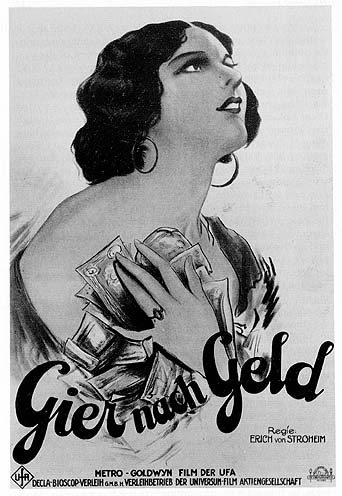
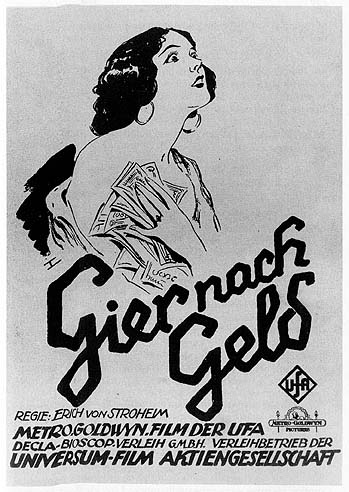
Advertisements for Greed,. In the first instance both sketch and script completely romantisize the film. The second offers a clue, albeit still muted, to the unsuspecting viewer. (Lichtbildbühne, 15 May 1926, p. 17; Kinematograph, 16 May 1926, p. 30.)
Greed’s reception dealt a rude blow to UFA’s hope that it would overcome anti-American sentiment, especially since critical opinion generally sympathized with the protest of the premiere audience. However, critics did not uniformly mock UFA’s analysis of the film. Whether or not prompted by the advertising campaign, some drew parallels between Greed and specific German film conventions. Of these, a few grudgingly conceded Greed a place among the select group of art films, even though they showed slight appreciation for Stroheim’s staging and handling of characters.[54] Others noted affinities with German filmic practice but challenged UFA’s assumption that these flattered Stroheim’s work. Hollywood’s imitation of German stylistic devices exposed these rather as dated and flawed. Ernst Blass, poet and lead critic for Berliner Tageblatt, argued that Stroheim had copied the chief faults of the German cinema, “the penchant for exaggerated theatrical conflicts and the taste for pictorial allegory.”[55] According to a review in Lichtbildbühne, in the second half of the film Stroheim had attempted to stage a motion picture chamber drama in the German tradition. Focusing attention on the emotional confrontation of three persons, he adopted the technique discovered by Ernst Lubitsch of depicting emotional states and suggesting plot developments by parallels with nature or inanimate objects. But his ambition to do for the cinema what Dostoyevsky had done for the novel—explore in infinite detail every facet of a mood or situation—demonstrated the inherent limitations of the medium. Symbolism carried to excess robbed Greed of tempo and pushed the viewer’s tolerance of morbid content beyond the breaking point. Film could not borrow literary ambitions or styles.[56]
If the approximation between German practice and Stroheim’s style constituted one recurring theme in commentary on Greed, an element of excess or fanaticism was the other. In this critics confirmed that UFA had correctly sensed, though falsely understood, the deviation of Greed from American motion picture convention. Stroheim made a noteworthy departure but lacked a sense of proportion. Wanting to get to the heart of an issue, he flogged it so unremittingly that it lost meaning. After a lengthy introduction which portrayed in striking realism the petty bourgeois society of America, the film plunged into a tale of fanatical lust for money whose naturalism strained the limits of credibility. The plot centred on a “borderline case” and left the viewer with a feeling of “oppressive torment.”
Willy Haas welded these ideas into a blistering denunciation of the picture and its director.Nowhere is there a humanly conciliatory ray of light. In this film everything is bitterness and torment right to an end which withers performers and audience. Here art is poisoned by philosophy, all life is ridiculous or horrifying madness.[57]
A frightful film; the most frightful, the most horrific film ever made. An orgy of hatred; a symphony of nausea; cold, hoarse, devilish laughter. Three thousand meters of indigestion at human meanness.
This Erich von Stroheim is a sick man.…If he had made any run-of-the-mill film he would have almost seemed brilliant; but with the diseased craving of the hysteric he takes everything to the heights and depths of a fundamental analysis of life.[58]
Needless to say, none of these indictments applied to the mainstream of Hollywood’s production. As the critic for Montag Morgen argued, Stroheim had become addicted to an excess of Un-Amerikanismus: “He made a gloomy, over-psychological, morose-cranky chamber play which could have more likely been devised in Germany.”[59] Several weeks after the ill-fated premiere Ernst Blass underscored this point and suggested that Stroheim’s brand of naturalism fell between two stools. Popular and critical distaste were both understandable:
Significant here are the underlying value judgments. American motion pictures were repeatedly mocked for idealizing life, for evasion of touchy subjects or refusal to treat these realistically and consistently and, of course, for the happy endings which symbolized all these tendencies. In these respects they were too popular; they conceded too much to the instincts of the American masses. By contrast, Greed had taken upon itself the portrayal of human misery and death, had relentlessly pursued the pernicious consequences of lust for money (and in a land which allegedly worshiped the almighty dollar) and had distinguished itself with the very opposite of a happy ending. Yet Blass, and many other critics, refused to assign it artistic worth because it flew from one extreme to the other. Its affinities with German art films failed to redeem it.If the all too normalized character of the American average production is boring in the long run, the abnormal is still no refinement. Protest was made against this film because it was all too un-American. Without being art it was all too unpopular. The downfall of the average is, however, being all too popular for Europe.[60]
Initial responses to Greed blended recognition of Stroheim’s Germanic tendencies and chagrin that his fanaticism resulted in a caricature of the chamber dramas for which the German cinema was famous. Only in isolated cases did the picture win unqualified endorsement as an artistic achievement.[61] But the case on Greed did not close in May 1926. Although the film never shook its reputation as a box office disaster, it did gain critical rehabilitation. Panned in 1926, it became almost a cult film among cognoscenti in the subsequent two years. Ironically, the cult focused on the features which had earlier provoked such sharp rejection.[62]
Rehabilitation came in conjunction with the realistic impulses of Neue Sachlichkeit, particularly amidst acclaim for Soviet cinema. Critics had as many reservations about the political message of Russian motion pictures as they had about Stroheim’s quite different fanaticism, but their respect for the stylistic innovativeness and impact of the former spilled over into reassessment of Greed.[63] One reviewer, later reminded of Stroheim’s film by Sergei Eisenstein’s Strike, maintained that common to both films was celebration of hatred—in the Russian film, of capitalists and police; in Greed, of mankind as a whole, including the movie audience, which sensed it and reciprocated with a chorus of whistles. Greed thus deserved the riot it provoked. But it also deserved applause for adopting an independent artistic line. Its unsparing naturalist style linked it with Soviet experimentation.[64]
Revival of Greed in special showings in 1927 and 1928 prompted more explicit revisionism. Looking back from 1927 Helmut Brandis summarized earlier critical opinion as a blend of respect for Stroheim’s brilliance and horror at his poisoned outlook on life. Brandis argued that the personality types depicted in the film belonged in asylums, but they functioned as mirrors to expose a submerged segment of human character. In blatant contrast to the vast majority of motion pictures with their candied, false moralizing, Greed attained extraordinary realism. For this reason it deserved appellation as “an unprecedented accomplishment artistically and morally.”[65] In the parallel formulation of another critic, the departure of this film from conventional approaches comprised its chief plus: in place of mendacious, beautified kitsch and the sensations dreamed up by script writers the reviewer encountered “unadorned truth, life as it is.”[66]
Without always stating why Greed had stirred audience feeling in May 1926, these later analyses made it self-evident: the public had no appetite for a glimpse of life without the conventional filmic cosmetic. At stake was not just popular resistance to an unusual motion picture formula. Harry Kahn, a critic for Die Weltbühne, spelled out in mid-1928 the root cause of audience outrage, even as he articulated the immensity of Stroheim’s achievement. Like critics of the premiere, Kahn found Stroheim guilty of exaggeration and distortion in his zeal to paint the perverse side of life. The extremism of the contrasts he drew between human types and milieus exceeded even that of Russian directors. By the same token, however, he became the lone non-Russian director to give film a content worthy of its technical sophistication; to escape conventional sentimentality and fantasizing in pursuit of uncompromising naturalism. The facet of life he chose to confront, and the method he used to portray it, predestined Greed to public rejection:
In short, Greed struck a chord in viewers which they simply refused to hear.A person is happy to pay several marks to sit two hours in a comfortable theater seat horrified at the sight of fates which can never touch him. But to have the horror of the emptiness of his own existence driven home to him is something which the average man scarcely tolerates in theater; in film he still today rebels against it.[67]
In retrospect Greed’s reception stands out for conflicting reasons. Strictly speaking, it presents a case with neither precedents nor sequels. Other motion pictures, such as Fridericus Rex, Battleship Potemkin or All Quiet on the Western Front, which triggered more violent responses (involving politicians and censors), did so on generally recognizable grounds. Greed’s rejection was much more problematic. Attempts were made to politicize the incident, beginning with UFA’s vague allegations about premeditated, organized opposition. Stroheim already enjoyed notoriety as a self-proclaimed renegade Austrian officer who had made a name in America during the war in anti-German hate pictures. Some suggested that the protest was at least partially directed against him. (Much later a leftist film journal claimed that for this reason UFA had itself orchestrated the demonstration in order to sabotage the premiere.) At the same time, however, there was a substantial body of opinion which pinned the uproar on the film, though again for diverse reasons. Critics found much internal evidence to support the theory that Greed was doomed to failure whatever the specifics of protest at the premiere. Popular resistance was thus at once part of the general aversion to American film and a reflection of Greed’s nonconformist approach.[68]
The timing of Greed’s release made its rejection the epitome of German rebellion against Hollywood. Ernö Rapée, the prominent Hungarian-American music director with UFA, argued that the scandal originated with shock and disappointment that UFA had been compelled to link its fortunes with those of Paramount and Metro-Goldwyn: protest aimed squarely at the Americanization of German cinema.[69] However, those who identified Greed as un-American, or at least more German than American, questioned so simple a reading of the affair. Their interpretation of audience response raised the possibility that Hollywood enjoyed greater acceptance in 1926 than complaints about moral and dramatic quirks implied: if “un-American” motion pictures provoked more protest than Hollywood’s assembly-line production, the latter had conceivably become more normative than experts wished to acknowledge. At a moment when domestic production was troubled by emigration of leading artists to the United States and was struggling financially and artistically to find a distinct identity, Greed called into question prevailing judgments about Hollywood’s place in Germany. Greed’s posthumous rehabilitation underscored the fact that Hollywood was not a spent force. It also threw into sharp relief the disjunction between critical and popular attitudes concealed by recourse to national taste differences. The Los von Amerika movement which has been traced in this chapter allegedly embraced all levels of German opinion. Greed initially appeared to confirm this, but its deviance from the Hollywood mainstream and later rehabilitation exposed the disharmony of critical and popular sensibilities. In sum, while spotlighting Hollywood’s middecade troubles in Germany, Greed’s reception also exposed unresolved domestic film dilemmas.
Notes
1. A summary is in Willett, The New Sobriety, pp. 95–104. The bibliography in Beck, Germany Rediscovers America, pp. 289–306, gives some indication of escalating interest in the United States. The statistics compiled by Wilhelm Pocher, “Die Rezeption der englischen und amerikanischen Literature in Deutschland in den Jahren 1918–1933” (Ph.D. Dissertation, Jena, 1972), pp. 18–19, show that over the period 1923–1928 German articles published on contemporary American literature increased 400 percent
2. On its reception see Lethen, Neue Sachlichkeit, pp. 20–24, and Peter Berg, Deutschland und Amerika, pp. 99–107. Cf. reactions to Walt Whitman cited in Sahl, Memoiren eines Moralisten, p. 58.
3. On Amerikanismus see Anton Kaes (ed.), Weimarer Republik. Manifeste und Dokumente zur deutschen Literatur 1918–1933 (Stuttgart: J. B. Metzlersche, 1983), pp. 265–286; Peukert, Die Weimarer Republik, pp. 178–190; Hermand and Trommler, Die Kultur der Weimarer Republik, pp. 49–57, 314.
4. Cf. Lethen, Neue Sachlichkeit, pp. 25–26; Beck, Germany Rediscovers America pp. 244–245, whose concern to show that the German perception of America was seriously flawed mars his analysis of German perceptions. Contemporaries recognized that America was largely an abstraction. Cf. the essays reprinted in Kaes (ed.), Weimarer Republik; Alfred Ehrentreich, “Americana,” Die Tat, 19 (1928), 789–792: “In the final analysis it is ideologically not at all a matter of America itself, but of what type of intellectual culture we endorse.”
5. On social realism and politicization see Korte (ed.), Film und Realität; Murray, Film and the German Left; Rainer Berg, “Zur Geschichte der realistischen Stummfilmkunst.”
6. For a pithy summary of sentiments see “Volkes Stimme,” Lichtbildbühne, 24 January 1925, p. 14.
7. Adolf Halfeld, Amerika und der Amerikanismus (Jena: E. Diederichs, 1927), pp. x and 237. This work is a compendium of the contrasting stereotypes applied by nationalists to Germany and the United States.
8. Hans Buchner, Im Banne des Films: Die Weltherrschaft des Kinos (Munich: Deutscher Volksverlag, 1927), pp. 24–25, 78, 80. A brief analysis of Buchner is in Rainer Berg, “Zur Geschichte der realistischen Stummfilmkunst,” pp. 195–196. For parallels with France see Strauss, Menace in the West, p. 141.
9. In this regard see the shrewd guesses of Buchwald, “Das Kulturbild Amerikas,” p. 112, which still, however, fail to penetrate stereotypes applied to American film.
10. G.H. (Georg Herzberg), “Madame Dubarry und wir,” Film-Kurier, 6 August 1925 (italics in original).
11. Willy Haas, “Nostra culpa?” Film-Kurier, 16 November 1925; David Melamerson, “Unsere Stellung zum Auslandsfilm in der neuen Saison,” Kinematograph, 30 August 1925.
12. Pinthus wrote under the pen name Heinrich Stürmer, “Deutscher oder amerikanischer Film?” Das Tagebuch, 6 (1925), 1702.
13. Hanns Brodnitz, “Zur Psychologie der Filmkrise,” Film-Kurier, 8 June 1926; H. Sp. (Hans Spielhofer) reviewing “Durch Feuer und Flammen,” Süddeutsche Filmzeitung, 17 September 1926, p. 3.
14. On Schacht see my contribution to CineGraph. For his migration from literature to the cinema and conception of film criticism see his “Filmproduktion und Filmkritik,” B.Z. am Mittag, 25 November 1923, and “Deutsche und Amerikaner,” Das blaue Heft, 5 (1 December 1923), 26. His emphasis on mass sensibilities is explained in Freie Deutsche Bühne, 1 (1920), 919. The cinema’s fate at the hands of German intellectuals is lamented in “Filmhandlung und Stoffgebiet,” Das blaue Heft, 5 (1 March 1924), 17–21, and 124–126. All Schacht’s film essays in Das blaue Heft appeared under the pseudonym Balthasar.
15. Balthasar, “Rundschau-Filmpolitik,” Das blaue Heft, 3 (1922), 532–533 and 1022–1023; also “Deutsche und Amerikaner,” ibid., 5 (1 December 1923), 26–27.
16. “Der Carlos-Film,” ibid., 5 (1 April 1924), 16–19.
17. “Amerikanische Invasion,” ibid., 5 (1924), 199–200.
18. This review was reprinted under the caption “Entlarvung,” in Der Bildwart, 2 (1924), 643–644.
19. “Beginn der Filmsaison,” Das blaue Heft, 6 (1 October 1924), 23–24. “The intellectual paltriness of the whole thing, the balletlike style of the first part [and] the primitiveness of the second would have been overlooked because for the price there was still something to watch. Only when an attempt was made to dupe the Berliner did he start to rebel.”
20. Ibid., p. 24.
21. “Bilanz,” ibid., 6 (1925), 556–557; “Ausgangssituation,” ibid, 7 (1 October 1925), 32.
22. “Ausgangssituation,” ibid., p. 34.
23. Cf. Paul Beyer, “Abgesang,” Film-Kurier, 12 January 1924.
24. See, for example, the lead article “Ein Welterfolg . . .?” Lichtbildbühne, 23 August 1924, p. 9. Cf. reviews in Kinematograph, 24 August 1924, p. 11; Der Bildwart, 2 (15 September 1924), 94–96; Der Kunstwart, 38 (January 1925), 191–192. More general, caustic reflections are found in Franz Blei, “Die zehn Gebote,” Berliner Tageblatt, 14 August 1924; Fritz Engel, “Die zehn Gebote aus Amerika,” ibid., 22 August 1924.
25. Georg Mendel, “Wie lange noch,” Lichtbildbühne, 11 May 1926.
26. See Joe May, “Wir und ihr Film,” Das Tagebuch, 3 (1922), 1217; Aros (Rosenthal), “Deutschland und Amerika,” Kinematograph, 18 November 1923, p. 5.
27. Cf. Walter Flitner, “Amerikanisierung?” Reichsfilmblatt, 12 January 1924, pp. 16–19; Fritz Berger, “Der amerikanische Filmgeschmack,” Der Film, 18 May 1924, pp. 20–24.
28. Cf. “Das Kentucky Derby,” Süddeutsche Filmzeitung, 27 June 1924, p. 3; e.b. (Erna Büsing), Vorwärts, no. 302, 29 June 1924.
29. On King of Kings see the reviews by Willy Haas in Film-Kurier, 29 October 1927; Kurt Pinthus in Das Tagebuch, 8 (1927), 1814–1815; Hans Wollenberg in Lichtbildbühne, 28 October 1927; Harry Kahn in Die Weltbühne, 23 (1927), vol. II, pp. 755–757.
30. “Amerika, hörst Du die Pfiffe?” Film-Kurier, 10 September 1926. Also on Ben Hur see Film-Kurier, 8 September 1926; Süddeutsche Filmzeitung, 22 October 1926, p. 8; the exhaustive critique in Der Bildwart, 4 (1926), 788–791; Kracauer’s review of 23 October 1926 from the Frankfurter Zeitung in the folio at the Schiller Museum in Marbach, henceforth cited as Kracauer Folio, Marbach; Reichsfilmblatt, 11 September 1926, pp. 18–19.
31. Willy Haas, “Charleys Tante,” Film-Kurier, 26 September 1925; “Premiere im UFA-Palast,” Reichsfilmblatt, 3 October 1925, p. 14. Interestingly, Lichtbildbühne, 26 September 1925, pp. 25–26, expressed admiration for the new style. Rainer Berg, “Zur Geschichte der realistischen Stummfilmkunst,” pp. 98–99, implies that this development was the start and finish of anti-American protest, which it clearly was not. UFA put the program on the road with Rappé: Frankfurter Volksstimme, 7 October 1925 and 25 November 1925.
32. On the former see May, Screening out the Past.
33. “Verlorene Töchter,” Kinematograph, 17 August 1924, p. 13. This was one of the pictures Schacht lumped with the new wave of American imports which were beneath discussion.
34. Vossische Zeitung, no. 390, 17 August 1924. For Mendel’s comments see “Verlorene Töchter,” Lichtbildbühne, 16 August 1924, p. 34. Almost identical sentiments came from Berliner Tageblatt, 17 August 1924.
35. Vorwärts, no. 386, 17 August 1924.
36. “Du sollst nicht begehren deines Nächsten Weib,” Vorwärts, no. 446, 21 September 1924. The tone here was sharper than in the trade press; the message was similar. Cf. Lichtbildbühne, 20 September 1924, p. 29; Kinematograph, 28 September 1924, p. 18.
37. Der Film, 21 September 1924, p. 41. Cf. Pinthus’s blistering attack on American moral obtuseness in Das Tagebuch, 5 (1924), 1158–1159.
38. Reichsfilmblatt, 20 September 1924, pp. 35–36.
39. See the remarks by Ludwig Scheer, president of the National Association of German Exhibitors in Reichsfilmblatt, 31 July 1926, p. 4.
40. Although the historical section came under fire in some quarters for externalizing and trivializing sacred history the modern part did most to offend. Cf. Fritz Goetz in Vossische Zeitung, no. 399, 22 August 1924; Ternova in Der Kritiker, 6 (October 1924), 16.
41. Kurt Pinthus, “Die zehn Gebote,” Das Tagebuch, 5 (1924), 1235–1236.
42. Ibid., p. 1236. Cf. the review in Vorwärts, no. 398, 24 August 1924: “To the major questions which concern mankind the American cinema answers with a miserable little tract which may be good over there to dupe the masses but has no place any more in Europe.”
43. Martin Beheim-Schwarzbach, “Goldrausch oder Rauschgold,” Film-Journal, 11 June 1926. Cf. Walter Steinhauer: “The customary female type in American film…is slowly becoming unbearable. One can no longer quite swallow this blond, overly sentimental virtue.” Reichsfilmblatt, 16 January 1926, p. 36.
44. See the review of “Das goldene Land,” Vorwärts, no. 102, 1 March 1925; Ludwig Scheer in Reichsfilmblatt, 31 July 1926, p. 4; and especially Axel Eggebrecht in Die Weltbühne, 22 (1926), vol. I, pp. 229. Sentiments in this area are no more aptly captured than in the surprise and admiration for films perceived as an assault on the cult. See Kracauer, “Girldämmerung,” Kracauer Folio, Marbach, 22 June 1928; (Felix) Gong, “Zwei Amerikas,” Deutsche Republik, 2 (1928), 1161; Wolfgang Petzet, “Amerikadämmerung,” Der Kunstwart, 41 (1928), 269–270; especially Hans Kafka, “Neben dem Theater,” Das blaue Heft, 10 (1928), 427–428. On the phenomenon in general see Fritz Giese, Girlkultur: Vergleiche zwischen amerikanischem und europäischem Rhythmus und Lebensgefühl (Munich: Delphin-Verlag, 1925); Günter Berghaus, “Girlkultur—Feminism, Americanism, and Popular Entertainment in Weimar Germany,” Journal of Design History, I (1988), 193–219.
45. Haas, “Was uns an der amerikanischen Filmmoral befremdet,” Film-Kurier, 5 November 1925. Hans Tintner, “Die zehn Gebote des amerikanischen Films,” Film-Kurier, 11 April 1925, deals only marginally with ethical questions.
46. Rainer Berg, “Zur Geschichte der realistischen Stummfilmkunst,” pp. 93–99, acknowledges a crisis at middecade under the impact of the American invasion but then all but ignores the repercussions of this crisis in his discussion of developments from 1926 to 1929.
47. A critical biography is Richard Koszarski, The Man You Love to Hate (New York: Oxford University Press, 1983).
48. This plot summary is cursory even for the two and a half hour version of the film which saw public release. As Stroheim created it, the picture would have run for seven and a half hours. The script has been published: Joel Finler (ed.), Greed. A Film by Erich von Stroheim (London: Lorimer, 1972). For a selection of stills from the film see Herman Weinberg, The Complete Greed of Erich von Stroheim (New York: Avon Press, 1972).
49. For a brief description of the premiere and its aftermath see “Skandal im UFA-Palast,” Lichtbildbühne, 17 May 1926. Heinrich Fraenkel, Unsterblicher Film (Munich, 1956), vol. I, p. 126, claims perfect recall of the premiere, but does not even mention that the showing was canceled and the film withdrawn. He presumably was present at the first show, for which he records considerable enthusiastic applause drowned out by whistles and laughter. He remarks as well that the “literary” press was ecstatic—an overstatement—while the box-office results were disappointing—an understatement. For a report which linked the uproar to chauvinistic protest against Stroheim himself see Joseph Delmont, “Der Skandal im UFA-Palast,” Süddeutsche Filmzeitung, 21 May 1926, p. 10.
50. There were similar scenes over enlightenment films in the postwar period and over Fridericus Rex in 1922.
51. Cf. Balthasar, “Leckerbissen,” Das blaue Heft, 8 (1926), 304–305; F. Olimsky, “Gier nach Geld,” Berliner Börsen-Zeitung, no. 223, 16 May 1926, p. 6, who both conceded that the film had artistic merit, especially in the acting. Vorwärts, no. 227, 16 May 1926, also noted a nationalist protest directed against Stroheim. Film-Echo, 17 May 1926.
52. See “Die UFA gegen den amerikanischen Film,” Lichtbildbühne, 10 May 1926.
53. 8 Uhr-Abendblatt, no. 109, 12 May 1926 (my emphasis).
54. One critic advised shifting its venue from the UFA-Palast am Zoo to the smaller UFA theater on the Kurfürstendamm which specialized in Kulturfilme. UFA’s show theater, geared to pomp and glitter, was the least appropriate place in which to release serious motion pictures: Germania, 15 May 1926.
55. Berliner Tageblatt, 16 May 1926. In substance Fritz Olimsky (see note 51 above) and Max Freyhan in Deutsche Allgemeine Zeitung, 15 May 1926, agreed without relating this criticism to German practice.
56. Lichtbildbühne, 15 May 1926, p. 20.
57. Germania, 15 May 1926. Cf. reviews by Felix Henseleit in Reichsfilmblatt, 15 May 1926, p. 10, and those by Ernst Blass and Max Freyhan already cited. Henseleit saw a preliminary press performance and predicted that the German public would be “aghast in the face of this film.” Albert Schneider, Der Film, 16 May 1926, p. 11, attended the premiere and remarked that the audience failed to comprehend this rare masterpiece.
58. Haas, “Gier nach Geld,” Film-Kurier, 15 May 1926. While conceding certain pluses this review is decidedly negative.
59. See “Publikum als Scharfrichter,” Montag Morgen, 17 May 1926, p. 4.
60. Ernst Blass, “Normalfilme,” Berliner Tageblatt, no. 287, 20 June 1926.
61. Erwin Gepard, scriptwriter and critic, decided that not Stroheim but the Kurfürstendamm public was mentally deficient; no German director could presently rival Stroheim’s accomplishment: Der Deutsche, 16 May 1926.
62. See BA-UFA R109I/2440, Revisions-Abteilung, 13 December 1926, Anlage 3, which shows gross distribution receipts of RM 280.85 for May 1926, clearly the box office from the first showing on opening night. Between June and September the film earned another RM 2507, evidence that it did show elsewhere, if not widely or with great success.
63. The Soviet breakthrough came just two weeks before Greed with the premiere of Sergei Eisenstein’s Battleship Potemkin. Haas, “Meine Meinung,” Die Literarische Welt, 11 June 1926, p. 2, opened the door for revisionist appraisals.
64. “Streik,” Film-Kurier, 26 February 1927. Roland Schacht, “Russische Filme, amerikanische und deutsche,” Der Kunstwart, 40 (April, 1927), 55–57, also linked reflections on Greed to a discussion of the unique impact of Soviet pictures, chief among them Strike.
65. Helmut Brandis, “Gier und Geld,” Film-Kurier, 24 December 1927.
66. Georg Kruse, “Neue Wege des Films,” Der Kunstwart, 42 (October, 1928), 62–66.
67. Cf. Harry Kahn, “Alte Filme,” Die Weltbühne, 24 (1928), vol. II, pp. 103–104; Arnheim, “Erich von Stroheim in der Kamera,” in his Kritiken und Aufsätze zum Film (Frankfurt a.M.: Fischer, 1977), pp. 204–208.
68. UFA’s sabotage is alleged in Kurt Kersten, “Gier nach Geld,” Film und Volk, August, 1928, pp. 10–11. Haas, “Meine Meinung,” Die Literarische Welt, 13 August 1926, p. 2, credited the scandal to a combination of National Socialist agitators and a sincerely outraged audience. Cf. the suspended judgment of Willi Wolfradt in Das Kunstblatt, 10 (1926), 390. Kinematograph, 16 May 1926, p. 13, called the premiere of a Metro-Goldwyn picture amidst protests against this firm for re-release of the hate film, The Four Horsemen of the Apocalypse, scarcely tactful, but did not relate this to the critique of the film. A number of critics (Schacht, Schneider and Delmont) accused UFA of mismanagement of the premiere
69. “Amerikanische Filme und das deutsche Publikum,” Lichtbildbühne, 30 June 1926.