
4. People in a Landscape: Theokritos
Peter Levi
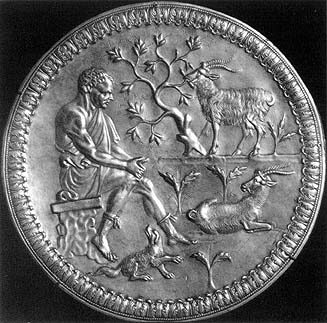
I must apologize for having the pretension to give this paper, which I know raises questions too naive to be answered.[1] My excuse is that I never cease to wonder about Theokritos. Virgil is already a brilliant and a thrilling poet in the Eclogues, but I think he got a lot wrong about Theokritos' bucolic world (figure 29)—almost everything, in fact, except the poetry, which he reproduced perfectly.[2] I have spent thirty years trying to master the lessons that Virgil learnt from Theokritos in his youngest poems. Four or five years ago when I was writing a history of Greek literature I reread most of what there is to read in Greek, and in all that long spell of reading, after Homer and Aeschylus I liked Theokritos best; he was freshest, and I was most surprised by him.[3] He came neck and neck with Plato, who took up a whole long summer. Indeed he owes something to Plato—those endless summer evenings, the dialogues of the idle in beautiful places—but I would sooner take part in an idyll of Theokritos than a dialogue of Plato, if only because of the sensuous concentration and apparent ease of the poetry, and its self-echoing noise. As Philetas claims in Daphnis and Chloe,[4] the echoes in the woods sing Amaryllis-yllis-yllis for ever. That trick has been reinvented many times; what persists is what du Bartas called “Écho, voix forestière, Écho fille de l'air” (Paradis terrestre, La Seconde Semaine, Premier jour).
Fig. 29.Pastoral scene probably representing Theokritos. Silver dish, late Hellenistic period. The Hermitage, St. Petersburg. From The History of the Hellenic People (Ekdotike Athenon, 1974), vol. 5, p. 397.
La gentile Alouette avec son tyre-lire Tire l'yre à l'iré, et tiri-lyrant vire Vers la vou;afte du Ciel, puis son vol vers ce lieu Vire, et desire dire, adieu Dieu, adieu Dieu.
I would like, initially, to notice a short lyric by the modern Russian poet Mandelshtam, which perhaps says more about Theokritos' technique as a poet and imitates him better than I can hope to do:
Orioles in the deep wood: vowel length is the one measure of all tonal verse: and on one day a year pure duration pours out and nature's metre is Homer's.
Like a caesura that long day dawns: from early morning longueur's lazy weed: oxen at pasture, golden indolence won't let you drain the whole note from the reed.
The question I have set myself is, what kind of a world are these herdsmen living in, and what are their social relations, as presupposed by the bucolic idylls? The idylls are deliberately varied, and they offer us an entire gallery of more or less unhappy country lovers, as seen by urban or courtly eyes, not by one another, like the sheepshearing in The Winter's Tale observed by the king. Theokritos in his χάριτες for Hieron (Id. 16.36ff.) makes an apology for pastoral poetry. He remembers the cattle of the Scopadae, the shepherds, and the horses. Cycnus earns a mention because he was turned into the water bird of his name on the river Sybaris: the scholiast says he was white from birth, διὸ καὶ θῆλυν αὐτὸν εἶπεν ὀ Θεόκριτος.[5] Then he goes on to the Cyclops, and the pigs and cows in the Odyssey, and Laertes tilling the ground. The final praise of Hieron is a prayer for the peace of Sicily and the flourishing of the earth:
May the old inhabitants repossess their cities, Build on ruins and restore what has been spoiled. May the fields be worked and bring forth crops once more While bleating flocks, too many to count, grow fat On the grassy plains. May the passer-by at nightfall Quicken his steps as the cattle are driven home. Let fallows be ploughed for sowing while the cicada, The shepherd's sentinel, high among branches, rasps The midday silence. Let the armoury be shrouded. Let poetry carry Hiero's fame through the world.
That is as close as the king can come to entering the idyllic world of the poems. Even the cicada is more memorable: how that tiny detail—typical of Theokritos—brings the rest to life!
The people want an old prosperity restored, an old natural order reinstated.[6] Apropos, the cattle are driven in at night but the sheep seem to be everywhere. This raises the important question of transhumance. We have been warned recently in the Journal of Hellenic Studies[7] not to believe too easily that ancient cattle were transhumant. In the earlier classical period I speculate that they were. Otherwise Kerambos (punished for disobeying the rules of transhumance) would not have become a stag beetle;[8] nor could the two herdsmen have met on Kithairon, thus making the story of Oedipus impossible. Louis Robert has pointed out[9] that grazing rights could be a causa belli; an inscription that guarantees mutual grazing rights between two cities foresees damages and infringements even so.
We know that owners were charged by the night for their cattle's grazing on temple lands at the Isthmus, and I assume that those cattle were crossing the Isthmus, as the sheep and goats from Dolianá in Arcadia did annually in living memory.[10] We know of an ancient boundary that cut off Aráchova from its grazing,[11] but that was because the grazing belonged to the Delphians: they were richer and their cattle grazed further. I do not understand how the enormous numbers of cattle sacrificed in Athens in the course of a year could graze normally inside the plain of Attica. So I assume that herdsmen wandered. In a period closer to Theokritos, we have a sad inscription from islanders seeking relief against wandering herds guarded by toughs, who grazed their flocks where they chose.[12] In the Roman period, Cicero's friend Atticus is supposed to have controlled much of the grazing of Epirus.[13] One man can physically handle only so many animals of course, but the growth of capitalism in the ancient world meant that one man could be the owner of many flocks—and of many shepherds, if they were slaves.
Very few herdsmen are named in inscriptions. Two of the few exceptions are Μάνης χρηστὸς τοῖς δεσπόταις ἤμην, surely a slave; and, in the cave at Vari: “Skyron's goatherd (dedicates) this altar to the Nymphs”—probably another slave since he has no personal name.[14] It would be interesting to know—not that they seem to care—whether the herdsmen in Theokritos are slaves or free. In the Roman period, it seems to have been conventional to reward herdsmen, or more particularly shepherds, by letting them raise a few beasts of their own among the flock. John Aubrey noticed the same custom in his own day in Wiltshire. “In our western parts (I know not what is done in the north), the sheep-masters give no wages to their shepherds, but they have the keeping of so many sheep, pro rata; so that the shepherd's lambs do never miscarry.” “He has the keeping of so many sheep with his Master's flock. Plautus hints at this in his Asinaria, (a.3 s.1, l.36). ‘The herdsman, too, who, like a mother, pastures strangers' sheep, has some of his own too, who are his chiefest hope.’ ” [15] When shepherds offer sacrifice at Mykale, all they can offer according to the inscribed record is a little cheese or a kid or a lamb.[16] This custom, which seems to go back at least to Theokritos, explains some otherwise perplexing moments in the Idylls.
It makes a lot of difference whether the herdsmen are free or not; on the whole I think they are not. It matters just as much whether or not they are travelers; that is a problem we must discuss in detail. They certainly seem to know one another quite well, and the social distinction of “cowmen top, shepherds second, and goatherds lowest,” [17] which a scholiast gives and the idylls on the whole confirm, is not sufficiently sharp to make them uneasy. Their typical songs, the βουκολικὰ, consist of a brief series of two or three lines each on a wide variety of themes, with a refrain, often strung together and quite subtly matched, almost like the matching series of haiku of the Japanese poet Basho.[18] The relationships of persons are conventional, but they are very much sharper than the languorous, scarcely differentiated landscapes, haunted by country gods and shepherds, that we find depicted in the visual arts[19]—those twisted trees and wordless conversations that tend to swamp our reading of the idylls. From the first idyll onwards, relationships are crisp: more is implied than is said.
Thyrsis in Idyll 1 is a shepherd, who invites a goatherd, in the name of the nymphs who own the spot, to sit and pipe, while Thyrsis looks after the goats. The goatherd refuses to pipe at noon but begs Thyrsis to sing the cowman's song, The Passion of Daphnis, which Thyrsis composed. All this is pure diplomacy: Thyrsis has induced the goatherd to offer him a solid bribe, three milkings of a good nanny goat, and an elaborate wooden cup as queer, on a lesser scale, as the shield of Achilles.[20] I take the description of the cup to be the goatherd's equivalent of a song. There are two strange references to travel. First, the goatherd bought his cup, for a goat and a fine cheese, from the Kalydna ferryman. Kalydna seems to be a little island north of Kos; so people, perhaps herdsmen and their flocks, move about among the islands. Or was the cup carved in Kalydna and sold in Kos? Then why to a goatherd? Is the point that a wooden cup would be terribly old-fashioned and a goatherd would treasure it? I think the goatherd traveled with the ferryman. Second, who is this Chromis the Libyan against whom Thyrsis sang in a contest? A Greek-speaking shepherd, but “Chromis” may mean he was black. The contest was local: they know one another. Is Chromis a local man, or a mildly exotic member of the floating population of the Near East? There were flourishing Greek settlements in Libya, and in Idyll 3 we have a yellow Libyan billy goat (4–5). This internationalism is apparently deliberate. Thyrsis himself is from Sicilian Etna.
The song about Daphnis seems to be set in Sicily. Daphnis is the cowman par excellence, who died of love, mourned by the wild beasts and by his own cattle, by herdsmen of all kinds, and by Priapos. The same thrilling detail as usual brings the scene to life: Daphnis grazed and watered his cattle on Mount Etna, but the nymphs of eastern Sicily failed to protect him from Aphrodites' vengeance. When he dies, nature is reversed:
Let the prickly juniper bloom with soft narcissus, Let pine be weighed with pears. Let the stag hunt the hounds, Let the nightingale attend to the screech-owl's cries.
It may not help much, but my own suspicion is that Daphnis invented the bucolic song; that he is, in fact, Boutes, the human lover of Aphrodite of Eryx at the far end of Sicily, who, the Athenians maintained, was the founder of the Boutiadae, a clan active and privileged on the acropolis of Athens. Apollonios of Rhodes explained how Boutes ended up at Eryx, having swum ashore there from the Argo.[21] I take this elaborate bit of mythological cunning to date from the fifth century, and I assume that Apollonios, an Alexandrian by birth, simply found it useful, just as Kallimachos found Hekale useful. But Theokritos was a Syracusan, Thyrsis was from Aitna, and apparently so was Daphnis. If we are right to set this idyll in Kos, because of the ferryman of Kalydna, then the goatherd comes from there.
After many years of suspicious resistance, I am bound to admit here that I accept most of Gow's footnote about the Kalydnian ferryman.[22] I think the reference in Homer (Il. 2.677) to the Kalydnian islands as the islands, most notably Kalymnos, around Kos must be decisive in such a poet as Theokritos; and we know he wrote about Kos in the great seventh idyll, where the country people were surely masks for real poets. It does remain possible that the cup for which the goatherd paid in cheeses is so elaborate that it must have come from Kos or even Alexandria, and that the poet's fancy of how such a wonderful cup might get into the hands of a goatherd involved him in the invention of a vague Kalydnian sailor. That is a possible reading, and then the setting is Sicily; but the goatherd still has dealings with a sailor, and I prefer the other view. As for Kos, it was the home of Philetas, and Tityros and Daphnis were both his characters.[23]
Notice that the settings of the idylls are intensely and sensuously realized, but as vignettes, never complete landscapes, and with only hints as to what country we are in. I like Wilamowitz's observation[24] that Aigilian figs at the end of the first idyll are related to the Aigelioi of Kos and not to the Attic deme of Aigilon (or its hero Aigilos), which is an unrecorded village remembered for its figs only by Philemon in his treatise on Attic names, quoted by Athenaios.[25] Philemon may be thinking of this poem.[26] Gow takes the view that geographical names in bucolic poetry are not to be taken seriously.[27] My impression is that they are hints at the real world of the poem's characters. At any rate we should pursue them as if they are, and I believe they will turn out to make sense.
Let me offer, at least as a kind of extended footnote, a formal rebuttal of Gow's view that geographical names are used by Theokritos with cheerful insouciance and are often contradictory.[28] I have already dealt with the first idyll. But to say that “Thyrsis is Sicilian (65) and the Libyan (24) also suggests the west” is to sweep the problem under the carpet. Thyrsis and the Libyan met at some international competition, a shepherds' Olympics. In the second idyll, to say that “Lipara (133) conflicts” with all the evidence for Kos is ridiculous: the fire of Lipara is an enormous volcano, which is bound to be proverbial at least as far away as Kos. In Idyll 3 Gow is simply guessing, and so am I. In 4 and 5 his attempts to pick holes in the geography pile conjecture on conjecture: the rivers of Sybaris, Haleis, and Himera are admittedly surprising and raise a mild doubt; but even if Theokritos had invented them, which I do not suppose, only in Sybaris (which no longer existed) would he have given his own names to a landscape. But I think he knew Kroton and Sybaris. In the tenth idyll we have the old problem about Sicily and Kos. But the choice of Sicily depends here (4) upon the plant kaktos, which was known to Nikander and Philetas, who had no Sicilian connection, and on the song of a lark (50), which we know from the seventh idyll to have been at home in Kos, and which anyway was Demeter's bird. (Philetas, incidentally, wrote a poem about Demeter.) The other indications in the tenth idyll, such as they are, point to Kos.[29] Theokritos' world is the real world.
One might go further. The goatherd's description of his cup forms a fine matching contrast with the song Thyrsis sings, but in an Alexandrian mode of another kind; it is not bucolic song. The goatherd's language is in general queerer, quirkier, and spiky with detail. Apart from the first exquisite exchange of compliments—and even this he is not well able to sustain—the goatherd is scarcely capable of true bucolic song. Of that Thyrsis gives a perfect and fully developed example. Thyrsis is a master-singer of international fame: the passion of Daphnis is his set piece, it is not impromptu, and the goatherd worships it. What a herdsman might produce on his own we learn from other idylls: specifically, from 3 and from Komatas and Lakon in 5. It seems to be just a few antiphonal, competitive verses sung impromptu, suspiciously like certain epigrams which we have only from a slightly later generation, from Mnasalkes of Sikyon for example.[30] Idyll 3 consists of the rustic, solitary komos to Amaryllis: a string of fragmentary love songs. Their eloquence is not bucolic, but rather belongs to the traditional nature of love songs. The singer is unnamed; Tityros, however, is looking after the goats:
Lucky the bee as it flits through the curtain drawn Across your cave, dark ivy and maidenhair fern. O pity my restless heart! Look how I pine!
Now I know Love as he is, an angry god Suckled by a lioness, reared in a wild wood, A smouldering fire that burns to the very bone.
The lips may be loving though the heart is unstirred. Then let yourself be kissed by a clumsy goatherd, Girl with bright eyes, dark brow and heart of stone.
Who is Amaryllis? Philetas surely invented her.[31] Does she live alone in a cave? Is she a nymph? No, common sense assumes that she lives there in the summer, keeping a few animals. He might give her a white nanny goat with kids. His own goats are on the hill, but she lives less ambitiously by the shore. He might turn away and give the goats to Mermnon's ἐριθακίς, a girl servant in diminutive form, who wants them. This landscape is quite densely populated. Olp(h)is sits on the cliff watching for tunny fish, and normal island life is going on. Can Olp(h)is be a character from Sophron's mime about tunny fishing?[32] The Tityros of Idyll 7 is a shepherd, probably native to Kos, in the song sung by Lycidas; yet he reminds us of Thyrsis, because Lycidas says that Tityros (72–73) will sing how Daphnis loved Xenea, and the hill grieved for him, and the oak trees on the banks of Himera sang his dirge. The river Himera brings Daphnis further west and closer to Boutes; but Tityros, as Lycidas imagines him, is in Kos: his song comes fresh off the mountain. Between Kos and Sicily, herdsmen's songs are apparently common property—not, after all, an unlikely phenomenon. The explanation may well be that, as Bowie argues,[33] Lycidas and Tityros both come from Philetas.
The fourth idyll reveals a new world: it is a frank and salty conversation between two herdsmen. Aigon (also a herdsman) has gone off to Olympia as an athlete, taking twenty sheep. This is southern Italy, and he will have to stay in Greece at least a month in the hot season. His companion is the famous athlete Milon of Kroton (fl. mid–sixth century B.C.), so this idyll takes place in the remote past. Milon was once defeated in a test of strength by a cowman,[34] and the Alexandrians were interested in that legend;[35] so we are in either the sixth century or a vague and dateless golden age. Yet scholars identify Glauke (31) as a contemporary musician; if she is, she seems a deliberate intrusion. In this poem, “Amaryllis” is recently dead. Is she the same Amaryllis or another? Is she nothing more than a girl's name from a song? Or is this a deliberate attempt to create a web of relationships, between scarcely named characters, covering the whole Greek rural world of the Mediterranean? I suspect this Amaryllis of having one foot in the grave and the other in the sixth century B.C. Maybe Philetas buried her. Kroton had a disturbed, unhappy history: it is a queer place to choose for a golden age. I agree with Gow that the poem itself is early Theokritos;[36] it contains no great song. Battos is grazing Aigon's herd, but the father of Aigon oversees the milking; the herd are in bad condition, missing their master. Battos might steal milk if he could. The calves stray into somebody's olive grove, and Battos gets a thorn in the foot, which Korydon pulls out. This is certainly a timeless world.
Tell me Korydon, is the old man still screwing That little girl he fancied, the dark-eyed one?
The same as ever. It was only yesterday Down by the byre that I caught him on the job.
You'll never rest old boy, till you beat the Satyrs And thin-shanked Pans at their own horny game.
In the fifth idyll, we have the same capricious network of relationships, but in this idyll alone the goatherd and the shepherd are definitely slaves. A subversive question: in this poverty-stricken, sufficient world, where there are so many refinements of status, does slavery really seem to matter very much? It would matter to me; but does it matter to them, or does Theokritos think it does? He does, I think, make slavery an ironic background for ridiculous pretensions; but in these two last idylls I am not clear about how unhappy the herdsmen are. Komatas may well (in my view) be the heroic herdsman of Thourioi who was famous for his resurrection from a chest of honey.[37] Lakon (racial names for slaves are extremely common) knows Korydon from Idyll 4, and Sybaris is close to Kroton; indeed their rivalry was famous, so I imagine Idylls 4 and 5 are linked. Sybaris was famous for its luxuriousness and its obliteration. The tall stories about Aigon are surely very old.
Also, these two idylls both deal with pungently low life. It must be deliberate that they are both set long ago and far away, and yet that these conversations and songs could happen anywhere. The sense of a dreamlike confusion of time is as essential to Theokritos as the sharpness of the thorn in the foot and the lazy sweetness of the Italian grazing grounds. Even the small thefts in Idyll 5—the stolen milk, the goatskin, and the pipe—are in some way innocent; while the bets between the two slaves, a fattened lamb against a billy goat, are wholly innocuous. The erotic undertones are merely rustic and propose quite an innocent picture of life. Lakon used to be buggered by Komatas, but now he has fantasies of his own about the boy Kratidas, while Komatas has discovered girls. Lakon's girl is less credible, being introduced at the last moment, and he boasts about her only when he is sore: she is ἁ παῖς, only a figure in a competitive couplet (126–27) to answer a couplet by Komatas. The same may be said of Alkippe and Eumedes at the end of the contest (132–35). Morson, the woodman cutting heather nearby, judges that Komatas wins (138–40), and in the final few couplets of the contest Komatas without doubt has the upper hand—psychologically at least, and, I believe, even as a poet: “Moon clover and goatwort have my goats for pasture; on mastic they walk, they couch on arbutus.” Lakon's reply is pretty but less thrilling: “Balm have my sheep to browse, and like roses in plenty flowers the cistus.” Even in Robert Wells's beautiful version, Komatas is the more sharply sensuous of the two:
Komatas: Vetch and clover are my goats' favourite browse, They walk on mastich and sleep among arbutus.
Lakon: Where my sheep graze, rock-roses open around them. They feed on the starry balsam's favourite blossom.
The old unregenerate bugger goes his way rudely rejoicing; the old lover has beaten his beloved, the old singer his pupil; and the goatherd, because of the hardness and pungency of his song, has beaten the shepherd. It need scarcely be said that competitions like these are real. Antiphonal song on impromptu subjects, involving a conflict of wit and, to some degree, of poetry, has been recorded as late as the 1960s by A. L. Lloyd.[38] I have even heard it myself, as a conversation in the fields, and as a mocking comment on the slowness of our expedition, sung in Persian in the remote mountains of central Asia. That is the source of bucolic song, which Gow found so enigmatic. Living folksong enters into the heart of it.
Idyll 6 is another challenge and response, but the songs are longer: fourteen verses against twenty-one. Damoitas and Daphnis are both cowherds, both apparently Sicilians; they exchange gifts of a flute and a pipe, and the physical difference between them is very slight: “The face of one was blurred with down, the other had a beard coming.” They grazed their herds together and together they sang; they kissed each other at the end, and one fluted and the other piped “while their calves frisked over the soft turf.” These two are in stark contrast to the couples of Idylls 4 and 5. Galatea and Polyphemos are the theme: Daphnis sets it but Damoitas completes it. In Daphnis' song Galatea is a nymph taunting Polyphemos, whom Damoitas makes pathetic: she calls him “goatherd, clumsy lover.” The love of Polyphemos and Galatea, unhappy as usual, is framed by the happy herdsmen, and they in turn are framed against the sad human poets, Theokritos and Aratos. Daphnis of course is an ancient, not a contemporary, character.
Only the famous seventh idyll is certainly meant to be contemporary. An inscription has even turned up on the island of Kos that seems to localize it, or rather to confirm its localization, not far from the spring of which Gow reproduces a photograph.[39] The characters in this idyll only seem to represent real poets, and the descriptions are the lushest and most inviting in all the works of Theokritos. The competing songs are based on a genuine bucolic tradition, no more remotely than those of Daphnis and Damoitas; but a certain unreality or surface shimmer divides this idyll from those I want to discuss more fully. It reads to us as a puzzle, and any hints it offers about real rustic life must be treated with caution.
All the same, Lycidas, the Kydonian[40] goatherd who looks the part, is of some interest, and so is the sensory sharpness of his conversation (7.11ff.):
All these conversations are in the hot season and mostly at midday. The contrast of heat and coolness, smooth and shaggy, movement and stillness, are essential to the poetry: “Now even the lizard lies asleep in its cranny, / And the tomb-haunting larks have gone to ground.” The larks, I suppose, are ground-nesting birds among the shade of roadside tombs. Παίζει τάφοις, Babrius says (72.20). I find it impossible to believe in a crested lark called “tomb-crested” except as a joke in Aristophanes. In a recent Festschrift, Dr. Lezzi-Hafter offered a suggestion that would throw light on this idyll: that the bird on top of Demeter's sceptre is a lark.[41] I find the suggestion so attractive that I am bound to adopt it until and unless it should be disproved; though I notice also that the Athenians were led by a lark to Korone, where they worshipped Apollo Korydos.[42] I take the bird flying up behind Demeter's throne in the fifth-century Boeotian plate reproduced by Gow[43] to be a lark. The memorable festival at the end of the poem (128–57) is one that normal herdsmen never get to attend: it is the innermost sanctuary of Theokritean verse.
A coarse-haired, shaggy goatskin, the colour of rust, Smelling of milky rennet, hung from his shoulders. Beneath lay a threadbare smock, done up with twine About the waist, and he carried an olivewood crook In his right hand.
It is with some reluctance that I abandon the seventh idyll, because this is the last poem genuinely by Theokritos to touch on herdsmen and their songs. His fishermen share the same poverty, but the bucolic singing that makes him so famous is confined to four or five poems, unless you count Boukaïos the reaper in Idyll 10. Idylls 8 and 9, though probably not genuine, do cast a little further light on the pastoral world, in spite of their inferior verses. In the eighth idyll Menalkas does not dare to bet a lamb against a calf, because he works for his father—“stern my father is, and stern my mother, and at nightfall they count over all the flock” (15–16). A goatherd has a barking dog, just as Polyphemos had in Idyll 6 (10–11), and Menalkas has one called Lampouros (65). The destiny of most milk is as usual cheese making. Fresh milk, of course, would not keep, and we know from a fragment of Nikander[44] that on Samos and Doulichion βουγάïος meant a milk drinker. People live in caves. Both these phony idylls are about Daphnis and Menalkas; at the end of the first, Daphnis, ἄκραβος ἐών, florens aetate, marries the nymph Naïs, and in the second Menalkas addresses Αἴτνα, μᾶτερ ἐμᾶ…(15). The poet gives Menalkas a seashell from the rocks of Ikaria, near Kos, a conch that fed five people. Finally, Idyll 27 is not by Theokritos, and what light it casts is confusing. Daphnis, son of Lycidas, seduces a girl called Akrotime, daughter of Menalkas. He is a cowherd and she is (what I wish I knew more about) a shepherdess:
Χἠ μὲν ἀνεγρομένη πάλιν ἔστιχε μᾶλα νομεύειν ὄμμασιν αἰδομένοις, κραδίη δέ οἱ ἔνδον ἰάνθη.(69–70) She rose and went again to herd the sheep, Shamed in her eyes, but her heart within was glad.
The reapers in Idyll 10 are a gruff, perhaps elderly workman called Milon, given to coarse rustic proverbs, and a lovestruck young man, Boukaïos, whose name suggests a cowman and his song: in the Iliad Hector uses it as an insult to Ajax, as Antinoös does to Iros in the Odyssey.[45] Homer says βουγάïος, not βουκάïος, and the two citations confirm one another, but the difference of spelling is nothing. It is typical of the freakish pedantry of the Alexandrians to use a Homeric word in a corrected form. Bougaïos or Boukaïos has fallen for the girl from Hippokion's farm, the daughter of Polybotas, who must be a farm slave if not a wage laborer. She plays the flute for the reapers, and Milon's advice about her is “Take what you want and pay for it.” Boukaïos sings a song about love:
Bombyca, they call you a gipsy, sunburnt, thin. I call you slender child with the honey skin.
The word “gipsy” stands here for the Greek Syra, a Syrian, which is a slave name and maybe a joke. Milon mockingly admires this song, which is indeed admirable and pathetic at the same time:
Milon replies with what he calls the song of Lityerses; Lityerses was a form of John Barleycorn, and his only function here is to indicate a reaping song, which turns out to be a string of loosely related couplets, whereas Boukaïos's impromptu love song was more artistic, probably because love songs were like that.[46] Like the Works and Days of Hesiod, Milon's song begins formally, but it soon tails off into proverbs and satiric verses. The encounter remains undecided.
Bombyca, knuckle-bone feet and voice like a flower— I am lost for words to show how lovely you are.
Boukaïos would like a pair of Amyclaean sandals (35),[47] at present we must think of him as barefooted, like Battos in the fourth idyll. The cattle graze, the world of these poems is unshod. Sex and poverty are the only troubles, but dreams overcome both, and song consoles for both. Sex in fact is sex without consequences. Priapos has presided over everything that happened since Idyll 1. Desire comes easily and in many forms; and so perhaps does the fulfillment of desire. “There is in empty kisses sweet delight” (Id. 27.4). Sometimes the world of Theokritos is like Plato's, as shameless and yet as virtuous; the opening of the seventh idyll recalls Plato's Republic in its carefully detailed setting and the meeting of friends. But Theokritos is not a philosopher, or at least his philosophy is in reserve, unspoken. His technique is a little Chekhovian; he likes resonance and echoes and counterechoes, and he hints at far more than he precisely reveals. (With Aischines and Thyonichos, for example, in Idyll 14, we discover only gradually where we are, after the poem has hooked us.) His great urban set pieces, Idylls 15 and 2, the Festival of Adonis and the Pharmakeutria, only gradually reveal themselves. The same is certainly true of his brief bucolic idylls. We read the characters, surmise a world (or an age of the world), and overhear an enchanted singing; and that is all. I assume it was meant to be all. We may well wish that some ancient professor, a lesser Aristotle or a Xenophon, had written us a treatise on the subject matter of Theokritos, but no one was interested enough to bring it to life except Theokritos himself. All we have really is the poetry; the learned scholia hardly amount to much.
The intrusion of love poetry of various kinds into the herdsmen's world calls for tactful observation, because when we are presented with poetry of a unique nature we are not always able to see what is being mixed with what. Mnasalkes of Sikyon makes it clear, in his seventh epigram,[48] that love is not a proper theme for herdsmen. His epigram is addressed to a syrinx, a pair of Pan-pipes, that he finds in a shrine of Aphrodite. The point is that he does find it there, and I assume that he may be thinking of Theokritos:
I do not think it is too pedantic to suggest this poem is about wordless music, the kind of piping heard by lost travelers in the Alps, echoing from the rocks, according to Lucretius, and taken to be Pan (4.577–89). Pan plays a small part in Theokritos: he is a name to swear by, and Daphnis, dying, hails Pan as his master because of his piping. But Daphnis is dying of love, and as Mnasalkes says, wild music lives on the mountain. “O Pan, are you ranging the long hills of Lycaeus / Or the heights of Maenalus?” Daphnis asks (1.123–24), and bids him
Syrinx what are you doing here with the Foamborn? Why did you stray here from a shepherd's lips? Here are no cliffs or glens, but only loves And longing. The wild Muse lives on the mountain.
Come, master, and take this pipe of mine, sweet-smelling, Fastened with wax, the lip-piece delicately bound. Love drags me into the darkness where no songs sound.
But the truth seems to be that the love theme was essential to bucolic song, if only because it was essential to the death story of Daphnis. This argument is, of course, based on a myth, and a late version of a myth; but love also occurs in the stray impromptu stanzas sung in competition, or simply strung together in the fields. Men and animals come together in the shade at fresh water in the heat of the day and of the year. Why is there no piping, though there may be singing, when Pan sleeps at midday? Because it is not only Pan who sleeps, and because the use of the pipes is to lead animals out in the morning and home in the evening. The Greeks used pipes as we use sheepdogs. In the heat of the day animals may stray, as Theokritos has them stray whenever the herdsman's eye has been off them, but normally they lie stinking in the shade of trees, like their human guardians. I have heard the klarino played at midday high up on Mount Pelion, but that was by an itinerant musician on his way to a festival. Other times, other customs.
The first idyll is an aberrant masterpiece: its mourning music, its theme of a love-death, and its refrain to the Muses, are adapted from various sources to a work of high art, just as the second idyll is adapted from magical language that we could never recognize by knowing only the second idyll. The love songs of the Amaryllis idyll (3) suggest a wider variety of loosely related themes, but although the situation is realistic and rustic enough, the poetry here sounds far more sophisticated than the real impromptu serenade would. The classical references to Hippomenes and Melampous and Adonis and Endymion are enchanting, but not truly rustic. They are part of international grand mythology; they are in fact literary. (One would not expect, for example, to find them all together in a shepherd's speech in Aristophanes.) The fourth idyll is full of hints about real herdsmen, but not exactly herdsmen's song. The description of the grazing grounds which is gradually built up has an amazing casual-sounding grace; the sound is genuine but the trick is literary. The sound is the recognizable sound of Greek poetry, in its most refined form, sounding as clear through the dialect as William Barnes does in English (a kind of Tennyson by other means), and making cunning use of the most peculiar and knobbly words to produce that fresh and sighing effect only a poet as good as Theokritos can produce: a sound worth all the generations of effort that lie behind it. Our truest, or nearest to true, example of bucolic song is in Idyll 5, the contest between Lakon and Komatas, two slaves, one of them just touched with obscure mythological grandeur. I think that Virgil understood how this poetry worked, and learnt to reproduce it gleefully. That of course is another story.
May I set The winnowing fan in another year's heaped grain While the laughing Goddess clutches her poppies and sheaves.
| • | • | • |
Response: David M. Halperin
For Pratt C. Remmel, Jr.
When I was writing my love poems, which sprouted out from me on all sides, and I was dying of depression, nomadic, abandoned, gnawing on the alphabet, they said to me: “What a great man you are, Theocritus!” I am not Theocritus: I took life, and I faced her and kissed her, and then went through the tunnels of the mines to see how other men live. And when I came out, my hands stained with garbage and sadness, I held my hands up and showed them to the generals, and said: “I am not a part of this crime.” They started to cough, showed disgust, left off saying hello, gave up calling me Theocritus, and ended by insulting me and assigning the entire police force to arrest me because I didn't continue to be occupied exclusively with metaphysical subjects. But I had brought joy over to my side. From then on I started getting up to read the letters the sea birds bring from so far away, letters that arrive moist, messages I translate phrase by phrase, slowly and confidently: I am punctilious as an engineer in this strange duty. All at once I go to the window. It is a square of pure light, there is a clear horizon of grasses and crags, and I go on working here among the things I love: waves, rocks, wasps, with an oceanic and drunken happiness. But no one likes our being happy, and they cast you in a genial role: “Now don't exaggerate, don't worry,” and they wanted to lock me in a cricket cage, where there would be tears, and I would drown, and they could deliver elegies over my grave.
This is not a personal confession, but Robert Bly's translation of “Carta a Miguel Otero Silva, en Caracas” (Letter to Miguel Otero Silva, in Caracas), a lengthy lyric poem composed in 1948 by Pablo Neruda.[1] I have chosen this poem because it articulates a notion of Theocritus that Professor Peter Levi and I can join in repudiating. Theocritus the elegist, the weepy love poet, the metaphysician, caged with crickets behind the bars of his own artistry and self-absorption (cf. Id. 1.45–54)—that is not the poet whom Professor Levi and I admire: Neruda's Theocritus, I think it is fair to say, is not our Theocritus. We do not suppose, to be sure, that Theocritus could easily pass Neruda's test of social engagement. Theocritus is not a revolutionary, a social reformer, or even a militant social critic. But he is not wholly immersed in the world of his own sentiments. I doubt that anyone could come away from hearing Professor Levi's paper without a just appreciation of Theocritus' skill as a social observer, his keen interest in the details of “how other men live,” and his sympathetic engagement with the world around him.
I begin by emphasizing the extent of my agreement with Professor Levi, because I shall have scant occasion to do so again. I hope none of my sweetly reasonable fellow discussants will take offense if I say that to agree with the speaker is a kind of professional betrayal in a scholarly commentator. Even worse, it is alien to the spirit of bucolic exchange, as Professor Levi has described it.
Despite this shameful inability of mine to rise to the bucolic occasion, I can declare that my outlook on Theocritus really does differ from that of Professor Levi; in what follows, I shall try to magnify our disagreement in the interests of scholarly controversy. In fact, I cannot help but suspect that Professor Peter Green, when he invited me to comment on Professor Levi's paper, must have been indulging his own well-known bent as a provocateur, a mischief maker. To engineer an exchange between Professor Levi and myself on the subject of Theocritus was surely to construct an exercise calculated to drive each of us deeper into his own established identity, putting on public display Professor Levi's marvelous and highly personal intuitions about ancient authors, his splendid eye for the significant detail, his incomparable knowledge of the Mediterranean and its inhabitants, and his dazzling hit-and-run tactics as a literary critic, all the while exposing more plainly to view my own hopelessly academic relation to the subject, my tedious concern with literary categories and schemes, and my cautious, perennially dreary interpretative style. I must now give up the struggle against Professor Green's typecasting and submit myself to the inevitable: against necessity, as Simonides said, even the gods do not fight.[2]
Professor Levi's Theocritus is a poet of nature, a Hellenistic Mandelshtam, tuning his verse to the rhythm and cadence of the seasons, capturing in language the sonorities of the classical landscape. My Theocritus is, characteristically enough, “the first academic poet,” as his most recent American translator, Daryl Hine, has called him[3]—or perhaps I should say, the first great academic poet: a writer whose artful language, lavished on uncouth subjects, creates an effect of deliberate incongruity which is designed to forestall any reader's attempt to wallow complacently in Theocritus' sensuous images.[4] Rather than dilate further upon my Theocritus, however, I wish to examine more closely that alien creature, Professor Levi's Theocritus, in order to determine what it is about him, exactly, that seems so unfamiliar to me.
Professor Levi's Theocritus is at once a romantic and a realist, whose poetry combines “sensuous concentration” with keen observation of social realities. The Idylls invite us to while away “endless summer evenings…in beautiful places” even as they present to us a window on the life of rural Greece in the Hellenistic period. These two tendencies in Professor Levi's Theocritus—the evocative and the documentary—are not in principle contradictory ones, but I often find them difficult to harmonize in Professor Levi's handling of them. I can never tell in advance which details in Theocritus Professor Levi will take to be simple reflections of contemporary reality and which he will derive from the inherited traditions of Greek poetry, history, and myth; nor have I fathomed the logic that governs his choices in specific instances. And yet it makes some difference to our reading of Idyll 1, for example, whether we consider the fictive “internationalism” of Theocritus' pastoral world (to which Professor Levi rightly calls our attention) purely facetious, a pretty fantasy of performing herdsmen who manage to acquire within the confines of their little society an international prestige, or whether there really was “a shepherd's Olympics,” as Professor Levi calls it, a periodic pan-Hellenic festival for talented rustics. The latter possibility, I think, would have struck a sophisticated Alexandrian audience as hardly less comical than the annual convention of village idiots in Woody Allen's Russian idyll, Love and Death, which is perhaps closer in spirit to Theocritus on this point than is Professor Levi's reconstruction. In any case, what I have difficulty understanding about Professor Levi's interpretation is why he believes in Chromis the Libyan in Idyll 1 (even though Virgil treats Chromis as a standard pastoral persona in Eclogue 6) but in neither Olpis the fisherman nor Amaryllis in Idyll 3, preferring to relegate them to a lost mime of Sophron's and to a lost work of Philetas', respectively. (Philetas seems to have become, since E. L. Bowie's recent essay,[5] an all-purpose dumping ground, a popular interpretative resort for scholars who wish to dispose of anything in Theocritus for which they have little explanatory use.) Professor Levi's Theocritus, it seems, can be counted on to be a reliable witness to the Hellenistic world whenever documentation is needed, and to be a sensuous and allusive scene painter when it is not.
Similarly, Professor Levi concedes that Theocritus is quite vague about the chronological settings of the idylls: “The sense of a dreamlike confusion of time is as essential to Theokritos as the sharpness of the thorn in the foot and the lazy sweetness of the Italian grazing grounds,” he remarks, apropos of Idyll 4, concluding, “This is certainly a timeless world.” But when we come to geography, Professor Levi delivers a different verdict: “Theokritos' world is the real world,” he says, and he opposes A. S. F. Gow's view that Theocritus' use of geographical names is arbitrary and inconsistent. Far from being casual in his treatment of geographical detail, Professor Levi's Theocritus sets many of the bucolic Idylls in some quite specific locale—though it is difficult, evidently, to say exactly where. Professor Levi places Idyll 1 on Cos, but not very confidently; he admits that a Sicilian location for the poem is possible. Although I agree that in this case Cos is the likelier setting, I find it significant that Professor Levi, an established authority on Pausanias and an expert on the geography of the Mediterranean, is still unable to determine the poem's dramatic setting to his complete satisfaction. Theocritus can surely have had few readers so well informed as Professor Levi; if even he cannot definitively establish the setting of Idyll 1, who can? I am forced to conclude that Theocritus attaches a different sort of value to the place-names he sprinkles throughout his poems, that he chooses them for their literary associations, or their euphony, or their arcane preciosity: the Kalydnian ferryman is surely meant to demonstrate the skill with which Theocritus could lift a relevant detail from the Homeric catalogue—at least as much as he is meant to situate the first idyll on Cos. The epithet “Kalydnian” would indeed seem, though not decisively,[6] to place Idyll 1 on Cos; but that is not the point.
Professor Levi's positivism becomes more intrusive when he moves from geography to social forms. Speaking of Idyll 10, for example, he notes that Boukaïos' love song is “more artistic [than Milon's reaping song], probably because love songs were like that.” Similarly, in the course of discussing the ivy cup in Idyll 1, Professor Levi enumerates a number of possible surviving artistic models and wonders whether Theocritus intended the cup to represent a contemporary work or an antique. I believe that Professor Levi has been taken in by Theocritus' ability to produce what critics nowadays call “an effect of the real”: the ivy cup is modeled, surely, not on any of the artifacts Professor Levi mentions, but on the Shield of Achilles in the Iliad and on the Shield of Heracles in a poem which Theocritus' contemporaries, such as Apollonius, ascribed to the authorship of Hesiod.[7] Theocritus secures the epic descent of his ivy cup by reweaving in his own hexameters the verbal texture of those earlier poems. The vineyard scene on the goatherd's cup, which apparently frustrates Professor Levi's search for a model among the plastic arts, is actually an amalgam of the Homeric and the pseudo-Hesiodic sources, as he is well aware. I therefore stand by my previous interpretation of the cup as a complex literary symbol designed to advertise to the learned reader Theocritus' characteristic modus oper- andi—namely his elaboration, in a humble material, of insignificant but poignant and hitherto neglected details from the great archaic epics.[8]
Professor Levi's positivism crops up again when he treats the exchange of insults between the two herdsmen in Idyll 5. Taking those herdsmen at their word, Professor Levi assumes that, as he puts it, “Lakon used to be buggered by Komatas.” That inference is particularly puzzling to me, because Professor Levi clearly understands the convention governing the exchange of abuse between herdsmen—“antiphonal song on impromptu subjects involving a conflict of wit and to some degree of poetry” is how he describes it—and he can claim to have heard it himself. I, of course, cannot make the same claim, sticking close to my desk as I do while Professor Levi is off exploring the wilds of Afghanistan, but—like the good academic I am—I can claim at least to have read about these rustic contests, specifically in the oral histories from Sicily collected by Gavin Maxwell in the 1950s and published by him in a marvelous book entitled The Ten Pains of Death. In chapter 3 of that book, Maxwell interviews a shepherd boy who describes the song-form known as botta e riposta, alternating couplets of challenge and reply, thrust and counterthrust, which are sung by adjacent herdsmen at night. These herdsmen can hear but not see, let alone bugger, one another: they are too far separated, pasturing their animals in different locations. Maxwell's informant, speaking of the sexual abuse that is an integral part of these exchanges, explains, “We don't take offense at what we sing to each other—if we did we wouldn't sing them, or else we'd go and beat each other up.” [9] Here, then, is another point at which Professor Levi's documentary approach to Theocritus' realism leads him astray.
When T. S. Eliot writes, “Under the brown fog of a winter dawn, / A crowd flowed over London Bridge, so many, / I had not thought death had undone so many” (The Waste Land, 61–63), he is not simply describing London but is alluding, as he helpfully informs us in his Notes, to Dante. We should not draw firm conclusions from his verses about the size of the crowd that traveled across London Bridge during the winter of 1921, although I do not doubt that it was indeed sizable. My Theocritus is closer to Eliot than is Professor Levi's Theocritus; I like him that way. But if the real Theocritus could hear us wrangling over him, in our lamentably unbucolic fashion, I shouldn't be surprised if he remarked, in the words Neruda used to fend off the ambiguous compliments of his own overenthusiastic interpreters, “Yo no soy Teócrito” (I am not Theocritus).
| • | • | • |
Discussion
K. Galinsky (University of Texas at Austin):Professor Halperin said there is the “effect of the real,” what Gow called verisimilitude, in Theocritus' poetry. The real question, I think, is to what point can you push the positivism of geographic and other realities, and at what point do you start with this sort of fuzzy evocational interpretation? What are the boundaries here?
P. Levi:I think it's Gow who's vague about geography, not Theocritus, and certainly not his audience, all of whom knew infinitely more about the Mediterranean than any of us ever can, because, for one thing, we don't live there. But I think that while Theocritus is a poet of very precise sense impressions—the thorn in the foot isn't a bad example—and also very precise about things, quite precise about relationships, the whole of his poetry adds up with all his positivism to a slightly cloudy general picture, as Virgil's does too, I suppose. I don't know if you'll agree with me about Virgil—the world of Virgil's Eclogues is one that one can't understand and isn't perhaps meant to understand as a world. And yet line by line it's all so precise.
D. M. Halperin:I agree that that kind of precision of detail is one of the characteristics of Theocritus' poetry, and I'm not trying to deprive would-be historians of a historical source in Theocritus. If we had further information about these details we would be justified in saying that Theocritus used them precisely. But it's hard to judge that in the absence of corroborating evidence, and I would never be happy simply to take Theocritus' word at face value. The inescapable question for the interpreter is: What is the literary valence, the function and meaning, of supposed realia in Theocritus' poems themselves? The answer will determine how one reads Theocritus; it never would have occurred to me to read him for documentary information.
S. Burstein:Clearly, the geography of Theocritus' poems should not be pressed too closely. I was, however, particularly intrigued by the suggestion that the antiphonal singing competitions, which the textbooks single out as an example of the artificiality of pastoral poetry, may actually be anchored in the reality of rural life. Would it, therefore, be correct to say that Theocritus gained his effects by exploiting his audience's experience of two different realities: the literary tradition of which they could recognize echoes in his poetry, and the world around them?
D. M. Halperin:I think so. I wouldn't want to suggest that Theocritus composed in some other universe, that his poetry falls to earth like a meteor. We can be pretty confident about the historical reality of antiphonal song in the pastures of ancient Greece, but only because we know about it from other sources. But to me, as I read Theocritus, the reality it makes available to us is the reality of the history of reading in the Hellenistic world, especially in the early Hellenistic world. That Theocritus conveys extremely vividly, the sense of a new light that's being shone on all sorts of details of the previous literary tradition, and even on its textual variants.
A. E. Samuel:I'm intrigued by the assumption that the ancient Greeks knew the Mediterranean world thoroughly, much more than we do. I teach in Toronto, which is two and a half hours from Dallas and an hour from my birthplace in New York, and this week I've been asked twice whether I have to teach in French; and this is an environment where people are quite alert to what's going on in the world.
P. Levi:I assume that Theocritus was read, firstly, by a circle of poets and literary people, based upon that curious museum in Alexandria, and that there must also have been some learned men in the court. And those people knew the way from Cos to Sicily as well as the back of their hands.
J. Scarborough:I have a question on the realities of plants, flowers, agriculture: Are we or are we not dealing with particular places that grow particular flowers? We discuss altitude, climate, and islands that have flowers which other islands do not. To me the mastic is real. It's not symbolic.
P. Levi:Well, the mastic, I agree, is real. But I'm worried about that cactus that is supposed to tie the poem down somewhere where it may not be meant to be tied down. Although we know there are different kinds of plants in different kinds of places, we don't know what there could have been on one or another Mediterranean island, unless we're told that something grows only in one place. I'm sure that Theocritus meant to be accurate about such things, but I don't myself possess the knowledge by which I could test his accuracy. He knew illustrated manuscripts, and they must have annotated where things were to be found.
D. M. Halperin:I would agree that the plants are real. But I also think that some plants are more real than others. I think that the ivy winding around the top of the ivy cup in Idyll 1 goes back to Homer and tragedy, and to wooden vessels said either to be used by rustics or made of ivy. I think Theocritus is elaborating various notions having to do with cups in the previous literary tradition.
J. Scarborough:The audience would know Homer very well all the way from childhood. But they also would know the plants. I think we can assume that the botany would be ordinary stuff. If he got it wrong people would say, Hey, you got it wrong.
D. M. Halperin:Well, what do you make of the passages in tragedy where people are given bowls made of ivy wood? It seems hard to imagine how a large bowl could be made of ivy wood.
J. Scarborough:It could be made of more than one piece.
P. Levi:I want it to be more like my wife's grandfather's old Irish blackthorn stick, which I possess; it's a great cudgel, and it still has the ivy that was around the branch twining around the stick. So that if somebody carved, say, a cup out of oak, it is conceivable that he was proud to have left the ivy around the outside of the cup he was carving. That's my hypothesis. As for Euripides, he is as foolish about the ivy bowl as he is about geography.
S. M. Burstein:Our two speakers have presented two dramatically different assessments of the reality of the supposed rural background of Theocritus' pastoral poems. I would like to know how each of them views Idyll 15. Certainly, Theocritus would seem to have tried to create the illusion of a specific location in space and time for that poem.
D. M. Halperin:My initial response is that there was some fascination on the part of propertied Alexandrians with the lives of “little people” of all sorts, not just herdsmen and other country folk. Think of all those portraits of slaves and low-life characters on mosaics and terracottas, for example.
P. Levi:Since in the poem some of the women are said to be Syracusan by blood, they can't be in that sense of the word low-life. And if you want something to illustrate this, there are, or used to be, a lot of funeral monuments in the museum in Alexandria—personally I've never seen them anywhere else—with the most hideous bourgeoises with their hair all round them all painted in vivid color, all made of terracotta. That's the analogy, rather than those very beautiful Negro heads that you get.
D. M. Halperin:Both the low life of Idylls 2 and 15 and the country life of the pastoral idylls create very much the same effect poetically for Theocritus. They provide for him a world distant from that of his own society, one in which strong emotions can be represented directly. This ironic or comic distance makes possible, paradoxically, a portrayal of passion free from irony.
K. Galinsky:Professor Levi, you said that Virgil got everything wrong about Theocritus except his poetry. Knowing ancient imitatio, I think that's not a bad record. But what is it exactly that you feel he got wrong? Is it the geography, or the insects, or what?
P. Levi:I don't feel that he knew or cared about what degree of reality might underlie Theocritus. In fact we don't know. David Halperin and I learned only the other day that the rennet that is used in Theocritus, which a man stinks of from cheese making in Idyll 7, is seal rennet. I suppose this must explain why the seals are said to stink so badly in the Odyssey. After all, why does he think seals smell that bad? Presumably because they're associated with rennet and cheese making. That's the kind of point Virgil didn't understand. I don't think he would know that rennet meant seal rennet.
K. Galinsky:So? (Laughter.) I'm being facetious, but this gets us back to the basic question, the level of reality in Theocritus. So if Virgil didn't pick that up, if he didn't know about the seals, what else did he miss?
P. Levi:To exaggerate the contrast I would say that Virgil's Eclogues read like a Mozartian opera, where Theocritus reads more like some drama of the age of Shakespeare.
K. D. White:A clarification about Idyll 15: Is Professor Halperin really telling us that there's a lack of reality in this poem? Are we not on the streets of Alexandria at all, but rather in some imaginary place? What is your picture of Idyll 15?
D. M. Halperin:I think we would know better exactly where we were in Idyll 15 if we could check Theocritus' poem against more reliable historical sources. In the meantime, we can only speculate—not very securely. At any rate, what is interesting about Theocritus is not the points of correspondence between the real world and the poetry—I concede to you that there may well be many such correspondences (although we may never discover what they are)—but something else. I can't imagine why anyone would read Theocritus for such correspondences unless he or she had some extraliterary motive for doing so, such as being a historian of the Hellenistic period.
P. Green:I think Idyll 2 is the perfect meeting ground for these two approaches. I'm interested in magic. We have in this poem formulas known from the Greek magical papyri—all genuine. And yet at the same time the magic becomes a metaphor and a symbol. It is the magic of literature, the magic of love. In the same way Ovid, for example, picks up this metaphor later in great detail. You have there, it seems to me, a congruence between the kind of social observation that Professor Levi posits, which in fact is very close and very accurate, and the kind of literary craftsmanship that Professor Halperin is after. Theocritus seems to blend them there.
D. M. Halperin:Yes, but to draw a neat distinction between accurate social observation, on the one hand, and literary extrapolation or exploitation, on the other, is to run the risk of distilling spurious, preliterary “facts” from the poetry of Theocritus. Even a good historian may be misled by such a practice. To conclude, for example, from the similarity of magical formulas in Idyll 2 and in the Greek magical papyri that Theocritus' representation of magic in Idyll 2 is “basically” accurate, however idiosyncratic his poetic treatment of the scene may be, would not only be incautious—it would be to miss part of what Theocritus was up to, and it would be to mischaracterize the general practice of ancient magic. For, according to a paper on the magical papyri by Jack Winkler, in his new book Constraints of Desire, the vast majority of erotic magical spells surviving in the Greek magical papyri are designed to be used by men against women, not by women against men. The picture we get in Theocritus and Virgil, then, seems to be quite untypical with respect to one very material point, and it would be unwise to lump the represented magic in their poetry in the category of “reality” pure and simple, on the basis of lexical correspondences with the papyri, without allowing for the possibility that our poets may have injected a good deal of imagination even into their portrayal of “facts,” of social and erotic practices.
P. Green:Winkler's point is of course largely true—though there are gender-neutral or gender-alternative spells—and of considerable social significance. But it doesn't really affect the point I was making, which was to do rather with the techniques and materia magica employed (where there is great similarity between the papyri and our literary sources) rather than with the operators, whether male or female.
P. Levi:Suppose that most women were illiterate. Then women's magic would be carried on woman to woman and would be traditional, whereas men's magic would be scribbled down in a mannish and pedantic way.
Notes to Text
1. Most of the modern references are in David Halperin's Before Pastoral: Theocritus and the Ancient Tradition of Bucolic Poetry (New Haven, 1983).
2. Tityros, whose name comes from Philetas—cf. G. Bonfante, “Tityros e Satyros,” RAL 39 (1984): 197—might mean a ram, the leader of the flock; but Virgil noticed in Theokritos the possibilities of the name for making a self-echoing noise like that of the opening of Theokritos' first idyll. It was, precisely, the sound of a pipe or a flute. “Tityre tu,” he began, and then, in case we missed it, “Tu Tityre.”
3. Robert Wells has recently produced the best, the most telling translation of Theocritus we have had since the sixteenth century: Theocritus, The Idylls (London, 1988). All my verse quotations are from Wells's version. He lightened my task and made it a pleasure. I would, at the same time, like to draw attention to the impressive, and little-known, translation of Idyll 11 (“The Cyclops”), by Elizabeth Barrett Browning, Poetical Works (New York, Boston, 1897) 576–78.
4. Longus 2.7: ἐπῄνουν τὴν Ἠχὼ τὸ Ἀμαρυλλίδος ὄνομα μετ' ἐμὲ καλοῦσαν.
5. Schol. Theocr. 16.49 Wendel.
6. Cf. P. Levi, The Lamentation for the Dead (London, 1984), 1–5.
7. Halstead, “Tradition and Ancient Rural Economy in Mediterranean Europe: Plus C;ala Change?” JHS 107 (1987): 79–81.
8. Ovid Met. 7.353.
9. L. Robert, “Les Chèvres d'Héracleia,” Hellenica 7 (1949): 161–70.
10. Personal knowledge: conversation with old villagers; confirmed by Mr. Roger Howell.
11. Cf. Robin Osborne, Classical Landscape with Figures: The Ancient Greek City and Its Countryside (London, 1987), 51.
12. L. Robert, “Épitaphe d'un berger à Thasos,” Hellenica 7 (1949): 152; cf. “Chèvres,” 161 for third-century-B.C. Herakleia, south of Naxos and west of Amorgos.
13. Cornelius Nepos, Life of Atticus 25.14.3.
14. Robert, “Chèvres”; “Épitaphe.”
15. Worlds of John Aubrey (Folio Society 1988) 237, 181.
16. Robert, “Épitaphe,” 154.
17. Schol. Theocr. 1.86b Wendel.
18. See, e.g., Matsuo Basho, The Four Seasons: Japanese Haiku (Mount Vernon, N.Y., 1958), and A Haiku Journey: Basho and Selected Haiku (Tokyo, 1974).
19. On these, cf. in general Claude Rolley, Greek Bronzes (London, 1986) 214–16, and in detail, Achille Adriani, Documenti e ricerche d'arte alessandrina (Rome, 1959), particularly the chapter entitled “Divagazioni intorno ad una coppa paesistica del museo di Alessandria.” Cf. also J. Charbonneaux, R. Martin, and F. Villard, Hellenistic Art, 330–50B.C. (London, 1973), 164ff., with figs. 169, 176, 178, 180.
20. Theocr. Id. 1.1–63. The best discussion of this strange cup and the contradictions it embodies is that by David Halperin, Before Pastoral, 161ff. Was it meant as a contemporary work or an antique? In the time-scale of the poem, of course, it is new, freshly made and still fragrant from the chisel (28). The aged fisherman on a jutting rock, with his white hair and his fresh, supple strength, could be a late-fifth-century fisherman, perhaps a satyr or a papposilenos. The ivy need be no later. The woman with two bearded suitors certainly need not. But the vineyard, the foxes, and the little boy with the cricket cage on the stone wall are puzzling at any period. The landscape cup in Adriani, Documenti, or even the Portland Vase and its like, are much less specific, and the fineness of detail seems impossible on a cup; it suggests a trompe l'oeil painter, maybe an Alexandrian.
21. Ap. Rhod. 4.910ff., cf. Paus. 1.26.5; see RE 3 (1899) cols. 1081–82, s.v. “Butes (4)” (Wernicke); P. Levi, History of Greek Literature (New York, 1985), 422.
22. A. S. F. Gow, Theocritus, 2d ed. (Cambridge, 1952) 2:14–15.
23. Cf. E. L. Bowie, “Theocritus' Seventh Idyll, Philetas and Longus,” CQ n.s. 35 (1985): 67–91.
24. Ap. Gow, Theocritus 2:31; cf. Paton and Hicks, Inscriptions of Cos nos. 393, 394, cited ibid.
25. Philemon ap. Athen. Deipn. 14.652e.
26. W. Seelbach, Die Epigramme des Mnasalkes von Sikyon und des Theodoridas von Syrakus (Wiesbaden, 1964), identifies the place as Aigaleon in northern Greece; but he has not noticed Theokritos, and Gow has not noticed Mnasalkes.
27. Gow, Theocritus 1:xx, and notes ad loc.
28. Ibid.
29. Rivers of Sybaris, Haleis, and Himera: Theocr. Id. 5.123–24. Larks on Cos: Id. 7.23, 141. The lark as Demeter's bird: A. Lezzi-Hafter, “Demeter mit dem Vogelszepter,” in Studien zur Mythologie und Vasenmalerei, ed. E. Böhr and W. Martini (Mainz, 1986), 87–89. Philetas' poem on Demeter: J. U. Powell, Collectanea Alexandrina (Oxford, 1925), 90–91.
30. For these epigrams by Mnasalkes see A. S. F. Gow and D. L. Page, eds., Hellenistic Epigrams (Cambridge, 1965), 140–44.
31. See Bowie, “Seventh Idyll,” 80–81.
32. Sophron, Θυννοθήρας, CGF no. 162.
33. Bowie, “Seventh Idyll,” 68ff.
34. Aelian VH 12.22.
35. Alexander Aetol. frag. 11, ap. Powell, Collectanea, 128.
36. Gow, Theocritus 1:xviii ff., 2:76.
37. Colin Macleod, Collected Essays (Oxford, 1983), 168–69, suggests that being buried alive is a metaphor (cf. Ovid Ibis 16 and La Penna ad loc.), the point being that Lycidas will be renewed as a poet. Cf. Gow, Theocritus 2:152, on Theocr. Id. 7.78.
38. A. L. Lloyd, Folk Music of Bulgaria (London, 1964); Folksong in England (New York, 1967).
39. Gow, Theocritus, vol. 2, pl. VIII B.
40. Bowie, “Seventh Idyll,” 90–91, identifies Kydonia as an island off Lesbos. But see Gow, Theocritus 2:135, on Id. 7.12.
41. For “tomb-crested” larks see Gow, Theocritus 2:138, cf. 1:57; Aristoph. Birds 471–75; Lezzi-Hafter, “Demeter,” 87–89.
42. Paus. 4.34.8; cf. D'Arcy W. Thompson, A Glossary of Greek Birds (Oxford, 1936), 136–38.
43. Gow, Theocritus, 2: pl. VIII B.
44. Nicander frag. 131 Schneider.
45. Hom. Il. 13.823; Od. 18.79.
46. The flute song included in Powell, Collectanea, 199, is not a bad analogy to the form of composition.
47. References to Amyclaean sandals collected by Gow, Theocritus 2:202; cf. Suda s.v. Ἀμύκλαι. Elsewhere in Theocritus (Id. 12.13) Amyklai stands for Sparta, in a passage that seems to derive from a glossary of homosexual dialect words.
48. Gow and Page, Hellenistic Epigrams.
Notes to Response
1. Robert Bly, ed., Neruda and Vallejo: Selected Poems, trans. Robert Bly, John Knoepfle, and James Wright (Boston, 1971), 118–27; cf. Robert Bly's introduction, “Refusing to Be Theocritus,” 3–15.
2. Simonides, frag. 37.29–30 = PMG Page, no. 542 (p. 282).
3. Daryl Hine, trans., Theocritus: Idylls and Epigrams, with an Epilogue “To Theocritus” (New York, 1982), ix. I have reviewed Hine's translation in The Yale Review 74 (1984–85): 587–96.
4. See David M. Halperin, Before Pastoral: Theocritus and the Ancient Tradition of Bucolic Poetry (New Haven and London, 1983), esp. 219–37.
5. E. L. Bowie, “Theocritus' Seventh Idyll, Philetas and Longus,” CQ n.s. 35 (1985): 67–91.
6. A. S. F. Gow, Theocritus, 2d ed. (Cambridge, 1952) 1:xx, 2:14–15.
7. See Rudolf Pfeiffer, History of Classical Scholarship, vol. 1, From the Beginnings to the End of the Hellenistic Age (Oxford, 1968), 144, for Apollonius' theory about the authorship of this poem.
8. Halperin, Before Pastoral, 167–81.
9. Gavin Maxwell, The Ten Pains of Death (New York, 1960), 50.